Introduction
The life and political activity of the Mahatma Gandhi has attracted great attention over the years, and countless scholarly works have been written about him. Aspects of both his public and private life have been teased out, mainly in a critical search for an explanation for the complexity of the Mahatma's life and thought.Footnote 1 The meanings, outcomes and shortcomings of Gandhi’s political philosophy are still under discussion, as an ongoing debate and the continuous production of new works on these themes testifies.Footnote 2 However, the Mahatma’s engagement with what can be defined as conceptions and practices of citizenship has hardly been explored and needs thorough investigation.
Two recent academic investigations, by Vinay Lal and Ornit Shani, explore the elements of Gandhi’s thought that can be considered as defining his thinking around an idea of citizenship. As both Lal and Shani noted, “Gandhi did not often speak of citizenship”, but it is also true that he implicitly sought to define principles and practices to discipline life and sociality in common.Footnote 3 Interestingly enough, both authors take into consideration the legacies of Gandhi’s thinking about citizenship in the frame of the struggle for swaraj and in the construction of the independent state of India, and both of them arrive at very similar conclusions.Footnote 4 In this perspective, the discourse on citizenship becomes embedded within a broader legislative framework, in which traditionally “the conception of the citizen has gone hand-in-hand with the conception of rights”.Footnote 5 In Gandhi’s understanding of community life however, the definition of, and demand for, rights came after the acknowledgement of the ‘duties’ of each individual towards his/her community. This approach appears to be perfectly in line with the way in which Gandhi conceived moral responsibility in relation to society, and allowed him to open the way for an innovative “non-statist” conception of citizenship, in which the balance between duties and rights would lead to self-governance and help regulate the relationship amongst individuals. As Gandhi stated, swaraj could come “only from performance by individuals of their duties as citizens”.Footnote 6
However, as Shani notes, such a “non-statist” notion of citizenship was not theorised by Gandhi himself, rather it can be “inferred” from his thinking and was developed after independence. In fact, Gandhi did not engage directly with conceptions of citizenship in theoretical terms or in relationship with broader definitions of the limits and powers of the new state. As this article argues, more than in political and legislative terms, Gandhi's engagement with issues relating to citizenship was at a practical, every-day level. It touched all those sets of unwritten rules and practical norms that could help establish shared criteria of inclusion and exclusion. This perspective allows us to understand the meaning and importance of Gandhi's involvement in the working class movement in Ahmedabad. When, in 1915, Gandhi returned to India and established his ashram near Ahmedabad, he found a very critical situation in the city, mostly related to the dynamics that accompanied industrialisation. Gandhi, who was in his late forties at the time, became involved with the city in its entirety, and chose to engage with one of the most critical phase of its dynamic; that is the transformation of the city, both socially and spatially, following the arrival of masses of rural migrants who formed makeshift settlements around the textile mills. In doing that, he directly dealt with the issue of citizenship, in terms of membership and belonging to a community, and he did this by requesting migrant-labourers to conform to an urbanised lifestyle. In fact, the gap between ‘citizens’ and ‘rural migrants’ was mainly understood as a matter of habits, in which two different lifestyles were opposed to each other. Rural migrants were perceived as outsiders, alien people who occupied portions of the urban territory but were not participating to the urban life and culture.
By taking the leadership of the mill workers, in 1918, Gandhi sought not only to help them secure better wages and working conditions but, before that, he aimed at showing the workers how to behave ‘morally’, how to conduct their lives and run their household in accordance to urbanised values. As this article shows, while Gandhi became involved with the fight of the working classes, he in fact chose to deal with the complex dynamics and the challenges that industrialisation was posing throughout the city. He responded on different levels to communicate to different social groups: first, Gandhi sought to guide the working classes in a process of integration and assimilation within the urban milieu. Second, he called on the industrialists to bear their responsibilities towards the workers, providing them with houses, services and facilities. Third, Gandhi presented himself as an example of what he defined “citizen-service”, so as to inspire the whole citizenry to a ‘correct’ (in terms of morals) code of conduct: “I thought I should contribute my share in the service of this city, and be worthy of calling myself its citizen”. Gandhi highlighted that the very idea of social service could not be devoid from an awareness of context where it took place, in this case the city and its socio-cultural practices. Living morally meant also to live in accordance with the rules and the ‘mores’ of the community, hence accepting its principles and ‘serving’ all its members.Footnote 7
From town to city: the outcomes of industrial development on the transformation of the urban landscape
Towards the end of the nineteenth century, Ahmedabad emerged as one of the first cities in India to develop a mechanised industrial sector. From the early decades of that century, many merchant families of Ahmedabad had flourished thanks to the commerce of European articles and, more importantly, of opium.Footnote 8 Thus, the large financial capability and the traditional propensity of these families towards business provided a fertile terrain for the establishment of the first few steam-powered textile mills in the 1860s.Footnote 9 During the last three decades of the century, the textile industrial sector expanded slowly but steadily, as more traders sought business opportunities by establishing new factories in the city. Moreover, the construction of a railway line linking Ahmedabad to Bombay (in 1864) increased the potential for distribution of the textile products, favouring the expansion of the whole sector within the city. Its growth however assumed staggering proportions in the first decade of the twentieth century and, in particular, in correspondence with the swadeshi (self-sufficiency) movement in 1905.
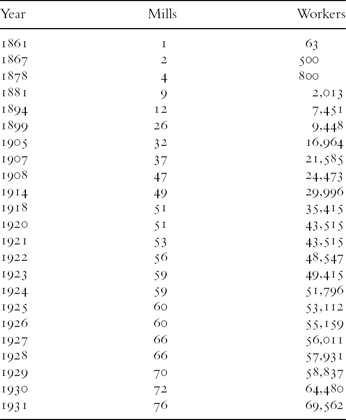
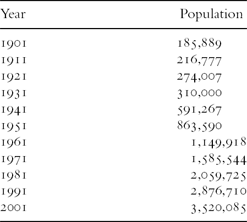
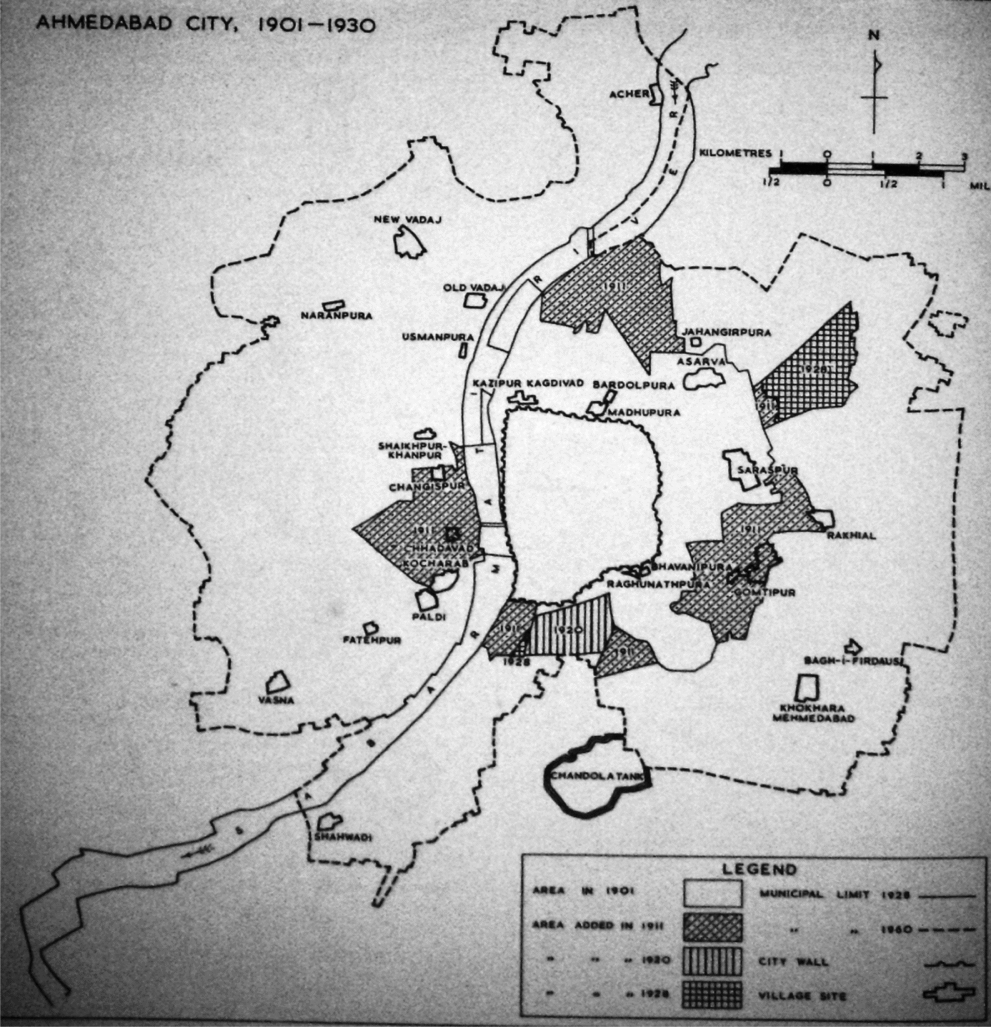
In Ahmedabad, the number of mills almost doubled and the size of the working population increased by more than three times between 1899 and 1914 (see Table 1). In this period, textile industries became the dominant economic sector in the city, attracting capital and a workforce to Ahmedabad, which came to be known as the ‘Manchester of India’.Footnote 10 Other than having a critical impact on the city's economy, industrial growth hastened a process of redefinition of both the geographic and social landscape of Ahmedabad. The rise of new mills in the city and the overall expansion of the industrial sector became part of a dynamic of urban transformation influencing the structure of the city. Industrial neighbourhoods mushroomed. By the beginning of the twentieth century, Ahmedabad was a medium size township of 185,889 inhabitants with the urbanised area almost entirely confined within the city walls – the fifteenth century fortifications that delimited the traditional area of the ‘old city’ (see Map 1). The establishment of additional textile mills drove the expansion beyond the city walls, mainly to the eastern side, in proximity of the railway station.
Ahmedabad Mills and Mill Workers 1861 – 1931

Source Jan Breman, Working Class, pp.14 and 62.
Most industries were established on open lands surrounding the city, as were the shacks of thousands of migrants workers. Most of these newcomers settled in makeshift slums in the fields surrounding the factories, so in the span of a few years entire areas of former rural lands had become semi-urbanised settlements. Significantly, being totally unregulated and unplanned, these new areas were devoid of any kind of infrastructure or basic amenities. Over-crowdedness, pollution and an overall state of degradation was the normal in these areas during the early days of industrialisation.
This dynamic affected deep modifications in the social fabric of the city. Considering that from 1905 to 1931 the number of mill workers grew from one tenth to one fourth of the total population, and that the vast majority of these workers were migrants, it demonstrates how the expansion of textile mills had a disruptive impact on the on the social balance of Ahmedabad Table 2. Migration, demographic growth, social stratification and spatial segregation represented three faces of the same process of urban change.
Population of Ahmedabad Municipal Corporation 1901-2001

Source: Census of India 2001 Ahmedabad District Handbook
The majority of migrants came from the countryside and had no experience of life in an urbanised environment. From a certain point of view, migrant labourers were not – and were not perceived as – ‘citizens’ in the full sense of the term. Migrants were mostly from the countryside, separated from their roots, living and working in a difficult, and at times hostile, environment. They tended to organise their living space in a non-urban way, which resembled a rural village rather than an urban neighbourhood. As a consequence, urban elites and administrators started labelling migrant labourers, and the urban poor, with multiple stereotypes of non-urban existence, such as keepers of cattle in the houses, or as being neglectful of personal hygiene. From this point of view, the process of industrialisation, and the demographic growth that accompanied it, created a contradicting dynamic of change from both a cultural and social perspective. Whilst migration contributed towards creating a population of new urban dwellers and industrial labourers, as soon as they entered the city, the newcomers found themselves marginalised. At the same time, urban elites, who profited from the fast expansion of the industrial sector, looked upon the mill workers with suspicion. Migrants were, on all counts, strangers.
Living in slums and chawls, or working in a textile mill became symbols of cultural segregation as well as spatial segregation. So mill workers were subjected to exploitation on two different levels. Inside the mills, migrant-labourers were at the bottom of the production process, working without regulation or any kind of security.Footnote 11 Outside the mills, migrants were amassed around the industrial estates, living in village-like, filthy quarters. In 1931, the Royal Commission on Labour in India visited the working class neighbourhoods of Ahmedabad. Their report provides us with a vivid description of the labourers’ neighbourhoods –the chawls – at the time:
The areas occupied by the working classes in Ahmedabad present pictures of terrible squalor. Nearly 92% of the houses are one-roomed; they are badly built, insanitary, ill-ventilated and over-crowded, while water supplies are altogether inadequate and latrine accommodation is almost entire [sic] wanting. Resulting evils are physical deterioration, high infant mortality and a high general death-rate. Thirty five of the textile mills have provided chawls for about 16% of their employees but in only one or two cases is the accommodation of a reasonable standard, and sanitary arrangements are frequently inadequate.Footnote 12
Still at the beginning of the 1930s, notwithstanding the active presence of the workers union and the many social initiatives conducted in the city under the auspices of Mohandas Karamchand Gandhi and Anasuya Sarabhai in the industrial areas to the East of the walled city, the living conditions of migrants-labourers were such that there was little to see of an organised, urban settlement.
The rise of new industries and mushrooming chawls also represented an important challenge on the political level. In particular from the early 1920s, urban authorities recognised the scope of the economic and social transformation enacted by industrialisation, and sought to enclose these dynamics in the overall policies of urban planning. In this sense, the rise of industrial areas in Ahmedabad must be read along with the development of other areas, mainly residential neighbourhoods meant for the middle and upper-middle classes. From the 1920s onwards, the Ahmedabad Municipality realised new Town Planning Schemes on the northern and western sides of the old city. In this way, it responded to the challenges of industrialisation by reorganising zoning within the city. So, while areas on the East were gradually becoming industrial districts, the Planning Schemes sought to foster expansion of new, well serviced, neighbourhoods on the western side of the River Sabarmati.Footnote 13
This picture highlights a contrasting image of the city, where both the rich and the poor were gradually moving to live in suburbs. If, at a spatial level, a centrifugal force was driving the expansion of the city, at a social and cultural level, the development of the textile industrial sector, the formation of a network of social activists and the parallel rise of a local political elite during the 1920s redefined terms of mutual recognition between different groups in the city.
This is the context in which a group of social workers, inspired by Gandhi, Anasuya Sarabhai and Shankerlal Banker, and the local political administration, headed by Vallabhbhai Patel, tried to respond to such dynamics and to manage urban change both in its spatial and social dimension.Footnote 14
Urban development as the battleground for political contestation

In his 1968 history of Ahmedabad, Kenneth Gillion described the first construction phase of the city's infrastructures and the improvement of the sanitation system.Footnote 15 Across the nineteenth century, a process started in the city, where “the political, social, and economic changes [. . .] were making for a different kind of urban environment”.Footnote 16 Altogether, Gillion describes a city that is gradually moving from a traditional type of urban organisation into a “modern” one, and shows how these dynamics took place mainly in connection with an increasing involvement of local elites in the political administration of the city.Footnote 17
In continuity with these dynamics, Ahmedabad entered a further phase of change in the early decades of the twentieth century, when the development of a mechanised industrial sector brought masses of workers to settle down in the outskirts of the city, and when the struggle for Independence contributed towards further involving urban economic elites in the city politics.
In fact, the management of urban growth increasingly emerged as the battleground of the fight between local leaders and colonial authorities. The Indian National Congress considered the control of local administrations all over India as part of the strategy to challenge the colonial government, and local elites of Ahmedabad confronted the colonial administration on matters regarding “the restructuring that the government was carrying out in the city”, so that they could appropriate “it to bring about their own reorganization of the urban centre”.Footnote 18
The arrival of Mohandas Karamchand Gandhi in the city, and his engagement in urban politics and society along with Vallabhbhai Patel, must be understood in this context of fast transformation and changing balances. For both of them, the years in Ahmedabad represented a fruitful opportunity to experiment, on a local level, with those practices of social mobilisation and political contestation that they would then apply on a larger scale in the struggle for independence. Gandhi and Patel took active part in the public life of the city, and in different ways both of them addressed the issues that industrialisation and migration were raising. Soon after coming back to India from South Africa, Gandhi decided to establish his ashram in Ahmedabad. He lived in the city from 1915 until the end of the Salt March in 1930, and this period represented a key phase in the elaboration of his political strategies, as well as in the formation of his ideas regarding social work and peaceful mass mobilisation. During the time he spent in Ahmedabad, Gandhi became actively engaged in organising the working classes inside and outside the mills. His leadership and his ideas deeply influenced a series of protests that the workers conducted in the early 1920s in order to advance their instances regarding wages, working hours and conditions. Moreover, Gandhian principles of negotiation and arbitration, to substitute strikes and violent confrontations, underpinned the creation of the first trade union in the city, the Majoor Mahajan (Textile Labour Association, 1920).
Vallabhbhai Patel acted at a political level, engaging with the administration of the city. He entered the Ahmedabad Municipality in 1917, and his first assignment was that of president of the Sanitary Committee, a key position in the Municipality and also in relation to the expanding working class neighbourhoods. After his mandate in the Committee, Patel was again elected and became the president of the Ahmedabad Municipality (1924–1928), a position from which he promoted reforms in the government of the city as a means to contrast the colonial power. He began his reformative work by dislodging certain British functionaries from key positions in the administration and substituting them with Indian functionaries.Footnote 19 In this way, Patel progressively secured more control for the Indian elected members over the Municipal machinery; at the same time he gathered a group of young activists under his leadership and in the name of the opposition to the colonial administrators.
Although acting in different fields, both Gandhi and Patel showed a similar understanding of the dynamics that were transforming the urban landscape. In 1927 Sardar Patel, addressing the conference on Local Self-Government in Surat as president of the Ahmedabad Municipality, commented:
Our cities are neither cities, nor villages. Though living in cities, many of our urban people behave as they would amidst rural conditions. Half the buildings have no latrines, and there is no place even to throw the garbage from the houses. Although they live in houses in narrow streets and in thickly populated areas, they do not hesitate to keep cattle. [. . .] Ordinarily, people are very lax in observing even the most ordinary rules of health and cleanliness, and indeed in such matters they neither appreciate what their duty is to themselves nor their duty to their neighbours. They do not consider it wrong to throw the rubbish from their own houses in front of the doorsteps of their neighbours. They do not hesitate to throw from the windows of upper storeys of their houses dirt and other rubbish or dirty water.Footnote 20
Such a statement shows how the masses of poor and migrant workers were perceived by the established sectors of the society. As Patel clearly pointed out, the living conditions of migrants within the city were not only a matter of poor services and infrastructures, but were determined by their behaviour. Hence, the way poor citizens conducted their lives was the primary cause for the unsanitary conditions in the working class neighbourhoods. Moreover, Patel's words represent an important first step to marking the strong relationship between migration, urban poverty, and a discourse on citizenship. The issue of including the newcomers in the urban social fabric was not only a matter of political and civic rights. Mill workers and migrants were generally marked as rural people, and that became the symbol of their marginalisation. According to this perspective, the first concern was that a large portion of the urban population did not conform to a given model of urbanity.
Although the city was structurally unprepared to bear the consequences of the fast demographic increment, through Patel's words the matter appears to be closer related to the migrants’ behaviour and to involve the use that these people were making of private and public spaces. In the prosecution of Patel's speech, such a view emerges more clearly: “people spit where they like, they ease themselves where they like, and generally consider themselves free to cause nuisance, irrespective of time and place”.Footnote 21 In this rebuke, the importance lies more on people's habits than on the lack of infrastructure and civic amenities. Rural migrants were not fully recognised as citizens, and the difficulties caused by the expanding city were largely ascribed to the newcomers’ incapacity to live in the urban space and to their tendency to organise the space in a rural manner.
While the progressive consolidation of a municipal administration and of local political elites fostered a structural reorganisation of urban space, industrialisation and migrations challenged the traditional structure of urban society. The way newcomers were either integrated, or segregated, within the urban space represented an answer to the process that was transforming Ahmedabad. Hence, discussing integration in early twentieth century Ahmedabad implies looking at the process through which migrants became, or were made to become, ‘citizens’.
From this perspective, industrialisation in Ahmedabad can be understood also as a dynamic that led to the urbanisation of thousands of people and of the space around them. The history of the working class and industrial relations in Ahmedabad has been investigated by many authors, who have thoroughly illustrated the process of assimilation of labourers in the new industrial realities, and their struggle to secure better conditions inside the mills.Footnote 22 However, the rise of a working class in Ahmedabad must be understood not only in the relationship between the workers and the factories, but also as a critical element in the transformation of the whole urban landscape. In order to outline the role that these dynamics had on the redefinition of conceptions and practices of citizenship, the focus must shift from the relations between industries and workers to those between workers and the city, and to the process through which they were progressively assimilated in the urban environment.
Trade unionism as a form of civic education
In this context, the emergence of trade unionism in Ahmedabad took the shape of a wider programme to discipline the masses of migrants living in the city. From the early 1910s onwards, a group of local activists, including people such as Anasuya Sarabhai and Shankarlal Banker started activities of social reform among the working classes. Since the beginning, their most urgent concern was that of supporting the workers outside the working place. The first project that Anasuyabehn started, in 1916, was a night school for the workers’ children, at the same time, she worked in close contact with women in the working class areas. Starting from her base of social work, Anasuyabehn established a strong relationship with the labourers and their families. And, soon, labourers began to relate to her also for matters regarding working conditions.Footnote 23
In 1916 Anasuyabehn came in touch with Shankarlal Banker and together they decided to extend their commitment to the workers beyond the field of education. In order to reach the workers and to organise activities with and for them, Anasuyabehn and Shankerlal Banker, along with two Ahmedabad-based lawyers, Krishanlal Desai and Kalidas Jhaveri, founded the Majoor Mitra Mandal (Friends of Workers’ Society). Through this society, they started “giving medical facilities to workers, disseminating knowledge of thrift, promoting saving and cooperation amongst workers’ families and removing grievances of workers in connection with pay and related matters”.Footnote 24 According to this perspective, helping the workers meant to organising them in their negotiations with the mill-owners, as well as providing them with guidance and support in their neighbourhoods.
Activists of the Majoor Mitra Mandal started schools for the children, and for the workers themselves, they organised groups to teach workers how to keep houses in hygienic conditions and, in general, tried to improve sanitary conditions in the chawls. In this way, they adopted a model of trade unionism that derived from the idea that social justice started from the improvement of daily living conditions.Footnote 25 That is, a trade union to help workers in the mills was not enough, as living conditions in the labourers’ areas demanded a different kind of attention, covering a wider spectrum. In fact, the kind of attitude that Anasuyabehn and Banker showed towards the workers and their families, approaching the issue from its social dimension, was to be very close to the way Gandhi imagined – and then practised – social service and activism. Since Gandhi devoted himself to the cause of Ahmedabad workers in 1918, trade unionism and social work in the city implicitly became a programme of civic education for the masses.
Since he settled in Ahmedabad, Gandhi established a twofold relationship with the industrial world, on one side being closely associated with the mill owners, who generously funded his activities and supported the Congress, and sharing, on the other, with the strife of the working class. Gandhi became directly involved in the relations between mill owners and mill workers in 1918 when, “at the request of the collector of Ahmedabad, [of] Ambalal Sarabhai on behalf of agents and [of] Ansooyaben on behalf of workers” he agreed to reconcile a dispute between weavers and mill owners.Footnote 26
The controversy, which has been recorded in the city's public memory as the “righteous struggle”, started in February 1918, as mill owners decided to stop giving a bonus on weavers’ wages, which had been previously raised due to a plague epidemic in the city. Weavers of the Ahmedabad mills had opposed the decision, on account of an increase in the cost of living in the post-War years, and, given the inflexible position of the mill owners, resorted to seek Anasuyabehn's help. When Anasuyabehn asked Gandhi to intervene, he reckoned that it was primarily important to investigate the living conditions of workers and their families, in order to understand whether the workers’ request for an increase was fair and which amount they could, as representatives, fairly ask on behalf of the workers. In this regard he instructed Shankerlal Banker and other social workers to gather information about living standards in the chawls. After this primary survey, Gandhi resolved to support the request for a 35 percent increase. The mill owners clung to their refusal to concede no more than a 20 percent increase, and declared a lock-out. The agitation went on peacefully for twenty days. During this time, Gandhi would gather the strikers every evening on the banks of the Sabarmati River and would address them on various issues related to the protest. “He urged them not to give up their righteous struggle, to clean their homes and, now that they had time on their hands, to increase their knowledge by reading, [. . .] and to ask neither more nor less than they deserved, i.e. to demand a just wage”.Footnote 27
For three weeks the situation remained static, with neither part moving an inch towards the other's position. Even though exhausted by hunger and lack of work, the strikers conducted their protest in peace and showed a considerable moral strength, giving themselves faithfully to the hands of Gandhi, Anasuyabehn and Banker. Change came on the 14 March: some workers in a chawl, being asked to attend the morning meeting at Gandhi's ashram, protested that, while they were suffering “death-agonies” and were close to starvation, Gandhi and Anasuyabehn were moving around in Ambalal Sarabhai's car and were eating “sumptuous food”.Footnote 28 This episode caused great distress to Gandhi, who took it as a lesson for himself and decided to fast until the 35 percent increase would be conceded. As well as pressurising the mill owners, Gandhi explained his decision as a way of demonstrating to the workers the importance of respecting their own vows. In the moment when the morale of thousands of hungry workers was weak, and many of them were near to giving up and going back to their jobs, Gandhi wanted to give them new strength, and at the same time to demonstrate that the accusations made to himself and Anasuyabehn were unjustified. “We are not out to have fun at your cost or to act a play”. For Gandhi fasting was an extreme act to prove his loyalty to the labourers. In his words: “How can I prove to you that we are prepared to carry out whatever we tell you? I am not God that I can demonstrate this to you in some way [other than by fasting]”.Footnote 29 The extreme gesture of fasting, even though officially not aimed at convincing the mill owners, had the effect of granting the wage increase to the weavers, as “the employers [. . .] had little choice other than to surrender to this form of pressure with a religious tint”. Footnote 30
The ‘righteous struggle’ has been taken as an example to show how Gandhi set the foundations of an innovative trade unionism.Footnote 31 The idea of negotiation between the parts substituted that of the confrontation, and arbitration, rather than the strike, became the means for workers to thrust their grievances forward. However, the ‘righteous struggle’, apart from being the first example of this type of industrial relations, reveals the perspective from which the Mahatma engaged with workers in the city. For Gandhi, the issue was not only limited to the conditions of the workers within the mills and their relations with the employers. It was also, and even more so, a matter regarding how workers managed their lives. Helping them to obtain their wage increase was not just a struggle for money, as in Gandhi's view the situation of extreme degradation and poverty, in which workers lived, was not dependent only on their economic condition. Gandhi conducted the whole struggle as a way of dignifying the workers and increasing their self-respect.
The daily speeches that Gandhi made to the workers addressed issues of poverty and called for the need to improve working conditions from an ethical perspective. This was so that the workers would be called to adjust their behaviour to a morality without which any wage increase would have been useless. In this way, the themes of the protest merged with a rhetoric about living a moral life and behaving as urban rather than rural people:
It is just about a fortnight since the lock-out commenced, and yet some say that they have no food, others that they cannot even pay rent. The houses of most of the workers are found to be in a very unsatisfactory condition. They are without proper ventilation. The structures are very old. The surroundings are filthy. The clothes of the workers are dirty. Some wear such clothes because they cannot afford to pay the washerman, others say that they cannot afford soap. The workers’ children just play about in the streets. They go without schooling. Some of the workers even set their tender children to work for money. Such extreme poverty is a painful thing indeed. But a 35 per cent increase will not by itself cure it. Even if wages were to be doubled, in all likelihood the abject poverty would remain unless other measures were also adopted. There are many causes for this poverty.Footnote 32
This passage illustrates how Gandhi understood the workers’ struggle: trade unionism should have encompassed a whole system of practical and moral regulations to teach workers out of their poverty. The “many causes” of poverty included practical habits, such as drinking, gambling and creating debts, but also involved the sphere of ethics and moral behaviour.Footnote 33 Moreover, material poverty descended directly from the moral poverty, thus the latter should have been the first concern for trade unionists and social workers. The educational angle in Gandhi's perspective emerged clearly as he stressed people's need to practise self-discipline and restraint, which were seen as two preliminary conditions in order to start social actions on matters such as hygiene, household cleanliness, children's education and the role of women.
This combination of militant trade unionism and social work was the main outcome of the encounter between Anasuya Sarabhai and Gandhi, and it became the core of values of the Majoor Mahajan, founded in February 1920. In a speech to celebrate the second anniversary of the ‘righteous struggle’, Gandhi reaffirmed the principle that a labour union was not only about the workers’ wages and economic conditions:
Anasuyabai has not dedicated her life to you merely for the purpose of securing for you better wages. Her object in doing so is that you may get enough to make you happy, to make you truly religious, that you may observe the eternal laws of ethics, that you may give up bad habits such as drink, gambling, etc., that you may make good use of your earnings, that you may keep your houses clean and that you may educate your children.Footnote 34
In his work on the industrial working class in Ahmedabad, Jan Breman talks about “taming the workforce”, while referring to the policies of the Textile Labour Association in dealing with the workers. The strategy of the labour union was mainly oriented towards “improving the quality of life in the residential areas”, and therefore trade unionists and social activists focused their attention on the conditions of dire poverty in which the workers were living.Footnote 35 This approach reflected the moral vision that Gandhi had of workers’ poverty and the consequent need of providing guidance to the workers not only in matters relating to their jobs, but in all aspects of life. Within the dynamics of change in the city in the 1920s and 1930s, such a model of social activism had the effect of improving, to a certain degree, the living conditions in the chawls but, at the same time, it fostered a strong hierarchical relation between labourers and the trade union. In the long run, such a hierarchy contributed to keeping the workers in a marginalised position, both within the trade union and the city. Labourers were asked to completely trust their representatives and to follow their directives without question. Gandhi's constant stress on discipline reflected his conception of a rigid social order, in which both workers and mill owners had a clearly defined position.
Both Gandhi and Vallabhbhai Patel believed that the duty to provide housing for the labourers rested on the mill owners, according to a concept of social responsibility that called the “wealthy and the educated” to bear responsibility for the well-being of all.
How wonderful it would be if all the mill-owners of Ahmedabad consider themselves the insurers for anything that may happen in Gujarat and they would donate generously for any worthy cause or institution? From where would they give that money? If they decide to do so out of their earnings, we will never be in difficulty. [. . .] I do not want to run them down. They do give but I want to squeeze more out of them. [. . .] Why can't its [Ahmedabad’s] purse strings be loosened for the deserving? God will replenish the amount. That is what I wish to tell the mill owners and the rich.Footnote 36
Such a conception, where the rich and the upper class were called upon to take responsibility over the whole urban population, referred to an organic image of the society in which duties and rights were well distributed among all the parts of the social body. The relationship between employers and employees, in Gandhi's wishes, should have resembled that between father and son, as well as that between a Government and its citizens. And, as a father, Gandhi addressed the workers when they gathered to listen to him.Footnote 37
In this way, the Mahatma created a chain of interdependence among different sectors of society. As Gandhi himself suggested in many of his speeches, social workers should have inoculated a sense of social responsibility in all groups and classes, so that each of them would have understood its role and act accordingly towards the others. From his moral position Gandhi could address the mill-owners and remind them about their responsibilities: “what I expect of you [. . .] is that you should hold all your riches as a trust to be used solely in the interests of those who sweat for you, and to whose industry and labour you owe all your position and prosperity”.
The same tones and words were used to address the workers. The language of expectations became a code to call upon all workers to take up their responsibilities towards the community, in a way by which moral behaviour and life practices both became means to achieve personal dignity and self-respect, and to contribute to the betterment of the whole citizenry. Workers were “expected” not to take liquor, not to commit theft or gambling – in short, to give up all addictions – and, at the same time, to educate their children and themselves, to keep their houses and streets clean, because only through observing these rules could they improve their self-respect and be dignified before the rest of the society.Footnote 38
Gandhi's direct involvement in the workers’ lot extended from 1918 to the early 1930s (his last speech to the ‘mill-hands’ was in 1936). Issues regarding moral responsibility and civic education emerged whenever he spoke to both workers and mill owners, and remained pillars of his moral conception of society during all his life as national leader. In this way, the intent to educate workers and their families was elaborated according to a whole model of social organisation. The ‘righteous struggle’ represented only the beginning of such a path, as in fact, after reaching a deal with the mill owners and setting the arbitration, Gandhi himself told the workers:
If you permit us, we should like to help some of you to overcome your bad habits. We want to provide facilities for your and your children's education. We want to see all-round improvement in you, in your morals, in your and your children's health, and in your economic condition. If you permit us, we will work amongst you towards this end.Footnote 39
As a union leader, Gandhi always pointed out that organising the workers did not mean to aim at gaining control of the industries. Workers should understand their position and accept it. Through this acceptance, they would have gained respect for their hand work. Workers’ integration in the social milieu of Ahmedabad was, in a way, subjected to the acceptance of their position in the social ladder and of the space given to them as ‘citizens’.
Gandhian trade unionism and social service have to be placed in the background of rural migration and fast urbanisation, as a contribution in the effort to urbanise the migrants, including them in the socio-cultural frame of a modern industrial city and giving them a specific place within this order. From this point of view, educating migrant labourers meant to adjust their habits and their organisation of the space according to a given model of ‘urbanity’ – borrowed from western industrial cities. For the urban elites, migrants, who would organise their living space as a rural village –which was the only way they knew – appeared out of place, something which did not conform to a ‘modern’ urban centre. Thus, issues of dignity, self-respect and sanitary conditions of the newcomers, underpinned a dialectic confrontation between rural and urban ways of life, where ‘urban citizens’ living in ‘rural conditions’ were out of place.
Citizenship as praxis
The concept of citizenship has been generally defined in terms of rights. For instance, in a widely accepted notion, British sociologist Thomas Humphrey Marshall placed the accent on people's accessibility to civil, political and social rights as a precondition for a full attainment to the citizenship status.Footnote 40 Citizenship was seen as a principle of equality, in opposition to social classes, which were considered as a “system of inequality”.Footnote 41 According to this perspective, arguably not all urban residents can be considered as citizens, as in the case of slum dwellers in many contemporary Indian metropolises.Footnote 42 In fact, life in a slum often implies the denial of legal rights to their places of residence, of the right to a free participation in the exercise of political power, and of the right to a modicum economic welfare and security, three elements that determine limits of citizenship.Footnote 43 Such a definition proves useful in understanding the impact that migration and the emergence of large and unregulated working class areas had on the political and social life of Ahmedabad.
However, in Gandhi's speeches and in his activities with the mill workers, the issue of citizenship appears to be wider than a matter of access to social, political and civic rights. As it has been noted, a first important element that distinguishes Gandhi's approach to citizenship is his stress on the dimension of ‘duties’, before the claim for ‘rights’.Footnote 44 The righteous struggle shows how Gandhi went beyond an understanding of citizenship within the dichotomy right/duty, and he dealt with the issue as a matter of integration and assimilation within a just, and moral social order.
In fact, on the part of the mill workers, the righteous struggle was primarily an endeavour to access ‘social rights’, but the way Gandhi approached the protest showed that he had broader concerns. Securing a higher wage for the workers was part of a programme to reform the living conditions and the habits of migrant-labourers. While referring to “all-round improvements”, Gandhi encompassed a whole sphere of ethic and practical behaviours that would have dignified the workers, even more than an economic improvement. Conforming to such an implicit code of conduct was the real precondition for the workers in order to become citizens, as it delimited the boundary between rural and urban lifestyles. In this sense, citizenship not only pertained to a discourse on rights, or duties, but it referred directly to the complexity of the interconnected relations that regulate life in a collective dimension.
Hence, citizenship not only defines a set of rights and duties, but refers directly to the relation between the individual and the community. In this sense, ‘citizen’ can be considered as a political word with a threefold dimension. First, it acknowledges “a territorial unit organised for a life in common – a political community”. Second, it encloses “the rights and obligations of members of this polity”. Third, it involves the right of members of the community to be “sovereign” of their community, and thus “the right of citizens to claim new rights for themselves”. Such a definition highlights an important aspect within the idea of citizenship, the need to understand it as a “concept in the public sphere”. There are full citizens only in relation to a community, as participants in a set of implicit and explicit rules that regulate life in common. From this perspective, citizenship is inextricably related to another important “concept in the public sphere”, which is the idea of civil society. Following Friedmann and Douglass, civil society is “the society of households, family networks, civic and religious organisations, and communities that are bound to each other primarily by shared histories, collective memories and cultural norms of reciprocity”.Footnote 45
In this light, Gandhi's activity with the workers of Ahmedabad acquires a greater significance. The massive flows of migrants from the countryside and from other regions impressed a deep transformation in the social and spatial structure of the city. As they arrived from different places, and mainly from non-urban environments, the newcomers did not share “histories, collective memories, and cultural norms of reciprocity” with the rest of the urban population. Migrants were not citizens, they lived in Ahmedabad but they were not part of the urban civil society. For this reason, the urban elites and the city authorities perceived migrant-labourers as aliens within both the urban territory and the society. Hence, social work and trade unionism implied the basic effort to discipline the newcomers in order to make them part of the civil society of Ahmedabad.
In several occasions, while referring to this issue Gandhi used the expression “citizen service”.Footnote 46 This idea accurately summarises the dual implication of his engagement with the working class of Ahmedabad. As to become – and to be considered as – full citizens, migrants had to adopt behaviours and habits that would conform to urban life and, at the same time, they had to participate directly in social life and contribute to it. The access to civic, political and social rights would have come as a consequence of the acceptance of and the conformation to an urbanised lifestyle. In this sense, citizenship was primarily a praxis, an accepted practice or custom, that needed to be reaffirmed in the every-day life of every member of society. Only by learning how to live as urban people, organising their space according to urban standards, could the migrants be part of the civil society and, thus, become citizens of Ahmedabad.