Hindostan is an Italy of Asiatic dimensions, the Himalayas for the Alps, the Plains of Bengal for the Plains of Lombardy, the Deccan for the Apennines, and the Isle of Ceylon for the Island of Sicily.
———Karl Marx
If we want everything to remain as it is, everything must change.
———Giuseppe Tomasi di Lampedusa
Revolutions and Conservative Modernization
Since Barrington Moore (Reference Moore1993: 438) famously wrote, “the notion that a violent popular revolution is somehow necessary in order to sweep away ‘feudal’ obstacles to industrialization is pure nonsense,” conservative modernization has been the object of considerable attention (McDaniel Reference McDaniel1991: 5; Trimberger Reference Trimberger1978: 3). Revolution from above (Trimberger Reference Trimberger1978: 3), and autocratic modernization (McDaniel Reference McDaniel1991: 5), in particular, are now widely viewed as alternative paths to “modern” (nationally integrated and industrialized) societies. While scholars emphasize important differences among these routes, they share two main features. First, these forms of modernization leave intact much of the pre-existing class and state structure. Second, the main agent of transformation in these cases is usually considered to be the central state.
This paper conceptualizes and explains a specific form of conservative modernization which we term “passive revolution,” in which a mass political party rather than the state promotes economic development and national integration while leaving the pre-existing social and political order largely undisturbed (Gramsci Reference Gramsci1971: 106–20). We explain the general conditions for this path to the modern world and distinguish between two forms of it: violent passive revolutions exemplified by Italian fascism (1919–1938), and non-violent passive revolutions exemplified by Indian nationalism (1919–1947). We conclude by placing passive revolution in the context of other conservative modernization process, and briefly discuss the possible consequences of this route to modern society.
Passive Revolutions
Political theorists (Chatterjee Reference Chatterjee1986: 48–49), historians (Adamson Reference Adamson1980; Davis et al. Reference Davis1979; Roosa Reference Roosa2001; Sarkar Reference Sarkar1983a), scholars of international relations and of development (Abrahamsen Reference Abrahamsen1997; Morton Reference Morton2003; Soederberg Reference Soederberg2001) have all used the term passive revolution. However it remains marginal to the lexicon of political sociology, in part because it has been poorly defined. In this section of the essay we conceptualize passive revolution as a distinctive “route to the modern world” (Moore Reference Moore1993: 413–14).
Passive Revolution Defined
Antonio Gramsci draws the concept of passive revolution from the Neapolitan political writer Vincenzo Cuoco (Reference Cuoco1998: 326, 251), who uses the term to describe how younger members of the southern Italian aristocracy adopted French revolutionary ideas in the eighteenth century. Gramsci extends the concept by suggesting that revolutionary ideas and forms of organization can be pressed into the service of reactionary politics. He defines passive revolutions as “restoration-revolutions” (1971: 118). The alliance between the “moderates” (made up of mostly landed aristocrats) around Cavour and Mazzini's radical democrats during the Italian Risorgimento and Italian fascism both exemplify this process (Adamson Reference Adamson1980: 630; De Felice Reference De Felice1977: 198; Gramsci Reference Gramsci1971: 108–9).
Distinctively in passive revolutions, a revolutionary model of political organization and revolutionary political techniques are pressed into the service of a conservative modernization project (De Felice Reference De Felice1977: 198–99; Gramsci Reference Gramsci1971: 118, 120). Specific to passive revolutions is the paradoxical combination of conservative aims and revolutionary means.
Passive revolutions resemble social revolutions in the types of organizational actors that carry them out, but are similar to revolutions ‘from above’ and autocratic modernization in their consequences. As in social revolutions, political organizations rather than bureaucrats and notables are the main actors. Yet, like revolutions from above and autocratic modernization, passive revolutions leave intact, and may even strengthen, the social and political power of pre-existing dominant classes. Thus they do not issue in “rapid, basic transformations of a society's state and class structures” (Skocpol Reference Skocpol1979: 4). Distinctively passive revolutions are instances of the use of revolutionary means of organization, rather than bureaucratic power, to achieve conservative modernization.
Passive Revolution Explained
How should passive revolutions be explained? Many of the conditions that explain them are common to conservative modernization in general. Most important among these is the absence of a “bourgeois revolution,” defined as the violent elimination of the landed elite accompanied by land redistribution. But within this general type of path passive revolutions occur under two further conditions. The first is the weakening of the agrarian old regime by an external power. This condition is important because it blocks the development of an alliance between agrarian and industrial elites and the state typical of revolutions from above and autocratic modernization. The second condition is the emergence of mass mobilization among the working class and the peasantry, which convinces an important sector of the agrarians and industrialists of the need for a new political order. Passive revolutions are thus intimately, if rather paradoxically, connected to mass mobilization or at least to the perceived threat of mass mobilization.
These, we argue, are the general conditions of passive revolutions. But passive revolutions take different forms depending on the political instruments available for dealing with working class and peasant insurgency. Where formal national unification is achieved prior to mass mobilization, the agrarian-industrial elite has difficulty forming a nationalist alliance with the mobilized peasantry.Footnote 1 Thus in these cases agrarians and industrialists face a double threat: mobilized peasants and workers. Alienated from the state, and unable to form a modernizing coalition that includes the peasants, the social elite pursue a violent passive revolution. We argue that Italian fascism typifies this path.
In conditions of true colonialism the elite has different options. Mobilization for national self-determination becomes a powerful ideological tool to incorporate broad sectors of the peasantry. Further, the colonial regime may repress mobilization among the working class at no political cost to agrarians and industrialists. A more inclusive non-violent passive revolution then becomes possible. Indian nationalism typifies this path.
Two Types of Passive Revolution: Italy and India
Our analysis establishes two key similarities that explain the emergence of a passive revolutionary agent. First, in both Italy and India external powers destroyed the agrarian old regime through military and diplomatic means. This condition, as we argue, cut off the possibility of a conservative modernizing alliance with the bureaucracy, and forced agrarians and industrialists back on their own organizational resources. Second, both Italy and India underwent a period of rapid peasant and working class mobilization that was a major stimulus toward an alternative modernization project. In Italy this occurred in a concentrated period during the two years following World War I, while in India it was a more protracted process during the thirties. In both cases, however, popular insurgency was a stimulus to elite self-organization and was a key condition for passive revolution.
We then contrast the two cases on the factor of the timing of national unification relative to the mobilization of the working class and the peasantry showing that in Italy formal national unification preceded working class and peasant insurgency by over fifty years. In India the coincidence of mobilization from below and mobilization against the colonial state allowed the social elite to ally with a large sector of the middle peasantry. The alliance was held together with the technique of non-violence. In Italy, in contrast, agrarians and industrialists were much more politically isolated. Not only were they unable to ally with the urban working class, they were also unable to form a significant base of support among the peasantry. The passive revolution in this case took the form of a violent reaction against mobilization from below.
Italy's Road to Passive Revolution
We divide the analysis of the Italian path into three sections. In the first we discuss the process of nation-state formation. Our key argument here is that the unified Italian state politically eliminated the old regimes while leaving their social bases intact. The consequence was a quasi-colonial relationship with the underlying society. The second section analyzes the post-World War I crisis that led to the rise of fascism, and argues that both the peasantry and the working class mobilized on a national scale for the first time during the two years from 1919 to 1920. Fascism was a response to a failed revolutionary breakthrough under these conditions. The third section discusses the achievements of the passive revolution in Italy.
Unification and Trasformismo
Italy failed to produce a national state of its own until the mid-nineteenth century. Prior to this the country remained divided among different political regimes. After the defeat of Napoleon in 1815 seven main states existed. Piedmont in the Northwest corner of the peninsula was an autonomous principality ruled by the Savoyard monarchy. To the East Lombardy-Venetia was an Austrian province. Tuscany and Modena were Austrian archduchies and Parma was given to Napoleon's second wife Marie-Louise. The church directly ruled the Papal States in the center of the country (Lazio, Umbria, the Marches, and Romagna). South of Rome the largest political unit on the peninsula was the Kingdom of the Two Sicilies that united Sicily with most of the southern peninsula (Holt Reference Holt1970: 38–42). The native population controlled none of these political units except for Piedmont. Broadly speaking, Austrians controlled the north and the Spanish Bourbons the south. Nineteenth-century Italy then was a geographical zone in which political divisions followed dynastic lines.
The presence of multiple foreign powers on Italian soil meant that diplomatic and military factors shaped unification. The process began from Piedmont, a small but autonomous kingdom that originally stretched from northern Italy to southern France. Given its small size, the Piedmontese could unify the peninsula only by maintaining adequate relations with the French, and discouraging Austrian intervention. These two diplomatic priorities were incompatible with radical social transformation. The conflict between them became clear with the Italian nationalist Giuseppe Garibaldi's expedition to the south in 1860. Garibaldi threatened both to arouse the rural masses, and to unseat the papacy, outcomes unacceptable both to the French and the Austrians. In part to avoid foreign intervention, the main conservative architect of unification, Count Camillo Benso di Cavour, acted to check this project by marching Piedmontese troops to the northern border of the Kingdom of the Two Sicilies, thereby blocking Garibaldi's advance to the North. Southern Italy was subsequently attached to the Italian kingdom through a plebiscite. A bloody civil war (1861–1865) fought against an alliance of ex-Bourbon retainers and the southern peasantry followed formal political unification (Seton-Watson Reference Seton-Watson1967: 26). A military and diplomatic process in which one small state rapidly extended its institutions to the peninsula as a whole substituted for either popular or elite mobilization from below (Banti Reference Banti1996: 52–53; Ragionieri Reference Ragionieri1972: 44–53, 70; Seton-Watson Reference Seton-Watson1967: 49). As a consequence a large sector of the population especially in the south experienced unification as occupation.
After unification local control shifted to a group of powerful and unaccountable royally appointed prefects who were mostly Piedmontese (Ragionieri Reference Ragionieri1972: 26–27). Alongside this despotic local regime, parliament functioned as a deal-making forum for elite interests. No political parties existed to aggregate these at a national level, and only a narrow stratum could vote until 1912 when suffrage increased from about 7 percent of the population to about 20 percent (Farneti Reference Farneti1971: 228). The post-unification state, like colonial regimes, based its rule on repression and elite cooptation.
The main technique of cooptation was called trasformismo, in which great parliamentary leaders formed governments in parliament by striking agreements with various electoral cliques. Giovanni Giolitti, its most notorious practitioner, ruled indiscriminately with the support of the left or right, but lacked his own party organization (Carocci Reference Carocci1971). This system of control worked well through the nineteenth and early twentieth centuries. It was capable of effectively managing the competing regional interests and conflicts between agricultural and industry (Banti Reference Banti1996: 168), and was relatively successful at incorporating politically some of the more privileged sectors of the northern industrial working class (Carocci Reference Carocci1971: 84–85; De Cecco and Pedone Reference De Cecco, Pedone and Raffaele1995: 260; Roberts Reference Roberts1979: 50–51).
Despite its fragile political foundations, the post-unification state presided over rather successful economic development from 1895–1913 (Federico Reference Federico1996: 765, 768, 774; Zamagni Reference Zamagni1993: 93–95, 121, 147). This benefited many agrarian and urban workers. Zamagni (Reference Zamagni1984: 198) shows a 44 percent increase in industrial workers' wages over the years 1898 to 1913, and rapidly rising incomes from 1913 to 1919 among agricultural day laborers (braccianti) (Zamagni Reference Zamagni1979–1980: 22). The last decade-and-a-half of liberal Italy was, then, a period of steady social progress and lessening inequality.
Thus unification had mixed results. Although the new state achieved impressive economic growth, especially after the turn of the century, it had little structured support among the population. The social elite lacked peninsula-wide political organizations. As both the domestic and international environments became more threatening in the period after 1911, the relations between liberal representatives and those whom they represented (primarily the agrarian and industrial elite) grew strained. As became clear with the rise of fascism, they would carry out a modernization project against the state.
The Post-War Period and the Rise of Fascism
The political crisis following World War I, called “the red two years,” or biennio rosso (1919–1920), revealed the weakness of the Italian state. In the immediate post-war period the prospects for social peace seemed rather promising since in early 1919 the Confederazione generale del lavoro (CGL) and the Confederazione Generale dell'Industria (Confindustria) reached a wide-ranging agreement covering hours, wages, and rights of representation within the factory (Maione 1970: 827). Yet this accord unraveled in a series of wildcat strikes throughout the summer and fall of that year. The underlying cause was probably steep rises in the cost of living due to wartime price inflation (Cammett Reference Cammett1967: 65).
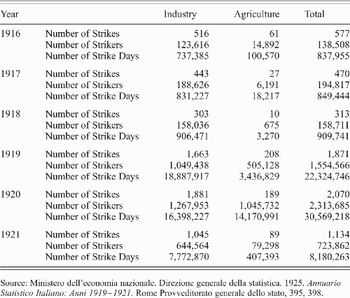
The war had also produced a large population of returning recruits who had difficulty finding employment, and mostly gravitated to the left. The largest veteran's organization, with 550,000 members, was linked to the Catholic democratic popular party (Gentile Reference Gentile1989: 515). Further, the safety valve of immigration had closed off after 1913 when the United States and other countries placed new restrictions on migrants. The Italian Socialist Party (PSI) adopted the establishment of a dictatorship of the proletariat as an immediate goal, and won 32 percent of the vote in the November 1919 elections. In 1919 and 1920 massive strikes broke out among telegraph and railroad workers, metallurgy workers, and automobile manufactures in the city of Turin, and among agricultural laborers in areas of north central Italy (Tasca Reference Tasca1950: 26–27). Table 1 shows the increase in working class and peasant insurgency during this period.
Strikes in War-Time and Post-War Italy

Source: Ministero dell'economia nazionale. Direzione generale della statistica. 1925. Annuario
Statistico Italiano: Anni 1919–1921. Rome Provveditorato generale dello stato, 395, 398.
The table shows a drop in strike activity during the war years and a very sharp rise in the immediate post-war period. From a low of 303 strikes in 1918, the number of strikes in industry spiked in 1919 to 1,663. A similar surge is evident in agriculture where the evidence records only 10 strikes for 1918, but 208 for 1919. This wave of industrial disputes had a strong political charge. In industry, many of the strikes were in part struggles over workers' control. In agriculture they were closely linked to socialism and land seizures. The high point of the red two years occurred in the winter and early spring of 1920 during the occupation of the factories and the general strike of April of that year.
The factory occupations began as a technique of labor protest in response to owners' lockouts. Instead of a conventional walk-out or sit-down strike, workers organized production (Tasca Reference Tasca1950: 117). The occupations were planned in part to demonstrate that the working class could organize production by itself, and that therefore private ownership had become technically superfluous. Further they were often accompanied by the demand that the company in question “be entrusted to the management of the collectivity of workers belonging to the company” (Maione Reference Maione1972: 254). The technique began among workers in the Federazione Impiegati Operai Metallurgici (Fiom) at Genova, Piedmont, and Milan, and some factories in smaller towns in north central Italy (Cammett Reference Cammett1967: 112–13; De Felice Reference De Felice1995a [1965]: 503). Thus, a very threatening form of labor insurgency swept across the most industrially developed zone of Italy in the period immediately following the war.
Large landed proprietors faced an even more serious threat. Proprietors suffered from unfavorable prices (industrial inputs were relatively much more expensive than agricultural outputs), increased taxes, and excess labor costs imposed by socialist leagues often in alliance with socialist dominated municipal governments. The leagues forced owners to both pay workers more, and to hire unemployed braccianti and small holders (Corner Reference Corner1975: 89; Zamagni Reference Zamagni1979–1980: 24). During February and March of 1920 in the countryside around Turin peasants undertook a “systematic invasion of the lands of the large proprietors” (Maione Reference Maione1972: 265), formed a red-guard organization, and set houses on fire. In Tuscany 500,000 sharecroppers went on strike during the summer (Snowden Reference Snowden and Davis1979: 163). Agrarian socialism in Italy promised a thorough alternation of rural class relations, either through the redistribution of land or the establishment of collectively run farms.
Working class, peasant, and day laborer insurgency took place in the context of an increasingly weak state. As the head of Confindustria put the point, “Our political parties are vile in the infamy” (quoted in Maione Reference Maione1972: 279). Giolitti, who had returned to power in 1920, refused to deploy troops against the factory occupations. A natural result of biennio rosso, especially as a consequence of the absence of state action against workers and peasants, was an intensive wave of self-organization both among the industrialists and the agrarians. In the period from 1917 to 1920, locally based elites organized strikebreaking, the provisioning of public services, and policing throughout north and central Italy (Gentile Reference Gentile1989: 70). This was also the period when the major national organizations of industry and agriculture were founded. These were highly sensitive to the threat posed by mass agrarian socialism and the factory occupations. By 1920 they were seeking alternatives. Biennio rosso produced a climate of fear among Italian industrialists and agrarians. Already weakly committed to the Italian liberal state, by 1920 these groups were seeking a new form of political organization.
This political organization emerged, quite paradoxically, as a consequence of processes internal to the Italian far left. By the outbreak of World War I a distinct national revolutionary group had consolidated on the fringes of the socialist party. These men became increasingly critical of socialism, not because it threatened their class interests but because it had repeatedly failed to show itself as a truly revolutionary force (Nello Reference Nello1982: 1014). The formation of this group occurred in two main stages: in the struggle over entry into the war, and in the aftermath of the defeat of the post-war revolutionary wave described above.
Some renegade socialists had begun to embrace nationalism during Italy's invasion of Libya in 1912. In part this was due to the view that the industrial working class had been effectively co-opted by parliamentary trasformismo. Thus the socialists could be presented as part of a parasitic alliance of northern classes against southern Italy that appeared as a semi-colonial dependency (Roberts Reference Roberts1979: 66, 107). But the mainstream of the party remained immune to nationalism up until World War I. The war, however, set off a debate between “interventionists” (those pushing for Italian participation) and “neutralists” (those who argued that Italy had nothing to gain from involving itself in the European conflict) that deeply affected the party's leadership.
Since 1887 Italy had formed part of the triple alliance linking it with Austria and Germany, against France. But Italian neutrality broke this connection and lay the foundations for a new political position on the war. Interventionism now could be linked to support for the democratic powers of France and Britain. Thus Italy's initial neutrality opened a space for “left” or “democratic” interventionism that presented the conflict as a struggle between democratic powers and reactionary empires (Austria and Germany) (Gentile Reference Gentile1982: 126; De Felice Reference De Felice1995a: 223; Milza Reference Milza2000: 184–90). To the extent that the mainstream of the socialist party supported neutrality, the socialists themselves could be presented as supporters of the reactionary side in World War I. This created a crisis of representation within the party as many of its key leaders, and probably a significant portion of its membership, moved to the position of left interventionism.
Mussolini, who had been the key political leader of the socialist far left, was the most dramatic representative of this political migration, but it was much broader. De Felice (Reference De Felice1995a: 283) states that the membership of the socialist party declined from 41,974 persons in 1914 to 29,426 in 1915, suggesting that much of this represented a defection to the position of left interventionism (Gentile Reference Gentile1975: 36; Roberts Reference Roberts1979: 117–19). The crisis of interventionism also touched Italy's most famous Marxist theorist Antonio Gramsci and its most famous post-war Italian Communist politician, Palmiro Togliatti. In the struggles over interventionism both defended Mussolini from the attacks of more conventional socialists such as Angelo Tasca. Gramsci, in particular, argued that an entente victory would be much more favorable for socialists than a victory of the central powers (Agosti Reference Agosti2003: 13). Thus Italian neutrality produced a nationalist left, a position that had not existed to any significant extent before World War I (Gentile Reference Gentile1975: 113).
The main program of the nationalist left was to form a cross-class alliance between organized workers and industrialists to carry out a national democratic revolution. The high tide of this political tendency was the Republic of Fiume: an illegal border state created by the poet Gabriele D'Annunzio where many of the techniques that would be characteristic of fascism were first developed. This political entity, which the nationalist right had initially supported, moved sharply to the left in 1920. Alceste d'Ambris, a radical revolutionary syndicalist, drew up the Fiumean constitution called the Carta del Quarnaro, or “Charter of Carnaro,” which established a form of corporative representation (De Felice Reference De Felice1995a: 553; Gentile Reference Gentile1975: 181; Roberts Reference Roberts1979: 180). There were even schemes to launch a leftist insurrection using Fiume as a basis of operations, and d'Ambris worked hard to established links to the left. Early fascism (the movement was founded in March of 1919) was very much part of this milieu. Thus the biennio rosso in Italy appeared to be a period of growing left-wing nationalist strength. By 1920, however, the leftist tide began to recede. D'Annunzio was driven out of Fiume and the factory occupations ceased. The post-war social revolutionary situation had ceased to exist.
Left nationalism in Italy was a political failure. The elections of November 1919 underlined this fact by delivering a crushing defeat to the nascent fascist movement, and by revealing a generally fragmented left nationalist milieu. In contrast, the socialist party appeared politically strong and disciplined (Gentile Reference Gentile1989: 61). By early 1920 the ex-socialist political entrepreneurs who had attempted to formulate a left nationalist alternative were facing what appeared to be a dead end. During the same period both agrarians and industrialists began to feel “betrayed” by the Italian liberal state, as labor costs rose, workers seized factories, and a pro-Soviet socialist party demonstrated its electoral strength. Evidently, the program of the nationalist left had little hold over either peasants or workers in post-war Italy. This would leave the Italian agrarians and industrialists increasingly politically isolated, with important consequences for the specific form that passive revolution took. As we show in the next section, this was a major difference between the Italian and Indian paths.
Under these conditions it is perhaps unsurprising that elements of the original left nationalist coalition, who had unsuccessfully sought to win the working class to their cause, turned to the self-organizing industrialists and agrarians in their search for a more congenial audience. Since many of these men had experience in parties of the left, this constituted an injection of revolutionary political techniques into reactionary politics.
The interventionist left brought a new style to the politics of bourgeois and agrarian self-organization. The various self-defense organizations that had emerged in the period from 1917 to 1920 were generally defensive. Their main function was to take over the operation of public services during a general strike (Gentile Reference Gentile1989: 76). This began to change with the emergence of fascist squads from the winter of 1920. These organizations were offensive rather than defensive formations. Their basic activity was the “punitive expedition,” trips in which a group of men from the city would drive into the countryside or small rural town on trucks and destroy the local socialist organizations (ibid.: 159; Tasca Reference Tasca1950: 165–67). Most scholars have identified two overlapping sources of this political technique: the futurists, and the special assault squads (or arditi) that developed during World War I to make daring incursions behind enemy lines. The two groups were closely related because futurists often organized associations of arditi, and their conceptions of politics thus entered into fascist paramilitary organization (Milza Reference Milza2000: 260–61).
The most distinctive feature of futurism was that it was both an aesthetic and a political movement. In Gentile's words, the Futurists sought “to establish a cult of progress, speed, sport, physical force and courage, to modernize the Italian way of life” (1982: 144). Although politically protean, the futurists shared the idea that their aesthetic conceptions should be connected with practice in seeking to overcome the separation between “life” and “art.” More than a specific set of programs, the futurists brought a form of vanguardist politics to the post-war political struggle. This futurist conception of politics was crucial to the emergence of squadrism as a political tactic: a process that occurred in Milan (the futurist city par excellence) between January and April of 1919. Its birth can be identified with two main events: the first was the protest against the right wing socialist Leonida Bissolati at the La Scala opera house in January of 1919, and the second was the burning of the socialist newspaper Avanti in April of 1919 (De Felice Reference De Felice1995a: 480).
The squadrist technique spread rapidly in the years prior to the fascist seizure of power in 1922, as fascism moved to the right and solidified an alliance with big landholders (Elezar Reference Elazar1993; Tasca Reference Tasca1950: 163). During the first six months of 1921, the fascist organizations formed alliances, and sometimes fused with many of the bourgeois self-defense organizations described above. By 1921, then, the militia side of the party-militia had developed. The migration of the left-wing nationalists to the right, a consequence of the failure of the left nationalist alternative, was key to the development of fascist paramilitary political tactics.
This was not, however, the only resource that the left brought to fascism. Squadrism was an intrinsically anarchic form of political tactic because it was based on small bands of armed men. It is, then, unsurprising that early fascism faced centrifugal tendencies (Gentile Reference Gentile1989: 252). At various points in the movement's early history this threatened to tear it apart. Mussolini's response was to transform the militia movement into a true party organization, a policy that met with stiff resistance among the provincial leaders who thought they were involved in an anti-party movement (De Felice Reference De Felice1995b: 198; Gentile Reference Gentile1989: 253–54). A serious struggle took place within fascism that was in part one between the Milanese urban wing and the rural agrarian wing of the movement, but was also a struggle about the nature of the political movement itself (that is, whether it would be a party or a federation of local paramilitaries).
The adoption of the party-form was central to fascism's success. It allowed the inchoate movement to impose discipline on its various factions, it began the process of the development of something like an ideology, and it gave the fascists a decisive strategic advantage in relation to the liberal state, which had to tolerate the paramilitary militias as long as they were affiliated with the party organization. The driving force behind developing the movement as a party was the group of ex-socialists in Milan in their struggle against the agrarian wing of fascism (Gentile Reference Gentile1984: 253). This is quite unsurprising since many of the men who made up this Milanese group had a socialist past. Thus the “party-form” of fascism came from socialism, although in these early years the agrarians constituted a key part of its social base.
We have tried to show how fascism emerged as a revolutionary organization that pursued substantially conservative goals. This combination of conservative and revolutionary elements was characteristic of the movement. The great doyen of Italian contemporary history, Renzo De Felice (Reference De Felice1995a: 661), eloquently underlines the importance of it when he writes, “only fascism with its undeniably ideal charge and its revolutionary appearance, could ensure a truly reactionary force, could guarantee an ideological and moral appearance to reaction.” For De Felice, fascism's “revolutionary form” was an essential part of its successful “reactionary content.” But fascism was a passive revolution not only in its origins, but also as a regime.
The Passive Revolution in Power
The fascist seizure of power emerged from a social revolutionary situation, but as we have argued, it did not issue in a social revolution. It led neither to a rapid alteration of the class structure nor a rapid alteration in the state. The fascist party instead carved out some areas of control (such as the union organizations, and the corporative bureaucracy), while pre-fascist elites maintained their dominance in most areas.
Under the fascist regime many of the gains of the Giolittian period, and particularly of the biennio rosso, were reversed. First, braccianti incomes ceased to grow rapidly. According to Zamagni, real incomes in these jobs in 1938 were lower than had been in 1919 (1979–1980: 23). Fascism also pursued an extremely successful policy of wage compression in industry. As De Grazia puts it, “Italy was the only industrialized country in which wages fell continuously from the start of the 1920s through the outbreak of World War II” (1992: 9). Of course, some have suggested that fascism constituted a social revolution of the middle classes, and particularly state employees. Yet surprisingly little evidence supports this view. State employment in Italy grew rather slowly over the regime. Zamagni shows that state employees did do relatively well especially compared to industrial workers during the first half of the nineteen thirties, but then their incomes began to drop (1979–1980: 39). The real story of income distribution under fascism lay elsewhere. Dividends on stock ownership remained high, even through the darkest period of the depression. Wages, in contrast, were easy to shift downward. Thus, as Zamagni puts it, “after a egalitarian push in the immediate post-war period, [the income distribution] became progressively more unequal, with the rich becoming ever richer and the poor ever poorer” (ibid.: 41). In terms of the basic distribution of income between social classes, it seems clear that the consequences were to reverse the trend toward greater social equality during the Giolittian period and particularly in the immediate post-war period.
The Italian class structure, it must be emphasized, did not remain unaltered during the regime. For example, the fascists successfully reduced the number of braccianti through their agrarian policy. Further, women entered the labor market in higher numbers than in the liberal period. Yet despite these reforms, fascism was not a social revolutionary regime. It did not threaten private property and much of the pre-existing bureaucracy was maintained.
Still, the regime did carry out important changes in the area of economic and social policy. After a period of orthodox economic policy aimed at strengthening the lira, and cutting state expenditures, in the early 1930s Mussolini's regime transformed itself into a dictatorship of a new type. From late 1931 fascist organizations (particularly the unions and the party) expanded rapidly. Recent historiography, in partial revision of an earlier tradition, has stressed the centrality of the party not only to the seizure of power, but also to the regime that emerged after 1926 (Gentile Reference Gentile1989; Pombeni Reference Pombeni1984: 459; Reference Pombeni and Raffaele1995: 109). The party established a ramified network of organizations for youth, workers, women, and myriad professional groups. Membership in party organizations tended to expand throughout the regime, until about 10 percent of the entire population enrolled in one of its organizations (ibid.: 478). This kind of organization was unprecedented in Italian history. No political force, not even the socialists and Catholics, had a permanent national presence like the fascist party (Togliatti Reference Togliatti1970: 171). The same expansion can be traced in the union organizations, the after-work organizations (dopolavoro), and the women's organizations (De Grazia Reference De Grazia1981: 16).
Aside from party and union developments, the fascist government developed an extremely interventionist policy of state ownership and state financing. Indeed, De Felice argues that by 1934 Italy had the highest level of state ownership of any European state outside of the Soviet Union (1996 [1974]: 179). By the 1930s a group of key institutions engaged in “massive doses of institutional engineering planed in Rome” (De Cecco and Pedone Reference De Cecco, Pedone and Raffaele1995: 262–63). Much of this apparatus developed as a direct result of Italian participation in the war, but it was justified ideologically in terms of the concept of a “corporative economy,” representing a third way between “liberalism” and “socialism.”
Ex-leftists were prominent in many of these organizational efforts. Edmondo Rossoni, head of the fascist syndicates until 1928, was an ex-revolutionary syndicalist who had organized workers at Modena and also dockworkers in New York (Roberts Reference Roberts1979: 14). Leftist ideas seem to have been quite widespread throughout the leadership. According to an old union organizer, the fascist syndicalists in their negotiations with the bosses “unsheathed a barricade-like language that would make not only Corridoni or Alceste De Ambris envious, but even the old anarchist Errico Malatesta” (Sarti Reference Sarti1972: 761). Bruno Buozzi, a reformist union organizer who went into exile in 1926 also noted the presence of “ex-revolutionaries” among the ranks of the fascist syndicalists (1988: 111).
Leftists were also prominent in the fascist women's organizations. Regina Teruzzi, an ex-socialist who gravitated toward fascism during the war, was a major force in organizing the rural housewives organizations (Massaie rurali) that aimed to prevent rural-to-urban migration by improving material conditions in the agricultural population (De Grazia Reference De Grazia1992: 99). As De Grazia argues, “The Mussolinian old guard ... like the Duce himself brought to the organization of the dictatorship important skills acquired in the socialist movement” (ibid.: 32). Thus Italy's passive revolution was accomplished by revolutionary political techniques that had been brought into the fascist regime in part by ex-socialists.
Conclusion
Italian fascism was a passive revolution. The agrarian and industrial elite, under pressure from an insurrectionary threat, adopted a revolutionary form of political organization (the fascist party-militia) instituting a pattern of modernization that left in place much of the preceding structure of political and social power. We have argued that there were two main factors that produced this outcome. The first was the destruction of the old regime in Italy. Unified by a diplomatic and military process, the agrarian and industrial elite in Italy was not well incorporated into the liberal state. This condition made impossible the path of revolution from above or autocratic modernization in alliance with the bureaucracy. Second, mass mobilization among workers and peasants pushed agrarians and industrialists to self-organize against the liberal state.
The Italian passive revolution, however, took a specific form. Although the social elite mobilized against the state, it remained politically isolated. The failure of left-nationalism in the period after World War I is indicative of this. As we will argue more fully in the Indian section, the timing of formal national unification relative to the mobilization of workers and peasants was decisive. Italy was unified fifty years before the threat from the left, and thus could not incorporate peasants and workers through an appeal to a struggle against foreign powers, as the Indian agrarian-industrial elite very effectively did. This political isolation was a key factor (although certainly not the only one) in explaining why the Italian passive revolution took a violent form.
Indian Nationalism and Post-Colonial Passive Revolution
We now turn to the Indian passive revolution. We begin by establishing some of the basic structural similarities between colonial India and Italy in the early nineteenth century. Like Italy, India was politically and socially fragmented prior to independence. The state was cobbled together through the administrative structures of British rule, yet the sub-continent remained linguistically and politically fractured. Besides the regions, the British had incorporated several hundred princely states indirectly into the empire, preserving princely supremacy without modernizing their social structures. In an effort to determine land tenure, The British identified the existing local magnates through whom the Mughals ruled as the real landowners. Yet, in many regions of India there was a largely peasant proprietorship system of land tenure, which meant there was no single, cohesive aristocratic class across the subcontinent. “Hence,” as Barrington Moore writes, “the empire was made up of local despotisms varying greatly in size and degree of independence, yet all owing revenue to the imperial coffers” (Moore Reference Moore1993: 326). As Bayly (Reference Bayly1988: 13) notes, “empire” and “state” were always limited political entities in India, because there were so many overlapping layers of rights and obligations.
Although British colonial penetration in the late eighteenth and early nineteenth centuries imposed a degree of political uniformity and order over these myriad polities, this was only partial. Until 1857 the East India Company ruled as a military despot, waging a series of wars and defeating the already crumbling principalities. The policy of subsidiary alliances with various rulers based on their payment of tribute to the Company failed by the mid-nineteenth century when the Company went into debt (ibid.: 90). The few concerted attempts to resist British expansion, for example by the Marathas in western India, failed, largely because of internal factions that the British could easily exploit. Thus with partial administrative modernization and its conservative alliances, British rule essentially preserved the fragmentation of the ruling classes. The relationship between the British colonial regime and Indian society was not dissimilar from that between Piedmont and Italy in the nineteenth century. India, like Italy, unified as the result of a military and diplomatic process, not an uprising from domestically rooted social classes.
India's Passive Revolution
In India the main organizational force of a passive revolution was the anti-colonial Congress Party. As in Italy, this organization emerged following a period of mass insurgency. In India this occurred primarily from the mid- to late 1930s. But despite this similarity Congress was a very different type of organization from Italian fascism. This was an anti-colonial mass democratic party, not a party militia (as we discuss below, under Gandhi's leadership it rejected the use of violence). Further, Congress enjoyed significant popular support in a way that the fascist party never did. The main reason for this difference was the simultaneity of the struggle for independence and the struggle against the left. As a result, Congress could rely both on the British imperial administration to repress the left, and present national unification as the precondition for all subsequent political projects, including socialism, thereby incorporating radical elements. Many convinced socialists thus supported the Congress Party not because they discovered the social elite as an alternative revolutionary agent, as occurred in Italy, but because they understood national unification as the precondition for social transformation. This did not involve, as in Italy, a dramatic turn to the right, but rather a postponing of radical ends (Haithcox Reference Haitchox1971: 240–44).
Like the fascists, the Congress Party was a nationalist organization that aimed at creating a sense of political belonging that cut across localism and regionalism. In the various non-cooperation campaigns of the 1920s the party sought to instill a sense of national identity. As Chandra Bose writes, “Uniform slogans were repeated everywhere, and a uniform policy and ideology gained currency from one end of India to the other” (1964: 70). Italian fascism was indeed an important model for some leaders of the Indian nationalist movement. There were several high-level contacts between Indian nationalist leaders and Italian fascists during the 1930s. Gandhi made an official visit to Italy in 1931, and was popular with a segment of the fascist elite around the notorious squadrist leader Roberto Farinacci (De Felice Reference De Felice1987: 1314). The Italians also quickly translated the Mahatma's autobiography into Italian and furnished it with an introduction by the official regime philosopher Giovanni Gentile (ibid.).
Gandhi's reflections on his Italian trip are striking. Of Mussolini, he wrote to the French pacifist Romain Rolland, “his attention for the poor, his opposition to super-urbanization, his attempt to realize an accord between capital and labor, seem to me to demand special attention.” Gandhi downplayed the significance of fascist violence as not specifically fascist, and attributable to “Western society” (quoted in De Felice Reference De Felice1987: 1317). Other Indian nationalists were more directly influenced by Italian fascism. Perhaps the most important of these contacts was with Subhas Chandra Bose, who was officially received by the secretary of the Fascist party Achille Starace in Rome in 1934 (ibid.: 1324). Bose argued for a synthesis between “fascism and communism” which would be realized by the Indian Nationalist movement (1964: 313–14).
The Origins of the Indian National Congress
The formation of the Indian National Congress (INC) (later referred to as the Congress Party) in 1885 was the first institutional step towards shaping modern Indian democracy. Early nationalists in the INC were largely professionals who sought a share of political power from the British, and attempted to gain this by petitioning the colonial administrators. On the British side, the Act of 1883 allowed Indians to become eligible for administrative posts if they were “sufficiently qualified.” Sympathetic British officials like Allan Octavian Hume, who wanted some political representation for Indians, pressed for this measure. Conditions during the late nineteenth century, including famines, had brought about increasing peasant unrest, and growing resentment of a host of state repressive measures had “brought India under Lord Lytton within measurable distance of a revolutionary outbreak,” as one commentator put it (Sitaramayya Reference Sitaramayya1935: 16). Hume conceived of the INC as a “safety valve” for this unrest.
When the INC formed in 1885, it was a gathering of less than a hundred English-speaking lawyers and other professionals. For another three decades the Congress Party retained a largely urban outlook, distanced from the masses of rural people and their living conditions. The crucial break with this elitist orientation came with Gandhi's intervention. He broke with the leadership's largely urban tactics of petitions and meetings. In part, Gandhi and his followers did this by using a popular idiom, in part by extending Congress organization to far-reaching villages and districts. The Congress Party opened itself up to mass membership, and anyone who could pay a membership fee of four annas (5 cents) could become a “primary member.”Footnote 2 The Congress was the only party to develop a mass character at the time, with branches in every district of India and a strong rural presence. This made it one of the strongest and earliest mass party formations in the world (Huntington Reference Huntington1968: 84). Aside from district-level Congress committees, state- and provincial-level committees were set up. The All India Congress Committee (AICC) formed an umbrella organization.
Central to Gandhi's program was non-violence as a tactic. The Congress Party under his leadership, for example, tended to encourage picketing and boycotts of British goods, and later, civil disobedience and passive resistance, rather than insurgency. Perhaps the most salient and famous example of Gandhi's disdain for rebellion was his reaction after tenants of the village of Chauri Chaura in the United Provinces in 1921 rioted, burned down a police station, and killed several policemen. Gandhi saw this as a political wrong, immoral, and an “infection” caused by the failure of Congress organization. Significantly, he called off the civil disobedience movement after the incident, claiming that Chauri Chaura showed how imperfect the Congress organization was (Amin Reference Amin1995: 50). This led to a serious split within the congress organization and the rise of distinct nationalist left wing opposing Gandhi (Bose Reference Bose1964: 72–83). Although the later 1920s was a period of growing left nationalist strength, and many contacts were established between communists and nationalists, Gandhi's control over the movement was too entrenched to break at this point (Haithcox Reference Haitchox1971: 88).
The strategy of mass mobilization adopted by the Congress Party leadership was a fine balance between restraint and radicalism following a ‘compromise-struggle-compromise’ strategy (Chandra Reference Chandra1986), whereby the party alternated round-table negotiations with phases of mass civil disobedience and street protest. After two large civil disobedience movements during the 1920s, the Congress-led nationalist movement began to dissipate and membership declined as the British imprisoned the leadership. In 1930, with a large number of leaders in jail, Gandhi attempted to de-politicize the Congress Party and transform it into an organization of individual protest and social uplift (Tomlinson Reference Tomlinson1976: 36). Gandhi's discomfiture with mass, spontaneous unrest is well known but poorly understood. His deep concern for poverty was combined with a resolute disinterest in politicizing it in class terms, which won him the wrath of many socialists and communists.
As historian Sumit Sarkar observes, “The range, and the radicalism of popular actions was remarkable—but so was the irresistible tendency to keep on seeking shelter behind the Mahatma's banner” (1983a: 41). Spontaneous rebellions never quite challenged the Congress Party's organizational strength and monopoly over political expression during the 1920s. Until the advent of mass, radical parties of the left, there was no significant rhetorical or real challenge to Gandhi's particular direction of the nationalist movement.
Worker and Peasant Mobilization
Until the 1930s there was no clear or unified radical threat to the Congress Party, either internal or external. The Communist Party of India (CPI) was formed in 1924, but it maintained a strong line of insurrection and revolution, and more crucially, political isolationism. Until 1935, when the party adopted a United Front policy of joining forces with “progressive” elements within the Congress Party (the Congress Socialist Party or CSP), they were in no position to challenge Congress' dominance of the nationalist movement. During the 1930s this situation began to change as the Gandhian leadership of Congress came under increasing pressure from the left. As Sarkar puts it, “By late 1930 or early 1931, a process of simultaneous decline and radicalization had set in: a weakening of forms of struggle associated with business groups or peasant upper strata … accompanied by sporadic but fairly widespread tendencies towards less manageable forms” (1983a: 47–48). From mid-1930s, after the Great Depression, mass unemployment, hunger, and declining wages produced popular unrest. Even while attempting to stake a claim to being the sole representative party of the masses, Congress leaders were ambivalent toward these protests and growing radicalization because mobilization threatened to spill out of the boundaries of the nationalist movement, partly through tactical expansion that included political strikes, and no-rent movements that the Congress leadership came to define as “violent.” Communists in Bombay and Calcutta began to organize the industrial working classes in those regions in 1928 and 1929 (ibid.: 55–56). Strikes increased in number and frequency, especially in the years following 1934 when leftists within the Congress Party formed an internal faction known as the Congress Socialist Party (CSP). Following a period of setbacks in the labor movement between 1930 and 1934 as a direct result of British repression and the imprisonment of communist trade union leaders, in 1934 strikes began to double the man-days lost each year (Revri Reference Revri1972: 185). Waves of large strikes in the textile and jute mills, most famously in Bombay and Calcutta, swept across the country from 1936 onwards.
This wave of radicalism met with resistance from both the British and the Congress Party. But this resistance took different forms. The British colonial regime deployed a policy of repression. Paranoid about communist conspiracies that could shake the foundations of their empire, they undertook mass arrests of nationalist leaders, particularly communists, proscribed literature, and cracked down on communist cells. Within the Congress Party, the conservatives sought to co-opt the leftists by prioritizing the nationalist struggle in relation to the class struggle. A key part of their strategy here was to strictly define the tactical terrain on which the anti-colonial struggle would be carried out. These two responses were intimately connected. The non-violence of the anti-colonial movement depended on the violence of the British colonial state.
We begin the analysis here with a discussion of repression. As Haithcox writes, “Faced with a challenge of unprecedented magnitude, the government of India was compelled to make large scale arrests” (1971: 149). In 1931 the British accused three communists of plotting to kill British officials and sentenced them to death by hanging, in what was subsequently known as the Meerut Conspiracy Case. A secret file on the proceedings stated:
The programme of the Communist International which the conspirators in India were following is described in detail on pages 13–16 of the High Court judgement and the Government of India would suggest that it is most important that public opinion in England should be fully acquainted with that programme. The undisguised object of the Communist International is the destruction of Governments of the type existing in India by means of violent mass action. There can be no object which a Government should be expected to resist more strongly and unhesitatingly than that which the Communists set before themselves. And while in a country like England success in a programme of this kind may be such a remote contingency that it need not be taken seriously into consideration, that is emphatically not the case in India. The activities of the Communists in other Eastern countries, whether successful as in China or unsuccessful as in some other places convey the clearest warning of the dangers.Footnote 3
Although the three communists were hanged in an effort to send a direct message to would-be insurgents, death by hanging was employed more sparingly as a technique of repression. Instead, the British relied on a well-trained and effective police force—the Criminal Investigation Department or CID—fashioned after the London Metropolitan Police's own CID. There was “very little that went on among the Communists that the CID did not learn about sooner or later,” according to Overstreet and Windmiller (Reference Overstreet and Windmiller1959: 63). During the 1930s various emissaries from the Comintern were arrested and deported by the CID before they could gain influence in India (ibid.: 149). The reliance on police-work rather than the military was a political technique of colonial power influenced by working class protests and radicalism in the home countries. However, the idea of relying upon a large and well-trained police force was stimulated by the fear of sudden upsurges that could be prevented through proper intelligence. Police crackdowns and mass arrests disrupted communist mobilization, particularly during the 1930s while the party attempted to gain a foothold within the mainstream of the anti-colonial movement.
While the British used force against the left, the leadership of the Congress Party shaped tactics. The Gandhi-led Congress embraced non-violence, an aversion to strikes, land grabbing, burning of land records, and non-payment of taxes (Haithcox Reference Haitchox1971: 97; Sarkar Reference Sarkar1983a: 50). Guha (Reference Guha1997) and others have pointed to the disciplinary effects of Gandhi's moral injunctions, in which self-purification and control were translated into a political goal. Each time public protest turned violent, Gandhi asked what the corrective atonement would be. In doing so, he channeled political anger into peaceful mass activities in which there was to be “no assembling in crowds, no rioting, no inflammatory speeches, no meetings and hartals (strikes) on every occasion” (ibid.: 150). Thus Gandhi's moral leadership made a clear distinction between violent and non-violent groups, thereby excluding many forms of direct collective action, not necessarily involving bodily or physical violence, from the movement for independence.
Significant among the marginalized radical protests were those led by lower-caste associations that challenged the caste hierarchy, raising questions about the very edifice of Hindu society, as well as the upper-caste bias of the nationalist movement led by the Congress Party (Ambedkar Reference Ambedkar1968 [1939]; O'Hanlon Reference O'Hanlon1985; Omvedt Reference Omvedt1976). The fiery untouchable activist B. R. Ambedkar launched bitter criticisms of the Gandhian nationalist movement, as did Jyotibao Phule, the social reformer among the low-caste untouchables in Maharashtra. Both pointed to the manner in which the Congress Party's privileging of political independence from the British had failed to consider the “first” colonization of the untouchables; indeed, its upper caste leadership was charged with a deliberate subversion of the aims of lower castes.
Gandhi led a largely moral campaign against untouchability, yet because he failed politically to integrate the caste issue into the core of Congress' agenda, most Congressites at the ground level either ignored this campaign or interpreted it as an ideology of benevolence and trusteeship rather than a call radically to democratize the emerging shape of the Indian polity. This may have been because Gandhi himself balked at calling for the eradication of caste, as well as the fact that a more revolutionary upheaval of the caste system would necessarily have to confront the property relations that supported caste relations. In regions where caste associations were particularly militant, developing outside of or within areas left open by weak local Congress Party associations, the confrontations between castes were usually violent. In Tamil Nadu, for example, the low-caste Dravidian leaders often turned violent against the Brahmins (Washbrook Reference Washbrook1976). Likewise, in Satara district of Maharashtra, the untouchable caste Mahars led a rebellion in 1933 in several villages, attacking landlords and raiding their lands. In both cases, the violent challenge to the caste hierarchy and segregation took place outside the Congress Party-led nationalist movement.
Following this period of leftist insurgency, Indian industrialists in particular were ambivalent towards the Congress Party. Nehru's popularity with the rank and file and his socialist leanings infuriated big business (Markovits Reference Markovits1985: 108). Yet, his election to the position of President of the Congress Party in 1933 had little effect on the program of the Congress as a whole, and the majority defeated his proposal to introduce direct affiliation of workers and peasants' organizations to the Party. The business community launched a vitriolic attack on Nehru, fearing that his ‘extreme’ ideas would find fertile ground in the context of economic misery across the country. Despite political differences among the industrialists, many signed a manifesto in 1933 that constituted a clear attempt to interfere in Congress politics and demonstrated growing political unity among them (ibid.). Internal rebellion reinforced this resistance within the right wing in the Congress Party, particularly from the Bombay Presidency and United Provinces, where Nehru's espousal of socialism had been the strongest. On 29 June the moderates within the party sent a collective letter of resignation to Nehru, withdrawing this threat only after Nehru promised to ratchet down his speeches. This defeat of Nehru and the left could be attributed at least indirectly to the manifesto circulated by big business, and its mobilizing effect on the propertied classes more generally, as well as its supporters within the Congress party (ibid.) By 1936 Indian big business was closely allied with the Congress Party, in opposition to the British government.
Despite the continued dominance of the right within Congress, the rise of a distinct left wing had important consequences. Worker demands began to appear in Congress manifestos and Sarkar (Reference Sarkar1983a: 59) notes an increasing use of a “socialist idiom.” Thus by the late 1930s the Congress Party embodied an organization not dissimilar from Italian fascism: a mass party dominated by propertied interests (ibid.: 66). The socialist component of the movement found its way into the post-independence state through the Congress left and specifically through its Nehru wing. The new post-independence economy was founded on principles that represented the historical alternative to social revolution by protecting private property rights, and opting for a mixed economy of public and private ownership. The implementation of state planning as a way to organize the post-independence economy was itself the product of struggles between Nehru's socialist ideas and his fascination with Russia's development after 1917, and the concerns of right-leaning Congress members. The British government itself weighed in with support for planning after 1937, arguing that some redistribution of wealth would strengthen colonial rule. But in the end Nehru muted the idea of planning as a technique of socialism, linking it instead to the idea of national reconstruction. As Chakravorty (Reference Chakravorty1992: 282) observes, Nehru thought he could establish a “‘socialist economy within a democratic structure’ without disrupting the existing social order and multi-class Congress platform ‘since [any attempt to bring about] a premature conflict on class lines would lead to chaos and possibility of prolonged inability to build anything.’” Congress was thus able to incorporate socialist elements by appealing to a logic of postponement in which national unification was presented as the precondition of social transformation.
The mass mobilizing threat in India differed from that in Italy. Rather than a concentrated insurrectionary threat, the 1930s in India were marked by waves of mass mobilization that Gandhi and other Congress leaders sought to harness for mass movements such as the civil disobedience movements, and in 1942 the militant Quit India movement. As historian Sumit Sarkar writes, “The years 1935, and particularly 1936, saw the emergence of a pattern in Indian politics which would be repeated often, both before and after Independence. Outwardly, all the signs were of a significant lurch to the Left: growing Socialist and Communist activity (despite the 1934 ban on the CPI), numerous labor and peasant struggles, the formation of several Left-led all-India mass organizations … . Yet in the end the Right within Congress was able to skillfully and effectively ride and utilize this storm …” (1983b: 338). During the whole period between 1920 and 1947 there was a struggle between the more “spontaneous,” that is, direct initiatives by popular classes, and the Congress Party leadership.
Why was the Congress Party able to co-opt popular mobilization? One of the main reasons was the centrality of the struggle for home rule. The party could co-opt the left by presenting national unification as the precondition for social transformation. Thus Congress was able to tame and moderate socialist influences within the party, and co-opt more radical ones outside it. In this task it was assisted by the British who sought to repress any signs of radical activity whose growth might threaten a communist revolution, much like the radical movements that had erupted in the post-Depression years across the world. Even in these favorable conditions, however, it was essential for the movement to exercise strict control over political tactics. Where the party lost control over such tactics, the outcome was very different.
Historical Alternatives in India
One way of establishing the importance of non-violent tactics to Congress domination of the nationalist movement is to examine cases in which Congress failed to establish such control. Two cases in particular point toward potential alternative trajectories for other parts of India because they succeeded in knitting together and surpassing the localism and fragmentation of subaltern resistance. First, in the southern state of Kerala, skillful maneuvering by communists within the nationalist movement, and within the Congress party, allowed various forms of popular insurgency to expand beyond the margins of Congress nationalism as it took shape elsewhere. Working within the Congress Party, socialists (who later joined the communist party) expanded the repertoire of Congress protests from town-based picketing to workers' strikes, tenants' invasions of land, and, during the 1940s, often violent protests in which workers burned bridges and blockaded roads.
During this period communists won hegemony of the nationalist movement, carrying this forward to the first electoral victory of a left party (barring the communists in San Marino, Italy) in the post-independence era, in 1957. The communists in Kerala implemented a social revolution of sorts, carrying out massive land reforms, minimum wage bills, and an extensive network of welfare policies that raised literacy and life expectancy to the highest levels in India (and in the developing world more generally). In many ways Kerala represents a trajectory ‘that might have been’ had there been a stronger challenge to the passive revolution led by the Congress Party in other regions of India.
Another case in southern India, however, provides a different sort of evidence of the political possibilities for a left-led challenge to passive revolution. A strong challenge to landlords and the state emerged through a large peasant rebellion in the southern state of Andhra Pradesh, also known as the Telengana Rebellion in 1946. The Telengana case is particularly instructive because Andhra Pradesh possessed an extremely primitive political order. The conditions that allowed Congress to flourish elsewhere were absent here. The Sultan of Hyderabad, Nizam Mir Usman Ali Khan, exploited economically and dominated politically an impoverished peasantry, and was one of the wealthiest individuals in the world in the 1940s (Roosa Reference Roosa2001: 58). The Nizam initially resisted national unification, and repressed the local Congress party organization. In this political atmosphere the communists quickly rose to political prominence (ibid.: 61–66).
After independence the situation changed. In September 1948 the Indian army invaded Hyderabad, in part in order to use martial law against the Communist party. During this period (1948–1949) organized peasants in the Telengana area followed a new line within the party of a guerrilla war against the “fake independence” of the Nehru government. By 1948, the Communists had organized 2,000 peasants into 100 armed guerrilla squads. In the large peasant insurrection that followed between 1948 and 1951, peasant squads created “liberation zones” and conducted a massive campaign of decimating landlords, seizing land and grain in village after village. Police forces crushed and surrounded them. In the aftermath, the CPI (Communist Party of India) renounced the use of violent tactics, and “moderate” voices within the party calling for the adoption of the parliamentary path of peaceful transition to socialism emerged as the dominant strategic and tactical strand.Footnote 4
The two cases of Kerala and the Telengana rebellion throw into dramatic relief what could occur when Congress lost tactical control of the nationalist movement. In Kerala the alternative possibility was to some extent realized. The result was the closest approximation to a welfare state found in the developing world, a set of policies that successive governments implemented, dramatically reducing social inequality, raising literacy rates, and lowering mortality rates to levels not achieved in most of the third world. In Telengana a very radical alteration in the structure of class relations was clearly a possibility, but it was suppressed by force.
Conclusion
We have argued that the Indian path to modernity shared two crucial factors with the Italian. First, as in Italy, India's agrarian old regime had been severely weakened by colonial penetration. To an even greater extent than in Italy, the colonial character of the regime cut off the option of revolution from above or autocratic modernization by fragmenting the dominant classes. Second, under pressure from increased peasant and worker mobilization, especially during the 1930s, the agrarian industrial elite felt the need for a new political order, which lead them to mobilize a revolutionary party.
But there was a crucial difference between India and Italy. The simultaneity of the threat from the left, and mass mobilization against colonialism, gave the Indian social elite greater alliance possibilities especially with the peasantry. Further, the Congress right enjoyed the advantages that derived from colonial repression against the organized working class, without having to pay any political price. The Congress was thus a truly popular and democratic organization, at least during some periods. The contrast with the Italian case is complete on this point. Italian agrarians and industrialists were isolated, and the failure of the nationalist left after the war led them to the tactics of paramilitary violence, rather than non-violence as was the case with Congress. The tactic of non-violence was essential to maintaining the alliance with the peasantry in India. Where Congress lost control of these tactics (as in Kerala and Hyderabad) popular mobilization quickly threatened the class and caste structure of Indian society.
Conclusion
Let us briefly draw together the threads of our analysis. This paper has aimed to conceptualize and explain the passive revolutionary route to the modern world. We suggested that Italian fascism and Indian nationalism were passive revolutions because in both a mass political party possessing a revolutionary ideology and political organization modernized the country while preserving the basic distribution of property and much of the pre-existing state. Both the PNF and the INC were mass political parties. Both contained substantial “revolutionary” wings, and both established the framework for industrial and nationally integrated societies but left significant elements of the old order intact. While the general conditions of passive revolutions (especially the absence of a bourgeois revolution leading to land redistribution) are similar to other forms of conservative modernization, passive revolutions are distinguished by the organizational characteristics of the main revolutionary agent. Unlike revolutions from above or autocratic modernization, a mass political party, rather than a central state, is the primary agent of modernization in these cases. Passive revolutions thus use revolutionary means (that is, the mass political party) for conservative ends.
We explained this form of conservative modernization as the consequence of two factors: a weak old regime and a period of working class and peasant insurgency that prompted the social elite to seek new political solutions. The process of unification in Italy, and that of colonial penetration in India, both had destroyed much of the political order of the landed aristocracy prior to the development of a significant industrial group. The states that emerged from these processes were weakly rooted among social elites. One of the key pillars of conservative modernization and revolution from above (a strong state with close connections to the dominant class) was thus absent in both cases.
Peasants and workers mobilized within this context of overall political weakness. The red two years in Italy (1919–1920) combined an unprecedented level of mass mobilization from below with a crisis of the liberal state. But by late 1920 this wave of mobilization had petered out and the propertied classes were beginning a counter-offensive. In India as well, mass strikes broke out in the mid- to late 1930 that were partly quelled by the colonial regime, and partly co-opted into the anti-colonial movement. Under pressure from below both the Italian and Indian agrarian and industrial elites organized for the first time mass parties that pushed for a rapid modernization of the political and economic order, while agreeing to preserve the basic distribution of property and much of the political order. We showed how in Italy the fascist party arose under these circumstances in the 1920s while a similar process occurred with the Congress party in India in the 1930s.
While we have argued that Italian fascism and Indian nationalism were passive revolutions, we have also argued that they represent two sub-varieties of this general type: a violent passive revolution (Italy), and a non-violent passive revolution (India). The main difference between the two, we suggest, lay in the timing of the threat from the left relative to national unification. In Italy, unification was achieved in 1870, at a time when no serious threat from below was present. Further, the process was primarily diplomatic and military and lacked anything corresponding to the long period of anti-colonial mobilization that unfolded in India. A serious threat from below emerged only in the period from 1919 to 1920. There was no way to co-opt this threat into a nationalist united front, as the failure of progressive nationalism in the post-World War I period shows.
The Indian social elite, in contrast, faced the challenges of national unification and threat from the left not in discrete periods, but together in the 1930s and 1940s. The Congress Party thus sought both to mobilize mass support against the British occupier, and to tame that mass support. Gandhi's tactics of non-violence answered remarkably well these twin needs. In any case, the Indians could depend on the British to do much of their dirty work in this regard. The colonial administration gave Indian middle classes much more effective political instruments to deal with the threat posed by the 1930s than were available to Italian agrarians and industrialists in the early 1920s. The contrast is evident in the highly effective police measures that the British were able to use against the communists in the 1930s, as against the perceived abdication of the Italian state in the immediate post-war period in Italy.
We have argued that this difference was reflected in the political tactics that the passive revolutionary alliance used. In Italy, violent tactics were fused with more specifically political tactics in the form of a party-militia. In India a division of labor developed between the colonial state and the Congress party. By establishing non-violence as the fundamental tactic of anti-colonial struggle, and by defining strikes and land occupations as violence, Gandhi could simultaneously incorporate and control mass protest.
At this point it may be useful to contrast passive revolutions more explicitly with other forms of conservative modernization. The first question to pose is, “what does conservative modernization look like where old regimes remain strong?” In this context the Japanese path forms a useful foil to the passive revolutions we have analyzed. As Barrington Moore points out, Japanese society in the nineteenth century shared many similarities to other semi-peripheral capitalist societies: a powerful landed elite, a state-dependent industrial bourgeoisie, and a highly restricted internal market. Yet Japan lacked that prolonged period of foreign domination and political fragmentation that so weakened the old regime in both Italy and India.
Japan of the later nineteenth century faced domestic and political challenges similar to those Italy confronted in the same period, and those India would face a generation later. In the late Tokugawa period the peasantry became progressively more dependent on the market to purchase “manure and fertilizer as well as agricultural inputs” (Norman Reference Norman1940: 21). This drove many agrarian direct producers into the hands of local usurers. Norman suggests that the deterioration in peasant living standards “weakened the strength of the feudal regime so dangerously that they made possible to a large extent the victory of the political movement directed against the Bakufu [the Tokugawa polity]” (ibid.: 24). The external pressures were also enormous as the examples of China, India, Egypt, and Turkey showed the threat of a colonial future. A group of declassed feudal retainers, the samurai, backed by the resources of key rice merchants, formed the social backbone of anti-Tokugawa forces that would eventually defeat the Bakufu in a series of decisive battles, and return the imperial court to a position of real power.
The Japanese coalition of landed and commercial wealth, however, faced the twin challenges of a geopolitical threat and peasant revolt with different resources from their Italian and Indian counterparts. It is suggestive that the emergence of the modern state in Japan occurred as the Meiji restoration. During the Tokugawa period the emperor had been reduced to a symbolic figurehead relegated “to the obscurity of a cloistered life in Kyoto” (ibid.: 11). The break with this order took the form of a project to re-establish an effective emperor. In building the new state, the Meiji could draw on many institutions, and men, from the Tokugawa period. The imperial court whose power and influence was enormous during the entire period after 1868 constituted one element of this continuity. The second was the heavy presence of samurai at all levels of the state (ibid.: 83).
This institutional and personal continuity between the old regime and Meiji state sets the Japanese pattern apart from both the Italian and Indian routes. For the Japanese social elite had no need to rely on the rhetoric and organization of radicalism in their search for an appropriate organizational and ideological vehicle for conservative modernization. In part, the key ideological role of a mass nationalist party was preempted by the figure of the emperor as a national symbol (Moore Reference Moore1993: 304). This was backed up by a very strong bureaucratic organization that both “snuffed out all signs of genuine democratic activity” and “blocked the outright victory of fascist forces” (Norman Reference Norman1940: 206). The Japanese case may thus provide evidence, a contrario, of the importance of a weak old regime, usually a consequence of a long period of foreign domination, in explaining passive revolutions. Where an old regime could be converted into an instrument for modernization, the social elite has tended to rally to it rather than flirt with unpredictable revolutionary forms of organization, even where it faces a broadly comparable domestic and international situation.
Our second major argument is that passive revolutions are closely linked to insurrectionary mass mobilization from below. Where such mobilization has not occurred, we would suggest that a passive revolution is unlikely even in the context of a non-existent old regime and a hostile international environment. The reason for this is that passive revolutions depend on the self-organization of the social elite, and this is generally stimulated by pressure from below. The Populist dictatorships of Getulio Vargas and Juan Domingo Perón illustrate this point.
Populist dictatorships inspired more or less directly by European fascism arose in both Brazil and Argentina in the 1930s and 1940s. They copied many of the external trappings of fascist regimes, especially in the area of labor organization (Alexander 1962: 58–59). But in neither country did the dictatorships emerge in response to an incipient revolutionary crisis (Carlos Torre and de Riz 1987: 73).Footnote 5 Because of this, the social elite, and especially industrialists, provided only tepid support for these regimes. Indeed, one the great paradoxes of the Latin American populisms is that under the guise of a nationalist and deeply anti-communist ideology, these regimes rested heavily on working class support. In Argentina throughout the 1940s the number of unions affiliated to the CGT (Confederación General del Trabajo) expanded from 356 to 969. Over the same period membership grew from 441,000 to 528,000. Perón was the driving force behind much of this expansion. As historian David Rock writes, “Perón's basic techniques were to enforce labour legislation that already existed, to support wage increases in sectors where unions were already organized and to promote new unions where none existed” (1984: 65). After a striking victory at the polls, from 1946 to 1955 Perón launched an ambitious program of state-led industrialization (Carlos Torre and de Riz Reference Carlos Torre and de Riz1984: 81–82). By the mid-1950s, Peronism was the dominant political ideology of working class Argentina. Getulio Vargas, who ruled Brazil from 1930 to 1945, although less populist than Perón, instituted a similar structure of labor relations. He, too, placed unions under state control, and gave them significant social welfare functions (Alexander 1962: 58–61). These mushroomed under his control.
Populism was, however, a dead end. These regimes did not successfully break out of the cycle of economic dependence that characterized Latin America from the nineteenth century on. As Miguel Centeno emphasizes, “Latin American states have performed quite badly, even taking into account the resource constraints under which they operate” (2002: 3). Populism was not so much a “route” to the modern world as a holding pattern that prevented modernization. One reason for this is that Vargas and Perón failed to rally the social elite to the task of modernization, a process that has usually occurred as the consequence of a serious threat from below. Had that elite felt threatened, as its European counterparts clearly did, a more virulent, but perhaps also more vigorous, set of regimes might have emerged. For the purposes of this paper, the Vargas and Perón experiences underline the importance of working class and peasant insurgency as a stimulant to passive revolutions. It was precisely the absence of this insurrectionary threat from below that explains the stunted nature of passive revolution in these cases.
These tentative remarks are meant to concretize the limits of the concept of passive revolution as we use it. Passive revolutions, to reiterate, should be understood as a form of conservative modernization occurring in the presence of mass mobilization from below, but in the absence of a strong old regime. It is under this set of circumstances, we argue, that the social elite is likely to throw its weight behind a revolutionary organization to achieve conservative modernization. The project of a “revolutionary restoration” thus emerges at the confluence of popular mobilization and old regime weakness.
In closing, we would like to suggest a way of extending the analysis developed here. We would argue that post-passive revolutionary politics tend, in the long run, to be highly favorable to the development of mass parties of the radical left and right in a way that is not true of the politics of countries that have undergone other forms of conservative modernization. Although it would require a separate analysis fully to justify this argument, we would underline one point of continuity between the passive revolutionary and consolidated democratic phases of Italian and Indian history. Just as their paths to modernization depended heavily on mass party organizations, powerful mass parties dominated the political sphere in both consolidated democracies. This shared feature of Indian and Italian politics developed in different ways in the two cases. In Italy there was a sharp discontinuity between the period of one-party nationalist rule under fascism and the mass democracy that emerged in 1948. Yet many scholars argue that fascism deeply influenced the style of political activity even in post-fascist period. As Pietro Scoppola writes, “Only great popular movements profoundly rooted in the country in the different popular cultures, could assume the heritage of fascism” (1997: 103). Paolo Pombeni (Reference Pombeni and Raffaele1995: 114) argues that the model of party as an alternative path of political representation linking the parliamentary group and local militants was directly linked to the fascist experience. The precise nature of the connection between the party-form in the fascist and post-fascist periods remains to be specified, but that there was a close relationship is widely accepted. In India the connection is more direct. The dominance of the Congress Party was carried over into the post-independence period. Thus we would suggest that the use of political parties as the primary method of modernization has had important effects on the structure of politics in post-passive revolutionary societies. Politics in these societies is likely to be dominated by mass parties rather than social movements or other non-party forms of political action. Although we cannot fully justify this argument given the scope of this paper, we would suggest that it is an important avenue for future research.