Introduction
Economic values of ecosystem services (ES) provided by biodiversity are not revealed through observable economic transactions and are therefore not measurable through market data. Environmental valuation techniques can provide useful evidence to support environmental policies by quantifying the economic value associated with the ES provided by biodiversity. For instance, the Millennium Ecosystem Assessment (MEA) recognizes the importance of understanding the economic value of biodiversity for policy-making (MEA 2003). However, the economic valuation of ES in the neo-classical economics framework is a difficult task and it has become the subject of continued controversy and debate over its theoretical basis and moral justification (Horton et al. Reference Horton, Colarullo, Bateman and Peres2003). This paper aims to show some problems surrounding the economic valuation of biodiversity.
One method of attempting to capture the benefits of the ES provided by biodiversity is contingent valuation (CV), which measures individual preferences for non-market goods and services by establishing the maximum amount of money that people would be willing to pay (WTP) for improvements in the quality and/or quantity of the ES in question. WTP represents a direct expression of the value of the ES, providing useful estimates in the absence of markets (Mitchell & Carson Reference Mitchell and Carson1989).
One of the main principles of this methodology is the concept that individuals’ preferences are ranked according to the relative individual desirability. However, there is evidence that a percentage of respondents does not reveal commensurable preferences according to standard economic theory (Rekola et al. Reference Rekola, Pouta, Kuuluvainen, Tahvonen and Li2000) and economic valuation of ES depends on people's underlying motivations (Stevens et al. Reference Stevens, Echeverría, Glass, Hager and More1991, Reference Stevens, More and Glass1994; Kotchen & Reiling Reference Kotchen and Reiling2000).
Different theories of social choice suggest that CV bids usually reflect other motives instead of an economic value. Three different types of motivations can be identified.
(1) Altruistic motives towards future generations and within the current generation, related to the consumer/citizen dichotomy model (Sagoff Reference Sagoff1988) where people are motivated by self-interest (consumer) and social interest (citizen). Nyborg (Reference Nyborg2000) has suggested the terms Homo economicus, referring to those who maximize personal well-being, and Homo politicus, referring to those who maximize social welfare.
(2) Recognition of the intrinsic value of non-human species and their environments (Spash & Hanley Reference Spash and Hanley1995). Respondents with egoistic or ethical preferences may be distinguished (Edwards Reference Edwards1986). Egoists are assumed to be motivated by self-interest, while ethicists are assumed to be motivated by ‘genuine altruism’, which reflects a commitment to the existence of wildlife. Another approach is the rights-based-utilitarian dichotomy, where a rights-based perspective is characterized by beliefs such as ‘all species simply have a right to exist’. A utilitarian perspective acknowledges the monetary trade-offs required to maximize personal or social utility (Kotchen & Reiling Reference Kotchen and Reiling2000).
(3) Both previous motivations are related to the individuals’ moral responsibility, such that CV respondents derive moral satisfaction from the act of contributing to a worthy cause (Kahneman & Knetsch Reference Kahneman and Knetsch1992; Stevens et al. Reference Stevens, More and Glass1994; Spash Reference Spash1997).
Knowledge about the ES under study can increase the reliability of stated WTP estimates (Paradiso & Trisorio Reference Paradiso and Trisorio2001; Kniivilä Reference Kniivilä2006), however there is interdependence between environmental attitudes and familiarity with the ES. People who have an intrinsic interest in nature are probably more likely to collect information about it and be more receptive to information about it. Thus, the process of learning depends on the environmental motivations of individuals. Information is filtered, discarded or retained by individuals in accordance with their attitudes and motivations, which of course may not be static themselves (Tisdell et al. Reference Tisdell, Wilson and Nantha2005).
For certain types of ES, such as those associated with direct use values, it seems reasonable to propose that WTP declines with geographical distance (the distance-decay approach). This effect may exist with respect to services that are related with non-use values (Sutherland & Walsh Reference Sutherland and Walsh1985; Pate & Loomis Reference Pate and Loomis1997; Loomis Reference Loomis2000; Hanley et al. Reference Hanley, Schläpfer and Spurgeon2003). There may also be a strong correlation with the familiarity/knowledge variable (Pate & Loomis Reference Pate and Loomis1997). Thus preservation values for water quality depended on available information about the resource and both available information and WTP declined with distance (Sutherland & Walsh Reference Sutherland and Walsh1985). Individuals tended to be more aware of the ES importance of nearby sites not only because higher access costs made distant sites unattractive, but also because information was more readily available about nearby sites (Johnson et al. Reference Johnson, Dunford, Desvouges and Banzhaf2001).
Mediterranean systems are characterized by their high diversity, closely linked with the unique climate and unpredictability of natural disturbances, but also to the diversification of human uses in adaptation to a highly changeable environment (García Mora et al. Reference Gómez-Limón García, Medina Domingo, Atance Muńoz and Garrido Palomero2003). The combination of climate and geological conditions with cultural and historical factors has helped create one of the planet's biodiversity hotspots (Myers et al. Reference Myers, Mittermeier, Mittermeier, Fonseca and Kent2000). This heterogeneity is expressed in the variability of ES that Mediterranean ecosystems offer. ES can be divided into: provisioning, regulating, cultural and supporting services (MEA 2003). Provisioning services are the products obtained from ecosystems, like food, fuel or timber. Regulating services are the benefits obtained from the regulation of ecosystem processes. Cultural services are the non-material benefits people obtain from ecosystems through spiritual enrichment, cognitive development, reflection, recreation and aesthetic experiences. Supporting services are those necessary for the production of all other ES. In this context, the Doñana social-ecological system (SES) offers a high diversity of ES to human society.
Our aim here is to determine the influence of the non-economic motives on CV results, specifically the influences of environmental behaviour and local knowledge. In order to determine the extent of the social benefits of the ES, we examine the impact of the geographic distance between the respondents and the ES under research on the WTP data. The social benefits of the ES depend on the distance-decay function and the concentration of population around the study area (Loomis Reference Loomis2000). In this context, aggregating the WTP across the different zones defined in the distance-decay function seems the most reasonable approach. We provide different aggregation methodologies with the aim of comparing the results and proposing an optimal aggregation technique.
This is the first application of economic valuation where the preferences are studied as a function of environmental behaviour, knowledge and distance in a Mediterranean-type natural protected area.
Methods
Study area
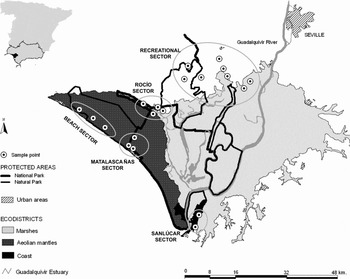
The Doñana Natural Protected Area (NPA) is located in Andalusia on the south-western coast of Spain (Fig. 1), covering c. 2207 km2 of natural systems that include four eco-districts: aeolian sheets, marshes, coast and the Guadalquivir estuary (Montes et al. Reference Montes, Borja, Bravo and Moreira1998). These ecosystems make Doñana unique in many aspects: it is a major stepping-stone in the migration route of birds moving between Europe and Africa, it is home to the most endangered mammal in the world, the Iberian lynx, as well as many endemic, threatened or ecologically interesting species, and it contains perhaps the most significant wetland in Europe (García Novo & Marín Cabrera Reference García Novo and Marín Cabrera2005).
Study area map. Location of the Doñana SES and its main landscapes.

In 1969, the Spanish government declared Doñana a National Park and its surroundings were declared Natural Park in 1989 by the Andalusian government. Doñana was recognized as an International Biosphere Reserve in 1980, as a Ramsar site in 1982 and as a UNESCO World Heritage Site in 1995. However, despite these conservation efforts, Doñana has serious conservation problems. In recent years, conflicts between conservation and economic development have increased, especially with the expansion of agriculture, urbanization projects and tourism. Four million people visit Doñana NPA annually (Gómez Limón García et al. Reference García Mora, Montes, Castro, Molina, Baudry, García Mora and Montes2003).
Sampling strategy
We conducted direct face-to-face interviews at 20 sample points in the Doñana SES. We developed the questionnaire during February–October 2004 and pre-tested it in December 2003 to identify and correct any problems. The representativeness of the final dataset was cross-checked against previous studies about visitors to Doñana (de Lucio & Múgica Reference de Lucio and Múgica1994; Múgica & de Lucio Reference Múgica and De Lucio1996; Gómez Limón García et al. Reference García Mora, Montes, Castro, Molina, Baudry, García Mora and Montes2003). Only adults (>18 years old) were interviewed. We interviewed 672 visitors to the Doñana NPA, but because some of them did not answer all the questions, the final data set was reduced to 663.
To consider the spatial and temporal variability that characterize Mediterranean ecosystems, the sample population was randomly selected from five different areas of Doñana SES (Fig. 1) during different months of a homogeneous year, namely (1) the Rocío village sector, (2) the Matalascañas sector, (3) recreational areas, (4) beaches and (5) the Sanlúcar sector. Each of these sectors offers different ES as a result of both sociopolitical and ecological variables, and people make different use of these different sectors.
Structure and content of the questionnaire
We designed the survey in several sections, which were delivered to respondents in the following order: (1) questions about the importance of Doñana ES, (2) questions regarding WTP for ES, (3) questions to establish knowledge and attitudes, and (4) collection of socioeconomic data and information regarding the characteristics of the respondents’ visits to Doñana NPA.
The importance of the ecosystem services
After a brief explanation of what ES were and the importance of biodiversity in the provision of ES to society, respondents were asked whether they believed that the biodiversity of Doñana NPA provided any ES to society besides tourism. We exclude recreational and tourist services here because several users were looking for these services during their visit to Doñana SES (see B. Martín López, E. Gómez-Baggethun, P.L. Lomas & C. Montes, unpublished data 2006).
If respondents believed that the biodiversity of Doñana provided some ES, we asked which ES they believed to be the most important. The answers were classified as: (1) provisioning services, (2) supporting and regulating services, (3) services derived from an interest in acquiring knowledge, scientific or educational, (4) religious services and (5) spiritual services. The last is reflected in the non-human rights that people attribute to some species, often resulting from an aesthetic experience of wildlife and, therefore, is a consequence of aesthetic services.
Willingness to pay for the ecosystem services
When respondents identified some ES, in order to establish their maximum WTP we asked: ‘If you think that the biodiversity of Doñana NPA provides this ES to society, would you be willing to contribute economically so that the biodiversity of Doñana can continue fulfilling this ES? Your economic contribution would comprise part of an annual donation to a trust fund that would be managed by an environmental organization in order to maintain the ecosystem services’. If the response was affirmative, the elicitation of WTP was an open-ended (OE) format question. If the response was negative, we asked about the motives for their disagreement to pay in order to distinguish protest responses from real zero values.
We used an OE elicitation format here. Many CV researchers prefer the closed-ended format because OE questions are more difficult to answer and the question format is not incentive compatible (Carson et al. Reference Carson, Groves and Machina2000), however by using OE questions we obtained a more realistic and direct measure of maximum WTP without anchoring bias. OE questions may result in lower WTP estimates than closed-ended format questions (Kiström Reference Kriström1993; Brown et al. Reference Brown, Champ, Bishop and McCollum1996), however experimental results comparing hypothetical and actual WTP show that the hypothetical bias is lower for the OE format as compared with the closed-ended format (see Balisteri et al. Reference Balisteri, McClelland, Poe and Schulze2001). We used a donation to a trust fund as a payment vehicle to make the hypothetical market more credible and feasible.
Environmental behaviour and knowledge
Respondents were asked a series of questions to establish their environmental behaviours and what they knew about Doñana. Questions related to the environmental behaviours were classified as either general environmental behaviours or specific behaviours developed towards Doñana NPA. General behaviours toward the environment were measured by traditional variables that are considered indicators of the respondent's interest in nature, such as whether the respondent held membership of an environmental organization and the number of other NPAs that the respondent had visited during the previous year. The Doñana specific environmental behaviours were measured by four variables: (1) the main reason for their visit to Doñana; (2) the activity that the respondent undertook; (3) the amount of time that the respondent spent in his/her visit; and (4) the number of different places that the respondent visited. Familiarity with the Doñana NPA was measured by four indicators, the first two directly related to the respondents’ knowledge and the last two to the respondents’ perceptions of Doñana. These were: (1) respondents’ knowledge of the management of Doñana NPA; (2) respondents’ knowledge of the differences among the protection categories and organizations working in Doñana; (3) the main impression that people had when ‘Doñana’ was mentioned; and (4) the main role that Doñana NPA should play in society. With the aim of classifying Doñana's visitors, these variables were analysed by a two-step clustering technique appropriate for large data sets with mixed variables (Norusis Reference Norusis2003). This enabled continuous and categorical attributes to be derived from a probabilistic model where the distance between two clusters is equivalent to the decrease in the log-likelihood function as a result of merging. The Schwarz Bayesian criterion (BIC) for each cluster within a specified range was used first to initially estimate the number of clusters. This estimate was then refined by finding the largest increase in distance between the two closest clusters at each hierarchical clustering stage. Both background noise and outliers could be identified and screened out.
Socioeconomic and general data
Social and demographic information included variables such as age, sex, level of study, current occupation, household size and monthly family income. Respondents were also asked about their place of residence in order to estimate how far they had travelled. The survey included general questions, such as the frequency of their visits to Doñana, length of stay, source of information about Doñana NPA and individual satisfaction level attained during the visit.
Economic valuation methodology
A common feature in the analysis of open-ended CV-bids (Mitchell & Carson Reference Mitchell and Carson1989) is that there are a large number of responses with zero WTP. One way to deal with this is to use a censored model, such as the Tobit model. However, if we believe that individuals in the study are more likely to consider first the decision of whether to pay into the fund or not, and then, if participating, how much to pay, the Heckman model (Heckit), wherein ‘pay or not’ is estimated in the first stage and the positive WTP is estimated in the second stage, is preferable to the Tobit model, which imposes the presumption of censoring (Greene Reference Greene2000; Sigelman & Zeng Reference Sigelman and Zeng1999).
Following Sigelman and Zeng (Reference Sigelman and Zeng1999), the Heckit model is a response to sample selection bias, which arises when data are available only for cases in which a variable reflecting ‘pay’, z*, exceeds zero.


where for the ith individual, Xi is a vector of explanatory variables, β is a parameter vector common to all individuals and μi is a random disturbance term. The error terms are assumed to follow a bivariate normal distribution with means 0, variances σμ = 1 and σϵ and correlation coefficient ρ. The observed variable is z = 0 if z* ≤ 0 and z = 1 if z* > 0; y = 0 if z* ≤ 0 and y = y* if z* > 0. The expected Y is:

where  is the inverse of the Mill's ratio, ø is the standard normal density function, and Φ the standard normal function. Equation (3) implies that the conditional expectation of y is Xβ only when the errors of Eqs (1) and (2) are uncorrelated. In the first stage, we obtained γ from a probit estimation of Eq. (1), where z = 1 if z* > 0 and 0 otherwise. Pseudo R2 was calculated according to the method proposed by Veall and Zimmermann (Reference Veall and Zimmermann1992). In the second stage, we estimated Eq. (3) using ordinary least squares (OLS) regression.
We determined the influence of the non-economic motives on CV results by two models relative to the central thesis of this study, DISTANCE and USER, estimated by Heckit regression. The DISTANCE model included six categories for the distance variable: (1) <20 km, (2) 21–50 km, (3) 51–100 km, (4) 101–300 km, (5) 301–700 km and (6) >701 km. The USER model included six dummy variables to associate every visitor with one user type. Distance and six dummy user variables were used in the first and second stages of the Heckit regression in DISTANCE and USER models, respectively.
We also estimated the first stage of the Heckit model by the following variables: (a) the cost of the respondent's visit to Doñana, (b) the household size and (c) the monthly family income, which was a semi-continuous variable that reflected the mid-point of the income intervals used in the questionnaire (600 €, 1200 €, 1800 €, 2400 €, 3000 € and 3600 €; 1€ = US $1.24, 2004). In order to reduce the heteroskedasticity problem, we have transformed it into its natural log form. The second stage of the Heckit model included as explanatory variables user's age, household size and monthly family income.
To confirm the results obtained by the USER model, we correlated the WTP amount with environmental-behaviour and knowledge-level factors. The environmental-behaviour factor was constructed by the addition of the following variables: (1) the number of NPAs visited during 2003, in four categories, and (2) whether the visitor held membership of an environmental organization. The knowledge factor was created by adding the following variables: (1) knowledge of Doñana management and (2) knowledge of Doñana's protection status/management.
To obtain further insight into how individuals responded to CV questions, we used the Kaplan-Meier survival function; some recommend this technique for continuous WTP data (see Bateman et al. Reference Bateman, Carson, Day, Hanemann, Hanley, Hett, Jones-Lee, Loomes, Mourato, Özdemiroglu, Pearce, Sugden and Swanson2002).
Results
Users of the Doñana NPA
The average visitor to Doñana NPA was a 38-year-old male from Seville (25 %) or other parts of Spain (30%), with a university-level education (48%), an average monthly income of € 1770 and a household of three people. Although the visits were spread throughout the year, visitor numbers peaked May–October. Most visits concentrated on Rocío village and the Visitor Centres of the National Park.
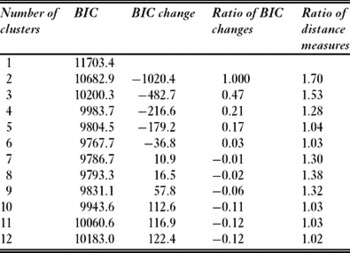
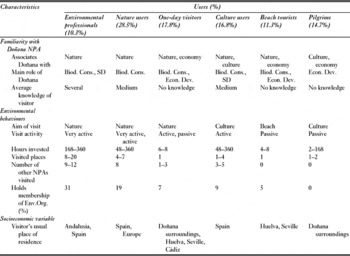
Cluster analysis indicated that a six-cluster solution was the best model because it minimized the BIC value and the change in it between adjacent numbers of clusters (Table 1). The resulting clusters were: (1) environmental professionals of Doñana NPA, (2) users that showed interest in nature (nature users), (3) people who spent one day in Doñana (one-day visitors), (4) visitors who looked for cultural heritage (culture users), (5) people who visited the beach (beach tourists) and (6) pilgrims and religious visitors (Table 2).
Results of auto-clustering using the Schwarz Bayesian criterion (BIC). BIC changes are from the previous number of clusters in the table, ratios of BIC changes are relative to the change for the two-cluster solution and ratios of distance measures are based on the current number of clusters against the previous number of clusters.

Characterization of Doñana users by the two-step cluster statistical analysis. Env. Org. = environmental organization; Biod. Cons. = biodiversity conservation; SD = sustainable development; Econ. Dev. = economic development. The average knowledge of visitor is the result of the addition of ‘knowledge about Doñana management’ and ‘knowledge about Doñana's protection status/management’ variables, which are constructed as: 0 = no knowledge, 1 = knowledge of some managing institutions and 2 = extensive knowledge. Several = 4 and medium = 2–3. The aim of visit was classified in three categories: nature (when visitors demanded activities associated with biodiversity or ecosystems), beach (when visitors spent their time exclusively on the beach) and culture (when visitors were interested in, for example, local traditional practices, folklore or gastronomy). Visit activity was classified as very active when respondents cited activities such as horse-riding, cycling or running, or they actively worked in the Doñana NPA, active when respondents cited activities such as walking, landscape contemplation, bird-watching or organized excursions, and passive when respondents spent their time relaxing or socializing with family and friends.

Users’ perceptions of Doñana ecosystem services
While biodiversity conservation services were perceived as important by all user categories (>50% rated them most important), the perception of other ES varied by user group. Pilgrims did not attach importance to the supporting-regulating services; in contrast, religious (25% rated them most important) and provisioning (15% rated them most important) services were considered important. Scientific and educational services were considered important by all categories of user; however >10% of environmental professionals rated these as most important.
Estimation results
Respondents refused to participate in CV procedures because: (1) they conflicted with their beliefs about the role of government in environmental management (57.2%), (2) they were opposed to new taxes (24.7%), (3) they distrusted government or they thought that government was inefficient (11.5%) and (4) individuals with environmental behaviours refused to participate because of the incompatibility between ethical beliefs and ascribing economic value (6.6%).
Using the Kaplan-Meier estimator for the respondents that participated in the proposed hypothetical market, the overall annual mean WTP was € 23.9 (median € 20; 95% confidence limits € 21.6–26.2).
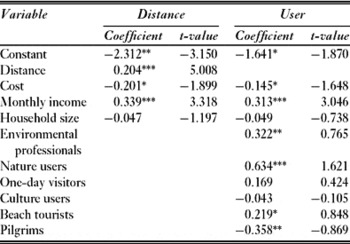
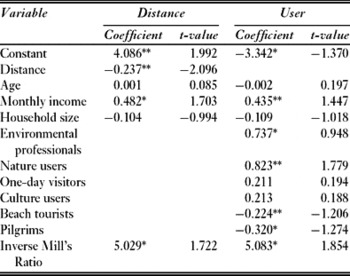
The chosen explanatory variables and in most cases expected signs were highly significant (Tables 3 and 4). The inverse Mill's ratio (Table 4) indicated some correlation between the error terms in the two steps. Both DISTANCE and USER models explained WTP, validating the data set and indicating the importance of both factors on WTP.
Probit regression results regarding willingness to pay (WTP) or not pay for NPA (first stage of Heckit model). Dependent variable: 0 when WTP = 0 and 1 when WTP > 0. n = 576. Significance *** = 1%, ** = 5% and * = 10%.

Sample selection two-stage least squares regression results (second stage of Heckit model). Dependent variable: ln(WTP). n = 576. Significance *** = 1%, ** = 5% and * = 10%.

The probit results of DISTANCE (log likelihood =−346.4, χ 2 = 49.9, pseudo-R2 = 0.34) and USER (log likelihood = −343.6, χ 2 = 55.3, pseudo-R2 = 0.36) models were consistent with our expectations (Table 3). The monthly income variable was positive and significant across both models, and we infer that the probability of users accepting the CV procedure depends on their income. The DISTANCE and USER models showed negative effects on the cost of current use, indicating that individuals were sensitive to the cost of visiting Doñana NPA. People who spent more money in making their visit to the NPA refused to make annual economic contributions to a trust fund in order to conserve the ES provided by Doñana's biodiversity. In the DISTANCE model, distance had a positive effect; people who had travelled further to visit Doñana NPA were more likely to participate in the hypothetical market than people who lived nearby. In the USER model, only the dummy variables environmental professionals, nature users, beach users and pilgrims were significant (Table 3).
The second stage of the Heckit model provides additional information about the non-economic motives that influenced WTP (Table 4) in both DISTANCE (log likelihood =−538.9, adjusted R 2 = 0.56) and USER (log likelihood =−522.2, adjusted R 2 = 0.56) models. Monthly income was positive and the only significant socioeconomic variable across both models. The analysis of the open-ended bids also showed a significant distance-decay effect; people who travelled further to visit Doñana were interested in participating in the CV procedure and willing to contribute lower WTP amounts than locals. The USER model indicates that for environmental professionals and nature users WTP was significantly positive, but for beach tourists and pilgrims WTP was significantly negative.
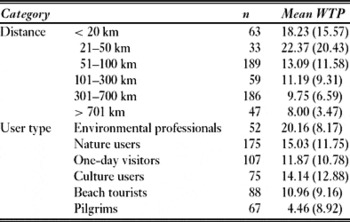
Mean WTP varied among the categories defined by geographic distance and user group (Table 5).
ANOVA tests results for distance (F = 8.68, α < 0.0001) and user (F = 10.28, α < 0.0001) categories. Standard deviation shown in parentheses. WTP = willingness to pay.

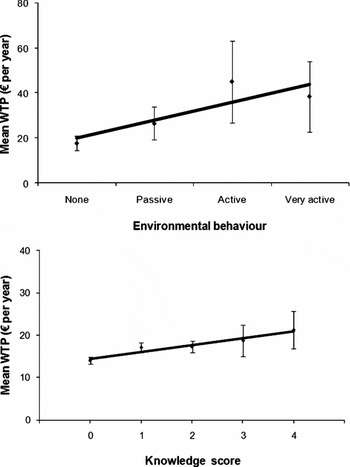
People with higher levels of environmental behaviour and greater local knowledge were willing to donate more money to maintaining ES than people who were not well informed about the environment of Doñana NPA (Fig. 2). We found a linear relation between WTP and environmental behaviour (y = 8.01x + 11.88, R 2 = 0.73), and local knowledge (y = 1.63x + 14.47, R 2 = 0.93). The users who were willing to pay more money to conserve ES were those who were more knowledgeable about Doñana and were more active in their environmental behaviour (see Table 2).
Mean (± SD) WTP for conservation of the Doñana ES in relation to (a) user's environmental behaviours; and (b) their local knowledge about Doñana NPA. Environmental behaviours: passive = > 4 but < 8 NPAs visited in 2003; active = > 8 NPAs visited in 2003; very active = > 8 NPAs visited in 2003 and member of an environmental organization. The average knowledge of visitor is the result of the addition of ‘knowledge about Doñana management’ and ‘knowledge about Doñana's protection status/management’ variables, where: 0 = no knowledge; 1 = knowledge of some managing institutions; 2 = extensive knowledge.

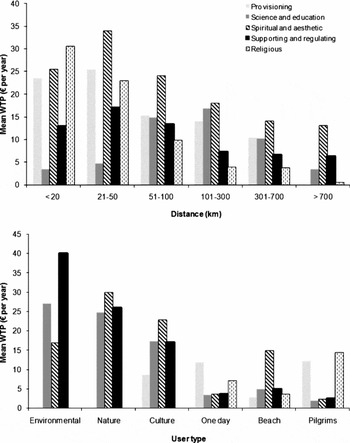
Distance also played a role in relation to the type of ES valued (Fig. 3a). WTP for science and education did not follow a distance-decay function, because these services were highly valued at a regional scale. The aesthetic service was the most valued by people who had travelled from places more than 20 km away. Religious services were the most valued by local people. People who live in Doñana and its surroundings awarded more value to provisioning services than other users.
Relationship between WTP for maintaining the Doñana ES and (a) distance and (b) user type.

Religious services followed a distance-decay function because local users (pilgrims and one-day users) assigned greater WTP. Mean WTP by ES and user type (Fig. 3b) provides further empirical evidence of the positive correlation between ethical concern and the WTP amount. However, this positive relationship was only found for science-education, spiritual-aesthetic and supporting-regulating services. Nature and culture users awarded more value to spiritual-aesthetic services and environmental professionals assigned higher WTP to conserving supporting-regulating services. Provisioning services had the opposite trend: users with low levels of environmental behaviour were willing to pay higher amounts than environmentally active users, indicating that perceived utility of certain commodities predominates.
Benefits aggregation
To assess the total benefit of a public good, it is usual to aggregate mean WTP figures over the relevant market, which in our case was the Doñana SES. This represents an underestimate of benefits, because the ES provided by the biodiversity of Doñana are a national and even a global public amenity. Numerous controversies exist around the aggregation of the economic values of ES. There are several different ways of aggregating annual benefit.
(1) If we assume that non-respondents reflected the general population of Doñana users and assigns them the mean WTP, we obtained € 97 807 858 (95% confidence interval: € 88 395 386–107 220 330) as social benefits. This provides the highest social benefits for ES.
(2) If we suppose that protest responses did not reflect the population of Doñana users, social benefits resulted in € 56 239 518 (95% confidence interval: € 59 827 347–61 651 690).
(3) If we suppose that protest responses reflected the most conservative approach by assuming that non-respondents were real zero WTP bids for maintaining ES, social benefits resulted in € 45 285 038 (95% confidence interval: € 40 927 064–49 643 013).
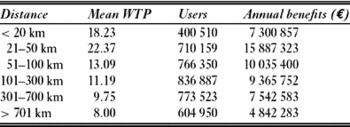
(4) If we use the results of Heckit regression from DISTANCE model for the whole sample, the social benefits were € 51 318 433; however if we used the means of the sub-samples defined by distance the social benefits increase to € 54 974 199 (Table 6).
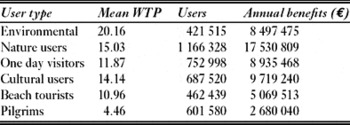
(5) Finally, if we use the results from the USER model, the social benefits were € 53 732 939 for the whole sample and € 52 432 544 if we use the mean WTP of user groups (Table 7).
Aggregation of annual benefits by Heckit regression estimation of mean WTP for different distances (DISTANCE model). Social benefits = € 54 974 199.

Aggregation of annual benefits by Heckit regression estimation of mean WTP of user categories (USER model). Social benefits = € 52 432 544.

DISCUSSION AND CONCLUSIONS
Neo-classical economics is accepted as a useful partial valuation when making decisions about ES management, if we assume that human preferences form the basis for the value and if we also assume that aggregate individual preferences reflect social valuation of ES (Pritchard et al. Reference Pritchard, Folke and Gunderson2000). Valuation of ES was significantly influenced by people's environmental behaviour and knowledge of the ES. Thus, knowledge and environmental behaviour were positively related to WTP; however knowledge exerted more influence than environmental behaviour. This has important implications for environmental policies because it demonstrates the potential impact that environmental education programmes could have on individuals’ stated behaviours. In Spanish national parks there is a strong relationship between environmental educational programmes and increase in active environmental behaviours (Benayas et al. Reference Benayas, de Lucio and Bernáldez1987). Knowledge is positively reinforced by individual experience. On-site use can be considered one of the most effective ways to understand the relative importance of biodiversity (Kniviilä 2006). Excessively restrictive conservation policies, which reduce the user's opportunities to access NPAs, reduce public support and appreciation of ES. In Doñana National Park, restricted access has heightened local opposition toward conservation policies, and local preferences for non-use services have become less important (Elbersen Reference Elbersen2001). Although Doñana NPA is one of the most ecologically important and highly controversial areas in Europe, very little attention has been given to users’ opinions and preferences (Elbersen Reference Elbersen2001). In order to establish successful environmental policies for sustainability of the area, the population of users must be involved and their opinions and preferences, as well as their posture towards the NPA, properly understood.
In the Doñana NPA, we found different perceptions among users about the importance of ecosystem services. While local users prefer cultural and modified ecosystems (Bernáldez 1985) because they are motivated by anthropocentric reasons (provisioning services), others perceive biodiversity conservation services as important, indicating that existence values could play an important role in conservation management decisions (see also Stevens et al. Reference Stevens, Echeverría, Glass, Hager and More1991; Kniivilä Reference Kniivilä2006).
The information obtained using CV techniques can be used to change either environmental behaviours or local knowledge about the natural system.
The value of ES provided by biodiversity is highly dynamic. The factors that control the WTP can increase or decrease over time, and are strongly affected by changes in government policy and other forces, such as media influence. Human values and preferences are not static and pre-existent; rather, they are formed by interaction with nature and society (Pritchard et al. Reference Pritchard, Folke and Gunderson2000). They evolve as part of social processes.
To express the social valuation of ES by individual preferences, aggregation is one of the most problematic assumptions in CV methodology. Decisions over the size of the benefiting population are crucial in terms of the calculation of the social benefits (Hanley et al. Reference Hanley, Schläpfer and Spurgeon2003). Previous studies (Loomis Reference Loomis2000; Hanley et al. Reference Hanley, Schläpfer and Spurgeon2003) tested the distance-decay effect, and therefore we use distance-decay functions as a way of resolving this aggregation problem. Distance-decay relationships may well prove useful in valuation studies because they provide a way to conceptualize the question ‘who benefits?’ (Hanley et al. Reference Hanley, Schläpfer and Spurgeon2003). However, we found that the distance-decay functions varied among different ES. For instance, the distance function decayed more rapidly for provisioning and religious services than other non-use values. At a municipal scale, the most important ES were related to religious and provisioning services, whereas at a national or global scale biodiversity conservation became the most important service. Similarly, benefits aggregation obtained from the sub-samples defined by user typology was also useful to define who benefits. We were thus able to better discern which beneficiary group obtained more social benefits from ES. Clearly, the aggregation methods derived from the Heckit regression (methods 4 and 5) provided the most plausible aggregation because they were averages of all methodologies, and the probability of bias originated from the influence of distance decrease. There is a need to consider different scales in CV to support decision-making processes.
ACKNOWLEDGEMENTS
We thank Doñana National and Natural Park for providing facilities and the Andalusian Network of Natural Protected Areas for financial support. K. Turner kindly provided instruction in environmental economics. We also thank P. Lomas, E. Gómez, B. Pérez, C. Louit, Á. Sánchez, L. Losada, C. de Miguel and E. Araujo for unselfish help with the interviews, and two anonymous referees for comments that improved this paper.