Introduction
Contraceptive use is one of the proximate determinants of fertility regulation (Davis & Blake, Reference Davis and Blake1956; Bongaarts, Reference Bongaarts1978; Bongaarts & Potter, Reference Bongaarts and Potter1983). It has also been regarded as the most important factor in enhancing the pace of fertility transition. Moreover, increased contraceptive use during the postnatal period could substantially reduce maternal and infant mortality by preventing unplanned and unwanted pregnancies (Vernon, Reference Vernon2009). Contraceptive use in the early stage of reproductive life and for appropriate spacing of pregnancies can significantly improve the health, education and labour force participation of women (Miller, Reference Miller2010; Banerjee & Duflo, Reference Banerjee and Duflo2011, p. 110). This is because contraceptives enable women to decide the number and timing of birth of their children. Even though India has achieved a high prevalence of contraception use and lower fertility rate, its maternal and child health indicators have remained far below expected levels. This can partly be attributed to the lopsided focus of India’s contraceptive policy on achieving lower fertility rates without giving due regard to contraception as an instrument for improving maternal and child health.
Although the family welfare programme in India was launched with the objective of stabilizing population growth by reducing the birth rate, the programme evolved through a number of stages and strategic approaches over last half of the 20th century. This included the cafeteria approach, the time-bound and target-oriented approach, the family planning camp approach, contraceptive-specific incentives and finally, articulating a reproductive health and rights-based paradigm (Santhya, Reference Santhya2003; Pachauri, Reference Pachauri2014). Despite changing approaches and strategies, the universal adoption of the small-family norm has remained a distant dream (Chaurasia, Reference Chaurasia2014). Additionally, the contraceptive method-mix is heavily skewed towards sterilization, even after a continued emphasis on informed choice in the National Population Policy (Pachauri, Reference Pachauri2014).
The prevalence of female sterilization is common in the countries of Latin America, e.g. Brazil (29.1%), Colombia (31.2%) and the Caribbean islands (22.5%), followed by countries in Asia, particularly China (28.7%), Thailand (26.6%) and India with a relatively higher rate (37.3%). European countries, on the contrary, mainly rely on reversible methods of contraception with a very low prevalence of sterilization, averaging around 3% (United Nations, 2011).
India’s sterilization rate among currently married women increased by three percentage points between 1998–99 and 2005–06, from 34.2% to 37.3%. However, the overall contraceptive prevalence was 56.3% (International Institute for Population Sciences (IIPS) & ORC Macro, 2000, 2007). Thus the dominance of sterilization in the contraceptive method-mix (66%) indicates that use of contraception has primarily been a function of fertility limitation rather than birth planning/spacing in India (Chaurasia, Reference Chaurasia2014).
Contraceptive behaviour, however, has been influenced by a range of independent socio-demographic, economic and cultural correlates. Numerous studies conducted in India and other developing countries have pointed out that individual-level factors, such as women’s educational attainment, son preference, marital duration, degree of media exposure and work status, independently influence contraceptive behaviour (Saleem & Bobak, Reference Saleem and Bobak2005; Sahoo, Reference Sahoo2007; Blunch, Reference Blunch2008; Islam et al., Reference Islam, Islam and Banowary2009; Okezie et al., Reference Okezie, Ogbe and Okezie2010; Singh et al., Reference Singh, Verma and Tanti2014). Studies have also revealed that socio-religious affiliation, incidence of domestic violence, women’s autonomy at the household level and husband’s attitude towards contraception are also significantly associated with contraceptive use (Blunch, Reference Blunch2008; Sharma & Rani, Reference Sharma and Rani2009; Samandari et al,. Reference Samandari, Speizer and O’Connell2010; Manna & Basu, Reference Manna and Basu2011).
Most studies on the determinants of contraceptive adoption and method-mix in developing countries, including India, have primarily focused on individual- and household-level demand-side factors, neglecting wider socio-cultural environment and supply-side correlates (Gulati, Reference Gulati1996; Pickett & Pearl, Reference Pickett and Pearl2001; Sahoo, Reference Sahoo2007; Barman, Reference Barman2013; Oliveira et al., Reference Oliveira, de. Dias and Padmadas2014; Singh et al., Reference Singh, Verma and Tanti2014; Chaurasia, Reference Chaurasia2014). Although such research has produced a considerable body of literature on contraceptive behaviour, it undermines the potential role of social context in which couples live (Grady et al., Reference Grady, Billy and Klepinger1993). Such truncated analyses are the result of a lack of information on community-level variables and supply-side factors in national-level health surveys available to researchers. Although a few studies have been conducted in other developing and developed countries to ascertain community-level influence on contraceptive use and its interaction with individual- and household-level variables (Kahn et al., Reference Kahn, Thapa and Gaminiratne1989; Grady et al., Reference Grady, Billy and Klepinger1993; Khan et al., Reference Khan, Mishra, Arnold and Abderrahim2007; Stephenson et al., Reference Stephenson, Beke and Tshibangu2008; Kaggwa et al., Reference Kaggwa, Diop and Storey2008), the findings of such studies are mixed in India (Chacko, Reference Chacko2001; Stephenson & Tusi, 2002, 2003; Khan et al., Reference Khan, Mishra, Arnold and Abderrahim2007). In the absence of such community-level variables, some studies have used health service characteristics such as distance to services, provider attitudes and the availability of contraceptives as indicators of quality of care (Seiber & Bertrand, Reference Seiber and Bertrand2002; RamaRao et al., Reference RamaRao, Lacuesta, Costello, Pangolibay and Jones2003; Katende et al., Reference Katende, Gupta and Bessinger2003; Hamid & Stephenson, Reference Hamid and Stephenson2006).
However, studies evaluating the independent effects of community-level interactions and contextual/supply-side factors that have appropriately controlled for socioeconomic and demographic variables among disadvantaged communities in India are scarce. Furthermore, studies that have used multilevel modelling have primarily focused on modern contraceptive adoption by using a binary outcome variable, thereby ignoring choice and reducing the scope of the study. The present paper attempts to bridge this gap by employing an integrative framework and analysing small-scale primary data collected from an underdeveloped rural region in the state of West Bengal, India, which is comparable to the national average in human development indicators. The principal hypothesis is that community-level exposure to family planning messages and village-level contextual/supply-side factors independently influence contraceptive behaviour.
Methods
Study setting
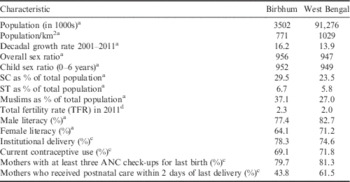
Birbhum district is a typical backward district of West Bengal. The geophysical characteristics of this district include undulating topography, remoteness and drought (UNDP & Government of West Bengal, 2008). According to the 2011 Census of India, the total population of Birbhum district is 3.5 million, with a sizeable proportion belonging to the socially disadvantaged section of society: 37% Muslim, 29.5% scheduled caste and 6.9% scheduled tribe (Table 1). Moreover, 87.2% of the population live in rural areas and earn their livelihood through agriculture, mining and quarrying and related activities, and experience economic hardship (Ghosh et al., Reference Ghosh, Siddiqui, Barik and Bhaumik2015). A few key indicators of the study district and the state of West Bengal are presented in Table 1.
Profile of the study district (Birbhum) compared with state-level (West Bengal) characteristics
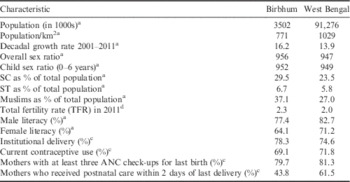
Sources: aPrimary Census Abstract (Registrar General of India, 2014); bReligion Primary Census Abstract 2016 (Registrar General of India, 2016); cDistrict-level household and facility survey (DLHS)-4, 2012–13 (International Institute for Population Sciences (IIPS), 2015); dGuilmoto & Rajan (Reference Guilmoto and Rajan2013).
Data
The district of Birbhum was purposely selected for data collection as it was among the lowest five districts in terms of human development indicators according to the West Bengal Human Development Report of 2004 (UNDP, 2004). A multistage sampling design was adopted to select respondents. At the first stage, the proportion of non-agricultural labourers was used as the sampling stratification frame. Three blocks, namely, Sainthia, Mohammad Bazar and Suri-I, which have the lowest, medium and highest proportions of non-agricultural labourers in Birbhum district, respectively, according to the 2001 census, were selected for the study. At the second stage, fifteen villages in each block were selected by probability proportional to size sampling from each block. A rapid house listing exercise was conducted in each of the 45 selected villages. In order to maintain variation in the exposure to the length of childbearing period among currently married women, the respondents were divided according to their ages at the next stage of stratification: 15–24 years representing younger women; 25–34 years representing middle age-group women; and 35–44 years representing older women. From each selected village 30 respondents were selected on the basis of age-group-stratified random sampling. Selection was restricted to married, non-menopausal, non-pregnant (including those who had not delivered a baby within the 6 months preceding the survey – the lactational amenorrhoea period) females. Thus, the targeted sample size was 1350 (=30×45). Of these, 1348 currently married women responded successfully.
Data were collected between February and April 2012 through a standard pre-tested questionnaire by door-to-door visit. Ethical approval was obtained from the institutional ethics committee of the Institute of Development Studies Kolkata and the local administration was informed before undertaking the study. In addition, informed consent was obtained from the study participants before data collection and the collected individual data were kept confidential.
Variables
Predictor variables used in the analysis primarily fell into four categories: individual level, household level, community-level exposure to family planning messages and contextual/supply-side variables. Individual-level variables included age, number of living children, whether the respondent had at least one living son, educational attainment (completed years of schooling), degree of exposure to family planning messages, inter-spousal communication and work status. Household-level variables incorporated type of family, socio-religious category and household wealth quintile. The community-level variables were membership of a self-help group and discussions regarding family planning matters with friends/neighbours, which were considered as proxies of community-level interactions. A self-help group (SHG) is an informal group of 5–20 persons of the same low level of economic condition, belonging to the same locality or hamlet. They are subject to open and voluntary membership, democratic control of members, participation of members in economic activities of the group, autonomy and independence, education, training and information, co-operation amongst different groups and concern for the community. Distance to the nearest town (considered as a proxy for remoteness) and availability of grassroots-level community health workers in the village were included as supply-side variables; degree of community-level information–education–counselling (IEC) activities related to family planning matters in the village was taken as a contextual variable.
Degree of exposure to family planning messages with a one-year recall period was created from four separate binary variables, namely: read about family planning in newspaper/magazine; heard about family planning on radio; seen any advertisement/programme on family planning on the television; and, seen any advertisement/programme on family planning at the cinema/theatre. The variable was coded to have a maximum score of 2 if the participant had exposure to family planning messages from more than one source to provide the same statistical power as exposure from three or four sources were very limited. Caste and religion were pooled together to form a single categorical variable and categorized as scheduled caste Hindu, scheduled tribe Hindu, forward caste Hindu and Muslim/other minorities. As information on household income or expenditure was not directly asked in the survey, the wealth index was calculated by using factor analysis and was used as the proxy for household economic status. The wealth index consisted of the following indicators: type of house, toilet facility, main fuel for lighting and cooking, main source of drinking water, use of separate room for cooking and ownership of assets such as a house, agricultural land, irrigated land, livestock and other durable goods. On the basis of the composite score related to these characteristics as obtained from principal component analysis (PCA), the household wealth was divided into poor, middle and rich.
The variable ‘availability of grassroots-level community health workers’ was created from two binary variables, namely, availability of an auxiliary nurse midwife (ANM) and accredited social health activist (ASHA) from whom women generally seek advice on contraceptives and also obtain contraceptives. Degree of community-level IEC activities in family-planning-related matters over a one-year recall period was obtained by adding the following seven binary variables: organization of any cinema/theatre, exhibition/seminar, drama/song/performance, puppet show, group meeting and awareness generation programme on family planning or HIV/AIDS.
The response variable for analysis had four categories: 0 if women reported using permanent methods (female and male sterilization), 1 if women reported using modern temporary methods (IUD, pill, injectables, implants, Norplant, male and female condom), 2 if women reported using natural methods (rhythm and withdrawal) and 3 if women reported not using any contraceptive method during the time of the survey.
Analytical model
The aim of the analysis was to identify the factors that are associated with adoption of modern temporary contraceptive methods, natural methods and the non-use of contraception in comparison with adoption of a permanent method. Multilevel multinomial logit models were employed with the use of permanent methods as the reference category. Due to the hierarchical structure of sample selection, some unobserved characteristics of villages might influence the likelihood of outcomes. A multilevel modelling technique in such circumstances is handy, as it not only adjusts standard errors of estimates for clustering of observations within villages, but also treats clustering as an additional source of information (Goldstein, Reference Goldstein2003). The multilevel multinomial model can be expressed as:
 $$ln\left( {{{\theta _{{ij}}^{z} } \over {\theta _{{ij}}^{0} }}} \right)=\alpha ^{z} {\plus}\mathop{\sum}\limits_{k=1}^K {\beta _{k}^{z} X_{{kij}} \,{\plus}\,\mu _{j}^{z} \,{\plus}\,\epsilon _{{ij}}^{z} } $$
where
 $\theta _{{ij}}^{z} $
is the probability of adoption of a contraception method by individual i belonging to village j depending on the value of the z superscript, which can take values of 1, 2 and 3 for modern temporary method, traditional method and no contraception, respectively. The term
 $\theta _{{ij}}^{0} $
is the probability of adoption of a permanent method, which is used as the reference category in the regression model. Accordingly, the left-hand side of the equation is the log-likelihood of adopting a modern temporary method (when z equals 1), traditional method (when z equals 2) or no contraception (when z equals 3), relative to the choice of a permanent method (sterilization). The right-hand side of the equation expresses the log-likelihood of contraception choices as a linear function of individual-, household-, community- and village-level characteristics, denoted by X
k
. Additionally, the random components for unobserved effects of village-level factors
 $\left( {\mu _{j}^{z} } \right)$
and the usual individual-level error component
 $$\left( {\epsilon _{{ij}}^{z} } \right)$$
are also denoted. Therefore, the presence of a village-level random effect in addition to an individual-level random component makes it a two-level multinomial logit model. The term
 $$\beta _{k}^{z} $$
is the independent effect of variable k on the log-likelihood of outcome z.
Associated with the use of multinomial logit is the restrictive assumption of independence of irrelevant alternatives (IIA). Since IIA holds conditionally on all the covariates and random errors, multilevel models due to their additional random component(s) are not prone to failure of IIA assumption (Skrondal & Rabe-Hasketh, Reference Skrondal and Rabe-Hesketh2003; Grilli & Rampichini, Reference Grilli and Rampichini2007; Oliviera et al., 2014). For example, in the case of choice of brands for drugs, the multilevel model can effectively reduce the IIA issue by adding a random effect for doctors as on many occasions prescribing of brands would be nested within doctors.
A cumulative model-building process was used. Model 0 represents the intercept-only model without including any independent variable to understand community-level unexplained variance on contraceptive use as well as the intra-cluster correlation coefficient indicating amount of variation attributable to the clusters. Model 1 includes individual-level variables to elicit their independent effect on adoption and choice of contraception. Models 2 and 3 add household-level variables and those indicating respondents’ community-level exposure sequentially to investigate how each of these group of variables explains the variation in contraceptive method-mix. Further, Model 4 incorporates contextual/supply-side variables to examine the extent of influence of these variables on contraceptive behaviour. The changes (reduction) in the variance of the village-level random component
 $\sigma _{j}^{2} $
from Model 1 to Model 4 were also tracked to examine the extent of the unobserved effect being picked up by successive addition of covariates in regression.
Data were analysed using Stata 13. To obtain the basic socioeconomic characteristics of the samples, descriptive analyses were performed. Then bivariate and multivariate analyses were conducted to identify the association of contraceptive use with individual-, household- and community-level exposure factors and contextual/supply-side variables. However, for brevity the results obtained from bivariate analysis are not reported.
Results
Sample characteristics
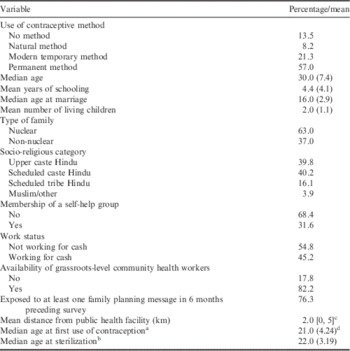
The key feature of this sample is that it represents an economically disadvantaged and impoverished population that varies significantly in social status. Thus it allows for a microscopic view of contraceptive choices that are made by poor females or couples. The characteristics of the surveyed women are reported in Table 2. The prevalence of contraceptive use among the surveyed women was found to be higher (86.5%) than the national average (56.3%). A dominance of the permanent method, i.e. female sterilization, was also found in the sample. Nearly 57% of sampled females were using a permanent method, which is much higher than the national average (37.3%), while only about 29.5% were using a temporary (modern or natural/traditional) method, which is again above the national average (19%).
Characteristics of survey women, Birbhum district, India
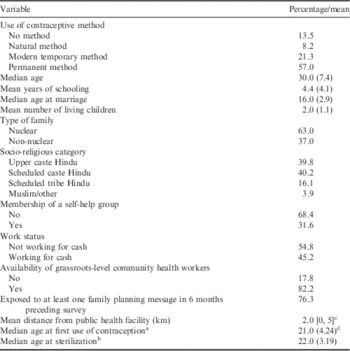
aAmong ever users of any contraceptive method; bamong sterilization users.
cRange; dstandard deviation.
A high median age (30 years), low median age at marriage (16 years) and low number of living children (median 2 children) together indicate that almost every sample woman had already achieved their desired family size. Furthermore, it also suggested that, as in other parts of rural West Bengal (Guilmoto & Rajan, Reference Guilmoto and Rajan2013), fertility transition had occurred in this underdeveloped region. Furthermore, a 5-year gap between median age at marriage (16 years) and median age at first use of contraception (21 years) implies that women tended to achieve their desired reproductive goal before using contraception. The educational attainment of the surveyed women was found to be poor with a mean of 4.4 years. More than three-fifths of the respondents resided in nuclear households, while more than half belonged to socially marginalized sections of society. Less than one-third of the respondents were members of a self-help group, while 45% of participants were employed in some paid work in the 6 months preceding the survey. More than three-quarters of the respondents had been exposed to at least one family planning message. The mean distance to a public health facility was 2 km, suggesting that these are located in the vicinity of villages in most of the cases.
Multilevel analyses
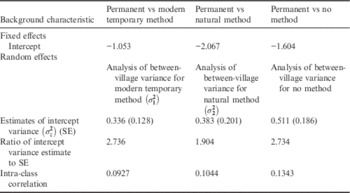
Table 3 reports the intercept-only model (Model 0). The reference category of the response variable was ‘currently using permanent method’, i.e. the log odds of the remaining choices of contraception (modern temporary and natural methods and not adopting any method) are expressed relative to use of a permanent method. The intra-class correlation shows that village-level contextual factors are relevant in determining the probability of choosing contraceptive methods.
Results of intercept-only multilevel multinomial logit model
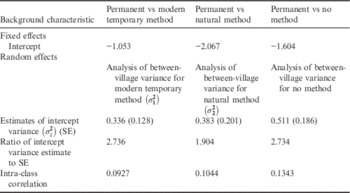
It would normally be expected that the variance components would become smaller as explanatory variables are included in the subsequent models (Hox, Reference Hox2010). However, Hox (Reference Hox2010) also noted that the underlying latent variable is re-scaled in logit and probit regressions (and many other generalized linear models), so that the lowest level residual variance is again π2/3 or unity. As a consequence, higher-level variances were also re-scaled, in addition to any real changes resulting from the changes in the model(s). Due to this implicit re-scaling it is often problematic, even impossible, to investigate how the variance component changes once explanatory variables are incorporated in the intercept-only model. This problem has also been discussed in Snijders and Bosker (Reference Snijders and Bosker1999) and in Fielding (Reference Fielding2003, Reference Fielding2004). Precisely for this reason, although the intercept-only model was tried first (as reported in Table 3) and the cumulative model-building procedure adopted thereafter, the interpretation and discussion of the findings are confined to Model 1 to Model 4.
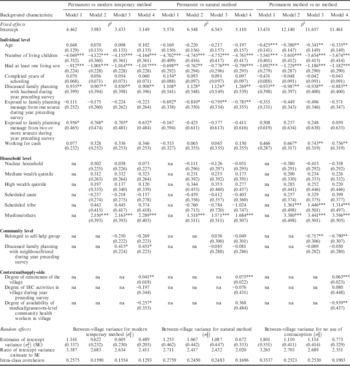
Table 4 reports the adjusted coefficients based on the multilevel multinomial logit analyses. Based on preliminary analysis, quadratic functional forms were adopted for fuller utilization of available information for education, age and number of children. In other words, for these covariate coefficients, linear as well as square terms were estimated. After individual-level variables were controlled for (Model 1), number of offspring and their sex composition were among the most noticeable predictors explaining adoption and choice of sterilization. Women with a higher number of living children had a higher odds of using a permanent method versus any other contraceptive choice. This is evidenced by the negative and significant value of the estimated coefficients (β Z ) for number of children in Model 1 for all choices, i.e. modern temporary (β 1= −4.049, p<0.001), natural (β 2= −4.702, p<0.001) or not using contraception (β 3=−5.541, p<0.001). Similarly, the likelihood of using a permanent method increased significantly among women who had at least one living son (β 1=−0.912, p<0.001; β 2=−0.698, p<0.001; β 3=−1.092, p<0.001). Further, inter-spousal communication regarding contraceptive usage significantly increased the odds of using non-permanent methods, i.e. modern temporary (β 1=0.935, p<0.01) and natural (β 2=1.108, p<0.05) methods, at the same time decreasing the likelihood of non-use of contraception (β 3=−0.933, p<0.01). A positive effect of higher educational attainment in the use of natural methods was also observed (β 2=0.154, p<0.05). Women who had received information on family planning methods from one source were significantly less likely to adopt natural methods compared with permanent methods (β 2=−0.692, p<0.05), while exposure to family planning messages from two or more sources significantly enhanced the likelihood of use of modern temporary methods (β 1=0.956, p<0.05).
Coefficient from multilevel multinomial logit regressions identifying factors on multiple levels associated with adoption and choice of contraception by survey women
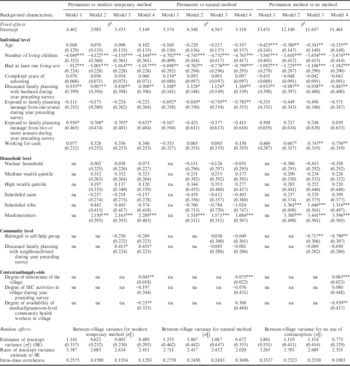
Note: Square terms of the continuous variables age, education and number of living children were controlled in the models as covariates.
Parentheses denote standard errors (SE) of the estimates. na: not applicable.
***p<0.001; **p<0.01; *p<0.05.
Model 1 also indicates that random intercept variances for all outcomes were significant and substantial
 $\left( {\sigma _{z}^{2} } \right)$
:
 $\sigma _{1}^{2} =1.141$
for adoption of modern temporary methods,
 $\sigma _{2}^{2} =1.253$
for the adoption of natural methods and
 $\sigma _{3}^{2} =1.801$
for not using any method. To get a relative idea of the strength of these village-level random intercept variances, intra-class correlation (ICC
Z
) was used, which is expressed as the share of random intercept variance in the total unobserved variance. Values of ICC
Z
corresponding to each
 $\sigma _{z}^{2} $
were ICC1=25.75%, ICC2=27.59% and ICC3=35.37%, implying that some of the between-village differences are not attributable to individual characteristics; there is a large unexplained between-village variation.
In Model 2, after adjustment for household-level variables, socio-religious affiliation was found to have a significant association with contraceptive behaviour, in addition to the significant variables of Model 1. Respondents belonging to the Muslim community were significantly more likely to choose both modern temporary (β 1=2.150, p<0.001) and natural methods (β 2=1.518, p<0.001) compared with a permanent method. At the same time, both scheduled tribe and Muslim women were more likely to go without contraception compared with a permanent method in Model 2 (β 3=1.361, p<0.001 for scheduled tribe, and β 3=3.380, p<0.001 for Muslims). Additionally, one of the individual-level variables – women’s work – becomes positive significant in Model 2, implying that working females have higher odds of not using contraception compared with permanent methods (Model 2) (β 3=0.667, p<0.05). Notably, the significance of other variables in Model 1 persists in Model 2, but the positive and significant effect of educational attainment in reliance on natural methods turns insignificant, and continues to remain so, for Model 3 and 4.
The random component of Model 2 shows that the inclusion of household-level variables substantially reduces the random intercept variance
 $\left( {\sigma _{z}^{2} } \right)$
for all outcomes but does not render them insignificant. The values of
 $\sigma _{z}^{2} $
for different outcomes in Model 2 are
 $\sigma _{1}^{2} =0.622$
,
 $\sigma _{2}^{2} =1.067$
and
 $\sigma _{3}^{2} =1$
. As expected, ICC
Z
scores also decline significantly from previous levels (Model 1) ─ ICC1 declines from 27.75% to 15.90%, ICC2 from 27.59% to 24.50% and ICC3 from 35.37% to 25.23%. This sharp decline in ICC
Z
or
 $$\sigma _{z}^{2} $$
indicates that a considerable amount of between-village difference is attributable to household-level characteristics. Moreover, since other household-level variables, namely, type of household and household affluence, were not significant, one can argue that the reduction in random intercept variance and interclass correlation was almost entirely attributable to the socio-religious affiliation of the respondents. In other words, villages are highly segregated along socio-religious lines.
After adjustment of variables indicating community-level exposure in Model 3, women who had discussed family planning with neighbours/friends during the year preceding the survey were significantly more likely to use modern temporary methods compared with permanent methods (β 1=0.415 at p<0.05). Further, women who belonged to any self-help group had significantly lower odds of not using contraception relative to using permanent methods (β 3=−0.717 at p<0.01). Additionally, significant variables in Model 2 tended to persist in Model 3 as well.
The addition of community-level exposure variables did not cause any significant change in values of random intercept variances
 $\left( {\sigma _{z}^{2} } \right)$
for all outcomes. This should not imply that factors associated with community-level exposure play a negligible role. In Model 3, random intercept variance was more likely to contain factors related to community-level exposure that remain only partially observed in this analysis. This is on account of the fact that differences in quality of discussion with neighbours/friends and in group meetings could not be controlled due to informational constrains.
In the final model (Model 4), which included contextual/supply-side characteristics in addition to the variables in Model 3, the significant effect of individual- and household-level factors and variables associated with community-level exposure to family planning messages observed in Model 3 largely persisted. Additionally, the associations between contextual/supply-side characteristics and contraceptive behaviour were also found to be significant. Degree of remoteness, as indicated by distance from the nearest town, significantly increased the odds of adoption of reversible (modern temporary and natural) methods and non-adoption of contraception at the expense of permanent methods (β 1=0.041, p<0.01; β 2=0.075, p<0.01; β 3=0.063, p<0.01). Moreover, the availability of grassroots-level community health workers in a village significantly reduced the odds of non-use of contraception (β 3=−0.939, p<0.01) and discouraged the adoption of modern temporary methods (β 1=−0.257, p<0.05), thus promoting the adoption of a permanent method. However, community-level IEC activities in the village did not have any significant bearing on usage of any contraception method or its non-use.
The random intercept variances
 $\left( {\sigma _{z}^{2} } \right)$
in Model 4 for all outcomes declined significantly from previous (Model 3) values:
 $$\sigma _{1}^{2} $$
declined from 0.605 to 0.489,
 $\sigma _{2}^{2} $
from 1.087 to 0.672 and
 $\sigma _{3}^{2} $
from 1.114 to 0.773. The corresponding declines for ICC
Z
were as follows: ICC1 reduced from 15.54% to 12.93%, ICC2 from 24.83% to 16.96% and ICC3 from 25.3% to 19.03%. Nevertheless, ICC
Z
, i.e. intra-class correlations, were still quite high, with between-village differences explaining a major share of the unexplained variation in the adoption of various options. It must be noted that contextual/supply-side variables used in the analysis were not a very robust measure as quality attributes from medical/grassroots-level community health workers and IEC activities were not available due to informational constraint. Thus, it can be concluded that high values of ICC
Z
(even after introducing various control variables) in large part represent unobserved contextual/supply-side characteristics that are associated with a woman’s adoption and choice of contraceptive method.
Discussion
Using small-scale primary data from rural West Bengal, India, representing an economically impoverished population, the present study found that factors that significantly influence the adoption and choice of contraceptive methods are size and sex composition of living offspring, inter-spousal communication, degree of exposure to family planning messages, work status, socio-religious affiliation, membership of a self-help group, discussion of family planning with neighbours/friends, remoteness of the village and the availability of grassroots-level community health workers in the village. In other words, not only demand-side factors but also community-level exposure and supply-side factors have a significant bearing on the contraceptive behaviour of these woman.
The study found that of these factors, number of living children had the strongest influence on contraceptive adoption and choice. The sampled women overwhelmingly opted for permanent methods once their desired number of children was achieved. Many studies have pointed out that number of children has a decisive influence on the choice of permanent methods (Sahoo, Reference Sahoo2007; Walvekar, Reference Walvekar2012; Singh et al., Reference Singh, Ogollah, Ram and Pallikadavath2012; Barman, Reference Barman2013; Oliveira et al., Reference Oliveira, de. Dias and Padmadas2014). In concordance with other studies, the present study also observed that Indian women generally switch over to permanent methods from modern temporary and natural methods only after achieving their desired number of sons (Raju & Bhat Reference Raju and Bhat1995; Roy et al., Reference Roy, Ram, Nangia, Saha and Khan2003; Jayaraman et al., Reference Jayaraman, Mishra and Arnold2008; Oliveira et al., Reference Oliveira, de. Dias and Padmadas2014; Ghosh & Begum, Reference Ghosh and Begum2015) as son-preference is a deeply seated phenomenon in the Indian patriarchal social system (Arnold et al., Reference Arnold, Choe and Roy1998; Arnold, Reference Arnold2001; Pande, Reference Pande2003; Das Gupta et al., Reference Das Gupta, Zhenghua, Bohua, Zhenming, Chung and Hwa-Ok2002; Jayaraman et al., Reference Jayaraman, Mishra and Arnold2008).
Although research conducted in developing countries has found that increasing inter-spousal communication enhances the likelihood of adoption of modern contraceptive methods including sterilization (Kaggwa et al., Reference Kaggwa, Diop and Storey2008; Myo-Myo-Mon & Liabsuetrakul, Reference Liabsuetrakul2009), the present study observed that such communication significantly increased the probability of modern temporary and natural method use compared with use of permanent methods. There could be a couple of explanations for this. First, those women who had discussed contraception with their husbands presumably had greater household autonomy and decision-making power in the household, and this could have encouraged them to explore the availability of spacing methods. Alternatively, the partners of this set of women could have more exposure to, and knowledge of, different temporary and natural methods and thus encouraged their wives to opt for non-permanent methods. However, further research is required to establish such a relationship.
The present study further found that exposure to family planning messages from different sources significantly increases the usage of modern temporary methods and decreases the use of natural methods. Earlier studies found considerable influence of mass media exposure on adoption of modern contraceptive methods in India and other developing countries (Bhat, Reference Bhat1996; Ramesh et al., Reference Ramesh, Gulati and Ratherford1996; Jato et al., Reference Jato, Simbakalia, Tarasevich, Awasum, Kihinga and Ngirwamungu1999; Stephenson & Tsui, Reference Stephenson and Tsui2002; Gupta et al., Reference Gupta, Katende and Bessinger2003; Kulkarni, Reference Kulkarni2003; Kaggwa et al., Reference Kaggwa, Diop and Storey2008). A recent study by Oliveira et al. (Reference Oliveira, de. Dias and Padmadas2014) argued that family planning messages endorsed through mass media should be strengthened to inform couples of the effectiveness of reversible methods in birth spacing and its association with better maternal and child health outcomes, particularly among socioeconomically vulnerable sections of society.
The findings of the present study differ somewhat from those of recent studies that have linked women’s work in the wage-earning sector to adoption of modern contraceptive methods (Barman, Reference Barman2013; Oliveira et al. Reference Oliveira, de. Dias and Padmadas2014). Women who were in paid work at the time of survey were more likely to not use any contraceptive method. In this underdeveloped and impoverished rural region, the surveyed working women were mostly employed as agricultural labourers or as mining and quarry workers, and adoption of a permanent method requires hospitalization and thereby loss of livelihood since such employment does not have any social security. Perhaps for this reason, working women in the survey sample did not opt for permanent methods. Although a 2006 government scheme suggested that women opting for tubal ligation were eligible for Rs 600 (US$10) and men undergoing vasectomy were eligible for Rs 1100 (US$19) to compensate for wages lost during recovery (Singh et al., Reference Singh, Ogollah, Ram and Pallikadavath2012), anecdotal evidence from the study area suggests that payment of such compensation was delayed for several months in many instances.
Although a number of studies have shown a profound influence of women’s education on contraceptive behaviour (Saleem & Bobak, Reference Saleem and Bobak2005; Shaoo, 2007; Okezie et al., Reference Okezie, Ogbe and Okezie2010; Barman, Reference Barman2013; Oliveira et al., Reference Oliveira, de. Dias and Padmadas2014), this study did not find any such association. This may be due to the fact that the general level of women’s education in this underdeveloped rural region itself was very poor (median 4 years) indicating the absence of a critical mass of educated females, which renders individual education futile in positively affecting women’s contraceptive behaviour. In fact the share of females with 10 or more years of education in any study village never crossed the 30% mark.
The study found that Muslim and scheduled tribe women had a strong aversion to permanent methods, and they were more likely to adopt either modern temporary or natural methods. This finding is consistent with those of earlier studies (IIPS & Macro International, 2007; Barman, Reference Barman2013; Oliveira et al., Reference Oliveira, de. Dias and Padmadas2014), which showed that Muslim women were more likely to choose the pill and condoms rather than sterilization. However, such a preference of Muslim and scheduled tribe females does not necessarily imply that their fertility behaviour is different from that of other groups that are more likely to use sterilization, like schedule castes. Muslims and scheduled tribe females are no better in spacing their births than other social groups. Thus, their preference for temporary methods could be a result of a strong desire to keep their fertility options open as females from these social groups have better re-marriage possibilities than other social groups. In addition, Muslim females are also inclined to use reversible methods for religious reasons (Omran, Reference Omran1992; Schenker & Rabenou, Reference Schenker and Rabenou1993; Poston, Reference Poston2005). However, a detailed qualitative examination of socio-cultural factors influencing contraceptive practices is called for in order to confirm such speculation.
This study observed that self-help group membership significantly increases the adoption of sterilization instead of no contraception, while discussion of family planning issues with community members significantly facilitates the use of modern temporary methods over permanent methods. Some studies in developing countries found that social networks and motivation from providers and friends significantly influence contraceptive decisions through the transmission of positive attitudes towards contraception (Entwisle et al., Reference Entwisle, Rindfuss, Guilkey, Chamratrithirong, Curran and Sawangdee1996; Myo-Myo-Mon & Liabsuetrakul, Reference Liabsuetrakul2009; Yee & Simon, Reference Yee and Simon2010).
Dev et al. (Reference Dev, James and Sen2002) argued that not only mere information on birth control but the sum total of one’s exposure and interaction within the community helps in taking progressive decisions such as acceptance of contraception. They further argued that rather than purely individualized interaction, the diffusion of birth control and acceptance of contraception takes place through a social interactive framework such as self-help groups and informal gatherings. At the same time, Munshi and Myaux (Reference Munshi and Myaux2006) argued that an individual’s contraception decision strongly responds to changes in contraceptive prevalence in her own social group within the village, while cross-group effects are entirely absent, independent of other background characteristics. Possibly for this reason, a member of a self-help group is more likely to choose sterilization services due to the influence of other self-help group members, while those who are exposed to a diverse set of community members such as relatives, friends and neighbours will be more knowledgeable about different contraceptive methods and choose modern temporary methods. Since the study villages in the current research were segregated on socio-religious lines, as noted above, the results obtained from community-level exposure variables could mirror the relationship between socio-religious group and contraceptive practices.
It has to be acknowledge that the community-level exposure variables included in the analysis do not fully explain the community-level variation in contraceptive choice, as noticed from the little or no change in the random intercept variance after inclusion of these variables in the model. Hence, there could be other factors operating at the community level that were excluded from the analysis and which could be helpful in shaping inter-community variation in the contraceptive method-mix. A similar presence of community-level residual variation in contraceptive decisions has been shown in previous research (Amin et al., Reference Amin, Basu and Stephenson2002; Stephenson & Tsui, Reference Stephenson and Tsui2002; Stephenson et al., Reference Stephenson, Baschieri, Clements, Hennink and Madise2007, Reference Stephenson, Beke and Tshibangu2008). Future qualitative investigations could collect data on community attributes that are less tangible and difficult to quantify.
In spite of a general perception of their importance, contextual/supply-side factors have not been widely considered in earlier studies, possibly due to a lack of such data (Grady et al., Reference Grady, Billy and Klepinger1993; Stephenson & Tsui, Reference Stephenson and Tsui2002, Reference Stephenson and Tsui2003; Stephenson et al., Reference Stephenson, Beke and Tshibangu2008). The present analysis found that the remoteness of a village (which also implies physical accessibility), measured by the distance to the nearest town, decreases the likelihood of using sterilization services. Some earlier studies in developing countries have found that the physical accessibility of the service is an important predictor of contraceptive acceptance (Entwisle et al., Reference Entwisle, Rindfuss, Guilkey, Chamratrithirong, Curran and Sawangdee1996; DeGraff et al., Reference DeGraff, Bilsborrow and Guilkey1997; Sultan et al., Reference Sultan, Cleland and Ali2002). Sterilization services in India are generally provided in secondary- or tertiary-level health facilities, which are often located in towns or cities, whereas remote, underdeveloped regions often lack tarmacked roads and thereby transport facilities. Perhaps for this reason, couples residing in remote areas depend on non-permanent methods. Large-scale data from India also suggest that physical accessibility is one of the reasons for unmet need for contraception ((IIPS & Macro International, 2007).
At the same time, the availability of ANM/ASHAs in a village enhances the odds of sterilization. From this finding one can argue that family planning services offered through the public sector primarily focus on promoting permanent methods, while the concept of ‘informed choice’, as envisaged in the National Population Policy 2000, has remained a myth (Santhya, Reference Santhya2003; Oliveira et al., Reference Oliveira, de. Dias and Padmadas2014; Pachauri, Reference Pachauri2014). Although modern contraceptives, including sterilization, are available free of cost in public sector facilities, it has been found that sterilization services are costless for 90% women, while the corresponding figures for the IUD, pill and condoms are 68%, 76%, and 70% respectively (IIPS & Macro International, 2007). According to current government policy, grassroots level public health and family welfare workers are entitled to Rs 200 (US$3) for vasectomy and Rs 150 (US$2.5) for tubal ligation for counselling, motivating and providing follow-up visits to the sterilization acceptors (Government of India, 2007). Under such an incentive structure for the motivators (as well as for the acceptors, as discussed earlier), it is not surprising that grassroots-level public health workers lure poor couples to undergo sterilization by not sufficiently informing/educating them about alternative choices. This strong financial incentive has led to mass-scale sterilization taking place under highly risky conditions in underserviced facilities, often turning into horrific accidents including death (Koenig & Khan, Reference Koening and Khan1999; Pulla, Reference Pulla2014).
Surprisingly, the study did not find any significant influence of community-level IEC activities on contraceptive decision-making. A recent study conducted on the utilization of skilled birth attendants in the same geographic area found that ANM/ASHAs do provide information individually on issues related to pregnancy, child birth and contraception but seldom communicate at the community level (Ghosh et al., Reference Ghosh, Siddiqui, Barik and Bhaumik2015). Notably, a large village-level intercept variance was observed in this analysis, even after incorporating contextual/supply-side variables. It would not be unreasonable to speculate that village-level intercept variance contains a significant amount of unobserved contextual/supply-side factors. Since most such measures in this analysis are dichotomous they cannot account for qualitative differences that may exist in the provision of services at the village level.
It must be acknowledged, however, that this study has certain limitations. First, it used cross-sectional data, which cannot help establish a cause–effect relationship. Second, due to the non-availability of variables that could influence contraceptive usage (e.g. variables related to beliefs surrounding use of contraceptives, quality of care, status of women within households and the community at large), the coefficients may have been overestimated to some degree. Finally, the study was based on a small-scale survey and thus cannot be generalized.
In conclusion, this analysis of the role of community-level exposure and contextual/supply-side, village-level factors in contraceptive behaviour found the predominant motivation for adoption of any contraceptive method in this underdeveloped region of India was to restrict the number of offspring after achieving a desired family size and composition, instead of using it to appropriately space births for better maternal and child health outcomes. Influencing this qualitative aspect of couples’ family planning decisions through the appropriate use of contraceptives should be the focus of government policy, given the large burden of global undernourishment for children and adults that India faces. Tailoring the contextual/supply-side factors to suit the socio-religious needs of the community, along with a collective advocacy on informed choice, is imperative for a contraceptive mix that ensures greater equity in health outcomes for mothers and children of disadvantaged sections of society. However, comprehensive measures by future studies of community-level exposure and contextual/supply-side factors are needed to rigorously establish the importance of these determinants in the uptake of contraceptive services.
Acknowledgments
Most of the data used in this article were from the project titled Improving Health Status of Women and Institutional Delivery of Public Reproductive Health Services (Phase 2) funded by the Rosa-Luxemburg-Stiftung (RLS) Foundation, Berlin. The contributions of the field investigators, field supervisors, members of the village panchayets and respondents are gratefully acknowledged.