1. THE ANCIENT HISTORIOGRAPHY OF PHILOSOPHY, PHILODEMUS AND DIOGENES
Considering the fair amount of ancient authors who compiled works on the subject of the ‘History of Philosophy’, it is remarkable—and regrettable—that there is no solid basis for a comparative analysis of their structures.Footnote 1 Most ancient histories of philosophy are only preserved in a few fragments or excerpts and hardly allow any meaningful non-trivial comparison of the structure and order of the philosophers and schools discussed.Footnote 2 The only more or less entirely preserved ‘History of Philosophy’ is Diogenes Laertius’ famous treatise.Footnote 3 Although his work seems to offer an idiosyncratic rendering in some respects, and is hardly representative of the genre, some structural similarities with Sotion's Διαδοχαί (Successions) can be identified.Footnote 4 Generally, a crucial question concerning the structure is how the philosophers and their schools were arranged in these works. Did the works basically follow a chronological order? How were the Διαδοχαί arranged?Footnote 5 Were certain schools or philosophers dealt with together in a single book or in more than one book, or were they presented in a certain order?
The only other ‘History of Philosophy’ which has come down to us from antiquity in significant excerpts—or, to be more precise, in significant original fragments—is Philodemus’ Σύνταξις τῶν φιλοσόφων. For about 1500 years this work was only known to the educated world by a quotation in Diog. Laert. 10.3: συνεφιλοσόφουν δ' αὐτῷ προτρεψαμένῳ καὶ οἱ ἀδελφοὶ τρεῖς, ὄντες Νεοκλῆς Χαιρέδημος Ἀριστόβουλος, καθά φησι Φιλόδημος ὁ Ἐπικούρειος ἐν τῷ δεκάτῳ τῆς τῶν φιλοσόφων συντάξεως. The situation changed dramatically with the discovery and subsequent publication of the Herculanean papyri. Several papyri can be assigned with high probability to this work. Palaeographical reasons, reasons of content and in particular the fact that at least one book is preserved in a provisional draft version as well as in a final version leave less doubt that the whole Σύνταξις τῶν φιλοσόφων was stored in the library of the Villa dei Papiri, though no subscription survives. Given that we might even possess another second draft and final version of one book of this work,Footnote 6 it is reasonable to ask whether there are more draft versions to be found among the hundreds of not-yet-unrolled papyri in the collection, and whether the draft versions of all books might have been shelved in the library alongside their final versions.
We learn from the passage cited above (Diog. Laert. 10.3) that both Philodemus and Diogenes dealt with Epicurus in Book 10 of their works. This has led to some speculation about a common structure for the two works. For instance, Gigante remarked:Footnote 7 ‘It is widely thought that Diogenes Laertius directly used an edition of the book of Philodemus’ Syntaxis that dealt with Epicurus and the Epicureans for the structure of his Life of Epicurus (Book 10 of his Lives of Philosophers). The syntaxis of Philodemus and the Lives of Diogenes Laertius each cover ten books. We are led to ask whether Philodemus, who evidently was still read in the third century a.d., did not at least provide Diogenes with a model of writing and structure’.Footnote 8 Also Sedley considered the possibility of common elements in the structure of both works. With regard to the so-called Index Academicorum, a book of the Syntaxis, he observed: ‘the book's ending indicates—at least as I understand it—that the book has covered not just Plato's school, the Academy, but also, prior to that, the school founded by Euclides, that is, the Megarians. Such a sequence is of great interest because it is identical to the sequence of diadochai found in Diogenes Laertius books II–III, which once again encourages the supposition of a historical link between the two works.’Footnote 9 Indeed, the book's ending as printed in the last edition of the Index Academicorum might support such an interpretation and supposition.
In this contribution I present a new reading of the final section of the Index Academicorum which has far-reaching consequences not only for the supposed content of the Index Academicorum itself but also for the supposed structure of the entire syntaxis. A reassessment of the similarities between Philodemus and Diogenes, taking the new evidence into account, suggests that the structure of the two works was different in many respects and that the hypothesis that Philodemus’ arrangement of the material served as model for Diogenes has to be rethought and probably rejected.
2. THE FINAL PASSAGE OF THE INDEX ACADEMICORVM SO FAR—EUCLIDES OF MEGARA AND PLATO
The Index Academicorum (also known as Historia Academicorum or similar) is commonly deemed to represent a book of Philodemus’ Σύνταξις τῶν φιλοσόφων.Footnote 10 The papyrus (P.Herc. 1691/1021) is an opisthograph (that is, it has writing on the front and the back) and preliminary draft, Philodemus’ actual working manuscript. It is unique among the Herculanean papyri in many respects. There are several marginal notes, a certain disarray, additions written above and below the columns intended to be inserted in the final version, authorial and transposition signs, doublets, literally copied excerpts and corresponding prose paraphrases. Nor should we forget the several columns on the back which were added later (or forgotten on the front) and should supplement or replace the text in the final version.Footnote 11P.Herc. 164 preserves scanty remains of the final version which allow a comparison between the two versions and an insight into the process of composing an ancient book.Footnote 12
The draft version of the Index Academicorum ends more or less in the middle of col. 36 with a passage obviously not belonging to the preceding account. In the latest edition by Dorandi—which, as far as this passage is concerned, does not differ substantially from all previous editions—the last seven lines read as follows:
Philodemus, Ind. Acad. (P.Herc. 1021) col. 36.14–20 Dorandi 1991:
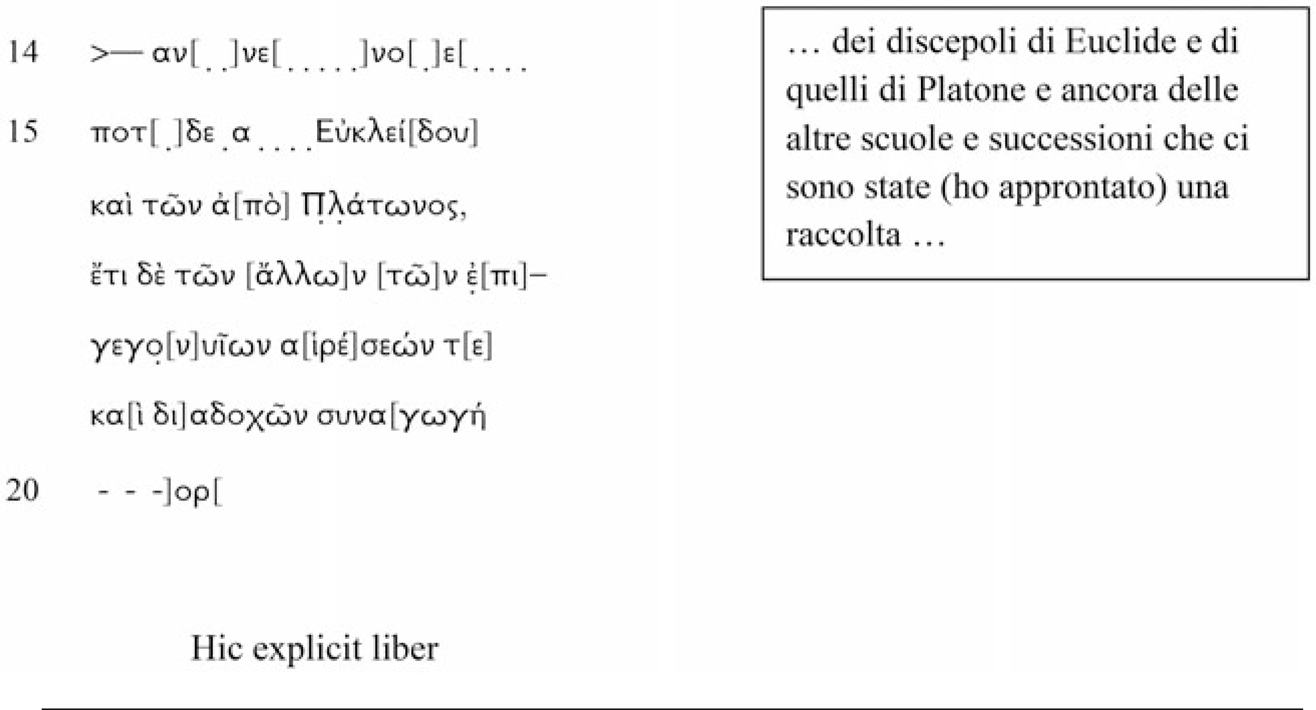
14–15 ὁ]|πότ[ε] Gaiser 15 Mekler/Gaiser: εὐκλεί[αι Bücheler 16 ἀ[πὸ] Π̣λ̣άτωνος Dorandi: ἀ[πὸ Πλά]τ̣ων̣ος Bücheler 17 [ἄλλω]ν [τῶ]ν Gaiser: τοὐντεῦθ]εν Mekler 18 Mekler 19 συνα[γωγή Mekler: συνα[γωγάς Gaiser 20 τόνδ᾿ ἐχέ]τ̣[ω μοι τὸν] ὅρ[ον Bücheler: [διέρχη]ι, [τὰ ἑπόμενα] ὁρ[ᾶις Gaiser
Earlier scholars seem to have regarded this final passage as a kind of closing summary, but for a long time glossed over this rather vexing passage, containing an unexpected mention of Euclides—whose teachings and pupils are not touched upon in the surviving part of the papyrus.Footnote 13 Remarkably, it was Gaiser who first tackled the problem directly, and suggested that the passage was supposed to provide an overview of the entire (remaining) work, not a closing summary: ‘Einen Ausblick auf das gesamte Werk gibt Philodem offenbar am Schluß der Academica, wo von weiteren philosophischen Richtungen die Rede ist.’Footnote 14 Dorandi adopts Gaiser's hypothesis in his edition ad loc.:Footnote 15 ‘Gaiser pensa, in maniera soddisfacente, a Euclide di Megara. Con τῶν ἀπὸ Πλάτωνος (αἱρέσεων) Filodemo indica non i discepoli e i successori di Platone in senso stretto, ma anche le scuole che da Platone si erano distaccate, per esempio, il Peripato e la scuola di Menedemo di Eretria.’ It would be unexpected to find an overview of the remaining part of the work or substantial parts of it at the end of the book on Plato and the Academy. Accordingly, one might be more inclined to adopt the aforementioned interpretation put forward by Sedley, who thinks that what we have here is a summary of the book, which must therefore have dealt with the Megarians, Plato and the Academics. However strange it might be to find an overview of more or less the whole book at this point in the work, a combined treatment of Plato, the Academics and the Megarians in a single book would not be very natural either—certainly, it would be quite unexpected.
3. A NEW READING OF THE FINAL PASSAGE OF THE INDEX ACADEMICORVM—EUCLIDES, PHAEDO AND ANTISTHENES
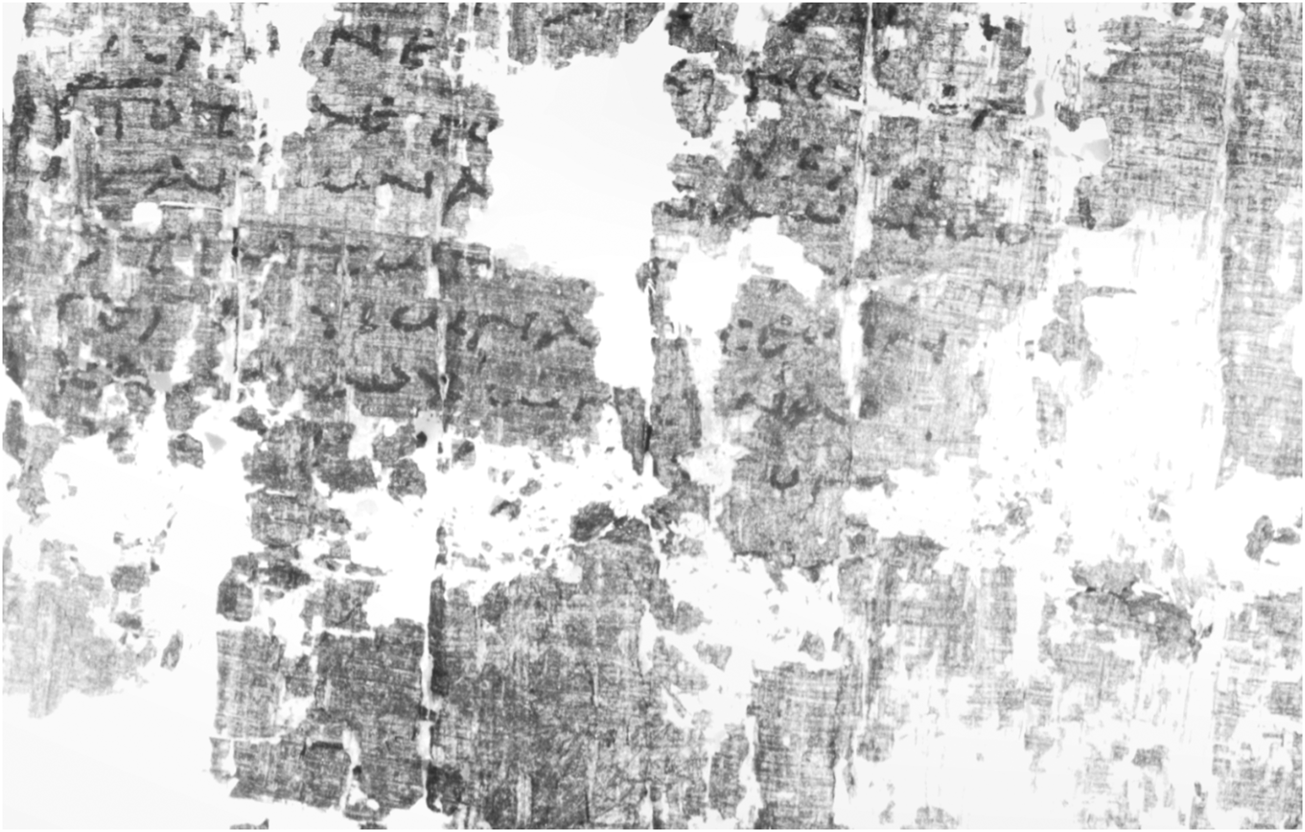
For the discussion in this chapter I may refer the reader to the image of the papyrus (MSI) to be found below (Figure 1). The reading of the name Plato in the passage can be traced back to the editio princeps by Bücheler, who relied exclusively on the Collectio altera (Neapolitan disegni). These drawings of the papyrus read λωμοσ, which Bücheler corrected to Πλά]τωνος, assuming that the disegnatore had mistaken μ for ν and λ for τ. The latter error (λ for τ) would be unusual. However, we do not have to focus on the disegni here, since the original is still preserved today and the multispectral images (MSI—see below) confirm what we can see with the naked eye: the reading Πλάτωνος is excluded by the traces in the papyrus. The letter preceding the ω must be either δ or λ, whereas δ fits considerably better with the traces. Before this letter the papyrus has a vertical at the bottom, hinting strongly at ι, which is preceded by a descending oblique compatible either with α or with λ. The papyrus is somewhat curled and stretched,Footnote 16 and a look at the original makes it even more obvious that the name of Plato cannot be read here. Instead, the supplement ἀ[πὸ Φ]α̣ί̣δ̣ωνος is not only possible but almost unavoidable.Footnote 17 Dorandi claims to have read a diple obelismene, but in fact we have here a huge right-angled hook open to the right and covering the πο in line 14 and extending with its vertical to line 15. There are ink traces on the right margin of line 14, which can hardly be from a letter, and on the left-hand margin of line 19 there might be the upper part of another hook. The right part of the papyrus has been destroyed. It seems possible that lines 15–20 were framed by four hooks marking (rather than deleting) this final passage in the draft version of Philodemus for whatever reason. What remains in line 18 in the original does not seem to allow for ἄλλω]ν [τῶ]ν ἐ̣[πι]–. The disegno has ενο at the end of the line, and the ο is supported by the original. The remaining traces allow for ἀ̣π̣᾿ [Ἀ]ν̣[τ]ι̣σ̣θ̣⌈έ⌉ν⌈ο⌉υ̣[ς.Footnote 18 Hence, my transcription of the end of the Index Academicorum, including a translation, reads as follows:
Philodemus, Ind. Acad. (P.Herc. 1021), col. 36.14–20 – end of book Biblioteca Nazionale Vittorio Emanuele III’ di Napoli, Italy – Brigham Young University (Provo, Utah, USA). All rights reserved. With permission from Ministero dei Beni e delle Attività culturali e del Turismo.

Philodemus, Ind. Acad. (P.Herc. 1021), col. 36.14–20 Fleischer:

15–16 et 19–20: init. et fin. parentheses angulares disp. Fleischer adiuvante Ranocchia
14–15 πoτ[ὲ] Fleischer: ὁ]|πότ[ε] Gaiser: πότ[ε] cogitaveris 15 Mekler/Gaiser 16 Φ]α̣ί̣δ̣ωνος, Fleischer: Π̣λ̣άτωνος perperam editores 17 ἀ̣π̣᾿ [Ἀ]ν̣[τ]ι̣σ̣θ̣⌈έ⌉νου̣[ς Fleischer: [ἄλλω]ν [τῶ]ν Gaiser (non ad vest. aptum vid.): τοὐντεῦθ]εν spat. long. Mekler 18 Mekler 19 συναγ̣[ωγή Mekler: συναγ̣[ωγάς Gaiser: συναπ̣[τ– vel συναψ̣[– vel συναχ̣[θ– vel συναγ̣[– cogitaveris 20 τόνδ᾿ ἐχέ]τ̣[ω μοι τὸν] ὅρ[ον Bücheler: [διέρχη]ι, [τὰ ἑπόμενα] ὁρ[ᾶις Gaiser 21 sub linea 20 fort. alia linea (l. 21) in P, sed certa vestigia non supersunt
My new reading of the passage reveals that the names occurring at the end of the Index Academicorum are those of Euclides (of Megara), Phaedo (of Elis) and Antisthenes (of Athens), not the names of Euclides and Plato. Plato is not mentioned and it is almost absurd to assume that he and his school, the Academy, went without explicit mention and were simply subsumed under sects or lines of succession deriving from those three philosophers. Besides, a common treatment of all those philosophers, including Plato and the Academy, in a single book (roll) is not a reasonably arguable hypothesis.Footnote 19
Phaedo and Euclides are also coupled by Diogenes Laertius who, contrary to the order in the Index Academicorum, deals first with Phaedo (2.105) and then with Euclides (2.106–8) before mentioning the direct pupils of Euclides and other Megarians, followed by Phaedo's pupils.Footnote 20 From Diogenes as well as from other sources it emerges that at least some of the philosophers mentioned should not be seen to stand in the tradition of a continuous and homogeneous succession of the Elean or the Megarian Schools, but as having established or represented their own school traditions and (sub)sects with varying scopes. There might have been a more or less orthodox Megarian and Elean–Eretrian line, but rather independent philosophers or groups would also seem to have existed. In the end, these philosophers may all have been associated with Phaedo and Euclides; at any rate, the historians of philosophy, including Diogenes Laertius, may have drawn this association in order to fit them within a (fictional) succession scheme. A vexed question in this context is whether the Dialectics represented a school different from the Megarians or whether the two designations are synonymous.Footnote 21 Diogenes devotes altogether more than thirty chapters to the Elean–Megarian School and related or derived sects.Footnote 22
Antisthenes of Athens is treated by Diogenes at the beginning of Book 6 (1–19). Being a pupil of Socrates, he is deemed to be the proto-Cynic and indeed the founder of the Cynic school, whose most famous representative was clearly his pupil Diogenes of Sinope. The whole of Book 6 is devoted to the Cynics. Diogenes (Laertius) even indirectly regards Antisthenes as the founder of the Stoa, since the Cynic Crates was Zeno's teacher.Footnote 23
Certainly, I would take οἱ ἀπ᾿ Εὐκλείδου, οἱ ἀπ᾿ Φαίδωνος, οἱ ἀπ᾿ Ἀντισθένους to refer to the founders and their pupils and official schools. It seems that the different sects (αἱρέσεις) and more official lines of succession (διαδοχαί) of the schools, which originated (γεγονυιῶν) from those philosophers, are indicated. Alternatively, only διαδοχαί might refer to institutional lines of succession in a strict sense, whereas αἱρέσεις might connote the philosophical aspects, that is, the system of philosophical principles.Footnote 24 For sure, all three philosophers are ‘Socratics’, but the ἔτι δέ separates Antisthenes to some extent from the other two, who were obviously seen as a kind of natural pair owing to their dogmatic similarities. Antisthenes and his school, as ἔτι δέ might imply, are a different matter.
4. A PREVIEW OF THE NEXT BOOK(S) ON THE SCHOOLS OF EUCLIDES, PHAEDO AND ANTISTHENES
Before discussing the exact meaning of the final passage and approaching the remaining textual problems, we should try to clarify what this passage basically refers to. As already stated, a combined treatment of all Academics, Eleans, Megarians and Cynics in one book should be excluded—Diogenes reserves about three and a half books for these philosophers and there is no reference to Plato in the final passage of Philodemus. But what do we have here, if not a conclusive summary? The answer ought to be simple: a preview of the next book, of the sort that can be found in several book-endings of Diogenes Laertius’ work. I quote all four Diogenian book-endings, which give a preview of the next book(s):
Diog. Laert. 2.144: καὶ οὗτοι μὲν οἱ Σωκρατικοὶ καὶ οἱ ἀπ' αὐτῶν, μετιτέον δὲ ἐπὶ Πλάτωνα τὸν τῆς Ἀκαδημείας κατάρξαντα, καὶ τοὺς ἀπ' αὐτοῦ, ὁπόσοι γεγόνασιν ἐλλόγιμοι. – end of Book 2 (preview of Books 3 and 4)
Diog. Laert. 4.67: ἡμεῖς δὲ τοὺς Ἀκαδημαϊκοὺς τοὺς ἀπὸ Πλάτωνος διεληλυθότες ἔλθωμεν ἐπὶ τοὺς ἀπὸ Πλάτωνος Περιπατητικούς, ὧν ἦρξεν Ἀριστοτέλης. – end of Book 4 (preview of Book 5)
Diog. Laert. 6.105: καὶ οὗτοι μὲν οἱ κυνικοί· μετιτέον δ' ἐπὶ τοὺς Στωικούς, ὧν ἦρξε Zήνων, μαθητὴς γενόμενος Κράτητος. – end of Book 6 (preview of Book 7)
Diog. Laert. 8.91: ἐπειδὴ δὲ περὶ τῶν ἐλλογίμων Πυθαγορικῶν διεληλύθαμεν, νῦν ἤδη περὶ τῶν σποράδην, ὥς φασι, διαλεχθῶμεν. λεκτέον δὲ πρῶτον περὶ Ἡρακλείτου. – end of Book 8 (preview of Book 9)
For our purposes, what proves most interesting is the preview given in Book 6, after the life of Antisthenes:Footnote 25 Diog. Laert. 6.19: ἐπειδὴ δὲ τοὺς ἀπ' Ἀριστίππου διεληλύθαμεν καὶ Φαίδωνος, νῦν ἑλκύσωμεν τοὺς ἀπ' Ἀντισθένους κυνικούς τε καὶ Στωικούς. καὶ ἐχέτω ὧδε. Additionally, we may note the end of Philodemus’ Index Stoicorum (col. 74.5–7):Footnote 26 οἱ μὲν οὖν ἀπὸ Z[ή]νω|νος Στωικοὶ διά[δοχοι| π]άντ̣[ες αἱ θ᾿ αἱρ]έσε[ις| (number of lines lost after line 7 unknown) – end of book.
I cannot see any reasonable way of interpreting the final passage of the Index Academicorum other than inferring that Philodemus lets his book end with a preview of the next book or maybe of the next two books. Unlike Diogenes, Philodemus does not seem to be briefly referring to the book he has just ended, unless one assumes that in the fragmentary and destroyed lines something of the sort was written.Footnote 27 Not least for reasons of syntax and space, I regard the hypothesis of a flashback along the lines of ‘having dealt with Euclides, Phaedo and Antisthenes, we have now also finished the book on Plato’ as rather unlikely. Moreover, this kind of back-reference at this point in the work would be rather unnatural and strange and a preview is much more expected. The question arises as to whether the preview refers to the following book (on the Megarians, EleansFootnote 28 and Cynics) or to the following two books (first book on the Megarians and the Eleans, followed by the book on the Cynics).
Given the considerable space that Diogenes reserves for Phaedo, Euclides and their ‘successors’ (more than 30 chapters), it is not unlikely at all that Philodemus dedicated a whole book to these philosophers and schools. While this book might not have had the size of the book about Plato and the Academics (P.Herc. 1691/1021), the Megarian-Elean philosophers, their (sub)schools and (sub)sects might have theoretically filled a whole book. Various references to Dialectics, and especially to Eubulides, in Philodemus’ works could reflect a certain interest in these philosophical currents.Footnote 29 In contrast to Diogenes, Philodemus treated Plato and his successors in a single book: he may have been saving some space, as it were, for another book and for a more extended discussion on the schools of Euclides and Phaedo. Even if this book was less extended than other books of the syntaxis, it is likely to have included more information on those philosophers or schools than Diogenes provides. We may note the extra material of the Index Academicorum that has not been transmitted by any other ancient source.Footnote 30 A separate Megarian book would imply that, as in Diogenes, the Cynics were dealt with in a separate book, namely in the book following the Megarian one. For such a ‘double preview’ of two books (schools) one may consider the above-cited final passages of Diog. Laert. 2.144 and 6.19 (also Diog. Laert. 2.47 and 2.85).
Equally reasonable, however, is the hypothesis that the Megarians and the Cynics were treated together in a single book. Certainly, devoting a separate book to the Cynics might seem more natural, but there was certainly enough space in a scroll for both, Megarians, Eleans and Cynics. One wonders whether the mention of Antisthenes would have been really necessary if he was not dealt with in the next book. On the other hand, it might be possible that Philodemus was here announcing the treatment of all remaining Socratics and therefore offering a preview of two books. The ἔτι δέ does not really favour either hypothesis, since it may either be due to the different character of the Cynic School or refer to a later, separate book. Anyway, the relative order of the schools discussed after the Index Academicorum seems clear to me: Euclides (Eleans)–Phaedo (Megarians)–Antisthenes (Cynics).
As already noted, I would exclude the hypothesis of a flashback referring to the treatment of the three schools before the Index Academicorum. Also the hypothesis that the three philosophers Euclides, Phaedo and Antisthenes had already been dealt with earlier, and that now only their school would be discussed (οἱ ἀπὸ …), seems rather unlikely. So for instance the expression οἱ μὲν οὖν ἀπὸ Z[ή]νω|νος Στωικοὶ at the very end of the Index Stoicorum certainly includes Zeno himself (the first preserved columns of the papyrus are devoted to him). I believe that we can also exclude that other schools (for example the Peripatos) were dealt with between the Index Academicorum and the three philosophers mentioned (for, otherwise, why is there no direct mention of Aristotle and the Peripatos, for example?).
Α possible ποτ[ὲ] δέ apparently finds no corresponding element (ποτὲ μέν) in the preceding lines. The traces in these lines do not favour ποτὲ μέν and it seems that the information on the pupils of Charmadas or Metrodorus respectively extended to line 14. Also the position of the rectangular hook(s) does not make a preceding ποτὲ μέν likely, since, whatever the exact meaning of the hook(s) may have been (I guess they only mark the final preview section in this draft), the expression would most probably have been framed within them. One could imagine that at the beginning of the Index Academicorum or at the end of the first book of the syntaxis there was a ποτὲ μέν, and all previews at the end of the following books started with ποτὲ δέ. Yet, this would be an artificial and far-fetched explanation. There are a few cases in ancient literature where ποτὲ δέ has no direct corresponding element and one could consider a translation of the following kind: ‘Now is finally the time (to deal with) …’ or ‘At some time (that is, in the following book) we will deal with …’. There might have been a future tense or an imperative/subjunctive (perhaps the first-person plural) with a future meaning at the end of the sentence in line 19 or 20. If we change the accent, πότε δέ could be taken to introduce a direct or indirect question, but it is difficult to make sense of a direct question in this context. Assuming that the hooks were added later and that the first ο at the end of line 14 was not included in order to avoid confusion, Gaiser's ὅποτε might be arguable.Footnote 31 A more or less fitting clause with this conjunction might be reconstructed, but it is not very straightforward. For palaeographical and syntactical/grammatical reasons I am inclined to prefer ποτ[ὲ] δέ, supposing a slightly elliptic and concise use by Philodemus, who would be announcing in a somewhat peculiar way that he is now moving on to the philosophers mentioned.
The sequence of letters συνα might be a form of συναγωγή, but another word (for example a verb or a participle or even σὺν α) is also possible. The sense of the passage was probably: ‘At some time [in the following book] … the sects and lines of succession deriving from Euclides and Phaedo, besides those deriving from Antisthenes (shall be dealt with).’ Of course, the fragmentary status of the text should prevent us from insisting on a particular reconstruction. The phrasing and the structure of this final passage might have been more elaborate or slightly different from the translation I have proposed exempli gratia, but its general meaning—that is, the offering of a preview—now becomes clear.
5. A COMPARISON OF THE STRUCTURE OF PHILODEMUS’ AND DIOGENES’ WORKS
The following papyri can be assigned with varying degrees of certainty to Philodemus’ Σύνταξις τῶν φιλοσόφων (syntaxis philosophorum).Footnote 32
Assignment very speculative (content not entirely certain either):Footnote 33

Crönert proposed that P.Herc. 327 included a history of the Eleatic and the Abderitan Schools.Footnote 39 To be sure, the assignment is by no means arbitrary or impossible, but it is considerably speculative owing to the scanty fragments.Footnote 40 The same can be said—mutatis mutandis—about P.Herc. 1508 and in this case the assignment seems even more problematic to me.Footnote 41 If not a separate biography—such as the Vita Philonidis (P.Herc. 1044), for instance—the papyri dealing mainly with Socrates (P.Herc. 495 and P.Herc. 558) might be assigned to the syntaxis.Footnote 42 It is possible that the content was not limited to Socrates’ biography. Although Crönert did not include the Index Epicureorum (P.Herc. 1780) among the books of the syntaxis, recent scholarship tends to see P.Herc. 1780 as part of the syntaxis.Footnote 43 The only caveat for an attribution of this sort might be that we have two other treatises, Tractatus (P.Herc. 1418 + 310) and De Epicuro (Περὶ Ἐπικούρου), among the Herculanean papyri, which are surely not part of the syntaxis, but which also deal with historical-philosophical matters.Footnote 44 Provided that the assignment is correct, the question arises whether Epicurus was the subject of one book and his successors of another. If this is so, P.Herc. 1780 would be Book 11 of the syntaxis, since, for example, the Epicurean scholarch Dionysius, his last will and a succession are mentioned in the papyrus. Yet, I do not favour the assumption that the syntaxis had more than ten books.Footnote 45 As in the Index Academicorum, Philodemus might have closely connected the founder of the Epicurean school to his successors by presenting them in the same book.Footnote 46 There are practically no doubts concerning the assignment of the Index Stoicorum and the Index Academicorum, and consequently the Index Megaricorum and the Index Cynicorum (or, alternatively, the Index Megaricorum et Cynicorum), books which were derived from our above-discussed new reading and interpretation of the final passage of the Index Academicorum. We can confidently say that the Index Academicorum cannot have been Book 9 of the syntaxis, since it was followed by a non-Epicurean book and Epicureans are dealt with in Book 10. Plato cannot have been dealt with in the first book, since the account on Socrates most likely preceded the account on Plato and the Academics. Consequently, the Megarians, the Eleans and the Cynics did not appear earlier than in Book 3.Footnote 47
For a comparison between the structure of Philodemus’ work and Diogenes’ work, we may recall the structure of Diogenes’ work in ten books.
1 Seven sages
2 Anaximander, Anaximenes, Anaxagoras, Archelaus, Socrates (18–47), Xenophon, Aeschines, Aristippus, Theodorus, Phaedo (105), Euclid (106–8), the ‘pupils and successors’ of Euclid (113–20), other minor Socratics, Menedemus (125–44)
3 Plato
4 Academy
5 Peripatos
6 Cynics (Antisthenes, Diogenes, etc.)
7 Stoa (partly lost)
8 Pythagoreans and Empedocles
9 Heraclitus, Eleatics, (early) Atomists, Protagoras, Pyrrhonists
10 Epicureans
Divergences between Philodemus and Diogenes:Footnote 48
a) Philodemus arranges Plato and his successor in a single book (Index Academicorum).
Diogenes arranges Plato and his successor in two separate books (Books 3 and 4).
b) Philodemus deals with the Megarians/Eleans (possibly together with the Cynics) in a book after the book on the Academy and does not discuss Aristotle immediately after the Academy.
Diogenes places the Megarians/Eleans at the end of Book 2, which deals with various other philosophers (but not with the Cynics). The Megarians/Eleans precede, rather than follow, the book on the Academy (Plato), and Aristotle is dealt with in the book following the Academics.
c) Philodemus deals with Socrates and the Megarians/Eleans in separate books.
Diogenes deals with Socrates and the Megarians/Eleans in the same book.
d) Philodemus mentions first Euclides and then Phaedo in the preview of the Index Academicorum.
Diogenes mentions first Phaedo and then Euclides in Book 2.
e) Philodemus has most probably dealt with Socrates in a book preceding the Index Academicorum (for chronological and logical reasons) and therefore inserted Plato (and the Academics) between Socrates and the Megarians.
Diogenes inserted the Megarians between Socrates and Plato.
f) Philodemus deals with the Cynics immediately after the Megarians.
Diogenes deals with the Megarians at the end of Book 2 and with the Cynics in Book 6.
Convergences between Philodemus and Diogenes:
a) Philodemus devotes Book 10 to the Epicureans.
Diogenes devotes Book 10 to the Epicureans.
b) Philodemus writes first about Plato, then about the Academy.
Diogenes writes first about Plato, then about the Academy.
c) Philodemus dealt with the Stoics in a single book.
Diogenes dealt with the Stoics in a single book.
d) Philodemus gives at least once a preview at the end of a book.Footnote 49
Diogenes gives previews at the end of four books and sometimes within books.
e) Philodemus deals with the Cynics after Plato.
Diogenes deals with the Cynics after Plato.
The ‘external structure’ (the relative and absolute order of the philosophers/schools) of the works of Philodemus and Diogenes differed in one crucial respect, namely the place assigned to the Megarians/Eleans, Cynics and Peripatetics within the text. Philodemus deals with the Megarians after Plato and the Academy, Diogenes before them. Philodemus deals with the Cynics immediately after the Megarians/Eleans, Diogenes has three books between the Megarians and the Cynics. Since Aristotle is hardly dealt with before Plato, Philodemus must have discussed him after the Cynics. On the contrary, Diogenes devotes Book 5 to Aristotle and Book 6 to the Cynics. It is probable that Book 10 also marked the end of Philodemus’ work and that, as in Diogenes, Epicurus and his successors were the subject of this book. This coincidence might be less remarkable than it seems at first glance. While it cannot be taken for granted, the choice to end with the Epicureans is a rather natural one for a historian of philosophy, since these philosophers are chronologically rather late and more difficult to fit within a succession scheme compared to other schools. Therefore, their occurrence towards the end of a work, or at the very end, is not unexpected. The relative order of the schools discussed was obviously rather divergent and might be illustrated as follows:
Philodemus’ relative order:
(Socrates) – Plato – Academics – Megarians – Eleans – Cynics – (Peripatetics?) – Epicureans
Diogenes’ relative order:
Socrates – Eleans/Megarians – Plato – Academics – Peripatetics – Cynics – Epicureans
Equally noteworthy are the divergences in the ‘internal structure’ of the works. Plato and his successors were discussed in a single book by Philodemus, whereas Diogenes reserved one book for Plato and another book for his successors. The Megarians/Eleans possibly had their own book in Philodemus’ syntaxis, while Diogenes ‘only’ integrates them in his second book, which also discusses Socrates. Philodemus instead dealt with Socrates—although not necessarily exclusively with him—in a book which did not include the Megarians/Eleans. In the case of a separate Megarian/Elean book, a common element of Diogenes and Philodemus would be the presence of a separate book for the Cynics. Given a combined treatment of the Megarians/Eleans and the Cynics, we would have another divergence. The final passage of the Index Academicorum could imply that Euclides and Phaedo were mentioned in the Index Megaricorum in an order reverse to the order Diogenes applies. Concerning certain convergences in the ‘internal structure’ of the works, one may state quite trivially that the Stoics were given one book and that Plato was followed by his Academic successors. The fragmentary remains of the so-called Index Pythagoreorum and Index Eleaticorum et Abderitum should prevent us from drawing any comparison, since even their content (and assignment) is very doubtful. The common element of a preview might be worth pointing out, but also several other ancient works provide a preview of this kind at the end of certain books. Consequently, this similarity should not be overestimated, though it may hint at a common feature of some ‘Histories of Philosophy’.
6. CONCLUSION—PHILODEMUS’ STRUCTURE HARDLY SERVED AS A MODEL FOR DIOGENES
Drawing a conclusion from the convergences and divergences between the two ‘Histories of Philosophies’ by Philodemus and Diogenes, one should not simply perform a dull quantitative analysis, but consider the independence and quality of the similarities and the dissimilarities. The only substantial similarity between Diogenes’ work and that of Philodemus is the fact that, in all likelihood, they had the same number of books and provided a treatment of Epicurus and his successors in Book 10. This similarity is by no means trivial and absolutely justifies the previous speculations about a common or similar structure of the two works. However, I have also identified several points of divergence. By contrast to Diogenes, Philodemus includes Plato and the Academy in a single book and possibly devotes a separate book to the Megarians/Eleans (no combined treatment with Socrates), and places this book after Plato and the Academy, not before them. He treats the Cynics immediately after the Megarians/Eleans, not leaving several books in between. A joint treatment of the Megarians/Eleans and the Cynics in a single book is certainly a possibility. The Peripatos is not placed between the book about the Academy and the book about the Cynics. We must conclude that the difference between Philodemus and Diogenes is either that the Cynics did not have their own book in Philodemus or, alternatively, that the Megarians did. These non-trivial divergences in the structures of the two works and the resulting divergent orders assigned to the philosophers weaken the hypothesis that the structure of Philodemus’ work may have served as a model for Diogenes (Gigante) to a significant extent. I am even inclined to say that the many divergences are a good reason to reject this hypothesis, unless new evidence emerges to suggest otherwise. How different the overall structure of the two authors’ works was—that is, the order of books (schools), and the arrangement of schools and philosophers—is impossible to say, but the evidence we have reveals that there were at least some very significant divergences.
Scepticism about the idea that Philodemus served as a model for Diogenes may be corroborated by the observation that Philodemus is only quoted (or referred to) twice by Diogenes, namely in Book 10. Although I have some remaining doubts, I tend to share the view of most scholars that Diogenes probably consulted Book 10 of Philodemus’ syntaxis directly. However, the fact that no other mention of Philodemus is made in the rest of the work is more than suspicious and suggests that Diogenes made use only of this individual book, if he had direct access to it at all. Book 10 must have been particularly attractive for Diogenes—the Epicurean Philodemus writing about Epicurus and Epicureans. I would even venture that the only surviving book of the whole syntaxis by Diogenes’ time (or, at any rate, the only one available to him) was Book 10, possibly owing to its much-appreciated Epicurean authorship. Assuming that the syntaxis really served as a model for Diogenes, he must have had access to the whole work. If so, one wonders why he did not draw upon and cite Philodemus in other books. Even if we assume that Diogenes drew upon him but did not cite him explicitly, he must have at least ignored Philodemus in the book about the Academy. Philodemus preserves much interesting information in the Index Academicorum not to be found in Diogenes—in particular, Philo and Antiochus are overlooked—and the different treatments of the same subjects make it clear that Philodemus was not Diogenes’ source. It is hardly believable that Diogenes, if he really did have access to the whole work and accordingly to the Index Academicorum, did not draw upon Philodemus for Plato and the Academy.Footnote 50 It is also rather absurd to assume that Diogenes only took a quick look at the structure of Philodemus’ work, adopted it but did not make any use of the work afterwards for the content of his work. But, even in this case, Diogenes obviously did not follow Philodemus’ structure closely (to say the least), as I have demonstrated in this contribution. The natural and easiest explanation for all this is that Diogenes simply did not know Philodemus’ entire work and consequently could not copy or follow its structure. Some basic and rather trivial elements the two authors share in common (for instance the treatment of the Stoics in one book) can hardly be taken as proof or evidence of the fact that Philodemus was Diogenes’ model, since such elements were demonstrably features of many other ‘Histories of Philosophy’ and a certain chronological-successional approach automatically leads to some common structural elements. Therefore, not every (trivial) similarity between Philodemus and Diogenes implies direct dependence. On the contrary, where structural features are no longer ‘trivial’, divergences between Philodemus and Diogenes must be stated.
To sum up, in the light of my new reading of the final passage of the Index Academicorum and of the other arguments brought up here, the hypothesis that Philodemus’ syntaxis figured as a model for the structure of Diogenes’ work can hardly be upheld any longer. Apart from the common Epicurean Book 10, the order of the philosophers discussed and their grouping into books were different in many respects, and more trivial similarities are not that meaningful.Footnote 51 Maybe even more striking than the differences in structure I have identified is the fact that there is absolutely no positive evidence in Diogenes supporting the view that he had access to the entire work of Philodemus, made use of it and applied it as his model. If at all, he only had direct access to Book 10. It cannot be excluded that new discoveries among the Herculaneum papyri may refine or mitigate my conclusion, but, considering the current status quo, the structure of Diogenes’ and Philodemus’ ‘Histories of philosophy’ cannot be judged similar in any meaningful sense. Hence, a direct Philodemean influence on Diogenes’ structure is not likely. Whomever Diogenes followed in structuring his work—if indeed there was any specific model for his apparently rather idiosyncratic treatise—most probably it was not Philodemus’ Σύνταξις τῶν φιλοσόφων.Footnote 52