Introduction
Owing to growing recent interest in successful aging (SA), this topic has gained significant traction as an area of research. However, SA research is limited by non-availability of a standardized definition, deficiencies in existing models of SA, and lack of consensus on what comprises SA (Depp and Jeste, Reference Depp and Jeste2006; Pruchno et al., Reference Pruchno, Wilson-Genderson and Cartwright2010). The most widely researched model of SA is that proposed by Rowe and Kahn (Reference Rowe and Kahn1987). According to this model, SA involves freedom from disease and disability, high cognitive and physical functioning, and an active engagement with life. This model has been criticized in subsequent research for a restrictive focus on physical and cognitive health (Crowther et al., Reference Crowther, Parker, Achnebaum, Larimore and Koenig2002), a problematic assumption that all three traits are equally weighted across all age groups (Weir et al., Reference Weir, Meisner and Baker2010), and exclusion of psychological traits such as spirituality and well-being (Crowther et al., Reference Crowther, Parker, Achnebaum, Larimore and Koenig2002). Moreover, it has been found that persons who do not meet the criteria proposed by Rowe and Kahn still rate themselves subjectively as aging successfully (Strawbridge et al., Reference Strawbridge, Wallhagen and Cohen2002; Montross et al., Reference Montross2006), suggesting a disconnect between subjective appraisals and objective definitions of SA.
The lack of clarity in the definition of SA is further demonstrated in a comprehensive literature review by Depp and Jeste (Reference Depp and Jeste2006). In this review, Depp and Jeste found 29 distinct components of SA across 28 quantitative studies. They noted that aside from “absence of physical disability,” every other component was included in fewer than half the reviewed studies. Their review confirms that across disciplines researchers conceptualize SA very broadly, thus limiting how well the existing literature can be synthesized into a more empirical understanding of SA.
Recent work has demonstrated associations between self-rated successful aging and several psychosocial domains such as resilience (Lamond et al., Reference Lamond2008), spirituality (Vahia et al., Reference Vahia2011b), attitude towards own aging (Kavirajan et al., 2011) and functioning. In addition, we have demonstrated an association between presence of subsyndromal depressive symptoms and lower scores on a broad range of indicators of successful aging (Vahia et al., Reference Vahia2010). This last finding points to the importance of incorporating mood and emotion-related factors (such as presence of depression) along with cognitive, physical and psychosocial indicators of SA.
Pruchno and colleagues (Reference Pruchno, Wilson-Genderson and Cartwright2010) used factor analyses to propose a two-factor model of SA that incorporates both subjective and objective definitions of SA, suggesting a dimensional approach to SA. A dimensional approach offers the advantage of being applicable to a broad range of populations, and of being relatively independent of demographic or cultural elements that could limit applicability of standardized definitions (Weir et al., Reference Weir, Meisner and Baker2010; Lewis, Reference Lewis2011). The two-factor model proposed by Pruchno and colleagues, however, focuses primarily on physical functioning, absence of pain, and subjective successful aging. In this study we propose to expand Pruchno and colleagues’ model to incorporate cognitive ability, mood, and psychosocial traits identified in previous literature as being most clearly associated with successful aging, i.e. self-efficacy, resilience, attitude towards own aging, and optimism. We also aim to use cutting-edge statistical approaches to identify the strength and direction of associations between dimensions of SA. Our methodology will allow us to identify primary dimensions of SA, based on factor loading of measures of SA-related traits. Since the existing literature suggests that dimensions of successful aging tend be associated with each other, rather than independent, we will also use the empirical pattern of partial correlations among the factors to identify how the domains identified by factor analysis are associated with each other. In this manner, our model will not only identify the dimensions of SA, but also shed light on interaction between these dimensions. This dimension based-approach may also help identify areas that could be potential targets of interventions to promote successful aging.
Based on current literature, and findings from our previous work, we hypothesized that physical, psychological/emotional, and cognitive domains would represent separable but potentially correlated factors. We further hypothesized that self-rated successful aging would load on all three of these factors.
Methods
Sample
The study sample consisted of women enrolled at the San Diego site of the Women's Health Initiative study, a large NIH-funded multi-center study of the predictors of morbidity and mortality among post-menopausal women (McCall-Hosenfeld et al., Reference McCall-Hosenfeld2008) who were followed for an average of seven years between 1994 and 2005. A detailed description of the WHI methodology is available in prior publications (Women's Health Initiative, 1998). Inclusion criteria were post-menopausal status, plan to reside in the area for at least three years, no medical conditions predictive of survival less than three years or complicating disorders such as substance abuse disorders, and ability to provide written consent. The WHI included an observational study and three separate clinical trials, involving hormone replacement therapy, dietary modification, and calcium/vitamin D supplementation.
At their final study visit, 3653 San Diego WHI enrollees were invited to participate in a self-rated study of successful aging (SA). For this study, women either consented at their final clinic visit or by mail, and all those who consented were mailed a successful aging questionnaire. Overall, 2017 women returned the SA survey questionnaire, and after initial screening, 1979 surveys were deemed acceptable. We noted no differences between returned surveys from participants in the observational study and those in clinical trials. We have previously published several studies based on analyses of data collected using this questionnaire in the same sample, on topics including spirituality, subsyndromal depression, attitude towards own aging, and resilience (Vahia et al., Reference Vahia2010; Reference Vahia, Chattillion, Kavirajan and Depp2011a; Jeste et al., Reference Jeste, Depp and Vahia2010b). For the current study, we conducted analyses on the subsample of 1948 English-speaking women, aged 60–89 years old who returned the SA survey with a signed consent form. Thirty-one subjects were excluded because of unacceptable preponderance of missing information on variables included in this study. The Institutional Review Board of the University of California, San Diego approved this study.
Measures
Demographic and socioeconomic variables
Age and self-reported race/ethnicity information were obtained through the successful aging questionnaire. Race was coded as a dichotomous variable (1 = white; 0 = all other racial categories) because of the heavy predominance of white participants.
Education, marital status and income data were obtained from the baseline WHI questionnaire, collected approximately five to seven years before other measures.
Self-rated successful aging
Participants rated their own level of successful aging on a 10-point Likert scale, with 1 being least successful and 10 most successful (Montross et al., Reference Montross2006).
Measures of successful aging domains
Our questionnaire included multiple self-report measures of domains related to successful aging. For this study, we included only those domains that had been found to be associated with successful aging in previous literature or in our prior work. Further, we only included domains measured using standardized, validated scales. Self efficacy was measured using a brief eight-item version of the Self-Efficacy Scale (SES) (Sherer et al., Reference Sherer1982). Scores on this scale range from 8 (low self-efficacy) to 32 (high self-efficacy) and are indicative of a person's ability to carry out the regular day-to-day activities in their life. Optimism was measured using the Life Orientation Test (LOT) (Scheier et al., Reference Scheier, Carver and Bridges1994). The LOT is a six-item scale, scored from 6 to 30, with higher scores indicating a higher level of optimism. Attitude Towards Own Aging was measured using the Attitude Toward Aging subscale of the Philadelphia Geriatric Morale Scale (PGMS) (Lawton, Reference Lawton1975; Kavirajan et al., 2011). The PGMS is a five-item scale where scores range from 0 (negative attitude) to 5 (positive attitude). We employed the 25-item Connor Davidson Resilience Scale (CD-RISC) (Connor and Davidson, Reference Connor and Davidson2003) to measure resilience. Scores on the CD-RISC range from 0 to 100, with higher scores indicating a higher level of resilience. We used the physical and mental/emotional composite scores of the MOS-RAND SF-36 as indicators of physical and mental/emotional functioning respectively (Ware and Sherbourne, Reference Ware and Sherbourne1992). Each of these composites is scored from 0 to 100, and higher scores indicate higher health related quality of life and functioning. To measure severity of depression, we used the Center for Epidemiological Studies Depression Scale (CESD) (Radloff, Reference Radloff1977). The CES-D is a 20-item self-report measure of depression. Scores greater than 16 on the CES-D are indicative of clinical depression and scores between 8 and 15 are considered indicative of subsyndromal depression. To measure cognitive status we used a modified version of the Cognitive Assessment Screening Tool (CAST) (Drachman and Swearer, Reference Drachman and Swearer1996). Our version was shortened, and included tests of orientation, crystallized knowledge (naming the president, previous president, and governor), simple copying of a drawing and a sentence, the ability to draw a person, numeric calculation, check writing, clock-drawing, copying a cube, and naming both senators of one's state and the vice-president.
Statistical analysis
We first examined successful aging (SA) variables for normality; we log-transformed those variables exhibiting high levels of skewness. Missing data on SA variables and demographics (age, education, and income) were imputed using the method of chained equations (van Buuren, Reference van Buuren2007). To control for the effects of age, education, and income, we fitted multiple linear regressions for each of the nine SA variables and extracted the residuals (observed value minus predicted) for each subject. We then fitted an exploratory factor analysis (EFA) model to these covariate-adjusted SA variables, using maximum likelihood. We selected enough factors to explain at least half of the observed variation and to obtain an adequate fit to the data as determined by a χ2 test. Factors were rotated using an oblique rotation (promax, with power equal to 4). Oblique rotations seek a simple structure without enforcing orthogonality of resulting factors.
Next, we computed a Bayesian Belief Net (BBN) using the rotated factor scores. A BBN is a data-driven methodology for discovering the network structure in a system of variables (Tsamardinos et al., Reference Tsamardinos, Aliferis and Statnikov2003; Hasanat et al., Reference Hasanat, Ramachandram and Mandava2010). The links in a BBN are obtained by estimating partial correlations between pairs of variables controlling for the remaining variables in the system. Variables A are called the “parents” of variable B if there are direct links from A to B; conversely, B is called a “descendent” of A. The directed links to B from its parents A codify the property that B is independent of its non-descendents conditional on its set of parents A. While we do not make causal claims in this report, these directed relationships are identical to direct causal relationships under (untestable) assumptions about the underlying system of variables (Tsamarinos et al., Reference Tsamardinos, Aliferis and Statnikov2003). Undirected links between two variables result from significant partial correlations between them but inconclusive conditional independence relationships with the remaining variables. The significance levels of links of the BBN were set at a Bonferroni-adjusted threshold of 0.005. All analyses were done using SPSS Version 12 and R Version 2.10.
Results
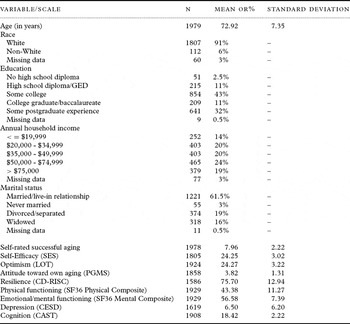
In terms of demographic information (Table 1), the sample of women was predominantly Caucasian, relatively well educated (with over 81% reporting a high school diploma or higher, and 33% reporting a college degree or higher), and relatively affluent (with 46% reporting a household income of $50,000 or higher). Mean scores on CESD were below 8, suggesting that our sample had minimal depressive symptoms (Vahia et al., Reference Vahia2010).
Descriptive statistics for sample

On all scales except CESD, higher scores indicate better functioning. For CESD, higher scores indicate higher depression i.e. worse functioning.
SES = Self Efficacy Scale; LOT = Life Orientation Test; PGMS = Philadelphia Geriatric Morale Scale; CD-RISC = Connor Davidson Resilience Scale; CESD = Center for Epidemiological Studies Depression Scale; CAST = Cognitive Assessment Screening Test.
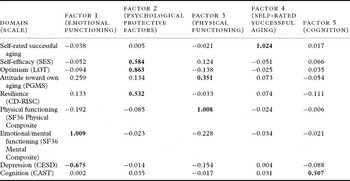
The exploratory factor analysis showed that five factors explained 69.1% of the variation in observed responses and resulted in an adequate fit (χ2 = 1.87, df = 1, p = 0.172). The promax-rotated factor loadings for the five factors are given in Table 2, along with percentage variance explained by each factor. Using the common threshold of 0.3, Factor 1 (labeled “Emotional functioning”) loaded onto CES-D and SF-36 Mental Component. The second factor (“Psychological protective factors”) loaded onto Self-Efficacy, Optimism, and Resilience. The third factor (“Physical functioning “) loaded onto Attitude toward own Aging and SF-36 Physical Component. The fourth factor loaded only on Self-Rated Successful Aging, and the fifth loaded only on cognitive abilities as measured by the CAST. We note here that interpretation of these results should be colored by the fact that measurement error in the individual scales may attenuate factor loadings in any EFA.
Factor loadings for successful aging related variables

Percent variance explained: Factor 1, 17.3%; Factor 2, 16.5%; Factor 3, 13.7%; Factor 4, 11.1%; Factor 5, 10.5%.
SES = Self Efficacy Scale; LOT = Life Orientation Test; PGMS = Philadelphia Geriatric Morale Scale; CD-RISC = Connor Davidson Resilience Scale; CESD = Center for Epidemiological Studies Depression Scale; CAST = Cognitive Assessment Screening Tool.
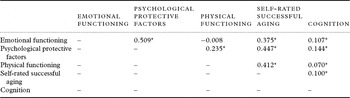
These factors had low-to-moderate levels of correlation with each other, with all associations except one achieving statistical significance after Bonferroni correction (Table 3).
Correlation between rotated factors

* Significant at the Bonferroni-adjusted level 0.05/10 = 0.005.
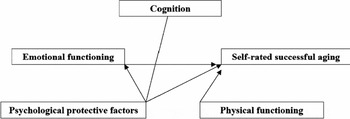
The BBN is provided in Figure 1. In generating the BBN, all factors were equally weighted and, as described in the statistical analysis section, effects of age, income and education were adjusted for. The BBN demonstrated five significant partial correlations. It is important to emphasize that the directional associations in the BBN codify observed conditional independence relationships in these data but do not imply causality except under untestable assumptions (Tsamardinos et al., Reference Tsamardinos, Aliferis and Statnikov2003). As Figure 1 demonstrates, the exploratory results from the BBN indicate that self-rated successful aging received inputs from strength of psychological protective factors, physical/general status and mental emotional/status. Cognition, however, is not directly related to self-rated successful aging. Also, notably, psychological protective traits such as resilience, self-efficacy, and optimism appear to be upstream entities strongly related to mental/emotional status and physical/general status.
Bayesian Belief Net.
Note: Presence of a link between two variables indicates that the partial correlation is significantly different from zero between the two variables. Presence of a directed link (i.e. arrow) indicates if the partial correlation graph structure conforms to a directional relationship of one variable acting causally on another. Note, this does not imply causality, but rather consonance of the observed data with that which would have been obtained from a causal network. Absence of a link between variables denotes that partial correlation between those variables was not significant.
Coefficients of Links: Psychological Protective factors -> Mental Emotional Status: 0.428
Psychological Protective factors – Cognition: 0.083
Psychological Protective factors -> Self-rated Successful Aging: 0.226
Mental/emotional status -> Self-rated Successful Aging: 0.265
Physical/General status -> Self-rated Successful Aging: 0.397

Discussion
The primary aim of this study was to develop a dimension-based model for SA that incorporated subjective self-rated successful aging as well as cognition, physical and emotional/mental functioning, impact of depressive symptoms, resilience, optimism, attitude toward own aging, and self-efficacy. Through exploratory factor analysis we identified five latent domains: self-rated successful aging, cognition, physical/general status, mental/emotional status, and psychosocial protective factors. We noted that each of these domains was weakly to moderately correlated with the other domains. To evaluate the nature of association between these domains, we then constructed a BBN and explored putative directional associations between individual domains using relationships determined by partial correlations. We found that self-rated successful aging was primarily a downstream rather than upstream domain. Also, contrary to our primary hypothesis, we noted that self-rated successful aging was impacted by psychosocial protective traits, physical/general status, and mental/emotional status, but not by cognition. The impact of cognition on self-rated successful aging appeared to be mediated by psychological protective traits. This finding suggests that intact memory, concentration, and logic (as represented by intact “cognition”) are less important in determining subjective successful aging than psychological traits and physical and mental status. This finding echoes a suggestion by Weir and colleagues (Weir et al., Reference Weir, Meisner and Baker2010) that subjective successful aging may not be a reliable benchmark for measuring SA. This finding also supports the suggestion of Blazer (Reference Blazer2006) that high self-rated successful aging does not imply a high level of cognitive function. It is, however, important to note that our BBN suggests that self-rated successful aging synthesizes inputs from multiple dimensions.
We also found that physical functioning was downstream from self-rated successful aging independently of the other domains. Previous reports (Montross et al., Reference Montross2006) have found that high self-rated successful aging was possible despite physical disability. It is possible that better attitude toward own aging – a component of the physical functioning dimension – may impact how physical function interacts with self-rated successful aging. Additionally, we found that mental/emotional status was associated with self-rated successful aging, and that mental/emotional status may also mediate the positive impact of psychosocial protective traits such as resilience, optimism, and self-efficacy on self-rated SA This finding speaks to the impact of depression on SA. There is a growing body of research (Lyness et al., Reference Lyness, Chapman, McGriff, Drayer and Duberstein2009; Vahia et al., Reference Vahia2010; Meeks et al., Reference Meeks, Vahia, Lavretsky, Kulkarni and Jeste2011) showing that subsyndromal depression is up to three times more common in older adults than major depression, is often undiagnosed and under treated, and has a significant negative impact on morbidity in older persons. Subsyndromal depression has been found to be more responsive to interventions such as physical exercise (Vahia et al., Reference Vahia2010; Meisner et al., Reference Meisner, Dogra, Logan, Baker and Weir2010) than to medication. Hence, this represents a clear target for intervention. When considered in the light of other recent evidence (Bowling and Iliffe, Reference Bowling and Iliffe2011) suggesting that psychological intervention approaches may have a more long-lasting impact on SA than physical health-based approaches, this finding highlights the role that geriatric psychiatrists can play in improving SA.
Our study may also have broader implications for how mental illness is conceptualized in late-life. It has recently been suggested (Jeste et al., Reference Jeste, Wolkowitz and Palmer2011) that trajectories of physical, cognitive, and psychosocial aging may diverge in persons with schizophrenia and potentially other mental illnesses. With growing evidence for accelerated physical aging in late-life psychiatric illness, there is an impetus to identify other dimensions such as cognition, resilience, and functioning that may be intervention targets to boost potential for better outcomes with age, despite the potential for worse physical functioning. Our study suggests some preliminary avenues for research in this area.
Findings from our study must be interpreted with caution in the light of several limitations. First, our sample comprised only post-menopausal women who had volunteered to participate in the Women's Health Initiative study. Participants in this study also tended to have relatively higher income and educational attainment than the general US population. While we adjusted for these factors in our analyses, these results may not apply to other sociodemographic groups. The nature of our sample may limit the generalizability of the associations noted in our model as well, and will need to be replicated in other diverse samples. Our sample also prevents us from studying gender effects. It has been suggested that there are gender differences in patterns of successful aging (Bowling and Iliffe, Reference Bowling and Iliffe2006; Depp and Jeste, Reference Depp and Jeste2006), and we are unable to determine whether these domains interact similarly among men and women. Second, the cross-sectional and observational nature of the data strongly cautions against inferring causal relationships from our model. However, this domain-based model provides a framework that future longitudinal or interventional studies may use to test for stronger evidence of causal relationships. Third, our measures were self-reported, and may be limited by recall and reporting bias, though we have previously demonstrated that social desirability (Dawes et al., Reference Dawes, Palmer, Allison, Ganiats and Jeste2011) does not impact reliability of self-report findings. It is also possible that scores may be influenced by the mood states of the participants at the time of completing the study instrument. Fourth, we did not specifically include physical illness burden in our model, though SF36 physical functioning is likely to reflect impact of physical illness vis-à-vis disability. Finally, there is growing evidence to suggest that domains such as religiosity, spirituality and wisdom also impact on successful aging and related domains (Jeste et al., Reference Jeste2010a; Vahia et al., Reference Vahia2011b; van Ness and Kasl, Reference van Ness and Kasl2003). In our model, we were not able to incorporate these domains since we did not have standardized, validated measures available in our questionnaire. Future work should incorporate these domains to create a more inclusive model of successful aging.
Our study has several strengths that we believe offset the limitations. The well-defined nature of our sample limits confounders related to ethnicity and race and the impact of socio-economic stressors on aging. Our use of standardized scales for all variables, and our broad range of selected traits and domains, represent, to our knowledge, the most inclusive model of successful aging reported in the literature. Our model also incorporates evidence of directed relationships, which can guide the process of developing intervention targets to improve successful aging.
In summary, we believe that this study represents an incremental step in the process of developing an inclusive and generalizable model of successful aging. We recommend that future investigators test our findings in larger, diverse, longitudinal samples. We also recommend that psychiatry, and especially geriatric psychiatry, utilize models of successful aging to develop creative therapeutic approaches that target multidimensional improvement in aging-related outcomes, rather than just symptom management.
Conflicts of interest
None.
Description of authors' roles
Dr. Vahia was responsible for developing the study hypotheses and interpreting results of the data analysis, and played a primary role in preparing the paper. Dr. Thompson played a primary role in preparing the paper and was responsible for conducting all data analyses for the study. Dr. Depp had a lead role in conceptualizing the dimensional model developed in this study and assisted in writing the paper. Dr. Allison was responsible for recruitment of the study sample and overseeing the administration of the successful aging questionnaire. Dr. Jeste was the primary investigator for the successful aging study and had a primary role in selecting domains of successful aging included in this study.
Acknowledgments
This work was supported, in part, by grants from the National Institute on Mental Health (MH080002, MH076981), the National Institute on Aging (AG26757), and by the UCSD Sam and Rose Stein Institute for Research on Aging. The WHI program is funded by the National Heart, Lung, and Blood Institute, National Institutes of Health, US Department of Health and Human Services through contracts N01WH22110, 24152, 32100–2, 32105–6, 32108–9, 32111–13, 32115, 32118–32119, 32122, 42107–26, 42129–32, and 44221.
WHI Investigators
Program Office: (National Heart, Lung, and Blood Institute, Bethesda, Maryland) Jacques Rossouw, Shari Ludlam, Joan McGowan, Leslie Ford, and Nancy Geller. Clinical Coordinating Center: (Fred Hutchinson Cancer Research Center, Seattle, WA) Ross Prentice, Garnet Anderson, Andrea LaCroix, Charles L. Kooperberg; (Medical Research Labs, Highland Heights, KY) Evan Stein; (University of California at San Francisco, San Francisco, CA) Steven Cummings.
Clinical Centers: (Albert Einstein College of Medicine, Bronx, NY) Sylvia Wassertheil- Smoller; (Baylor College of Medicine, Houston, TX) Haleh Sangi-Haghpeykar; (Brigham and Women's Hospital, Harvard Medical School, Boston, MA) JoAnn E. Manson; (Brown University, Providence, RI) Charles B. Eaton; (Emory University, Atlanta, GA) Lawrence S. Phillips; (Fred Hutchinson Cancer Research Center, Seattle, WA) Shirley Beresford; (George Washington University Medical Center, Washington, DC) Lisa Martin; (Los Angeles Biomedical Research Institute at Harbor- UCLA Medical Center, Torrance, CA) Rowan Chlebowski; (Kaiser Permanente Center for Health Research, Portland, OR) Erin LeBlanc; (Kaiser Permanente Division of Research, Oakland, CA) Bette Caan; (Medical College of Wisconsin, Milwaukee, WI) Jane Morley Kotchen; (MedStar Research Institute/Howard University, Washington, DC) Barbara V. Howard; (Northwestern University, Chicago/Evanston, IL) Linda Van Horn; (Rush Medical Center, Chicago, IL) Henry Black; (Stanford Prevention Research Center, Stanford, CA) Marcia L. Stefanick; (State University of New York at Stony Brook, Stony Brook, NY) Dorothy Lane; (The Ohio State University, Columbus, OH) Rebecca Jackson; (University of Alabama at Birmingham, Birmingham, AL) Cora E. Lewis; (University of Arizona, Tucson/Phoenix, AZ) Cynthia A. Thomson; (University at Buffalo, Buffalo, NY) Jean Wactawski-Wende; (University of California at Davis, Sacramento, CA) John Robbins; (University of California at Irvine, CA) F. Allan Hubbell; (University of California at Los Angeles, Los Angeles, CA) Lauren Nathan; (University of California at San Diego, LaJolla/Chula Vista, CA) Robert D. Langer; (University of Cincinnati, Cincinnati, OH) Margery Gass; (University of Florida, Gainesville/Jacksonville, FL) Marian Limacher; (University of Hawaii, Honolulu, HI) J. David Curb; (University of Iowa, Iowa City/Davenport, IA) Robert Wallace; (University of Massachusetts/Fallon Clinic, Worcester, MA) Judith Ockene; (University of Medicine and Dentistry of New Jersey, Newark, NJ) Norman Lasser; (University of Miami, Miami, FL) Mary Jo O'Sullivan; (University of Minnesota, Minneapolis, MN) Karen Margolis; (University of Nevada, Reno, NV) Robert Brunner; (University of North Carolina, Chapel Hill, NC) Gerardo Heiss; (University of Pittsburgh, Pittsburgh, PA) Lewis Kuller; (University of Tennessee Health Science Center, Memphis, TN) Karen C. Johnson; (University of Texas Health Science Center, San Antonio, TX) Robert Brzyski; (University of Wisconsin, Madison, WI) Gloria E. Sarto; (Wake Forest University School of Medicine, Winston-Salem, NC) Mara Vitolins; (Wayne State University School of Medicine/Hutzel Hospital, Detroit, MI) Michael S. Simon.