Introduction
The music culture of Japan following the Meiji Restoration of 1868 is characterized by the coexistence and interdependent development of three types of music: (1) traditional music passed down from the Edo period (1603–1867), exemplified by gagaku; (2) the Western music that entered the country and became established after it was opened to the outside world; and (3) modern songs that were the first to be created in East Asia, such as shōka [school songs] and gunka [military songs].
Previous accounts of the history of music in modern Japan have generally distinguished two broad musical fields – traditional music and Western music – and have studied the processes of their mutual influence, including both assimilation and friction, to produce historical accounts of reception and creation in each field.Footnote 1 It cannot be denied that this dichotomy reveals glimpses of a conceptual framework that views the modernization of music in non-Western cultures largely as a process of westernization. Within this dichotomy, modern songs composed in Japan and later sung by people of all of its regions and classes have usually been treated as an example of the introduction or influence of Western music.
Although these modern songs are closer in style to Western than traditional music, because they were modelled on similar Western songs, they reflect more than just the introduction and assimilation of Western music, since they represented a new eclectic song style based on the idea of the Japanese people ‘singing together in Japanese’. The fact that they spread to other countries of East Asia, forming the matrix for various modern national song forms, such as the xuetang yuege [school songs] of China, also suggests that viewing them as a third type of music distinct from both traditional and Western music may give us a clearer picture of the music history of modern Japan. The coexistence of these three types of music is paralleled by, and corresponds to, the establishment of three important musical institutions within the administrative apparatus of the early Meiji years: the Gagaku Kyoku [Gagaku bureau] (forerunner of the Music Department of the Imperial Household Agency) in 1870, the Army and Navy Military Bands in 1871, and the Ministry of Education's Ongaku Torishirabe Gakari [Music Study Committee, Institute of Music] (later Tokyo Music School, forerunner of the Faculty of Music of Tōkyō Geijutsu Daigaku [Tokyo University of the Arts]) in 1879.
To put it simply, these three types of music each played roles required of them by the Meiji state and became indispensable elements of the music culture of modern Japan. Traditional music is an irreplaceable fund of original musical expression intrinsic to Japan, Western music offers a common language facilitating musical contact in international society, especially with countries of the West, and modern songs are an essential tool for unifying the Japanese people through the act of singing together in Japanese. Moreover, while the contents of the three elements and the balance between them have changed in the succeeding decades, they have continued to form the basis of Japan's unique musical culture.
This article examines the way in which the coexistence of these three types of music that characterize modern Japan began in the post-Restoration nineteenth century. Focus is placed on three classes of state ceremony that were newly created after the Meiji Restoration and the types of music that they used: gagaku in imperial rites, Western music in military ceremonies, and ceremonial song in school ceremonies. These classes of state ceremony have been selected since they represent the earliest and most typical contexts of the three types of music. A final area for consideration is how national identity was expressed within music in the early decades of modern Japan.
It should be noted that the Meiji government adopted the Gregorian calendar on 1 January 1873. In this article, dates preceding this are given according to the older Chinese-derived lunar calendar.
Imperial Rites and Gagaku
Among the many genres of Japanese traditional music, gagaku is that with the oldest origins.Footnote 2 Although the performance traditions of many traditional genres continued strongly into the Meiji and later eras, only gagaku was selected for performance in the state ceremonies of the Meiji era (1868–1912); and it is clear that, at least at that time, a clear distinction was made between gagaku and the other genres of traditional music, which were referred to as zokugaku [‘common’ or ‘vulgar’ music]. In this section, I examine the relationship between imperial rites and gagaku in the post-Restoration years.Footnote 3
The common definition of gagaku as ‘Japanese court music’ is correct, insofar as the court has long been an important venue for its performance, along with the other traditional venues of Buddhist temples and Shinto shrines. It cannot be said, however, that Japan's modern court music was a simple extension of the gagaku ‘tradition’ of the Edo period. As will become clear from the following account, there was a substantial change in both the content of court ceremony and the carriers of the court music tradition during the period in question.
After the Emperor's move from Kyoto to Tokyo, occasioned by the Meiji Restoration, sweeping changes were made to the schedule of court ceremonies, which had already undergone a series of revivals and refurbishments throughout the Edo period.Footnote 4 Some rites were retained, such as two important occasions for the performance of the sacred kagura (mikagura) repertoire, namely the Niiname-sai (Rite of tasting of the new grains, a thanksgiving rite) and the Kashikodokoro Mikagura (Kagura performance at the Kashikodokoro (or Naishidokoro) Shrine of the Imperial Palace). Many rites were abolished, however; such was the case with the three New Year ceremonies and other occasional celebrations at which bugaku dances were performed, as well as with the regular concerts at which the Emperor and members of the court aristocracy performed kangen instrumental music. Responsibility for the performance of kagura and azuma-asobi at shrines in the vicinity of Kyoto, originally undertaken by musicians dispatched from the court by the Emperor, had been transferred to civilian hands by 1877. The abolished court ceremonies were replaced with a broad range of new imperial rites celebrated in Shinto style. These included Jinmu Tennō-sai (memorial for Emperor Jinmu, believed to be the first Emperor), rites for each of the four Emperors preceding Meiji (Kōmei, Ninkō, Kōkaku and Gomomozono), rites for the other Emperors and all Empresses (Spring and Autumn Kōrei-sai; Spring and Autumn Shinden-sai), a rite celebrating the beginning of the Imperial Throne (Genshi-sai), a rite celebrating the accession of Emperor Jinmu (Kigensetsu-sai) and a rite inclusive of that held at Ise Shrine for the presentation of the new grains to Amaterasu, major deity of the Shinto religion (Kanname-sai).
All of these rites were created by the Jingikan (Department of Shinto Affairs, a branch of the bureaucracy reinstated in 1868) with a view to unifying court ritual and political affairs, and were celebrated in a newly created Shinto style at the Imperial Palace from 1872. Imperial rites had been celebrated in Buddhist style in the Edo period, and many of the new Meiji rites, especially those associated with Shinto ancestor worship, had no antecedents among the various court ceremonies of the Edo period.
Many of the new rites made use of the various pieces that make up the indigenous kuniburi no utamai genre. That viewed as most important was kagura (or the kagura-uta at its centre), the only kuniburi no utamai form that had not died out in the medieval period, and the one that was most symbolic of imperial Shinto. This was also the form that was most restricted in terms of its rights of transmission and performance, and expansion of occasions for its performance inevitably necessitated reforms in the way that it was transmitted.
Soon after the establishment of the Gagaku Kyoku, on 7 November 1870, a series of reforms were implemented. Until this time, the performance tradition of gagaku had followed the conventions of the Heian period (ninth to twelfth centuries). Gagaku performance at court ceremony involved not only the hereditary gakunin families of full-time musicians, from the lower ranks of courtiers whose entrance to the imperial palace was restricted, but also musicians of higher rank, namely Emperors, and the members of royal houses and highly ranked noble families. Hereditary musician families also existed at this higher rank. Musicians of lower rank danced and played wind instruments, while those of higher rank sang and played string instruments. The performance of kagura involved musicians of both ranks, but only a limited number of families were involved in its transmission.
With the establishment of the Gagaku Kyoku, however, this complicated system of rights and conventions associated with the transmission of gagaku, which would have interfered with any sort of practical musical activity, was brought to an end. All genres of gagaku – all instrumental, dance and vocal performance – were entrusted to the full-time gakunin musicians of lower rank who staffed the new body. Between 1871 and 1873, these musicians trained specifically in the performance of kagura, after which they mastered the string instruments and other vocal genres, thus placing the complete gagaku repertoire in their hands. In 1876 and 1888, these musicians compiled the Meiji sentei-fu: standardized part scores for the complete repertoire of modern gagaku. In this way, modern gagaku came to be transmitted by musicians originally of the lower ranked gakunin class, who staffed the Gagaku Kyoku as musicians of the Imperial Household Agency.Footnote 5
In summary, then, although the reforms of gagaku following the Meiji Restoration were not intended to alter the repertoire or the music itself, they nevertheless resulted in major changes in the relative importance of the various genres in the context of court ceremony, as well as in the central body of transmitters of the tradition. As a result, the ‘tradition’ of gagaku was reworked to make it suitable for a modern state, reappearing in what we may see as a strengthened form. With each change in reign in later eras, minor revisions have been made to court ceremony and its music; but in contrast to the situation in many other East Asian countries, where court music has been lost or severed from its traditional context, Japanese gagaku has largely retained its function as court music, even with the redefinition of the Emperor as a symbolic figure in the post-war years. While it cannot be denied that there are problematical issues in a political system that tolerates this arrangement, we should not overlook the fact that the gagaku ‘tradition’ was reworked and strengthened as early as the 1870s, attaining at the same time a system for transmission that has been able to adapt successfully to subsequent social change.
There is another aspect to the activities of the musicians of the court that distinguishes them clearly from musicians of other traditional genres. This is the fact that, from the 1870s, they studied not only elements of gagaku performance that were new to them, but also the newly introduced Western music as a type of ‘new’ court music, thus attaining a direct path of access to Western music.Footnote 6
New ceremonies added to the court calendar in the Meiji era included the Tenchōsetsu (Emperor's Birthday) as well as luncheons and banquets for visiting dignitaries celebrated in Western style. Until 1874, the Western music necessary for these celebrations was provided by the Navy Military Band. However, once these Western-style celebrations had become regular features of the court calendar, a band of court musicians capable of providing the music became necessary, and, primarily for budgetary reasons, the Meiji government ordered the court musicians to add the study and performance of Western music to their duties. From late 1874, a group of court musicians aged between 15 and 40 began their study of Western staff notation under Nakamura Suketsune (1852–1925), leader of the Navy band. After the instruments, which had been ordered from Great Britain arrived in April 1876, they studied under John William Fenton (1831–1890), a British instructor of the Navy band who was given a joint appointment at the court; and on the Tenchōsetsu of 3 November 1876 the court musicians gave their first performance of band music.Footnote 7
With their background in gagaku, and training from the 1870s in Western music, its notation and practices, the court musicians attained a bi-musicality that gave them many new musical opportunities outside of the court. In 1877 they were asked to compose hoiku shōka [childcare songs] for the kindergarten attached to the Tokyo Women's Normal School.Footnote 8 As detailed below, in the succeeding years they composed ceremonial pieces for military use, and songs for use in school ceremonies. In their compositional activity, they made use of gagaku modes (rissen and ryosen)Footnote 9 and Western scales, with both of which they were familiar from their training and practice.
Gagaku also played an important role in contacts with foreign dignitaries from an early date. Tōgaku pieces were played, as if to support the movement of the young Emperor Meiji, during his entrance to and exit from formal audiences with foreign envoys, both at the first held in February to March 1868 at the Kyoto Gosho Palace, and at that held in November of the same year at the Imperial Palace (formerly Edo Castle) on his first visit to Tokyo. A suggestion was made that bugaku dances be performed when the Duke of Edinburgh (Prince Alfred, second son of Queen Victoria) visited Tokyo and was entertained as Japan's first state guest in 1869, but since this preceded the founding of the Gagaku Kyoku neither the necessary musicians nor costumes could be procured, and the plan had to be abandoned. The second state guest, Grand Duke Alexei Alexandrovich (fourth son of Emperor Alexander II of Russia) was the first to be entertained with bugaku dances, when he visited Japan in 1872.
Gagaku instruments were displayed along with the instruments of other genres of traditional music at the second Paris World Exposition of 1867, and the Viennese World Exposition of 1873. An official request was made to the Music Department of the Imperial Household Agency for the preparation of a music exhibit for the third Paris World Exposition of 1878, and, in addition to a set of instruments, nine scrolls of music notation and thirteen drawings of bugaku dances, a booklet of commentary on gagaku entitled Nihon gagaku gaiben [Outline of Japanese court music] was prepared, an English translation of which was displayed in Paris.Footnote 10
In this way, gagaku was the first of Japan's traditional music genres to be introduced overseas in a systematic way. Of special interest is the fact that, in the process of this introduction, the earlier tendency to give precedence to the indigenous kuniburi no utamai forms at the expense of the genres with origins on the Asian mainland, namely tōgaku and komagaku, was no longer present. The 1878 Nihon gagaku gaiben explains tōgaku and komagaku in this way: ‘Almost all of the pieces were either reworked or composed anew after transmission, and the instruments are made in Japan. Nothing remains exactly the same as it was when it was transmitted. Although of foreign origin, this music is completely Japanese now, and is only referred to as “Chinese” or “Korean” in accordance with ancient custom.’ Here we can see a shift to an understanding that gagaku as a whole, including its sub-genres with foreign origins, is ‘Japanese music’, in clear recognition of the fact that it had been transmitted within the country for an extremely long time.
Military Ceremony and Western Music
In non-Western countries, the military is where modernization and Westernization have generally displayed their greatest influence. Here I deal with military ceremony and the music used within it. Just as gagaku was the only music used in imperial rites, the only music used in both army and navy ceremonies was Western music played on Western instruments, in the form of drum corpsFootnote 11 and military bands. Although the sound was of Western music, certain musical ideas were employed to express a Japanese identity in the ceremonial space.
From the 1850s, the Tokugawa shogunate and a number of han [feudal domains] established Western-style military forces modelled on those of The Netherlands, Britain or France. This brought with it the use of Dutch and British drum calls, and British and French bugle calls.Footnote 12 The mix of styles continued for a short time after the Meiji Restoration, but on 2 October 1870, the Meiji government proclaimed the adoption of the French model for the Army and the British model for the Navy. This decision meant that the Army got French-style bugle calls and military band, while the Navy got those of British style.
From September 1869, 30 military cadets from the Satsuma domain received training in British drum and brass band music from the above-mentioned J.W. Fenton, at that time bandmaster of Britain's Tenth Foot Regiment, which was stationed in the Yokohama foreign settlement. These cadets became the core of the military band organized in 1871 by the Ministry of War; but when in September of the same year this was split into Army and Navy divisions (with independent Ministries of the Army and of the Navy commencing in 1872), the military band was also split into a French-style Army band and British-style Navy band. Fenton retired from the British army in June 1871, becoming instructor first of the Ministry of War's military band, and then of the Navy's. The training of the French-style Army band began in earnest under Gustave Dagron (1845–?1898), who arrived in 1872 as a member of the second French military mission to Japan.
The first piece for military band composed in Japan is the version of ‘Kimigayo’ Fenton is said to have written during the period when he was instructing the Satsuma military cadets (1869–70). It is a ceremonial piece for brass band that corresponds to ‘God Save the King (Queen)’, expressing toward the Japan's Emperor and imperial house what the latter expresses toward Britain's monarch and royal house. Until Fenton's melody was replaced in 1880 with the current melody written in a gagaku scale, it was used by the Navy band and the musicians of the Music Department of the Imperial Household Agency. The Army band did not use Fenton's ‘Kimigayo’; for the Emperor, the Army band played the bugle salute Aux Champs, which is used for the French head of state. On ships without military bands, the Navy used the bugle salute ‘Royal Salute’, which is performed for the British monarch and royal house.
When performed in international contexts for ceremonial exchanges, these band pieces and bugle salutes honouring a monarch become a musical expression of nationality. In these terms, the Japanese use during the 1870s of French and British salutes as they stood was problematic, especially in international exchanges involving ceremony. In the Navy, which was especially likely to meet with such situations, a strong sense was born by about 1879 that a bugle salute and ceremonial piece unique to Japan were needed. In 1880, it was suggested that Fenton's ‘Kimigayo’ be revised, and a new general salute, ‘Umi yukaba’, be composed. The musicians of the Music Department of the Imperial Household Agency were entrusted with composing the new melodies. A number of candidate melodies were written, from which two, both in the rissen ichikotsu-chō mode (on D), were chosen: Kimigayo Footnote 13 by Hayashi Hiromori (1831–1896) and Umi yukaba by Tōgi Sueyoshi (1838–1904). The German musician Franz Eckert (1852–1916), who had been hired as instructor to the Navy band in 1879, arranged the melodies for brass band.
The composition of new bugle calls began from January 1881 with Salutes; and the project came to a conclusion on 3 December 1885, when the Ministry of War promulgated the Rikukaigun Rappa-fu [Bugle calls for army and navy], which includes the complete total of 221 calls used in the Army and Navy. The five Salutes at the head of the collection (1. ‘Kimigayo’, 2. ‘Umi yukaba’, 3. ‘Sumera mikuni’, 4. ‘Kuni no shizume’, 5. ‘Inochi wo sutete’), as well as the Parade ‘Fusōka’ (215), the Fall In ‘Araki iwane’ (218), the March to Quarters ‘Ōkimi no’ (219) and the Funerary Procession ‘Fukinasu fue’ (220), a total of nine calls in total, are also given together in a section with lyrics for each, as ‘songs for bugle performance’. They are never actually sung, but we should note that they were understood as ‘songs’ to be played on bugle.
Later, in September 1891, the Ministry of War commissioned five ceremonial pieces for Army band performance from the Music Department of the Imperial Household Agency. Each of the five was for a specific use: ‘Umi yukaba’, a general salute, ‘Sumera mikuni’ for ceremonial salutes between battalions; ‘Kuni no shizume’ for god worship and worship at Yasukuni Shrine; ‘Inochi wo sutete’ for general funerals; and ‘Ashibiki’Footnote 14 for paying homage to the military flag. Notation for the five pieces was finally sent to the Ministry of War in March 1892. Since a ceremonial piece had already been composed and arranged for ‘Umi yukaba’, in 1880, the remaining four pieces were arranged for brass band. All pieces were later used in military ceremony.
Of particular interest is the fact that the original melodies composed by the court musicians were altered in the process of ‘arrangement’. Here I would like to examine the changes in two of the pieces, ‘Kuni no shizume’ and ‘Inochi wo sutete’. Their texts, authors unknown, read as follows.
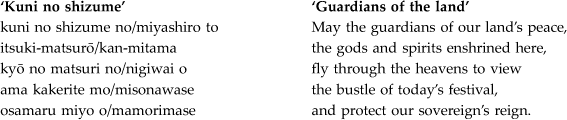

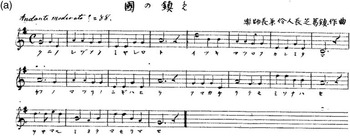
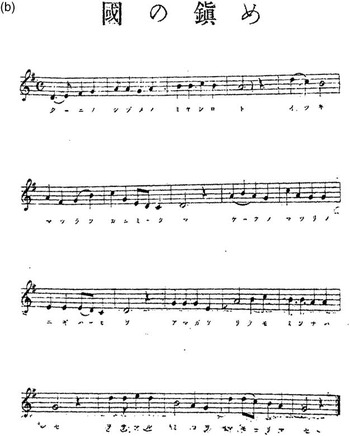
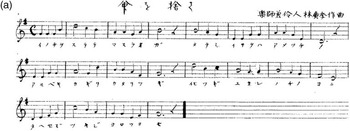
The melody that underwent the greatest transformation was that of ‘Kuni no shizume’, originally composed by the court musician Shiba Fujitsune (1849–1918). The original melody (Example 1a) was in the pentatonic ryosen sōjō mode (on G), but in the revised version (Example 1b) the melody has been changed so much that everything but the last phrase is hardly recognizable.Footnote 15 Nevertheless, the solemn tone of the revised melody, still based as it is on a gagaku scale, matches the content of the lyrics, making the piece a suitable one for performance at memorials for the war dead.
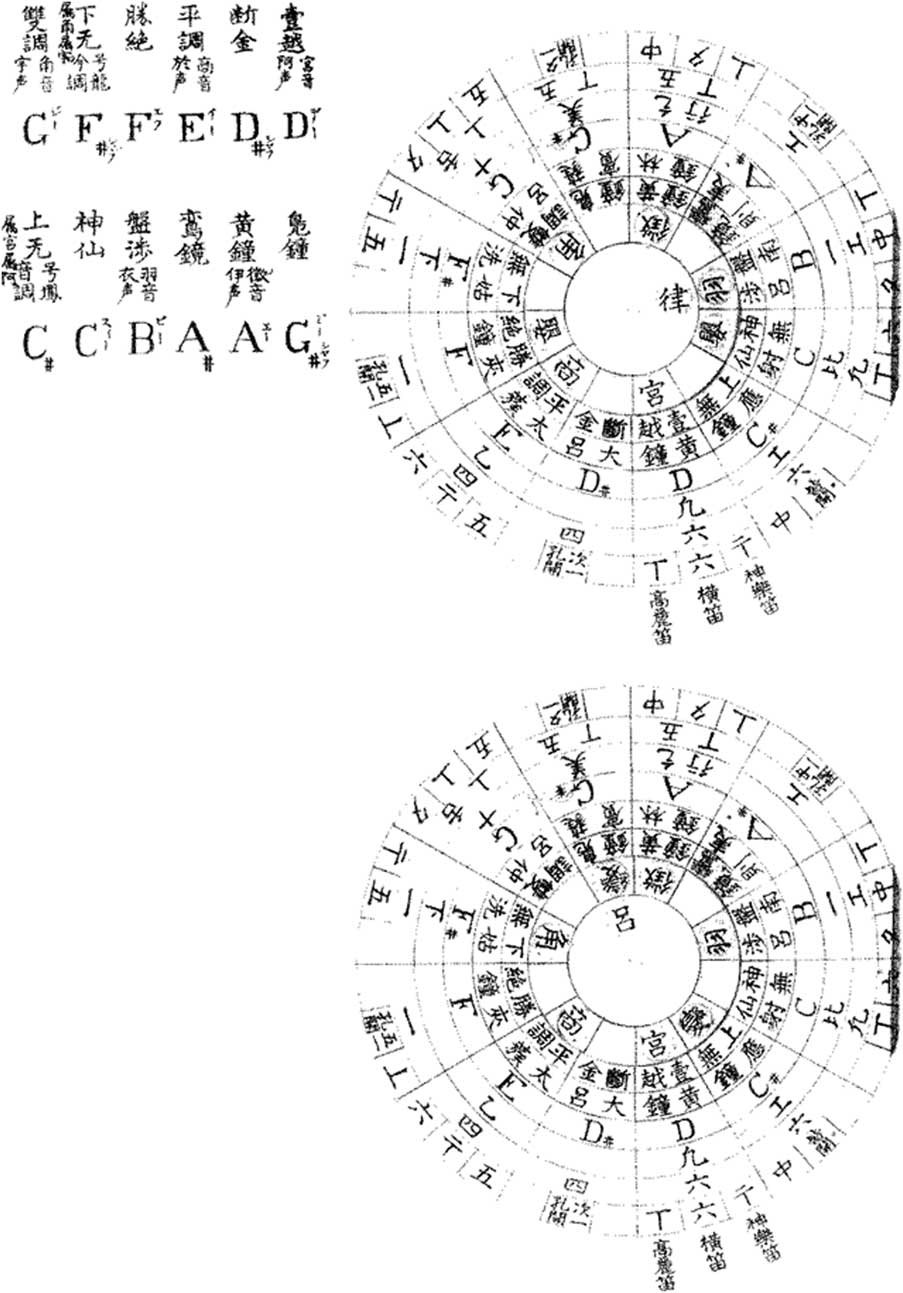
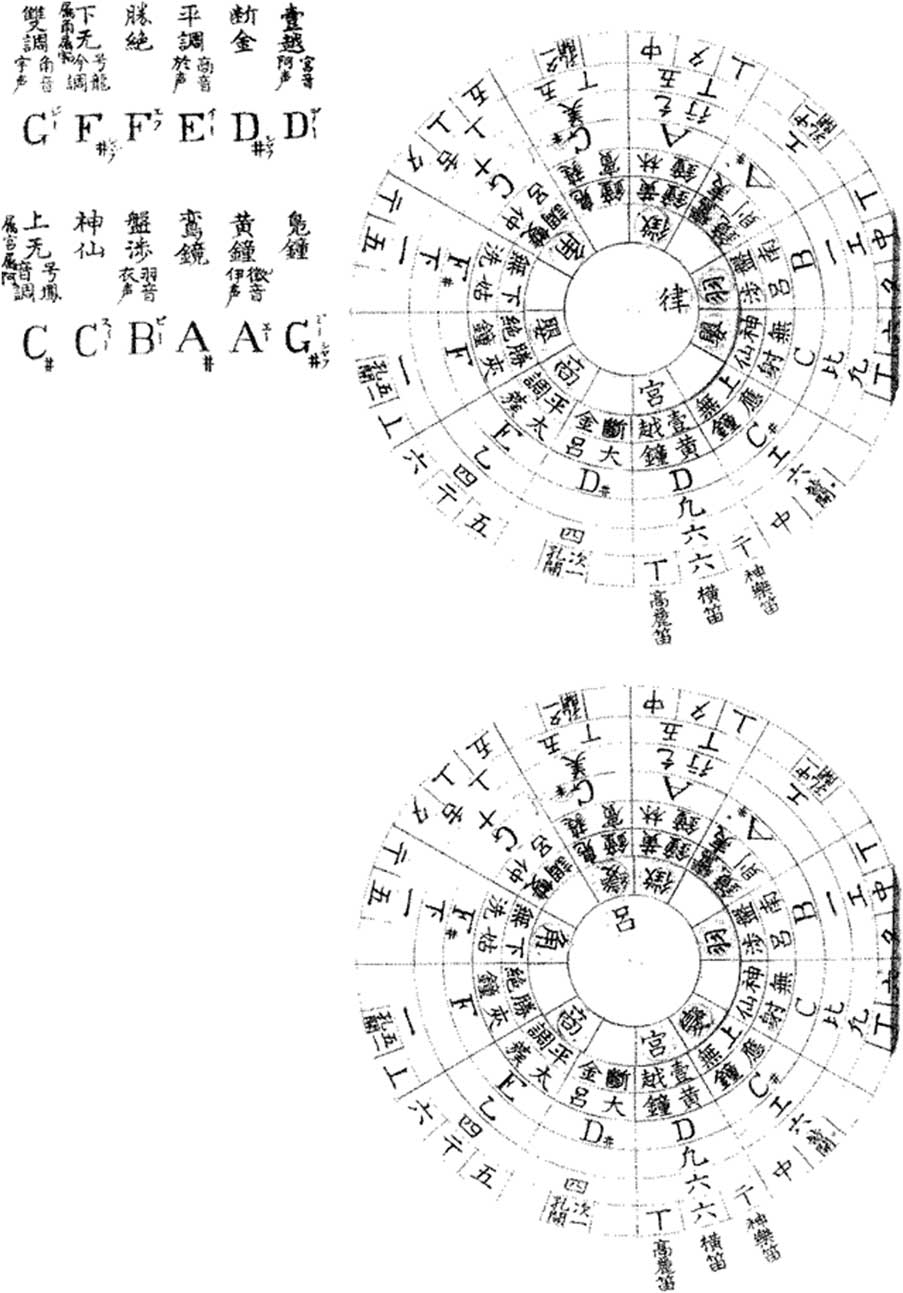
Onsen shishō-zu [chart clarifying modes and tones], from the collection of the Tanimori Archive, Archives and Mausolea Department of the Imperial Household Agency. The circular graphs indicate modes on ichikotsu (D): rissen above and ryosen below
The original melody of ‘Kuni no shizume’ composed by Shiba Fujitsune. From Gagakuroku [Record of gagaku] 1892 Issue 4

The revised version of ‘Kuni no shizume’. From Kaigun gunka [Navy military songs] (Tokyo: Training Bureau of the Ministry of the Navy, 1914)

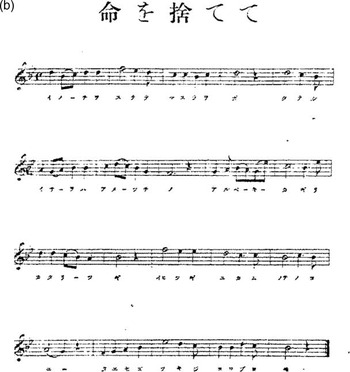
The melody of the second piece, ‘Inochi wo sutete’, was originally composed in a Western scale (Example 2a), and, although transposed, was not altered as much as ‘Kuni no shizume’ in its revision (Example 2b), retaining some elements reminiscent of melodic movement in the gagaku modes. The original melody of ‘Inochi wo sutete’ was composed by Hayashi Hirosue (1858–1898), who was only fifteen, and the youngest member of the group, when the court musicians started their study of Western music in 1874.
The revised version of ‘Inochi wo suttee’. Kaigun gunka [Navy military songs] (Tokyo: Training Bureau of the Ministry of the Navy, 1914)

The original melody of ‘Inochi wo sutete’ composed by Hayashi Hirosue. From Gagakuroku [Record of gagaku] 1892 Issue 4

It seems likely that alterations were made to the original melodies to make them sound more Western when they were arranged, but it is not known who made the alterations. At the time, Eckert was instructor at both the Music Department of the Imperial Household Agency and the Army Military Band, but there is no conclusive evidence that he made the changes. It may be that Furuya Hiromasa (1854–1923),Footnote 16 the then Army bandmaster who has traditionally been credited with the composition of these ceremonial pieces, was involved. In any case, the Westernized melodies of the revised ‘Kuni no shizume’ and ‘Inochi wo sutete’, with their seven tones and occasional diatonic runs, form a strong contrast with the gagaku scales of the two pieces written in 1880, ‘Kimigayo’ and ‘Umi yukaba’, whose original melodies remained unchanged when they were arranged.
The ‘gagaku taste’ of the ceremonial pieces played by the military bands, though of varying degree depending on the nature of the piece concerned, creates for them a distinctive sound world – completely different from the general concert repertoire and marches that are so customary in military band performance. We might say that the sound world of gagaku, which formed the musical support of imperial rites, made its way by means of the gagaku scales into the Western musical language of military ceremonial pieces, bringing them a distinctively Japanese flavour.
Ceremonial Song in School Ceremonies
Much has been written about the songs of modern Japan that were spread within the school system.Footnote 17 With the exception of a small number of pieces newly composed in gagaku scales, the great majority of songs in the early school songbooks, including the first, the Shōgaku shōka-shū [Collection of songs for primary schools] compiled by the Ongaku Torishirabe Gakari [Music Study Committee] and published between 1882 and 1884, were little more than Western melodies set with new texts in Japanese. The popular understanding, therefore, is that these school songs are essentially Western music. There is, however, a special repertoire of songs for ceremonial use that were produced in a different manner. These are the songs used in school ceremonies before World War II.
On 14 October 1873, the following eight festival days were declared as national holidays: Genshi-sai (Beginning of the Imperial Throne, January 3); Shinnen Enkai (New Year Banquet, January 5); Kōmei Tennō-sai (Memorial for Emperor Kōmei, January 30); Kigensetsu (Accession of Emperor Jinmu, February 11); Jinmu Tennō-sai (Memorial for Emperor Jinmu, April 3); Kanname-sai (Festival of Tasting New Grains, October 17); Tenchōsetsu (Emperor's Birthday, November 3); and Niiname-sai (Thanksgiving Festival of New Grains, November 23). All except the New Year Banquet, a court ceremony celebrating the arrival of the New Year, were related to imperial rites. At first no school ceremonies were held on these national holidays, but from 1888 a number of prefectures began to hold celebratory events as school ceremonies for the three ‘grand festivals’, namely the Kigensetsu, Tenchōsetsu and Shinnen Enkai. On 17 June 1891, school ceremonies were made compulsory, when the Ministry of Education announced a regulation concerning the ceremonial observation of the ‘grand festivals’ at primary schools, the first article of which prescribed that principals, teachers and pupils should sing together songs that suited the particular festival.
At this stage, no songs had been stipulated. In October of the same year, the Ministry of Education appointed Muraoka Han'ichi (1853–1929), then head of the Tokyo Music School, to the position of chair of a committee organized to select the texts and music for the school ceremonies. The 16 committee members included Rudolf Dittrich (1861–1919), an Austrian musician contracted to work at Tokyo Music School. Two of the eight songs required were selected from the pre-existing song repertoire: ‘Kimigayo’ and ‘Kigensetsu’. For the other six, texts were selected from those submitted by ten writers, including scholars of Japanese literature. In turn, pieces were solicited from musicians at the Music Department of the Imperial Household Agency, Tokyo Music School and the military bands, and the committee made its final selection from the pieces submitted.
The eight songs for the ‘grand festivals’ were officially issued in a government gazette of 12 August 1893.Footnote 18 They are ‘Kimigayo’, ‘Chokugo hōtō’, ‘Ichigatsu ichijitsu’, ‘Genshi-sai’, ‘Kigensetsu’, ‘Tenchōsetsu’, ‘Kanname-sai’ and ‘Niiname-sai’. Five of the pieces were composed in gagaku scales: ‘Kimigayo’ by Hayashi Hiromori, ‘Genshi-sai’ by Shiba Fujitsune, ‘Kigensetsu’ by Isawa Shūji, and ‘Kanname-sai’ and ‘Niiname-sai’ by Tsuji Takamichi. The remaining three are in Western scales: ‘Chokugo hōtō’ by Koyama Sakunosuke, ‘Ichigatsu ichijitsu’ by Ue Sanemichi and ‘Tenchōsetsu’ by Oku Yoshiisa. Matching these songs with the festivals for which they are intended, we notice that songs written for ceremonies deriving from imperial rites are written in gagaku scales, while those written for ceremonies with Western origins are written in Western scales, just as imperial rites used gagaku, while ceremonies deriving from the West used Western music in the calendar of court ceremonies. Moreover, of the seven composers, only two (Isawa and Koyama) were affiliated with Tokyo Music School; the remaining five were court musicians who had been trained in both gagaku and Western music. The distinction made between gagaku and Western music according to ceremonial context in court ceremony appears in a new guise here as a difference in musical scale. Although imperial rites and school ceremonies are state ceremonies of completely different origins, there exists between them a surprising musical connection.
Conclusion
With the change in political system after Japan's defeat in World War II and the Allied Occupation, the ceremonial songs used in schools before the war stopped being sung. In contrast, a limited number of military ceremonial pieces, including Kuni no shizume and Inochi wo sutete, continue to be used as ceremonial pieces today by Japan's Ground and Maritime Self-Defence Forces, even though all knowledge of their links with gagaku has evaporated.
The imperial rites, military ceremonies and school ceremonies created as state ceremonies in the years following the Meiji Restoration were celebrated in completely different forms. There was a strong correspondence between ceremonial context and music: imperial rites used gagaku, military ceremonies used Western music, and school ceremonies used ceremonial songs. Close examination of their musical language, however, has shown that the influence of gagaku permeated into both military and school pieces in the form of gagaku scales, producing a distinctive sound world in the ceremonial spaces of both. Just as Japan's ‘Emperor system’ (tennōsei) ideology functioned as the central pillar that supported the political system and unified the nation and its people in the pre-war period, so the gagaku of imperial rites played a special role in the state ceremonies that were concrete expressions of that ideology.
In this way, the gagaku scales, conceptualized for the first time at the beginning of the modern period, played a crucial role in linking the musical language of Japan's state ceremonies. In light of the contemporary development of comparative musicology, in which musical scales were thought to be an important key to identifying the characteristics of a particular country or region, the way in which the gagaku scales were employed in Japan is a typically nineteenth-century phenomenon.
Translated by Steven G. Nelson, Professor, Japanese Department, Faculty of Letters, Hosei University, Tokyo.