Introduction
This article examines public attitudes toward government spending in six major countries of the Asia-Pacific region, including Australia, China, India, Japan, Russia, and the US. The recent global financial crisis has resulted in a widespread demand for state intervention, and the magnitude of the demand has been greater than ever before. Before the crisis, the general trend for the six countries (as well as for others around the world in general) had been that of state contraction or retrenchment arising from global pressures, a trend that had existed for more than two decades. Australia, Japan, and the US, encountering slow economic growth and growing budget deficits, sought to transform their welfare states into neoliberal states by reducing the role of government in welfare provision (Levy, Reference Levy2006). In contrast, China, Russia, and India, experiencing a failure of state socialism, sought to transform command economies into market-oriented ones by reducing the scope of government intervention in the economy. Regardless of the types of political regime, they all experienced the problem of ‘big government’ and sought after ‘small government’ by redefining the proper role of government in the economy and welfare (Harvey, Reference Harvey2005; Bevir, Reference Bevir and Bevir2007).
To the extent that public opinion determines the scope of government, it is important to understand how supportive the general public is of state intervention in the economy and welfare (Borre and Scarbrough, Reference Borre and Scarbrough1995). Assuming that attitudes toward government spending indicate the level of support for state activism, this article examines whether people favor increased government spending on a variety of policy programs and determines the factors that shape citizen attitudes toward government spending. These questions are explored in the context of the AsiaBarometer Survey (ABS hereafter) conducted in the sample countries during the period from June to August in 2008, just before the onset of the global financial crisis.Footnote 1
Contexts
The six sample countries were chosen for the present analysis simply because the 2008 ABS data were available for them. We divided the countries into two groups. One includes Australia, Japan, and the US. These are all advanced market economies and liberal democracies. The other includes China, India, and Russia. These are all emerging markets or transition economies with a legacy of state socialism; two of these are non-democracies, and one is the world's biggest democracy. According to the World Bank (2007), the sample countries are all major economic powerhouses in terms of GDP. In 2007, the US had the largest global economy; Japan was the second, and China was the fourth, just behind Germany. Russia and India ranked eleventh and twelfth, respectively, and Australia was ranked fifteenth.
According to the Economic Freedom of the World (EFW) index, whose values range from 0 (the lowest score) to 10 (the highest), the degree of economic freedom as measured by the size of government has varied considerably from one country to another. In 2006, Australia ranked 52nd with a rating of 6.77, Japan was 71st with a rating of 6.23, and the US was 39th with a rating of 7.12. On the other hand, India had a rating of 7.14 and ranked 38th, China had a rating of 5.00 and ranked 101st, and Russia had a rating of 5.64 and ranked 87th. Among the sample countries, India and the US had the smallest size of government, while Russia and China had the largest. Australia and Japan fell somewhere in between (Gwartney and Lawson, Reference Gwartney and Lawson2006).
According to the United Nation's Human Development Report (UNDP, 2007/8), the 2005 Human Development Index (HDI hereafter) for Australia was 0.962 (3rd out of 177 countries). The HDI for Japan was 0.953 (8th). The US had a value of 0.951 (12th). In contrast, the HDI for Russia was 0.802 (67th). China had a value of 0.777 (81st), while India had a value of 0.619 (128th). The peoples of the advanced market economies lived a longer and healthier life, were more educated, and had a higher standard of living than those of the emerging market economies.
Australia, Japan, and the US are widely known as welfare state laggards among advanced industrial countries. In particular, Australia and the US are regarded as liberal welfare state regimes where the market is the primary arena in the distribution of resources and state provisions are relatively low (Esping-Anderson, Reference Esping-Andersen1990). Japan is seen as a conservative welfare state regime where the reliance on the market as a provider of welfare is limited and the role of family is more emphasized. Japan is also known as a prototype of a developmental state where the government plays an activist role in promoting economic development; the US, on the other hand, is considered a prototype of a regulatory state where the government concerns itself with the rules of economic competition (Johnson, Reference Johnson1982).
In contrast, Russia and China were command-and-control economies, where the state performed the functions of regulation, distribution, and even production. Both counties once eradicated private ownership. While India did not destroy capitalism, it had followed the example of the Soviet Union for a long time. Nonetheless, they all sought excessive state intervention in welfare and the economy. They are now transiting to market economies from planned economies and replacing state socialism with a new policy of liberalization.
The countries selected for the present study vary in the size of government, quality of people's life, types of economies and political regimes, and historical legacies. While bearing in mind these cross-national differences, we now turn to how the mass publics of the sample countries feel about government spending on a variety of policy programs.
Conceptualization and measurement
While analyzing attitudes towards the scope of government, Roller (Reference Roller, Borre and Scarbrough1995) made a useful distinction between range and degree. The range of government refers to the extent of policy areas in which a government intervenes, while the degree of government refers to the intensity with which a government intervenes in any given area. The former is measured by attitudes toward the extent of government responsibilities, while the latter is determined by attitudes toward the level of government spending (Huseby, Reference Huseby, Borre and Scarbrough1995). This study focuses primarily on the degree dimension by examining attitudes toward government spending on a variety of policy programs.
In order to ascertain attitudes toward government spending, the 2008 ABS asked respondents whether they would like to see more or less government spending in each of the following policy programs: (1) the environment, (2) health, (3) policing and law enforcement, (4) education, (5) the military and defense, (6) old age pensions, (7) unemployment benefits, (8) public transport and telecommunications infrastructure, (9) culture and the arts, and (10) the improvement of the social status of women. To obtain responses, the survey used a five-point verbal scale: 1 (spend much more), 2 (spend more), 3 (spend the same as now), 4 (spend less), and 5 (spend much less). It should be noted that this battery of questions addresses program-specific spending preferences rather than general spending preferences.
The policy programs surveyed by no means encompass all activities of modern government. For instance, housing and community development, key items of government expenditure, were not included. Nonetheless, they constituted major ones. The policy programs were grouped into four categories of public expenditure: security, infrastructure, human capital, and welfare. First, defense and law enforcement were considered as security-seeking functions of government. Second, transport and telecommunications, the environment, and culture and the arts were categorized as public investment in physical and cultural infrastructure, although the latter two are also related to quality-of-life concerns. Third, health and education are often regarded as welfare programs. However, since these are more related to investment in people rather than the protection of the vulnerable, these need to be distinguished from traditional welfare programs. Last, old age pensions, unemployment benefits, and women's status were considered as welfare concerns, although women's status seeks to improve social equality, while old age pension and unemployment benefits reflect social security. Of these, old age pensions and unemployment benefits can be seen as key welfare programs (Wilensky, 1976). Especially notable is that even these social insurance programs are designed to benefit people in need but are not targeted to the poor like social assistance programs.
Dimensions of spending preferences
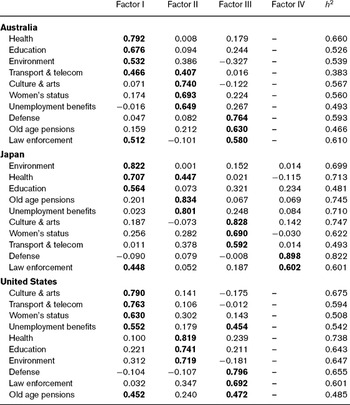
To explore how the mass publics of the sample countries distinguish items of government expenditure, we performed factor analysis on the ten programs and estimated the proximity of their relations by country. The three advanced market economies, as shown in Table 1, are addressed first, followed by emerging market economies. First, public attitudes toward government spending in Australia were grouped into three clusters: health, education, the environment, and transport and telecommunications displayed primary loadings on the first factor; culture and the arts, women's status, and unemployment benefits, the second factor; and defense, old age pensions, and law enforcement, the third factor. It is interesting that old age pensions and unemployment benefits, which are key welfare programs, did not load on the same factor in the minds of Australians. Notable is that spending for human capital was viewed as closely related to spending for environmental protection and physical infrastructure.
Dimensions of spending preferences: advanced market economies

Note: The reported loadings were from a principal component solution with varimax rotation using the listwise deletion of missing data. Loadings of greater than 0.40 are in bold.
Source: 2008 AsiaBarometer Survey.
Second, public attitudes toward government spending in Japan were grouped into four clusters: the environment, health, and education displayed primary loadings on the first factor; old age pensions and unemployment benefits, the second factor; culture and the arts, women's status, and transport and telecommunications, the third factor; and defense and law enforcement, the fourth factor. The Japanese clearly distinguished security-related spending from other kinds of spending. Notable is that they distinguished key welfare programs from health and education. This finding suggests that health and education are more closely related to investment in people than the protection of the vulnerable in the minds of Japanese.
Third, public attitudes toward government spending in the US were grouped into three clusters: culture and the arts, transport and telecommunication, women's status, and unemployment benefits displayed primary loadings on the first factor; health, education, and the environment, the second factor; and defense, law enforcement, and old age pensions, the third factor. Unemployment benefits and old age pensions failed to load on the same factor, suggesting that they do not constitute social insurance programs in the minds of Americans. Notable is that spending for human capital and environmental protection was distinguished from other kinds of spending.
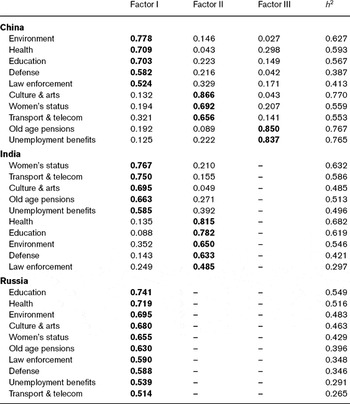
The three emerging market economies with a legacy of state socialism, as presented in Table 2, are now addressed. First, public attitudes toward government spending in China were grouped into three clusters: the environment, health, education, defense, and law enforcement displayed primary loadings on the first factor; culture and the arts, women's status, and transport and telecommunications, the second factor; and old age pensions and unemployment benefits, the third factor. The Chinese distinguished key welfare programs from other non-welfare programs. They considered health and education as more closely linked to investment in people than the protection of the vulnerable. Notable is that spending for human capital was seen as closely related to spending for national security and public order in the minds of Chinese.
Dimensions of spending preferences: emerging market economies

Note: The reported loadings were from a principal component solution with varimax rotation using the listwise deletion of missing data. Loadings of greater than 0.40 are in bold.
Source: 2008 AsiaBarometer Survey.
Second, public attitudes toward government spending in India were grouped into two clusters: women's status, public transport and telecommunications, culture and the arts, old age pensions, and unemployment benefits displayed primary loadings on the first factor; and health, education, the environment, defense, and law enforcement, the second factor. Indians failed to distinguish key welfare programs from other non-welfare programs. Yet, in the eyes of Indians, health and education were distinguished from social insurance programs.
Last, public attitudes toward government spending in Russia constituted a single dimension. All programs displayed primary loadings on the same factor. They rarely distinguished old age pensions and unemployment benefits from non-welfare programs. They seldom differentiated government programs addressing market failure from those designed to improve distributional equity.
The analysis shows that public attitudes toward government spending hardly constitute a single dimension in all of the sample countries except for Russia. The results also indicate that empirical dimensions of spending preferences do not correspond to conventional types of state functions or goals taken on by government (World Bank, 1997). Noteworthy is that programs designed to protect the vulnerable, such as the elderly and the unemployed, did not constitute the same type of government activities in the US, India, and Australia. It was only in the minds of Japanese and Chinese that old age pensions and unemployment benefits were clearly differentiated from non-welfare programs.
Although health and education are often regarded as welfare programs, they were found to be distinguished from old age pensions and unemployment benefits almost everywhere. To the extent that health is primarily seen as public health intervention rather than health insurance, it is likely to be distinguished from social insurance programs such as old age pension and unemployment benefits. Similarly, to the extent that education is seen as promoting equality of opportunity rather than equality of outcomes, it is likely to be differentiated from welfare programs designed to protect the vulnerable. Furthermore, health and education were closely related to the environment in the highly developed countries, while they were related to defense, law enforcement, and the environment in the less developed countries. These findings suggest that health and education are viewed as government programs addressing market failures rather than improving social equity.
In brief, the number of dimensions of spending preferences and their constituent programs differed considerably from country to country. The public attitudes toward government spending were multidimensional and varied depending upon dimensions; as such, the use of a simple analytic scale to measure the level of support for state activism would be difficult to justify (Jacoby, Reference Jacoby1994).
Distribution of spending preferences
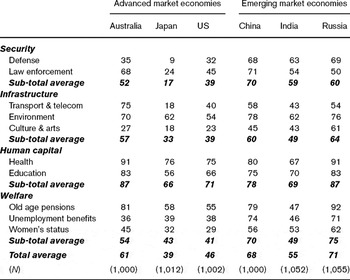
How do the mass publics of the sample countries feel about government spending across the policy programs? Which area of government spending is most or least popular? Table 3 shows the percentage of respondents indicating support for increased spending on each policy program by saying ‘spend much more’ or ‘spend more’. The three advanced market economies are addressed first. In Australia, health was the most-favored area of expenditure. Six of ten policy programs received the support of more than a two-thirds majority, including health, education, old age pensions, transport and telecommunications, the environment, and law enforcement. The least favored area of expenditure was culture and the arts. Notable is that in this welfare state laggard, the government protection of the elderly enjoyed overwhelming public support. It is rather surprising that, in this advanced industrial country, public investment in physical infrastructure received a high level of support.
Distribution of sending preferences by types of programs

Note: Entries are percentages favoring increased spending.
Source: 2008 AsiaBarometer Survey.
In Japan, health was the most preferred area of expenditure. It was the only policy program on which more than a two-thirds majority favored increased spending. The least favored area of expenditure was defense, indicating its distinctive historical legacy. It is interesting that, in this highly aging society, old age pensions were less popular than environmental protection. In this conservative welfare state regime, none of the key welfare programs enjoyed the support of a two-thirds majority.
In the US, the most favored area of expenditure was health, which was followed by education. They were the only policy programs on which more than a two-thirds majority favored increased spending. The least favored area of expenditure was culture and the arts. Notable is that, in this most advanced country without a universal health insurance program, increased spending on health received the highest public support (Shapiro and Young, Reference Shapiro and Young1989).
The mass publics of these advanced industrial economies were most supportive of health and education, while least supportive of defense and culture and the arts. Even though these countries turned post-industrial and their peoples became increasingly post-materialist (Inglehart, Reference Inglehart1990), health was still given the highest spending priority, while culture and the arts were provided the lowest one. The mass publics of these developed countries still remained strongly supportive of increased public investment in people.
The three former state socialist countries are now addressed. In China, health was the most favored area of expenditure. Seven of ten policy programs received the support of more than a two-thirds majority, including health, old age pensions, the environment, education, unemployment benefits, law enforcement, and defense. The least favored area of expenditure was culture and the arts, the only area where a minority favored increased spending. Notable is that, in this not yet post-industrial society, environmental protection was one of the top three spending priorities.
In India, the most popular area of expenditure was education, which was closely followed by health. They were the only policy programs on which more than a two-thirds majority favored increased spending. The least favored areas of expenditure were culture and the arts and transport and telecommunications. Notable is that, in this developing country, public investment in physical infrastructure was given the lowest spending priority.
In Russia, old age pensions were the most favored area of expenditure. It was closely followed by health. Nearly every Russian wanted more government intervention in protecting the elderly. Six of ten policy programs received the support of more than a two-thirds majority, including old age pensions, health, education, the environment, unemployment benefits, and defense. The least favored area of expenditure was law enforcement, although it still received the support of a bare majority.
Cross-national comparisons
A cross-national comparison shows that public demands for government intervention varied from country to country and from program to program. Russia, China, and India were distinguished from Australia, the US, and Japan in their higher support for increased defense spending. China and Australia were most supportive of more government action to maintain law and order, while Japan was least supportive.
Public support for increased spending on welfare programs varied considerably from country to country. In China and Russia where the state used to guarantee full employment, large majorities favored increased spending on unemployment benefits. In sharp contrast, in liberal or conservative welfare state regimes, such as Australia, the US, and Japan, only small minorities favored it. In India, one of the emerging market economies with a history of state socialism, only a minority favored more government action to protect the unemployed.
Russia, Australia, and China were distinguished from Japan, the US, and India in their greater support for increased spending on old age pensions. As expected, the former state socialist countries tended to display higher levels of support for government protection of the elderly than the market capitalist countries. Australia and India appeared to deviate from this pattern.
Notable is that the support for old age pensions was greater than the support for unemployment benefits everywhere, perhaps because of the universality of aging and uneven risks of unemployment (Pettersen, Reference Pettersen, Borre and Scarbrough1995). The finding suggests that public support for welfare programs tends to vary depending upon the size of their potential beneficiaries. That is, welfare programs benefiting larger constituencies garner a higher level of support than those benefiting smaller constituencies (Taylor-Gooby, Reference Taylor-Gooby1985).
Although health was the least contested area of government spending, the levels of support varied from country to country. Russia and Australia were distinguished from Japan, the US, and India in their higher levels of support. There existed nearly unanimous public support for increased spending on health in Russia and Australia. It remains unclear whether the higher support for health spending indicates support for more government provision of social insurance, public health services, or both.
Public support for increased spending on education was also widespread. More public investment in education received the support of a two-thirds majority in every sample country except for Japan. It was indeed one of the most favored areas of expenditure. The higher support for health and education indicates a strong popular commitment to the accumulation of human capital, which is essential for development.
In contrast, women's status was one of the least favored areas of expenditure. Notable is that the market capitalist democracies tended to display a lower level of support than the former state socialist countries, which once pursued equality for all. It is interesting that, in the male-centered Japanese society, more government action to improve gender equality enjoyed a lower level of public support.
Irrespective of the level of industrialization, every sample country displayed relatively high levels of support for increased spending on the environment. Notable is that less developed China and Russia displayed higher levels of support than more advanced Japan and the US. This finding suggests that public concerns for clean air and safe water do not require value changes from materialism to post-materialism (Inglehart, Reference Inglehart1990).
China and Russia were distinguished from Japan in their greater support for increased spending on transport and telecommunications. Notable is that the support levels in India were similar to those in the US. More notable is that Australia was most supportive of increased spending on physical infrastructure, despite its already highly industrialized society.
Public support for more government subsidies for culture and the arts varied widely from one country to another. Russia was particularly distinguished from Japan, the US, and Australia in its greater levels of support. Notable is that, in the highly developed countries, more government subsidies for culture and the arts enjoyed lower public approval. This suggests that, in the developing countries, the support for increased spending on culture and the arts may reflect public concerns on cultural infrastructure rather than aesthetic aspects of quality of life.
Support for state expansion and contraction
In order to ascertain the overall support for state expansion, we averaged the percentages favoring increased spending on the policy programs surveyed. As presented in the bottom row of Table 1, Russia displayed the highest level of support for state expansion. It was closely followed by China. In contrast, Japan displayed the lowest level of support. It was followed by the US. India, and Australia fell between the two. Overall, the former state socialist countries still displayed a greater level of support for the activist role of government than the market capitalist countries. The exception was Australia, where the level of support for state activism was higher than that in Japan, the US, and even India. It remains to be seen whether this indicates a new trend distinguishing Australia from other advanced market economies.
The table also shows the average percentages of favoring increased spending across four types of policy programs. First, China, Russia, and India displayed a greater level of support for security-related government activities than Japan and the US. Second, Russia, China, and Australia were distinguished from Japan and the US in their higher support for public investment in infrastructure. Third, Russia and Australia were distinguished from Japan, India, and the US in their stronger commitment to public funding for human capital. Last, Russia and China were distinguished from Japan and the US in their greater support for welfare state activities. Overall, attitudes toward government spending in China and Russia were markedly contrasted with those in Japan and the US.
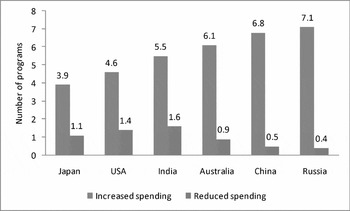
To simultaneously explore the support for state expansion and contraction, we counted the number of policy programs on which each respondent wanted more to be spent or less to be spent. As presented in Figure 1, there existed wide cross-national differences in support for state activism. The market capitalist countries are addressed first. The Japanese public wanted, on average, increased spending on 3.9 of ten programs and reduced spending on 1.1 programs. The US public wanted increased spending on 4.6 programs and reduced spending on 1.4 programs. In contrast, the Australian counterpart desired increased spending on 6.1 programs and reduced spending on 1.0 program. There were fewer differences in the number of policy programs on which reduced public expenditure was favored. Yet, there were notable differences in the number of policy programs on which increased public expenditure was desired. It is evident that there was a lack of support for state contraction or retrenchment. Yet, there existed varying levels of support for state expansion.
Support for government expansion and contraction.

Turning to the three emerging market economies, the Russian public, on average, wanted increased spending on 7.1 programs and reduced spending on 0.4 programs. The Chinese counterpart desired increased spending on 6.8 programs and reduced spending on 0.5 programs. The Indian public favored increased spending on 5.5 programs and reduced spending on 1.6 programs. Although they shared a legacy of state socialism, Russia displayed a higher level of support for state activism than China. Moreover, the former displayed a lower level of support for state contraction than the latter.
Overall, Americans and Japanese were the least supportive of state activism, while Chinese and Russians were the most supportive. Australians and Indians fell somewhere in between. China and Russia exhibited a wider support for ‘big government’ than Japan and the US. These findings suggest that not only levels of economic development, but also distinctive historical legacies may account for the variation in support for state expansion and retrenchment.
Determinants of spending preferences
Previous studies have emphasized a wide range of factors shaping individuals’ preferences for government spending, especially welfare spending (Borre and Scarbrough, Reference Borre and Scarbrough1995; Svallfors, Reference Svallfors1997; Mehrtens, Reference Mehrtens2004; Kulmin, Reference Kumlin, Dalton and Klingemann2007). They have suggested that individual attitudes toward government spending reflect economic self-interests, left–right ideology, values and beliefs, and social position, among others (Coughlin, Reference Coughlin1980; Eismeier, Reference Eismeier1982; Sanders, Reference Sanders1988; Hasenfeld and Rafferty, Reference Hsenfeld and Rafferty1989; Pettersen, Reference Pettersen, Borre and Scarbrough1995). Some have proposed that individuals calculate the economic benefits and tax burdens of government spending and behave according to their own self-interests. Attitudes toward government spending have been argued to reflect the impact of long-term predispositions such as party identification and political ideology; values and beliefs such as economic individualism, meritocracy, egalitarianism, and materialism/post-materialism have been proposed to shape attitudes toward the scope and types of government intervention; individuals’ positions within society and their associated life experiences have been identified as helpful in understanding their preferences for government spending.
Reflecting on prior studies, this study proposes the following hypotheses. First, women are expected to be more supportive of welfare spending than men because a welfare state makes it possible for women to work, whereas men would experience an increased tax burden and unemployment rate. Second, age-related differences are anticipated. Older people are expected to be more supportive of social insurance and security-related spending than younger people. On the other hand, younger people are expected to be more supportive of human capital-related spending than older people. Third, people of high social status have less need of welfare services and more interest in non-material aspects of life. Hence, people with a higher level of income or more education are expected to be less supportive of welfare spending and more supportive of quality of life-related spending than people with a lower level of income or less education. Fourth, since greater government intervention is associated with left-wing political parties, while lesser government intervention is related to right-wing political parties, people on the political left are expected to be more supportive of additional government spending, especially welfare spending, than people on the political right. Finally, value priorities determine types of goals that people expect the government to address. Hence, people with material values are expected to be more supportive of physical- and economic security-related spending, while people with post-material values of quality of life-related spending.
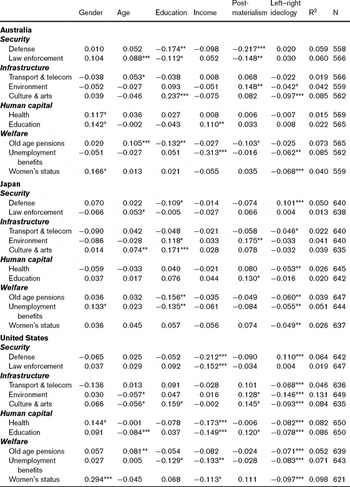
The following section examines, through multiple regression analyses, how individual attitudes toward government spending are related to four socio-demographic variables (i.e., gender, age, education, and income) and two attitudinal variables (i.e., left–right ideology and post-material values)Footnote 2 and how their effects and relative importance vary across the sample countries.
Advanced market economies
The three advanced market economies are addressed first (see Table 4). In Australia, gender had a positive effect on health, education, and women's status. Women were more supportive of increased spending for human capital and gender equality than men. Age had a positive effect on old age pensions, law enforcement, and transport and telecommunications. Older people were more concerned with physical and economic security than younger people. Educational attainment had a negative effect on defense, law enforcement, and old age pensions and a positive effect on culture and the arts. Income had a positive effect on education and a negative effect on unemployment benefits. People with a higher social position were less supportive of welfare spending than people with a lower social position. Post-material values had a negative effect on defense, law enforcement, and old age pensions and a positive effect on the environment. As expected, people with post-material values were less supportive of security-related spending and more supportive of quality of life-related spending than people with material values. Left–right ideology had a negative effect on unemployment benefits, women's status, the environment, and culture and the arts. People on the political left were more supportive of welfare and quality of life-related spending than people on the political right. Overall, educational attainment, left–right ideology, and post-material values were significantly related to four of ten spending preferences. Values and beliefs appeared to be more prominent than economic self-interest. Nonetheless, there was no single dominant predictor of Australian attitudes toward government spending.
Multivariate analysis of spending preferences: advanced market economies

Notes: Entries are unstandardized regression coefficients. Variables are coded as follows: gender (male = 1 and female = 2); age (20–29 = 1, 30–39 = 2, 40–49 = 3, 50–59 = 4 and 60–69 = 5); educational attainment (less than high school = 1, high school = 2 and some college+ = 3); income (low = 1, middle = 2 and high = 3); post-materialism (materialist = 1, mixed = 2 and post-materialist = 3); and left–right ideology (10-point left–right self-placement scale). * P<0.05. ** P<0.01. *** P<0.001.
Source: 2008 AsiaBarometer Survey.
In Japan, gender had a positive effect only on unemployment benefits. It is interesting that women were no more supportive of increased spending on gender equality than men. Age had a positive effect on law enforcement and culture and the arts. Notable is that older people were no more supportive of increased spending on old age pensions than younger people. Educational attainment had a negative effect on defense, old age pensions, and unemployment and a positive effect on the environment and culture and the arts. The more educated were more supportive of quality of life-related spending and less supportive of welfare spending than the less educated. As expected, post-material values had a positive effect on the environment and education. Left–right ideology had a negative effect on old age pensions, unemployment benefits, women's status, health, and transport and telecommunications and a positive effect on defense. Left-wing people were more supportive of welfare spending than right-wing people. Notable is that key welfare spending preferences were consistently related to left–right ideology and educational attainment. Income had no effect. This finding suggests that the support for welfare programs reflects not so much economic interests as symbolic predispositions. Overall, left–right ideology was significantly related to six of ten spending preferences, while educational attainment, five. It seems that political ideology and educational attainment were major, if not dominant, predictors of Japanese attitudes toward government spending.
In the US, gender had a positive effect on women's status and health. Not surprisingly, women were more supportive of increased spending on gender equality than men. Age had a negative effect on education, the environment, culture and the arts, and women's status and a positive effect on old age pensions. As expected, older people were more supportive of increased spending on old age pensions than younger people. Yet, the former were less supportive of quality of life-related spending than the latter. Educational attainment had a positive effect on culture and the arts and a negative effect on unemployment benefits. The more educated were less supportive of welfare spending and more supportive of quality of life-related spending than the less educated. Income had a negative effect on a wide range of spending programs. High-income people were less supportive of welfare, human capital, and security-related spending than low-income people. Post-material values had a positive effect on quality of life- and human capital-related spending. Left–right ideology had a significant effect on all spending programs except defense. People on the political left were more supportive of welfare, human capital, and cultural and physical infrastructure spending than people on the political right. In contrast, the left were less supportive of defense spending than the right. Notable is that attitudes toward welfare spending were consistently related to economic interest and left–right ideology, with the latter being stronger than the former. Overall, left–right ideology was significantly related to nine of ten spending preferences, while income, six. This evidently indicates that political ideology and economic interest are dominant factors in shaping American attitudes toward government, underscoring the influence of symbolic politics and self-interest in the US (Sears et al., Reference Sears, Lau, Tyler and Allen1980).
Emerging market economies
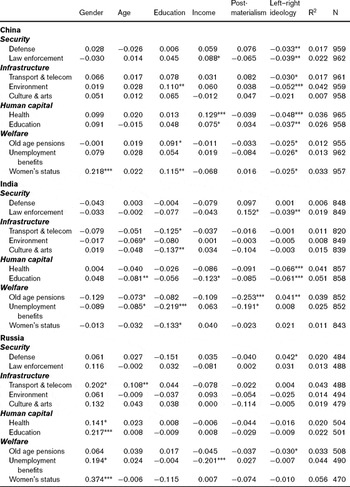
The three emerging market economies are now addressed (see Table 5). In China, gender had a positive effect only on women's status, indicating that women are more supportive of an increased government action to improve gender quality than men. Educational attainment had a positive effect on the environment, old age pensions, and women's status. The more educated were more supportive of increased spending on clean air and safe water, the welfare of the elderly, and gender equality than the less educated. Income had a positive effect on health, education, and law enforcement. Notable is that people with a higher level of income were more supportive of increased spending on human capital than people with a lower level of income. Left–right ideology had a negative effect on a wide range of spending programs. People on the political left were more supportive of increased spending on security, human capital, infrastructure, and welfare than people on the political right. Age and post-material values had no effect. Overall, left–right ideology was related to nine of ten spending preferences. This suggests that political ideology is a single dominant predictor of Chinese attitudes toward government spending.
Multivariate analysis of spending preferences: emerging market economies

Notes: Entries are unstandardized regression coefficients0. * P<0.05. ** P<0.01. *** P<0.001.
Source: 2008 AsiaBarometer Survey.
In India, age had a negative effect on old age pensions, unemployment benefits, education, and the environment. Unexpectedly, older people were less supportive of increased spending on old age pensions than younger people. Educational attainment had a negative effect on unemployment benefits, women's status, transport and telecommunications, and culture and the arts. The more educated people were less supportive of increased spending on welfare and physical infrastructure than the less educated. Income had a negative effect only on education expenditure. Post-material values had a negative effect on old age pensions and unemployment benefits, but unexpectedly a positive effect on law enforcement. Left–right ideology had a negative effect on law enforcement, health, and education and a positive effect on old age pensions. As expected, people on the political right were less supportive of government intervention in health and education than people on the political left. However, right-wing people were more supportive of old age pensions than left-wing people. Gender had no effect. Overall, there was no major dominant determinant of Indian attitudes toward government spending.
In Russia, gender had a positive effect on a wide range of spending programs, such as health, education, unemployment benefits, women's status, and transport and telecommunications. Women were more supportive of increased spending on human capital and welfare than men. Age had a positive effect only on transport and telecommunications. Income had a negative effect only on unemployment benefits and educational attainment had no effect. Socioeconomic status, as measured by education and income, was hardly a prominent factor in determining spending preferences. Left–right ideology had a positive effect on defense and a negative effect on old age pensions. As expected, people on the political right were more supportive of defense spending and less supportive of welfare spending than people on the political left. Post-material values had no effect. Overall, gender was significantly related to five of ten spending preferences. This suggests that gender is a major predictor of Russian attitudes toward government spending. If there were a politics of government spending in Russia, it would be neither self-interest politics nor symbolic politics, but gender politics.
The results of multiple regression analyses show that the primary determinants of public attitudes toward government spending vary greatly from country to country. Yet, some notable patterns can be identified. In the US, left–right ideology and economic self-interests constituted major fault lines for the politics of government spending. In Japan, left–right ideology divided public attitudes toward government spending. In Australia, diverse factors such as post-material values, educational attainment, and left–right ideology formed the bases of political conflict on government spending. Overall, in the highly developed capitalist democracies, left–right ideology and their political carriers played a prominent role in shaping public attitudes toward government spending.
In China, left–right ideology emerged to divide public attitudes toward government spending. People on the political right were inclined to support state contraction, while people on the political left supported expansion, indicating that the right embraces neoliberal ideologies, while the left adheres to the legacy of state socialism. In India, there was no notable dividing line of conflict on government spending, although left–right ideology played a limited role in shaping public attitudes toward spending on human capital. In Russia, if there were a politics of welfare and social spending, it would reflect the gender conflict. In some emerging market economies, such as China and India, public disagreements about the scope of government seem to reflect a growing ideological tension between neo-liberalism and state socialism.
Summary and conclusion
The recent global financial crisis has resulted in a widespread demand for more state intervention, and the magnitude of the demand has been greater than ever before. Before the crisis, there existed, due to global pressures, a period of state contraction or retrenchment for more than two decades; in the wake of economic globalization and the neoliberal reform movement, both rich democracies and poor non-democracies had been forced to roll back the state (Levy, Reference Levy2006). Against this backdrop, this study examines public support for the scope of government by analyzing attitudes toward government spending across a wide range of policy programs.
The analysis of the 2008 ABS data from six major countries of the Asia-Pacific region suggests that ordinary citizens of the sample countries are more likely to favor increased, rather than reduced, government spending. There was no popular support for state contraction or retrenchment. Even in leading advanced market economies, such as Japan and the US, the mass publics were not supportive of state contraction, although they were the least supportive of state expansion. Public support for state expansion remained very strong in China and Russia, former state socialist countries. Surprisingly, public support for state expansion was stronger in Australia, an advanced market economy, than in India, an emerging market economy with a long history of state socialism.
Public support for social insurance programs such as old age pensions and unemployment benefits was weaker in market capitalist countries such as the US and Japan in comparison to those of former state socialist countries such as China and Russia. Noteworthy is that, in the areas of health and education, there was a universally strong support for state intervention regardless of types of political regimes or levels of economic development. Since health and education are viewed as human capital investment essential for development, they were the least contested items of government expenditure in not only advanced market economies but also emerging ones.
The welfare programs benefiting larger constituencies, such as old age pensions, enjoyed a higher level of public support, while those benefiting smaller constituencies, such as unemployment benefits or women's status, received a lower level of public support. This finding suggests that the size of beneficiaries of spending programs may account for the variation in support for them.
The analysis also shows that determinants of attitudes toward government spending varied from country to country. It is found that, in many sample countries, economic self-interests, as measured by income, were likely to influence attitudes toward government spending. Individuals from high-income groups were opposed to welfare spending while supportive of non-welfare spending associated with quality of life. In many sample countries, left–right ideology played a key role in determining a wide range of spending preferences. Especially notable is that, in the market capitalist democracies, public disagreements over welfare spending reflected ideological differences. Social status, as reflected by education, discouraged support for welfare spending and encouraged support for quality of life-related spending. Life experiences associated with gender were also occasionally related to attitudes toward welfare spending. All these findings evidently indicate that the socially vulnerable, such as the poor, women, and younger people, as well as the left, are more likely to favor more state intervention in assisting people in need.
Overall, the mass publics of six major countries in the Asia-Pacific region did not endorse state contraction or retrenchment in the wake of economic globalization and the neoliberal reform movement. There was little public antagonism to state intervention, particularly in human capital and universal social services. The ideal scope of government that the majorities preferred is hardly smaller than it is right now. Citizen demands for public goods and services appeared to be insatiable almost everywhere. Despite neo-liberal calls for reductions in public expenditure for more than two decades, ordinary citizens of the advanced and emerging market countries surveyed displayed a wide support for state activism. There was, however, little indication of popular support for state retrenchment.
About the author
Chong-Min Park is Professor of Public Administration, and Director of Survey Research Center of the Institute of Governmental Studies, at Korea University in Seoul. He received his Ph.D. in Political Science from the University of California, Berkeley. He has published articles and book chapters examining Asian values, social capital, institutional trust and quality of life. His areas of research include comparative political behavior, especially mass politics in East Asia. He is currently working on the relationship between citizens and the state in East Asian democracies.