It's time for us to change America…. change happens because the American people demand it—because they rise up and insist on new ideas and new leadership, a new politics for a new time. America, this is one of those moments. I believe that as hard as it will be, the change we need is coming.
—Barack Obama, speech accepting nomination, Democratic National Convention, August 28, 2008, Denver, COEternal vigilance is the name of the game in taxation. We do not anticipate shining a light on this now-dormant proposal in coming months, but we will remain intensely focused on it.
—National Association of Realtors, “Eye on the Hill,” after opposing Obama's proposal to limit itemized deductions for individuals earning more than $250,000 as a means to raise revenues for health care reform, March 9, 2009.I voiced my opinion and voted for a Republican, and the roof did not cave in … the health bill totally upsets me. First of all, do we really know what's going on with it? It's always evasive when they're talking about it.
—Marlene Connolly, North Andover, MA, after voting for Senate candidate Scott Brown, January 19, 2010Barack Obama ran for president on the platform of change, and social welfare policies ranked among his top priorities for reform. During his campaign he denounced tax breaks and recent tax cuts that benefit the most affluent, even amidst rising economic inequality; he condemned the deteriorating condition of education, including reduced affordability of and access to higher education among those from low to moderate income households; and he excoriated the skyrocketing costs of health care, the growing numbers of the uninsured, and the poor treatment Americans often receive from insurance companies. These issues resonated with the public, because most Americans are aware of and concerned about economic inequality, and most support expanded government programs to mitigate it, particularly in the areas of education and health care.Footnote 1
The 2008 election offered promising indications that Obama could succeed in accomplishing his agenda. He won 53 percent of the vote, a level no Democrat had achieved since Lyndon Johnson in 1964, and his party won back control of both chambers of Congress for the first time since 1992. During his Inauguration week, Obama enjoyed an approval rating of 69 percent, higher than any newly-elected President of either party since Johnson.
Yet, as would soon become evident, established political arrangements present formidable obstacles to would-be reformers once they attempt the work of governance. Change requires not only new ideas and determination but also the arduous reconstitution of pre-established political relationships and modes of operation. As Stephen Skowronek explains in his analysis of such efforts in the Progressive Era, “success hinges on recasting official power relationships within governmental institutions and altering ongoing relations between state and society.”Footnote 2 In each area he sought to reform, Obama confronted an existing state that is at once formidable and elusive, and thus the quest required engagement in treacherous political battles. Remarkably, his administration has now succeeded in achieving several of its major goals with respect to social welfare policy. Even so, for much of the public, the delivery on those promises fails to meet the high expectations that surrounded the president when he first took office. What can explain the shape that reform has taken and the formidable challenges Obama has faced in accomplishing his agenda? Further, how can we make sense of why even after scoring key victories, he has had to try to convince the public of the value of what he has achieved?
Obama confronted an established and complex policy thicket that presents tremendous challenges to reform. By contrast to presidents such as Franklin D. Roosevelt and Lyndon B. Johnson, Obama did not aim to create major new direct visible government social programs. Neither did he seek to terminate or dramatically alter such programs, as did Ronald Reagan, who told the nation that “government is not the solution to our problem; government is the problem,” or Bill Clinton, who vowed to “end welfare as we know it.” Rather, Obama's policy objectives involved primarily attempts to reconstitute the submerged state—policies that lay beneath the surface of US market institutions and within the federal tax system.
While its origins are not new—they date back to the middle and even early twentieth century—the “submerged state” has become a formidable presence in the United States particularly over the past twenty-five years. I am referring here to a conglomeration of federal social policies that incentivize and subsidize activities engaged in by private actors and individuals. These feature a variety of tools, including social benefits in the form of tax breaks for individuals and families; the regulation and tax-free nature of benefits provided by private employers, including health care benefits in the form of insurance; and the government-sponsored enterprises and third-party organizations that receive federal subsidies in exchange for carrying out public policy goals, such as the banks and lending associations that have administered student loans.
Over time, the policies of the submerged state have reshaped politics in two ways, both of which presented profound challenges to Obama as he sought to accomplish reform and which, paradoxically, also imperil the success of his greatest achievements thus far. First, especially during the past two decades, the submerged state has nurtured particular sectors of the market economy and they have in turn invested in strengthening their political capacity for the sake of preserving existing arrangements. As a result, the alteration of such arrangements has required either defeating entrenched interests—which has proven impossible in most cases—or, more typically, negotiating with and accommodating them, which hardly appears to be the kind of change Obama's supporters expected when he won office. Second, such policies have shrouded the state's role, making it largely invisible to most ordinary citizens, even beneficiaries of existing policies. As a result, the public possesses little awareness of such policies, nor are most people cognizant of either what is at stake in reform efforts or the significance of their success.
I show how these dynamics combined to present challenges to Obama as he sought to achieve change in social welfare policy, and I indicate how they may likely curtail the perceived and actual political effectiveness even of his policy successes. I focus especially on tax expenditures and higher education policy, and also give some attention to health care reform. As we will see, the nature of the submerged state requires reformers to reveal its existence and how it functions to the public. To the extent Obama has done this, it has helped to facilitate the accomplishment of his goals. Yet several of the reforms his administration has accomplished expand the submerged state further, and this means that the dynamics it promulgates are likely to continue rather than to diminish.
Understanding Contemporary Challenges to Reform
Despite the promising aspects of the 2008 election results for Democrats, Obama's reform agenda quickly faced formidable obstacles, two of which have been highlighted often by political observers. First, partisan polarization has been on the rise over the past 15 years, bringing with it an end to the bipartisan compromises on social legislation that occurred more regularly in the mid-twentieth century.Footnote 3 As a presidential candidate, Obama often articulated a yearning to overcome such division. Yet, in the first year of the 110th Congress, polarization levels reached their highest levels yet since the end of Reconstruction; indeed, aside from three Republican senators who supported Obama's first major piece of legislation, the American Recovery and Reinvestment Act, no Republican in either chamber has voted in favor of his major social welfare priorities on final passage.Footnote 4
Second, although Republicans make up the minority of the U.S. Senate, the chamber's basis of representation and rules combined with current political geography gives them significantly more power than the election returns would suggest. As has been the case since the Founding, the assignment of equal numbers of Senators to states with unequal representation advantages states with fewer residents. These disparities can be quite extreme: today, for each individual represented by a Senator from Wyoming, a Senator from California represents 69 individuals. Overall, the partisan composition of the current Senate gives a representational bias to Republicans, since they are more likely than Democrats to represent states with small populations, and vice versa.Footnote 5 While the actual extent of this bias may appear modest, it is of critical importance because it enables the Republicans to reach the threshold level at which they can wield effective veto power. Since a rule change in the 1970s, Senators in the minority have increasingly been able to use the threat of filibuster to impede the majority's legislative agenda.Footnote 6 The Democrats controlled 60 votes throughout much of 2009, but when Republican Scott Brown won the Massachusetts Senate seat of the late Ted Kennedy in January 2010, it ended their ability to pass legislation with a filibuster-proof supermajority.
While the importance of these political and institutional features of the contemporary polity is undeniable, focusing on them alone fails to illuminate sufficiently the politics of social policy. They offer no insight as to why Obama's supporters—so energized during his campaign—became so quiet with respect to his issue agenda. They do not indicate why policymakers have not embraced different policies, featuring mechanisms distinct from those which gained political traction. Nor do they explain why even Obama's policy achievements confront a public that appears largely unimpressed if not—like a strong vocal minority in the Tea Party Movement—outwardly hostile.
A fuller explanation requires a policy-focused analytical framework, one that puts existing policy front and center and views how it has developed over time.Footnote 7 Policies created or expanded in past decades have shaped the political terrain the Obama administration confronts, and they have generated powerful dynamics that imperil reform efforts. Specifically, we need to understand the character of policies of the submerged state and the political effects they have yielded across time: the economic actors they have nurtured, whose ascent as influential players has reshaped the political landscape; and their obscurity to most Americans, particularly those of low or moderate incomes. Viewing the past year's developments through this lens should allow us to understand why change is so difficult, the form that it has taken, and the relative degrees of success of various initiatives.
In putting forward the concept of the “submerged state,” I am building on pioneering work by various scholars about the more obscure but immense aspects of American social policy. In a brief article in 1979, Paul Starr and Gosta Esping-Andersen argued that in the United States, social policy has often been created in the form of “passive intervention,” through which established interests—which would have fought againstsweeping reform, for example in the areas of housing and health care reform—have been accommodated through policy designs that channel expensive subsidies and incentives toward them.Footnote 8 More recently, separate components of such governance have been examined in depth and detail through a few brilliant studies. Christopher Howard exposed what he termed the “hidden welfare state” of tax expenditures, showing that it competes in size, scope, and functions with the visible, traditional social programs, but that it generates distinct political dynamics.Footnote 9 Jacob Hacker revealed the politics of “private” social protections for retirement pensions and health insurance coverage, meaning those that are provided by employers but regulated and subsidized by government.Footnote 10 Kimberly Morgan and Andrea Campbell illuminated “delegated governance,” meaning the allocation of authority for many aspects of social welfare policy to non-state actors.Footnote 11 Here I extend insights from these works, attempting to illuminate the similar political dynamics manifest across a few social welfare policy areas. In particular, insights offered by Howard and Hacker directed my attention to how the submerged state activates third-party interests that benefit from its existence, and yet it remains largely invisible to citizens generally.Footnote 12
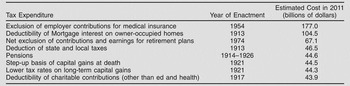
While the foundations of the “submerged state” were established in the early and mid-twentieth century, its size and costliness have grown especially in recent decades. Overall, as of 2006, social (non-business) tax expenditures accounted for 5.7 percent of GDP, up from 4.2 percent in 1976.Footnote 13 Today, the largest of these—as seen in Table 1—emanates from the non-taxable nature of health insurance benefit provided by employers, followed by the home mortgage interest deduction, and then by tax-free employer-provided retirement benefits. Indicating the scope of these “submerged” dimensions relative to the clearly visible components of social welfare spending, Jacob Hacker calculated that whereas traditional social public welfare expenditures amounted to 17.1 percent of GDP in the United States in 1995, making the nation a laggard relative to other OECD nations, the inclusion of tax expenditures and other private social welfare expenditures brought the total to 24.5 percent of GDP, placing U.S. spending slightly above average.Footnote 14 Among tax expenditures, health care costs especially have ballooned over time, growing (in nominal dollars) from 77.3 billion in 1995 to 137.3 billion in 2007.Footnote 15 Meanwhile, through another policy vehicle that also subsidizes private actors to provide social benefits, the Higher Education Act of 1965 gave incentives to banks to lend to students at low rates of interest by offering that the federal government would pay half the interest on such loans.Footnote 16 In 1972, policymakers provided further impetus to student lending by creating the Student Loan Marketing Association (SLM, otherwise known as “Sallie Mae”), to provide a “secondary market” and warehousing facility.Footnote 17 By the 1980s and 1990s, student lending became highly lucrative for lenders but costly to the federal government; in 2009, the Congressional Budget Office estimated that $87 billion could be saved over 10 years if the system of subsidizing lenders was terminated entirely and replace by direct lending.Footnote 18
Largest individual tax expenditures: Year of enactment and cost in 2011

Sources: US Budget, Analytical Perspectives, FY 2011; Howard Reference Howard1997, 176–77.
Although some individual features of the submerged state—most notably, the Earned Income Tax Credit—mitigate inequality, on net, these policies exacerbate it. First, as seen in Figure 1, they often bestow their benefits in an upwardly distributive fashion, as in the case of the charitable contribution and home mortgage interest deduction, and to a lesser extent, the tax-free nature of employer-sponsored health insurance. Second, according to Starr and Esping-Andersen, such policies compound these inequality-generating effects. They promote consumption of higher-priced goods than individuals might choose otherwise, for instance as they buy bigger houses than they would in the absence of tax incentives. Inflated prices result, which makes non-recipients of such incentives (e.g., renters) unable to participate in the market, and this further promotes inequality. In addition, the lost revenues or excessive spending associated with operating the submerged state functions as “opportunity costs,” leaving government with insufficient funds to maintain or create policies that could more effectively enhance the social welfare of low and moderate income citizens.Footnote 19 This is illustrated by the growth in spending, over much of the past quarter-century, of student loans and tax credits for higher education, while the real value of Pell Grants—a more effective tool for financing college for low-income students—deteriorated in real value.
Percentage of tax subsidy funds claimed by households, by income, 2004
Sources: IRS Statistics of Income 2004; Burman, Leonard E., Garrett, Bowen, and Khitatrakan, Surachai, “The Tax Code, Employer Sponsored Insurance, and The Distribution of Tax Subsidies,” in Using Taxes to Reform Health Insurance: Pitfalls and Promises, ed. Aaron, Henry J., Burman, Leonard. Washington, DC: Urban Institute, 2008.

Interest Group Politics and the Submerged State
Ironically, when policies of the submerged state were first put in place, the affected industries were initially either indifferent or opposed, but over time they became ardent defenders of such arrangements. For example, Christopher Howard explains that while tax breaks related to homeownership had long existed, homebuilders and realtors only began to mobilize to protect them after Congress began, in the late 1960s, to publish a list of them with the annual budget. Such activism paid off: “Between 1967 and 1995, the total cost of the home mortgage interest deduction increased by an average of almost 7 percent per year, adjusted for inflation.”Footnote 20 Similarly, in 1965, bankers exercised the strongest opposition to the passage of student loan policy, yet by 1993, when the Clinton Administration advanced its proposal to replace the existing system with direct lending, they led the fight to preserve the system on which they had come to rely.Footnote 21
Developments over the past 15 years have fostered change in the degree and form of activism undertaken by these types of organizations, such that the Obama Administration confronted highly sophisticated efforts to protect the status quo. Notably, the president's agenda implicated industries especially in the financial, insurance, and real estate sector—the same ones that have, collectively, procured the greatest profits in the American economy over the past quarter-century. Frank Levy and Peter Temlin show that since 1980, most private industries have experienced, at best, slow and steady growth. In the finance, insurance, and real estate sector, however, profits spiked, vastly outpacing growth in other sectors.Footnote 22 The fortunes of these industries emanated not from “market forces” alone but rather from their interplay with policies of the submerged state that promoted their growth and heaped extra benefits on them.
Take, for example, student lending, administered by banks and organizations within the financial sector. During the 1980s and 1990s, tuition outpaced inflation and policymakers at the national and state level failed to maintain a constant level of funding for grants and public universities and colleges.Footnote 23 Amid the growing partisan divide in Congress, policymakers found consensus more easily on student loans, for which they expanded borrowing limits and loosened eligibility requirements. As a result, the number and average amount of loans grew dramatically, as did lenders' profits. After lawmakers in 1996 permitted Sallie Mae to reorganize as a private company, over the next decade its stocks returned nearly 2000 percent, compared to the S&P 500's average 228 percent gain, and its CEO became the most highly compensated in the nation, with approximately $37 million in salary, bonuses, and stock awards in 2006.Footnote 24 Similarly, existing political-economic arrangements bestowed extra benefits on the thriving health insurance and real estate industries.
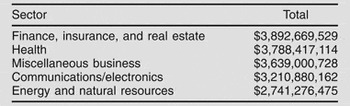
In turn, soaring profits permitted these industries to invest in their political capacity to protect the policies that have served them well. Over the past decade, the finance, insurance, and real estate sector has poured considerable resources into both campaign contributions and lobbying, outspending all other sectors in both domains and rapidly increasing its spending over time. In the 2008 election, it spent $457.4 million on campaigns, combining contributions to candidate committees, leadership PACs, and party committees.Footnote 25 As seen in Table 2, between 1998 and 2009, it invested $3.892 billion dollars on lobbying.
Spending on lobbying by top five sectors, 1998–2009

Source: Center for Responsive Politics, OpenSecrets.org.
Although the Republican leadership aggressively promoted the interests of such industries over the past decade and a half, their trade organizations deftly avoided committing themselves to an exclusive partisan relationship and instead maintained their traditional multi-pronged, bipartisan approach.Footnote 26 First, they strived to maintain and strengthen relationships with elected officials who are inclined to support them—predominantly Republicans but also some moderate Democrats—by providing them with information, hearing their ideas, and ensuring that they will exert the energy to represent them effectively.Footnote 27 Second, on issues characterized by a rigid partisan divide, interest groups often focused on converting a few individuals to vote for their favored position. Although political scientists have usually found little evidence of success at such efforts, nonetheless their frequency need not be great in order to alter outcomes; currently, just destabilizing one senator's support for an issue can be enough to thwart action on a major issue.Footnote 28 Third, interest groups have generally sought to cultivate cordial relationships with candidates and elected officials on both “sides of the aisle,” as evidenced by the fact that their campaign contributions are typically distributed widely to both parties, with a slight edge to the party holding or expected to win the majority. This may help explain why on some issues, even in today's highly partisan environment, industries can count on support from both Republicans and Democrats, as we will see.
Few organizations, by contrast, represent the general public on social welfare issues, particularly those involving policies of the submerged state. Since the 1970s, the large broad-based membership groups that previously served as vehicles for articulating the preferences of the general public have dwindled in size; in national politics, they have been replaced by advocacy organizations with no grassroots base and thus lacking comparable organizing capacity and political effectiveness.Footnote 29 Moreover, unlike visible policies that more readily attract group loyalty, policies of the submerged state are typically too hidden and their status too unclear to generate such affiliations.Footnote 30 Finally, some membership organizations—namely unions and the AARP—have sometimes made compromises that have positioned them as either defenders of existing arrangements or as less-than-ardent advocates for reform.Footnote 31
Yet, while the interest groups that have been nurtured by the submerged state are formidable, their power to impede reform is not absolute. Change is possible when, for example, the political credibility of such groups becomes sullied, changing circumstances lead them to alter their position, or new policy compromises enable them to be on the side of reform. As we will see, the Obama administration has enjoyed the benefit of a few such openings.
Mass Politics and the Submerged State
By contrast to the 2008 presidential campaign, when fairly high rates of citizen involvement and electoral turnout helped usher Obama into office, since his inauguration supportive mass publics have been characterized by relative quiescence. Certainly some mobilization has occurred among the new grassroots component of the Democratic National Committee, “Organizing for America,” and “Health Care for America Now,” a coalition of several unions, MoveOn, Planned Parenthood, and other groups. Yet the most evident popular momentum has taken place among conservative opponents—as indicated by the Tea Party movement.
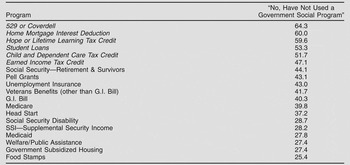
This is not surprising, because in taking on the submerged state, Obama engaged in a set of battles over policies that are obscure if not invisible to much of the public. In fact, even individuals who have themselves utilized such policies may have little awareness of them as public social benefits. Because few existing surveys permit us to examine citizens' perceptions and experiences of such policies compared to more visible ones, I designed the Social and Governmental Issues and Participation Study of 2008 (hereafter, referred to as “Governmental Issues Survey”) to do so.Footnote 32 Respondents were asked, first, whether they had “ever used a government social program, or not.” Later, they were asked whether they had ever benefitted personally from any of 19 federal social policies, including some that belong to the “submerged state” and others that are visible and direct in their design and delivery. Table 3 presents the percentage of beneficiaries of each of several policies who reported that they had never used a federal social program. Notably, the six italicized policies that head the list are precisely those belonging to the submerged state: tax-deferred savings accounts, several tax expenditures, and student loans. Given the design and manner of delivery of these policies, few individuals seem to perceive them to be social benefits. Such dynamics may imperil the political effectiveness of reforms that are limited to expansions or modifications of the submerged state.
Percentage of program beneficiaries who report that they “have not used a government social program”

Source: Social and Governmental Issues and Participation Study, 2008. Note: Submerged state policies shown in italics.
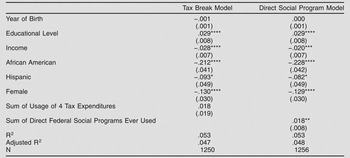
Elected officials often seem to assume, furthermore, that providing tax breaks will alter citizens' attitudes about their taxes, but the evidence suggests otherwise. I examined whether individuals' views that they paid more than their “fair share” in federal taxes might be mitigated by their receipt of tax expenditures, which effectively lightened their tax burden. Interestingly, this appears not to be the case. When Americans were asked their views about federal income taxes, 56 percent reported that they were asked to pay their “fair share,” whereas 40 percent said they paid “more than their fair share.”Footnote 33 The analysis of the “tax break model” in the first column of Table 4 shows that while the number of tax expenditures individuals report utilizing (including the home mortgage interest deduction, 529 or Coverdell accounts, HOPE or Lifetime Learning Tax Credits, or Child and Dependent Care Tax Credit) positively relates to their views of tax fairness, the relationship is not statistically significant.Footnote 34 Paradoxically, these policies, although they permit individuals to pay significantly less in taxes, do not alter their view about the tax system. Instead, determinants of this view include education (those who have more education are more likely to perceive the system to be fair) and income (those who have less income perceive the system to be fair), among other factors.
Effects of extent of tax expenditures and direct social program usage experiences on perception of fairness of federal income taxes (OLS Regression)

Source: Social and Governmental Issues and Participation Study, 2008.
* p < .10,
** p < .05,
*** p < .01,
**** p < .001;
Cells show unstandardized coefficients, with standard errors in parentheses. Note: Tax fairness variable is coded as 1, “more than fair share;” 2, “asked to pay fair share;” and 3, “less than fair share.”
By contrast, experiences of benefiting from direct visible federal social programs do appear to influence individuals' views of tax fairness in a salutary manner. The “direct social program model,” shown in the right-hand column of Table 4, replaces the tax breaks variable with the sum of the number of traditional, visible social programs individuals have ever utilized. Those who had used a greater number of visible programs were significantly more likely to report that they paid their “fair share” in taxes; other results remained consistent with those in the first model. Thus, individuals' sense of having benefitted from government through visible social programs appears to mitigate their sense of being burdened by it through taxes. Conversely, usage of policies embedded in the submerged state—the types of policies on which Obama's efforts have focused—do not. In short, the expansion of policies in the submerged state, even if they are aimed at low- and moderate-income Americans rather than the more typical affluent recipients, may do little to engender positive attitudes among recipients toward such policies—or, quite likely, toward the political leaders who helped bring them into being.
Neither do citizens exhibit much understanding of how policies in the submerged state function nor of the upwardly redistributive bias many of them possess; thus they do not comprehend what is at stake in policy battles surrounding them. This is not surprising, given that political elites communicate about such policies rarely, and when they do, it is typically in muted, oblique, and contradictory ways. An experimental study to test how the provision of information about tax expenditures influenced attitudes about them found that when citizens were asked outright whether they supported particular examples of such policies, typically one out of three respondents responded that they did not know or had no opinion.Footnote 35
The same study also suggested, however, that the “submerged state” need not necessarily remain hidden from ordinary Americans and visible only to entrenched powerful interests. When respondents were provided with basic facts about how such policies function and then asked their views, the ranks of the uninformed fell to less than one in five: simple, clear, policy-relevant information facilitated opinion expression among citizens, particularly those with at least moderate levels of political knowledge. After respondents were provided with basic information about the distributive effect of the home mortgage interest deduction—the fact that it benefits mostly affluent people—opposition grew sharply, particularly among those with low to moderate incomes and among liberals and Democrats. By contrast, after being informed that the EITC benefitted mostly those in low-moderate income groups, support grew among respondents generally, regardless of income.Footnote 36 This implies that if policymakers would reveal the features of the submerged state and what is at stake in reform efforts through clear communication with citizens, they could foster greater understanding of and support for reforms.
In short, in attempting to create or alter policies within the submerged state, reformers engage in a high-risk endeavor in which the challenges are great and the political rewards may be very few. Their opponents will likely meet them quickly, armed and ready for battle, whereas their supporters and those of behalf of whom they engage in such struggles are unlikely to even appreciate their efforts not to mention offer assistance. Reconstituting the submerged state successfully, then, requires that reformers pay apt attention to conveying what is at stake to the public, through political communication, policy design, and the manner of program delivery.
Tax Expenditures
Obama considers tax policy a centerpiece of his domestic agenda, particularly for purposes related to social welfare. He looks to it to reallocate priorities, devote resources to a wide array of purposes, mitigate rising economic inequality, and not least, raise revenues for health care reform. During the presidential campaign, Obama articulated three goals linking tax policy and social welfare: first, he planned to allow the 2001 and 2003 Bush tax cuts for the most affluent Americans to expire, restoring the higher rates on income, capital gains, and dividends that existed previously; second, he sought to scale back the regressivity of tax expenditures that favored the wealthy, restoring rules that had existed prior to the 2001 tax cuts; and third, he aimed to channel a higher proportion of tax expenditures to low and moderate income people, through both the creation of new policies and alterations to existing ones. For instance, he planned to make new and existing tax breaks “refundable,” such that even those with no tax liability could benefit from them. Such ideas drew inspiration from the emerging field of behavioral economics, “the integration of economics and the psychology of preference formation and choice,” an approach embraced by several of his advisors.Footnote 37
Early Action: The Economic Stimulus Bill
With the American Recovery and Reinvestment Act of 2009, otherwise known as the stimulus bill, President Obama scored several victories for his agenda within five weeks of taking office. Although this law resembled legislation enacted during Roosevelt's First Hundred Days inasmuch as it aimed to revive a devastated economy, it differed dramatically by making tax breaks the primary vehicle for offering relief to most Americans: in total, they amounted to $288 billion, fully 37 percent of the entire $787 billion dollar stimulus package.Footnote 38 The largest of these was the president's signature proposal, “Making Work Pay” Tax Credits, which was based on principles like those of the Earned Income Tax Credit (EITC) but reached well up into the middle class: individuals with incomes below $75,000 and married couples with incomes up to $150,000 qualified for this credit of up to $400. Second, as a means to make college more affordable, the “American Opportunity Education Tax Credit” offered up to $2500 to reimburse low and moderate-income families for tuition costs.Footnote 39 The bill also included several other tax features, including: increases in the EITC and child tax credit; one-time payments of $250 to recipients of Social Security, SSI, Railroad Retirement, Veterans' Disability Compensation, and some federal and state pensions; tax credits of up to $8000 for first-time home buyers; and several others.Footnote 40
The stimulus bill achieved the president's goals of channeling funds toward low to moderate income Americans, but it did so by further expanding the submerged state. In political terms, with over one out of three dollars in the stimulus bill tucked into tax breaks rather than in more obvious forms of social welfare such as relief payments or job creation, it was not certain that Americans would clearly recognize that the extra funds they received or did not owe in taxes owed to Obama's efforts. One year later, when a CBS poll asked, “In general, do you think the Obama Administration has increased taxes for most Americans, decreased taxes for most Americans, or have they kept taxes the same for most Americans?” only 12 percent responded that taxes had been decreased. In fact, 24 percent believed that the new president had increased taxes for most Americans.Footnote 41 Remarkably, although 95 percent of employed Americans owed less in taxes thanks to the “Making Work Pay” tax credit in the stimulus, a policy projected to cost $536 billion over ten years, most were unaware of it. Through an innovation prompted by behavioral economists who reasoned that small amounts of funds made available gradually would stimulate spending more reliably than a lump sum reimbursement, the new credit had been paid out automatically in the form of slightly larger earnings in workers' paychecks throughout 2009. While this approach may have prompted more spending, as intended, it seems not to have yielded enduring recognition of Obama's first major accomplishment in social welfare policy.
Obstacles to Scaling Back Regressivity
In February 2009, President Obama presented to Congress his first budget, one that contained nearly all of his campaign promises for changes in the tax code, including plans to scale back the regressivity of some tax expenditures. Obama proposed that those in the top two tax brackets—36 and 39.6 percent—should have their deductions, such as those for home mortgage interest and charitable contributions, limited to their value at the 28 percent tax bracket.Footnote 42 As seen in Figure 1 above, those two tax deductions are especially regressive and thus altering them would facilitate progress on Obama's goal of reducing inequality. The president planned to use the saved revenues—projected to amount to $267 billion over ten years—to help finance health care reform, for which they would provide approximately 45 percent of the needed funds.
On Capitol Hill, however, this plan met instantly with antipathy from Republicans and it received a less-than-enthusiastic reception even from some in the President's own party. Fellow Democrat Max Baucus (MT), Chair of the Senate Finance Committee, cautioned that “some of the reforms and offsets … such as the limitations on itemized deductions, raise concerns and will require more study as we determine the best policies for getting America back on track”.Footnote 43 In the House, Majority Leader Steny Hoyer (MD) warned, “That's going to be controversial. And, obviously, charitable contributions … [present] great concern. Clearly, one of their greatest concerns will be very, very large-income donors who make very substantial contributions to very worthwhile enterprises.”Footnote 44 Charles Rangel (NY), Chair of the House Ways and Means Committee, also expressed reservations, noting, “I would never want to adversely affect anything that is charitable or good.”Footnote 45
What could explain such swift opposition—even from fellow Democrats—to modifying these tax breaks for the wealthy? The answer likely lies in the political power possessed by the organized groups that benefit from such provisions, starting with the real estate lobby. On the day Obama presented his budget, Charles McMillan, President of the National Association of Realtors, wrote to him voicing opposition to proposed changes to the Home Mortgage Interest Deduction (MID). He argued that “diminishing or eliminating the MID would hurt all families, the housing market, and our national economy…. At a time when our housing and real estate markets are suffering, we believe it would be irresponsible for the real estate industry and federal policymakers to consider, much less support, any proposal seeking to alter the MID.”Footnote 46 The organization circulated similar letters to all senators and representatives in Congress and published ads expressing its opposition in several newspapers.Footnote 47 The Financial Services Roundtable, Mortgage Bankers Association, and the National Association of Home Builders also quickly announced their opposition to any alterations to the real estate tax deductions.Footnote 48
Such letters and ads carried weight because the real estate lobby had cultivated relationships with politicians from both parties and had done so over a long period of time and with an increasingly intense commitment of resources in recent years. In the size of its campaign contributions, it ranked among the most generous six industries in every electoral cycle at least since 1990. The $136 million it spent in the 2008 election—combining contributions from its PACs, soft money, and individual donors—was distributed widely: every member of the US House received contributions that averaged $54,000, and every senator received an average of $401,000. Moreover, during 2009, the industry spent over sixty-five million on lobbying activities. The National Association of Realtors alone invested $19,669,268 in such activities, making it the tenth biggest spender across all types of organizations in the nation. While its prominence in such activities is nothing new, the amount it invests in politics annually has soared over time, nearly quadrupling in just the past decade.Footnote 49
Though it may seem surprising, charitable organizations behaved very similarly to those in the real estate industry, spending considerable sums to protect their self-interest by protesting to the Obama administration's proposed changes in the tax code. The non-profits, foundations, and philanthropy sector spent less on such efforts than the real estate industry, but still invested considerably: it spent just one-eighth as much in campaign contributions in the 2008 election ($18 million), but fully half as much on lobbying in 2009—a total of about $38 million.Footnote 50 Philanthropists themselves appeared to be divided on whether a change in the tax law would adversely affect charitable giving, some predicting that its influence would be minor and far outweighed by the value of the achievement of health care reform.Footnote 51 Nonetheless, trade associations such as the Council on Foundations actively fought the Obama administration's proposals.Footnote 52 Throughout the ensuing debates, policymakers of both parties invoked the moral high ground associated with the philanthropic sector by expressing concerns about it far more than the real estate industry; such arguments quickly derailed the administration's primary plan for financing health care reform.
By late March, just one month after Obama introduced his proposal, the Senate had already taken action to stymie the administration's efforts to modify the two most regressive tax deductions. At Baucus' urging, Democrats endorsed a proposal offered by Republican Senator Bob Bennett (UT) requiring that health care funding not be financed through alteration of the tax benefits tied to charitable contributions.Footnote 53 A few weeks later, when the Senate Finance Committee released a report listing policy options for raising revenues to finance health care reform, it offered no discussion of Obama's preferred approach.Footnote 54
From the start the administration had sought to avoid difficulties faced by Clinton's health care plan by leaving it to Congress to devise plans, and thus the president refrained from strongly promoting the financing plan he favored. During a prime-time news conference in March, a reporter asked him whether he was reconsidering his approach of cutting back deductions for mortgages and charities, and whether he regretted having proposed it in the first place. Obama answered, “No, I think it's the right thing to do.” Referring to the rise of economic inequality, he defended his approach as a way to “raise some revenues from people who benefitted enormously over the last several years.” Then in a statement that was unusual for an elected official in its candor at revealing how an aspect of the submerged state functions, he explained:
People are still going to be able to make charitable contributions. It just means if you give $100 and you're in this tax bracket, at a certain point, instead of being able to write off 36 (percent) or 39 percent, you're writing off 28 percent. Now, if it's really a charitable contribution, I'm assuming that that shouldn't be the determining factor as to whether you're giving that hundred dollars to the homeless shelter down the street…. what it would do is it would equalize. When I give $100, I get the same amount of deduction as … a bus driver who's making $50,000 a year or $40,000 a year gives that same hundred dollars. Right now, he gets 28 percent—he gets to write off 28 percent, I get to write off 39 percent. I don't think that's fair.Footnote 55
Yet never did Obama offer a major speech in which he explained to the American public with similar clarity how such policies work and what difference proposed changes would make and for whom. The issue thus remained largely invisible to the public. Without a concerted effort by the president to promote it and in the absence of public mobilization, the administration's plan continued to lose traction.
Taking Stock
Obama came into office with ambitious plans for restructuring tax expenditures and undercutting their upwardly redistributive bias. In his first year, he succeeded only in his goal of creating new tax breaks—at least temporary ones—for low to middle-income households. But these policies further add to the size and scope of the submerged state, and they are imperceptible to most Americans.
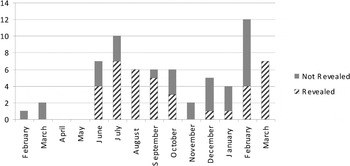
Given that the submerged state is not nearly as visible to most Americans as it is to the interest groups that benefit from it, the task falls to reformers to reveal its key features to the public. An analysis of all speeches, press conferences, and weekly addresses given by Obama himself between his Inauguration in January 2009 through March of 2010 shows that he spoke about taxes 38 times. As seen in Figure 2, taxes were a common theme in February 2009, when Obama gave speeches focusing on the tax breaks that were part of the stimulus. After that, however, though the subject came up fairly often, it was in the context of speeches about health care reform, and took the form of brief comments about either financing or incentives and mechanisms through which the policy would operate. As indicated by the lined sections of the bars, furthermore, even direct references to taxes rarely involved statements that made explicit the actual features of the submerged state. Content analysis of the speeches revealed that only on eight of the 38 occasions did the president actually describe how such policies functioned and who benefitted. Such statements, moreover, were usually very brief: the statement in the March 2009 press conference mentioned earlier, for instance, occupied only 446 words in the midst of a 9000 word news conference.Footnote 56 The president refrained from making a full and sustained case for the financing plans his Administration put forward, and the public remained quite uninformed.
Obama's public statements on tax policy: Revealing the submerged state, Feb. '09–Mar. '10

By contrast, groups benefitting from existing arrangements continued to be astutely aware of developments and poised to act when necessary to protect the status quo. As 2009 came to a close, the National Association of Realtors applauded itself for effectively “protecting the mortgage interest deduction,” noting that it had “aggressively fought off changes to the MID through grassroots, advertising and similar advocacy tools.”Footnote 57 Subsequently, reformers had to seek other means for financing health care reform, favoring alternatives that did not provoke such vociferous opposition among groups that benefitted from existing arrangements.
Higher Education Policy
A few decades ago, the United States led the world in the attainment of bachelor's degrees, but progress has stalled, particularly because of stagnating graduation rates among those from less advantaged backgrounds.Footnote 58 Obama's ambition to restore American leadership in college graduation rates required, first, a restructuring of entrenched policy arrangements, namely a subsidized lending system that has consumed funds that could have been spent instead to foster access, and which has, meanwhile, fostered increasingly divisive politics over the past decade and a half.
After enacting the legislation establishing student loans, the Higher Education Act of 1965, Democrats positioned themselves as the program's protector, while Republicans continued to object—as they had at its inception—to channeling government subsidies toward lenders. By the late 1980s, however, members of both parties became aware that student lending was expanding into a highly lucrative business, and the politics surrounding it began to shift. An official in the George H.W. Bush administration hatched the idea of direct lending by government—cutting out the banks as intermediaries—as a means to reduce overall spending for loans. A bipartisan group of Congressmen led by Senator Paul Simon (D-IL) promoted the idea and won support for a pilot program in the 1992 reauthorization of the Higher Education Act. In 1993, newly-elected President Bill Clinton made one of his initial goals the full replacement of existing system with direct lending. Suddenly, the lenders mobilized as never before and a bitter fight ensued. Congress adopted only a weakened version of Clinton's plan, permitting the adoption of direct lending on a limited basis. By the time Republicans took control of Congress in 1995, the two parties had effectively traded the positions they had each held on student lending just one decade previous, and they had adopted more stringent versions of each.Footnote 59
As student lenders' profits soared between 1995 and 2006, they invested in strengthening their political capacity. In campaign financing, Sallie Mae established a PAC in the late 1990s, and by 2006 it emerged as the top donor within the entire finance and credit industry; fellow student lender Nelnet ranked fifth.Footnote 60 In lobbying, Sallie Mae began to rank among the top five finance and credit companies, outspending even Mastercard and American Express.Footnote 61 Lenders also worked together to create several new organizations to represent their interests in Washington, DC. Over this period, Republicans in Congress increasingly worked in tandem with lenders, attempting to seek favorable rates and terms for them.
Late in 2006, however, the lenders' stature began to decline. Heightened voter participation by young people and investigative reports into lender practices by a few journalists caught Democrats' attention. After regaining control of the House in 2007, they unveiled higher education legislation that put lenders on the defensive. New York State Attorney General Andrew Cuomo then launched an investigation, charging that financial aid officers in many colleges and universities maintained improper relationships with “preferred lenders.” An internal investigation in the Department of Education indicated that Bush Administration appointees had given tacit approval to such arrangements.Footnote 62 In turn, in 2007 and 2008 Congress enacted and Bush signed into law two bills that put new constraints on lenders, one by placing restrictions on how colleges interacted with them and the other, by lowering subsidies and using the savings to finance increased student aid funding.Footnote 63 Thus, when Obama took office, the battles he supported were already underway on the student aid front, and the opposition had been dealt several blows.
As we have seen, Obama readily achieved the American Opportunity Tax Credit as part of the stimulus bill. In 2009, Congress also boosted Pell Grant maximum grant rates to $5550, continuing a trend of recent years. In addition, Obama—like Clinton—aimed to replace the existing student loan policy with 100 percent direct lending, a goal that involves reconstituting the political economy of the submerged state. He proposed to use the savings from the termination of lender subsidies to make Pell Grants an entitlement. Both objectives were articulated in the administration's first budget.
Taking on the Lenders
Just a few months into his presidency, Obama delivered a speech that revealed the inner workings of the submerged state with respect to student lending:
Under the FFEL [Federal Family Education Loans] program, lenders get a big government subsidy with every loan they make. And these loans are then guaranteed with taxpayer money, which means that if a student defaults, a lender can get back almost all of its money from our government …. taxpayers are paying banks a premium to act as middlemen—a premium that costs the American people billions of dollars each year…. Well, that's a premium we cannot afford—not when we could be investing the same money in our students, in our economy, and in our country.Footnote 64
Continuing, the president directly and forcefully took on the lenders:
The banks and the lenders who have reaped a windfall from these subsidies have mobilized an army of lobbyists to try to keep things the way they are. They are gearing up for battle. So am I. They will fight for their special interests. I will fight for … American students and their families. And for those who care about America's future, this is a battle we can't afford to lose.Footnote 65
By summer, however, health care reform efforts consumed the administration's attention and the president rarely spoke about higher education.
As seen in Figure 3, Obama discussed higher education issues publicly only 9 times during his fourteen months in office, compared to 68 times for health care and 38 for taxes. Figure 4 reveals that when speaking about higher education, Obama did usually make explicit the features of the submerged state with respect to student lending. He likely felt freer to do so on this issue because others—Cuomo, the Department of Education Inspector General, and Democratic leaders in Congress—had already begun the process. Yet because the president spoke about it so infrequently and it was vastly overshadowed by the focus on health care, the issues at stake likely remained hidden to most Americans.
Frequency of Obama's public statements on social welfare issues, compared, Feb. '09–Mar. '10

Obama's public statements on higher education policy: Revealing the submerged state, Feb. '09–Mar. '10

The Lenders Fight Back
The lenders, by contrast, continued to focus on the issue. Realizing that existing arrangements were unlikely to endure, in July 2009 they put forward a proposal that ceded ground to the administration by assuming the end of subsidies to lenders. Nonetheless, the plan featured a continuing role for themselves: they would originate, service, and collect payments on student loans, in exchange for fees paid to them by government.
The House of Representatives quickly repudiated the lenders' plan. Education and Labor Committee Chairman George Miller spoke out against it and introduced his own bill, one that followed Obama's lead on core principles and effectively ended the FFEL program. The Committee approved a version that met the president partway: on Pell Grants, it recommended regular annual increases but retention of discretionary authority for Congress to set the base award, and on student loans, it permitted lenders to compete to service loans but not to originate them.Footnote 66 In September, the full House approved the measure.Footnote 67
In the Senate, however, it appeared that changes to student lending would prove more contentious. Already in the spring of 2009, Nebraska Senator Ben Nelson, in whose state lender Nelnet employs one thousand individuals, voiced his opposition to direct lending.Footnote 68 Senate leaders decided to put the issue on hold while grappling with health care legislation. Senate rules permit per session just one budget reconciliation vote, in which a simple majority—unstoppable by filibuster—may approve legislation that is strictly related to the budget. Leaders realized that they might ultimately need to combine elements of the higher education policy with health care reform in such a bill, so they delayed action throughout the autumn.
Lenders used the delay to organize the opposition, both at the grassroots and elite levels. Sallie Mae mobilized workers and residents in towns where it employs the greatest numbers. In Fishers, Indiana, for example, over 81,000 individuals signed a petition urging Congress to preserve a role for lenders. At a rally of company employees, hundreds of whom donned matching tee-shirts that read “Protect Indiana Jobs,” Sallie Mae CEO Albert Lord attempted to stir populist anger, declaring, “There's Washington, and then there's the rest of the country. This is the rest of the country.”Footnote 69 Meanwhile, in Washington, DC, lenders set the goal of gaining support from at least five moderate Democratic Senators to retain the FFEL program, and they spent millions on lobbying.Footnote 70 Sallie Mae alone devoted over $4 million to such activities in 2009, the second-largest amount it had ever spent in one year.
By November, the lenders appeared to be gaining ground: analysts predicted that Obama's proposal lacked the support of enough Senators to pass.Footnote 71 The next month, Democratic Bob Casey from Pennsylvania led 11 moderate Democrats in support of an alternative to the House bill that would allow lenders to continue to originate government-backed loans and to be awarded fees by the federal government for doing so.Footnote 72 The prospects for the achievement of Obama's goals looked increasingly uncertain. Similar to the tax policy realm, vested interests of the submerged state seemed far more aware of what was at stake in reform efforts than did ordinary citizens, and they were mobilized whereas the general public remained quiescent.
Remarkably, however, in an eleventh hour stroke of good fortune for the Obama administration, Democratic leaders ultimately found that including the higher education legislation with health care reform in the March 2010 budget reconciliation bill helped it to meet the criteria for cost-savings that would help ensure passage. Despite the dim prospects in December for the administration's higher education proposals to acquire support from even 50 Democratic Senators, 56 came on board when the direct lending plan that some disliked was combined with the party's top agenda item, health care reform. In what represented the most significant shift from submerged to visible governance achieved by Obama to date, the existing system of student lending was terminated and replaced entirely by direct lending.
Health Care Reform
By 2008, the idea was widely accepted that the U.S. health care system was in crisis. Health care costs had climbed to 16 percentage of the U.S. GDP—more than the percentage spent in any other OECD nation and twice that of the average.Footnote 73 The nation has long been the only one in that western industrialized world that lacks national health insurance, yet the U.S. government itself spends substantially more than other countries on health care—on Medicare and Medicaid and the subsidization of employer-provided health care. The percentage of Americans with employer-provided private insurance benefits fell from 69 percent to 60 percent between 2000 and 2005 alone;Footnote 74 one in six Americans were uninsured.Footnote 75
As a result, health care reform hit the political agenda again in 2009 as it has approximately every 15 years since 1920. Each time, the issue has consumed the attention of policymakers and the media for months of intense drama, protracted battles, and deal-making between the political parties and with interest groups.Footnote 76 That health care reform would require Herculean efforts by the president and congressional leaders was a given; that such efforts would guarantee success was anything but. And yet, this time, the reformers won.
A full recounting of the tumultuous saga of 2009–2010 and a comprehensive analysis of the issues involved lies well beyond our scope here. Rather, the analytical framework featured throughout this article will be utilized to consider the briefly the challenges the Obama administration faced on the issue and the level of success it has achieved. As much or even more than other aspects of the submerged state, existing arrangements for the health care system have long fostered powerful vested interests, complicating the quest for reform. Over the past decade, the amount that strictly health-related groups have spent on lobbying—$3.788 billion—ranked second only to spending by the finance, insurance, and real estate sector, and much of the lobbying by the latter industries—as well as by other miscellaneous business groups—also focused on health care.Footnote 77 And just as in the other areas of the submerged state, government's role in subsidizing private actors in the provision of health care is largely hidden from ordinary citizens.
Interest Group Politics
Throughout the long history of struggles over health care reform in the United States, interest groups have played leading roles—primarily as antagonists. Some of this activism preceded the development of existing policies. The American Medical Association (AMA), for instance, opposed national health insurance as early as 1920 and impeded its inclusion in New Deal legislation.Footnote 78 Health insurance companies sought and achieved special tax-exempt status in the early twentieth century, and then worked to strengthen and expand their government-subsidized role.Footnote 79
Health policies, in turn, reshaped politics, particularly among labor unions. These organizations found greater leverage in negotiating with employers for private health insurance benefits than in seeking government-sponsored coverage, so they became lukewarm supporters at best and often opposed reform.Footnote 80 By the 1993–1994 reform cycle, when labor's power and circumstances had changed dramatically from its zenith in the postwar era, it refrained from a strong endorsement of Clinton's plan—in part, holding out for a stronger alternative and in part, disillusioned by the president's support for the North American Free Trade Agreement.Footnote 81 In fact, few groups—with the exception of the American Nurses Association and a coalition of black and Hispanic doctors—expressed firm support for the Clinton proposal.Footnote 82
Viewed against this daunting history, during 2009 the Obama administration and congressional Democrats achieved significant success in working together with key interests—namely doctors, labor, drug companies, and the AARP—to create a stronger coalition of support for health care reform than in the past. First, although the AMA signaled early on that it would oppose a government-sponsored insurance plan, in a dramatic reversal it lent its support. It even endorsed the House plan, complete with the “public option,” of which it disapproved, because it had won several modifications it favored within the Medicare payment reform plan.Footnote 83 Second, organized labor played a more active and constructive role in pushing for the adoption of health care reform than in the past. The Service Employees International Union (SEIU), AFL-CIO, and American Federation of State, County, and Municipal Employees all strongly supported the adoption of the “public option,” and thus favored the House plan.Footnote 84 But rather than only disparaging alternatives, unions actively promoted the legislation: they ran ads, they showed up at town meetings to counter the arguments of opponents, and they mobilized in states and districts of swing voters. Said organizer Dennis Rivera, “We're running this … like … a presidential campaign, and our candidate is health care reform.”Footnote 85 Third, the pharmaceutical industry cooperated in supporting reform. Although Obama had lambasted it throughout the 2008 campaign, once elected he and Senator Baucus worked closely with its leaders—as well as the AARP—to broker an agreement about how to reduce the cost of drugs purchased through the Medicare prescription drug benefit, and its “doughnut hole” provision that required seniors to pay the full price of some prescriptions. The result, while granting some leverage to the drug companies, generated $80 billion in savings to help finance health care reform, and also brought the AARP on board.Footnote 86
While this degree of cooperation among stakeholders brought reform closer to being realized than ever before, some powerful interests remained opposed. Insurance companies and business groups, which continued to benefit most from the existing arrangements of the submerged state, allied themselves and mobilized vigorously against proposed changes. Unlike the drug companies, insurance companies refused to cooperate in cost cutting. America's Health Insurance Plans, a trade group of several large insurance companies, collected funds from its members—Aetna, Cigna, Humana, and others—to finance television ads disparaging the main proposals being developed in Congress. The U.S. Chamber of Commerce facilitated the ad buys.Footnote 87 For its part, the Chamber of Commerce also poured $144 million into lobbying, outspending all other organizations and businesses during 2009.Footnote 88
As we saw in examining tax policy, the demise of the Obama administration's proposed limitations on tax deductions for wealthy Americans involved organizations that might seem to have little to do with health care reform—the real estate industry and charitable organizations. Their action thwarted the bill's progress at a critical juncture and prompted leaders to advance instead a tax on high-priced employer-provided health insurance. That plan, because it would have affected a significant number of low and moderate income Americans, involved greater political risks. But that story lies beyond our scope here.
Revealing Reform to the Public
In using the bully pulpit during his fourteen months in office, Obama prioritized health care reform. As seen in Figure 3, he spoke out on that issue far more than higher education and taxes combined. Possibly the timing of these speeches, which did not begin until summer, was a bit delayed: at that point, opponents had already mobilized to depict the “public option” as a “government takeover” and to stoke concerns about new taxes on existing health benefits, and support had begun to diminish.
The complexity of health care reform, furthermore, involving efforts to alter practices carried out between government, employers, and insurance companies, makes it difficult to explain to the public. As seen in Figure 5, Obama made public statements on the subject 68 times, and on 38 of those occasions he attempted to reveal what was at stake in reconstituting the submerged state in this area. In some instances, he described how existing arrangements benefitted private interests. For example, at an on-line town hall meeting in July, he said:
About two-thirds of the costs of the reforms … will come from reallocating money that is already being spent in the health care system but isn't being spent wisely. So it doesn't involve more spending; it just involves smarter spending…. And I'll just give you one example…. Over the next 10 years, we will spend $177 billion … in unwarranted subsidies to insurance companies under something called … Medicare Advantage. Now, this does not make seniors healthier. People who are signed up for this private insurance subsidized program don't get any better care than those who aren't. The subsidies don't go to the patients; they go to the insurance companies. Now, think if we took that $177 billion and helped families so that they could have insurance, and that we could have preventive care.Footnote 89
The next month, in Montana, he once again talked about the need to “eliminate subsidies to insurance companies”: “I just think I would rather be giving that money to the young lady here who doesn't have health insurance and giving her some help, than giving it to insurance companies that are making record profits.”Footnote 90 The president also tried to explain how differently situated citizens—those with insurance already and those without it—would experience the benefits that came with reform.
Obama's public statements on health care reform: Feb. '09–Mar. '10
Sources, figures 2–5: White House Briefing Room Website (http://www.whitehouse.gov/briefing-room), speeches on health care, taxes, and higher education given by Barack Obama (not White House staff) as listed under “Speeches and Remarks” and Your Weekly Address” between January 2009 and March 21, 2010.
Note: Health speeches include those during which Obama mentions or discusses health reform. Tax speeches include those during which Obama mentions or discusses tax cuts, tax credits, or tax expenditures (e.g., limiting the itemized deduction). Higher education speeches include those during which Obama mentions or discusses higher education, particularly education tax credits (American Opportunity Tax Credit), Pell Grants, student loans, and community colleges. Some speeches are included in multiple categories. For example, discussions of the American Opportunity Tax Credit are included in both the tax category and the higher education category. Mentions of the limit on itemized deductions are included in both the health category (as a financing option for the overhaul) and in the tax category.

Obama did less, however, to illuminate the cost of health care reform and how it would affect ordinary Americans. The public thus likely found little clarity and assurance on questions that likely most concerned many: how it would be paid for, and whether and to what extent they personally would be burdened by new costs. Without making these dimensions of the submerged state visible to the public, Obama may have left uncertain Americans more easily swayed by the arguments of opponents, who repeatedly equated health care reform with higher taxes.
While citizens may have received insufficient information about how reform would affect them, what they could observe clearly in media coverage was the numerous special deals that lawmakers made in the process of arriving at a bill. Repeatedly, congressional leaders and the president negotiated with stakeholder interest groups and with a handful of individual lawmakers whose votes were deemed crucial. Each of these interactions resulted in the negotiation of privileged treatment for particular parties, whether Nebraskans, union members, or drug companies. While such agreements helped move this major legislation aimed for the general public closer to passage, it likely appeared to many citizens as excessive catering to special interests. Such politics likely strike many—particularly independents, who have less knowledge of the political process generally—as undemocratic, and at odds with the open and accessible forms of governance Obama had promised during his campaign. Massachusetts voter Marlene Connally, quoted in one of the quotations opening this paper, articulated this view when she called the reform plans “elusive.”
At Last
Time and again, the hopes of reformers have been dashed in the pursuit of health care reform, and yet this time, despite the obstacles, they prevailed. After 90 years of effort, the achievement is momentous. It promises to expand health care coverage to 32 million Americans and, by imposing new regulations on insurance companies, to grant people greater security that they will not be denied coverage, for example if they have a pre-existing condition. In some significant ways, the policy expands the visible state, particularly by making many more Americans eligible for Medicaid. In other ways, however, it enlarges the submerged state, by channeling many more toward private insurance and offering them tax breaks to help pay for it. Other aspects of reform use state action to modify the action of private actors. This raises the question: How will Americans view the reformed health care system once it is underway? As accountable to citizens, through government, or as a system that is not subject to public control? Time will tell, but the Obama administration may influence the outcome, first through how it communicates about the meaning of reform and next through the process of policy delivery.
Visible and Submerged Success
In the realm of social welfare issues, Barack Obama set out to transform existing policies within the submerged state. He sought to harness this vast set of arrangements and to make it more inclusive and responsive to the needs of ordinary citizens, and to curtail the extent to which it channels public funds toward powerful sectors of the economy and affluent citizens. This has been an ambitious reform agenda. Such change requires the reconstitution of long-established relationships between government and economic actors. Organizations and industries that have long benefitted from the established system of public subsidies and incentives have been willing and able to invest tremendous resources in preserving those arrangements. Paradoxically, in defending them, they and their allies in elective office officials have routinely depicted reform proposals as attempts at “government takeovers,” as if to imply that government were not already central to the existing arrangements.
Reconstituting the submerged state has been doubly difficult because while the stakes have been highly apparent to the groups that have benefitted from them, they were not very visible to most Americans. Most people perceived only the market at work: they have little awareness that many social benefits they receive emanate from a submerged state that is structured by public policy and subsidized by government. Neither do they realize that many such policies disproportionately benefit wealthy citizens. They are unlikely to know the extent to which government policy promotes the profitability of some industries by offsetting their costs in serving citizens, whether as consumers or borrowers. The functioning and effects of the submerged state remain murky, if not largely hidden, to most citizens.
Yet despite the shrouded nature of the submerged state, citizens have been able to observe—illuminated in the media's spotlight—the activities of reformers who attempt to engage in its reconstitution. The problem is that without perceiving what is at stake, citizens likely viewed reformers as simply playing “politics as usual,” making deals with powerful interests. The process of reforming the submerged state is inherently messy and conflictual, far from idealized notions of change. It may have reinforced some citizens' views that government should not be trusted with complicated matters, that the private sector can handle them better and without such controversy.
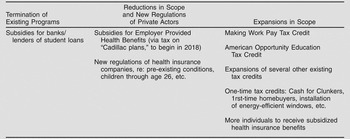
In his first fourteen months in office, Barack Obama accomplished numerous of his major goals with respect to social welfare policy, as we have seen. Yet, as shown in Table 5, the scorecard indicates that new policies do as much or more to expand the submerged state as they do to reduce its scope. The end of the existing bank-based system of student lending and its replacement with direct lending represents the most significant curtailment of the submerged state—even though lenders will continue to have a role in servicing loans. In the area of tax expenditures, the Obama administration achieved the creation of new and expanded policies for low to moderate income people. Several aspects of health care reform, as discussed above, also expand on the submerged state. Thus, the submerged state endures, albeit in altered form. The political dynamics that it engenders will continue to challenge reformers.
Effects of the Obama presidency on the submerged state

Successful reconstitution of the submerged state requires reformers to accomplish several tasks. First, they must either regroup or defeat the interest groups that have been empowered by existing arrangements. If circumstances allow and meaningful agreements can be reached, some groups might be brought on board to cooperate in reform, as the Obama Administration succeeded in doing with respect to health care reform. Outright defeat of groups that benefit from current policies is unlikely, given the extent to which they were empowered. It worked in 2010 with respect to student lenders only because those groups had already been weakened substantially over time: the creation of pilot programs for direct lending in the early 1990s created an entering wedge, a base on which reformers could build until their ideas became more widely acceptable. As this indicates, a new policy alternative can be established alongside existing arrangements as an interim approach that can facilitate more extensive reform later on.
Second, reformers must reveal to the public how existing policies of the submerged state function and who benefits, what is at stake in reform, who will gain and what the costs will be. In each of the three policy areas considered here, Obama has done more than other political leaders to expose the deeply obscured arrangements, but more focused and sustained attention is warranted. The tasks of reform may have proceeded more easily throughout 2009–2010 if political leaders had attempted to communicate to the public earlier, more often, and more deliberately about these matters. Even now that reform has been achieved, political leaders need to continue to inform the public about what has changed and how new policies will function.
Third, reformers must revamp policies, either through redesigning them or at least by guiding their delivery to make them more visible to citizens. The primary way to engage in this meaningfully is for policies to be restructured so that they no longer subsidize the interests and groups they have promoted in the past, or at least so that such support is curtailed. The change to direct lending represents quite a complete reconstitution of one policy area. The health care reform bill offers a more modified approach by retaining the existing system of private health insurance, but making it subject to mechanisms that regulate private actors and slightly curtail the extent of subsidization. But administrators should seek means to make the benefits of the submerged state more evident to citizens, for example by providing a summary sheet to individuals with their tax return that notes the amount accrued through each type of tax expenditure, or by indicating what private health insurance would cost individuals in the absence of public subsidies.
When Obama first declared his candidacy and then as he assumed the highest office in the land, he promised that his presidency would help Americans to “reclaim the meaning of citizenship,” “restore our sense of common purpose,” and “restore the vital trust between people and their government.” While efforts to reconstitute the submerged state may have appeared distant from or antithetical to such goals, it is crucial to their achievement because to the extent it has succeeded, it diffuses the power of special interests relative to that of the public. Now, if the Obama administration can successfully reveal the remaining aspects of the submerged state to citizens through new features of policy delivery, it may help enable them to participate in a more meaningful way.