Introduction
Control of helminthiasis among school children has typically focused on drug provision (WHO, 2006), the benefits of school-based mass treatment programmes (Miguel & Kremer, Reference Miguel and Kremer2004) and population-based sanitation campaigns (Patil et al., Reference Patil, Arnold, Salvatore, Briceno, Ganguly, Colford and Gertler2014). Soil-transmitted helminths are worms that live in human and animal hosts, and their disease burden compounds the impact of poverty. There is evidence to suggest that helminth infection may lead to developmental deficits, such as physical stunting (Feasey et al., Reference Feasey, Wansbrough-Jones, Mabey and Solomon2010; Taylor-Robinson et al., Reference Taylor-Robinson, Maayan, Soares-Weiser, Donegan and Garner2012; Prendergast & Humphrey, Reference Prendergrast and Humphrey2014; Pullan et al., Reference Pullan, Smith, Jasrasaria and Brooker2014) and more controversially to cognitive and motor function delay (Sakti et al., Reference Sakti, Nokes, Hertanto, Hall and Bundy1999; Grigorenko et al., Reference Grigorenko, Sternberg, Jukes, Alcock, Lambo and Ngorosho2006; Mireku et al., Reference Mireku, Boivin, Davidson, Ouédraogo, Koura and Alao2015). However, the prevention of infection is complex, as re-infection may occur rapidly following treatment (Jia et al., Reference Jia, Melville, Utzinger, King and Zhou2012), and development of drug resistance may undermine long-term eradication (Geerts & Gryseels, Reference Geerts and Gryseels2000; Vercruysse et al., Reference Vercruysse, Albonico, Behnke, Kotze, Prichard and McCarthy2011). The most effective and sustainable efforts to control such infections involve integrated approaches that address water, sanitation and hygiene (Ziegelbauer et al., Reference Ziegelbauer, Speich, Mausezahl, Bos, Keiser and Utzinger2012), making education strategies particularly promising when trying to diminish high-risk behaviour (Asaolu & Ofoezie, Reference Asaolu and Ofoezie2003; Freeman et al., Reference Freeman, Greene, Dreibelbis, Saboori, Muga, Brumback and Rheingans2012, Reference Freeman, Clasen, Brooker, Akoko and Rheingans2013a, Reference Freeman, Clasen, Dreibelbis, Saboori, Greene and Brumback2013b). Nevertheless, within indigenous contexts such as among the Maasai pastoralist communities described here, cross-cultural educational initiatives stir added procedural and ethical challenges for health promotion. This is because material scarcity and the social stigma often attached to traditional ways of life compel those who design interventions to adapt health promotion initiatives to existing resiliency and to local experiences of parasitic infections.
In May 2014, the team organized workshops with science and civics teachers in two secondary schools in the Ngorongoro Conservation Area (NCA) to address water, sanitation and hygiene, and parasitism. This was part of a programme to implement a school-based participatory science education initiative with Maasai pastoralist youth. A health education scholar and an anthropologist on the team collaborated with undergraduate research assistants and local translators to conduct a series of discussion groups with distinct stakeholders, namely students in each school, teachers, parents and a women’s group within the wider community. The goal of these activities was to assess the relevance and appropriateness of a youth empowerment and social entrepreneurship model for the long-term prevention of parasitic infections in pastoralist contexts. This formative stage was designed to incorporate local community interests, features and concerns in the evolving implementation of the participatory science education programme known as Project SHINE (Sanitation and Hygiene INnovation in Education).
Through extensive consultation between diverse partners and community members, the team identified local community features and concerns around research and health promotion. These local perspectives enabled the team to incorporate the unique resources and constraints of pastoralist life in the NCA into Project SHINE’s six-month roll out. This article focuses on local knowledge shared in early discussion groups that enhanced understanding among the research team of contextual factors shaping the project’s implementation. Overall, Project SHINE affirmed the principle that the health of people and animals are mutually affected by interactions between human, animals and the environment. This grounded the initiative in a critical One Health approach to parasitism (Reparent et al., Reference Reperant, Cornaglia and Ostserhaus2013; Zinsstag, 2012) – a framework that in principle emphasizes that health promotion strategies be adaptive to local, national and global realities. While the One Health paradigm may serve as a tool for highlighting contextual factors, the authors note that its interface with international philanthropy to meet Millennium Development Goals may nevertheless ignore local perceptions and priorities (Smith et al., Reference Smith, Taylor and Kingsley2015). In practice, a One Health approach requires moving beyond conceptual rhetoric that risks preventing the research team from adequately engaging local community and system actors, to attend to ‘how different knowledges are brought together’ (Hinchliffe, Reference Hinchliffe2015, p. 28). In this case, the approach challenged partners and research team members to account for the ways in which parasitism and its treatment are influenced by local factors such as frequent migration, seasonal and precarious access to clean water, material scarcity and close contact with livestock. Meanwhile, at a national scale it highlighted social hierarchies that may stigmatize indigenous practices and ways of life often unfamiliar to public health authorities. The framework also drew attention to the limitations of globally orchestrated strategies to adapt health promotion to local contexts.
Analysis of early discussion group responses presented here is anchored in an appreciative approach to inquiry that fosters collective action towards reducing early childhood disease. Moving beyond deficiency or problem-driven research (Bushe & Kassam, Reference Bushe and Kassam2005), what are local experiences of parasitism in the NCA, including causes, symptoms, risk factors, prevention and finally treatment options? Regarding secondary students in particular, how might youth be engaged as change agents to identify barriers to improved health within their communities? And finally, what are local cultural and ethical considerations that may guide public health interventions in pastoralist contexts more generally?
Methods
Project SHINE was implemented throughout 2014, taking a multi-phase approach to community engagement. Improved health outcomes were targeted through a focus on sanitation and hygiene practices at the individual, school and community levels. Project SHINE also promoted the capacity to engage in related social entrepreneurship and income-generating activities through science fair projects, which focused on water, sanitation and hygiene.
Study design
The formative stage of Project SHINE was designed to develop an understanding of pastoralist norms, attitudes and practices related to sanitation and hygiene, as well as to identify facilitators and barriers for efforts to mitigate parasitic infection in the NCA, such as limited or seasonal availability of water (Bastien et al., Reference Bastion, Herthington, Hatfield, Kutz and Manamain press). On the basis of findings in this early stage, workshops for teachers and a women’s group in the NCA were tailored to help these actors engage youth in lessons and extracurricular activities that could enhance school curricula related to sanitation and hygiene. Mobilized within the communities surrounding the ward of Endulen, the women’s group offered insight in terms of local perceptions of parasitism and wisdom for how to ensure Project SHINE could have a lasting impact. Subsequent project stages focused on developing innovations in sanitation and hygiene by organizing school- and community-based activities to mark three international days in the latter half of 2014: 1) World Water Monitoring Day (September 18th), 2) Global Hand-Washing Day (October 15th) and 3) World Toilet Day (November 19th).
Throughout all stages, a mixed methods participatory action research (PAR) approach engaged schools and communities in the development and evaluation of Project SHINE for health promotion. Data collection was conducted throughout the project in order to assess the process and impact of the intervention. This included interviews and group discussions allowing the team to understand community perceptions of Project SHINE, specifically to what extent it met student, teacher and other stakeholder needs, as well as to measure the intervention’s impacts. Effectiveness of the intervention drew on before and after measures through baseline surveys, the first carried out in April 2014 (n=889) and the second in November 2014 (n=914), both completed by secondary school students in forms 1–4 in the partnered schools.
Study setting
Located in northern Tanzania along the western flanks of the Great Rift Valley, the NCA encompasses diverse ecosystems, including lush forest highlands along the rim of the Ngorongoro Crater, and the arid plains and woodlands in the south-eastern stretches of the Serengeti. The partnered secondary schools are located in each of these areas, at a distance of approximately 1.5 hours by vehicle one from the other, though both attract students from throughout the NCA and beyond. One challenge on the ground was to navigate translation in an environment where many participants could understand the spoken English of the research team, but could more freely answer probes in Maa or Swahili. The employment of Maasai translators fostered fluidity in communication across the three languages, while Canadian student assistants took detailed notes on the language in which statements were made.
Since 2006, health and veterinary scholars from the University of Calgary and the Catholic University of Health and Allied Sciences in Mwanza have established a long-running global health field school in the NCA. The trans-disciplinary collaboration grounds the annual field school in a One Health approach by accounting for human, animal and ecosystem interfaces as key social determinants of well-being (Reperant et al., Reference Reperant, Cornaglia and Ostserhaus2013; Zinsstag, 2012). In 2014, two inter-related though independently funded research projects addressed the prevalence, perceptions and prevention of human and animal parasitism, among which Project SHINE was one. While the prevalence study partnered with six primary schools in the NCA, the two secondary schools with which Project SHINE collaborated were boarding schools. Ongoing academic partnership with Maasai communities in the NCA include with traditional leaders, a local women’s group and stakeholders providing veterinary services. It also involves partnership with staff at the Endulen Hospital, primarily with doctors, laboratory technicians and dispensary workers. School headmasters and teachers played a key role in identifying project priorities, working alongside the team towards the eventual implementation of a science fair in late November 2014. Local education authorities, namely District and Ward Education Officers, granted permission for the study. Additionally, authorities at the NCAA (Ngorongoro Conservation Area Authority) and the Archdiocese of Arusha, which runs the Endulen Hospital, were policy-level stakeholders familiar with project goals through discussions with the research team. These were also circulated copies of the proposal that was submitted to Tanzania’s National Institute for Medical Research (NIMR).
Data collection
In May 2014, qualitative discussion groups were conducted with secondary school students in two boarding schools in the NCA (n=60), as well as with Maasai teachers (n=6) and a women’s group with members ranging in age from approximately 20 to 60 years (n=8). To complement the group discussions, the research team interviewed two doctors working in the Endulen Hospital about their perceptions of parasitism and clinical partnerships with local schools. Student participants were predominantly of Maasai origin, and student discussion groups were recruited according to an even distribution of participants of each sex (i.e. male; female). For the first round of student discussion groups, a few non-Maasai students also participated, as it was not initially evident to the research team that some non-Maasai youth attend boarding schools in the NCA. Therefore, aside from a first round of discussion groups that included students originating from outside of the NCA, recruitment focused on Maasai youth; more than 80% (n=50) of the student participants were Maasai. Separate discussion groups for male and female students were carried out simultaneously in the schools.
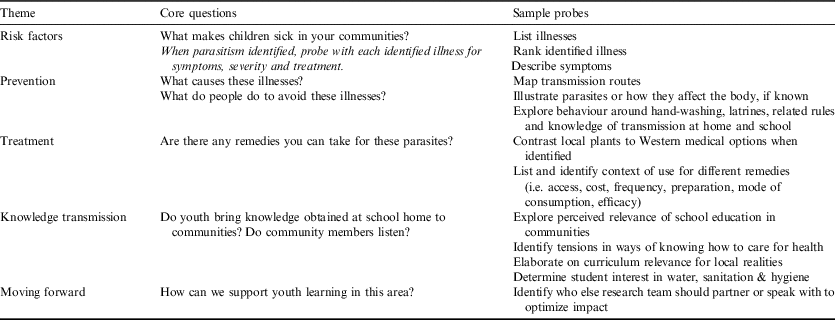
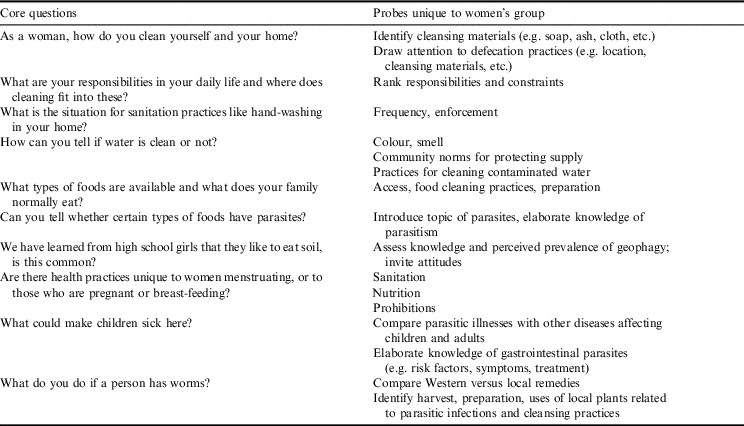
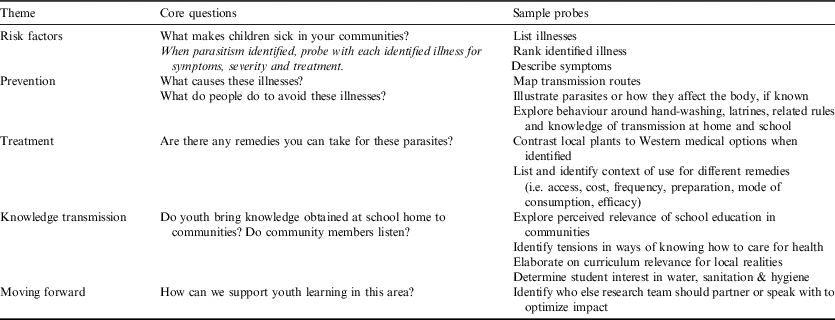
The question guides (Tables 1 and 2) varied according to participant groups (i.e. students, teachers, women’s group). All were asked about local understandings of parasite transmission routes, as well as attitudes and practices around water, sanitation and hygiene. Knowledge about treatment options available and preferred among area communities was also explored. The Canadian students who helped with note-taking prepared for their role over the course of three months prior to travelling to Tanzania, each also designing and facilitating workshops on water, sanitation and hygiene education with the teacher and women’s groups.
Student group discussion guide
Women’s group discussion guide

While probes guiding group discussions with the distinct groups were largely the same, the order of themes and the approach to questions were adapted to the interests and concerns of each. Student groups were also engaged in participatory mapping activities to represent their knowledge visually. With the Maasai teachers, who were a minority tribal group among educators in each school, discussion began with their community role as educators, relating this to their perception of the extent to which school knowledge is recognized and received more broadly within Maasai society.
With the women’s group in particular, questions were adapted in collaboration with a female translator who in advance of the group discussion made suggestions for fostering the flow of ideas and recommendations against certain approaches. For instance, while discussion with students began with what makes children sick among their communities, the women’s group discussion began with how they keep themselves clean as women. This recognized that to focus at the outset with women on childhood diseases could limit their understanding of the team’s goals, restricting attention to maternal care and potentially resulting in the exclusion of equally relevant material related to sanitation and hygiene practices in the home and beyond.
Quality control and thematic analysis
In addition to note-taking by Canadian students, all discussion groups were also audio-recorded, with a portion of particularly relevant segments transcribed and translated into English by a Tanzanian research assistant fluent in Maa and Swahili. After each student discussion group, debriefs were held between the six facilitators (three with each group), ensuring the systematization of notes and audio-recordings and the identification of emerging themes for further probing. Member checking was carried out by addressing with each subsequent discussion group the research team’s ongoing observations and interpretations of data. Following the field school, thematic analysis was used to identify significant patterns in notes and recordings from the discussion groups (Morse & Field, Reference Morse and Field1995). Thematic coding involved both inductive and deductive approaches (Fereday & Muir-Cochrane, Reference Fereday and Muir-Cochrane2006). For the former, this meant that analysis was open to the discovery of new themes and patterns at distinct levels of social life.
An interpretative phenomenological (Fade, Reference Fade2004) approach was used for understanding local experiences of, and responses to, parasitism among children. The framework prioritizes the perceptions of participants, making it particularly relevant for grasping local norms, attitudes and practices without over-determining discussion with investigator bias. Interpretative phenomenological analysis is practical for the range of data that may be generated during open-ended discussions, for instance taking into account non-verbal communication (e.g. tone, hesitation) documented by note-takers. Emphasizing the perceptions communicated by participants also offers a means of revealing possible tensions between local knowledge systems and knowledge that derives from outside actors or community members who have acquired education and experience from elsewhere. As explored below, the suggestion in the title statement by a male student that ‘we cannot get worms from cow dung’ takes on enhanced meaning through discussions around barriers to overcoming parasitic infections within local communities.
Ethical considerations
The study was approved by two ethics committees: the University of Calgary’s Conjoint Health Research Ethics Board (CHREB) and Tanzania’s National Institute for Medical Research (NIMR). A multi-layered consent process ensured that all respondents fully understood consent. The procedure used for consent has been utilized widely in similar studies when the research involves representative surveys entailing minimal risk to participants. The District Education Officer and headmasters in each school provided permission, letters were sent home to parents and students were requested to describe the information to their parents, especially when these could not read. No refusals to participate in the survey were registered. For the interviews and group discussions, consent (or assent for the students) to participate and to audio-record the session was obtained from parents prior to the discussions, in writing if the participants were literate in Swahili or English.
Results
Data generated through the diverse discussion groups are arranged here according to causes, signs and symptoms of childhood illness, prevention and treatment.
Causes, signs and symptoms of childhood illness
When asked what makes children sick in the NCA, answers offered in the student discussion groups were varied, at times identifying illnesses by their English names (e.g. malaria, typhoid), while at other times referring to environmental conditions or systemic factors that could precipitate these (e.g. lack of water, poverty). Responses to this first question stirred mention of nutritional imbalance, lack of parental care due to being orphaned, typhoid, cholera, untreated water, uncooked meat or cold food that has been left out too long, and lack of shoes and mosquito nets. Some factors were related to education and social status, such that students occasionally stated things like ‘wearing shoes is a sign of being educated’ (Female secondary school discussion group, May 2014). On one occasion, a student memorably raised her hand after several minutes of discussing this question among peers to point out that she in fact did not think it was malnutrition, as they had identified, so much as poverty that made children sick. With this, she articulated that malnutrition is not generally a choice, nor isolated from social inequities. In some discussions, students mentioned invisible ‘micro-organisms’ in river water, explaining that to avoid these they sometimes filter their water with a cloth or opt to consume rainwater when possible. Participants in the women’s group described similar filtration practices, stating that they generally only filtered to remove visible residues, especially in cloudy or low-quality water gathered during drier months. Materials used for filtering were often also used for clothing and were only occasionally washed with soap, this being relatively affordable but not as highly prioritized by the women as purchases like food and shoes for their children.
One student proposed that food prepared at home is safer than food consumed while travelling. This contrasted with observations made to research team members by school staff that, following extended holidays when students return to their communities, there are often outbreaks of diarrhoea and related illnesses such as typhoid among the student body. The perspectives of school authorities on factors in Maasai homes seen to pose greater risk than within the boarding schools were complicated by the perspectives of youth. These expressed that ignorance alone was not to blame for childhood illnesses. Other factors identified in the discussion groups were inequities about which their families could do little, such as unreliable access to safe water for humans and livestock for several months out of each year. It is worth noting that while enduring dry seasons is part of a traditional Maasai way of life, the multiple-land-use system of recent decades has established more permanent and densely populated settlements within the NCA, also restricting where herders may roam to access water. As such, precarious access to food and water was commonly identified as the leading cause of illness among children, livestock and wider communities.
Through mapping activities, students highlighted factors that may increase the transmission of disease-inducing pathogens over which their families could have some measure of control. This began by inviting students to rank the relative dangers of consuming uncooked foods and water versus the risks posed to children who walk outside barefoot. This was followed by asking students whether certain animals are more likely to transmit parasites than others. At this prompt, one male student clarified that ‘we can’t get worms from cow dung, only from human faeces, and also from dogs’ (Male secondary school discussion group, May 2014). His group then elaborated that young men butcher animals at a distance from the household to eat in a place called the orpul, and while women and children often do not eat meat, dogs can transmit pathogens by eating faeces and later contaminating food in the orpul. Flies were also seen to be leading vectors of disease-inducing pathogens, with several discussion groups drawing diagrams of transmission routes where flies landed on faeces and would then travel into homes and onto food. However, by insisting that cow dung is relatively safe, several groups referred to its frequent use as a construction staple for corrals and shelters.
Once on the topic of childhood parasitic infections, students revealed knowledge that echoed prevention practices promoted within the schools, such as the importance of using latrines, which are widely referred to by the Swahili term choo. Students explained that while they were at school, they were responsible for buying their own soap for washing hands. Improvised hands-free hand-washing facilities (also often referred to as tippy-taps) existed in some schools, while water for washing or drinking was rarely treated. Toilets hooked up to water tanks existed at both secondary schools, though they flushed into nearby bushes. It was also difficult to identify where students had acquired certain knowledge, as they repeated messages apparent in public health materials that were on display at the dispensary, though where they had acquired certain lessons remained unclear. Often participants attributed a key cause of childhood illness to lack of education and ignorance about how parasites are transmitted and reproduce. Many of the students and women expressed confidence that the growing school attendance of both boys and girls could overcome this so-called ignorance without diminishing Maasai ways of knowing.
Focusing specifically on knowledge of parasitic infections, at least a few people in each discussion group identified that tapeworm is common in the NCA. Several of the youth laughed as they admitted having experienced it, confirming its presence through its visibility to the naked eye within one’s own faeces. They called a visibly large, white tapeworm orpuduki, and described these as also appearing in cattle faeces (where they are known as olbuduki). At the same time, no discussion group identified cow dung as particularly dangerous in terms of parasite transmission, which members of the research team note is a reliable assessment, given that people generally get the cattle tapeworm (Taenia saginata) from undercooked meat. In fact, the women’s group described the frequent handling of cow dung for the purposes of building or reinforcing the walls of homes, suggesting that the prevalence of dung throughout living spaces casts doubt on risk for transmitting illness in general. This is especially so given that the dung is dried in the sun and desiccated, which could kill the vast majority of parasites of concern.
When the women’s group was first asked what makes children sick in the NCA, the terms participants identified by name were malaria, high fever, pneumonia and brucellosis. Research team members from the veterinary sciences noted that the inclusion of brucellosis on the list could reflect the field school’s role in putting certain diseases on the radar of nearby residents, though such diseases might escape attention in more outlying areas. These responses indicate that helminth-like parasites were not considered as prevalent as other illnesses. However, when asked if there were sicknesses specifically caused by the environment, one woman noted that parasites are indeed significant for children, more frequently leading to death than among adults. Explaining how one knows that a child may be sick with parasites, students described not only that the stomach may become big in spite of repeated vomiting accompanied by hunger, but that ‘bubbles and bumps’ may also appear on the skin. From a diagnostic perspective, these may signal hookworm (most likely Ancylostoma duodenales and Necator americanus) or Strongyloides (most likely S. stercoralis), which both penetrate skin and migrate. In one group, lips were described as becoming green and eyes ‘too white’, the latter a common sign of anaemia, which can be caused by hookworms. Participants consistently indicated that such illnesses were a bigger concern for children than for adults, recognizing that those who die from these conditions are by and large young.
For hookworms and small parasites such as Strongyloides, which would not be noticed with the naked eye, local names were not identified in any language and were referred to more generally according to the Swahili and Maa terms for worms: minyoo and orkuto, respectively. Nor was there a local term for Ascaris, intestinal roundworms which children were also described as having through talk of vomiting and defecation. Prompted to describe the effects of these on the body, the students spoke of weakness, fever and sweats, vomiting, diarrhoea, hunger, weight loss, distended bellies, severe salivation, green lips, eerily whitened eyes and dry skin or irritations. While the students described little difference between parasites in children and adults, and while members of the women’s group agreed that parasites affect everyone, the women proposed that tapeworms were more common among adults, while the less visible parasites were believed to mostly affect children. The women did not speculate on why this would be, but the longevity of tapeworms, and the likely increased access of adults to meat (the source of tapeworms), may explain the apparent higher abundance in adults. It is also technically possible that tapeworm could be transmitted via wild meat scavenged by adults, though the research team seldom ever heard of Maasai community members eating wild game or carcasses. Furthermore, lack of treatment may also play a role, as the most common Western treatment option in the area is albendazol, which has no effect against tapeworms. Taken together, these perspectives affirm intricate understandings of parasites based on lived experiences, framing predictions about who is most likely to experience what types of infection, as well as recognition of the progression of disease burden on different bodies.
Prevention
Prompting discussion about practices that might increase one’s likelihood of developing a parasitic infection, nearly all the groups identified the consumption of uncooked meat and blood, which are traditional among the Maasai. To mitigate this risk, some argued that one could merely avoid eating meat that contains visible white specks, namely larval tapeworms embedded in it. Others insisted that cooking all foods and boiling water were key strategies for reducing risk, arguing that only through intense heat could a transmission route truly be interrupted. However, while insistence on boiling water was almost universally identified as a prevention strategy, it was noted in each discussion group that many residents in the NCA do not boil their water. The most common explanations for this were, in the terms used by participants, ‘ignorance,’ ‘lack of education’ and ‘preference for the taste of un-boiled water’. Some also observed a heavy load carried by women to collect both firewood and drinking water for their families, sometimes at a distance of hours by foot. Conservation regulations in the area prohibit the cutting of trees or shrubs for firewood, meaning that within the area firewood is primarily collected from fallen brush.
The longest distances travelled for water were in the dry season, when men herd livestock far from permanent settlements and when access to even contaminated water cannot be guaranteed. Many participants noted that at these times of the year, they also frequently resort to cattle urine as a means for washing hands. One student argued during an activity to collaboratively map likely transmission routes that perhaps the riskiest time for parasite transmission is while walking through the bush for water. She explained that one may unexpectedly encounter a site where a person has defecated, which especially for small children who have not yet begun to wear shoes may lead to worms entering into the body via skin exposure. Research team members note that this could effectively occur with Strongyloides and hookworm. Her peer added that it could be even riskier when the rains come and human defecation near rivers is swept up in the current, contaminating communal water sources downstream. In this case, regardless of fences used to control livestock interactions with a water source, the rise of water between dry and wet seasons may engulf the supply with contaminated human faeces scattered in the vicinity.
During the women’s group and discussions with female students, considerable attention was given to the prevalence of geophagy, which is the eating of soil-like substances. A majority of the girls admitted to consuming soil, ranging from once every few days to multiple times a day. Recognizing that parasites may easily enter their intestinal tracts by means of geophagy, the students described how they carefully select the soil they eat, finding dark red or black pristine-looking soil for consumption. Not unique to the NCA, a doctor who was interviewed associated the practice with pregnant women, as has literature on from elsewhere in Tanzania addressing the exposure to chemical elements through the consumption of soil (Nyanza et al., Reference Nyanza, Premji and Mannion2014). While the female students spoke openly about eating soil, as well as their means of avoiding detection while at school, the women’s group debated the practice with some disdain. In the eyes of more elderly women, it was not previously practised among Maasai people in the area, except perhaps only among pregnant women, becoming more generally common among women in the past 15–20 years. One women’s group member expressed disapproval as she recalled seeing women eating soil unashamed in public. Others nodded in agreement, as though it is an increasing problem. In dialogue, they explained that previously a pregnant woman might occasionally practise geophagy, whereas today it is widespread among post-pubescent females and bears its own side-effects, such as constipation and increased risk of parasitic infection. Female student participants giggled that while they recognized some risk for parasitic infection, the desire to consume earth was just too compelling to resist. Students nevertheless explained that they often avoid being caught eating soil so as not to be mistaken for being pregnant, and also because they would be punished if discovered doing so at school.
None of the female discussion groups reflected on possible underlying causes to account for the increase in appeal for eating soil, such as significant transformations in food supply introduced with prolonged cultivation bans in recent decades. Upon learning that not only pregnant women but also adolescent girls engage in geophagy, the same doctor reflected that it ‘might be an iron deficiency; in the Conservation Area, they don’t cultivate, so micronutrient deficiency could be common’ (Personal communication, area physician, May 2014). Echoing the relevance of a One Health approach, geogaphy has been observed among wildlife and livestock in and near the NCA in known salt-licks in the region. In the zoological literature, geophagy has been linked to the potential for providing micronutrients key to health among local animal and human populations, as well as to supporting reproduction (Mills & Milewski, Reference Mills and Milewski2007).
A public health dilemma emerged in discussion groups when attention shifted from descriptions of education and individual choice regarding exposure to disease-inducing parasites, towards small children who cannot be expected to, in the words of participants, ‘know better.’ After all, small children depend on their caregivers and wider communities to reduce risk for them. Student groups spoke of efforts, presumably by government officials tasked with monitoring health, to promote the use of latrines in the NCA. In particular, students described latrine enforcement efforts where officials could fine households that did not have a functional shallow pit latrine. According to the women’s group, such officials arrive every year or two and usually after typhoid or cholera outbreaks. The women described such efforts as largely punitive in nature, as retribution for recent health scares instead of preventative or proactive in protecting residents from disease. The women and students also described how some households erected false latrines with shallow pits in order to comply with the regulations and avoid paying a fine of 50,000 TZS, then approximately the price of a goat or sheep. One participant stressed that regulations against erecting permanent constructions in the NCA prohibit residents from entering the conservation area’s gates with supplies like concrete or metal, preventing the building of sturdier facilities that they deemed would be safer.
Complaints about the homemade latrines were common and by no means restricted to the potential fine for failing to have one. The structures were widely perceived to pose a risk for injury to large animals that could easily wander in and break a leg. This was a disturbing possibility for some participants, given that livestock are kept close to living quarters at night, herded into corrals as a means of guarding against predator attacks. The threat of falling into a pit led one adult participant to speculate that for this reason the homemade latrines were also a danger for children. Students highlighted that the structures are of little use to owners who do not know how, or do not have the means, to effectively clean makeshift latrines, and who instead could make these sites of foul odour and parasitic infestation.
In this context, complaints by participants that latrines are also embarrassing, as they may be seen to announce to members of the opposite sex one’s intention to defecate, are worth deeper consideration. Describing where local people go to defecate when they have no latrine, such as while herding during the dry season or while at home instead of school, male participants explained that care is always taken to find a location that is not well-trafficked, that will not announce one’s activities, and that is unlikely to house dangers such as snakes in dark corners. Ideally, the place is surrounded by plants that offer an abundance of material for anal cleansing, most popularly the oloiyapyap (a.k.a. loyapiap). However, in dry spells a handful of small stones was also identified as useful for this purpose. Nevertheless, gendered decisions around where best to defecate reveal that the preference for open defecation in remote sites is not as freely available to women and girls. For instance, when describing dangers females may encounter on long walks to fetch water (often of an hour or several more from their homes), the girls identified lions, buffalos, snakes, other wild animals and that ‘men can rape you’ (Female secondary student discussion group, May 2014). Especially at night, the students observed a difference in practices, where ‘men stay far from the boma to defecate; women are close’ (ibid). Boma is the common term for a group of households gathered within a common livestock enclosure and shared by family networks in the NCA. For these girls, venturing out at night was less an issue of privacy than it was one of being afraid of what may harm them.
Treatment
Addressing practices among Maasai communities in the NCA for eliminating parasitic infections, it was uncommon among all groups that treatment would be initially sought in a hospital or clinic. The discussion groups routinely described a range of traditional plants available at distinct times of year and for varied purposes. These could be used for sanitation and hygiene, as well as to eliminate infection. There are limitations associated with the translation of plant names, including variability in access to, and use of, plants throughout Maasai society. As such, while plant uses among Maasai communities in Kenya are documented in the literature (Bussmann et al., Reference Bussmann, Gilbreath, Solio, Lutura, Lutuluo, Kunguru and Mathenge2006), there may be many reasons why few plants identified by participants in the NCA coincide with those described in the literature. For the purposes of this study, every attempt was made to represent the language used by participants. Plant uses identified by participants extended well beyond medicinal purposes, to include anal cleansing (e.g oloiyapyap, orgumi, odule), as well as household and hand cleaning (e.g., endulele, osinoni), especially when no water is available. Some plants have multiple common uses; for instance, the osinoni leaf is widely considered useful for absorbing grease and is therefore used both to wash hands, as well as to clean dishware and other food preparation surfaces.
When probed about what they would do if a child began to show signs of a parasitic infection, groups generally discussed diverse plants that could be consumed as treatment, how to prepare these and who would administer them. The most commonly identified traditional medicine was a remedy known in the area as olmurkutan. Students described boiling and crushing the plant’s root in water and milk before drinking. It was also potentially consumed with cattle fat while eating meat, and only in small quantities (a maximum amount of liquid consumed being the size of a teacup). This was expected to prompt diarrhoea and vomiting. Other plants that were identified for medicinal properties included the endulele, after which the area of Endulen is named. The lodua, a fruit boiled and mixed with water or milk, was considered by many participants as the strongest remedy. Still other medicinal plants identified were eseke, orconel and olorien (a root boiled with cow’s fat). The benefits of these latter plants were debated in several groups, highlighting that local knowledge about medicinal plants was far from uniform. While most remedies involved the mixing of leaves or roots with liquids for consumption, one student group also described using a leaf wrapped around a finger as a form of anal probe to extract parasites.
Elders or traditional healers were responsible for conveying knowledge about the medicinal properties of certain plants, though youth felt that the knowledge was not exclusive and that they too were capable of fetching and harvesting the plants on their own, if need be. In fact, the team learned that in recent years, enterprising Maasai youth often educated in urban contexts have capitalized on their knowledge about traditional medicines by gathering and selling such plants in cities and the surrounding region. This informal sale of Maasai medicines well beyond Maasai society is said to have reached into neighbouring countries and was seen by some of the students and women’s group members to offer a viable alternative to more costly medical options.
Common reasons identified for avoiding the hospital were not only that home remedies are cost-effective and that Maasai plants are found to be effective in emptying one’s system of parasites, but also that the likelihood of re-infection regardless of treatment type is considered high. When probed about perceptions of effectiveness, both students and women’s group members explained that, with local medicines, expelled parasites may be observed in faeces as proof that a treatment works. Arguing that this made local medicines safer than clinical options, one male student explained: ‘if you use Maasai medicine, it goes in and all the worms come out’ (Male secondary school discussion group, May 2014). The research team notes that medical treatment options, for instance albendazole or mebendazole, kill parasites within the gut and that the pathogens may thereby disintegrate prior to being expelled. These drugs will also expel smaller parasite species that are not visible to the naked eye. This may explain why in addition to the relatively low cost and availability of local plants compared with Western medicine, the participants judged local remedies to be more effective.
Nevertheless, health workers indicated that the prevalence of parasitism is significant and that local treatment options may pose an equal health concern. When asked what he considered was the most important health problem in the NCA, one doctor explained: ‘serious communicable diseases, like intestinal worms’ (Personal communication, area physician, May 2014). Regarding the safety of different treatment options, another doctor expressed concern that Maasai treatment methods could dehydrate people who are already weakened, complicating a condition for which there are effective medical treatment options. He explained that when a patient arrives who complains of parasitic infection, medical treatment is often required because of the dehydration or kidney failure instead, symptoms that he believed were caused by attempts to use traditional medicines to treat parasites. He lamented that patients often arrived at the clinic when they were too far along in their deterioration for Western medical treatment to be of much help. This framed his speculation that many Maasai individuals lack confidence in Western medicine because, for many in local community members, it is often a treatment of last resort sought by only those in poorest health.
While delayed and forestalled medical visits could pose significant risks (e.g. dehydration, anaemia, hypoproteinaemia) for vulnerable children with parasitic infections, the discussion groups suggested that the negative impacts of traditional medicinal practices were unclear. In this fashion, students indicated that underlying social, cultural and economic reasons limit their uptake in medical services. First, travelling long distances for medical treatment when parasitism is common and recurrent is not often feasible, especially for children who may be so ill they require carrying. Second, knowledge about the effectiveness of available resources is widespread and in general considered to be safe if used in moderation. Finally, Maasai plant medicines have been informally commercialized by enterprising youth capitalizing on demand beyond Maasai society, buffering confidence in the effectiveness of local treatment options.
By recognizing existing resources and constraints with which communities have to work, discussion group participants conveyed complex understandings of how parasitic diseases impact local health. As participants sketched the symptoms of known infections, they collaboratively ranked illnesses provoked by helminth-like parasites according to degree of severity compared with other known illnesses, they brainstormed risk factors and they debated the effectiveness of available treatment options, drawing on remedies from both Western medicine and local plants. The many relevant uses of local plants were not restricted to medicinal properties for dealing with infection; discussion groups also elaborated on the use of plants for anal cleansing and tooth-brushing. Meanwhile, experiences of limited access to water, strategies for keeping available sources secure and challenges surrounding cooking food and purchasing hygiene products emphasized that attention to context would be crucial for Project SHINE’s educational activities. In summary, interaction with livestock was seldom identified as a significant vector of disease transmission, though the particular hardship and uncertainty of a pastoralist way of life was widely seen to increase vulnerability to childhood disease.
Discussion
The title of this article highlights complex and contextualized understandings of parasitism among pastoralist communities and particularly Maasai youth in the NCA. The perception captured in the words of a student discussion group member, that cow dung poses a relatively low risk for the transmission of parasitic diseases, is relevant on several levels. Shared in group dialogue, these words were framed not as indisputable truth, but rather as an affirmation of the wider contexts in which risk of disease is experienced. From a scientific perspective, the statement makes sense, as the major worms spread to humans from animals come either from carnivore faeces such as dogs (e.g. Echinococcus, Toxocara, etc.) or from eating livestock meat (e.g. tapeworm). In fact, medical doctors and veterinarians on the research team indicate that people can get relatively few pathogens directly from cattle dung (e.g. protozoa such as some strains of Cryptosporidium, Giardia, Entamoeba; bacteria such as Salmonella, Campylobacter, E. coli). Beyond the parallel between scientific and local knowledge, the statement ‘we can’t get worms from cow dung’ can also be read as staking out a local position in relation to outside knowledge. This is because the students affirmed that animal faeces are indeed disease vectors, while also disputing blanket messages that could cast all faeces as equally unsafe. After all, blanket health promotion messages could portray local communities as unclean, dangerous or even ignorant for retaining close contact between humans and livestock, which are at the core of a pastoralist way of life. Taken as an affirmation of local knowledge and practical realities that fall outside of conventional public health interventions, these words are helpful for reflecting on the lived experiences of parasitism and the limits to prevention.
Recalling One Health’s attention for the human–animal–environment interface, discussion groups reinforced that protection of water sources relies on shared knowledge, community vision and collective practice to ensure the local relevance of prevention measures. For instance, when describing collective water sources in which men and women bathe in the same water where animals drink, both girls and women lamented that humans and animals alike often urinate, defecate and vomit in such sources. That girls and women expressed greater concern and feelings of powerlessness around this issue revealed gender and power dynamics that may enable or restrict health promotion strategies such as Project SHINE’s, which are aimed at empowering marginalized actors (i.e. youth) as change agents. The team was also intrigued by the inconsistent observance of prevention strategies (i.e. eating soil), in spite of practical understandings of pathogen transmission routes. It appears that daily circumstances like a heavy workload among women and nutritional deficiency may undermine prevention efforts. While participants emphasized individual responsibility behind behaviour that is likely to increase risk, social determinants of well-being were confirmed when probed directly. For example, in describing daily choices made around risk of exposure to parasites, discussion groups portrayed risk as never being entirely avoided, but rather navigated between multiple factors impacting health and well-being (e.g. hunger, fatigue, access to care). In this light, the student’s claim about not contracting worms from cow dung is further contextualized, considering dung’s function as a construction staple.
Discussion groups also highlighted that effective change occurs when communities prioritize and take ownership of the process. For instance, a significant amount of discussion focused on the relevance of the school curriculum for Maasai ways of life, and the extent to which knowledge acquired at school was perceived to be taken up in communities. While the interviewed teachers were all Maasai, not all originated from within the NCA, framing reflections among the educators from outside the NCA on efforts to forge relationships with local communities. This group was particularly interested in discussing the potential for new ideas around health promotion to spread beyond the school. They highlighted that social change and innovation may be more positively received when driven by local youth instead of outside authorities. This was echoed in sentiment repeated in several groups, that public health interventions focused on behaviour change to reduce parasitic infections (Asaolu & Ofoezie, Reference Asaolu and Ofoezie2003; Freeman et al., Reference Freeman, Greene, Dreibelbis, Saboori, Muga, Brumback and Rheingans2012, Reference Freeman, Clasen, Brooker, Akoko and Rheingans2013a, Reference Freeman, Clasen, Dreibelbis, Saboori, Greene and Brumback2013b) are unlikely to produce sustainable results without local engagement. This was the case with the enforcement of latrine use, about which numerous participants spoke. Such observations highlight structural-level determinants (e.g. access to resources, treatment costs, availability of clean water) in creating and enabling an environment in which behaviour change can take place.
In principle, latrines pose to undercut parasitic transmission routes by isolating pathogens from the environment (Olsen et al., Reference Olsen, Samuelsen and Onyango-Ouma2001). While open defecation is associated in the literature with diarrhoeal diseases in sub-Saharan Africa (Bethony et al., Reference Bethony, Brooker, Albonico, Geiger, Loukas, Diemert and Hotez2006), among pastoralist communities living in a multiple-land-use conservation area, discussion groups exposed that unsafe latrines may themselves be a public health hazard. This is because Maasai experiences in the NCA demonstrate the threat of health promotion strategies that do not adequately account for local realities. A potential harm revealed by community members who create false latrines to avoid fines, is that a mismatch between interventions and local realities may inhibit long-term community engagement and uptake in health promotion. Taking the voices of community members seriously, the research team notes that open defecation may indeed be a safer option for some, posing much less of a risk than in urban areas with greater population density.
Given rich data surrounding perceptions of childhood parasitism, members of the research team have been struck by an evident gap in the public health literature on helminthiases relating to local knowledge and resiliency to parasitism. Research has focused almost exclusively on drug provision (WHO, 2006), sanitation campaigns (Patil et al., Reference Patil, Arnold, Salvatore, Briceno, Ganguly, Colford and Gertler2014) and mass treatment (Miguel & Kremer, Reference Miguel and Kremer2004). These have not been without controversy, for instance as mass drug administration has been critiqued for presuming that one-size-fits-all approaches can achieve the same effect across widely variable contexts (Allen & Parker, Reference Allen and Parker2011; Molyneux & Malecela, Reference Molyneux and Malecela2011; Parker & Allen, Reference Parker and Allen2014). Some attention has increasingly been paid to concerns highlighted by the student and women’s group members around the perceived effectiveness of medical treatment, the likelihood of re-infection following treatment (Jia et al., Reference Jia, Melville, Utzinger, King and Zhou2012) and the potential for developing drug resistance (Geerts & Gryseels, Reference Geerts and Gryseels2000; Vercruysse et al., Reference Vercruysse, Albonico, Behnke, Kotze, Prichard and McCarthy2011). However, discussion groups revealed a wide range of information that garners little attention in the literature. For instance, in disclosing local perceptions of Western medicine as ineffective, the team learned of why many poor and remote populations may be discouraged from seeking clinical treatment. In this case, the long distance often travelled to reach such services and the costs that Maasai pastoralists are unable to incur on a regular basis undermine access to care. Meanwhile, concerns about the effectiveness of Western care were often expressed uncertainly and related to experiences where medicines may have been administered on an empty stomach (with potential of causing nausea and vomiting), or after a patient’s condition had significantly deteriorated. These revealed that generalized apprehension about Western medicine was based on experience and may actually reinforce lack of uptake in clinical treatments.
In contrast to other approaches common in public health research, participatory methodologies involve targeted populations not just as research participants, but in reflection, data collection and action towards improving their own health (Baum et al., Reference Baum, MacDougall and Smith2006). The participatory nature of the formative stage of Project SHINE was designed to foster youth interest in science and social entrepreneurship through youth-driven projects, as well as to generate unique opportunities for building linkages between schools and wider communities. The resulting lessons around tailoring educational interventions to prevent parasitic infection to local contexts, concerns and understandings of illness are not without limitations. While the One Health paradigm focuses attention on unique factors for sanitation and hygiene within pastoralist contexts, the limited timeframe of a four-week field school meant that the team could not probe additional sources of information. This includes Maasai experiences of hospital services and the perspectives of other stakeholders, such as primary school teachers and traditional healers. Nor did the research timeline allow for effective engagement of the civic leadership group called the Pastoralist Council, which is composed of elected and appointed officials from villages and wards throughout the NCA. Furthermore, as some Maasai students in the secondary schools originated from outside of the NCA, from regions as far away as Kilimanjaro and Moshi at more than 200 km distance, results are difficult to generalize as specific to the context of the NCA. Nevertheless, this may also enrich data, by conveying a broad view on Maasai youth experiences of parasitism. Above all, through a unique partnership between local and global communities, service providers and schools, this work forges new empirical data on parasitism in pastoralist contexts.
Returning to the title phrase, the words ‘we can’t get worms from cow dung’ allude to everyday life spent in close proximity to livestock. The words convey local perspectives on the benefits of cattle, with cow dung a common form of building mortar and urine a material for hand-washing during dry seasons. The words also signal knowledge acquired through prior experiences with public health campaigns, related to government efforts to reduce open defecation and to promote the appropriate preparation of foods commonly responsible for parasite transmission (e.g. uncooked meat). While sanitation was largely neglected as a priority in the UN’s Millennium Development Goals, greater focus in the subsequent Sustainable Development Goals indicates growing recognition that such initiatives pose to reduce childhood mortality and develop global partnerships for development, two core action areas in coming years. Such efforts have a great deal to learn from local knowledge.
Acknowledgments
The authors would like to thank all persons involved in the group discussions described here, as well as undergraduate student research assistants Vanessa Barr and Raida Khajwa, who participated in the collection of data. They also thank Karin Orsel for her logistical and mentorship support over numerous years of the field school. This project is supported by Grand Challenges Canada, which is funded by the Government of Canada and is dedicated to supporting Bold Ideas with Big Impact® in global health. The project is also supported by Global Health & International Partnerships in the Cumming School of Medicine and the University International Grants Committee (UIGC) at the University of Calgary. The University of Calgary’s multi-year commitment to the Cumming School of Medicine’s field school in the Ngorongoro Conservation Area has enabled the development of important infrastructure to positively engage local human resources in health and education collaborations with community. Co-operation with the Ngorongoro Conservation Authority, as well as school headmasters and teachers who participated in the study, was also instrumental in making this research possible.