Research on the antecedents of early aggressive behavior has burgeoned, due in part to evidence of stability in aggressive-type behaviors over time, beginning as early as age 2–3 years (Crockenberg & Lourie, Reference Crockenberg and Lourie1996; Cummings, Iannotti, & Zahn-Waxler, Reference Cummings, Iannotti and Zahn-Waxler1989; Shaw et al., Reference Shaw, Winslow, Owens, Vondra, Cohn and Bell1998). It has been stimulated further by studies linking infant temperament to early and later aggressive behavior (Belsky, Hsieh, & Crnic, Reference Belsky, Hsieh and Crnic1998; Calkins & Johnson, Reference Calkins and Johnson1998; Moffitt, Caspi, Dickson, Silva, & Stanton, Reference Moffitt, Caspi, Dickson, Silva and Stanton1996), and by evidence that stability in aggressive behavior occurs under conditions of adverse caregiving or other risk conditions, especially for boys (for a review, see Campbell, Shaw, & Gilliom, Reference Campbell, Shaw and Gilliom2000). When circumstances are more auspicious, there is little stability in aggressive behavior. Thus, identification of conditions that moderate effects of infant temperament on later aggression suggests points of intervention into this developmental process during infancy, when behavior may be easier to change.
In this longitudinal study, we investigate the main and interactive effects of infant temperament (negative reactivity to frustrating events) and gender, infant attentional behaviors, and maternal attention-related behaviors on aggressive behavior in the third year of life. One goal is to identify the characteristics and experiences of infants that both contribute to and limit the development of aggressive behavior. Another goal is to test the specificity of infant distress to frustrating events as a predictor of aggressive behavior, by comparing the results to those obtained when infant distress to novel events is used to predict later aggressive behavior.
Negative Reactivity and Regulation: Dual Facets of Infant Temperament
Infant temperament includes both reactive and regulatory components (Cole, Martin, & Dennis, Reference Cole, Martin and Dennis2004; Rothbart & Derryberry, Reference Rothbart, Derryberry, Lamb and Brown1981), and therefore reactivity and regulation likely contribute jointly to behavioral development and adjustment (Calkins & Fox, Reference Calkins, Fox, Bates and Wachs1994; Rothbart & Bates, Reference Rothbart, Bates, Damon and Eisenberg1998). Further, Rothbart and Derryberry (Reference Rothbart, Derryberry, Lamb and Brown1981) identified two types of infant negative reactivity, distress to limits and distress to novelty, that neither correlate highly with each other, nor similarly with child behaviors (Karrass & Braungart-Rieker, Reference Karrass and Braungart-Rieker2004; Mangelsdorf, McHale, Diener, Goldstein, & Lenn, Reference Mangelsdorf, McHale, Diener, Goldstein and Lehn2000). These two types of reactivity are also linked to specific negative emotions (i.e., fear and anger), which are associated, in turn, with different sides of the brain and the synchrony between them (Buss et al., Reference Buss, Schumacher, Dolski, Kalin, Goldsmith and Davidson2003; Davidson & Rickman, Reference Davidson, Rickman, Schmidt and Schulkin1999). This connection provides a basis for expecting discriminant validity of the two types of infant negative reactivity. Nevertheless, a strong case for identifying distress to limits as the type of negative reactivity linked specifically to later aggression requires empirical evidence that distress to novelty shows no comparable effect. We test the specificity of prediction in this study.
Infant regulatory behaviors that begin to develop during the first year of life (Kopp, Reference Kopp1989, Reference Kopp2002; Rothbart, Ziaie, & O'Boyle, Reference Rothbart, Ziaie and O'Boyle1992) may explain why some reactive infants develop in ways that are consistent with their early reactivity and others do not. Central among these behaviors is orienting toward visual locations (the posterior attention system; Posner & Peterson, Reference Posner and Peterson1990) that demonstrates important changes between 3 and 6 months postpartum. These include the increasing ability to disengage gaze from an external stimulus (Johnson, Posner, & Rothbart, Reference Johnson, Posner and Rothbart1991), which correlates with less negative affect in 4-month-old infants, indicating that regulation of attention and expression of negative emotions are linked by this age. Recent studies confirm that by 4–6 months of age infants who regulate attention better in one context show less negative affect in another (Axia, Bonichini, & Benini, Reference Axia, Bonichini and Benini1999; Whitehead & Frick, Reference Whitehead and Frick2004).
More compelling evidence that infants modulate negative emotion in frustrating contexts by regulating attention comes from studies in which contingency analyses were used to determine if putative infant regulation behaviors served a regulatory function. Stifter and Braungart (Reference Stifter and Braungart1995) found that self-comforting and orienting away from the frustrating event toward another object or toward mother (i.e., attention shifting) in 5- and 10-month-old infants were more likely to occur when infant distress was decreasing than when it was increasing, suggesting a regulating effect. Buss and Goldsmith (Reference Buss and Goldsmith1998) reported similarly that decreases in anger distress during a barrier task were more frequent than expected following distraction among 6-, 12-, and 18-month-old infants. Distraction was defined as attending to something other than the provoking stimulus. We infer from these findings that infants who shift attention away from frustrating events and toward something else have developed an adaptive way of managing frustration, and therefore should engage in less aggressive behavior as they get older. It seems likely as well that prediction from early negative reactivity to later aggressive behavior should be weaker for negatively reactive infants who develop effective regulatory behaviors than for those who do not (Calkins, Dedmon, Gill, Lomax, & Johnson, Reference Calkins, Dedmon, Gill, Lomax and Johnson2002).
Counter to this line of reasoning is evidence that the ability to inhibit a dominant response in favor of a nondominant response (effortful control) that begins to develop later in the first year (Rothbart, Reference Rothbart, Kohnstamm, Bates and Rothbart1989; Rothbart, Ahadi, & Hershey, Reference Rothbart, Ahadi and Hershey1994). If we assume that the dominant response to frustration is approach, looking away from a frustrating event and toward something else would be a subdominant response, and doing so would require a capacity that may be unavailable to younger infants. Conversely, antecedents of a later behavior can often be detected before the more mature form has fully developed, as demonstrated by evidence that speed of information processing at 6 months predicts more complex forms of cognition 5 years later (Rose & Feldman, Reference Rose and Feldman1997). Thus, the ability to look away from a frustrating event at 6 months could be an early manifestation of effortful control, and demonstrate a similar modulating effect on the development of aggressive behavior. We test this possibility in this study.
Gender and Emotion Regulation
There is evidence that female infants develop the ability to self-regulate more rapidly than male infants. Although males displayed more irritability and crying than females during the neonatal period (Feldman, Brody, & Miller, Reference Feldman, Brody and Miller1980; Korner, Reference Korner1969; Osofsky & O'Connell, Reference Osofsky and O'Connell1977), female newborns showed greater social orientation and maintained eye contact longer than males, possible antecedents of better emotion regulation. Consistent with a gender difference in emotion regulation, Belsky, Fish, and Isabella (Reference Belsky, Fish and Isabella1991) found that infant boys were less likely than girls to exhibit reductions in negative emotionality between 3 and 9 months of age. More specifically, Weinberg, Tronick, Cohn, and Olson (Reference Weinberg, Tronick, Cohn and Olson1999) reported that male infants had greater difficulty than female infants in maintaining emotion regulation during the still-face procedure. Females looked away from mothers and toward other objects more than males, and increased this behavior during the still-face and reunion episodes during which a greater need for regulation is presumed. Stifter and Spinrad (Reference Stifter and Spinrad2002) found similarly that among infants who cried excessively at 6 weeks, only boys displayed lower regulation in a frustrating context at 5 and 10 months. Moreover, looking away from the frustrating event and toward something else was the most frequently used regulating behavior, suggesting that the gender difference in regulation may have reflected a difference in attention shifting. Calkins et al. (Reference Calkins, Dedmon, Gill, Lomax and Johnson2002) reported also that 6-month-old male infants were less able to regulate physiologically than females of the same age.
It appears from these studies that male infants may be deficient in certain self-regulating behaviors during the first year, in particular, regulation involving control of attention. As a consequence, early assessments of attention shifting may be linked more weakly to later aggression for male than female infants, and male infants may rely more on their mothers to regulate negative emotion than do female infants in the middle of the first year of life.
Negative Reactivity, Infant Regulation, and the Development of Aggression
There have been few tests of the association between emotion regulation in infancy and later aggressive behavior, although in studies with older children this association is fairly well established, both concurrently and predictively, especially for children high in negative emotionality (e.g., Eisenberg et al., Reference Eisenberg, Fabes, Guthrie, Murphy, Maszk and Holmgren1996). Kochanska, Murray, and Harlan (Reference Kochanska, Murray and Harlan2000) extended the main effect of emotion regulation downward in age, reporting that effortful control at 22 months predicted more regulated anger at 33 months of age. This is noteworthy because effortful control is thought to include an attentional component, and Kochanska et al. (Reference Kochanska, Murray and Harlan2000) reported further that focused attention at 9 months predicted later effortful control, confirming this link. It is uncertain, however, how their measure of focused attention relates to the infant's ability to shift attention in the service of emotion regulation, the focus of our investigation.
To date, moderating effects of emotion regulation on high infant negative reactivity in relation to later aggression-related behavior have been tested in two studies. Stifter, Spinrad, and Braungart-Reiker (Reference Stifter, Spinrad and Braungart-Rieker1999) reported that 5-month-old infants who were highly reactive and highly regulated during a frustration task were less defiant as toddlers than highly reactive infants who lacked regulation. Similarly, Belsky, Friedman, and Hsieh (Reference Belsky, Friedman and Hsieh2001) reported that high negative emotionality at 15 months was associated with lower social competence at 36 months only when attentional persistence was poor. Taken together, these findings indicate that reactive and regulatory components of infant temperament interact to predict differences in later aggression-related behaviors. However, in Stifter et al. (Reference Stifter, Spinrad and Braungart-Rieker1999), regulation behaviors were combined, leaving unanswered whether differences in attention shifting explain the moderating effect. In Belsky et al. (Reference Belsky, Friedman and Hsieh2001), attentional persistence included both attention focusing and attention shifting, obscuring the specific process by which attention may have regulated infant negative reactivity. We extend these findings by testing the moderating effect of infant attention shifting and attention focusing on the trajectory between infant reactivity to frustrating events and later aggressive behavior.
Negative Reactivity, Maternal Behavior, and the Development of Aggression
Thomas and Chess's (Reference Thomas and Chess1977) thesis that parents' ability to match their behavior with their infants' temperament influences the development of negatively reactive infants has been elaborated further (Lerner, Nitz, Talwar, & Lerner, Reference Lerner, Nitz, Talwar, Lerner, Kohnstamm, Bates and Rothbart1989; Wachs & Kohnstamm, Reference Wachs, Kohnstamm, Wachs and Kohnstamm2001) and linked with the development of aggressive behavior (Campbell et al., Reference Campbell, Shaw and Gilliom2000). Caregiver behavior has also been implicated in the process by which infants learn to regulate negative arousal, and is a likely moderator of infant negative reactivity for that reason as well.
Maternal sensitivity/responsiveness has been shown to modulate infant negative affect concurrently (Haley & Stansbury, Reference Haley and Stansbury2003), as have specific maternal behaviors (Crockenberg & Leerkes, Reference Crockenberg and Leerkes2004; Jahromi, Putnam, & Stifter, Reference Jahromi, Putnam and Stifter2004). Thus, it is reasonable to expect mothers to alter associations between early negative reactivity and later aggression by fostering emotion regulation. Support for such a moderating effect of maternal behavior is accumulating. As reported by van den Boom (Reference van den Boom1994, Reference van den Boom1995), mothers of irritable infants who participated in an intervention designed to foster responsiveness to infant cues were more sensitive when their infants cried, and at age 4 their children exhibited fewer externalizing behaviors. Support for a beneficial effect of maternal behavior on infant negative reactivity derives from Feldman, Greenbaum, and Yirmiya's (Reference Feldman, Greenbaum and Yirimiya1999) finding that mutual synchrony between mothers and infants at 9 months predicted self-control at age 2 among those with “difficult temperaments” as infants.
Mothers also engage in behaviors that increase the likelihood of later aggression, especially in negatively reactive infants. Calkins and Johnson (Reference Calkins and Johnson1998) reported that the correlation between distress to limits and aggression at 18 months was greater when mothers acted in ways that precluded children from doing an activity themselves. Similarly, Belsky et al. (Reference Belsky, Hsieh and Crnic1998) found that the extent to which parents imposed their own agendas on a child was more strongly linked with externalizing if the child had been a negatively reactive infant. Rubin, Hastings, Chen, Stewart, and McNichol (Reference Rubin, Hastings, Chen, Stewart and McNichol1998) reported similar results for 2-year-old boys: maternal negative dominance (intrusive, overcontrolling behavior) was associated with more aggression and externalizing behavior for boys with less regulated temperaments. For girls, aggression was linked only with a lack of regulatory skills.
It appears from these studies that mothers exacerbate early negative reactivity, increasing the likelihood of later aggressive behavior, by depriving infants of opportunities to self-regulate. In contrast, sensitivity to infant cues modulates negative reactivity, reducing the risk of later aggression. We propose that it does so in part by supporting infant efforts to shift attention away from the source of frustration. For young infants whose mobility is limited and whose ability to shift attention is just developing, parents produce diverting events that attract their infants' attention. They use animated facial and vocal cues to engage their infants, introduce visual stimuli that interest them, and maintain infant attention through these behaviors. From this perspective, parents who engage in such behaviors when infants are exposed to frustrating events foster the redirection of infant attention in the service of emotion regulation. Parents who encourage infant attention to the events should have the opposite effect because infants who focus on the source of frustration should be more distressed, especially when the source cannot be overcome through direct action. Moreover, if males develop the ability to regulate attention more slowly than females, the impact of maternal behavior should be greater for them than for females because they must depend more on their mothers to regulate negative affect.
The Current Study
We test the main and interactive effects of infant distress to frustrating events and attention shifting and focusing at 6 months on aggressive behavior 2 years later, using maternal reports of infant reactivity and observations of infant attention. Second, we attempt to replicate previous gender differences in infant reactivity and regulation, and test gender-linked patterns of prediction from infancy to later aggression. Third, we test associations between infant attention behaviors and maternal encouragement of those behaviors to determine if they are consistent with the expected pattern of influence. Fourth, we examine moderating effects of maternal behaviors expected to increase or reduce the risk of aggressive behavior among easily frustrated infants. Fifth, we test the discriminant validity of distress to limits relative to distress to novelty in relation to later aggressive behavior. The hypotheses are listed in the order in which they are tested.
Hypotheses
1. Female infants shift attention away from the frustrating event more than male infants; male infants attend to the frustrating event more than female infants.
2. Infant distress and attention to frustrating events are positively associated with aggressive behavior, whereas shifting attention away is negatively associated.
3. Infant attention to and away from frustrating events correlate positively with mothers' encouragement of those respective behaviors.
4. Infant distress to frustrating events interacts with attention to and attention away from frustrating events to predict aggressive behavior. Easily frustrated infants who are high in attention to or low in attention away from the frustrating event are expected to be more aggressive than infants low in attention to or high in looking away from the frustrating event.
5. Attention shifting is more strongly, negatively associated with aggressive behavior for female than male infants; attention to the frustrating event is more strongly, positively associated with aggressive behavior for male than female infants.
6. Infant distress to frustrating events interacts with maternal behavior to predict aggressive behavior. Easily frustrated infants whose mothers encourage their attention to the frustrating event or do not encourage them to look away are expected to be more aggressive than comparable infants whose mothers do not engage in these behaviors.
7. Infant gender interacts with maternal behavior to predict aggressive behavior. Males whose mothers encourage attention to the frustrating event or do not encourage looking away are expected to be more aggressive than females whose mothers engage in comparable behavior.
Method
Participants
Sixty-four primiparous mothers and children, 92 with complete 6-month data available, participated at 2.5 years. Mothers averaged 31 years (range = 21–41), had 16 years of education (range = 11–20), and had been married/living with a partner for 5 years; 95% were Caucasian, 3% Asian, and 2% Hispanic. Mean family income was $61,460 (range = $15,000–140,000). Thirty-eight toddlers were male. All had been healthy at birth and full term.
All mothers who remained in the area and who were willing to participate were included.Footnote 1 With one exception, participants did not differ from nonparticipants on demographic, maternal, or infant variables (p levels > .20, two tailed); mothers who participated at 2.5 years were more educated than those who did not, t (90) = −2.12, p < .05, Ms = 15.6 and 14.8 years, respectively. Because maternal education correlated weakly only with infant attend to the frustrating event, r (83) = −.18, p < .10, we inferred that this difference in maternal education would have no appreciable effect on the results.
Procedures
Two months prior to delivery, mothers were recruited from birthing classes; they completed a demographic questionnaire by phone at that time. At 5 months postpartum, mothers rated infant temperament by phone; at 6 months, infants and mothers were videotaped during a laboratory assessment of infant emotion regulation. At 2.5 years, mothers rated their children's aggressive behavior and rated their own trait anger on standardized questionnaires that were mailed or given to them. Mothers received $10 and were entered into a $100 lottery for Wave 1 data collection; they received $15 for participating in the follow-up.
Measures
Infant Behavior Questionnaire (IBQ)
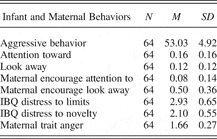
Two IBQ (Rothbart, Reference Rothbart1981) subscales were administered to assess mothers' perceptions of their infant's temperament, distress to limits (distress to frustrating events), and distress and latency to approach sudden or novel stimuli (distress to novelty). Mothers indicate on a 7-point scale how frequently their infants respond to specific events by fussing, crying, or no reaction during the previous week (e.g., when placed in a car seat—limits, or when exposed to a loud noise—novelty). At 6 months, subscales have good internal reliability (.75–.81), moderate interrater reliability (.54–.66), and concurrent validity with home observations of infant temperament (mean r = .40), and the negative emotionality and approach–sociability subscales of the Revised Infant Temperament Questionnaire and the Infant Characteristics Questionnaire (rs = .61 to .73; Rothbart, Reference Rothbart1981; Rothbart & Goldsmith, Reference Rothbart and Goldsmith1985). Mean ratings on the 20-item Distress to Limits Scale (α = .78) and on the 17-item Distress to Novelty Scale (α = .68) served as emotion-specific measures of infant reactivity; the latter was used to test the discriminant validity of the distress to limits scale as a predictor of later aggressive behavior. Descriptive data are included in Table 1.
Descriptive statistics

Note: IBQ, Infant Behavior Questionnaire.
6-Month behavioral observation
Following a 5-min warm-up, mothers placed their infants in a car seat (attached firmly to a chair), and then sat 3 feet away, situated so that by turning their heads to the right infants could see them. Two novel events were introduced first, followed by a 5-min break, and then two frustrating events: arm restraint and toy removal. The order of frustrating events was counterbalanced to control for event-specific effects on infant and maternal behavior. Only data obtained from the frustrating events are included in this report.
Prior to the toy retraction, the experimenter moved the chair holding the infant seat into a table and then sat to the infant's left. She showed the infant two attractive toys (a teething ring with multicolored plastic keys and a brightly colored plastic face with a mirror on the back). When the infant displayed interest in one toy, the experimenter placed that toy on the table directly in front of the infant for 15 s and placed the unselected toy out of view. After 15 s, she placed the toy just beyond the infant's reach. This sequence was repeated 12 times. The experimenter did not interact with the infant during this task. During arm restraint, the infant seat was pushed away from the table. The experimenter knelt in front of the seat and gently held the infant's forearms immobile for 3 min. Her head was bowed so that she did not interact with the infant.
During the first frustrating event (mother uninvolved), mothers remained neutral so that we could observe infants' self-regulatory behaviors. During the second event (mother involved), mothers interacted with their infants as they liked, but were asked not to intervene directly (e.g., give the removed toy to the infant) or to remove their infant from the seat unless they wished to end the activity.Footnote 2 Measures of infant behavior were obtained when mothers were not involved; measures of maternal behavior were derived from the mother involved condition.
Infant and mother behavior coding
Infant and maternal behaviors were coded continuously from videotapes, using a computerized, event-based coding system. Trained students coded in pairs to maintain accuracy while viewing tapes, operating the VCR, and entering codes. Different pairs coded infant and maternal behaviors to avoid bias, and were blind to all other data and to the specific hypotheses of the study. Pairings varied to prevent pair-linked coder drift. The authors coded 25 videotapes independently, at the beginning and midway through the process, to assess reliability and to prevent coder drift for each type of coding.
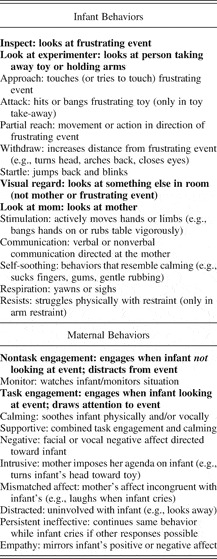
Fourteen mutually exclusive behavioral codes, 12 of which were adapted from Rothbart et al. (Reference Rothbart, Ziaie and O'Boyle1992), were used to code infant behavior. Two infant behaviors, resists and looks at experimenter, were added based on our observations of infant behavior during the frustrating events. Brief definitions are included in Table 2. Coding instructions are available from the first author. Thirteen other codes were created during coder training to identify instances in which infants engaged in two or more behaviors simultaneously (e.g., self-soothe and look at mother). Intercoder reliability for all codes within a 1-s interval ranged from .69 to .97 (mean κ = .78).
Definitions of infant and maternal behaviors

Note: The infant and maternal behaviors used in this table are in bold.
To maintain an adequate subject to variable ratio, infant behaviors were combined based on both conceptualizations of the behaviors and their simple correlations. To control for time differences, each variable was defined as the percent time the infant engaged in the behavior. Based on the conceptualization of attention shifting presented above and prior research identifying attention shifting as an effective regulator in infancy and a likely moderator of negative reactivity, two infant behaviors were identified a priori as predictors of aggressive behavior: attend to the frustrating event; and look away from the frustrating event. Attend to was the sum of inspects the frustrating event (κ = .75) and looks at experimenter (κ = .77), combined because both involved attending to the frustrating event and correlated significantly, r (84) = .50, p < .01. Look away was the sum of visual regard of another object (κ = .85) and look at mom (κ = .79), combined because both involved looking away from the frustrating event and toward something else, and correlated significantly, r (84) = .57, p < .01. These variables were positively skewed, and therefore underwent a logarithmic transformation to reduce skewness (Tabachnick & Fidell, Reference Tabachnick and Fidell1996).
Twelve maternal behavior codes were created based on existing schemes (Farran, Kasari, Comfort, & Jay, Reference Farran, Kasari, Comfort and Jay1986; van den Boom, Reference van den Boom1994.) Intercoder reliability (κ) within a 1-s interval ranged from .65 to .85 for the 12 codes (mean κ = .75) using procedures described above. These are defined in Table 2. Coding instructions are available from the first author. Variables representing the percent of time mothers engaged in each of the 12 behaviors were created. Because of technical difficulties, data were missing on one infant and on two mothers; mean scores were substituted in those cases.
Based on the argument that mothers foster attention shifting by inviting their infants to look away from frustrating events and engaging positively with the infants when they do so, and discourage it when they encourage their infants to attend to the event, twoFootnote 3 maternal behaviors were included as potential moderators of infant reactivity to frustrating events: mother encourages infant attention away from the frustrating event (nontask engagement, κ = .80) and mother encourages infant attention to the frustrating event (task engagement, κ = .73). The latter variable was skewed, and therefore corrected using a logarithmic transformation. The untransformed descriptive data for infant and maternal behaviors are included in Table 1.
Child Behavior Checklist (CBCL)/2-3
This 100-item checklist (Achenbach, Reference Achenbach1992) was administered to mothers to assess children's behavioral and emotional symptoms. Mothers indicate whether specific behaviors are not true, somewhat/sometimes true, or very/often true for their child within the last 2 months. The T score for the 15-item aggression subscale (e.g., hits others, temper, disobedient, defiant) was the operational measure of aggressive behavior used in this study. The distribution of T score aggression was skewed, and thus corrected using a log transformation; an outlier was adjusted using guidelines from Tabachnick and Fidell (Reference Tabachnick and Fidell1996). Only one child had a score in the clinical range of the aggression subscale. Descriptive data using the untransformed T scores are included in Table 1.
The scale has excellent test–retest reliability for maternal ratings of nonreferred 2- and 3-year-olds 1 week apart, r (60) = .86, p < .001, stability over a 1-year interval, r (74) = .62, p < .001, and good interparent agreement for 2 year olds, r (63) = .71, p < .001 (Achenbach, Reference Achenbach1992); it also distinguishes clinically referred and nonreferred children (p < .001), controlling for demographic differences.
State-Trait Anger Expression Inventory (STAXI)
Mothers completed the STAXI (Spielberger, Reference Spielberger1988) at 2.5 years to provide a brief, objectively scored measure of their tendency to become angry. The scale consists of 44 items, administered in three subsections, and distributed across five main scales. Of these, only the 10-item Trait Anger scale (Cronbach α = .73) was included in this study as a possible covariate of maternal reports of infant frustration and aggressive behavior. We reasoned that mothers who were prone to anger might view their infants as easily frustrated and their children as aggressive, or behave in ways that would increase aggressive behavior. Items on this scale are rated on a 4-point scale in relation to “how I generally feel,” with 1 = almost never, and 4 = almost always. Examples are “I have a fiery temper,” “I fly off the handle,” “It makes me furious when I am criticized in front of others.” Higher scores indicate greater and more persistent trait anger. Descriptive data are provided in Table 1.
The test–retest reliability for the Trait Anger scale of the STAXI over a 2-week interval was .77 for adult females (Jacobs, Latham, & Brown, Reference Jacobs, Latham and Brown1988). The scale exhibits convergent validity with the Buss–Durkee Hostility Inventory and the Hostility and Overt Hostility Scales of the Minnesota Multiphasic Personality Inventory (Spielberger & Sydeman, Reference Spielberger, Sydeman and Maruish1999).
Results
Data analyses proceeded in several steps. First, we used independent samples t tests to test for gender differences. Second, we correlated mother-rated infant reactivity to frustrating events, observed infant and mother behaviors, and mother-rated aggressive behavior to assess collinearity and identify hypothesized main effects. Third, we regressed aggressive behavior at 2.5 years on reactivity to frustration, infant and maternal behaviors, and their interactions to test their hypothesized prediction to later behavior. Fourth, we tested the discriminant validity of IBQ distress to limits in relation to IBQ distress to novelty as a predictor of aggressive behavior. For clarity, we refer to distress to limits as distress to frustrating events in describing the results.
Independent samples t tests
Results of independent samples t tests by child gender on infant and maternal variables revealed two significant differences. Consistent with Hypothesis 1, mothers rated male infants as more easily distressed by frustrating events than female infants, t (62) = 2.27, p < .05, and males attended to the frustrating event more than females, t (61) = 1.68, p < .05 (one-tailed test). Contrary to prediction, females did not look away from the frustrating event more than males, t (61) = -1.06, ns, although the means were in the expected direction (Ms = .073 and .056 for females and males, respectively). To investigate whether the absence of a gender difference in looking away was a function of combining look at mother and look at other object, we conducted t tests by gender for these behaviors separately. No significant gender differences were observed.
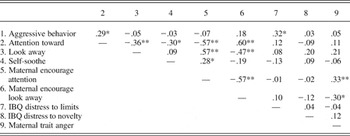
Zero-order correlations among and between infant, maternal, and child behaviors
Correlations with aggressive behavior
As shown in Table 3 and consistent with Hypothesis 2, infant distress to frustrating events and attend to the frustrating event correlated positively with later aggressive behavior. Contrary to the hypothesis, look away from the frustrating event did not correlate significantly with aggressive behavior.
Correlations between infant and mother predictors and aggressive behavior

Note: N = 64. IBQ, Infant Behavior Questionnaire.
* p < .05.
** p < .01.
Infant and maternal behavior correlations
Contrary to Hypothesis 3, infant attention to the frustrating event correlated negatively with maternal encouragement of attention to the frustrating event, but positively with maternal encouragement of looking away. Similarly, infant look away from the frustrating event correlated positively with encouragement of attention to the frustrating event, but negatively with maternal encouragement of look away from the frustrating event. In addition, mothers who reported more trait anger encouraged infant attention to the frustrating event more and encouraged infant look away less. However, trait anger did not correlate significantly with aggressive behavior, and was considered no further.
Additive and interactive effects of infant reactivity and infant and mother regulation
Aggressive behavior at 2.5 years was regressed on its predictors to determine if main effects were additive, and to test the hypothesized moderating effects. To maintain an adequate subject to variable ratio, analyses were conducted sequentially considering infant behaviors first, and then maternal behaviors. Using liberal criteria, Harris (Reference Harris1985) identified an adequate sample size in multiple regression as 50 plus the number of predictors, which in these analyses is 8, and therefore acceptable with n = 64.
Infant predictors of aggressive behavior (Hypotheses 4 and 5)
First, aggressive behavior was regressed on distress to frustrating events and child gender entered simultaneously to control for their covariation, followed by infant attend to and look away from the frustrating event, and then the interactions between infant distress and each of the two infant behaviors and between gender and the two infant behaviors.
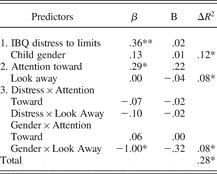
As shown in Table 4, three of the hypothesized effects were significant. Infant distress to frustrating events and infant attention to the frustrating event predicted aggressive behavior at 2.5 years after all main effects had entered the equation, indicating that these two dimensions explain nonoverlapping variance. Consistent with Hypothesis 5, infant gender interacted with infant look away from the frustrating event to predict aggressive behavior. To interpret this interaction, separate analyses were calculated for male and female infants. For females (n = 26), there was a strong trend for look away to be negatively associated with aggressive behavior (β = −.36, p = .06) for males (n = 38), the association was in the positive direction, but not significant (β = .18, ns). Contrary to Hypothesis 4, there was no moderating effect of infant look away or infant attend to the frustrating event on the association between infant distress to frustrating events and later aggressive behavior.
Multiple regression: Predicting aggressive behavior from infant variables

Note: N = 64; β, standardized beta; B, unstandardized beta at entry; IBQ, Infant Behavior Questionnaire.
* p < .05.
** p < .01.
Maternal predictors of infant behavior (Hypotheses 6 and 7)
To determine whether the two maternal behaviors interacted as predicted with infant distress to frustrating events or with infant gender to predict aggressive behavior, aggressive behavior was regressed on the infant variables (distress to frustrating events, gender, attend to, and look away from the frustrating event), and on one of the maternal behaviors (encourage attention to or encourage looking away from the frustrating event) entered simultaneously, the significant Gender × Look Away interaction identified above, and then the interactions of that maternal behavior with infant distress and with infant gender. Given the difficulty of detecting moderation in nonexperimental research (McClelland & Judd, Reference McClelland and Judd1993), and to determine if infant and maternal moderating effects were interdependent, the interactions were evaluated in three ways: independent of all main effects only, independent of all infant effects including the Gender × Look Away interaction, and all interactions independent of each another when entered simultaneously.
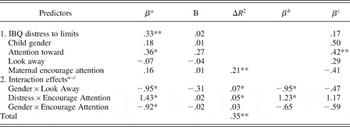
As shown in first beta column in Table 5, all three hypothesized interactions were significant independent of the main effects when maternal encouragement of attention to the frustrating event was the moderator: Gender × Look Away, Gender × Maternal Behavior, and Distress to Frustrating Events × Maternal Behavior.
Multiple regression: Predicting aggressive behavior at 2.5 from infant and mother variables

Note: N = 64; B, unstandardized beta; β, standardized beta at entry or on final step; t = .06; IBQ, Infant Behavior Questionnaire.
a Each interaction was evaluated for significance independent of main effects (entered in Block 1) only.
b Maternal behavior interactions were entered in Block 3 after entry of Block 1 and the Gender × Look Away interaction in Block 2.
c All interaction effects were entered simultaneously in Block 2.
* p < .05.
** p < .01.
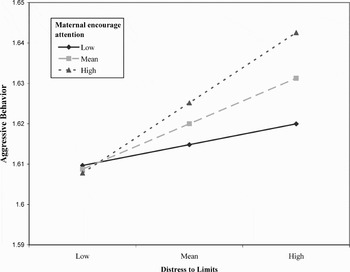
The interaction of gender and look away operated as explained above: looking away from the frustrating event at 6 months was negatively associated with aggressive behavior for girls only. To interpret the Gender × Maternal Behavior interaction, separate analyses were calculated for male and female infants. For males (n = 38), the association between maternal encourage attention to the frustrating event and later aggressive behavior was positive and significant (β = .45, p < .05), whereas for females (n = 26), it was in the negative direction (β = −.22, ns). Consistent with Hypothesis 7, mothers' encouragement of infant attention to the frustrating event predicted more aggressive behavior for males, but not for females. To interpret the interaction of infant distress and maternal behavior, the regression lines for the association between infant distress and aggression were plotted at ±1 SD and at the mean of maternal encourage attention to the frustrating event (Aiken & West, Reference Aiken and West1991). As illustrated in Figure 1 and consistent with Hypothesis 6, the positive association between infant distress to frustrating events and aggression was strongest when mothers frequently encouraged their infants to look at the frustrating event.
Maternal encouragement of attention to a task has a moderating effect on the association between infant distress to limits and aggression. [A color version of this figure can be viewed online at www.journals.cambridge.org]

In addition, as shown in the second beta column in Table 5, the Distress to Frustrating Events × Maternal Behavior interaction remained significant after the infant Look Away × Gender interaction entered the equation, demonstrating the independence of these two effects. In contrast, after infant Look Away × Gender entered the equation, the Maternal Behavior × Gender interaction was no longer significant, indicating that these two gender-linked effects explain overlapping variance in aggressive behavior.
As shown in the third beta column in Table 5, Infant Distress × Maternal Behavior remained a strong trend when all main effects and interactions entered the equation, indicating that this effect was primarily, although not entirely independent of gender. Notably also in this column, the main effect of infant distress to frustrating events was no longer significant after the Distress × Maternal Behavior interaction entered the equation, indicating that the interaction completely explained the main effect. In contrast, infant attend to the frustrating event remained significant after entry of all main effects and interactions, demonstrating its robustness as an early predictor of later aggressive behavior.
Contrary to Hypotheses 6 and 7, maternal encouragement of infant look away was unrelated to aggressive behavior at 2.5, either as a main effect or interactively with infant distress to frustrating events (β = −.40, ns) and infant gender (β = −.27, ns). Nevertheless, the interaction between infant look away and infant gender reported above remained significant after all other main effects and interactions entered the regression equation (β = −1.19, p < .05).
Discriminant validity
To establish the discriminant validity of infant distress to limits as a unique predictor of aggressive behavior and to test the assumption that specific types of reactivity relate to specific behavior problems, an additional hierarchical regression was conducted, in which distress to novelty replaced distress to frustrating events as the measure of infant negative reactivity. As expected, distress to novelty did not predict aggressive behavior as a main effect (β = .03) or interactively with either infant attention behavior or maternal behavior (β = .05).
Discussion
As hypothesized, infant attention to a frustrating event predicted aggressive behavior 2 years later, independently of all other effects; the more infants looked at the frustrating event at 6 months, the more aggressive behavior mothers reported in their children 2 years later. In addition, as expected, attention shifting was negatively associated with aggressive behavior, although this effect was apparent only for girls. In addition, the data supported the hypothesized moderating effect of maternal behavior on the association between infant distress to frustrating events and later aggressive behavior; infant distress to frustrating events predicted aggressive behavior only if mothers encouraged their infants to look at the frustrating event during the 6-month assessment. Evidence that the interaction entirely explains the main effect of infant distress to frustrating events on aggression indicates that there is no necessary link between mother-reported distress to frustrating events in infancy and mother-reported aggressive behavior 2 years later.
The robust association between observed infant attention to a frustrating event and later aggressive behavior is consistent with the link between observed approach in a high intensity context at 6 months and later externalizing behavior reported recently by Putnam and Stifter (Reference Putnam and Stifter2005). In our study, looking intently at the frustrating event can be considered a type of approach because it brings the infant into visual contact with the frustrating event when other forms of approach are restricted by features of the experimental context (i.e., the car seat, the distance between infant and toy, and the experimenter during the arm restraint).
In contrast to the moderating effect of 6-month attention shifting on the trajectory between distress to novelty and later anxiety reported by Crockenberg and Leerkes (Reference Crockenberg and Leerkes2006), and contrary to Hypothesis 4, there was no such moderating effect of attention shifting on distress to frustrating events in relation to aggression. This finding parallels the results of Olson, Sameroff, Kerr, Lopez, and Wellman (Reference Olson, Sameroff, Kerr, Lopez and Wellman2005), that effortful control and child dispositional anger at 3 years predicted concurrent externalizing behavior as main effects, but not interactively. In the current study, attention shifting demonstrated no main effect in relation to later aggressive behavior either, indicating that at 6 months highly reactive infants lack the ability to exercise effortful control.
Nevertheless, evidence that shifting attention away from the frustrating event was associated with less aggression for girls suggests that this behavior may operate as a brake on the development of aggression for some 6-month-olds. Infants who look away from the frustrating event and toward something else may be able to reduce the negative arousal they experience in the moment. In doing so, they learn that looking away has a desirable effect, and therefore repeat the behavior when similar events occur in the future. That attention shifting was not associated with less aggressive behavior in boys could indicate that boys develop the capacity to look away from frustrating events later than girls, as suggested by Weinberg et al. (Reference Weinberg, Tronick, Cohn and Olson1999), although the absence of gender differences in attention shifting in the current study would seem to undermine this explanation. At 6 months of age, boys were as likely as girls to look away from the frustrating event and toward something else. However, boys were significantly more inclined than girls to focus their attention on the frustrating event, and it may be that this behavior outweighs their developing capacity to look away.
If for male infants there is a strong dominant inclination to look at the frustrating event, looking away requires them to inhibit the dominant response in favor of the nondominant response (effortful control), a capacity that does not begin to develop until late in the first year of life (Rothbart, Reference Rothbart, Kohnstamm, Bates and Rothbart1989). In the absence of such a dominant response, inhibition is unnecessary, and therefore, female infants may be able to modulate their distress in frustrating situations by looking away, much as they do in novel contexts. From this perspective, it is not that females regulate negative affect better than males, but rather that regulating distress to frustrating events is easier for female infants because they do not have to inhibit approach to the same degree as male infants. Taken together, it appears that differences in attention to and away from frustrating events apparent at 6 months are linked to later aggression, and may help to explain the gender differences in aggression that emerge in early childhood (Maccoby, Reference Maccoby, Moen and Elder1995).
The inability of 6-month-old infants to inhibit a dominant response in favor of a less dominant one may also explain why looking away serves as a moderator of infant distress to novelty in relation to later anxiety (Crockenberg & Leerkes, Reference Crockenberg and Leerkes2006), but not as a moderator of infant distress to frustrating events in relation to later aggressive behavior. Looking away may be more easily learned in response to fear-related emotions as an adaptation of the human tendency to withdraw in fear-eliciting situations, whereas the tendency in frustrating contexts is to approach in the service of obtaining the blocked goal (at least for males), and looking away runs counter to this inclination. As such, it may require more effort on the part of infants, as well as greater support from caregivers, for infants to learn to use looking away as a strategy for regulating frustration. We return to this point below in discussing the unexpected positive link between infant look away and mother encouragement of infant attention to the frustrating event.
Maternal behavior moderates the early temperament to later behavior link
The presence or absence of prediction from infant reactivity to frustrating events to child aggression depended on the way mothers behaved during their infants' exposure to frustrating events. Consistent with Hypothesis 6, easily frustrated infants whose mothers encouraged their attention to the frustrating event engaged in more aggressive behavior than comparable infants whose mothers did not draw their attention to the frustrating event.
Although mothers encouraged attention to the frustrating event, both by drawing the infant's attention to it (e.g., by touching the removed toy and talking about it) and by following the infant's focus of attention with the same behavior, other data suggest that mothers lead this interaction. That the interactive effect of infant distress to frustrating events and maternal encouragement of attention to such events remained significant after controlling for differences in infant attention to the frustrating event indicates that mothers were not simply responding to the infant's inclination to look at the event. In fact, mothers were more likely to encourage their infants' attention to the frustrating event when infants had spent more time looking away from the frustrating event in the prior mother uninvolved episode. In doing so, they may have inadvertently undermined their infants' developing capacity to shift attention away from the frustrating event, or increased the salience of the event and hence the dominant tendency to look at it, contributing over time to the development of aggressive behavior.
Why would mothers encourage their babies to look at the frustrating event? Possibly they wanted them to learn to overcome barriers as a prelude to action-oriented coping, and failed to recognize the adaptive value of being able to shift attention to something else when an initial goal is unattainable, especially for infants easily distressed by frustrating events. That mothers who reported more trait anger were also more likely to encourage their infants to look at the frustrating event is consistent with this explanation; mothers may have replicated their preferred approach to frustrating events in their behavior with their infants, although we suggest this cautiously because trait anger was assessed well after maternal behavior.
Some mothers did encourage their infants to look away from the frustrating events, perhaps in an attempt to help them regulate their distress. Typically, these were mothers whose infants had focused attention on the frustrating event in the first frustration episode, as indicated by the positive correlation between those behaviors. Contrary to expectation (Hypothesis 6), maternal encouragement to look away from the frustrating event was not effective in reducing the association between infant distress to frustrating events and aggressive behavior, although it had served a moderating function between infant's distress to novelty and anxiety. The discrepancy in the way the same maternal behavior operates in the two contexts may reflect the greater challenge involved in distracting an infant from something that tends to elicit approach, in contrast to something that tends to elicit withdrawal. In a frustrating situation, infants must inhibit a dominant response in favor of a subdominant response, a capacity that does not develop until later in the first year (Rothbart, Reference Rothbart, Kohnstamm, Bates and Rothbart1989). Mothers' attempts to encourage looking away from frustrating events when infants are 6 months old may be ineffective because the behavior in question requires a capacity these infants have not yet developed. In Vygotsky's (Reference Vygotsky1978) terms, it falls outside the zone of proximal development. Although speculative, this interpretation is consistent with Kochanska et al.'s (Reference Kochanska, Murray and Harlan2000) findings that maternal responsiveness at 22 months, but not at 9 or 14 months, predicted effortful control concurrently and at 33 months. Subsequent analyses of those data revealed further that maternal responsiveness moderated the association between infant anger at 9 months and effortful control at 22 months (G. Kochanska, personal communication, Reference Kochanska, Murray and Harlan2004); the negative effect (high anger, less effortful control) was greater for infants with less responsive mothers than with more responsive mothers (rs = −.32, p < .05 and .22, ns, respectively). It appears from these findings that mothers may alter developmental trajectories of easily frustrated infants through their responsiveness in the second year of life.
Gender and aggressive behavior
Is it fair to say that temperament (i.e., distress to frustrating events), rather than gender, accounts for the differential effects of maternal behavior on later aggression? Strictly speaking, that is the case: the interaction of distress with maternal behavior significantly predicted later aggressive behavior, whereas the interaction of gender with the same maternal behavior did not. Nevertheless, some caution is required on this point because the gender by maternal behavior interaction was significant after all single variables had entered the equation, with maternal encouragement of attention to the frustrating event more strongly associated with aggression for males than for females. That it was no longer significant after entry of the look away by gender interaction (i.e., looking away was significantly and negatively associated with aggressive behavior only for female infants) indicates that the two effects are linked.
It may be that 6-month-old females are less influenced by maternal attempts to encourage their attention to frustrating events because, as suggested above, their ability to shift attention to modulate distress is more fully developed than it is in male infants of the same age. Accordingly, male infants may be more responsive to maternal encouragement to look at the frustrating event because for them it is a more strongly dominant response. Alternatively, if fathers' and mothers' behaviors correlate, but only fathers interact differentially with male and female infants, this unmeasured, differential paternal behavior could explain or partially explain the “effect” of maternal encouragement on aggression in boys. In support of this interpretation, researchers have reported that fathers are indeed more likely than mothers to engage differently with their infant sons and daughters (for a review, see Parke, Reference Parke1996).
Methodological issues and limitations
That the association between early temperament and later aggressive behavior was unique to distress to limits (frustrating events) supports an emotion-specific model of infant temperament. Distress to novelty, although similarly reported by mothers, was not associated with mother-reported aggressive behavior later on. Taken together, these findings increase confidence in the validity of the results and indicate that a mother's general tendency to view her infant more negatively does not explain the association between mother-reported distress to frustrating events and mother-reported aggressive behavior 2 years later.
Nevertheless, the results are limited by the sample size and homogeneity, by the single measure of aggressive behavior obtained at 2.5 years, and by the relative absence of aggression scores in the clinical range. Evidence that predictions from infant reactivity to frustrating events and attention focusing and shifting to aggression are apparent in observed behavior would strengthen the results. In addition, in a clinical sample with more extreme (e.g., intrusive) maternal behavior, main effects of maternal behavior might well be apparent. Finally, in this study we have considered only mothers' impact on children's aggressive behavior at 2.5 years, although we know that fathers' behavior toward children and experience in childcare are also associated with differences in aggressive behavior at slightly older ages (Jaffee, Moffitt, Caspi, & Taylor, Reference Jaffee, Moffitt, Caspi and Taylor2003; NICHD Early Child Care Research Network, 2003). Thus, a complete understanding of the early development of aggressive behavior requires both a larger sample and consideration of the multiple conditions that contribute to its development.
Conclusions and Implications
In this study, we demonstrate that an infant's tendency to look at a frustrating event is associated with a stronger tendency to engage in aggressive behavior 2 years later, and further that the infant's shifting of attention away from a frustrating event and toward something else is adaptive over time, as demonstrated by its association with less aggressive behavior, albeit only for girls. In addition, the exacerbating effect of maternal behavior provides meaningful information about the conditions under which we can expect both continuity and lawful discontinuity between early temperamental reactivity to frustrating events and later aggressive behavior. Taken together, these findings are congruent with a contextual approach to temperament that emphasizes the fit between infant characteristics and the social environment in predicting developmental outcomes (Lerner et al., Reference Lerner, Nitz, Talwar, Lerner, Kohnstamm, Bates and Rothbart1989; Thomas & Chess, Reference Thomas and Chess1977; Wachs & Kohnstamm, Reference Wachs, Kohnstamm, Wachs and Kohnstamm2001). They suggest that altering specific caregiver behaviors toward easily frustrated infants may reduce aggressive behavior later in development, but also that attempts to change other maternal behaviors (e.g., encouragement of looking away) may have a greater impact on infant emotion regulation and later aggression if it occurs later in the second year of life. If these findings are replicated, they will identify strategies useful to clinicians and other practitioners engaged in preventive and therapeutic interventions with infant–mother dyads.