Introduction
In Australia, skilled nursing facilities or nursing homes are referred to as Residential Aged Care Facilities (RACFs). Comparable to skilled nursing facilities, Australian RACFs provide a range of domestic, medical, personal care and support services to older people, and employ staff including registered nurses, assistants in nursing, akin to certified nursing assistants, vocationally trained care and support staff, and externally employed allied health and physicians. RACFs serve a diverse population and present a unique setting, a mix of a medical institution and home environment (Heumann, Boldy and McCall Reference Heumann, Boldy, McCall, Heumann, McCall and Boldy2001; Perry et al. Reference Perry, Bellchambers, Howie, Moxey, Parkinsons and Capra2011). The environment within RACFs is mediated by many factors, including the physical setting, resource availability, staff communication, mentorship and management, staff education, professional development, and attitudes towards ageing and resident care (Heumann, Boldy and McCall Reference Heumann, Boldy, McCall, Heumann, McCall and Boldy2001; Kaasalainen et al. Reference Kaasalainen, Williams, Hadjistavropoulos, Thorpe, Whiting, Neville and Tremeer2010; Perry et al. Reference Perry, Bellchambers, Howie, Moxey, Parkinsons and Capra2011). Furthermore, the population within RACFs is complex, with high co-morbidity, and a high prevalence of cognitive impairment, behaviour difficulties, mental health difficulties and communication impairment (Australian Government Productivity Commission 2011; Worrall, Hickson and Dodd Reference Worrall, Hickson and Dodd1993).
With increased international focus on consumer-directed health services, person-centred care (PCC) principles and quality of life issues, staff within RACFs are expected to provide an increased range of services, necessitating communication across a broad range of service providers (Australian Government Productivity Commission 2011; Australian and New Zealand Society for Geriatric Medicine 2011; World Health Organization 2002). To facilitate cross-discipline communication, recommendation has been made for the implementation of multi-disciplinary clinical practice guidelines that explicitly foster inter-disciplinary collaboration and relationship development (Australian and New Zealand Society for Geriatric Medicine 2011). However, research investigating multi-disciplinary service provision in United Kingdom nursing homes states that to achieve such guidelines, more research is needed to develop generalised models of care specific to the aged care setting and that address service provision across disciplines, and public and private health sectors (Davies et al. Reference Davies, Goodman, Bunn, Victor, Dickinson, Gage, Martin and Froggatt2011). Furthermore, these must be relevant to the running of the facility as a whole, rather than reflecting discipline-specific aims (Davies et al. Reference Davies, Goodman, Bunn, Victor, Dickinson, Gage, Martin and Froggatt2011).
To date, the majority of studies investigating service provision considerate of the range of care domains in RACFs and skilled nursing facilities have focused on the perceptions of single disciplines (Davies et al. Reference Davies, Goodman, Bunn, Victor, Dickinson, Gage, Martin and Froggatt2011), with the studies largely focusing on the perceptions and experiences of internally employed nursing and personal care staff (Goodwin-Johansson Reference Goodwin-Johansson1996; McGilton et al. Reference McGilton, Irwin-Robinson, Boscart and Spanjevic2006; Parsons et al. Reference Parsons, Simmons, Penn and Furlough2003; Perry et al. Reference Perry, Bellchambers, Howie, Moxey, Parkinsons and Capra2011). Though nursing and personal care staff are a primary workforce in RACFs, holistic service provision is achieved through input from a wider range of additional medical, allied health, management, domestic and support staff, as well as community volunteers and family members. The perceptions of these professional groups and how they are similar or different to other RACF staff needs to be further explored.
Many service providers who work in RACFs are contracted from external agencies and work under management and service structures that are distinctly different to those operating internally within the RACF. These service providers are employed across both public and private health sectors, with RACFs themselves also falling into several categories of administration within the public and private health sectors, e.g. profit or not-for-profit entities. As a result, there is often great divide between the philosophies underpinning different work organisations and associated policy and work practice guidelines. Consequently, communication and professional relationship development is by nature quite complex. In the few studies that have examined multi-disciplinary care in RACFs and skilled nursing facilities, and included external service providers, findings indicate that cross-discipline communication is limited in both frequency and success (Halcomb, Shepherd and Griffiths Reference Halcomb, Shepherd and Griffiths2009; Kaasalainen et al. Reference Kaasalainen, Williams, Hadjistavropoulos, Thorpe, Whiting, Neville and Tremeer2010). In these studies neither internally employed RACF staff or externally contracted service providers perceived themselves to be working as a part of a team.
A distinct lack of shared understanding among service providers about the role of different disciplines and multi-disciplinary care in RACFs has also been identified (Halcomb, Shepherd and Griffiths Reference Halcomb, Shepherd and Griffiths2009), with ineffective communication among service providers found to be a key barrier to the implementation of research innovations in RACFs (Kaasalinen et al. Reference Kaasalainen, Williams, Hadjistavropoulos, Thorpe, Whiting, Neville and Tremeer2010). To overcome barriers to communication and integrated care between professions and across organisations, Reed et al. (Reference Reed, Cook, Childs and McCormack2005) comment we must first implement structural and procedural changes that foster compatibility of cross-professional and organisational agendas. However, Reed et al. (Reference Reed, Cook, Childs and McCormack2005) note that at present, this goal is challenged by a scarcity of research investigating integrated care across care tasks and a paucity of studies exploring the full range of services and service providers involved in delivering care for older people.
Research investigating multi-disciplinary service provision and service change in the broader aged care and health sectors provides much general discussion of factors that can influence multi-disciplinary service provision and service change. Bard, Lowenstein and Satin (2009) state that the success of multi-disciplinary teams is dependent on multiple factors, including: the range of service providers and disciplines within the team; provider level of appreciation for the role of other disciplines; the frequency and depth to which disciplines learn and work together; the flexibility of role allocation across the team; service provider perception of the impact of working in a team on their own professional identity and development; and the influence of external factors including structural and procedural constraints. Similarly, and of particular relevance to communication among providers, Trinka and Clark (Reference Trinka and Clark2009) call for a reflective ethic of multi-disciplinary care; reflection of ones own professional and training background and the differences between backgrounds across the team, to increase active consideration and understanding between disciplines and thereby facilitate collaboration.
Whilst it is accepted that achieving positive multi-disciplinary interaction is a complex endeavour, to date, the specific factors influencing multi-disciplinary to maintain consistency in terminology interaction and collaboration within the unique RACF environment have not been fully examined. Specifically, it is clear that as yet, full understanding of what constitutes widespread or disparate issues across service providers working in RACFs has not been achieved. Therefore, the aim of the current study is to explore and compare the perceptions of a cross-section of service providers, regarding challenges and motivators to working in RACFs. By doing so, both common and unique issues across service disciplines may be identified. Consideration of these issues will help to guide the development of more generalised models of service provision that explicitly foster cross-discipline communication and relationship development and optimise multi-disciplinary care.
Methods
Research strategy
A qualitative descriptive methodology was adopted in this study to explore multi-disciplinary service provision in high-care Australian RACFs. Qualitative descriptive methodology allows for a comprehensive summary of an event or phenomena in everyday lay language, while also providing valid and accurate accounts of the meaning attributed to these events and phenomena by the participants (Maxwell Reference Maxwell1992; Sandelowski Reference Sandelowski2000).
Participants
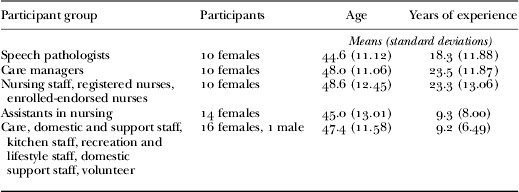
Purposive criterion sampling was used to collect information-rich data across cohorts, increasing the potential to identify issues of central importance to the aims of the study (Patton Reference Patton2002). A total of 61 participants were recruited across five service provider groups: (a) care managers; (b) nursing staff; (c) assistants in nursing; (d) care, lifestyle, domestic and support staff; and (e) speech pathologists (in the participant quotes these are indicated by CM, NS, AIN, CDSS and SP, respectively). All participants included in the study were required to have functional English skills adequate for an interview, be working with residents of high-care RACFs at the time of recruitment, and have at least six months of prior experience in RACFs and 12 months of qualifying experience in their occupation. Care managers were included to provide a management perspective. Nursing staff and assistants in nursing were included to provide two different nursing perspectives, and the care, lifestyle, domestic and support staff participant group was included to represent a range of other support staff and lifestyle staff in regular contact with the residents. Speech pathologists were included as a sample of external service providers contracted by RACFs. Participant recruitment continued until saturation of key themes was reached (Sandelowski Reference Sandelowski1995). Participant details are provided in Table 1. Only one participant in the study was male, equating to approximately 2 per cent of the RACF staff cohort. A distinct gender imbalance is evident among RACF staff, with national data indicating approximately 93 per cent of RACF staff are female (Australian Government Productivity Commission 2011).
Participant demographics
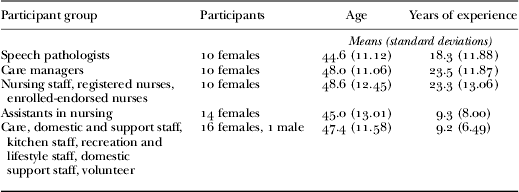
Care managers, nursing staff, assistants in nursing, and care, lifestyle, domestic and support staff were recruited through ten high-care RACFs in rural and metropolitan areas. All participating RACFs were governed by two independent aged care providers, one for profit and one not for profit. Speech pathologists were recruited through the public directory of speech pathologists provided on the website of The Speech Pathology Association of Australia (Speech Pathology Australia 2010). Permission for this study was granted by the Behavioural and Social Sciences Ethical Research Committee of The University of Queensland and the participating aged care providers.
Procedure
Individual in-depth semi-structured interviews were conducted with the care managers, nursing staff and speech pathologist participants, while focus group interviews were conducted with the assistants in nursing, and care, lifestyle, domestic and support staff. In-depth interviews provide a comprehensive exploration of the topics of interest by obtaining a detailed account of participant thoughts and behaviours (Patton Reference Patton2002). In-depth interviews are particularly useful in obtaining data embedded within the context of a complex setting, such as RACFs, and are also an appropriate first step in investigating topics about which little research has been conducted to date (Patton Reference Patton2002). In contrast, focus group interviews were used for the assistants in nursing, and care, lifestyle, domestic and support staff, because they have been found to be particularly useful in interviewing participants in more vulnerable or subordinate positions (Madriz Reference Madriz, Denzin and Lincoln2000), such as those held by assistants in nursing, and care, lifestyle, domestic and support staff within the RACF staff hierarchy (in the participant quotes focus groups are indicated by FG). Focus groups validate participant responses through shared experience in a homogenous and non-threatening group environment (Kruegar and Casey Reference Kruegar and Casey2000). Each focus group consisted of between three and six participants, with group size dependent on staff availability at the scheduled interview time. Separate focus groups were conducted for the assistant in nursing, and care, domestic and support staff participant groups.
During the interviews, participants across all five participant groups were asked to comment on: why they work in aged care; the challenges and rewards of working in aged care; what ongoing training and support they receive in their roles; and their perceptions about multi-disciplinary care and relationships among service providers. Participants were interviewed either face-to-face or via telephone, as determined by their location. The interviews were audio-recorded and transcribed verbatim with the accuracy of transcriptions checked by a second analyst. The key benefit of telephone interviewing in this study was to reduce the financial cost of travel time and associated expenses required to include participants from diverse geographical locations. All individual and focus group interviews were conducted by the first author (MB), a speech pathologist with experience of working in RACFs. Interview duration ranged from 15 to 67 minutes.
Data analysis
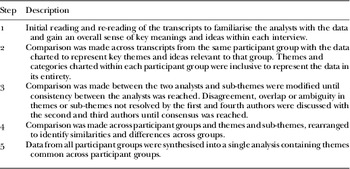
Qualitative content analysis was conducted by two of the authors (MB) and (MW), guided by the systematic stages of the framework approach to analysis (Ritchie and Spencer Reference Ritchie, Spencer, Bryman and Burgess1994). The framework approach to qualitative content analysis uses explicit stages of data analysis, increasing the accessibility of the analysis and interpretation of the data beyond the analysts themselves (Pope, Ziebland and Mays Reference Pope, Ziebland and Mays2000; Rabiee Reference Rabiee2004). This transparency renders the approach particularly useful for research aiming to influence service provision and policy direction (Pope, Ziebland and Mays Reference Pope, Ziebland and Mays2000; Rabiee Reference Rabiee2004). In accordance with the framework analysis, the authors utilised both inductive and deductive methods of enquiry, drawing on a priori issues originating from the research aims while remaining sensitive to concepts and ideas emerging from the data itself (Pope, Ziebland and Mays Reference Pope, Ziebland and Mays2000; Ritchie and Spencer Reference Ritchie, Spencer, Bryman and Burgess1994). An outline of the stages of analysis is provided in Table 2.
Steps of data analysis
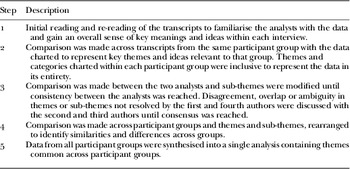
Following analysis, a summary of themes and sub-themes for each participant group as well as a small number of additional open-ended questions arising from concepts evident in the data were distributed to all participants for member checking. Feedback provided through member checking was used to refine the themes and sub-themes further, thereby increasing the validity of the analysis and accuracy in the interpretation of participant views (Hoffart Reference Hoffart1991). Completed member-checking documents were received from approximately 50 per cent of participants with all participants indicating overall agreement with the summary provided.
Results
Four common themes described the perceptions and experiences of participants working in RACFs. These were: (a) working in RACFs is both personally rewarding and personally challenging; (b) relationships and philosophies of care directly impact service provision, staff morale and resident quality of life; (c) a perceived lack of service-specific education and professional support impacts service provision; and (d) service provision in RACFs should be seen as a specialist area. The four key themes and corresponding sub-themes are outlined in Tables 3–6, including participant quotes.
Theme 1: Working in RACFs is both personally rewarding and personally challenging
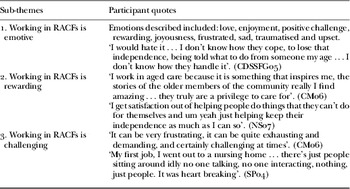
Working in a high-care RACF as either an internal or external service provider was identified as highly emotive, providing participants with both personal reward and challenge (see Table 3). A broad range of positive and negative emotions were identified by all participant groups, with the most common emotions described being ‘love’ and ‘frustration’ (Sub-theme 1, Table 3). Further, all participant groups described how they often found themselves reflecting on their own health and independence, and how they would feel if they were a resident. Many factors contributed to the emotive nature of the setting including: the physical environment; the nature of resident difficulties; the degree of personal care provided; resource constraints; and communication among staff.
Theme 1: Working in Residential Aged Care Facilities (RACFs) is both personally rewarding and personally challenging
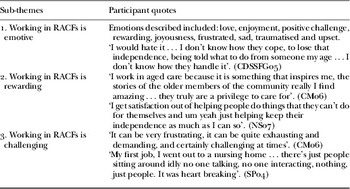
Notes: CM: care manager. NS: nursing staff. CDSSFG: care, lifestyle, domestic and support staff focus group. SP: speech pathologist.
Another key sub-theme across participant groups was the personal reward gained in being able to provide for the residents and develop relationships with them (Sub-theme 2, Table 3). All participants emphasised a strong sense of valuing older people and pride in caring for and providing services to better the lives of older people. This was the primary reason participants chose to continue to work in RACFs. Relationships with residents were described as being ‘family like’ (CDSSFG01). Assistants in nursing and speech pathologists described the richness of each resident's experience and stories, and the positive connections they made in sharing each resident's history. Care managers discussed the inspirational nature of the residents, the knowledge to be gained from older people, and the reward gained by spending personal, non-clinical time with residents. Care managers, nursing staff and assistants in nursing also noted the personal reward gained from the appreciation of family members and friends of the residents, as well as the residents themselves. These participant groups described the best moments of their day as, ‘when they say that they are happy with our care and the family come and say thanks to us’ (NS04).
Intertwined with the rewarding aspects of caring for residents in RACFs, all participant groups emphasised that working in a RACF is challenging (Sub-theme 3, Table 3). For most internal staff, the challenges arose from their daily interactions with residents. Residents were described as a source of frustration, sadness, anxiety and, at times, even being ‘a little frightening’ (CDSSFG06). In particular, RACF staff emphasised the frustration they felt in working with residents with communication difficulties and challenging behaviours. They described this frustration as being bi-directional, experienced by both the staff and the residents.
For nursing staff and speech pathologists, the inability to facilitate resident improvement was challenging and ‘frustrating, when I just can't do anything to make it better for them, no matter how hard I try’ (NS09). Speech pathologists discussed the need to balance goal setting with the knowledge that rehabilitation was unlikely. Assistants in nursing discussed how the fluctuating health status of the residents was challenging and necessitated the need for constant review of residents' needs.
Speech pathologists also described the challenges faced due to variable practices and procedures within and between RACFs. They noted significant variability in documentation and handover requirements between facilities, commenting that the success of handover was dependent on the type of documentation completed and to whom handover was given. Assistants in nursing felt that their input was not always valued during handover, with some facilities providing direct handover to assistants in nursing, and care, lifestyle, domestic and support staff only when registered nurses felt information transfer was necessary. A further challenge, expressed primarily by the speech pathologist participants, was the physical environment of the setting. Speech pathologists described the environment as confronting due to the impact of the physical layout and smell, as well as the social and communicative isolation of the residents.
Theme 2: Relationships and philosophies of care directly impact service provision, staff morale and resident quality of life
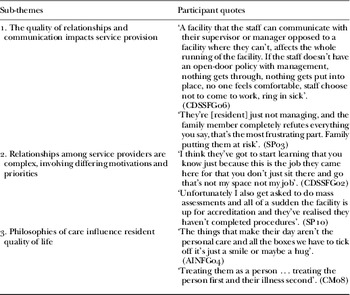
The second key theme described how relationships and philosophies of care impact service provision (see Table 4). Within this theme three distinct sub-themes were evident, the first illustrating the importance of developing collaborative relationships with co-workers and family members and friends (Sub-theme 1, Table 4). Service provision was described as being team dependent by all participant groups, with the team extending beyond RACF staff to external service providers, in particular general practitioners. Care managers, nursing staff and care, lifestyle, domestic and support staff emphasised the importance of building multi-disciplinary relationships based on mutual respect. Without these relationships it was felt that service provision ‘falls apart’ (SP03) and resident care is diminished. The importance of getting along with immediate co-workers was of particular importance, especially in close working quarters, such as the kitchen. Nursing staff also valued the input of assistants in nursing, and care, lifestyle, domestic and support staff, acknowledging that as they are not able to be in all places at once, they rely heavily on feedback from assistants in nursing and personal care staff to meet residents' needs. In developing quality relationships, all participant groups emphasised the need for effective communication, as well as consistency in staffing. High staff turnover was identified as the primary barrier to achieving effective communication and relationship development by all participant groups. Further, speech pathologists noted that high staff turnover affected the implementation of recommendations, and RACF staff reported that high staff turnover led to inconsistencies in resident care, particularly for residents with communication or cognitive difficulties.
Theme 2: Relationships and philosophies of care directly impact service provision, staff morale and resident quality of life
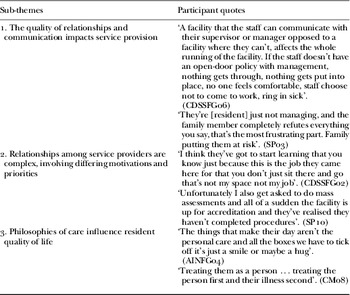
Notes: CM: care manager. AINFG: assistants in nursing focus group. CDSSFG: care, lifestyle, domestic and support staff focus group. SP: speech pathologist.
Ongoing collaboration and positive relationships among staff and external service providers was also viewed as critical to achieving change in service provision and in implementing new services. Both care managers and speech pathologists stressed the importance of positive relationship development across the staff hierarchy to ensure that support for change is provided from the top down. In contrast, assistants in nursing, and care, lifestyle, domestic and support staff emphasised the success of communication ‘up’ rather than ‘down’ the chain. Many assistants in nursing, and care, lifestyle, domestic and support staff questioned whether their opinions were valued by facility management, noting that their input often did not travel up the staff hierarchy or was not responded to sufficiently. Ineffective communication with management was also viewed by assistants in nursing, and care, lifestyle, domestic and support staff as having a detrimental impact on staff morale and confidence, particularly for new staff members. Both assistants in nursing, and care, lifestyle, domestic and support staff described how they often found themselves unsure of what to do in their duties because of incomplete or conflicting communication from superiors and facility management, as well as insufficient information provided during handover. As a result, care, lifestyle, domestic and support staff participants stated that staff often called in sick and the entire service was affected. A flow-on effect of staff morale to resident morale was also noted, ‘you've gotta be able to get along with one another, the residents pick up on it’ (CDSSFG02). This point was also illustrated by care managers who stated that resident quality of life was, in part, dependent on staff mood projected during interactions with the residents and the general atmosphere of the facility.
Participants discussed communication and relationship development with family members and friends as both a positive and negative experience. Care managers and speech pathologists noted that relationship development with family members and friends aided in obtaining knowledge about a resident's past. In addition, when they had a good relationship with families and friends, there was the perception that families and friends provided an additional set of hands during care and therapy tasks. On the contrary, however, there was much discussion about disagreement between staff and family members in particular in regards to resident care. Participants felt these disagreements often arose from a lack of communication and shared understanding between parties, and was a key source of frustration for staff members. In discussing communication with family members and friends, staff commented on the need to manage unrealistic care and service expectations of family members and friends, as well as the unwillingness of family members and friends to accept resident difficulties and challenging behaviours.
The second sub-theme pertaining to relationship development among service providers centred on the inherent complexity of differing motivations and priorities of care across service providers (Sub-theme 2, Table 4). Both speech pathologists and care, lifestyle, domestic and support staff discussed the impact of motivation on service provision. Care, lifestyle, domestic and support staff described how some staff members worked solely to be paid, performing only those duties outlined in their contract, and being unwilling to step outside of their designated duties to help others. Speech pathologists described these staff members as ‘bank staff’ (SP06) and reported a lack of compliance with recommendations by these staff members.
Differences between the motivations and priorities of care of RACFs, the acute hospital setting and general practitioners were also highlighted across participant groups, with ageism being discussed extensively. Nursing staff and assistants in nursing perceived that many external service providers did not value the care they provided to the residents; ‘it's a nursing home so you know, why bother’ (AINFG03). One speech pathologist stated ‘ageism seems alive and well’ (SP01). Care, lifestyle, domestic and support staff felt more so than any other participant group that other staff, including management, neither understood nor valued their role or duties. Recreation and lifestyle staff discussed how advocating for their position among the general staff body was like ‘dragging teeth’ (CDSSFG02). One participant said, ‘Some people think we're babysitters, that really annoys me, I'm not a babysitter’ (CDSSFG05). Speech pathologists were frustrated with the lack of shared understanding of speech pathology services amongst RACF staff, policy makers, and family members and friends. Speech pathologists stated that RACFs did not always value the service they provided, and often referred residents for services because of the requirements of upcoming accreditation rather than in response to residents' needs.
The third sub-theme reflects the influence of philosophies of care and governing legislation on service provision in RACFs (Sub-theme 3, Table 4). The basic principles of PCC were discussed by all participant groups. In particular, participants emphasised the importance of recognising residents as individuals, and providing adequate opportunities for social interaction and recreational activities to ensure residents' lives remained purposeful, and thereby enhance resident quality of life. The need to address residents' emotional and spiritual needs was also raised as an important factor in facilitating resident quality of life. RACF staff identified the need to create a happy home-like environment where the residents felt safe, and trust between the residents and staff was firmly established. RACF staff discussed the importance of getting to know each resident's idiosyncrasies, stressing the importance of actively listening to, and communicating with, the residents. Finally, all participants advocated that one-on-one, non-clinical time with residents had the most positive impact on resident and staff global wellbeing.
Theme 3: A perceived lack of service-specific education and professional support impacts service provision
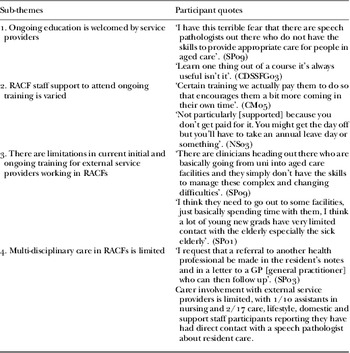
Theme 3 identified issues around ongoing education and professional support and its impact on service provision (Table 5). The first sub-theme highlights the positive value RACF staff and external service providers place on ongoing education and training opportunities (Sub-theme 1, Table 5). Multi-disciplinary training was held in high regard in facilitating understanding and appreciation of the roles of different service providers, as was ‘hands on’ training, which was seen to increase the applicability of training to daily care practice. On-site training was also seen as facilitating access to education for RACF staff.
Theme 3: A perceived lack of service-specific education and professional support impacts service provision
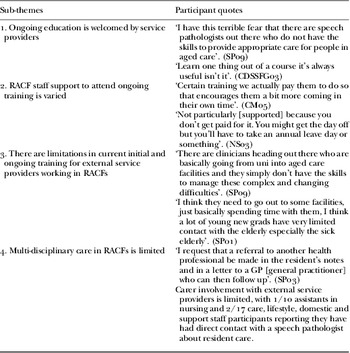
Notes: RACFs: Residential Aged Care Facilities. CM: care manager. NS: nursing staff. CDSSFG: care, lifestyle, domestic and support staff focus group. SP: speech pathologist.
Mixed views were evident in discussions regarding the perceived support to attend training (Sub-theme 2, Table 5). Though some nursing staff noted management was ‘very supportive’ (NS04) of training, others felt that the support received was superficial. For example, assistants in nursing reported that many care staff were not paid to attend training, and, at times, were pressured to attend training solely to meet the training deadlines of the facility. Care, lifestyle, domestic and support staff had similar perceptions, with some participants stating, ‘There's lots of education available it's just a matter of whether staff want to attend’ (CDSSFG06), whereas others noted that they often have to attend training on their days off and without financial remuneration due to staffing and time constraints. For speech pathologists, shortfalls in training specific to RACFs were emphasised (Sub-theme 3, Table 5). Speech pathologists raised concerns that their initial training at university was not sufficient to prepare them for the unique services provided in RACFs and that ongoing training opportunities specific to working in RACFs were very limited. In terms of informal training and support, most speech pathologists had never had a mentor while working in a RACF and felt that peer support in the setting was limited. Speech pathologists also commented about a lack of discipline-specific special interest and support groups for service providers working in RACFs.
Sub-theme 4 explores participant perceptions of current multi-disciplinary care in RACFs (Sub-theme 4, Table 5). All participants indicated they had limited involvement with the wider multi-disciplinary team. Assistants in nursing, and care, lifestyle, domestic and support staff commented that they very rarely had any communication or contact with external service providers, whereas reported registered nurse and care manager contact with external service providers was mixed, as was their desire for contact. For some care mangers and nursing staff, active participation in external service provider consultations was desired, others, however, indicated a preference for communication via written recommendations only. Speech pathologist participants commented that they had little direct or ongoing collaboration with other external service providers, describing how referrals to other providers were most commonly made through the registered nurse or general practitioner. Further, following these referrals, speech pathologists rarely initiated active follow-up of the referrals or received direct feedback from either RACF staff or the referred service. For RACF staff, care managers felt there was little support from facility staff in completing their duties, but acknowledged that this lack of support was often because of the time constraints of staff, rather than an unwillingness to provide support. Nursing staff, assistants in nursing, and care, lifestyle, domestic and support staff all sought most support from their peers and highly valued the support their peers provided. Assistants in nursing did acknowledge that registered nurses will step in to provide support if explicitly asked, but that the level of assistance provided was not always consistent.
Theme 4: Service provision in RACFs should be seen as a specialist area
The final theme expresses service provider desire for greater recognition of the duties they perform in RACFs, and for RACFs to be recognised as a specialist area (Table 6).
Theme 4: Service provision in Residential Aged Care Facilities (RACFs) should be seen as a specialist area
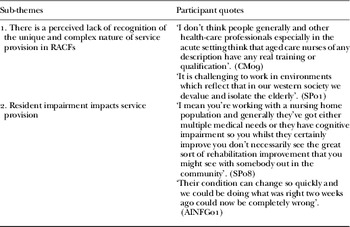
Notes: CM: care manager. NS: nursing staff. AINFG: assistants in nursing focus group. SP: speech pathologist.
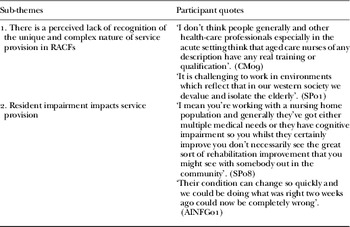
Lack of recognition of the unique and complex nature of the services provided in RACFs was a key source of frustration across participant groups (Sub-theme 1, Table 6). Care managers, in particular, emphasised the ongoing difficulties they faced in advocating for both residents and staff in health, community and government sectors. Care managers felt strongly that to increase recognition of RACFs, recognition must extend beyond individual persons and service providers to government bodies and policy makers. Further, care managers believed that working in aged care should be seen as a specialist area across health disciplines, with service providers who work in RACFs being required to undertake additional training prior to working in the setting. Care managers felt that recruitment of external service providers was often hindered by difficulty finding providers with not only a genuine interest in working in aged care, but also appropriate experience and knowledge specific to working with older people and working in RACFs.
The unique impact of resident impairment, in particular medical frailty and cognitive impairment, on service provision in RACFs was also discussed across participant groups (Sub-theme 2, Table 6). Cognitive impairment was seen as limiting the nature of the services provided to the residents, as well as the ability of RACF staff and external service providers to uphold philosophies of care and meet legislative requirements. In providing daily care, care, lifestyle, domestic and support staff described the need for flexibility in care practices when working with residents with cognitive difficulties. Speech pathologists described how high prevalence of cognitive impairment and degenerative disease in RACFs limited the application of many evidence-based therapy approaches and further led to questions regarding the appropriateness of allocating limited resources to the RACF population. Speech pathologists also commented that a lack of resources developed specifically for the RACF population limited both assessment and therapy.
Discussion
This study identifies vast similarity in the perceptions of service providers, internal and external, working in RACFs. The findings provide valuable common ground on which to base the development of more generalised service provision models to facilitate; cross discipline communication, professional relationship development, and multi-disciplinary care in aged care settings. Where differences in perceptions did arise, it was clear that these differences arose primarily due to poor communication and a lack of shared understanding among service providers. Consistent with past research (Davies et al. Reference Davies, Goodman, Bunn, Victor, Dickinson, Gage, Martin and Froggatt2011; Halcomb, Shepherd and Griffiths Reference Halcomb, Shepherd and Griffiths2009; Kaasalainen et al. Reference Kaasalainen, Williams, Hadjistavropoulos, Thorpe, Whiting, Neville and Tremeer2010), this study re-affirmed that in practice multi-disciplinary service provision in RACFs is limited.
This study identified a common ‘love’ of aged care and a great depth of personal reward gained across service providers, from working with older people. Whilst shared knowledge of the principles of PCC was demonstrated, the same limitations in providing PCC, including the impact of resident impairment and resource constraints, were discussed across participant groups. These limitations have been identified in prior studies (Dwyer Reference Dwyer2011; Goodwin-Johansson Reference Goodwin-Johansson1996; Heumann, Boldy and McCall Reference Heumann, Boldy, McCall, Heumann, McCall and Boldy2001; Perry et al. Reference Perry, Bellchambers, Howie, Moxey, Parkinsons and Capra2011), suggesting that despite continual policy redevelopment, barriers to daily practice are still poorly addressed and inadequately recognised. Perhaps this continuing issue relates to the perception shared by prior researchers (Dwyer Reference Dwyer2011) that health sectors, community and government bodies still fail to truly recognise the unique and complex nature of hands-on practice in aged care. As a result, these sectors continue to give inadequate consideration to the unique challenges faced by service providers when developing policy and practice guidelines. This perception can be classified under the broad notion of ageism, with ageism viewed by all participant groups as continuing to have a direct negative impact on both resident care and morale. This issue was raised with particular reference to services provided by primary care sectors, general practitioners and medical specialists. Participants in this study, both internal and external to the RACF, demonstrated collegiality in advocating for greater recognition of the needs of the residents and the unique challenges faced in working in RACFs.
Whilst the current study is consistent with past studies in Australia and overseas in emphasising the importance of open and equal communication and relationship development among internal staff members (Blackford, Strickland and Morris Reference Blackford, Strickland and Morris2007; Jeong and Keatinage Reference Jeong and Keatinage2004; Kaasalainen et al. Reference Kaasalainen, Williams, Hadjistavropoulos, Thorpe, Whiting, Neville and Tremeer2010; Perry et al. Reference Perry, Bellchambers, Howie, Moxey, Parkinsons and Capra2011), it extends our understanding of the importance of ensuring successful communication with external service providers. The current data demonstrate the different degrees of impact of poor communication across RACF service and staffing levels. External providers also noted this difference and discussed a direct impact of poor communication across RACF staffing levels on the following of provider recommendations. Participants holding less authoritative positions within the RACF staff hierarchy discussed a direct relationship between the successful communication with, and support from, superiors with their own personal morale and physical health. Both management and nursing and care staff expressed that staff morale has a direct impact on resident morale, suggesting a link between resident wellbeing and staff satisfaction in the workplace. This link has been suggested previously (Ball et al. Reference Ball, Whittington, Perkins, Patterson, Hollingsworth, King and Combs2000; Goodwin-Johansson Reference Goodwin-Johansson1996) and warrants greater consideration in the development of future service provision models.
All participant groups expressed concern about limited opportunity for education specific to working in RACFs and limited professional support provided within the workplace. This finding is consistent with recurrent international discussion of insufficiencies in training within the aged care workforce for several decades, thus indicating little progress has been made in this area. The current data found limited education had a direct negative impact on both service provision, and communication and understanding among all service providers. As a result, all participant groups expressed a desire for multi-disciplinary training opportunities to facilitate shared understanding of the contribution of different disciplines. Hogan (Reference Hogan2004) argued that as a major investor in aged care, it is the role of government to actively influence nursing, allied health and physician curricula to ensure it contains sufficient material specifically tailored to working in aged care.
Though this study was conducted within the specific context of RACFs, results of the study are directly relevant to, and support, similar research in skilled nursing facilities and nursing homes. Further, the results are applicable to consideration of health-care services for older people and in particular international emphasis on both PCC and active ageing. Despite continued emphasis on PCC as the philosophy of preference in aged care services, a standard definition of PCC is yet to be agreed upon (Australian Government Productivity Commission 2011; World Health Organization 2002). Research into PCC is often discipline-specific, and further, factors claimed to facilitate and hinder PCC are yet to be backed by sufficient empirical studies (McCormack et al. Reference McCormack, Karlsson, Dewing and Lerdal2010; Edvardsson, Fetherstonhaugh and Nay Reference Edvardsson, Fetherstonhaugh and Nay2010). As a result, clarity in the practice of PCC and therefore successful implementation of PCC is unlikely to be achieved without further research and development of setting-specific and multi-disciplinary service provision guides. Further, the basic premise of active ageing, described as ‘optimizing opportunities for health, participation and security in order to enhance quality of life as people age’ and allowing people to ‘realize their potential for physical, social and mental well-being throughout the life course’ (World Health Organization 2002: 12), is also unlikely to be achieved considering current barriers to multi-disciplinary service provision, difficulty implementing PCC and the continued devaluing of aged care.
Limitations of the current study are acknowledged, including the inclusion of a single external service discipline. The inclusion of general practitioners in future studies would be of particular value, with general practitioners providing a central point of contact for both RACF staff and external service providers working in RACFs. In addition, with general practitioners viewed by participants in this study as often having negative perceptions of service provision in RACFs, the opinions and perceptions of general practitioners are necessary to provide a balanced view of service provision in the setting. The perceptions of family members and administrators, two key stakeholders in resident care, were not explored in this study but are pertinent to the development of models of care in the setting. Despite these limitations, it is argued that this study adds considerable knowledge in understanding potential barriers and facilitators to communication and relationship development among service providers. It has identified considerable common ground in the perceptions of both internal and external providers, as well as understanding the underlying basis of differences in perceptions across service disciplines.
Conclusion
Despite ongoing policy redevelopment and research focus on service provision in RACFs and skilled nursing facilities, multi-disciplinary care in RACFs continues to be poorly implemented. Communication and relationship development among different disciplines remains infrequent and often limited in success. The results of this study unite the views of management, nursing and personal care staff, domestic, lifestyle and support staff as well as speech pathologists, to identify vast commonality in perceptions across providers about key challenges and motivators to working in aged care. It is clear from the findings that regardless of provider role or discipline, those working in aged care are working towards the same common goals and are impacted by the same challenges. This commonality, however, is not being communicated among providers.
There needs to be greater recognition of shared experiences and issues faced by a range of service providers who work in aged care, including greater recognition of the specialist nature of the services provided and the personal challenges inherent in working in the setting. This needs to be achieved through better training and preparation for all service providers working in aged care, with a focus on training that facilitates cross-discipline communication and relationship development. By acknowledging, accepting and communicating shared experiences and perceptions across service providers, the divide across disciplines may be reduced. Ultimately, it is hoped this will help to facilitate a workplace that is more personally rewarding, where resident wellbeing is enhanced and multi-disciplinary care optimised.
Acknowledgements
We thank Bupa and UnitingCare Ageing for their assistance in data collection and the individual participants for their contribution to this study. Aspects of this article were presented at the Speech Pathology Australia Conference, June 2012, in Hobart, Tasmania, Australia. Permission for this study was granted by the Behavioural and Social Sciences Ethical Research Committee of The University of Queensland and the participating aged care providers. The authors received no financial support for the research and/or authorship of this article. The authors declare no conflicts of interest with respect to the authorship and/or publication of this article.