INTRODUCTION
When it comes to evaluating the potential load of effluents or the quality of environmental matrices, the use of traditional analytical methods is not always the best choice, as many pollutants, in case of episodic input, may be active at levels difficult to be traced by ordinary techniques. The use of environmental toxicology and of ecotoxicology is becoming increasingly widespread, and may represent a fruitful integration to the physical–chemical approach. These techniques are also considered in the more recent Italian and European legislation on water protection (see, e.g. the Italian Legislative Decree No. 152 of 2006 and the European Water Framework Directive 2000/60). The traditional analytical, physical–chemical analyses provide information on the presence and quantity of pollutants. The introduction of tests on aquatic organisms yields an indication on the toxicity of matrices. The bioassays, together with the classic chemical analyses, can contribute to the definition of thresholds and limit values of pollutants in effluents and ecosystems (Damiani, Reference Damiani2002).
Produced formation water (PFW) is an effluent discharged from gas and oil platforms. It originates from water naturally present in geological formations (formation water) and water injected in the oil field (process water) to maintain reservoir pressure. Because of the contact with formations over geological time scales, PFW composition includes a mixture of inorganic and organic compounds (Trieff et al., Reference Trieff, Romaña, Esposito, Oral, Quiniou, Iaccarino, Alcock, Ramanujam and Pagano1995). PFW is discharged into the sea after separation from oil and gas according to existing laws (in Italy this is ruled by the Legislative Decree No. 152 of 2006). The competent institutions monitor the PFW discharge and evaluate the possible effects on the marine ecosystem. Chemical analyses and bioassays represent a suitable tool to accurately monitor the effects of PFWs on the marine environment.
Chemical characteristics of PFWs are very unusual and the exposure of marine organisms to contaminants contained in PFW may cause different responses (e.g. narcosis, alterations of the permeability of cell membranes and developmental defects; see OGP, 2005). The integration of chemical and biological analyses allows assessment of the toxicity and bioavailability of PFWs, to understand the mechanisms of their toxic action and identification of the area of potential biological impact of PFW discharge (see review by Cianelli et al., Reference Cianelli, Manfra, Zambianchi, Maggi, Cicero and Canton2009).
This study evaluates the applicability of some test species belonging to the consumer compartment to investigate the toxicity of PFWs discharged from four natural gas production platforms located in the Adriatic Sea. Since the composition of PFWs over time may be altered by volatilization, adsorption and degradation (Capuzzo, Reference Capuzzo, Boesch and Rabalais1987), the toxicity assessments were carried out by using acute or short-term chronic tests (≤96 hours).
Very few studies have been devoted to the ecotoxicological characterization of PFW originated from Italian platforms. Mariani et al. (Reference Mariani, Manfra, Maggi, Savorelli, Di Mento and Cicero2004) have published preliminary results on the response of fish exposed to PFW samples from an Adriatic platform; examining and comparing the toxic response time to unfiltered and to filtered PFW, they observed a shorter response time to the unfiltered sample, probably induced by chemical compounds associated with the solid fraction of PFW or to the ingestion and absorption of particulate matter by test organisms. Manfra et al. (Reference Manfra, Moltedo, Virno Lamberti, Maggi, Finoia, Gabellini, Giuliani, Onorati, Di Mento and Cicero2007) report about the effects of PFW toxicity on the marine bacterium Vibrio fischeri and on the sea urchin Paracentrotus lividus, whereas they do not detect significant effects on sediments collected near the originating platform, likely as an effect of the swift dilution process of PFW discharge.
In this paper the toxicity of PFW has been assessed using a bioassay battery composed of Brachionus plicatilis (Rotifera), Artemia franciscana (Crustacea) and Paracentrotus lividus (Echinodermata). The first bioassay evaluates the mortality of rotifer larvae; the second test evaluates the immobilization of crustacean larvae; the sea urchin tests assess fertilization success/failure with transmissible damage from sperm to the offspring (sperm cell test) and larval (pluteus) development success/failure (embryo toxicity test). We decided to use these life stages because embryos and larvae are less tolerant to pollutants than adults and therefore represent the critical life stage for toxicity tests (Martin et al., Reference Martin, Osborn, Billig and Glickstein1981).
MATERIALS AND METHODS
Sampling and treatment
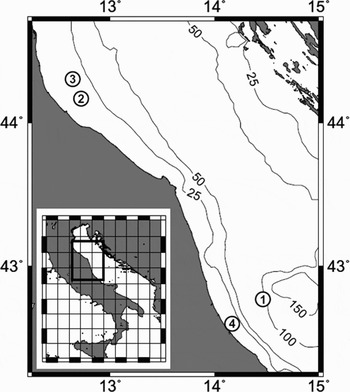
Produced formation water samples were collected in August 2005 and September 2006 onboard four platforms located in the western Adriatic Sea (platforms PLATF1, PLATF2, PLATF3, PLATF4; see map in Figure 1). Samples, collected before discharge, were stored in high density polyethylene vessels.
Area map with sampled platforms.

Surface seawater samples were also collected, using Niskin bottles (1 l of unfiltered seawater and 1 l of seawater filtered using 0.45 µm Millipore membranes, both then stored at 4°C), in correspondence to the discharge port and 25 m downstream the observed ambient current, as suggested by Manfra et al. (Reference Manfra, Moltedo, Virno Lamberti, Maggi, Finoia, Gabellini, Giuliani, Onorati, Di Mento and Cicero2007): filtered samples were tested with B. plicatilis, A. franciscana and P. lividus while the unfiltered ones were tested only with B. plicatilis and A. franciscana. The bioassays with P. lividus were not carried out on unfiltered samples following the indication of Carr & Chapman (Reference Carr and Chapman1995). For each bioassay data quality was assessed by a negative control test (with synthetic seawater for B. plicatilis and A. franciscana, and with natural filtered seawater for P. lividus). A positive control test (with potassium dichromate K2Cr2O7 for B. plicatilis, copper sulphate CuSO4 × 5H2O for A. franciscana and copper nitrate Cu(NO3)2 × 3H2O for P. lividus) was also carried out, in order to assess the sensitivity of species to reference toxicants (Table 1).
Results of bioassays with Brachionus plicatilis exposed to K2Cr2O7, Artemia franciscana to CuSO4 × 5H2O for and Paracentrotus lividus to Cu(NO3)2 × 3H2O. EC50 data are compared to acceptability mean value or range reported in standard methods.

Bioassay methodological protocols
BRACHIONUS PLICATILIS
Rotifer cysts were hatched in synthetic seawater (with a salinity of 22 psu) and juveniles were used within 28 hours from hatching (ASTM, 1991). The nauplii were first placed in a vessel containing synthetic water with same salinity of the PFW, to enable osmotic adaptation. Then, they were transferred, with a variable-volume micropipette, to PVC multiwell plates containing the actual PFW. Each plate had 36 test wells, each of them containing 0.3 ml of PFW and five nauplii; the total number of nauplii exposed to each PFW concentration was 30. Six PFW concentrations were tested (100%, 50.2%, 25.1%, 12.6%, 6.3% and 3.1%) and each dilution was replicated six times. The mortality rate was recorded after 48 hours of incubation in the dark at 25°C. Larvae were considered dead when they did not exhibit any internal and external movement after 10 seconds. The test was considered valid only if mortality did not exceed 10% in the negative control test.
ARTEMIA FRANCISCANA
Reference cysts (RAC) were provided by the Quality Assurance Research Division US Environmental Protection Agency (Cincinnati OH 45268, USA) and by the Laboratory for Biological Research in Aquatic Pollution, University of Ghent (Belgium). Brine shrimp eggs were hatched in synthetic seawater and instar II–III larvae (nauplii) were used within 48 hours of hatching (APAT IRSA-CNR, 2003). The nauplii were transferred with a variable-volume micropipette (with a round tip, so as to allow the uptake of the larvae without damaging them) to polypropylene multiwell plates for the acute test (24 hours) and beakers for the long term acute test (96 hours). The first bioassay was carried out in a multiwell plate with 24 test wells, each of which containing 2 ml of PFW and 10 nauplii. The total number of nauplii exposed to each PFW concentration was 30. The incubation was conducted at 25°C for 24 hours and in the dark. The second bioassay was carried out in Pyrex beakers, each containing 40 ml of PFW and 10 nauplii; the total number of nauplii exposed to each PFW concentration was 30. The incubation was conducted at 25°C for 14 hours in the light and 10 hours in the dark during the 96 hour incubation. PFW concentrations were chosen as indicated in the rotifer method and three replicates per treatment were tested. The immobilization rate was taken as endpoint. Larvae were considered immobilized if they did not exhibit any movement during observation time (15 seconds) and after mechanical stimulation. The tests were considered valid only if the control test did not exceed 10%.
PARACENTROTUS LIVIDUS
Adult sea urchins of P. lividus were collected by SCUBA divers in an area with low anthropogenic impact in the Gulf of Naples (Tyrrhenian Sea). Organisms were stored in a glass aquarium containing aerated natural seawater, fed on Ulva lactuca and Posidonia oceanica, at a temperature of 20°C and salinity of 38 psu, with a natural photoperiod. Spawning was induced by injection of 1 ml of 0.5 M KCl solution into the coelom through the peristome. Eggs were collected by placing spawning females separately in 250 ml beakers containing natural filtered seawater at 18°C, according to the procedures reported in His et al. (Reference His, Beiras and Seaman1999). Dry sperm from each male was collected and stored immediately in a sterile 10 ml tube placed at 4°C. Sperm mobility was checked under the microscope. For the fertilization test the protocol applied was a derivation of Dinnel et al. (Reference Dinnel, Link and Stober1987), US EPA (1991) and Environment Canada (1992). For the sperm cell test, sperm was exposed to test solution (PFW and seawater samples) and incubated at 18°C for 60 minutes. Then a volume of 0.1 ml of sperm suspension was added to aliquots of 10 ml of test solution containing 1 ml of the unfertilized eggs in accordance with Volpi & Arizzi Novelli (Reference Volpi Ghirardini and Arizzi Novelli2001). After 2 hours at 18°C, fertilization success was verified by identifying the presence of the fertilization membrane (by counting 300 eggs); after 72 hours at 18°C transmissible damage from sperm to the offspring was evaluated. The same procedure was followed to evaluate embryotoxicity; in this case the gametes were put together with a sperm:egg ratio of 10:1 according to the ASTM (1995) protocol and to Arizzi Novelli et al. (Reference Arizzi Novelli, Argese, Tagliapietre, Bettiol and Volpi Ghirardini2002). Then 1 ml of fertilized egg suspension was transferred with a variable-volume micropipette to different polypropylene vessels containing 10 ml of test solution (six replicates per treatment). After a 72 hour period at 18°C in the dark, the percentage of plutei with normal (N) and abnormal development was determined by direct observation of 100 larvae per vessel, randomly chosen out of the 300 per vessel. We observed the following larval anomalies: retarded larvae with size 1/2 N (R); malformed larvae affected in skeletal or gut differentiation (P1); embryos unable to attain the pluteus stage as abnormal blastulae or gastrulae (P2); dead pluteus larvae, identified as transparent larval ghosts (D1); embryos prior to larval differentiation, e.g. pre-hatching arrest (D2). The tests were considered valid only if the percentage of fertilized eggs and normal plutei was ≥ 70%.
Data analysis
The toxicity of PFW was expressed as the percentage sample volume that induces the 50% effect (EC50). The probit analysis was used to calculate the EC50 value with 95% confidence limits. This allowed us to analyse the relationship between a stimulus (dose) and a response (such as death or sub-lethal effects). The probit model assumes that the percentage response is related to the log dose as according to the cumulative normal distribution. The EC50 data were categorized according to Persoone et al. (Reference Persoone, Goyvaerts, Janssen, De Coen and Vangheluwe1993): EC50 not determinable corresponding to ‘non-toxic’, EC50 values larger than 100 to ‘weakly toxic’, EC50 values between 100 and 10 to ‘toxic’, EC50 values between 10 and 1 to ‘very toxic’, and EC50 values less than 1 to ‘extremely toxic’. When EC50 could not be calculated, we reported the maximum percentage effect normalized to the negative control.
Since the conditions of normality of data and homogeneity of variance have not been met, a non-parametric analysis (Spearman test) was used. It was applied to the data of percentage effect observed in undiluted PFWs in order to assess: (a) if there were significant differences among the five bioassays (B. plicatilis test, A. franciscana 24 hour test, A. franciscana 96 hour test, P. lividus fertilization test and P. lividus embriotoxicity test) applied to filtered PFWs; (b) if there were significant differences among the three bioassays (B. plicatilis test, A. franciscana 24 hour test and A. franciscana 96 hour test) applied to unfiltered PFWs; and (c) if there were significant differences between the PFWs that showed toxic effects.
RESULTS
In the first (August 2005) and second survey (September 2006), negative control tests using dilution water showed percentage effects less than 10% in the bioassays with rotifers and crustaceans and less than 30% in the tests with urchins, as required by methodological protocols. Copper and chromium, used as reference toxicants (positive controls), showed data within the EC50 acceptability range reported in the standard methods (Table 1).
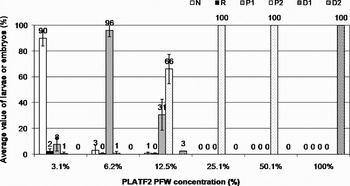
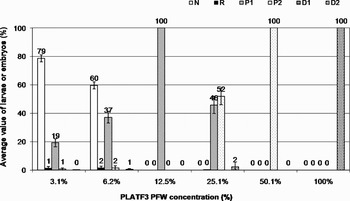
Produced formation water samples collected at PLATF1 and PLATF4 did not show toxicity (maximum percentage effect was ≤ 10%, i.e. the organism response was comparable to that observed in negative controls) while samples from PLATF2 and PLATF3 showed toxic response only in some cases (Table 2). In particular, the Artemia 24 hour test and the rotifer 48 hour test never highlighted toxicity of filtered PFW (maximum percentage effect resulted ≤ 10%) while the Artemia 96 hour test showed low toxicity of filtered PLATF2 (maximum percentage effect = 14%). Sea urchin tests pointed out toxic (sperm cell test) and very toxic (embryo toxicity test) effects of PLATF2 and PLATF3 samples (EC50 values of 30.3% and 100% for the sperm cell test and of 4.3% and 6.5% for the embryo toxicity test). In particular, P. lividus showed larval malformations (P1 and P2) at 25.1% concentration of PFW and total embryo mortality (D1 and D2) with the undiluted sample (Figures 2 & 3).
Average value of normal (N) and abnormal plutei/embryos (retarded R, skeletal or gut malformations P1, blastulae or gastrulae P2, dead pluteus larvae D1, pre-hatching arrest D2) of Paracentrotus lividus exposed to filtered PFW collected at PLATF2.

Average value of normal (N) and abnormal plutei/embryos (retarded R, skeletal or gut malformations P1, blastulae or gastrulae P2, dead pluteus larvae D1, pre-hatching arrest D2) of Paracentrotus lividus exposed to filtered PFW collected at PLATF3.

Results of bioassays expressed as EC50 with confidence limits or, if it is not calculable, as mortality percentage (%M) and immobilization percentage (%I).

NA, not analysed.
The non-parametric analysis was applied only to the PFWs that showed toxicity, i.e. to samples from PLATF2 and PLATF3. The results of the filtered PFWs highlighted significant differences between the five bioassays but did not record significant differences among the two PFWs. The results relative to the unfiltered PFWs did not show significant differences among the three bioassays used nor between the two PFWs. The Artemia 24 hour test showed weak toxicity only of the unfiltered PLATF2 sample (maximum percentage effect of 30%), while the 96 hour test showed toxicity of the PLATF2 sample and low toxicity of the PLATF3 one (maximum percentage effect of 37%). The rotifer test (48 hours) highlighted toxicity of the unfiltered PLATF3 sample.
During the discharge of PFW, no toxic effect was recorded on seawater; the percentage effects were ≤ 10% both for seawater sampled in correspondence to the discharge and for samples collected 25 m from it. In particular, no toxicity was observed at sea after discharge for the toxic PFWs (samples from PLATF2 and PLATF3).
DISCUSSION AND CONCLUDING REMARKS
Since the chemical composition of PFW is complex and variable (Manfra et al., Reference Manfra, Moltedo, Virno Lamberti, Maggi, Finoia, Gabellini, Giuliani, Onorati, Di Mento and Cicero2007), it is very difficult to discriminate and quantify the toxicity or biological and ecological impact of one contaminant type as opposed to another (Higashi et al., Reference Higashi, Cherr, Bergens, Fan, Ray and Engelhart1992). Consequently, we chose to study the toxicity of the whole PFW rather than of its individual chemical constituents.
Many authors (Somerville et al., Reference Somerville, Bennett, Davenport, Holt, Lynes, Mahieau, McCourt, Parker, Stephenson, Watkinson and Wilkinson1987; Brendehaugh et al., Reference Brendehaugh, Johnsen, Bryne, Gjose, Eide, Aamot, Ray and Engelhart1992; Krause et al., Reference Krause, Osenberg, Schmitt, Ray and Engelhart1992; Krause, Reference Krause1993; Schiff et al., Reference Schiff, Reish, Anderson, Bay, Ray and Engelhart1992; Stagg et al. Reference Stagg, Gore, Whale, Kirby, Blackburn, Bifield, McIntosh, Vance, Flynn, Foster, Reed and Johnsen1995; Stromgren et al., Reference Stromgren, Sorstrom, Schou, Kaarstad, Aunaas, Brakstad and Johansen1995; Mariani et al., Reference Mariani, Manfra, Maggi, Savorelli, Di Mento and Cicero2004) studied the toxicity of PFW in toto with organisms of different taxonomic groups, such as Photobacterium phosphoreum (Beijerinck, 1889), Lehmann & Neumann 1896, Skeletonema costatum (Greville) P.T. Cleve, 1878, Americamysis bahia Molenock, 1969, Mytilus edulis Linnaeus, 1758, Crassostrea gigas (Thunberg, 1793), Salmo gairdneri Richardson, 1836, Acartia (Acanthacartia) tonsa Dana, 1849, Tisbe battagliai Volkmann-Rocco, 1972, Strongylocentrotus purpuratus (Stimpson, 1857) Neanthes arenaceodentata (Moore, 1903) and Dicentrarchus labrax (Linnaeus, 1758). They observed EC50 values ranging between 4.0 and 53.5%; the Californian sea urchin Strongylocentrotus purpuratus was the most sensitive organism whereas the polychaete Neanthes arenaceodentata was the most tolerant one.
In this study, we observed EC50 values ranging between 4.3% and more than 100%. In particular, we found that the sea urchin (P. lividus) was the most sensitive organism, whereas the brine shrimp (A. franciscana), after 24 hours' exposure was the most tolerant one. Moreover, the embryo toxicity test with P. lividus showed higher toxicity than the sperm cell test with sea urchins, as reported by other authors (Arizzi Novelli et al., Reference Arizzi Novelli, Losso, Ghetti and Volpi Ghirardini2003; Volpi et al., Reference Volpi Ghirardini, Arizzi Novelli and Tagliapietre2005). Therefore, PFW resulted toxic for sea urchin in terms of both embryogenesis and fertilization success although offspring quality was not affected by the exposure of sperm to PFWs. These results are in agreement with those by Schiff et al. (Reference Schiff, Reish, Anderson, Bay, Ray and Engelhart1992), Krause et al. (Reference Krause, Osenberg, Schmitt, Ray and Engelhart1992) and Krause (Reference Krause1993). In particular Krause et al. (Reference Krause, Osenberg, Schmitt, Ray and Engelhart1992) and Krause (Reference Krause1993) hypothesized that PFW contaminants could cause lesser sperm motility while the adult sea urchin females accumulate these contaminants in the eggs. This detoxification mechanism explains the toxic effects observed in adults but associated with a higher toxicity during fertilization. A similar result was also observed in molluscs (Fan et al., Reference Fan, Higashi, Cherr, Pillai, Ray and Engelhart1992), amphipods (Linden, Reference Linden1976), fish (Larsson et al., Reference Larsson, Okla and Collvin1993; Hogan & Brauhn, Reference Hogan and Brauhn1975; Daniels & Means, Reference Daniels and Means1989), birds (Ratcliffe, Reference Ratcliffe1967) and mammals (Britt & Howard, Reference Britt, Howard and Howard1983).
The bioassays with A. franciscana and B. plicatilis highlight higher toxicity of unfiltered PFWs than of filtered samples. Mariani et al. (Reference Mariani, Manfra, Maggi, Savorelli, Di Mento and Cicero2004) observed an analogous result with fish larvae (D. labrax) and they attributed it to particle mechanical effects (i.e. absorption through body surface and gills or oral ingestion/digestion) and/or to particle-associated contaminants.
Usually, Artemia franciscana and Brachionus plicatilis are suitable test species because they do not require a continuous maintenance of stock cultures. On the other hand, for PFW toxicity assessment, the bioassays with B. plicatilis (48 hours) and A. franciscana (24 hours) were not particularly sensitive, and thus not very suitable to highlight the toxicity of filtered PFW. On the contrary, the A. franciscana 96 hour test revealed toxicity of both filtered and unfiltered PFWs.
Sea urchin bioassays utilizing sperm, eggs and fertilization reaction of echinoids require organism collection and laboratory maintenance but are fast, sensitive and inexpensive; they are used to assess the toxicity of metals, pesticides, petroleum fractions and dispersants, sewage effluents and natural seawater. In the case of PFW, P. lividus was the most sensitive organism.
As an overall toxicity response, the unfiltered PLATF2 and PLATF3 samples resulted toxic with A. franciscana (96 hours) and B. plicatilis, respectively; moreover these PFWs, even if filtered, resulted very toxic from the embriotoxicity test with P. lividus.
What can explain the observed toxicity? The chemical composition of the PFWs has been analysed preliminarily and is reported in Manfra (Reference Manfra2007): looking in particular at metals, volatile organic hydrocarbons (BTEX) and at the additive diethylene glycol (DEG). The results showed indeed a high content of zinc and no negligible concentrations of BTEX and DEG both in the PLATF2 and PLATF3 samples; in particular, zinc is the primary element in PFW particulate and is also associated with maintenance activities (e.g. involving the use of galvanic anodes) (Manfra et al., Reference Manfra, Moltedo, Virno Lamberti, Maggi, Finoia, Gabellini, Giuliani, Onorati, Di Mento and Cicero2007). These compounds could originate PFW toxicity probably in synergy with other contaminants present in the PFWs. In addition to the toxicity detected in unfiltered PFW and linked to particulate matter compounds, toxicity of filtered PFWs has been also recorded, indicating that some contaminants present in the dissolved phase could also generate toxic effects.
As to PFWs, Artemia (long-term acute test) can be used as a screening test species to evaluate the toxicity of filtered and unfiltered PFWs: if the goal is to register toxicity, it would be superfluous to use any other organism belonging to the consumer compartment; on the other hand if Artemia did not register toxicity, it would be obviously essential to use P. lividus.
Finally, as far as seawater samples are concerned, they never resulted in being toxic, independently from the quantity of discharged PFW and from the diffuser depth. As a matter of fact, different conditions of discharge showed the same behaviour of PFWs at sea: a low volume and a superficial level of discharge for the PLATF4, a high volume and a superficial discharge for the PLATF1, medium/high volumes and deep discharges for the PLATF2 and PLATF3 did not induce toxicity in the seawater receiving the discharges. No toxicity of seawater is probably a consequence of a fast and efficient initial dilution of PFW into the sea (Cianelli et al., Reference Cianelli, Manfra, Zambianchi, Maggi, Cappiello, Famiglini, Mannozzi and Cicero2008) and the discharge conditions are likely to influence the dilution process rather than seawater toxicity. This is confirmed by the fact that no toxicity was observed on sediments collected near to the platform discharges, as reported in a previous study by Manfra et al. (Reference Manfra, Moltedo, Virno Lamberti, Maggi, Finoia, Gabellini, Giuliani, Onorati, Di Mento and Cicero2007).
ACKNOWLEDGEMENTS
The authors acknowledge comments by M. Uttieri and F. Bignami. This research has been carried out as the result of a reciprocal agreement between the ‘Parthenope’ University of Naples and the ISPRA. Any studies involving humans or experimental animals were conducted in accordance with national and institutional guidelines for the protection of human subjects and animal welfare.