Introduction
Cognitive impairment usually indicates poor general health (Lobo et al. Reference Lobo, Folstein, Escolar, Lobo and Tres1988; Kelman et al. Reference Kelman, Thomas, Kennedy and Cheng1994; Bassuk et al. Reference Bassuk, Wypij and Berkman2000; Margiotta et al. Reference Margiotta, Bianchetti, Ranieri and Trabucchi2006), is a major and may be a public health concern owing to its high prevalence in the elderly community, the estimates ranging from 10.7 to 23.3% (Di Carlo et al. Reference Di Carlo, Baldereschi, Amaducci, Maggi, Grigoletto, Scarlato and Inzitari2000; Rait et al. Reference Rait, Fletcher, Smeeth, Brayne, Stirling, Nunes, Breeze, Ng, Bulpitt, Jones and Tulloch2005; Zhang et al. Reference Zhang, Shi, Liu, Liu, Yue, Liu, Xiang, Lu, Liu, Wisniewski, Wang and Ji2014).
Most studies conducted in large community samples documenting a high mortality risk among individuals with cognitive impairment, particularly in the elderly, have controlled for potentially confounding factors (Kelman et al. Reference Kelman, Thomas, Kennedy and Cheng1994; Bruce et al. Reference Bruce, Hoff, Jacobs and Leaf1995; Bassuk et al. Reference Bassuk, Wypij and Berkman2000; Nguyen et al. Reference Nguyen, Black, Ray, Espino and Markides2003; Schultz-Larsen et al. Reference Schultz-Larsen, Rahmanfard, Kreiner, Avlund and Holst2008; Park et al. Reference Park, Kwon, Jung, Han, Jo and Jo2013). However, while depression was included among the potentially confounding factors, the instruments used are appropriate for the recording of depressive symptoms, but not to detect the clinical entities of depressive disorders (Bassuk et al. Reference Bassuk, Wypij and Berkman2000; Schultz-Larsen et al. Reference Schultz-Larsen, Rahmanfard, Kreiner, Avlund and Holst2008). Moreover, previous studies did not control for anxiety disorders or most importantly dementia, despite the fact that both have been associated with an increased mortality risk (Saz et al. Reference Saz, Launer, Día, De-La-Cámara, Marcos and Lobo1999; Dewey & Saz, Reference Dewey and Saz2001; Denollet et al. Reference Denollet, Maas, Knottnerus, Keyzer and Pop2009; Carrière et al. Reference Carrière, Ryan, Norton, Scali, Stewart, Ritchie and Ancelin2013). Finally, previous reports which did show that cognitive impairment is associated with the increased mortality rates (Kelman et al. Reference Kelman, Thomas, Kennedy and Cheng1994; Bassuk et al. Reference Bassuk, Wypij and Berkman2000; Nguyen et al. Reference Nguyen, Black, Ray, Espino and Markides2003; Schultz-Larsen et al. Reference Schultz-Larsen, Rahmanfard, Kreiner, Avlund and Holst2008) did not include standardised measures of degree of cognitive impairment.
In view of the high prevalence of cognitive impairment in the general population it would be useful to document the mortality risk associated with each degree of impairment. It would also be useful for researchers, public health workers and clinicians to have data on the risk of mortality attributable to cognitive impairment. Attributable risks may guide policymakers (Northridge, Reference Northridge1995), and this may be particularly relevant when the risks are potentially preventable. For example, interventions to control vascular risk factors have been suggested to decrease the risk of cognitive disturbance (Weinstein et al. in press).
In this context, the objectives of the present study are: to test the hypothesis that cognitive impairment, when potentially confounding factors are controlled, is associated with all-cause mortality risk and that the mortality risk increases with the degree of cognitive impairment; and then, as a secondary objective if this association is confirmed, to report the population-attributable fraction (PAF) of mortality due to cognitive impairment.
Method
Sample
The data presented here come from the Zaragoza Dementia and Depression (ZARADEMP) study, a longitudinal community study carried out in Zaragoza, Spain. The longitudinal design included a base-line, cross-sectional study (Wave I, starting in 1994) and four follow-up waves completed to date. This report presents data from the baseline study, and mortality data from the official population registry. Data collection and sample characteristics have been described elsewhere (Lobo et al. Reference Lobo, Saz, Marcos, Día, De la Cámara, Ventura, Montañés, Lobo-Escolar and Aznar2005). In short, a random sample of community dwelling persons aged 55 or more years, proportionally allocated by age and sex, was drawn from the census list of the city of Zaragoza (Spain) in 1991. Institutionalised individuals were also included. From a starting sample of 9739 patients, it was found that 3.6% had moved away, 18.9% had died and 7.6% were untraceable. In addition, 20.5% refused participation. As a result, 4803 subjects underwent the baseline interview (Wave I). Since the mortality rate might be overestimated by terminal illness, we included in the analysis only 4557 subjects remaining alive at the end of the first year of follow-up.
The principles of the Declaration of Helsinki were followed throughout. The Ethics Committee of the University of Zaragoza, and the Fondo de Investigación Sanitaria (FIS) approved the study protocol, according to Spanish Law. All individuals included in the study provided written informed consent.
Procedure
An epidemiological, longitudinal study was designed and A two-phase, diagnostic procedure was implemented. In the baseline interview, phase I, well-trained and regularly supervised lay interviewers conducted the 25- to 90-min ZARADEMP interview at the subjects' home or place of residence. Research psychiatrists supervised the lay-interviewers, and re-examined in the elderly's homes all doubtful cases. Periodic re-training of interviewers was implemented to avoid the reliability decay. The ZARADEMP interview incorporates standardised Spanish versions of several international instruments.
Examen Cognoscitivo Mini-Mental (Lobo et al. Reference Lobo, Saz, Marcos, Día, de la Cámara, Ventura, Morales Asín, Fernando Pascual, Montañés and Aznar1999), the Spanish version of the Mini-Mental Status Examination (MMSE) (Folstein et al. Reference Folstein, Folstein and McHugh1975).
Geriatric Mental State (GMS), a semistructured standardised clinical interview for assessing the mental state of elderly persons (Dewey et al. Reference Dewey, Copeland, Lobo, Saz and Día1992; Lobo et al. Reference Lobo, Saz, Marcos, Día and De-la-Cámara1995), accompanied by the AGECAT computer system, which uses an algorithm to analyse the GMS data and can have as outcome the psychiatric diagnosis.
The History and Aetiology Schedule (HAS), a standardised method of collecting history data from a caregiver or directly from the respondent when he or she is judged to be reliable (Dewey & Copeland, Reference Dewey and Copeland2001).
Katz Index (Katz et al. Reference Katz, Ford, Moskowitz, Jackson and Jaffe1963; Alvarez et al. Reference Alvarez Solar, de Alaiz Rojo, Brun Gurpegui, Cabañeros Vicente, Calzón Frechoso, Cosío Rodríguez, García López, García-Cañedo Fernández, Pardo González and Suárez-González1992) and Lawton and Brody Scale (Lawton & Brody, Reference Lawton and Brody1969; Tárraga, Reference Tárraga, Boada and Tárraga1995) to assess basic and instrumental activities of daily living, respectively; and a series of questions regarding medical and psychiatric history from the European Community Concerted Action on the Epidemiology and Prevention of Dementia (EURODEM) Study Risk Factors Questionnaire (Launer et al. Reference Launer, Brayne, Dartigues and Hofman1992). Medical reports, which are frequently available at individuals' homes in Spain and usually include laboratory data, were used in the assessing process.
In phase II, the trained, supervising research psychiatrists also reassessed those individuals considered to be ‘probable psychiatric cases’, and/or the participants with information considered to be unreliable. These interviews were also conducted in the participants' place of residence, and the same instruments were used. Our previous studies support the validity of this procedure (Lobo et al. Reference Lobo, Saz, Marcos, Día and De-la-Cámara1995).
Assessment of degrees of cognitive impairment
Information coming from the MMSE was used to classify subjects according to their scores into corresponding degrees of cognitive impairment. Standardised degrees of cognitive impairment in the MMSE validated by Perneczky et al. (Reference Perneczky, Wagenpfeil, Komossa, Grimmer, Diehl and Kurz2006) have been used in this study: ‘normal’ (scores 30), ‘questionable’ (scores 26–29), ‘mild’ (scores 21–25), ‘moderate’ (11–20) and ‘severe’ (scores 0–10).
Ascertainment of mortality
All-cause mortality of the ZARADEMP-Project respondents was ascertained through a reliable source, the official population registry in the city. Information in the registry was completed and verified via death certificate, which provide accurate information, including day, month and year of death. Days from birth to the date of death were calculated for each subject, and those individuals remaining alive in 1st January 2012 or missing (emigrated, not localisable) were included in the analysis as censured.
Covariates
Potentially confounding factors were assessed at baseline, and included socio-demographic characteristics (sex, educational level and marital status), behavioural risk factors (tobacco use, alcohol intake and obesity), health status, medical risk factors (vascular disease, hypertension and diabetes), functional status and psychiatric conditions (depression, anxiety and dementia).
Education was categorised into three levels: illiterate (unable to read and write, and/or <2 years of formal education), primary (complete or incomplete) and secondary school or higher.
Marital status was categorised as follows: ‘single’, ‘married or living with couple’, ‘divorced or separated’ and ‘widowed’.
Information was obtained on alcohol daily consumption and tobacco use (both codified as past, present or never users) using the ZARADEMP Interview.
Body mass index (BMI) was calculated as weight in kilograms divided by height in square metres. A BMI between 25 and 30 kg/m2 was classified as overweight, and a BMI >30 kg/m2 as obese.
Blood pressure (BP) was measured during the interview by using a standard manual tensiometer, using the average of 2 BP readings; hypertension was considered when BP >140/99 mmHg or if the participant reported being treated for hypertension.
Health status was rated according to the HAS criteria and was dichotomised as ‘good (physical illness absent)’ or ‘not good (physical illness present)’.
The presence of vascular risk factors and diabetes was based on the medical history obtained by using the EURODEM Risk Factors Questionnaire (Launer et al. Reference Launer, Brayne, Dartigues and Hofman1992).
The presence of vascular diseases was dichotomised, distinguishing between vascular disease (angina and/or myocardial infarct and/or stroke) and no history of vascular disease.
Diabetes was dichotomised into persons with a previous medical diagnosis or receiving treatment for diabetes and the absence of diabetes.
Functional status was based on the Katz Index (Katz et al. Reference Katz, Ford, Moskowitz, Jackson and Jaffe1963), and the Instrumental Activities of Daily Living Scale (Lawton & Brody, Reference Lawton and Brody1969). For this study, scores on each scale were dichotomised into disability and no disability.
The diagnosis of depression and anxiety were based on the AGECAT computer system. Dementia was diagnosed by a panel of research psychiatrists, following the information provided by the psychiatrists who examined the patient at the end of phase II, and using DSM-IV criteria.
Statistical analysis
The two-tailed Cochran–Armitage (Armitage, Reference Armitage1955) trend test was used to seek a linear trend in proportions across MMSE stages, and a two-tailed analysis of variance contrast analysis was used to seek linear trends of means of continuous measures.
We used a survival analysis with exact age as timescale (Thiébaut & Bénichou, Reference Thiébaut and Bénichou2004) to test the specific hypothesis that standardised degrees of cognitive impairment (Perneczky et al. Reference Perneczky, Wagenpfeil, Komossa, Grimmer, Diehl and Kurz2006) are associated with increased risk of mortality.
In a first step, we built unadjusted survival curves for the MMSE degrees of cognitive impairment. The different degrees of cognitive impairment were compared with the normal performance group in the MMSE. In order to explore mechanisms explaining the association between MMSE stages and all-cause mortality, we constructed a univariate model. Then, a multivariate model additionally included socio-demographic characteristics (sex, education and marital status), behavioural risk factors (tobacco use, alcohol intake and obesity), health status, medical risk factors (vascular disease, hypertension and diabetes), functional status and psychiatric conditions (depression, dementia and anxiety) were carried out. Interactions between covariates and cognitive disturbance were assessed before calculating the multivariate regression model, and no statistical significance was observed in any.
In a second step of the survival analysis, we estimated the fraction of population mortality attributable to cognitive impairment. The PAF estimates the proportional amount that risk of death would be reduced if a specific MMSE stage were eliminated of population (Rockhill et al. Reference Rockhill, Newman and Weinberg1998). To estimate the PAF of death due to specific MMSE stage, the following calculation was performed: [px(HR − 1)/(1 + px(HR − 1))] × 100 (‘p’ represents the proportion of subjects who were exposed to the specific MMSE stage and ‘HR’ represents the hazard ratio of the specific MMSE stage in the multivariate model) (Rockhill et al. Reference Rockhill, Newman and Weinberg1998; Daly, Reference Daly1998).
All p values were two-tailed and we used bootstrap resampling to compute all CI at the 95% level (95% CI). To examine the assumption of proportional hazards, we visually inspected Schoenfeld-type residuals and then confirmed by Therneau & Grambsch's test. (Therneau & Grambsch, Reference Therneau, Grambsch, Dietz, Gail, Krickeberg, Samet and Tsiatis2000).
Statistical analyses were conducted using R software (http://www.r-project.org) with its Survival package for survival analysis, and its coin package for Cochran–Armitage test for trend.
Results
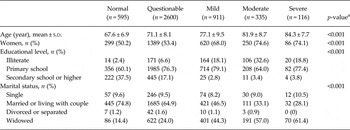
Out of the 4557 participants included in the analysis, 595 (13%) were classified as ‘normal’ (no cognitive impairment), 2600 (57%) as ‘questionable’ cognitive impairment, 911 (20%) had ‘mild’ cognitive impairment, 335 (7%) had ‘moderate’ cognitive impairment and 116 (3%) had ‘severe’ impairment. Table 1 shows the socio-demographic characteristics of the participants by degree of cognitive impairment. The participants with higher degree of cognitive impairment (MMSE) were significantly older. Furthermore, as the severity of the impairment increased, participants were more likely to be women, illiterate and widowed (Table 1).
Socio-demographic characteristic by degree of cognitive impairment

aCochran–Armitage trend test or analysis of variance linear trends.
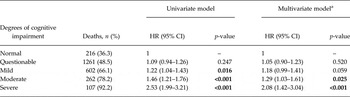
The median follow-up time was 11.7 (interquartile range, IQR: 5.0–15.3) years. During the follow-up period, 2448 (53.7%) participants died. The distribution of MMSE degrees of impairment according to survival status is presented in Table 2. The proportion of deaths increases gradually as the MMSE scores decrease (i.e., the severity of the cognitive impairment increases) (p < 0.001).
Hazard ratio and confidence intervals (95%) for Cox regression models

aAdjusted for sex, educational level, marital status, obesity, alcohol intake, tobacco use, health status, vascular disease, diabetes, hypertension, functional status, depression, anxiety and dementia.
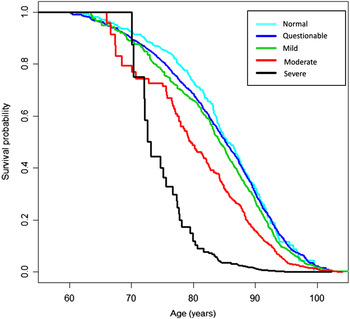
The crude comparison of the survival curves according to MMSE degree of impairment (Fig. 1) shows a more favourable survival probability in the ‘normal’ MMSE degree, and this probability decreased as the severity of impairment increases. In fact, the median survival age for subjects in the ‘normal’ degree of impairment was 85.9 (95% CI: 84.6–87.3) years, significantly higher than 82.7 (95% CI: 81.5–84.0) years for subjects in the ‘moderate’ degree and 77.5 (95% CI: 76.2–79.8) years for subjects in the ‘severe’ degree. The median survival age for the ‘questionable’ and ‘mild’ degrees were 85.1 (95% CI: 84.4–85.7) years and 84.2 (95% CI: 83.3–85.1) years, respectively, but did not reach statistical significance when compared with the ‘normal’ degree of cognitive impairment.
Survival curves for degrees of cognitive impairment.

Table 2 also shows the results of Cox regression analysis of the mortality risk associated with the different degrees of cognitive impairment. The association with mortality risk increases by degree of cognitive impairment.
In the multivariate model, with the inclusion of all potential confounding factors, the association between MMSE degrees of cognitive impairment and mortality was slightly attenuated (HR = 1.18 in the ‘mild’ degree of cognitive impairment; HR = 1.29 in the ‘moderate’ degree; HR = 2.08 in the ‘severe’ degree). The association between ‘questionable’ degree of cognitive impairment and mortality did not reach statistical significance.
We estimated that the proportion of the population exposed to the ‘severe’ degree of cognitive impairment was 0.03. The estimate of 0.03 for the proportion exposed yields a PAF of 3.49% (95% CI: 1.38–6.40%). Similarly, with an estimated proportion of the population exposed to the ‘moderate’ and ‘mild’ degrees of impairment of 0.08 and 0.20, respectively; the corresponding PAF were 2.20% (95% CI: 0.23–4.52%) for ‘moderate’ degree and 3.50% (95% CI: 0.00–7.64%) for ‘mild’ degree of cognitive impairment.
Discussion
The results of this study support the hypothesis that cognitive impairment, when socio-demographic characteristics, behavioural risk factors, health status, medical risk factors, functional status and psychiatric conditions are controlled will be associated with long-term all-cause mortality risk; and that the risk will be higher when the degree of cognitive impairment is higher, the gradient of the increment being apparent. While the increased risk was particularly marked in cases of severe cognitive impairment (HR = 2.08, p < 0.001), the results were marginally significant in cases of mild cognitive impairment (HR = 1.18, p = 0.059), and did not reach statistical significance in cases of questionable impairment (HR = 1.05, p = 0.590).
The association between cognitive impairment and mortality has also been reported in previous community studies (Kelman et al. Reference Kelman, Thomas, Kennedy and Cheng1994; Bruce et al. Reference Bruce, Hoff, Jacobs and Leaf1995; Bassuk et al. Reference Bassuk, Wypij and Berkman2000; Nguyen et al. Reference Nguyen, Black, Ray, Espino and Markides2003; Schultz-Larsen et al. Reference Schultz-Larsen, Rahmanfard, Kreiner, Avlund and Holst2008; Park et al. Reference Park, Kwon, Jung, Han, Jo and Jo2013) although the results have been inconsistent in relation to mild or non-severe impairment (Bassuk et al. Reference Bassuk, Wypij and Berkman2000; Nguyen et al. Reference Nguyen, Black, Ray, Espino and Markides2003; Park et al. Reference Park, Kwon, Jung, Han, Jo and Jo2013); Our study does not resolve this controversy in relation to non-severe cognitive impairment, but it is the first one suggesting a clear gradient, a ‘dose–response’ relationship, the mortality risk increasing in parallel with the severity of impairment.
Furthermore, this is the first follow-up study of such characteristics conducted in Southern Europe, with its long follow-up period, and has several additional advantages in relation to previous studies. First, it documents for the first time the PAF of death due to cognitive impairment. The contribution to mortality was 3.49% in severe cases and is judged to be considerable, as suggested by the fact that the fraction is similar to the one found in this same study (not shown among the results in this paper) for a classical risk factor such as diabetes (3.58%, 95% CI: 1.88–5.45). However, the causality implications in the PAF should be taken with caution in this particular study, in view of controversies about the meaning of the construct cognitive impairment (Dartigues & Amieva, Reference Dartigues and Amieva2014).
Second, we used the multivariate Cox proportional hazard models using exact age as timescale, which consistently showed that cognitive impairment was independently associated with mortality risk. Previous studies (Kelman et al. Reference Kelman, Thomas, Kennedy and Cheng1994; Bruce et al. Reference Bruce, Hoff, Jacobs and Leaf1995; Bassuk et al. Reference Bassuk, Wypij and Berkman2000; Nguyen et al. Reference Nguyen, Black, Ray, Espino and Markides2003; Park et al. Reference Park, Kwon, Jung, Han, Jo and Jo2013) with the exception of one (Schultz-Larsen et al. Reference Schultz-Larsen, Rahmanfard, Kreiner, Avlund and Holst2008) used time-on-study (i.e., time since inclusion date) in Cox regression models, taking age as a covariate. In samples of older adults, since age is strongly associated with some covariates (for example chronic diseases) it is preferred to use the exact age as timescale. The advantage of this method, as has been used here, is that bias on effect estimates can be avoided (Thiébaut & Bénichou, Reference Thiébaut and Bénichou2004).
Third, this study was more stringent than previous studies in controlling for potentially confounding factors. We controlled for factors previously associated with mortality, including socio-demographic characteristics such as gender (male) and limited education (Kunst & Mackenbach, Reference Kunst and Mackenbach1994), health factors; (Kelman et al. Reference Kelman, Thomas, Kennedy and Cheng1994; Bassuk et al. Reference Bassuk, Wypij and Berkman2000; Nguyen et al. Reference Nguyen, Black, Ray, Espino and Markides2003; Schultz-Larsen et al. Reference Schultz-Larsen, Rahmanfard, Kreiner, Avlund and Holst2008; Park et al. Reference Park, Kwon, Jung, Han, Jo and Jo2013), functional status (Scott et al. Reference Scott, Macera, Cornman and Sharpe1997) and relevant behavioural risk factors (tobacco use, alcohol intake and obesity) (Patel et al. Reference Patel, Rehkopf, Leppert, Bortz, Cullen, Chertow and Ioannidis2013). Moreover, to minimise the possibility that mortality was due to an acute or terminal medical condition, we only included in the analysis subjects remaining alive at the end of the first follow-up year. In controlling for depression, which has previously been shown to be associated with an increased mortality risk (Saz & Dewey, Reference Saz and Dewey2001; Schoevers et al. Reference Schoevers, Geerlings, Deeg, Holwerda, Jonker and Beekman2009), and contrary to most previous investigations using instruments such as the Center for Epidemiological Studies Depression scale (Kelman et al. Reference Kelman, Thomas, Kennedy and Cheng1994; Bassuk et al. Reference Bassuk, Wypij and Berkman2000; Nguyen et al. Reference Nguyen, Black, Ray, Espino and Markides2003), Geriatric Depression scale (Schultz-Larsen et al. Reference Schultz-Larsen, Rahmanfard, Kreiner, Avlund and Holst2008) or Beck Depression Inventory (Park et al. Reference Park, Kwon, Jung, Han, Jo and Jo2013), we used a diagnostic instrument, the AGECAT system. ‘Cases’ detected in the community with this system have been shown to correspond to what clinical psychiatrists consider a ‘treatable case’ (Copeland et al. Reference Copeland, Beekman, Braam, Dewey, Delespaul, Fuhrer, Hooijer, Lawlor, Kivela, Lobo, Magnusson, Mann, Meller, Prince, Reischies, Roelands, Skoog, Turrina, deVries and Wilson2004). Furthermore, our study is the only one controlling for anxiety disorder, which has recently been shown to be associated with an increased mortality risk (Denollet et al. Reference Denollet, Maas, Knottnerus, Keyzer and Pop2009; Carrière et al. Reference Carrière, Ryan, Norton, Scali, Stewart, Ritchie and Ancelin2013). Contrary to previous studies, we also controlled for dementia, shown to be one of the best-known mortality risks in the elderly in general (Dewey & Saz, Reference Dewey and Saz2001) and also in this same population in Zaragoza (Saz et al. Reference Saz, Launer, Día, De-La-Cámara, Marcos and Lobo1999). It might be argued that new covariate alterations could occur in the long follow-up period in this particular study. However, in such case the group with cognitive disturbance would probably be more exposed to the covariate alterations and, consequently, the main results and conclusions of this study would be reinforced.
Finally, the MMSE severity degrees of cognitive impairment used in this study have been validated against well-known scales such as the Clinical Dementia Rating (CDR) (Hughes et al. Reference Hughes, Berg, Danziger, Coben and Martin1982). It might also be argued that this validation against a dementia scale limits the utility of this MMSE categorisation of cognitive impairment. However, the CDR has also been used to assess cognitive impairment (Modrego & Ferrández, Reference Modrego and Ferrández2004), and the thresholds implemented here have been used previously by the authors to categorise cognitive impairment in general (Sartorius et al. Reference Sartorius, Semrau, Burns, Lobo, Rikkert, Robert and Stoppe2013). In support of the generalisability of the ‘standardised’ cut-off to evaluate cognitive impairment in a general population the study was completed in a representative community sample, and the data showing that mortality risk increases in parallel with the severity of cognitive disturbance supports the predictive validity of this MMSE categorisation. The robustness of the results is also supported by the fact that the individuals with normal cognitive performance were used as the reference in the statistical, regression models.
Although There is no consensus about the construct cognitive impairment, It has been considered to be a frailty index (Kelaiditi et al. Reference Kelaiditi, Cesari, Canevelli, van Kan, Ousset, Gillette-Guyonnet, Ritz, Duveau, Soto, Provencher, Nourhashemi, Salvà, Robert, Andrieu, Rolland, Touchon, Fitten and Vellas2013), an index of ill health for specific illnesses (Wiesli et al. Reference Wiesli, Schwegler, Schmid, Spinas and Schmid2005) or for general ill health (Regal-Ramos et al. Reference Regal-Ramos, Salinero-Fort and Cruz-Jentoft2005). The results of this study demonstrate the significance of the construct. While cognitive impairment cannot be considered an illness by itself, the severity gradient we have shown makes it a candidate variable for future research of diseases staging models (Rikkert et al. Reference Rikkert, Tona, Janssen, Burns, Lobo, Robert, Sartorius, Stoppe and Waldemar2011). Staging models in which medical diseases or disorders are assessed according to different severity degrees have been shown to be clinically useful (Edge & Compton, Reference Edge and Compton2010) and have also been proposed for psychiatric disturbances (Vieta et al. Reference Vieta, Reinares and Rosa2011) and for dementia (Rikkert et al. Reference Rikkert, Tona, Janssen, Burns, Lobo, Robert, Sartorius, Stoppe and Waldemar2011). Despite the fact that mortality risks for different severity degrees in the MMSE overlap, the severity gradient observed in this study points in the direction of staging degrees. It might be useful in future studies to consider implementing a staging-like approach to care for patients with cognitive impairment.
Several hypotheses may be put forward about the potential mechanisms involved in the intriguing, increased mortality risk associated with cognitive disturbance documented in this study. Among them, biological mechanisms, including frailty-related factors (Kelaiditi et al. Reference Kelaiditi, Cesari, Canevelli, van Kan, Ousset, Gillette-Guyonnet, Ritz, Duveau, Soto, Provencher, Nourhashemi, Salvà, Robert, Andrieu, Rolland, Touchon, Fitten and Vellas2013) or leucoaraiosis (Grueter & Schulz, Reference Grueter and Schulz2012) should certainly be considered. However, psychosocial factors such as self-neglect and lack of compliance with medical care may also be at play. Mortality has been associated with self-neglect, such as observed in depressed patients (Campayo et al. Reference Campayo, Alvarez-Silva, Saz, Barcones, Gutiérrez-Galve and Lobo2009), and depression was common among individuals with cognitive disturbance in this same population (Gracia-Garcia et al. Reference Gracia-García, de-la-Cámara, Santabárbara, Lopez-Anton, Quintanilla, Ventura, Marcos, Campayo, Saz, Lyketsos and Lobo2013).
In relation to the clinical implications in this study, the usefulness of this simple method to document degree of cognitive impairment and detect individuals with an associated mortality risk may also be underlined. The MMSE is a valid instrument that can be applied and interpreted by clinicians in 10 min However, they should be alert at the influence of both age and education in the MMSE scores (Lobo et al. Reference Lobo, Saz, Marcos, Día, de la Cámara, Ventura, Morales Asín, Fernando Pascual, Montañés and Aznar1999). Since age and educational level are strongly related to mortality (Moe et al. Reference Moe, Steingrímsdóttir, Strand, Grøholt and Næss2012), we have been particularly careful in controlling by both in the statistical, regression models used in this study.
Some other limitations in this research should also be considered, including the controversies about the meaning of the construct cognitive disturbance (Dartigues & Amieva, Reference Dartigues and Amieva2014). Epidemiological limitations, such as those related to response rate have been previously commented (Lobo et al. Reference Lobo, Saz, Marcos, Día, De la Cámara, Ventura, Montañés, Lobo-Escolar and Aznar2005). Putative misclassification of cognitive disturbance cannot be discarded, since the sensitivity, specificity and predictive values of the MMSE in the general population are not optimal (Lobo et al. Reference Lobo, Saz, Marcos, Día, de la Cámara, Ventura, Morales Asín, Fernando Pascual, Montañés and Aznar1999). A number of known mortality risk factors in old individuals have been controlled, but we cannot assure that factors uncontrolled in this study, such as the co-morbidity (Helvik et al. Reference Helvik, Engedal and Selbæk2013) or the diet (Morris, Reference Morris2012), might influence the reported results. Moreover, information about the specific cause of death was not available for this mortality study. These limitations notwithstanding, it is remarkable that, after controlling for a number of known mortality risk factors in old individuals, we show that, compared with an individual with good cognitive performance, an individual of the same age, sex, physical and mental conditions, has a survival expectation half if he/she has severe cognitive impairment. This is of major significance for public health work and may be important in selecting areas for future research.
Conclusion
The results of this study support the hypothesis that cognitive impairment is associated with all-cause mortality risk; and shows a clear gradient of risk, the mortality risk increasing with the degree of cognitive impairment. The PAF of death due to severe cognitive impairment was 3.49%. It may be remarked that the cognitive disturbance may be detected with a simple, bed-side or office cognitive test, and therefore clinicians in settings such as Primary Care or Geriatric facilities should be alert to a common disturbance with associated mortality risk, and should consider routine assessment of cognitive function in the elderly. Specifically, if severe cognitive disturbance could be prevented, the mortality rate shown in this study would decrease by 3.49%. Clinicians could also consider the possibility of informing the caregivers in cases of patients with cognitive disturbance.
Acknowledgements
The authors acknowledge the contribution of the lay interviewers, senior medical students and members of the ZARADEMP Workgroup who participated in the study.
Financial Support
This work was supported by Grants from the Fondo de Investigación Sanitaria, Instituto de Salud Carlos III, Spanish Ministry of Economy and Competitiveness, Madrid, Spain (grant numbers 94/1562, 97/1321E, 98/0103, 01/0255, 03/0815, 06/0617 and G03/128).
Conflict of Interest
All authors declare that there are no potential financial, personal or organisational conflicts of interest for this particular study.
Ethical Standard
The authors assert that all procedures contributing to this work comply with the ethical standards of the relevant national and institutional committees on human experimentation and with the Helsinki Declaration of 1975, as revised in 2008.