The emergence of antimicrobial resistant organisms (AROs) has led to a global public health crisis. The World Health Organization has named antibiotic resistance one of the most important public health threats of the 21st century. 1 According to the Centers for Disease Control and Prevention (CDC) 2019 Antimicrobial Threats Report, >2.8 million antibiotic-resistant infections occur in the United States each year, resulting in >35,000 deaths. 2 The AROs classified as urgent and serious threats include Clostridioides difficile, carbapenem-resistant Enterobacteriaceae (CRE), extended-spectrum β-lactamase (ESBL)–producing Enterobacteriaceae, vancomycin-resistant Enterococcus spp (VRE), and antimicrobial-resistant Pseudomonas aeruginosa. 2 Infections by AROs are associated with greater morbidity, mortality, and costs compared with antimicrobial-susceptible organisms. 1
The gut microbiota plays an important role in host defense by preventing overgrowth and colonization of potentially pathogenic bacteria. This colonization resistance is disrupted by antimicrobial exposure, an important risk factor for ARO development, acquisition, and colonization. Reference Caetano, Antunes and Han3 Although most patients with gastrointestinal colonization by ARO have no symptoms, they can serve as a reservoir that can facilitate transmission and subsequent infection in susceptible patients. Reference Donskey4
Treatment options for AROs are limited, and strategies to prevent these infections, including strict infection control practices and antimicrobial stewardship, have had limited success, highlighting the need for better strategies. Ingestion of prophylactic Lactobacillus rhamnosus GG (LGG) and other probiotics could be an approach to preventing the spread of and subsequent infection due to AROs by promoting a healthy bacterial environment within the colon. However, the current literature offers conflicting data regarding the efficacy of probiotics in preventing ARO colonization. Multiple probiotics have shown a lack of benefit in preventing acquisition or promoting loss of AROs in several randomized clinical trials, Reference Kwon, Bommarito and Reske5–Reference Schnadower, Tarr and Casper9 but other studies have shown a potential benefit. Reference Goldstein, Johnson and Maziade10,Reference Eggers, Barker, Valentine, Hess, Duster and Safdar11 Therefore, in the present study, we sought to determine whether LGG could safely prevent intestinal colonization due to AROs.
Methods
Study overview
Between January 2014 and September 2015, we conducted a single-center, double-blinded, randomized, placebo-controlled pilot trial in hospitalized patients at Barnes-Jewish Hospital in St Louis, Missouri. The trial was approved by the Washington University Human Research Protection Office (HRPO).
Study population
Patients aged ≥18 years on antimicrobials, admitted to medical and surgical wards and intensive care units (ICUs), with an anticipated hospital length of stay >48 hours were eligible to participate in this study. Study participants provided written, informed consent. We applied the following exclusion criteria: pregnant, non-English speaking, unwilling to participate, expected to die within 7 days, HIV infection with a CD4 count <200 cells/mm Reference Caetano, Antunes and Han3 , neutropenia with an absolute neutrophil count <500 cells/mm Reference Caetano, Antunes and Han3 (or expected drop to <500), clinically significant diarrhea or history of Clostridioides difficile infection (CDI) in the previous 3 months, history of VRE colonization and/or infection in the last year, transplant recipients, acute pancreatitis, and previously enrolled patients.
Randomization, trial intervention, and specimen collection
Patients were randomized to receive 1 capsule containing 1×10¹⁰ cells of LGG (Culturelle, i-Health, Cromwell, CT) twice daily or an identical appearing placebo, in a 1:1 ratio using permutation blocks (n = 4 per block), stratified by type of ward. A computerized random number generator determined the treatment arm. Participants, study staff, and data analysts were blinded; only the study pharmacist knew the treatment assignment. Both drugs were administered orally. To ensure safety in patients unable to swallow, the drug was given via nasogastric tube administered in a saline slurry via syringe through the tube after removal of gelatin capsule. Reference Kwon, Bommarito and Reske5 Study participants received the study drug from enrollment until hospital discharge. Stool or rectal-swab specimens were collected at enrollment (prior to first dose of the study drug), approximately every 3 days after enrollment, and at discharge. Stool specimens submitted to the clinical laboratory as part of routine care were collected as well. Specimens were stored at −80°C until cultured. When cultured, specimens were inoculated onto MacConkey with Cefotaxime Agar (Hardy Diagnostics, Santa Maria, CA), ChromID® VRE agar (bioMerieux, Durham, NC), HardyCHROM™ ESBL Agar (Hardy Diagnostics, Santa Maria, CA) and ChromID® Pseudomonas (Biomerieux, Durham, NC) agar. Cycloserine-cefoxitin mannitol broth with taurocholate lysozyme cysteine (Anaerobe Systems, Morgan Hill, CA) was used for C. difficile isolation as previously published. Reference Hink, Burnham and Dubberke12 The selective agar was incubated at 35°C for 48 hours. Organisms recovered from selective media underwent Gram staining and were identified using matrix-assisted laser desorption/ionization time-of-flight mass spectrometry (MALDI-TOF MS). Antimicrobial susceptibility testing was performed on enterococcal and gram-negative isolates using Kirby-Bauer disk diffusion.
Chart review and patient interviews were conducted to ascertain patients’ medical histories, treatments, comorbidities, and outcomes. Data collected included demographics, type of ward, length of stay, primary reason for admission, presence of any infections, healthcare-facility exposures, and antimicrobials received in the previous 60 days. Consistency of bowel movements were assessed using Bristol stool type at enrollment and at discharge. Drug accountability with number of missed doses and reason for stopping study drug prematurely were also evaluated.
Study outcomes
Patients were included in the outcomes analyses if they received at least 1 dose of the study drug and had admission and discharge stool or swab specimens. All patients who received at least 1 dose of study drug were included in the safety analyses. Acquisition of an ARO was defined as isolation of any ARO after enrollment that was not present on enrollment. Loss of ARO was defined as not isolating an ARO on discharge that had been isolated at enrollment. The primary outcome was any ARO acquisition while on the study drug. Secondary outcomes included loss of any ARO present at enrollment and acquisition or loss of an individual ARO. ARO included the following organisms isolated with antimicrobial-resistant selective media: extended-spectrum β-lactamase (ESBL) Enterobacteriaceae, ciprofloxacin-resistant Enterobacteriaceae, other antimicrobial-resistant (AR) Enterobacteriaceae (not ESBL or ciprofloxacin resistant), antimicrobial-resistant Pseudomonas, vancomycin-resistant Enterococcus spp, and Clostridioides difficile. Safety end points evaluated included infections due to Lactobacillus, CDI diagnosis, and 60-day survival after discharge.
Statistical analysis
We performed χ 2 and Mann-Whitney U tests as appropriate to compare baseline characteristics and the primary and secondary outcomes between groups. All data management and analyses were performed using SPSS version 24 software (IBM, Armonk, NY).
Results
In total, 88 study participants on antibiotics were enrolled and were randomized to receive LGG twice daily or placebo: 44 in the LGG group and 44 in the placebo group (Fig. 1). Both groups had similar baseline characteristics in demographics, length of stay, type of ward, or number of bowel movements per day (Table 1). Patients in the placebo group were less likely to have an infection as primary reason for admission (48% vs 80%; OR, 0.24; 95% CI, 0.07–0.86) (Table 1). Patients in the placebo group also were more likely to receive a fluoroquinolone in the 60 days prior to enrollment (27% vs 9%; OR, 3.75; 95% CI, 1.10–12.74) (Table 1).
Patient randomization.

Comparison of Study Groups Baseline Characteristics

Note. OR, odds ratio; CI, confidence interval; LGG, Lactobacillus rhamnosus GG; ICU, intensive care unit.
The median durations of the study drug for the LGG and placebo groups were 5.8 and 6.5 days, respectively. Most of the patients in both groups received the drug via oral administration (LGG group 70% and placebo group 82%); 14% of the LGG group and 16% of the placebo group received the study drug through both oral and nasogastric administration. Exclusive nasogastric administration was more frequently used in the LGG group (16% vs 2%; P = .05). During the study period, most patients did not miss any doses (68% in LGG group and 66% in placebo group), and only a few missed >3 doses (5% in LGG group and 9% in placebo group). Comparison of Bristol stool type between groups showed no differences at either enrollment or discharge. The most common reason for study exit was hospital discharge (77% in LGG group and 75% in placebo group).
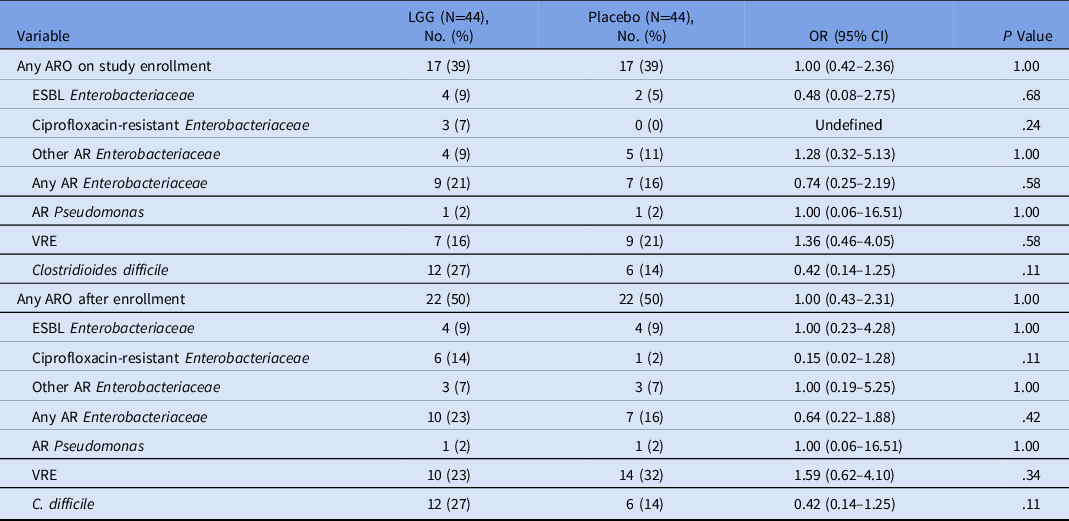
Colonization status throughout the study is summarized in Table 2. Study participants in both groups had similar prevalence of colonization with any ARO at study enrollment (LGG 39% vs placebo 39%; OR, 1.00; 95% CI, 0.42–2.36). Both groups had similar colonization prevalence for individual AROs, except for C. difficile, which was more prevalent in the LGG group (27% vs 14%), although the difference was not statistically significant (Table 2). ARO colonization prevalence after enrollment was also similar in both groups (LGG 50% vs placebo 50%; OR, 1.00; 95% CI, 0.43–2.31).
Prevalence of ARO Colonization at Enrollment and After Enrollment

Note. LGG, Lactobacillus rhamnosus GG; ARO, antimicrobial resistant organism; AR, antimicrobial resistant; ESBL, extended-spectrum β-lactamase; VRE, vancomycin-resistant Enterococcus spp.
Primary and secondary outcomes
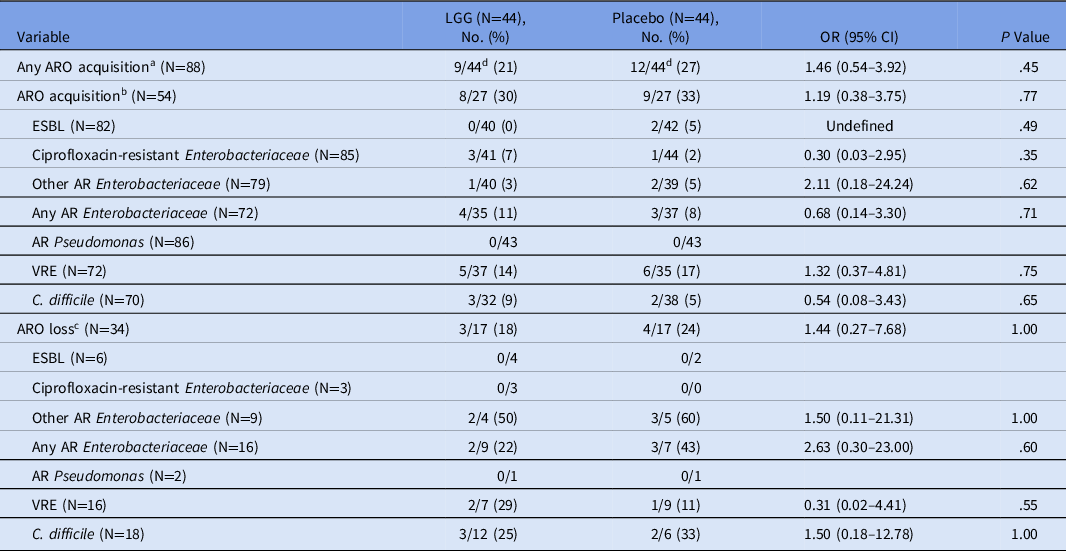
We detected no difference between the 2 groups in overall acquisition of any ARO (LGG 30% vs placebo 33%; OR, 1.19; 95% CI, 0.38–3.75) or any individual ARO (Table 3). 2 patients in the placebo group acquired ESBL colonization and none in the LGG group (OR undefined; P = .49) and 3 patients (7%) acquired ciprofloxacin-resistant Enterobacteriaceae in the LGG group compared to 1 patient in the placebo group (OR, 0.30; 95% CI, 0.03–2.95). These differences were not significant, and no other notable differences in ARO acquisition of individual organisms were noted. No patients acquired antimicrobial resistance (OR, 1.44; 95% CI, 0.27–7.68) or any individual ARO (Table 3). No patients in any group lost colonization with ESBL, ciprofloxacin-resistant Enterobacteriaceae, or antimicrobial-resistant Pseudomonas.
Primary and Secondary Outcomes

Note. OR, odds ratio; CI, confidence interval; LGG, Lactobacillus rhamnosus GG; ARO, antimicrobial-resistant organism; AR, antimicrobial resistant; ESBL, extended-spectrum β-lactamase; VRE, vancomycin-resistant Enterococcus.
a Acquisition of any new ARO (not colonized at enrollment or colonized with ARO but acquired different ARO).
b Not colonized with any ARO at enrollment but colonized at ≥1 time point after enrollment.
c Colonized with any ARO at enrollment but not after enrollment.
d Denominator numbers are provided in each cell to indicate how many patients from each study group were included in each comparison. For example, patients colonized with an ESBL-producing organism at enrollment were excluded from the “ESBL acquisition” comparison; conversely, only patients colonized with ESBL-producing organisms at enrollment were included in the “ESBL loss” comparison.
All 88 patients were included in the safety assessment (Table 4). We detected no significant differences between LGG and placebo groups in the number of patients who died within 60 days after discharge (LGG 18% vs placebo 23%; OR, 1.32; 95% CI, 0.47–3.75). No infections due to probiotic Lactobacillus occurred in either group.
Safety Assessment at 60 Days After Discharge

Note. OR, odds ratio; CI, confidence interval; LGG, Lactobacillus rhamnosus GG; N/A, not applicable; CDI, Clostridioides difficile infection.
Discussion
Given the importance of the gut microbiome as a reservoir for AROs, the prevention of ARO colonization of the intestine with probiotics has been proposed, and probiotics have been administered to prevent CDI. Reference Goldstein, Johnson and Maziade10,Reference Mills, Rao and Young13,Reference McFarland, Ship, Auclair and Millette14 It has also been proposed that probiotics may promote decolonization of AROs. Reference Gopalsamy, Woodworth and Wang15 This study did not confirm these purported benefits of probiotics.
Several hypotheses may explain our negative findings. First, our sample size may not have been large enough to detect a difference between groups, and most patients’ duration of time on study drug was relatively short. However, despite the short duration of observation, ∼30% of people acquired a new ARO in both arms, suggesting no treatment effect versus the study being underpowered. Also, based on the purported mechanisms of action as to why probiotics may impact ARO colonization (competition for binding sites and/or nutrients, production of antimicrobial compounds), one would expect to see an immediate impact on new ARO acquisition. Additionally, in terms of efficacy, once antibiotics are stopped, recovery of the microbiome and restoration of colonization resistance is relatively rapid. Reference Palleja, Mikkelsen and Forslund16,Reference Burdet, Nguyen and Duval17 Emerging data suggest that probiotics may delay recovery of the microbiome after antibiotics. Reference Suez, Zmora and Zilberman-Schapira18 Also, we used a probiotic with a single organism. Diversity is an important quality of a healthy microbiome, Reference Kho and Lal19 but currently no probiotics are available that have a level of diversity that approximates that of the microbiome, even a microbiome after an antibiotic exposure. Another potential explanation is that all patients were receiving systemic antibiotics, many of which likely had activity against LGG. Additionally, 32% of the LGG group patients missed 1 or more probiotic doses, which may have limited the effectiveness of the probiotic.
Another potential explanation is that currently available probiotics are not effective at preventing acquisition or promoting loss of ARO. Prior studies evaluating the role of probiotics for ARO decolonization have produced mixed results. We previously performed an open label randomized controlled trial (RCT) involving critically ill patients that showed no significant difference in acquisition or loss of colonization of AROs between patients receiving LGG versus standard of care. Reference Kwon, Bommarito and Reske5 This lack of benefit of LGG was also seen in another RCT where there was no effect over VRE colonization. Reference Doron, Hibberd, Goldin, Thorpe, McDermott and Snydman6 Furthermore, 2 other RCTs concluded that probiotics, including a probiotic strain of Escherichia coli (Mutaflor) and a symbiotic probiotic containing Lactobacillus bulgaricus and L. rhamnosus, were not effective in decolonizing hospitalized patients or long-term residents harboring antimicrobial-resistant E. coli and other gram-negative bacilli. Reference Tannock, Tiong and Priest20,Reference Salomão, Heluany-Filho, Menegueti, de Kraker, Martinez and Bellissimo-Rodrigues21 In addition, a lack of efficacy has been reported in studies that have evaluated probiotics as prevention for antibiotic-associated diarrhea or C. difficile diarrhea in older patients, as well as absence of better clinical outcomes in children with acute gastroenteritis. Reference Allen, Wareham and Wang7–Reference Schnadower, Tarr and Casper9 Conversely, a recent trial found that gut carriage of S. aureus decreased by 83% with L. rhamnosus compared to placebo, but the effect was not the same in other body sites. Reference Eggers, Barker, Valentine, Hess, Duster and Safdar11 These studies produced different results for several reasons, including different sample size, doses and types of probiotics, analyzed ARO, and time of therapy.
A potential therapy being considered for ARO decolonization includes microbiota restoration therapy (MRT) given its success in treating recurrent CDI by restoring a healthy intestinal microbiome. Reference Woodworth, Hayden, Young and Kwon22 A few case reports have described successful eradication of several AROs including ESBL-producing Enterobacteriaceae, carbapenem-resistant Enterobacteriaceae, multidrug-resistant Pseudomonas, VRE, among other organisms after MRT, often as an incidental outcome while undergoing treatment for CDI. Reference Singh, van Nood and Nieuwdorp23–Reference Crum-Cianflone, Sullivan, Ballon-Landa and Onderdonk25 In addition, prospective studies of MRT for ARO colonization have reported efficacy ranging between 40% and 93% during follow up. Reference Singh, de Groot and Geerlings26,Reference Davido, Batista and Michelon27 A phase-2, open-label, treatment-only study of a human microbiota-derived investigational product (RBX2660) for treatment of recurrent CDI found that 73% of patients colonized with VRE at baseline were decolonized by the end of the follow-up period. Reference Dubberke, Mullane and Gerding28 Analyses of stool specimens from the RBX2660 phase 2b double-blinded, placebo-controlled, randomized trial using metagenomic sequencing found that RBX2660 reduced ARO colonization and more rapidly restored the microbiota compared to placebo. Reference Kwak, Choi and Hink29 MRT administered for CDI has also been associated with reductions in urinary tract infections. Reference Tariq, Pardi, Tosh, Walker, Razonable and Khanna30 Notably, a detailed cased report in which RBX2660 was administered for treatment of recurrent antimicrobial-resistant Klebsiella pneumoniae UTIs suggests that decolonization may not be the mechanism by which MRT interacts with ARO. After receipt of RBX2660, the case patient had a prolonged period without UTIs due to the antimicrobial-resistant K. pneumoniae. However, whole-genome sequencing revealed that she remained colonized with the organism, and then she developed another UTI due to K. pneumoniae after receipt of broad-spectrum antibiotics for osteomyelitis. Reference Keen, Tasoff and Hink31 Notably, potential risks are associated with MRT administration for ARO colonization, including transferring new resistant organisms or genes to the recipient. Reference Kwak, Choi and Hink29 Additional study is needed to better understand the mechanisms, benefits, and harms of MRT when administered for ARO colonization before adoption into clinical practice. Reference Woodworth, Hayden, Young and Kwon22
Probiotics overall are safe, but it is also important to consider the potential for organisms in probiotic formulations to cause infections, particularly in immunocompromised patients who may be at risk of gut microbiota disruption due to other factors. Reference Hempel, Newberry and Ruelaz32 No infections related to probiotics occurred in our study, suggesting that probiotics may be safe in the studied patient population, but we excluded immunocompromised patients. In addition, use of LGG did not result in any difference in 60-day mortality.
The evidence suggesting that commercially available probiotics are effective at promoting a healthy microbiome is limited. Along these lines, in 2 studies we have failed to find LGG to be associated with preventing ARO colonization or promoting loss of ARO colonization. To determine whether probiotics play a role in promoting a healthy microbiome, future studies should be adequately powered with a clinically significant outcome and/or focus on microbes that have been consistently associated with a healthy microbiome and good clinical outcomes in observational studies.
Acknowledgments
Financial support
This study was funded by the CDC Prevention Epicenter (grant no. 1U54CK000162-01). The probiotic Lactobacillus rhamnosus GG (Culturelle) was provided by i-Health. i-Health did not take part in the study design, data collection, analysis, or final manuscript.
Conflicts of interest
E.R.D. reports grants from Pfizer and Synthetic Biologics, personal fees from Pfizer, Ferring, Merck, Synthetic Biologics, bioK+, and Sanofi; none are relevant to this article. C.-A.D.B. reports grants from bioMerieux, Luminex, BioFire, and SeLux and personal fees from Thermo Fisher Scientific; none are relevant to this article. All other authors report no conflicts of interest.