


Impact Statement
Neurological disorders are a global health challenge, yet many promising medicines fail because they cannot reach the correct cells and molecular locations within the central nervous system (CNS). This Perspective provides a framework for developing nanoscale delivery systems for CNS therapeutics by comparing lipid nanoparticles (LNPs) with exosome-based systems. Rather than asking which platform is universally superior, we argue that delivery technologies should be matched to the therapeutic cargo, administration route, target cell, site of action, disease stage, dosing schedule, and manufacturing requirements. The article emphasizes that measurable accumulation in the brain is not sufficient evidence of successful therapy. Translation requires stable transport, appropriate interaction with or bypass of the blood–brain barrier, penetration into relevant tissue, verified entry into the intended cells, release of an active payload at the required location, and a meaningful pharmacological effect. This distinction can help researchers avoid misleading biodistribution claims and prioritize experiments that better predict clinical benefit. LNPs offer defined composition, efficient nucleic acid loading, scalable production, and regulatory precedent, but often face peripheral sequestration, limited CNS entry, and inefficient payload release inside cells. Exosome-based systems provide biological membrane functions and potential advantages for protein delivery, immune modulation, and communication between cells, but remain limited by source heterogeneity, complex purification, variable potency, and difficult quality control. The framework therefore highlights the translational trade-offs that must be resolved before either platform can be implemented at scale. By promoting mechanism-matched selection, standardized functional benchmarking, early consideration of manufacturability and repeat-dose safety, and rational hybrid designs, this Perspective aims to support more reproducible and clinically realistic CNS nanomedicine. These principles may accelerate treatments for Parkinson’s disease and other neurological disorders, reduce ineffective experimentation, improve resource allocation, and strengthen the path from laboratory innovation to patient benefit. They also provide guidance for researchers, industry, regulators, clinicians, and funders.
1. Introduction: Therapeutic Cargo Requirements and Criteria for Successful CNS Delivery
Therapeutic strategies for central nervous system (CNS) disorders encompass neurotransmitter replacement and other small-molecule approaches, peptides, proteins, enzymes, antibodies, and nucleic acid-based agents. These modalities face distinct but overlapping delivery barriers. Neurotransmitter-based therapies and many small molecules may be limited by rapid metabolism, insufficient exposure, or inadequate blood–brain barrier (BBB) permeability, whereas peptides, proteins, enzymes, and antibodies are further constrained by molecular size, susceptibility to degradation, and limited cellular entry. RNA therapeutics require protection from enzymatic degradation, delivery to relevant tissues, uptake by target cells, endosomal escape, and access to the cytosol or nucleus depending on mechanism [Reference Terstappen, Meyer, Bell and Zhang1,Reference Hou, Zaks, Langer and Dong2,Reference Hauck and Hecker3]. CNS drug delivery remains one of the most stringent tests for nanomedicine. The challenge is not simply that therapeutics fail to “enter the brain.” Delivery platforms are required when the free therapeutic cannot achieve sufficient stability, biodistribution, target-cell access, or functional availability at its intended intracellular or extracellular site of action. The BBB, as a specialized component of the neurovascular unit, preserves CNS homeostasis by tightly regulating exchange between the circulation and brain parenchyma [Reference Terstappen, Meyer, Bell and Zhang1]. This protective biology, however, also restricts access of antibodies, enzymes, peptides, nucleic acids, and many small molecules.
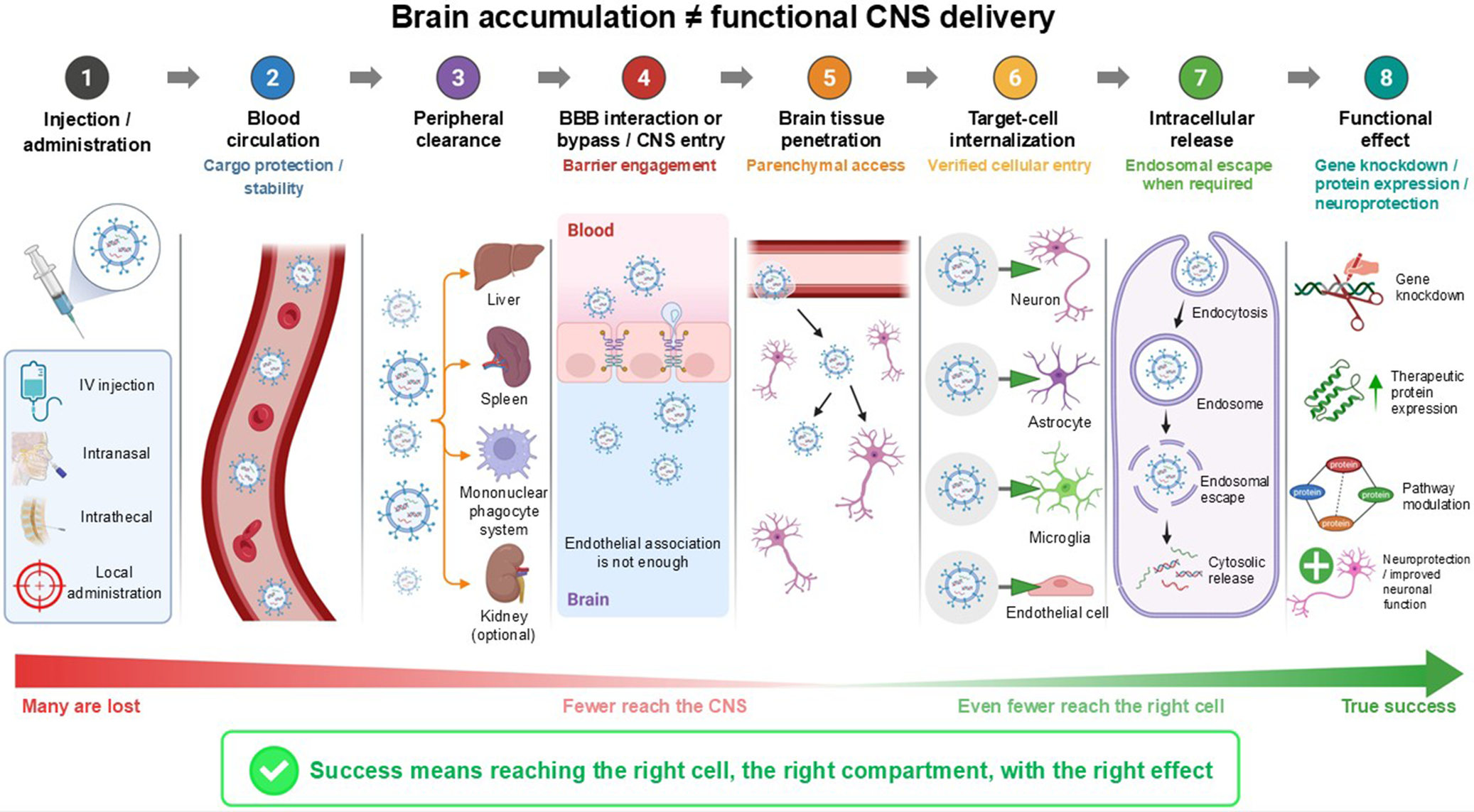
The term “delivery” is often used too loosely in CNS nanomedicine. Meaningful CNS delivery should be viewed as a sequential cascade rather than a binary outcome. As summarized in Figure 1, a therapeutic nanocarrier must negotiate eight linked requirements: administration through a clinically relevant route; maintenance of cargo stability within the systemic circulation or local administration environment; avoidance of premature clearance; productive engagement with or bypassing of CNS entry barriers; penetration into disease-relevant brain tissue compartments; internalization by the intended target cell; release or presentation of the payload at the correct intracellular or extracellular site of action; and, ultimately, measurable pharmacological or disease-modifying benefit. This hierarchy emphasizes that delivery becomes therapeutically meaningful only when the right cargo reaches the right CNS cell, the right compartment, and produces the intended biological effect. The exact sequence is route-dependent: systemically administered carriers must negotiate circulation and the BBB, whereas local routes may bypass these steps but remain constrained by local stability, clearance, tissue distribution, and cellular access. Failure at any stage can compromise therapeutic outcome. Insufficient stability can expose the cargo to degradation; premature clearance can redirect it to peripheral organs or remove it from the administration site; vascular or endothelial association can occur without BBB crossing; and tissue entry may still fail to provide access to the disease-relevant cell population. Even verified cellular internalization does not establish successful delivery when the payload remains trapped in endosomes or lysosomes or fails to reach its molecular target.
What counts as success in CNS nanocarrier delivery?

Figure 1. Long description
The flowchart is organized into eight vertical panels connected by arrows.
1. Injection / administration: Shows a syringe and nanocarriers with icons for I V injection, Intranasal, Intrathecal, and Local administration.
2. Blood circulation: Depicts nanocarriers inside a blood vessel with the note Cargo protection / stability.
3. Peripheral clearance: Shows nanocarriers being diverted to the Liver, Spleen, Mononuclear phagocyte system, and Kidney (optional).
4. B B B interaction or bypass / C N S entry: Illustrates nanocarriers crossing from the Blood compartment through endothelial cells into the Brain. A caption states Endothelial association is not enough.
5. Brain tissue penetration: Shows nanocarriers moving from a vessel into the parenchymal space toward neurons.
6. Target-cell internalization: Arrows point from nanocarriers to specific cell types: Neuron, Astrocyte, Microglia, and Endothelial cell.
7. Intracellular release: A diagram of a cell showing the sequence of Endocytosis, Endosome formation, Endosomal escape, and Cytosolic release.
8. Functional effect: Lists outcomes including Gene knockdown (illustrated by scissors cutting D N A), Therapeutic protein expression (upward arrow), Pathway modulation, and Neuroprotection / improved neuronal function.
At the bottom, a large gradient arrow transitions from red to green. Text along the arrow reads: Many are lost, Fewer reach the C N S, Even fewer reach the right cell, and True success. A final green box states: Success means reaching the right cell, the right compartment, with the right effect.
Successful CNS delivery is a sequential process rather than a binary outcome. After administration, nanocarriers must remain stable in circulation, avoid peripheral clearance, interact with or bypass the BBB to achieve CNS entry, penetrate brain tissue, undergo internalization by the intended target cell, and release cargo in the correct intracellular compartment or extracellular site of action before achieving a meaningful functional effect. The exact sequence is route-dependent, and local administration routes may bypass or modify the circulation, peripheral clearance, and BBB-related steps. Target-cell internalization refers to verified cellular entry rather than cell-surface association. Endosomal escape is required only for cargos whose site of action is intracellular. Brain-associated signal alone is insufficient to define success; true CNS delivery requires functional payload availability in the right cell, the right compartment, and with the right therapeutic outcome.
This hierarchy matters because brain-associated signal can be misleading. A nanocarrier that increases whole-brain fluorescence, radioactivity, or drug concentration may still fail to deliver cargo to neurons, astrocytes, microglia, endothelial cells, oligodendrocytes, or disease-relevant intracellular compartments [Reference Dong4,Reference Gilleron, Querbes and Zeigerer5]. Nanoparticles may prolong circulation, bind brain endothelial cells, exploit disease-associated vascular leakage, or increase luminal exposure without crossing an intact BBB [Reference Dong4]. Rather than functioning as a simple anatomical barrier, the BBB operates as a dynamic component of the neurovascular unit, integrating brain endothelial cells, tight junction complexes, pericytes, astrocytic endfeet, basement membrane components, neurons, microglia, influx and efflux transporters, and other regulatory systems [Reference Furtado, Björnmalm and Ayton6]. Therefore, evidence of endothelial association should not be equated with parenchymal delivery.
Route of administration further changes the definition of success. Intravenous delivery is widely used and easily scalable, but it imposes the full barrier sequence: circulation, peripheral clearance, BBB engagement, tissue penetration, cellular uptake, and intracellular release [Reference Terstappen, Meyer, Bell and Zhang1,Reference Blanco, Shen and Ferrari7]. Intranasal delivery may access the CNS through olfactory and trigeminal-associated pathways, but it faces constraints in dosing volume, mucociliary clearance, enzymatic degradation, deposition variability, and limited efficiency in delivering biomacromolecules [Reference Lochhead and Thorne8]. Intrathecal or intracerebroventricular administration bypasses the BBB but primarily produces cerebrospinal fluid (CSF) exposure rather than diffuse parenchymal distribution; CSF-injected drugs are often rapidly cleared into the bloodstream and typically penetrate only a limited distance into surrounding brain tissue [Reference Pardridge9]. Intracerebral administration provides direct access to brain tissue, but it is limited by its invasiveness, restricted spatial distribution, risk of tissue injury, and challenges with repeated dosing.
The intracellular step is equally critical. For siRNA, mRNA, antisense oligonucleotides, genome-editing components, enzymes, and many proteins, cellular internalization alone is not sufficient if the cargo remains trapped in endosomes or lysosomes. Endosomal escape is often the rate-limiting step for cytosolic delivery, and qualitative imaging of uptake cannot replace quantitative or functional measures of cargo release into the cytosol [Reference Smith, Selby, Johnston and Such10]. Thus, successful CNS delivery should be defined by functional payload availability and therapeutic effect in the correct cell type and compartment, not by accumulation alone.
The central argument of this Perspective is that CNS delivery should not be judged by total brain accumulation alone. The more meaningful question is whether a platform produces functional delivery through a clinically plausible route and can be manufactured reproducibly. This question is especially important as nanomedicine moves toward precision design, where patient heterogeneity, disease stage, route of administration, and biological barrier state should inform platform selection [Reference Mitchell, Billingsley and Haley11]. Extracellular vesicles (EVs) and synthetic nanoparticles have been directly contrasted as drug-delivery systems with distinct biological, engineering, and manufacturing attributes, while prior analyses have also emphasized the potential value of integrating lessons from both approaches [Reference Witwer and Wolfram12]. Building on this comparative context, we use lipid nanoparticles (LNPs) and exosome-based systems as representative but not universally competing delivery philosophies. We therefore propose that CNS nanocarrier selection should be mechanism-matched rather than platform-ranked, with cargo type, route feasibility, target-cell access, site of action, intracellular release, manufacturability, dosing requirements, and disease biology jointly determining platform choice.
2. LNPs for CNS Therapeutics: Engineering Control with Biological Constraints
Among non-viral nucleic acid delivery technologies, LNPs have the strongest clinical track record, supported by approved LNP-formulated siRNA therapeutic patisiran (ONPATTRO) and the global deployment of mRNA vaccine platforms [Reference Hou, Zaks, Langer and Dong2]. Yet clinical success in hepatic and vaccine applications does not automatically solve CNS delivery. Peripheral clearance, liver and spleen accumulation, limited BBB transport, innate immune activation, and inefficient endosomal escape remain major constraints [Reference Terstappen, Meyer, Bell and Zhang1,Reference Hou, Zaks, Langer and Dong2,Reference Gilleron, Querbes and Zeigerer5].
LNPs are powerful because their formulation parameters can be systematically tuned. RNA-loaded LNPs are generally built from four core lipid classes: ionizable lipids, helper phospholipids, cholesterol, and PEG-lipids [Reference Hou, Zaks, Langer and Dong2,Reference Schoenmaker, Witzigmann, Kulkarni, Verbeke, Kersten and Jiskoot13]. Ionizable lipids complex nucleic acids during formulation and facilitate endosomal escape after protonation in acidic compartments [Reference Hou, Zaks, Langer and Dong2,Reference Schoenmaker, Witzigmann, Kulkarni, Verbeke, Kersten and Jiskoot13]. Helper lipids influence membrane organization and fusogenic behavior, whereas cholesterol contributes to particle stability, lipid packing, membrane interaction, and intracellular delivery performance [Reference Hou, Zaks, Langer and Dong2,Reference Schoenmaker, Witzigmann, Kulkarni, Verbeke, Kersten and Jiskoot13,Reference Eygeris, Patel, Jozic and Sahay14]. PEG-lipids control size, reduce aggregation, and improve colloidal stability, although excessive or persistent PEG shielding can reduce cell interaction and cellular uptake [Reference Hou, Zaks, Langer and Dong2,Reference Schoenmaker, Witzigmann, Kulkarni, Verbeke, Kersten and Jiskoot13].
This modular architecture enables rational formulation, as changes in lipid composition can alter LNP structure, lamellarity, morphology, rigidity, and transfection efficiency. For example, replacing cholesterol with phytosterols changed LNP morphology and enhanced mRNA transfection, illustrating that LNP performance depends not only on targeting ligands but also on internal architecture and lipid phase behavior [Reference Eygeris, Patel, Jozic and Sahay14]. Manufacturing is another major advantage. Rapid mixing microfluidic approaches allow control over particle size, polydispersity, encapsulation efficiency, and process reproducibility, supporting scalable production and clinical translation [Reference Roces, Lou and Jain15].
RNA-LNP products have already reached patients, and the rapid development, large-scale manufacturing, and worldwide clinical use of Comirnaty and Spikevax, the Pfizer-BioNTech and Moderna mRNA-LNP COVID-19 vaccines, respectively, established mRNA-LNP vaccines as a landmark example of platform scalability and translational maturity [Reference Polack, Thomas and Kitchin16,Reference Baden, El Sahly and Essink17]. Many clinically advanced RNA-LNP systems share a relatively standardized formulation logic: ionizable lipid, phospholipid, cholesterol, PEG-lipid, defined lipid ratios, defined buffers, and controlled manufacturing workflows [Reference Schoenmaker, Witzigmann, Kulkarni, Verbeke, Kersten and Jiskoot13]. This makes LNPs especially attractive when the therapeutic cargo is siRNA, mRNA, or gene-editing machinery requiring defined dose, high encapsulation, and a tractable regulatory path.
Yet CNS delivery exposes LNP limitations. Conventional intravenously administered LNPs often show strong hepatic tropism, which supports liver-directed applications but creates a major obstacle for brain-targeted therapy [Reference Hou, Zaks, Langer and Dong2,Reference Cheng, Wei and Farbiak18]. The Selective ORgan Targeting (SORT) strategy showed that organ tropism can be shifted through lipid composition, demonstrating that LNP biodistribution is tunable but also confirming that extrahepatic delivery requires purpose-built design [Reference Cheng, Wei and Farbiak18]. CNS-oriented lipid engineering is possible: neurotransmitter-derived lipidoids have been used to transport cargos with limited intrinsic BBB permeability, including amphotericin B, tau-targeting antisense oligonucleotides, and Cre protein [Reference Ma, Yang and Sun19]. However, even this study showed that brain delivery remained low relative to peripheral organs and required careful balancing of BBB crossing and cellular uptake.
Other constraints are general but highly relevant to chronic CNS disease. PEG-lipids improve stability but may contribute to anti-PEG antibodies, accelerated blood clearance, infusion reactions, and altered repeat-dose performance [Reference Zhang, Sun, Liu and Jiang20]. Endosomal escape remains the delivery bottleneck: quantitative imaging has shown that only 2% of LNP-delivered siRNA escapes into the cytosol, and uptake does not necessarily predict gene silencing [Reference Gilleron, Querbes and Zeigerer5]. Recent studies demonstrate that incorporating polymers composed exclusively of tertiary amines into LNPs can substantially enhance endosomal escape and functional RNA delivery while avoiding the toxicity often associated with primary and secondary amines, providing a concrete example of intracellular-release engineering [Reference Kannan, Tran, Le, Hohenwarter, Chao and Brar21,Reference Zhao, Luppi and Chao22]. By increasing pH-buffering capacity within endosomes, these formulations achieved markedly improved siRNA and mRNA delivery in vivo.
Beyond intracellular-release engineering, recent studies have advanced CNS-directed LNP development across complementary stages of platform design and route optimization. Han et al. developed a 96-well high-throughput BBB Transwell platform that simultaneously measured brain endothelial transfection and trans-barrier transport, screened 14 LNPs formulated with structurally diverse ionizable lipids, and identified lead candidates whose in vitro performance predicted mRNA delivery to the mouse brain following intravenous administration [Reference Han, Padilla and Palanki23]. Using a local CNS route, Xue et al. [Reference Xue, Wang and Li24] identified TD5 brain-targeting LNPs (BLNPs) that, after a single intrathecal injection, produced GFP expression in 29.6% of neurons and 38.1% of astrocytes and induced Cre-mediated reporter expression in approximately 30% of neurons and 40% of astrocytes across major brain regions. For systemic delivery, Wang et al. [Reference Wang, Xue and Markovic25] synthesized 72 BBB-crossing lipids and developed lead BLNPs that transfected neurons and astrocytes across broad brain regions after intravenous administration and delivered mRNA to ex vivo human brain tissue. Collectively, these studies demonstrate how predictive BBB screening, route-specific formulation, and BBB-crossing lipid design can improve functional CNS mRNA delivery. They also reinforce the need to distinguish endothelial transfection, BBB passage, parenchymal distribution, cell-type-specific expression, and functional intracellular activity when evaluating CNS-directed LNPs.
Despite these advances, enhancing escape must be balanced against cytotoxicity, membrane disruption, and neuroinflammation. LNPs are therefore best understood as highly controllable and clinically mature systems whose CNS utility requires disease-, route-, and cell-type-specific redesign rather than simple transfer of liver-optimized formulations. Their translational value ultimately depends on aligning formulation properties with realistic CNS delivery routes, target cell populations, and intracellular sites of action.
3. Exosome-Based Systems for CNS Therapeutics: Biological Functionality with Translational Complexity
Exosome-based systems follow a different logic. EVs are membrane-bound vesicles released by cells, and exosomes are generally considered a subset of EVs generated within the endosomal system and secreted when multivesicular bodies fuse with the plasma membrane [Reference Kalluri26]. In this Perspective, “exosome-based systems” is used as a practical translational term, while recognizing that many reported preparations are more accurately described as small EV-enriched products unless endosomal biogenesis is demonstrated [Reference Welsh, Goberdhan and O’Driscoll27]. This definitional issue matters because product identity determines characterization, potency, comparability, and regulation. Exosomes carry membrane-associated and luminal molecules, including proteins, glycans, lipids, nucleic acids, and other endogenous cargoes that reflect the state and origin of the producer cell [Reference Kalluri26].
A landmark study showed that rabies virus glycoprotein (RVG)-targeted exosomes could deliver siRNA to the mouse brain after systemic administration and induce beta-site amyloid precursor protein cleaving enzyme 1 (BACE1) knockdown, establishing proof of concept for functional exosome-mediated CNS RNA delivery [Reference Alvarez-Erviti, Seow and Yin28]. This finding helped motivate the broader idea that biologically derived vesicles may access intercellular communication pathways unavailable to purely synthetic nanoparticles. However, exosome-based systems also introduce complexity: source dependence, heterogeneous cargo, inefficient drug loading, variable composition, variable biodistribution, and challenging quality control [Reference Witwer and Wolfram12].
Their attraction for CNS therapeutics comes from their biological interface. Exosomes are not inert containers; they participate in cell–cell communication, membrane recognition, immune modulation, and molecular transfer. In this Perspective, “biological interface functions” is used as an umbrella term encompassing vesicle-mediated cell recognition, receptor engagement, immune modulation, and intercellular molecular transfer, rather than merely nonspecific cellular association. EVs can carry proteins, lipids, DNA, mRNA, miRNA, and other RNAs, and endogenous sorting mechanisms may be exploitable for therapeutic loading, although these mechanisms remain incompletely understood and cargo-specific [Reference Elsharkasy, Nordin and Hagey29]. Exosomes have therefore been described as “nature’s lipid nanoparticles,” but this metaphor should be used carefully: their biological complexity is both the source of their appeal and a key driver of their translational challenges [Reference Tenchov, Sasso and Wang30].
Neurodegenerative disease illustrates this duality. In Parkinson’s disease, exosomes are implicated in α-synuclein transfer, glial interaction, neuroinflammation, and disease-associated molecular spread. This makes them attractive for therapeutic delivery but also raises safety concerns because the same vesicular pathways may propagate pathology [Reference Pinnell, Cui and Tieu31]. Exosomes have been explored for the delivery of dopamine, catalase, siRNA, shRNA, and other cargos relevant to Parkinson’s disease, but the biological message carried by the vesicle itself must be controlled [Reference Pinnell, Cui and Tieu31,Reference Haney, Klyachko and Zhao32].
Systemic exosome delivery should also not be overestimated. After systemic administration, exogenous EVs may be rapidly sequestered by clearance organs such as the liver and spleen, with uptake mediated in part by macrophage-rich mononuclear phagocyte pathways. Biodistribution depends on vesicle source, route, size, surface composition, isolation procedure, and even the methods used to label and track the vesicles [Reference Di Rocco, Baldari and Toietta33]. Claims of natural BBB crossing therefore require functional validation, not only imaging or bulk tissue accumulation.
The largest translational challenge is exosome heterogeneity. Exosome preparations vary by source cell, culture conditions, donor state, isolation method, storage, drug loading method, vesicle subpopulation, and endogenous cargo. This heterogeneity may encode useful biological function but also complicates potency assays, batch consistency, release criteria, and regulatory evaluation [Reference Carney, Mizenko and Bozkurt34]. A systematic review of EV clinical trials found that therapeutic EV trials remain a minority, reporting of isolation and characterization is often incomplete, and most analyses rely on bulk rather than subpopulation-level characterization [Reference Mizenko, Feaver and Bozkurt35]. The latest Minimal Information for Studies of Extracellular Vesicles (MISEV) guidance therefore recommends precise terminology, transparent reporting of source and separation methods, multiple characterization approaches, and caution in assigning function to EVs rather than co-isolated materials [Reference Welsh, Goberdhan and O’Driscoll27].
Current efforts to address these production and cargo-loading limitations increasingly involve engineering the producer cells and vesicle-generation process rather than relying solely on passive EV collection. Yang et al. [Reference Yang, Shi and Xie36] developed a cellular-nanoporation approach in which producer cells were transfected with plasmid DNA and exposed to focal, transient electrical stimulation, promoting the release of exosomes containing endogenously transcribed therapeutic mRNAs and targeting peptides. Compared with bulk electroporation and other exosome-production strategies, cellular nanoporation generated up to 50-fold more exosomes and produced a greater than 1,000-fold increase in exosomal mRNA transcripts, including in cells with low basal exosome secretion [Reference Yang, Shi and Xie36]. These findings demonstrate that EV yield, cargo enrichment, and functional properties can be actively engineered at the producer-cell level. Nevertheless, increased vesicle output and cargo loading do not by themselves resolve source-cell dependence, vesicle-subpopulation heterogeneity, product identity and purity, contamination by co-isolated materials, batch-to-batch consistency, potency-assay development, or clinical-scale release criteria. Cellular nanoporation should therefore be viewed as a promising producer-cell engineering and manufacturing strategy rather than a complete solution to EV standardization.
Exosome-based systems may ultimately be strongest when the therapeutic hypothesis depends on biological interaction, membrane-associated signaling, protein handling, or cell-type communication. They are currently weaker when the priority is defined composition, high drug loading, scalable manufacturing, and standardized quality control. Their future depends on converting biological sophistication into reproducible clinical-grade products. Thus, exosome-based systems should be viewed not as naturally superior CNS carriers but as biologically complex delivery systems whose value depends on whether active vesicle populations, endogenous cargo, potency, and manufacturing processes can be defined and controlled.
4. Head-to-Head Comparison: A Decision Framework, Not a Winner
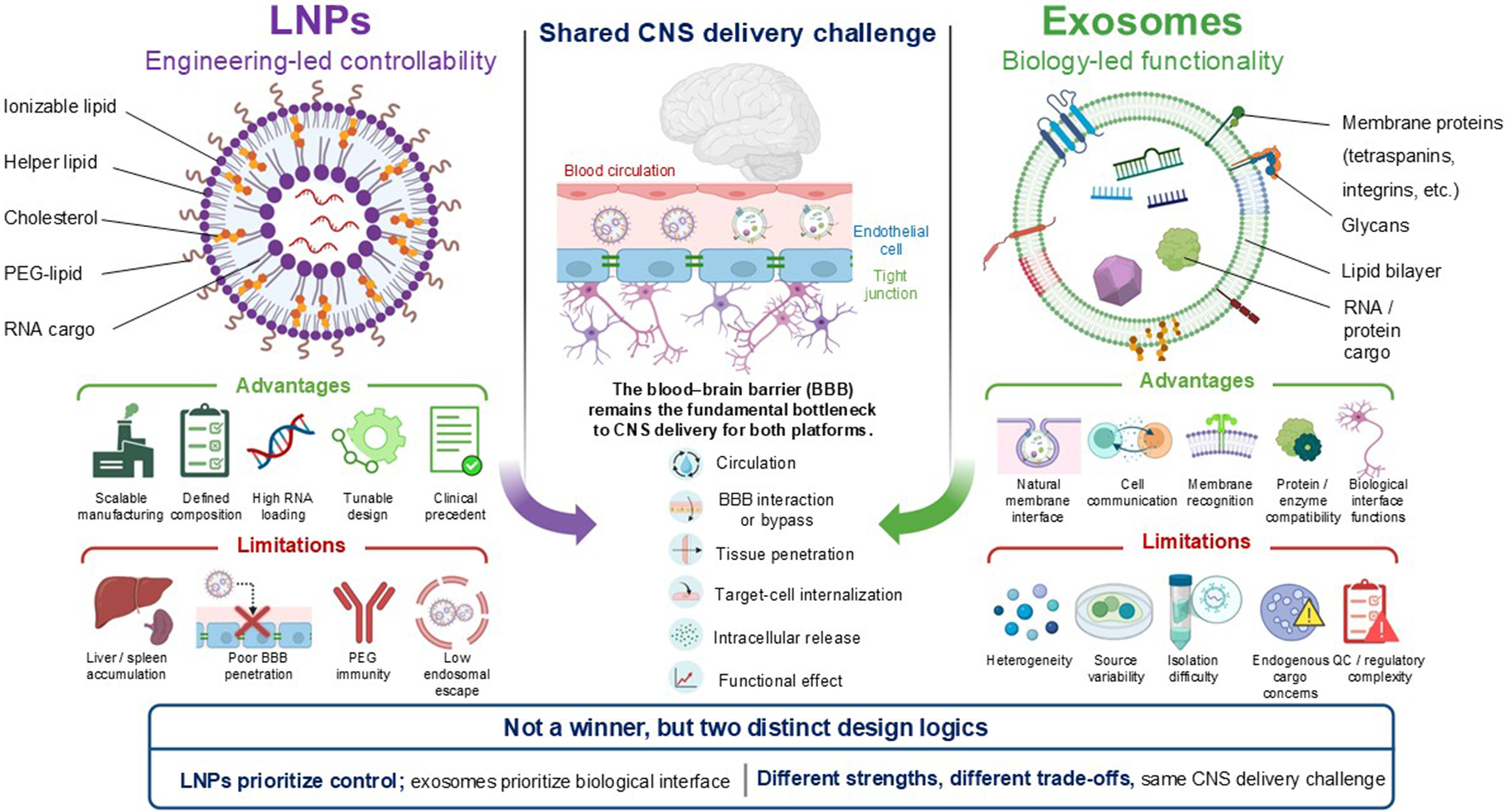
The comparison between LNPs and exosome-based systems should not be framed as a contest with a universal winner. The more useful question is: under what conditions does each platform make translational sense? This section provides a translational decision framework for matching delivery platforms to therapeutic mechanisms, rather than ranking LNPs and exosome-based systems as intrinsically superior or inferior technologies (Figure 2).
LNPs versus exosomes: two delivery philosophies.

Figure 2. Long description
The diagram is divided into three vertical sections.
Left Panel: L N Ps (Engineering-led controllability). At the center is R N A cargo. Moving outward is a lipid bilayer containing Ionizable lipid, Helper lipid, Cholesterol, and P E G-lipid. Advantages include Scalable manufacturing, Defined composition, High R N A loading, Tunable design, and Clinical precedent. Limitations include Liver / spleen accumulation, Poor B B B penetration, P E G immunity, and Low endosomal escape.
Center Panel: Shared C N S delivery challenge. A top-down anatomical cross-section shows a brain above a blood vessel. The vessel contains blood circulation with particles. The vessel wall consists of Endothelial cells and Tight junctions. Below the wall are neurons. A list of steps for delivery includes: Circulation, B B B interaction or bypass, Tissue penetration, Target-cell internalization, Intracellular release, and Functional effect.
Right Panel: Exosomes (Biology-led functionality). At the center is R N A / protein cargo. Moving outward is a lipid bilayer embedded with Membrane proteins (tetraspanins, integrins, etc.) and Glycans. Advantages include Natural membrane interface, Cell communication, Membrane recognition, Protein / enzyme compatibility, and Biological interface functions. Limitations include Heterogeneity, Source variability, Isolation difficulty, Endogenous Q C / regulatory cargo concerns, and complexity.
A bottom banner concludes that L N Ps prioritize control while exosomes prioritize biological interface, noting they represent two distinct design logics for the same C N S delivery challenge.
Lipid nanoparticles (LNPs) and exosomes represent distinct strategies for therapeutic delivery to the CNS. LNPs are defined by engineering-led controllability, including modular composition, scalable manufacturing, high RNA loading, and tunable design, but face challenges such as peripheral accumulation, limited BBB penetration, PEG-associated immunity, and inefficient endosomal escape. Exosomes are characterized by biology-led functionality, including natural membrane interfaces, cell-communication properties, membrane recognition, and biological interface functions such as receptor engagement, immune modulation, and intercellular molecular transfer but are constrained by heterogeneity, source variability, isolation challenges, endogenous cargo concerns, and quality-control complexity. “Biological interface functions” is used here as an umbrella term encompassing these vesicle-mediated interactions rather than as a separate single mechanism. Both platforms confront the same CNS delivery challenge, but approach it through different design logics rather than as a simple winner-versus-loser comparison. Accordingly, the figure is intended to support mechanism-matched platform selection rather than universal platform ranking.
The first decision point is cargo. For siRNA, mRNA, and some gene-editing cargos, LNPs currently have the stronger foundation because they offer high nucleic acid loading, tunable ionizable lipid chemistry, endosomal escape logic, scalable production, and clinical precedent. Exosome-based systems may be preferable for cargos whose activity depends on protein preservation, membrane presentation, endogenous trafficking, or biological signaling. The distinction is not absolute, but cargo mechanism should drive platform choice [Reference Hou, Zaks, Langer and Dong2,Reference Schoenmaker, Witzigmann, Kulkarni, Verbeke, Kersten and Jiskoot13,Reference Polack, Thomas and Kitchin16,Reference Tenchov, Sasso and Wang30].
The second decision point is the site of action. If the desired effect is cytosolic gene silencing or mRNA translation, LNPs have a clear mechanistic rationale. If the desired effect is extracellular neutralization, receptor modulation, immune signaling, or cell–cell communication, exosome-based systems may provide functions that are difficult to engineer synthetically. Engineered decoy exosomes displaying the TNFα-binding domain of human TNF receptor-1 were shown to antagonize TNFα-mediated inflammatory signaling, illustrating extracellular cytokine neutralization through receptor-like surface presentation [Reference Duong, Curley and Brown37]. Similarly, multifunctional engineered exosomes displaying antibody-targeting groups and immunomodulatory proteins have been used to redirect and activate T cells, supporting the broader concept that exosome-based systems can be designed for immune signaling and cell–cell communication functions [Reference Cheng, Dai and Smbatyan38]. These examples illustrate that exosome performance may arise from biologically encoded or engineered membrane-interface functions, not only from cargo loading.
The third decision point is route. Intravenous administration is currently a more mature for LNPs when defined dose, systemic stability, reproducible manufacturing, and controlled RNA formulation are priorities. However, successful intravenous CNS delivery still requires purpose-built BBB-interacting or BBB-crossing chemistry and remains vulnerable to hepatic and splenic sequestration [Reference Terstappen, Meyer, Bell and Zhang1,Reference Hou, Zaks, Langer and Dong2,Reference Blanco, Shen and Ferrari7,Reference Han, Padilla and Palanki23,Reference Wang, Xue and Markovic25]. Exosome-based systems can also be administered intravenously and have demonstrated functional CNS delivery in selected studies, but they similarly face rapid liver and spleen clearance; their additional biological and manufacturing complexity is most justified when vesicle-surface or membrane-interface functions provide a specific therapeutic advantage [Reference Alvarez-Erviti, Seow and Yin28,Reference Di Rocco, Baldari and Toietta33]. Intrathecal or intracerebroventricular administration can support either platform by bypassing the BBB. LNPs may be favored when a defined RNA dose, reproducible formulation, and intracellular expression are required, as illustrated by recent intrathecal mRNA-LNP studies [Reference Pardridge9,Reference Xue, Wang and Li24]. Exosome-based systems may be considered when the therapeutic mechanism depends on protein handling, membrane-mediated interaction, receptor engagement, or biological signaling. Nevertheless, BBB bypass primarily provides CSF access and does not ensure widespread or uniform parenchymal distribution [Reference Pardridge9]. Intranasal delivery is potentially compatible with both platforms but remains constrained by variable deposition, mucociliary clearance, dosing-volume limitations, and difficulty in dose standardization [Reference Lochhead and Thorne8,Reference Haney, Klyachko and Zhao32]. Direct intracerebral administration provides local parenchymal access for either platform but is invasive, spatially restricted, and difficult to repeat. Thus, no administration route intrinsically belongs to one platform; route selection should instead determine which barriers are bypassed, which new constraints are introduced, and whether the platform’s mechanism is compatible with the resulting exposure profile.
The fourth decision point is dosing frequency. Chronic diseases require repeat dosing. LNPs provide batch control but may encounter PEG-related or innate immune complications, particularly when repeated administration is required [Reference Zhang, Sun, Liu and Jiang20]. Exosome-based systems may appear more biocompatible, but repeated dosing raises concerns about endogenous cargo, immune recognition, source variability, and long-term biological signaling [Reference Welsh, Goberdhan and O’Driscoll27,Reference Carney, Mizenko and Bozkurt34].
The fifth decision point is manufacturing. Here, LNPs currently have an advantage because their composition, process parameters, and quality attributes are more readily defined through established formulation and manufacturing workflows [Reference Schoenmaker, Witzigmann, Kulkarni, Verbeke, Kersten and Jiskoot13,Reference Roces, Lou and Jain15]. Exosomes require more complex control over producer cells, culture conditions, isolation, purification, loading, storage, potency, and release specifications [Reference Welsh, Goberdhan and O’Driscoll27,Reference Carney, Mizenko and Bozkurt34].
The sixth decision point is regulatory tractability. LNPs are closer to conventional nanopharmaceutical chemistry, manufacturing, and controls logic, whereas exosomes remain closer to complex biological products requiring rigorous identity, purity, potency, and release criteria [Reference Welsh, Goberdhan and O’Driscoll27,Reference Carney, Mizenko and Bozkurt34,Reference Mizenko, Feaver and Bozkurt35].
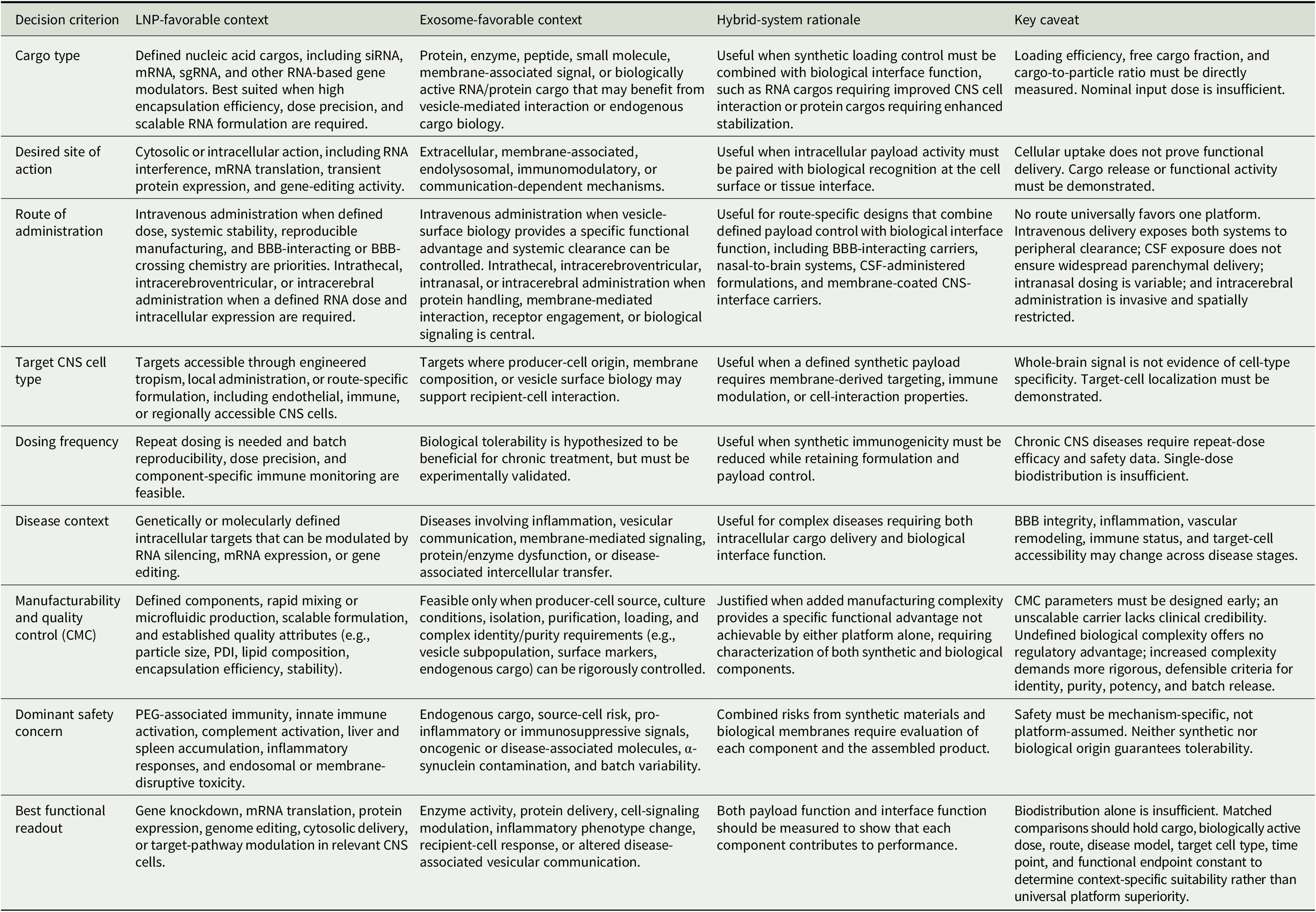
A practical rule follows: LNPs should generally be prioritized when the therapeutic problem is primarily one of defined nucleic acid delivery, dose control, scalable manufacturing, and regulatory tractability. Exosome-based systems should be considered when the therapeutic problem requires biological membrane identity, endogenous cell-interaction pathways, immune modulation, or protein and peptide cargo handling, provided that active vesicle populations and potency can be controlled. A major knowledge gap is the scarcity of matched, mechanism-based benchmarking across LNPs, exosome-based systems, and hybrid carriers. Such benchmarking should not be used to identify a universal platform winner. Rather, its purpose is to determine which platform is best suited to a defined therapeutic context by holding the cargo, biologically active dose, route of administration, disease model, target cell type, time point, and functional endpoint constant. Matched comparisons can reveal which delivery barrier each platform resolves, which trade-offs it introduces, and whether its performance remains reproducible under clinically relevant conditions. Cross-study comparisons remain difficult to interpret when these experimental variables, labeling strategies, and characterization methods differ [Reference Witwer and Wolfram12,Reference Di Rocco, Baldari and Toietta33,Reference Leong, Butler and Brinker39]. Barrier-specific screening systems that separately quantify endothelial transfection and trans-barrier transport illustrate the value of standardized functional endpoints for formulation selection [Reference Han, Padilla and Palanki23], although truly matched LNP–exosome comparisons remain limited [Reference Witwer and Wolfram12]. Benchmarking should therefore support mechanism-matched platform selection rather than global platform ranking. These decision criteria are summarized as a platform selection matrix in Table 1.
Platform selection matrix for CNS therapeutics.

Table 1. Long description
The table consists of five columns: Decision criterion, L N P-favorable context, Exosome-favorable context, Hybrid-system rationale, and Key caveat. There are nine rows of criteria:
1. Cargo type: L N P is best for defined nucleic acids like s i R N A and m R N A. Exosomes are better for proteins, enzymes, and small molecules. Hybrids combine synthetic loading with biological interface functions. Caveat: Loading efficiency must be directly measured.
2. Desired site of action: L N P for cytosolic or intracellular action. Exosomes for extracellular or endolysosomal mechanisms. Hybrids for intracellular payloads with biological surface recognition. Caveat: Cellular uptake does not prove functional delivery.
3. Route of administration: L N P for I V or direct C N S administration of R N A. Exosomes for I V or intranasal when membrane biology is central. Hybrids for route-specific designs like nasal-to-brain. Caveat: No route universally favors one platform.
4. Target C N S cell type: L N P for engineered tropism. Exosomes for producer-cell origin support. Hybrids for synthetic payloads requiring membrane-derived targeting. Caveat: Whole-brain signal is not evidence of cell-type specificity.
5. Dosing frequency: L N P for repeat dosing with batch reproducibility. Exosomes for chronic treatment tolerability. Hybrids to reduce synthetic immunogenicity. Caveat: Chronic diseases require repeat-dose safety data.
6. Disease context: L N P for molecularly defined intracellular targets. Exosomes for inflammation and vesicular communication diseases. Hybrids for complex diseases requiring both. Caveat: B B B integrity and immune status change across disease stages.
7. Manufacturability and quality control (C M C): L N P uses microfluidic production and established attributes. Exosomes require rigorous control of producer-cell source and purification. Hybrids are justified when complexity adds specific functional advantages. Caveat: Unscalable carriers lack clinical credibility.
8. Dominant safety concern: L N P risks include P E G-associated immunity and innate immune activation. Exosome risks include endogenous cargo and batch variability. Hybrids carry combined risks. Caveat: Safety must be mechanism-specific.
9. Best functional readout: L N P uses gene knockdown or protein expression. Exosomes use enzyme activity or signaling modulation. Hybrids measure both payload and interface function. Caveat: Biodistribution alone is insufficient.
Note: This matrix is intended as a translational decision framework rather than a ranking system. Platform choice should be driven by therapeutic mechanism, route feasibility, target-cell access, repeat-dose requirements, manufacturability, and functional pharmacology. Matched benchmarking is intended to support context-specific platform selection, not universal platform ranking.
Abbreviations: BBB, blood–brain barrier; CMC, chemistry, manufacturing, and controls; CNS, central nervous system; EV, extracellular vesicle; IV, intravenous; LNP, lipid nanoparticle; PDI, polydispersity index; sgRNA, single-guide RNA; siRNA, small interfering RNA.
5. Parkinson’s Disease as a Representative CNS Use Case
Parkinson’s disease is a useful stress test for CNS delivery platforms because it is chronic, progressive, cell-type-specific, and biologically complex. Its pathobiology spans dopaminergic neurodegeneration, α-synuclein aggregation and spread, motor and non-motor manifestations, mitochondrial and lysosomal dysfunction, oxidative injury, calcium dysregulation, axonal transport defects, and neuroinflammatory responses [Reference Poewe, Seppi and Tanner40]. Current therapies improve symptoms but do not reliably modify disease progression, creating opportunities for neuroprotective, anti-inflammatory, RNA-based, protein-based, and disease-modifying biologic strategies [Reference Poewe, Seppi and Tanner40,Reference Stocchi, Bravi, Emmi and Antonini41].
Different Parkinson’s disease mechanisms impose different delivery requirements [Reference Poewe, Seppi and Tanner40,Reference Sasso, Ambrose and Tenchov42]. Silencing SNCA or LRRK2 requires intracellular delivery of RNA or related gene-modulating cargo to appropriate CNS cells. Restoring lysosomal or mitochondrial function may require enzyme, mRNA, antisense oligonucleotide, siRNA, small-molecule, or protein delivery. Modulating neuroinflammation may require targeting microglia, astrocytes, endothelial cells, or infiltrating immune cells. Blocking α-synuclein propagation may require extracellular or endolysosomal action rather than cytosolic RNA delivery [Reference Danzer, Kranich and Ruf43].
The mechanistic distinction between LNPs and exosome-based systems becomes especially useful in this context. LNPs are compelling for defined RNA-centered strategies: gene knockdown, transient protein expression, or delivery of gene-editing components [Reference Hou, Zaks, Langer and Dong2,Reference Cheng, Wei and Farbiak18]. Their main challenge is achieving sufficient CNS exposure and endosomal escape in the relevant cell type [Reference Terstappen, Meyer, Bell and Zhang1,Reference Gilleron, Querbes and Zeigerer5,Reference Smith, Selby, Johnston and Such10].
PD-specific evidence for lipid-based nanocarriers, however, remains heterogeneous. In one study, a multifunctional borneol-functionalized LNP carrying exenatide achieved 4.21-fold greater distribution within the brain parenchyma than a conventional LNP. In a PD mouse model, the formulation increased dopamine content to 1.85-fold in the substantia nigra pars compacta and 1.49-fold in the striatum relative to untreated PD mice, while reducing α-synuclein expression and Lewy-body deposition to 51.85% and 44.72% of PD-control levels, respectively [Reference Wu, Yuan and Xu44]. These quantitative results are reported in the original study and provide evidence of enhanced parenchymal access, pathway engagement, dopaminergic biochemical rescue, and reduction of α-synuclein-related pathology.
A second study used an intranasal albumin-coated liposomal system to co-deliver selegiline and SNCA-targeting siRNA. The formulation achieved a threefold higher brain area under the concentration–time curve than intravenously administered selegiline solution and restored brain dopamine in rotenone-treated rats from 49.66 ± 3.23 ng g−1 to 142 ± 1.83 ng g−1. It also increased catalase activity, reduced monoamine oxidase-B levels, improved motor and non-motor outcomes, and demonstrated intracellular siRNA uptake and α-synuclein silencing in rotenone-treated SH-SY5Y cells [Reference Katamesh, Abdel-Bar and Break45].
Importantly, these examples represent broader multifunctional LNPs or liposomes and should not all be equated with clinically standardized four-component ionizable RNA-LNPs. They demonstrate that lipid-based carriers can improve brain exposure and produce PD-relevant biochemical and behavioral effects, but they do not yet provide comprehensive evidence of dopaminergic-neuron-specific internalization, directly quantified endosomal escape, durable in vivo RNA target engagement, or disease modification by conventional ionizable LNPs. These remain important knowledge gaps for PD-directed LNP development.
Exosome-based systems are compelling when Parkinson’s disease biology itself involves vesicular communication [Reference Pinnell, Cui and Tieu31,Reference Danzer, Kranich and Ruf43]. Experimental evidence indicates that packaging α-synuclein oligomers within exosome-associated fractions can enhance recipient-cell uptake and cytotoxicity compared with soluble extracellular species, supporting a role for vesicular pathways in pathological propagation [Reference Danzer, Kranich and Ruf43]. This makes exosome biology both a therapeutic opportunity and a safety concern.
Therapeutically, catalase-loaded exosomes have been used in Parkinson’s disease models to address oxidative stress and neuroinflammation. Macrophage-derived exosomes loaded with catalase showed brain delivery after intranasal administration, accumulated in neurons and microglial cells, reduced oxidative stress and neuroinflammation, and increased neuronal survival in in vitro and in vivo PD models [Reference Haney, Klyachko and Zhao32]. This illustrates where exosomes may be advantageous: protein delivery, inflammatory modulation, and biological interaction with CNS cells. This, however, also underscores the need to control vesicle source, endogenous cargo, and α-synuclein contamination.
Parkinson’s disease therefore clarifies the broader framework. LNPs are likely stronger when the therapeutic strategy is RNA-centered, chemically defined, and intracellular. Exosome-based systems may be stronger when the therapeutic strategy depends on biological communication, protein delivery, or inflammatory modulation. Neither platform should be judged by brain entry alone, but by mechanism-matched functional delivery.
Although Parkinson’s disease is used here as a stress-test indication, the proposed framework is not disease-specific. In Alzheimer’s disease, platform selection may prioritize extracellular protein aggregation, neuronal internalization, and widespread cortical distribution; in multiple sclerosis, immune-cell and endothelial targeting and the inflammatory state of CNS barriers may be more important; and in brain tumors, blood–brain and blood–tumor barrier heterogeneity, local invasion, and tumor-cell selectivity become central considerations. Disorders such as amyotrophic lateral sclerosis or Huntington’s disease may instead require broad CNS distribution combined with access to specific vulnerable neuronal or glial populations. Across these disease contexts, the same decision variables—cargo, route, target cell, site of action, dosing frequency, manufacturability, and functional readout—remain applicable [Reference Terstappen, Meyer, Bell and Zhang1,Reference Blanco, Shen and Ferrari7,Reference Mitchell, Billingsley and Haley11].
6. Future Directions: Mechanism-Matched Convergence
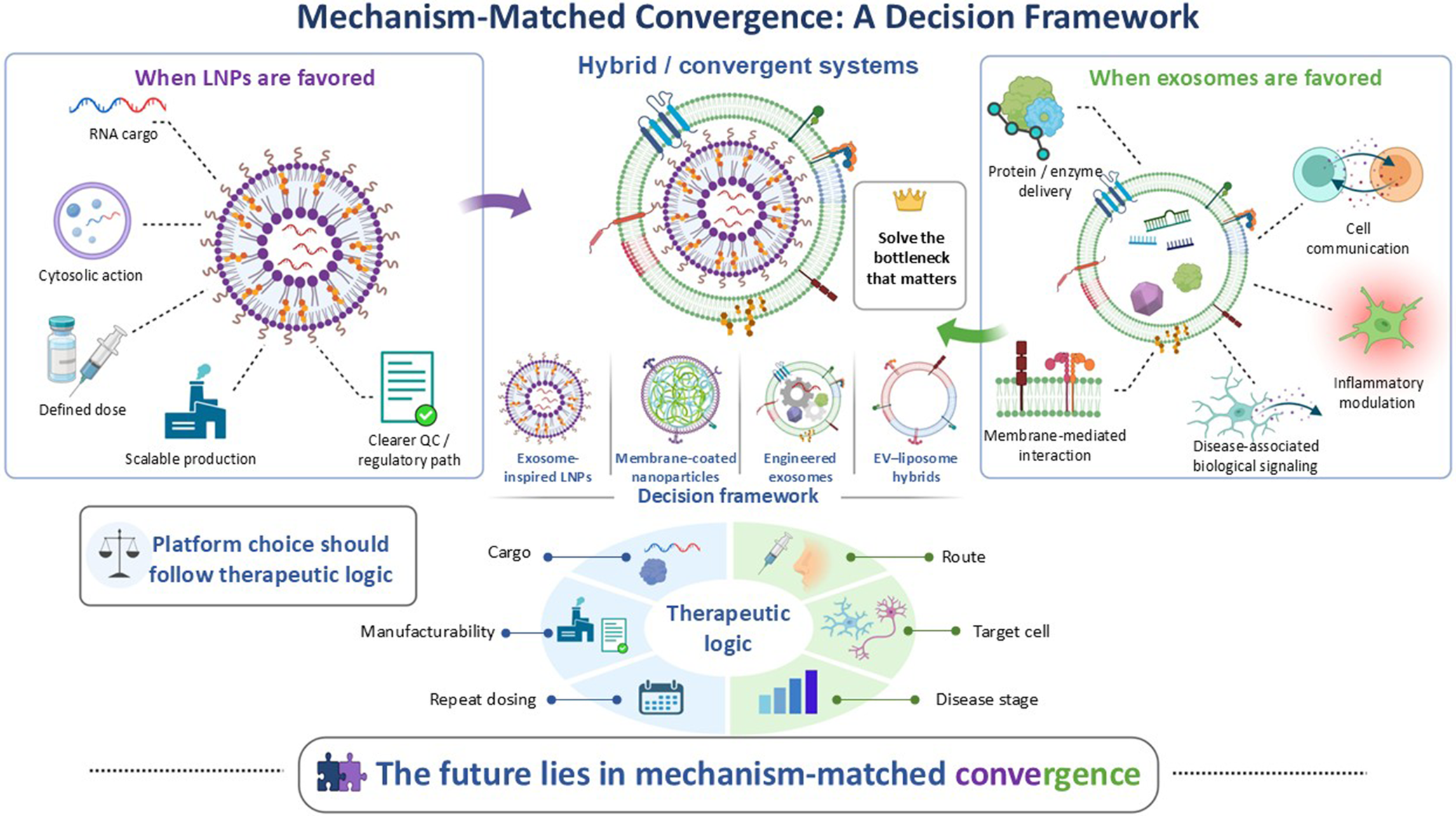
The future of CNS nanomedicine is unlikely to be defined by pure LNPs versus pure exosomes. A more plausible path is convergence. LNPs provide engineering precision, scalable manufacturing, and controllable cargo loading. Exosomes offer biological interface functions, membrane recognition, and endogenous communication properties. The next generation may include exosome-inspired LNPs, engineered exosomes with improved loading and quality control, cell membrane-coated nanoparticles, or hybrid carriers combining synthetic cores with biologically functional membranes. The rationale for these systems should not be novelty alone, but a defined need to pair synthetic payload control with biological interface function, as summarized in Figure 3.
Mechanism-matched convergence: a decision framework.

Figure 3. Long description
The diagram is divided into four main sections.
Top-left panel: When L N Ps are favored. A central L N P diagram is surrounded by five key advantages: R N A cargo, Cytosolic action, Defined dose, Scalable production, and Clearer Q C / regulatory path.
Top-right panel: When exosomes are favored. A central exosome diagram is surrounded by five key advantages: Protein / enzyme delivery, Cell communication, Inflammatory modulation, Disease-associated biological signaling, and Membrane-mediated interaction.
Top-center panel: Hybrid / convergent systems. This section shows a complex vesicle combining features of both L N Ps and exosomes. Below it are four specific examples: Exosome-inspired L N Ps, Membrane-coated nanoparticles, Engineered exosomes, and E V-liposome hybrids. A central gold crown icon states Solve the bottleneck that matters.
Bottom panel: Decision framework. A circular diagram titled Therapeutic logic is split into two halves. The left side (blue) lists Cargo, Manufacturability, and Repeat dosing. The right side (green) lists Route, Target cell, and Disease stage. A final banner at the bottom states: The future lies in mechanism-matched convergence.
Future CNS nanomedicine is unlikely to be defined by a simple choice between lipid nanoparticles (LNPs) and exosomes, but by mechanism-matched convergence between synthetic controllability and biological interface function. Accordingly, platform selection should follow therapeutic logic. LNPs are favored when the problem requires defined RNA cargo delivery, cytosolic action, precise dosing, scalable production, and clearer quality-control or regulatory pathways. Exosome-based systems are favored when therapeutic performance depends on protein or enzyme delivery, membrane-mediated interaction, inflammatory modulation, cell communication, or disease-associated biological signaling. Many future applications may benefit from hybrid or convergent systems that combine synthetic controllability with biological interface functions, including exosome-inspired LNPs, membrane-coated nanoparticles, engineered exosomes, and EV-liposome hybrids. The future of CNS delivery lies in rational, mechanism-matched convergence rather than universal platform ranking.
Exosome-liposome fusion provides one model. In this strategy, EVs are fused with liposomes using PEG as a fusogenic agent, producing semisynthetic hybrid vesicles that incorporate liposomal cargo capacity while retaining EV-associated membrane features [Reference Piffoux, Silva, Wilhelm, Gazeau and Tareste46]. This approach addresses a central exosome bottleneck, namely loading, by borrowing the versatility of synthetic liposomes while retaining biological vesicle interfaces. Cell membrane coating offers another model: synthetic nanoparticles can be cloaked with natural membranes, transferring complex protein, lipid, carbohydrate, immune-evasive, and targeting functions that are difficult to reproduce by ligand conjugation alone [Reference Fang, Kroll, Gao and Zhang47].
However, convergence should not mean complexity for its own sake. Nanoparticle design must address sequential biological barriers: opsonization, macrophage clearance, nonspecific biodistribution, vascular interaction, tissue penetration, cellular uptake, endosomal escape, and efflux or clearance [Reference Blanco, Shen and Ferrari7]. A hybrid system is useful only if it solves a defined bottleneck. For CNS therapeutics, that bottleneck may be BBB interaction, neurovascular inflammation, parenchymal penetration, glial uptake, neuronal endosomal escape, or repeat-dose tolerability.
Precision CNS nanomedicine will also require a better understanding of the disease-state BBB. Its function and integrity are dynamically regulated across development and aging and can be disrupted in inflammatory, neurodegenerative, vascular, and acute CNS disease states. These changes may involve altered transporter activity, receptor-dependent transcytosis, efflux pump function, endothelial junction integrity, pericyte support, astrocyte-derived signaling, and immune-cell interactions [Reference Sweeney, Zhao, Montagne, Nelson and Zlokovic48]. Future nanocarriers should therefore be matched to disease stage, BBB status, immune state, lipid metabolism, inflammatory profile, and target cell type rather than designed for a generic “brain.”
Future comparative studies should apply the matched benchmarking framework described above and incorporate orthogonal characterization, physiologically relevant stability testing, degradation and clearance assessment, and transparent reporting of synthesis and storage conditions [Reference Leong, Butler and Brinker39]. Three priorities should guide future convergence. First, hybrid or bioinspired systems should be designed to solve a defined biological bottleneck. Second, comparative studies should assess platform-specific trade-offs under clinically relevant conditions rather than establish a global ranking. Third, manufacturability, composition, potency, and repeat-dose safety should be evaluated early rather than treated as late-stage translational problems.
7. Conclusion: Toward Translationally Realistic CNS Nanomedicine
LNPs and exosome-based systems should be viewed as complementary design logics rather than interchangeable or competing platforms. The central contribution of this Perspective is to reframe CNS nanocarrier selection as a translational decision problem: delivery systems should be matched to therapeutic cargo, route feasibility, target-cell access, disease biology, site of action, and manufacturability. In this framework, LNPs provide engineering discipline and translational maturity, whereas exosome-based systems provide biological interface functions that may be valuable when membrane-mediated interaction, vesicular communication, or protein and enzyme delivery are central to the therapeutic mechanism.
For CNS therapeutics, the determining question is no longer whether a nanocarrier reaches the brain. It is whether the system delivers the right cargo to the right CNS compartment, in the right functional form, through a clinically feasible route, with reproducible manufacturing and quality control that support clinical translation and ultimately benefit patients. Lessons from liposome translation and precision nanoparticle design reinforce that biologicalrealism, functional benchmarking, and manufacturability should guide next-generation CNS nanomedicine [Reference Mitchell, Billingsley and Haley11,Reference Crommelin, van Hoogevest and Storm49]. The field should therefore adopt functional delivery, matched benchmarking, and manufacturability as minimum standards for evaluating LNPs, exosome-based systems, and convergent hybrid carriers.
Author contributions
Conceptualization: H.-Y.H., S.-D.L.; Formal analysis: H.-Y.H.; Funding acquisition: H.-Y.H.; Project administration: H.-Y.H.; Supervision: S.-D.L.; Validation: S.-D.L.; Visualization: H.-Y.H., C.-W.L.; Writing—original draft: H.-Y.H., C.-W.L.; Writing—review and editing: H.-Y.H., S.-D.L.
Acknowledgments
During the revision of this manuscript, OpenAI ChatGPT (GPT-5.6 Thinking; accessed via the ChatGPT web interface in July 2026) was used solely for English-language proofreading. The tool was not used to generate scientific conclusions, analyze research data, select or interpret evidence, or create figures. All suggestions were independently reviewed and revised by the authors, who take full responsibility for the accuracy, originality, and integrity of the manuscript.
Financial support
This work was supported by the National Science and Technology Council, Taiwan (NSTC 112-2314-B-016-004-MY2 and NSTC 114-2314-B-016-039), the Canadian Institutes of Health Research (CIHR; grant number PJT-168861), the Natural Sciences and Engineering Research Council of Canada (NSERC; grant number RGPIN-2023-04020), and the Tong Louie Chair Professorship.
Competing interests
The authors declare that they have no competing interests.
Data availability statement
This article is a Perspective and did not involve the generation or analysis of new primary research data, datasets, or code. All literature and source materials discussed in this article are cited in the References.
Open peer review
To view the open peer review materials for this article, please visit http://doi.org/10.1017/S2978170126000026.


 Open access


Comments
Cover letter
June 8, 2026
Professor Gang Zheng
Associate Editor
Cambridge Materials: Health
Dear Professor Zheng and Editorial Team,
On behalf of all authors, we are pleased to submit our invited Perspective article entitled “Lipid Nanoparticles versus Exosome-Based Systems for Central Nervous System Therapeutics: A Translational Perspective” for consideration for publication in Cambridge Materials: Health.
Following your kind invitation, we have crafted a Perspective that directly addresses a premier translational challenge in health-related materials science: effective drug delivery to the central nervous system (CNS). Rather than treating lipid nanoparticles (LNPs) and exosome-based systems as mutually exclusive competitors, we reframe them as complementary delivery philosophies: engineering-led controllability for LNPs versus biology-led functionality for exosomes. We critically evaluate how their distinct advantages, alongside their respective manufacturing or biological constraints, should dictate a mechanism-matched platform selection framework. By clarifying these boundary conditions, this work provides timely intellectual guidance for researchers navigating the choice between synthetic and biological vectors, thereby accelerating the translational pipeline of brain-targeted nanomedicines.
We argue that successful CNS nanomedicine should not be defined by brain accumulation alone, but by functional payload availability in the appropriate CNS cell type, site of action, and therapeutic context. Using Parkinson’s disease as a representative clinical stress test, we introduce a comprehensive translational decision matrix (Table 1) to illustrate how payload type, route of administration, cellular target, disease mechanism, manufacturing feasibility, and regulatory considerations should guide platform development.
We hope that this Perspective will be of interest to readers in health-related materials science, nanomedicine, RNA therapeutics, extracellular vesicle engineering, neuroscience, and translational therapeutics. This manuscript is original, has not been published previously, is not under consideration elsewhere, has been approved by all authors, and has no conflicts of interest to declare.
Sincerely yours,
Shyh-Dar Li, Ph.D.
Tong Louie Chair Professor in Pharmaceutical Sciences
Chair, Nanomedicine and Chemical Biology
Faculty of Pharmaceutical Sciences
The University of British Columbia |
Phone 604-827-0675 | Fax 604-822-3035
Email: shyh-dar.li@ubc.ca