Introduction
A persistent question in the Pannariaceae, a well-known and cosmopolitan lichen family, lies with the assignment of taxa with collematoid thalli, that swell considerably and form gelatinous masses when wet and quickly return to a crispy and fragile form when dry, unlike typical members of the family that develop a ‘pannarioid’ thallus that does not swell when wet (Wedin et al. Reference Wedin, Wiklund, Jørgensen and Ekman2009; Otálora et al. Reference Otálora, Aragón, Molina, Martínez and Lutzoni2010). Species in the genus Kroswia P. M. Jørg. develop thalli of the former type, typically homoiomerous with an indistinct cortex, the photobiont forming chains of cells with much swelling sheaths and present thoughout the thallus; species with a typical ‘pannarioid’ thallus such as in the genus Fuscopannaria P. M. Jørg. develop heteromerous thalli with a distinct upper cortex and a very distinct photobiont layer with photobiont cells compacted and assembled in clusters.
A further interesting matter within the same family is the occurrence of tripartite thalli, which are lichenized with green algae but produce well-differentiated structures, usually referred to as cephalodia, which are lichenized with cyanobacteria usually belonging to the genus Nostoc. Such cephalodia may develop thalloid forms, sometimes produce fragments that act as vegetative diaspores (Jørgensen & Wedin Reference Jørgensen and Wedin1999), or may resemble autonomous entities recognized as a different genus, namely Santessoniella Henssen.
A recent study conducted by the authors (Magain & Sérusiaux Reference Magain and Sérusiaux2014) could provide strong support for two interesting evolutionary patterns within that family. Indeed, a photobiont switch between two different strains of Nostoc is suspected to be the driver for the change in thallus type (pannarioid thallus to collematoid type) within a strongly supported clade comprising the genera Fuscopannaria, Kroswia, Leciophysma Th. Fr. and Protopannaria (Gyeln.) P. M. Jørg. & S. Ekman. Photobiont switches have been shown or are suspected to play a crucial role in speciation processes of lichens (examples in Baloch & Grube Reference Baloch and Grube2006; Nelsen & Gargas Reference Nelsen and Gargas2008; Fernández-Mendoza et al. Reference Fernández-Mendoza, Domaschke, García, Jordan, Martín and Printzen2011; Printzen et al. Reference Printzen, Domaschke, Fernández-Mendoza and Pérez-Ortega2013) and the molecular inferences in a phylogenetic context do support such a scenario for the genus Fuscopannaria.
Furthermore, cephalodia emancipation from ancestral tripartite thalli followed by divergence is supported by the data and may represent an evolutionary pattern present throughout the family; it may explain the morphological resemblance between the thalli of several genera with cephalodia of others, as well as the complex phylogenetic relationships between species with tripartite thalli and others with collematoid or pannarioid thalli. A convincing example of this evolution pattern is provided by the free-living Santessoniella polychidioides (Zahlbr.) Henssen, lichenized with Nostoc, which is nested with strong support within the tripartite genus Psoroma Ach. ex Michx. (Ekman et al. Reference Ekman, Wedin, Lindblom and Jørgensen2014) and can be interpreted as the emancipated cephalodia of its tripartite ancestor which eventually diverged.
This study aims to confirm the finding by Magain & Sérusiaux (Reference Magain and Sérusiaux2014) that the collematoid genus Kroswia is nested in Fuscopannaria and to resolve their relationships by producing a phylogenetic tree including all data available in Fuscopannaria. As three accessions of its type species (K. crystallifera P. M. Jørg.) are found nested within Fuscopannaria with strong support, the taxonomic and nomenclatural conclusions are drawn in this paper.
Material and Methods
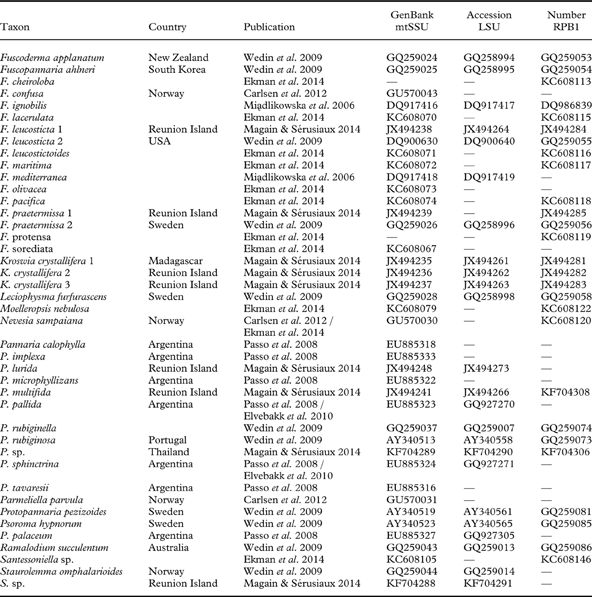
All sequences used in the phylogenetic analyses were downloaded from GenBank (Table 1). Those produced by Ekman et al. (Reference Ekman, Wedin, Lindblom and Jørgensen2014) in a revised classification of Pannariaceae and Magain & Sérusiaux (Reference Magain and Sérusiaux2014) for the taxa dealt with in this paper are thus included. We assembled a concatenated matrix of three loci: mtSSU, nuLSU and RPB1 using MacClade v. 4.08 (Maddison & Maddison Reference Maddison and Maddison2005). Ambiguously aligned positions were delimited by eye and excluded from the phylogenetic analyses. The alignment was divided into six subsets: mtSSU, nuLSU, RPB1 1st, 2nd and 3rd codon positions, and the intron in RPB1. The best partition for the dataset was estimated using PartitionFinder (Lanfear et al. Reference Lanfear, Calcott, Ho and Guindon2012) using AICc as a criterion and testing all models available with the greedy algorithm. The partition selected consisted of 5 subsets: LSU and the 1st codon of RPB1 together, and every other subset by itself.
Table of the voucher specimens used in this study, with the species names and references to original publications; GenBank accessions of the sequences.

We produced a best ML tree using RaxML-HPC2 v. 8.0.24 (Stamatakis Reference Stamatakis2006; Stamatakis et al. Reference Stamatakis, Hoover and Rougemont2008) as implemented on the CIPRES portal (Miller et al. Reference Miller, Pfeiffer and Schwartz2010), using the GTRGAMMA model and 1000 bootstrap iterations. A Bayesian analysis was performed using MrBayes v. 3.2.2 (Huelsenbeck & Ronquist Reference Huelsenbeck and Ronquist2001) as implemented on the CIPRES portal, running for 20 million generations with two runs of three cold chains and one heated chain each, and sampling every 1000th generation. The first 25% of the trees sampled were discarded as burn-in, and a 50% consensus tree was produced using the remaining trees. Convergence of the analyses was assessed using Tracer (Rambaut & Drummond Reference Rambaut and Drummond2007) and AWTY (Nylander et al. Reference Nylander, Wilgenbusch, Warren and Swofford2008) as implemented on the website http://king2.scs.fsu.edu/CEBProjects/awty.
Results
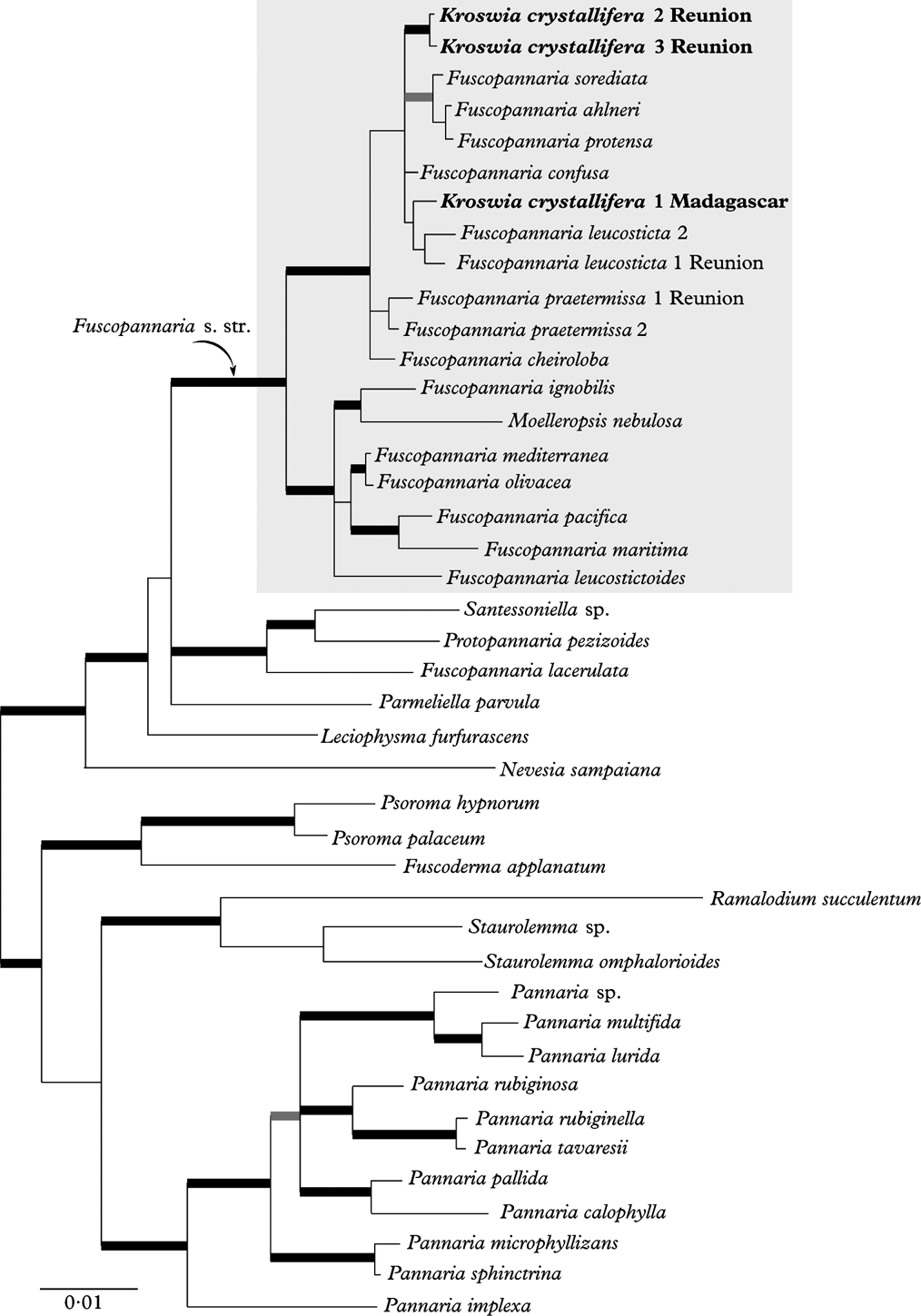
The phylogenetic tree (Fig. 1) presented here is the Bayesian 50% consensus tree with evaluation of branch support from the Maximum Likelihood results and the posterior probabilities of the Bayesian search; 2666 characters from four loci (5.8 S, mtSSU, nuLSU and RPB1) are included for 42 accessions representing 38 taxa.
50% consensus tree resulting from the Bayesian analysis of mtSSU, LSU and RPB1 on representatives of the family Pannariaceae. The genus Fuscopannaria is highlighted. Rooting follows Magain & Sérusiaux (Reference Magain and Sérusiaux2014). Thick black branches have a Posterior probability>0·95 and a Maximum Likelihood bootstrap>70. Thick grey branches have a PP>0·95 but MLBS<70.

As in earlier studies (Ekman et al. Reference Ekman, Wedin, Lindblom and Jørgensen2014; Magain & Sérusiaux Reference Magain and Sérusiaux2014), the genus Fuscopannaria is retrieved as a monophyletic group, divided into two strongly supported clades, accepting that F. sampaiana (Tav.) P. M. Jørg. is assigned to a different genus (Nevesia: Ekman et al. Reference Ekman, Wedin, Lindblom and Jørgensen2014) and with the exception of F. laceratula (Hue) P. M. Jørg. which is resolved within a strongly supported and related lineage comprising Protopannaria pezizoides P. M. Jørg. & S. Ekman. The first clade within Fuscopannaria includes, among others, the type species [F. leucosticta (Tuck.) P. M. Jørg.] and the three accessions of Kroswia crystallifera, whilst the second one includes, among others, the monotypic genus Moelleropsis nebulosa (Hoffm.) Gyeln.
Synonymy of Kroswia and new combination in the genus Fuscopannaria
The phylogenetic relationship of Kroswia crystallifera, the type species of Kroswia, is similar to Moelleropsis nebulosa: although the overall morphology strongly deviates from the typical pannarioid thallus type of all species assigned to that genus, the molecular data leave no doubt that both species must be subsumed into Fuscopannaria (Ekman et al. Reference Ekman, Wedin, Lindblom and Jørgensen2014; Magain & Sérusiaux Reference Magain and Sérusiaux2014). Data on apothecial characters provided by Jørgensen (Reference Jørgensen2007a ) on another species [K. gemmascens (Nyl.) P. M. Jørg.] referred to that genus are congruent: hymenium I+ blue-green rapidly turning red-brown, asci with an amyloid ring structure. Two characters of the ascospores do deviate as they are globose and pale brown in K. gemmascens, while they are ellipsoid without any colour in Fuscopannaria leucosticta, F. praetermissa (Nyl.) P. M. Jørg. and other related species (Jørgensen Reference Jørgensen2007b ). Furthermore they lack a perispore, which makes a difference for many species of Fuscopannaria. The value of these characters have never been tested in a phylogenetic context, and they are thus difficult to interpret. They might be species-specific within the genus, or represent autapomorphies for a further generic entity within the Fuscopannaria clade. Certainly, the genus has no close relationship with the Pannaria lurida (Mont.) Nyl. group as previously assumed (Jørgensen Reference Jørgensen2002), as this group is resolved with strong support within Pannaria Delise ex Bory s. str.
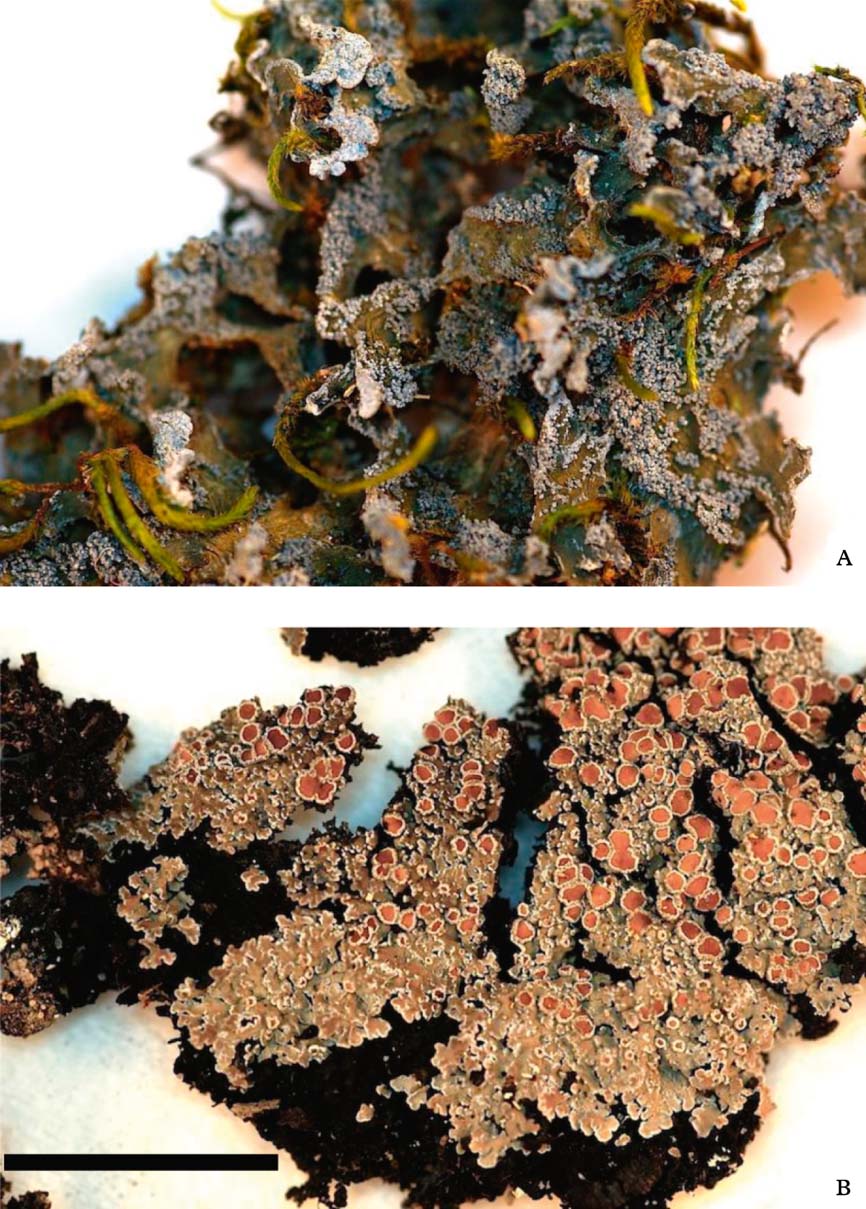
A detailed description of Kroswia is available in Jørgensen (Reference Jørgensen2002). Three species are currently recognized in the genus: K. crystallifera, known from Kenya, South Africa, Reunion, India/Tamil Nadu, Sri Lanka, Taiwan, Papua New Guinea and Australia (Jørgensen & Sipman Reference Jørgensen and Sipman2006) and also Madagascar (Magain & Sérusiaux Reference Magain and Sérusiaux2014); K. gemmascens, reported from Japan and China/Sichuan and Xizang (Jørgensen Reference Jørgensen2007a ); and K. polydactyla P. M. Jørg., described and known only from New Caledonia (Jørgensen & Gjerde Reference Jørgensen and Gjerde2012). The collematoid thallus of K. crystallifera (Fig. 2A) is homoiomerous, with a hardly distinct epicortex, or no cortex at all, with individual chains of Nostoc easily distinguished and spreading throughout the height of the thallus. Such a thallus is very different from the closely related species which have a distinct, multi-layered cortex and a well-delimited layer containing Nostoc cells, with hardly any chains distinguishable (Magain & Sérusiaux Reference Magain and Sérusiaux2014).
Fuscopannaria, thalli of the species studied; A, F. (Kroswia) crystallifera; B, F. leucosticta. Scale=1 cm. In colour online.
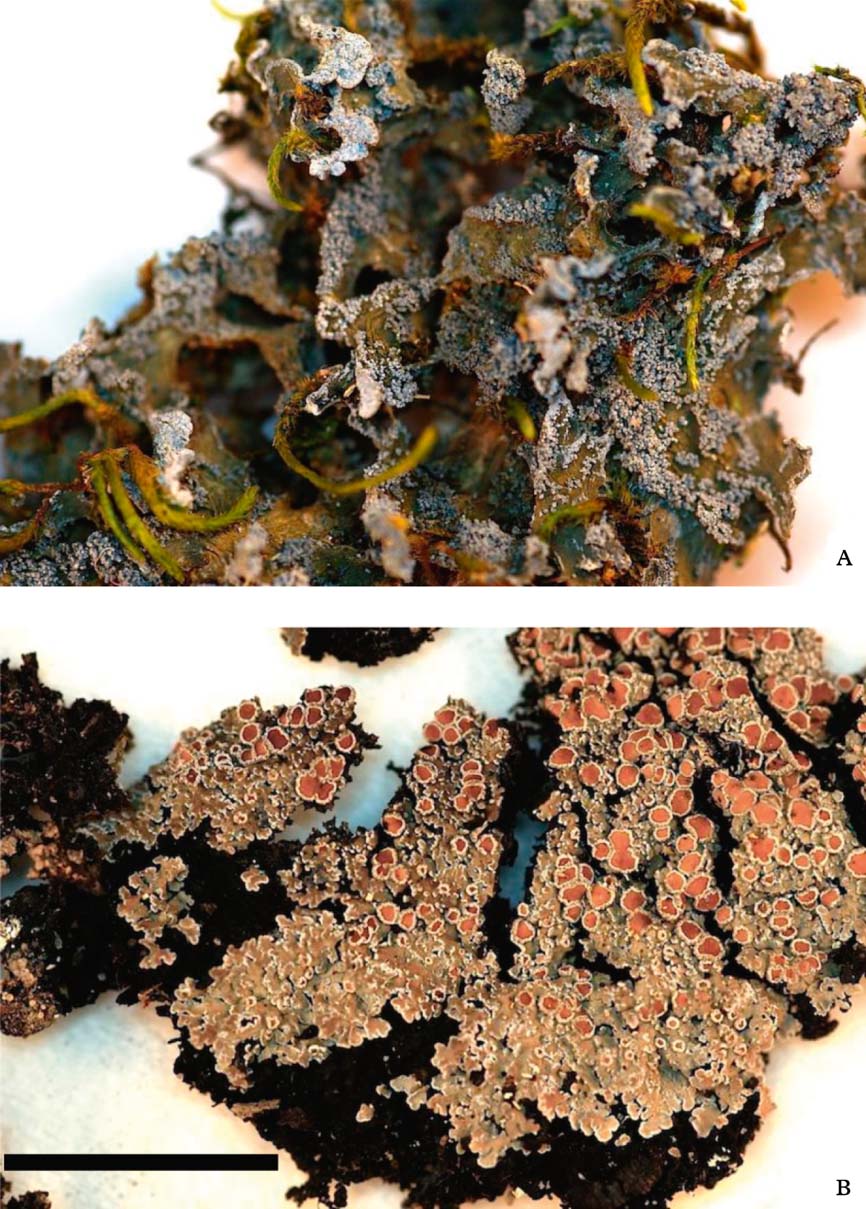
Interestingly, Kroswia crystallifera is closely related to the type species of Fuscopannaria (F. leucosticta, Fig. 2A), and to other species grouped together as an unresolved polytomy [F. ahlneri (P. M. Jørg.) P. M. Jørg., F. cheiroloba (Müll. Arg.) P. M. Jørg., F. confusa (P. M. Jørg.) P. M. Jørg., F. praetermissa, F. protensa (Hue) P. M. Jørg., F. sorediata P. M. Jørg.]. The hypothesis that F. crystallifera evolved from a duo of photomorphs, formed by the very same fungus and lichenized with two different strains of Nostoc that eventually dissociated and diverged, cannot be ruled out. Both photomorphs may even have formed a single thallus, such as in the case of cyano-chlorolichens (Henskens et al. Reference Henskens, Green and Wilkins2012) or in cases of co-existence of two different photobionts within a single thallus [Casano et al. Reference Casano, del Campo, Garcia-Breijo, Reig-Armiñana, Gasulla, Del Hoyo, Guéra and Barreno2011; del Campo et al. Reference Del Campo, Catalá, Gimeno, del Hoyo, Martínez-Alberola, Casano, Grube and Barreno2013 for Ramalina farinacea (L.) Ach.]. Furthermore, another switch between different strains of Nostoc within the clade of Fuscopannaria is likely to explain the very different thallus of Moelleropsis nebulosa, formed by coarse, usually dispersed granules, as this monotypic genus is nested within the second group recognized within Fuscopannaria.
As no molecular data are available for Kroswia gemmascens and K. polydactyla, we refrain from formally proposing the combination of both epithets to Fuscopannaria. Indeed, the Pannariaceae have reserved so many surprises regarding its evolutionary patterns that proposing hardly confirmed nomenclatural changes must be avoided.
Moelleropsis Gyeln. is a monotypic genus and is an older name than Fuscopannaria; a conservation proposal has been formally made (Jørgensen et al. Reference Jørgensen, Ekman and Wedin2013) and we therefore maintain the use of Fuscopannaria for this widespread and well-known species clade.
Fuscopannaria P. M. Jørg.
J. Hattori Bot. Lab. 76: 198 (1994); type: Fuscopannaria leucosticta (Tuck.) P. M. Jørg.
Kroswia P. M. Jørg., Lichenologist 34: 297 (2002), syn. nov.; type: Kroswia crystallifera P. M. Jørg.
Fuscopannaria crystallifera (P. M. Jørg.) Magain & Sérus. comb. nov.
MycoBank No.: 809865
Kroswia crystallifera P. M. Jørg., Lichenologist 34: 299 (2002); type: India, Tamil Nadu, Palni Hills, 23 January 1975, M. E. Hale 43843 (US—holotype!)
(Fig. 2A)
Selected material examined of Fuscopannaria crystallifera: Madagascar: Angavokely Forest Station, 18°55′37·9″S, 47°44′15·2″E, alt. 1770–1780 m, degraded ericaceous shrub near the summit, 2008, E. Sérusiaux s. n. with E. Fischer, D. Ertz, D. Killmann & V. Razafindrahaja (LG M788).—Réunion: Cirque de Cilaos, Forêt du Grand Matarum, 21°07·416′S, 55°28·983′E, alt. 1400–1450 m, disturbed montane forest, 2008, E. Sérusiaux with M. Brand & P. van den Boom (LG R1055); ibid., Col de Taïbit, 21°06′42·5″S, 55°26′34·0″E, alt. 1800 m, disturbed montane forest, N. Magain & E. Sérusiaux (LG R1679).
Field studies in Reunion were made possible with the help and advice of the “Parc National de La Réunion”, especially through the courtesy of Mr B. Lequette. Dr Cl. Ah-Peng and Prof. D. Strasberg of the University of La Réunion in Saint-Denis, and Dr J. Hivert of the Conservatoire Botanique National de Mascarin (St-Leu) were also very helpful. A first field trip to Reunion in 2008 was conducted with our colleagues and friends Maarten Brand and Pieter van den Boom. The field trip to Madagascar was organized with the logistical support of the “Parc Botanique et Zoologique de Tsimbazaza” in Antananarivo, and with collecting and export permits of scientific material issued by the “Ministère des Eaux & Forêts”; it was organized with our colleagues and friends Damien Ertz, Eberhard Fischer, Dorothee Killmann and Tahina Razafindrahaja. We thank them all very warmly. We further thank the curators of the following herbaria for the loan of type collections or relevant material: H, US. In addition, we thank Mr I. Cremasco and L. Gohy for technical assistance in the molecular laboratory and herbarium at the University of Liège. Prof. A. Elvebakk recently corresponded with us regarding the generic status of several clades within the Pannariaceae and we thank him very warmly for providing us with interesting clues and hypotheses. Nicolas Magain acknowledges financial support from FRIA, an organization of the Belgian Scientific Research Foundation. Finally we warmly thank both referees (Arve Elvebakk and Mats Wedin) for their critical and helpful notes and suggestions.