




No CrossRef data available.
Article contents
Eye gaze and conscious processing in severely brain-injured patients
Published online by Cambridge University Press: 20 December 2010
Abstract
Niedenthal et al. discuss the importance of eye gaze in embodied simulation and, more globally, in the processing of emotional visual stimulation (such as facial expression). In this commentary, we illustrate the relationship between oriented eye movements, consciousness, and emotion by using the case of severely brain-injured patients recovering from coma (i.e., vegetative and minimally conscious patients).
Information
- Type
- Open Peer Commentary
- Information
- Copyright
- Copyright © Cambridge University Press 2010
References
Boly, M., Faymonville, M. E., Schnakers, C., Peigneux, P., Lambermont, B., Phillips, C., Lancellotti, P., Luxen, A., Lamy, M., Moonen, G., Maquet, P. & Laureys, S. (2008) Perception of pain in the minimally conscious state with PET activation: An observational study. The Lancet Neurology
7:1013–20.CrossRefGoogle ScholarPubMed
Bruno, M., Vanhaudenhuyse, A., Schnakers, C., Boly, M., Gosseries, O., Demertzi, A., Majerus, S., Moonen, G., Hustinx, R. & Laureys, S. (2010) Visual fixation in the vegetative state: An observational case series PET study. BMC Neurology
10(1):35.CrossRefGoogle ScholarPubMed
Giacino, J., Ashwal, S., Childs, N., Cranford, R., Jennett, B., Katz, D., Kelly, J., Rosenberg, J., Whyte, J. & Zafonte, R. (2002) The minimally conscious state: Definition and diagnostic criteria. Neurology
58:349–53.CrossRefGoogle ScholarPubMed
Giacino, J., Kalmar, K. & Whyte, J. (2004) The JFK coma recovery scale-revised: Measurement characteristics and diagnostic utility. Archives of Physical Medicine and Rehabilitation
85(12):2020–29.CrossRefGoogle ScholarPubMed
Laureys, S., Faymonville, M. E., Peigneux, P., Damas, P., Lambermont, B., Del Fiore, G., Degueldre, C., Aerts, J., Luxen, A. & Franck, G. (2002) Cortical processing of noxious somatosensory stimuli in the persistent vegetative state. NeuroImage
17:732–41.CrossRefGoogle ScholarPubMed
Laureys, S., Faymonville, M., Degueldre, C., Fiore, G., Damas, P., Lambermont, B., Janssens, N., Aerts, J., Franck, G., Luxen, A., Moonen, G., Lamy, M. & Maquet, P. (2000) Auditory processing in the vegetative state. Brain
123(8):1589–601.CrossRefGoogle ScholarPubMed
Massimelli, M. (2007) The anencephalic newborn: Medical/legal and bioethical issues. Panminerva Medica
49(2):83–96.Google ScholarPubMed
Multi-Society Task Force on PVS (1994) Medical aspects of the persistent vegetative state I. New England Journal of Medicine
330(21):1499–508.CrossRefGoogle Scholar
Owen, A., Coleman, M., Boly, M., Davis, M., Laureys, S. & Pickard, J. (2006) Detecting awareness in the vegetative state. Science
313:1402.CrossRefGoogle ScholarPubMed
Schnakers, C., Perrin, F., Schabus, M., Majerus, S., Ledoux, D., Damas, P., Boly, M., Vanhaudenhuyse, A., Bruno, M. A, Moonen, G. & Laureys, S. (2008) Voluntary brain processing in disorders of consciousness. Neurology
71:1614–20.CrossRefGoogle ScholarPubMed
Vanhaudenhuyse, A., Schnakers, C., Bredart, S. & Laureys, S. (2008) Assessment of visual pursuit in post-comatose states: Use a mirror. Journal of Neurology Neurosurgery and Psychiatry
79(2):223.CrossRefGoogle ScholarPubMed
Working Party of the Royal College of Physicians (2003) The vegetative state: Guidance on diagnosis and management. Clinical Medicine
3:249–54.CrossRefGoogle Scholar
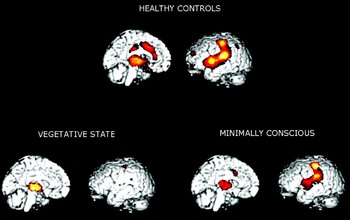
Figure 1. Cerebral activation to noxious stimulation. In the darker brain regions (which appear in red in the online version, available at www.journals.cambridge.org/bbs) that activated more during noxious stimulation in healthy controls (top), in vegetative state (bottom, left side) and in minimally conscious state (bottom, right side) as compared to rest (adapted from Boly et al. 2008 and Laureys et al. 2002).
The vegetative state (VS) is characterized by a preserved arousal level but also by the absence of any sign of consciousness of the environment and of oneself (e.g., absence of oriented responses to environmental stimulation) (The Multi-Society Task Force on PVS 1994). The patient in a minimally conscious state (MCS), on the contrary, demonstrates inconsistent, basic but reproducible signs of consciousness of the environment and of oneself (e.g., oriented responses to environmental stimulation suggesting an interaction between the patient and his/her surroundings) (Giacino et al. Reference Giacino, Ashwal, Childs, Cranford, Jennett, Katz, Kelly, Rosenberg, Whyte and Zafonte2002). Both populations may be particularly useful for studying the concept of consciousness via the progressive recovery of the most primary aspects of consciousness, and the behavioral and cerebral correlates that accompany them.
Niedenthal et al. discuss the importance of eye gaze in embodied simulation and, more globally, in the processing of emotional visual stimulation (such as facial expression). Eye gaze involves interaction between the subject and his/her surroundings. At a neurobehavioral level, oriented eye movements are usually associated with conscious processing (Giacino et al. Reference Giacino, Ashwal, Childs, Cranford, Jennett, Katz, Kelly, Rosenberg, Whyte and Zafonte2002). MCS patients are able to track a person moving in front of them, whereas VS patients are not. Only MCS patients can therefore detect emotional visual stimuli present in their surroundings. According to a recent study, visual pursuit is more frequently detected in response to emotional stimulation (e.g., the appearance of one's face in a mirror) than to non-emotional stimulation (e.g., a person moving) (Vanhaudenhuyse et al. Reference Vanhaudenhuyse, Schnakers, Bredart and Laureys2008).
MCS patients also show more complex emotional responses than VS patients. For instance, VS patients may smile or grimace, shed tears, or make grunting or groaning sounds, but for no discernible reason (The Multi-Society Task Force on PVS 1994; Working Party of the Royal College of Physicians 2003), similarly to what can be observed in anencephalic infants lacking a functional neocortex (Massimelli Reference Massimelli2007). MCS patients can manifest appropriate smiling or crying in response to specific linguistic or visual content of emotional stimuli, suggesting an appropriate interaction between the patient and his/her environment (Giacino et al. Reference Giacino, Ashwal, Childs, Cranford, Jennett, Katz, Kelly, Rosenberg, Whyte and Zafonte2002). Here, consciousness is reflected by the presence of basic but contingent social and emotional behaviors, those requiring a complex cortical activity. Using auditory (Laureys et al. Reference Laureys, Faymonville, Degueldre, Fiore, Damas, Lambermont, Janssens, Aerts, Franck, Luxen, Moonen, Lamy and Maquet2000) and noxious stimuli (Boyl et al. 2008; Laureys et al. Reference Laureys, Faymonville, Peigneux, Damas, Lambermont, Del Fiore, Degueldre, Aerts, Luxen and Franck2002), previous studies in functional neuroimaging have shown that, while brain activation isolated to primary cortices is observed in VS patients, an activation in associative areas as well as preserved functional connectivity between cortico-cortical areas (i.e., between primary and associative cortices) is observed in MCS patients (see our Fig. 1). MCS patients seem, therefore, to present a more complex social and emotional pattern at a behavioral level and a more integrative brain processing than VS patients.
Cerebral activation to noxious stimulation. In the darker brain regions (which appear in red in the online version, available at www.journals.cambridge.org/bbs) that activated more during noxious stimulation in healthy controls (top), in vegetative state (bottom, left side) and in minimally conscious state (bottom, right side) as compared to rest (adapted from Boly et al. Reference Boly, Faymonville, Schnakers, Peigneux, Lambermont, Phillips, Lancellotti, Luxen, Lamy, Moonen, Maquet and Laureys2008 and Laureys et al. Reference Laureys, Faymonville, Peigneux, Damas, Lambermont, Del Fiore, Degueldre, Aerts, Luxen and Franck2002).
Even if oriented eye movements, such as visual pursuit, are usually considered a sign of consciousness, controversies remain concerning visual fixation. Visual fixation includes eye gaze and can be described as the eyes changing from their initial fixation point and refixating on the new target location (Giacino et al. Reference Giacino, Kalmar and Whyte2004). As eye gaze involves interaction between the subject and his/her surroundings, visual fixation would have to be considered as a sign of consciousness. However, whereas the Aspen Workgoup considers this behavior as a sign of consciousness (Giacino et al. Reference Giacino, Ashwal, Childs, Cranford, Jennett, Katz, Kelly, Rosenberg, Whyte and Zafonte2002), the College of Physicians considers its presence as reflecting a reflexive activity (Working Party of the Royal College of Physicians 2003). Using active paradigms (i.e., the patients were asked to mentally perform a task), voluntary brain activity has been obtained in patients showing mainly low-level behavioral responses such as visual fixation, suggesting it may be a sign of consciousness (Owen et al. Reference Owen, Coleman, Boly, Davis, Laureys and Pickard2006; Schnakers et al. Reference Schnakers, Perrin, Schabus, Majerus, Ledoux, Damas, Boly, Vanhaudenhuyse, Bruno, Moonen and Laureys2008). However, we have recently shown no differences in brain activity and connectivity in VS patients presenting or not presenting visual fixation, suggesting that it does not necessarily reflect consciousness and higher-order cortical functioning (Bruno et al. Reference Bruno, Vanhaudenhuyse, Schnakers, Boly, Gosseries, Demertzi, Majerus, Moonen, Hustinx and Laureys2010). According to these results, it is not clear whether visual fixation reflects conscious interaction between the patient and his/her surroundings.
In conclusion, consciousness level is associated with social and emotional behaviors of different complexity. Conscious patients (i.e., MCS) show high-level behavioral responses and brain activation as compared to non-conscious patients (i.e., VS). Nevertheless, the particular case of visual fixation would have to be further investigated in order to better define its relationship to consciousness.
ACKNOWLEDGMENTS
Our research is funded by the Belgian Fund for Scientific Research (FNRS), European Commission, James McDonnell Foundation, Mind Science Foundation, French Speaking Community Concerted Research Action (ARC-06/11-340), Fondation Médicale Reine Elisabeth, University of Liège, and the CNRS/FNRS-CGRI collaboration funds.