

Perceived organisational support (POS) in the organisational literature refers to workers’ general perceptions regarding their managements’ contributions and concern for their wellbeing (Eisenberger, Armeli, Rxwinkel, Lynch, & Rhoades, Reference Eisenberger, Armeli, Rexwinkle, Lynch and Rhoades2001). Organisational support theory holds that the formation of POS is encouraged by employees’ tendency to assign their organisations humanlike characteristics. Based on these personifications of their organisations, employees would view favourable or unfavourable treatment received from the management as an indication of the extent to which the organisation values their contributions and cares about their wellbeing. Workers have inferred the extent to which organisations care about their wellbeing from the meaningful organisational and social organisational values, norms, beliefs, practices and structures that are operational at the workplace.
Increased attention among organisational researchers has been directed toward understanding how workers perceive managerial support and react to their management, as these perceptions can have considerable influence on organisational behaviour (e.g., Eisenberger et al., Reference Eisenberger, Armeli, Rexwinkle, Lynch and Rhoades2001). The central themes used in explaining the relationships between POS and job outcomes are the Social Exchange Theory (Blau, Reference Blau1964) and the Reciprocity Norm (Gouldner, Reference Gouldner1960). According to these theories, expression of positive affect and concern for others create a feeling of indebtedness and a corresponding sense of obligation to respond positively in return. Thus, workers who experience higher levels of organisational support have felt obligated to reciprocate organisational management with expressions of greater affective commitment to their organisations in the form of longer tenures at a post (Allen, Shore, & Griffeth, Reference Allen, Shore and Griffeth2003; Rhodes & Eisenberger, Reference Rhoades and Eisenberger2002), active participation in organisational citizenship behaviours (Gyekye & Salminen, Reference Gyekye and Salminen2009; Podsakoff, MacKenzie, Paine, & Bachrach, Reference Podsakoff, MacKenzie, Paine and Bachrach2000), and compliance with safety management policies (Gyekye & Salminen, Reference Gyekye and Salminen2007; Tucker, Chmeil, Turner, Hershcovis, & Stride, Reference Tucker, Chmeil, Turner, Hershcovis and Stride2008), with resultant decreases in accident frequency (Gyekye & Salminen, Reference Gyekye and Salminen2007; Gyekye, Salimnen, & Ojajarvi, Reference Gyekye, Salminen and Ojajarvi2012).
Over the past decade, organisational researchers have investigated the relationships between POS and employee performance, making employees’ perceptions of managerial support an interesting area that organisational managers cannot overlook. Although these studies have greatly increased our understanding of the impact of managerial support in organisations, there has been less effort to examine the impact of culture and investigate the relationships between demographic variables and POS. Thus, despite the observation by culture theorists (e.g., Adler, Reference Adler2002; Hofstede, Reference Hofstede2002) of the central role that culture and recently, social influence (Zagenczky, Scott, Gibney, Murrell, & Thatchet, Reference Zagenczyk, Scott, Gibney, Murrell and Thatcher2010) play in human and organisational behaviour, the extent to which POS varies across cultures continues to be an under-researched area. Calls have been made for studies to address this paucity (e.g., Eisenberger et al., Reference Eisenberger, Armeli, Rexwinkle, Lynch and Rhoades2001), and the results of the current study are envisaged to contribute to addressing the generalisability of POS findings.
Another area of omission is the impact of demographical variables on POS. Rhoades and Eisenberger observed after their review of the POS literature that ‘demographic characteristics of employees are often used as control variables to rule out alternative explanations for the relationship between POS and hypothesized antecedents’ (Rhoades & Eisenberger, Reference Rhoades and Eisenberger2002, p. 701). Even after these remarks, not much attention has been paid to investigating the link between worker demographic variables and POS. This is disconcerting, considering Tsui and O'Reilly's (Reference Tsui and O'Reilly1989) proposition that worker demographic variables could be possible viable explanations for the relationship between antecedents and supportive perceptions because of their significant associations with characteristic perceptions, attitudes and work outcomes. We extend previous research in this area by investigating the impact of job satisfaction, workers’ age, gender, educational background, job position and organisational tenure within and between Ghanaian and Finnish industrial workers. More importantly, we also tested a model in which job satisfaction was a mediator between these relationships.
Organizational Cross-Cultural/National Studies
National culture, as defined by Hofstede is ‘the collective programming of the mind acquired by growing up in a particular country’ (Hofstede, Reference Hofstede2002, p. 262), which is formed by a broad tendency to prefer certain states of affairs over others (Hofstede, Reference Hofstede1984). It is very often the result of a social construction and depends on the society's experiences and history, its needs, level of development, the evolution of knowledge, and technological progress. Thus, Gelfand, Eraz, and Aycan (Reference Gelfand, Erez, Aycan, Posner and Rothbart2007) have reported how national values shape beliefs about what behaviours and the extent to which selected behaviours are viewed as legitimate and acceptable. The suggestion here is that individuals draw on their beliefs about how the world works when determining how to act, and that these beliefs are therefore predictive of behaviour. Comparative studies, based on national cultural values, have therefore highlighted several distinctive general norms that are dominant in one culture/nation and absent in another.
The seminal work of Hofstede (Reference Hofstede1984) on IBM workers worldwide provided a concise framework of dimensions for differentiating national cultures. Drawing from his statistical analyses of his multi-country sample on work-related values, Hofstede distinguished among five central dimensions of national culture: individualism–collectivism, power distance, uncertainty avoidance, masculinity–femininity, and long-term orientation. Despite some vigorous criticisms of his work of late (e.g., McSweeney, Reference McSweeney2002), Hofstede's work still remains influential. Among the principal dimensions, cross-cultural researchers (e.g., Farh, Hackett, & Liang, Reference Farh, Hackett and Liang2007) have considered individualism–collectivism and power-distance orientations as key characteristics that could possibly differentiate national cultures on POS.
Individualism–collectivism is defined as the degree to which people in a country prefer to act as individuals rather than as members of groups (Hofstede, Reference Hofstede1984). Work by Hofstede (Reference Hofstede1984, Reference Hofstede2002) and others (e.g., House, Hanges, Javidan, & Dorfman, Reference House, Hanges, Javidan and Dorfman2004) have suggested this dimension as a fundamental distinction between cultures. Individualism reflects the extent to which individuals emphasise their own goals over those of their clan or group. By contrast, collectivism represents the degree to which people view themselves as part of a community whose goals take precedence over those of individuals. A collectivistic society is thus characterised by individuals who seek to support the goals of the group and promote group welfare, while an individualist society is characterised by individuals who seek to promote their own interests. Because of their inclination to in-group activities, perceptions of employees in collectivist societies are not solely a product of their evaluations of treatments offered by the organisations, but are also shaped by the social context. Hence, collectivists have paid added attention to the treatment of their co-workers in their assessments of managerial support (Aselage & Eisenberger, Reference Aselage and Eisenberger2003; Zagenczy et al., Reference Perryer, Jordan, Firns and Travaglione2010).
Power-distance refers to the extent to which a society accepts that power in institutions and societies is unequally distributed (Hofstede, Reference Hofstede1984). In an organisational setting, it denotes the situation where the less powerful members of the organisation (e.g., subordinate workers) expect and accept power differentials. High power-distance cultures are thus characterised by the acceptance of inequality and its institutionalisation in the workplace. In such work environments, organisations tend to be hierarchically ordered, and role expectations bind subordinate workers to behave submissively and show deference, respect and loyalty to senior management (Hofstede, Reference Hofstede2002). On the other hand, societies that support egalitarian values and equality are termed low power-distance cultures. Within such workplaces, status differentials are minimised and subordinates are less reverential and less submissive towards senior management (Hofstede, Reference Hofstede2002). Consistent with this, organisational cross-cultural researchers (e.g., Farh et al., Reference Farh, Hackett and Liang2007; Kirkman, Chen, Farh, Chen, & Lowe, Reference Kirkman, Chen, Farh, Chen and Lowe2009) have found power-distance to be a strong and consistent moderator of POS-work outcomes relationships.
The Case for Ghana — Finland Comparative Analysis
Ghana and Finland were chosen for this examination because they have contrasting profiles on these dimensions. By Hofstede's (Reference Hofstede1984) classification, Finland is individualistic and low on power-distance, and Ghana, by contrast, is collectivistic and high on power-distance. Differences in the national cultures of these two nations are reflected in how their organisations are structured and managed. For example, organisational management in Ghana tends to be paternalistic, with hierarchical relationships that promote values of high power-distance and collectivism. It has a bureaucratic control and a centralised decision-making set-up that provides little worker empowerment (Gyekye, Reference Gyekye2001). By contrast, organisational management in Finland is less bureaucratic, promotes individualism and low power-distance values, has a decentralised decision-making set-up, and is more empowering to their employees (e.g., Hofstede, Reference Hofstede2002). Given these salient differences, the antecedents and predictors of POS are likely to be different between Ghanaian and Finnish workers. In the following sections, further arguments are developed on why these differences are anticipated. Our hypotheses are drawn from these arguments.
Interrelationships Between POS and Demographic Variables
Two paramount predictors of POS have been job satisfaction and organisational tenure (Allen, Shore, & Griffeth, Reference Allen, Shore and Griffeth2003; Rhoades & Eisenberger, Reference Rhoades and Eisenberger2002), and research shows a positive relationship between these two variables (Ng & Feldman, Reference Ng and Feldman2010). Long-tenured employees who, because of their accumulated job-related knowledge, wider set of skills, and familiarity with the organisations, and who consequently tend to occupy supervisory positions, have expressed higher levels of job satisfaction (Gyekye, Reference Gyekye2006; Mathieu & Zajac, Reference Mathieu and Zajac1990). Job satisfaction is defined as an employee's overall sense of wellbeing at work (e.g., Locke, Reference Locke1970). It is frequently conceptualised as an indicator of working conditions, and hence a determinant of general work performance (Judge, Bono, & Locke, Reference Judge, Bono and Locke2000). Accordingly, expressions of satisfaction have identified cognitive appraisals of the fairness of the social exchange, particularly organisational management's treatment that employees enjoy with their organisations (e.g., Wayne, Shore, Bommer, & Tetrick, Reference Wayne, Shore, Bommer and Tetrick2002).
Workers who indicate positive perceptions regarding managerial support have correspondingly expressed higher levels of job satisfaction (Gyekye & Salminen, Reference Gyekye and Salminen2009; Rhoades & Eisenberger, Reference Rhoades and Eisenberger2002). The favourableness of satisfying job conditions has been interpreted as a sign of managerial support, which in turn fosters organisational affective commitment (employees’ emotional bond to their organisations) and longevity. Empirical evidence indicates that employees who express higher levels of managerial support tend to be more committed to their organisations and are less likely to seek alternate employment or leave the organisation (Allen et al., Reference Allen, Shore and Griffeth2003; Rhoades & Eisenberger, Reference Rhoades and Eisenberger2002; Riggle, Edmondson, & Hansen, Reference Riggle, Edmondson and Hansen2009). The social exchange theory (Blau, Reference Blau1964) and the reciprocity norm (Gouldner, Reference Gouldner1960) have been commonly used to explain these relationships.
Another theory that provides support for these observations is the inducements-contribution theory by Hom and Griffeth (Reference Hom and Griffeth1995) — a theory that has also provided foundation for the contemporary turn-over theory. According to this theory, employees’ decision to continue at their posts is based on the balance between inducements offered by their organisations and the contributions expected from the employees. When employees have perceived and received greater inducements in this exchange, they have been less likely to leave their posts, and vice versa (Allen et al., Reference Allen, Shore and Griffeth2003; Riggle et al., Reference Riggle, Edmondson and Hansen2009). The perception of managerial support (i.e., POS) resulting from this exchange has strengthened employees’ felt obligation to help their organisations reach their goals and increase affective organisational commitment, with consequential increase in organisational tenure. Drawing from both the inducements-contributions and social exchange perspectives, it sounds logical to expect POS to be strongly and positively correlated with organisational tenure, such that employees who perceive greater managerial support will similarly express higher levels of job satisfaction and indicate longer tenure at their posts. It was therefore hypothesised that:
Hypothesis 1a: POS among both Ghanaian and Finnish employees will be positively related to job satisfaction and organisational tenure.
Organisational support theorists (e.g., Rhoades, Eisenberger, & Armeli, Reference Rhoades, Eisenberger and Armeli2001; Eisenberger et al., 2002) have noted that favourable opportunities for reward convey a positive evaluation of employees’ contributions and thus contribute to POS, which in turn increases affective commitment, and consequently, organisational tenure. Hence, organisational rewards and opportunities for recognition, pay and promotion have been found to be positively associated with POS. Finland, as compared to Ghana, is a relatively advanced and prosperous nation, with the managerial approach and logistics (e.g., human resource practices and resources) to offer superior inducements for its employees. Accordingly, it was predicted that:
Hypothesis 1b: The positive relationship between POS, job satisfaction and organisational tenure will be especially pronounced in Finland compared to Ghana.
Meta-analytic reviews by Riggle et al. (Reference Riggle, Edmondson and Hansen2009) and Rhoades & Eisenberger (Reference Rhoades and Eisenberger2002) have confirmed job satisfaction to be a consistent and strong predictor of POS. According to these findings, perceptions regarding managerial support are strengthened by favourable work experiences that employees believe reflect voluntary and purposeful decisions made by the organisation. Drawing from the reciprocity norm (Blau, Reference Blau1964), employees who receive highly valued resources (e.g., organisational rewards, generous benefits, appropriate remunerations, developmental training opportunities) have perceived more managerial support than recipients of lower valued resources (e.g., Rhoades et al., Reference Rhoades, Eisenberger and Armeli2001). Given that Finnish workers have comparatively better organisational rewards and working conditions than their Ghanaian counterparts, it was anticipated that:
Hypothesis 2: Finnish industrial workers will indicate higher levels of managerial support (POS) than their Ghanaian counterparts.
A review of past research, which were mainly Western studies, indicates that demographic variables show very little to no relationship with POS (Rhoades & Eisenberger, Reference Rhoades and Eisenberger2002). The link between worker demographic characteristics and POS has therefore not attracted much interest. However, studies with Ghanaian industrial workers found demographic variables to be strong predictors of POS (Gyekye & Salminen, Reference Gyekye and Salminen2009); and quite recently, of organisational justice (Gyekye & Haybatollahi, Reference Gyekye and Haybatollahi2015). Based on Tsui and O'Reilly's (Reference Tsui and O'Reilly1989) suggestion that demographic variables could potentially offer explanations for associations between antecedents and consequences of POS, it was anticipated that:
Hypothesis 3a: The demographic variables understudy (age, gender, educational status, and organisational tenure) will be significant predictors of POS.
According to the social dominance theory (Sidanius & Pratto, Reference Sidanius and Pratto2001), in hierarchical cultures like Ghana, individuals are more likely to espouse beliefs that maintain the existing hierarchy. They will, for example, be more inclined to assume that dominant factions, such as the highly educated, those in seniority positions, the elderly and the wealthy deserve their status. Hence, these dominant factions will tend to receive more resources in society and the workplace, manifesting as managerial support (Gyekye & Salminen, Reference Gyekye and Salminen2009). Thus:
Hypothesis 3b: The positive relationship between dominant segments, such as male and higher-educated workers, supervisors and POS, should be especially pronounced in Ghana's work environment relative to Finland's.
Job Satisfaction as a Mediator: Research examining the relationship between POS and job satisfaction has consistently shown a significant, large-to-moderate positive relationship between the two variables (Rhoades & Eisenberger, Reference Rhoades and Eisenberger2002). A key assumption underlying this observation is that the relationship between organisational climate (i.e., employees’ evaluations of their work environment) and POS is at least partially mediated by job satisfaction (e.g., Riggle et al., Reference Riggle, Edmondson and Hansen2009; Rhoades & Eisenberger, Reference Rhoades and Eisenberger2002). According to organisational support theory (Eisenberger, Cummings, Armeli, & Lynch, Reference Eisenberger, Cummings, Armeli and Lynch1997; Eisenberger, Huntington, Hutchison, & Sowa, Reference Eisenberger, Huntington, Hutchison and Sowa1986), POS is strengthened by favourable work experiences that employees believe reflect voluntary and purposeful decisions made by organisational management. The mediating role of job satisfaction between organisational outcomes and POS has been confirmed in studies conducted in the United States (Eisenberger et al., Reference Eisenberger, Armeli, Rexwinkle, Lynch and Rhoades2001; Eisenberger, Cummings, Armeli, & Lynch, Reference Eisenberger, Cummings, Armeli and Lynch1997), and the relationship is even stronger for studies conducted outside of the United States (Meyer, Stanley, Herscovitch, & Topolnysky, Reference Meyer, Stanley, Herscovitch and Topolnytsky2002). To the best of our knowledge, no published work has investigated the mediation effect of job satisfaction between worker demographic variables and perceived managerial support. Despite the absence of prior research, it was anticipated that:
Hypothesis 4: Job satisfaction will mediate the relationships between worker demographic factors and POS.
Methodology
Participants
The Ghanaian participants comprised 320 industrial workers from underground mines (n = 102; 32%) and industrial plants (n = 218; 68%). Participants had the following characteristics: 65% (n = 208) were male and 35% (n = 112) female. The age range was between 19 and 62 years. Thirteen per cent had 1 year's work experience, 22% had 1–4 years, 21% had 5–10 years, 25% had 11–14 years, and 19% had 15 years and over. Subordinate workers made up 75% (n = 240) and supervisors 25% (n = 80). The Finnish sample consisted of 520 industrial workers, mainly from the iron and metal industry. Participants had the following characteristics: 78% (n = 405) were male and 18% (n = 94) female. The age range was between 21 and 65 years. Six per cent had 1 year's work experience, 7% had 1–4 years, 27% had 5–10 years, 13% had 11–14 years, and 47% had 15 years and over.
Measuring Instruments
POS was measured with the short version of Eisenberger, Fasolo, and LaMastro's (Reference Eisenberger, Fasolo and Davis-LaMastro1990) Survey of Perceived Organizational Support (SPOS). This scale consists of seven items and assesses workers’ evaluations of organisational issues that affected their wellbeing. Sample items were ‘The organization values my contribution to its well-being’, ‘The organization takes pride in my accomplishments’, and ‘Help is available from the organization when I have a problem’. The coefficient α scores were .93 and .95 for the Finnish sample and Ghanaian sample respectively.
Job satisfaction was measured with Porter and Lawler's (Reference Porter and Lawler1968) one-item global measure of job satisfaction. This measure was chosen because single-item measures of overall job satisfaction have been considered to be robust as scale measures (e.g., Dolbier, Webster, McCalister, Mallon, & Steinhardt, Reference Dolbier, Webster, McCalister, Mallon and Steinhardt2005) and have been used extensively in the organisational behaviour literature (e.g., Gyekye, Reference Gyekye2005; Nagy, Reference Nagy2002). Participants responded to the two above-mentioned instruments on a 5-point scale ranging from 1 = not at all to 5 = very much. Organisational tenure represents the number of months/years that workers have held their current job. It was measured by participants’ responses to the question: ‘How long have you worked in this company?’ Response options were: (a) below 12 months; (b) 1–4 years; (c) 5–10 years; (d) 11–14 years; and (e) 15+ years. For tenure-related comparisons, 1–4 years was categorised as short-tenured, and 5 years and above as long-tenured. Age was measured by participants’ responses to the question ‘How old are you?’ For age-related comparisons, the sample was divided into four age cohorts from this information. These were: 18–29 years (young workers); 30–39 years (middle-aged); 40–50 years (old workers) and 51+ (older adults). Educational levels were measured by participants’ response to the option that corresponded to their educational backgrounds. Response options were: (a) basic education, (b) secondary/technical school, (c) professional/vocational, and (d) university. Workers with basic and secondary educational background were categorised as lower-educated, and those counterparts with vocational/professional and university education as higher-educated workers. Gender and job positions were measured by participants’ responses to questions that asked them to indicate their gender (male or female) and job positions (subordinate or supervisor).
Procedure
The English version of the questionnaire was translated into Finnish by a linguist in the English Department of the University of Helsinki. To ensure equivalence in meaning (Brislin, Reference Brislin1970), it was back-translated into English by a researcher in The Finnish Occupational Health Institute who was fluent in both languages. The Finnish version was pilot-tested and appropriate corrections were made before administering it to participants. The Ghanaian participants completed the questionnaire in English, while the Finnish participants responded to the Finnish version. All were assured that their responses would remain anonymous and confidential and without disclosure to their line managers.
Data Analyses
To meet the purpose of the present study, we examined the degree as well as the direction of the association that the two nations have in regard to the dependent variable, POS. Prior to that, the data were checked to ensure no violations of the assumptions of normality, outliers and multicollinearity. The data were normally distributed across the variables and cases with extreme outlier effect were removed from the analyses. A check of the Tolerance and Variance Inflation Factor (VIF) showed no issue with multicollinearity. The tolerance value is the amount of variability of the selected independent variable not explained by other independent variables. The VIF indicates the extent of influence of the other independent variables on the variance of the selected independent variable. The tolerances were all greater than .10 (Tabachnick & Fidell, Reference Tabachinck and Fidell2007), and ranged between .51 and .90; VIFs were all below 10 (Hair, Anderson, Tatham, & Black, Reference Hair, Anderson, Tatham and Black1995), and ranged between 1.03 and 1.95.
Culture-related variables have been conceptualised and measured in several ways in cross-cultural studies. At one level, culture-related variables are measured at the individual level. This involves a direct measure of the values, beliefs and behaviour of the individual, with the assumption that these values, beliefs and behaviours have been shaped by the context within which the individual lives. At another level, cultural variables have been viewed as representing societal norms of values, beliefs and behaviour. We employed the second approach, and therefore did not directly measure the culture-related variables of individualism–collectivism and power distance. Cross-cultural studies show that they are empirically related, and that most individualistic and collectivistic cultures tend to be low or high in power distance respectively (Hofstede, Reference Hofstede1984, Reference Hofstede2002; House et al., Reference House, Hanges, Javidan and Dorfman2004).
Results
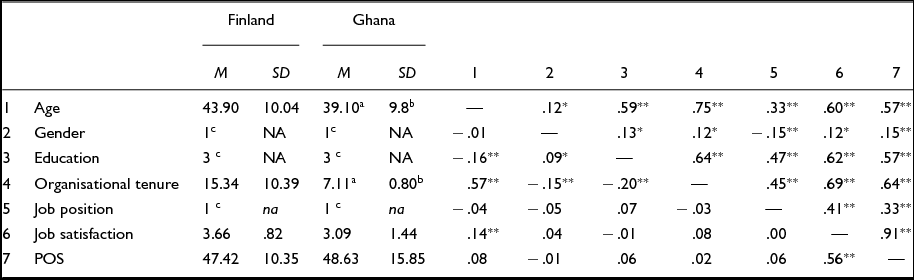
Table 1 presents means, standard deviations and correlations between the variables under study. An examination reveals some interesting patterns. Correlations between demographic variables and POS were stronger for Ghanaian workers than for the Finnish workers. Workers’ age, educational background and organisational tenure were all highly correlated with POS. Strong and positive correlations involving job satisfaction, organisational tenure and POS were recorded for both Ghanaian and Finnish participants. Longer-tenured workers and workers with higher levels of job satisfaction indicated higher levels of managerial support. This correlational evidence (Table 1) is thus consistent with Hypothesis 1a.
Descriptive Statistics and Intercorrelations Among Variables Under Study

Note: *p < .05, **p < .01. Means, standard deviations, and zero-order correlations of study variables for Finnish (below diagonal) and Ghanaian (above diagonal) samples. aMedian, bQuartile deviation, cMode; NA = not applicable. Values for gender: 1 = Men; 2 = Women; Educational background: 1 = Elementary School; 2 = Middle School; 3 = Secondary/Technical School; 3 = Professional/Vocational, and 5 = University. Job position: 1 = Worker and 2 = Supervisor. POS = Perceived Organisational Support.
Preliminary analyses that compared differences between the two nations on workers’ age, gender, and job position indicated differences of statistical significance, t = 6.15, p < .001; χ2 = 23.17 p < .001; and t = −9.69, p < .001, respectively, in favour of Ghanaian workers. Ghanaian female workers (gender) and supervisors (job position) indicated greater supportive perceptions. There were also indications of statistically significant differences for job satisfaction (t = 6.33, p < .001) and organisational tenure (t = 7.77, p < .001) in favour of the Finnish industrial workers. Hypothesis 1b was therefore supported.
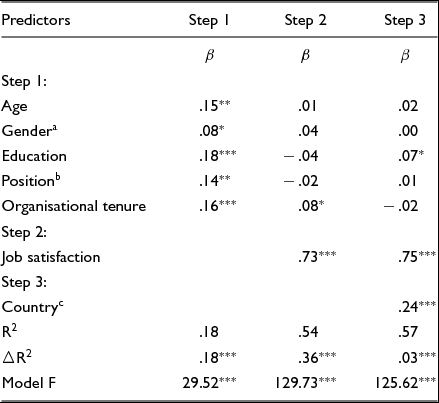
To test the hypotheses more thoroughly, hierarchical regression analysis was performed to examine the effects of the demographic variables, the strength and direction of their relationships with culture and POS. In Step 1, the demographic variables were entered as control variables. The results (Table 2) for this step indicated the demographic variables: age (p < .01), gender (p < .05), educational status (p < .001), job position (p < .01) and organisational tenure (p < .001) to be significant predictors of POS. Eighteen per cent of the variance of POS could be explained by these demographic variables. This gave support to Hypothesis 3a. In Step 2, POS was regressed on job satisfaction; job satisfaction significantly predicted POS, after controlling for the demographic variables (β = .73, p < .001). After its entry in the model, job satisfaction explained 36% (p < .001) of the variance of POS for the whole sample, regardless of country. The analyses suggest a full mediation effect of job satisfaction regarding the association of POS with the demographic variables. A partial mediation effect on the relationship between POS and organisational tenure was also indicated.
Hierarchical Regression Analysis of POS in Ghana and Finland

Note: *p < .05, **p < .01, ***p < .001. aGender: male = 0 and female = 1; bJob position: worker = 0 and supervisor = 1; cCountry: Finland = 0 and Ghana = 1. Β = Standardised beta coefficient. ∆R 2 = R 2 change.
Finally, in Step 3, POS was regressed on a dummy variable country. The results indicated a significant relationship between country variable and POS (β =.24, p < .001) after controlling for the effects of the demographic variables. The country variable explained 3% (p < .001) of the total variance of POS for the whole sample. Because the reference group for the dummy variable country was the Finnish sample, the implication here is that Ghanaian workers have significantly more positive perceptions of managerial support than their Finnish counterparts. Hypothesis 2 was therefore not supported.
Structural Equation Modelling Analyses
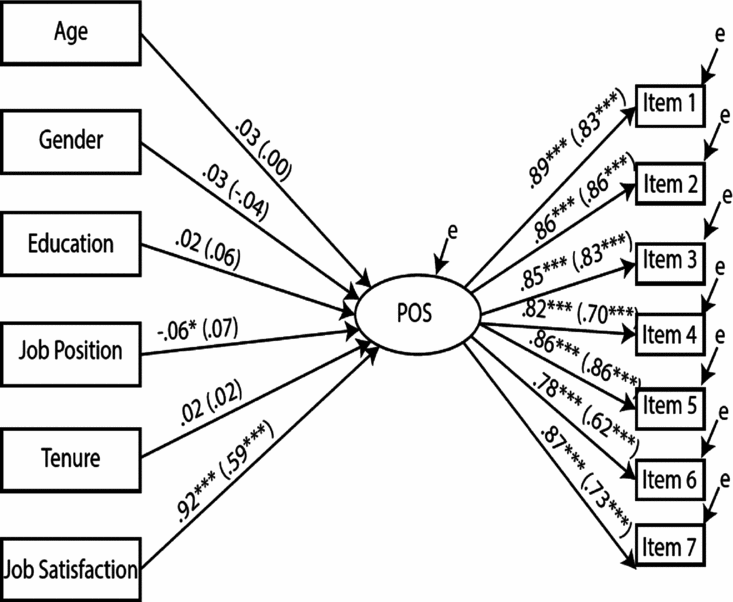
Structural equation modelling (SEM) was conducted to further examine the relationships between the demographic variables and POS in both cultures. According to SEM procedures, a model is considered to have a good fit to the data when the fit indices have a value lower than .90 or higher and the RMSEA has a value lower than .08 (Kelloway, Reference Kelloway1998). In our analyses, the root mean square error of approximation (RMSEA = .047) was less than .05, and χ2/df was 2.83, less than 3. Besides, all model fit indices were above the criterion value of .90 (e.g., CFI = .97, TFI = .95, IFI = .97, and NFI = .95). The NFI, CFI, TFI, IFI and RMSEA fit indices showed that the hypothesised model had a relatively good fit to the data. As illustrated by Figure 1, the overall model comparison between a fully constrained model (where the effects for both countries were set to be equal) with an unconstrained model (where the effects were set to be freely estimated) indicated that the two countries are significantly different in terms of the directions and effects of the independent variables on POS, ∆χ2(12) = 95.64, p < .001.
A model of the relationships between demographic variables and POS among Ghanaian and Finnish industrial workers.
Note: Parameter estimates are given separately for Ghana (outside parentheses) and Finland (within parentheses) samples. The e-sign in the figure represents error terms or residuals for the corresponding variable. *p < .05, **p < .01, ***p < .001.
Path analysis performed to identify specific variables that were moderated by culture revealed organisational position, ∆χ2(1) = 7.01, p < .001, and job satisfaction, ∆χ2(1) = 10.33, p < .001, as potential variables. Though not statistically significant, the results showed that the two cultures were marginally different regarding the relationship between gender and POS, ∆χ2(1) = 2.93, p < .06. Job position was a strong indicator of the impact of the high distance-power orientation, and sums the collective influence of seniority in terms of age, work experience, education and organisational tenure in Ghana's work organisations. On the whole, the analyses indicated a moderation effect of culture on the relationship between the variables understudy with POS.
The Mediating Role of Job Satisfaction
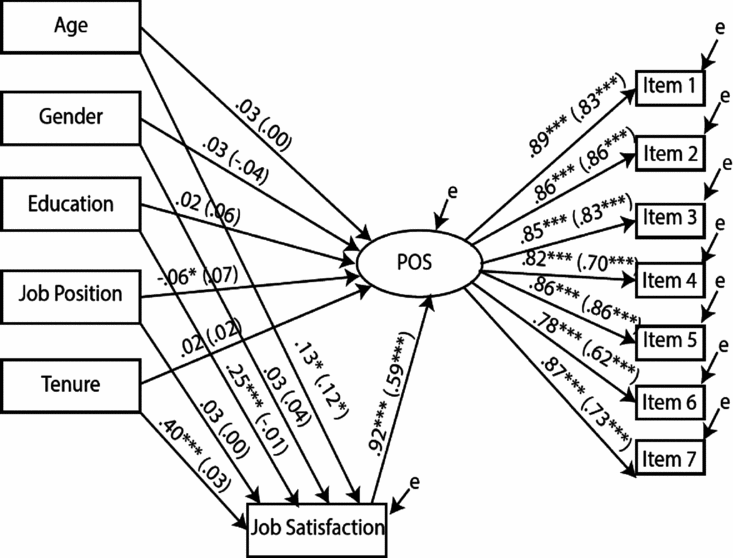
In Hypothesis 4, job satisfaction was positioned as a mediator between demographic variables and POS. The pattern of correlations satisfied Baron and Kenny's (Reference Baron and Kenny1986) conditions for demonstrating mediation — namely, that (1) the independent variables should significantly relate to the mediator; (2) the independent variables should significantly relate to the dependent variable, and when examined simultaneously; (3) the mediator should significantly relate to the dependent variable; while (4) the independent variables no longer relate to the dependent variables. In sum, job satisfaction mediated the relationships between the demographic variables and POS, as all four conditions were met in our SEM analyses (Figure 2). Hypothesis 4 was therefore supported. These findings suggest that the impact of employee demographic factors on job performance that are attributable to job satisfaction could potentially contribute to employees’ perceptions of managerial support.
A model of the relationships between demographic variables and POS among Ghanaian and Finnish industrial workers, with job satisfaction as a mediating variable.
Note: Parameter estimates are given separately for Ghana (outside parentheses) and Finland (within parentheses) samples. The e-sign in the figure represents error terms or residuals for the corresponding variable. *p < .05, **p < .01, ***p < .001.
Discussion
The current study responded to calls for cultural/national comparative analyses in POS, and also investigated the role of worker demographic variables. This response is important as the extant POS literature has focused exclusively on Western and to a lesser extent, Asian studies, with minimal attention to examining the impact of culture. The data analyses found support for Hypothesis 1a. Strong and positive relationships were noted between job satisfaction, organisational tenure and POS in both cultures. This observation is consistent with organisational support theory, which holds that POS strengthens organisational affective commitment and generates among employees the felt obligation to identify with the organisation and the willingness to continue to contribute to its goals and aspirations (e.g., Perryer, Jordan, Firns, & Travaglione, Reference Perryer, Jordan, Firns and Travaglione2010; Rhoades & Eisenberger, Reference Rhoades and Eisenberger2002). It corroborates Farh et al.’s (Reference Farh, Hackett and Liang2007) findings that POS relates strongly and positively with organisational tenure, regardless of culture. We also found support for Hypothesis 1b. Consistent with the reciprocity norm (Gouldner, Reference Gouldner1960) and inducements-contribution theory (Hom & Griffeth, Reference Hom and Griffeth1995), the Finnish industrial workers demonstrated more obligation to repay their organisations with greater affective commitment and longer tenure than their Ghanaian counterparts.
The crux of the study, Hypothesis 2, stated that Finnish workers will indicate higher levels of POS than their Ghanaian counterparts. This was not supported. Contrary to expectations, Ghanaian respondents indicated more managerial support than their Finnish counterparts, even after expressing relatively lower levels of job satisfaction. The lack of support for the hypothesised relationship may be explained in terms of the element of discretion in supportive perceptions. According to managerial support theorists (e.g., Aselage & Eisenberger, Reference Aselage and Eisenberger2003; Eisenberger et al., Reference Eisenberger, Cummings, Armeli and Lynch1997) favourable organisational experiences contribute more substantially to POS when they are perceived to stem from discretionary or voluntary actions of the organisations. Conversely, when perceptions of the favourableness of job conditions are attributed to external constraints such as union contracts, legislature or governmental regulations, over which organisations have little or no control, then they exert little influence on POS. It happens to be the case in Finland that effective and pragmatic measures by powerful trade unions ensure employment security, the enforcement of health and safety regulations, and ultimately a better quality of work life. Under such conditions, it seems highly plausible that the Finnish respondents did not consider their favourable work experiences as discretionary and voluntary, and were therefore less inclined to endorse organisational management as supportive and responsible for their conducive work environment and higher levels of job satisfaction.
A second possible explanation for the absence of support for the hypothesised relationship can be gleaned from the social exchange literature (Blau, Reference Blau1964; Gouldner, Reference Gouldner1960). As reported by Rhoades and Eisenberger, the social exchange theory explanations for a relationship between POS and employee outcomes are governed by the norms of reciprocity and that ‘the strength of this association should be influenced by employees’ acceptance of the reciprocity norm as a basis for employee-employer relationships’ (Rhoades & Eisenberger, Reference Rhoades and Eisenberger2002, p. 711). Cross-cultural organisational researchers have found that the social exchange theory-based explanations for employee attitudes and behaviours apply less to individuals in collectivistic and high-power distance cultures than in individualistic and low power-distance cultures (e.g., Farh et al., Reference Farh, Hackett and Liang2007; Lam, Schaubroeck, & Aryee, Reference Lam, Schaubroeck and Aryee2002; Lee, Pillutla, & Law, Reference Lee, Pillutla and Law2000). The prominence of interpersonal relationships in Ghana's workplace (Gyekye, Reference Gyekye2001; Gyekye & Haybatollahi, Reference Gyekye and Haybatollahi2015) suggest that workers’ perceptions regarding managerial support tend to be governed more by their traditional socio-cultural values, which places a premium on affiliative and familial relationships, than by the social exchange principle.
Empirical work in Ghanaian organisations suggests organisational management style to be paternalistic and a relational environment in which personal loyalty and attachment to members of the family is transferred to employment situations (Gyekye, Reference Gyekye2001), and through which a strong relationship may be sufficient for inducing employee reciprocity (see Gyekye & Haybatollahi, Reference Gyekye and Haybatollahi2015). In the exchange between management and subordinate workers, management provides a holistic concern for employees in return for which they are accorded loyalty and deference. It is not uncommon to notice top and middle managers being regarded and addressed as fathers and uncles respectively, in Ghanaian workplaces. There is also a strong desire among subordinate workers to maintain a positive image and avoid creating a negative one in order to obtain or retain special benefits. With such paternalistic relationships, workers have felt bound to their organisations and have been particularly motivated to behave in ways that strengthen these familial relationships with their employers. It is therefore conceivable that from the Ghanaian perspective, perceptions of managerial support (POS) is not simply a consequence of the level of job satisfaction, but rather an opinion that is attributed more to personal loyalty and attachment to specific others than to an impersonal form of satisfaction.
The third possible explanation is drawn from the Cornell model of job attitudes (Smith, Kendall, & Hulin, Reference Smith, Kendall and Hulin1969) — a model that examines the relationship between job satisfaction and environmental factors. According to this model, employees use a frame of reference, such as the availability of potentially satisfying alternative employment to evaluate their current jobs. Accordingly, employees are presumed to rate their jobs more favourably during difficult economic times when job opportunities are scarce than during prosperous times when alternatives are plentiful. Similarly, workers living in poor communities will presumably evaluate their job conditions positively because the alternative might be a worse job or unemployment. Hulin's (Reference Hulin, Brett and Drasgow2001) study provided empirical support for this assertion. According to the study findings, employees working on objectively unpleasant jobs, with few positive outcomes, expressed positive evaluations of their work and working conditions while their counterparts working on objectively desirable jobs evaluated their jobs quite negatively. Following from this, the Ghanaian employees’ recognition of the financial constraint in their organisations, the unfavourable work conditions and the unavailability of job alternatives may have indicated lower levels of job satisfaction, but not with a corresponding decline in their perceptions of managerial support and concern.
Hypothesis 3a, which anticipated demographical variables to be potential predictors of POS, was supported. Between the two nations, the impact of demographical variables was more noticeable among the Ghanaian respondents. Male workers, older workers, the higher-educated, longer-tenured employees and supervisors indicated greater supportive perceptions. That these observations did not evidence in the Finnish sample could be attributed to Ghanaian socio-cultural values where seniority in terms of age, education, work experience and job position is acknowledged and highly esteemed. This respect for seniority is compounded by greater power differentials and unequal relations that are characteristic of collectivistic and high power-distance cultures (Bochner & Hesketh, Reference Bochner and Hesketh1994; Hofstede, Reference Hofstede2002). While top and middle management (who are usually male workers, relatively higher-educated, longer-tenured and more experienced) are entitled to privileges and amenities, the subordinate workforce, which is normally uneducated, unskilled or at best semi-skilled, has little or no access to workplace amenities. These differences result in a wide gap between subordinate workers and supervisors in terms of remuneration and privileges, and have manifested in Ghanaian supervisors expressing higher levels of job satisfaction and to regard their relatively stress-free job assignments and privileges as some token of managerial support (Gyekye & Salminen, Reference Gyekye and Salminen2009). The observation that men indicated more POS in the Ghanaian sample could be a reflection of Ghana's masculinity cultural orientation as opposed to Finnish femininity construct (Hofstede, Reference Hofstede1984). The masculinity cultural element meant that men are receiving special privileges that give them a special in-group status with their management.
From the data analyses, it can be deduced that the relationships between employees’ demographic variables and POS is mediated by job satisfaction, which is consistent with Hypothesis 4. This is an important confirmation of job satisfaction's implicit position within the organisational support theory, and gives credence to the reported role that job satisfaction plays regarding perceptions of managerial support (Eisenberger et al., Reference Eisenberger, Armeli, Rexwinkle, Lynch and Rhoades2001; Meyer et al., Reference Meyer, Stanley, Herscovitch and Topolnytsky2002). Altogether, the current findings indicate culture as a moderator in the relationships with POS. Apparently, managerial support perceptions are not only influenced by job-relevant information and treatment provided by organisational management, they are also framed by employees’ cultural orientation or the subjective perceptions of the extent to which they feel supported.
Theoretical and Practical Implications
The current findings extend previous research in the following ways: they add to the growing body of studies that have indicated cultural value orientations play an important role in organisational behaviours (e.g., Adler, Reference Adler2002; Gelfand et al., Reference Gelfand, Erez, Aycan, Posner and Rothbart2007; Gyekye & Haybatollahi, Reference Gyekye and Haybatollahi2015; Tsui, Nifadkar, & Ou, Reference Tsui, Nifadkar and Ou2007), particularly in regard to employees’ perceptions of workplace satisfaction and managerial support. Besides, they reinforce the validity of POS research within collectivistic and high power-distance cultures (e.g., China; Farh et al., Reference Farh, Hackett and Liang2007) where norms of reciprocity and the social exchange theory play a lesser role in governing social exchanges (see Rhoades & Eisenberger, Reference Rhoades and Eisenberger2002). By so doing, they contribute to enhancing our understanding of the generalisability of the POS phenomena.
Beyond conceptual and theoretical contributions, the current findings also have practical implications. In a multicultural social context or in a multinational organisation, an understanding of the role that culture-related variables play in employee attitudes and behaviour is critical. The practical implications of managing a diverse workforce, some of whom are responsive to the social exchange theory while others are not, may be far-reaching. Given that social exchange theory seems to be less dynamic with collectivists (Rhoades & Eisenberger, Reference Rhoades and Eisenberger2002; Farh et al., Reference Farh, Hackett and Liang2007), management in multinational organisations should be conscious of the cultural and national limits in their evaluations of POS and job outcomes, particularly with employees from collectivistic nations where POS are likely to be governed more by traditional socio-cultural values than the norm of reciprocity. Interventions aimed at improving POS and job outcomes should simultaneously address diverse variables such as the influence of social processes and socio-cultural values.
Limitations and Conclusion
The current study is limited by its cross-sectional design and its reliance on self-reported measures. Estimates of the relationships among the measures may therefore be undermined by common-method variance. However, Crampton and Wagner's (Reference Crampton and Wagner1994) meta-analytic review informs that the magnitude of such distortions is usually overestimated. Although the cross-sectional design may preclude making definitive causal inference, our focus was more on the comparative analyses and testing mediator and moderator effects; analyses of which integrity is not normally compromised by cross-sectional designs. Future research with longitudinal designs may help establish the direction of causality among the relationships examined in the study. Another limitation is our inability to directly measure the cultural variables used in the study. Nevertheless, data from Hofstede and other cultural theorists (e.g., GLOBE Project; House et al., Reference House, Hanges, Javidan and Dorfman2004) confirm Ghana and Finland as having contrasting values regarding individualism, power-distance, masculinity and uncertainty avoidance. Although the study drew on just two nations, a large number of other nations have cultural characteristics common to Finland and Ghana. Consequently, the results found in this study may also apply to substantial numbers of African, Caribbean and Latin American countries, and to Western nations. The findings are also applicable to multinational organisations; as reported by Triandis (Reference Triandis1996), the distinction between individualists and collectivists may exist within the same society or nation, and hence in the same work environment.