Introduction
Cellulose is the most abundant structural biopolymer on earthReference Fratzl1 and is found in a number of organisms, including bacteria, tunicates, and plants, that take advantage of its outstanding mechanical, thermal, and optical properties.Reference Moon, Martini, Nairn, Simonsen and Youngblood2 Cellulose nanocrystals (CNCs) serve as key reinforcing building blocks for natural hierarchical composites in a variety of plants, specifically trees, as well as plant-derived materials, including linen, hemp, and cotton. Their high crystallinity, strong molecular interactions through hydrogen bonding and non-bonded van der Waals forces, and rigid chain structure give rise to mechanical properties rivaling those of synthetic aramid fibers such as Kevlar.Reference Diddens, Murphy, Krisch and Mueller3 Beyond the mechanical and structural roles it has in plants, cellulose is also an integral part of tunicates, algae, and bacteria,Reference Fratzl1,Reference Moon, Martini, Nairn, Simonsen and Youngblood2 where it is a component of protective gels that block ultraviolet light and act as a barrier to other organisms.Reference Moon, Martini, Nairn, Simonsen and Youngblood2 In addition to these natural systems, man-made engineering materials, including rope, paper, and timber for housing, are directly derived from cellulose in plants and continue to be important raw materials for the worldwide paper, textile, and forest products industries.Reference Eichhorn, Dufresne, Aranguren, Marcovich, Capadona, Rowan, Weder, Thielemans, Roman, Renneckar, Gindl, Veigel, Keckes, Yano, Abe, Nogi, Nakagaito, Mangalam, Simonsen, Benight, Bismarck, Berglund and Peijs4
One of the most exciting and interesting developments in the field of cellulose, beyond the established industrial applications, is the idea of using nanoscale CNCs as building blocks for the development of novel materials, including CNC thin filmsReference Iguchi, Yamanaka and Budhiono5–Reference Diaz, Wu, Martini, Youngblood and Moon7 and nanocompositesReference Eichhorn, Dufresne, Aranguren, Marcovich, Capadona, Rowan, Weder, Thielemans, Roman, Renneckar, Gindl, Veigel, Keckes, Yano, Abe, Nogi, Nakagaito, Mangalam, Simonsen, Benight, Bismarck, Berglund and Peijs4,Reference Abbott and Bismarck8–Reference Lee, Tammelin, Schulfter, Kiiskinen, Samela and Bismarck11 where CNCs serve as filler particles in a polymer host matrix. By recognizing that CNCs serve key mechanical functions in the hierarchical structure of wood (Figure 1), itself a biological nanocomposite, researchers have established ways to extract these materials in hopes of using them to re-engineer polymer-based nanocomposites. Nanocellulose offers advantages over other filler nanoparticles used in nanocomposites; CNCs are widely available and inexpensive to extract from industrial byproducts and waste using a variety of low-cost processing techniques.Reference Moon, Martini, Nairn, Simonsen and Youngblood2 Thus far, significant research progress has been made with the expectation of re-engineering new bio-nanocomposites containing CNCs serving as key, reinforcing filler materials. For example, the presence of CNCs in these materials has been shown to enhance a number of material properties, including elastic modulus and glass transition temperature.Reference Moon, Martini, Nairn, Simonsen and Youngblood2,Reference Dong, Strawhecker, Snyder, Orlicki, Reiner and Rudie10
(a) Hierarchical structure of a cellulose nanocrystal (CNC) showing the formation from the basic cellulose repeat unit into a Iβ crystal. Multiple cellulose repeat units (hundreds to tens of thousands) come together via covalent and hydrogen bonding to form long cellulose chains. These cellulose chains are then stabilized into sheets by extensive interchain hydrogen bonding. The CNC-Iβ crystalline structure is formed from multiple cellulose sheets that are stabilized by van der Waals (vdW) forces and results in two prominent exposed surfaces: (110) and (200). (b) Hierarchical structure of cellulose in wood/trees starting with the basic building blocks of CNCs embedded in amorphous cellulose domains. These cellulose fibrils aggregate and order themselves across multiple length scales to provide structural stability and strength to these systems. The (O) above each image represents the length scale of that particular structure and demonstrates how this hierarchical structure spans multiple length scales ranging from the nanoscale to the macroscale. Adapted with permission from Reference 43. © 2014 American Chemical Society.

Despite the enhancement of properties observed in these cellulose-based materials, a number of challenges remain that must be addressed in order to fully leverage the outstanding properties of CNCs.Reference Moon, Martini, Nairn, Simonsen and Youngblood2 The central bottleneck to improving material performance lies at weak, nanoscale interfaces within the materials, which play a crucial role in dictating emergent, macroscale material properties. For example, interfaces can help promote the formation of percolated networks among filler particles that distribute cracks and consequently improve material strength and toughness.Reference Ohji, Jeong, Choa and Niihara12,Reference Mizuno, John and Okamoto13 Interfacial mechanics of CNCs are fundamental to understanding different aspects of nanocellulose, including CNC processing,Reference Siqueira, Bras and Dufresne14 surface modification of CNCs,Reference Roy, Semsarilar, Guthrie and Perrier15,Reference Siro and Plackett16 self-assembly/organization of CNCs,Reference Habibi, Lucia and Rojas17 and interactions with matrix materials in thin films and nanocomposites.Reference Azizi Samir, Alloin and Dufresne18–Reference Lee, Buldum, Mantalaris and Bismarck21
The aim of this article is to highlight the features of nanocellulose that make it an ideal candidate for inclusion in novel engineering materials. Beyond focusing on the structure and mechanical performance of CNCs, the interfacial properties of CNCs with other materials and solvents will be highlighted, as they shed light on the behavior of these crystals in hierarchical structures where nanoscale interfaces often govern macroscopic properties. Specifically, this article focuses on interactions between CNCs and other cellulosic materials and the interactions between CNCs and polymers. The former are important in CNC thin films and all-cellulose nanocomposites, while the latter are crucial to the performance of CNC-polymer nanocomposites. By highlighting recent experimental and computational research, this review demonstrates the importance of interfacial mechanics within CNC-based materials and illustrates how these aspects could be tuned to improve material performance moving forward.
Structure and properties of cellulose nanocrystals
Cellulose, first discovered and isolated in 1838,Reference Payen22 is composed of a linear chain of repeat units known as cellobiose ((C6H10O5)n, where n can range from hundreds to tens of thousands depending on the source material), which is formed from two anhydroglucose rings through a β 1–4 glucosidic linkage. The crystal structure and hydrogen bonding exhibited by cellulose have been carefully investigated,Reference Jarvis23–Reference Nishiyama, Langan and Chanzy25 revealing that in addition to the covalent linkages between repeat units, hydrogen bonding helps stabilize the linear configuration of cellulose chains (intrachain). Additionally, significant hydrogen bonding can develop between adjacent chains (interchain) and leads to the formation of cellulose sheets. These sheets do not form significant hydrogen bonds with one another due to the chemical nature of the (200) surface of cellulose, but instead, van der Waals forces promote parallel stacking of cellulose chains into a repeated crystalline structure, as pictured in Figure 1a. The extensive hydrogen-bonding network within CNCs makes cellulose a relatively stable biopolymer and accounts for the high axial elastic modulus of cellulose fibrils.Reference Moon, Martini, Nairn, Simonsen and Youngblood2
CNCs possess a number of key engineering properties such as low density (∼1.6 g cm–3) and high elastic modulus (∼110–220 GPa) that are coupled with inherent chemical advantages, including wide availability, biocompatibility, and tunable surface morphology.Reference Moon, Martini, Nairn, Simonsen and Youngblood2,Reference Habibi, Lucia and Rojas17,Reference Gui, Zhu, Gillette, Han, Rubloff, Hu and Lee26 In addition to these properties, CNCs possess an extremely low coefficient of thermal expansionReference Moon, Martini, Nairn, Simonsen and Youngblood2 of approximately 0.1 K–1 (rivaling that of carbon nanotubes) and also have been shown to be optically transparent—making them attractive for a number of multifunctional materials. Our understanding of these materials comes from their examination in natural systems, as shown in Figure 1b. The rigid structure of CNCs serves as the reinforcing phase in the multiscale and multiphasic structure of wood, playing a key role in its impressive strength and toughness.Reference Moon, Martini, Nairn, Simonsen and Youngblood2,Reference Jin, Qin and Buehler27
For larger-scale applications in structural engineering and architecture, wood is recognized as a very efficient, lightweight material. Despite wood being utilized as an engineering material for centuries, an open question remains as to whether nature’s biofactories can be utilized to create mechanical functions and material performance beyond what exists in nature. This can be accomplished through an understanding of polymer processing and mechanics, for instance, by tailoring properties through nanostructuring and better interface design. This grand challenge, pursued by many researchers, aims to scale up the properties of CNCs in a number of novel materials and applications, including transparent films,Reference Nogi, Iwamoto, Nakagaito and Yano28,Reference Nogi and Yano29 flexible displays,Reference Okahisa, Yoshida, Miyaguchi and Yano30 reinforcing fillers for nanocomposites,Reference Hubbe, Rojas, Lucia and Sain31–Reference Capadona, Shanmuganathan, Tyler, Rowan and Weder33 components for drug delivery, templates for electronics, batteries, and a number of other new areas waiting to be explored. In many of these applications, the necessity of bearing load under service conditions makes the mechanical properties of the material of paramount importance and a requirement CNCs are capable of meeting.
Anisotropic behavior of cellulose nanocrystal surfaces
CNCs typically have a high aspect ratio (3–5 nm in width and 50–500 nm in length) and are extracted from sources in which they exhibit the Iβ crystalline structure—the most common polymorph of CNCs.Reference Moon, Martini, Nairn, Simonsen and Youngblood2 Within this monoclinic crystal structure (shown in Figure 1a in the form of an elementary fibril), the displacement between each subsequent cellulose sheet alternates between c/4 and –c/4, where c is a crystalline unit cell parameter. This is in contrast to the triclinic Iα crystal structure, which has a relative displacement of c/4 between every sheet. Due to these differences in sheet stacking, as well as slight differences in the unit cell parameters, the Iβ crystal structure exhibits a higher number of weak interchain hydrogen bonds that contribute to the higher stability of this polymorph compared to the Iα structure. Although there are other forms of cellulose (Cellulose II, III, and IV), Cellulose I is the most relevant, as it exhibits the best mechanical properties and specifically the highest elastic modulus.Reference Ishikawa, Okano and Sugiyama34 Additional reviews offer further discussion of the differences between CNC polymorphs.Reference Moon, Martini, Nairn, Simonsen and Youngblood2,Reference Habibi, Lucia and Rojas17
The elastic modulus of CNCs has been measured using a number of techniques, including atomic force microscopy (AFM), Raman spectroscopy, and x-ray diffraction (XRD),Reference Lahiji, Xu, Reifenberger, Raman, Rudie and Moon35,Reference Šturcová, Davies and Eichhorn36 with values ranging from 110–200 GPa in the axial direction (intrachain direction in Figure 1a) and 10–50 GPa in the transverse direction (interchain or intersheet direction in Figure 1a). The precise morphology of CNCs has also been well characterized with experimental techniques, including transmission electron microscopy, AFM, x-ray scattering, and environmental scanning electron microscopy.Reference Elazzouzi-Hafraoui, Nishiyama, Putaux, Heux, Dubreuil and Rochas37–Reference Miller and Donald39 These investigations have found that the cross-section of CNCs can vary significantly from a rectangular to a hexagonal shape (the so-called elementary fibril arrangement)Reference Moon, Martini, Nairn, Simonsen and Youngblood2,Reference Ding and Himmel40 depending on the source of extraction. Despite the cross-sectional shape, along the axial direction (i.e., intrachain in Figure 1a), CNCs are flat or ribbon-like with a small angle of twist of 1.5° nm–1.Reference Habibi, Lucia and Rojas17 The mechanical properties of CNCs have been well characterized, and a general consensus on their size and shape has been agreed upon; however, the extraction process can introduce many uncertainties, including defects and surface modifications that can influence their mechanical and chemical behavior. These factors can contribute further to the heterogeneity in CNC properties and account for some of the differences observed in structural measurements using various experimental techniques.
One of the more interesting aspects of CNCs is their clear anisotropy and differences between the two dominant surfaces (the (110) and (200) surfaces as shown in Figure 1a) based on their surface chemistries. The (110) surface has a large number of hydroxyl groups that are capable of serving as donor/acceptors for hydrogen bonding, whereas the occupancy of hydrogen bonds along the (200) surface is much lower due to bond and side-group orientations. This difference between the (110) and (200) surfaces influences mechanical properties, intermolecular interactions, and interfacial behavior. The covalent interactions and intrachain hydrogen bonding combined with extensive interchain OH–O hydrogen bonding is responsible for the high elastic modulus in the (110) direction, while van der Waals forces, together with weaker CH–O hydrogen bonding, account for the intersheet cohesion of cellulose in the (200) direction.Reference Jarvis23,Reference Li and Renneckar41 Atomistic modeling of benzophenone adsorption onto CNCsReference Mazeau and Vergelati42 and the fracture behavior of individual CNCsReference Sinko, Mishra, Ruiz, Brandis and Keten43 have provided a similar picture, with the (200) plane stabilized by van der Waals forces and hydrogen bonding playing a greater role on stabilization of the (110) planesReference Moon, Martini, Nairn, Simonsen and Youngblood2,Reference Sinko, Mishra, Ruiz, Brandis and Keten43 —helping to explain the drastically different elastic properties in these two directions.Reference Moon, Martini, Nairn, Simonsen and Youngblood2,Reference Dri, Hector, Moon and Zavattieri44 These observations suggest that intermolecular forces and interactions, specifically hydrogen bonding and van der Waals interactions, are key to understanding the underlying differences between these surfaces and are important in the context of interfacial behavior.
This anisotropy that is manifested in varying mechanical properties and intermolecular interactions for different surfaces is of particular interest when understanding the interactions of different solvents with CNCs, with a particular focus on water. Although generally assumed to be a largely hydrophilic material,Reference Jonoobi, Harun, Mathew, Hussein and Oksman45,Reference Dagnon, Shanmuganathan, Weder and Rowan46 recent work on CNCs has suggested that the anisotropy of surfaces actually causes cellulose to be a dual-natured amphiphilic material with distinct hydrophobic and hydrophilic regions.Reference Sinko and Keten47 Early molecular dynamics (MD) simulations on water and crystalline cellulose interfaces revealed that water-cellulose hydrogen bonds are highly related to surface hydrophilicityReference Heiner, Kuutti and Teleman48 and have been shown to vary drastically for the two surfaces. This dual-natured behavior is also supported by experiments using a thin-layer wicking technique, which revealed that the free energy for interactions between cellulose and water was positive regardless of the crystallinity (suggesting a hydrophilic character), while the work of spreading water on these surfaces was slightly negative (suggesting a hydrophobic character).Reference Dourado, Gama, Chibowski and Mota49 Additionally, it has been suggested that hydrophobic interactions are important in the dissolution of cellulose and extraction of CNCs.Reference Lindman, Karlstrom and Stigsson50 These interactions and chemical characteristics of cellulose surfaces are relevant to using cellulose under changing environmental conditions and will be illustrated in the following sections.
Interfaces between CNCs and other cellulosic materials
Within cellulose microfibrils (Figure 1b), CNCs coexist with paracrystalline and amorphous domains, with the interface and interphase regions between these phases influencing the properties of wood microfibrils. Amorphous and crystalline cellulose play a role in the mechanics of man-made all-cellulose composites and processed cellulose fibers, with the interactions between the two phases serving to extend the property space accessible to natural multiphasic designs. These complex interactions also govern processes such as CNC extraction and isolationReference Moon, Martini, Nairn, Simonsen and Youngblood2,Reference Reising, Moon and Youngblood6,Reference Habibi, Lucia and Rojas17,Reference Fratzl, Burgert and Gupta51 where interfaces must be broken or disrupted. Beyond these interactions between the two phases, the interfacial behavior between multiple CNCs is also of interest in the applications of CNC neat films, as well as nanocomposites where CNCs may aggregate with one another.
Most isolation procedures used to extract CNCs from natural materials (e.g., wood pulp, bacteria, tunicates), including acid hydrolysis, homogenization, sonication, or oxidation with mechanical treatment, require a deep understanding of interfaces between CNCs and the material they must be extracted from. Further, these processes are especially important as CNCs obtained using different processes exhibit different surface functionalities, which may influence their mechanical and chemical properties. One process in which this is not a concern is intensive sonication, where CNCs are agitated using sound energy at high frequencies in excess of 20 kHz.Reference Li and Renneckar52 Using this technique, thin cellulose sheets have been extracted from wood pulp to sub-nanometer thickness while retaining lengths of hundreds of nm. XRD data suggest that the sonication process breaks CNCs along the (200) plane while retaining some form of Iβ crystalline structure with reduced crystallinity. These findings demonstrate that this isolation process breaks the CH–O intersheet hydrogen bonds and the van der Waals interactions while the intrasheet hydrogen bonding remains intact. These findings again illustrate that the strength of interactions between different planes is anisotropic and confirm that the extraction technique used plays a key role in generating a variety of CNC structures for fillers and functional materials.
Mechanical exfoliation studies, such as the sonication method described, have demonstrated the versatility of isolation methods, and also highlight challenges in preserving crystallinity while keeping defects to a minimum. Extraction processes for CNCs from natural materials are highly dependent on interfacial interactions, as they are used to obtain intact CNCs while removing any amorphous or paracrystalline regions chemically. These methods, including acid hydrolysis and 2,2,6,6-Tetramethylpiperidine-1-oxyl (TEMPO)-mediated oxidation,Reference Moon, Martini, Nairn, Simonsen and Youngblood2,Reference Habibi, Lucia and Rojas17 take advantage of interfaces between CNCs and amorphous cellulose and free-volume differences between these phases to obtain nearly defect-free CNCs. However, one consequence of these chemical extraction methods is that they often modify exterior CNC surfaces, and these modifications must be taken into account, as they will ultimately change the surface behavior of the extracted material.
Beyond direct experimentation, computational studies have commonly been utilized in recent years to obtain direct insight into key interfaces in nanocomposites and all-cellulose materials. Recently, MD simulations of a single octamer cellulose chain interacting with CNCs were performed to shed light on the interfacial behavior and mimic the AFM experimental procedure.Reference Bergenstråhle, Thormann, Nordgren and Berglund53 This study found that hydrogen bonds between individual cellulose chains and CNCs are an important factor in the pull-off behavior. MD simulations of CNC/lignin assemblies also demonstrated the predominant role of van der Waals interactions for the (200) plane, as well as the importance of hydrogen bonding interactions on (110) planes.Reference Besombes and Mazeau54 These results are consistent with the hypothesis that intrasheet and interchain hydrogen bonding interactions are much greater than intersheet hydrogen bonds and van der Waals interactionsReference Kong and Eichhorn55,Reference Qian, Ding, Nimlos, Johnson and Himmel56 for interactions with both amorphous and crystalline materials. However, they also highlight an even more important message that the dominant bonding mechanism on the molecular scale greatly influences the mechanical performance of systems. When taking a materials-by-design approach, these results suggest that tailoring the surface chemistry to one molecular interaction over another (i.e., hydrogen bonding versus van der Waals) can influence emergent properties. Computationally, it remains a challenge to directly link these calculated interfacial energies to nanocomposite properties, although systematic coarse-graining simulationsReference Hsu, Xia, Arturo and Keten57 are breaking new ground in providing advances in our understanding of interphase thickness, glass-transition, and modulus variations near interfaces.Reference Xia and Keten58,Reference Xia, Mishra and Keten59
In many hierarchical nanocomposites incorporating nanocellulose, interfaces between individual CNCs are tremendously important in explaining macroscale mechanical performance, because interfacial shear transfer between crystals dominates the elastic response, as is also observed for a number of other natural materials.Reference Wei, Naraghi and Espinosa60 This interfacial shear behavior (i.e., atomic interlayer friction) between CNCs has been studied through a combination of experiments and simulations. Colloidal probe microscopy studies show that friction exhibits irregular stick-slip behavior related to surface roughness,Reference Zauscher and Klingenberg61 and this phenomenon can be attributed to the surface geometry and inherent roughness of CNCs. AFM investigations have demonstrated that the interactions are composed of a longer range double layer force and short range steric hindrances, which relate directly to the surface roughness and surface chemistry.Reference Stiernstedt, Nordgren, Wågberg, Brumer III, Gray and Rutland62 Simulations of friction between a CNC and nanocrystalline cellulose substrate showed that, although correlated with friction behavior, hydrogen bonding may not be the determining factor governing interfacial sliding.Reference Wu, Moon and Martini63
These findings related to the interfacial shear behavior are especially relevant to the development of hierarchical CNC materials, most notably CNC neat films (Figure 2a). CNC neat films consist of assemblies of CNCs and no matrix material, giving rise to high modulus and strength arising from the polycrystalline microstructure and interfacial interactions between the planes of CNCs, as shown in Figure 2b. The interfacial behavior between crystals and alignment are important for dictating the overall performance in these novel materials.Reference Reising, Moon and Youngblood6 Beyond thin films, the interactions between CNCs are also relevant in the context of nanocomposites. This is because CNCs can form percolated networks depending on the nature of the interactions with the polymer host matrix, and CNC–CNC interactions govern the percolated network’s load transfer ability and consequently its constitutive behavior (Figure 2c).Reference Haghpanah, Tu, Da Silva, Yan, Mueller, Weder, Foster, Sacui, Gilman and Montclare64 In order to further advance these materials toward their “optimal” performance, the interfaces between CNCs must be properly designed. Since experiments to characterize interfacial properties of nanoscale materials are difficult, molecular simulation has emerged as an effective tool to better characterize these interfaces. Studies aimed at predicting how surface modifications, defects, and morphological factors can be used to improve the mechanical behavior of CNC neat films and CNC nanocomposites.
(a) Illustration of self-organized (i.e., random) and shear-oriented cellulose nanocrystal (CNC) neat films. In these materials, nanoscale CNC–CNC interfacial interactions, particularly the interlayer shear modulus, play an important role in dictating the macroscale, mechanical performance of the film. (b) Molecular snapshots of the (110)–(110) and (200)–(200) interfaces between two CNCs. The interfacial properties between nanocrystals (shear modulus, adhesion energy) largely dictate the emergent macroscale properties of cellulose thin films and, to a lesser extent, CNC-based nanocomposites. (c) Illustration of CNC-polymer nanocomposites in which t-CNCs (tunicate-derived cellulose nanocrystals) can form isolated aggregates or integrated networks depending on their interactions with the specific polymer. The host polymer is a block copolymer derived from elastin (E) and the coiled-coil region of cartilage oligomeric matrix protein (C). The illustrations demonstrate that chemistry and block orientation can influence the nature of the composite. (a) Adapted with permission from Reference 7. © 2013 American Chemical Society. (c) Reprinted with permission from Reference 64. © 2013 American Chemical Society.
One of the most interesting applications of CNC interfaces has been the development of CNC nanocomposites that exhibit stimuli-responsive behavior due to CNC–CNC interactions.Reference Shanmuganathan, Capadona, Rowan and Weder9,Reference Capadona, Shanmuganathan, Tyler, Rowan and Weder33,Reference Dagnon, Shanmuganathan, Weder and Rowan46 Such systems, often inspired from structurally analogous biological systems like the sea cucumber dermis, are also similar to thermomoisture-responsive shape-memory polymers that change their shape/properties in response to environmental shifts in temperature or moisture content. However, they exhibit distinctly different mechanisms arising from the chemistry of nanocellulose and the hierarchical structure of the nanocomposite. In these cellulose-polymer composites, synthesized in this specific case by mixing poly(styrene-co-butadiene) rubber (SBR) with tunicate cellulose whiskers,Reference Dagnon, Shanmuganathan, Weder and Rowan46 the presence of water (Figure 3a) can be used to drastically change the elastic modulus of the material by one to two orders of magnitude, as shown in Figure 3b. The hypothesized reason for this change is that, since CNCs are dominantly hydrophilic (with a larger percentage of (110) surfaces compared to (200) surfaces), when water is introduced into the system, it prefers to stick to the surface of CNCs. These interactions with water disrupt the percolated network of CNC–CNC interfaces that develop within the composite and are a key factor in the composite’s high elastic modulus. Once this network is disrupted by environmental changes in the moisture content, a sharp drop in the elastic modulus is observed.
(a) Illustration of a percolated network of cellulose nanocrystals (CNCs) within a stimuli-responsive nanocomposite in which the interaction between crystals/fibrils can be turned on or off by changing the moisture content. (b) Plot showing the drastic change in storage modulus (E') for the stimuli-responsive cellulose nanocomposite SBR-17TW (poly(styrene-co-butadiene) mixed with tunicate cellulose whiskers) when water is added to the system at room temperature (RT). Here, water serves to disrupt CNC–CNC interfaces by reducing their shear resistance and elastic modulus. (c) Drastic changes in mechanical properties due to the presence of water are not limited to CNCs, but are also observed for amorphous cellulose as the bulk modulus is decreased with increasing moisture content due to disruption of percolated networks. The moisture content is defined here as the ratio of the mass of water to the mass of amorphous cellulose. (a) Reprinted with permission from Reference 33. © 2008 AAAS. (b) Adapted with permission from Reference 46. © 2012 American Chemical Society. (c) Adapted with permission from Reference 65. © 2014 American Chemical Society.
In addition to these changes in the mechanical properties, a clear change in the shape of the material is observed upon wetting that can be eliminated once dry, indicating shape-memory behavior in addition to stimuli-responsive properties. In CNC assemblies, water can diffuse to the surface of crystals where there is adequate free volume, and due to this changing interfacial water content, mechanical properties show sharp changes due to the loss of shear transfer. This is distinct from amorphous cellulose (Figure 3c),Reference Kulasinski, Keten, Churakov, Guyer, Carmeliet and Derome65 where initial sorption of water does not change the modulus drastically, but significant reduction of the modulus occurs when water molecules begin to percolate in the biopolymeric network. These studies demonstrate the importance of nanostructure and percolation concepts in describing environmental response of cellulose nanomaterials.
CNC interfaces in reinforced nanocomposites
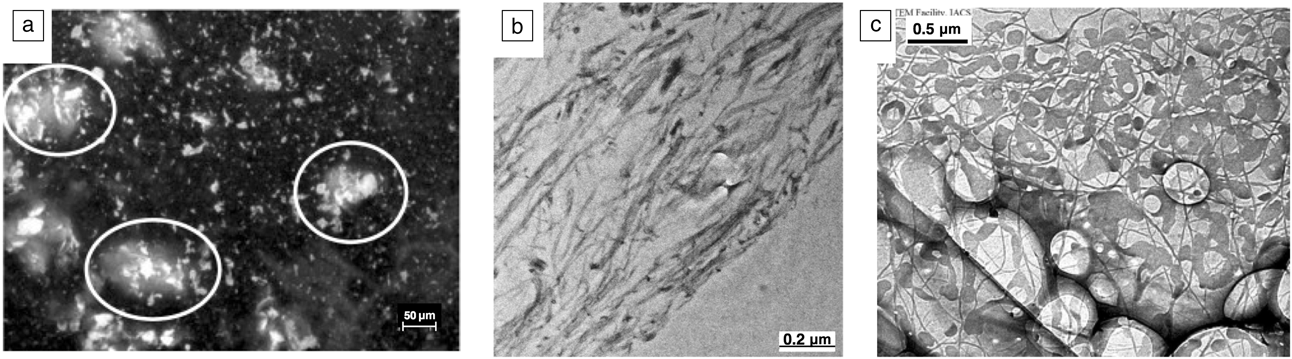
Since the first reported CNC-reinforced nanocomposites,Reference Favier, Chanzy and Cavaille66 there has been ongoing research into these materials to produce useful properties, including high mechanical strength, biocompatibility, reactive surfaces, and stimulus responses. CNCs have been incorporated into a wide range of matrices as reinforcements, with images of a few select materials pictured in Figure 4.Reference Gu and Catchmark71,Reference Zimmermann, Bordeanu and Strub72,Reference Banerjee, Sain, Mukhopadhyay, Sengupta, Kar and Ray75 Such nanocomposites exhibit desirable enhancements in mechanical properties (Figure 5), thermal stability, and optical transmittance properties. There have been extensive reviews on CNC-reinforced nanocomposites,Reference Moon, Martini, Nairn, Simonsen and Youngblood2,Reference Eichhorn, Dufresne, Aranguren, Marcovich, Capadona, Rowan, Weder, Thielemans, Roman, Renneckar, Gindl, Veigel, Keckes, Yano, Abe, Nogi, Nakagaito, Mangalam, Simonsen, Benight, Bismarck, Berglund and Peijs4,Reference Siqueira, Bras and Dufresne14,Reference Habibi, Lucia and Rojas17,Reference Hubbe, Rojas, Lucia and Sain31 and we focus on the interfacial mechanics between CNCs and matrix materials and how they play a fundamental role in dictating the overall performance of this class of nanocomposites.
Experimental images of cellulose-based nanocomposites. (a) Scanning electron microscope image showing cellulose nanowhisker (CNW) aggregation and dispersion in CNW-polylactic acid nanocomposites. (b) Transmission electron microscope (TEM) image of a cellulose nanocrystal (CNC)-hydroxypropyl cellulose nanocomposite interface with CNCs well dispersed in an aligned structure. (c) TEM micrograph of CNC-poly(methyl methacrylate) (PMMA) nanocomposite with surface-treated CNCs showing networks of CNC-PMMA and CNC–CNC interfaces. (a) Adapted with permission from Reference 71. © 2013 Springer. (b) Adapted with permission from Reference 72. © 2010 Elsevier. (c) Adapted with permission from Reference 75. © 2013 Wiley.
Elastic modulus of cellulose (cellulose nanocrystals [CNCs] and/or nanofibrillated cellulose [NFC]) reinforced nanocomposites: NFC-thermoplastic starch (TPS),Reference Alemdar and Sain85 NFC-polylactic acid (PLA),Reference Jonoobi, Harun, Mathew, Hussein and Oksman45,Reference Suryanegara, Nakagaito and Yano86 NFC-poly(vinyl alcohol) (PVA),Reference Cheng, Wang and Rials87 NFC-polyurethane (PU),Reference Seydibeyoglu and Oksman88 NFC-phenol formaldehyde (PF), NFC-poly(S-co-BuA),Reference Samir, Alloin, Paillet and Dufresne89 CNC-hydroxypropyl cellulose (HPC),Reference Johnson, Zink-Sharp, Renneckar and Glasser90 CNC-waterborne polyurethane (WPU),Reference Cao, Dong and Li91 CNC-polycaprolactone (PCL),Reference Habibi and Dufresne73,Reference Siqueira, Bras and Dufresne92 and CNC-poly(methyl methacrylate) (PMMA).Reference Dong, Strawhecker, Snyder, Orlicki, Reiner and Rudie10,Reference Banerjee, Sain, Mukhopadhyay, Sengupta, Kar and Ray75
In order to probe the interfacial behaviors and characteristics of CNCs, it is necessary to employ a combination of both experimental and computational techniques. Experiments have long been adopted to investigate interfacial behaviors of composites. Techniques like Rutherford backscattering have been used to investigate long-range behaviors, and more recent techniques such as neutron specular reflection can be used to capture short-range behaviors such as the interfacial structure of polymer-polymer interfaces at the nanoscale.Reference Okada, Oka, Kuwajima, Toyoda and Tanabe67 Although these experimental techniques are advanced, atomistic simulations further enable the possibility of observing mechanical behavior at the atomic level where experiments are often expensive and difficult to perform. Simulations have demonstrated that interfacial interactions greatly influence performances of polymericReference Xia and Keten58,Reference Xia, Mishra and Keten59 or composite materials.Reference Dandekar and Shin68,Reference Rissanou and Harmandaris69 In addition to all-atomistic simulations, the development of systematic coarse grainingReference Hsu, Xia, Arturo and Keten57 methods offers great potential to conduct simulations at larger length and time scales that can be more directly compared with experimental results. Together, these advances can greatly expand our knowledge on interfacial mechanics and benefit the research and development of CNC-based nanocomposites.
Interfacial properties, either CNC–CNC and/or CNC–matrix interactions, play a crucial role in the performance of nanocomposites. The enhancement of properties in these composites compared to the pure matrix material (Figure 5) originates from the rigid network of CNCs, while compatibility between CNCs and matrix materials is also key to developing successful new nanocomposites.Reference Dufresne70 Although both percolated CNC networks (strong CNC–CNC interactions) and filler-host compatibility (strong CNC–matrix interactions) offer improved properties of the composite, they present competing effects to the overall performance. Rigid, percolated networks are the result of rich hydroxyl groups on the outer surfaces of CNCs, and they facilitate the formation of a rigid hydrogen bonding system between CNCs within the matrix. These hydrogen-bonded systems are incredibly stiff and lead to higher mechanical strength and modulus as they enhance load-bearing and stress-transfer within the matrix. For example, systems such as CNC-reinforced poly(methyl methacrylate) demonstrate improved mechanical properties and increased thermal transitions with increasing CNC contentReference Dong, Strawhecker, Snyder, Orlicki, Reiner and Rudie10 due to these percolated networks. However, in polymers where these strong CNC–CNC interactions lead to enhanced mechanical properties, there is also an undesirable high agglomeration of filler particlesReference Gu and Catchmark71 (Figure 4a), leading to decreased strain at failure. Increasing the affinity of CNC–matrix interactions would promote increased dispersion of filler particlesReference Zimmermann, Bordeanu and Strub72 (Figure 4b) and higher strain at failure,Reference Habibi and Dufresne73 but also leads to decreased mechanical performance of the composite material,Reference Azizi Samir, Alloin and Dufresne18 as seen in the case of glycerol-plasticized starch reinforced with CNCs.Reference Anglès and Dufresne74 Here, the strong interaction of CNCs with the matrix material actually serves to reduce/confine the interactions with other CNCs to form rigid, percolated networks within the material. These examples demonstrate the necessity of tuning CNC–CNC and/or CNC–matrix interactions to tailor composite performance, but also illustrate the challenge of practically doing so due to a number of competing effects.
In order to overcome some of these challenges, different research approaches have been adopted to investigate the complex interfacial mechanics problems of CNCs embedded within polymer matrices (Figure 4).Reference Zimmermann, Bordeanu and Strub72,Reference Banerjee, Sain, Mukhopadhyay, Sengupta, Kar and Ray75 In one case, researchers observed that the conformational change to the crystalline structure of CNCs at the CNC–matrix interface of CNC-reinforced fibroin nanocomposites is induced by the interaction of fibroin molecules with highly ordered CNC surfaces.Reference Noishiki, Nishiyama, Wada, Kuga and Magoshi76 In another case, Raman spectroscopy was used to study the CNC–matrix interface and capture the deterioration of this interface under tension.Reference Rusli and Eichhorn77 Chauve et al.Reference Chauve, Heux, Arouini and Mazeau78 reported that the interfacial properties of CNC-reinforced polyethylene-co-vinyl acetate nanocomposites are highly influenced by matrix polarity. These findings are only a small representation of the ongoing work in this field but, as a whole, reinforce the fact that molecular interaction mechanisms at the nanoscale are perhaps one of the most important properties to control in designing new high-performance materials.
Despite our limited understanding of these nanoscale interfaces believed to be crucial to the overall performance of CNC-based nanocomposites, novel materials are continually being produced with promising properties. Figure 5 shows a number of these materials and compares the elastic modulus of the pure polymer host material to that of the nanocomposite with embedded CNCs or nanofibrillated cellulose (NFC)—a primarily crystalline material that also has some amorphous cellulose regions within its fibril structure. Micro/nanofibrillated cellulose reinforcements can lead to higher mechanical strength and modulus than CNCs due to higher aspect ratios and fiber entanglement, which form rigid hydrogen bonding systems more easily in the matrix.Reference Bendahou, Kaddami and Dufresne79–Reference Bergenstrahle, Mazeau and Berglund81 Regardless of the type of nanocellulosic filler material embedded, Figure 5 demonstrates a clear trend that cellulose serves to enhance mechanical properties, but the effect varies significantly depending on the host polymer. For example, in the case of NFC-polyurethane, the elastic modulus is enhanced by nearly 3000% when cellulose is added, but in the case of NFC-polylactic acid, the enhancement is only 40%.
These stark differences are attributed to nanocellulose–polymer interactions, which are dictated by a number of factors involving CNC-polymer compatibility. Some of the issues related to compatibility revolve around the complicated dual-natured hydrophobic and hydrophilic nature of CNCs. These concerns can be alleviated using a number of surface modification approaches (Figure 4c) to change the interactions and compatibility of CNCs and matrix materials.Reference Moon, Martini, Nairn, Simonsen and Youngblood2,Reference Roy, Semsarilar, Guthrie and Perrier15,Reference Klemm, Heublein, Fink and Bohn20 Such techniques have been reported to form covalent linkages between CNCs and the matrix or enhance non-bonded interactions and hydrogen-bonding at the interfaceReference Banerjee, Sain, Mukhopadhyay, Sengupta, Kar and Ray75,Reference de Mesquita, Donnici, Teixeira and Pereira82 and could help to explain the property differences observed in Figure 5. The facilitation of these CNC–matrix interactionsReference Capadona, Shanmuganathan, Trittschuh, Seidel, Rowan and Weder83,Reference Capadona, Van Den Berg, Capadona, Schroeter, Rowan, Tyler and Weder84 is perhaps the most important means of improving the relatively weak interfaces that dominate these nanocomposites. Improvement will start with developing fundamental understanding of these interfaces and using these findings to design interfaces within these materials—something that has yet to be achieved.
Conclusions and perspectives
In this review, recent advances in our understanding of the interfaces between cellulose nanocrystals and their fundamental importance to describing the mechanical behavior of novel engineered materials have been elucidated. A number of relevant, hierarchical materials, including CNC neat films, CNC-polymer nanocomposites, and all-cellulose composites, were emphasized and contrasted in terms of mechanical performance. Most importantly, these examples demonstrate how nanoscale interfaces involving nanocellulose materials are crucial to describing the macroscale performance. Moreover, further understanding of the interactions at interfaces within these materials is fundamental to designing improved material systems that leverage the full range of properties exhibited by individual CNCs. This understanding will involve characterizing interfacial properties such as elastic/shear modulus and adhesion energy through experiments and simulation, while also focusing on key aspects such as surface compatibility in order to enhance interfacial cohesion between different materials.
Recent research has begun to shed light on these aspects, but open fundamental questions that must be addressed still remain. Ultimately, these interfacial characterizations will serve as a useful design tool in developing novel nanocomposites using a materials-by-design approach with tunable interfaces and prescribed molecular structure. Although these issues appear complex, a combination of experimental and computational techniques can be utilized to accelerate this characterization process in order to develop a practical way to develop improved cellulose-based hierarchical materials. This research field still requires a joint effort between diverse research communities to further our scientific knowledge, but the great opportunity for new discoveries on interfacial mechanics of cellulose will advance and push CNC-based hierarchical materials to new limits.
Acknowledgments
The authors acknowledge funding by the US Army Research Office (Award #W911NF-13–1-0241) and a supercomputing grant from Northwestern University High Performance Computing Center. R.S. was supported by the US Department of Defense (DoD) through the National Defense Science & Engineering Graduate Fellowship (NDSEG) Program.