INTRODUCTION
In 2011 New York’s Metropolitan Museum of Art (MMA) formerly took possession of some 10,000 fragments of Greek pottery that had formed part of the personal collection to Dietrich von Bothmer (1918–2009), chairman of Greek and Roman Art at the MMA.Footnote 1 These fragments had been acquired throughout his career at the MMA (1946–2009), and they formed his own private collection, which was stored in his MMA office. The MMA accepted the donation reportedly “with the express approval of the Italian Ministry of Culture.”Footnote 2 Bothmer is acknowledged as the best student taught by Sir John Beazley, Lincoln Professor at Oxford University, who is universally recognized as the leading international scholar of ancient Greek pottery.Footnote 3 Bothmer had the rare skill of identifying fragments of the same vases in different institutions, inheriting Beazley’s talent and continuing his tradition. Jody Maxmin noted Bothmer’s skills:Footnote 4
He was one of the few people who could look at a fragment of a vase and realize, by consulting his limitless memory, that it belonged to a vase in the Louvre … Then he’d buy it and donate it. The world of vases, for him, was an infinite, never-finished jigsaw puzzle.
Bothmer was instrumental in mounting an exhibition of the Athenian black-figured pot-painter known as the Amasis painter, bringing together pots attributed to this anonymous figure.Footnote 5 Five years later the Louvre hosted an exhibition of the works attributed to the Athenian red-figured pot-painter Euphronios that included the calyx-krater that Bothmer had acquired for the MMA.Footnote 6
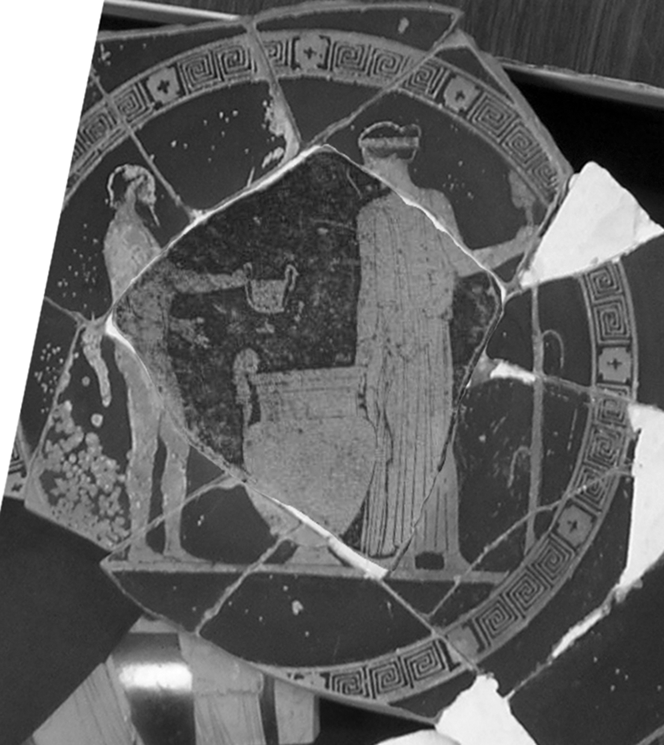
In January 2012 it was announced that 40 fragments from Bothmer’s collection would be returned to Italy.Footnote 7 Some of these fragments are reported to be from pots already returned to Italy from North American collections, though not necessarily from the MMA. Little detail was provided about the return.Footnote 8 In February 2013 the MMA announced the creation of a project to digitize and place online Bothmer’s collection of fragments, mostly thus far unpublished. The announcement included four random images from the collection, currently stored in shelves at the MMA. A short notice was also posted on the website of the Association of Art Museum Directors (AAMD) Object Registry in compliance with their policy relating to the acquisition of antiquities that lack documented collecting history (erroneously termed as “provenance”) prior to November 1970.Footnote 9 One of the images depicts a kylix put together from many fragments in a yellow cardboard box. The exterior of the kylix seems to have been cleaned; the interior, by contrast, appears worn. A few fragments are missing, mainly the center of the tondo, leaving a rhomboid-shaped space. The tondo was decorated with a satyr and a maenad, both standing, on each side of a large vase of an unidentified type.
In March 2013, while researching a separate cup via the Beazley Archive database, Christos Tsirogiannis noticed a rhomboid-shaped fragment from an Attic red-figured cup tondo that resided in the Villa Giulia in Rome.Footnote 10 The Rome fragment showed part of a satyr holding a kantharos over a volute-krater, with a maenad to the right. Although the find-spot of the fragment was unrecorded, it had been given to the museum by Contessa Francesca Parisani Gnoli in 7 September 1913 (along with eight complete vases). The Rome fragment was attributed to the Euaion painter by Sir John Beazley in the 1920s.Footnote 11 This Rome fragment fitted the fragmentary cup residing in the Bothmer collection that had been illustrated on the MMA website as an example of the bequest (Figure 1).
Reconstruction of Attic red-figured cup attributed to the Euaion painter using images from the Museo Nazionale di Villa Giulia (tondo), and fragments from the collection formed by Dietrich von Bothmer (posted via the AAMD Object Registry). Photographic composition by David Gill.

This raises the issue of how the fragments had entered the Bothmer collection, and whether Bothmer could have been expected to appreciate the significance of the link with the Villa Giulia fragment. In addition, was the collecting history of this fragment typical of the rest of Bothmer’s collection as well as his donations to other institutions?
BOTHMER AND THE EUAION PAINTER
The Euaion painter is recognized as an Athenian pot-painter who was influenced by the work of Douris.Footnote 12 Martin Robertson described him as “an accomplished draughtsman and maintains a high standard of care,” and John Boardman noted that he was “a prolific artist of some merit and more nearly Classical in mood.”Footnote 13 Surprisingly, the Bothmer fragmentary cup was not listed on the Beazley Archive database as attributed to the Euaion painter. The Beazley Archive lists three fragments in the Bothmer collection:
a. Cup-skyphos fragments, showing Menelaos.Footnote 14 [Beazley 28564]
b. Cup fragment, showing komos. Formerly in the Curtius collection, Rome.Footnote 15 [Beazley 209737]
c. Cup fragment, showing a man in a chitoniskos, and a woman holding an oinochoe. Formerly in the Curtius collection, Rome.Footnote 16 [Beazley 209794]
While two of the fragments were attributed by Beazley, one (a) was perhaps attributed to the Euaion painter by Bothmer himself.Footnote 17 Bothmer appears to have been familiar with the work of the Euaion painter. Two of the fragments had formed part of the collection created by Ludwig Curtius (1874–1954) of the German Archaeological Institute in Rome.Footnote 18 Apart from the three listed fragments in his collection (a–c), other pieces were donated by him to the MMA and to the J. Paul Getty Museum. The MMA has several examples of the painter’s output, including several fragments acquired from Bothmer:
d. Cup. Acc. no. 96.18.119. Purchased by subscription (1896). Said to be from Capua.
e. Cup. Acc. no. 06.1021.177. Rogers Fund (1906). Said to be from Capua.
f. Cup. Acc. no. 1973.96.5. Gift of Dietrich von Bothmer (1973). The fragment joined a fragment that was placed on loan to the MMA from the Louvre Cp 11439.Footnote 19 Bothmer gave four further fragments in 1983, acc. no. 1983.186a-d, and a further fragment in 1989, acc. no. 1989.175.Footnote 20 The Louvre fragment had been attributed to a follower of Douris.Footnote 21
g. Cup fragments. Acc. no. 1980.11.5. Purchase, The Dover Fund, Inc. Gift (1980).Footnote 22
h. Cup, 2 fragments. Acc. no. 1985.228.3a-b. Gift of Dietrich von Bothmer (Reference Bothmer1985). The fragments joined MMA 1979.517.1 and Louvre Cp 11472.Footnote 23 The Louvre fragment had been attributed to the Brygos painter.Footnote 24
i. Cup fragment. Acc. no. 1986.99.3. Gift of Dietrich von Bothmer (1986). The fragment joined Dresden 355.Footnote 25
It should be noted that Bothmer was able to link fragments in his possession to those in other collections such as the Louvre and Dresden (f, h, and i). In addition, Bothmer was so confident about his attributions that he was able to depart from Beazley’s identifications (f and h). One of the Louvre fragments fitted a cup that was acquired in fragments between 1973 and 1989 (f). Bothmer commented:
In the course of the last ten years fragments of a cup appeared on the market and were acquired piece by piece. When the cup was nearly completed it was discovered that a small triangular fragment was in the Louvre. This has now been incorporated.Footnote 26
The identity of the dealer or dealers was not disclosed, and full collecting history has not been provided.
The Getty has at least eight fragmentary cups attributed to the Euaion painter, and at least four of these contain fragments presented by Bothmer.
j. Cup fragments. Inv. 81.AE.2.a-b. Gifts of Dietrich von Bothmer. Joins Getty inv. 86.AE.707. Cup fragment. Gift of Dietrich von Bothmer.Footnote 27
k. Fragmentary cup, showing on the inside a figure reclining on a kline, and on the outside a man and a youth also reclining, and served by holding an oinochoe. Inv. 83.AE.237. Presented by Dietrich von Bothmer.Footnote 28 [13367] From the same cup as a further fragment. Inv. 83.AE.284.102. Gift of Herbert L. Lucas.Footnote 29
l. Cup fragment. Inv. 83.AE.284.86. Gift of Herbert L. Lucas.Footnote 30
m. Fragment of cup, symposium scene. Inv. 84.AE.973. Presented by Dietrich von Bothmer. Same cup as inv. 81.AE.206.B. 36 [two fragments]).Footnote 31
n. Cup, showing a youth and a man inside, and outside 10 figures. Inv. 86.AE.682. Source: “European Art Market.” “The cup has been restored from a number of fragments.”Footnote 32 Apparently joins cup fragment, Getty 87.AE.100, gift of J. Robert Guy, attribution by J. Robert Guy.Footnote 33 [28082] [28793]
o. Cup fragment. Inv. 86.AE.482.28. Gift of Dietrich von Bothmer.Footnote 34
p. Cup fragment. Inv. 98.AE.22.44.1.
q. Cup fragment. Inv. 98.AE.22.44.2.
The Bothmer fragments were donated to the Getty without full collecting histories. The fragments given by Herbert L. Lucas (k and l) are interesting as Lucas supplied fragments of an Attic red-figured krater attributed to the Berlin painter that was returned to Italy.Footnote 35 Other fragments of the krater were derived from Bothmer, Galerie Nefer, and Robin Symes, and other fragments were reported to be in the possession of Giacomo Medici.
Other Recently Surfaced Fragments of the Euaion Painter
The restored Getty cup derived from the European Art Market (n) included a fragment donated by J. Robert Guy. Guy had supplied 15 fragments for an Attic red-figured amphora attributed to the Berlin painter and acquired by the MMA.Footnote 36 (Polaroid images from the Medici Dossier show the amphora in the early stages of restoration.) Four fragmentary cups attributed to the Euaion painter, and derived from Guy’s personal collection, were acquired by the Harvard University Art Museum.Footnote 37 The source or sources for these fragments has not been disclosed, although Guy claimed that the pieces were derived “from friends and dealers.”Footnote 38 Did Guy’s fragment come from the same “European Art Market” source as the other fragments? If so, what were the circumstances of the acquisition? Guy also attributed two of the three cup fragments acquired by the San Antonio Museum of Art to the Euaion painter, although the date of the attributions is not recorded. All three fragments were given by Gilbert M. Denman, Jr.Footnote 39 The fragments themselves were purchased from the former MMA conservator Peter Sharrer, New York, in 1985.Footnote 40 Sharrer also handled the collection of pot fragments sold by J. Robert Guy. James Cuno, then at Harvard, described the acquisition of the Guy fragments by the Harvard University Art Museums:Footnote 41
In 1995, David Mitten, James C. Loeb Professor of Classics and our George M. A. Hanfmann Curator of Ancient Art, encouraged me to visit Peter Sharrar [sic.], a New York art dealer, to see the group of vase fragments he had acquired from Robert Guy.
These Harvard fragments, described by Cuno as “fractures in time,”Footnote 42 form part of the opening statements in Cuno’s major contribution to the cultural property debate.Footnote 43
It is perhaps significant that Princeton University Art Museum acquired a Roman sculpture from Sharrer in 1985, the same year that the Harvard fragments were purchased (with funds from Mr. & Mrs. Leon Levy); this piece has subsequently been returned to Italy as it has been found near Tivoli in 1981–82.Footnote 44 In addition one of the pieces remaining in Princeton at the time of the agreement to return other antiquities to Italy was a fragment from an Attic red-figured lekythos attributed to the Pan painter (inv. 1998–223).Footnote 45 This had been given by Mr. and Mrs. Peter Sharrer in honor of Allen Rosenbaum. The lekythos is clearly recognizable in the Becchina photographic archive. It was apparently purchased on 26 June 1993 for 2 million Italian lire. It is unclear how the lekythos fragments moved from Switzerland to Princeton. What was Sharrer’s role? Can their journey find a parallel in other antiquities that he handled? It is important that Princeton releases the full information relating to the acquisition.
Princeton remains silent over the cup fragment, attributed to the Euaion painter, that was acquired by Princeton University Art Museum in 2002.Footnote 46 It was given in memory of Emily Townsend Vermeule. Requests for information about the collecting history have gone unanswered by James Steward, the Director, and Michael Padgett, the Curator of Ancient Art. Yet the AAMD’s Guidelines on the Acquisition of Archaeological Material and Ancient Art (revised 2013) clearly state (Section G)
The museum should promptly publish acquisitions of archaeological materials and ancient art, in electronic form, including an image of the Work (or representative images in the case of groups of objects) and its provenance, thus making this information readily available to all interested parties.Footnote 47
It is unclear if the fragment was derived from a private donor or a dealer. It should be noted that a black-glossed askos, acquired in 2002 and given in memory of Emily Townsend Vermeule, was returned to Italy in 2011.Footnote 48 Among the other pieces given in memory of Emily Townsend Vermeule was a gilt silver pierced appliqué plaque showing a chariot with a Nike as a charioteer.Footnote 49 This plaque seems identical to another in a British-based private collection that has been linked to the Koreschnica burial near the river Vardar in the Former Yugoslav Republic of Macedonia, which also contained a monumental krater now apparently in a New York private collection.Footnote 50 Again, requests for information about the collecting history for this relief have gone unanswered by the curatorial staff in the museum.
The Formation of the Bothmer Sherd Collection
The link between the Villa Giulia tondo fragment and the fragmentary cup in the Bothmer collection raises several questions. As Bothmer was not born when the central piece of the cup was donated to the Villa Giulia Museum in 1913, how did Bothmer acquire the remaining fragments? What was his source or sources? What is the full, accurate, documented, and authenticated collecting history (or histories) of these Bothmer fragments? Were the pieces found together with the central piece or at another time (as was the case for the Attic black-figured François vase)?Footnote 51 How and when did the Bothmer fragments cross the Atlantic? Tsirogiannis contacted the curatorial staff at the MMA (email February 26, 2013) regarding the name of the person from whom Bothmer acquired the fragments and the kylix’s earlier collecting history, but at the time of this writing (some two years later), he was still waiting for an answer. Yet the museum had drawn attention to these very fragments by posting them on the museum website.
It has been established that a proportion of the fragments in Bothmer’s collection were acquired from the convicted dealers Gianfranco BecchinaFootnote 52 and Robin Symes (from Symes’s interrogation by the Italian authorities on 28 March 2003), as well as from the arrested dealer Edoardo Almagià.Footnote 53 Between 1984 and 1993, Bothmer donated 119 fragments to the Getty Museum,Footnote 54 some of which have recently been identified as looted and have been returned to Italy.Footnote 55 Dozens of other fragments were donated by Bothmer to the MMA, before they, too, were returned to Italy.Footnote 56 Bothmer was a major contributor to the publication of the exhibition catalogue Glories of the Past, which included a considerable part of the Shelby White/Leon Levy antiquities collection.Footnote 57 Several pieces have been identified as looted and have been returned to Italy and Greece.Footnote 58 (A fragmentary “Weary Herakles” has been returned to Turkey via Boston’s Museum of Fine Art.)Footnote 59 Several other high-profile antiquities acquired by the MMA during Bothmer’s curatorship were also identified as looted and have been repatriated to Italy. These include the famous Euphronios kraterFootnote 60 and the Morgantina treasure.Footnote 61 The Lydian hoard has also been returned to Turkey.Footnote 62
Bothmer had a trained and keen eye that could connect fragments held by different institutions. Given his apparent interest in the work of the Euaion painter, it seems surprising that he would not have linked his fragments with the long-published and distinctively shaped Villa Giulia fragment. He would have been able to reunite the fragments as a whole object. After all he stated his views on fragmentary pots in an interview given in 1997:
I always gave fragments of mine when they would fit another vase in the collection. Or if they fitted vases in other collections and could be used as exchange material. I have made 35 exchanges like this with the Louvre over the years. I do not consider my own collection of fragments as my property, but they are, so to say, in my custody and are left to the Metropolitan Museum of Art in my will.Footnote 63
It seems unlikely that Bothmer would have overlooked the association with a fragment listed by his supervisor Beazley. And if he overlooked it, what could be the reason?
The answer perhaps lies in the secure Italian origin of the Villa Giulia fragment. If Bothmer had published the whole kylix, he would have to explain how an ancient vase of Italian origin had surfaced in Bothmer’s New York office in the MMA. If the fragments he owned were licit (e.g., from an old named collection), there was no reason for them to remain unpublished while in his hands. It seems, then, that Bothmer was willing to suppress knowledge of a fine work of art, and its broader academic implications, rather than to be publicly involved, once more, in the political implications of owning a potentially toxic antiquity, especially after the repatriations of other looted and smuggled antiquities to whose acquisition and publication he had contributed.Footnote 64
The connection between the Villa Giulia fragment and the Bothmer collection had been made by Tsirogiannis through a piece of research on a fragmentary (and restored) cup attributed to the Euaion painter that had surfaced at Sotheby’s (London) in December 1982, and again in July 1989.Footnote 65 (It appears as two separate entries in the Beazley Archive database: 13718, 51204.) This Sotheby’s cup then reappeared at Christie’s New York in December 2012. The cup itself was identified from the Schinousa archive, suggesting that it had passed through the hands of Robin Symes and Christos Michaelides.
The Sotheby’s December 1982 sale is also significant as it contained material that has subsequently been returned to Italy. They include a Lucanian nestoris attributed to the Amykos painter (lot 298) that appears to have been associated with Graham Geddes in Australia and then passed into the collection of Boston’s Museum of Fine Arts,Footnote 66 and an Attic red-figured amphora attributed to the Berlin painter (lot 220) that had been acquired by the MMA, with additional fragments supplied by J. Robert Guy.Footnote 67 This amphora was recognized from images seized in the Geneva Freeport demonstrating its links with Giacomo Medici.Footnote 68 In addition, a disputed Athenian black-figured amphora, attributed to the painter of Vatican 365 and showing a departing chariot, passed through the December 1982 sale (lot 255) [Beazley 7462]. It is now in Madrid’s Museo Arqueológico Nacional (inv. 1999/99/61).Footnote 69
The Context for the Euaion Painter’s Cup
One of the consequences of the looting of archaeological sites is the loss of scientific knowledge about find-spot and associated finds. The distribution of Athenian figure-decorated and black-glossed pottery adds to information about economic interactions between different parts of the Mediterranean world during the sixth, fifth, and fourth centuries bce.
The Beazley Archive lists some 224 pots against the Euaion painter. The majority of the find-spots for the pots and fragments attributed to the Euaion painter are lost. Fragments have been found in the Athenian agora and in the Kerameikos, with another fragment at Brauron in Attica. Many of the known find-spots in Italy have been found in Etruria (Cerveteri, Chiusi, Gravisca, Nepi, Orvieto, Poggio la Croce, Populonia, Veii, Vulci), Campania (Capua, Nola), northern Italy (Bologna). and on the Adriatic coast (Adria, Numana). Further fragments have been found in southern France (Ensérune, Le Cayla), and in the Crimea (Kerch).
FRAGMENTARY POTS IN A WIDER CONTEXT
It has been argued by some that these fragmentary pots are peripheral to the looting of larger works of art. However, it has been observed that many of these fragments have sharp edges, indicating that they are fresh breaks.Footnote 70 This has raised the possibility that the pots have survived in near intact condition for some 2500 years and have then been deliberately broken when they have been removed from their previously undisturbed archaeological contexts.
It is noteworthy that some of the Athenian pots returned to Italy were restored from fragments derived from a number of different sources. The Getty returned a fragmentary red-figured krater attributed to the Berlin painter that was derived from several individuals, including Herbert Lucas (1977), Vasek Polak (1982), Dietrich von Bothmer (Reference Bothmer1984) and Robin Symes (1990) as well as purchased from Galerie Nefer owned by Frida Tchacos-Nussberger (“European Art Market”) in Switzerland (1984), and Frederick H. Schultz, Jr. (“European [sic] Market”; 1987).Footnote 71 Further fragments are reported to have been offered on loan by Giacomo Medici.Footnote 72
Another Athenian red-figured cup returned from the J. Paul Getty Museum was attributed to Onesimos.Footnote 73 The first fragments were derived from Galerie Nefer (“European Art Market”) in 1983. A further fragment from the Bothmer collection was added the following year, and additional material from the Hydra Gallery (“European Art Market”) in 1985. Two further fragments of the cup were provided to the Italian authorities by Giacomo Medici in 2005, and a further fragment showing Talthybios was recovered from a private address at Cerveteri in 2008. The Etruscan inscription on the cup suggests that it was found in a sanctuary at Cerveteri.
Two Getty examples shed light on the way that money could be demanded for fragments that could be added to a pot attributed to a well-known “painter.” A fragmentary Athenian red-figured phiale attributed to Douris was also returned from the Getty.Footnote 74 The initial gifts were made by Werner Nussberger (husband of Frida Tchacos-Nussberger) in 1981, and additional fragments were sold by Fritz Bürki & Sons in 1982, and by the Galerie Nefer in 1985; additional pieces were reportedly placed on loan in 1992.Footnote 75 Robert Hecht reportedly offered a single fragment for an “outrageous” sum for one of the Getty cups attributed to the Brygos painter.Footnote 76
There was concern that the attribution of fragments to named painters could enhance their value for donations to museums.Footnote 77 Bothmer is reported to have donated some 119 fragments to the Getty between 1981 and 1993, and Watson and Todeschini have provided estimates of possible monetary values for the gifts.Footnote 78
CONCLUSION
The Bothmer fragments appear to be linked with the wider movement of archaeological material from Mediterranean countries, and specifically Italy, to North American private (and public) collections.Footnote 79 The connections between fragments in different institutions or held by private individuals may indicate how the networks behind the market operate. It will be important for the MMA to publish the remaining Bothmer fragments as a matter of urgency so that they, too, can be open to public scrutiny. The museum also needs to state how Bothmer acquired the fragments, either as gifts, payments in kind or as purchases. The MMA also needs to look at the conflict of interest when a curator collects in his or her area of museum specialism.Footnote 80 The case is also a reminder of how curators in the great encyclopedic museums have been central to the acquisition of recently surfaced material.Footnote 81 The ethical issues are a reminder of the wider questions that have been raised about the culture within the MMA in this period.Footnote 82
On 14 June 2013 (or earlier), the image of the kylix was removed from the MMA’s website, without any explanation from the museum. In July the Italian Ministry of Culture announced that the Bothmer fragments would be returned to Italy to be reunited with the Villa Giulia tondo. Can further returns (and restorations) be expected as the MMA publishes images of the Bothmer collection? The Euaion painter’s cup opens a door on how Attic pot fragments circulated among dealers, collectors, and museums.
ACKNOWLEDGMENTS
We are grateful to Jessica Powers (San Antonio Museum of Art) and Claire Lyons (J. Paul Getty Museum) for providing information about items in their collections, but any remaining inaccuracies are ours. Lyons also commented on an earlier version of this article. James Steward and Michael Padgett (Princeton University Museum of Art) have been unable to respond to requests for information about the Princeton fragment. We would also like to acknowledge the wider contribution of our colleague Christopher Chippindale to this area of our research. Christos Tsirogiannis acknowledges support from the European Research Council under the European Union’s Seventh Framework Programme (FP7/2007-2013)/ERC Grant agreement no. 283873.