Introduction
Lac insects (Kerria spp., Tachardiidae/Kerriidae) are valued for their secretion of natural resin widely used in industrial applications (Mohanasundaram et al., Reference Mohanasundaram, Kaprakkaden, Nebapure, Sharma, Naaz, Mishra and Shree2022; Das et al., Reference Das, Hazarika, Saikia, Kalita and Sharma2023). Their secretions yield resin (65%), wax (∼5–6%), and dye (1%) (Sharma et al., Reference Sharma, Chowdhury, Srivastava, Dhingra, Kumar and Kumar2020), all of considerable commercial significance. These insects are distributed across tropical and subtropical regions of South and Southeast Asia (Kapur, Reference Kapur, Mukhopadhyay and Muthana1962). Globally, 99 species in 9 genera have been recorded, with 26 species in 2 genera reported from India (Mohanasundaram et al., Reference Mohanasundaram, Monobrullah, Sharma, Meena and Ramani2016; Sharma, Reference Sharma2017). Among these, Kerria lacca is the principal commercial species, while K. chinensis and K. sharda dominate regional production in Northeast India and the eastern coastal states. Lac cultivation is an important livelihood activity in forested and semi-forested regions. India contributes approximately 50–60% of global lac production (Sharma et al., Reference Sharma, Jaiswal and Kumar2006), with Jharkhand, Chhattisgarh, Madhya Pradesh, West Bengal, and Maharashtra accounting for nearly 95% of national output. In Assam, tribal communities in Karbi Anglong, Dima Hasao, Sonitpur, Goalpara, and Tinsukia districts depend on lac cultivation for income generation.
However, lac insects are highly vulnerable to biotic and abiotic stresses (Jaiswal et al., Reference Jaiswal, Bhattacharya, Kumar and Singh2008), which can reduce productivity by up to 80% (Oerke et al., Reference Oerke, Dehne, Schonbeck and Weber1994; Shah et al., Reference Shah, Thomas and Bhandari2015). Temperature, rainfall, humidity, and wind substantially influence lac yield (Patel et al., Reference Patel, Patel, Jayani, Shekh and Patel1997; Bhagat and Mishra, Reference Bhagat, Mishra, Kumar, Ramani and Sharma2002; Thomas, Reference Thomas2010). These environmental factors play a pivotal role in determining the dynamics of insect populations, particularly in poikilothermic insects, where growth, survival, and reproduction are largely determined by the prevailing climatic conditions. Temperature is a key factor in determining development rate, longevity, and reproductive capacity, while relative humidity determines hatchability of eggs, survival of larvae, and adult activity. Precipitation and bright sunshine hours determine the microclimatic conditions in the lac ecosystem, which in turn determine the population density and seasonality of predators. Among natural enemies, predators cause 30–35% damage (Meshram et al., Reference Meshram, Gupta, Banafar, Katlam and Joshi2017). Of the ∼20 species reported, Eublemma amabilis Moore (Lepidoptera: Noctuidae), Pseudohypatopa pulverea Meyr (Blastobasidae), and the chrysopids Chrysopa lacciperda Kimmins and C. madestes Banks are among the most destructive (Glower, Reference Glower1937; Narayanan, Reference Narayanan1962; Mehra, Reference Mehra1965; Malhotra and Katiyar, Reference Malhotra and Katiyar1975; Thomas, Reference Thomas2004).
E. amabilis, a destructive predator of the lac insect, was definitely influenced by environmental factors. Insect physiology, developmental rate, survival, and reproductive potential were highly influenced by temperature, relative humidity, and rainfall. Favourable environmental conditions may accelerate insect development and increase fecundity, which can lead to rapid population build-up. This further results in increased predation on lac insects, feeding on lac encrustations and affecting the resin quantity as well as quality. Thus, changing climatic variables indirectly influence lac productivity through their effect on natural enemies and predators, emphasising the understanding of these climatic interactions and influence for better management strategies. E. amabilis, as a key predator, was first described by Moore, which feeds exclusively on live lac insects, causing severe population loss. Its incidence is highest from August to September, particularly under warm, humid, high-rainfall conditions (Yogi et al., Reference Yogi, Kumar and Singh2018). In lac cultivation, Phunki lac refers to the lac stick devoid of crawlers, which usually harbours larval stages of E. amabilis.
Despite its economic importance, information on the bio-ecology of E. amabilis in the lac agro-ecosystem of Assam remains limited, and the influence of environmental factors on its population dynamics was poorly understood. Earlier studies have not explained these aspects in the context of Northeast India. Therefore, the present study was undertaken to i) characterise the bionomics and morphometrics of E. amabilis infesting K. lacca and K. chinensis, and to ii) determine its seasonal incidence under field conditions, to support the development of effective management strategies.
Materials and methods
Collection and biology study of E. amabilis
Phunki lac (stick lac without crawlers) from Flemingia semialata at the Regional Lac Insect Field Gene Bank, Assam Agricultural University (AAU), Jorhat, was cut into 15-cm pieces and placed in wooden cages (20 × 20 × 30 cm) to obtain emerging adults. Field-collected larvae were also brought to the Lac Laboratory and reared in muslin-covered plastic containers (26 × 15 × 7.5 cm) until adult emergence. Newly emerged adults were paired (1:1, male:female) in small plastic containers (7 × 7 cm) lined with black muslin cloth, with seven replications (a pair serving as a replication). A 10% honey solution was provided as food, and a 5-cm lac encrustation was supplied for oviposition. Containers were maintained at 30 ± 2 °C for egg hatching. Ten newly hatched larvae were transferred to 90-mm Petri dishes containing fresh lac encrustation, which was replaced after each moult during both winter and summer seasons. Observations were taken at 24-h intervals to record instar duration. Mating behaviour was studied during the dusk and dawn periods of the day using ten adult pairs maintained with a brood lac.
Morphometric study
Morphometric measurements of all immature stages and adults were taken under a zoom stereomicroscope (Stemi Zeiss 508) at the Physiology Laboratory, Department of Entomology, AAU, Jorhat. Mean values at each life stage were generated from seven replications.
Seasonal incidence
Seasonal incidence of E. amabilis (number of larvae per 90-cm lac stick) was recorded in K. chinensis during April–October (winter crop) and November–May (summer crop). In K. lacca, observations were made during June–September (monsoon crop) and September–February (winter crop) at the Regional Lac Insect Field Gene Bank, AAU, Jorhat. The variations in observation period were due to differences in crop cycles, brood inoculation period, and harvest schedule under Assam conditions.
Meteorological parameters
Fortnightly data on maximum and minimum temperature, morning and evening relative humidity, rainfall, number of rainy days, and bright sunshine hours were obtained from the Department of Agricultural Meteorology, AAU, Jorhat.
Statistical analysis
Simple correlation and multiple regression analyses were performed between fortnightly meteorological variables and the incidence of E. amabilis on F. semialata lac encrustation following Gomez and Gomez (Reference Gomez and Gomez1984). Assumptions of normality using residual histograms and linearity between meteorological variables and pest incidence using scatter plots were assessed, and both were found to be satisfactory. The best-fit model based on Adjusted R 2, which adjusts the coefficient of determination (R 2), was selected for regression analysis, and multiple regression models were developed to forecast the incidence and population dynamics of E. amabilis in lac culture.
Results
Life parameters of E. amabilis
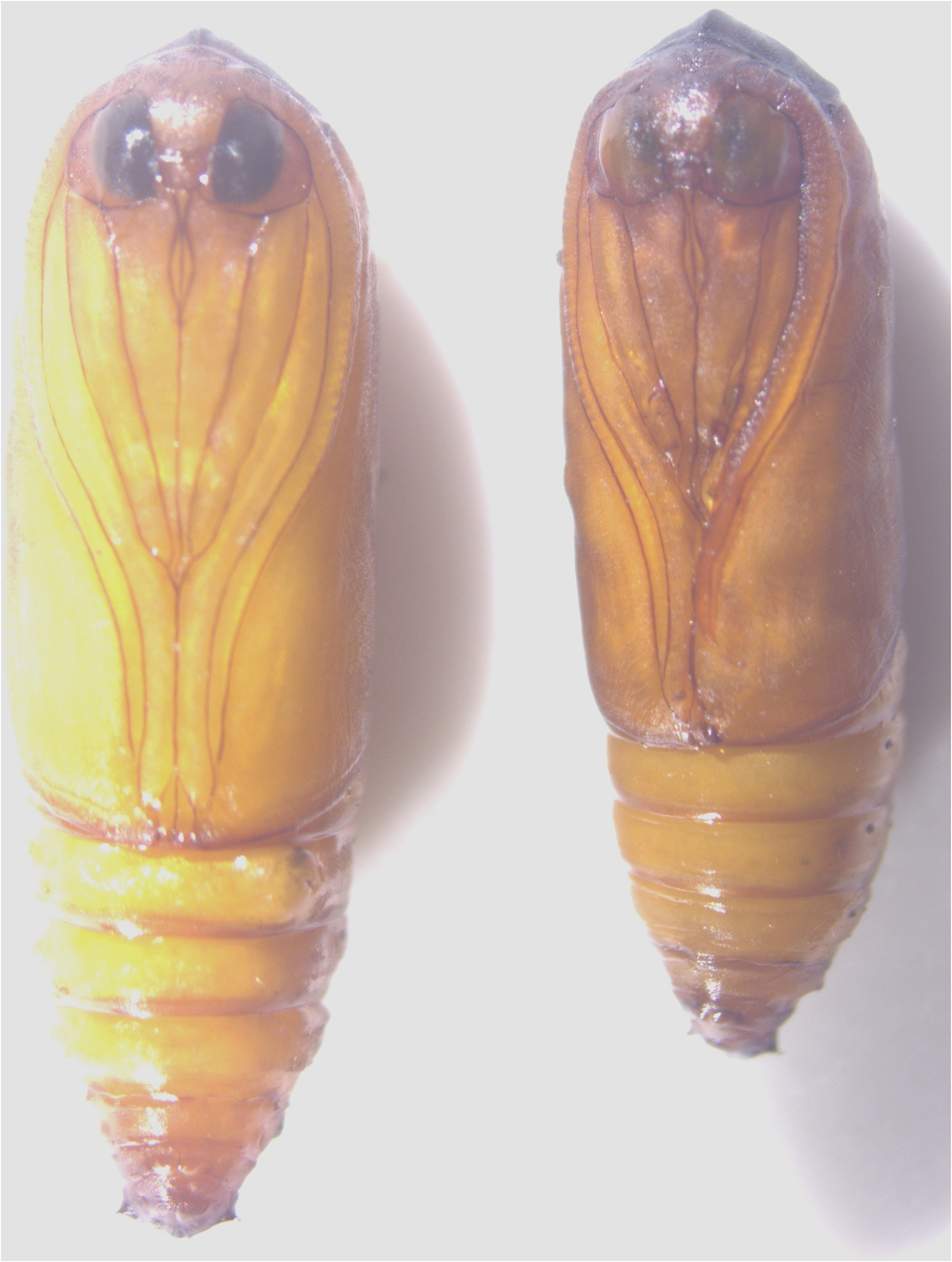
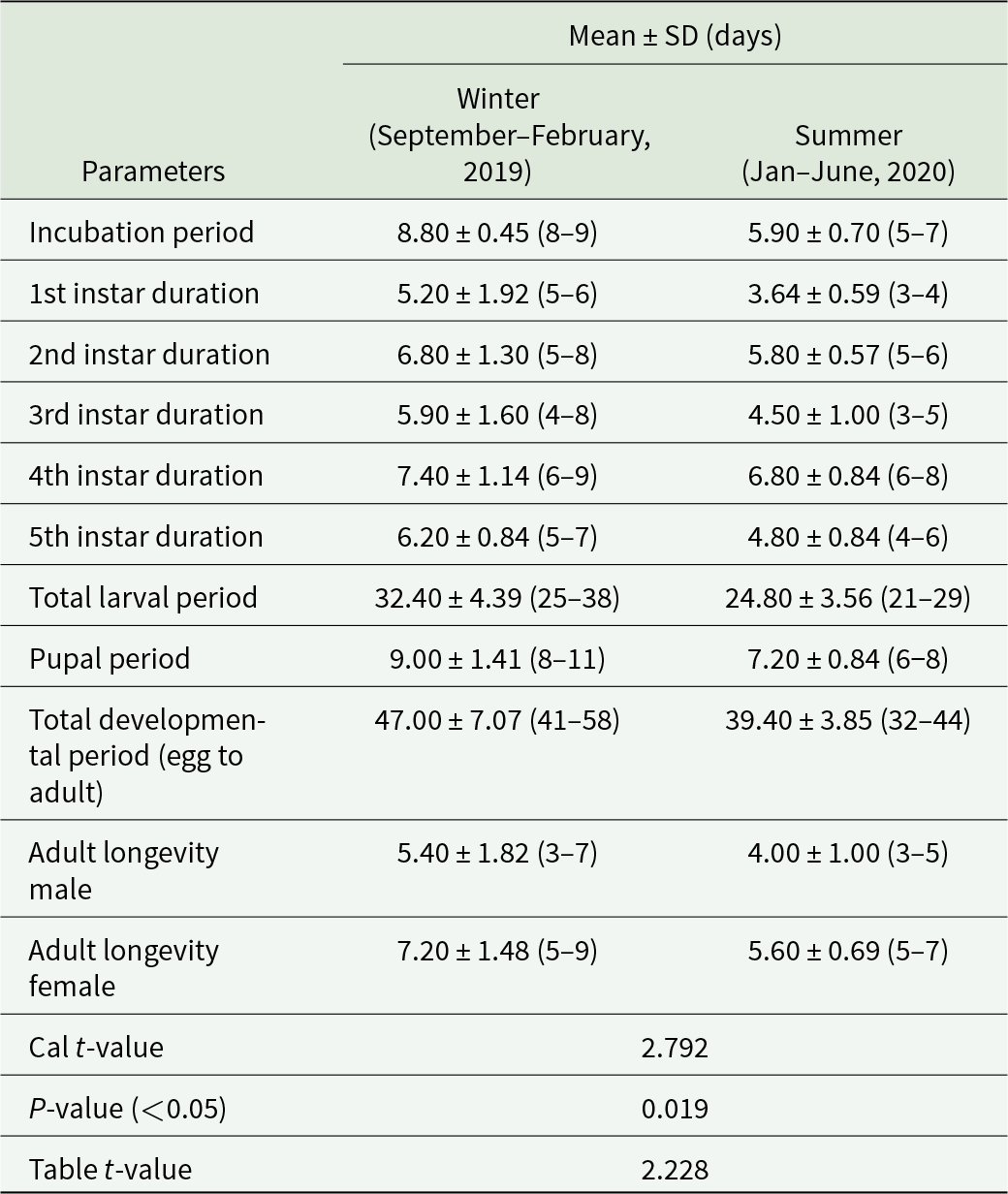
The life parameters of E. amabilis were studied under controlled laboratory conditions during winter (September–February 2019) and summer (January–June 2020). The incubation period ranged from 5 to 7 days in summer (mean 5.90 ± 0.70 days) and 8 to 9 days in winter (mean 8.80 ± 0.45 days) (table 1). Eggs were dull, round, yellowish-white, depressed medially, and ventrally flattened with a sculptured chorion. A black spot appeared prior to eclosion, marking the site of larval emergence. Larvae were eruciform, with eleven segments and three pairs of thoracic legs, passing through five instars. Two pairs of ventral prolegs (segments 8 and 9) and a pair of anal prolegs (segment 10) bore uniradial crochets; the anal crochets showed a lateral penellipse arrangement. First-instar larvae were active and translucent pinkish-white. All five instars showed a shorter duration period in the summer compared to the winter. The results from the t-test indicated that the duration period of development was significantly lower in summer compared to winter (t = 2.792, p < 0.05). Pupae were adecticous-obtect, initially white to yellow and later turning dark brown. Sexual dimorphism was evident: females possessed a cloven sternum on the eighth abdominal segment (bursa copulatrix), whereas males showed a pair of rounded knobs on the ninth segment (phallomeres) (fig. 1). Pupation was shorter in summer than in winter (table 1). Adults were medium-sized, dull-brown moths. Female longevity ranged from 5 to 7 days, while males lived 3–5 days during summer (table 1).
Reproductive parameters of E. amabilis during winter and summer seasons, 2019 and 2020

Table 1 Long description
The table compares seasonal reproductive timing and output for E. amabilis, including copulation duration, pre-oviposition, oviposition, post-oviposition, fecundity, daily reproductive rate, eggs hatched, hatching percentage, and environmental conditions. In winter, copulation averages 2.40 hours, pre-oviposition 6.80 days, oviposition 10.40 days, and post-oviposition 3.00 days. Winter fecundity averages 38.4 total eggs per 15 cm stick lac, with a daily reproductive rate of 8.20 eggs per female per day, about 33.57 eggs hatched, and 67.81 percent hatching; temperature is about 22.5 degrees C with relative humidity around 80 to 90 percent. In summer, copulation averages 3.51 hours, pre-oviposition 4.74 days, oviposition 6.80 days, and post-oviposition 2.82 days. Summer fecundity rises to 70.4 total eggs per 15 cm stick lac, daily reproductive rate to 11.4 eggs per female per day, eggs hatched to 59.56, and hatching percentage to 83.66 percent; temperature is about 32.5 degrees C with relative humidity around 90 to 95 percent. Overall, summer is associated with shorter pre-oviposition and oviposition periods but substantially higher egg production and hatching success than winter. Values are reported as averages with variability and ranges, so differences should be interpreted as seasonal patterns rather than exact fixed outcomes.
Note: Mean of seven observations. Figures in the parentheses are ranges.
Female and male pupa of Eublemma amabilis (left to right).

Behavioural response: Courtship and copulation
Copulation occurred during evening hours when both sexes exhibited increased agitation, particularly females. Males approached females and mating ensued. Females deposited eggs singly on lac encrustations, ranging from 51 to 89 eggs per female. Total fecundity was higher in summer (70.4 ± 8.52 eggs) than in winter (38.4 ± 8.52 eggs), with reproductive rates of 11.4 ± 3.20 and 8.20 ± 3.11 eggs/female/day, respectively (table 2).
Life cycle parameters (mean ± SD) of E. amabilis during winter and summer seasons, 2019 and 2020

Table 2 Long description
The table reports mean durations in days, with standard deviations and ranges, for incubation, each larval instar, pupation, total development from egg to adult, and adult longevity for males and females in winter and summer. Across nearly all stages, summer values are shorter than winter values. Incubation averages 5.9 days in summer compared with 8.8 days in winter, and the total larval period averages 24.8 days in summer versus 32.4 days in winter. The pupal period is also shorter in summer at 7.2 days compared with 9.0 days in winter. Overall development from egg to adult averages 39.4 days in summer and 47.0 days in winter. Adult longevity is shorter in summer for both sexes, with males averaging 4.0 days versus 5.4 in winter and females averaging 5.6 days versus 7.2 in winter. A reported t test indicates a statistically significant seasonal difference at the stated threshold, but the table does not specify which parameter the test summarizes, so interpretation should be cautious.
Note: Data are mean of seven observations. Figures in the parentheses are ranges.
Morphometric measurements of E. amabilis
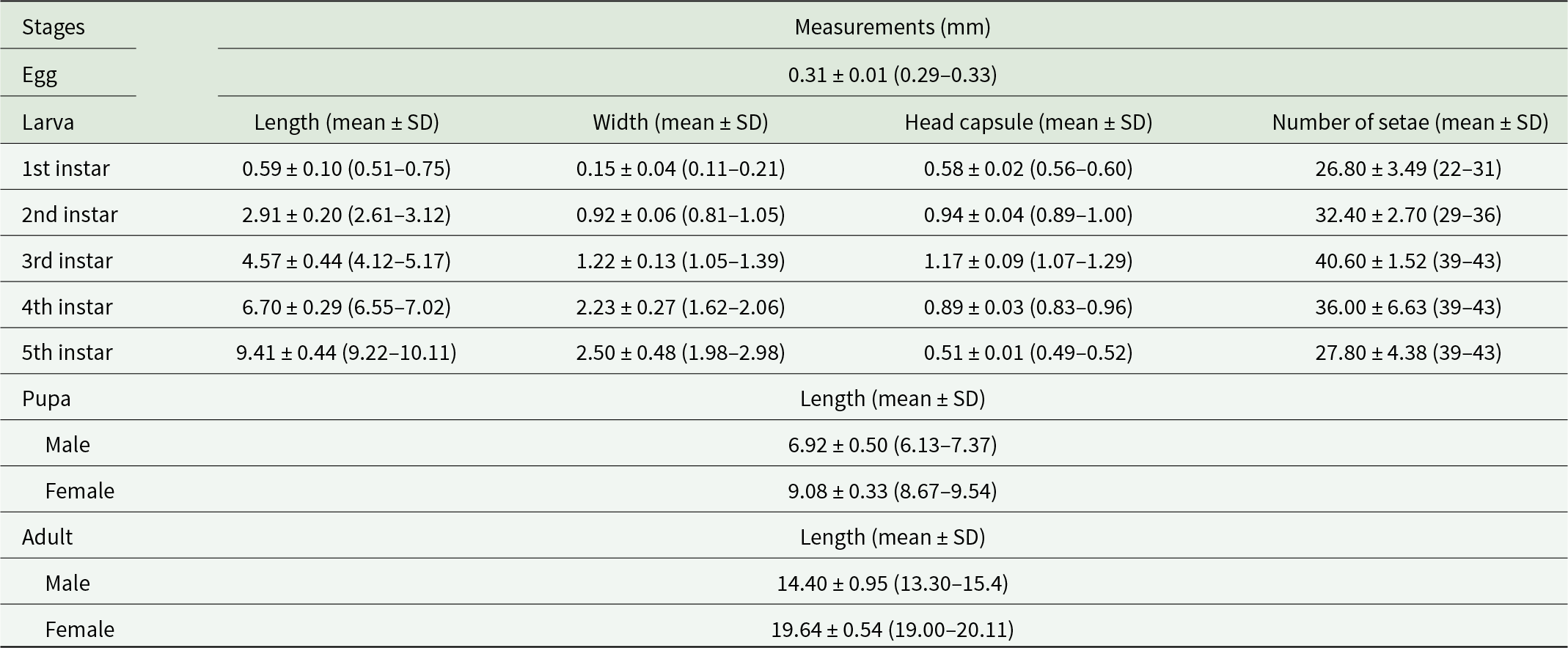
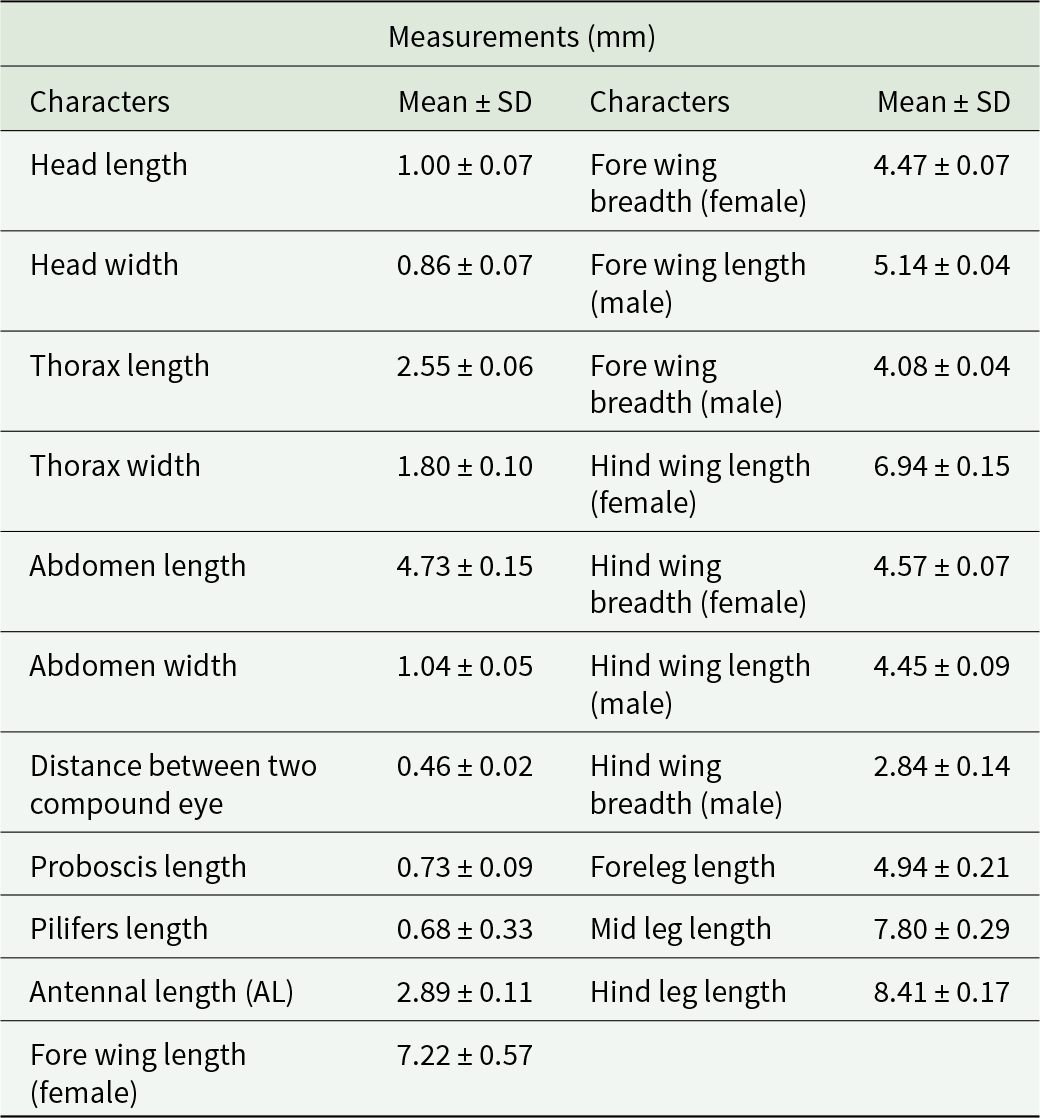
Morphometric traits across all developmental stages are summarised in table 3. Egg diameter ranged from 0.29 to 0.33 mm (mean 0.31 ± 0.01 mm). Larval instars displayed progressively increasing body and head dimensions, with the first instar measuring 0.51–0.75 mm in length and 0.11–0.21 mm in width (mean 0.59 ± 0.10 and 0.15 ± 0.04 mm), and the final instar reaching 9.22–10.11 mm in length and 1.98–2.98 mm in width (mean 9.41 ± 0.44 and 2.50 ± 0.48 mm). Setae counts ranged from 22 to 31 in first instars and 33 to 43 in later instars. Female pupae were longer than males, while pupal width was similar. Adult females were larger (19.64 ± 0.54 mm) with a posteriorly tapering abdomen and an anal hair tuft; males were smaller (14.40 ± 0.95 mm). The head was hypognathous, with compound eyes spaced 0.46 ± 0.02 mm apart. Mouthparts were of the siphoning type, and pilifers measured 0.68 ± 0.33 mm. Filiform antennae were 2.89 ± 0.11 mm long, composed of 36–42 flagellomeres. The thorax measured 2.55 ± 0.06 mm in length and 1.80 ± 0.10 mm in width. The abdomen was 10-segmented. Legs were densely hairy, and hind tibiae possessed two pairs of tibial spines. Male wings were smaller than female wings (table 4).
Morphometric measurements of different stages of E. amabilis

Table 3 Long description
Morphometric measurements in millimeters are summarized for E. amabilis across egg, larval instars, pupa, and adult stages, reported as mean with standard deviation and a range from seven observations. The egg measures 0.31 mm on average, with a range from 0.29 to 0.33 mm. Larval length increases steadily from 0.59 mm in the first instar to 9.41 mm in the fifth instar, and larval width generally increases from 0.15 mm to 2.50 mm. Head capsule width rises from 0.58 mm in the first instar to 1.17 mm in the third instar, then drops to 0.89 mm in the fourth instar and 0.51 mm in the fifth instar, indicating overlap and variability in later instars. The mean number of setae increases from 26.80 in the first instar to 40.60 in the third instar, then decreases to 36.00 in the fourth and 27.80 in the fifth. Pupal length is larger in females than males, averaging 9.08 mm for females and 6.92 mm for males. Adult length also shows females larger than males, averaging 19.64 mm for females and 14.40 mm for males. Interpret head capsule changes cautiously because later instars show a deviation from the expected progressive increase, consistent with natural variability and character overlap.
Note: Data are mean of seven observations. Although Dyar’s rule generally predicts a progressive increase in head capsule width across successive instars, a slight deviation was observed in the later instars of E. amabilis, which may be attributed to natural variability and overlap in larval morphometric characters during the current study.
Morphometric measurements of different body parts of adult E. amabilis

Table 4 Long description
Morphometric measurements in millimeters are listed for adult E. amabilis body parts and appendages, reported as mean with standard deviation. Head dimensions are small, with head length about 1.00 mm and head width about 0.86 mm, while the thorax is larger at about 2.55 mm long and 1.80 mm wide. The abdomen averages about 4.73 mm long and 1.04 mm wide. Wing measures show females larger than males: female fore wing length about 7.22 mm versus male about 5.14 mm, and female hind wing length about 6.94 mm versus male about 4.45 mm. Wing breadths follow the same pattern, with female fore wing breadth about 4.47 mm compared with male about 4.08 mm, and female hind wing breadth about 4.57 mm compared with male about 2.84 mm. Legs are among the longest structures measured, increasing from foreleg about 4.94 mm to mid leg about 7.80 mm and hind leg about 8.41 mm. Other small features include distance between compound eyes about 0.46 mm, proboscis length about 0.73 mm, pilifers length about 0.68 mm, and antennal length about 2.89 mm. Values summarize a small sample and include variability, so individual specimens may fall outside the means.
Note: Mean of seven observations. Figures in the parentheses are ranges.
Seasonal incidence of E. amabilis
Summer season (winter-harvested crop) of K. chinensis
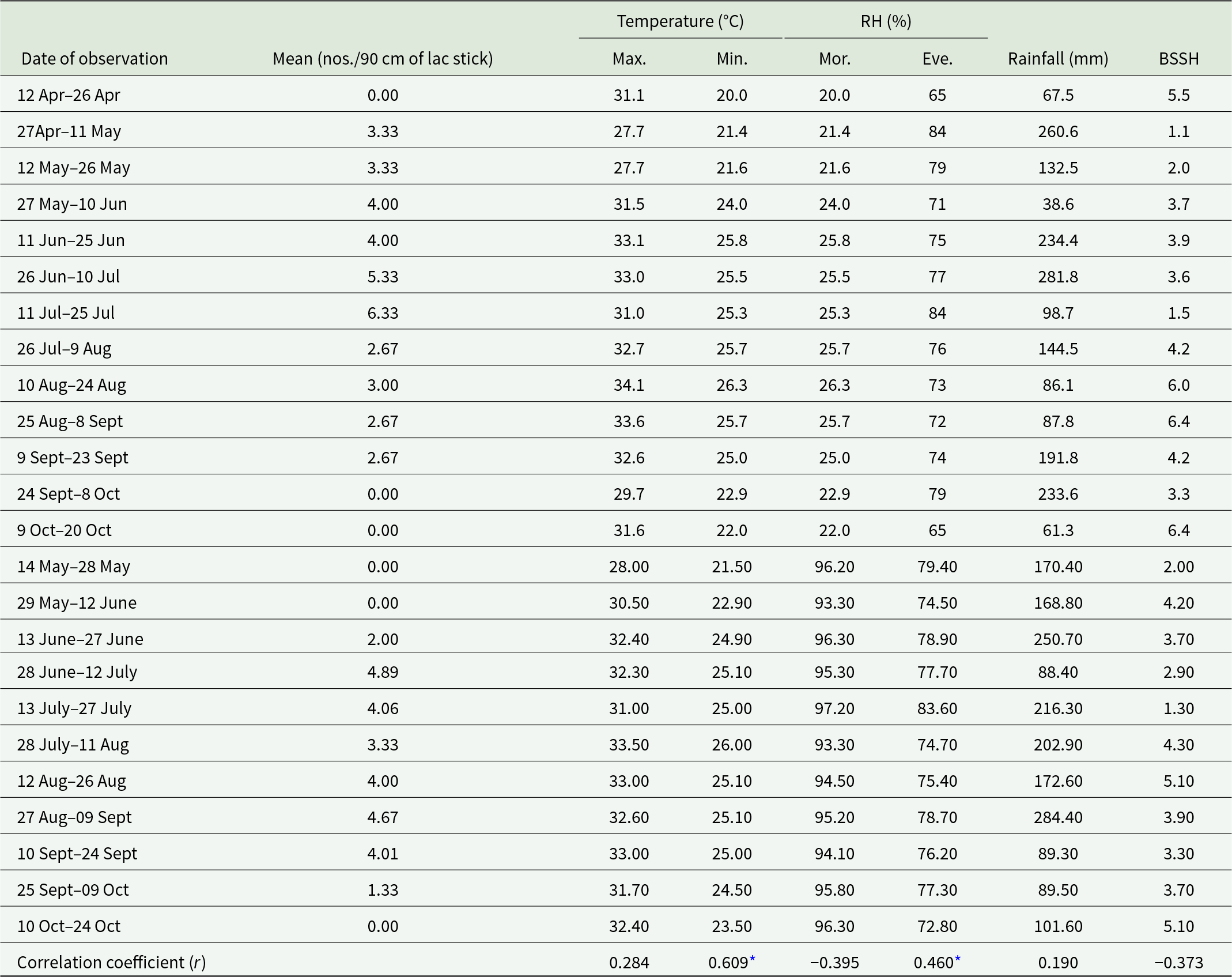
During the 2019 and 2020 summer seasons (April–October), larval populations rose sharply with the onset of monsoon, peaking in July (5.33–6.33 larvae/90 cm stick in 2019 and 4.33 larvae in 2020; table 5). A decline was observed towards October. These patterns indicate that favourable night-time microclimatic conditions promote pest proliferation during the winter-harvested crop period.
Incidence of E. amabilis in summer season (winter harvested) crop of Kerria chinensis during 2019 and 2020

Table 5 Long description
The table lists observation periods across the summer season for two years, reporting mean E. amabilis counts per 90 cm of lac stick alongside weather measures: maximum and minimum temperature, morning and evening relative humidity, rainfall, and bright sunshine hours. In the first year, incidence was zero in mid to late April, rose to about 3 to 4 from late April through late June, peaked at about 6.33 in mid July, then fell to about 2.67 to 3.00 from late July through late September and returned to zero from late September into October. Weather during the first-year peak coincided with a maximum temperature near 31 degrees Celsius, minimum near 25 degrees, evening humidity in the mid 80s, rainfall near 99 mm, and low sunshine around 1.5 hours. In the second year, incidence stayed at zero through mid June, increased to about 2.00 in late June, peaked at about 4.89 in late June to mid July, remained mostly between about 3.33 and 4.67 through late September, then dropped to 1.33 in early October and to zero by mid to late October. The correlation summary indicates incidence tended to increase with higher maximum temperature and higher evening humidity, while it tended to decrease with higher minimum temperature and with more sunshine; rainfall and morning humidity showed weaker relationships. Correlations describe association only and do not establish that weather factors caused changes in incidence.
* Significant at p < 0.05.
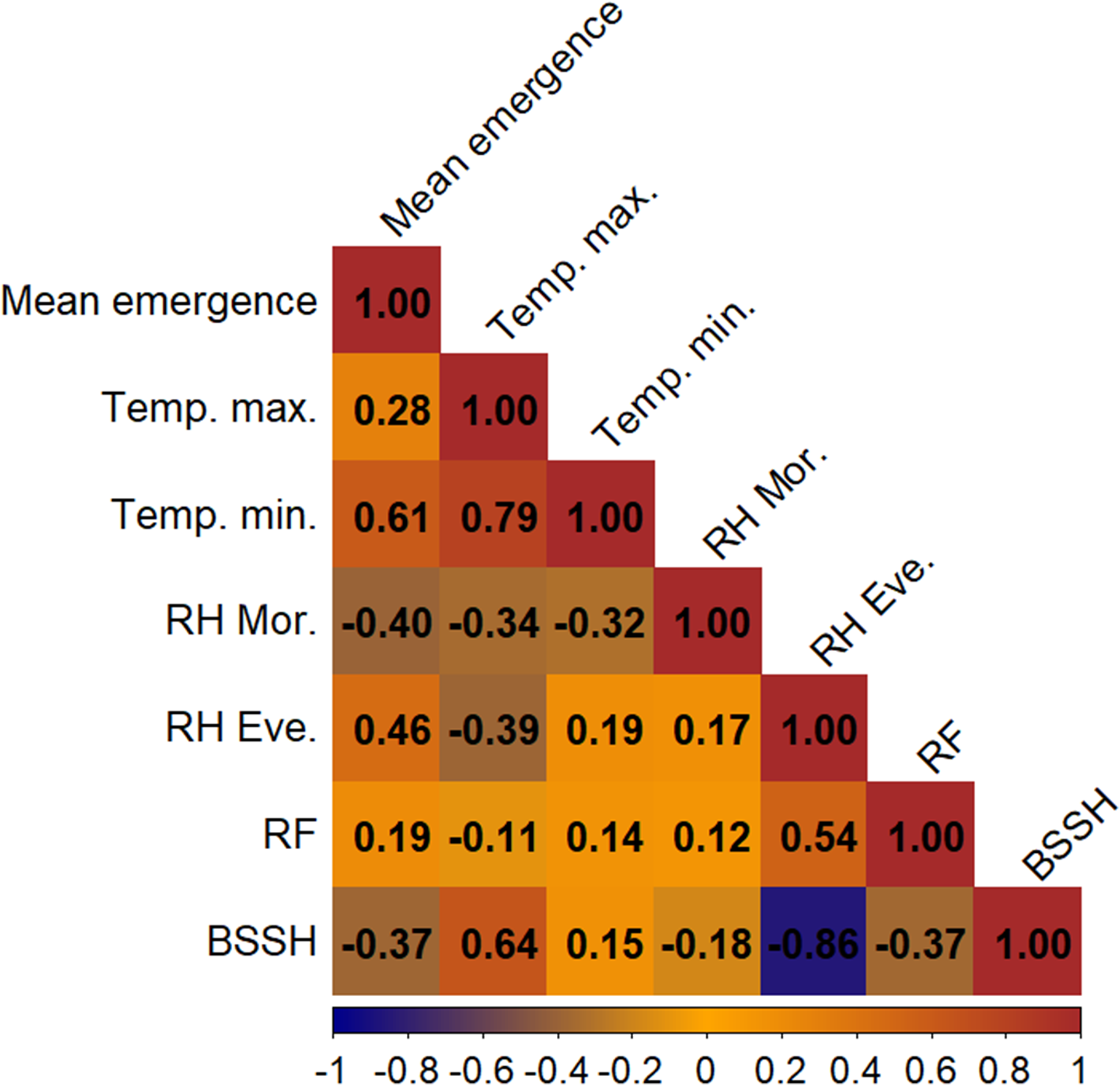
Correlation analysis (2019–2020 pooled) revealed significant positive associations with minimum temperature (r = 0.609) and evening relative humidity (r = 0.46), while maximum temperature (r = 0.284) and rainfall (r = 0.19) showed weak, non-significant positive correlations (fig. 2). Morning relative humidity (r = −0.395) and sunshine hours (r = −0.373) were negatively correlated. The regression model Y = 6.416 + 0.341 Tmin – 0.026 RH(eve) explained 69.6% of the variation (table 6).
Correlation matrix of incidence of E. amabilis in K. chinensis during summer crop (winter harvest). Developed using R software coloured scale represents the correlation coefficients. Brown: Strong + correlation, blue: strong correlation; values within the correlogram = Pearson’s correlation coefficients (r values).

Figure 2 Long description
Correlation matrix heatmap with a triangular grid of square cells. Row and column labels: Mean emergence, Temp. max., Temp. min., RH Mor., RH Eve., RF, BSSH. Each cell contains a numeric correlation value. A horizontal scale below the heatmap is labeled from minus 1, minus 0.8, minus 0.6, minus 0.4, minus 0.2, 0, 0.2, 0.4, 0.6, 0.8, to 1. Diagonal cells show 1.00 for each variable with itself. Cells shown below the diagonal, listed by row label then column label: Temp. max. with Mean emergence: 0.28. Temp. min. with Mean emergence: 0.61; with Temp. max.: 0.79. RH Mor. with Mean emergence: minus 0.40; with Temp. max.: minus 0.34; with Temp. min.: minus 0.32. RH Eve. with Mean emergence: 0.46; with Temp. max.: minus 0.39; with Temp. min.: 0.19; with RH Mor.: 0.17. RF with Mean emergence: 0.19; with Temp. max.: minus 0.11; with Temp. min.: 0.14; with RH Mor.: 0.12; with RH Eve.: 0.54. BSSH with Mean emergence: minus 0.37; with Temp. max.: 0.64; with Temp. min.: 0.15; with RH Mor.: minus 0.18; with RH Eve.: minus 0.86; with RF: minus 0.37. Largest positive value shown is 0.79 between Temp. min. and Temp. max. Largest negative value shown is minus 0.86 between BSSH and RH Eve.
Incidence of E. Amabilis in winter season (summer harvested) crop of Kerria chinensis during 2019 and 2020–21

Table 6 Long description
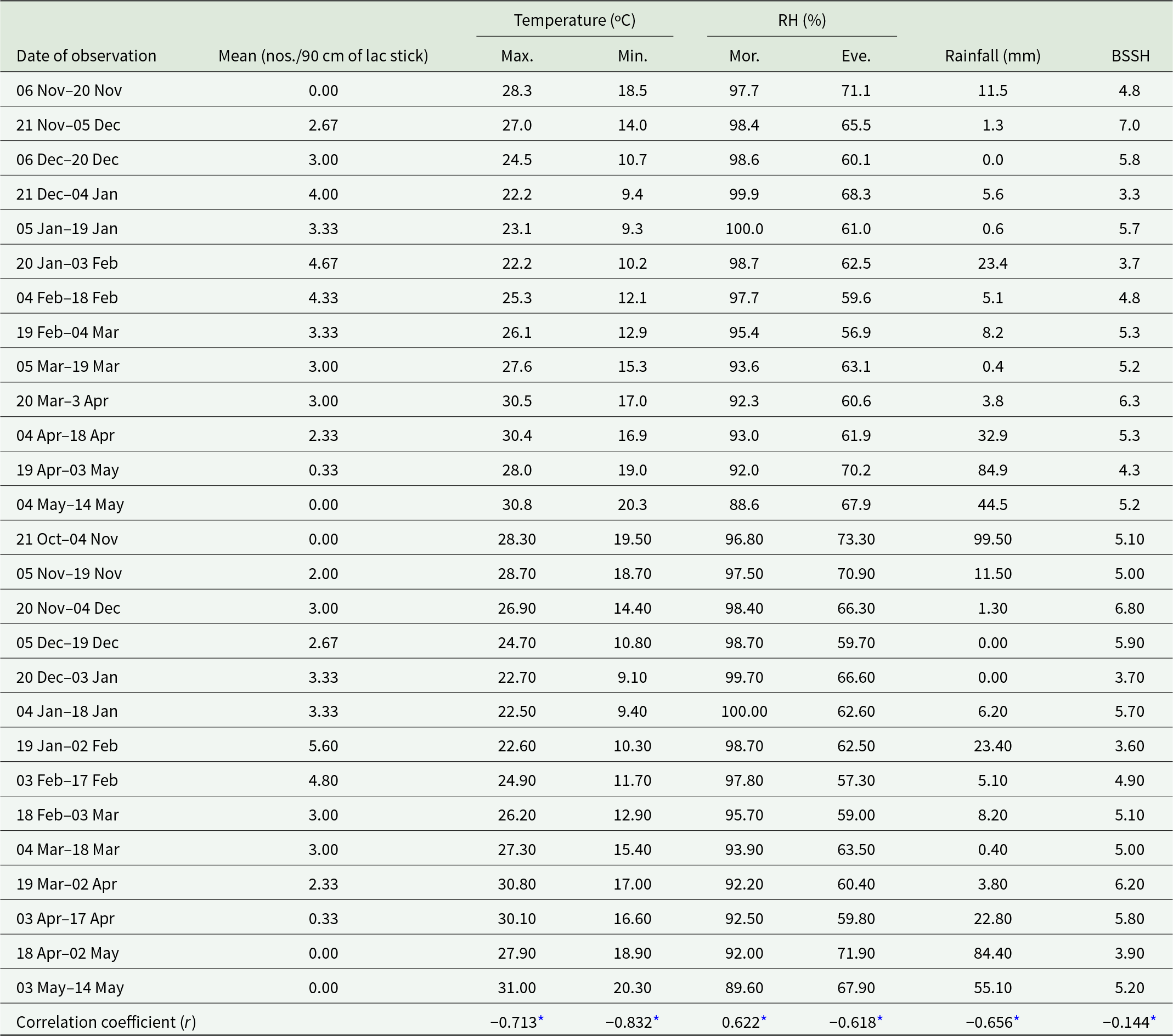
The table reports fortnightly mean counts of E. amabilis per 90 cm lac stick alongside weather conditions: maximum and minimum temperature, morning and evening relative humidity, rainfall, and bright sunshine hours. In the first season, incidence is zero in early November, increases through December, peaks at 4.67 during 20 Jan to 03 Feb, then declines to 0.33 by 19 Apr to 03 May and returns to zero by 04 May to 14 May. In the second season, incidence is also zero at the start (21 Oct to 04 Nov), rises through November and December, reaches the highest value of 5.60 during 19 Jan to 02 Feb, then drops to 0.33 by 03 Apr to 17 Apr and to zero by 18 Apr to 02 May and 03 May to 14 May. Peak incidence occurs during cooler periods with minimum temperatures near 9 to 10 degrees Celsius and very high morning humidity near 99 to 100 percent, while late season declines coincide with warmer minimum temperatures near 19 to 20 degrees Celsius and heavier rainfall. Reported correlations indicate incidence tends to decrease as temperatures, evening humidity, and sunshine increase, and tends to increase with higher morning humidity; rainfall shows only a weak relationship. Correlation results are associative and do not establish causation, and the table summarizes averages over observation windows rather than daily values.
* Significant at p < 0.05.
Winter season (summer harvested) crop of K. chinensis
In 2019–2020, the first recorded incidence occurred in late November (2.67 larvae/90 cm). Populations peaked in late January (4.67) and early February (4.33). A similar trend occurred in 2020–2021, with maxima in late January (5.60) and early February (4.80) (table 7).
Incidence of E. amabilis in monsoon-harvested crop of Kerria lacca during 2020 and 2021

Table 7 Long description
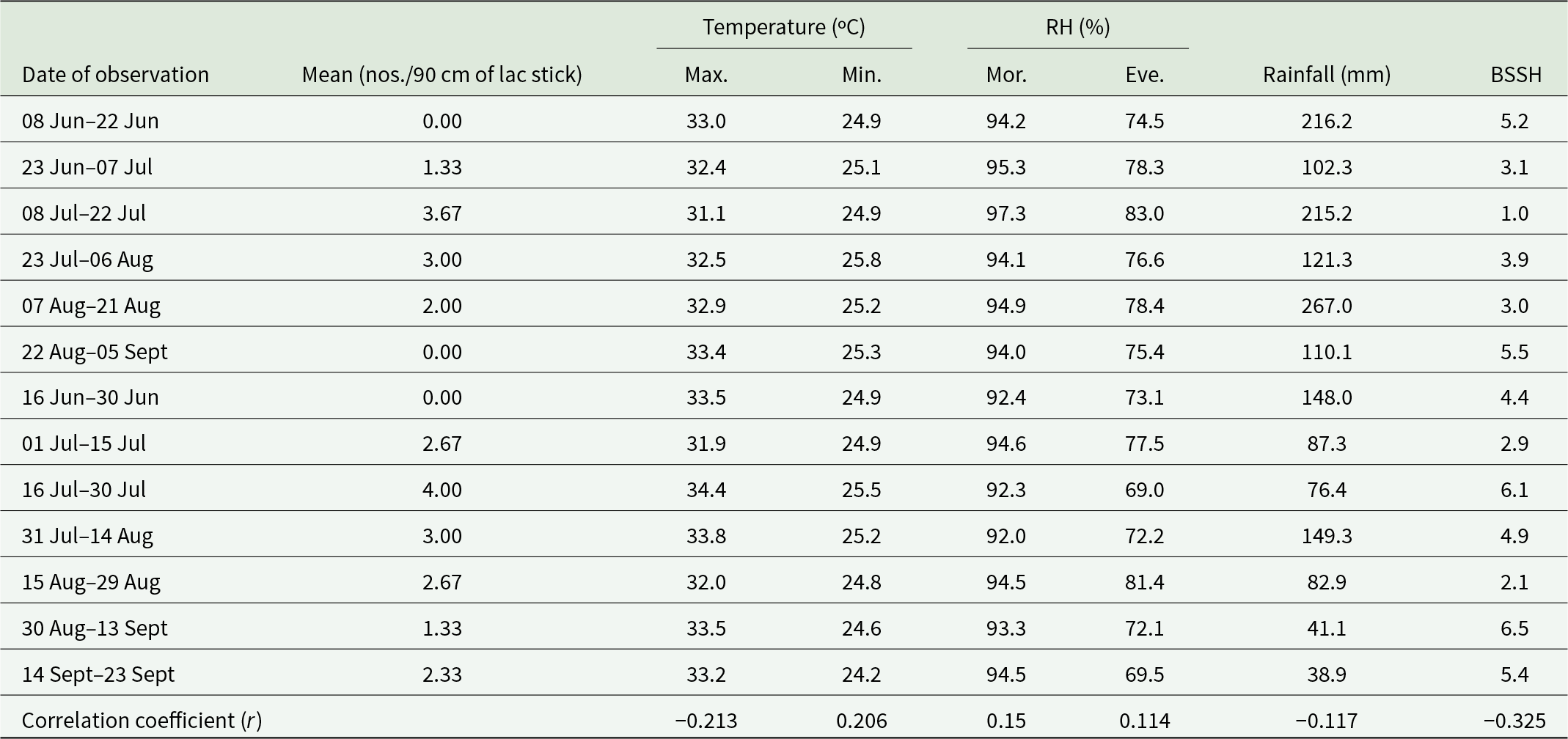
The table lists fortnightly observations of E. amabilis incidence per 90 cm of lac stick alongside weather conditions: maximum and minimum temperature, morning and evening relative humidity, rainfall, and bright sunshine hours. In the first season shown, incidence rose from zero in early to late June to a high of 3.67 in early to late July, then declined to zero by late August to early September. In the second season, incidence was zero in mid to late June, increased to 2.67 in early to mid July, reached the overall maximum of 4.00 in mid to late July, and then generally decreased through September, ending at 2.33 in mid to late September. Weather during these periods ranged from about 31.1 to 34.4 degrees Celsius for maximum temperature and about 24.2 to 25.8 degrees Celsius for minimum temperature, with high humidity overall and rainfall varying widely from about 38.9 to 267.0 millimeters. The correlation row suggests weak relationships between incidence and most weather variables, with the strongest tendency being a negative association with bright sunshine hours and a smaller negative association with rainfall. These correlations are small, so they should be interpreted cautiously and do not by themselves indicate cause and effect.
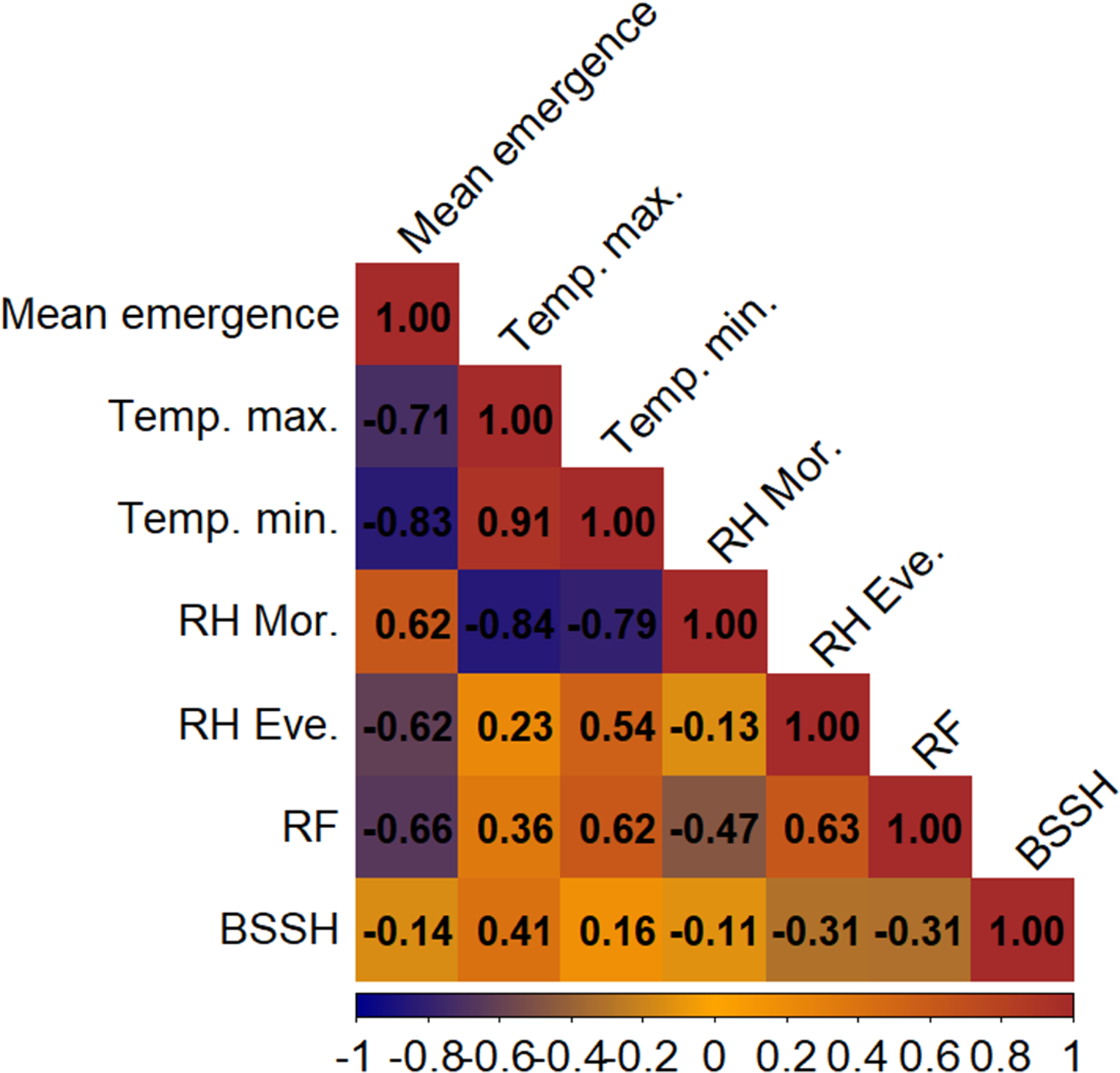
Correlation analysis showed a significant positive association with morning relative humidity (r = 0.622). Maximum temperature (r = −0.713), minimum temperature (r = −0.832), evening relative humidity (r = −0.618), and rainfall (r = −0.656) were significantly and negatively correlated (fig. 3). Multiple regression identified maximum temperature and rainfall as dominant factors, explaining 78% of variation (R 2 = 0.78).
Correlation matrix of incidence of E. amabilis in K. chinensis during winter crop (summer harvest). Developed using R software coloured scale represents the correlation coefficients. Brown: Strong + correlation, blue: strong correlation; values within the correlogram = Pearson’s correlation coefficients (r values).

Figure 3 Long description
The heat map displays a correlation matrix with labels: Mean emergence, Temp. max., Temp. min., RH Mor. (Relative Humidity Morning), RH Eve. (Relative Humidity Evening), RF (Rainfall) and BSSH (Bright Sunshine Hours). The color gradient ranges from blue to brown, representing negative to positive correlations. Key insights include: Temp. max. and Temp. min. show a strong positive correlation of 0.91. Mean emergence has a strong negative correlation with Temp. min. at minus 0.83 and Temp. max. at minus 0.71. RH Mor. is positively correlated with Mean emergence at 0.62 but negatively with Temp. max. at minus 0.84. RF shows a moderate positive correlation with RH Eve. at 0.63. The diagonal values are all 1.00, indicating self-correlation. The gradient scale below the matrix ranges from minus 1 to 1, with blue indicating strong negative and brown indicating strong positive correlations.
Monsoon-harvested crop of K. lacca
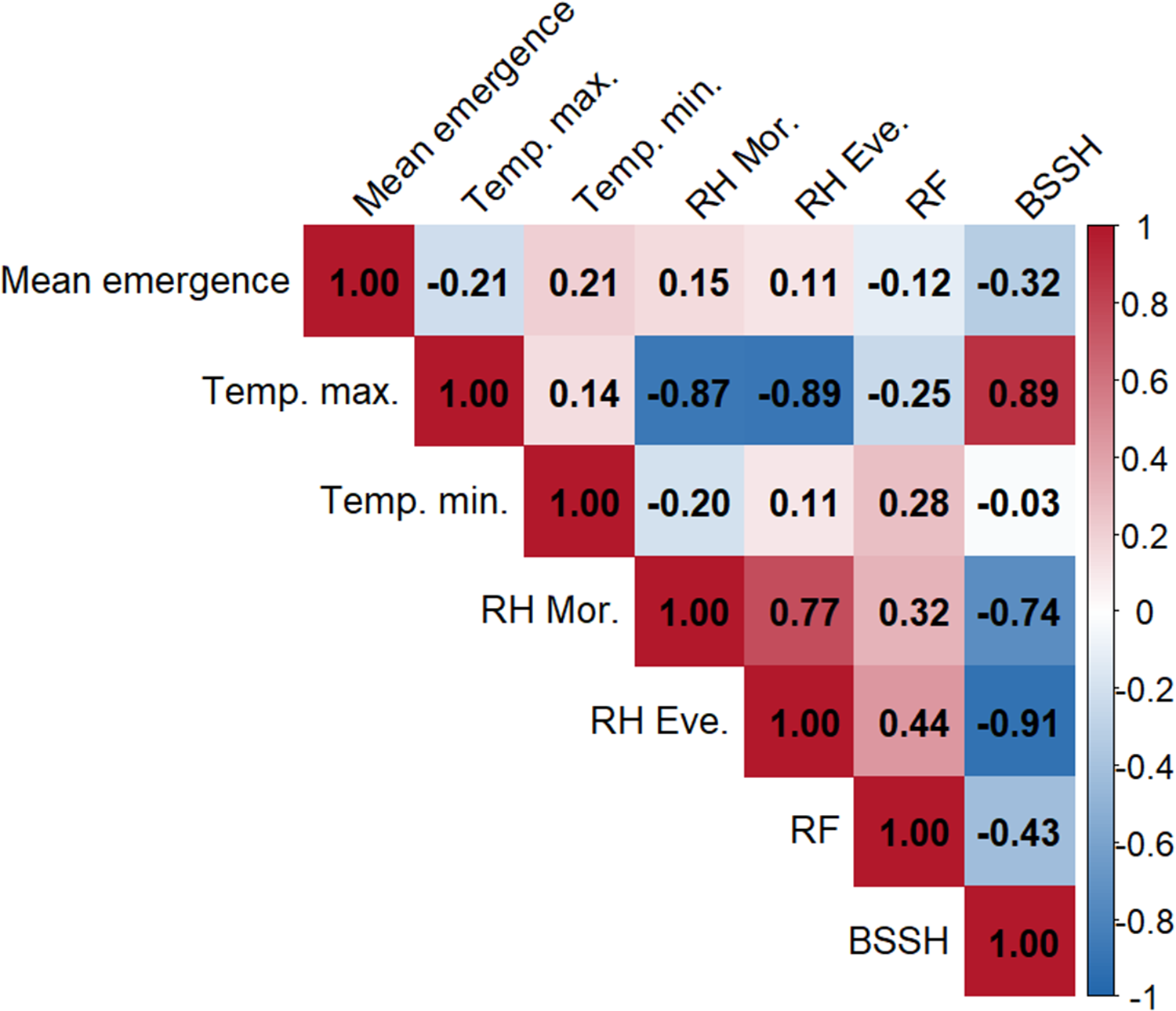
Peak incidence occurred in early July 2020 (3.67 larvae/90 cm) (table 8). Weather variables showed weak, non-significant correlations, with negative associations for rainfall (r = −0.177), maximum temperature (r = −0.213), and sunshine hours (r = −0.325), and weak positive associations with minimum temperature and humidity (fig. 4). These results suggest only modest sensitivity to short-term weather fluctuations.
Correlation matrix of incidence of E. amabilis on K. lacca during monsoon harvest. Developed using R software coloured scale represents the correlation coefficients. Blue: Strong correlation, brown: strong + correlation; values within the correlogram = Pearson’s correlation coefficients (r values).

Figure 4 Long description
A square correlation matrix heatmap with seven row labels and seven column labels. The row labels, from top to bottom, read: Mean emergence; Temp. max.; Temp. min.; RH Mor.; RH Eve.; RF; BSSH. The column labels, from left to right, read: Mean emergence; Temp. max.; Temp. min.; RH Mor.; RH Eve.; RF; BSSH. Each diagonal cell shows 1.00. Row Mean emergence: under Mean emergence 1.00; under Temp. max. minus 0.21; under Temp. min. 0.21; under RH Mor. 0.15; under RH Eve. 0.11; under RF minus 0.12; under BSSH minus 0.32. Row Temp. max.: under Temp. max. 1.00; under Temp. min. 0.14; under RH Mor. minus 0.87; under RH Eve. minus 0.89; under RF minus 0.25; under BSSH 0.89. Row Temp. min.: under Temp. min. 1.00; under RH Mor. minus 0.20; under RH Eve. 0.11; under RF 0.28; under BSSH minus 0.03. Row RH Mor.: under RH Mor. 1.00; under RH Eve. 0.77; under RF 0.32; under BSSH minus 0.74. Row RH Eve.: under RH Eve. 1.00; under RF 0.44; under BSSH minus 0.91. Row RF: under RF 1.00; under BSSH minus 0.43. Row BSSH: under BSSH 1.00. A vertical scale at the right shows tick labels 1, 0.8, 0.6, 0.4, 0.2, 0, minus 0.2, minus 0.4, minus 0.6, minus 0.8, minus 1.
Incidence of E. amabilis in the winter-harvested crop of Kerria lacca during 2020–2021

Table 8 Long description
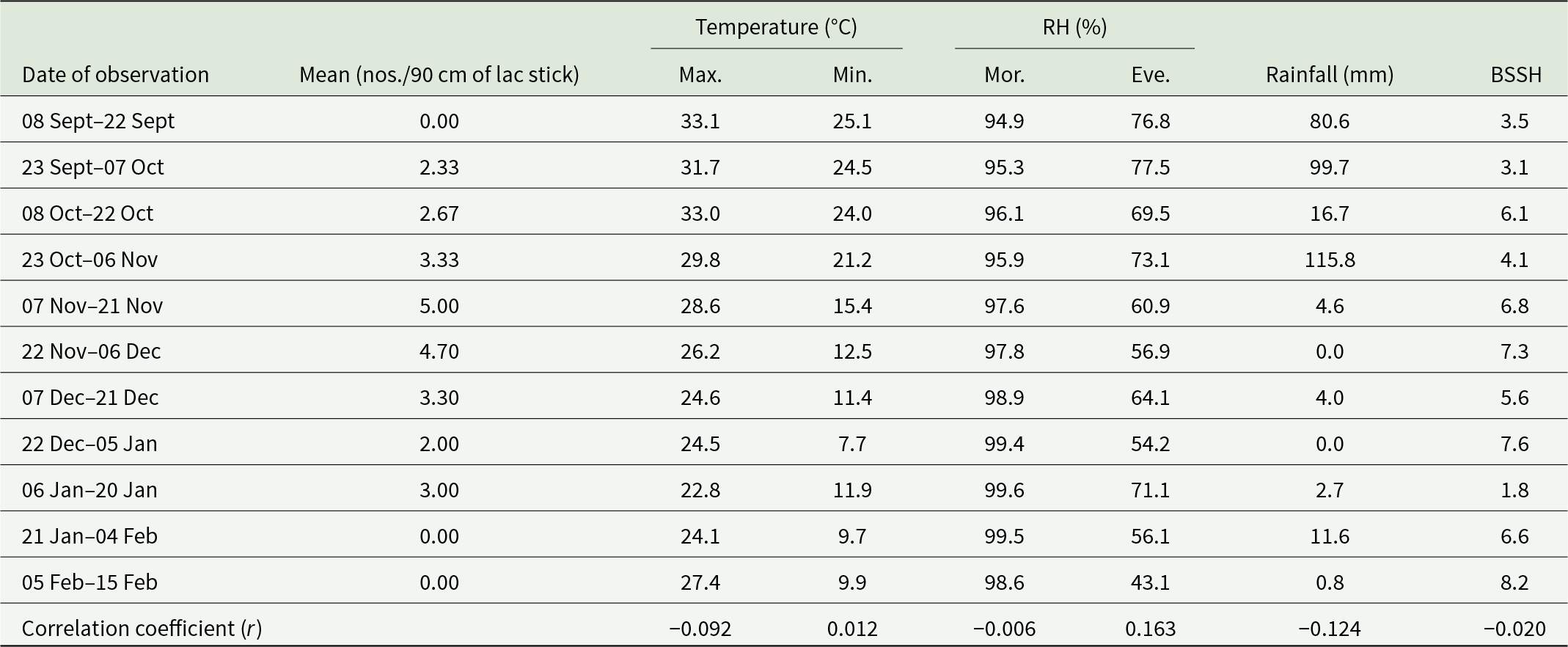
The table reports E. amabilis incidence per 90 cm of lac stick across 11 observation periods from early September to mid February, alongside maximum and minimum temperature, morning and evening relative humidity, rainfall, and bright sunshine hours. Incidence was zero in early to late September, rose through October, and reached its highest value of 5.00 during 07 Nov to 21 Nov. After a slight drop to 4.70 in 22 Nov to 06 Dec, incidence generally declined through December and early January, returned to 0.00 in 21 Jan to 04 Feb, and stayed at 0.00 in 05 Feb to 15 Feb. Weather during the peak period included a maximum temperature of 28.6 degrees Celsius, minimum of 15.4 degrees, very high morning humidity near 97.6 percent, evening humidity near 60.9 percent, low rainfall at 4.6 mm, and 6.8 hours of bright sunshine. The lowest minimum temperature occurred in 22 Dec to 05 Jan at 7.7 degrees, when incidence was 2.00. Correlation values at the bottom suggest very weak relationships between incidence and the listed weather variables overall, so patterns should be interpreted cautiously and not as proof of causation.
Winter-harvested crop of K. lacca
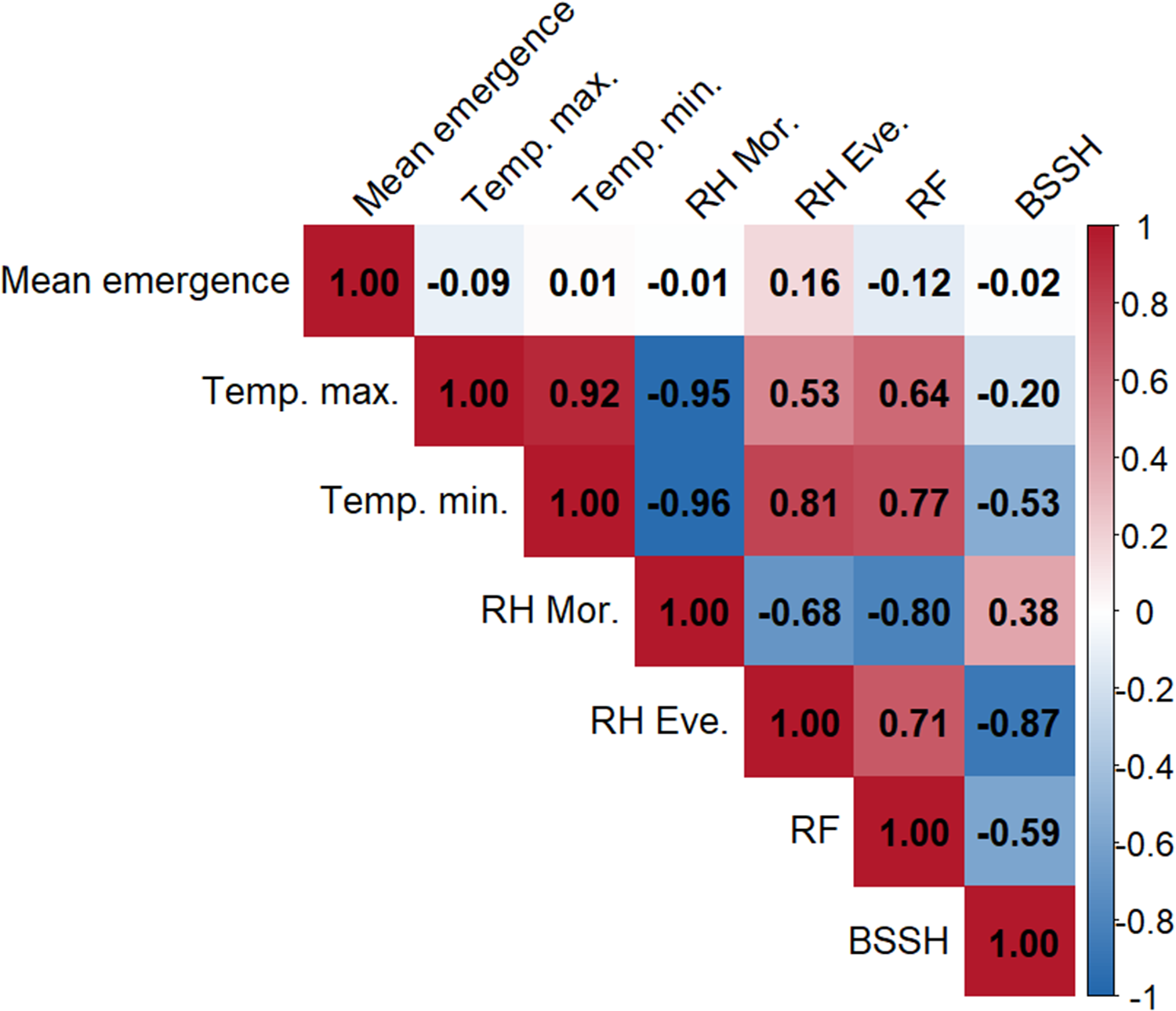
E. amabilis first appeared in late September–October 2020 (2.33–2.67 larvae/90 cm) and peaked in November (4.70–5.00 larvae) (fig. 5) (table 9). Correlation analysis showed no significant relationships between pest incidence and any weather parameter, indicating minimal influence of short-term climatic variation under winter-harvested conditions.
Correlation matrix of incidence of E. amabilis on K. lacca during winter harvest. Developed using R software coloured scale represents the correlation coefficients. Blue: Strong correlation, brown: strong + correlation; values within the correlogram = Pearson’s correlation coefficients (r values).

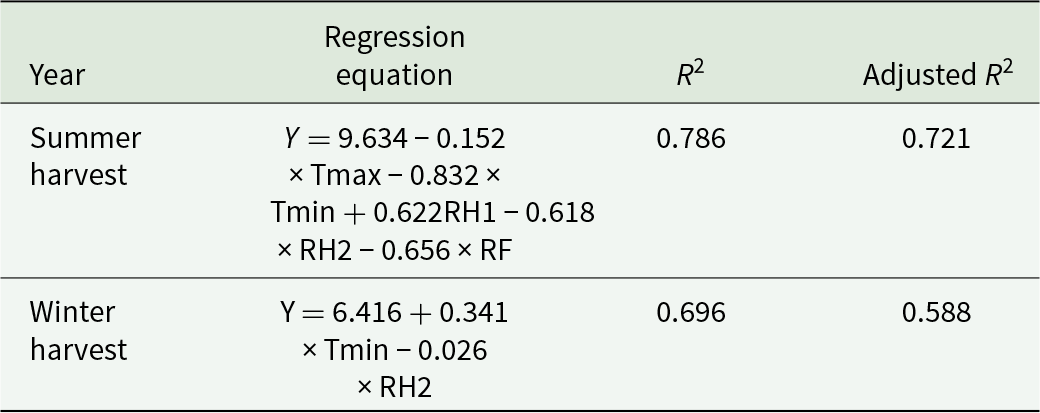
Regression equation of weather parameters with incidence of E. amabilis infesting Kerria chinensis

Table 9 Long description
The table summarizes two regression models that relate weather conditions to the incidence of E. amabilis infestation on Kerria chinensis, reported separately for summer and winter harvests. Model fit is higher for the summer harvest, with an R squared of 0.786 and an adjusted R squared of 0.721. The winter harvest model has a lower fit, with an R squared of 0.696 and an adjusted R squared of 0.588. In the summer model, maximum temperature, minimum temperature, the second relative humidity measure, and rainfall are associated with lower predicted incidence, while the first relative humidity measure is associated with higher predicted incidence. In the winter model, minimum temperature is associated with higher predicted incidence, while the second relative humidity measure is associated with lower predicted incidence. Adjusted R squared values are lower than R squared in both seasons, indicating some reduction in explained variation after accounting for the number of predictors.
Discussion
Seasonal variation in incubation period is likely driven by temperature and humidity, food sources consistent with Mishra et al. (Reference Mishra, Negi and Gupta1930). Egg morphology and pre-eclosion patterns corroborate earlier reports (Bento et al., Reference Bento, Nava, Chagas, Costa, Libardi and Parra2006; Rahman et al., Reference Rahman, Ahmed, Shahjahan and Sohrab2009; Khobragade, Reference Khobragade2010; Sarvade et al., Reference Sarvade, Panse, Rajak and Upadhyay2018; Bouslama et al., Reference Bouslama, Chaieb, Jerbi-elayed and Laarif2019). The observed egg diameter (0.29–0.33 mm) matches (0.34–0.38 mm) Rahman et al. (Reference Rahman, Ahmed, Shahjahan and Sohrab2009) and Indrayati and Susilo (Reference Indrayati and Susilo2015) but is slightly lower than Rahman et al. (Reference Rahman, Ahmed, Shahjahan and Sohrab2009), possibly due to environmental effects.
Larval traits, instar number, and crochet patterns align with Rahman et al. (Reference Rahman, Ahmed, Shahjahan and Sohrab2009) and Indrayati and Susilo (Reference Indrayati and Susilo2015). Although Dyar’s rule generally predicts a progressive increase in head capsule width across successive instars, slight deviation was observed in the later instars of E. amabilis in the present study. Such variation may possibly be due to natural overlap between larval instars and morphometric variability under different developmental conditions. Similar deviations from Dyar’s rule have also been reported by Calvo and Molina (Reference Calvo and Molina2008). The incubation period of E. amabilis recorded during summer in the present study (5.90 ± 0.70 days) was slightly higher than the 4.60 days reported by Meena et al. (Reference Meena, Swami, Sharma and Gautam2025). Similarly, the total larval duration observed under Assam conditions (24.80 ± 3.56 to 32.40 ± 4.39 days) was in close agreement with the larval-pupal duration of 22–38 days reported earlier. However, fecundity recorded in the present investigation during summer (70.4 ± 8.52 eggs/female) was comparatively lower than the 90–110 eggs/female observed by Meena et al. (Reference Meena, Swami, Sharma and Gautam2025), which may possibly be due to differences in geographic conditions. Total larval duration was longer than reported for Spodoptera mauritia (Ramaiah and Maheswari, Reference Ramaiah and Maheswari2018). Morphometric traits and setal counts match previous descriptions (Rahman et al., Reference Rahman, Ahmed, Shahjahan and Sohrab2009; Khobragade, Reference Khobragade2010). Pupal sexual dimorphism corresponds with earlier studies suggesting bursa copulatrix on eight abdominal segment of female which was lacking in male adults in other noctuid moths such as S. mauritia and Helicoverpa armigera (Ramaiah and Maheswari, Reference Ramaiah and Maheswari2018; Khobragade et al., Reference Khobragade, Thomas, Pachori, Sharma and Shrivastava2012; Bouslama et al., Reference Bouslama, Chaieb, Jerbi-elayed and Laarif2019). Shorter summer pupal duration agrees with Mironidis and Savopoulou-soultani (Reference Mironidis and Savopoulou-soultani2008). Adult longevity and dimorphism match previous findings, though Islam et al. (Reference Islam, Ali and Islam2010) reported no size difference between sexes, which might be due to various geographical and ecological conditions. Courtship behaviour resembled patterns described by Bento et al. (Reference Bento, Nava, Chagas, Costa, Libardi and Parra2006). Fecundity (51–89 eggs) was consistent with Mishra et al. (Reference Mishra, Negi and Gupta1930) and others.
Seasonal incidence trends on K. chinensis matched Rahman et al. (Reference Rahman, Ahmed, Shahjahan and Sohrab2009), who reported peak activity during July–October due to high oviposition rate, while rainfall effects aligned with Morshed et al. (Reference Morshed, Howlader, Rafiqul, Islam and Hera2020), who described rainfall as the key factor in governing pest proliferation during winter harvesting crop. Observations on K. lacca corroborated earlier findings that populations peak around August–September (Kravchenko and Muller, Reference Kravchenko and Muller2008) and October–November in winter crops, where similar findings were also mentioned in findings by Meena and Sharma (Reference Meena and Sharma2018) and Mohanasundaram et al. (Reference Mohanasundaram, Sharma, Lohot, Thamilarasi, Ghosh, Ramani and Eqbal2018).
The regression models developed indicated R 2 values ranging from 0.696 to 0.786. However, the comparatively lower adjusted R 2 value observed for the winter harvest model (0.588) indicates that the observed variables might not explain the pest incidence completely, suggesting greater variability in pest incidence during the winter season, possibly due to the influence of some unaccounted environmental factors.
Overall, E. amabilis exhibited four larval stages, with peak incidence from April/May to October, coinciding with active lac resin secretion in K. chinensis and K. lacca. The study provides detailed life-history data and clarifies how weather parameters shape pest incidence under Assam conditions. The predator showed lesser developmental period with higher fecundity during summer, indicating the influence of elevated temperatures during summer season on its life cycle. Seasonal activity also varied between K. chinensis and K. lacca, showing peak activity during July (summer crop) and January–February (winter crop), July (monsoon crop) and November (winter crop), respectively. Correlation studies have revealed that population incidence of K. chinensis was positively correlated with temperature and relative humidity, while K. lacca showed rather weak correlation.
The study was conducted on two lac strains/species across different crop seasons over two consecutive years to examine the consistency of the observed relationships under varying field conditions. The influence of environmental variables on the occurrence of E. amabilis was evaluated using field-based observations. Although the strength of relation between the variables varied, the overall trends remain broadly comparable. Climatic parameters such as temperature, relative humidity and rainfall were considered external environmental factors influencing pest population dynamics; therefore, reverse causality between pest incidence and weather variables is unlikely. The influence of relative humidity on the incidence of E. amabilis varied with lac strain and crop season due to sub-humid climatic conditions of Assam. Larval incidence is favoured by moderate humidity which maintains softer lac encrustation and suitable internal moisture conditions. Accordingly, evening RH showed a positive association during the summer crop of K. chinensis, while both morning and evening RH were positively correlated during the monsoon crop of K. lacca. However, certain correlations deviated from the expected trend. The negative correlations observed with morning RH during the summer crop of K. chinensis and winter crop of K. lacca, as well as with evening RH during the winter crop of K. chinensis, may be attributed to excessive moisture, prolonged condensation and reduced aeration within the encrustation under cool or highly humid conditions.
The regression models developed in the present study were strictly based on the available field observations under Assam conditions. Therefore, the models should be considered preliminary and further validation across multiple years, locations and cropping conditions would be necessary before their wider application. Also, these insights may support the development of predictive models and inform management strategies to safeguard lac-producing insects of ecological and economic significance.
Acknowledgements
The authors express their sincere gratitude to ICAR-National Institute of Secondary Agriculture (NISA), Ranchi and Assam Agricultural University, Jorhat, for their support in facilitating the smooth execution of the research work.
Author contributions
Conceptualisation and methodology: P.D.; Investigation: B.B.; Formal analysis: B.B. and U.B.; Writing – original draft preparation: B.B. and U.B.; Writing – review and editing: U.B., P.D., S.K., P.S., V.D.L., and M.A.; Resource acquisition: P.D. All the readers have read and agreed to the version of the manuscript.
Data availability statement
All the data analysed and included in the manuscript were available to the author.
Ethics and approvals
The current research does not contain any study related to any animal other than insects and was done within the ethical standards of the university.
Financial support
Partially funded by ICAR-National Institute of Secondary Agriculture (NISA), Ranchi.
Competing interests
None.