INTRODUCTION
Cognitive deficits are one of the major disabilities associated with schizophrenia and have been even considered as core symptoms (Green, 1996). Virtually all cognitive functions have been shown to be impaired in patients with schizophrenia (Aleman et al., 1999; Heinrichs & Zakzanis, 1998). Such cognitive deficits are strongly correlated with disturbed functioning of everyday life (Green, 1996). Among them, memory impairments are likely to play a crucial role. Indeed, not all cognitive abilities are equally impaired, and several studies have shown memory functions to be disproportionately impaired (e.g., Bilder et al., 2000; Gold et al., 1992; Heinrichs & Zakzanis, 1998; Palmer et al., 1997; Saykin et al., 1991). Substantial memory impairments are typically observed during tasks used to assess episodic memory (memory for personal episodes). This finding has been consistently demonstrated in free-recall (Koh & Peterson, 1978), cued-recall (Schwartz et al., 1993), and, to a lesser degree, recognition tasks (Aleman et al., 1999; Calev, 1984a,b). There is consistent evidence that the episodic memory deficit is related to an impairment of both encoding and retrieval processes.
In contrast to this large body of data, little is known about metamemory in patients with schizophrenia, in other words patients' awareness of their own memory capacity and control of related behaviors (Flavell, 1979). Flavell (1979) made a distinction between metacognitive knowledge and metacognitive awareness. “Metacognitive knowledge” refers to explicit knowledge about our cognitive strengths and weaknesses. There is some evidence that metacognitive knowledge is impaired in patients with schizophrenia (Bacon & Huet, 2005; Lysaker et al., 2005). “Metamemory awareness” is the ability to control and monitor how relevant information is processed depending on the loads and needs of the task at hand. It can be considered as a regulatory system whereby to-be-learned items are mastered and memory performances are influenced. Two processes, monitoring and control, are involved in the adjustment of memory performances (Koriat & Goldsmith, 1996; Nelson & Narens, 1990). Monitoring refers to the participant's subjective reports about his or her introspection and is expressed as metamemory judgments such as Judgments of Learning (JOL) at the time of encoding, and Feeling of Knowing (FOK) or Confidence Level (CL) at the time of retrieval. Control refers to anything that modifies the participant's behavior, for example, allocating a given study time, volunteering or withholding an answer, continuing an action, or spending more time searching for known information. Empiric observation is typically based on the computation of a correspondence between the accuracy of an answer and its metamemory rating.
Some studies have explored the functioning status of metamemory in patients with schizophrenia at the time of memory retrieval using a general knowledge task for assessing semantic memory. Bacon et al. (2001) observed that the predictive value of monitoring toward memory performance was preserved in patients, despite that they underestimated their level of knowledge. Danion et al. (2001) investigated monitoring and control processes. They showed that monitoring effectiveness levels (the extent to which metamemory judgments adequately assess the correctness of responses) and control sensitivity levels (the extent to which the volunteering or withholding of responses is sensitive to the monitoring) were both lower in patients. These studies suggest that the functioning of metamemory in patients with schizophrenia is impaired at the time of retrieval of semantic knowledge. Patients are impaired in the way they subjectively assess the correctness of their knowledge, and, moreover, their behavior is less determined by their subjective experience than that of healthy controls.
Metamemory functioning during the acquisition of information has not yet been explored in schizophrenia. In typical metamemory experiments aimed at studying episodic memory encoding, participants are usually instructed to memorize pairs of words so as to recall the target word when presented with the cue word (Nelson & Narens, 1990). They are then asked to predict the likelihood of recalling the target word during the test (Nelson & Dunlosky, 1991). It has been postulated that, when making these predictions, participants do not directly monitor the strength of their memory of the item, but rely instead on a variety of contextual cues (Koriat, 1997) and on how they perceive their general and/or specific memory abilities (“I have a poor memory for names”). Contextual cues include the characteristics of the learning episode such as the encoding operations applied by the participants or the number of times an item has been presented. Other examples are the familiarity of a given item or its ease of acquisition. Memory control is usually assessed by measuring study-time allocation. Healthy participants allocate study-time according to given JOLs. In the absence of time pressure, for instance, they spend more time studying difficult items than easy ones (Son & Metcalfe, 2000), or items presented for the first time than those that are repeated (Koriat, 1997).
A critical feature of patients' memory effectiveness may be the way they use the information provided by the external situation, which may help with memorization during the learning phase. This study aimed to assess the respective contribution of control and monitoring processes in the strategic regulation of episodic memory function. The frequency with which items were presented was varied, and memory control and monitoring were assessed by measuring study-time allocation and JOLs, respectively (procedure adapted from Moulin et al., 2000a). We predicted that because patients with schizophrenia exhibit long-term memory impairments, they should display lower JOLs than controls. Patients may also allocate study time inappropriately as a function of item repetition. Our prediction was based on previous evidence according to which schizophrenia is associated with difficulty using subjective experience to adapt controlled behavior (Danion et al., 2001).
METHODS
Participants
Nineteen chronic, clinically stable outpatients from the University Hospital were recruited along with 19 healthy comparison subjects matched with the patients for age, gender, and educational level (Table 1). Patients met Diagnostic and Statistical Manual of Mental Disorders, Fourth Edition (DSM-IV), criteria for schizophrenia as determined by consensus of the current treating psychiatrist and two senior psychiatrists in the research team. Patients with histories of traumatic brain injury, epilepsy, current alcohol or substance abuse, or other diagnosable neurological conditions were excluded from the study, as well as patients treated with antidepressants, benzodiazepines, or lithium. The ages of onset of the illness ranged from 18 to 33 years. A total of 10 patients were receiving typical neuroleptics, 7 atypical neuroleptics, and 2 were medication-free. The control participants had no history of alcoholism, drug abuse, or neurological or psychiatric illness and did not take any drugs. The study was approved by the Faculty Ethics Committee. Any human data included in this manuscript were obtained in compliance with regulations of the local institution, and human research was completed in accordance with the guidelines of the Helsinki Declaration. Following a thorough description of the study, written informed consent was obtained.
Demographic and clinical data for control participants and patients with schizophrenia (standard deviations in parentheses)

There was no significant Group effect in terms of mean age or educational level. Global psychiatric symptoms were assessed by means of the Positive and Negative Symptoms Scale (PANSS, Opler et al., 1991), a scale of 30 items scored from 1 to 7 used to assess psychopathological symptoms observed in patients with schizophrenia. Three scores were calculated to assess their positive, negative, and general psychopathology. As shown in Table 1, PANSS scores indicated that most patients were suffering from positive and negative symptoms of moderate severity. IQ, assessed using a short form of the Wechsler Adult Intelligence Scale, Revised (WAIS-R; Silverstein, 1982), was significantly lower in patients than controls.
Stimuli/Materials
The items consisted of 30 weakly associated word-pairs from the database of Ferrand and Alario (1998), which provides French word association norms out of a total of 366 names of concrete objects. We have used word-pairs with association levels of 5% of less.
All the words were single words of one to three syllables. A third of the pairs were presented once during the learning session, another third twice, and the remaining third three times. In terms of the association scores, the pairs presented once, twice, and three times were of equivalent difficulty. The pairs were presented in random order, and at least four pairs separated any repetition of a given pair.
Procedure
A computerized version of the tasks was used. Participants were tested individually in the presence of the experimenter. The word-pairs appeared on the screen one by one, and the participants were required to read them out loud. They were told that they controlled how long each pair was presented because a new word-pair would appear only once they had clicked on their mouse, and they were informed that after a certain delay, the next pair would appear automatically. Participants were instructed to study the word-pairs until they felt they had maximized their chances of remembering the second word of each pair when required later to recall it if presented with the first word. Each word-pair was displayed for a minimum of 2 seconds and a maximum of 8 seconds; this was controlled by the computer. A chronometer in the computer was stopped after the participant had clicked on the mouse, and the next pair appeared on the screen after the click or after 8 seconds had elapsed. Participants were informed that some of the pairs would appear only once, whereas others would be presented two or three times. After the learning session, a 4-minute retention interval (Kelemen & Weawer, 1997) was spent carrying out a nonverbal distracting task. It also served to give participants detailed instructions about the task requirements, with the help of a concrete example.
After the retention phase, the first half of each word-pair (cue) was presented without the second half (target). Participants were asked to indicate their JOL ratings for their capacity to recall the target word when presented with the cue word, via a 100-mm visual analogue scale displayed on the screen. For example, if the item “elephant–basket” had been presented during the study phase, the JOL prompt was “elephant–” followed by the query, “How confident are you that in a few minutes from now you will be able to recall the second word of the pair when prompted with the first?”. JOL ratings ranged from “definitely won't recall” (confidence score = 0) on the left to “definitely will recall” (confidence score = 100) on the right of the 100-mm visual analogue scale. Participants predicted their performance by mouse-clicking on the scale.
Immediately after that, there was a recall phase during which the 30 cue words were displayed on the screen one by one and participants had to try to recall the target word. They could either provide a word or say, “I don't know” (omission). The experimenter entered the answer on the keyboard. At the end of the procedure, participants were asked during an informal interview to record their feelings about the task and to describe the learning strategies they might have used.
Data Analyses
Memory performances, mean study time allocated, magnitude of JOLs, and measure of accuracy with G coefficient were run through analyses of variances (ANOVAs) with Group as a between-factor and item repetition as a within-factor. The t tests were used whenever analyses were carried out only on Group difference.
RESULTS
Memory Performances (Table 2)
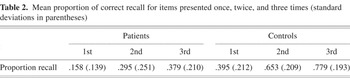
We calculated the proportion of omissions as the number of “I don't know” answers divided by the sum of the correct, incorrect, and “I don't know” answers. The proportion of correct recall answers was calculated in the same way. During the recall phase, a significantly higher proportion of omissions (“I don't know”) was provided by patients (.591) than controls (.307) [t(36) = 4.5, p < .001]. The mean proportion of correct recall answers was calculated for each level of repetition (first, second, third presentation). Memory performances were assessed by means of a 2 (Group) × 3 (Repetition) repeated-measures ANOVA. Statistical analysis of the results revealed a main effect of Group [F(1,36) = 34, MSE = 31334.2, p < .001], the proportion of correct recalls being lower for patients (.277) than controls (.609). Both the main effect of Repetition [F(2,72) = 53.1, MSE = 8969.3, p < .001] and the interaction between Group and Repetition were significant [F(2,72) = 4.0, MSE = 681.6, p < .05]. Patients benefited from both second and third repetitions, thus increasing the proportion of correct recall answers between the first and second presentation [F(1,72) = 9.0, MSE = 1515.8, p < .01] and between the second and third presentation [F(1,72) = 4.0, MSE = 673.7, p < .05]. Controls also benefited, increasing the proportion of correct recall answers between the first and second presentation [F(1,72) = 37.4, MSE = 6318.4, p < .01] and between the second and third presentation [F(1,72) = 9.0, MSE = 1515.8, p < .01]. Follow-up analyses comparing separately first and second presentation, second and third, and first and third were carried out to disentangle the terms of the Group × Repetition interaction. They showed that the interaction between Group and Repetition was significant only when comparing first and third presentation [F(1,36) = 8.5, MSE = 1264.5, p < .01]. This finding indicates that the Group × Repetition interaction was due to the fact that patients improved their performance less than control participants between the first and third presentation.
Mean proportion of correct recall for items presented once, twice, and three times (standard deviations in parentheses)

Allocation of Study Time (Table 3)
There are two ways of analyzing study-time. One examines the mean time spent on all items depending on item repetition (first vs. second presentation and second vs. third presentation of each word-pair). This analysis was conducted first. However, it confounds word-pairs and presentation frequency, insofar as, of the total of 30 word-pairs, all were presented once, 20 were presented twice and 10 three times. Consequently, we conducted a second analysis to examine the effects of repetition only for those items that were presented three times (10 pairs of words). For all dependent variables, results were similar for both analyses. Hence, here we are reporting only the statistical results of the former analysis, conducted on all 30 word-pairs.
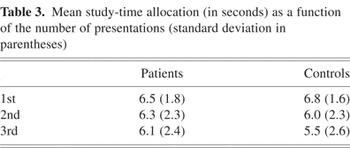
Mean study-time allocation (in seconds) as a function of the number of presentations (standard deviation in parentheses)

The main effect of Repetition was significant for the allocation of study-time [F(2,72) = 15.7, MSE = 7.8, p < .001]. The Group main effect was not [F(1,36) = .1, MSE = 1.0, p = .78]. The Group × Repetition interaction was significant [F(2,72) = 3.2, MSE = 1.6, p < .05]: patients allocated an amount of time that was not sensitive to presentation frequency. There were no significant differences in the time spent on each word-pair, neither between the first and second presentation [F(1,72) = 1.4, MSE = .7, p = .25] nor between the second and third presentation [F(1,72) = 1.0, MSE = .5, p = .32]. In contrast, controls spent more time exploring word-pairs on their first presentation than on their second [F(1,72) = 13.0, MSE = 6.5, p < .001]; more time was also spent on their second presentation than on their third [F(1,72) = 4.3, MSE = 2.2, p < .05].
JOL Ratings (Table 4)
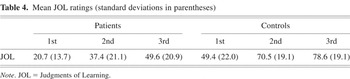
A 2 (Group) × 3 (Repetition) repeated-measures ANOVA was conducted on JOL ratings for all answers. Results revealed a main effect of Group, with patients having significantly lower JOL ratings than controls [F(1,36) = 33.4, MSE = 26074.7, p < .001]. The main effect of item repetition was also significant [F(2,72) = 46.2, MSE = 8285.7, p < .001], the JOL ratings being higher for items presented twice rather than once [F(1,72) = 38.0, MSE = 6804, p < .001] and three times rather than twice [F(1,72) = 11.0, MSE = 1966.6, p < .01]. The Group × Repetition interaction was not significant [F(2,72) = .3, MSE = 57.5, p = .73].
Mean JOL ratings (standard deviations in parentheses)

When considering the type of answers separately (correct, incorrect, and omissions), it was observed that the two groups differed only in their evaluation of the omissions: patients had lower mean estimated JOLs for the omissions (11.5) than controls (21.00) [F(1,36) = 7.6, MSE = 863.4, p < .01], but not for the correct (86.5 vs. 92.3, respectively) and incorrect (43.4 vs. 42.0, respectively) responses.
Predictive Value of JOL Ratings on Recall (Table 5)
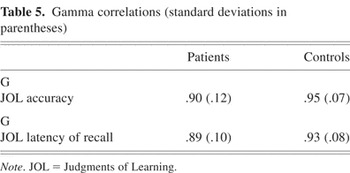
The predictive values of JOL ratings during the recall phase were assessed using the Goodman–Kruskal Gamma correlation (Goodman & Kruskal, 1954; Nelson, 1984). This Gamma coefficient is an alternative to signal-detection theory's measures (Nelson, 1987). It is a measure of association between the monitoring and the performance. It allows investigators to rate the relative accuracy of metamemory judgments in predicting memory performance. It provides a measure of the ability of participants to discriminate between correct and incorrect answers. The gamma score is defined as follows:
Gamma correlations (standard deviations in parentheses)


There are two ways in which a participant's monitoring and his/her memory concord: when a correct answer is associated with a high JOL and when an incorrect answer is associated with a low JOL. It is the opposite for discordances. The values of the G coefficient can range from 1.0 to −1, with large positive values corresponding to a strong association between memory performance and JOL (high JOLs for correct answers, and low JOLs for incorrect answers), while negative values show an inverse relationship, indicating a low metamemory accuracy. Gamma correlations were computed for each participant. Only the performance of participants who had provided both correct and incorrect recalls could be included in the Gamma calculation. Two patients did not fulfill these conditions (they had no correct recall), and thus they, and their respective controls, were not included. Indeed statistical analyses carried out on other parameters after exclusion of these two patients led to the same conclusions as those carried out on the whole sample of patients.
Patients' Gamma coefficients were slightly but not significantly lower than those of the control participants [t(34) = 2.2, p = .15]. High Gamma coefficients indicated that metamemory judgments closely matched true memory performances.
Relationship Between Monitoring and Control During the Retrieval Phase (Table 5)
To assess the accuracy of the decision to respond, Gamma correlations were also computed between JOL ratings and the decision to answer. A high correlation between JOLs and answering would mean that when a participant gives a high JOL rating, the participant should provide an answer during retrieval. On the contrary, with a low JOL, a participant should refrain from answering (omission). For patients, the Gamma correlation was high, suggesting a strong relationship between the JOL rating for a given word-pair and the decision to provide or withhold an answer. The Gamma correlation of the corresponding controls was slightly higher but not significantly so [t(34) = 1.9, p = .18].
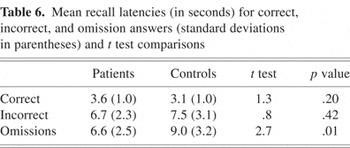
Recall Latencies (Table 6)
The mean recall latency needed to give a correct or an incorrect answer did not differ significantly between the two experimental groups However, patients with schizophrenia took significantly less time than controls to answer “I don't know.”
Mean recall latencies (in seconds) for correct, incorrect, and omission answers (standard deviations in parentheses) and t test comparisons

Explicit Descriptions of the Strategies Used
Patients with schizophrenia differed from controls in terms of the strategies they said they used. Eight of the controls said they associated word-pairs with personal, autobiographical events; seven mentioned the incongrousness of the unrelated pairs as cues. None of the patients reported using such strategies. Mental imagery was used by seven controls and only three patients. In contrast, the mere repetition of a word-pair was a strategy used by six patients and only two controls.
Correlation Analyses
For the patients, there were no significant correlations between metamemory variables (JOL ratings, G-JOL) on the one hand, and IQ, type of medication, or psychiatric symptoms (global, positive, and negative scores of the PANSS) on the other hand (n = 19, all correlations < .45).
DISCUSSION
Our results show, first, that, as expected, memory performances of patients with schizophrenia were significantly lower than those of control participants. Second, patients' JOLs remained sensitive to item repetition; their predictive values for memory accuracy and the decision to respond during the recall task were not significantly different from those observed with the control participants. Third, unlike control participants, patients did not adapt the study-time spent on each item according to presentation frequency. Overall, this pattern of results cannot be fully explained by a general, nonspecific reduction in intellectual ability or by drug treatment, since patients' metamemory performance was not significantly correlated with either IQ or type of neuroleptic treatment. The possibility that these factors played a role, however, cannot be totally ruled out.
Memory Performance
The analysis of memory performance showed that patients produced a smaller proportion of correct answers than control participants. Moreover, although patients benefited from item repetition, they benefited less than control participants. This finding is in line with consistent evidence indicating that episodic memory is defective in schizophrenia (Aleman et al., 1999; Dickinson et al., 2004; Lewis, 2004; Lussier & Stip, 2001; Rushe et al., 1999; Vidailhet et al., 2001). The difficulty of the present task, which requires participants to establish an association between two weakly associated words, may provide the explanation for patients' low memory scores (Danion et al., 1999). This severe impairment may be linked to the finding that patients did not report the use of effective strategies to help them remember word-pairs, such as deliberately associating target words with personal autobiographical recollections. It must be noted, however, that the reporting of strategies is based on a qualitative interpretation of the data. This interpretation is consistent with converging evidence that schizophrenia is associated with an impairment of elaborative, strategic processes at encoding (Brebion et al., 1997; Koh et al., 1973; Traupmann et al., 1976; Truscott, 1973). The role of depth of processing seems to be crucial, as studies that manipulated the level of processing at encoding have indicated (Kubicki et al., 2003; Mazzoni & Nelson, 1995; Paul et al., 2005; Ragland et al., 2003, 2005; Weiss et al., 2003). Patients benefit if provided with efficient strategies, such as semantic encoding, for encoding the to-be-remembered words. This finding indicates that it is not the implementation of the strategies that is impaired in schizophrenia, but their self-initiation (Medalia et al., 2000).
Memory Monitoring
The magnitude of JOL ratings for omission errors was reduced in patients with schizophrenia. More importantly, however, the effect of item repetition on JOL ratings was similar in patients and controls. Patients showed a normal pattern of response, that is, more frequent items being rated as easier to retrieve than items seen only once. These results show that patients' memory monitoring remained sensitive to item repetition.
According to recent metacognition approaches, metamemory judgments are inferential by nature. When making JOLs, normal participants do not directly monitor the strength of the memory trace for the target item. Rather, they monitor a variety of contextual cues that are predictive of the subsequent memory performance (Koriat, 1997). Contextual cues include the familiarity of a given item, the ease with which information comes to mind, or the memory for its ease of acquisition (Son & Metcalfe, 2005). They reflect the degree to which the studied items have been mastered, and, thus, this degree increases with presentation frequency (Koriat, 1997). Evidence that the effect of item repetition on JOLs is preserved suggests that patients with schizophrenia are still able to take these cues into account when predicting their future performance.
Other processes involved in patients' memory monitoring also seemed to be preserved. The monitoring accuracy in predicting recall, as assessed by the Gamma coefficient between JOL ratings and recall performance, was slightly lower in patients than controls, but not significantly so. This finding indicated that patients were as successful as control participants in subjectively assessing the correctness of their answers at the end of the encoding phase. Moreover, patients' control of behavior at the time of retrieval was consistent with the output of their monitoring. The Gamma correlation between the JOL and the production of an answer during recall revealed no significant difference between the two groups, indicating that patients were able to keep to their monitoring to control their recall behavior and thus decide either to respond or to withhold an answer.
However, patients were quicker to answer “I don't know,” despite taking as long as the healthy participants to provide a correct or an incorrect answer. Such a behavior was also in keeping with the monitoring ratings: patients assigned lower confidence levels than controls to the items they later decided not to produce. Such behavior is consistent with the results of Costermans et al. (1992) who observed that healthy participants took less time to give an “I don't know” answer when the metamemoric judgment was lower. It should be noted that, because patients spent less time looking for an answer than controls, the likelihood of their retrieving an answer was reduced, which may have contributed to the retrieval impairments observed for patients with schizophrenia.
Memory Control
In terms of the strategic control of learning, it was observed that patients with schizophrenia took account of the frequency of item presentation in a different way to the controls. Control participants spent less time studying a word-pair on the second and third presentation than on the first. Patients did not adapt their study-time to the presentation frequency to the same extent. Moreover, given their low accuracy rates in the recall task, the fact that patients took less than the maximal possible time for each item is striking. With regard to the effect of item repetition on JOLs and the allocation of study-time, assessment therefore reveals a dissociation between memory monitoring, which was preserved, and memory control, which was impaired.
There are several, non–mutually exclusive explanations as to why patients did not adapt their allocation of study-time according to presentation frequency in the same way as controls. First, it is possible that patients with schizophrenia forgot they had already seen some of the pairs in the course of the experiment. Therefore, they could not use explicit, deliberate memory control processes to adapt study-time according to repetition. Nonetheless, they provided higher JOLs for increasing presentation frequency. Second, the impairment of study-time allocation may reflect impaired use of the strategic effects of repetition on memory capabilities. Evidence that the two groups differed in their explicit reporting of encoding strategies is consistent with this interpretation. As previously discussed, studies that manipulated the level of processing at encoding have shown that patients with schizophrenia benefit from being provided with efficient strategies to encode new information. It would be interesting for future studies to investigate the influence of depth of processing on memory performance, monitoring, and control in patients with schizophrenia. Third, the perceived difficulty of the task may differ between patients and controls and, hence, may have modified their strategic approach to it (Son & Metcalfe, 2000). However, patients took less than the maximal possible time for each item. Finally, another explanation must be discussed with reference to the recent study revealing a dissociation between memory monitoring and control in Alzheimer's patients, results which were strikingly different to those observed here in patients with schizophrenia (Moulin et al., 2000a,b). As for the control participants, Alzheimer's patients allocated less time to studying repeated items but their JOL ratings were insensitive to presentation frequency. Therefore, memory control was intact in Alzheimer's patients, whereas memory monitoring was impaired. Such dissociation suggests that the allocation of study-time does not necessarily involve deliberate memory control processes, but may rather reflect an automatic response to item repetition (Moulin et al., 2000a). It is possible that such an automatic process is impaired in schizophrenia. Taken together, the results observed for the Alzheimer's patients and patients with schizophrenia suggest the possibility of a double dissociation between the processes of monitoring and control.
To conclude, this study demonstrated that the strategic regulation of memory function in patients with schizophrenia is impaired not only at the time of retrieval of semantic knowledge, as previously reported (Danion et al., 2001), but also during encoding of episodic information. However, the patterns of impairments vary across studies. Regarding memory monitoring, the accuracy of judgments elicited at the time of retrieval, namely the retrospective Confidence Level in the answers provided and the Feeling of Knowing regarding the future recallability of unrecalled items, is preserved in some (Bacon et al., 2001), but not all (Danion et al., 2001), types of semantic tasks. By using the Feeling of Knowing task, we found that patients also accurately predicted at the time of retrieval their subsequent recognition performance in an episodic task (Souchay et al., 2006). Evidence from the present study indicates that the accuracy of judgments elicited at encoding, namely delayed JOLs, is preserved in patients and that the correlation between memory appraisal and memory accuracy is strong. Regarding memory control, the extent to which volunteering an answer is affected by the Confidence Levels has been shown to be altered in a semantic memory task (Danion et al., 2001) and in the Wisconsin Card Sorting Test (Koren et al., 2004). However, using an episodic memory task, the present study shows that the volunteering of an answer in the recall task, but not the allocation of study-time, is related to JOLs.
Taken together, these data suggest that schizophrenia is not associated with a global, nonspecific impairment of metamemory processes, but that different patterns of impairments are observed, depending on the type of memory task used (semantic vs. episodic), the phase of the task being considered (encoding vs. retrieval), and the type of instruction given (more or less demanding on metamemory abilities). Nonetheless, beyond these differences, a common feature of the metamemory impairment reported in the patients with schizophrenia seems to be a significant dissociation between the subjective experience of monitoring one's knowledge and the control of behavior. This dissociation between conscious awareness and behavior has now been reported during encoding in an episodic memory task (this study) and during retrieval in a semantic memory task (Danion et al., 2001). It could reflect a shared mechanism underlying the impairment of the strategic regulation of memory function in schizophrenia. This dissociation, which is reminiscent of Bleuler's proposal that schizophrenia is characterized by a splitting of thought and action, could be a hallmark of the disease (Knoblich et al., 2004).
ACKNOWLEDGMENTS
We acknowledge that the information in this manuscript and the manuscript itself is new and original and that it is not currently under review by any other publication and that it has never been published either electronically or in print We disclose any and all financial or other relationships that could be interpreted as a conflict of interest affecting this manuscript. We thank Isabelle Offerlin-Meyer for her scientific and technical assistance, and Sandrine Burger and Christine Ramana-Keller for their technical assistance. Our thanks also go to Dr. Kapfer. This work was supported by INSERM (Institut National de la Santé et de la Recherche Médicale).