Introduction
The autonomous Åland Islands have recently been ranked as Finland’s healthiest region. According to a composite index based on the disease prevalence register data developed by the Finnish Institute for Health and Welfare, the islands have a lower prevalence of several non-communicable diseases (NCDs) compared with the national mean. 1 In addition, mean life expectancy at birth is among the highest in the Nordic countries. 2 Several NCDs show regional variation in prevalence, in part, explained by geographic, socio-economic and genetic factors.Reference Koskinen and Martelin 3 – Reference Rissanen 5 One factor associated with later health is the foetal developmental period, where a small body size at birth is associated with an increased risk for developing several NCDs including cardiovascular disease (CVD), stroke and type 2 diabetes.Reference Barker, Osmond, Golding, Kuh and Wadsworth 6 – Reference Whincup, Kaye and Owen 8 In the present study, we have compared measurements of birth weight and length from the Åland Islands for the years between 1937 and 1944 with contemporaneous measurements from the Helsinki Birth Cohort Study (HBCS). Our aim was to explore differences in birth size between the two regions as a first step towards a potential future analysis of Ålandic health from a life-course perspective.
Method
The HBCS comprises 13,345 singletons born in Helsinki between 1934 and 1944, who visited child-welfare clinics in the city and who were still living in Finland in 1971 when all Finnish citizens were given a unique personal identification number. A detailed set of birth records are available for all the individuals with data on weight and length at birth, as well as maternal age, parity, weight, length, marital status, time of last menstrual period and socio-economic status, based on the husbands’ occupation. Furthermore, records from child-welfare clinics and school records, with serial measurements of weight and length, are available for all individuals. The individuals’ birth and childhood records have been linked to the national mortality register, the Finnish cancer and hospital discharge registers, as well as the Social Insurance Institution’s medical reimbursement register, laying the foundation for the epidemiological studies conducted within the HBCS. Furthermore, 2003 individuals from the HBCS participated in a clinical follow-up. The linked registers as well as the clinical study are outside the scope of the present study. For the purposes of this study, only births between the years 1937 and 1944 were included, in total 11,808 individuals.
In a series of publications, Eriksson and Fellman have studied factors influencing birth weight and its distribution on the Åland Islands in a dataset based on official birth certificates collected over more than a century (1885–1998). Reference Fellman and Eriksson 9 – Reference Fellman and Eriksson 11 Åland is an autonomous province of Finland with its own legislation and administration. The archipelago is located in the Baltic Sea, between Finland and Sweden, and consists of around 6000 islands.Reference Mielke, Pitkänen, Jorde, Fellman and Eriksson 12 For purposes of this study, we have included singleton births between 1937 and 1944 and compared them with births from the Helsinki cohort from the same years. The years from 1934 to 1936 were excluded as the dataset only included births from three out of Åland’s 13 parishes for these years. The number of available recorded births during the period was 1803. The accuracy of the birth weight records has been estimated to be within 50 g.Reference Fellman and Eriksson 11 After excluding individuals with missing data for birth weight and length, missing data for child sex, stillborns, twins and one individual with an impossible live birth weight (200 g), the number of remaining individuals included in the study was 1697. In addition, the birth records included date of birth (year and month), maternal age and marital status, as well as the parish in which the birth took place. Data on parity were only available for 6.4% of the individuals and head circumference was only available for 2.4% of the individuals. Therefore, these variables were not included in the analysis.
Statistical analysis
Means and standard deviations of birth weight, birth length and maternal age were calculated separately for the two cohorts. The 95% confidence intervals of differences in means between the cohorts were calculated using t-tests. Dummy variables were created for the individual years of birth. The year 1943, with most births for both cohorts, was designated as the reference year. Marital status was defined according to the following three groups: married, unmarried and ‘unknown/other’. The ‘unknown/other’ represents those of unknown marital status for the Åland cohort and widows and divorcees for the HBCS. Dummy variables were created for the unmarried and unknown/other status, respectively, with married group as the reference. Birth weight was entered into multiple linear regression models with maternal age, the dummy variables for marital status and year of birth, sex and cohort of birth as predictors. Maternal age was centred at 28 years (mean maternal age in both cohorts combined was 28.4 years). To explore potential cohort-specific associations between the predictors and birth weight, interaction terms with the cohort variable were created for all other predictors. For each predictor, we compared a model including all predictors, with an expanded model additionally including that predictor’s interaction term. The marital status interaction terms were added to the same expanded model and all the year of birth interaction terms were added to the same expanded model. The F changes were significant at 0.05 level for the marital status variables and maternal age, and therefore the regression analysis was stratified by cohort. We also created a dichotomous variable stratifying Åland into an urban (Mariehamn) and rural sub-cohort, but interaction tests with this variable yielded no significance.
Results
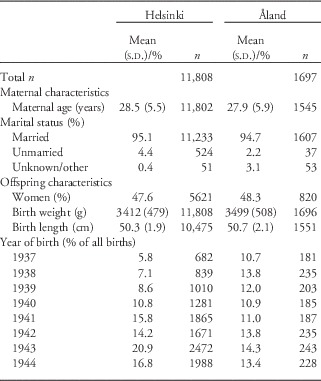
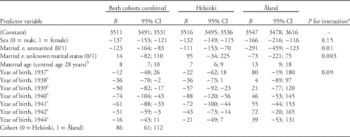
Table 1 shows the characteristics of the two birth cohorts. The average birth weight and length on the Åland Islands were 3499 g and 50.7 cm, respectively. Babies born on the Åland Islands were 87 g (95% CI 62; 111) heavier and 0.4 cm (95% CI 0.3; 0.5) longer than those born in Helsinki. On the Åland Islands, birth weight quintiles were 3100, 3400, 3600 and 3900 g, whereas in Helsinki they were 3040, 3300, 3530 and 3800 g. The mothers on Åland were on average 6 months (95% CI 3.6; 9.6 months) older than those in Helsinki. Several of the predictor variables were significantly associated with birth weight, and some of these effects varied between cohorts (Table 2). For example, babies born to unmarried mothers in Helsinki had an average birth weight that was 111 g (95% CI −153; −70) lighter than those with married mothers. In Åland, the offspring of unmarried mothers were 290 g (95% CI −459; −123) lighter on average.
Descriptive data of the birth cohorts

Multiple regression analysis with birth weight (grams) as the dependent variable

a P-value represents significant F change for a model including all predictor variables in addition to an interaction term between birth cohort and the row’s predictor variable, compared with a model without the interaction term. The marital status and year of birth interaction terms were added simultaneously; therefore, only one P-value is presented for these.
b Mean maternal age in the study was 28 years.
c 1943, the year with most births, for both cohorts, was used as the reference year and defined as 0 for all birth year predictor variables.
Discussion
We report that children born on the Åland Islands between 1937 and 1944 had an average birth weight of 3499 g (s.d. 508) and an average birth length of 50.7 cm (s.d. 2.1). They were larger than their Helsinki peers, with 87 g (95% CI 62; 111) higher average birth weight and 0.4 cm (95% CI 0.3; 0.5) higher average birth length. Our findings are comparable with those in a study from the Swedish city of Uppsala,Reference Leon, Lithell and Vågerö 13 where the mean birth weight during the years between 1915 and 1929 was 3429 g, 70 g lower than the mean for the Åland cohort in our study. Uppsala is located on the Swedish east coast, 131 km southwest of Åland’s capital Mariehamn. In a recently published meta-analysis, the mean weighted estimate of the relative risk between coronary heart disease (CHD; fatal and non-fatal) and birth weight was 0.83 (95% CI 0.80; 0.86) per kg of birth weight.Reference Wang, Shu and Sheng 14 Another meta-analysis reported a hazard ratio of 0.94 (95% CI 0.92; 0.97) for all-cause mortality per kg of birth weight.Reference Risnes, Vatten and Baker 15 The 87-g difference would translate into a relative CHD risk of 0.984 (95% CI 0.980; 0.987) and a relative all-cause mortality hazard ratio of 0.995 (95% CI 0.993; 0.997) for the Åland Islands cohort compared with the Helsinki cohort.
In the regression analysis, we found that sex and maternal marital status showed the most pronounced associations with birth weight and that the association varied between the two cohorts in the case of marital status. In the Åland cohort, children born to unmarried mothers were on average 290 g lighter than those born to married mothers. The corresponding numbers for the Helsinki cohort was, on average, 111 g.
The importance of body size at birth as a predictor for future health and disease is well-documented. A small body size at birth, in relation to gestational age, is an indicator of sub-optimal intrauterine growth and development. Several factors influence the foetus’s development in utero, among them are maternal nutrition, hormonal status, genetic factors and placental function.Reference Gluckman, Hanson, Cooper and Thornburg 16 , Reference Lewis, Cleal and Hanson 17 A small body size at birth has been linked to a higher risk for developing several NCDs, such as CVD,Reference Barker, Osmond, Golding, Kuh and Wadsworth 6 , Reference Lawlor, Ronalds, Clark, Smith and Leon 7 strokeReference Lawlor, Ronalds, Clark, Smith and Leon 7 and type 2 diabetes.Reference Whincup, Kaye and Owen 8 It is, therefore, with interest we note that for the years between 1937 and 1944, the average size at birth on the Åland Islands is somewhat higher than that in the capital Helsinki.
Health statistics show that the prevalence of several NCDs is lower on the Åland Islands compared with the average of the rest of Finland. 1 Mean life expectancy for Ålandic men at birth was 79.7 years in 2005–2009, 3.2 years longer than that for their mainland peers and among the highest in the Nordic countries. 2 The corresponding number for women was 83.1 years, the same as for mainland Finland. In an earlier report (2001–2004), however, Ålandic women had the longest life expectancy at birth in the Nordic Countries – 83.9 years. In addition, the current mean remaining life expectancy at 80 years of age (+10 years) for women is the highest in the Nordic countries. In a study analysing demographic patterns in the Åland Islands from 1750 to 1900, the mean life expectancy at birth was higher in Åland than in mainland Finland from the second quarter of the 19th century and onwards.Reference Mielke, Pitkänen, Jorde, Fellman and Eriksson 12 Furthermore, anthropometric studies from the beginning of the 20th century on Ålandic men indicate that the inhabitants of Åland historically have been taller than their mainland peers and even among the tallest people in the world.Reference Arho 18 , Reference Sievers 19 Increase in height between 1768 and 1968 was 8.4 cm for the Åland population compared with 6.0 cm for Western Finns and 4.7 cm for Eastern Finns.Reference Eriksson, Fellman and Forsius 20
In a 2012 report from the Finnish National Institute of Health and Welfare, 1 the Åland Islands ranked as the healthiest region in Finland based on the age-standardized composite index of disease prevalence. The index is based on prevalence figures of seven disease categories and is weighed according to each category’s influence on mortality, work disability, quality of life and healthcare costs. The national mean score is set at 100, with a higher score representing higher morbidity. The Åland region received a composite score of 68.9, and was scored significantly lower than the national average for five of the seven disease categories: CHD, psychiatric disease, dementia, accidents and musculoskeletal disorders. The remaining two categories – cerebrovascular disease and cancer – were not significantly different from the national mean.
Despite these notable health differences between the Ålandic population and the rest of Finland, very few studies have explored their background. One study focussed on sense of coherence (SOC) – a concept developed by Antonovsky that posits that the way one relates to life influences one’s health – among the Ålandic population.Reference Eriksson, Lindström and Lilja 21 In this study, SOC scores were high and strongly correlated with self-rated health, an important predictor of mortality. A few studies have explored the differences in mean life-expectancy and other health-related outcomes between Swedish-speaking and Finnish-speaking Finns.Reference Koskinen and Martelin 3 , Reference Hyyppä and Mäki 22 Swedish-speaking Finns account for around 5.5% of the Finnish population and 96% of the Åland population. In a study by Koskinen and Martelin from 2003, age-standardized relative mortality for Swedish-speaking women was lower (0.93) compared with Finnish-speaking women.Reference Koskinen and Martelin 3 After adjusting for factors relating to geographical location and socio-economic position, these differences disappeared. Among Swedish-speaking men, the age-standardized relative mortality was 0.73, which attenuated to 0.83 after adjustments. The remaining difference was primarily explained by excess cardiovascular mortality and non-natural deaths among Finnish-speaking men.
This observational historical study has some important limitations. The HBCS is restricted to individuals who were born in Helsinki between 1934 and 1944 (in the context of the present study between 1937 and 1944), attended child-welfare clinics there and still lived in Finland in 1971 when all citizens received a unique personal identification number. Attendance at child-welfare clinics was free but voluntary, and a majority of families attended the clinics. Previous studies have shown that the distribution of socio-economic position, indicated by the father’s occupation, was similar to that of the rest of Helsinki.Reference Eriksson, Forsen, Tuomilehto, Osmond and Barker 23 Survivor bias might be present in the HBCS, as only individuals still alive in 1971 were included in the study. A small body size at birth is associated with premature deathReference Kajantie, Osmond and Barker 24 suggesting that this study’s finding could potentially have been even more pronounced if individuals who did not survive childhood had also been included. With regard to the Åland cohort, the dataset lacked information on gestational age at delivery for the years studied in this publication. This information is needed to determine whether a small body size at birth is a sign of impaired foetal growth, rather than a short gestational period or a combination of both conditions. Information on parity was also missing from most of the births in the Åland records. According to Finnish statistical yearbooks for the years 1943, 1944–1945 and 1946–1947, the proportion of in-wedlock firstborn children on the Åland Islands during 1942, 1943 and 1945 was 32–39% compared with 50–58% for cities in the Uusimaa region, in which Helsinki is located. 25 – 27 The study period coincides with the second world war, which affected the two cohorts differently. Although food shortages and other factors potentially influenced Helsinki births adversely, the Åland Islands were largely unaffected by the war.Reference Rotkirch 28
In conclusion, we have found that babies born in the Åland Islands between 1937 and 1944 on average were 87 g heavier and 0.4 cm longer than their peers in Helsinki. Further studies, for example, register linkage and potential clinical studies similar to those that have been carried out in the HBCS, would be needed to explore whether this slight but significant difference in birth size has an impact on these individuals’ adult health.
Acknowledgements
None.
Financial Support
The Helsinki Birth Cohort Study has been supported by grants from the Academy of Finland (grant numbers 120386, 125876), the Finnish Special Governmental Subsidy for Health Sciences, Finska Läkaresällskapet, the Juho Vainio Foundation, Liv och Hälsa, Samfundet Folkhälsan, the Signe and Ane Gyllenberg Foundation and the foundation Stiftelsen Dorothea Olivia, Karl Walter och Jarl Walter Perkléns minne. Johan Fellman’s work has been supported by the foundation Magnus Ehrnrooths Stiftelse.
Conflicts of Interests
None.
Ethical Standards
The Helsinki Birth cohort study has been approved by the Ethics Committee of Hospital District of Helsinki and Uusimaa.