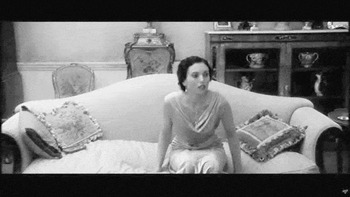
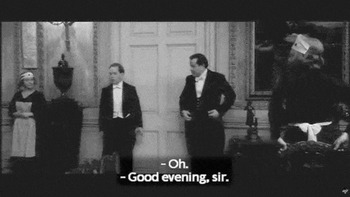
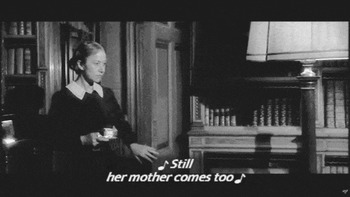
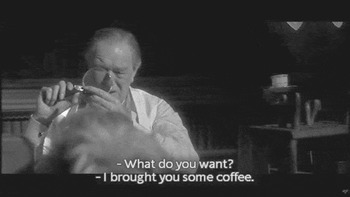
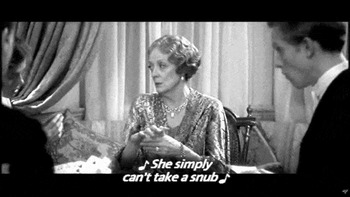
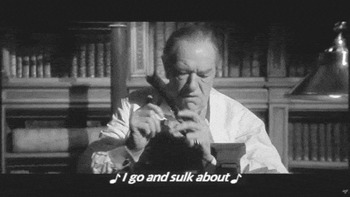
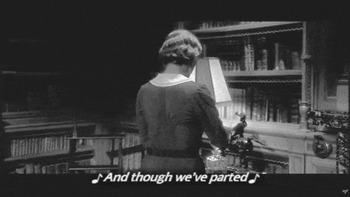
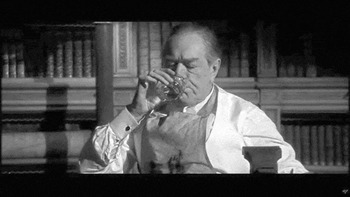
During the performance of several songs at the midpoint of the film Gosford Park (2001), the audience witnesses the brutal stabbing of Sir William McCordle in his library. David Levy, one of the film's producers, commented, “It's not really murder music, is it?”Footnote 1 Yet the songs act as the perfect accompaniment for this sequence, hinting at, and even subtly identifying, the murderers, motivations, methods, and other plot intricacies. Moreover, the choice and presentation of the songs here and elsewhere, and the processes used to craft the film as a whole, create an embryonic commentary on the work's genres and specific models—all under the guise of innocuous, entertaining after-dinner music.
The songs are provided by the character of Ivor Novello (1893–1951) as played by Jeremy Northam (see Appendices 1 and 2 for a synopsis and a list of characters). Novello was a celebrated British film star, songwriter, and playwright who emerged as one of Britain's first movie stars following the First World War.Footnote 2 By the later 1920s, Novello had seemed destined to conquer the US market, and British movie magazines and media mourned his imminent loss. But several attempts to reach US audiences through contracts with Paramount and MGM studios failed, and eventually Novello abandoned films for the theater in 1934. Thus, his appearance in Gosford Park (which takes place in November 1932) comes as Novello the former silent-screen star approaches the end of his film career.
Novello was added to the screenplay after the first draft at the request of director Robert Altman, who wanted to incorporate Novello's music and character into the film. Screenwriter Julian Fellowes recalled, “Once I had completed the first draft I was invited to fly out to California. . . . At this point Bob Altman suggested adding Ivor Novello to the mix. He was a fan of [Novello's] and he wanted some ‘live action music’ in the movie, not just background scoring, and we both felt it would anchor the film in the period to have one real-life person of the time.”Footnote 3 Beyond his significance as a character, Novello's songs are “integral to Gosford Park” and “central to the movie,” according to Altman.Footnote 4
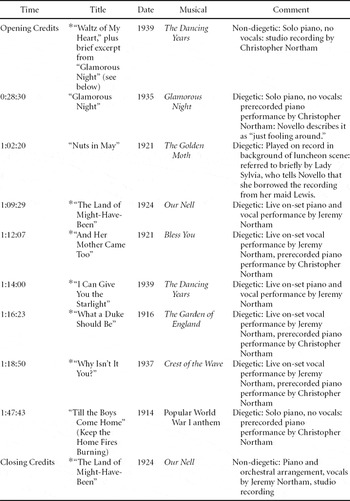
Novello's songs appear in both diegetic and non-diegetic contexts, as summarized in Table 1 (which includes premiere and/or publication dates and shows if relevant). For the purpose of this article, I will focus primarily on the five diegetically performed songs in the murder sequence that comprise the movie's core, as well as the non-diegetic songs that accompany the opening and closing credits (indicated with an asterisk in Table 1). Northam performed the vocals to the five murder sequence songs live on the set. Additionally, the two ballads in the center section (“The Land of Might-Have-Been” and “I Can Give You the Starlight”) included Northam's own live piano accompaniment recorded on set as well.
Performances of Novello's music in Gosford Park.

*Songs discussed extensively in this article.
The choice to use Novello's songs as the central component in the film invites closer scrutiny. Beyond anchoring the work historically, Novello and his songs fulfill several critical functions in the film, most notably in the murder sequence but also as a musical frame around the entire work. First, the songs give clues to the filmmaker's sophisticated juggling of several historical genres. Second, the songs subtly communicate plot revelations under the smooth guise of entertaining dinner music. And last, the musical accompaniment sonically presents the animating tensions of the story: the divisions between upper and lower classes, between past and present, between the UK and the US, and between reality and film. The following discussion outlines the film's most significant models—British heritage films, melodramas, musicals, and “double features”—in tandem with close visual and musical analyses of Novello's songs. Altman stated that Gosford Park “isn't a Who-Dunnit” but “a Who-Cares-Who-Dunnit”; as will be shown, the murder mystery serves merely as a narrative façade for a cinematic tour de force intricately constructed through ambi-diegetic musical performances.Footnote 5
The British Heritage Film and “Waltz of My Heart”
Andrew Higson, the leading authority on the British heritage film genre, described Gosford Park as “a new English heritage film” that did “excellent business at the box office in both the USA and the UK.”Footnote 6 The seeming contradictions in this statement abound, as Higson notes: box office success for a genre associated with independent filmmakers and niche markets; a British product successfully exported to the US; and a specifically English period film “directed by veteran American filmmaker Robert Altman, whose preferred shooting style perfectly matches the standard aesthetics of the heritage film.” Although the definition of the British heritage film genre continues to be debated, it is generally agreed that the genre includes connections to British history through literary sources, newly written plots, and costuming and mise-en-scène, in addition to independent production, intimate and usually leisurely film style, auteurism, and cultural over commercial value.Footnote 7
The closest models for Gosford Park within this genre are the films of the Merchant Ivory production company (director James Ivory, producer Ismail Merchant, and screenwriter Ruth Prawer Jhabvala). Altman recognized the influence of the company, stating that “had [Merchant Ivory] not done their films, Gosford Park wouldn't have been made, as there wouldn't have been a reference.”Footnote 8 Merchant Ivory's earlier films such as A Room with a View (1985) were aimed primarily at audiences in the United Kingdom with only limited art house releases in the United States. However, the team secured US financing and distribution for its 1992 adaptation of E. M. Forster's novel Howards End, which proved economically and critically successful in the United States. Their next film, The Remains of the Day (1993), was financed and distributed by Disney-Miramax using the sophisticated tools and substantial resources of a major Hollywood studio, embodying what Balio describes as the takeover of “the art film market . . . [by] Hollywood majors who either created classics divisions or acquired the leading independent art film distributors.”Footnote 9 Merchant Ivory's stateside success, industry consolidation, and the art film/Hollywood hybrid spawned a flurry of Jane Austen adaptations of US and UK pedigree, with six new releases in 1995–96. According to Linda Troost and Sayre Greenfield, although only three of these six originated in Hollywood, “the rest [were] influenced by it.”Footnote 10
Like Gosford Park, most of the plot of The Remains of the Day takes place in an English country house in the 1930s (framed by segments set after the Second World War), and the story is told from the servants' point of view.Footnote 11 Both Ivory and Altman employed retired domestic servants as technical advisors on the sets of their respective films.Footnote 12 More specifically, Ivory described Stevens, the central character in The Remains of the Day (played by Anthony Hopkins), as “the perfect butler,” and Mrs. Wilson in Gosford Park describes herself as “the perfect servant.” Both have sacrificed love—either romantic or familial—in the line of domestic service. Most tellingly, both Ivory and Altman compare their perfect servants to the same ideal: Mrs. Danvers, the omnipresent housekeeper in Hitchcock's Rebecca (1940).Footnote 13
More generally, Gosford Park evokes the Hollywood-created British heritage film from its very opening. According to Altman, the soggy English weather signified both a location and era: “We started this film out in rain . . . because I wanted the audience to feel that they were . . . at the end of the nineteenth century, and even though there's a car there, I still wanted the look of those old nineteenth-century, sort of ‘English’ dramas.”Footnote 14 Sweeping views of the English countryside, vintage cars, the estate emerging from the greenery on a gray day—all images immediately establish Gosford Park as a heritage film. Indeed, one of the most common means of beginning the genre—and establishing real estate as a central character—involves an establishing shot of the English country home, whether revealed through the windshield of a vintage car traveling down a lane (The Remains of the Day), alongside gamboling sheep and a horse and carriage (Persuasion, 1995), gentleman galloping through the countryside (Pride and Prejudice, 1995), or lit by oil lamps at night (Sense and Sensibility, 1995).
Beyond this visual trope, almost all of the Austen adaptations prominently feature the same instrument to accompany the estate shot: the piano.Footnote 15 In Gosford Park, Novello's piano piece “Waltz of My Heart” accompanies the film's opening credits, and contains a number of close correspondences, or “hits.” The elegant, metronomic “beats” of the windshield wipers on the car (2:19–26 and 3:02–12, for example) reinforce the waltz's downbeat like a mechanized conductor. Lady Trentham's three knocks on the glass divider (3:03–04) are strictly on the beat and in tempo, as are Mary's footsteps as she walks around the car to help her employer (3:34–35). Throughout, Christopher Northam's piano accompaniment alternates between more rhythmically strict passages and more rubato sections that are nonetheless timed to the visuals. Following a particularly rubato phrase just before the da capo, the thermos pops open (3:40–44) in time to accentuate the cadence and fermata. Even the dialogue is delivered rhythmically to enhance the music: for example, Lady Trentham's “I can't get this top open” (3:39–40) fits neatly into two elongated beats with accents on each main pulse (on “can't” and “top”).
Apart from this close synchronization, the waltz meter and tempo rubato embodies the nostalgia and gentility appropriate to the British heritage film, particularly for US audiences. At the same time, the thickened (although not virtuosic) texture recalls Marianne Dashwood and all of the other capable amateur pianists in earlier heritage films, even as it foreshadows the intimate domestic music that will structure the central section of Gosford Park. That the music is so closely synchronized with visual rhythms presages the later songs of the murder sequence. Indeed, Robynn Stilwell's words describe quite accurately the use of Novello's music. In her article on music in Sense and Sensibility, Stilwell describes a diegetic musical sequence in the Jane Austen adaptation as “particularly intricate as regards the interaction between musical and dramatic structures” almost to the point of “‘mickey-mousing’ (an undesirably close imitation of physical action by musical motion, associated with cartoon music).”Footnote 16
By the time Gosford Park was made, Hollywood had moved on from its Jane Austen years to the ersatz-heritage Harry Potter movies, and Merchant Ivory productions had fallen out of favor with the industry, with critics, and, in terms of box office receipts, with stateside audiences. Yet the Merchant Ivory stamp on the genre lingered so strongly that a feature in the New York Times on Gosford Park declared, “Altman on the Loose in Merchant Ivory Territory,” even as Altman himself mused that the opening scenes firmly establish “the territory of Brideshead Revisited and Upstairs [Downstairs], you know, all of those English period, Jane Austen [films].”Footnote 17 Arriving more than a decade after the British heritage film landed in US theaters, Gosford Park pays clear homage to its own cinematic heritage right from its very beginning.
Gosford Park, Transatlanticism, and “The Land of Might-Have-Been”
Like its immediate predecessors, Gosford Park negotiates a hybridized identity. The film is neither predominantly American nor British in terms of its cast, crew, production history, financing, distribution, plot, and characters. The director, all of the producers, and most of the pre- and post-production crew were based in Hollywood. Yet the cinematographer, composers (of original and adapted music), and casting director were based in England where the project was filmed in its entirety. Moreover, the project initially received funding from the British Film Council, a fund designed to promote investment in the British filmmaking industry, established by the government and financed by lottery proceeds. The British Academy of Film and Television Awards (BAFTA) recognized the film as homegrown by awarding it the Alexander Korda Award for Best British Film of the year. However, one critic described the possible problems associated with recognizing Gosford Park as the best British film of the year, stating that the work and another high-profile nominee could seem
to stretch the definition [of a British film] a little. Chris Columbus's Harry Potter and Robert Altman's Gosford Park are packed with British A-list talent, but both are directed by Americans and financed almost entirely with American money. Surely, the sceptics will say, this is the kind of smash-and-grab raid that the best British film category was designed to prevent. . . . [W]hat's the point of cordoning off a section of the trophy table, if Hollywood can just lean over and rake in the cups?Footnote 18
The cast reflects a carefully balanced internationalism as well. Even though the film employed English theatrical and cinematic actors at its core, many were very familiar to US audiences through feature films and imported miniseries shown on PBS.Footnote 19 Of course, Altman himself was the main drawing card for US audiences, although Bob Balaban—a co-producer of the film who plays the film producer Morris Weissman as well—would have been known through his appearances in films such as Midnight Cowboy, Waiting for Guffman, and Best in Show, and through a recurring role on the television sitcom Seinfeld.
Indeed, it is this transatlantic pedigree—itself carrying historical significance—that informs another stratum of the film and can be heard in one of the central musical numbers. The complicated and unequal relationship between British and Hollywood movie studios, manifest through the Americanization of the heritage film in the 1990s, has its origins in the 1930s. Hollywood's use (and abuse) of English settings and characters began in earnest in the mid-1930s, with continued use of aristocratic British stereotypes through the century. Although rampant, the coding of Britishness in US films is rarely investigated as a component within the films themselves. Gosford Park places this common tendency at the forefront in many ways, beginning with Morris Weissman and his troubled production of Charlie Chan in London. Weissman's profanity-laden diatribes are obviously another jab at the industry machine and meddling studio executives parodied by Altman in films such as The Player. Yet Weissman's lack of familiarity with British culture serves another purpose, by offering a commentary on the shallow, misinformed Hollywood construction of English aristocracy. To emphasize the point, Weissman discusses the potential cast for his film (with the comically anachronistic, very American word like): “What about Claudette Colbert? She's British, isn't she? She sounds British. Is she, like, affected, or is she British?”
On the flip side of the coin would be the British relationship with Hollywood films, a mix of fascination, condemnation, and revulsion. In his essay “‘D’ Is for Disgusting: American Culture and English Criticism,” Richard Maltby details “the diverse forms of resistance to American culture” even as “European popular cinemas have remained subaltern industries, subordinated by the competing hegemonic powers of Hollywood's commercial imperium.”Footnote 20 Despite criticism of Hollywood films, British audiences have remained fascinated with imported films for decades. A 1937 editorial from the Daily Express (cited by Maltby) complained that British film audiences “talk America, think America, and dream America. We have several million people . . . who, to all intent and purpose, are temporary American citizens.”Footnote 21 The division between official criticism, even censorship, of Hollywood films on the one hand, and widespread popular acceptance on the other was embedded in the Gosford Park screenplay. Writer Julian Fellowes created a contrast between the older aristocratic characters who express a “rejection of popular culture” and the middle class, servants, and younger aristocracy who enjoy popular entertainment and are therefore “connected to their own time and who have a future.”Footnote 22 As Julianne Pidduck notes, the film is “a coy parable about the cross-fertilisation of British and American characters and cultural production” through the dramatization of “the magnetic capacity of popular entertainment to invade the snobbish enclave of the Edwardian landed gentry.”Footnote 23 Thus the British view of Hollywood, as represented in the film, is one conditioned both by class and generation.
Indeed, class issues feature prominently in the heritage film as well, yet the tensions between the classes are overwhelmingly limited to the upper and middle classes as in A Room With a View, or at least confined within a single strata of society, as in the servant romance of The Remains of the Day.Footnote 24 As Martin A. Hipsky states, this combination of a limited sphere of romantic interaction, the validation of upper-bourgeoisie characters, and the celebration of imperialism's material benefits is exactly what made “Merchant-Ivoryesque films” particularly appealing to US audiences, since
class conflict takes the form of tension over relative levels of gentility. Once the less-genteel figures are vindicated, as by film's end they inevitably are, we can all breathe a sigh of satisfaction, forgetting how limited the scope of inter-class tension has been. In many ways, these historical films function to efface the very social history they purport to portray; they provide North American viewers with a kind of sanitized, guilt-free nostalgia. It is, after all, the historical landscape of our trans-Atlantic cousins there on the screen, and while we are aware of empire and class injustices hovering somewhere beyond the movies' immediate social landscape, they trouble us not, as they do not signify any dirty historical laundry of our own.Footnote 25
This “guilt-free nostalgia” fueled the Austen craze, in which differing expressions of class relationships “correspond quite closely to the nationality of the filmmakers,” according to Carol M. Dole. “The solidly British productions take the hardest look at class, while the mainstream American films tend on the surface to ridicule class snobbery but on a deeper level to ratify class divisions.”Footnote 26
Gosford Park offers “recent costume drama's most sophisticated class critique,” according to Pidduck, by focusing on the relationships—particularly but not exclusively romantic—between the classes.Footnote 27 In so doing, it confronts much more directly the abusive, ultimately devastating nature of class rule. Unlike most Merchant Ivory films, and even the more class-critical Persuasion, the central tensions in Gosford Park occur between the titled class and the working and servant classes. These relationships are represented in the past through Sir William's affairs with the workers at his factories; in the present via his affair with Elsie; and through Lady Sylvia's affair with Henry Denton, which is abruptly terminated when his real status is revealed. At the juncture of the servant and ruling classes is Ivor Novello—middle class by birth yet commercially successful in the popular realm by imitating the aristocracy. Novello and his music appeal primarily to the servants in the household, who watch his performances from the shadows, appear starstruck at every encounter, see his movies, and own his recordings.Footnote 28 Mabel, the bourgeois wife of Freddie Nesbitt, is socially defined in part by her barely contained excitement at meeting movie star Novello and hearing his tales of encounters with celebrities like Greta Garbo. In what may be the most understated line in the film, Elsie states that she prefers Hollywood stars to Novello because “they've got more oomph,” apparently echoing the reaction of US audiences to Novello as well—a reaction that may have been based on several aspects of Novello's screen presence. As Michael Williams states in his study of the actor's screen career, Novello exuded a “semi-aristocratic persona” in both his public image and his characters despite his humble origins. In fact, his “background as a composer was continually re-emphasised by contemporary media, and it is this ‘high-art’ background that helped differentiate him from Valentino or Ramon Navarro.” Perhaps it was this combination of artistic and aristocratic identity that made Novello “too English” for US audiences.Footnote 29
The British and American views of each other echo in “The Land of Might-Have-Been,” an apt summary of Hollywood's construction of Britain for US audiences; of the appeal of Hollywood films for British audiences; and of Novello's own Hollywood aspirations. Novello's song originated in a 1924 musical, and according to Michael Williams, the wistfulness, longing, and nostalgia clearly references the still fresh losses of the First World War, the numb and grieving postwar society, and the “might-have-been” for the soldiers who died in the conflict, as expressed by their survivors:
“The Land of Might-Have-Been,” as the title suggests, is wistfully elegiac and . . . reaches towards a metonymic landscape (“somewhere there's another land”) of “innocence and peace” in order to escape “the cruel place we know.” . . . [T]his act of reaching is an acknowledgement of current suffering, but more than that, the song is about being intolerably separated, even romantically. . . . Not only is this work a perfect distillation of Novello's myths of impossible romance within historical moments of particular hardship, but it directly springs from the most lively context of cultural production during the war.Footnote 30
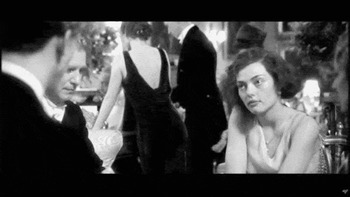
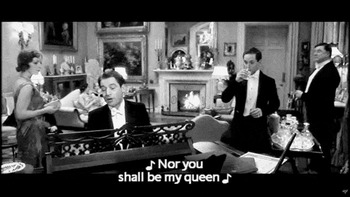
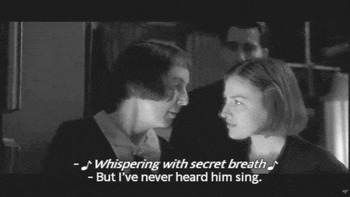
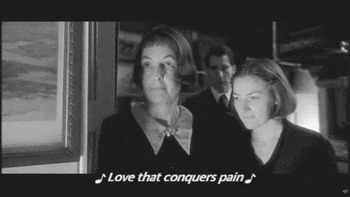
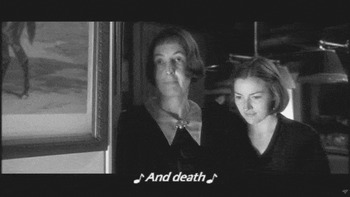
Apart from its associations with the war, “The Land of Might-Have-Been” musicalizes several other aspects of the plot (summarized in Figure 1), ranging from the doomed love affair between Rupert and Isobel, who looks longingly at her would-be husband on the word “love”; the perceived failure of characters such as Commander Meredith and Mabel (whose movements are choreographed to “king” and “queen” respectively); and, as Renee whispers to Mary, the future of Robert Parks (who is seen looking at Mary on the word “love,” and slipping out of the room on “death”). In a more general sense, “The Land of Might-Have-Been” summarizes the film's plot in that both upstairs and downstairs characters long for “what might have been.” Two sisters upstairs long for happier marriages, having wed for money (Lady Sylvia, who detests Sir William) or for rank (Lady Louisa, who finds Lord Stockbridge dull). As is ultimately revealed, two sisters downstairs mourn the losses of their sons and “what might have been” in their family lives. Only after this connection has been revealed does the song reappear transformed over the closing credits, reinforcing not only the dramatic core of the film, but also the reciprocal, variable, and always unequal transatlantic gaze that permeates the film.
Selected hits in “The Land of Might-Have-Been.”
1a. Novello (sung): “Love grows never old nor tired” Isobel looks longingly at Rupert (1:10:06).

Novello (sung): “I shall never be your king” Meredith looks up sharply (1:10:24).

Novello (sung): “nor you shall be my queen” Mabel slowly enters the frame from the left (1:10:27).

Novello (sung): “whispering with secret breath” Renee whispers to Mary (1:11:06–10).

Novello (sung): “Love that conquers pain . . .” Parks looks at Mary (1:11:16).

Novello (sung): “. . . and death.” Parks leaving in background (1:11:18–20).

Melodrama and “Her Mother Came Too”
One consistent criticism of the film—in Britain, the United States, and elsewhere—addresses the series of personal revelations that explain the murder: Mrs. Wilson and Mrs. Croft are sisters; both women bore Sir William's illegitimate sons decades earlier; Robert Parks is Mrs. Wilson's son; and both mother and son committed the murder. For example, the New York Times decried the denouement's artificiality, complaining, “The final revelations, when they pour out, feel like the hoary contrivances of a 19th-century melodrama.”Footnote 31 It is tempting to connect this review with the term's origins. A mélodrame described a spoken play in which musical accompaniment is used to heighten meaning—a particularly apt model for this film's murder sequence.
By the early twentieth century, melodrama in literature, theater, and film had come to signify both popular entertainment (particularly works that criticized those in wealth or power for an audience of lower class) and unrealistic, excessively emotion-driven narratives. Film historian John Mercer has pointed out the term's problematically pejorative connotations, including “a specific performance or narrative style regarded as artificial, excessively emotional, unrealistic, or anachronistic,” as well as “formulaic, sentimental, old-fashioned, and inferior to ‘serious’ drama; it is often equated with soap opera.” Mercer recognizes the gender implications of the term as well, stating that these attitudes have “frequently been applied to cinema aimed at a female audience and/or films featuring female protagonists. There is a clear yet problematic link made in such usage between excessive emotion, sentimentality, and the feminine or feminine concerns.”Footnote 32 As such, the term has been used to signify “women's movies,” or particular styles of filmmaking that emphasize female heroines and maternal or familial plots (often involving a hidden, broken nuclear family), and that are aimed primarily at female audiences.
Indeed, the cathartic ending that reunites long-estranged sisters offers another means for understanding Gosford Park's melodrama in gendered terms, as well as the gendered negative implications associated with “melodrama” invoked by the New York Times review. In describing the British heritage film, Claire Monk further connects the “overwhelmingly pejorative and censorious” criticism of the heritage film in the UK with “the gender-blindness of the dominant British critical approach” and the dismissal of “female-centred narratives and ‘female’ genres such as romance and melodrama.”Footnote 33
Melodrama's multiple meanings as a genre have been questioned by film scholars who redefine melodrama as an expressive code.Footnote 34 Yet, the term melodramatic as used in reviews of Gosford Park—with an emphasis on the revelation of complex familial relationships, illegitimate and lost children, and secret romantic liaisons that fly in the face of social acceptability—reflects the more widely accepted definition of the term rather than that debated by film scholars. Again, the music highlights the film's melodramatic dimensions. Altman commented that the opening sequence “reminds me of radio soap operas of the 1930s,” thus connecting the film to one of the most familiar examples of melodrama in popular culture. In its closing credits as well, Gosford Park musically reinforces its references to melodrama. The final performance of “The Land of Might-Have-Been” features the piano joined by a sumptuous string section that eventually replaces the vocals, replicating what has been identified as melodrama's signature instrumentation.Footnote 35
In her study Melodrama and Meaning, Barbara Klinger maintains that one of the many functions of film melodrama is to present “a subversive relationship to the dominant ideology.”Footnote 36 In Gosford Park the subversion focuses on a critique of power relationships through the implicit approval of the murder of Sir William. By the end of the film, we know the identities of both murderers, neither of whom will ever be caught, and we sympathize with their motives because of the melodramatic character of their relationships with each other and with one of the central protagonists, Mary. Parks and Mary's long-awaited kiss temporarily obscures the revelation of his violent, criminal act, emphasizing the artificiality of the Hollywood happy ending. Parks emerges as a sympathetic romantic lead who just happens to be guilty of patricide. A similar obfuscation occurs with Mrs. Wilson's confession to Mary of her triple role—as Sir William's former lover, as Parks's mother, and as a servant who has murdered her employer. Her confession should be startling, but it is immediately overshadowed by the cathartic reconciliation with her sister, Mrs. Croft. In both cases, by downplaying the murderous acts of sympathetic characters, the film enacts another of melodrama's principles: the critique of the “artifice of romance and gender roles in Hollywood cinema.”Footnote 37
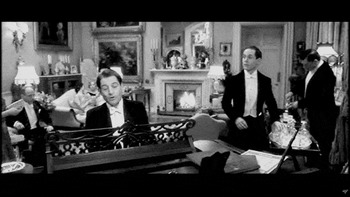
Just as the murder lies at the center of the story of a hidden nuclear family, so the soundtrack to the actual murder includes a song that heightens these melodramatic elements. And, given the tradition of melodrama, it is appropriate that the musical accompaniment to the spoken dialogue underscores this relationship. “And Her Mother Came Too” is one of the most entertaining songs of the group, even as a close reading of images and dialogue reveals a number of unmistakable hits (summarized in Figure 2). Commander Meredith, who has been humiliated and destroyed financially by Sir William, is shown leaving the room as “a victim of a cruel jest,” even as his wife Lady Lavinia, “the girl [he] loves the best,” tries to get him to stay. He is looking for “a chance to be alone,” which is thwarted by the servants in the adjacent room. Lady Trentham's image underscores the word “snub,” and Sir William is showing brooding in his office with the words “sulk at the club.” Immediately after the word “fainted” is heard, Sir William winces as he drinks the poison, foreboding his imminent collapse.
Selected hits in “Her Mother Came Too.”
2a. Novello (sung): “the victim of a cruel jest” Commander Meredith leaves the room (1:12:09).

Novello (sung): “the girl I love the best” Lady Lavinia notices Meredith leaving (1:12:13).

Novello (sung): “the chance to be alone” Meredith surprised by servants' presence (1:12:22).

Novello (sung): “still her mother comes too” Mrs. Wilson enters the study, carrying the coffee cup, and looks at Sir William (1:12:37).

Novello (sung): “at dinner, supper or tea” Mrs. Wilson: “I brought you some coffee.” Sir William: “If I wanted coffee I'd have rung for it” (1:12:45–46).

Novello (sung): “she simply can't take a snub” Lady Trentham at the card table (1:13:02).

Novello (sung): “sulk at the club” Sir William sulking in his office (1:13:05).

Novello (sung): “and her mother came too. And though we've parted” Mrs. Wilson pours the whiskey for Sir William (1:13:14).

Novello (sung): “fainted just off the tee” Sir William drinks poison (1:13:25).

Most conspicuous, however, is the soundtrack accompaniment to Mrs. Wilson's actions in the library. She offers Sir William coffee just before Novello is heard singing “tea,” and with his rejection of the beverage a counterpoint of coffee-tea-coffee emerges deep in the soundtrack. In retrospect, Mrs. Wilson's reason for offering Sir William poisoned coffee is constantly amplified by a repetition of the one word that summarizes the outcome of their former relationship, and the reason that she is now taking this particular action: “mother.” In fact, she appears onscreen more than any other single character to the accompaniment of “mother,” most prominently during her entry into Sir William's library just as she looks at her victim (1:12:37).
Only a portion of the song's hits are presented here to suggest the extraordinary coordination of image, sound, and plot, even to the point of revising the song's text (1:13:14 in Figure 2). At this point in the commercially available soundtrack, Novello/Northam sings the line, “To golf we started . . . three bags I carted,” which is the song's original text. However, in the film the line is replaced with “although we've parted . . . three bags I carted,” which accompanies Mrs. Wilson's preparation of the (poisoned) drink. Northam's performance is heard from a distance, yet every word is clearly audible because of a slightly slower tempo and more prominent mix in the soundtrack. The replaced line makes no literal sense, but the superimposition of Mrs. Wilson as Northam carefully enunciates “we've parted” explains her actions towards Sir William at this moment.
“And Her Mother Came Too” abruptly ends with Sir William's grimacing, fatal swig, as the scene cuts to Denton's opportunistic seduction of Elsie. Yet the song manifests Gosford Park's multiple melodramatic levels: as a heritage film in Monk's sense, a family-crisis/women's film in general, and as an integral synthesis of spoken word heightened by musical performance. As the segment most closely tying together images and music, “And Her Mother Came Too” spins a web of meaning that only becomes clear retrospectively and on repeated viewings, after the film's denouement and its revelation of the family drama of the Parks sisters.
Live Recording and “I Can Give You the Starlight”
As Novello, Jeremy Northam defied convention by singing the five central songs live on the set, without significant post-synching, and performing the piano accompaniment to two songs live—a risky act, and an extraordinarily outdated method of filmmaking. The era of recording music and dialogue live represents a very brief period in film history, and offers an additional model for the role of music in Gosford Park.
By November 1932—the setting of the film—synchronized sound was still in its infancy, having just recently become standard in the industry. To capitalize on the still novel use of synchronized musical performances, many movies in the early sound era incorporated conspicuous source performances as a matter of course. One approach was part of what Roy Prendergast called the “theme song craze” in which a performance of the film's hit song appeared onscreen, often in extremely contrived nightclub or theater scenes.Footnote 38 Although films continued to combine live musical performances in nonmusical genres of drama and comedy, their numbers were reduced with the success of the first Busby Berkeley “backstage” musical, Forty-Second Street, which was released in March 1933.Footnote 39
Set only a few months before this release date, Gosford Park re-creates the period of live musical performances interpolated into a nonmusical genre. The combination of the technical processes used to record the music in Gosford Park and the music's placement and use re-creates much of the ambience of an extremely specific period in Hollywood film. Indeed, the first song in the murder sequence qualifies as a theme song, since “The Land of Might-Have-Been” appears over the closing credits as well as in its entirety during the film, thereby closely connecting with the “theme song craze” of the very early 1930s.
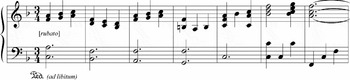
“I Can Give You the Starlight” meshes Northam's own live piano playing and singing with the most languid visual accompaniment. Although little appears to be happening on screen, Northam's performance is particularly worth examining in some detail. The on-film accompaniment is characterized by clunky, awkward voicings clustered in mid-range (shown in Example 1a) in contrast to the elegant soundtrack version played by the actor's brother, Christopher Northam (shown in Example 1b). The thin, sometimes monophonic, texture testifies to Jeremy Northam's self-acknowledged limitations on the instrument. Altman defended Northam's performance (which he described as “the best performance on film”), applauding the added sense of realism, and the efficiency and inexpensiveness of recording the music with the dialogue.Footnote 40 He went so far as to claim, “I think [movie makers] take this music in films a little too seriously.”Footnote 41
“I Can Give You the Starlight,” Film version played by Jeremy Northam (introduction).

“I Can Give You the Starlight,” soundtrack version played by Christopher Northam (introduction).

This imperfect recording is strangely apt for the song. The text offers a classic romantic ballad in which the protagonist offers the beauty and perfection of nature (“pools of shimmering dew,” “music in spring”) in lieu of more material gifts. That Novello performs for a dazzled Mabel reinforces the appeal of romantic ideals for the middle and lower classes—a cinematic ideal heightened by the framing sequences of Denton and Elsie's potential liaison. Accompanied by images of rapt servants, immobile for the only time in the entire film, the song embodies the calm, still center of the film, even as the combination of Novello's popular songs and live performance weds heritage film—in which most performed music conjures a “classical” style, whether historical or contemporary—to the earliest musicals through the unique effect of live performance.
The Double Feature, “What a Duke Should Be” and “Tell Me Why”
In describing Gosford Park, Altman said, “Now, if I were pitching it to Hollywood, I'd say it's Ten Little Indians meets The Rules of the Game . . . assuming you could find an executive in Hollywood familiar with Rules of the Game.”Footnote 42 In fact, Altman explicitly divided Gosford Park into two halves, describing “the second picture” as beginning after the discovery of Sir William's murder.Footnote 43 These two halves correspond to his description of the work's models, with one key substitution.
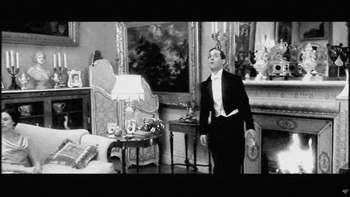
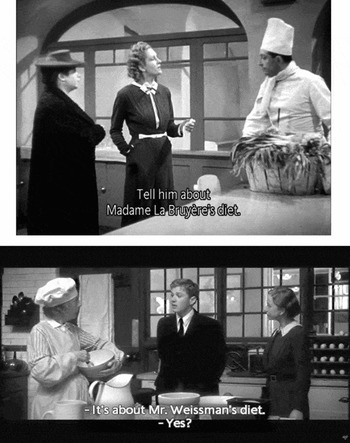
The first half of Gosford Park contains numerous references to Jean Renoir's 1939 classic The Rules of the Game (originally La règle du jeu). Altman made clear that he was influenced by Renoir's film on many occasions, ultimately concluding, “The Rules of the Game taught me the rules of the game.”Footnote 44 Gosford Park contains many parallels to Renoir's film, and several critics have identified Altman's film as his most explicit tribute to Renoir.Footnote 45 Several specific scenes are closely modeled on Renoir (see one such example in Figure 3, where dialogue, staging, and the mise-en-scène are perfectly matched). Each story uses a 1930s setting to reflect on the impact of the First World War on the aristocracy, underscored by constant reminders of the earlier struggle. Both films center on a shooting party at a country estate, and the plots turn on the extramarital affairs of the gentry, their guests, and their servants, resulting in a murder. Ultimately, it is the breaking of the rules of society through interclass liaisons that brings about fatal consequences.
Comparison between The Rules of the Game (dir. Jean Renoir, Reference Renoir1939) and Gosford Park.

In The Rules of the Game, the climactic party sequence features elegant couples waltzing to Johann Strauss's “Waltz” from Die Fledermaus with a farcical chase and gunfight among the servants—an apt aural distillation of the film's condemnation of a decadent, narcissistic society. Similarly, Gosford Park distills its critique of the aristocracy into musical performances. The consequences of cross-class romances are summarized in the song “What a Duke Should Be,” which describes the genealogical consequences of high/low romances between a Roman hero and a Norman wench, a felon and the Duke of Malta's daughter as a “dowdy, gouty” pseudo-aristocrat. No wonder that this Duke's “people, by my soul it's true, look on no one as a parvenu.” Sir William, the nouveau riche outsider and terrible shot, is a parvenu whose disrespect for the Table of Precedence—which governs the placement of guests at dinner—marks him as a moneyed interloper or, in his wife's words, “a peasant.” To nail the connections between genealogy, class, and murder, Novello's lyrics describe “shaving water” just as a long sharp blade glints in the hands of a member of Sir William's family tree (1:17:49–50). Capping this musical sequence and the film's double murder, a rhythmic knife thrust punctuates the chorus's cadence (1:18:20–22), succeeded immediately by an ironically festive double-time repeat by Novello/Northam and an image of the dead Sir William being pushed over to the phrase “wonderful to see” (1:18:27–29).
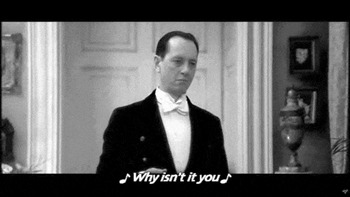
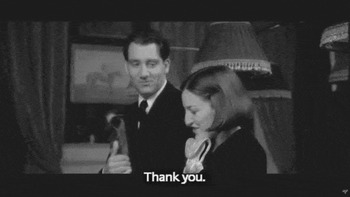
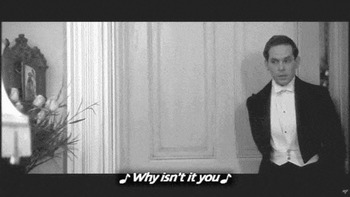
As in any Agatha Christie, Sherlock Holmes, or Charlie Chan tale, the red herrings are trotted out, again to musical accompaniment. “Why Isn't It You?” is ostensibly a song about unrequited love, yet it contains hits on three suspects in a refrain that muses “something is wrong but who can tell us what” (summarized in Figure 4). Commander Meredith and footman George each appear as dark-suited images in front of a white background as the refrain is heard within the room. By contrast, a spatially distorted refrain accompanies the appearance of the murderer, Robert Parks, in black against a black background. Northam leads into his final high pitch of “tell me why,” which is answered by the scream of discovery of Sir William's body by Lady Louisa. The subtle and multilayered construction of music, lyric, image, and plot have already explained in aural and visual detail why Sir William has been murdered—twice.
Selected hits in “Why Isn't It You?”
4a. Novello (sung): “Why isn't it you?” George enters the room (1:19:47).

Novello (sung): “Why isn't it you?” Parks enters the room (1:20:02).

Novello (sung): “Why isn't it you?” Meredith enters the room (1:20:09).

After the murder, the remainder of Gosford Park parallels its second model: not the red herring of Ten Little Indians offered by Altman but Charlie Chan in London (1934), which the character of Weissman discusses explicitly and which serves as the purpose for his visit to the estate. A sample of parallels between the films include the country house setting, the gathering of suspects at the beginning rather than the end (atypical of the murder mystery, as noted by Altman), a bumbling, incompetent inspector, and a denouement that unmasks a butler who is not whom he appears to be.Footnote 46 In Charlie Chan, the plot mixes US and “British” characters, most played by North American actors with unpredictable accents. This last aspect—of poor British accents in Hollywood films—is referenced as an inside joke in Gosford Park by the character of Henry Denton. His patently false Scottish-by-way-of-Hollywood accent is immediately recognized and criticized by other characters in the film, and disappears halfway through the picture. The character of Paul Gray in Charlie Chan in London (who vaguely resembles the character of Henry Denton) is played by Canadian-born Douglas Walton, who appeared regularly as British characters in smaller and uncredited roles through the 1940s. His accent in Charlie Chan in London appears and disappears for no apparent reason (see, for example, 47:30–45, in which he seems to have forgotten that his character is English).
More explicitly, Altman identifies the character of Mary as “the real Charlie Chan” who, as an outsider to the action, introduces necessary clues and information.Footnote 47 Indeed, her distinctive accent (particularly in comparison to the remainder of the cast) and her ultimate ability to solve the mystery provide parallels to the character portrayed by Warner Oland in the original. Weissman discusses actors who were eventually cast in Charlie Chan in London including Alan Mowbray (1:22:28, who plays Geoffrey Richmond) and Ray Milland (1:22:42, who plays Neil Howard). A more subtle connection is made at the end of the film, as the newly unemployed Elsie leaves the estate in the company of Weissman, Novello, and Denton. Although never directly articulated, this scene suggests that Elsie the movie fan will have her chance in Hollywood. The character of the maid in Charlie Chan in London was played by Elsie (a.k.a. Elsa) Buchanan, a London-born actress who had a minor career in the 1930s playing bit parts—usually maids—in Hollywood's “British” films.
The recognition of Gosford Park's two generically incompatible halves suggests yet another overall schema: the double feature with music as intermission. Charlie Chan in London was shown as part of a double feature, which usually included two films lasting between sixty and ninety minutes. Live musical performances—of jazz bands, vaudeville acts, singers, instrumentalists including organists—were once standard parts of the film program, along with newsreels, live-action shorts, and cartoons. Although the use of live music declined in the 1930s, recorded music continued to be used for intermissions, whether between two shorter films or, later, to break up a larger feature. In this light, the musical bridge between the two halves—in the form of Novello's songs—takes on yet another significant structural, historic, and intertextual role, acting as yet another reminder of the cinematic experience.
Novello's Songs and Cinematic Reflexivity
The placement of Novello's songs in a conspicuously staged, live-recorded centerpiece does more than evoke several types of early 1930s films, including musicals, melodramas, and double features. It also reflects a trademark of Altman's style. Many of Altman's films draw on various incarnations of the musical; to put it another way, the most consistent genre in Altman's genre-deconstructing films is what director Paul Thomas Anderson called “musicals without people singing.”Footnote 48 Apart from the much-maligned Popeye (1980), Altman's clearest tribute to and deconstruction of the classic film musical, the most obvious candidates are three disparate films that nonetheless replicate the backstage musical by profiling working musicians while integrating ambi-diegetic music throughout, in many cases using live performances and avoiding post-synching whenever possible.Footnote 49 Nashville (1975), often heralded as Altman's greatest film, Kansas City (1996), and A Prairie Home Companion (2006) connect characters through the music industry, introducing dramatically and structurally significant musical performances on stage, in recording studios, and through the media.Footnote 50
Yet even less obvious Altman film examples use music prominently and for dramatic effect, including MASH (1970), McCabe and Mrs. Miller (1971) and The Long Goodbye (1973). Occurring in each of these films, and emerging as a trademark of Altman's work, is the musically heightened death sequence, whether that death occurs from natural causes (Prairie Home Companion), public assassination (Nashville), fake suicide (MASH), a Western shootout (McCabe), or a stabbing in a country house, and whether accompanied by Kansas City jazz, old-timey music on a popular radio show, a simple guitar and vocal arrangement supplied by Altman's teenage son, a nostalgic ballad by John Williams and Johnny Mercer, the songs of Leonard Cohen, or an onscreen performance by the character of Ivor Novello. Thus Gosford Park merges one of Altman's most distinctive cinematic traits— diegetically accompanied death scenes, often using live-recorded music—with the piano-based, onscreen performances typical of the heritage film. A close reading of music and images during this segment reveals that, as Lady Trentham states in the film, Novello's songs are “much more than just background music.”Footnote 51
Hidden in plain sight, the songs prepare the audience for the untangling of sordid relationships and the resolution of the murder mystery at the end of the film. The extended musical segment ties together the two halves of Gosford Park even as the film incorporates clear references to period films, from the social criticism of The Rules of the Game to the post-murder denouement that parallels Charlie Chan in London. Throughout, the work is permeated with direct if seemingly innocuous references to other films even as the plot, music, technical processes, and characters connect to the most popular film moments of the 1930s and the 1990s—“British” costume heritage films, murder mystery, melodrama, and the live musical performances characteristic of both period films and Altman's own films. At the same time, the music of the opening and closing credits provide another frame for the work. Just as “Waltz of My Heart” evokes upper-class English estates for US audiences, the closing performance of “The Land of Might-Have-Been” signals the divide of Gosford Park's two worlds of rulers and servants; “reality” and cinema; past and present; the United Kingdom and the United States; mother(land) and estranged offspring.
Indeed, it is the reappearance and transformation of “The Land of Might-Have-Been” into non-diegetic, self-consciously artificial music over the closing credits that may best summarize the use of Novello's songs in Gosford Park. Lush strings and winds supplement, and eventually supplant, the piano and Northam's vocals. Previously heard in an intimate, live performance, the song is now expanded musically and visually as the camera pans over the idyllic English countryside. What was perceived as authentic has metamorphosed into the closing credits of a Hollywood movie, during which the illusion of this separate world is conclusively dismantled and the audience must leave the “land-of-might-have-been.” The music anticipates and enables this transition, as it has throughout the film, by acting as the perfect servant to the plot, characters, and the viewer.
Appendix 1
Synopsis of Gosford Park
The setting is a weekend shooting party at Gosford Park, the country estate of Sir William and Lady Sylvia McCordle, and their daughter Isobel, in November 1932. The guests include Lady Sylvia's sisters and their husbands, Lady Louisa and Lord Raymond Stockbridge, and Lady Lavinia and Commander Anthony Meredith; the sisters' aunt, Constance, the Countess of Trentham; screen idol Ivor Novello and his friend, Hollywood producer Morris Weissman; Rupert Standish, who is courting Isobel, and his friend Jeremy Blond; and the aristocratic Freddie Nesbitt and his bourgeois wife Mabel. Accompanying the guests are their ladies' maids and valets who mingle with the house servants, including Mary Maceachran (Trentham), Robert Parks (Stockbridge), Henry Denton (Weissman and Novello), butler Jennings, head maid Elsie, and head valet George.
Tensions mount between upstairs and downstairs contingents, most notably between Gosford Park's head housekeeper Mrs. Wilson and the cook Mrs. Croft, and among Sir William, his family, and many of the guests. After an outing of pheasant shooting, a tense dinner scene ends with the revelation that Sir William is having an affair with maid Elsie. Novello entertains the guests as we see Sir William murdered in his study. Inspector Thompson and his deputy Constable Dexter arrive after the discovery of the body, and interrogate the family, guests, and (briefly) the servants. As the weekend ends, the murder mystery is resolved through several surprising revelations regarding Sir William's past affairs with his employees.
Appendix 2
Character List for Gosford Park
Note: Characters are listed under surname first, if provided. (Many servants are identified by a single name only.)