

There is a widespread account of Aristotle's logic that claims that it applies only to non-empty terms. We find it recently endorsed in, for example, the Stanford Encyclopedia article entitled ‘Aristotle's Logic’:
[According to Aristotle] we can get ‘Some monsters are chimeras’ from the apparently true ‘All chimeras are monsters’; but the former is often construed as implying in turn ‘There is something which is a monster and a chimera’, and thus that there are monsters and there are chimeras. In fact, this simply points up something about Aristotle's system: Aristotle in effect supposes that all terms in syllogisms are non-empty. (Smith Reference Smith and Zalta2009)
According to Church (Reference Church and Bar-Hillel1965: 420), this account stems from Łukasiewicz, who wrote in 1929: ‘In Aristotle's logic, empty names may not be the values of . . . name variables’ (Łukasiewicz Reference Łukasiewicz, Wojtasiewicz and Słupecki1963: 103—italics in the original). Łukasiewicz repeated the claim in his definitive work first published in 1951: ‘Aristotle does not introduce into his logic singular or empty terms or quantifiers. He applies his logic only to universal terms, like “man” or “animal”. . . . Singular, empty, and also negative terms are excluded as values’ (Łukasiewicz Reference Łukasiewicz1957: 130, 72). In fact, the claim goes back at least as far as Śleszyński (Reference Śleszyński1921. According to Władisław Bednarowski (Reference Bednarowski1956: 227), ‘Śleszyński assumes that the terms employed in the Aristotelian logic are not empty’, and in Bednarowski (Reference Bednarowski1949: 543, 545), he noted that Śleszyński's reason was a general belief that the laws of the syllogism and of the square of opposition are otherwise invalidated.Footnote 1
The doctrine was taken up by the Kneales in their influential history: ‘In order to justify Aristotle's doctrine as a whole it is necessary, then, to suppose that he assumed application for all general terms with which he dealt’ (Kneale and Kneale Reference Kneale and Kneale1962: 62) and by Patzig in his influential study: ‘[Aristotle] assumes without further argument that . . . in each case [the set of subject (predicate, contrary) terms] have at least one member’ (Patzig Reference Patzig1968: 6–7). We also find the doctrine in Corcoran (Reference Corcoran and Corcoran1974: 104): ‘Since Aristotle held that every secondary substance must subsume at least one primary substance, . . . j is an interpretation of L if and only if j is a function which assigns a non-empty set to each member of U’, and in Smiley (Reference Smiley1973: 143): ‘The intended interpretation . . . is the familiar one in which the terms are understood as ranging over non-null classes’.
John Martin (Reference Martin2004: 6, 20) and Seuren (Reference Seuren2010: 158 ff.) claim in addition that, whereas Aristotle restricted terms in syllogisms to non-empty species terms, it was the medievals who widened the scope of syllogistic to allow empty terms. But against this weight of authority there have been several lone voices: Manley Thompson in 1953, Michael Wedin in 1996, Terry Parsons (Reference Parsons and Zalta2008b) in his Stanford Encyclopedia article on the square of opposition, and Gisela Striker in her recent translation of the Prior Analytics (Aristotle Reference Striker2009: 88). They claim that Aristotle himself intended his syllogistic to apply to empty as well as non-empty terms. We need to go back to Aristotle's De Interpretatione (on the nature of syllogistic propositions) and Prior Analytics (on the nature of inference) and look closely at what he says there.
In chapters 7 and 8 of De Interpretatione, Aristotle distinguishes between four different types of subject-predicate proposition:
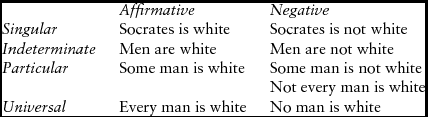
Some have claimed that Aristotle does not include singular propositions among the syllogistic. But this is not true; Aristotle gives several examples of syllogistic reasoning containing singular propositions, for example (Ross Reference Ross, Edghill, Jenkinson, Mure and Pickard-Cambridge1928: 70a27):
One argument, much repeated (see, e.g., Łukasiewicz Reference Łukasiewicz1957: §3; Bochenski Reference Bochenski and Thomas1962: 13 C 5, 70; and Kneale and Kneale Reference Kneale and Kneale1962: 67; see also Striker in Aristotle Reference Striker2009: 76), is that Aristotle cannot include singular terms in syllogistic propositions because it is essential that terms in them can take both subject and predicate position, and Aristotle explicitly rules out the occurrence of singular terms in predicate position (see 43a25 ff.). But the middle term in the third figure occurs only as subject, so certainly singular terms could always occur in third figure syllogisms, in addition to cases such as the (first figure) syllogism about Pittacus above. In fact, unless it is circular, ecthesis (that is, the expository syllogism) involves singular propositions essentially. In general, Aristotle treats singular propositions like universal ones (for example, at 70a16–21, where Aristotle proves that the wise are good by Darapti from the fact that Pittacus was wise and good).
Indeterminate propositions are ambiguous: contrast ‘Men are animals’ (interpreted as a universal) with ‘Men are running down the street’ (usually interpreted as particular). Łukasiewicz (Reference Łukasiewicz1957: 5) claims that Aristotle takes indeterminate propositions to be particular, for Aristotle follows his demonstration of the validity of Darii, which has a particular as minor premise, with the comment (see also 29a28–29): ‘The same holds if the premiss BC should be indeterminate and positive [i.e., affirmative], for the same syllogism will result whether we take it to be indeterminate or particular’ (26a29–30). However, Aristotle may equally well mean that whether we take the indeterminate premise to be universal or particular, the syllogistic conclusion will follow, either by Barbara or by Darii.Footnote 3 But on the whole, Aristotle takes syllogistic propositions to be universal or particular, affirmative and negative. The square of opposition is an attempt to formalize what Aristotle describes in chapter 7 of De Interpretatione:Footnote 4

Each universal proposition entails its subalternates. Contraries cannot both be true. Subcontraries cannot be false together. Contradictories cannot both be true and cannot both be false.
Strawson, claiming that Aristotle's logic is restricted to non-empty terms, suggests that each constituent proposition presupposes the non-emptiness of the subject, failing which it has no truth-value:
If we interpret the propositions of the [square] as neither positively, nor negatively, nor positively and negatively, existential, but as sentences such that the question of whether they are being used to make true or false assertions does not arise except when the existential condition is fulfilled for the subject term, then all the traditional laws hold good together. (Strawson Reference Strawson1950: 343–44; italics in original)
Geach had expressed a similar view in the previous issue of Mind: ‘If “S” is a pseudo-name like “dragon” or “round square”, and names nothing, none of the [four Aristotelian] forms has a truth-value, and so the “square of opposition” becomes not invalid but inapplicable’ (Geach Reference Geach1950: 480). Łukasiewicz (Reference Łukasiewicz1957: 4), as we noted, claims that ‘in building his logic Aristotle did not take notice either of singular or of empty terms’. But Aristotle is happy to speak of the ‘goat-stag’ as an object of knowledge qua not existing (49a24) and to ask if there is a centaur or a God (89b32). Complex terms, which can be empty, e.g., ‘sleeping horses’ (40a38) are included in the syllogistic. That Aristotle rejects uninstantiated universals does not mean he didn't think there were any empty terms. The Kneales answer their own question, ‘Are we then to say that Aristotle's teaching is inconsistent . . .?’ (Kneale and Kneale Reference Kneale and Kneale1962: 58–59) by claiming that unless non-empty terms are excluded altogether, there is no consistent interpretation at all that preserves all the relations of the square.
This despairing conclusion is not warranted. The heart of the issue is the interpretation of O- and A-propositions. For Aristotle, O-propositions do not have existential import, but A-propositions do. Once this is realized, we find a consistent and straightforward reading of Aristotle's view, one that does not restrict the syllogistic to non-empty terms. This reading was recognized by the medieval commentators (see, e.g., Burley Reference Burley and Spade2000: 110; Ockham Reference Ockham and Boehner1974: II, 3; Buridan Reference Buridan and Klima2001: I, 5), and by Moody (Reference Moody1953: 52), Prior (Reference Prior1962: 169), and Parsons (Reference Parsons2008a, Reference Parsons and Zaltab), among others:

It was not just moderni like Ockham and Buridan who attributed existential import to universal affirmative. In his interview with Wilfrid Hodges (Reference Hodges2011: 182), Niki Pfeifer asks: ‘Mentioning Aristotle's syllogisms, is Ibn Sina making existential import assumptions? I.e., does “Every A is a B” presuppose that A is non-empty?’ Hodges replies:
Yes. When there are no As, he takes affirmative sentences with subject A (for example ‘Every A is a B’) as false, and negative statements with subject A (for example ‘It's not the case that every A is a B’) as true. I don't think we know where this convention came from, but it's certainly older than Ibn Sina.Footnote 5
My claim is that this interpretation goes right back to Aristotle. In fact, Aristotle commonly (though not invariably) expresses the O-proposition as ‘Not every S is P’ (or as he usually puts it: ‘P does not belong to every S’), and he clearly treats ‘P does not belong to every S’ as equivalent to ‘P does not belong to some S’. He says of the O-proposition (see also 27b20–21): ‘Further, since [P]'s not belonging to some [S] is indeterminate—it is true that it does not belong to some both if it belongs to none and if it does not belong to all’ (26b15). By ‘indeterminate’, he means that there are two possible causes of the O-proposition's truth. Thus ‘P does not belong to some S’ (i.e., ‘Some S is not P’) is not equivalent to ‘Not-P belongs to some S’ (i.e., ‘Some S is not-P’). Aristotle rejects obversion: ‘Some S is not-P’ is affirmative, and entails the negative proposition ‘Some S is not P’, but is not entailed by it. Moreover, ‘No S is P’ is the contradictory of ‘Some S is P’. ‘Some S is P’ entails there is an S. So ‘No S is P’ does not entail there is an S (otherwise the existence of S would be necessary). Indeed, Aristotle spends the whole of Prior Analytics I 46 arguing that ‘is not P’ and ‘is not-P’ are different. He writes:
It makes a difference in establishing or refuting whether one believes that ‘not to be this’ and ‘to be not-this’ signify the same or different things. For example, ‘not to be white’ and ‘to be not-white’:Footnote 6 for these do not signify the same, nor is ‘to be not-white’ the denial of ‘to be white’; rather, it is ‘not to be white’. (51b6–9)
Aristotle then spends several pages explaining the difference. Consequently, the O-proposition ‘Not every S is P’ (or ‘Some S is not P’) does not entail that there is an S. Nicholas Rescher comments in his translation of Al-Farabi's commentary on the Prior Analytics (Rescher Reference Rescher and Rescher1963: 61 fn. 9, and again at fns. 22a, 31, 41, 44 in the same section) that although he translates the Arabic as ‘Some X is not E’: ‘Literally, that Not every X is E. Al-Farabi frequently formulates O-propositions in this way’. We can be grateful that he points this out; but he should have translated it more closely to begin with, else we have interpretation rather than translation.
Accordingly, A-propositions, as the contradictories of O-propositions, require the existence of their subject. But the existential import of A-propositions seems to entail that no such propositions concerning corruptible things can be necessary, that is, can be always true. Ockham (Reference Ockham and Boehner1974: III-2 c. 5, 512; English translation at Ockham Reference Ockham and Longeway2007: 159) observes that this is contrary to Aristotle's doctrine, when he claims, for example (Prior Analytics I 15, 34b17), that man is an animal of necessity. Does the fact that Aristotle thought that such propositions were demonstrably true show that he did not accord existential import to them? Not at all. Knowledge of such necessities, which ground all scientific knowledge, derives for Aristotle from knowledge of essence presented in intuition, that is, perception. Accordingly, as he says repeatedly in the Posterior Analytics (e.g., 92b5; cf. 93a19): ‘no one knows the nature of what does not exist’ (Ross Reference Ross, Edghill, Jenkinson, Mure and Pickard-Cambridge1928). Thus, knowledge of essence guarantees existence, and so for Aristotle, unlike for Ockham, there is no warrant for skepticism about scientific knowledge. Buridan (Reference Buridan and Read2014: 141) makes the same point, adding that ‘Aristotle believed such [propositions as “A horse is an animal”] to be simply necessary because he thought that the eternity of the world and universal nature could not allow that at some time nothing was a horse or a dog’. The important point to realize is that what Ockham means is not that the existential import of affirmatives is contrary to Aristotle's doctrine, but rather the belief that in consequence such propositions cannot be necessary.
Seuren (Reference Seuren2010: 125) claims that the reading attributing existential import to affirmatives and not to negatives ‘violates natural intuitions: some F is not-G clearly implies intuitively that not all F is G’,Footnote 7 and that ‘the modern notion of internal negation . . . was not available to Aristotle’ (Seuren Reference Seuren2010: 59). This surprising claim seems to overlook Aristotle's careful discussion in Prior Analytics I 46. His account there was the hard-won result of a succession of treatments of negation in the Metaphysics, the Topics, De Interpretatione, and Prior Analytics (Bochenski Reference Bochenski and Thomas1962: §12), distinguishing the various propositions that are in different senses ‘opposite’ to a given proposition. Thus, for example, ‘No S is P’ is opposite to ‘Every S is P’ as its contrary; ‘Not every S is P’ is opposite as its contradictory, and ‘Some S is P’ is opposite as its subaltern (see Keynes Reference Keynes1884: §53). These are represented in the square of opposition. But Prior Analytics I 46 shows that there is a further opposite, ‘Every S is not-P’. Thus, among the many contraries of ‘Every S is P’ there is both a negative contrary, ‘No S is P’, and an affirmative contrary, ‘Every S is not-P’; accordingly, there are two internal negations, one negating the copula and producing the negative contrary, the other negating the predicate and resulting in the affirmative contrary. This affirmative contrary has its own opposites, ‘No S is not-P’, ‘Not every S is not-P’, and ‘Some S is not-P’ as well as ‘Every S is P’. Together, they form a cube, with two squares on parallel faces, one for the propositions with positive predicates (A,E,I,O), the other for the negated predicates (A*, ¬I* = E*, I*, ¬A* = O*, * marking predicate negation):Footnote 8
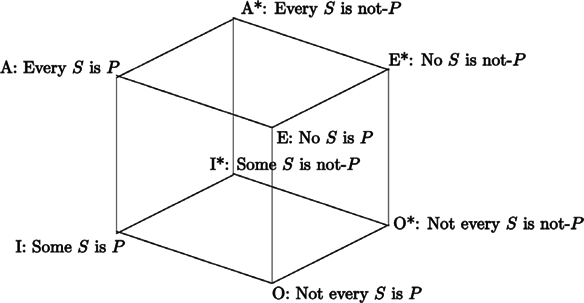
The face containing A, A*, I and I* consists of the affirmatives and that containing E, E*, O and O* of the negatives. The top face (A, A*, E, E*) contains the universals and the bottom face (I, I*, O, O*) the particular propositions. Each universal node has an affirmative and a negative contrary connected to it, each particular an affirmative and a negative subcontrary. Moreover, A* implies E, A implies E*, I implies O* and I* implies O, and each universal node implies the particular node beneath it (as its subaltern).
Seuren's mistake, we now see, is to equate ‘Some S is not-P’ with ‘Some S is not P’. The former is an affirmative proposition, false if there is no S, whereas the latter is a negative proposition, true in those same circumstances. Aristotle wrote in Prior Analytics I 46: ‘It is clear that “is not-white” and “is not white” signify different things and that one is an affirmation, the other a denial’ (52a24–26). Nonetheless, Seuren is partly right: Aristotle's system would be ‘nonvalid’ (Seuren Reference Seuren2010: 14), that is, useless as a logical system, if it applied only to non-empty terms, for there is no logical guarantee that a term is non-empty. Aristotle was too good a logician to miss that. For Aristotle, existence goes with quality, not quantity. The I-proposition ‘Some S is P’ is false if there is no S (e.g., goat-stag, centaur, white raven, sleeping horse). It follows that its contradictory, the E-proposition ‘No S is P’, is true if there is no S. Hence, its subaltern, the O-proposition ‘Not every S is P’ is also true, and therefore its contradictory, the A-proposition ‘Every S is P’, which Aristotle believes implies the I-proposition, must be false if there is no S. Contrast:
‘Every three-year-old student is doing a PhD’—arguably false, with
‘Every winged horse has wings’—arguably true
Aristotle takes these propositions to be uniformly false if the subject term is empty. So ‘Every S is S’ is false if there is no S. Indeed, on Aristotle's principles, ‘All chimeras are monsters’ is false, as is ‘All chimeras are chimeras’. There is only one passage where Aristotle commits himself to the self-predication: ‘B is affirmed . . . of itself’ (68a19). However, in this case, the truth of the proposition follows from the given assumption that A belongs to every B, so the argument begs the question: unless the A-proposition can be true when B is empty, B is true of itself only on the assumption that B is non-empty. Aristotle does not claim that ‘Every B is B’ is always true.
Given that the A-proposition ‘Every S is P’ is false if there is no S, the corresponding O-proposition must be true either if there is no S or if there is an S that isn't P, as we noted Aristotle explicitly says at 26b15. The negative proposition ‘Not every S is P’ (or ‘Some S is not P’) is not equivalent to the ‘infinite’ and affirmative proposition ‘Some S is not-P’, as Aristotle emphasizes at Prior Analytics I 46, though the latter is entailed by the former.
There is, however, one passage where Aristotle appears to say that self-denial (that is, ‘No S is S’ and ‘Some S is not S’) always results in falsehood, namely, at Prior Analytics II 15. This is the chapter Łukasiewicz (Reference Łukasiewicz1957: 9) cites in support of his interpretation, and Thom (Reference Thom1981: 92) and others follow him. In this chapter, Aristotle considers whether a syllogism is possible where the premises are opposites—either contraries or contradictories. He observes that the premises are opposites only if one is affirmative and the other negative and only if the premises share not only the middle term but also the other term, asserting and denying the same thing of the same thing. He then claims that whereas one can deduce a true conclusion from falsehoods, one cannot deduce a true conclusion from opposites: ‘for the syllogism always comes about contrary to the facts’ (64b9–10: gignetai to pragmati).
However, this does not show that self-denial is always false. For the subject of the conclusion must appear in both premises, including the affirmative premise, so again the argument begs the question. Of course, that premise may be false—at least one of the premises must be, since they are opposites. Nonetheless, both terms are assumed to be non-empty in the affirmative premise. Unless an affirmative proposition about S can be true when there is no S, which is exactly the issue before us, the conclusion denying that S is S is false only on the assumption that there is an S. That is quite correct on the interpretation proposed here: ‘S is not S’ is true if and only if S does not exist.
Finally, what of Aristotle's remark at the end of Prior Analytics I 1 that ‘we speak of “being predicated of all” when nothing can be found of the subject of which the other will not be said’? Will this not hold when the subject term is empty and nothing can be found of the subject at all? Aristotle commits himself in the very next paragraph, at the beginning of chapter 2, to the division of propositions exclusively into affirmative and negative. But some propositions that appear negative are equivalent to others that appear affirmative. Are they affirmative or negative? Just as ‘No S is P’ denies what ‘Some S is P’ says, so too ‘No S is not P’ denies what ‘Some S is not P’, that is, ‘Not every S is P’, says. So ‘No S is not P’ is in fact an affirmation, equivalent to ‘Every S is P’, as the dictum de omni says.
I conclude that Łukasiewicz's interpretation is mistaken. The weight of evidence is that Aristotle interpreted affirmative universal propositions the same way he interpreted singular ones, namely, as false when their subject terms are empty:
With an affirmation and negation one will always be false and the other true whether [Socrates] exists or not. For take ‘Socrates is sick’ and ‘Socrates is not sick’: if he exists, it is clear that one or the other of them will be true or false, and equally if he does not; for if he does not exist ‘he is sick’ is false but ‘he is not sick’ true. (De Interpretatione 13b26–31)
On this interpretation, all the relations that Aristotle accepts are preserved:
-
• A- and E-propositions are contrary (cannot both be true), and I- and O-propositions are subcontrary (cannot both be false)
-
• A- and O-propositions are contradictories, as are I- and E-propositions
-
• A-propositions imply their subaltern I-proposition, and E-propositions their subaltern O-proposition
-
• and E-propositions convert simply (‘Some S is P’ implies ‘Some P is S’, and ‘No S is P’ implies ‘No P is S’)
-
• A-propositions convert accidentally (‘Every S is P’ implies ‘Some P is S’), and O-propositions don't convert at all
In conclusion, Aristotle takes syllogistic propositions to be singular, indeterminate, particular, or universal. He places no requirement that the terms be non-empty. Łukasiewicz was simply mistaken to claim that Aristotle did. Existential commitment goes with quality, not quantity, thus satisfying all the demands of the square of opposition. O-propositions can be expressed either as ‘P does not belong to every S’ or as ‘P does not belong to some S’, and they are true if there is no S, the corresponding A-proposition then being false.


