INTRODUCTION
Use of pasture as the primary feed resource for cattle is the main reason why beef production costs in Brazil are low (Corsi & Goulart Reference Corsi, Goulart, Pedreira, Moura, da Silva and de Faria2006). About 10 million ha in Central Brazil are planted with Marandu palisadegrass (Brachiaria brizantha (Hochst ex A. Rich.) Stapf. (synonyms Urochloa brizantha and Panicum brizanthum)) cultivar Marandu, an introduced warm-season perennial grass, which corresponds to an area of c. 2·8 million km2 between 10–23°S and 40–60°W, c. 0·21 of the total cultivated grasslands in the country (Macedo Reference Macedo, Peixoto, Moura, da Silva and de Faria2004). Marandu has been accepted well by cattle producers because of its resistance to spittlebug (Deois sp. and Notozulia entreriana) and its high forage yield.
Herbage allowance (HA) has a major impact on forage intake and animal performance in grazing systems (Boval et al. Reference Boval, Cruz, Peyraud and Penning2000; Hernandez-Garay et al. Reference Hernandez-Garay, Sollenberger, Staples and Pedreira2004), and affects plant re-growth as a result of its marked effects on sward structure (Kim et al. Reference Kim, An and Jung2001; Braga et al. Reference Braga, Pedreira, Herling, Luz and Lima2006). In temperate grass pastures, maximum individual gain has been estimated to occur when HA is three to four times higher than daily animal intake (Hodgson Reference Hodgson1990). In tropical grasses, as discussed by Boval et al. (Reference Boval, Cruz, Peyraud and Penning2000), results are often erratic and still inconsistent, partially explained by discrepancies in the way in which HA is reported in the scientific literature (Sollenberger et al. Reference Sollenberger, Moore, Allen and Pedreira2005).
Adjei et al. (Reference Adjei, Mislevy and Ward1980) concluded that maximum average daily gain (ADG; 0·5 kg/head) from stargrass (Cynodon spp.) pastures was reached in the HA range of 6–8 kg dry matter (DM)/100 kg live weight (LW) per day. Almeida et al. (Reference Almeida, Maraschin, Harthmann, Ribeiro Filho and Setelich2000), on the other hand, estimated that 11 kg leaf/100 kg LW per day was the HA level that maximized ADG (1·0 kg/head per day) under continuous stocking. Boval et al. (Reference Boval, Cruz, Peyraud and Penning2000) showed in studies with tropical grasses that the HA levels that maximized animal performance ranged widely from 6 to 35 kg DM/100 kg LW per day. This probably reflects forage nutritive value differences as well as sward structure variations, in terms of height, density and leaf:stem ratio, among other attributes (Rezende et al. Reference Rezende, Pereira, Pinto, Borges, Muniz, Andrade and Evangelista2008).
The objective of the current study was to evaluate the effects of HA on the performance and productivity of Nellore steers (Bos taurus indicus L.) grazing Marandu palisadegrass pastures managed under rotational stocking.
MATERIALS AND METHODS
Local conditions, experimental design and treatments
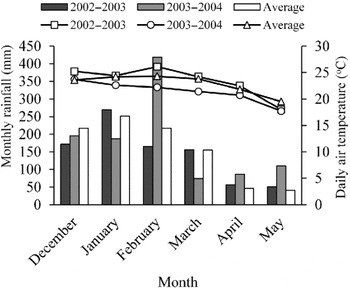
The work was carried out at the Departamento de Zootecnia of the Faculdade de Zootecnia e Engenharia de Alimentos, Universidade de São Paulo, in Pirassununga, Brazil (21°59′S, 47°26′W, 634 m asl). The climate at the site is Cwa (humid subtropical) according to the Köppen–Geiger classification (Peel et al. Reference Peel, Finlayson and McMahon2007). Monthly rainfall and mean daily air temperature during the study were recorded at the Air Force Academy weather station (Fig. 1), 16 km from the experimental site. The study was conducted on a pasture established in 1997 with Marandu palisadegrass. Soil pH (CaCl2) was 5·3 and concentrations of P, K, Ca and Mg were 0·66, 0·04, 0·35 and 0·09 g/kg, respectively. In November 2001, 0·7 t/ha of dolomitic lime was applied to the soil surface. Experimental grazing extended from December 2002 to April 2003 (140 d) and from January to May 2004 (140 d). These will be referred to herein as 2003 and 2004 seasons, respectively. During the experimental period each year, urea and potassium chloride totalling 200 kg N/ha and 84 kg K/ha were applied, split into four equal applications distributed equally along the experimental period, always at post-graze in every paddock. Single superphosphate (72 g/kg) was applied at 39 kg P/ha in October 2002 after harvesting the forage mechanically at 200 mm and again in December 2003 before the first grazing of the second year in each experimental unit.
Monthly rainfall data and mean daily air temperature in 2003 and 2004 at Pirassununga SP, Brazil. The average values correspond to the 30 years of historical series. The lines correspond to temperature and the columns correspond to monthly rainfall.

The experimental design was a randomized complete block with four replications. Treatments were four daily HA levels applied as 5, 10, 15 and 20 kg DM, measured as pre-graze herbage mass (HM) to soil level, per 100 kg steer LW/d. These treatment levels are referred to as HA5, HA10, HA15 and HA20 throughout the paper. Experimental pastures were rotationally stocked during the summer rainy season. Grazing cycles were 35 days, with 7 days of grazing and 28 days of rest, with all animals rotated over paddocks on the same day. Allowance levels were controlled and adjusted at the beginning of each grazing cycle in one of the five paddocks (control paddock) of each experimental unit and applied as HA=(100×HMpre–graze)/(LW×DG), where HA is the herbage allowance in kg forage DM/100 kg animal LW per day, HMpre-graze is the pre-grazing HM in kg DM/ha (details below), LW is the total animal LW in the control paddock in kg/ha and DG is the days of grazing (7 days for this experiment).
Stocking rate adjustments and HM estimates
The total experimental area was 25·5 ha, divided into 16 experimental units of 1·6 ha, each further subdivided into five paddocks (35×90 m). Experimental animals were 15-month-old Nellore (Bos indicus L.) steers with an average initial weight of 250 kg. Before the experiment started they were grazed on adjacent Marandu palisadegrass pastures with no quantitative forage restrictions, and received a mineral mix ad libitum throughout the trial. In each experimental unit, four animals were assigned as experimental animals in 2003 and three in 2004 and they remained on the pasture during the entire grazing season for animal performance evaluation. Additional steers, similar to the grazer animals, were added or removed from the experimental units every 35 days, in the control paddock, to maintain the target HA. Animals were weighed ‘shrunk’ (i.e. after 16 h without feed or water) once per 35-day grazing cycle. HM was estimated pre- and post-graze in the same control paddock. In 2003, HM estimates pre- and post-graze were done by destructive sampling (three 1×1 m quadrats cut at soil level per paddock), at sites representing mean HM in the paddock by visual appraisal, prior to sampling. In 2004, HM was estimated indirectly using a rising plate meter (Ashgrove, New Zealand), calibrated both pre- and post-graze, against selected clipped sites where mass was measured by destructive sampling after plate readings were taken. These were chosen so as to represent a wide range of HM values, to strengthen the calibration. First degree linear models were later fitted and when possible combined so as to reduce the number of calibration equations. The linear regression calibration models for HM as a function of disk meter readings in 2004 showed good fit (P<0·01), with R 2 of 0·82–0·91 (Braga et al. Reference Braga, Pedreira, Herling, Luz, Marchesin and Macedo2009). In addition, mean undisturbed sward height was estimated from 30 measurements in the control paddock. For this purpose, individual readings were made at the highest point reached by leaves and/or stems, in the undisturbed sward.
Plant part composition was established in three pre-graze and three post-graze HM samples per paddock (0·25 m2), which were separated into three fractions: leaf blades, stem plus leaf sheaths and dead material. Dead material was visually defined as senescent leaves and stems with 0·50 or more area of yellow or ‘strawy’/dry tissue. Green leaf blades and stems combined were defined as green material. Between the first and the second year, during the winter and spring of 2003, pastures were managed to maintain the same HAs, but the rest period was 56 days due to slow growth rates. During this period no fertilizer was applied and animal performance was not evaluated.
Data analysis
ADG was calculated individually for each experimental animal, dividing the mean individual gain during the grazing cycle by 35 days. Gain per unit area was obtained by multiplying ADG by average stocking rate in each grazing cycle. Data were analysed using analysis of variance and regression analysis, using both the MIXED and GLM procedures (SAS 1999), respectively. Treatment means were compared using orthogonal polynomial coefficients at P<0·10. Analysis of variance was run by year because the experiment did not start and end on the same dates each year. For simplicity, the 2 years are referred to herein as 2003 and 2004, and the grazing cycles within years are described as Cycle I, II, III and IV.
RESULTS
Daily air temperature and monthly rainfall
The mean daily air temperature between December 2002 and May 2003 was slightly higher than average in Pirassununga, whereas in the following summer it was lower than the average (Fig. 1). Monthly rainfall was close to the 30-year average, except in February 2004, when it was 200 mm (92%) higher than normal. This high rainfall, however, did not appear to affect DM production (Braga et al. Reference Braga, Pedreira, Herling, Luz and Lima2006). One possible explanation is the fact that temperatures in February 2004 were 2·1°C, or 9%, lower (24·3 v. 22·2°C) than the 30-year average.
Effect of HA on performance and productivity
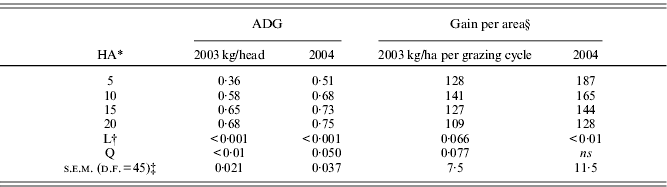
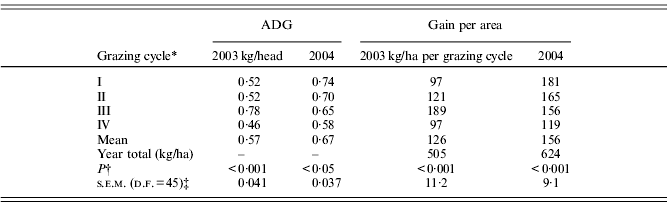
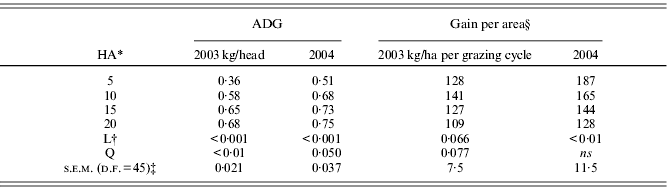
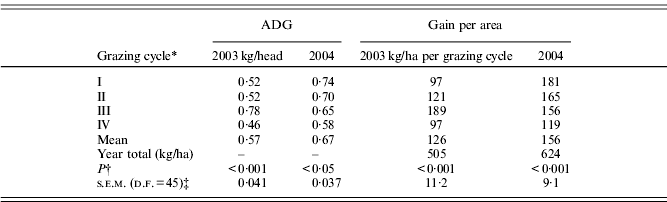
Steer ADG was affected by HA in 2003 and 2004 (P<0·001). Increasing HA increased ADG in both years (Table 1), reaching an asymptotic plateau around HA15, and remaining essentially unchanged at HA20, as both quadratic and linear orthogonal polynomial coefficients were significant. There was no interaction between HA and cycle (P>0·10). Although the HA effect on ADG remained constant across cycles, there were cycle effects (Table 2) both in 2003 (P<0·001) and in 2004 (P<0·05). In Cycle III of 2003 (February), ADG was highest, contrasting with Cycle IV (March), when it was lowest.
ADG and gain per area from palisadegrass pastures in response to HA in 2003 and 2004
* Herbage allowance expressed in kg of forage DM mass/100 kg of animal LW/day.
† Orthogonal polynomial coefficients for HA effect. L, linear; Q, quadratic; ns, not significant.
‡ Standard error of the mean.
§ Year totals for gain/ha is cycle means multiplied by four.
ADG (kg/head) and gain per area (kg/ha) from palisadegrass pastures in response to grazing cycles in 2003 and 2004
* Grazing cycles I, II, III, and IV are from December to April in 2003 and from January to May in 2004.
† Cycle effect within year.
‡ Standard error of the mean.
HA had a significant effect on gain/ha in 2004 (P<0·05), but not in 2003 (P=0·091) (Table 1), probably a consequence of the high ADG under the HA5 treatment in 2004. The response was quadratic in 2003 and linear in 2004. Gain/unit area was maximized at HA10 and declined as HA increased beyond that level in 2003. In 2004, maximum gain/ha occurred for HA5 and declined as HA increased. There were cycle effects on gain/ha both in 2003 (P<0·001) and 2004 (P<0·001), and similar to the ADG response, gain/ha was not affected by HA×grazing cycle interaction (P>0·10; Table 2). In 2003, gain per ha was higher in Cycle III (February; 189 kg/ha), contrasting with 2004 when the greatest gain was recorded in Cycle I (January; 181 kg/ha).
Effect of HA on sward structure
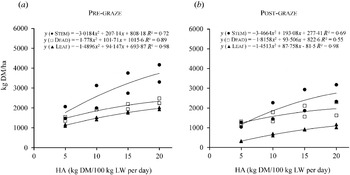
The amount of stem in pre-graze HM was greater than leaf blade and dead material, especially for HA15 and HA20. There was an increase in mass of all plant components in response to increasing HA (Fig. 2a, b). Variation in stem mass data was high, caused by its accumulation from the first (2003) to the second year of the experiment (2004), while results for dead material and leaf blade were similar from year to year.
Plant part components of Marandu palisadegrass pastures, managed at four levels of HA (5, 10, 15 and 20 kg DM/100 kg LW/day), at pre- (a) and post-graze (b), under rotational stocking in 2003 and 2004. Each point in the curve corresponds to the mean of four replicates and four grazing cycles per year. The symbols ●, □ and ▲ correspond to stem, dead material and leaf, respectively.

Mean pre- and post-graze sward heights in 2003 were 0·30, 0·42, 0·54 and 0·66 m (s.e.m.=±0·009 m), and 0·17, 0·24, 0·33 and 0·40 m (s.e.m.=±0·009 m) for HA5, HA10, HA15 and HA20, respectively. In 2004, pre- and post-graze sward height was 0·27, 0·45, 0·54 and 0·61 m (s.e.m.=±0·01 m) and 0·16, 0·31, 0·40 and 0·46 m (s.e.m.=±0·01 m) for HA5, HA10, HA15 and HA20, respectively. There was an increase in post-graze sward height from 2003 to 2004, except for HA5, a trend that was consistent with the increase in stem mass variation between years (Fig. 2b).
DISCUSSION
Evidence exists that more lenient and less frequent defoliation results in taller swards, greater HM and a smaller proportion of leaf and greater proportion of stem and dead material than under more severe and frequent defoliation (Da Silva et al. Reference Da Silva, Bueno, Carnevalli, Uebele, Bueno, Hodgson, Matthew, Arnold and Morais2009). In addition, an increase in stem during re-growth, especially for tufted, tropical grass species, is associated with fixed rest periods, which do not allow for the control of sward structure efficiently. In the current experiment, as expected, post-graze swards had reduced mass of all plant components after grazing (Fig. 2b). The reduction in leaf mass was greater than the disappearance of dead material, probably because of the greater abundance of leaf at the top of sward and also due to selective grazing (Boval et al. Reference Boval, Cruz, Ledet, Coppry and Archimede2002). Reflecting diverse pre-graze conditions between years, there was a relatively high variation in stem mass at post-graze sampling (quadratic model; R 2=0·69), as well as for dead material (R 2=0·55). In Marandu palisadegrass pastures managed at different stocking rates, there was an average decrease of 14 and 65% in the amount of stem and leaf blade after grazing, respectively (Rezende et al. Reference Rezende, Pereira, Pinto, Borges, Muniz, Andrade and Evangelista2008). In the current study, mean disappearance of stem and leaf was around 29 and 55%, respectively. However, stem disappearance rate observed for HA15 and HA20 was associated not only with intake but also with excessive lodging observed visually in these paddocks. In contrast, the amount of stem in post-graze HM was lower for HA5 and HA10, due to higher grazing efficiency (Braga et al. Reference Braga, Pedreira, Herling and Luz2007) associated with higher stocking rates.
As HA increases, grazing efficiency (total intake as a proportion of forage accumulation) is reduced and both individual intake and individual performance tend to increase up to an asymptote (Hodgson Reference Hodgson1990). In 2004, there was an ADG increase, especially for HA5, and this was associated with low-grazing efficiency (0·65 v. 0·55 for 2003 and 2004, respectively; Braga et al. Reference Braga, Pedreira, Herling and Luz2007), whereas the stocking rate was similar (10·1 v. 10·5 head/ha in 2003 and 2004, respectively). In general, ADG increased with the increase in HA, most noticeably at allowance levels lower than HA15. Hodgson (Reference Hodgson1990) projected values between HA10 and HA12 for maximum ADG from temperate pastures; however, there is an indication that those values may be higher in tropical pastures because of a greater proportion of stems in the HM of most tropical grass swards (Gontijo Neto et al. Reference Gontijo Neto, Batista Euclides, do Nascimento Junior, Miranda, Miranda da Fonseca and Paschoal de Oliveira2006).
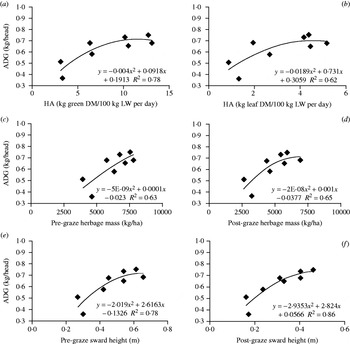
In the current study, the pattern of ADG response to ‘green’ and ‘leaf’ HA (HAgreen and HAleaf Fig. 3a, b) was similar to that for HA based on total HM and did not seem to be more powerful in explaining the variation in ADG response. The statistical models showed that maximum ADG is obtained between HA10 and HA13 for HAgreen and between HA4 and HA5 for HAleaf. For HAgreen, the results were consistent with those proposed by Hodgson (Reference Hodgson1990) for temperate grasses. Almeida et al. (Reference Almeida, Maraschin, Harthmann, Ribeiro Filho and Setelich2000) concluded that 11 kg of leaf/100 kg LW per day, (or HA11) maximized ADG of beef steers. In Tanzania guineagrass (Panicum maximum Jacq. cv. Tanzânia1) pastures grazed at 3, 7, 11 and 15 kg leaf/100 kg LW per day, maximum ADG was reached at c. HA10 (Barbosa et al. Reference Barbosa, Nascimento and Cecato2006).
ADG as a function of (a) green HA (stem+leaf blade); (b) leaf HA; (d) post-graze HM; (c) pre-graze HM; (f) post-graze sward height; (e) pre-graze sward height. Each point in the curve corresponds to the mean of four replicates and four grazing cycles.

Although ADG varied across grazing cycles, no interaction was detected between cycles and HA. Even with significant changes in sward structure, especially early in the experiment (Braga et al. Reference Braga, Pedreira, Herling, Luz and Lima2006) and most pronounced in the HA15 and HA20 pastures (Fig. 2a), HA effect on animal performance was consistent. Despite the practical advantages in terms of management, fixed rest and grazing days generally resulted in changes in sward structure with time, because there were no target sward conditions at which grazing initiation and conclusion were based. Deleterious effects caused by excessive ungrazed forage can be detrimental to subsequent herbage yield and animal performance, as underutilization degrades sward structure with excessive lodging and accumulation of overly mature and dead material, lowering overall nutritive value of forage on offer. The results of the present study, however, suggest that there is a consistent response of ADG to HA across years, an effect that was not modified significantly by changing sward conditions (Braga et al. Reference Braga, Pedreira, Herling, Luz and Lima2006). When ADG was regressed on sward height (Fig. 3e, f), the fit was superior to that for HM (Fig. 3c, d), especially for post-graze sward height (R 2=0·86). This shows an influence of sward height on cattle ingestive behaviour that was reflected in performance.
In 2003, gain/unit area was maximized at HA10, contrasting with 2004 when the HA effect was linear and gain per ha decreased as HA increased. This was probably associated with the high ADG response at HA5 in 2004, while the annual deviation for the other treatments was relatively small. In studies with Cynodon spp. that were stocked rotationally for 168 days and fertilized with 220 kg N/ha, gain/unit area was 576 kg/ha for a HA9 treatment (Adjei et al. Reference Adjei, Mislevy and Ward1980). In the present study, during 140 days of grazing and using 200 kg N/ha pastures, the HA10 treatment produced gain of 612 kg LW/ha (2-year average; Table 1). In Mott elephantgrass (Pennisetum purpureum Schum.) pastures, gain/unit area increased linearly from 767 to 1410 kg/ha when HA was increased from 3·8 to 14 kg leaf DM/100 kg LW/day over 210 days (Almeida et al. Reference Almeida, Maraschin, Harthmann, Ribeiro Filho and Setelich2000). Similarly, in pearl millet (Pennisetum glaucum (L.) R. Br.) pastures, where HA increased from 4 to 10 kg DM/100 kg LW/day, the response of individual gain to HA was positive and linear (de Moraes & Maraschin Reference de Moraes and Maraschin1988). For leaf HA of 3·8 and total HA of 4 kg/100 kg LW, in the studies of Almeida et al. (Reference Almeida, Maraschin, Harthmann, Ribeiro Filho and Setelich2000) and de Moraes & Maraschin (Reference de Moraes and Maraschin1988), ADGs were 0·83 and 0·58 kg/head, respectively, the latter being similar to what was found in the present study.
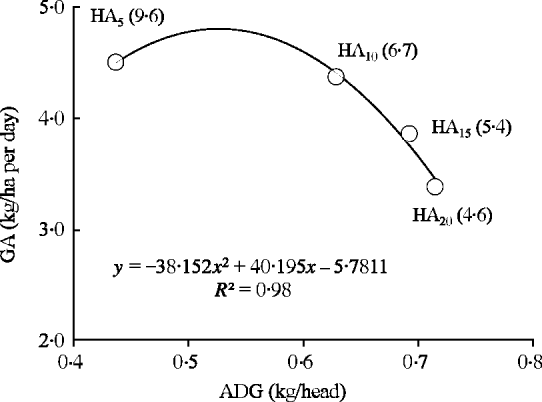
Higher levels of HA were always associated with lower levels of stocking rate; however, gain/unit area did not increase linearly as stocking rate increased, due to differences in ADG. Despite the HA5 and HA10 resulting in similar gain per unit area (Fig. 4), those gains were achieved using different stocking rates (6·7 head/ha for HA10 and 9·6 head/ha for HA5). Thus, HA10 pastures produced similar gain/unit area to those under HA5, with stocking rate being lower but ADG higher for HA10. Under these circumstances, stocking rates for HA10 may help reduce production costs and increase whole system profitability.
Average gain/area (GA) as a function of ADG of Nellore steers in Marandu palisade grass pastures. The numbers in parentheses on the curve indicate the mean stocking rate (head/ha) for each HA treatment. Data are an average of 2 years, 2003 and 2004. The average initial weight of the steers was 250 kg/head.

In order to achieve good levels of individual animal performance (⩾0·5 kg ADG) combined with good gain/unit area (c. 500 kg/ha during a 130–150 d summer grazing season) managing pastures at HA10 seems to be the best option. Use of lower HA (e.g. HA5) in order to achieve improved gain per area via increased stocking rate are likely to be unsuccessful due to low individual animal performance, resulting in longer periods of time until animals can be finished on pasture. However, despite the possibility of better individual animal performance, long-term use of HA15 or HA20 can have a negative effect on sward structure and ultimately result in lower herbage accumulation (Hodgson Reference Hodgson1990). In the current study, visual appraisal of pastures under high HA indicated large amounts of stem and dead material, which can hinder regrowth by shading basal tillering and cause forage spoilage by lodging.
To date, the wide range of methodological approaches used in studies of HA effects on cattle performance have hindered our understanding of the biological basis of the response. Further research is needed to examine how the quantitative aspect of forage–animal relationships (expressed by the concept of HA), together with qualitative characteristics of the forage on offer (such as plant part composition within levels of HA) interplay to determine the productive responses of grazing animals in forage–livestock systems.
This research was supported by Fundação de Amparo à Pesquisa do Estado de São Paulo (FAPESP).