Introduction
The Queensland fruit fly, Bactrocera tryoni (Froggatt) (Diptera: Tephritidae), poses a significant threat to horticultural crops in eastern and southern Australia, with occasional outbreaks in South Australia (SA) and rare incursions in Western Australia. In response, a fruit fly exclusion zone (FFEZ), which encompasses some of the most valuable horticultural production areas in New South Wales (NSW), SA and Victoria (Reynolds et al., Reference Reynolds, Dominiak and Orchard2010) was established. A bordering risk reduction zone (RRZ) was also established as a buffer zone to minimise movement of wild B. tryoni into the FFEZ. The current management protocol for B. tryoni in NSW includes extensive monitoring for early detection, bait and cover spraying, and the use of the sterile insect technique (SIT) (M. Nolan, personal communication 2009). Release of sterile adult B. tryoni has proven to be effective as part of an integrated pest management approach in eradicating fruit fly incursions (Fisher, Reference Fisher, McPheron and Steck1996) and suppressing wild B. tryoni in buffer zones, thereby minimising introductions into pest-free areas (B. Dominiak personal communication, 2009; M. Nolan, personal communication, 2009). One form of release is chilled adult release, which is used to transfer sterile, chilled adult flies from emergence containers to the field for release, to allow more compact packaging and reductions in the space required for transportation (Mangan, Reference Mangan1996). Chilled adults are usually released from a moving vehicle (termed roving release), allowing the rapid dispersal of large numbers of sterile flies (Meats & Smallridge, Reference Meats and Smallridge2007). Chilled adult fruit fly release is used effectively around the world, often as part of an aerial release program using airplanes (Cunningham et al., Reference Cunningham, Routhier, Harris, Cunningham, Johnson, Edwards and Vettel1980: Sivinski et al., Reference Sivinski, Jeronimo and Holler2000) or helicopters (Nakamori & Kuba, Reference Nakamori and Kuba1990; Vargas et al., Reference Vargas, Whitehand, Walsh, Spencer and Hsu1995). Ground release programs do not commonly involve chilled adults (Fisher, Reference Fisher, McPheron and Steck1996; Dominiak et al., Reference Dominiak, McLeod and Cagnacci2000), and there is scant data regarding the efficacy of the roving release of chilled adults (Salvato et al., Reference Salvato, Hart, Holler and Roland2003). Due to excessive travel distances between the location of fly production and release along with the large numbers of fruit flies that need to be transported, chilled adult release may be a viable option for B. tryoni.
There is concern that chilling sterile adult fruit flies may have negative effects on their performance and resulting SIT efficacy (Serghiou, Reference Serghiou1977; Mangan, Reference Mangan1996). The effects of chilling or chilled adult release on the performance of B. tryoni has received very little attention. Based on modelling results, Meats & Fitt (Reference Meats and Fitt1987) suggested that B. tryoni would incur the least stress and have the most rapid recovery if the chill temperature was as close as possible to the torpor threshold. They showed that adult B. tryoni acclimated at 25°C could be chilled for 24 h at 1°C and then recover within 12 min at 25°C. Adult diet and sex may also influence the performance (Perez-Staples et al., Reference Perez-Staples, Prabhu and Taylor2007) of chilled fruit flies.
In this study, we tested whether chilling and holding sterile adult B. tryoni at 4°C for different lengths of time affected their recovery time, flight and longevity. We then determined if a relationship between fly weight and adult wing length exists; the latter is known to correlate with adult fly size (Prabhu et al., Reference Prabhu, Perez-Staples and Taylor2008). Wing length measurements are tedious and time consuming. Using fly weight to determine fly size, a much simpler and quicker technique, needs to be examined for its efficiency and reliability. We also determined if fly size had any influence on adult B. tryoni recovery and longevity. We discuss the results in terms of the potential to use chilled adults for the sterile release of B. tryoni as part of a sterile insect release program.
Material and methods
Production and handling protocol
Bactrocera tryoni were obtained as pupae from the Fruit Fly Production Facility at the Elizabeth Macarthur Agricultural Institute, Menangle, NSW, Australia. Larvae were reared on a standard lucerne chaff diet (Prabhu et al., Reference Prabhu, Perez-Staples and Taylor2008), and pupae were dyed with Fiesta FEX 1 Astral Pink or Stellar Green fluorescent pigment (Swada, 30–32 Kilkenny Court, Dandenong South, Victoria, Australia), as described by Reynolds et al. (Reference Reynolds, Dominiak and Orchard2010) . Weekly consignments of dyed B. tryoni were sent as 8-day-old pupae to the Australian Institute of Nuclear Science and Engineering (AINSE) facility, Lucas Heights, where they were irradiated under hypoxia at 71.3–75 Gy of gamma irradiation from a cobalt-60 source. The dyed, irradiated pupae were then transported by road to the Wagga Wagga Agricultural Institute (WWAI) entomology laboratory in NSW.
Study insects
Insects were reared out in a growth room at the WWAI at 26±2°C, 65±10% RH and a light:dark period of 14:10, with a simulated dawn and dusk as the lights ramped up and down at the beginning and end of the light phase. Approximately 200 sterile pupae (emergence 86–91%) were placed in a petri dish on the base of ten, 30×30×30 cm mesh holding cages (Bugdorm, Taiwan). Half the cages were provided with five sugar (sucrose) cubes as a source of carbohydrate and a 30 mm diameter plastic petri dish containing yeast hydrolysate enzymatic (MP Biomedical, Auburn, OH, USA; 60% protein) as a source of protein, and the other half were supplied with sucrose only. All cages were supplied with water-soaked cotton wicks. Within one day of emergence, adult flies were separated according to sex and assigned immediately to a diet/chill treatment according to trial requirements (see below). Green-dyed flies were assigned the protein and sucrose diet and pink dyed flies the sucrose only diet in the first study, and this was reversed in the second study.
Chilling trials
Two chill regimes using split plot designs but different randomisations were carried out on separate dates. For the chilled adults, sterile B. tryoni were chilled at 4°C. In trial 1, flies were chilled for 0 (control; no chilling), 0.5, 1, 2 or 4 h. In a second trial, flies were chilled for 0, 2, 4, 8 or 24 h. At the start of each chill regime, all flies were 48–60 h old, which is the average age at which adult B. tryoni are released in an SIT program in NSW.
Recovery and longevity
For each diet/chill treatment (protein, sucrose+no chill; protein, sucrose+chill; sucrose only+no chill; sucrose only+chill), 25 flies of each sex were aspirated from the holding cages and placed individually in 700 ml round plastic containers (Centrapak, Australia) containing either a single sugar cube or sucrose and protein, giving a total of 200 flies. Each container was supplied with a water-soaked cotton wick changed as needed. A fine mesh (25 filaments per cm) was placed over the top of each container to allow airflow and secured with two rubber bands. For the chill treatments, containers were taken to a separate growth room nearby where they were chilled for different lengths of time, as detailed above. After the designated chill time, flies were placed back under standard conditions and recovery and longevity assessed immediately.
To assess recovery, individual adult B. tryoni were observed every 1–3 min, and the time to recover for each individual was recorded. Recovery was deemed to have occurred when the fly commenced walking or flying. To assess longevity, the same individuals were observed once daily (08.30 each morning) for 28 days for the first study or until all had died for the second study, and mortality was recorded. The mean and standard error are presented. Escaped flies and unnatural death were also recorded. Flies were weighed to 0.001 mg immediately upon discovery of death and frozen in individual vials (−20°C). At the end of the study, the right wing of each fruit fly was mounted onto a microscope slide following Prabhu et al. (Reference Prabhu, Perez-Staples and Taylor2008) . Each wing was then photographed using a Leica DFC290 digital camera (Leica Microsystems Pty Ltd, Unit 3, 112–118 Talavera Road, North Ryde, 2113, Australia) through the phototube of a Leica MZ75 stereomicroscope. The wing images were later measured using Leica Application Suite V3.1.0 software. As a measure of fly size, wing length was measured (mm) from the proximal edge of the basal radial cell to the intersection of the costal and R4+5 veins on the margin (P. Gillespie, personal communication 2009).
Flight ability
Trials for flight ability used ten mesh cages, each containing four flight tubes after (IAEA/FAO/USDA, 2003) setup without food or water in a growth room at 4°C. In each cage, two flight tubes were randomly assigned for protein and sucrose-fed flies and two for sucrose only fed flies. Holding cages, containing adult B. tryoni were transferred to the chilled growth room. After 3 min, a total of 120 B. tryoni were aspirated from each holding cage, and 30 randomly selected individuals were placed in each individual flight tube according to diet treatment. The chill treatments were the same as described above. Control flies remained in the chilled room for less than 5 min, which ensured they were immobile and could be readily aspirated into the flight tubes. Once the flies had undergone their chill treatment, the entire cage holding the flight tubes and chilled B. tryoni were placed back under standard rearing conditions in a replicate split plot design. Tests for flight ability were conducted immediately after chilling. Flies that left the flight tube were aspirated four times on the first day and twice a day from then on until all flies had either been aspirated or had died within the flight tube. The mean and standard error are presented. Flies were sent to the Agricultural Scientific Collections Unit, Orange Agricultural Institute, Orange, NSW, Australia, to ascertain dye colour on the ptilinum and counts of ‘fliers’ and ‘non-fliers’ were made. This procedure was initially performed under a Leica MZ 8 microscope (Leica Microsystems Pty Ltd, Unit 3, 112–118 Talavera Road, North Ryde, NSW 2113) under a blue light source (Leica CLS 150 X light source with a blue filter). However, where the presence of dye colour was difficult to detect, examination of the specimen under a UV light (Leica Stereo- Fluorescence System 10446271 with a blue filter) was performed.
Analysis
All models were fitted using ASReml 2.0 (Gilmour et al., Reference Gilmour, Gogel, Cullis and Thompson2005) . In all linear mixed models, the significance of fixed effects was assessed using approximate F tests from the methods of Kenward & Roger (Reference Kenward and Roger1997) and derived from a scaled Wald statistic together with an estimation of the residual degrees of freedom. Only significant fixed terms (P<0.05) were retained in the final model. Experiment design structures including replicate and cages within replicate were fitted as random effects and retained in all models. Residuals from fitted models were examined for independence, normal distribution and constant variance using residuals versus fitted value plots and normal probability plots for each individual trial.
Recovery
A linear mixed model was used to model recovery time. Chill times between 0–4 h were tested in both trials, but 8 and 24 h chill time were only tested in the second trial. A factor was set up to distinguish between these times so that within and across trial estimates of a regression trend could be obtained for the 0.5–4 hour (factor at level 1) chill time. Only trial specific point estimates of recovery time for the longer (8 and 24 h; factor at level 2) chill times were estimated. For the 0.5–4 h chill times, fixed effects included intercept effects of trial, diet, sex and their interactions and linear trends across chill time due to these factors and their interactions. For the 8 and 24 h treatments of trial 2, fixed effects included sex, diet, chill time and their interactions fitted as factors. Replicate and cage within replicate for each trial were estimated as random effects.
Control or 0 chill time flies had zero recovery time with standard error estimates of zero. To ensure that least significant differences (P=0.05) between positive chill times were not underestimated by the inclusion of these zero standard error estimates, control flies were not included in this analysis. Of the 200 flies in the first trial, five flies did not recover from chilling. These comprised two male and two females after 1 h chilling and one female after 2 h chilling. In the analysis, these five flies were identified as outliers and consequently removed from the analysis. The variable analysed was thus ‘minutes taken to recover for flies which survived the chilling process’. In trial 2, all flies recovered from chilling.
Longevity
Linear mixed models were used to model longevity of adult B. tryoni in two trials. Trial 1 was terminated at 28 days and the surviving five flies treated as missing values in the analysis. Trial 2 continued until all flies were deceased. The difference in trial management resulted in separate analysis of the trials. Fixed terms in each model included effects of diet, sex and chill time and their interactions. Replicate and cage within replicate were estimated as random effects. Data for longevity or ‘days until deceased’ was recorded for chilled and control flies, including those flies which did not recover from chilling (0 longevity).
Weight and wing length at death
Linear mixed models were also used to model weight and wing length at death. Data from the two trials were analysed in a single model. Trial, chill time, diet and sex and their interactions were fitted as fixed effects, and the blocking structure of replicate and box within replicate were fitted as random effects. A linear mixed regression model was used to determine the relationship between wing length and weight. Since the coefficient of variation for wing length from the previous analysis was only 2.8%, wing length could be used as the independent variable. The covariate wing length plus the design factors of trial, diet, sex and chill time and all interactions of factors and factors with covariates were fitted as fixed effects in a linear mixed model. Random effects included replicate and cage within replicate for each trial.
Effect of fly size (wing length) on recovery and longevity
Bivariate models were fitted to the pairs of ‘traits’: wing length and recovery, and wing length and longevity. These models included all terms in the univariate analyses of recovery and longevity, respectively, but interacted with ‘trait’. The individual trait residual variances were modelled. The data for the bivariate model relating wing length and longevity consisted of 200 records for both wing length and longevity from trial 2 and 195 records of longevity and wing length from trial 1, as five data points were not recorded and treated as missing.
Flight ability
A linear mixed model was used to model flight ability. A factor was set up to distinguish between (0–4 h chill time) and (8 and 24 h chill time). Intercepts and trend effects across chill time of trial, diet, sex and their interactions were estimated as fixed effects, while effects of replicate and cage within replicate for each trial were estimated as random effects.
Results
Recovery
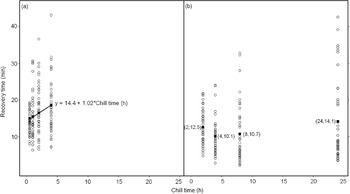
In the first trial, only five flies remained alive after the trial was terminated at 28 days. In trial 2, all flies had died by 66 days. At 0.5 to 4 h chill time, there was a significant effect of trial (F=18.08, df=1, 35.8, P<0.001), chill time (F=4.54, df=1, 40.3, P=0.039), and a trial×chill time interaction (F=5.60, df=1, 70.4, P=0.021) on recovery time of B. tryoni (fig. 1). For trial 1 (fig. 1a), an increase in recovery time with increasing chill time was significant for the chill time range of 0.5 to 4 h (F=5.60, df=1, 70.4, P=0.021). For trial 2 (fig. 1b), recovery times for the 2 h chill time were higher than those for the 4 or 8 h chill time. Across both trials, there was a significant difference from 0 for the chill times 0.5–4 h, where the intercept of the line was 14.4 min (F=308.53, df=2, 35.7, P<0.001). For trial 2, recovery took longer at 24 h chill time (14.10 min) compared to 8 h chill time (10.72 min) but only at P=0.060 (F=3.66, df=1, 70.9).
The recovery time for adult sterile B. tryoni fed either a protein and sucrose or sucrose only diet chilled at 4°C for (a) 0, 0.5, 1, 2 and 4 h (trial 1) and (b) 0, 2, 4, 8 and 24 h (trial 2). Zero chill time (control) was not included in the analysis. x and y values shown in brackets (x, y) are the chill time (h) and recovery time (min) respectively (▪, Trial predicted values).

Longevity
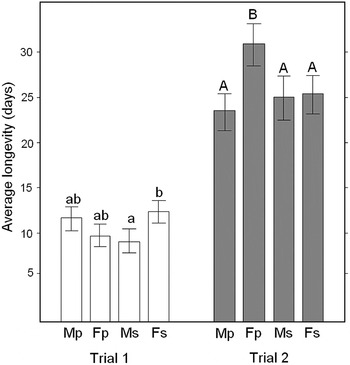
Trial 1 was terminated at 28 days with only five flies still alive at this time. Trial 2 had 66 flies still surviving at 28 days and was monitored until all flies were deceased. In trial 1 for those flies deceased by 28 days, there were no effects of chill time but there was a diet×sex interaction (F=4.97, df=1, 191.0, P=0.027; fig. 2). This finding reflected the fact that, among sucrose only fed adults, females (12.22±1.12 days) lived longer than males (8.99±1.29 days), while protein and sucrose-fed males and females (11.53±1.23 and 9.67±1.45 days, respectively) did not differ in longevity from the sucrose only fed males and females. In trial 2, there was also a significant diet×sex interaction (F=4.79, df=1, 175.7, P=0.030; fig. 2) with protein and sucrose-fed females (30.8±2.3 days) surviving longer than sucrose only fed females (23.37±2.11 days) and males fed either protein and sucrose or sucrose only (25.34±2.14 and 24.98±2.38 days, respectively).
The average longevity of adult sterile male and female B. tryoni fed either a protein and sucrose or sucrose only diet for trial 1 (terminated at 28 days) and trial 2. M, male; F, female; p, sucrose and protein diet; s, sucrose only diet. Error bars are SE. Within each trial, means between columns with the same letter are not significantly different from on another (P>0.05) using Fisher's LSD test.

Weight and wing length
There was a significant effect of sex on weight (F=3.99, df=1, 383.8, P=0.047) and a significant trial×diet×sex interaction (F=7.95, df=1, 391.3, P=0.006). In trial 1, the weights of males and females fed on sucrose only or the sucrose and protein diet did not differ (4.6±0.3 mg); however, in trial 2, males fed on sucrose only (4.1±0.3 mg) weighed less than males fed the sucrose and protein diet (5.2±0.3 mg) and females on either sucrose and protein or sucrose only (5.0±0.3 mg and 5.3±0.3 mg, respectively).
There was a significant effect of trial (F=9.83, df=1, 18.0, P=0.006), sex (F=88.35, df=1, 376.7, P<0.001) and a diet×sex (F=6.07, df=1, 384.3, P=0.015) interaction on wing length. Averaged across trials, wing length was lowest for males, with sucrose-fed males (4.46±0.016 mm) lower than sucrose and protein-fed males (4.50±0.015 mm), and both of these lower than sucrose or sucrose and protein-fed females (4.61±0.015 mm and 4.59±0.016 mm, respectively), of which the wing length of females fed on either diet did not differ significantly.
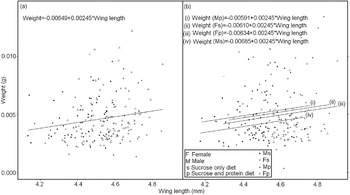
As wing length had a coefficient of variation of only 2.8% in the preceding analysis, it was a reliable measure to use as the independent variable in a regression analysis examining the nature of the relationship between wing length and weight. Weight was considerably more variable (coefficient of variation 26.4%). In trial 1, wing length and weight were related by a single linear relationship (weight=−0.00649+0.00245×wing length; fig. 3a), while in trial 2, the relationship between weight and wing length had an identical trend but significant differences in the intercepts for sucrose only fed males (−0.00685) and protein and sucrose-fed males (−0.00591, 5% l.s.d.=0.000854; fig. 3b). The lower coefficient of variation and the consistency of diet and sex effects in both trials on wing length, make this the preferred measure of B. tryoni body size.
The relationship between weight and wing length of adult B. tryoni for (a) trial 1 and (b) trial 2.

Effect of fly size (wing length) on recovery and longevity
As wing length was determined to be the best measure of fly size in the analysis above, this variable was used here to determine if there was a relationship between fly size and recovery and longevity. In the bivariate model relating fly size and recovery, significant interactions included trait (i.e. wing length and recovery means)×trial (F=18.05, df=2, 100.1, P<0.001), trait×sex (F=40.44, df=2, 392.7, P<0.001) and trait×diet×sex (F=3.20, df=2, 399.7, P=0.033). In trial 1, adult B. tryoni were smaller (4.52±0.01 mm) and took longer to recover (16.38±0.58 min) than in trial 2, where flies were larger (4.57±0.01 mm) and recovery was shorter in duration (11.84±0.57 min). While females had longer wing length averaged across trials and diets (4.61±0.01 mm) than males (4.48±0.01 mm), recovery times did not differ between sexes. When averaged across both trials, although there were diet and sex effects on fly size as indicated above, there were no diet and sex effects on recovery time.
In the bivariate model relating fly size and longevity, significant terms included trait×trial (F=111.96, df=2, 45.4, P<0.001) and trait×sex (F=46.78, df=2, 514.9, P<0.001). The smaller adult B. tryoni in trial 1 (4.52±0.01 mm) had reduced longevity, (10.5±0.74 days) compared to the larger adults in trial 2, (4.56±0.011 mm), which had greater longevity (25.91±0.73 days). When averaged across trials and diet, the smaller male B. tryoni (4.48±0.01 mm) also had reduced longevity (16.95±0.72 days) compared with females, (19.5±0.72 days) which were larger (4.61±0.01 mm).
Flight ability
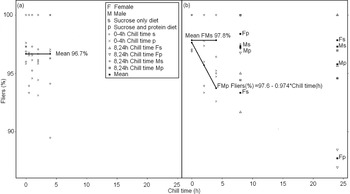
For the 0.5 to 4 h chill times, there was a significant effect of chill time (F=4.69, df=1, 15.0, P=0.047) and a trial×diet×chill time interaction (F=6.29, df=1, 50.7, P=0.015) on flight ability (fig. 4). Adults fed on either diet for the 0.5 to 4 h chill time for trial 1 did not differ in their ability to take flight (mean 96.7%) (fig. 4a). In trial 2, for the 0.5 to 4 h chill time, there was no difference in flight ability among adults fed sucrose only (mean 97.8%) (fig. 4b). However, for those fed the protein and sucrose diet, the propensity for flight decreased with increasing chill time (mean flight ability: 0 chill time −97.6%, 2 h chill time −95.7%, 4 h chill time −93.7%; slope −0.9736±0.29 per h) and differed from those flies fed sucrose only (fliers (%)=97.635–0.9736×chill time, slope SE=0.29, P<0.05).
The percentage of sterile adult B. tryoni capable of escaping from flight tubes when chilled at 4°C for (a) 0, 0.5, 1, 2, 4 h (trial 1) and (b) 0, 2, 4, 8, and 24 h (trial 2).

At 8 and 24 h chill times, there was a significant effect of sex (F=6.20, df=1, 21.1, P=0.021) and a significant diet×chill time (F=15.86, df=1, 21.1, P=0.001) and diet×chill time×sex (F=5.80, df=2, 21.1, P=0.010) interaction (fig. 4b). Females held on a protein and sucrose diet had the greatest propensity for flight after 8 h of chilling (98.39±1.53%) and the lowest flight propensity after 24 h of chilling (87.71±1.53%). Females held on a sucrose only diet displayed the opposite trend (93.33±1.53% and 97.83±1.53%, respectively). Males did not differ from any treatment combination except females at 24 h chill time fed on a protein and sucrose diet, which had the lowest tendency for flight.
Discussion
Adult B. tryoni suffered few detrimental effects of chilling under the trial procedures described in this study. Neither adult B. tryoni survival nor flight differed substantially between chilled and non-chilled cohorts. Although recovery time increased with chill time in trial 1, our results showed that when recovery time was averaged over both trials there was no effect of chill times of 0.5 to 4 h on the time it took for the fruit flies to recover. However, chilling does introduce a recovery time that is not experienced by non-chilled flies. Nonetheless, what is apparent in all of the variables tested is that there is significant variation between trials, or batches of fruit flies. The general lack of long-term effects of chilling is consistent with the absence of noticeable effects on Ceratitis capitata (Wiedemann) mortality (Hooper, Reference Hooper1970), sexual efficacy (Taylor et al., Reference Taylor, Bear, Gazit and Rossler2001) and, when aerially released, the propensity to take flight with good recovery (Vargas et al., Reference Vargas, Whitehand, Walsh, Spencer and Hsu1995). In addition, release of chilled sterile males of C. capitata results in significant reductions in wild fly infestations (Hendrichs et al., Reference Hendrichs, Franz and Rendon1995; Vargas et al., Reference Vargas, Whitehand, Walsh, Spencer and Hsu1995; Dowell et al., Reference Dowell, Siddiqui, Meyer and Spaugy1999).
Recovery of adult B. tryoni at the lower chill times (0.5–4 h) averaged 14.4 min irrespective of the length of time spent in chilling at 4°C (fig. 1). Modelling by Meats & Fitt (Reference Meats and Fitt1987) predicted that B. tryoni chilled at 1°C and then warmed at 25°C would recover within 12 min. However, the authors did not use sterile adult B. tryoni, but rather fertile adults and sterility is known to lead to decreases in some fruit fly performance variables (Hooper & Katiyer, Reference Hooper and Katiyer1971; Collins et al., Reference Collins, Weldon, Banos and Taylor2008). In trial 2, although recovery took longer at 24 h as opposed to 8 h, these lengthy chill times are unlikely to be used in standard release programs within Australia. Most sterile insect release programs aim to chill flies for no longer than 0.75–2.5 h at 3–5°C (Mangan, Reference Mangan1996; Tween & Rendon, Reference Tween, Rendon, Vreysen, Robinson and Hendrichs2007).
Chilling had no effect on adult B. tryoni longevity in this study. Similarly, Ceratitis capitata chilled at 4°C for 0, 15, 30 or 60 min had no effect on fecundity, egg hatch (Hooper, Reference Hooper1970) or mortality (Hooper, Reference Hooper1970; Serghiou, Reference Serghiou1977). In trial 1, although adult females fed sucrose only diets lived longer on average than males fed sucrose only diets, longevity did not differ to flies fed on protein diets (fig. 2). However, in trial 2, females fed protein and sugar survived the longest. Perez-Staples et al. (Reference Perez-Staples, Prabhu and Taylor2007) also demonstrated that access to protein increased fly longevity, particularly in female B. tryoni. Further, the authors showed that access to a source of protein had a greater effect on the longevity of sterile flies compared with fertile flies. These results are consistent with an earlier study by Drew (Reference Drew1987), which showed that female B. tryoni require protein to mature and reproduce, while males do not. The requirement of protein for reproduction of female B. tryoni was supported by Meats & Leighton (Reference Meats and Leighton2004) . However, recent studies of B. tryoni have shown that males experience reductions in mating probability, delayed mating and shorter copulations when deprived of protein as adults (Perez-Staples et al., Reference Perez-Staples, Prabhu and Taylor2007; Prabhu et al., Reference Prabhu, Perez-Staples and Taylor2008). Adult males of the oriental fruit fly, Bactrocera dorsalis (Hendel), require protein to obtain matings; and, additionally, the ingestion of methyl eugenol, which acts as a pheromone precursor, increases male attractiveness and mating competitiveness (Shelly et al., Reference Shelly, Edu and Pahio2005) and can also counteract a protein-lacking diet and enhance male mating success (Shelly et al., Reference Shelly, Edu and Pahio2007). Male Mexican fruit flies, Anastrepha ludens (Loew), show no benefit from access to yeast hydrolysate as adults (Aluja et al., Reference Aluja, Jácome and Maćias-Ordóñez2001a), although females do (Aluja et al., Reference Aluja, Díaz-Fleischer, Papaj, Lagunes and Sivinski2001b). While protein may be important in some aspects of sterile male B. tryoni performance, it may not be necessary for all performance variables. In our study, although females generally have greater longevity on either diet compared with males, females don't contribute to the overall SIT program and are infertile; however, they may still cause damage when they ‘sting’ or excavate fruit using their ovipositors. This lends further support for the production of a male-only B. tryoni strain for sterile release.
In our study, fly weight was affected by both diet and sex although only in trial 2. In this trial, males fed sucrose only weighed less than males fed the protein and sucrose diet and females fed on either diet. A study on the weight of male C. capitata showed that males fed sucrose only weighed significantly less than males fed on a full diet of protein and sucrose (Blay & Yuval, Reference Blay and Yuval1997). As the protein and carbohydrate diet is a more complete diet (Prabhu et al., Reference Prabhu, Perez-Staples and Taylor2008) and protein is particularly important for females to reproduce (Drew, Reference Drew1987), these results are not surprising. Our results also show that male B. tryoni generally have shorter wings compared with females. Females of other species of fruit fly have also been shown to be larger than their male counterparts (Jiménez-Pérez & Villa-Ayala, Reference Jiménez-Pérez and Villa-Ayala2006). However, within each sex, our results suggest that protein-fed flies generally have longer wings than sucrose only fed flies, although this was only significant for males and a surprising result that we cannot explain as wing length can only be environmentally influenced at the larval stage and not after imaginal moult (Rodriguero et al., Reference Rodriguero, Vilardi, Vera, Cayol and Rial2002). Small size (determined as a measure of wing length) resulting from a lack of food at the larval stage, and protein deprivation at the adult stage are both detrimental for male C. capitata (Blay & Yuval, Reference Blay and Yuval1997).
Fly body size has been determined in a number of species using wing length, including C. capitata (Blay & Yuval, Reference Blay and Yuval1997) and B. tryoni (Prabhu et al., Reference Prabhu, Perez-Staples and Taylor2008), and using weight in C. capitata (Whittier et al., Reference Whittier, Nam, Shelly and Kaneshiro1994) and papaya fruit fly, Toxotrypana curvicauda Gerstaecker (Jiménez-Pérez & Villa-Ayala, Reference Jiménez-Pérez and Villa-Ayala2006). Using fly weight is a much simpler and quicker technique; however, for B. tryoni, the results of our study show that wing length is still the best index of fly body size (fig. 3). Thus, we used wing length to determine if body size had any impact on both the recovery and longevity of B. tryoni. Although chilled adult females were larger in body size when averaged across trials and diets compared with males, recovery times did not differ between the sexes. Similar trials relating fly weight and recovery of other fruit fly species have not been done. The smaller adult B. tryoni in trial 1 had significantly reduced longevity compared to those in trial 2. Small size or weight has also been associated with reduced longevity in C. capitata (Bloem et al., Reference Bloem, Bloem and Chambers1994). Male B. tryoni were also smaller in size and had reduced longevity compared with females when averaged across both trials. Studies on the T. curvicauda, showed that females were significantly heavier than their male counterparts (Jiménez-Pérez & Villa-Ayala, Reference Jiménez-Pérez and Villa-Ayala2006). Female weight is generally accepted as an index of potential fecundity, assuming a positive relationship between the number of oocytes in the ovarioles and the weight of the female. Thus, heavy females have more eggs available for fertilization (Fay, Reference Fay, Robinson and Hooper1989; Tzanakakis, Reference Tzanakakis, Robinson and Hooper1989; Sivinski, Reference Sivinski1993). In our study, the trial differences highlight the variation in the quality of the sterile factory-produced fly and suggest that more careful management of production parameters needs to occur in order to ensure a consistent, high quality sterile fly.
Propensity for flight was not adversely affected by chilling at the chill times in trial 1 (fig. 4a). However, in trial 2, adults fed on a protein and sucrose diet had a decreased tendency for flight as the chilling time increased (fig. 4b). This suggests that chilling times should be kept to a minimum, particularly when B. tryoni are fed a protein and sucrose diet. Although males did not differ across treatments after 8 or 24 h chilling and females fed on protein and sucrose had the lowest tendency for flight overall (fig. 4b), these lengthy periods of chilling are unlikely to be used in a sterile release program for B. tryoni. Studies of chilled C. capitata have shown a significant decrease in the flight ability of pre-chilled flies to when immobilised flies were released after 2.5 h in an aerial release container (Salvato et al., Reference Salvato, Hart, Holler and Roland2003), thus confirming that flight ability is impaired when C. capitata remain chilled for extended periods of time.
Overall, our results suggest that chilling does not adversely affect male B. tryoni longevity or propensity for flight. Although recovery can take up to 15 min in chilled adults, research has shown that, in order to produce anaesthesia, results are more consistent with chilled insects than those that use CO2 (Harris et al., Reference Harris, Hoffman and Frazar1965). Although fly size did not affect recovery time, the smaller flies in trial 1 had significantly reduced longevity compared to the larger adults in trial 2. Importantly, though, as evidenced by the differences in B. tryoni performance between fly batches and sex, this study highlights the need to produce a more consistent quality factory-reared sterile fruit fly and to develop and trial a male-only sterile B. tryoni strain. Further research is required to determine the effect of chilling on mating, including mate attractancy and copulation of B. tryoni, as studies on other related species show varying results including reduced competitiveness of chilled male C. capitata (Serghiou, Reference Serghiou1977; although see Taylor et al., Reference Taylor, Bear, Gazit and Rossler2001), while in male A. ludens chilling did not affect female attractancy (Mangan, Reference Mangan1996).
Acknowledgements
We thank Peter Gillespie and Rosy Kerslake for identifying different dye coloured adult B. tryoni, Michael Stout, Vincent van der Rijt, Kim Holbrook and Roger Mandel for providing technical assistance, and Alfie Meats and Chris Weldon for providing input into the initial design of the trials. Todd E. Shelly and two anonymous reviewers are also thanked for providing useful comments on the manuscript. This project was facilitated by Horticulture Australia Ltd in partnership with industry.