


1. Introduction
Proponents of development in the Global South have long sought a shift from the targeted provision of goods and services to the implementation of universalistic policy. Clientelism, the discretionary redistribution of goods in exchange for political support, can distort political incentives and deepen inequalities. In low-income countries, clientelist appeals tend to dominate programmatic ones (Kitschelt and Wilkinson, Reference Kitschelt and Wilkinson2007; Hicken, Reference Hicken2011), especially among the powerful electoral bloc of business owners (Wank, Reference Wank1996). The lack of programmatic voting may be explained, in part, by the large number of firms in low-income countries that operate in the informal sector (Gottlieb, Reference Gottlieb2024). Informal firms tend to undervalue programmatic appeals, especially as their very existence is often contingent on clientelistic policies that overlook their illegality (Holland, Reference Holland2016).
But while some firms benefit from this type of targeting, many do not. Informal firms may be better off from the stability that predictable policy provides, especially via codified protection from the expropriation and illegal tax extraction that informal firms regularly face. Particularly as informal firms constitute the bulk of economic units in low-income countries (La Porta and Shleifer, Reference La Porta and Shleifer2014), they possess a latent capacity to coordinate around programmatic policies that could improve their outcomes in the long run. Regardless of demand, however, there may not be adequate supply: few low-income democracies boast candidates that effectively campaign on programmatic promises instead of clientelistic ones.
In this research note, we leverage a unique moment in Senegal’s political history to assess whether informal workers break away from the non-programmatic status quo when given the opportunity. We implemented an information experiment around Senegal’s local elections in 2022, when a programmatic political coalition—mobilized from outside the ancien regime (Shefter, Reference Shefter1977)—stood election against the traditionally clientelistic ruling party. To assess whether and how support for clientelism can be attenuated—and whether this translates into greater support for programmatic candidates—we implement a factorial survey experiment that (1) primes the salience of firm owners’ economic sector (formal or informal), (2) provides information about the benefits of the formal sector, and (3) reminds firm owners of their considerable within-sector coordination capacity.
We first confirm the common perception that informal workers are generally less supportive of programmatic candidates, and also show that priming the salience of the informal sector pushes them even further toward the ruling party. While reminding informal workers of the benefit of formalizing on its own does not change their behavior, reminding them of their considerable size and thus their coordination capacity reduces their support for clientelistic candidates. Importantly, this shift does not translate into support for programmatic candidates: informal firm owners disengage from the political process rather than support programmatic candidates.
Our findings demonstrate that the informal sector’s latent coordination capacity can potentially reduce dependence on non-programmatic or clientelistic candidates. Crucially, however, they also show that building a truly programmatic coalition requires more than simply activating their collective identity. A decline in informal firms’ support for the ruling party does not necessarily mean they have been persuaded by programmatic appeals or have reallocated their votes to the programmatic challenger. Instead, the key behavioral margin may be participation itself. In this sense, information and sector-based coordination cues may operate through an “exit versus voice” logic, reducing clientelist alignment but prompting political disengagement. This research note thus identifies a new and fertile area for future research on clientelism to explore.
2. Theory
Elections in the Global South have long been characterized by entrenched clientelism. Clientelist candidates offer selective material incentives to particular groups in exchange for political support, and their campaigns often rely on charisma, personalized appeals, and targeted inducements (Stokes et al., Reference Stokes, Dunning and Nazareno2013). Programmatic candidates, by contrast, offer policy platforms that are broad, impersonal, and rule-based, designed to apply to all citizens regardless of their partisan or personal loyalties (Kitschelt, Reference Kitschelt2000).
Firm formality plays a critical role in moderating support for clientelistic versus programmatic candidates. Formal firms are more likely to seek codified, rule-based policies rather than rely on the discretionary behavior of political patrons (Skowronek, Reference Skowronek1982; Kuo, Reference Kuo2018). This is because formalization ties firms to the regulatory state—through taxation, licensing, and legal institutions—creating incentives to support politicians who offer transparent and predictable governance. Rule-based governance is more amenable to long-term investment decisions compared to discretionary rule, where outcomes rely on one’s relationship to the party in power. In addition, firm productivity is higher where contracts are credible and where recourse exists to resolve disputes, compared to contexts where favorable judicial outcomes depend on political relationships (Frye and Shleifer, Reference Frye and Shleifer1997; Bhandari, Reference Bhandari2022). This leads to our first hypothesis:
Hypothesis 1. Relative to the informal sector, the formal sector will be more likely to vote for a programmatic candidate.
If this is the case, then formalization may shift political preferences by altering the relationship between firm owners and the state. But in many low-income countries, the informal economy dominates the formal one, and informal firm owners perceive little benefit from entering the formal sector. They often view the state as predatory or ineffective, and do not believe that registration will yield meaningful improvements in access to credit, infrastructure, or protection from economic harassment by informal tax collectors (La Porta and Shleifer, Reference La Porta and Shleifer2014). As a result, many informal firms choose to remain outside the state’s regulatory reach.
Information about benefits of formalization may thus change informal firm owners’ political calculations. If informal firm owners come to believe that formal status offers tangible advantages, they may be more inclined to support candidates who promise broad, rule-based programs. Owners who expect to benefit from firm formalization will have a greater stake in programmatic platforms that expand and protect those benefits. Thus, when a candidate campaigns on universal rules that would insulate formal firms from arbitrary harassment or enforcement, we hypothesize that making the benefits of formalization known will increase informal business owners’ support for programmatic candidates.
Hypothesis 2. The informal sector will be more likely to vote for a programmatic candidate when they are made aware of the benefits of formalization.
Formalization alone, however, may not be enough. Political transitions, especially away from clientelism, have historically required coordination from voters and from interest groups such as unions or business coalitions (Shefter, Reference Shefter1977; Kuo, Reference Kuo2018). While the act of voting is an individual activity (at least when ballots are secret), political shifts often depend on voters’ beliefs about whether others will act similarly (Olson, Reference Olson1971). Voting for a programmatic candidate under a clientelistic status quo can thus pose a collective action problem: while a soon-to-be formal business owner may prefer a universalistic policy regime, they may only shift away from the clientelist candidate if they believe others will as well (Adida et al., Reference Adida, Gottlieb, Kramon and McClendon2020). In developing contexts, however, the informal sector is highly fragmented. Informal business owners may not naturally perceive themselves as part of a common sector with shared interests or meaningful political weight. Indeed, they are much less likely than members of the formal sector to see their fate as linked or to discuss shared economic problems—both facilitators of coordination (Gottlieb, Reference Gottlieb2026). We thus consider whether priming coordination capacity, in addition to information about the benefits of formalization, impacts business owners’ likelihood of supporting programmatic politics. Our expectation is not that information about sector size, on its own, necessarily increases confidence in collective action. Rather, when paired with a prime that makes respondents’ sectoral status salient, such information may help informal firm owners view themselves as part of a broader and politically consequential constituency.
Hypothesis 3. The informal sector will be more likely to vote for a programmatic candidate when they are made aware of the benefits of formalization and see themselves as a sufficiently large constituency. Footnote 1
Understanding the conditions under which firm owners shift their support to programmatic candidates is important for identifying pathways out of long-lasting clientelist equilibria that constrain incentives to formalize, invest, and grow.
3. Context and research design
3.1. Background
While some programmatic opposition parties have emerged in Senegal’s history around workers’ rights and economic nationalism, their messages were limited in reach, only appealing to “a small segment of unionized urbanites and salaried professionals rather than the mass of the urban poor” (Resnick, Reference Resnick2014, p. 87). The broader electorate, especially informal workers, has remained tied to parties and coalitions with strong clientelist machines.Footnote 2
This pattern is notable given the sheer size and economic importance of Senegal’s informal sector. Informal economic activity accounts for over 90% of employment and nearly half of national GDP, encompassing occupations from petty trade and food service to retail and light manufacturing (ANSD, 2016).Footnote 3 Informality may induce divergent policy preferences given the distinct ways in which formal and informal actors interact with the state, for example, through different patterns of tax payment.Footnote 4 Yet despite their economic scale, informal actors have historically lacked formal political representation.Footnote 5 Their political engagement is often mediated through personalized ties with local politicians and intermediaries, and there are few institutional mechanisms through which their collective interests are channeled (Gottlieb, Reference Gottlieb2024). Instead, they are integrated into patron–client networks and urban political machines, limiting their ability to push for broader policy reforms.
In this context, we view the rise of a new programmatic political coalition in the country as a unique opportunity to assess whether programmatic discourse can gain traction within a clientelist political landscape, especially among informal firm owners historically attracted to clientelist appeals.Footnote 6 Macky Sall, the incumbent president at the time of the project’s implementation, had consolidated power through a presidency centered around clientelistic and populist strategies. This is not to say that Sall’s presidency lacked programmatic appeal altogether, however. Like Senegalese executives before him, his rise to power was accompanied by policy-based optimism, including his economic plan for an “emerging Senegal” and promises of executive reform. Toward the end of his presidency, he also served as chair of the African Union and emphasized infrastructure-driven development. Despite these programmatic elements, however, Sall’s presidency culminated in a constitutional crisis when he attempted to postpone the presidential election based on widely criticized justifications.Footnote 7 Furthermore, a leading resource on party linkage mechanisms, the Democratic Accountability and Linkages Project (DALP), suggests that Sall’s APR party “registers a steep rise [on the clientelism index] between DALP I (2008–09) and DALP II (2022–24), consistent with incumbency-driven organization and distributive reach,” scoring highest among parties in DALP II and rivaling former incumbent PDS’s score in DALP I (Kitschelt and Yildirim, Reference Kitschelt and Yildirim2026, p. 29).
Toward the end of Sall’s presidency, a largely programmatic opposition coalition began to gain mass appeal among broad segments of the urban and rural poor. This was the party of Ousmane Sonko, a former tax inspector who was fired by Sall after publicly exposing government corruption in 2016. This experience gave Sonko the credibility to build a political movement centered on government transparency and social justice (Monks, Reference Monks2019). In the 2019 presidential elections, Sonko campaigned against Sall on specific economic policies including moving away from the country’s colonial era currency and reducing tax evasion and expropriation by foreign firms. While Sonko only won a majority of the vote in his home region, he won a respectable 20% of the vote in Dakar (relative to 16% nationally) and his prominence in Senegalese politics continued to rise. Notably, DALP II rates Sonko’s Pastef party lowest on the clientelism index among Senegalese parties (Kitschelt and Yildirim, Reference Kitschelt and Yildirim2026).
Sonko’s influence had crescendoed by the time of local elections in 2022, which thus presented an ideal opportunity to assess whether programmatic appeals might sway informal workers from their usual voting behavior. While Sonko ran for mayor of his home region’s capital city of Ziguinchor, his coalition (Yewwi Askan Wi—“liberate the people” in Wolof) also ran a candidate, Barthélémy Dias, in Dakar. Sonko’s coalition was seen as establishing credible programmatic linkages with voters due to his personal history and the ideological commitments of the party he founded. We substantiate this claim empirically by having survey enumerators provide a standardized definition of programmatism and then asking respondents to identify which coalition best embodied this linkage mechanism. Approximately 53% of respondents identified Sonko’s coalition as programmatic compared to only 22% who did so for the incumbent president.Footnote 8 We further asked respondents how beneficial they perceived political clientelism to be. Consistent with our classification of Sonko as non-clientelistic, individuals who viewed clientelism as more beneficial were significantly less likely to support Sonko and significantly more likely to support the ruling coalition. Appendix L presents regression evidence confirming that each unit increase on a five-point scale measuring perceived benefits of clientelism is associated with a 5.9 percentage point increase in ruling-coalition support (p < 0.01) and corresponding decreases in support for Dias and Sonko.
3.2. Experimental design
We test our hypotheses using both descriptive analysis and causal inference based on a phone survey of business owners conducted approximately 1 week prior to Senegal’s 2022 local elections. The sample consists of 1,071 private business owners, of whom 39% operate formal firms and 61% operate informal firms. Respondents were drawn from two samples originally recruited face-to-face in prior research conducted in Dakar (Bhandari, Reference Bhandari2023; Gottlieb, Reference Gottlieb2024). These samples were drawn randomly, and their status as formal or informal was recorded using the objective measure of their business ID number. Additional details on these prior surveys and the resulting samples are provided in Appendix B.
We randomly assigned three informational treatments prior to measuring outcomes. Treatment 1 (T1) aimed to increase the salience of respondents’ sector (formal or informal) to causally test descriptive patterns associated with H1. Treatments 2 (T2) and 3 (T3) were designed to test H2 and H3, respectively. Treatments are summarized below, and the full scripts are provided in Appendix C.
T1: Increases the salience of the respondent’s economic sector by describing the formal or informal way in which each sector pays taxes.
T2: Increases the perceived benefits of formalization by providing (largely new) information about the advantages of a formal tax scheme that is applied to small businesses when they formalize.Footnote 9
T3: Increases perceptions of coordination capacity by priming the large size of the respondent’s economic sector (formal or informal).
For efficiency, we employ a factorial design, with Control and T1 being crossed with Control, T2, and T2 + T3 (see Table 1).Footnote 10 Enumerators read information scripts from tablets that automatically randomized assignment to one of the six treatment groups. Correct treatment implementation was validated via audio audits.
Factorial design treatment groups and assignment probabilities

Table 1 Long description
Rows list two conditions, Control and T1 sector salience. Columns list three conditions, Control, T2 benefits of formalization, and T2 plus T3 benefits of formalization plus coordination capacity prime. Each row and column combination contains one group label. In the Control row, the Control column is Group 1, the T2 column is Group 2, and the T2 plus T3 column is Group 3. In the T1 sector salience row, the Control column is Group 4, the T2 column is Group 5, and the T2 plus T3 column is Group 6. Each group label iindicate an assignment probability of one sixth for every group.
Note: for all of these, please get rid of ! and “and place the fraction in parentheses
Our main outcomes of interest are intention to turn out, vote choice in the 2022 local elections, and intention to vote for Sonko in the 2024 presidential elections.Footnote 11 Informed by previous research on the social desirability bias inherent in asking survey respondents their intention to turn out to vote (Adida et al., Reference Adida, Gottlieb, Kramon and McClendon2019), we preface the turnout question with a normatively acceptable excuse for not turning out to vote. For vote choice, response options are each of the parties or coalitions running and their mayoral candidate. We then create a binary indicator for Vote ruling if the response is for the incumbent coalition (Benno Bokk Yaakaar) and for Vote opposition if the response is for an opposition coalition. We create the binary indicator Vote Dias if respondents say they will vote for the Yewwi Askan Wi coalition (because our sample of voters are in Dakar; they cannot vote directly for Sonko in these local elections). Appendix E presents summary statistics for each outcome variable. We interpret voting for the ruling party as a preference for a more clientelistic party, as incumbents have a comparative advantage in using state resources, and there is a history of incumbents taking over the clientelistic networks of their predecessors in Senegal (Osei, Reference Osei2013). Of course, the ruling party and the Dias/Sonko movement differ in more ways than their entrenchment in clientelism. We are buoyed by respondents’ answers to questions about programmatism and clientelism (described at the end of Section 3.1), and we lend further support to our interpretation in Section 4.
4. Results
We first approach Hypothesis 1 descriptively. The results presented in Figure 1 show that, relative to informal firms, firms in the formal sector were more likely to say they would vote for the programmatic candidates; without any kind of priming, formal firm owners were 7 percentage points more likely to say they will vote for Dias in the upcoming local elections and 10 percentage points more likely to say they will vote for Sonko in the 2024 presidential elections. These results are robust to controlling for two covariates that are highly correlated with formality and may also affect political preferences: education and business income.
Test for Hypothesis 1: Outcomes by firm formality status.

For corroborating experimental evidence, we direct readers to Appendix G, which presents the full factorial specification for formal and informal sector respondents, respectively.Footnote 12 As evidence that the relationship between formality and programmatic support is not spurious, we show that experimentally priming informality (T1) among informal firms increased the likelihood that they vote for the less programmatic ruling party by almost 10 percentage points in the absence of T2 and T3 (see Appendix Table G8, model 2).
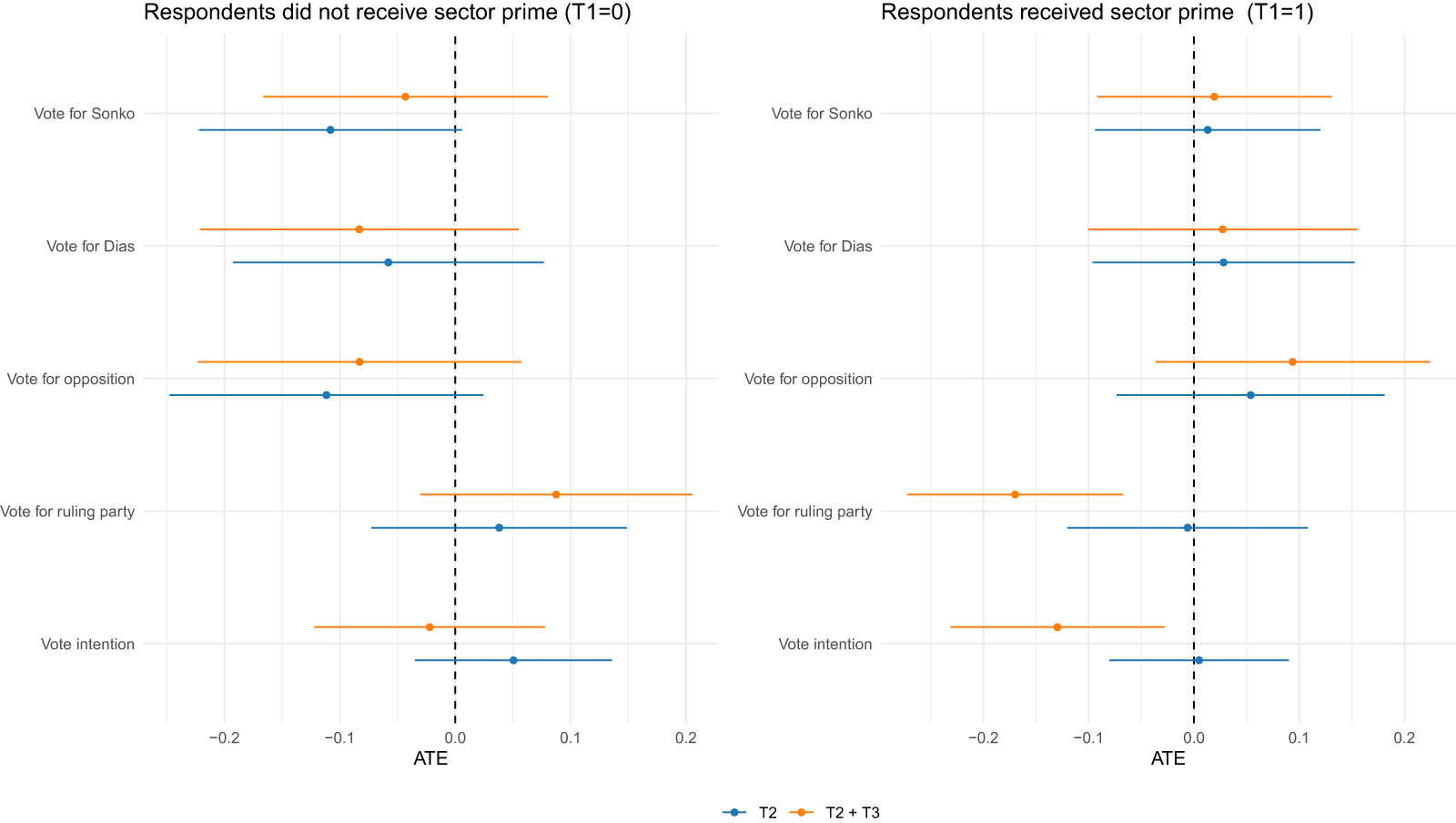
We next examine whether informal workers can be induced to support more programmatic candidates, testing Hypotheses 2 and 3 concerning the benefits of formalization and priming coordination capacity.Footnote 13 Appendix G.2 shows that providing information about the benefits of formalization (T2), either alone or in combination with a prime for sector size (T3), did not generate the expected increase in support for programmatic candidates. If anything, these treatments reduced support for a programmatic candidate in the absence of T1 (columns 3–5 of Table G8). These unexpected effects of T2 and T3 disappear, however, when respondents are first primed about their sector (T1), as illustrated in Figure 2. Thus, we find that such information alone does not translate into increased electoral support for programmatic candidates.
Tests for Hypotheses 2 and 3: Coordination matters.

Figure 2 Long description
The plots display average treatment effect estimates for various voting outcomes. The left plot is titled, Respondents did not receive sector prime left parenthesis T1 equals 0 right parenthesis and the right plot is titled, Respondents received sector prime left parenthesis T1 equals 1 right parenthesis. Both plots have the horizontal axis labeled as ATE, ranging from negative 0.2 to 0.2, with a vertical dashed line at 0.0. The vertical axis lists outcomes: Vote for Sonko, Vote for Dias, Vote for opposition, Vote for ruling party and Vote intention. Each outcome has two horizontal lines representing T2 and T2 plus T3 treatments. In the no sector prime plot, Vote for Sonko and Vote intention show positive estimates for T2 plus T3, while Vote for Dias and Vote for ruling party show negative estimates for T2. In the sector prime plot, Vote for Sonko and Vote intention show positive estimates for T2 plus T3, while Vote for Dias shows a positive estimate for T2. The plots illustrate how sector priming affects voting intentions, with estimates clustering around zero, indicating minimal effect in some cases. The legend differentiates T2 and T2 plus T3 treatments.
More in line with our expectations, combining information about the benefits of formalization with a prime about coordination capacity (T2 + T3) significantly reduced support for the clientelist ruling party among informal sector respondents who also received the sector salience prime. This result is depicted in orange in the right panel of Figure 2 (coefficients and standard errors reported in Appendix Table G8, column 2). Notably, the decline in support for the ruling party was not offset by increased support for a programmatic alternative like Dias or Sonko. Instead, informal workers split between abstaining from voting and supporting other opposition parties. When reminded about their informal status, the benefits of formalization, and their collective size, informal workers shifted their support to opposition parties (by approximately 10 percentage points) or disengaged from voting altogether (by approximately 13 percentage points). In short, providing informal sector voters with informational tools to think of themselves as a programmatic constituency reduces mobilization around the less programmatic incumbent, but does not necessarily increase coordination around a programmatic alternative.
One concern with our interpretation of these findings is that the ruling party and Dias/Sonko coalition differ on dimensions beyond their commitment to programmatism or clientelism. We provide some support for our interpretation by investigating a relevant mechanism implied by our theory. We hypothesized that our treatments could push informal sector members to vote for a more programmatic candidate if they saw themselves as an organized economic interest that could extract programmatic benefits. Consistent with this logic, we might expect this effect to be stronger among members of our informal sector sample who already belong to an economic association. When we interact an indicator for associational membership with the two treatment arms encouraging programmatic voting (T2 and T3), we observe a strong and significant effect of treatment on voting for Sonko among association members (see Appendix Table I10).
5. Conclusion
In sum, we find both descriptive and experimental support for the claim that firm informality decreases support for more programmatic candidates. By contrast, we find limited evidence that informal sector members can be induced to support programmatic candidates. However, we do find that invoking sector size matters in important and interesting ways. When combined with a reminder about one’s informal status, these reminders of potential coordination capacity can depress both vote intention and support for the clientelistic—or at least less programmatic—ruling party. This may be attributable to the fact that priming the status of informal economic actors reminds them of the inefficiencies, corruption, and lack of transparency in their interactions with local government. We see this exploration of mechanisms as a fruitful avenue for future research.
Acknowledgements
The authors thank Fodé Sarr and the enumeration team in Senegal for excellent research assistance. For helpful comments, they thank Scott Straus, Pau Vall-Prat, and participants at APSA 2024 and EPSA 2024.
Declaration of interests
The authors declare none.
Ethics and consents
The design for this study was preregistered with EGAP (https://osf.io/b52hw) and received IRB approval.
Funding statement
This work was funded by the authors’ home institutions.
Supplementary material
The supplementary material for this article can be found at https://doi.org/10.1017/psrm.2026.10137.




 Open access

