

The Lone Star State of Texas is well known for its pterosaurs, but most specifically for a single species of pterosaur, Quetzalcoatlus northropi Lawson, Reference Lawson1975a. This species is unambiguously the largest known flying organism with wingspan estimates ranging up to 15·5 metres (Lawson Reference Lawson1975a), but gravitating towards 10 metres in recent years (Marden Reference Marden1994; Chatterjee and Templin Reference Chatterjee and Templin2004; Unwin Reference Unwin2006; Witton Reference Witton2008). This enormous pterosaur is compatible with the perception of Texas as a large and impressive land, a view popularised through the work of Dr. Wann Langston Jr (Langston Reference Langston1978, Reference Langston1981, Reference Langston, Pausé and Spears1986). Dr. Langston is considered here the father of Texas pterosaurology for his long history of work with Texas pterosaurs.
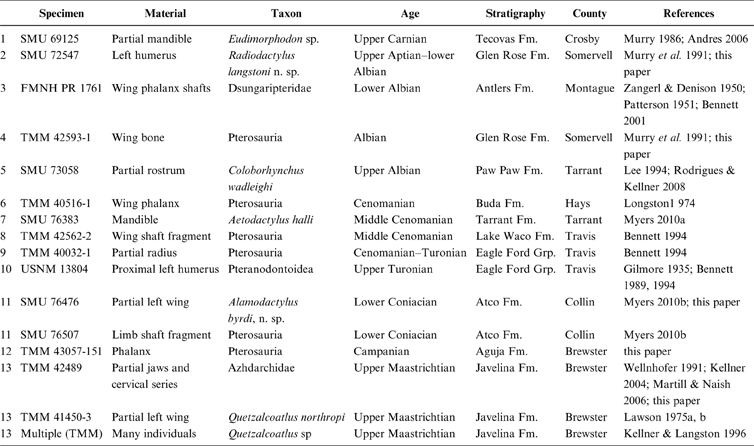
However, it has not been reported, that Texas has the greatest sample of pterosaur occurrences in the United States. Thirteen occurrences of at least 30 pterosaur specimens are reported from Texas (Table 1), surpassing all other US states, most of countries in the world and even some of the continents (Barrett et al. Reference Barrett, Butler, Edwards and Milner2008). Texas is also unique in the world for recording pterosaurs from the very beginning to the very end of their 150+ million year evolutionary history. The pterosaur fossil record of Texas is notable not for exceptional abundance or exquisite preservation of specimens, but for a relatively high diversity of taxa and the implications of these specimens for our understanding of pterosaur evolution and palaeobiogeography. To date, a total of five pterosaur species, including the two new species named here, have been identified from Texas (Table 1). This is notable considering that Texas essentially lacks surficially-exposed Jurassic strata and that the pterosaur-bearing strata of Texas span only 64% of the time pterosaurs existed. In this Festschrift in honour Dr. Langston, this article reviews the Texas record of pterosaurs that he popularised, names a new species after him, and fits this record in the evolutionary history of pterosaurs.
Occurrences and taxonomic classification of Texas pterosaurs. Numbers correspond to the number of occurrences in Figure 1

1. Review of the Pterosaur record of Texas
1.1. Late Triassic
Although the Triassic pterosaur record has increased notably since the first scientific description of a Triassic pterosaur specimen over 35 years ago (Zambelli Reference Zambelli1973), pterosaur material from this period is still relatively rare. The oldest occurrence of pterosaurs in Texas, and likely the oldest occurrence worldwide (Barrett et al. Reference Barrett, Butler, Edwards and Milner2008), is a partial mandible from the Kalgary Quarry in the Tecovas Formation of the Dockum Group that has been identified as Eudimorphodon sp. that has been dated to the Upper Carnian (Murry Reference Murry and Padian1986, Reference Murry, Lucas and Hunt1989; Lucas & Luo Reference Lucas and Luo1993; Andres Reference Andres2006) but is at least as old as the early Norian (Olsen et al. Reference Olsen, Kent and Whiteside2011). Aside from this specimen, unequivocal occurrences of Triassic pterosaurs are known only from Austria, England, Greenland and Italy (Barrett et al. Reference Barrett, Butler, Edwards and Milner2008). Other reports have not been confirmed and are likely not pterosaurs. This specimen also represents the sole evidence of Eudimorphodon outside Europe and Greenland. It shares the synapomorphy of tall cusps on its teeth (character 121: state 4) with the other Eudimorphodon species recovered as a monophyletic group in the phylogenetic analysis. The taxonomic affinities of numerous isolated multicusped teeth also recovered from the Kalgary Quarry (Murry Reference Murry and Padian1986) have yet to be determined but are currently not considered referable to the Pterosauria (Andres Reference Andres2006).
Chatterjee (Reference Chatterjee and Padian1986) reported both cranial and postcranial material of a Eudimorphodon-like pterosaur from the Post Quarry in the Lower Norian Cooper Canyon Formation of the Dockum Group. These specimens, along with more recently collected material from Upper Carnian strata of the Tecovas Formation, have been assigned to two new non-pterosaurian archosaur taxa (Atanassov Reference Atanassov2002). An unpublished phylogenetic analysis suggests that these taxa do not fall within the Pterosauria but may be closely related to that clade (Atanassov Reference Atanassov2002). Another Upper Triassic specimen, a partial maxilla found in the Kalgary Quarry, was initially attributed to Eudimorphodon along with the mandibular material from the same locality (Murry Reference Murry and Padian1986, Reference Murry, Lucas and Hunt1989; Lucas & Luo Reference Lucas and Luo1993). However, subsequent re-evaluation of this specimen determined that it was referable to the Cynodontia rather than Pterosauria (Andres Reference Andres2006). The Kalgary specimens are part of an ongoing project and will only be discussed relative to published accounts.
1.2. Early Cretaceous
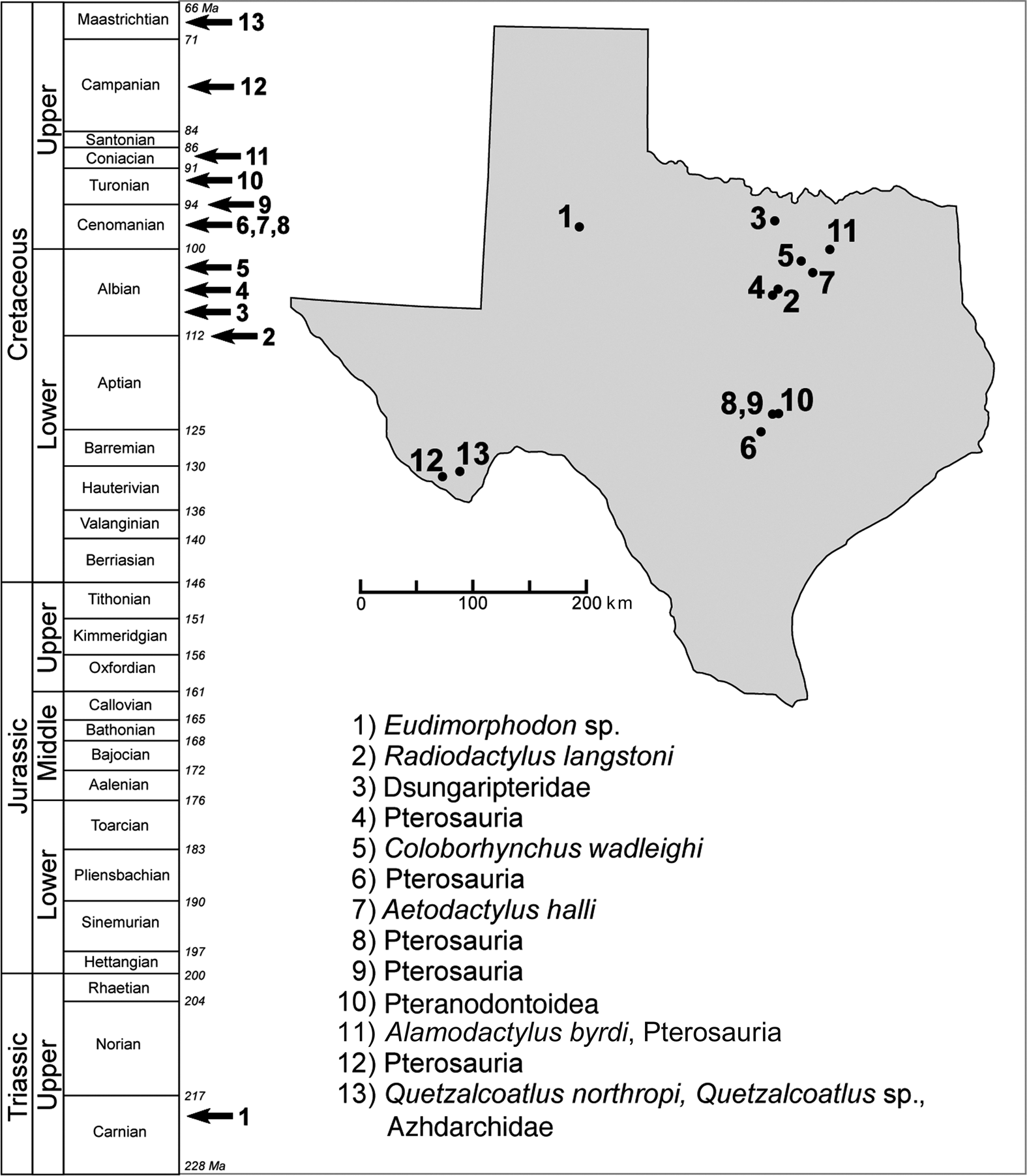
Following the occurrence of Eudimorphodon in the Late Triassic, there is a great gap in the Texas pterosaur record that spans the latest Triassic to the Early Cretaceous (Fig. 1). At least some of this gap is attributable to the fact that Jurassic strata in Texas are confined to the subsurface, and outcrop is virtually absent. The Lower Cretaceous of Texas preserves only three definitive occurrences of pterosaur remains: a partial rostrum that constitutes the holotype and only known material of Coloborhynchus wadleighi Lee, Reference Lee1994 from the Upper Albian Paw Paw Formation (Lee Reference Lee1994; Rodrigues & Kellner Reference Rodrigues and Kellner2008); a humerus from the Upper Aptian–Lower Albian Glen Rose Formation that is described by Murry et al. (Reference Murry, Winkler and Jacobs1991) and named in this paper; and an indeterminate wing bone from the Albian part of the Glen Rose Formation.
Ages and locations of Texas pterosaur occurrences discussed in the text. Numbers correspond to the pterosaur occurrence listed in Table 1. Timescale based on Gradstein et al. (Reference Gradstein, Ogg and Smith2005).
Originally identified as a new species of the genus Coloborhynchus (Lee Reference Lee1994), a recent re-evaluation of the holotype C. wadleighi by Rodrigues & Kellner (Reference Rodrigues and Kellner2008) erected the new genus name Uktenadactylus for this species on the basis of five distinguishing features. The original species binomen is maintained here to preserve continuity in the taxonomic literature and the information content of a Coloborhynchus clade. Should this name denote a non-monophyletic group of species in the future, Uktenadactylus would be the appropriate replacement name. The discovery of this species north of Fort Worth in 1992 marked the first reported ornithocheirid and toothed pterodactyloid in North America.
Murry et al. (Reference Murry, Winkler and Jacobs1991) reported an isolated pterosaur humerus discovered during the construction of an emergency spillway for the Comanche Peak Nuclear Power Plant near the town of Glen Rose. They referred this specimen to the Azhdarchidae based on characters found in the humeri of other azhdarchids. This referral and the Aptian–Albian age of the specimen would make this one of the oldest, if not the oldest, azhdarchid occurrence. Older isolated elongate cervical vertebrae from the Late Jurassic and Early Cretaceous have been referred to the Azhdarchidae, but these have been subsequently recovered in the Ctenochasmatidae, which have similar vertebrae, by the phylogenetic analysis of Andres & Ji (Reference Andres and Ji2008). The Glen Rose humerus bears both a unique combination of character states and autapomorphies of its own. It is, therefore, erected as a new species and named in honour of Dr. Langston.
Hollow bone fragments collected from the Lower Albian part of the Antlers Formation have been assigned to Pterosauria (Zangerl & Denison Reference Zangerl and Denison1950; Patterson Reference Patterson1951), although no diagnostic characters of Pterosauria were cited (Murry et al. Reference Murry, Winkler and Jacobs1991). Bennett (Reference Bennett2001) identified these as indeterminate wing phalanx shafts similar in cross-section to Dsungaripterus. If these specimens are closely related to Dsungaripterus, it would be the first reported dsungaripterid from North America.
Trace fossils discovered in the Albian part of the Glen Rose Formation have been attributed, often with caution, to the Pterosauria (Langston Reference Langston1974; Stricklin & Amsbury Reference Stricklin and Amsbury1974; Pittman Reference Pittman, Gillette and Lockley1989; Unwin et al. Reference Unwin, Lü and Bakhurina2000; Barrett et al. Reference Barrett, Butler, Edwards and Milner2008). Figured by both Langston (Reference Langston1974) and Stricklin & Amsbury (Reference Stricklin and Amsbury1974), these putative pterosaur traces comprise subparallel striae arranged in sets of three and preserved in a carbonate mudstone layer in Medina County. Stricklin & Amsbury (Reference Stricklin and Amsbury1974) interpreted these striae as potential manus claw marks. Additional features in the same horizon were identified as possible wing-tip drag marks (Stricklin & Amsbury Reference Stricklin and Amsbury1974). Although the number of recognised pterosaur trace fossils has grown significantly in recent years (Lockley et al. Reference Lockley, Harris and Mitchell2008), including traces which record behaviours such as swimming (Lockley & Wright Reference Lockley, Wright, Buffetaut and Mazin2003) and landing (Mazin et al. Reference Mazin, Billion-Bruyat and Padian2009), marks similar to those reported from the Glen Rose Formation have yet to be attributed to pterosaurs. In separate discussions of the Glen Rose traces, both Langston (Reference Langston1974) and Unwin (Reference Unwin, Gillette and Lockley1989) noted discrepancies between the traces and pterosaur morphology, including lack of an impression corresponding to the distal condyle of metacarpal IV, absence of pes prints, and incongruence of the length and spacing of the striae with the asymmetrical shape of the pterosaur manus. Based on the lack of correspondence between these traces and pterosaur manus and pes morphology, as well as lack of any similar types of tracks or traces attributed to pterosaurs, there is no compelling reason to ascribe the Glen Rose traces to pterosaurs, as concluded by Langston (Reference Langston1974).
1.3. Late Cretaceous
In contrast to the relatively depauperate record of pterosaur remains from the Lower Cretaceous, Upper Cretaceous strata preserve the bulk of Texas pterosaur occurrences (Table 1). Pterosaur fossils are found in the Eagle Ford Group, Austin Group, Aguja Formation, and Javelina Formation.
Notable occurrences within the Eagle Ford Group include the holotype and only specimen of Aetodactylus halli Myers, Reference Myers2010a from the Middle Cenomanian Tarrant Formation and a partial humerus from the Upper Turonian part of the Eagle Ford Group (Gilmore Reference Gilmore1935; Bennett Reference Bennett1989, Reference Bennett1994). Aetodactylus halli consists of a nearly complete mandible referred to the Ornithocheiridae (Myers Reference Myers2010a). The proximal part of a left humerus collected from Turonian strata of the Eagle Ford Group near Austin was initially referred to the genus Pteranodon by Gilmore (Reference Gilmore1935). Bennett (Reference Bennett1989, Reference Bennett1994) determined that the specimen differed from the humerus of Pteranodon and assigned it to the Pteranodontidae. Two indeterminate wing elements have been collected from the Eagle Ford Group in the vicinity of Austin (Bennett Reference Bennett1994), and a large first wing phalanx was recovered from the Cenomanian Buda Formation and tentatively referred to Ornithocheiridae (Langston Reference Langston1974). In addition, two isolated teeth (TMM 41935-14 and 41935-15) from northeast of Austin have been said to be consistent with the Ornithocheiridae (Myers Reference Myers2010b), but a number of organisms have similar teeth to the ornithocheirids and these cannot be unequivocally referred to that group.
Despite its large outcrop area and palaeoenvironmental conditions conducive to fossil preservation, the Austin Group has produced relatively few pterosaur fossils (Frey et al. Reference Frey, Buchy, Stinnesbeck, González and Stefano2006; Myers Reference Myers2010b). Of these, the only Texas occurrences are known from the Lower Coniacian beds of the Acto Formation north of Dallas (Myers Reference Myers2010b). These specimens consist of a partial left wing referred to the Pteranodontidae and an indeterminate fragment from the shaft of a limb bone. The humerus of the partial left wing is superficially similar to that of Pteranodon, but damage and distortion related to post-burial compaction have rendered comparisons difficult (Myers Reference Myers2010b).
After a gap of approximately 10 million years (Fig. 1), the next evidence of Texas pterosaurs occurs in the Campanian Aguja Formation in Big Bend National Park (Table 1). These include a bone fragment identified as pterosaur (Gasaway Reference Gasaway, Sankey, Ortiz and Meredith2007; Sankey Reference Sankey, Ryan, Chinnery-Allgeier and Eberth2010) and a wing phalanx. The bone fragment (LSUMNS V17827) was tentatively referred to the Pterosauria, but it is not a diagnostic or identifiable element (J. T. Sankey pers. comm. 2011). Further analysis is required to determine its relationships and, until then, it is considered only a possible pterosaur specimen.
The most notable pterosaur remains collected from this area, however, are those of Quetzalcoatlus found in the Late Maastrichtian Javelina Formation (Lawson Reference Lawson1975a; Kellner & Langston Reference Kellner and Langston1996). The holotype of Quetzalcoatlus northropi Lawson, Reference Lawson1975a consists of a partial left wing (Lawson Reference Lawson1975a, Reference Lawsonb). With a current estimated wingspan of approximately 10 m (Witton, Reference Witton2008), Q. northropi is the largest known pterosaur whose size can be reliably estimated. Larger wingspan estimates have been calculated for other pterosaur specimens (Frey & Martill Reference Frey and Martill1996; Company et al. Reference Company, Unwin, Ruiz-Omenaca and Pereda-Suberbiola2001; Buffetaut et al. Reference Buffetaut, Grigorescu, Csiki, Buffetaut and Mazin2003), but the highly fragmentary preservation of these specimens make these estimates uncertain. Numerous pterosaur specimens belonging to smaller individuals about half the size of Q. northropi have been collected from several nearby localities in the Javelina Formation (Lawson Reference Lawson1975a). Although all Quetzalcoatlus remains were initially interpreted as belonging to a single species, the smaller specimens have been the subject of continuing debate whether they are distinct from Q. northropi (Kellner & Langston Reference Kellner and Langston1996). They have often been referred to Quetzalcoatlus sp., pending full description and analysis.
One of the specimens initially referred to Quetzalcoatlus has been suggested recently to belong to another taxon. This specimen consists of the anterior end of the jaws and a series of cervical vertebrae. The skull material was figured and referred to Quetzalcoatlus sp. by Wellnhofer (Reference Wellnhofer1991, p. 144), but it has since been suggested to belong to other taxa (Kellner & Langston Reference Kellner and Langston1996; Kellner Reference Kellner2004; Martill & Naish Reference Martill and Naish2006). To date, only the figured skull material has been considered in discussions of the evolutionary relationships of this specimen and it is with the kind permission of Dr. Langston that the first author was allowed to code the entire specimen for phylogenetic analysis.
2. Material, methods and results
2.1. Material
The described and figured material is housed in the collections of Field Museum of Natural History, Chicago (FMNH); Museum of Natural Science, Louisiana State University, Baton Rouge (LSUMNS); Shuler Museum of Paleontology, Southern Methodist University, Dallas (SMU); Texas Memorial Museum, University of Texas at Austin (TMM); United States National Museum of Natural History, Washington, D.C. (USNM).
2.2. Methods
The phylogenetic relationships of nine Texas pterosaurs were analysed. The remaining seven specimens were referable to only the Pterosauria and could not be coded for more than one character. The matrix for this analysis was a modified version of the matrix used by Andres (Reference Andres2010, Reference Andres, Martill, Unwin and Loveridgein press) and Butler et al. (Reference Butler, Brusatte, Andres and Benson2011), updated with the nine Texas pterosaurs. It includes all the valid taxa and characters used by previous analyses to create the largest phylogenetic analysis of pterosaurs to date: 109 terminal taxa as well as 31 continuous and 154 discrete characters ().
Species circumscriptions follow the literature with few exceptions, and all accessible specimens were coded for the species. In this study, the specimens previously associated with Quetzalcoatlus northropi and Quetzalcoatlus sp. were analysed as separate terminal taxa. Euparkeria capensis Broom, Reference Broom1913 was used as the sole outgroup. Meristic, continuous and any other characters that have intermediate states in their transformational series were coded as ordered. Continuous characters were also scaled so that their values range from 0 to 1 so as not to swamp or be swamped by the discrete characters. This coding scheme results in tree lengths expressed as decimal fractions. The minimum and maximum values for the original continuous character states are listed in the character descriptions so that the original values for the terminal taxa can be calculated. Inapplicable features were reductively coded. Polymorphic coding was used to denote variation in terminal taxa when the variation was present in more than one specimen and when preservation of specimens do not allow precise coding, but do allow exclusion of some of the character states.
The phylogenetic analysis was conducted using the computer program TNT (Tree analysis using New Technology) Version 1.1 (Goloboff et al. Reference Goloboff, Farris and Nixon2008). A basic tree-searching analysis was implemented with 2000 random addition sequence replicates followed by branch swapping phases using both tree bisection and rerooting, as well as subtree pruning and regrafting heuristic searches. Ambiguous branch support was not used (“rule 1”), zero-length branches were automatically collapsed, and resultant trees were filtered for the best score. The matrix and commands implemented are listed in . The analysis resulted in a single wild card, or rogue, taxon. This analysis can be repeated by copying the matrix and commands from into a text file and executing it in TNT using the PROCEDURE command.
2.3. Results
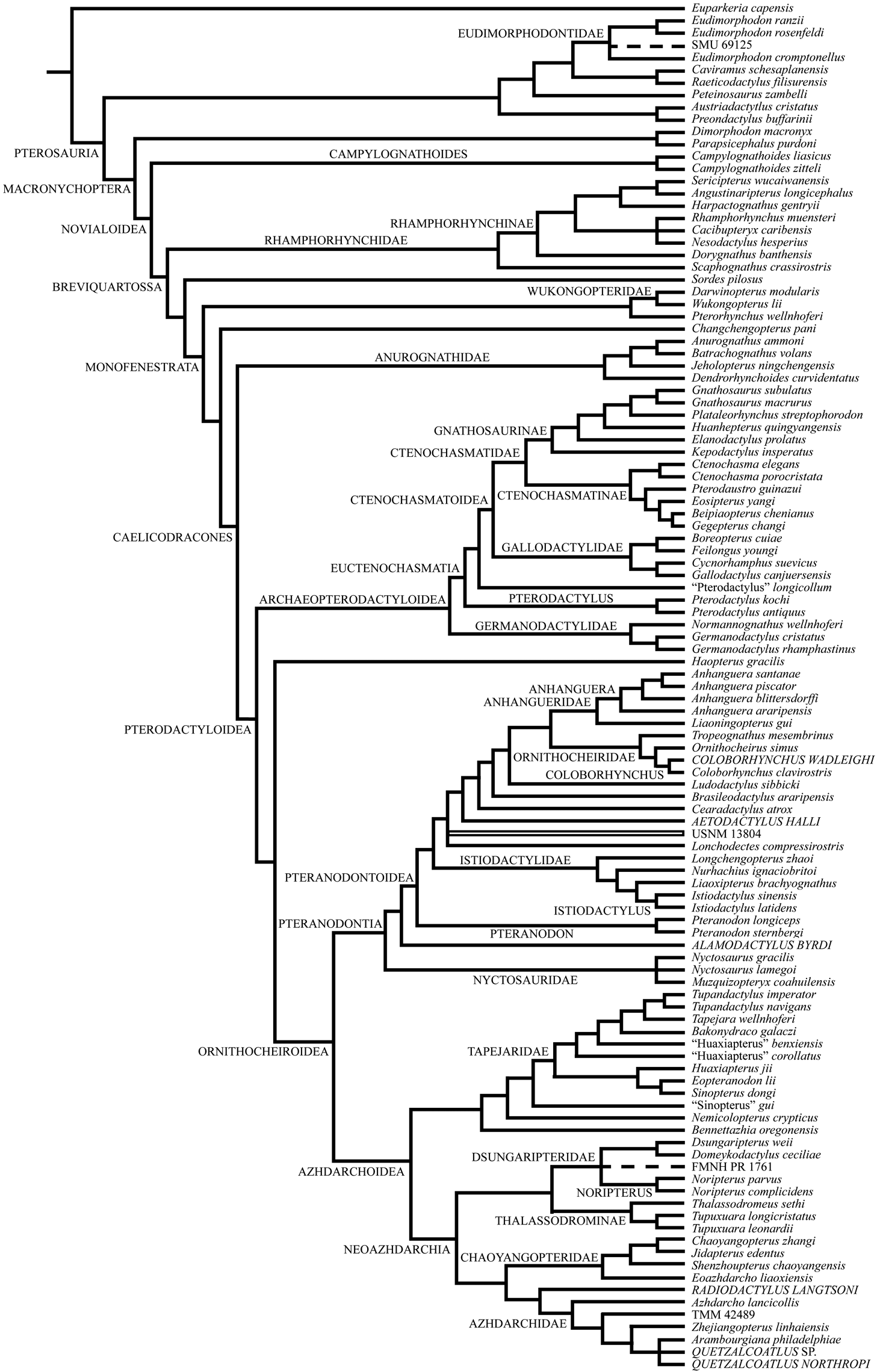
Phylogenetic analysis of the nine Texas pterosaurs and the relationships of the Pterosauria resulted in 12 most parsimonious trees (tree length=644·079 steps). The multiple trees are the sole result of the single terminal taxon USNM 13804 being recovered as a rogue taxon forming 12 possible relationships within the Pteranodontoidea (sensu Kellner, Reference Kellner, Buffetaut and Mazin2003). These multiple trees are the result of the highly fragmentary preservation of this specimen (proximal end of a humerus) instead of character conflict, because the taxa with which USNM 13804 forms relationships are either represented by only skull material or have humeral codings identical to USNM 13804. To extract the maximum amount of phylogenetic information from the results of the analysis, the basal-most resultant position of USNM 13804 was noted, the analysis repeated with USNM 13804 excluded, and the position of USNM 13804 illustrated at its most basal resultant position by means of an Adams consensus tree (Fig. 2). This analysis resulted in a single most parsimonious tree identical to the original analysis results for all other taxa. Specimens awaiting full description and analysis were also illustrated at the most basal positions in which their combination of character states taken from the literature can be found. Results of both analyses largely coincide with previous taxonomy and previous versions of the matrix.
Cladogram depicting Texas pterosaurs and the phylogenetic relationships of the Pterosauria. Texas taxa are written in all capital letters. The cladogram is an Adams consensus tree of 12 most parsimonious trees resulting from the single rogue taxon (USNM 13804), which is illustrated by a white branch at the most lowest phylogenetic position recovered. Dashed lines represent the inferred position of taxa that can only be coded by a single character.
3. Systematic palaeontology
Pterosauria Owen, Reference Owen1842 (sensu Padian, Reference Padian and Laurin2004)
Studied material. Indeterminate wing bone, TMM 42593-1; wing shaft fragment, TMM 42562-2; proximal radius, TMM 40032-1; and first wing phalanx, TMM 40516-1; wing phalanx fragment, SMU 76507; and wing phalanx, TMM 43057-151.
Remarks. It is a common misconception that the Pterosauria was named by Kaup (Reference Kaup1834). Kaup instead named the “Pterosaurii” and stated nothing about its definition or circumscription other than it included the “Pterodactyli” and could probably be divided into several genera. The Pterosauria was named by Owen (Reference Owen1842), who also specified Pterodactylus as the type, referred a number of species to the group, and characterized the Pterosauria as reptiles that achieved flight by modification of their pectoral extremity. As new and more basal pterosaurs were discovered, these modified limbs (i.e. wings) were used as the criterion to refer specimens to the Pterosauria. This use of an apomorphy to identify the Pterosauria culminated in Padian's (Reference Padian and Laurin2004) phylogenetic definition of the clade as “Pterosauromorpha with fourth metacarpal and digit hypertrophied to support wing membrane synapomorphic with Pterodactylus antiquus” (Padian Reference Padian and Laurin2004, p. 27). This tradition and definition is fortuitous for the referral of fragmentary remains to the Pterosauria, because it allows classification in the Pterosauria based on the presence of elongate wing elements, without the need for any other characters to place them within specific clades in the Pterosauria.
Occurrence. Albian, Glen Rose Formation, near Glen Rose, Somervell County; Middle Cenomanian, Lake Waco Formation, near Austin, Travis County; Cenomanian–Turonian, Eagle Ford Group, near Austin, Travis County; Cenomanian, Buda Formation; Hays County; Lower Coniacian, Atco Formation, Austin Group, north of Dallas, Collin County; and Campanian, Aguja Formation, Big Bend National Park, Brewster County.
Eudimorphodontidae Wellnhofer, Reference Wellnhofer1978
Eudimorphodon Zambelli, Reference Zambelli1973
Eudimorphodon sp.
Studied material. Partial mandible, SMU 69125.
Comparisons. The phylogenetic relationships of the putative pterosaurs from the Kalgary locality are part of an ongoing project and will not be discussed in detail here. However, optimising the character states taken from descriptions in the literature on the phylogenetic analysis indicates that the partial mandible from this locality is referable to Eudimorphodon. Unlike other authors, the phylogenetic analysis in this article recovers a monophyletic clade of Eudimorphodon species. Therefore, a synapomorphy such as tooth denticles in the shape of large cusps that is shared by both this partial mandible and a clade of Eudimorphodon species is necessary and sufficient to refer this specimen to Eudimorphodon.
Occurrence. Upper Carnian, Tecovas Formation, Dockum Group; Kalgary Quarry, Crosby County.
Pterodactyloidea Plieninger, Reference Plieninger1901 (sensu Padian, Reference Padian and Laurin2004)
Ornithocheiroidea Bennett, Reference Bennett1994 (sensu Kellner, Reference Kellner, Buffetaut and Mazin2003)
Azhdarchoidea Unwin, Reference Unwin, Sun and Y. Wang1995 (sensu Unwin, Reference Unwin, Buffetaut and Mazin2003)
Neoazhdarchia Unwin, Reference Unwin, Buffetaut and Mazin2003 (sensu Unwin, Reference Unwin, Buffetaut and Mazin2003)
Radiodactylus gen. n.
Derivation of name. After the Comanche Peak Nuclear Power Plant, where this specimen was discovered during the construction of an emergency spillway, using the prefix for radioactivity, radio, and dactylos, finger, the traditional Greek root for pterosaur genera in reference to their elongate wing digits.
Type species.Radiodactylus langstoni sp. n.
Diagnosis. As for species.
Remarks. When the specimen that would become the holotype and only known specimen of Radiodactylus langstoni was described by Murry et al. (Reference Murry, Winkler and Jacobs1991), it was referred to the Azhdarchidae based on characters of the humerus. However, it was noted at the time that many of these characters might represent plesiomorphies. This species is recovered here as the sister group to all other azhdarchid species in the phylogenetic analysis. The two disparate phylogenetic definitions of the Azhdarchidae by Kellner (Reference Kellner, Buffetaut and Mazin2003) and Unwin (Reference Unwin, Buffetaut and Mazin2003) would both exclude this species from the Azhdarchidae. Therefore, R. langstoni is considered here a non-azhdarchid neoazhdarchian. Though closely related to the Azhdarchidae, this species is relatively small and much older compared to true azhdarchids. The sister group relationship of R. langstoni to a sizeable clade including all other azhdarchid species warrants a new genus name in its species binomen.
Occurrence. As for species.
Radiodactylus langstoni sp. n.
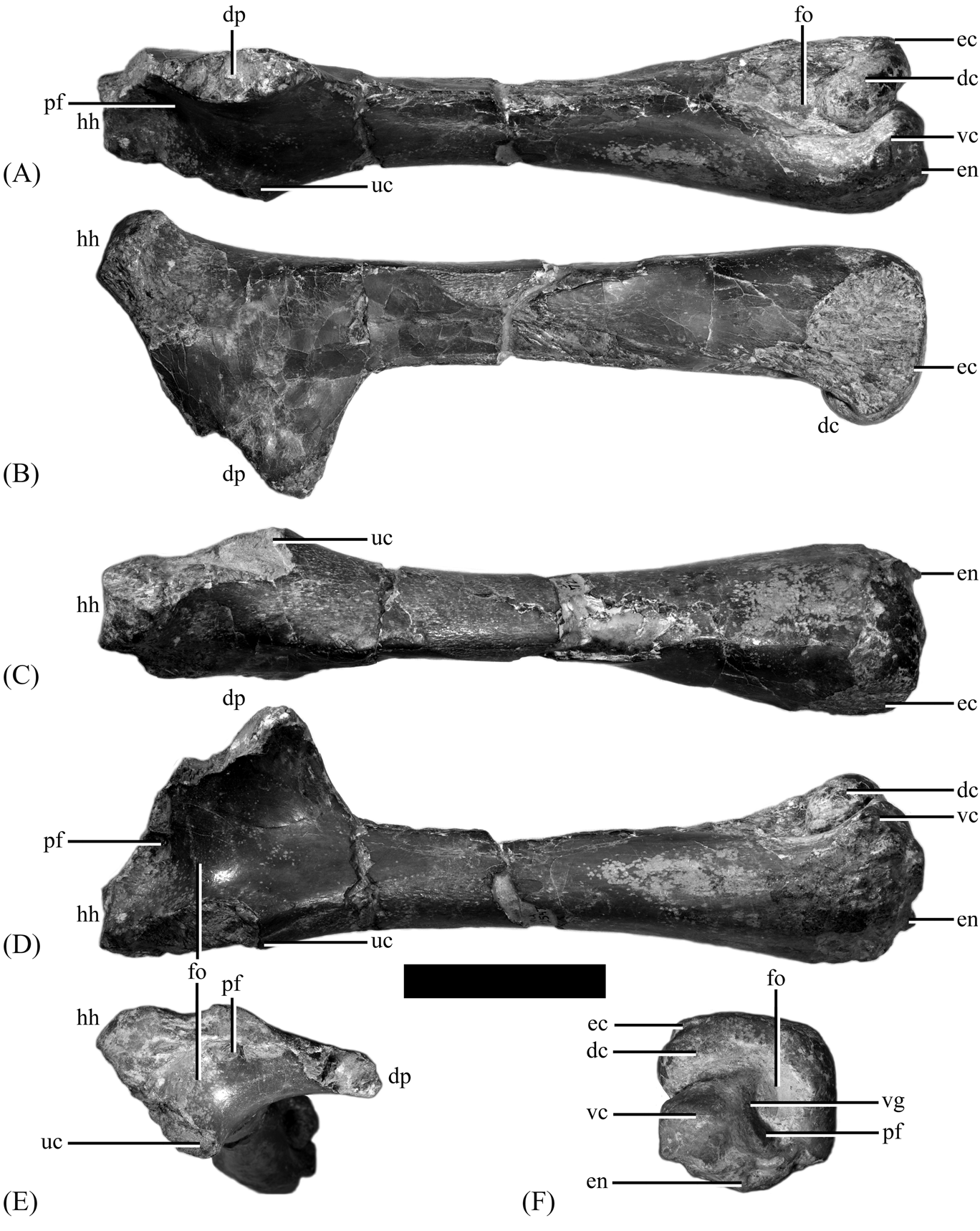
Photographs of the holotype and only known specimen of Radiodactylus langstoni gen. et sp. nov., SMU 72547: a left humerus shown in (A) anterior, (B) dorsal, (C) posterior, (D) ventral, (E) proximal and (F) posterior views. Scale bar=50 mm. Abbreviations: dc=dorsal condyle; dp=deltopectoral crest; ec=ectepicondyle; en=entepicondyle; fo=fossa; hh=humeral head; pf=pneumatic foramen; uc=ulnar crest vc=ventral condyle; vg=vertical groove.
Derivation of name. In honour of Dr. Wann Langston Jr.
Holotype. Left humerus, SMU 72547.
Studied material. Holotype and only known specimen.
Diagnosis. Large pterosaur with unique combination of tall rectangular deltopectoral crest positioned proximally and pneumatic foramen present on distal aspect of humerus; as well as autapomorphic square distal humerus cross-section, and humerus distal aspect with straight vertical groove and without ulnar tubercle.
Description. The description of Murry et al. (Reference Murry, Winkler and Jacobs1991) adequately describes this specimen and is repeated here with slight modification. The specimen is well preserved in three-dimensions with no apparent crushing and is missing only portions of the proximal end and anterior end of the deltopectoral crest (Fig. 3). There is a fracture in the mid-shaft area where there appears to have been some slight rotational distortion, but not enough to significantly alter its morphology or overall length. Cortical bone has broken off in several places, revealing the internal trabeculae.
The missing portions of the proximal end include most of the ulnar crest (medial crest, posterior tuberosity) and humeral head. The base of the ulnar crest remains, so it is possible to ascertain that it was massive in shape and oriented ventrally (Fig. 3E). The remaining portion of the humeral head is not considerably curved or dorsoventrally deep (Fig. 3E). A large fossa is positioned ventral to the humeral head, and a large pneumatic foramen lies in this fossa at the point where the proximal margin of the deltopectoral crest contacts the humeral head (Fig. 3D). A dorsal pneumatic foramen on the proximal end of the humerus is absent.
The deltopectoral crest is missing the anteroproximal corner of its apex. The remaining portions are sufficient to determine its overall shape. The deltopectoral crest is an elongate process oriented straight anteriorly in all views with almost no curvature. Its anteroposterior axis is perpendicular to the long axis of the humerus. The proximodistal axis of the crest is parallel with the long axis of the humerus and does not curve ventrally at its proximal or distal end. The proximal and distal margins of the crest are subparallel with a slight taper along its anteroposterior length. The deltopectoral crest is positioned proximally on the humerus and extends a little over a third of the humeral length.
The shaft is straight and narrower than the distal end, but it is parallel-sided in the region of the mid-shaft and does not have a significant constriction just distal to the deltopectoral crest, especially in dorsal view (Fig. 3B). A deep fossa begins three-quarters of the way down the anterior surface of the shaft and expands with the distal end until it contacts the distal condyles. As in other pterosaurs, the distal condyles consist of a larger dorsal condyle with its proximal end oriented 45° below the horizontal axis of the humerus, and a smaller ventral condyle. The ventral condyle is damaged and missing some of its articular surface (Fig. 3A). These condyles and the intercondylar sulcus between them reach onto the distal aspect of the humerus distal end. The sulcus contacts the dorsal end of a large fossa on the distal aspect of the humerus (Fig. 3). In the middle of the distal end, this large fossa contains a straight, vertical groove at its anterior margin (Fig. 3F). This groove terminates in a small pneumatic foramen at its ventral end. No ulnar tubercle is present. The entire distal end of the humerus is nearly square in cross-section mainly as a result of a pair of well-developed ridges at the dorsal and ventral margins of the distal end. Although these ridges are largely responsible for the shape of the distal end of the pterosaur humerus, they have been little discussed in the literature. When mentioned, they have been referred to as ridges for muscular attachment (Padian Reference Padian1983) (likely the m. flexor carpi and flexor digitorum longus of Bennett Reference Bennett2008), raised ridges (McGowen et al. Reference McGowen, Padian, de Sosa and Harmon2002), or adjacent parts of the epicondyles separated from the distal condyles by grooves extending along the length of distal aspect onto the anterior aspect of the distal end (Padian Reference Padian1984; Murry et al. Reference Murry, Winkler and Jacobs1991; Averianov Reference Averianov2010). All pterosaur humeri have these ridges and associated prominences in the epicondylar areas, although their positions relative to one another vary. This paper follows the literature in considering both the ridges and prominences as part of the epicondyles. The dorsal portions of the ectepicondyle have been sheered off above the ectepicondylar ridge so that it is not possible to determine the shape of the ectepicondylar prominence (Fig. 3B). The entepicondylar prominence is a low mound located in the middle of the dorsal surface (Fig. 3F).
Comparisons.R. langstoni shares a ventral pneumatic foramen on the proximal end of the humerus, a straight humeral shaft, and a distinct ulnar crest with members of the Ornithocheiroidea (sensu Kellner, Reference Kellner, Buffetaut and Mazin2003); a tall rectangular deltopectoral crest and a massive, ventrally-oriented ulnar crest with the rest of the azhdarchoids; as well as a pneumatic foramen on the distal end with the azhdarchids and homoplasticly with all pteranodontoids more closely related to the anhanguerids than Pteranodon. R. langstoni lacks: the dorsal pneumatic foramen on the proximal end of the humerus found in USNM 13804, the gnathosaurines, Anhanguera, Noripterus complicidens Young, Reference Young1973, and all species more closely related to Tapejara than the azhdarchids; the mid-shaft constriction found in SMU 76476, the Pteranodontoidea and Bennettazhia oregonensis Gilmore, Reference Gilmore1928; the subtriangular distal cross-section of the pteranodontoids; and the deltopectoral crest positioned more distally on the shaft observed in nyctosaurids and azhdarchids. The presence of a distal pneumatic foramen, combined with the lack of a distally positioned deltopectoral crest on the humerus, supports R. langstoni as the sister taxon to the Azhdarchidae. R. langstoni may be further differentiated from the Azhdarchidae by the absence of a deep horseshoe-shaped cross-section of the humeral head and a distinct supracondylar process on the humerus shaft.
Occurrence. Upper Aptian–Lower Albian, Glen Rose Formation, Comanche Peak Nuclear Power Plant, north side of Squaw Creek, Somervell County.
Dsungaripteridae Young, Reference Young1964 (sensu Unwin, Reference Unwin, Buffetaut and Mazin2003)
Studied material. Wing phalanx shafts, FMNH PR 1761
Comparisons. Bennett (Reference Bennett2001) describes these fragments as similar in cross-section to Dsungaripterus, with a suboval shape and a width/height ratio of 2:1. These cross-sectional characteristics have also been reported in other dsungaripterids and in the Late Jurassic rhamphorhynchid Sericipterus wucaiwanensis Andres et al., Reference Andres, Clark and Xu2010. Considering that the rhamphorhynchids went extinct before the Cretaceous, this specimen is referred to the contemporaneous Dsungaripteridae.
Occurrence. Lower Albian, Antlers Formation, near Forestburg, Montague County.
Azhdarchidae Nessov, Reference Nessov1984 (sensu Unwin, Reference Unwin, Buffetaut and Mazin2003)
Studied material. Partial jaws and cervical vertebrae series, TMM 42489.
Comparisons. This specimen is part of ongoing study and will not be described in detail or named in this paper. However, because this specimen has been noted and figured in the literature, it will be discussed briefly here with respect to previously published information. TMM 42489 was first reported in a figure from Wellnhofer (Reference Wellnhofer1991, p. 141) depicting the front end of the jaws and referring to the specimen as the ‘small’ Quetzalcoatlus sp. in the figure caption. Kellner & Langston (Reference Kellner and Langston1996) stated that it was inadvertently referred to Quetzalcoatlus sp. and described the skull (TMM 42489-2) and cervical (TMM 42489-1) material as belonging to a more short-faced animal with comparatively smaller cervical vertebrae found much lower in the Javelina Formation. This is the only mention of the cervical material in the literature, and subsequent studies have only considered the skull material. Kellner (Reference Kellner2004) went on to state that the incomplete skull and jaw likely represents a tapejarid pterosaur and provided a reconstruction of the skull to illustrate this. Martill & Naish (Reference Martill and Naish2006) provided an outline of the rostrum and stated that it had an aspect ratio more similar to Tupuxuara than to Quetzalcoatlus, referring to the specimen as the Javelina Tupuxuara in their figure 5.
Phylogenetic analysis of TMM 42489 indicates that this specimen is indeed not referable to Quetzalcoatlus but that it also is not a tapejarid or a tupuxuarid (or thalassodromine sensu; Kellner & Campos Reference Kellner and Campos2007). It is instead recovered as a basal azhdarchid, even when the characters of the cervical vertebrae are excluded, albeit with less resolution (tree number=2).
Occurrence. Upper Maastrichtian, Javelina Formation, Big Bend National Park, Brewster County.
Quetzalcoatlus Lawson, Reference Lawson1975b
Studied material. Partial left wing, TMM 41450-3; partial skeletons, multiple TMM specimens.
Comparisons. In his original description of the Quetzalcoatlus material, Lawson (Reference Lawson1975a) reported three large individuals and discussed some differential features of these specimens, as well as their relationships to other pterosaurs known at the time. The largest of these specimens was found two years before the others some 40 miles away at a different locality (Langston Reference Langston1978), but Lawson (Reference Lawson1975a) stated that all the specimens could be referred to the same species based on similarity in their humeri, proximal syncarpals, and second wing phalanges. Lawson (Reference Lawson1975b) erected the name Quetzalcoatlus northropi for the material, fixed TMM 41450-3 as the holotype, and repeated that the smaller specimens belonged to the same species. Nessov (Reference Nessov1991) would later add a proper diagnosis for this species and retain it in the Azhdarchidae. The original referral of Q. northropi to the Azhdarchidae was by Padian (Reference Padian1986) after it was discovered that his Titanopterygiidae Padian Reference Padian1984, which contained Q. northropi, was a junior subjective synonym of Nessov's (Reference Nessov1984) Azhdarchinae, which Padian (Reference Padian1986) raised to a Family rank and renamed Azhdarchidae. Initially, Langston (Reference Langston1978) stated that the smaller individuals belonged to the same species, but later (Langston Reference Langston1981) suggested that the specimens belonged to a distinct smaller species and that Q. northropi was limited to the holotype. Langston (Reference Langston1981) reported that there were at least a dozen of these smaller individuals and stated that it was not possible to distinguish them from the larger morph or establish whether they belonged the same population. He went on to suggest that the smaller morph may represent immature individuals of Q. northropi, but ultimately classified them as Quetzalcoatlus sp., an undetermined species, pending new discoveries. This taxonomy has been repeated by numerous authors, but Unwin (Reference Unwin2006) has hypothesised that both morphs belong to the same species with variable growth patterns dependent on external environmental factors. Kellner & Langston (Reference Kellner and Langston1996) stated that they were convinced that the smaller individuals most likely represent a different taxon and that the characterisation of a new Quetzalcoatlus species was in preparation.
The placement of Quetzalcoatlus in the Azhdarchidae has never been seriously challenged, and this material from the Javelina Formation provides the majority of the information known about the azhdarchids. The largest systematic issue surrounding the Quetzalcoatlus material is whether the smaller and larger morphs belong to the same species. Alpha taxonomic issues, such as species circumscriptions, are input a priori into phylogenetic analyses. However, if these populations of specimens are treated as separate terminal taxa and the analysis recovers them as non-monophyletic, this result can be used to support their separation into multiple species. To test whether Quetzalcoatlus northropi and Quetzalcoatlus sp. are more closely related to other taxa, they were analysed as separate terminal taxa in the phylogenetic analysis. This is the first phylogenetic analysis to analyse Quetzalcoatlus northropi as a separate species. These two terminal taxa have identical discrete codings where their preservation overlaps and only differ in their continuous codings. These differences were not significant enough to recover them as non-monophyletic. Both Quetzalcoatlus terminal taxa were recovered in a trichotomy with Arambourgiania philadelphiae Arambourg, Reference Arambourg1959. A. philadelphiae is represented only by a cervical vertebra and does not overlap in preservation with Q. northropi, which is represented only by a partial wing. Therefore, A. philadelphiae cannot be resolved with respect to Q. northropi resulting in the trichotomy and, therefore, does not falsify the monophyly of Quetzalcoatlus. This result is confirmed when the analysis is repeated with A. philadelphiae excluded. The two Quetzalcoatlus morphs either belong to the same species or two very closely related species.
Occurrence. Upper Maastrichtian, Javelina Formation, Big Bend National Park, Brewster County.
Ornithocheiroidea Seeley, Reference Seeley1891 (sensu Kellner, Reference Kellner, Buffetaut and Mazin2003)
Pteranodontia Marsh, Reference Marsh1876 (sensu Unwin, Reference Unwin, Buffetaut and Mazin2003)
Alamodactylus gen. n.
Derivation of name. After the Alamo, symbol of Texas independence, and dactylos, finger, the traditional Greek root for pterosaur genera in reference to their elongate wing digits.
Type species.Alamodactylus byrdi sp. n.
Diagnosis. As for species.
Remarks. When the specimen that would become the holotype and only known specimen of Alamodactylus byrdi was described by Myers (Reference Myers2010b), it was noted that the humerus was superficially similar to that of Pteranodon, but that post-burial compaction rendered comparison difficult (Myers, Reference Myers2010b). It was then conservatively referred to the Pteranodontidae (sensu Unwin, Reference Unwin, Buffetaut and Mazin2003) and tentatively identified as cf. Pteranodon because diagnostic features of the genus were lacking. In the description, however, features were noted in common with Nyctosaurus. Comparison of A. byrdi to the 108 other species in the phylogenetic analysis, which include specimens with similar distortion as well as three-dimensional preservation, permits assessment and coding of characters in the crushed specimen. As suggested in the original paper, the phylogenetic analysis here recovers A. byrdi as closely related to Pteranodon and the Nyctosauridae. A. byrdi and the Nyctosauridae are recovered as successive sister groups to the Pteranodontoidea, of which Pteranodon is the most basal taxon. A. byrdi displays a number of features intermediate between the taxa. Pteranodon and the Nyctosauridae have alternatively been recovered in a single clade excluding all other taxa or in two distinct clades as in the phylogenetic analysis here. Unwin (Reference Unwin, Buffetaut and Mazin2003) converted the name Pteranodontia for a Pteranodon and Nyctosaurus clade. However, this phylogenetic definition would also apply to a larger Pteranodontoidea and Nyctosauridae clade recovered here. Therefore, A. byrdi is classified here as a non-pteranodontoid pteranodontian. The sister group relationship of A. byrdi to the sizeable Pteranodontoidea clade warrants a new genus name in its species binomen.
Occurrence. As for species.
Alamodactylus byrdi sp. n.
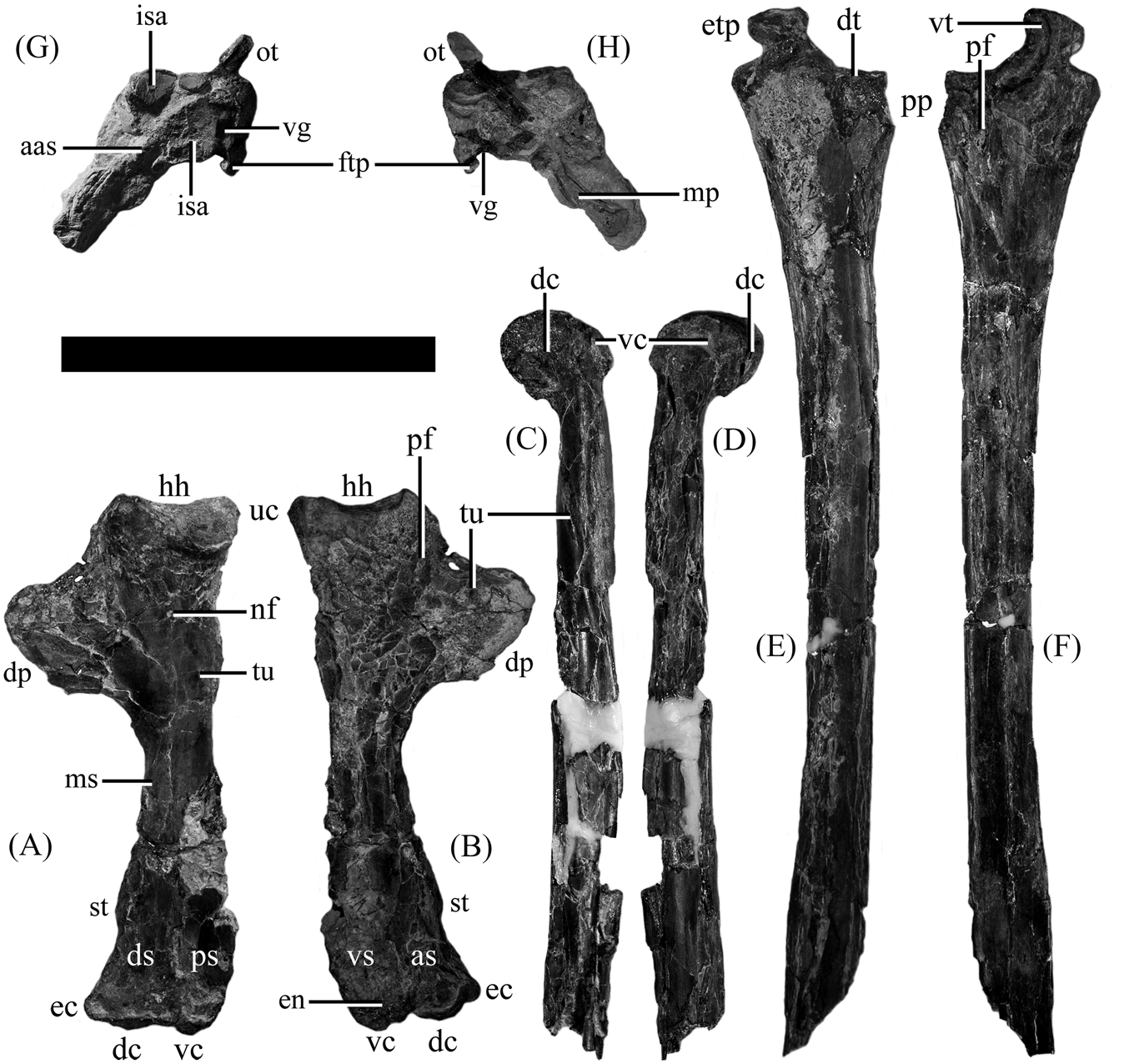
Photographs of the holotype and only known specimen of Alamodactylus byrdi, gen. et sp. nov., SMU 76476: left humerus in (A) dorsal and (B) ventral views; left wing metacarpal in (C) dorsal and (D) ventral views; first wing phalanx in (E) dorsal and (F) ventral views; proximal syncarpal in (G) proximal and (H) distal views. Scale bar=100 mm. Abbreviations: aas=accessory articular surface; as=anterior surface; dc=dorsal condyle; dp=deltopectoral crest; ds=dorsal surface; dt=dorsal cotyle; ec=ectepicondyle; en=entepicondyle; etp=extensor tendon process; ftp=flexor tendon process; hh=humeral head; isa=intersyncarpal articular surface; mp=manual phalanx; ms=muscle scar; nf=nutrient foramen; ot=possible ossified tendon; pf=pneumatic foramen; pp=posterior process; ps=posterior surface; st=supracondylar tubercle; tu=tubercle; uc=ulnar crest; vc=ventral condyle; vg=vertical groove; vs=ventral surface; vt=ventral tubercle.
Derivation of name. In honour of discoverer Gary Byrd.
Holotype. Partial left wing, SMU 76476.
Studied material. Holotype and only known specimen.
Diagnosis. Medium-sized pterosaur with unique combination of constricted humerus mid-shaft and D-shaped distal humerus cross-section; as well as autapomorphic small pneumatic foramen on ventral surface of humerus proximal end, warped humerus deltopectoral crest thicker proximally, and dorsal nutrient foramen positioned on midline of humerus shaft level with the middle of deltopectoral crest.
Description. The original description of SMU 76476 adequately describes this specimen and is repeated here with slight modification. This holotype specimen consists of a left humerus, the distal end of the wing metacarpal (metacarpal IV) and the proximal end of the first wing phalanx (phalanx 1 of digit IV) described in the original paper, as well as a left proximal syncarpal, manual phalanx, and a number of fragments reported here (Fig. 4). These fragments include four tapering processes that may be processes of skull bones, an articular surface that appears to be the mandible articulation of the right quadrate and four thin bones that do not taper and may be ossified tendons (not figured).
The humerus is crushed as is the rest of the specimen (Fig. 4A, B). The cortical bone has flaked off in areas and there are a few holes through the bone. The humeral head has a rather deep, crescentic cross-sectional shape. The articular surface of the humeral head is saddle-shaped and asymmetrically expanded posterodorsally and anteroventrally. A prominent, anteroposteriorly narrow ulnar crest (medial crest, posterior tuberosity) extends posteriorly from the humerus proximal end. A very small pneumatic foramen is positioned on the ventral surface of the humerus where the proximal end of the deltopectoral base joins with the humeral head. Prominent tubercles can be seen on the ventral surface in the middle of the deltopectoral crest and on the dorsal surface of the shaft near the posterior margin at a level even with the distal margin of the deltopectoral crest that likely correspond to insertion sites for the m. teres major and pectoralis of Bennett (Reference Bennett2008), respectively. A nutrient foramen pierces the dorsal surface of the humerus along the midline of the shaft at a point level with the middle of the deltopectoral crest.
The deltopectoral crest is positioned proximally and extends down the humerus for 35% of its length. The anteroposterior axis of the crest is oriented at an obtuse angle to the long axis of the humerus with respect to its proximal end, but the anterior margin of the crest is at an acute angle. This anterior margin curves ventrally only at its distal end so that proximodistal axis of the deltopectoral crest is at a much steeper angle at the anterior end than at the base of the crest. This shape of deltopectoral crest is termed ‘warped’ (Bennett Reference Bennett1989). The deltopectoral crest has an apex at its anteroproximal corner that is significantly thicker than the distal end or the rest of the crest. Distal to the deltopectoral crest, the mid-shaft of the humerus has a conspicuous constriction that is not an artifact of crushing. A short muscle scar extends along the dorsal surface of the mid-shaft distal to this constriction that is likely the origin of the lateral head of the m. triceps (Bennett Reference Bennett2008)
The distal end of the humerus has been distorted as a result of crushing. However, creases present on the distal ends of other pterosaur humeri at the edges of the anterior, dorsal, posterior, and ventral surfaces are also visible on the humeral shaft in this specimen. These creases delimit the dorsal surface from the posterior surface in one view and the anterior surface from the ventral surface in the other, confirming that the distal end had four distinct surfaces in addition to the distal surface. The humeral shaft is straight and expands distally, beginning at the mid-shaft constriction. The dorsal distal condyle and ectepicondyle are well preserved. The ectepicondylar tubercle is positioned at the anterodorsal apex of the humerus distal end and is confluent with the ectepicondylar ridge. The tubercle has a large divot in its centre. The distinct ectepicondylar ridge extends along the entire distal margin of the dorsal surface to contact the crease. The posterior surface is visible posterior to this crease and is marked by a concave surface. A small tubercle near the posterior margin of the ridge on the distal surface of the humerus may be the ulnar tubercle. On the other side, the distal ventral condyle and entepicondyle are missing their cortical bone so that it is possible to discern only their rough outlines, but they appear to be similar in shape to their dorsal counterparts. The anterior surface is visible and the intercondylar sulcus, a fossa proximal to the condyles and a small dorsal supracondylar tubercle can be seen. It can be inferred, from the four separate surfaces on the distal end and the distinct epicondylar ridges extending along the entire distal margins of the dorsal and ventral surfaces, that the humerus had a quadrangular, D-shaped distal cross-section as opposed to a triangular cross-section found in some taxa. A pneumatic foramen is not present on the anterior surface of the humerus distal end proximal to the distal condyles. The distal surface of the humerus is too crushed to ascertain if a pneumatic foramen is present there.
A left proximal syncarpal with an associated manual phalanx and possible ossified tendon is reported here (Fig. 4G, H). The proximal syncarpal is flattened proximodistally and is primarily visible in distal aspect with its proximal aspect obscured by matrix and the two associated elements. The entire bone appears to be subrectangular in outline. The distal aspect is dominated by two large, triangular intersyncarpal articular surfaces. These surfaces are anteroposteriorly longer than dorsoventrally tall. The posteroventral articular surface is longer than the anterodorsal articular surface in both directions. The anterodorsal articular surface is more poorly preserved and is divided into two surfaces, but these appear to have originally been part of the same articular surface. A ridge separates the two articular surfaces that extends past the surfaces to terminate in a promontory at its anteroventral end and is likely an accessory articulation surface. A prominent flexor tendon process extends ventrally from the posteroventral corner of the syncarpal. A distinct groove runs along the distal aspect of the syncarpal from the flexor tendon process separating the process from the posteroventral intersyncarpal articular surface, but this groove does not appear to reach the dorsal margin of the syncarpal. A long, thin bone cemented to the other side of the syncarpal is interpreted as an ossified tendon because it does not taper or show a trace of an articular end that would be expected for a manual or metacarpal element in this region of the specimen. An impression of a manual phalanx is also visible on this side. This element tapers rapidly from a rounded proximal articulation to a thin neck. There is no evidence of distal articulation. Based on the large expansion at the proximal end, this is likely a proximal manual phalanx.
Only the distal half of the left wing metacarpal is preserved (Fig. 4C, D). The element is crushed but the distal end preserves some of the original three-dimensions. The metacarpal is straight with no apparent curvature or kinks. The distal shaft is rectangular in cross-section. A rugose tubercle is located on the posterodorsal edge of the shaft proximal to the distal condyles that is possibly the ligamentous pulley of Bennett (Reference Bennett2008). As in other pterosaurs, the dorsal condyle is positioned more posterior than the ventral condyle. The condyles are both circular in outline and similar in size. There are no pneumatic foramina visible on the distal end of the wing metacarpal.
The left first wing phalanx is crushed, missing its distal end, and has lost the cortical bone from the dorsal surface of the proximal end (Fig. 4E, F). The extensor tendon process is fused to the proximal end of the phalanx with only a slight trace of a suture, indicating an osteological adult stage for the organism (Bennett Reference Bennett1993; Frey & Martill Reference Frey and Martill1998). The extensor tendon process is trapezoidal in outline with a very large constriction at its base. The ventral cotyle of the first phalanx dominates the extensor tendon process, extending along its entire proximodistal length and reaching partly onto the phalanx proper. The dorsal cotyle is not as well developed and just runs anteroposteriorly along the proximal aspect of the posterior process of the proximal first phalanx. This posterior process is broken off posterior to the dorsal cotyle. An oval pneumatic foramen pierces the ventral surface of the proximal end of the wing phalanx in a sulcus that extends down the shaft from between the cotyles. The shaft maintains a constant width distal to the proximal expansion. A slight anterior curvature and ventral bowing of the shaft is likely preservational.
Comparisons.A. byrdi shares: a ventral pneumatic foramen on the proximal end of the humerus, a straight humeral shaft and a distinct ulnar crest with the rest of the Ornithocheiroidea (sensu Kellner, Reference Kellner, Buffetaut and Mazin2003); a narrow and posteriorly-directed ulnar crest with the rest of the Pteranodontia; a warped curvature of the deltopectoral crest and a constricted mid-shaft of the humerus with the rest of the Pteranodontoidea; as well as with the rest of the Pterodactyloidea. A. byrdi lacks: the pneumatic foramen found on the dorsal surface of the humerus proximal end in USNM 13804, the gnathosaurines, Anhanguera, Noripterus complicidens, and all species more closely related to Tapejara than the azhdarchids; the triangular cross-section for the distal end of the humerus in the Pteranodontoidea; the deltopectoral crest positioned more distally on the shaft in the nyctosaurids and the azhdarchids; as well as the pneumatic foramen on the anterior surface of the humerus proximal to the distal condyles that is characteristic of Pteranodon. The presence of both a mid-shaft constriction of the humerus and a warped deltopectoral crest, combined with the absence of the triangular distal humeral cross-section found in the Pteranodontoidea, supports A. byrdi as the sister group to the Pteranodontoidea.
Myers (Reference Myers2010b) points out that SMU 76476, Pteranodon, Nyctosaurus, and some humeri referred to the Lonchodectidae have a smaller nutrient foramen instead of a pneumatic foramen on the dorsal surface of the humerus proximal end. However, A. byrdi is unique from these other taxa in the position of the nutrient foramen being more anterior and proximal at a position along the midline of the shaft, even with the midpoint of the deltopectoral crest. In the other taxa, the nutrient foramen is located on the posterior half of the humeral shaft closer to the distal margin of the deltopectoral crest. In A. byrdi, this position is taken up by a rugose tubercle that is likely the insertion for the m. teres major (Bennett Reference Bennett2008) and may be responsible for the distinct position of the nutrient foramen in this species. A. byrdi also exhibits a unique configuration of the warped deltopectoral crest. Whereas its crest curves ventrally at its distal end (as in the Pteranodontoidea) and has a proximal apex similar to Pteranodon, it is not thicker distally as in those taxa, but is thicker proximally as in the Nyctosauridae and more basal pterodactyloids. In addition, A. byrdi shares a ventral pneumatic foramen on the proximal end of the humerus with most other ornithocheiroids, but it is much smaller in this species.
Occurrence. Lower Coniacian, Atco Formation, Austin Group, north of Dallas, Collin County.
Pteranodontoidea Kellner, Reference Kellner, Buffetaut and Mazin2003 (sensu Kellner, Reference Kellner, Buffetaut and Mazin2003)
Studied Material. Proximal end of left humerus, USNM 13804.
Comparisons. USNM 13804 was reported in a two-paragraph paper (Gilmore Reference Gilmore1935), stating that it was probably referable to the genus Pteranodon, but that this assignment must be regarded as provisional on account of the scanty nature of the specimen. Bennett (Reference Bennett1989) extensively described and figured the specimen, referring to it as an indeterminate pteranodontid. Bennett (Reference Bennett1994) went on to state that the specimen differs from Pteranodon because of its large size and presence of a large pneumatic foramen on its dorsal, rather than ventral, surface, thus, could not pertain to Pteranodon. Kellner (Reference Kellner, Buffetaut and Mazin2003) has since renamed Bennett's (Reference Bennett1989, Reference Bennett1994) Pteranodontidae as the Pteranodontoidea, a clade roughly equivalent in circumscription to Unwin's (Reference Unwin, Buffetaut and Mazin2003) Ornithocheiroidea (contra Kellner, Reference Kellner, Buffetaut and Mazin2003), of which Myers (Reference Myers2010b) interpreted USNM 13804 as a member. Though the names of the clades may differ, the classification of USNM 13804 by Bennett (Reference Bennett1989, Reference Bennett1994) and Myers (Reference Myers2010b) are supported by the phylogenetic analysis. The analysis recovers USNM 13804 as a non-Pteranodon and non-istiodactylid pteranodontoid. No further information about its phylogenetic relationships can be taken from the analysis because this specimen is a rogue taxon within this group. All other species in this clade are represented by skull material alone, or as in the case of the Anhanguera species, have identical humerus codings to USNM 13804.
Occurrence. Upper Turonian, Eagle Ford Group; Travis County.
Aetodactylus halli Myers, Reference Myers2010a
Studied material. Mandible, SMU 76383.
Comparisons. The holotype and only known specimen of Aetodactylus halli consists of a nearly complete mandible that is characterised by subtle lateral expansion at its anterior end, a strong dorsoventral depression and a large number of teeth that extend posteriorly onto the rami (Myers Reference Myers2010a). It was referred to the Ornithocheiridae, making it the second reported occurrence of that group in North America and one of the youngest definitive occurrences of the group worldwide.
This referral was based on diagnostic characters listed for the rostrum by Unwin (Reference Unwin, Buffetaut and Mazin2003) and his assertion that the mandible shows similar morphological patterns to the rostrum. However, when Unwin (Reference Unwin, Buffetaut and Mazin2003) phylogenetically defined the Ornithocheiridae, he chose Haopterus gracilis Wang & Lü, Reference Wang and Lü2001 and Ornithocheirus simus Owen, Reference Owen1861 as specifiers for the name. H. gracilis had not been previously referred to that group beyond a note added in proof to Unwin (Reference Unwin2001) stating that it appeared to be a small ornithocheirid. Since then, phylogenetic analyses of H. gracilis have recovered it as a rogue taxon within the Pterodactyloidea (Lü & Ji Reference Lü and Ji2006), the Ornithocheiroidea (sensu Kellner, Reference Kellner, Buffetaut and Mazin2003) (Lü Reference Lü2009), the Pteranodontoidea (Lü et al. Reference Lü, Li and Ji2008a, Reference Lü, Unwin, Xu and Zhangb), and the Istiodactylidae (Lü et al. Reference Lü, Unwin, Jin, Liu and Ji2010), as well as a stable sister group to the Ornithocheiroidea by Andres & Ji (Reference Andres and Ji2008), Averianov (Reference Averianov2010) and the analysis in this present paper. Depending on the phylogeny referenced, the Ornithocheiridae could refer to any number of large clades including multiple families. The Ornithocheiridae has traditionally been a ‘trashcan’ group of widely ranging circumscription to which species of uncertain affinities have often been referred. The phylogenetic definition and diagnosis of Unwin (Reference Unwin, Buffetaut and Mazin2003) sought to clear up this taxonomy, and it is unfortunate that the specifier chosen would later turn out to lack a stable phylogenetic position. A full review of the taxonomy of the Ornithocheiridae is beyond the scope of this paper. To promote stability and consistency in the literature, the Ornithocheiridae sensu stricto is limited here to a close approximation of its common historical usage (see below), and A. halli is classified as a pteranodontoid.
Phylogenetic analysis of A. halli places it as a basal pteranodontoid and sister group to a clade containing: Cearadactylus atrox Leonardi & Borgomanero, Reference Leonardi and Borgomanero1985; Brasileodactylus araripensis Kellner, Reference Kellner1984; Ludodactylus sibbicki Frey et al., Reference Frey, Martill, Buchy, Buffetaut and Mazin2003; the Anhangueridae; and the Ornithocheiridae. It shares procumbent mesial teeth with this clade, but lacks their variation in tooth shape along the tooth row that becomes hyperelongate mesially. The most basal member of this clade that had been previously referred to the Ornithocheiridae is L. sibbicki. C. atrox has been placed in its own family (Wellnhofer Reference Wellnhofer1991; Dalla Vecchia Reference Dalla Vecchia1993) or referred to the Ctenochasmatidae (Unwin Reference Unwin2002). The original referral of A. halli was not far off from this phylogenetic position, which is approximately a second outgroup to the Ornithocheiridae sensu lato.
Occurrence. Middle Cenomanian, Tarrant Formation, Eagle Ford Group; south of Arlington, Tarrant County.
Ornithocheiridae Seeley, Reference Seeley1891 (sensu this paper)
Coloborhynchus Owen, Reference Owen1874
Coloborhynchus wadleighi Lee, Reference Lee1994
Holotype. Partial rostrum, SMU 73058.
Studied material. Holotype and only known specimen.
Remarks. The taxonomic history of Coloborhynchus is complex (Lee Reference Lee1994, p. 756). When Lee (Reference Lee1994) named this species, he resurrected the genus Coloborhynchus and its type species, stating that both were valid and distinct. Owen (Reference Owen1874) named Coloborhynchus, apparently considering Coloborhynchus clavirostris Owen, Reference Owen1874 as its type species, which he had termed Pterodactylus clavirostris four pages before. Kuhn (Reference Kuhn1967) later formally fixed clavirostris as the type species by subsequent designation. He referred to the genus Coloborhynchus both Pterodactylus cuvieri Bowerbank, Reference Bowerbank1851 and Pterodactylus sedgwickii, which had been placed by Seeley (Reference Seeley1870) in Ornithocheirus, along with all the pterosaur species from the Cambridge Greensand. Owen (Reference Owen1874) regarded Ornithocheirus as invalid and substituted his own genus Criorhynchus for its type species, his Pterodactylus simus Owen, Reference Owen1861. Seeley (Reference Seeley1881), not surprisingly, synonymised Coloborhynchus with Ornithocheirus. Hooley (Reference Hooley1914) retained cuvieri and sedgwickii in Ornithocheirus but also synonymised clavirostris with Criorhynchus simus. This taxonomy was upheld until Lee (Reference Lee1994) described the holotype of wadleighi. Noting that wadleighi was similar to the holotype of clavirostris and both were distinguishable from Criorhynchus as well as other dentulous pterosaurs, Lee (Reference Lee1994) resurrected Coloborhynchus and referred both species to it. Unwin (Reference Unwin2001) later synonymised Criorhynchus with Ornithocheirus and restricted its circumscription to the type species Ornithocheirus simus.
Since then, a number of species have been referred to Coloborhynchus: the new species Coloborhynchus spielbergi Veldmeijer, Reference Veldmeijer2003, as well as the previous species Ornithocheirus capito Seeley, Reference Seeley1870 (Unwin et al. Reference Unwin, Lü and Bakhurina2000); Santanadactylus araripensis Wellnhofer, Reference Wellnhofer1985 (Veldmeijer Reference Veldmeijer2003); Tropeognathus robustus Wellnhofer, Reference Wellnhofer1987 (Fastnacht Reference Fastnacht2001); Siroccopteryx moroccensis Mader & Kellner, Reference Mader and Kellner1999 (Unwin Reference Unwin2001); and Anhanguera piscator Kellner & Tomida, Reference Kellner and Tomida2000 (Veldmeijer Reference Veldmeijer2003). With the exception of S. moroccensis and O. capito, all of these species have been referred to and from Anhanguera Campos & Kellner, Reference Campos and Kellner1985 (i.e. Sayão & Kellner Reference Sayão and Kellner2006, Kellner Reference Kellner1990, Kellner & Campos Reference Kellner and Campos1988, and Kellner & Tomida Reference Kellner and Tomida2000, respectively). In addition, Anhanguera has been synonymised with Coloborhynchus (Steel et al. Reference Steel, Martill, Unwin and Winch2005), the Anhangueridae synonymised with the Ornithocheiridae (Unwin Reference Unwin2001), and both maintained as distinct (Kellner & Tomida Reference Kellner and Tomida2000). However, none of these taxonomic changes have been made with respect to a reference phylogeny or a phylogenetic analysis of species relationships. The ultimate taxonomy of these species is beyond the scope of this paper, but enough of them are included in the phylogenetic analysis to comment on their taxonomy. One of the important results of the analysis is that the species traditionally associated with Anhanguera and the species associated with Coloborhynchus or Ornithocheirus are recovered as two separate clades. Anhanguera blittersdorffi, araripensis, santanae, and piscator form a clade with Liaoningopterus gui that is distinct from a clade containing Ornithocheirus simus, Tropeognathus mesembrinus, as well as Coloborhynchus clavirostris and wadleighi. These clades are closest to the historical usage of the Anhangueridae and Ornithocheiridae clade names in the analysis. To promote stability and consistency in the literature, the Ornithocheiridae is phylogenetically defined here as the most inclusive clade containing Ornithocheirus simus Owen, Reference Owen1861 but not Anhanguera blittersdorffi Campos & Kellner, Reference Campos and Kellner1985, and the Anhangueridae is phylogenetically defined here as the most inclusive clade containing Anhanguera blittersdorffi Campos & Kellner, Reference Campos and Kellner1985 but not Ornithocheirus simus Owen, Reference Owen1861. These definitions provide the closest approximation of the historical usage of these names sensu stricto, accommodation for future discoveries and minimal disruption to the literature. The single disruption is that Ludodactylus sibbicki is classified as a pteranodontoid rather than an ornithocheirid pteranodontoid. Therefore, Coloborhynchus wadleighi is maintained as an ornithocheirid, both the first ornithocheirid and first dentulous pterodactyloid reported from North America.
When Rodrigues & Kellner (Reference Rodrigues and Kellner2008) reviewed Coloborhynchus, they erected the new genus name Uktenadactylus for Coloborhynchus wadleighi, diagnosed both previous Coloborhynchus species, and referred them to the Anhangueridae. They listed five features that distinguished the two species and led them to restrict Coloborhynchus to clavirostris and erect a new genus for wadleighi. However, they also listed five features that united the two species. One of which, a quadrangular shape to the anterior expansion of the rostrum, supports these species as sister groups in the phylogenetic analysis. They regarded these two species as closely related and perhaps forming a clade with Siroccopteryx moroccensis. Phylogenetic systematics prioritises synapomorphic similarity over dissimilarity for erecting clades and clade names. Rodrigues & Kellner (Reference Rodrigues and Kellner2008) comprehensively diagnose and support these two species as valid, but whether the presence of diagnostic features warrants changing the genus name of a species binomen when it refers to a valid clade is at the discretion of the taxonomist. The species wadleighi is referred back to Coloborhynchus to promote stability in the literature and preserve its information content (e.g. circumscription, geographic range, temporal range, synapomorphies, etc.). Literature searches for Uktenadactylus wadleighi will only retrieve information dating to 2008, whereas searches for Coloborhynchus wadleighi will retrieve information dating to 1994 including its original description, most of its taxonomic discussion and phylogenetic analyses of its relationships. At such time that Coloborhynchus is recovered as a non-monophyletic clade, Uktenadactylus wadleighi would be the appropriate replacement name for Coloborhynchus wadleighi.
Occurrence. Upper Albian, Paw Paw Formation; north of Fort Worth, Tarrant County.
4. Discussion
The state of Texas possesses a temporally extensive pterosaur fossil record that is unique in the world, preserving specimens that span the entire evolutionary history of the Pterosauria. Both Triassic and latest Cretaceous pterosaurs have also been reported from France (Barrett et al. Reference Barrett, Butler, Edwards and Milner2008), but the former consist of isolated teeth that are not referable to pterosaurs (Andres Reference Andres2006). The five pterosaur species and 13 occurrences of over 30 pterosaur specimens in Texas outnumber the pterosaur diversity of other US states and most of the countries around the globe. Many of the Texas pterosaurs classified here represent new palaeobiogeographic occurrences. Texas records the only unequivocal Triassic pterosaur outside of Europe and Greenland (Eudimorphodon sp.), as well as the only dsungaripterid and ornithocheirid from North America. Temporal range extensions based on Texas fossil material include: possibly the oldest pterosaur; the oldest member of the Azhdarchidae and its sister group; one of the youngest, if not the youngest, member of the clade consisting of all species more closely related to the Anhangueridae than the Lonchodectidae; and one of the oldest, if not the oldest, pterosaur. The Texas pterosaur record is very diverse including eudimorphodontids, basal neoazhdarchians, dsungaripterids, azhdarchids, basal pteranodontians, basal pteranodontoids and ornithocheirids. This high diversity is illustrated by the high resolution of these specimens in the phylogenetic analysis. Although most Texas pterosaur specimens are fragmentary, they only result in 11 extra most parsimonious trees in the phylogenetic analysis, and these multiple trees are the result of a single rogue taxon. Exclusion of this one specimen results in a single tree. All these occurrences culminate in Quetzalcoatlus northropi, the largest known flying organism. Texas is viewed as a large and impressive land, and this reputation is also well deserved with respect to its uniquely impressive pterosaur record.
5. Acknowledgements
The authors wish to acknowledge Dr. Wann Langston for his work describing and popularising the pterosaurs of Texas, and introducing the first author to pterosaur research. Phillip Murry, Vernon Mills, Chris Wadleigh, Lance Hall, Tom Wells, Gary Byrd and Douglas Lawson are thanked for discovering Texas pterosaur fossils and donating them to museums for scientific study. Louis Jacobs and Dale Winkler supported this project. Kent Newman is thanked for preparing the holotype of Radiodactylus langstoni. Reviewers David Hone and Alexander Kellner provided critical reviews that helped improve this manuscript. The Roy M. Huffington Department of Earth Sciences, Southern Methodist University, funded this research.
6. Supplementary Material
The taxon-character matrix for the phylogenetic analysis of Texas pterosaurs (), together with character settings, character names and states and analysis commands (), is provided as Supplementary Material with the online version of this paper. This is hosted by the Cambridge Journals Online service and can be viewed at http://journals.cambridge.org/tre. The analysis can be repeated by copying the matrix and commands into a text file and executing it in TNT.