Introduction
GAD is common among older adults and is associated with negative physical and mental health outcomes. Twelve-month community prevalence of late-life GAD is 3.3% (Gum et al., Reference Gum, King-Kallimanis and Kohn2009), and figures are higher in primary care settings (Wittchen et al., Reference Wittchen, Kessler, Beesdo, Krause, Hofler and Hoyer2002). GAD is associated with increased disability (Brenes et al., Reference Brenes2005), service utilization (Porensky et al., Reference Porensky2009), and mortality (Phillips et al., Reference Phillips2009). Anxiety is a risk factor for dementia (Gallacher et al., Reference Gallacher, Bayer, Sish, Pickering and Ben-Shlomo2009); and increased worry, a core component of GAD, is associated with poor treatment outcome in late-life depression (Andreescu et al., Reference Andreescu2009). Despite being associated with multiple negative outcomes, research in late-life anxiety is lacking compared with depression (Lenze and Wetherell, Reference Lenze and Wetherell2009).
In addition, QOL is lower in older adults with GAD than in non-psychiatric samples, those with other anxiety disorders, and individuals with medical illnesses (Bourland et al., Reference Bourland2000; Stanley et al., Reference Stanley2003; Wetherell et al., Reference Wetherell, Gatz and Craske2003; Wetherell et al., Reference Wetherell, Thorp, Patterson, Golshana, Jeste and Gatz2004). CBT, an efficacious treatment for late-life GAD, also improves QOL (Stanley et al., Reference Stanley2003; Wetherell et al., Reference Wetherell, Thorp, Patterson, Golshana, Jeste and Gatz2004; Brenes et al., Reference Brenes, Miller, Williamson, McCall, Knudson and Stanley2012). QOL has increasingly been a focus of treatment outcome research, as studies shift from a narrow focus on symptom reduction to broader evaluation of outcomes.
A number of factors predict QOL in older adults, including presence of GAD, depression and anxiety severity (Bourland et al., Reference Bourland2000; Wetherell et al., Reference Wetherell, Gatz and Craske2003; Borowiak and Kostka, Reference Borowiak and Kostka2004; Cully et al., Reference Cully2006), and dispositional factors, such as optimism (Bourland et al., Reference Bourland2000) and self-efficacy (Stretton et al., Reference Stretton, Lathan, Carter, Lee and Anderson2006). Age has a curvilinear relation with well-being (Mroczek and Spiro, Reference Mroczek and Spiro2005), and older women compared with older men report lower levels of well-being (Ruggeri et al., Reference Ruggeri2005; Zainotto et al., Reference Zainotto, Fasaschetti and Sacker2009). Presence of a social network and good social relationships are positively associated with higher QOL (Pinquart and Sorenson, Reference Pinquart and Sorensen2000). The current study examined predictors of change in QOL in a clinical trial of CBT for late-life GAD, using multilevel modeling to account for within and between person factors.
In this study, QOL was conceptualized as a multifaceted construct that encompassed satisfaction across multiple life domains. A framework proposed by Reidinger et al. (Reference Reidinger, Dracup and Brecht2000) was used as a model to categorize predictor variables. The model helped classify predictor variables into conceptually coherent groups. We hypothesized that within-person and between-person variability in anxiety and depression would predict change in QOL such that improvement in anxiety and depression would predict positive change in QOL. We also expected that higher levels of optimism, self-efficacy, and social support would predict improved QOL.
Method
Model
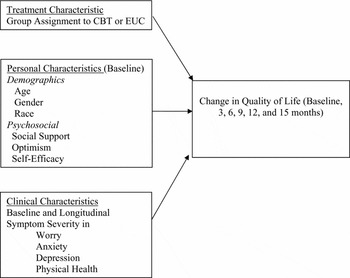
Riedinger and colleagues (2000) identified three categories of predictors of QOL, namely, treatment, personal and clinical characteristics. A revised version of this conceptual model was used in the current study (see Figure 1). Treatment assignment was denoted as a treatment characteristic. Participants’ age, gender, race, and psychosocial factors, namely, social support, optimism and self-efficacy were identified as personal characteristics. Longitudinal self-reported symptom-severity scores on worry, anxiety and depression and physical health functional status were identified as clinical characteristics.
Conceptual model-predictors of change in quality of life.

Participants
Participants included 134 adults, aged 60 years and older, who were enrolled in a randomized clinical trial of CBT for late-life GAD (Stanley et al., Reference Stanley2009). Participants were recruited using both physician and patient referrals from two primary-care clinics and completed screening and diagnostic procedures before they were randomized to CBT for anxiety or EUC. Included participants were 60 years of age or older with a diagnosis of principal or co-principal GAD according to the Diagnostic and Statistical Manual of Mental Disorders, Fourth Edition (First et al., Reference First, Spitzer, Miriam and Williams1997). Those with cognitive impairment, active substance abuse, psychosis and bipolar disorder were excluded. Participants in CBT received 12 weeks of treatment and telephone booster sessions at 4, 7, 10 and 13 months. The EUC group received biweekly telephone calls. Assessments were conducted at baseline, 3, 6, 9, 12 and 15 months. The sample was predominantly Caucasian (70.2%), female (78.4%), well-educated (M = 15.9 years (SD = 3.01)), and married (61.9%). A total of 60 participants (44.8%) had comorbid depressive disorders (for more details, see Stanley et al., 2009).
Measures
QOL: QOL was measured using the Quality of Life Inventory (QOLI; Frisch, Reference Frisch1994), a self-report measure that measured multiple life domains, with satisfaction on each domain weighted by its importance. QOLI included 32 items with scores ranging from −6 to +6. Higher scores indicate higher levels of QOL. The QOLI has been shown to be valid and reliable (Frisch et al., Reference Frisch, Cornell, Villanueva and Retzlaff1992) and has been used to measure QOL in older adults (Stanley et al., Reference Stanley2003; Wetherell et al., Reference Wetherell, Thorp, Patterson, Golshana, Jeste and Gatz2004). QOL was assessed at all-time points.
Predictor Variables. Random assignment to either CBT or EUC was the treatment characteristic predictor. Participant age, gender, race, and baseline psychosocial factors (social support, optimism, and self-efficacy) were included as personal characteristic predictor variables. Social support was measured using the Multidimensional Scale of Perceived Social Support (MSPSS; Zimet et al., Reference Zimet, Dahlem, Zimet and Farley1988). The measure has been shown to have good psychometric properties among anxious and nonanxious older adults (Stanley et al., Reference Stanley, Beck and Zebb1998) and has been used to assess social support among older adults (Fry, Reference Fry2001). The Life Orientation Scale (LOT; Scheier and Carver, Reference Scheier and Carver1985) was used to measure optimism. The scale has adequate predictive and discriminant validity and exhibits good psychometric properties among older adults with GAD (Stanley et al., Reference Stanley, Novy, Hopko, Beck, Averill and Swann2002). Self-efficacy was measured using the Self Efficacy Scale (SES; Sherer and Maddux, Reference Sherer, Maddux, Mercandante, Prentice-Dunn, Jacobs and Rogers1982). The SES has two subscales, generalized and social self-efficacy. Used to measure self-efficacy in older adults (Waller and Bates, Reference Waller and Bates1992; Smits et al., Reference Smits, Deeg and Bosscher1995), it has good psychometric properties in a sample of older adults with GAD (Stanley et al., Reference Stanley, Novy, Hopko, Beck, Averill and Swann2002). All personal-characteristic predictors were assessed only at baseline.
Worry severity, anxiety, depression, and physical health functional status were assessed at all six time points and were included as clinical-characteristic predictor variables. Worry severity was evaluated using the Pennsylvania State Worry Questionnaire (PSWQ; Meyer et al., Reference Meyer, Miller, Metzger and Borkovec1990). The PSWQ has excellent internal consistency, adequate convergent validity, and good sensitivity to change in anxious older adults (Beck et al., Reference Beck, Stanley and Zebb1995; Stanley et al., Reference Stanley2009; Brenes et al., Reference Brenes, Miller, Williamson, McCall, Knudson and Stanley2012). Anxiety was measured using the Beck Anxiety Inventory (BAI; Beck and Steer, Reference Beck and Steer1990). It has been used to measure anxiety symptoms in older adults (Wetherell et al., Reference Wetherell, Thorp, Patterson, Golshana, Jeste and Gatz2004). Depression was measured using the Beck Depression Inventory (BDI; Beck and Steer, Reference Beck and Steer1987). It has good psychometric properties when used with older adults (Gallagher et al., Reference Gallagher, Nies and Thompson1982; Gallagher et al., Reference Gallagher, Breckenridge, Steinmetz and Thompson1983). The physical component score from the Medical Outcomes Study, 12-item Short Form Health Survey (SF-12) was used to assess physical health functional status (Ware et al., Reference Ware, Kosinski and Keller1996). Reliability and validity of the SF-12 are well-established in older adults (Resnick and Nahm, Reference Resnick and Nahm2001).
Statistical analysis
For each participant, QOL was measured at baseline, and at 3, 6, 9, 12 and 15 months. Therefore, multilevel modeling was used to effectively manage any missing data and to adjust for the possible bias in standard errors and statistical tests that may result from dependent data (Krull and MacKinnon, Reference Krull and MacKinnon2001; Kenny et al., Reference Kenny, Korchmaros and Bolger2003). Coefficients were estimated using the PROC MIXED routine in SAS Version 9.3 (SAS Institute, Cary, North Carolina). As recommended with an adequate sample size at level 2, (i.e. the person level), full information maximum likelihood estimation was used (Snijders and Bosker, Reference Snijders and Bosker2004). Furthermore, partially due to expectations of between-person variance in QOL and no discernible pattern in variances and covariances, random intercepts and an unstructured covariance structure were specified. Two sets of models, each predicting change in QOL over time, were conducted: one set for predictors that were measured at baseline only (i.e. treatment characteristics and personal characteristics) and one set for predictors that were measured over time (i.e. clinical characteristics).
The first set of models began with an unconditional model that included only time as both fixed and random effect. Baseline time was coded as 0. This model enabled us to examine average change in QOL over time, as well as between-person variance in change in QOL. Three conditional models followed this unconditional model, each one introducing different predictors. The first conditional model added treatment condition to the model as a predictor of change in QOL. The second conditional model added demographic personal characteristics (i.e. age, gender, and race). Race was dummy coded into Caucasian and “other” groups, with the “other” group as the reference group. Age was grand mean centered. The third conditional model added psychosocial personal characteristics (i.e. general self-efficacy, social self-efficacy, social support, optimism). For each of the three conditional models, a main-effects model was first assessed, and then an interaction model was tested that included the main effects, as well as the interaction between each predictor and time. A significant interaction between a predictor and time would indicate that the predictor accounted for between-person variance in change in QOL. Aside from group assignment, predictors that were not significant were not included in subsequent models.
The second set of models examined clinical characteristics as predictors of QOL. The focus was on variation in QOL as a function of anxiety, worry, depression, and physical health. Therefore, both the outcome and the key predictors were time-varying measures (i.e. they were measured at baseline, and at 3, 6, 9, 12 and 15 months). Contextual effects (i.e. whether the association between each clinical characteristic and QOL were the same at both the within-person and between-person levels) were of interest. Therefore, the stable component was captured by obtaining the extent to which one's average deviated from the grand mean across the six assessments (i.e. participant's average anxiety, worry, depression, and physical health functional status were centered at the grand mean), and the temporal component was captured by obtaining a participant's deviation from his or her own mean across the six assessments (i.e. centered within person). Both centered within-person predictors and grand mean centered predictors were included to examine whether the two coefficients were statistically different from each other (Enders and Tofighi, Reference Enders and Tofighi2007). The differential influence of each clinical characteristic on one's QOL at level 1 and level 2 was tested by a series of estimate statements in PROC MIXED. The effects of each clinical characteristic were obtained while controlling for all other clinical variables at both the within- and between-person levels, which allowed assessment of the unique contributions of anxiety, worry, depression and physical health on QOL over time.
Results
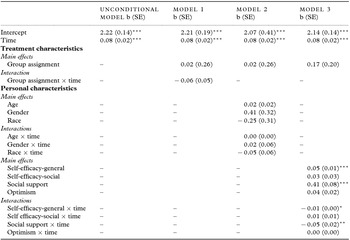
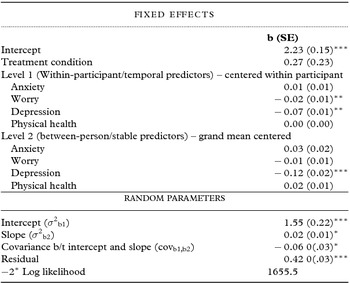
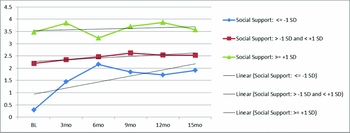
Results are presented in Tables 1 (treatment and personal characteristics) and 2 (clinical characteristics). The unconditional model showed that overall QOL improved over time and that there was significant variability between participants in change in QOL over time (random effect for time (σ 2) = 0.02, p = .007). In Models 1 and 2, neither treatment characteristics nor personal characteristics were significantly related to average QOL or change in QOL. In Model 3, main effects of general self-efficacy and social support were significant such that those with higher social support and higher general self-efficacy reported higher average QOL. Additionally, significant interactions were found between both general self-efficacy and time and social support and time. Simple slopes analyses revealed that those with lower social support showed the greatest increase in QOL over time (see Figure 2). The same pattern emerged for general self-efficacy.
Baseline predictors of change in quality of life

Note: * p < 0.05, ** p < 0.01, *** p < 0.001
†Main effects estimates are from main effects only models that do not include any interaction terms. Estimates of interactions are from models that include not only main effects but also interaction terms between each predictor and time. Note that group is retained in all models, and predictors that are not significant are dropped from subsequent models.
Contextual model of clinical characteristics predicting quality of life

Note: * p < 0.05, ** p < 0.01, *** p < 0.001
QOL over time for different levels of baseline social support.

In the clinical-characteristics contextual model, grand mean centered depression was significant, suggesting that, on average, those who reported more depression reported lower QOL. Additionally, both person-centered worry and depression were significant such that on assessments where one reported more worry or more depression than their average, they also reported lower QOL. Analyses of the differential influence of between-person and within-person differences in clinical characteristics revealed a significant contextual effect for depression between the two levels (t (128) = 2.20, p = .03) such that variability in QOL over time was better accounted for by between-person differences in depression than within-person differences in depression.
Discussion
Change in QOL over time was predicted by social support and general self-efficacy, within-person improvement in worry, within-person decline in depression, and average levels of depression. Average levels of depression better predicted QOL than within-person variability in depression among different assessment time points.
Among community-dwelling older adults, positive associations exist between QOL and social support (Wiggins et al., Reference Wiggins, Higgs, Hyde and Blane2004) and between self-efficacy and happiness (Jopp and Rott, Reference Jopp and Rott2006). Here, the improvement in QOL was stronger for those with lower social support and those with lower self-efficacy. Floor effects might explain these interactions, such that those with lower levels of social support and general self-efficacy had a higher likelihood of showing improvement. It is well-documented that depression and worry are negatively associated with QOL (Bourland et al., Reference Bourland2000; Brown and Roose, Reference Brown and Roose2011; Diefenbach et al., Reference Diefenbach, Tolin and Gilliam2012), findings supported by our study.
Negative associations between QOL and anxiety symptoms have been established (de Beurs et al., Reference De Beurs, Beekman, van Balkom, Deeg, van Dyck and van Tilburg1999; Bourland et al., Reference Bourland2000; Brown and Roose, Reference Brown and Roose2011; Baernholdt et al., Reference Baernholdt, Hinton, Yan, Rose and Mattos2012). However, in our study, neither average anxiety levels nor within-person variability in anxiety symptoms uniquely predicted QOL over time. The focus on physiological symptoms, as assessed by BAI among older adults (Morin et al., Reference Morin, Landreville, Colecchi, McDonald, Stone and Ling1999; Wetherell and Gatz, Reference Wetherell and Gatz2005), might have contributed to this lack of association.
Prior studies have demonstrated effects of CBT on QOL in late-life GAD (Stanley et al., Reference Stanley2003; Wetherell et al., Reference Wetherell, Gatz and Craske2003). However, the current findings revealed no difference between treatment groups in average QOL or in change in QOL over time. Differential findings in this regard may be due to variations in QOL measurement, CBT delivery options (individual vs. group), and populations served (community vs. primary care). Similarly, our study did not support an association between subjective assessment of physical health functional status and QOL. A relationship between physical status and QOL was documented in a longitudinal normative aging study using an all-male, nonclinical sample (Mroczek and Spiro, Reference Mroczek and Spiro2005). There is evidence that, when rating global QOL compared with health-related QOL, participants put greater emphasis on mental health rather than physical functioning (Smith et al., Reference Smith, Avis and Assmann1999). We used a global measure of QOL, not health-related QOL, in our study, which might explain why we did not find a relationship between QOL and physical health functional status.
Lastly, past research showed that optimism predicted QOL in a community sample (Bowling et al., Reference Bowling, Banister, Sutton, Evans and Windsor2002). In another study (Bourland et al., 2010), optimism predicted QOL in older adults with GAD when a life satisfaction index, another measure of QOL, was used. Therefore, the difference in how QOL was measured in our study might explain the lack of support for optimism uniquely predicting QOL.
Our study benefits from a longitudinal design and use of mixed-model analyses that allowed examination of unique predictors of between-person and within-person changes in QOL. To our knowledge, no other study has examined the relationships between group-level and person-level changes in clinical symptoms and the QOL of older adults with GAD. Based on our results, improvement in worry and depressive symptoms is associated with increased QOL. Additionally, efficacious treatments that focus on reduction in clinical symptoms may benefit from increased attention to psychosocial variables, such as social support and self-efficacy, to enhance study participants’ QOL. Knowledge about predictors of QOL may help enhance existing interventions for older adults with GAD, such as CBT, by broadening the targets for intervention.
Notwithstanding these contributions, however, there are some limitations. The psychosocial-predictor variables (social support and self-efficacy) were assessed at baseline only, limiting the examination of whether the relation between QOL and these predictor variables changed over time. Future research is needed to examine how within-group and within-person changes in psychosocial factors, like social support and self-efficacy, might impact improvement in QOL. Participants also were predominantly female, Caucasian, and well-educated. This homogeneity in the sample might limit generalizability. We need more studies that will examine predictors of change in QOL in a diverse sample.
Treatment intervention programs have been critiqued for their narrow focus on symptom reduction (Gladis et al., Reference Gladis, Gosch, Dishuk and Crits-Christoph1999). QOL has increasingly been used as an outcome measure in treatment outcome studies to focus on overall improvement in functioning. Our study suggests that improvement in worry and depression, along with general self-efficacy and social support, will increase QOL in older adults with GAD. Psychosocial interventions that focus on developing an internal locus of control and improving social support, along with targeting mood improvement, are well suited to enhance QOL.
Conflict of interest statement
None
Description of authors’ roles
S. Shrestha conceptualized the research question, oversaw all components of the study, and drafted major sections of the paper.
M. Stanley oversaw the overall project, conceptualized and led execution of the randomized controlled trial, supervised treatment, helped to plan data analysis and assisted with writing.
N. Wilson assisted with overall project conceptualization and writing.
J. Cully supervised independent evaluators who conducted outcome assessments, assisted with writing/editing.
M. Kunik assisted with overall project conceptualization and writing.
D. Novy provided input on study design and editing.
H. Rohades assisted with data analysis and editing.
A. Amspoker conducted the data analysis, assisted with writing and approved the final paper.
All authors approved the final version of the manuscript.
Acknowledgment
This research was supported by a grant from the National Institute of Mental Health (NIMH) R01-MH53932) to the second author and partially supported with the facilities and resources of the Houston VA HSR&D Center for Innovations in Quality, Effectiveness and Safety (CIN13-413). The views expressed reflect those of the authors and not necessarily those of the Department of Veterans Affairs, US government, Baylor College of Medicine, the NIMH or the National Institutes of Health. The NIMH had no role in the design and conduct of the study; the collection management, analysis and interpretation of the data; or the preparation, review or approval of the manuscript.