Introduction
Urbanisation and demographic change constitute two of the major developments of the 21st century. In 2014, 73 per cent of Europe's population lived in urban areas (United Nations 2015), and by 2030, at least a quarter of that percentage will be at least 60 years old or older (Handler Reference Handler2014). These older urban residents are becoming more ethnically and socio-economically diverse (Koceva et al. Reference Koceva, Brandmueller, Lupu, Oennerfors, Corselli-Nordblad, Coyette, Johansson, Strandell and Wolff2016).
Hence, urbanisation is accompanied by research questions for a variety of disciplines, such as urban sociology, migration studies and gerontology. However, until now, little attention has been paid to studying age, migration and environment together in a comprehensive manner (Warnes et al. Reference Warnes, Friedrich, Kellaher and Torres2004). This paper aims to fill this conceptual and empirical gap by proposing an intersectional ‘doing’ perspective on age, ethnicity and environment, and by exemplifying this approach using a study on the discrimination that Turkish migrants in Viennese neighbourhoods have experienced.
A ‘doing’ perspective on age, ethnicity and environment
Gerontology has a long tradition of conducting research on spatial living conditions and the place perceptions of older adults. Over the past 50 years, environmental gerontology has emerged as a distinct sub-field of gerontology that focuses on the description, explanation and optimisation of the relationship between older adults and their socio-spatial environments (Wahl and Weisman Reference Wahl and Weisman2003). The growing popularity of this field is not least due to the attention that the policy concept of ‘ageing in place’ has received since the 1990s. The notion of ageing in place suggests that older people should stay in their familiar environments despite the potentially arising needs for care and that they should not be forced to move into retirement homes. In line with supporting independence and autonomy in older age, one major argument for this policy is that it decreases costs for the health-care system (Wiles et al. Reference Wiles, Leibing, Guberman, Reeve and Allen2012). Despite having emerged from a care-focused discourse, ageing in place has ignited a debate about age-friendly cities. The focus on cities here can be explained by the fact that the older population is growing more rapidly in urban areas, but also by the finding that differences between urban and rural areas persist in regards to informal and family care-giving. For instance, older adults in rural environments are still more likely to be taken care of by their social networks and are less likely to be admitted into an institutional setting (McCann, Grundy and O'Reilly Reference McCann, Grundy and O'Reilly2014).
The World Health Organization (WHO) thus launched a number of policy initiatives in age-friendly cities throughout the 1990s and early 2000s, with active ageing as the core element (Buffel, Phillipson and Scharf Reference Buffel, Phillipson and Scharf2012). In 2006, they initiated the ‘Global Age-friendly Cities’ project in 33 cities, producing a Global Age-friendly Cities guide (WHO 2007) which has been used as an influential checklist for policy makers. Even though meta-analyses suggest that the age-friendly cities framework has been applied in different forms and with different foci (Lui et al. Reference Lui, Everingham, Warburton, Cuthill and Bartlett2009), the main idea of promoting active ageing through age-friendly environments has gained widespread acceptance. However, it is not only the urban population in general that is becoming more diverse, but also the older population in particular. For researchers and policy makers alike, the question that arises out of age-friendly guidelines and standards for cities remains: Do concepts of age-friendly cities consider all older individuals? Can they cater to the diversification of older age?
To review this question, we may critically discuss approaches and developments towards the study of age, ethnicity and environment in previous and contemporary environmental gerontology. Within this context, we can find three ways to approach age and ethnicity: as attributes, as properties or as social constructs (cf. Torres Reference Torres2015). From an essentialist perspective, variables, such as age or ethnicity, are understood as personal attributes that are unchangeable and as having a primary influence on the socialisation process of people (cf. Isaac Reference Isaac1975). From a structuralist perspective, age and ethnicity are viewed as personal properties, i.e. something that people have. Structuralist approaches exceed essentialism as variables become ‘fluid’ – their relevance for advantages or disadvantages can change depending on the social and historical context. Within that context, its effects, though not its essence, is perceived as being socially constructed. However, as Torres (Reference Torres2015: 942) notes: ‘The problem with this assumption is, of course, that some people assign no importance to their ethnic background and do not always regard themselves as people who are determined by them.’
Finally, from a social constructionist perspective, age and ethnicity are produced and reproduced within an interactional process of addressing and self-identifying (Barth Reference Barth1998). In this context, so-called attributes, such as age, ethnicity or gender, become practised and performed processes or ‘doings’ (Butler Reference Butler2004; West and Zimmerman Reference West and Zimmerman1987).
When we approach, for example, ethnicity as doings, the questions regarding when and how ethnicity is being done become more prominent than the question regarding ‘what’ ethnicity is (for) (Torres Reference Torres2015). However, as gender theorists have already learned in the 1990s, a social constructionist perspective does not automatically imply the ability to apply diversity and, moreover, intersectionality. Having been developed in gender studies (see e.g. Crenshaw Reference Crenshaw1989), intersectionality refers to overlapping systems of advantage or disadvantage (or as Crenshaw puts it, oppression and discrimination) which certain groups face based on their location at the intersection of gender, age, ethnicity, sexuality, economic background, and so on, which is, using the words of Durkheim, ‘greater than their sum’.
If intersectionality is applied to a social constructionist perspective of doing, as Staunæs (Reference Staunæs2003) argues, it can be understood as ‘doing difference’ (West and Fenstermaker Reference West and Fenstermaker1995), instead of just ‘doing gender’, ‘doing age’ or ‘doing ethnicity’. Developing this approach further, Hirschauer (Reference Hirschauer2014) speaks of multiple memberships instead of intersecting attributes or personal properties, and asks how such memberships are made relevant or irrelevant when they are done in different combinations and varying social situations. ‘Un-doing difference’ becomes, hence, as scientifically fruitful as doing difference. Age, for example, might be more intensely addressed and enacted in the work context than in religious situations; gender might be made more relevant in romantic rather than in platonic relationships; and ethnicity might be made more relevant with regards to culture and customs than with consumption.
When we proceed from the idea that multiple memberships – including age, ethnicity, gender, class or religion – are constructed in a process or ‘nexus of practice’ (Schatzki Reference Schatzki1996) involving both doings of addressing and doings of identifying, our attention turns to the question: which social memberships are made relevant or irrelevant in which situations and how? By focusing on residential environments, we can adjust this question to: which social memberships are made relevant or irrelevant in residential environments?
Perspectives on age and ethnicity in environmental gerontology
As Torres (Reference Torres2015) notes, most gerontological research approaches at least either age or ethnicity from an essentialist or structuralist perspective, hence understanding them as personal attributes or property. Moreover, environmental gerontology tends to add a deficiency perspective to both, treating age or ethnicity as risk factors. In gerontology, this deficiency perspective stems from the division between disengagement theory (Cumming and Henry Reference Cumming and Henry1979) and activity theory (Havighurst Reference Havighurst1961), and is still widespread. Some of the most influential works in environmental gerontology can be attributed to this perspective, including Lawton and Nahemow's (Reference Lawton, Nahemow, Eisdorfer and Lawton1973) competence press model. That model's ‘environmental docility hypothesis’ says that people are more independent from their environment when more resources are available. Even though this model might apply for all age groups, it has been particularly developed for old age, which is defined by the loss of socio-personal resources as well as cognitive and physical competencies.
The deficiency perspective becomes even more pronounced when age is combined with other ‘risk factors’, such as gender, disability, poverty or ethnicity. Much research has emphasised the cumulative vulnerability, or ‘double jeopardy’, of being both old and a migrant (see e.g. Baykara-Krumme, Schimany and Motel-Klingebiel Reference Baykara-Krumme, Schimany and Motel-Klingebiel2012; Dowd and Bengtson Reference Dowd and Bengtson1978); a situation which, in addition to a higher exposure to racism, might even constitute a ‘triple jeopardy’ for older migrants (Norman Reference Norman1985).
In contemporary environmental gerontology, a structuralist perspective is often applied when researching the objective living conditions of older adults, focusing on which age and ethnicity entails several risk dimensions. In their scoping review, Walsh, Scharf and Keating (Reference Walsh, Scharf and Keating2017) identified, for example, six dimensions of gerontological spatial exclusion research, including a lack of infrastructure and services, crime and spatial deprivation, as well as a lack of age-friendliness. Most of this research tends to emphasise the combination of age and various sorts of disabilities or mobility restrictions, but does not comprehensively consider older adults in their diversity. However, it does acknowledge that space can play a major role in contributing to social exclusion in older age and vice versa.
The problematic mechanism behind this is so-called ‘spatialisation’ of social inequalities, or the phenomenon that disadvantaged people tend to live in disadvantaged areas (Savage, Warde and Ward Reference Savage, Warde and Ward2003), which affects the opportunities that those people have in life and reproduces social inequalities (Haeussermann and Siebel Reference Haeussermann, Siebel, Harth, Scheller and Tessin2000). Residential segregation defines all those processes that eventually lead to internally homogenous spaces based on different social criteria like socio-economic status or ethnicity (Loew, Steets and Stoetzer Reference Loew, Steets and Stoetzer2007). Whereas in a free housing market, income plays an essential role in distributing people across the city (see e.g. Keim and Neef Reference Keim, Neef, Harth, Scheller and Tessin2000), gentrification research (see e.g. Kennedy and Leonard Reference Kennedy and Leonard2001) also stresses the role of cultural capital (Bourdieu Reference Bourdieu2010). Gentrification can, in particular, also trigger socio-spatial exclusion processes among older adults (Burns, Lavoie and Rose Reference Burns, Lavoie and Rose2012).
In many European countries, migrants are more likely to move to and live in cities (Koceva et al. Reference Koceva, Brandmueller, Lupu, Oennerfors, Corselli-Nordblad, Coyette, Johansson, Strandell and Wolff2016), and older migrants living in deprived urban neighbourhoods are among the most socio-spatially disadvantaged groups (see e.g. Scharf, Phillipson and Smith Reference Scharf, Phillipson and Smith2005; van der Greft, Musterd and Thissen Reference van der Greft, Musterd and Thissen2016). For Amsterdam, the largest city in the Netherlands, van der Greft, Musterd and Thissen (Reference van der Greft, Musterd and Thissen2016: 189) found a strong path-dependence of ethnicity and residential areas, claiming that ‘Older non-Western migrants in Amsterdam are highly concentrated in disadvantaged neighbourhoods. The number of concentrations has increased significantly over the past decade, as well as the concentration levels’.
However, they also emphasise the need to differentiate between different migrant backgrounds, since, for example, housing conditions among older Surinamese adults were better than among older Turkish adults. For the British context, Scharf (Reference Scharf2002) found that about three-quarters of Somali and Pakistani migrants who were 60 years of age or older, and who were living in inner-city neighbourhoods in Liverpool, London and Manchester, found it very difficult to make ends meet with their level of income. For California, Becker's (Reference Becker2003) results comprise a number of elders from ethnic minority groups who live in desolate, precarious and overcrowded conditions. In Austria, people of Turkish or former Yugoslavian origin have, on average, half of the living space per person available compared to the national average, and are more likely to live in apartments in need of renovation (Statistik Austria 2013).
Living in deprived conditions not only affects life satisfaction, but also health, life expectancy and even mortality rate. One of the most prominent examples for this is Cheshire and O'Brian's (Reference Cheshire and O'Brian2012) mapping of life expectancy along the London Tube, which has been taken and adapted to many other cities around the world. Moreover, living conditions can also increase mortality rates in times of crisis. Klinenberg (Reference Klinenberg2002), for example, found that the 1995 heatwave in Chicago predominantly killed older adults due in part to structural features that are typical in the urban environment, including physical barriers, and anxiety caused by signs of disorder, crime and neglected local infrastructure.Footnote 1
However, as Palmberger notes:
…concentrating only on vulnerabilities prevents us from drawing a more differentiated picture that does justice to the diverse migrant groups … Moreover, the sole focus on vulnerabilities, as inherent in the double jeopardy theory … carries the risk that in the wider society older migrants are perceived first and foremost as a ‘social problem’. (Palmberger Reference Palmberger2017: 236)
Some studies do in fact point to the positive effects of ethnic – not social – segregation. Such effects include, for instance, better access to and satisfaction with services (Bajekal et al. Reference Bajekal, Blane, Grewal, Karlsen and Nazroo2004; Bhalla and Blakemore Reference Bhalla and Blakemore1981) or protection from racism (Barker Reference Barker1984; Berry, Lee and Griffiths Reference Berry, Lee and Griffiths1981). Termed the ‘ethnic density effect’, ethnic segregation can lead to stronger neighbourhood integration for migrants, which can buffer, or protect against, experienced racist victimisation (Karlson, Becares and Roth Reference Karlson, Becares, Roth, Craig, Atkin, Chattoo and Flynn2012).
Whereas deprivation of socio-spatial living conditions is defined based on objective criteria in the above-mentioned studies, other researchers are concerned with how these conditions are perceived and assessed differently by various groups (or individuals) of older adults. Kahana's (Reference Kahana, Lawton, Windley and Byerts1982) person–environment congruence model exceeded Lawton and Nahemow's (Reference Lawton, Nahemow, Eisdorfer and Lawton1973) idea of environmental docility by incorporating preferences and perceptions. A great body of gerontological research has since targeted the question of subjective place attachment or ‘feeling at home’. Rowles (Reference Rowles1978) framed this feeling with his notion of ‘insideness’, which describes the relationship that an older person has to their home environment and which consists of three elements: physical insideness (defined as familiarities and routines within the home setting), social insideness (defined as the long-standing maintenance of social roles within the home setting) and autobiographical insideness (defined as filling a place with memories). Much of current research comes to the conclusion that place attachment seems to get stronger as people age (Wahl Reference Wahl and Pachana2015). Similarly, Rowles and Watkins (Reference Rowles, Watkins, Schaie, Wahl, Mollenkopf and Oswald2003) conceptualise a lifecourse model using environmental experience. In their experiential phenomenological research, they analyse the dynamic nature and the development of the person–environment relationship throughout the course of life and how the development of this relationship entails the formation of new competences. One of the core competences for building relationships with places is the ability to ‘make places’; an ability which evolves and changes throughout the course of life.
Golant's (Reference Golant2011) emotion-based theory of residential normalcy also focuses on the subjective assessment of older adults’ residential environments, enlarging it, however, to comprise not only assessments (residential comfort), but also action (residential mastery). In reference to Brandtstaedter and Greve (Reference Brandtstaedter and Greve1994), he differentiates between assimilative and accommodative forms of coping, with the former constituting action strategies to occupy or change their residential environments, and the latter constituting mind strategies.
Accommodative adaptive responses (or secondary control) refer to mind strategies whereby older persons deal with their negative appraisals by lowering their environmental expectations or aspirations, de-emphasizing their salience, or variously rationalizing that their incongruent residential arrangements are not that important for their self-esteem, self-identity, or happiness. (Golant Reference Golant2015: 71)
From these responses, a discrepancy, which has been labelled the ‘satisfaction paradox’ arises between objective and subjective approaches in environmental gerontology: many older adults living in adverse socio-spatial conditions still rate their quality of life and satisfaction with their environment as positive (see e.g. Walker Reference Walker, Dannefer and Phillipson2010).
This paradox, which gerontology discusses to be potentially generational, can also be found in migration studies, where it is called the ‘immigration paradox’: immigrants, despite living in worse socio-economic and spatial conditions than many natives, tend to be more satisfied than natives living in conditions that are socio-spatially better (Calvo, Carr and Matz-Costa Reference Calvo, Carr and Matz-Costa2017). This assessment is sometimes attributed to cognitive processes that compare their living conditions in the country of residence to the conditions in their country of birth. Hence, the paradox in this literature is also expected to be generational and it is expected to diminish within the second generation of migrants (see e.g. Bălţătescu Reference Bălţătescu2014).
However, neighbourhood networks might also have a buffering effect on the evaluation of deprived objective living conditions, as Buffel and Phillipson (Reference Buffel and Phillipson2011) suggest in the cases of older Somali and Pakistani people in Manchester, and Moroccan and Turkish elders in Brussels. Strong social ties lead to an increased sense of place attachment. Ethnic services and infrastructure can also contribute to the creation of new places of belonging for (first-generation) migrants (Ehrkamp Reference Ehrkamp2005).
We can thus see that environmental gerontology has made attempts to consider diversification in older age in general, and in regards to migration in particular. However, giving attention to both age and ethnicity in combination with the residential environment still offers room for scientific development. It is particularly necessary to criticise the static and positivist understanding of both terms, along with their one-dimensionality (Torres Reference Torres2015). Whether researching (deprived) socio-spatial living conditions or their subjective perceptions, studies neglect the interactional character that social constructionist approaches emphasise. The relationship that older adults have with their environments can be understood as a nexus of practice involving both doings of addressing as members of multiple groups, as well as doings of identifying as members of multiple groups. Also not all memberships are made relevant in the context of the residential environment. It is possible that biological age becomes relevant when people encounter barriers in their residential environment which they cannot overcome, for instance when they are offered a seat on a bus, or when they are simply overtaken on the street. Ethnicity might become relevant when women are accosted in the park for wearing headscarfs, when religious symbols occupy public space, or when street signs are in a language only they understand or only they do not understand.
Addressing a person as a member of a social group, and hence ‘doing difference’, can be subsumed under the term discrimination. According to the Merriam Webster Dictionary (n.d.), discrimination refers to ‘the act of making or perceiving a difference’ or the ‘act, practice, or an instance of discriminating categorically rather than individually’. Whereas common sense might associate discrimination as unjustified unequal treatment in the workplace, it also applies to other realms like the residential neighbourhood. The Austrian General Act on Equal Treatment, for example, forbids discrimination with regards to accessing public goods and services based on, inter alia, gender, ethnicity or age. Denying a disabled person access to a bus due to a lack of a ramp or putting up a signpost saying ‘No gypsies’ at a campground are both therefore considered discriminatory and illegal (GBK III/7 2006). Experienced discrimination in the neighbourhood, however, does not necessarily have to be against the law; it also includes the ‘everyday’ experiences of minority groups, such as verbal assault, violence against individuals or their property, prejudicial stereotyping or being treated unfairly because of a certain ascribed demographic (Essed Reference Essed1991; Karlsen and Nazroo Reference Karlsen and Nazroo2002; Williams, Neighbors and Jackson Reference Williams, Neighbors and Jackson2003). In fact, as Goffman points out, the relevance of social memberships in residential environments is often attributed to micro-situations. In his micro-sociological analysis of interactions in public spaces, he notes that
there are broad statuses in our society, such as that of old persons or the very young, that sometimes seem to be considered so meagre in sacred value that it may be thought their members have nothing to lose through face engagement, and hence can be engaged at will … they are ‘open persons’. (Goffman Reference Goffman1966: 125–6)
These everyday experiences of discrimination can also affect health and general wellbeing (Landrine et al. Reference Landrine, Klonoff, Corral, Fernandez and Roesch2006). However, as Magee et al. (Reference Magee, Fong and Wilkes2008) point out, discrimination experiences vary according to residential environment.
In the 2012 Eurobarometer (European Commission 2012), discrimination on the grounds of ethnic origin continued to be regarded as the most widespread form of discrimination in the European Union (56%). However, when asked about their personal experiences, only 17 per cent of Europeans reported having felt discriminated against or harassed on the basis of being over 55 years old (4%), ethnic origin or gender (each 3%), sexual orientation, being under 30 years old, religion or beliefs, disability (each 2%) or gender identity (0%). At 13 per cent, the majority of those who admit to experiencing discrimination do so on the basis of one ground, and only 4 per cent do so on the basis of multiple grounds. However, since personal experiences of discrimination are highly tabooed and since Eurobarometer samples may not represent the most stigmatised groups, these figures must be treated with caution.
Hence, whereas discrimination is often understood as a stressor to individuals (cf. Landrine et al. Reference Landrine, Klonoff, Corral, Fernandez and Roesch2006), in this paper, it is considered a process of making X relevant in a negative manner. Consequently, we pose the following questions: Which social memberships become negatively relevant in residential environments? How do they differ among the socio-spatial conditions in which people live? How does this affect residential satisfaction and sense of belonging? Or, put more concretely, against the backdrop of which socio-spatial conditions are (older) migrants addressed as such? Do people feel less at home in their neighbourhood and country if they are frequently addressed as (older) migrants?
Individuals of Turkish migrant origin in Vienna
The data presented in this paper stem from the three-year (2014–2017) interdisciplinary research project ‘Vulnerability of and adaption strategies for migrant groups in urban heat environments’ (abbreviation: EthniCityHeat), funded by the Austrian Climate and Energy Funds, which targeted individuals of Turkish migrant origin living in Vienna and focused on their exposure to and vulnerability towards high temperatures and heatwaves in their urban residential environments. The project followed a sequential mixed-methods design, starting with two exploratory ethnographic case studies, followed by 13 problem-centred qualitative interviews with older migrants, 15 stakeholder interviews, two quantitative face-to-face surveys (N = 400 each) and finally ten problem-centred qualitative interviews used to clarify issues that arose from previous research stages.
Vienna constitutes a particularly interesting case for researching older migrants and their residential environments due to its increasingly ageing migrant population. When the project started in 2014, 38.4 per cent of the Viennese population had a migrant background, with 28.3 per cent being first-generation migrants and 10.1 per cent second-generation migrants (Statistik Austria 2013).Footnote 2 Of those with migrant backgrounds, 45.6 per cent came from former Yugoslavian countries, 19.3 per cent came from Turkey and 35.1 per cent came from other countries. The group that consists of older immigrants is one of the most rapidly growing population groups in Vienna. Their number is expected to grow by 80 per cent within the next 20–30 years (Kytir Reference Kytir, Hoerl, Kolland and Majce2008).
The EthniCityHeat project followed a structuralist approach towards age and ethnicity, considering them as cumulating risk factors that would lead to increased vulnerability during heatwaves. It focused on Turkish migrants in particular, which might not be the largest group of migrants in Vienna quantitatively speaking, but was most at risk during heatwaves due to intersecting vulnerability factors such as deprived residential environments and living conditions, the worse status of health and disadvantaged socio-economic situations. While living conditions of the second generation have, in general, become better, first-generation immigrants still often live in small, badly isolated flats, which are often located in urban heat islands. Individuals of Turkish origin have half of the living space per person (25 square metres (m2)) compared with the national average (44 m2). In 2012, only 1.4 per cent of the entire Austrian population were living in apartments of the lowest category (D), while approximately 7 per cent of those of Turkish origin were (Statistik Austria 2013).
The reason for disadvantageous living conditions can often be attributed to limited financial resources and social deprivation. In Austria, social deprivation is prevalent among individuals with a migrant background in general and particularly among individuals of Turkish origin. Sixty-four per cent of individuals with a Turkish background have only finished compulsory education; however, the educational situation is improving for the second generation. Still, the migrant pay gap amounts to 20 per cent and has significantly increased since 2005. Twenty-six per cent of individuals with foreign citizenship live on the verge of poverty (Austrian citizenship: 11%), with Turks being most particularly affected (44%). Manifested poverty among foreigners amounts to 16 per cent (Austrian citizenship: 5%), again affecting Turks (27%) in particular. Regarding occupation, nearly half (45%) of individuals with a migrant background are manual workers (without a migrant background: 23%), with particularly high shares among those individuals of Turkish origin (63%; Statistik Austria 2013).
Unfavourable living and working conditions often impact the health status negatively. Even though much research has focused on the ‘healthy migrant effect’, which says that immigrants are healthier because of selection effects,Footnote 3 this effect does not seem to be the case among the Turkish migrant population in Vienna. In 2011, half of the labour force who were of Turkish origin suffered from at least one chronic health impairment. The increased health risk of individuals with a migrant background is due to physically demanding work, chronic psycho-social stress, disadvantaged living conditions, unhealthy lifestyles and a lack of preventive health care (see e.g. Biffl Reference Biffl2003; Weiss Reference Weiss2003).
In this project, a fixed definition of ethnicity has been used to recruit individuals for the surveys and interviews, determining whether a person has a migrant (Turkish) background and is thus eligible to participate if they themselves (first generation), or at least one of their parents (second generation), had been born in Turkey – independent of whether they identified or were being addressed as Turkish migrants by anyone but the research team. However, some of the measurement instruments were constructed in line with a constructionist, intersectional perspective on doing difference, and it is these instruments that shall be used here to identify how such deductive definitions, self-identifications and the way in which people address one another relate to each other.
Methods and measurements
This paper draws upon results from a quantitative survey carried out using 400 face-to-face interviews in people's homes between July and August 2015. The eligibility criterion was that the individuals themselves, or one of the individual's parents, had been born in Turkey. Quota sampling has been deployed to reach an equal gender balance and distribution of age groups, with 25 per cent of respondents each being between the ages of 18 and 29, 30 and 49, 50 and 64 years, as well as 65 years and older. The survey was based on a standardised questionnaire comprising perception of temperature, heat-induced conditions, health, heat adaptation strategies, as well as health, social networks and questions regarding their residential environment.
In the questionnaire from the EthniCityHeat project, a wide range of strategies was used to measure age, ethnicity, gender and religion.Footnote 4 Using a deductive manner, and treating these variables as properties or attributes, (calendric) age was measured via year of birth, gender was measured by an assessment done by the interviewer, and ethnicity was measured by country of birth, country of mother's birth and country of father's birth. Religion was measured via self-identification with one religious faith, plus the degree of religiousness, measured via the question ‘Do you observe Ramadan/Muharram?’ and the answer categories ‘Yes, strictly’, ‘Yes, but not strictly’ and ‘No’.
By treating these variables as practical constructions, age, gender, ethnicity and religion were all measured on a neighbourhood discrimination scale, stating ‘I will now read some situations to you. Please tell me how often these happen to you in your neighbourhood’, comprising the four items ‘I am treated unfairly or without respect due to my age’, ‘I am treated unfairly or without respect due to my gender’, ‘I am treated unfairly or without respect due to my religion’, ‘I am treated unfairly or without respect due to my ethnic origin’, and the answer categories ‘often’, ‘sometimes’, ‘seldom’ and ‘never’.
Neighbourhood satisfaction was measured via the question ‘I will now read some items to you. May you please tell me on a scale from one to ten how satisfied you are with each of the following items? One means not satisfied at all, ten means very satisfied. How satisfied are you with your neighbours/your neighbourhood?’ Spatial identity was measured via the question ‘On a scale from one to ten, how much do you feel at home in Austria? One means not really, ten means very much’.
Results
Sample description
Based on the quota sampling, 50 per cent of respondents are female and 50 per cent are male. Twenty-five per cent of each are between the ages of 18 and 29, 30 and 49, 50 and 64 years, as well as 65 years and older; 5 per cent are 85 years of age and older. Seventy-two per cent were born in Turkey themselves (first-generation migrants), but 45.3 per cent have obtained Austrian citizenship. Ninety-eight per cent self-identify as Muslims, with 74.1 per cent observing Ramadan (53.8% very strictly). Eighteen per cent are single, 74 per cent are married or are living in a partnership and 8 per cent are divorced or widowed. However, only 8 per cent live alone, while 27.5 per cent live with one other person and nearly two-thirds live in households with three or more persons.
With regards to socio-economic status, 22.5 per cent have no formal qualification, 32.8 per cent have finished compulsory schooling, 30.8 per cent have completed an apprenticeship, 11.5 per cent have graduated from high school and 2.5 per cent have graduated from university; 43.8 per cent are currently working, 29.3 per cent are retired, 12.3 per cent are housekeepers, 7.8 per cent are unemployed and 5.8 per cent are studying. Accordingly, 61.8 per cent report difficulties getting by with their income (6.6% with severe difficulties, 32.2% with many difficulties and 23% with some difficulties).
With regards to health status, 55.5 per cent of respondents describe their current health as excellent or very good, 33.3 per cent as good and 11.4 per cent as bad, with 39 per cent taking regular medication (two-thirds for high blood pressure, half for diabetes and one-quarter for heart conditions); 22.5 per cent state that they suffer from a chronic physical condition and 77 per cent feel impaired by psychological problems.
Intersectional patterns of discrimination in the neighbourhood
First, we turn to the question regarding which social memberships are made relevant in a negative manner in the residential environment. Comparing the different dimensions of discrimination one by one, most respondents state that they have been discriminated against in their neighbourhood based on their religion (74.2%), followed by their ethnicity (69.5%), their age (50.7%) and their gender (48.2%).
With regards to age, we find slight, yet significant (Cramer's V = 0.13; p < 0.05), differences between the age groups, with only the group aged 65 and older feeling more often discriminated against based on their age (64% compared to 46% in the other groups). The same is, however, true and even more pronounced for discrimination based on religion (86% compared to 70%; Cramer's V = 0.16; p < 0.01) and ethnicity (85% compared to 65%; Cramer's V = 0.13; p < 0.05). There are no age differences with regards to discrimination based on gender (52% compared to 47%; not significant).
Firstly, from a doing difference perspective, however, these categories of social membership must not be treated as traits belonging to a person, but rather as categories produced in social practice. It would therefore be a fallacy to conclude that, for example, women would feel more discriminated against in their neighbourhood (note: not their workplace, etc.) based on their gender than would men. Actually, there are no significant differences between the genders in this regard. Despite ethnicity signifying social membership for both first- and second-generation migrants, the first generation feels significantly more often discriminated against based on their ethnicity (76%) than the second generation (52.7%; Cramer's V = 0.23; p < 0.001). With regards to religion, a comparison is harder due to the fact that nearly the entire sample self-identifies as Muslim, but not all obey Ramadan, which can be taken as a measurement of the degree of self-identified religiousness. Between those who do and those who do not obey Ramadan, we find significant differences in perceived discrimination based on religion (68.6% versus 77.1%; Cramer's V = 0.15; p < 0.01). Secondly, from an intersectionality perspective, these categories must not be viewed in isolation. When looking for latent patterns, data actually show high and significant (p < 0.001) inter-item correlations and both the exploratory factor analysis and the reliability analysis reveal that all of the above-mentioned categories strongly overlap among the survey participants. Hence, a cluster analysis will be deployed in order to find out which patterns of ascribed memberships exist among the sample. Moreover, we want to find out (a) how such patterns are related to socio-spatial living conditions and (b) how they relate to patterns of self-identification.
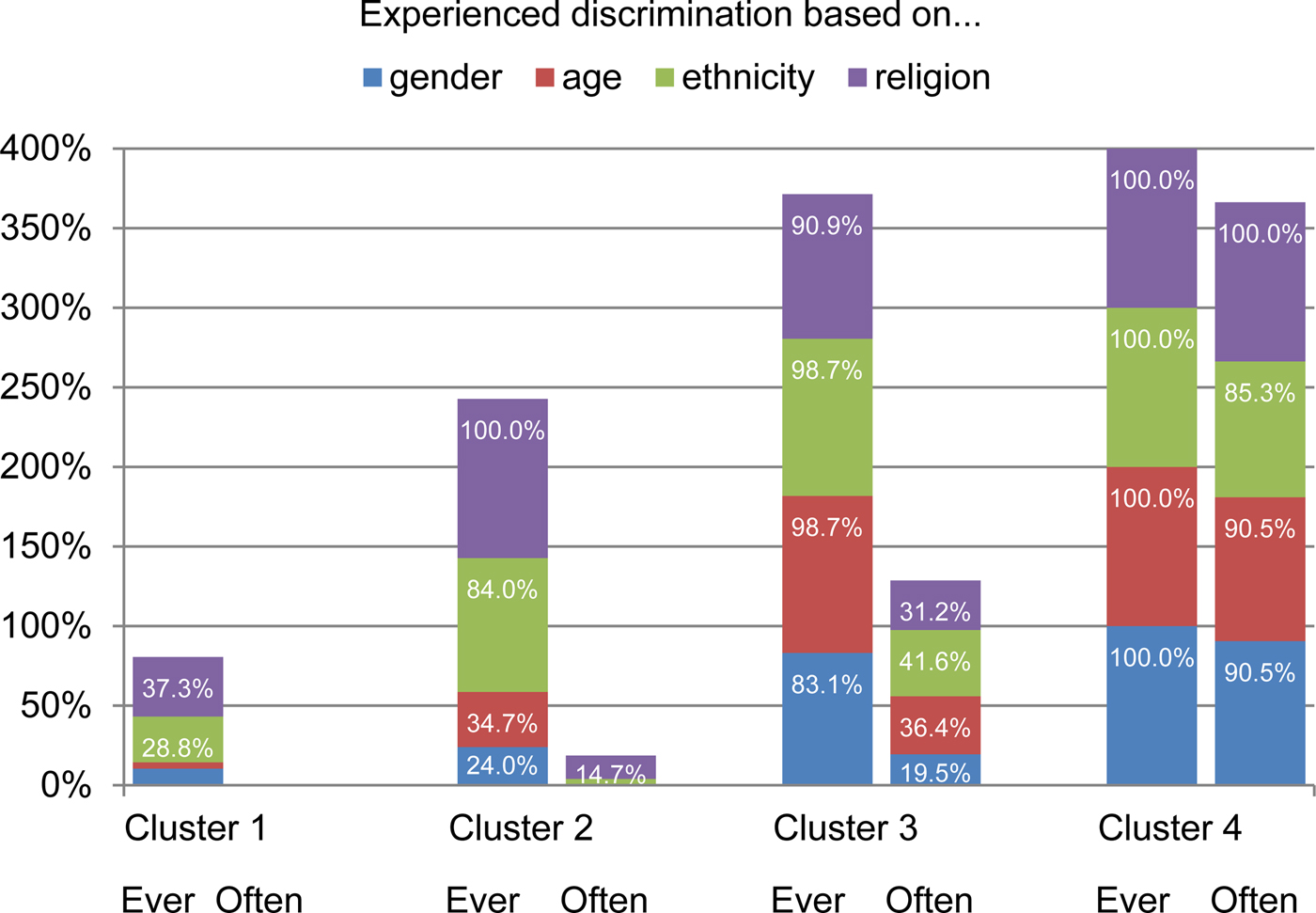
A hierarchical cluster analysis suggests a four-cluster solution (Figure 1).Footnote 5 One cluster often experiences neighbourhood discrimination regarding all four membership categories; one cluster experiences neighbourhood discrimination particularly regarding ethnicity and religion, as well as age (however, less frequently); one cluster experiences neighbourhood discrimination with regards to ethnicity and religion; and one hardly experiences any discrimination at all (and if so, then most likely in regards to ethnicity and religion). Looking at the intersection of discrimination experiences, two points are particularly striking: first, participants in all clusters experience at least some degree of discrimination in their neighbourhood based on religion, ethnicity, age and gender combined, and two of four clusters do so nearly entirely. Second, among three of the four clusters, discrimination in the neighbourhood based on religion and ethnicity is experienced by nearly all participants. Hence, the concept of intersectionality proves to be very valuable, particularly with regards to religion and ethnicity, both of which seem to be deeply entangled in addressing people as members of intersecting social groups.
Experienced discrimination based on gender, age, ethnicity and religion, by cluster.

Intersectional patterns of discrimination and socio-spatial living conditions
In this section, we will turn to the question regarding how patterns of discrimination (as ways of making social memberships relevant in a negative manner) differ according to the socio-spatial conditions in which people live.
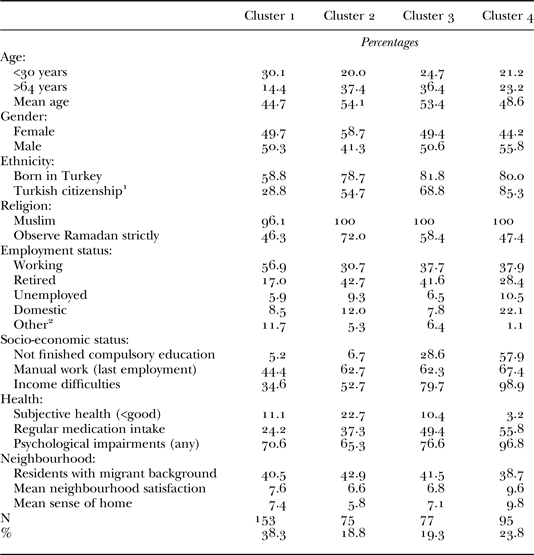
Cluster 1 resembles the young and more privileged second generation of Turkish migrants in Vienna (Table 1). They are younger (30.1% are 29 years of age or younger) than the average study participant, nearly half of them (41.2%) were born in Austria and most (71.2%) have acquired Austrian citizenship. Despite self-identifying as Muslim, more than one-third (37.4%) state that they do not observe Ramadan, while those who do observe Ramadan do not observe it strictly. They are socio-economically better off: the majority work (56.9%), and nearly double as often in white-collar jobs (30.7%) compared to those in the other clusters; 44.4 per cent have finished an apprenticeship and many (24.2% compared to an overall average of 14%) have completed college or university. With good jobs and few financial obligations, two-thirds (65.4%) state that they get by easily with their available income. Compared to the other clusters, neighbourhood discrimination is less widespread among this cluster. However, despite them resembling a socio-economically secure and seemingly well-integrated (compared with political standards) group, more than one-third (37.3%) experience discrimination in their neighbourhood based on their religion, and more than one-quarter (28.8%) based on their ethnicity.
Four-cluster solution by socio-spatial variables

Notes: 1. Dual citizenship is illegal in Austria; hence, keeping the Turkish citizenship means not having the Austrian and vice versa. 2. In education, military service or community service, other.
Cluster 2, in contrast, resembles older, more religious men and especially women (58.7%). More than two-thirds (37.4%) are 65 years of age or older and, hence, the cluster comprises the most retired persons (42.7%) and the fewest employees (30.7%) of all clusters (29.3 and 43.8% on average, respectively). Slightly more (8%) than the average (5.5%) are widowed, but their average household size still amounts to 3.7 persons. What mostly differentiates this cluster from the others, however, is their religious self-identification: nearly all of them (90.7%) state that they observe Ramadan, and most do so very strictly (72%). All of them state that they experience discrimination in their neighbourhood based on their religious beliefs, and most (84%) also do so based on their ethnic origin. However, their discrimination experiences are more often singular events and not frequent day-to-day experiences. Despite resembling the oldest and most female-dominated cluster, ‘only’ 34.7 per cent state that they have been discriminated against based on their age and 24 per cent based on their gender.
Cluster 3 resembles Cluster 2 in many ways, with 36.4 per cent being 65 years of age or older, 41.6 per cent being retired and 9.1 per cent being widowed, but they are socio-economically more disadvantaged. In relation to the whole sample, a large share (31.2%) have never worked, and of those who do or did, nearly one-third (30.2%) were construction workers. Nearly half (45.5%) have at most finished compulsory education and, hence, 56.7 per cent state that they have (serious) difficulties getting by with their available income. Other than the participants in Cluster 2, Cluster 3 often experiences discrimination based on a triad of ethnicity (98.7%), religion (90.9%) and age (98.7%), but 83.1 per cent also experience discrimination based on gender (despite an equal gender balance within the cluster). Their discrimination experiences are also more frequent than among those in Clusters 1 or 2.
Cluster 4, finally, comprises socio-economically disadvantaged, middle-aged and hardly religious men (55.8%). Persons belonging to this cluster are more often married (81.1%) than the average participants (71.5%), but also live in the smallest households (2.9 persons on average). In relation to the other clusters, the percentage of unemployed is high (10.5% compared to 7.8%), 28.4 per cent have never worked and those who do or did most often worked in construction (50%). The majority of them (57.9% compared to 22.5% on average) have not obtained any formal educational qualification, and 88.3 per cent are facing (serious) difficulties getting by with their income. Among this cluster, the smallest percentage has obtained Austrian citizenship (14.7% compared to 45.3% on average), and it might also be due to this legal barrier that they feel discriminated against based on all prompted membership categories at the same time. To summarise, we can see rather different patterns of discrimination experiences among a sample that has been deductively defined as homogeneous – consisting of exclusively Turkish migrants. Despite sharing the situation of having been born in a different country than that of residence, or having parents who were born in another country, people may or may not be addressed as old and/or Muslim and/or Turkish in a negative way, and such experiences might be exceptional or may happen on a day-to-day basis. Focusing on older (65 years of age or older) migrants in particular, who primarily belong to Clusters 2 and 3, they also seem to experience quite different patterns of discrimination – particularly in regards to age-based discrimination. Whereas Cluster 2 experiences discrimination mostly based on religion and ethnicity, and not age, Cluster 3 experiences discrimination based on religion, ethnicity and age. However, what differentiates those groups is not age, but rather gender and educational attainment. Hence, experiences of discrimination in the neighbourhood (being addressed as, for example, a Turk in the neighbourhood) do not equate to the deductive categorisations as proposed by researchers (being defined as, for example, a Turk by the researchers or being a certain age). They are, much rather, shaped by socio-spatial living conditions. From this point, we will now turn to the question regarding how such intersectional patterns of ‘being addressed as’ correspond to ‘identifying as’, in respect to personal feelings of place attachment.
Intersectional patterns of discrimination and place attachment
Beyond describing different patterns of intersectional discrimination experiences, this paper aims to help to explain how these patterns correlate with place attachment and spatial identity-management. Do different patterns of discrimination experiences lead to differences in satisfaction with one's neighbourhood? And do they correspond to the individual's sense of home in a country? In particular, do people feel less at home in their neighbourhood and country if they are frequently addressed as (older) migrants?
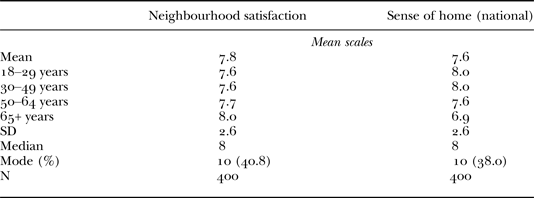
To answer these questions, two models of linear regression are presented and discussed. In both models, cluster membership constitutes the independent variable, whereas (a) neighbourhood satisfaction and (b) sense of home are the dependent variables.Footnote 6 Both metric dependent variables range from 1 to 10 and both share a similar distribution. While there are no significant age differences with regards to neighbourhood satisfaction, Turkish immigrants aged 65 years or older feel significantly (p < 0.01) less at home in Austria than the younger (often second-generation) respondents (Table 2).
Distribution of neighbourhood satisfaction and sense of home scales

Note: SD: standard deviation.
Neighbourhood satisfaction and sense of home in Austria correlate significantly with each other (R = 0.52; p < 0.001), as well as with frequency of experienced discriminations (R = 0.27 and R = 0.33, respectively; p < 0.001). As suggested by some studies, there is also a slight negative correlation between the frequency of experienced discrimination and the percentage of individuals with a migrant background living in the neighbourhood (R = −0.1; p < 0.05); however, this says nothing about the percentage of the ethnic community.
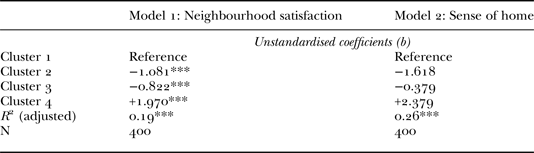
In an analysis of variance, we find significant (p < 0.001) differences between the clusters with regards to neighbourhood satisfaction and sense of home in Austria: Clusters 2 and 3 are least satisfied with their neighbourhoods, followed by Cluster 1, while Cluster 4 is most satisfied. Similarly, Clusters 2 and 3 feel least at home in Austria, whereas Cluster 4 feels most at home (Table 3).
Neighbourhood satisfaction and sense of home by cluster membership (linear regression)

Significance level: *** p < 0.001.
In the linear regression models, cluster membership explains about one-fifth and one-quarter of variance for neighbourhood satisfaction and sense of home, respectively. Patterns of intersectional discrimination in the neighbourhood can thus be assumed to have a significant impact on neighbourhood satisfaction, as well as on sense of home in a country in general. As hypothesised, individuals belonging to Clusters 2 and 3 who experience discrimination mainly based on religion and ethnicity feel less satisfied with their neighbourhood and less at home in Austria than individuals in Cluster 1 who hardly ever have such experiences. However, those very much disadvantaged respondents in Cluster 4 who frequently experience a multitude of discrimination feel much more at home than their younger, more highly educated and economically better-off fellow citizens in Cluster 1. This is the case for both neighbourhood satisfaction and sense of home in Austria.
This result suggests that we cannot assume a linear, one-dimensional relationship – more discrimination does not necessarily lead to less satisfaction and place attachment. It is much more the consideration of intersectional patterns that leads to a higher explanatory power. By comparing both models with models that use a simple sum score of discrimination experiences as an independent variable instead of cluster membership, the variance explained decreases from 19 to 5 per cent for neighbourhood satisfaction and from 26 to 9 per cent for sense of home in Austria. Hence, the results highlight the value of treating discrimination as a variety of intersectional patterns instead of treating it as a metric variable on a zero to n scale.
Discussion
In this paper, we have argued that age and ethnicity should be viewed from a social-constructionist, processual and intersectionalist perspective, understanding both categories as practical processes of being addressed as, and identifying with, a social group. Ageing populations, particularly those in urban areas, are becoming more and more diverse, and gerontology needs to account sufficiently for this diversity. This is not to say that gerontology, in general, and environmental gerontology, in particular, have not yet made attempts to consider diversification in older age but, as has been argued elsewhere, many approaches still follow essentialist or structuralist understandings of age and/or ethnicity (Torres Reference Torres2015).
Proceeding from the understanding that multiple memberships – including age, ethnicity, gender or religion – are constructed in a ‘nexus of practice’ (Schatzki Reference Schatzki1996), we asked the following questions: Which social memberships are made relevant in a negative manner in the residential environment? Against the backdrop of which socio-spatial conditions are (older) migrants addressed as such? Do people feel less at home in their neighbourhood and country if they are frequently addressed as (older) migrants? Drawing upon a quantitative study among individuals of Turkish migrant origin living in Vienna, Austria, we can draw the following conclusions.
First, being ascribed to a certain social group and, based on this ascription, treated unfairly or disrespectfully, is widespread among our respondents. In contrast to Eurobarometer figures, large shares of people state that they have been discriminated against based on their religion, ethnicity, age and/or gender. Compared to younger migrants, older migrantsFootnote 7 feel significantly more often discriminated against based on their age, but they also feel discriminated against based on their religion and ethnicity.
Second, the data suggest that we can hardly talk about discrimination other than in terms of intersectionality. All of the above-mentioned experiences correlated significantly and strongly and heavily overlapped among our survey participants. Particularly discrimination experiences based on a combination of ethnicity and religion were widespread among all participants, whereas the combination of age and gender was less prevalent. This relationship might also be more pronounced today due to disproportionate media coverage on ‘Islamic terrorism’ (Kearns, Betus and Lemieux Reference Kearns, Betus and Lemieux2017). Comparing linear regression models using cluster membership – representing intersectional patterns – and sum scores – representing unidimensional frequencies – shows the higher explanatory power of also considering intersectionalities for quantitative models.
Third, the experiences of discrimination (being addressed as X in the neighbourhood) do not necessarily resemble self-identifications (identifying as X) or deductive measures (being addressed as X by the researchers). Despite the fact that all interviewed individuals were selected based on their migrant status, as assigned to them by the interviewers, not all of them had ever felt discriminated against based on their ethnicity, and more than two-thirds who do not observe Ramadan have experienced discrimination based on their religion. The majority of older migrants either felt discriminated against based on their religion and ethnicity (Cluster 2), or their religion, ethnicity and age. What differentiates groups experiencing different patterns of discrimination is, thus, not age (or ethnicity, or religion), but rather gender and educational attainment. Being a woman, however, does not significantly correlate with feeling discriminated against based on one's gender.
Instead, whether or not migrant background is made relevant in the neighbourhood is shaped by their socio-spatial living conditions. In particular, age and socio-economic background influence whether a person experiences discrimination for ‘being’ (or being categorised as) a migrant.
Fourth, we asked whether people feel less at home in their neighbourhood and country if they are frequently addressed as migrants. Results from this study show, however, that more discrimination does not necessarily lead to less residential satisfaction and place attachment. The relationship here seems to be much more complex.
Considering age and ethnicity as constructed and intersectional is not only fruitful for research, but also for practical implications (cf. Mayrhuber et al. Reference Mayrhuber, Dückers, Wallner, Arnberger, Allex, Wiesböck, Wanka, Kolland, Eder, Hutter and Kutalekin press). Against the backdrop of urbanisation and demographic change, standardised concepts like those of inclusive or age-friendly cities are challenged by diversity. Such concepts could profit from an intersectional ‘doing’ perspective that focuses on the questions of ‘when’ and ‘where’ people are addressed as members of a certain social group (also by researchers or city planners) and ‘when’ and ‘where’ they self-identify as belonging to this group. Such a consideration could broaden the horizon of urban planners and policy makers to include different social positions, needs and preferences in comparison to those which already exist in ‘narrative vignettes’ about, for example, older adults (Buse et al. Reference Buse, Nettleton, Martin and Twigg2017).
However, as we follow a ‘doing’ approach that focuses on ascriptions and identifications, we must make sure that we do not become blind to socio-spatial inequalities that predominantly arise out of being addressed as, and not so much out of identifying as, a member of a certain social group. Across Europe, spatial segregation is still heavily based upon variables such as ethnicity, with older migrants living among the most socio-spatially disadvantaged groups (Scharf, Phillipson and Smith Reference Scharf, Phillipson and Smith2005; van der Greft, Musterd and Thissen Reference van der Greft, Musterd and Thissen2016). Despite the results of this study, that the most disadvantaged might state that they also feel most satisfied with their neighbourhoods, such deprived conditions still objectively affect health, life expectancy and mortality rates. The ‘satisfaction paradox’ is one that we not only find among older persons, but also among older migrants in particular, as the ‘immigration paradox’ suggests. Considering subjective measures of satisfaction and attachment, hence, does not relieve us from the political need to improve the living conditions and decrease discrimination experiences of these social groups.
Acknowledgements
This study received financial support from the Climate and Energy Fund and was carried out within the framework of the Austrian Climate Research Program. All authors declare that there are no competing financial interests. Ethical approval was not required.