INTRODUCTION
Approximately 700,000 U.S. military personnel deployed to Southwest Asia during Operation Desert Shield/Desert Storm. Unique aspects of the Gulf War (GW) included deployment of a relatively large proportion of Reservists and National Guard units, exposures to potentially harmful natural and man-made environmental toxins (Presidential Advisory Committee on Gulf War Veterans’ Illnesses, Final Report, 1996) and relatively few casualties. Large-scale epidemiological studies indicated that deployed veterans (DV) were more likely to report concentration and memory impairments than non-deployed veterans (NDV) (Fukuda et al., Reference Fukuda, Nisenbaum, Stewart, Thompson, Robin and Washko1998; Iowa Persian Gulf Study Group, 1997; Ishoy et al., Reference Ishoy, Suadicani, Guldager, Appleyard, Hein and Gyntelberg1999; Kang et al., Reference Kang, Mahan, Lee, Magee and Murphy2000; Unwin et al., Reference Unwin, Blatchley, Coker, Ferry, Hotopf and Hull1999). Findings of smaller studies using objective neuropsychological tests have been less conclusive. Several studies reported a negligible relationship between subjective complaints of poor cognition and objectively measured cognitive performance (Binder et al., Reference Binder, Storzbach, Anger, Campbell and Rohlman1999; Lindem et al., Reference Lindem, Proctor, Heeren, Krengel, Vasterling and Sutker2003; Storzbach et al., Reference Storzbach, Campbell, Binder, McCauley, Anger, Rohlman and Kovera2000). Research suggesting that GW deployment is associated with neuropsychological deficits must be interpreted with caution, because most studies are based exclusively on self-reports of poor cognition (Fukuda et al., Reference Fukuda, Nisenbaum, Stewart, Thompson, Robin and Washko1998; Iowa Persian Gulf Study Group, 1997; Ishoy et al., Reference Ishoy, Suadicani, Guldager, Appleyard, Hein and Gyntelberg1999; Kang et al., Reference Kang, Mahan, Lee, Magee and Murphy2000; Unwin et al., Reference Unwin, Blatchley, Coker, Ferry, Hotopf and Hull1999), or are not population based (Axelrod & Milner, Reference Axelrod and Milner1997; Goldstein et al., Reference Goldstein, Beers, Morrow, Shemanski and Steinhauer1996; Hom et al., Reference Haley, Kurt and Hom1997; Lindem et al., Reference Lindem, Proctor, Heeren, Krengel, Vasterling and Sutker2003; McDiarmid et al., Reference McDiarmid, Keogh, Hooper, McPhaul, Squibbs and Kane2000; Sillanpaa et al., Reference Sillanpaa, Agar, Milner, Podany, Axelrod and Brown1997; White et al., Reference White, Proctor, Heeren, Wolfe, Krengel and Vasterling2001), or have small sample sizes (Anger et al., Reference Anger, Storzbach, Binder, Campbell, Rohlman and McCauley1999; Binder et al., Reference Binder, Storzbach, Anger, Campbell and Rohlman1999; Storzbach et al., Reference Storzbach, Campbell, Binder, McCauley, Anger, Rohlman and Kovera2000).
Evidence suggests that subgroups of DV who may be at heightened risk for neuropsychological compromise show impairment on objective neuropsychological tests. For example, ill DV performed more poorly on tasks of memory, attention, and response speed (Anger et al., Reference Anger, Storzbach, Binder, Campbell, Rohlman and McCauley1999). Haley et al., (Reference Haley, Kurt and Hom1997a) identified six syndromes based on self-reported symptoms via factor analysis. Cases characterized by the syndrome of “impaired cognition” were impaired on brain stem auditory evoked potentials (Haley et al., Reference Haley, Hom, Roland, Bryan, Van Ness and Bonte1997b), and risk of this syndrome was increased in veterans wearing flea collars (Haley & Kurt, Reference Haley and Kurt1997c). Hom et al. (Reference Hom, Haley and Kurt1997) found that veterans with the highest factor scores from six identified syndromes, when compared to healthy veterans, demonstrated deficits in intelligence, abstract thinking, mental flexibility, grip strength, and tactile and visual perception. Storzbach et al. (Reference Storzbach, Campbell, Binder, McCauley, Anger, Rohlman and Kovera2000) found that veterans with persistent unexplained symptoms exhibited deficits on some tests of memory, attention, and response speed when compared to healthy veterans. McDiarmid et al. (Reference McDiarmid, Keogh, Hooper, McPhaul, Squibbs and Kane2000) found that seven years after exposure to depleted uranium, veterans’ urine uranium levels were positively associated with an impairment index derived from tests measuring processing efficiency, but not with an impairment index derived from a traditional neuropsychological test battery. White et al. (Reference White, Proctor, Heeren, Wolfe, Krengel and Vasterling2001) found that DV reporting greater exposure to pesticides performed more poorly on attention and memory tasks compared to unexposed veterans. In contrast, several studies found that neuropsychological deficits among DV were more closely related to emotional functioning than to other war-related variables (Axelrod & Milner, Reference Axelrod and Milner1997; Binder et al., Reference Binder, Storzbach, Anger, Campbell and Rohlman1999; David et al., Reference David, Farrin, Hull, Unwin, Wessely and Wykes2002; Goldstein et al., Reference Goldstein, Beers, Morrow, Shemanski and Steinhauer1996; Sillanpaa et al., Reference Sillanpaa, Agar, Milner, Podany, Axelrod and Brown1997).
The “National Health Survey of Gulf War Era Veterans and Their Families” was designed to collect longitudinal epidemiological data to assess the prevalence of medical and psychological conditions in GW veterans. Beginning in 1995, mail and telephone surveys were conducted on 15,000 DV and 15,000 NDV. DV reported more psychological symptoms, more functional impairment, and poorer health related quality of life compared to NDV (Kang et al., Reference Kang, Mahan, Lee, Magee and Murphy2000). The current study evaluated a subset of these veterans using in-person psychological and neuropsychological exams conducted between 1998 and 2001. In this sample, we previously reported that GW-era onset mental disorders were more prevalent in DV, compared to NDV, with depression and anxiety disorders remaining higher at the time of the exam, approximately 10 years after the war (Toomey et al., Reference Toomey, Kang, Karlinsky, Baker, Vasterling, Alpern, Reda, Henderson, Murphy and Eisen2007). At the time of the exam, DV were more likely to have 4 out of 12 medical conditions (fibromyalgia, chronic fatigue syndrome, dermatologic conditions, and dyspepsia) (Eisen et al., Reference Eisen, Kang, Murphy, Blanchard, Reda and Henderson2005), but had no increased prevalence of distal symmetric polyneuropathy, as determined by electrophysiology and neurologic examinations (Davis et al., Reference Davis, Eisen, Murphy, Alpern, Parks and Blanchard2004).
METHODS
Study Population and Recruitment
Recruitment for the survey phase of the study, performed in 1995, is described elsewhere in detail (Eisen et al., Reference Eisen, Kang, Murphy, Blanchard, Reda and Henderson2005). Briefly, the Department of Defense’s Defense Manpower Data Center (Monterey, CA) identified the entire cohort of 693,826 DV and approximately half (800,680) of NDV who were in military service between September, 1990 and May, 1991. A total of 15,000 DV and 15,000 NDV were solicited to participate in the study. To ensure that females, Reserve, and National Guard were adequately represented, a stratified random sampling methodology was applied so that one-fifth of each sample were women (3000), one-third Reservists (5000), and approximately one-quarter members of the National Guard (4000).
For our study’s examination phase, a list of potential participants was created by randomly selecting from the 11,441 DV and 9,476 NDV that participated in the 1995 study, stratified by deployment status and region of last-known residence at the time of the original survey, based on home telephone area code. Potential participants were assigned to the participating VA medical center closest to their home. Participating medical centers were located in Albuquerque, Baltimore, Birmingham, Boston, Cincinnati, Hines (Chicago), Houston, Miami, Minneapolis, New Orleans, New York, Portland (Oregon), Richmond, Salt Lake City, San Diego, and St. Louis. Recruitment packages were mailed to the veterans and included an introductory letter, a detailed explanation of the purpose and nature of the study, a letter of intent form, and a preaddressed stamped return envelope. Because of lower participation rates among NDV, we solicited an additional 799 NDV to obtain groups of equal size and achieve the desired sample size of 1,000 per group.
Signed letters of intent were returned to the Hines VA Cooperative Studies Program Coordinating Center, which forwarded them to the participating VA Medical Center to which the veteran was assigned. Site personnel contacted these veterans and scheduled examinations. Travel, hotel, per diem costs, and a $200 honorarium were provided by the research project. The protocol and consent form were approved by the Hines Cooperative Studies Program Human Rights Committee and the individual site and Brockton VAMC Institutional Review Boards. The research was completed in accordance with the Helsinki Declaration. Participants gave signed informed consent before the start of the examination.
Measures
Neuropsychological functioning
The neuropsychological test battery was based on prior GW studies (White et al., Reference White, Proctor, Heeren, Wolfe, Krengel and Vasterling2001). A similar battery, used in a study examining two cohorts of GW veterans (Fort Devens, MA and New Orleans, LA) and a Germany deployed cohort, was designed to assess abilities across general intelligence, attention/executive function, motor ability, visual-spatial processing, and verbal and visual memory. The only domain without suggestion of differences between DV and NDV cohorts was visual-spatial functioning (White et al., Reference White, Proctor, Heeren, Wolfe, Krengel and Vasterling2001); therefore, it was not included in the present test battery. In addition, White et al. used a measure of general intellectual abilities that did not generate group differences. We estimated IQ in our battery with a reading test commonly used as an estimate of premorbid intellectual abilities (Griffin et al., Reference Griffin, Rivera Mindt, Rankin, Ritchie and Scott2002; Johnstone et al., Reference Johnstone, Callahan, Kapila and Bouman1996).
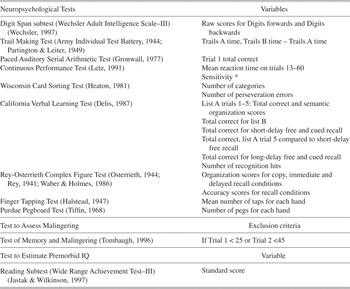
Factor analysis with orthogonal (varimax) rotation was employed to reduce data and derive variables reflecting neuropsychological domains of functioning. This analysis was performed by investigators blind to veteran deployment status. Selection of the 27 variables entered in the factor analysis was based on three criteria: (1) clinical significance, (2) elimination of test variables with non-normal frequency distributions (e.g., an error score on which most subjects received a 0 or 1), and (3) maximization of internal consistency of factors. Table 1 lists the variables selected by balancing these criteria, as well as tests used to assess insufficient effort and premorbid intellectual functioning.
Neuropsychological tests and variables

Note
* Because hit rates (HR) and false alarm rates (FA) are biased by the perceived payoffs for correct identification and perceived penalties for incorrect identification, a nonbiased sensitivity score was determined arithmetically from HR and FA using the following equation (Davies & Parasuraman, Reference Davies and Parasuraman1982): A’ = ½ + 
The sign of some test variables was reversed so that higher scores indicated better performance on all variables. Examiners infrequently rated variables invalid when factors unrelated to the test clearly interfered with the subject’s performance on the test, such that the scores were not considered an accurate reflection of the subject’s ability in that domain (e.g., poor motor performance due to a hand injury). Regression imputation was utilized to replace missing values on valid tests. Factors were maintained with eigenvalue magnitudes greater than one.
We compared factor scores to the combined group mean using impairment thresholds commonly used in clinical neuropsychological assessment. One threshold was 1 standard deviation (SD) below the mean, reflecting possible impairment. The second threshold was 2 SD below the mean, reflecting clear evidence of definite impairment (Lezak et al., Reference Lezak, Howieson and Loring2004). We examined both thresholds to balance the risk of false positives with the cutoff of 1 SD and false negatives with the cutoff of 2 SD. We also compared groups on factor score means and individual test score means.
Mental health assessment
The PTSD Checklist (PCL; Blanchard et al., Reference Blanchard, Jones-Alexander, Buckley and Forneris1996) was used to assess symptoms of post-traumatic stress disorder (PTSD) in the past month using 17 items, each rated on a scale of 1–5. The Beck Depression Inventory-II (BDI-II; Beck et al., Reference Beck, Steer and Brown1996) was used to assess depressive symptoms in the past two weeks using 21 items, each rated on a scale of 0–3. The Beck Anxiety Inventory (BAI; Beck & Steer, Reference Beck and Steer1993) was used to assess anxiety symptoms in the past week using 21 items, each rated on a scale of 0–3. Higher scores on each indicate greater symptoms and/or symptom severity.
Post-hoc analyses
We followed up the main group analyses with analysis of subgroups defined as follows:
Chronic Multisymptom Illness complex (CMI). CMI was defined, according to the Centers for Disease Control definition, as the presence, for six months or longer, of one or more symptoms from at least two of the following symptom clusters: general fatigue (Cluster-A), mood and cognitive abnormalities (Cluster-B), and musculoskeletal pain (Cluster-C) (Fukuda et al., Reference Fukuda, Nisenbaum, Stewart, Thompson, Robin and Washko1998). Further details about the identification of CMI in our sample are reported by Blanchard et al. (Reference Blanchard, Eisen, Alpern, Karlinsky, Toomey and Reda2006). CMI prevalence was 28.9% among DV and 15.8% among NDV. Diagnoses of pre-war non-PTSD anxiety disorders and depression were related to the presence of CMI in both groups.
Khamisiyah exposure. In March 1991, U.S. demolition experts destroyed a munitions storage site at Khamisiyah, Iraq that was subsequently demonstrated to contain nerve agents, sarin and cyclosarin. The risk of individual veteran exposure was estimated by the Department of Defense by overlaying troop location data with meteorological and dispersion modeling (Winkenwerder, Reference Winkenwerder2002).
Self-report of toxic exposure. In the 1991 survey, participants were asked “While in the Persian Gulf, do you believe you were exposed to or did you experience any of the following?” followed by several types of exposures: [Chemical Agent Resistant Compound (CARC) paint or other paint and/or solvent and/or petrochemical substances (2 questions); personal pesticides, including creams, sprays, or flea collars; nerve gas; immune globulin (IG); vaccines (5 questions); SCUD missile explosions; ate food contaminated with smoke, oil, or other chemicals, or bathed in or drank water contaminated with smoke, oil, or other chemicals (2 questions); pyridostigmine bromide pills (PB); ciprofloxacin; microwaves; burning trash/feces; smoke from oil well fires; depleted uranium; diesel, kerosene, or skin exposure to diesel (2 questions)].
Training and quality control
Dr. Toomey trained staff in neuropsychological testing and managed quality through weekly calls and periodic reviews.
Statistical analyses
Sample size requirements were estimated a priori. The target sample size of 1000 in each group provided 80% power to detect differences of 4.4% for neuropsychological impairment (assumed GW DV prevalence = 11.4%, NDV = 7.0%). Population prevalence estimates for both the unadjusted and adjusted analyses were obtained using SUDAAN (software developed for the analysis of complex survey data), release 8.0 (Research Triangle Institute, Research Triangle Park, NC). The sampling design was a stratified random sample with unequal probabilities of selection within combinations of the strata: deployment status, gender, and duty type. For continuous outcomes, t tests and linear regression models compared mean responses between groups. Logistic regression models were developed for dichotomous and ordinal polytomous outcomes. The demographic and military covariates considered in the multiple regression models were age, gender, race (white vs. other), years of education (less than 12 years vs. 12 or more), duty type (active vs. Reserve/National Guard), service branch (Army/Marine vs. Navy/Air Force), and rank (enlisted vs. officer). Candidate covariates were deleted for particular models when they caused computational problems preventing model calculation. The primary reason for this was low prevalence rates for certain outcome measures. Odds ratios, 95% confidence intervals, and p values are reported for dichotomous outcomes. Comparisons of categorical data and continuous data with adjustment for covariates are based on the Wald F statistic. For continuous data without adjustments, p values are based on the 2-sample t test. All statistical tests were two-sided and p ≤ .05 was the criterion for statistical significance. This criterion was chosen for ease of comparison with other studies. Analysis of group differences on individual test variables is reported with and without Bonferroni correction, again for ease of comparison to other studies.
RESULTS
Participants
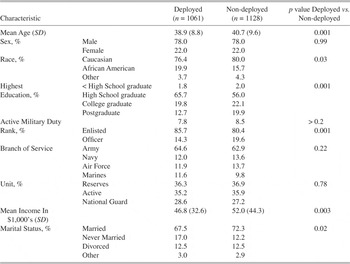
Table 2 lists the sociodemographic and military characteristics of 2189 Veterans who participated in the study. At the time of their research examination, DV significantly differed from NDV participants in that they were slightly younger, less likely to be Caucasian, less likely to have education past the high school level, less likely to be officers, less likely to be married, and reported a lower annual family income than NDV. There was no difference in the percentage of male participants and the percentage on active military duty. Although there were some group differences, these differences existed between the actual DV and NDV cohorts, and thus, are not unique to this sample (Kang & Bullman, Reference Kang and Bullman2001).
Sociodemographic and military service characteristics of deployed and non-deployed participants at the research examination

Participation Rates
Of the 1996 DV who were solicited to participate, 53% (1061) were examined; of 2883 NDV who were solicited to participate, 39% (1128) were examined. Despite intensive efforts, 12.8% of DV and 15.2% of NDV were not located. Of those who were located, 34.1% of DV and 45.6% of NDV either never returned their participation letter, or an examination could not be scheduled.
Participation Bias
Historical military service data, obtained in 1991 on all solicited veterans from the U.S. Department of Defense’s Manpower Data Center, were used to evaluate participation bias on sociodemographic variables. We compared participants and nonparticipants in each group (DV and NDV) and used the Breslow-Day homogeneity of odds ratios test to determine whether the odds ratios for DV and NDV were equal.
Participation bias for demographic characteristics is reported in detail elsewhere (Eisen et al., Reference Eisen, Kang, Murphy, Blanchard, Reda and Henderson2005). Briefly, we found that participants were nearly two years older than nonparticipants, and Caucasians, women, Reservists, and National Guard members were significantly more likely to participate. Additionally, officers and Army personnel were more likely to participate than non-officer and non-Army personnel, although these differences were not uniformly significant. We calculated participation bias for self-reports of neuropsychological functioning from the assessment of depressive symptoms [“Have you experienced (in the past year): difficulty concentrating or reasoning, memory loss”] in our 1995 survey. Participants and nonparticipants did not differ significantly within DV and NDV in their reports of these symptoms. The only characteristic that yielded a statistically significant difference in the odds ratios comparing participants to nonparticipants within NDV and DV was 1995 active duty status (Eisen et al., Reference Eisen, Kang, Murphy, Blanchard, Reda and Henderson2005). Participants were less likely to be on active duty. Overall, considering all variables examined, the degree of participation bias was independent of deployment status.
Neuropsychological Functioning
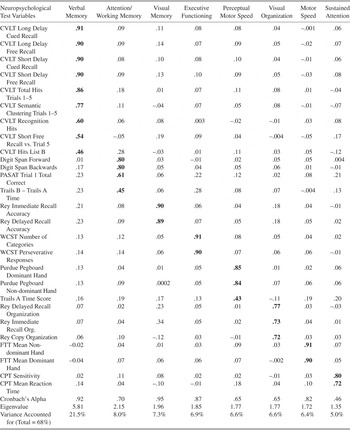
The groups differed significantly on the WRAT-III reading subtest. NDV displayed greater oral reading proficiency than DV (DV mean = 98.02, SE= 0.55; NDV mean = 100.39, SE = 0.43; weighted and adjusted p = .004). Because this test can be used to estimate level of premorbid intellectual functioning and it differed between DV and NDV, WRAT-III Reading was included as a covariate in neuropsychological analyses. Sixteen veterans (10 DV, 6 NDV) were excluded because they met criteria for insufficient effort (n = 8) on the Test of Memory and Malingering (TOMM) or had one or both trials missing (n = 8). Thirteen subjects were excluded for one or more invalid test scores (5 DV and 13 NDV). The tests that were invalid on these 13 subjects were as follows: grooved pegboard (3 subjects), CVLT (3), PASAT (3), Trails (1), Rey (1), and multiple test exclusions for 2 subjects. Some examples of the reasons for the invalid ratings include hand injuries or severe carpal tunnel syndrome interfering with pegboard performance, inability to understand directions, complete the practice items sufficiently, or clearly giving up effort part way through on the PASAT, and in some cases, examiner error (e.g., not stopping and redirecting a veteran making errors on the Trails test). One subject was excluded for an invalid reading score (DV). Table 3 presents the factor analysis results. Eight factors were generated, accounting for 68% of the variance: verbal memory, attention/working memory, visual memory, executive functioning, perceptual motor speed, visual organization, motor speed, and sustained attention.
Rotated factor loadings for neuropsychological test variables

Note
CVLT = California Verbal Learning Test, PASAT = Paced Auditory Serial Arithmetic Test, CPT = Continuous Performance Test, WCST = Wisconsin Card Sorting Test, FTT = Finger Tapping Test, Cronbach’s alpha was calculated for variables with loading ≥ .40 on each factor (factor loading scores in bold).
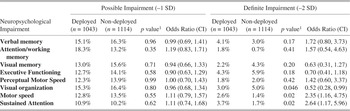
Table 4 shows the group comparisons on factor impairment. At the cutoff of 1 SD below the mean (possible impairment), the percentage of DV reaching this threshold on any one factor did not differ significantly from the percentage of NDV. At the cutoff of 2 SD below the mean (definite impairment) (Lezak et al., Reference Lezak, Howieson and Loring2004), DV performed significantly worse than NDV on factor 7 (motor speed) (DV = 2.6%, NDV = 1.4%, p = 0.02) and factor 8 (sustained attention) (DV = 3.7%, NDV = 1.7%, p = 0.02). In contrast, NDV performed worse compared to DV on factor 6 (visual organization) (DV = 3.0%, NDV = 5.0%, p = 0.046).
Prevalence of cognitive impairment at two levels compared to combined group mean

Note
1 Adjusted p -values are listed for all factors. CI = confidence interval. Analyses were adjusted for the Wide Range Achievement Test-3 (Reading subtest, Standard Score), age, gender, race (white vs. other), years of education (less than 12 vs. 12 or more), duty type (active vs. reserve/guard), service branch (army/marine vs. navy/air force), and rank (enlisted vs. officer).
Given that there were 7.2% more NDVs with postgraduate education compared to DVs, the above analyses were repeated to see if the results changed when excluding these subjects. This sample size included 1801 veterans (354 postgraduate veterans and 2 veterans with missing education were deleted). None of the previously nonsignificant p values changed to significant. DV still performed significantly worse than NDV on factor 7 (motor speed) (DV = 2.7%, NDV = 1.6%, p = 0.03) and factor 8 (sustained attention) (DV = 3.7%, NDV = 1.7%, p = 0.04). The significant p value for factor 6 (visual organization) shifted to a trend (DV = 2.9%, NDV = 4.4%, p = 0.055).
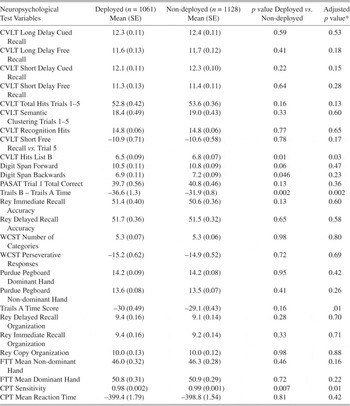
Group comparison of mean factor scores revealed no significant differences. Group comparisons of the mean scores of the 27 individual variables included in the factor analysis yielded four variables with significant differences between groups (Table 5): Trails A time (DV mean = 30.0, SE = 0.49; NDV mean = 29.1, SE = 0.43; p = .01); Trails B-A time (DV mean = 36.6, SE = 1.26; NDV mean = 31.9, SE = 0.84; p = .002); CVLT List B number correct (DV mean = 6.5, SE = 0.09; NDV mean = 6.8, SE = 0.07; p = .03); and CPT sensitivity (DV mean = 0.98, SE = .002; NDV mean = 0.99, SE = .001; p = .01). For all four variables, DV performed less proficiently than NDV. After using a Bonferroni corrected p value to adjust for multiple tests (p < .002), only Trails B-A remained significant.
Group means and standard errors (SE) on individual neuropsychological test variables

Note
CVLT = California Verbal Learning Test, PASAT = Paced Auditory Serial Arithmetic Test, CPT = Continuous Performance Test, WCST = Wisconsin Card Sorting Test, FTT = Finger Tapping Test,
* Analyses were adjusted for the Wide Range Achievement Test-3 (Reading subtest, Standard Score), age, gender, race (white vs. other), years of education (less than 12 vs. 12 or more), duty type (active vs. reserve/guard), service branch (army/marine vs. navy/air force), and rank (enlisted vs. officer).
To address whether significant neuropsychological declines remained in DV compared to NDV when emotional factors were controlled, we conducted three regression analyses to model the mean neuropsychological scores for factors 7 and 8 and for Trails B-A, using the explanatory variables of deployment and the continuous scores of the BDI, BAI, and PCL. Initially, a model was run with all explanatory variables entered simultaneously to evaluate the independent contributions of the explanatory variables on the outcomes. The WRAT-3 was also included as a covariate in all models. Because there were high correlations among BDI, BAI, and PCL (p < .0001), none were significant when all three were entered in the three models. Thus, we tried all combinations and tested for interactions. For factor 7, none of the variables were significant in any combination. For factor 8, deployment was not significant in any combination, but when each of the PCL and BDI were paired alone with deployment, these symptom scores were significant. For Trails B-A, deployment and WRAT-3 were significant in all models, but symptoms were not significant in any model.
Post-hoc Analyses
To investigate relationships between specific deployment-related factors and neuropsychological functioning, we conducted a series of logistic regression analyses within the deployed group only. Mean scores on all eight neuropsychological factors were the dependent variables, and the independent variables included PCL, BDI, BAI, CMI status, Khamisiyah exposure status, and self-reported exposure to toxic substances. In addition, age, sex, race, education, and WRAT-3 reading variables were used as covariates.
In the initial analyses, nonsymptom independent variables were examined individually to determine their significance. Significant explanatory variables were as follows: Verbal Memory (Khamisiyah, vaccines), Visual Memory (CARC/other paint, Immune Globulin), Perceptual Motor Speed (Scud missile explosions, vaccines), Motor Speed (Khamisiyah), and Sustained Attention (CMI, Pesticides, Nerve Gas, Contaminated water and food, Scud missile explosions, and PB pills). The following self-reported exposures were not significant for any factors: Ciprofloxacin, microwaves, burning trash/feces, smoke from oil well fires, depleted uranium, diesel, kerosene + skin exposure to diesel. For three factors (Attention/Working memory, Executive Functioning, Visual Organization), none of these explanatory variables were significant.
Follow-up analyses were conducted to determine if these predictors remained significant when including psychological symptoms in the model. For four of the five models, there was no change, while there was a change in the model for Sustained Attention. CMI, pesticides, scud missile explosions, and PB pills were no longer significant explanatory variables in the Sustained Attention model with the inclusion of psychological symptoms. Specifically, depression was a significant explanatory variable in all models for Sustained Attention. Only self-reported exposure to contaminated food or water remained significant with depression in the model.
In cases in which predictors remained significant after controlling for psychological symptoms and there was more than one significant predictor, we created models including the demographic variables and the significant toxicant exposure variables. For Verbal Memory, Khamisiyah exposure remained significant (along with age, gender, and WRAT reading), whereas vaccines were no longer significant (along with race and education). For Visual Memory, both CARC/paint and IG remained significant (along with age and gender), while race, education, and WRAT reading were not significant. For Psychomotor Speed, both Scud missiles and vaccines remained significant (along with age, gender, race, and education), whereas the only nonsignificant variable was WRAT reading. For Sustained Attention, significant variables in the model were contaminated water/food, education, and BDI. Nonsignificant variables were age, gender, race, and WRAT reading. In this model, contaminated water/food was somewhat correlated with nerve gas. When both variables were entered in a model together with depressive symptoms and education, contaminated water/food was no longer significant (p = .29), nerve gas was a trend (p = .09), education remained significant (p = .02), and BDI was the most significant (p = .001).
DISCUSSION
Gulf War deployed veterans have reported poor concentration and memory loss after their service (Fukuda et al., Reference Fukuda, Nisenbaum, Stewart, Thompson, Robin and Washko1998; Iowa Persian Gulf Study Group, 1997; Ishoy et al., Reference Ishoy, Suadicani, Guldager, Appleyard, Hein and Gyntelberg1999; Kang et al., Reference Kang, Mahan, Lee, Magee and Murphy2000; Vasterling et al., Reference Vasterling, Brailey, Tomlin, Rice and Sutker2003; Unwin et al., Reference Unwin, Blatchley, Coker, Ferry, Hotopf and Hull1999), but prior research indicated that self-report does not necessarily relate to performance deficits (Axelrod & Milner, Reference Axelrod and Milner1997; Binder et al., Reference Binder, Storzbach, Anger, Campbell and Rohlman1999; Silanpaa et al., Reference Sillanpaa, Agar, Milner, Podany, Axelrod and Brown1997; Vasterling et al., Reference Vasterling, Brailey, Tomlin, Rice and Sutker2003). We used objective neuropsychological tests to compare DV and NDV and to examine subgroups within DV. Using a possible impairment threshold of –1 SD, the percentage meeting this threshold in both groups was similar to that expected in a normative sample, and in some cases lower than would be expected. Using a definite impairment threshold of –2 SD, the percentage meeting this threshold in both groups tended to be higher than expected in a normative group. Using this latter threshold, DV performed worse on factors of motor speed and sustained attention compared to NDV. These results are based on analysis with no statistical correction for multiple comparisons. Such a correction was made on the comparison between groups on individual test variables, and DV performed worse on an individual test variable measuring flexibility of attention compared to NDV.
DV performed less well than NDV on three other test variables that did not remain significant after Bonferroni correction. These variables measured visual attention, verbal memory, and sustained attention. Of these four variables, three have norms available that vary in the size and nature of the normative sample. The mean of Trails A (DV = 30.0, NDV = 29.1) and Trails B-A (DV = 36.6, NDV = 31.9) are within normal limits (25th–75th percentile) compared to group norms (Strauss et al., Reference Strauss, Sherman and Spreen2006). CVLT variables with available group norms also are within normal limits for both groups compared to male and female norms (Delis et al., Reference Delis, Kramer, Kaplan and Ober1987). Lezak et al. (Reference Lezak, Howieson and Loring2004) emphasize that there are times when another comparison is more appropriate than a comparison with a normative sample, particularly when the normative sample may differ from an individual or clinical sample. In contrast to available normative groups, our control group of NDV is much larger and more closely matches the DV in important demographic and military characteristics. Though mean scores for both groups are within the normal range based on group norms, there are differences between groups in the percentage of individuals meeting a predefined impairment threshold for motor speed and sustained attention. Our definition of impairment is defined in terms of distance from the mean. Because the normal range spans half of people (25th–75th percentile), there is room for significant strengths and weaknesses within the normal range. On an individual level, a drop in functioning may be relevant even if performance remains in the average range.
Our findings of DV performing worse on attention tasks (Trails B-A and the sustained attention factor comprised of CPT variables) compared to NDV are consistent with those of White et al. (Reference White, Proctor, Heeren, Wolfe, Krengel and Vasterling2001), who used a Continuous Performance Test, the Trails error score, and another measure of attention, although their differences did not survive Bonferroni correction. Our finding of DV performing worse on verbal memory compared to NDV is consistent with David et al. (Reference David, Farrin, Hull, Unwin, Wessely and Wykes2002). For David et al., this difference no longer remained when controlling for current depression; in our study, the difference did not survive the Bonferroni correction. Vasterling et al. (Reference Vasterling, Proctor, Amoroso, Kane, Heeren and White2006) also found decrements in verbal learning and visual-spatial memory in DV. Also consistent with other studies, we found differences in motor functioning. We used the Finger Tapping Test while David et al. (Reference David, Farrin, Hull, Unwin, Wessely and Wykes2002) and White et al. (Reference White, Proctor, Heeren, Wolfe, Krengel and Vasterling2001) both used the Purdue Pegboard test. In contrast to other findings, we did not find differences on executive function (White et al., Reference White, Proctor, Heeren, Wolfe, Krengel and Vasterling2001, WCST). Axelrod and Miller (Reference Axelrod and Milner1997) compared DV performance to population means and found DV dysfunction on motor (Purdue Pegboard) and executive skills (the Stroop Test). Thus, we replicated small differences between groups on attention tasks and motor functioning, but not on executive function tasks.
Previous research demonstrating neuropsychological deficits among GW subgroups suggests these deficits are related to psychological disorders or distress (Axelrod and Milner, Reference Axelrod and Milner1997; Binder et al., Reference Binder, Storzbach, Anger, Campbell and Rohlman1999; David et al., Reference David, Farrin, Hull, Unwin, Wessely and Wykes2002; Goldstein et al., Reference Goldstein, Beers, Morrow, Shemanski and Steinhauer1996; Sillanpaa et al., Reference Sillanpaa, Agar, Milner, Podany, Axelrod and Brown1997; Vasterling et al., Reference Vasterling, Brailey, Tomlin, Rice and Sutker2003). This is not surprising given that difficulty concentrating is part of the diagnostic criterion for both depression and PTSD (American Psychiatric Association, 2000). Deficits in sustained attention have been observed in major depression (Egeland et al., Reference Egeland, Rund, Sundet, Landrø, Asbjørnsen, Lund, Roness, Stordal and Hugdahl2003; van der Meere et al., Reference van der Meere, Börger and van Os2007) and deficits in attention and working memory are associated with PTSD (e.g., Jenkins et al., Reference Jenkins, Langlais, Delis and Cohen2000; Vasterling et al., Reference Vasterling, Brailey, Constans and Sutker1998). The effects of PTSD on cognition are reviewed by Vasterling and Brailey (Reference Vasterling, Brailey, Vasterling and Brewin2005). Vietnam veterans with PTSD were shown to be impaired specifically on Trails B compared to Vietnam veterans without PTSD (Beckham et al., Reference Beckham, Crawford and Feldman1998). Previous GW investigators also controlled for emotional disorders when examining cognitive deficits. For example, Lange et al. (Reference Lange, Tiersky, DeLuca, Scharer, Policastro and Fiedler2001) compared Gulf War veterans with and without fatiguing illness and found that ill veterans displayed problems with response speed and mental flexibility that remained after controlling for emotional disorders. Complicating interpretation of the relationship between emotional factors and neuropsychological functioning is the possibility that psychological symptoms themselves could be caused by toxic exposures. Exposure to solvents and fuel can be associated with reports of depression, and, in some cases, this distress is independent of any cognitive dysfunction. Similarly, chronic exposure to pesticides is associated with reports of symptoms of depression and anxiety (Lezak et al., Reference Lezak, Howieson and Loring2004). Alternatively, psychological symptoms may be causally related to other effects of toxic exposures.
Subtle deficits in DV may be multiply determined by such factors as the psychological and physical environments, in combination with individual vulnerability factors and immunologic factors (Vasterling & Bremner, Reference Vasterling and Bremner2006). In addition to the effect of psychological distress, previous research has demonstrated that objective toxic exposure (McDiarmid et al., Reference McDiarmid, Keogh, Hooper, McPhaul, Squibbs and Kane2000), or self-report of GW chemical exposure (White et al., Reference White, Proctor, Heeren, Wolfe, Krengel and Vasterling2001) may explain impaired neuropsychological functioning in GW veterans. Indeed, we found that chemical exposure significantly predicted some areas of neuropsychological functioning in DV. Khamisiyah exposure alone predicted slower motor speed, even after controlling for emotional symptoms, which were not significant predictors of motor speed. Consistent with our data, Proctor et al., (Reference Proctor, Heaton, Heeren and White2006) found significant dose-response (high, moderate, none) relationships between Khamisiyah exposure and psychomotor dexterity (Purdue Pegboard), but not finger tapping. They speculated that motor speed as assessed by the Finger Tapping Test may have represented a skill that soldiers in the high exposure group were more likely to have practiced in their line of work. In contrast to Proctor et al., our sample is larger and we examined Khamisiyah exposure as a dichotomous variable. Their research group also compared 26 Khamisiyah exposed veterans to 13 unexposed veterans using brain magnetic resonance imaging (MRIs) to evaluate central nervous system pathology related to sarin/cyclosarin exposure. Linear trend analyses showed a significant association between Khamisiyah exposure and reduced white matter and increased right and left lateral ventricle volumes (Heaton et al. Reference Heaton, Palumbo, Proctor, Killiany, Yurgelun-Todd and White2007).
In our analyses, both current depressive symptoms and self-reported exposure to contaminated food and water explained unique variance in sustained attention. Garfield and Leu (Reference Garfield and Leu2000) cite data from the Iraqi ministry of health reporting a rapid rise in childhood illnesses related to contaminated water from 1990 to 1994. Other factors associated with sustained attention (CMI, Pesticides, Nerve gas, Scud missile explosion, PB pills) no longer remained significant after controlling for emotional distress.
Given that certain relationships may be obscured in group comparisons of DV with NDV, we examined relationships between deployment attributes and the other cognitive factors within the deployed group. For three other factors, environmental toxicants explained functioning beyond emotional distress and demographic variables: Khamisiyah exposure was associated with poorer verbal memory, CARC/other paint predicted poorer visual memory, and vaccines and scud missile explosions both explained poorer perceptual motor speed. A partial explanation for the lack of group differences may be that vaccines and IG exposure were not uncommon among NDV (vaccines in DV 37% and in NDV 25%, IG in DV 31% and in NDV 13%). Although verbal memory deficits may not characterize the DV group as a whole, they are relevant for the subset of DV with Khamisiyah exposure. Similarly, deficits in perceptual motor speed may be relevant for only the subset of DV exposed to scud missile explosions.
In November of 2008, the Research Advisory Committee on Gulf War Veterans’ Illnesses published a comprehensive report on the health of Gulf War veterans. In a summarizing statement, the report states that evidence across numerous studies indicates that GW illness is not caused by stress alone, and that psychological factors are not a central cause of GW illness. This is consistent with the fact that our neuropsychological findings remained significant even after controlling for emotional distress. In most research designs comparing DV to NDV, however, cognitive effects were diminished or eliminated when controlling for emotional functioning. The Institute of Medicine suggested that several of these studies overcorrected for depression and multiple comparisons, resulting in the possible masking of more subtle deficits. Our findings in DV versus NDV are indeed subtle, with DV performance still within the average range compared to normative samples. The Advisory Committee’s report discusses how studies evaluating symptomatic veterans consistently found differences in several neuropsychological domains that remained significant after emotional adjustment, although they were not large (examples include response speed, attention, executive function, memory, visuospatial, and psychomotor function). Studies revealed slowed response latencies across several cognitive domains. Of note, our areas of lower performance in our DV occurred on timed tasks. The Advisory Committee also reviewed animal studies and fewer human studies that examined the interaction of stress and chemical exposures. There is good evidence on the synergistic effects of stress and PB and hypotheses that conditions of stress may allow PB to cross the blood brain barrier directly or may indirectly allow PB to have greater central and autonomic nervous system effects. The chemical exposures with the strongest evidence to date of association with GW illness include PB and pesticides, although to date, there is little evidence on the synergistic effects of the multiple exposures GW veterans may have experienced in their service.
Limitations to the study include the low study participation rates, which may have biased results. Studies suggest that nonparticipants have higher rates of psychiatric disorders, and thus, epidemiologic studies may underestimate the prevalence of psychiatric conditions (Haapea, Reference Haapea, Miettunen, Läärä, Joukamaa, Järvelin, Isohanni and Veijola2008). We were able to determine that participants and nonparticipants did not differ in their report of the depressive symptoms of having difficulty with concentrating, reasoning, or memory loss, but we were unable to fully assess the differences between participants and nonparticipants on psychiatric and neuropsychological functioning. Given that we inquired about combat and other stresses, examiners were not blinded to the deployment status of the veterans. Furthermore, the cross-sectional design of the study precludes concluding causality regarding the relationships between neuropsychological functioning, poor physical or mental health, and exposure to environmental toxicants. We do not have objective verification of the self-report of toxic exposure in order to determine their validity. The Khamisiyah exposure was estimated by matching meteorological data and estimates of atmospheric transport of detonated munitions to data on troop locations in these geographical areas. Thus, these are estimates rather than exact determinations of who was exposed and the levels of exposures.
In summary, we found that DV performed worse on sustained attention and motor functioning compared to NDV, despite mean functioning in both groups remaining within the normal range. Depressive symptoms negatively influenced sustained attention, but not motor functioning. Chronic multisymptom illness and self-reported exposure to toxicants also influenced attention, coupled with emotional distress. In contrast, estimated Khamisiyah exposure was the only significant predictor for motor slowing. Some self-reported exposures to toxicants were associated with aspects of neuropsychological functioning that did not differentiate DV and NDV. The study thus demonstrates the importance of comparing DV and NDV, as well as examining subgroups within DV, and points to the need for better documentation of exposures to toxic substances and other war-zone hazards for future veterans.
ACKNOWLEDGMENTS
This study was supported by the Cooperative Studies Program of the Department of Veterans Affairs, Office of Research and Development. Nine authors of the study were employed by the VA at the time of the study, while one author (MJL) was a paid consultant for the study. The information in this manuscript and the manuscript itself has never been published either electronically or in print.
We acknowledge the Participating Investigators, Nurse Coordinators, and Research Assistants at the 16 participating Veterans Affairs Medical Centers (Albuquerque, Baltimore, Birmingham, Boston, Cincinnati, Hines, Houston, Miami, Minneapolis, New Orleans, New York-Manhattan, Portland, Richmond, St. Louis, Salt Lake City, San Diego); the staff at the Hines Cooperative Studies Program Coordinating Center, Hines, Illinois and the staff at the Cooperative Studies Program, Department of Veterans Affairs Central Office, Washington, DC; the members of the executive committee and the Data and Safety Monitoring Board; and the study Project Manager (Tammy Nydam, MA, Hines VAMC) and Coordinators (Joyce Hunter, RN, MSN, St. Louis VAMC; Leila Jackson, Dr.PH., VA Central Office).
We acknowledge the staff at the Brockton Psychometrics Lab, Brockton, Massachusetts: Lisa James and Zachary Warren, Research Assistants; Frank Weathers, Ph.D., and Marie Walbridge, Ph.D., Consultants.