Introduction
Deregulated and uncontrollable anger is considered to be the hallmark of antisocial personality disorder (ASPD; APA, 2000). By contrast, the key feature of psychopathy (PP) is blunted affect, and low autonomic arousal during stress is a well-replicated correlate of PP (see, for example, Patrick et al. Reference Patrick, Cuthbert and Lang1994; Raine, Reference Raine, Stoff and Cairns1996; Lorber, Reference Lorber2004). Consequently, psychopaths' crimes are considered to be primarily predatory and cold-blooded without anger necessarily playing a crucial role (Cleckley, Reference Cleckley1976; Cornell et al. Reference Cornell, Warren, Hawk, Stafford, Oram and Pine1996; Woodworth & Porter, Reference Woodworth and Porter2002; Porter et al. Reference Porter, Woodworth, Earle, Drugge and Boer2003). To our knowledge, no study has yet assessed the effect of experimentally induced anger in ASPD or PP populations. The current study therefore aimed to examine the impact of induced anger in ASPD patients with a varying degree of PP. Because sole reliance on self-report may bias findings, given psychopaths might not experience emotions as others do (Williamson et al. Reference Williamson, Harpur and Hare1991; Herpertz et al. Reference Herpertz, Werth, Lukas, Qunaibi, Schuerkens, Kunert, Freese, Flesch, Mueller-Isberner, Osterheider and Sass2001a) and the tendency of ASPD patients and psychopaths to under-report and deny (de Ruiter & Greeven, Reference de Ruiter and Greeven2000), anger reactivity was measured both directly and indirectly. More specifically, direct measures in this study were (1) self-reported emotions and (2) anger-related schema modes. Indirect anger effects were evaluated by means of (3) physiological reactivity (heart rate, blood pressure, skin conductance level and response, and frowning), and (4) associations between ‘self’ and ‘anger’ and between ‘aggressor’ and ‘swearwords’ by means of implicit association tasks. We compared, according to DSM-IV (APA, 2000), an ASPD group (with varying degrees of PP), a borderline personality disorder (BPD) and a Cluster C (Cl-C) patient group, next to a non-patient control group (NpC). By using Cl-C patients as the contol group, we tested whether the results were cluster specific, whereas inclusion of BPD patients allowed us to draw disorder (i.e. ASPD)-specific conclusions. We expected ASPD, and especially PP, to be associated with relatively higher responses on indirect than on direct anger measures, reflecting the tendencies of denial and impression management in these subgroups.
Method
Participants
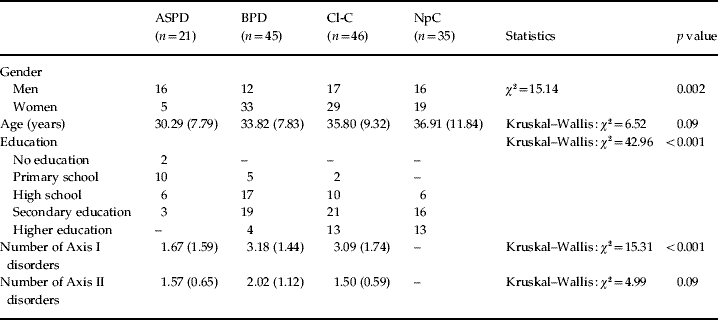
Data were analyzed from 147 subjects, divided into four groups: patients with ASPD (n=21), BPD (n=45) or Cl-C personality disorder (n=46) and NpCs without psychopathology (n=35). NpCs were recruited from the general population and patients from forensic institutes or mental health care institutes within The Netherlands and Belgium. General exclusion criteria were psychotic or bipolar disorder, age <18 and >55 years, intoxication by alcohol or drugs during testing, IQ <80 and not being a native speaker of the Dutch language. The non-BPD participants were not allowed to have more than two BPD criteria, and the non-ASPD participants were not allowed to have more than two ASPD criteria. The characteristics of the study groups are presented in Table 1. Testing of between-group differences revealed that the ASPD group contained fewer women and the BPD group fewer men than the other groups and that the ASPD group was significantly lower educated. Further analyses of this study were corrected for gender but not for education because a lower education level is inherent to the ASPD population (Robins et al. Reference Robins, Tipp, Pzybeck, Robins and Regier1991). The ASPD group had a significantly lower number of DSM-IV Axis I disorders compared to the BPD and Cl-C groups but the three patient groups did not differ with respect to number of DSM-IV Axis II disorders. The medical ethics committee of the Academic Hospital of Maastricht, The Netherlands, approved the study. Before starting the study, all participants gave their written informed consent. The same sample was used for the study ‘Emotional, cognitive and physiological correlates of abuse-related stress in patients with borderline and antisocial personality disorders’ (Lobbestael & Arntz, unpublished observations). The data are described in two different manuscripts because of the different research questions and because collection of the data was performed in two different sessions.
Comparison between the groups on the demographic measures (n=147)

ASPD, Antisocial personality disorder; BPD, borderline personality disorder; Cl-C, Cluster C personality disorder patient group; NpC, non-patient control group.
Materials
Screening
Using SCID-I and SCID-II (First et al. Reference First, Spitzer, Gibbon, Williams and Benjamin1994, Reference First, Spitzer, Gibbon and Williams1997), DSM-IV Axis I and II diagnoses were made by J.L. or by master-level graduate students who underwent an intensive training program. In the current sample, 97 SCIDs were rated twice, yielding high inter-rater reliability values for SCID-I and SCID-II (κ values of 0.98–1.00 and 0.76–0.93 respectively). PP was assessed (by J.L.) using the Psychopathy Checklist – Revised (PCL-R; Hare, Reference Hare2003). The PCL-R rating of the ASPD patients was based on extensive investigation of collateral patient file information and on the PCL-R interview with the patients themselves. The PCL-R interviews were videotaped and rated by a second rater, and a consensus meeting was held between the two raters. Both raters were trained extensively in PCL-R administration. Previous studies have revealed a two-factor, four-facet hierarchical model of the PCL-R (Hare, Reference Hare2003; Bolt et al. Reference Bolt, Hare, Vitale and Newman2004). The four facets are: interpersonal (facet 1), affective (facet 2), lifestyle (facet 3) and antisocial (facet 4). These four facets load onto two higher-order factors: affective/interpersonal (factor 1), and lifestyle/antisocial (factor 2). The total level of PP, the PCL-R factors and facets were expressed continuously.
Anger induction
A stress-induction interview (Dimsdale et al. Reference Dimsdale, Stern and Dillon1988) was used to induce anger. Each participant indicated a person who they disliked or had conflicts with as an aggressor. Participants recalled and verbally described a conflict in the past with the aggressor, guided by the interviewer to a level of strong experienced emotions of anger. The instruction by the interviewer was: ‘We are going to do a brief interview for 10 minutes about certain emotions you experienced in the past. I would like you to tell me about a situation in the past with your aggressor that made you very angry. Could you try to remember such a situation and tell me about it in detail? How did this made you feel? What did you want to do?’ Our group has earlier shown that this stress interview proved to generate the highest levels of self-reported anger and anger-related physiology (Lobbestael et al. Reference Lobbestael, Arntz and Wiers2008).
Dependent variables
Self-reported emotions were assessed by means of the Profile of Mood States (POMS), short version (McNair et al. Reference McNair, Lorr and Droppleman1992), with five subscales of tension, depression, anger, vigour, and fatigue. To investigate the influence of emotion induction on cognitive representation, anger-related schema modes were also assessed. Schema modes originate from Schema Therapy (Young et al. Reference Young, Klosko and Weishaar2003) and reflect clusters of feelings, thoughts and behaviors, prominent at a given moment in time, that are especially salient in patients with severe personality disorders. Schema modes were measured with an abbreviated version of the Schema Mode Inventory (SMI; Young et al. Reference Young, Arntz, Atkinson, Lobbestael, Weishaar, van Vreeswijk and Klokman2007) consisting of three items for each anger-related mode: the Angry Child, the Enraged Child and the Bully and Attack mode. Systolic (SBP) and diastolic blood pressure (DBP) were measured four times at each assessment using Omron M5-I (Omron Matsusaka Co. Ltd, Japan) with a standard cuff placed on the subjects' right arm above the elbow. To record heart rate, Blue Sensor electrodes (Emergency Medical Products, Waukesha, USA) were attached over the lower rib on the left side of the trunk and to the subjects' chest to record a lead II electrocardiogram. Heart rate was expressed as the number of beats per minute. To monitor palm sweat gland activity, Ag/AgCl electrodes (8 mm diameter) filled with isotonic paste were attached to the volar surface of the medial segment of the middle and ring fingers of the non-dominant hand. A galvanic skin response coupler supplied a constant 0.5 V to assess skin conductance level (SCL) and skin conductance response (SCR). SCR was defined as every response >0.02 μS and <30 μS. The number of SCRs was counted during each assessment. A bipolary facial electromyogram (EMG) was recorded over the corrugator supercilli (frowning). The electrodes were placed on the left side of the face with 4-mm standard Ag/AgCl electrodes. Heart rate, SCL, SCR and the EMG were recorded using the Vitaport III system, a portable continuously measuring physiological device, and analyzed off-line by means of a specially designed computer program. Two implicit association tasks were developed. In these adapted versions of the Single Category Implicit Association Task (SC-IAT; Karpinski & Steinman, Reference Karpinski and Steinman2006), participants were presented with words belonging to a target category or one of the two attribute categories, which they had to classify by pressing the left or right response key (Karpinski & Steinman, Reference Karpinski and Steinman2006). The self-SC-IAT measured the association between ‘self’ and ‘anger’ and the aggressor-SC-IAT measured the association between ‘aggressor’ and ‘swearwords’. The self-SC-IAT consisted of an individualized self-related target category and two attribute categories: ‘anger’ and ‘peaceful’. The aggressor-SC-IAT consisted of a target category of individualized aggressor-related items (the same aggressor as in the anger induction interview) and two attribute categories: ‘swearwords’ and ‘words of appreciation’. The time between the appearance of the word on the computer screen and the first key press was measured. The SC-IATs consisted of three practice blocks and two test blocks. In the first test block, ‘self’ and ‘anger’ words (respectively ‘aggressor’ and ‘swearwords’) had to be attributed to the same response button and ‘peaceful’ words (‘words of appreciation’) to the other button. In the second test block ‘self’ and ‘peaceful’ (respectively ‘aggressor’ and ‘words of appreciation’) were assigned to the same response button and ‘anger’ (‘swearwords’) to the other button. The presentation order of the self- and aggressor-SC-IATs and of attribute categories were randomized. By comparing the average reaction time of the compatible block with the incompatible, the extent to which targets are associated with one versus the other attribute can be measured (Karpinski & Steinman, Reference Karpinski and Steinman2006).
Procedure
After signed consent was obtained, SCID-I, SCID-II and (for the ASPD group) the PCL-R were administered. Next, the electrodes and blood pressure cuff were attached. The experiment was divided into three different phases (‘blocks’): (i) the neutral block, in which participants had to watch a nature documentary (used as baseline), (ii) the anger induction block (interview) and (iii) the positive induction block, in which participants viewed a ‘Mr Bean’ movie fragment. Each block had a 10-min duration. After the neutral and anger blocks, participants filled in the POMS and the short SMI while their blood pressure was recorded, and then completed the SC-IATs. Other physiological indices were assessed during the blocks. Finally, the experimenter removed the electrodes. Participants were given financial compensation and were informed of the nature of the study.
Statistical analyses
The self-SC-IAT effect was defined as the difference in reaction time between self-words when associated with anger compared to peacefulness. A positive self-SC-IAT score reflects a stronger self-anger than self-peaceful association, a negative self-SC-IAT score reflects a stronger self-peaceful than self-anger association. The dependent variables of the SC-IAT analyses were change scores of SC-IAT effects from baseline to anger block. Positive self-SC-IAT change scores reflect increases in self-anger association from baseline to anger block, and negative SC-IAT change scores reflect decreases in self-anger association. Similarly, positive aggressor-SC-IAT effects reveal stronger aggressor–swearwords than aggressor–appreciation associations, and positive aggressor-SC-IAT change scores reflect increases in aggressor–swearwords associations from baseline to anger block. For all dependent variables, baseline levels between groups were compared by means of ANOVAs. Deviation contrasts tested which of the groups differed from the overall mean. Because some of the group×gender cells were too small, a full-factorial gender by group analyses could not be performed. Instead, gender was included as an extra factor and only the main effect of gender was evaluated. To test whether dependent variables changed from baseline to anger induction, Cohen's d effect sizes were calculated based on paired-sample t tests for each group, and for the whole sample. Paired-sample t tests were calculated to test whether self-reported anger changes differed from changes in other emotions. Changes from neutral to anger block were analyzed by ANOVAs with change scores as dependent variables and group and gender as factors. If there was no main effect of gender, this variable was left out of further analyses. Deviation contrasts were calculated to test whether the groups differed significantly from the overall mean. The influence of PP level in the ASPD group was assessed by means of Pearson correlations between the change scores and the total PCL-R score, factors 1 and 2, and facets 1–4.
Results
Baseline values
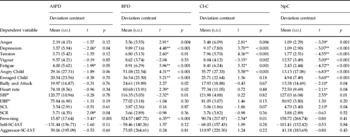
The BPD and Cl-C groups scored higher and the NpC group lower than average on all baseline negative emotions. The opposite pattern was found for the vigour subscale. The ASPD patients scored lower on depression and fatigue at baseline (Table 2). At baseline, there was no main effect of gender on the self-reported emotions (p's>0.42).
Mean and standard deviations of baseline levels of dependent variables for all groups

ASPD, Antisocial personality disorder; BPD, borderline personality disorder; Cl-C, Cluster C personality disorder patient group; NpC, non-patient control group; SBP, systolic blood pressure; DBP, diastolic blood pressure; SCL, skin conductance level; SCR, skin conductance response; SC-IAT, Single Category Implicit Association Task; s.d., standard deviation.
a Corrected for gender.
* Significant at p<0.05; ** significant at p<0.001.
Compared to the overall mean, BPD patients scored higher on Angry and Enraged Child modes, Cl-C patients higher on Angry Child mode, and NpCs lower on all modes at baseline (Table 2). At baseline, there was no main effect of gender on the modes (p's >0.14).
BPD patients had a lower and NpCs a higher baseline heart rate and SBP. NpCs had a higher baseline level of SCL, and ASPD patients had a higher SCR level than the overall mean. BPD patients displayed more and ASPD and Cl-C patients less frowning compared to the overall mean (Table 2). At baseline, there was a main effect of gender on SBP [F(1, 139)=20.57, p<0.001] and DBP [F(1, 139)=5.74, p=0.02], which were both higher in men.
None of the groups deviated from the overall mean in baseline SC-IATs (Table 2). At baseline, there was no main effect of gender on the SC-IATs (p's>0.22).
Change scores
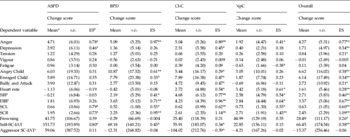
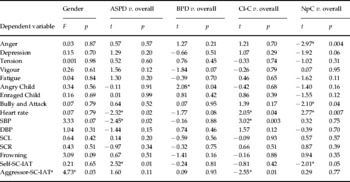
Self-reported anger, depression and tension increased significantly after the anger induction. Paired-sample t tests revealed that the increase in anger was stronger than the increase in depression [t(146)=6.84, p<0.001] and in tension [t(146)=9.14, p<0.001]. The overall effect size was medium for self-reported anger, small for depression and tension, and almost zero for vigour and fatigue (Table 3). The anger increase was significantly lower in the NpC group than the overall increase (Table 4). Gender did not influence the baseline to anger block change in self-reported emotions.
Mean, standard deviations and effect sizes for all changes in dependent variables for all groups

ASPD, Antisocial personality disorder; BPD, borderline personality disorder; Cl-C, Cluster C personality disorder patient group; NpC, non-patient control group; SBP, systolic blood pressure; DBP, diastolic blood pressure; SCL, skin conductance level; SCR, skin conductance response; SC-IAT, Single Category Implicit Association Task; s.d., standard deviation; ES, effect size.
a Positive scores indicate increases in dependent variables, and negative scores indicate decreases in dependent variables.
b Effect sizes (Cohen's d of change score).
c Corrected for gender.
* Significant at p<0.05; ** significant at p<0.001.
Main effects of gender and deviation contrasts between the groups on changes in dependent variables

ASPD, Antisocial personality disorder; BPD, borderline personality disorder; Cl-C, Cluster C personality disorder patient group; NpC, non-patient control group; SBP, systolic blood pressure; DBP, diastolic blood pressure; SCL, skin conductance level; SCR, skin conductance response; SC-IAT, Single Category Implicit Association Task.
a Corrected for gender.
* Significant at p<0.05.
The three anger-related modes increased significantly from baseline to anger block. The overall effect sizes were in the medium range for all three modes (Table 3). The BPD group displayed a stronger increase in the Angry Child mode compared to the overall mean, whereas the NpC group displayed a smaller increase in Bully and Attack mode compared to the other groups (Table 4). There was no gender effect on the change scores of the modes.
Overall effect sizes indicated that all physiological indices increased significantly from baseline to anger phase. Overall effect sizes of physiological indices varied from small (heart rate, SBP and frowning) to medium (DBP and SCL) to large (SCR, Table 3). ASPD patients showed a decrease in heart rate whereas the overall effect was an increase. The Cl-C and NpC groups had significantly larger increases in heart rate compared to the overall mean. ASPD patients also displayed a decrease in SBP that differed significantly from the overall mean, whereas this increase was significantly stronger in Cl-C patients than in the rest (Table 4). Gender had no effect on changes in physiological indices.
Effect sizes indicated that there was a significant overall change in the self-SC-IAT from baseline to anger phase but this was not the case for the aggressor-SC-IAT. The self-SC-IAT had a small effect size whereas the effect size of the aggressor-SC-IAT was close to zero (Table 3). ASPD patients displayed stronger changes towards self-anger associations than the overall mean whereas the opposite pattern was found for the NpC group. The Cl-C group displayed a weaker shift towards an aggressor–swearword association compared to the overall mean (Table 4). There was a main gender effect on the change score of the aggressor-SC-IAT, in that men displayed a stronger shift after the anger induction towards an aggressor–swearword association than women.
Influence of psychopathy
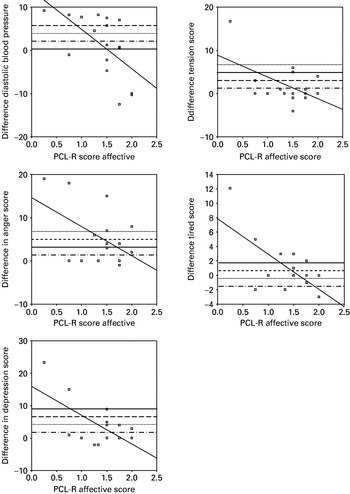
The mean score of the total PP score in the ASPD group was 22.02 (s.d.=4.25). The mean score on factor 1 of the PCL-R was 8.65 (s.d.=2.58), and the mean PCL-R factor 2 score was 10.89 (s.d.=2.68). Six ASPD patients had a total PCL-R score of ⩾26 and can therefore be labelled as psychopaths according to European studies (Cooke, Reference Cooke, Cooke, Forth and Hare1998; Grann et al. Reference Grann, Långström, Tengström and Stålenheim1998; Cooke & Michie, Reference Cooke and Michie1999). The total PP score, factors 1 and 2, and facets 1, 3 and 4 did not correlate significantly with the change scores of the dependent variables. The affective facet (facet 2) of PP had negative correlations, with increases in all negative affects (Pearson correlation with anger=−0.50, depression=−0.63, tension=−0.50 and fatigue=−0.66, p's<0.05) and DBP (Pearson correlation=−0.60, p=0.01). Scatter plots of the PCL-R affective scores and these variables indicated that ASPD patients scoring high on affective PP facet 2 had a lower increase in DBP compared to the overall mean, and those ASPD patients that scored low on the affective PP factor showed stronger increases in negative emotions (see Fig. 1).
Scatter plots of the Psychopathy Checklist-Revised (PCL-R) affective score and diastolic blood pressure (DBP) and the negative emotions with linear relationships in the antisocial personality disorder (ASPD) group and average levels in the four groups. –––, ASPD group; ·······, borderline personality disorder group; - - -, Cluster C personality disorder group; – · – · –, non-patient controls.

Discussion
The current study investigated the influence of anger on self-reported emotions, schema modes, physiological reactivity and implicit cognitive associations in patients with ASPD, BPD, Cl-C and in NpCs. Compared to the other groups, the ASPD group showed comparable self-reported increases in anger and in anger-related schema modes; smaller changes in heart rate and SBP; and a stronger shift towards self-anger associations after the anger induction. In other words, the ASPD patients demonstrated a cardiovascular hyporeactivity and an implicit cognitive hyper-reactivity. This finding has two important aspects: first, ASPD patients do not show abnormal self-reported anger reactivity. Second, on indirect measures, the anger reactivity of ASPD patients does differ markedly from the other groups. Within the indirect anger assessment level, ASPD patients show a discrepancy between physiology (i.e. heart rate and SBP) and implicit cognition.
This study also assessed the impact of PP traits on the findings of the ASPD group. First, the ASPD patients of this study differed widely with respect to their level of psychopathic traits, with only six ASPD patients meeting European criteria for full PP. This supports the speculation in the literature that ASPD is a very heterogeneous disorder that includes one subgroup with high anxiety and low psychopathy traits and another subgroup with low anxiety and higher psychopathy traits (Hare, Reference Hare1996, Reference Hare2006). Second, ASPD patients who scored high on the affective facet of PP indicated a smaller increase in negative emotions and showed a DBP decrease. Other factors and facets of PP were not predictive. This indicates that the overall level of PP does not play a major role in anger reactivity of ASPD patients, but the affective component of PP does.
Because lying is a central characteristic of ASPD (APA, 2000), it was expected that ASPD patients would have reported a smaller increase in anger. The fact that this was not the case could be due to two reasons. It could be that ASPD patients, in general, adequately acknowledge their level of anger. As the experiment took place in a neutral test situation and their anger rating had no consequences for any juridical decisions regarding their prison status, nor would it have had other benefits, it is unlikely that they felt any advantage in manipulating the outcome of the measure (Cima et al. Reference Cima, Merckelbach, Hollnack, Butt, Kremer, Schellbach-Matties and Muris2003). However, because there is no gold standard for measuring the ‘true’ presence of anger, it could be argued that the antisocial group in fact experienced more anger than they reported. This suggests that the questionnaire data reflect ‘text-appropriate’ ratings rather than emotional experiences per se (Herpertz et al. Reference Herpertz, Werth, Lukas, Qunaibi, Schuerkens, Kunert, Freese, Flesch, Mueller-Isberner, Osterheider and Sass2001a). Additionally, the finding that low affective ASPD patients indicated low levels of affect changes indicates that both the PCL-R raters and the patients themselves agree on the patient's lack of emotionality, at least on the overt level. Consequently, it is likely that this subgroup truly experienced a lower level of anger. This assumption was further supported by the finding that ASPD patients with a lack of affect displayed a lower change in DBP. Note, however, that implicit self-anger associations were not related to this PP facet, thus these patients were on an implicit associative level as angry as ASPD patients low in facet 2.
Our findings of cardiovascular underarousal in antisocial individuals support the notion that, although physiological hyporesponsivity has been particularly associated with PP (Patrick et al. Reference Patrick, Cuthbert and Lang1994; Raine, Reference Raine, Stoff and Cairns1996; Lorber, Reference Lorber2004), physiological under-reactivity also holds for the broader and more heterogeneous population of ASPD, rather than for psychopaths only (see also Raine, Reference Raine, Stoff, Breling and Maser1997; Steuerwald & Kosson, Reference Steuerwald, Kosson and Gacono2000; Patrick et al. Reference Patrick, Bernat, Malone, Iacono, Krueger and McGue2006; Verschuere et al. Reference Verschuere, Crombez, Koster and De Clerq2007). The negative association between the affective PP factor and DBP suggests that the cardiovascular under-reactivity is even more pronounced in the subgroup of ASPD patients who lack emotionality.
The cardiovascular changes in ASPD patients in reaction to anger did not parallel the cognitive anger-related changes. One possible explanation for this discrepancy can be found in animal defense models that propose that the defense phase (i.e. fight response) associated with increases in physiological responses is preceded by an orienting phase in which heart rate decreases and in which the organism is vigilant and prepares to respond, here reflected in cognitive anger-related hyper-association (Lacey & Lacey, Reference Lacey and Lacey1958; Graham & Clifton, Reference Graham and Clifton1966; Lang et al. Reference Lang, David and Öhman2000). The anger induction interview used in the current study was not set up to provoke a counter-attack of the participant because the object of aggression was far away. Nonetheless, physiological indices suggest that the interview did trigger a response that was associated with a defense reaction in most of the participants (i.e. increased heart rate and SBP), whereas in ASPD patients it seemed to result in a controlled preparation for a possible later attack (i.e. decreased heart rate and SBP, and cognitive vigilance association with aggression). This suggests that ASPD patients differ in their timing of their defensive response. Because organisms are assumed to switch to defense when the intensity of the emotional stimulus increases, it could be that ASPD patients would have switched to the defense phase if the anger stimulus was more imminent (e.g. harassment procedure; Lobbestael et al. Reference Lobbestael, Arntz and Wiers2008). Such an explanation implies that the strength and imminence of the anger stimulus determines whether an antisocial individual displays orienting or fight responses, which is in line with the ‘predatory imminence continuum’ as a key component of defensive switching (Fanselow & Lester, Reference Fanselow, Lester, Bolles and Beecher1988). In accordance with this, Mobbs et al. (Reference Mobbs, Petrovic, Marchant, Hassabis, Weiskopf, Seymour, Dolan and Frith2007) demonstrated that difference in predatory imminence is associated with differential brain activity. Relating this to the predatory and impulsive aggression dimensions (Meloy, Reference Meloy1988; Dodge, Reference Dodge, Pepler and Rubin1991), and given that autonomic arousal has been shown to be minimal in predatory aggression (Stanford et al. Reference Stanford, Houston, Villemarette-Pittman and Greve2003), the current data suggest that whether ASPD patients display predatory-like or impulsive aggression could depend on the intensity and/or imminence of the anger stimulus. As predatory-like aggression requires forethought (Blair, Reference Blair2003) and thus increased cognitive processing (Chase et al. Reference Chase, O'Leary and Heyman2001), the finding of increased implicit cognitive anger further supports the post-hoc interpretation that the anger interview caused ASPD patients to display controlled predatory-like aggression expressed in a prolonged orienting phase. Future studies should address how ASPD patients with different levels of PP respond to an anger induction where a (possible) counter-attack is provoked. It is important for further understanding of ASPD and PP to investigate whether this group still remains physiologically hyporeactive, or switches to a more common defensive response.
The borderline group of this study did not differ from the other groups in the self-reported changes of emotions and in physiological reactivity. This is in line with some previous studies (Herpertz et al. Reference Herpertz, Kunert, Schwenger and Sass1999, Reference Herpertz, Schwenger, Kunert, Lukas, Gretzer, Nutzmann, Schuerkens and Sass2000, 2001 b; Koenigsberg et al. Reference Koenigsberg, Harvey, Mitropoulou, Schmeidler, New, Goodman, Silverman, Serby, Schopick and Siever2002; Jacob et al. Reference Jacob, Guenzler, Zimmermann, Scheel, Ruesch, Leonhart, Nerb and Lieb2008) but it does not support Linehan's (Reference Linehan1993) notion of emotional hyper-responsivity and several other studies that corroborated this hypothesis (Levine et al. Reference Levine, Marziali and Hood1997; Herpertz et al. Reference Herpertz, Gretzer, Muhlbauer, Steinmeyer and Stass1998, Reference Herpertz, Werth, Lukas, Qunaibi, Schuerkens, Kunert, Freese, Flesch, Mueller-Isberner, Osterheider and Sass2001a; Schmahl et al. Reference Schmahl, Elzinga, Ebner, Simms, Sanislow, Vermetten, McGlashan and Bremmer2004). These mixed results indicate that self-reported and psychophysiological responsivity to stressors in patients with BPD is part of a yet unresolved debate.
Several limitations should be acknowledged. First, not enough female antisocial and male borderline participants were included in the current study to assess group by gender interactions. Unfortunately, women who are antisocial but not borderline and borderline men who are not antisocial are rare and subsequently difficult to enroll. Second, because this study did not include a baseline activation task (e.g. an interview on a neutral topic), we could not differentiate which part of the reactivity following the anger interview originated from activation versus emotional processing. Third, physiological reactivity was assessed during the anger induction phase, whereas self-ratings of emotions and the SC-IATs were performed immediately after the anger induction. This was done because the current study focused on emotional reactivity during anger experience, and not on the duration or post-hoc effects of anger. Nonetheless, it should be kept in mind that a time-effect might have confounded the comparison between physiology and the other anger-related variables. Fourth, although anger is robustly associated with increases in heart rate, skin conductance, frowning and blood pressure, increases in these variables are not exclusive markers of anger because they also occur in response to other negative emotions such as anxiety. Previous studies did indicate that there are specific differences in the quantity of change in some physiological measures with anger versus, for example, anxiety. Specifically, DBP and SCR distinguish anger from anxiety (see Cacioppo et al. Reference Cacioppo, Bernston, Larsen, Poehlmann, Ito, Lewis and Haviland2000 for an overview). On the one hand, as we found overall increases in DBP and SCR, this suggests there is anger specificity. On the other hand, it is difficult to draw conclusions on specificity when only one emotion is induced, as an emotion control condition misses. Finally, it would have been useful to analyze the data of the psychopathic patients separately to compare ASPD with PP patients directly, but this was not possible given the low number of psychopaths in this study.
In sum, to our knowledge this is the first study to assess the impact of sustained anger, and thereby increasing the ecological validity, in well-defined samples of antisocial and psychopathic individuals. Overall, antisocial patients did not differ from the other groups in self-reported anger, but ASPD patients lacking affect indicated a lower increase in negative emotions. Furthermore, ASPD patients displayed a cardiovascular under-reactivity that was even more pronounced in those lacking emotional affect, and an implicit cognitive over-reactivity in reaction to the anger induction procedure. These findings suggest a strong controlled predatory type of anger response in ASPD. This study stresses the importance of using alternative assessment methods of emotional reactivity in antisocial populations to further understand this personality disorder.
Acknowledgments
Thanks are due to Minda Dijkstra, Christine van Giesen, Sarah Holla, Yvette Haenen, Anke Verstegen and Nelly Dorssers for their help in collecting data, to Charlie Bonnemayer for the development of the SC-IATs, and to Theo van Aerts for his help with use of the Vitaport. We are grateful for the collaboration of the board of directors, staff and patients of the correctional institute ‘Ter Peel’ in Evertsoord and the correctional institute ‘de Geerhorst’ in Sittard; the ‘Rooyse Wissel’ in Venray and Maastricht; the ‘RIAGG Maastricht’; GGZ Midden Brabant and Midden Limburg; Mutsaersoord in Venray; the Symfora group, Amersfoort; and ‘Lianarons’ in Heerlen, all in The Netherlands, and the correctional institute of Brugge and ‘Medisch Centrum Sint-Jozef’ in Bilzen, both in Belgium.
Declaration of Interest
None.