The present study compares the comprehension and production of passive sentences in Italian-speaking children ranging in age from 3 years, 4 months to 6 years, 2 months (3;4 to 6;2), controlling for several variables: verb class (actional vs. nonactional), presence versus absence of the external argument expressed in the by-phrase, and auxiliary type (essere “to be” vs. venire “to come”). This is the first study that investigates both production and comprehension, focusing on similarities and differences in the route of acquisition of two different passive constructions in Italian, which use the auxiliaries essere and venire, respectively.
This study is at the heart of a lively debate on the acquisition of passive sentences, dating back to the end of the seventies. Since then, much linguistic and psycholinguistic research has been conducted on the acquisition of this structure across different languages in both comprehension (for English, Bencini & Valian, Reference Bencini and Valian2008; Borer & Wexler, Reference Borer, Wexler, Roeper and Willliams1987; Fox & Grodzinsky, Reference Fox and Grodzinsky1998; Gordon & Chafetz, Reference Gordon and Chafetz1990; Hirsch & Wexler, Reference Hirsch, Wexler, Deen, Nomura, Schulz and Schwartz2006; Horgan, Reference Horgan1978; Maratsos, Fox, Becher, & Chalkley, Reference Maratsos, Fox, Becher and Chalkley1985; O'Brien, Grolla, & Lillo-Martin, Reference O'Brien, Grolla, Lillo-Martin, Bamman, Magnitskaia and Zaller2006; Orfitelli, Reference Orfitelli2012; Pinker, Lebeaux, & Frost, Reference Pinker, Lebeaux and Frost1987; for Greek, Driva & Terzi, Reference Driva, Terzi, Gavarro and Freitas2008; Terzi & Wexler, Reference Terzi, Wexler and Hirotani2002; for Italian, Volpato, Verin, Tagliaferro, & Cardinaletti, Reference Volpato, Verin, Tagliaferro, Cardinaletti, Stavrakaki, Lalioti and Konstantinopoulou2013; for Portuguese, Rubin, Reference Rubin2009; for Japanese, Sano, Reference Sano and Otsu2000; for Russian, Babyonyshev & Brun, Reference Babyonyshev and Brun2003; for Sesotho, Demuth, Reference Demuth1989, Reference Demuth1990; Demuth, Moloi, & Machobane, Reference Demuth, Moloi and Machobane2010) and production (for English, Bencini & Valian, Reference Bencini and Valian2008; Crain, Thornton, & Murasugi, Reference Crain, Thornton and Murasugi1987; Horgan, Reference Horgan1978; Messenger, Branigan, McLean, & Sorace, Reference Messenger, Branigan, McLean, Sorace, Chandlee, Franchini, Lord and Rheiner2009, Reference Messenger, Branigan, McLean and Sorace2012; for German, Mills, Reference Mills and Slobin1985; for Hebrew, Berman & Sagi, Reference Berman and Sagi1981; for Sesotho, Demuth et al., Reference Demuth, Moloi and Machobane2010; for Italian, Manetti, Reference Manetti, Baiz, Goldman and Hawkes2013; Volpato, Verin, & Cardinaletti, Reference Volpato, Verin, Cardinaletti, Costa, Fiéis, Freitas, Lobo and Santos2014).
The results of these previous studies do not converge. Early studies proposed that the acquisition of passives is either semantically (Maratsos et al., Reference Maratsos, Fox, Becher and Chalkley1985) or syntactically constrained (Borer & Wexler, Reference Borer, Wexler, Roeper and Willliams1987). Maratsos et al. (Reference Maratsos, Fox, Becher and Chalkley1985) suggested that the children's ability to comprehend the passive structure is restricted to actional verbs (1a). At 4 years of age, children show a good competence of passives with actional verbs, while nonactional passives (1b) are still problematic at the age of 5–7 years, and are fully mastered only at a later stage, by the age of 9 to 11 years:
-
(1)
-
a. The boy is kissed (by the girl).
-
b. The boy is seen (by the girl).
-
Children also show a better comprehension of passives lacking the by-phrase (2a) than passives containing it (2b) (Horgan, Reference Horgan1978):
-
(2)
-
a. The window is broken.
-
b. The window is broken by the wind.
-
In English, a short passive, as in (2a), is ambiguous between an adjectival (allowing a stative reading) and a verbal passive (allowing an eventive reading). When the by-phrase is added to the sentence, as in (2b), the passive is no longer ambiguous, and only an eventive reading is possible. Borer and Wexler (Reference Borer, Wexler, Roeper and Willliams1987) suggest that earlier than 5 or 6, children are only able to master adjectival passives. Hence, they interpret broken in (2a) as an adjective rather than a verb. This strategy is possible and felicitous only with actional verbs because nonactional passive participles cannot be interpreted as adjectives.
The asymmetry between long and short passives was later replicated by other studies investigating children's comprehension in Greek (Terzi & Wexler, Reference Terzi, Wexler and Hirotani2002), Russian (Babyonyshev & Brun, Reference Babyonyshev and Brun2003), English (Hirsch & Wexler, Reference Hirsch, Wexler, Deen, Nomura, Schulz and Schwartz2006), and Portuguese (Rubin, Reference Rubin2009), although in some studies, the difference between the two structures is not statistically significant (Hirsch & Wexler Reference Hirsch, Wexler, Deen, Nomura, Schulz and Schwartz2006, for English; Driva & Terzi, Reference Driva, Terzi, Gavarro and Freitas2008, for Greek).Footnote 1 Lack of statistical significance between long and short passives was recently replicated by Orfitelli (Reference Orfitelli2012). She tested the comprehension of verbal passives in English-speaking children ranging in age from 4 to 6;11 using a binary picture-matching task. Analyzing actional and nonactional passives with or without the by-phrase, she found that at the age of 4 and 5, most children showed above-chance performance on both short and long passives, and at the age of 6, children performed at ceiling. At the age of 4 and 5, actional passives were comprehended significantly better than nonactional ones, on which children's performance is not significantly different from chance. The performance on nonactional passives increases in 6-year-old children (higher than chance), although percentages remain lower than with actional ones.
However, some other studies (Crain et al., Reference Crain, Thornton and Murasugi1987; O'Brien et al., Reference O'Brien, Grolla, Lillo-Martin, Bamman, Magnitskaia and Zaller2006; Pinker et al., Reference Pinker, Lebeaux and Frost1987) found that when felicity conditions in the test administration are met, English-speaking 4-year-old children comprehend and produce long and short eventive passive sentences with both actional and nonactional verbs. By using a priming task, Bencini and Valian (Reference Bencini and Valian2008) and Messenger et al. (Reference Messenger, Branigan, McLean, Sorace, Chandlee, Franchini, Lord and Rheiner2009, Reference Messenger, Branigan, McLean and Sorace2012) confirmed that the structure of passive sentences is fully represented in 3- and 4-year-old English children. Messenger et al. (Reference Messenger, Branigan, McLean and Sorace2012) extensively showed that by the age of 4, children's syntactic representation of passives is adultlike in both production and comprehension tasks, and it is not semantically constrained; that is, it is independent of the verb class tested (actional vs. nonactional). Both children and adults produced more passive sentences after hearing passive primes than after hearing active primes.
Further evidence in favor of the early acquisition of passive sentences comes from studies conducted on non-Indo-European languages (for Quiche Mayan, Pye & Quixtan Poz, Reference Pye and Quixtan Poz1988; for Sesotho, Demuth, Reference Demuth1989, Reference Demuth1990; Demuth et al., Reference Demuth, Moloi and Machobane2010; for Inuktikut, Allen & Crago, Reference Allen, Crago and Clark1993). Demuth (Reference Demuth1989, Reference Demuth1990) found that in Sesotho, a language in which verbal and adjectival passives are morphologically and syntactically distinct, passive sentences are attested in child language starting from 3 years of age or even in younger children. By the same age, comprehension of long and short passives containing either actional or nonactional verbs is also adequately developed (Demuth et al., Reference Demuth, Moloi and Machobane2010).
As for Italian, few data are available on the first language acquisition of passive sentences. Ciccarelli (Reference Ciccarelli1998), quoted in Guasti (Reference Guasti2007), investigated the comprehension of long passives with actional verbs, by using a sentence–picture matching task. At the age of 4, passive sentences are at chance level (57%). An improvement in performance is observed at the age of 5 and 6 (72% and 80% accuracy, respectively). Higher accuracy was found in a standardized comprehension test developed by Chilosi and Cipriani (Reference Chilosi, Cipriani, Giorgi, Fazzi and Pfanner2006), who showed that children acquire reversible passives (like La bambina è spinta dal bambino “the child.fem is pushed by the child.ms”) at the age of 5;6. Manetti (Reference Manetti, Baiz, Goldman and Hawkes2013) reports an elicited production study and two syntactic priming studies with Italian children aged 3;6 to 4;6. In the former, no passive sentence was produced; in the latter, the overall rate of production of passive sentences is 33% and 16%, respectively. The rate of passives in response to passive primes was significantly higher than in response to active primes (26% vs. 15%). She concluded that at the age of 3;6, children are able to produce passive sentences, thus proving that they master this syntactic construction very early.
The goal of our study is to contribute to the debate by providing a comprehensive analysis of the acquisition of passive sentences in Italian-speaking children ranging in age from 3;4 to 6;2. We investigate both the comprehension and the production of passive sentences in the different sentence combinations analyzed in previous studies, that is, the use of actional versus nonactional verbs and the presence versus absence of the by-phrase. We also investigate an Italian-specific variable, that is, the use of auxiliary essere versus venire.
Like English, Italian builds passive sentences by using the auxiliary essere, as shown in (3). As in English, verbal and adjectival passive constructions are not morphologically distinct. Therefore, sentences with essere are ambiguous. Because the word chiusa “closed” is either an adjective or a verb, (3a) can have a stative, a resultative, or an eventive reading. When the by-phrase or a manner adverb is uttered, as in (3b), the sentence is unambiguously an eventive passive. The three-way ambiguity of (3a) can also be solved by replacing the auxiliary essere with venire, as in (4a), which is only compatible with the eventive (nonstative) interpretation of the sentence and chiusa can only be analyzed as a verb. In (4b), the insertion of the by-phrase or a manner adverb is also possible:
-
(3)
-
a. La porta è chiusa.
-
b. La porta è chiusa da Maria / violentemente.
“The door is closed (by Mary / with violence).”
-
-
(4)
-
a. La porta viene chiusa.
-
b. La porta viene chiusa da Maria / violentemente.
the door comes closed (by Mary / with violence)
“The door is being closed (by Mary).”
-
The possibility of adding the by-phrase in venire passives confirms their eventive status: as in English, the by-phrase can only be used with verbal passives and not with adjectival ones (Frigeni, Reference Frigeni2004). Another observation points to the verbal status of what follows venire. While a superlative form of the adjective is possible with essere (5a), it cannot occur in verbal passives with either essere (5b) or venire (5c)Footnote 2 :
-
(5)
-
a. La gara è aperta / apertissima a tutti (*da Maria).
the race is open / very open to everybody (*by Mary)
-
b. La gara è stata aperta / *apertissima (da Maria).
the race has been opened / *very open (by Mary)
-
c. La gara viene aperta / *apertissima (da Maria).
the race comes opened / *very open (by Mary)
-
Further evidence that an eventive interpretation is present with both essere and venire is provided by the syntactic activity of the external thematic role even when it is not pronounced (Baker, Johnson, & Roberts, Reference Baker, Johnson and Roberts1989; Jaeggli, Reference Jaeggli1986):
-
(6) La nave fu / venne affondata [PRO per riscuotere l'assicurazione].
The ship was / came sunk [PRO to collect the insurance]
“The ship was sunk to collect the insurance.”
With both essere and venire, the external argument acts as a controller for the PRO subject of the embedded clause. Hence, both sentences are compatible with an eventive reading. In this respect, venire passives are different from English get passives, whose external argument is not syntactically active.
As in passives with essere, in sentences containing venire, the internal argument of the active verb (7a) becomes the subject of the passive sentence, in either the postverbal (7b) or preverbal (7c) position, and triggers agreement on the inflected verbFootnote 3 :
-
(7)
-
a. Maria chiude la porta / le porte alle cinque.
Mary closes the door / the doors at five
-
b. Viene chiusa la porta / Vengono chiuse le porte alle cinque.
-
c. La porta viene chiusa / Le porte vengono chiuse alle cinque.
The door is / doors are closed at five
-
Idiomatic expressions are possible in venire passives, as in essere passives:
-
(8) A Gianni era / veniva sempre data carta bianca.
to John was / came always given paper white
“Gianni was always given carte blanche.”
Venire passives differ from essere passives in aspectual properties. The former are preferred in progressive contexts in the present tense (no aspectual difference is, however, detected in past and future tenses).Footnote 4
In sum, venire and essere passives behave alike as true passives according to numerous tests, as shown above. We conclude, as per much of the literature on the topic, that Italian has two variants of the passive (introduced by the two auxiliaries), which are the focus of the current paper. Italian venire passives are crucial to assess the competence of passives in children. If Italian children comprehend and produce passive sentences with venire, it can safely be concluded that they have the representation of true verbal passives from very early on.
In our study, we also investigate how the interaction of all these variables (verb class, by-phrase, and auxiliary) modulates the comprehension of the passive voice in Italian children in the course of language development, in light of recent research on passives. In particular, we discuss how recent research on the syntactic representation of passives (Collins, Reference Collins2005) predicts and explains children's performance in the use of long and short passives. To this effect, tasks assessing memory resources are also used. Some studies (Montgomery, Magimairaj, & O'Malley, Reference Montgomery, Magimairaj and O'Malley2008) found an association between memory skills and complex sentence comprehension (also including passive sentences).
In addition to comprehension, we also investigate production. Only one modality is sometimes not sufficient to determine whether language is mastered by a child. Production provides a picture of the content and form of children's emerging language system. In contrast, comprehension makes it possible to give a picture of the grammatical knowledge of structures that are not produced yet. The use of both comprehension and production tasks provides more detailed evidence of children's linguistic knowledge. Some studies reported an asymmetry between the two modalities. In some cases, comprehension is shown to precede production in both typical (Clark, Reference Clark1993) and atypical language development (Contemori & Garraffa, Reference Contemori and Garraffa2010). Some other studies reported a reversed pattern, in which production precedes comprehension, as, for instance, in the acquisition of relative clauses (Håkansson & Hansson, Reference Håkansson and Hansson2000) and of object pronouns and subject–verb–object (SVO) word order (Hendriks & Koster, Reference Hendriks and Koster2010). Because the behaviors that children show in comprehension and production tasks investigating the same linguistic properties is particularly telling, both modalities in the acquisition of passive sentences are analyzed here.
THEORETICAL BACKGROUND ON THE ACQUISITION OF PASSIVE SENTENCES
In order to explain the difficulties experienced by children with the passive structure, Borer and Wexler (Reference Borer, Wexler, Roeper and Willliams1987) put forward the A-chain maturation hypothesis, according to which children manage to master verbal passives at the age of 5 or 6. Before this age, children are only able to comprehend and produce adjectival passives. Despite the same surface structure, adjectival and verbal passives have different syntactic representations. In verbal passives, the complement of be is a verb. Following early approaches to the representation of passives (Jaeggli, Reference Jaeggli1986), in verbal passives, the internal argument raises to the subject position, and the external theta role, absorbed by the passive morphology, is optionally transmitted to the by-phrase. In adjectival passives, the complement of be is an adjective, and no movement takes place. According to Borer and Wexler, this structural difference is crucial to understand why children are delayed in the acquisition of passives. They suggested that the ability to form argument A-chains becomes available starting from the age of 5 to 6 years. Earlier, children's grammar is only able to generate adjectival (stative) passives, which do not involve A-chains. The A-chain maturation hypothesis also predicts the correct comprehension of actional passives as opposed to nonactional passives, the adjectival interpretation being only possible with actional verbs. Hirsch and Wexler (Reference Hirsch, Wexler, Deen, Nomura, Schulz and Schwartz2006) slightly reformulated the hypothesis by suggesting that children's passives are resultative and contain verbs expressing a state as the result of an event. The A-chain maturation hypothesis is kept: no A-chain is built with resultatives.
However, the A-chain maturation approach is at odds with evidence coming from the acquisition of other A-movement constructions where children behave adultlike, such as reflexive–clitic constructions (Snyder & Hyams, Reference Snyder and Hyams2014) and subject-to-subject raising (Becker, Reference Becker2006; Choe, Reference Choe2012; Orfitelli, Reference Orfitelli2012).
The acquisition of the passive voice has recently been reconsidered given Collins's (Reference Collins2005) new analysis of passives. Collins (Reference Collins2005) suggests that the external argument is merged with v’, and by (for long passives) and 0 (for short passives) are merged as the heads of the passive VoiceP projection, as shown in (9):
-
(9)


Unlike previous approaches, in which long and short passives are derived in different ways, under Collins' (Reference Collins2005) approach, long and short passives have the same derivation, and a difference between the two is not expected. We will see that this is the correct prediction for the acquisition of passives.
Given (9), locality principles block the movement of the object DP from the merge position within VP to specTP: the external argument in SpecvP represents an intervening element for the movement of the object DP to a higher position:
-
(10)

Collins's proposal is that passive sentences must be derived in more local steps: the VP chunk containing the verb and the object moves leftward to smuggle the subject in the vP-internal position, and a second step is necessary for the object to reach the specTP position at the left edge of the sentence:
-
(11)

Stemming from Collins's (Reference Collins2005) proposal, Orfitelli (Reference Orfitelli2012) put forward the argument intervention hypothesis (AIH), according to which young children are only delayed in acquiring those syntactic structures, including verbal passives, which involve A-movement of one argument over another one. The experiment conducted on passive structures shows that children are especially delayed in the comprehension of nonactional passives regardless of the presence or absence of the by-phrase. This phenomenon led the author to conclude, like Collins, that unpronounced by-phrases are syntactically active and give rise to intervention effects. However, Orfitelli's AIH needs two further hypotheses. First, it needs to assume that only the experiencer arguments of nonactional verbs give rise to intervention effects, while agentive arguments do not. Second, the AIH is subject to maturation and no longer active in adults. Similar to other maturational approaches, it predicts that children should be delayed in all languages. We will see that this is not the case for Italian children, who comprehend nonactional passives well above chance.
Adopting Collins’ approach to passives, Snyder and Hyams (Reference Snyder and Hyams2014) suggest that children do not have access to smuggling, which matures at around age 6.Footnote 5 However, in the spirit of Rizzi (Reference Rizzi and Belletti2004), later adopted by Friedmann, Belletti, and Rizzi (Reference Friedmann, Belletti and Rizzi2009), Garraffa and Grillo (Reference Garraffa and Grillo2008), and Rizzi (Reference Rizzi2013) to state the link between memory resources and syntax, Snyder and Hyams suggest that intervention effects are only found when the two nominal arguments share the same features. Children are adultlike when the internal argument moved to specTP has a topic feature (as in Demuth, Reference Demuth1990; O'Brien et al., Reference O'Brien, Grolla, Lillo-Martin, Bamman, Magnitskaia and Zaller2006). This proposal predicts that there should be no difference between long and short passives and between actional and nonactional passives as long as the derived subject is a topic. As we will see, while the long versus short asymmetry is not found in Italian children, the actional versus nonactional asymmetry is also found with topic-derived subjects, as in our experiment. Notice that their analysis is also at odds with the results coming from priming experiments (Bencini & Valian, Reference Bencini and Valian2008; Messenger et al., Reference Messenger, Branigan, McLean, Sorace, Chandlee, Franchini, Lord and Rheiner2009, Reference Messenger, Branigan, McLean and Sorace2012), in which 3-year-olds produced passive sentences whose derived subjects were not topics in the discourse.
THE STUDY
This study included two experiments. The first experiment assessed the comprehension of passive sentences using a sentence–picture matching task and was complemented by a digit span task. The second experiment investigated the ability of young children to produce passive sentences using a picture description task. All participants were assessed individually. Each child was assessed orally at his or her infancy school by using a puppet in order to create a gamelike atmosphere, following Crain and Thornton's (Reference Crain and Thornton1998) guidelines. All trials were presented on a laptop screen. In the next sections, we present participants, materials, procedures, and results for each experiment.
EXPERIMENT 1: THE COMPREHENSION AND THE DIGIT SPAN TASKS
Participants
Seventy-five typically developing monolingual Italian children ranging in age between 3;4 and 6;2, and 17 Italian adults participated in this study. The children were divided into four different age groups: Group 1 (G1): N = 16, age range = 3;4–3;11, mean age = 3;9; Group 2 (G2): N = 25, age range = 4;0–4;8, mean age = 4;4; Group 3 (G3): N = 18, age range = 4;9–5;5, mean age = 5;1; Group 4 (G4): N = 16, age range = 5;6–6;2, mean age = 5;11.Footnote 6 Children were recruited in two kindergartens in Venice and Bassano del Grappa, near Vicenza. They did not have any language impairment, hearing, or mental disabilities. The control sample was composed of 17 Italian adults, ranging in age from 20 to 24 years, attending classes at the Ca’ Foscari University of Venice.
Materials
The comprehension task
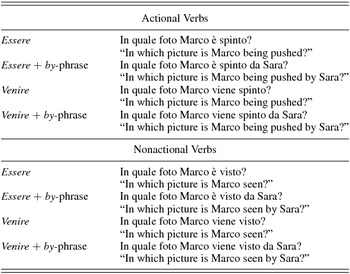
The comprehension of passives was investigated by using a sentence–picture matching task (Verin, Reference Verin2010) adapted from the Greek version elaborated by Driva and Terzi (Reference Driva, Terzi, Gavarro and Freitas2008). For each stimulus, each participant was presented with three photos and had to select the correct one matching a sentence read by the experimenter.Footnote 7 The battery included 40 experimental sentences created by using transitive reversible actional and nonactional verbs, and animate agents/experiencers and patients/themes. The animate characters were four people (two children Marco and Sara, and their two adult parents). Twenty-four trials contained actional verbs (baciare “to kiss,” colpire “to hit,” imboccare “to feed,” inseguire “to chase,” prendere a calci “to kick,” and spingere “to push”) and 16 contained nonactional verbs (amare “to love,” annusare “to smell,” sentire “to hear,” and vedere “to see”). Half of the items contained the auxiliary venire, and the other half the auxiliary essere. Twenty sentences were tested with the by-phrase and 20 without it. Table 1 shows all experimental conditions.
Experimental conditions

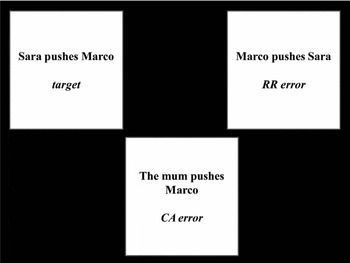
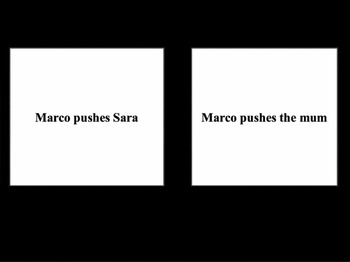
Figure 1 shows an experimental item matching the sentence containing the by-phrase In quale figura Marco è/viene spinto da Sara? (“In which picture is Marco being pushed by Sara?”). Two types of error were possible: either the selection of the picture in which theta roles were reversed (RR error: Marco pushes Sara) or the selection of the picture in which the agent changes (CA error: The mother pushes Marco).Footnote 8 Our prediction is the following: if children were unable to use passive syntax and to interpret the by-phrase, they would be forced to interpret long passives as short (adjectival) ones, and therefore CA errors would be expected.
Experimental sentence In quale figura Marco è/viene spinto da Sara? “In which picture is Marco being pushed by Sara?”

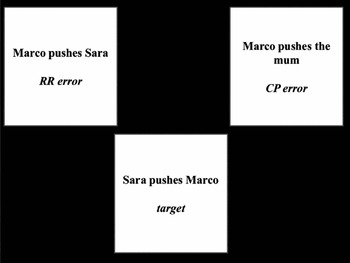
Figure 2 shows an experimental item matching the sentence lacking the by-phrase In quale figura Marco è/viene spinto? (“In which picture is Marco being pushed?”). The errors were either the selection of the picture in which the characters were the same as in the target picture, but theta roles were reversed (RR error: Marco pushes Sara), or the selection of the picture in which the patient changes (CP error: Marco pushes the mother). The prediction is that if children do not comprehend the passive structure, they would choose RR and CP pictures randomly; in both cases, Marco is the agent.
Experimental sentence In quale figura Marco è/viene spinto? “In which picture is Marco being pushed?”

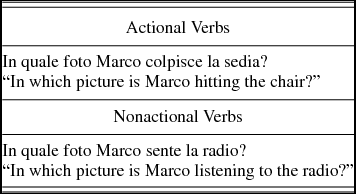
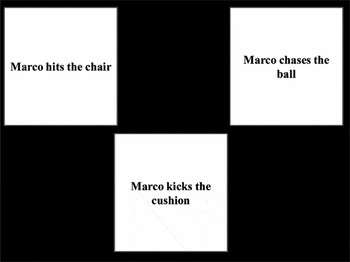
Experimental trials were interspersed with 10 filler items, matching active sentences containing both actional and nonactional verbs, with animate subjects (Marco, Sara, mum, and dad) and inanimate objects. Children providing incorrect responses to filler sentences would be excluded from the analysis. Table 2 shows the two conditions, and Figure 3 shows an example of filler sentence with the actional verb colpire “hit.”
Conditions for filler sentences

Filler item matching the sentence In quale figura Marco colpisce la sedia? (“In which picture is Marco hitting the chair?”).

The digit span tasks
We also collected data from a forward and backward digit repetition task. The reason for this choice is that because the syntactic representation of passive sentences either containing or lacking the by-phrase is the same (Collins, Reference Collins2005), we do not expect a difference between long and short passives. Hence, low accuracy in the comprehension of long passives might be attributed to some other causes, for example, to reduced memory resources.
The digit span tasks were taken from the standardized Test di Memoria e Apprendimento (TEMA; Reynolds & Bigler, Reference Reynolds and Bigler1995). Children were asked to immediately repeat sequences of digits of increasing length after the experimenter had read them aloud. Stimuli included sequences ranging from 2 to 10 numbers for the forward digit span and from 2 to 9 for the backward digit span. Testing stopped when children repeated fewer than four correct digits in two consecutive trials.
Procedure
The test administration was preceded by a familiarization and training session introducing the four characters, each on a separate picture (Questo è Marco “This is Marco,” Questa è Sara “This is Sara,” Questa è la mamma “This is their mum,” and Questo è il papa “This is their dad”). All verbs presented in the task were introduced by showing the children 10 pictures (Sara loves her teddy bear, Sara sees the ball, Marco chases the ball, Marco hits the chair, etc.). After showing the pictures, we asked: “Who is this?” and “What is Marco/Sara doing?” for each of the characters and each of the verbs. Items were presented in a random order. All children were tested on the same list of items.
Results
Filler sentences were correctly comprehended by all children. No child was hence excluded from the analysis.
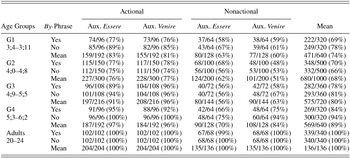
Table 3 shows the number and percentage of correct responses provided by each age group in the comprehension of passives with actional and nonactional verbs.Footnote 9 For each verb type, we analyzed accuracy when the auxiliary was either essere or venire, and when the sentence was either a long (Yes by-phrase condition) or a short passive (No by-phrase condition).
Number and percentage of correct responses in the different variable combinations

Note: G1–G4, Groups 1–4. Group ages are in years;months.
The results show that actional verbs are easier to comprehend than are nonactional verbs for all groups, replicating results on other languages, and overall (except for G2), short passives show higher percentages of accuracy than do long passives.Footnote 10 Younger children experience more difficulties than older ones in the comprehension of long passives. In G1, G3, and G4, all children performed above chance with actional verbs; in G2, only 5 children out of 25 performed at chance level, while the remaining ones performed above chance.
As far as the group of adults is concerned, their performance displays ceiling effects. Only with nonactional verbs, one adult made one error when the auxiliary was essere.
Following Jaeger (Reference Jaeger2008) and Dixon (Reference Dixon2008), a repeated-measure logistic regression analysis was carried out in order to analyze accuracy data, using the statistical software R (R Development Core Team, 2008). A group effect was found. G1 did not perform significantly different from G2 (Wald Z = –1.309, p = .191). The difference in performance between G1 and G3 is marginally significant (Wald Z = 1.841, p = .06), while it is statistically significant between G1 and G4 (Wald Z = 5.130, p < .001). G2 is significantly less accurate than both G3 and G4 (Wald Z = 3.124, p = .002, and Wald Z = 6.090, p < .001, respectively), and G3 is significantly less accurate than G4 (Wald Z = 3.096, p = .002).
In all groups, actional passives are more accurate than nonactional ones, with either essere or venire (G1: Wald Z = –3.480, p < .001, G2: Wald Z = –4.506, p < .001, G3: Wald Z = –6.091, p < .001, G4: Wald Z = –3.450, p < .001).
Overall, long passives are not significantly different from short passives (Wald Z = –0.147 p = .883). Looking more closely to the performance within each group, we found the role of the by-phrase appears to be significant only in G1; namely, the presence of the by-phrase appears to contribute to significantly decrease the level of accuracy with actional verbs (Wald Z = –2.675, p = .007). For the other groups, long passives are not significantly different from short passives, replicating Driva and Terzi's (Reference Driva, Terzi, Gavarro and Freitas2008) results on Greek and Orfitelli's (Reference Orfitelli2012) results on English, among others.Footnote 11
Considering the whole group of children, no significant difference is found between passives with auxiliary essere and venire (Wald Z = –0.858, p = .391). A difference in performance in the use of essere and venire is found with actional verbs in G3, in which the auxiliary venire is more accurate than essere (Wald Z = 2.248, p = .02). For all the other groups and sentence combinations, no significant difference is attested between the two auxiliaries.
We also verified for each group whether a correlation exists between overall accuracy in the comprehension of passive sentences and both forward and backward repetition tasks using Pearson correlation parameters. We also investigated the association between children's memory skills and their comprehension of long passives. We found that in G1, overall accuracy positively correlate with both forward (r = .641, p = .007) and backward digit span (r = .558, p = .025). In G1, percentages of accuracy on long passives also positively correlate with both forward (r = .514, p = .042) and backward digit span (r = .514, p = .042). In G2, we only found a positive association between overall accuracy and both forward (r = .647, p > .001) and backward digit span (r = .665, p > .001). We did not find any significant correlation between long passives and memory skills (r = .190, p = .363 for forward repetition; r = .277, p = .180 for backward repetition). In G3, overall accuracy positively correlated with only forward digit span (r = .569, p = .014), but not with backward digit span (r = .423, p = .081). In this case, we did not find any significant correlation between long passives and memory skills (r = –.041, p = .872 for forward repetition; r = –.017, p = .947 for backward repetition). In G4, the analysis did not show any association between overall accuracy on passive sentences and repetition tasks (r = .432, p = .095 for forward digit span; r = .383, p = .143 for backward digit span). A negative association was found between accuracy on long passives and forward digit span (r = –.578, p = .019), but no correlation was found with backward digit span (r = –.439, p = .089).
Qualitative analysis of responses
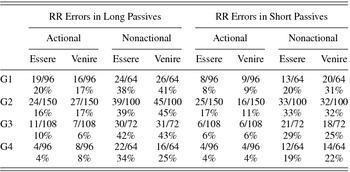
When the correct picture was not selected, two types of errors were possible. When the by-phrase was present in the test sentence, either RR or CA errors occurred; when the by-phrase was absent, either RR or CP errors occurred (see Figures 1 and 2, respectively, for the description of error types). For both long and short passives, most errors fell into the RR category. Table 4 shows the number and the percentages of this error type for each group in the different sentence combinations. As Table 4 shows, the tendency of selecting the picture displaying the reversed theta roles is relatively high in very young children, especially with nonactional verbs, while it decreases as children grow older.
Number and percentage of RR errors in each group in sentences with the by-phrase (long passives) and sentences without it (short passives)

Note: RR, Reversed theta roles; G1–G4, Groups 1–4.
In a small percentage of items containing the by-phrase (23/1500, 1.5%), children selected the picture displaying a change of the agent, more often with actional verbs (19/900, 2%) than with nonactional verbs (4/600, 1%). The selection of this picture is more frequent in the youngest age groups (G1: 7/320, 2%; G2: 13/500, 3%), and is nearly absent in the oldest ones (G3: 2/360, 0.5%; G4: 1/320, 0.3%). In some of the items lacking the by-phrase, children selected the picture involving the change of the patient, but this choice is made essentially by the youngest children (G1: 21/320, 7%, G2: 56/500, 11%). In the older children, it only persisted with nonactional verbs (G3: 11/144, 8%; G4: 5/128, 4%).Footnote 12
Interim discussion of Experiment 1
The most interesting finding of our study is the high accuracy of comprehension of venire passives: the mean percentage of correct responses is 86%.Footnote 13 Our data are unexpected both under Borer and Wexler's (Reference Borer, Wexler, Roeper and Willliams1987) A-chain maturation hypothesis and the proposal that early passives are either adjectival or resultative (Hirsch & Wexler, Reference Hirsch, Wexler, Deen, Nomura, Schulz and Schwartz2006). These proposals were developed on the basis of English data, in which the use of the auxiliary be allows a threefold interpretation, either a stative, resultative, or eventive reading. In Italian, a passive sentence with essere is also ambiguous among the three interpretations, but the use of venire, which is incompatible with an adjectival analysis of the past participle with which it combines, makes the sentence unambiguously a verbal passive. The percentage of accuracy in venire passives is already quite high in 3-year-old children (81% with actional verbs). This leads us to claim that A-chains are available to children from a very young age. In the overall comparison between actional passives with essere (86%) and venire (86%), the lack of difference between the two auxiliaries strengthens the hypothesis that very young children do comprehend eventive passive sentences, because passives with essere can also be taken to be interpreted by children with an eventive, true passive reading.Footnote 14
The significantly lower accuracy in G3 with passives with essere as opposed to those with venire might be attributed to the three-way ambiguity in Italian deriving from the use of this auxiliary. This suggests that children might experience difficulties in comprehending ambiguous sentences, as is the case when the auxiliary is essere.
Another much debated issue concerns the acquisition of long and short passives. While some studies found that short passives are easier to comprehend than long passives (Babyonyshev & Brun, Reference Babyonyshev and Brun2003; Borer & Wexler, Reference Borer, Wexler, Roeper and Willliams1987; Terzi & Wexler, Reference Terzi, Wexler and Hirotani2002), our overall results show that the performance on long passives is not significantly different from that on short passives, replicating Driva and Terzi's (Reference Driva, Terzi, Gavarro and Freitas2008) results on Greek and Orfitelli's (Reference Orfitelli2012) results on English, among others (the difference between long and short passives found in G1 is discussed below).Footnote 15
Provided that the appropriate discourse conditions are controlled for (Crain & Fodor, Reference Crain, Fodor and Dromi1993), as Driva and Terzi (Reference Driva, Terzi, Gavarro and Freitas2008) and we did, a difference between long and short passives is not expected if external arguments are represented even when they are not pronounced, as in Collins (Reference Collins2005; cf. Orfitelli Reference Orfitelli2012; Snyder & Hyams, Reference Snyder and Hyams2014). The fact that long and short passives are both comprehended by young children confirms that they have access to verbal passives, pace Borer and Wexler (Reference Borer, Wexler, Roeper and Willliams1987). In our study, a difference in performance between long and short passives is only found in the youngest group of children (G1, age range = 3;4–3;11). Results show a statistically significant correlation in G1 between memory skills and accuracy on the comprehension of long passives. Hence, the difficulty experienced by G1 with long passives might be attributed to a memory overload in the computation of the by-phrase.Footnote 16 The hypothesis that low memory skills can negatively influence the comprehension of long passives seems to be confirmed by the qualitative analysis of incorrect responses in these sentences. CA errors arise when children misinterpret the target sentence In quale figura Marco è/viene spinto da Sara? as a short passive: In quale figura Marco è/viene spinto? Because the agent is not specified, the CA picture (showing the mum pushing Marco) is compatible with the test sentence. CA errors are more frequent among the youngest children and might be attributed to the difficulties concerned with low memory resources.Footnote 17 As children grow up, the CA response is no longer found.
As for the comprehension of short passives, the higher percentage of RR errors as opposed to CP errors implies that the passive stimulus is correctly computed; otherwise, we would expect a random selection of either RR or CP errors (see Note 12).
As for the difference between actional and nonactional passives, we replicated previous results that the former are comprehended more easily than the latter. We found this asymmetry in all groups and under all conditions (when the auxiliary was either venire or essere, when the by-phrase was either present or absent), but in all children but five in G2, comprehension rates were well above chance. That the difference is also found with venire and with the by-phrase confirms that it is not due to the adjectival reading of early passives (pace Borer & Wexler, Reference Borer, Wexler, Roeper and Willliams1987). This result is also unexpected under Snyder and Hyams's (Reference Snyder and Hyams2014) approach in terms of intervention and maturation of smuggling: given that in our experiment, the derived subject was a topic with both actional and nonactional verbs, no difference is expected between the two verb classes, contrary to fact. Finally, that children comprehended nonactional passives above chance (albeit less than actional passives) is unexpected under Orfitelli's (Reference Orfitelli2012) approach in terms of experiencer intervention.
We follow Demuth et al. (Reference Demuth, Moloi and Machobane2010) and Messenger et al. (Reference Messenger, Branigan, McLean, Sorace, Chandlee, Franchini, Lord and Rheiner2009, Reference Messenger, Branigan, McLean and Sorace2012) in taking the lower performance on nonactional passives as an artifact of the experimental design, namely, the problematic picture representation of nonactional verbs. Messenger et al. (Reference Messenger, Branigan, McLean, Sorace, Chandlee, Franchini, Lord and Rheiner2009) found that even active sentences containing nonactional verbs were difficult to comprehend when a sentence–picture matching task was used. The effect of verb type disappears when a priming task is used instead of a picture matching task, and even at the age of 4, children are able to process passive structures (also see Bencini & Valian, Reference Bencini and Valian2008). That in our study children made RR errors more often in nonactional passives than in actional ones (while CP errors are more equally distributed) is a further confirmation that the depiction of nonactional verbs makes it difficult to understand the roles played by the relevant characters.
In conclusion, the very high level of accuracy observed in actional venire passives and the error analysis with both long and short passives makes it possible to conclude that young children have knowledge of verbal passives since the very first stages of language acquisition. No maturation hypothesis is necessary.
EXPERIMENT 2: THE PRODUCTION TASK
In order to find further support for the conclusion, based on the comprehension task, that an adultlike syntactic representation of the passive structure is available to very young children, we carried out an additional experiment, investigating their ability to produce unambiguous passive sentences, in particular venire passives and essere passives followed by the by-phrase.
Participants
Sixty Italian-speaking typically developing children ranging in age from 3;5 to 6;0 participated in the experiment investigating the production of passive sentences. They are a subgroup of the children included in the comprehension task (only children at the kindergarten in Venice are included in this study). The children were divided into three groups according to the class they were attending: GP1: N = 17, age range = 3;5–4;3, mean age 3;10; GP2: N = 23, age range = 4;0–5;1, mean age = 4;7; GP3: N = 20, age range = 5;1–6;0, mean age = 5;6.Footnote 18 All children participating in the production task were tested 1 to 6 months after the administration of the comprehension task.
Materials
Production was investigated by using a picture description task in which the child had to answer a question on the patient asked by the experimenter, being thus forced to produce a passive sentence (Verin, Reference Verin2010). For each trial, the experimenter showed two pictures in which two characters were involved. The pictures were the same as those used in the comprehension task. The battery included 24 experimental trials, 12 items eliciting passives with actional verbs and 12 items eliciting passives with nonactional verbs. The experimental sentences were created by using the same transitive verbs and the same animate agents/experiencers and patients/themes as in the comprehension experiment.
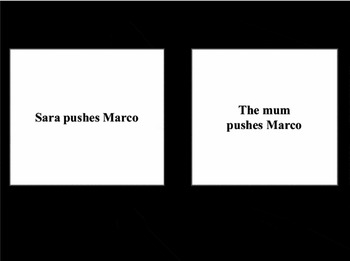
For the experimental trials, the experimenter described the two pictures to the child, as in Figure 4, and then asked a question, as in (12).
-
(12) Experimenter: Nella prima foto Sara spinge Marco. Nella seconda foto, la mamma spinge Marco. Cosa succede a Marco nella prima foto?
“In the former picture Sara is pushing Marco. In the latter, the mum is pushing Marco. What's happening to Marco in the former picture?”
Target : Marco è/viene spinto da Sara.
“Marco is being pushed by Sara”
Experimental trial eliciting a passive sentence containing the by-phrase.

The experimental trials either displayed two pictures in which the patient was the same, but the agent changed (example in Figure 4), or two pictures in which the agent was the same and the patient changed. In the former type, the by-phrase had to be obligatorily expressed (case of motivated presence); in the latter type, the by-phrase could also be omitted. This condition is exemplified in Figure 5 and (13).
-
(13) Experimenter: Ci sono due foto. Nella prima Marco spinge Sara. Nella seconda, Marco spinge la mamma. Cosa succede a Sara nella prima foto?
Target: Sara è/viene spinta (da Marco).
Experimenter: “There are two pictures. In the former, Marco is pushing Sara. In the latter, Marco is pushing the mum. What's happening to Sara in the former picture?”
Target: “Sara is being pushed (by Marco)”
Experimental trial eliciting a passive sentence lacking the by-phrase.

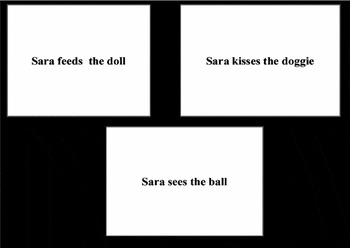
The experimental trials were interspersed with 12 filler sentences, in which children were asked to answer simple questions, using active sentences with transitive verbs, animate subjects, and inanimate objects. Children showing difficulties with these items would be excluded from the analysis. Figure 6 and (14) show an example of filler sentence.
-
(14) Experimenter: Cosa sta facendo Sara nella prima foto?
“What is Sara doing in the first picture?”
Target: Sara sta imboccando la bambola
“Sara is feeding the doll.”
Example of filler sentence.

Procedure
The procedure for the task administration is the same as that adopted in the comprehension task.
Coding
Children's productions were recorded and transcribed by the first two authors. We coded the target structures, namely, passive sentences in which the verb used by the experimenter (target verb) was produced:
-
(15) Marco è/viene spinto (da Sara).
“Marco is being pushed (by Sara).”
In addition to target sentences, we coded passive sentences in which nonactional verbs were replaced by actional ones, as in the following example:
-
(16)

Other answering strategies, such as active sentences with clitic pronouns or with full objects, that is, SVO sentences, are not included and analyzed in this paper (for a discussion, see Volpato et al., Reference Volpato, Verin, Cardinaletti, Costa, Fiéis, Freitas, Lobo and Santos2014). Differently from Manetti's (Reference Manetti, Baiz, Goldman and Hawkes2013) priming task, we have not found any passive sentences with reversed theta role errors.
Results
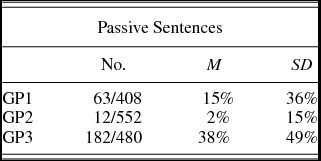
All children correctly produced filler sentences. Hence, none was excluded from the analysis. Table 5 shows the overall proportions of passive sentences produced by the three groups of children. In all groups, children produced some passive sentences, although percentages in each group are not high if compared to the total number of elicited sentences. In each group, a high interindividual variability of production is observed, because only some children produced passive sentences. In GP1, 8 children out of 17 produced passive sentences, in GP2 only 2, in GP3 almost all children produced passive structures. A repeated-measure logistic regression analysis was carried out in order to analyze accuracy data, and it was found that GP1 and GP2 significantly differ from GP3 (Wald Z = 2.923, p = .003 and Wald Z = 4.215, p < .001, respectively). GP1 is not significantly different from G2 (Wald Z = –1.103, p = .27).
Number, mean, and standard deviation of passive sentences produced by each group

Note: GP1–GP3, Groups 1–3.
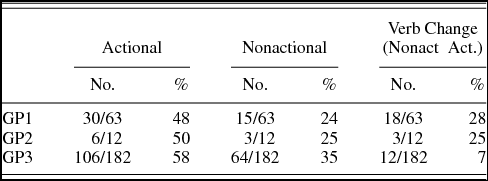
Table 6 shows the types of verbs used in the produced passive sentences. The table shows that children produced more passives containing actional verbs than passives containing nonactional verbs. In addition, in sentences in which the target verb was nonactional, children preferred changing the verb, by producing an actional one instead, thus increasing the whole percentage of this latter type.
Type of verb produced by each group

Note: GP1–GP3, Groups 1–3.
To investigate the use of the different verb types (actional, nonactional, and verb change), we run a repeated-measure 3 (group) × 3 (verb type) analysis of variance (ANOVA) using the Bonferroni correction. We found a main effect of verb, F (2, 32) = 16.213, p < .001, and an interaction effect between group and verb F (4, 64) = 3.697, p = .016. No main effect of group was found, F (2, 32) = 2.914, p = .098. By contrasting GP1 and GP2 using a repeated-measure 2 (group) × 3 (verb type) ANOVA, we did not find any significant effect: verb, F (2, 32) = 3.968, p = .033, group, F (1, 16) = 3.536, p = .078, interaction between group and verb, F (2, 32) = .874, p = .419. By contrasting GP1 and GP3 using a repeated-measure 2 (group) × 3 (verb type) ANOVA, we only found a main effect of verb F (2, 32) = 15.052, p < .001. Group and interaction between group and verb did not yield a significant effect, F (1, 16) = 0.004, p = .952 and F (2, 32) = 3.874, p = .033, respectively. By contrasting GP2 and GP3 using a repeated-measure 2 (group) × 3 (verb type) ANOVA, we found a significant main effect of group, F (1, 16) = 19.775, p < .001, verb, F (2, 32) = 18.850, p < .001, and an interaction effect between group and verb, F (2, 32) = 15.456, p = .005. We run a 1 (group) × 3 (verb type) one-way ANOVA and we found a significant effect of verb only within GP3, F (2, 57) = 10.127, p < .001. Using the Bonferroni post hoc test, we found that the production of sentences containing actional verbs is significantly higher than that of sentences with verb change (p < .001).
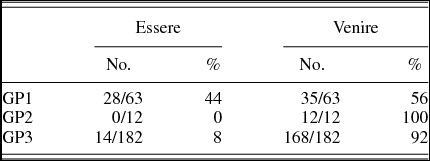
The use of auxiliaries is reported in Table 7. The auxiliary venire is largely preferred by all groups, especially GP2 and GP3. By running a repeated-measure 3 (group) × 2 (auxiliary) ANOVA using the Bonferroni correction, we did not find any significant effect of group: F (2, 32) = 3.088, p = .089; auxiliary: F (1, 16) = 4.161, p = .058; or interaction between group and auxiliary: F (2, 32) = 1.847, p = .189. By considering pairs of groups and analyzing their performance using a repeated-measure 2 (group) × 2 (auxiliary) ANOVA, we found significant effects only by contrasting GP2 and GP3. We found a main effect of group, F (1, 19) = 20.825, p < .001, a main effect of auxiliary, F (1, 19) = 14.008, p = .001, and a significant interaction effect between group and auxiliary type, F (1, 19) = 10.616, p = .004. By running a one-way ANOVA within GP3 in which the independent variable (auxiliary) had two levels, we found a significant effect, F (1, 38) = 16.213, p < .001.
Type of auxiliary produced by each group

Note: GP1–GP3, Groups 1–3.
The comparisons between GP1 and GP2, and between GP1 and GP3 using a repeated-measure 2 (Group) × 2 (Auxiliary) ANOVA did not yield any significant effect: GP1–GP2: group, F (1, 16) = 3.759, p = .070; auxiliary, F (1, 16) = 0.148, p = .706; interaction between group and auxiliary, F (1, 16) = 0.002, p = .967; GP1–GP3: group, F (1, 16) = 0.006, p = .940; auxiliary, F (1, 16) = 3.582, p = .077; interaction between group and auxiliary, F (1, 16) = 1.752, p = .204.
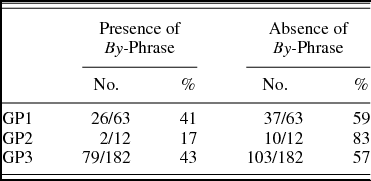
Table 8 reports the results on the use of the by-phrase. Most passive sentences produced by children lacked the by-phrase. By running a repeated-measure 3 (group) × 2 (by-phrase) ANOVA, we did not find any significant effect, group: F (2, 32) = 3.128, p = .86; by-phrase: F (1, 16) = 0.357, p = .559; interaction between group and by-phrase: F (2, 32) = 0.264, p = .669. By considering pairs of groups and analyzing their performance using a repeated-measure 2 (group) × 2 (auxiliary) ANOVA, we found a main effect of group by contrasting GP2 and GP3, F (1, 19) = 20.767, p > .001. The effect of by-phrase and the interaction between group and by-phrase were not significant, F (1, 19) = 0.081, p = .780 and F (1, 19) = 1.019, p = .326, respectively. By contrasting GP1 and GP2, and GP1 and GP3, no significant effects were found: GP1–GP2: group, F (1, 16) = 3.758, p = .070; by-phrase, F (1, 16) = 0.049, p = .827; interaction between group and by-phrase, F (1, 16) = 0.406, p = .533; GP1–GP3: group, F (1, 16) = 0.001, p = .970; by-phrase, F (1, 16) = 0.696, p = .417; interaction between group and by-phrase, F (1, 16) = 0.000, p = 1.
Use of the by-phrase in each group

Note: GP1–GP3, Groups 1–3.
Some children produced long passives also in cases in which the by-phrase is not required by the context (i.e., the by-phrase was redundantly realized, GP1: 41%; GP2: 17%; GP3: 20%). Because in this task adults produced the by-phrase 100% of the time (see Volpato et al., Reference Volpato, Verin, Cardinaletti, Costa, Fiéis, Freitas, Lobo and Santos2014), this phenomenon cannot be considered as a sign of lack of competence, but rather of redundancy also observed in adults.
In conclusion, children prefer producing actional passives with the auxiliary venire. This auxiliary is also largely adopted in passive sentences with nonactional verbs. Children tend to omit the by-phrase, but the difference between short and long passives is not significant. Like adults, children also add the by-phrase when it is not required by the context.
Interim discussion of Experiment 2
Results show that 3-, 4-, and 5-year-old children produce passive sentences. The percentage of passive structures correctly produced is undoubtedly low if compared to the number of sentences elicited by the task (and to the number of other strategies adopted by children instead of producing passive sentences, investigated in Volpato et al., Reference Volpato, Verin, Cardinaletti, Costa, Fiéis, Freitas, Lobo and Santos2014). What is worth pointing out, however, is that despite the high interindividual variability of performance, some very young children (GP1) produced 15% of passive sentences. A similar overall percentage (16%) was found in Manetti's (Reference Manetti, Baiz, Goldman and Hawkes2013) priming task used to test actional essere passives in young children ranging in age from 3;6 to 4;6. With venire passives, instead, she found that the overall rate of target adultlike sentences is 33%, which is similar to the percentage of passives produced by the oldest group in our study (38%). In an elicited production task, however, Manetti's (Reference Manetti, Baiz, Goldman and Hawkes2013) children did not produce any passive sentence. It is worth pointing out that our elicitation task is different from the one used by Manetti (Reference Manetti, Baiz, Goldman and Hawkes2013). In our task, the experimenter presented the events to the child before asking him/her the patient-oriented question. The patient was hence previously mentioned in the discourse, and the use of the passive construction was pragmatically motivated. In Manetti's experiment, the children were instead asked to answer patient-oriented questions (Che cosa succede a X? “What is happening to Xpatient?”) without introducing characters and events in the linguistic context. This might be the reason that Manetti's children did not produce any passives in the elicited production task, whereas our children did.
In our study, children have produced passive sentences using both essere and venire. The same finding has been observed in Manetti's (Reference Manetti, Baiz, Goldman and Hawkes2013) priming study. When children were exposed to the auxiliary venire, they produced more passives than when they were exposed to the auxiliary essere. Moreover, even when they heard essere passives, they produced venire passives. It can be suggested that children tend to use the unambiguously passive structure with venire. Another observation (by an anonymous reviewer) is that venire passives preferred in progressive contexts might have biased children toward venire passives.
The children in our study produced both short and long passives although a higher tendency toward the former is observed (it was not statistically significant). When a short passive contains the auxiliary essere, the sentence may be ambiguous between a stative and an eventive reading. Actually, a number of children in our experiment produced sentences containing the auxiliary essere and lacking the by-phrase, which might be analyzed as adjectival passives. This phenomenon is mainly observed in the group of younger children (GP1, age range = 3;5–4;3), for whom the by-phrase appeared to be problematic also in the comprehension task. However, it is interesting to observe that some children also produced the auxiliary essere followed by the agent, and it is most interesting that they produced a quite large number of passives containing venire, which unambiguously provides an eventive interpretation.
COMPREHENSION VERSUS PRODUCTION: A CROSS-MODALITY ANALYSIS
In this study, we also compared production and comprehension of passive sentences in the different groups. Because the groups are slightly different in the two tasks, in carrying out this comparison, the composition of groups we considered was that of the comprehension task.Footnote 19
The comprehension task showed high percentages of accuracy, differently from the production task. For all groups, a significant difference between the two modalities is observed (all ps < .001). The high percentage of accuracy (especially with actional verbs) in the comprehension task as opposed to the production task seems to suggest that comprehension precedes production. It is nonetheless worth noticing that instead of producing passive sentences, which belongs to a more formal register, children often preferred using other strategies, such as active sentences containing clitic pronouns and simple SVO sentences (Volpato et al., Reference Volpato, Verin, Cardinaletti, Costa, Fiéis, Freitas, Lobo and Santos2014), which are more frequent in colloquial contexts.
The high rate of accuracy in sentences with venire in both comprehension and production shows that verbal passives are correctly represented in young Italian children. The auxiliary venire showed a significant effect in G3 in the comprehension task and in GP3 in the production task. In GP2, venire is the auxiliary used in all cases. In these groups, accuracy significantly increased when passive sentences included this auxiliary.
These results confirm those obtained by Manetti (Reference Manetti, Baiz, Goldman and Hawkes2013) using a priming task. As we said, the preference for venire might be related to the preference of this auxiliary in progressive contexts and children's preference toward nonambiguous sentences.
Whereas the most frequent error occurring in comprehension is the use of theta role inversion, in production, children never produced sentences in which theta roles were inverted. In this respect, our results differ from those of Manetti's (Reference Manetti, Baiz, Goldman and Hawkes2013) priming experiment, in which children did produce sentences with theta role inversion. The difference between our and her results is very presumably to be attributed to the different experimental settings, elicited production versus priming, respectively. In the priming task, children had to understand a passive sentence before producing a sentence with the same structure. In our task, the linguistic context only contained active sentences, which did not cause any difficulty in the computation of thematic roles. As expected, no reversing role errors are found in production in our study.
Although in both comprehension and production, the percentages on short passives are higher than on long passives, some significant effects are observed only in comprehension and only in G1. Given the positive correlation with both forward and backward digit span, G1’s troubles with the comprehension of long passives can be attributed to their limited resources and the memory overload in the computation of sentences containing the by-phrase. Such limitations seem to be less effective in production tasks, and by-phrases were produced even by the youngest children.
In production, actional passives are not significantly different from nonactional ones, while the difference between the two verb classes is significant for all groups in the comprehension task. In production many target nonactional verbs are substituted by actional ones, which suggests that comprehension and production display a similar pattern of performance. However, that even the youngest group of children comprehends nonactional passives above chance and produces them suggests that the difference observed between actional and nonactional verbs may be considered an artifact of experimental designs and should not be attributed to grammatical reasons. In particular, these data are unexpected under the intervention and maturation approaches by Orfitelli (Reference Orfitelli2012) and Snyder and Hyams (Reference Snyder and Hyams2014).
CONCLUSION
This paper contributes to the debate on the acquisition of passive sentences by investigating the comprehension and production of this structure in Italian 3- to 6-year-old typically developing children. Verb type and presence or absence of the by-phrase have already been investigated in previous studies, but the Italian-internal variable we added (auxiliary venire) was crucial to check whether children have competence of the verbal passive structure.
The very high percentages of accuracy in the comprehension of venire passives suggests that the eventive interpretation of these sentences is fully available in child language very early. The fact that, overall, the auxiliary essere is not significantly different from the auxiliary venire contributes to strengthen our hypothesis. The difficulties experienced with essere by the youngest children can be traced back to the threefold interpretation (eventive, stative, and resultative) of this element. However, when asked to utter passive sentences through an elicitation task, 3- and 4-year-old children produced these structures with either venire or essere, also adding the by-phrase, thus unambiguously building adultlike verbal passives.
Despite the high interindividual variability within the groups of children (mainly in the production task), the correct comprehension and production of eventive passive sentences are unexpected under the adjectival passive hypothesis, the resultative passive hypothesis, the A-chain maturation hypothesis, and the AIH, which were put forward to explain children's difficulties with passives. We claim instead that the source of children's troubles with nonactional passives can be attributed to the difficult representation of nonactional verbs in the picture matching task, and the difficulties encountered with long passives by the youngest group (aged 3;4–3;11) can be attributed to their limited resources and the memory overload in the computation of these sentences.
ACKNOWLEDGMENTS
A special thanks goes to the young participants at the Scuola dell'infanzia statale “Tommaseo 1” of Venice and the Istituto Vescovile “A. Graziani” of Bassano del Grappa, Vicenza, their teachers, and their families. Thanks to Laura Tagliaferro and Emily Bonifacio for helping collecting the data. We thank two anonymous reviewers for their comments on previous versions of the paper and Mirta Vernice for her support in the statistical analysis.