Introduction
Inflation and unexpected costs for health care, including long-term care (LTC) services, are the two biggest risks that can lead people to have insufficient income for their post-retirement lifetime in the United States of America (USA). Unfortunately, most people do not fully appreciate these financial risks and do not save as much as analysts have estimated is necessary (Elmendorf and Sheiner Reference Elmendorf and Sheiner2000).
With the elderly comprising growing shares of countries' populations and current estimates indicating that at least 70 per cent of people who reach age 65 will need some sort of assistance with activities of daily living in their remaining years of life (Dilnot Commission 2011; Kemper, Komisar and Alecxih Reference Kemper, Komisar and Alecxih2005; Sun and Webb Reference Sun and Webb2013), there is growing recognition that current public programmes funding LTC services cannot meet expected greater demand in the coming decades (Kaye, Harringhton and LaPlante Reference Kaye, Harringhton and LaPlante2010). Most Organisation for Economic Co-operation and Development (OECD) countries' government programmes for people with LTC needs beyond what family and friends can provide are already requiring greater cost-sharing by individuals, especially those whose incomes are at least in the upper quartile of the income distribution (Costa-Font, Courbage and Swartz Reference Costa-Font, Courbage and Swartz2015). The combination of expected increased need for LTC and limited government resources is prompting efforts to create programmes or incentives so higher middle-income people (i.e. incomes between the 70th and 90th percentile of the income distribution) will protect themselves from the risk of high costs of LTC. Very wealthy people presumably have sufficient financial resources to finance their LTC needs.
Public policies that provide incentives for higher middle-income people to purchase private long-term care insurance (LTCI) have been proposed as a way to shield large numbers of middle-income people from the risk of needing costly LTC. However, the conditions for efficient markets for private LTCI cannot be met and so premiums for LTCI policies are inefficiently high (Brown and Finkelstein Reference Brown and Finkelstein2007). In particular, there are too many uncertainties about the future costs of LTC services, the types of LTC services that will be needed, the probability that a particular person will need LTC services later in life and expected years of life remaining given that the person does need care (Barr Reference Barr2010). Consumers' decisions about purchasing LTCI are affected by these uncertainties as well as uncertainty about whether today's insurers will still be financially viable decades in the future.Footnote 1 In addition, LTCI policies are complicated, making it difficult for many people to complete the process of purchasing a policy, and myopia about the risk of needing LTC seems to cause many middle-income people to forego purchasing LTCI policies (Colombo et al. Reference Colombo, Llena-Nozal, Mercier and Tjadens2011; Costa-Font, Courbage and Swartz Reference Costa-Font, Courbage and Swartz2015). As a result, the markets for LTCI in the USA and France – the OECD countries with the most active market for private LTCI – are small relative to estimated numbers of people who could afford to purchase LTCI. Between 7 and 8 per cent of Americans over the age of 50 (about eight million people) are estimated to have LTCI (Johnson Reference Johnson2015; Robert Wood Johnson Foundation 2014) and even in France, which has the largest share of people with LTCI of any OECD country, only 17 per cent of people over the age of 65 had a LTCI policy in 2011 (Colombo et al. Reference Colombo, Llena-Nozal, Mercier and Tjadens2011). In most OECD countries, the markets for private LTCI are very small, if they exist at all.
Despite the academic arguments that the necessary conditions are missing for private LTCI markets to be efficient, there is persistent interest among policy makers in promoting their growth as a way of expanding the ability of middle-income people to pay for LTC. Tax incentives have been used in a few OECD countries (e.g. the USA, Australia, Spain and Mexico) to reduce the effective price of LTCI and thereby encourage more people to purchase coverage. Evaluations of such preferential tax treatment in the American states suggest that they have only a modest effect on purchases. Further, because the people who take advantage of the tax subsidies are higher-income people, they are least likely to qualify for Medicaid coverage and therefore the states are foregoing more in tax revenues than they are saving in Medicaid spending (Goda Reference Goda2011).
Another public policy to promote purchases of private LTCI that has gained modest traction in the USA is the Partnership Program, which is a public–private venture. The incentive for people to purchase Partnership LTCI policies is that if their LTC needs exceed the value of their insurance policy, they can enrol in the public Medicaid programme (which paid 40% of all LTC expenditures in 2012; Reaves and Musumeci 2014) and still protect their savings and assets up to the value of the insurance policy. That is, they do not have to spend down these assets before qualifying for Medicaid. The incentive for states to offer these Partnership Program LTCI policies is that individuals who purchase these policies delay Medicaid enrolment, thereby saving states some future Medicaid costs.
Unfortunately, the hopes for the enrolment (or take-up) rate of Partnership Program policies exceed its current enrolment (Bergquist, Costa-Font and Swartz Reference Bergquist, Costa-Font and Swartz2015). Understanding why the Partnership Program is not a success may provide important lessons for other counties that have been interested in creating similar public–private ventures. In brief, we argue that the Partnership Program suffers from the same uncertainties that cause markets for private LTCI to fail to be efficient. The state governments are unable to offer sufficient assurances to consumers and insurers that the future costs of LTC services will not be far higher than at present.
In what follows, we review the structure and public–private nature of the Partnership Programs. We then briefly describe the trends in sales of both regular private LTCI policies and Partnership LTCI policies to show that both experienced low purchase rates. Implementation efforts for the Partnership Programs were very modest, in part because many were launched around the same time as the Affordable Care Act was passed. At the same time, there was a good deal of publicity about several well-known insurers withdrawing from selling private LTCI. The fact that the states could not offer more assurances that the Partnership Program insurance policies would retain their value and be able to pay for LTC costs years in the future provides a cautionary tale. In particular, public efforts to expand private insurance coverage for LTC need to address the reasons why markets for private LTCI have so far failed to be efficient. We cannot expect consumers to view Partnership-type public–private programmes any differently than traditional private LTCI unless government can reduce the inherent uncertainties about the future of LTC costs and risks.
Partnership for Long-Term Care Program (LTCP)
Background
Many explanations have been offered for why relatively few Americans have private LTCI (Brown and Finkelstein Reference Brown and Finkelstein2011; Frank Reference Frank2012). Chief among these is that purchasing LTCI is not straightforward – people must consider how much of their own savings and assets they will be able to spend on LTC many years in the future. This is a cognitively costly exercise if taken seriously. People must also assess trade-offs between how much they pay in an annual premium and the amount they estimate they will pay out-of-pocket for LTC in the future, especially when companies can increase their insurance premiums. For many middle-income people, LTCI is not a rationally good financial investment.
Another explanation is that many Americans believe – erroneously – that Medicare and private health insurance cover many expenses for LTC, and Medicaid will cover LTC as a last resort if they exhaust their savings and assets. The expectation that Medicaid will cover LTC so a person does not need to purchase LTCI is referred to as ‘Medicaid crowd-out’ of LTCI (Brown and Finkelstein Reference Brown and Finkelstein2004; Brown, Coe and Finkelstein Reference Brown, Coe, Finkelstein and Poterba2007; Costa-Font and Courbage Reference Costa-Font and Courbage2015; Pauly Reference Pauly1990). However, evidence on the extent of Medicaid crowd-out is limited. Wiener et al. (Reference Wiener, Anderson, Khatutsky, Kaganova and O'Keeffe2013) estimate only about 10 per cent of the previously non-Medicaid population aged 50 and older spent down to Medicaid eligibility, and those that did are disproportionally lower income and community residents using personal care services.
Despite little evidence of a Medicaid crowd-out effect, the notion has traction. One reason is that Medicaid has been the largest funder of LTC expenditures in the last decade. Forty per cent of LTC expenses in 2012 were financed by Medicaid (Reaves and Musumeci Reference Reaves and Musumeci2014). Although almost half of Medicaid's expenditures for LTC are for people younger than 65, the projected growth in the elderly population as the baby-boomers retire has policy makers very concerned about Medicaid's financial viability.Footnote 2
Partnership Program incentives
The LTCP was designed to potentially reduce the financial pressure on Medicaid to pay for LTC. Historically, public–private Partnership Programs have involved government incentives for private companies to build large public infrastructure projects or manage utilities. The LTCP builds on this notion but involves three partners: a federal-state programme (Medicaid) supporting the insurance scheme, private insurance companies willing to sell specific designs of LTCI and individuals who might purchase the Partnership LTCI policies. The LTCP was originally established in the early 1990s in California, Connecticut, Indiana and New York through grants from the Robert Wood Johnson Foundation (RWJF), which had fostered the idea through a demonstration programme.Footnote 3 Shortly after these four states created their LTCPs, the US Congress passed legislation that prohibited other states from implementing Partnership Programs. But by 2005, with growing Medicaid expenditures for LTC, Congress reversed its stance and authorised the expansion of LTCPs in other states. By 2013, 41 states (including the original four) had implemented Partnership Programs for LTCI.
The Partnership Program concept is based on the assumption that middle-class people (who would neither qualify for Medicaid nor self-insure their LTC needs) will be more likely to purchase a LTCI policy if they can protect a significant share of their assets in the event of their LTC expenses exceeding some threshold that would cause them to depend on Medicaid. Most traditional LTCI policies are designed to protect the insurer from adverse selection. They limit the amount of LTC expenses they cover and the majority also cap the duration of the insurance benefits at three to five years once the benefits begin. Thus, after a person's insurance benefits are exhausted, they become responsible for covering all of their LTC costs. For many people, this means they must deplete their savings and assets to pay their LTC expenses. Once they exhaust their assets (except for their equity in a home and a car), they are likely eligible for Medicaid to pay for their LTC either at home or in a nursing facility. Thus, the Partnership Program provides an incentive for middle-class people to purchase LTCI (Meiners Reference Meiners2009): after an individual exhausts his or her LTCI benefits and then qualifies for Medicaid, the Partnership LTCI policy protects his or her assets up to the value of the policy. The protected assets do not have to be spent before the person can qualify for Medicaid.
The Partnership Program has two advantages for policy holders: protection of some assets and lower premiums than traditional LTCI because Partnership policies generally cover a shorter amount of time (one to three years) than traditional LTCI policies (often three to five years). In addition, income earned on protected assets can be applied to the cost of care, providing yet further resources for paying for LTC (Meiners Reference Meiners2009). The Program's advantage for state governments is that people who purchase Partnership LTCI policies may not need Medicaid to help pay for LTC at all or as early as they would otherwise. If more people's initial three years of LTC expenses are covered by insurance, the growth in states' expenditures for Medicaid might be reduced. The potential savings are especially important with larger numbers of elderly expected to need help in financing LTC in the next two decades. Thus, advocates of the Partnership Program anticipate that middle-class people who in the past have not been interested in purchasing LTCI will be enticed to do so because of lower premiums and the ability to protect more of their assets.
Evaluation of Partnership Programs' effects
There is an ongoing debate about whether or not sufficient time has passed for an assessment of the four original Partnership Programs. Programme redesigns in the late 1990s – particularly in California and Connecticut – contributed to a belief that the Partnership Programs' effects in the years before 2000 could not be evaluated well (Ahlstrom et al. Reference Ahlstrom, Clements, Tumlinson and Lambrew2004; Meiners, McKay and Mahoney Reference Meiners, McKay and Mahoney2002).
Previous assessments of the Partnership Programs focused largely on the numbers of policies sold and their impact on state Medicaid expenditures for LTC (a full list of such studies is available upon request). Two such studies are worth noting because they have influenced more recent perceptions of the Partnership Programs' effects. A United States Government Accountability Office (US GAO) study in 2007 found that Medicaid savings were not likely, but Medicaid costs would be minimal because the GAO assumed that many participants would still be too wealthy to qualify for Medicaid. The GAO study also assumed policy holders do not over-insure their assets, which is a major source of potential Medicaid savings, and it assumed people do not often transfer their assets to others in order to qualify for Medicaid (Meiners Reference Meiners2009; US GAO 2007). Sun and Webb's (Reference Sun and Webb2013) numerical optimisation study suggests the Partnership Programs increased insurance coverage only among single individuals (by 4–5%), and that Partnership policies have been purchased mostly by people who, absent the availability of the Partnership Programs, would have purchased traditional LTCI. Hence, the Partnership policies appear to be largely substitutes for traditional LTCI contracts.
Traditional and Partnership LTCI sales in original Partnership states: 2000 and 2008
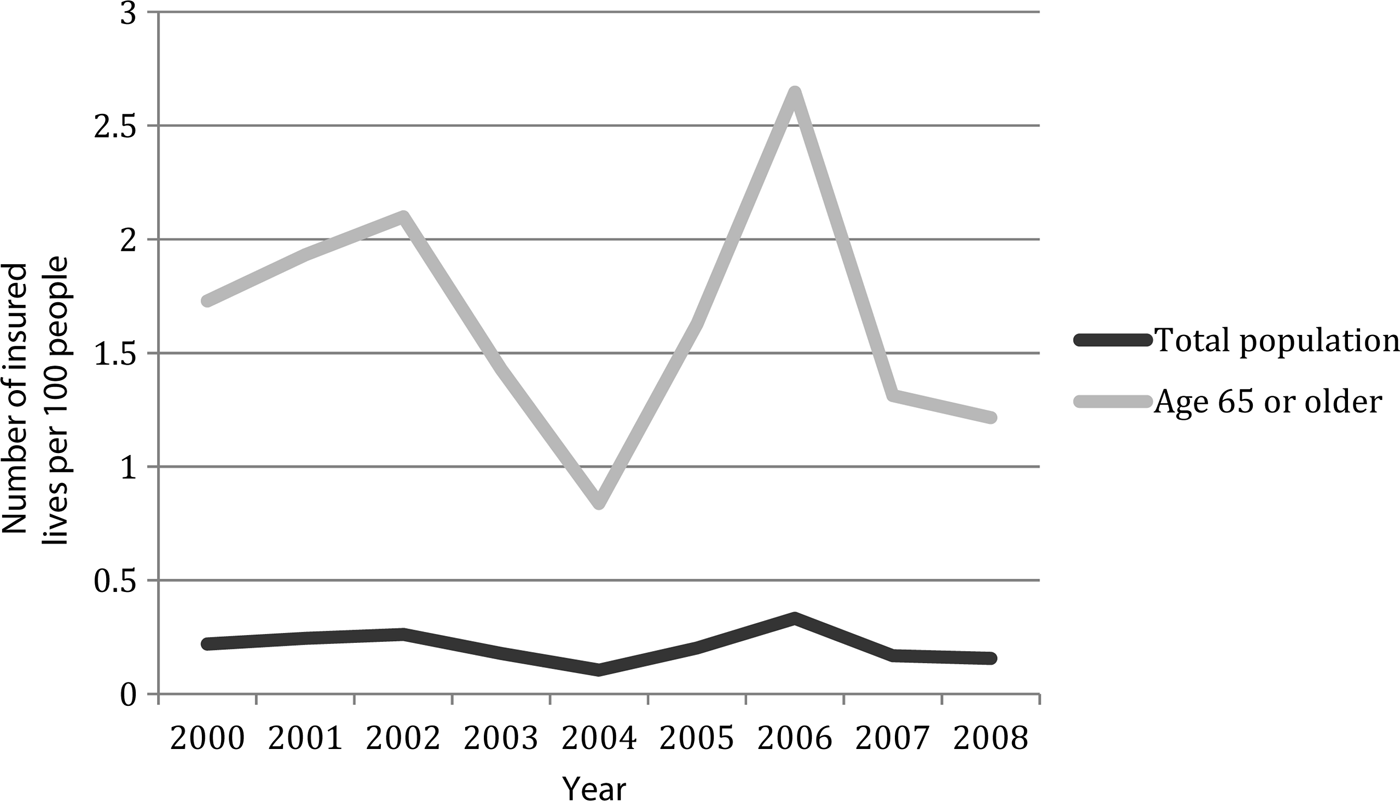
The number of people covered by private LTCI policies of all types (traditional and Partnership) shows low market penetration between 2000 and 2008 (Figure 1). To put Figure 1 in perspective, recent estimates indicate that sales of new LTCI policies were around 322,000 in 2012 compared to more than 700,000 new policies that were sold in 2002; approximately eight million people have LTCI (according to the American Association of Long-term Care Insurance and US Department of Health and Human Services, as cited by Johnson Reference Johnson2015).
United States all contracts: traditional and Partnership.

As Figure 1 indicates, the total number of people covered by LTCI (both traditional and Partnership policies) fell substantially in both 2004 and 2006–2007. Several factors contributed particularly to the decline in 2004: substantial rate increases for traditional LTCI went into effect in 2004, rate stability regulations were passed by states starting in 2004 and two large LTC insurers exited the market (Society of Actuaries 2005). We do not have a good explanation of the apparent rebound in sales in 2005–2006, and the fall-off in sales of all LTCI policies that starts in 2006–2007 – the apparent rebound may just reflect changes in small numbers rather than a change in trend. The continued decline in sales past 2008 no doubt reflects the great recession and the sharp decline in the number of insurers actively selling a substantial number of policies (Johnson Reference Johnson2015).Footnote 4
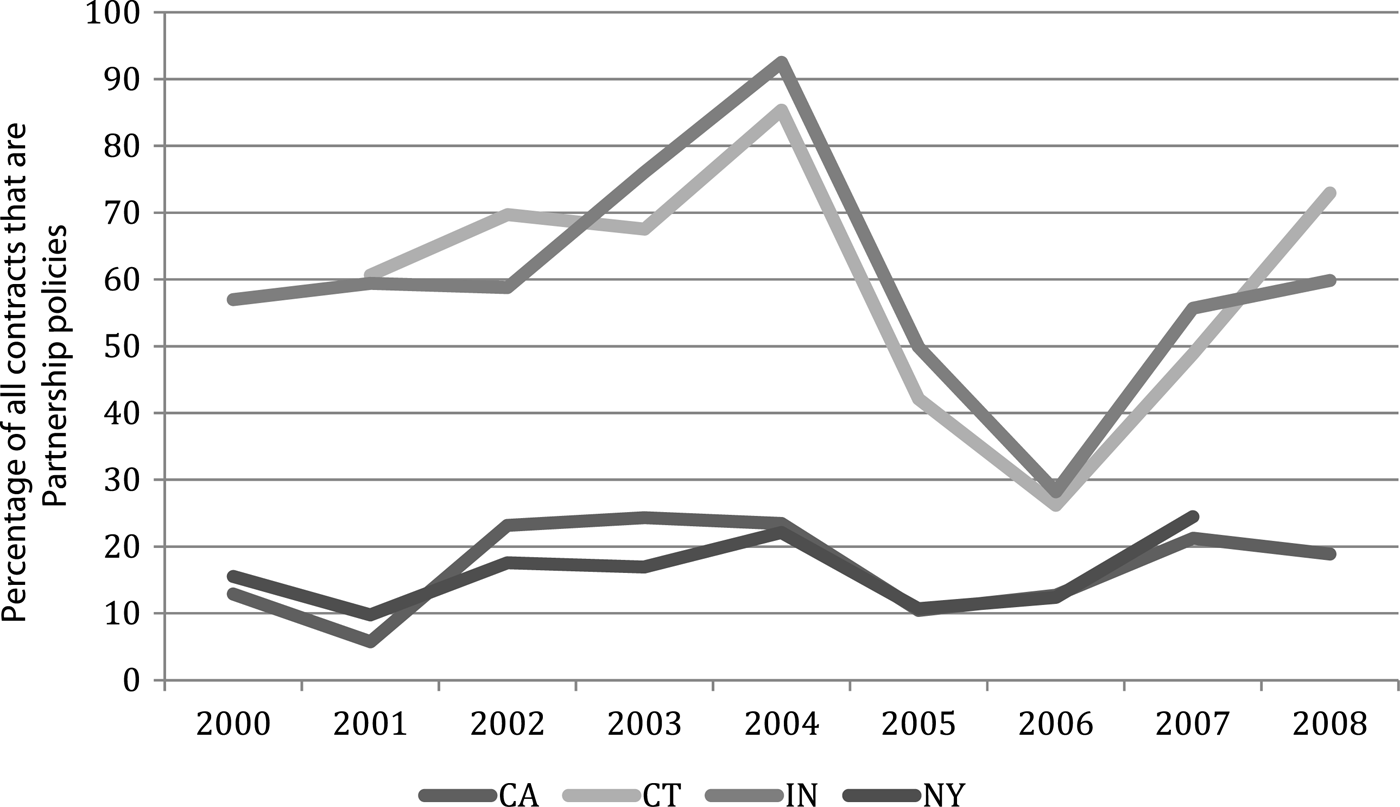
In both Connecticut and Indiana, Partnership policies have been a larger percentage of the LTCI market than in California and New York (Figure 2). The large increase in the Partnership share of the market in Connecticut and Indiana in 2004 is likely due to the decline in sales of traditional LTCI policies caused by the upsurge in premiums for traditional policies that year. However, the decline in Partnership policies' share of the LTCI market in 2005–2006 reflects a fall-off in Partnership sales while traditional policy sales rose again. By comparison, Partnership policies in California and New York maintained a relatively steady percentage of overall sales, between 10 and 20 per cent. Given the much larger populations of California and New York, it is possible that the overall larger number of sales of both types of LTCI policies in these states is why Partnership policies account for a steady but smaller share of LTCI policies.
Partnership policies as a percentage of total policies, California (CA), Connecticut (CT), Indiana (IN) and New York (NY).

Expansion Partnership Programs
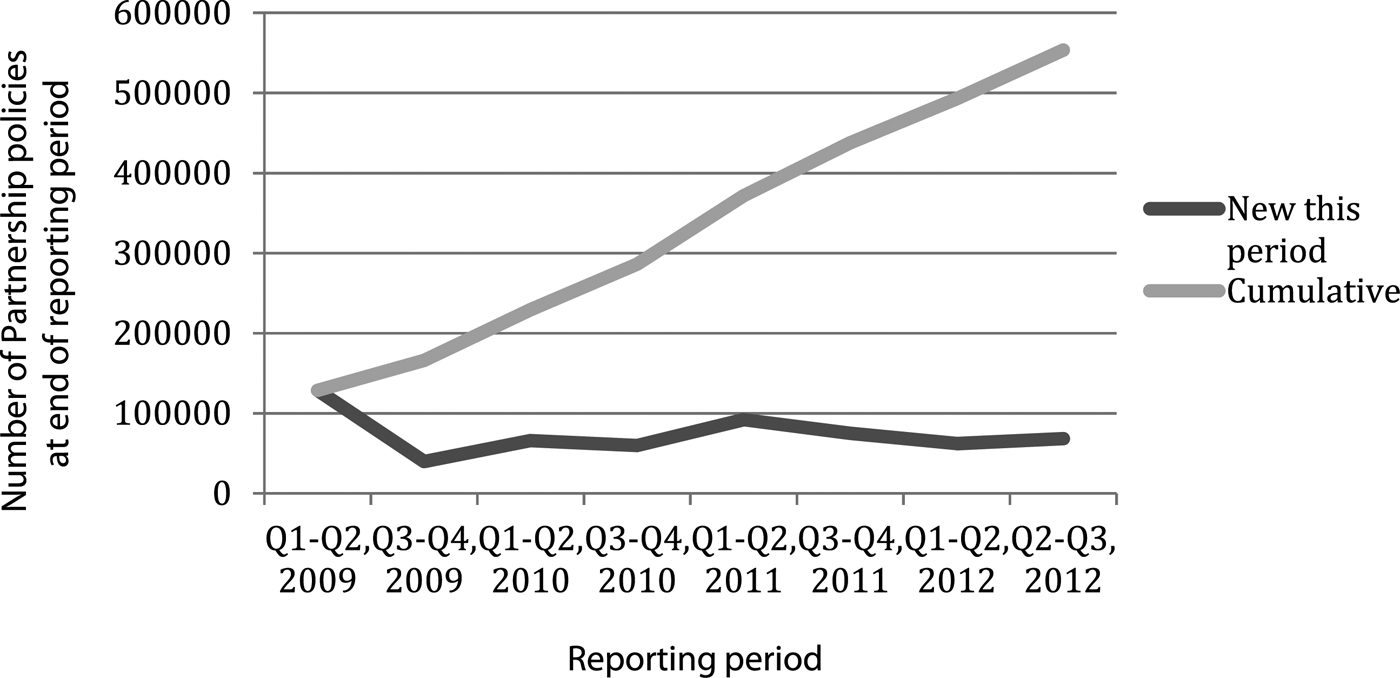
After Congress lifted the moratorium on the Partnership Program expansion in 2005, most of the 37 new programmes were implemented in 2008 or 2009. Since then, sales of new Partnership LTCI policies have totalled less than 100,000 per year through 2012 among all the new programmes (Figure 3). The expansion programmes are generating similar sales numbers as the four RWJF Partnership Programs, which sold approximately 20,000 contracts per year in total between 2000 and 2008. Looking at trends in penetration of Partnership sales, from 2009 to 2012 the number of newly issued policies in force per 100 people age 65 and older has consistently stayed between 0.6 and 0.4. In 2012, across all expansion states, approximately 0.43 newly issued policies were in force per 100 people age 65 and older.Footnote 5 This rate is comparable to the penetration of Partnership sales in California and New York during the 2000–2008 time period.
Expansion Partnership Programs: policies in force.

The expansion states' aggregate numbers mask a good deal of variation in penetration rates. West Virginia has a low number of policies sold and a relatively high percentage of the population are 65 and older. At the other end of the spectrum are Florida, Minnesota, Texas and Wisconsin; their combined sales make up about a third of all new Partnership sales among the expansion states. In 2012, across these four states, approximately 0.652 newly issued polices were in force per 100 people age 65 and older, a rate that is well above the penetration rates seen in California and New York from 2000 to 2008.
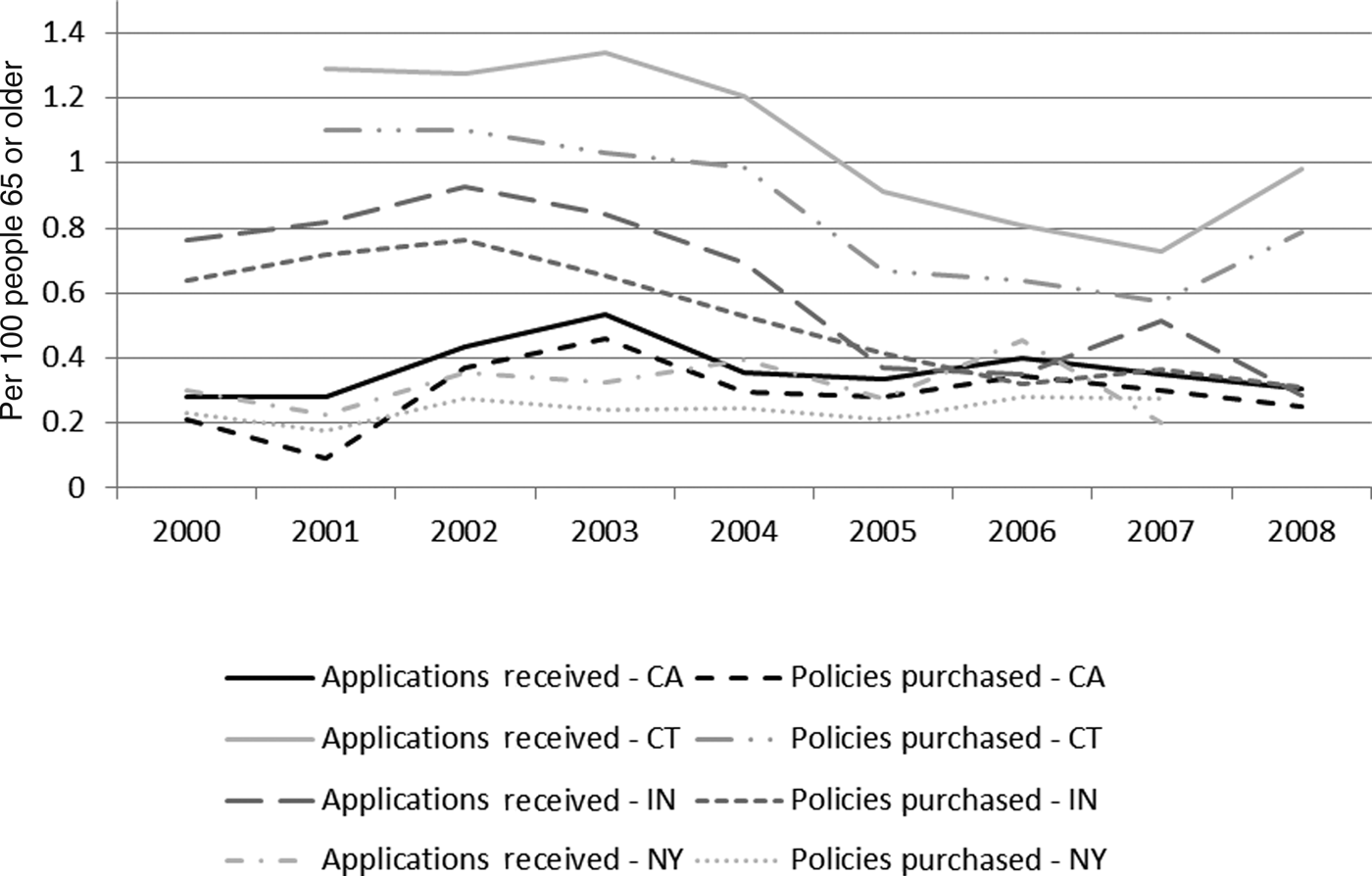
Given the relatively small number of Partnership LTCI policies sold in the original Partnership Program states between 2000 and 2008 (see Figure 4) and the increase in non-elderly who qualified for Medicaid on the basis of disability during the early 2000s (Bergquist, Costa-Font and Swartz Reference Bergquist, Costa-Font and Swartz2015; United States Department of Health and Human Services 2006), it should not be surprising that Medicaid spending on LTC services has not slowed in the four states. It is too early to expect to observe a slowing of Medicaid LTC spending per person in the 37 expansion Partnership states.
Partnership applications versus purchases, California (CA), Connecticut (CT), Indiana (IN) and New York (NY).

In sum, the trends in sales of the original Partnership Programs between 2000 and 2008 track the trends in sales of traditional LTCI policies. The original Partnership states' sales trends of both types of policies suggest that there may have been modest substitution of Partnership policies for traditional LTCI. However, the basic trend in sales of LTCI did not grow substantially during this time period. Equally important, among the expansion Partnership Programs between 2009 and 2012, the trend in Partnership policy sales is very similar to the trend in sales of the original RWJF Partnership Programs between 2000 and 2008. Thus, the sales data suggest that whatever factors were affecting sales of traditional LTCI were also affecting sales of Partnership policies.
Primary reasons for modest sales numbers
Affordability of Partnership policies is almost certainly the primary obstacle to greater market penetration. State programme data indicate that underwriting levels for the Partnership policies are as high as they are for traditional LTCI contracts, suggesting that Partnership premiums are inefficiently high (Bergquist, Costa-Font and Swartz Reference Bergquist, Costa-Font and Swartz2015). Moreover, a non-trivial share of applications has been denied each year, likely contributing to consumer apprehensions that they may not be approved even for Partnership policies. The extent of underwriting also suggests that the Partnership Programs have so far failed to attract sufficient numbers of healthy, younger middle-income consumers who might reduce insurers' concerns about adverse selection risk.
Another strong explanation for the modest sales numbers for Partnership policies is that marketing for Partnership plans was anaemic so many consumers were unaware of their existence (Alper 2007; Meiners Reference Meiners2012).Footnote 6 This could account for why Partnership sales are not a higher percentage of overall LTCI sales, particularly in New York and California, which have been less proactive about efforts to make consumers aware of the risks of high LTC costs. Our analysis of the RWJF Partnership Programs could not account for implementation issues encountered by each state. We do not know, for example, if the low level of sales of Partnership policies was due to people being unaware of their availability or insurance agents being reluctant to recommend them to clients. Commission-driven insurance agents may have had less interest in informing prospective buyers about the policies because commissions are based on premiums; the shorter-term Partnership policies have slightly lower premiums than the longer-duration traditional LTCI policies (Meiners Reference Meiners2012).
Significantly, the timing of the expansion of the Partnership Program (2008–2012) coincides with both the years of the great recession and state attention to the implementation of the Affordable Care Act (American health reforms). This could explain a good deal of the lacklustre sales of Partnership and traditional LTCI policies between 2008 and 2012. The Affordable Care Act included a section known as the Community Living Assistance Services and Supports (CLASS) Act, which would have created a voluntary social insurance programme for LTC. People who would have been involved in implementing the Partnership Programs were caught up in debates about the viability of the CLASS Act, which was finally abandoned by late 2012. Finally, the Obama Administration stopped funding aggregate data collection on the Partnership Programs in 2013, signalling the higher priority of other health reforms.
Implications: government needs to address uncertainties
The bad luck of timing and poor implementation management point to the underlying problem with the Partnership Program: it does not address the uncertainties in private LTCI markets. The significant underwriting of premiums and premiums that are substantially higher than expected benefits should not be an unexpected outcome. Even if the federal and state governments had focused on implementation, the current structure of the Partnership Program cannot overcome the fundamental uncertainties of an insurance product that is unlikely to pay out benefits for decades and the benefits themselves are not known.
If the public policy goal is to have almost all people older than age 50 with higher middle-incomes have insurance for LTC, government programmes (with or without a private-sector component) need to reduce the uncertainties inherent in voluntary markets for LTCI. This means that such efforts must require all higher middle-income people to contribute an annual amount equal to a percentage of income to a fund designated solely for LTCI. If private insurers are to offer LTCI plans that people can choose among, the plans' benefit structures should be standardised to reduce the complexity of LTCI. Further, if private insurers are to be involved in the programme, the government should determine which insurers are qualified. With these stipulations, government can assure those with higher middle-incomes that they will have at least some minimum set of LTC needs covered no matter what the future costs of LTC may be.
Regardless of whether a LTC policy initiative is a public insurance programme or a public–private programme with the conditions we have outlined, it protects higher middle-income people against the risk of catastrophic LTC costs. It also protects the government from the risk that higher-income people may become poor enough to qualify for a government programme for lower-income people with LTC needs. The key point here is that public policies intended to encourage higher middle-income people to protect themselves from the risk of high LTC costs must address the uncertainties inherent in voluntary markets for private LTCI. The Partnership Program failed to do that and the market outcome should come as no surprise.