Introduction
Normal adhesion testing is a widely used technique for determining adhesive contact between two surfaces. This testing technique most typically involves bringing a probe of known geometry in contact with a flat sample, applying a normal preload, and then retracting the probe until separation occurs.[Reference Hertz1–Reference Shull5] The most common approach is to utilize a hard, spherical probe to determine the adhesive properties of a soft, flat specimen.[Reference Maugis and Barquins6–Reference Kroner, Paretkar, McMeeking and Arzt11] The spherical nature of the probe makes testing relatively insensitive to slight misalignment, although the increasing contact area with increasing preload complicates data interpretation. A theoretical solution of the contact between spherical objects was developed by Johnson, Kendall, and Roberts (so called “JKR” theory),[Reference Johnson, Kendall and Roberts3] and has been widely accepted to describe the adhesive behavior of a clean, smooth, elastic surface, showing no hysteresis in the loading–unloading paths.[Reference Zhao and Kwon12]
Another commonly used probe geometry is a flat probe; the contact area beneath a flat probe is insensitive to the preload force, and the theory describing the adhesive behavior (often simply referred to as “Kendall” theory) is well-established.[Reference Kendall2] Unfortunately, flat probe testing is infrequently used relative to spherical probes because of the practical issues associated with probe alignment relative to the sample surface. However, recently some of the current authors have built a normal adhesion test set-up which allows control of probe–sample alignment within a fraction of a degree, allowing for more accurate testing.[Reference Kroner, Blau and Arzt13]
The purpose of this work is to derive a deeper fundamental understanding of adhesive behavior by experimentally characterizing normal adhesion behavior using spherical and flat probes, and comparing the results directly with well-established theories. Comparison of JKR and Kendall theory from a materials perspective reveals a strong relationship with surface energy; however, only flat probe adhesion is dependent on elastic modulus. Although these theories are well established, this has never been directly investigated; from a practical perspective it is difficult to change the elastic modulus without also changing the material and hence the surface energy. Our goal was to directly test a polymer network whose elastic modulus could be systematically varied independent of the surface energy. To accomplish this, we have derived an acrylate-based polymer system with tailorable mechanical properties. Specifically, four networks were fabricated with systematically varied crosslink molecular weight and mass fraction such that storage modulus can be varied over approximately an order of magnitude (2–12 MPa), while maintaining nearly constant glass transition temperature (T g) (−37 °C) and surface energy (γ s). These polymer networks are ideally suited for this fundamental study, as spherical adhesion testing is considered to be independent of material modulus, while flat probe testing is assumed to directly dependent on the square-root of modulus.
Experimental
The linear builder butyl acrylate (BA, number average molecular weight, M n ~128), crosslinker poly(ethylene glycol) dimethacrylate (PEGDMA, M n ~750), and the photoinitiator 2,2-dimethoxy-2-phenylacetophenone (DMPA) were procured from Sigma Aldrich (Sigma-Aldrich, St. Louis, MO). The other crosslinker poly(ethylene glycol) dimethacrylate (PEGDMA, M n ~ 1000) was procured from PolySciences Inc. (Warrington, PA). A crosslinker solution (XLS) was created by mixing 88% PEGDMA 1000 with 12% PEGDMA 750. Note that all % values are wt%. The XLS solution was chosen based on preliminary testing to yield a constant T g when copolymerized with BA, regardless of the XLS weight fraction. The BA-co-XLS networks were thoroughly mixed and then solidified by UV-induced free-radical polymerization using 0.1% DMPA photoinitiator.[Reference Frick, Lakhera and Yakacki14–Reference Lakhera, Laursen, Safranski and Frick18] The low-strain thermo-mechanical properties of the samples were characterized by dynamic mechanical analysis (DMA, TA Instruments Q800DMA, New Castle, DE). These samples were thermally equilibrated at −80 °C for 5 min and heated to 40 °C at a rate of 2 °C/min while subjected to a 0.1% dynamic tensile strain at 1 Hz. T g was defined as the peak of the tan delta curve.[Reference Cook and Delatyck19] The rubbery modulus, E r′, was defined as the storage modulus at 22 °C.
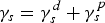
Contact angle measurements were performed using the EasyDrop Goniometer (Kruss Scientific, KRÜSS GmbH, Hamburg, Germany) to characterize the surface energy of the samples, γ s. Water and hexadecane were chosen as polar and non-polar liquids. The γ s was estimated using the Owens and Wendt model[Reference Owens and Wendt20]:
 $$\gamma _s = \gamma _s^d + \gamma _s^p$$
 $$\gamma _l \lpar 1 + \cos \theta\rpar = 2 \sqrt {\gamma _s^d } \sqrt {\gamma _l^d } + 2\sqrt {\gamma _s^p } \sqrt {\gamma _l^p }$$
where θ is the measured contact angle, γ l is the total surface tension of the liquid used, and superscript d and p denote the dispersive and polar components. A white light interferometer (Zygo NewView 5000, Zygo Corporation, Middlefield, CT) was used to obtain an estimate of the roughness of the probe and samples. The probes exhibited roughness on the order of 5 µm, while it was in the average range of 18–48 nm for samples of all crosslinking densities. The adhesion measurements were performed on the samples using a custom-made macroscopic adhesion measurement device built by Kroner et al.[Reference Kroner, Paretkar, McMeeking and Arzt11, Reference Kroner, Blau and Arzt13] The sample surface was cleaned with water and the probe surface was cleaned with high-purity ethanol before adhesion measurements. To measure adhesion the probe was brought in contact with the sample. After compressive preloading the probe was retracted at a constant rate until pull-off occurred. The loading/unloading velocity was kept constant at 10 µm/s. The preloads tested were 5000, 10,000, and 20,000 µN for spherical probe testing while only one preload of 5000 µN was used for flat probe testing, as flat-probe adhesion measurements are preload independent. Thirty measurements were performed for every sample to obtain statistically relevant data. The environmental temperature was recorded to be in the range of 25.5–27.0 °C, while relative humidity was always in the range of 27–42%. Data collection was performed using LabView software (National Instruments Corporation, Austin, TX) package. The spherical and flat probes were made of borosilicate glass having a diameter of 3 and 2 mm, respectively.
Results and discussion
Thermo-mechanical testing
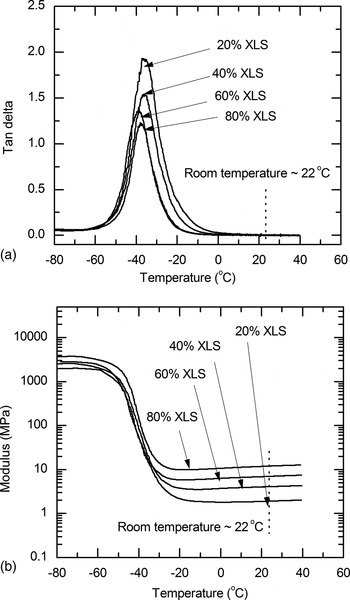
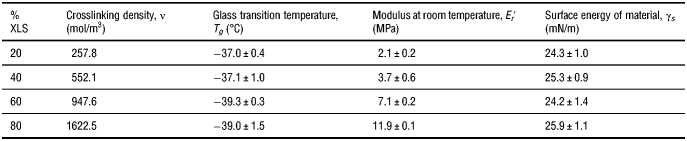
Representative data obtained from low-strain thermo-mechanical tests are summarized in Fig. 1. Figure 1(a) shows that tan delta increases with temperature, reaches a peak value at temperatures ranging from −37 to −39 °C (used to define the T g), and decreases with further increase in temperature. The tan delta peak scaled inversely with mass fraction of XLS. At 22 °C, where adhesion measurements were performed, all materials exhibit very low tan delta values (0.001–0.004) indicative of small time-dependent contribution. Figure 1(b) shows that independent of the crosslinking density, all samples demonstrate a sharp transition from glassy to rubbery state. With increasing temperature the modulus drops significantly at around T g for all crosslinking densities and reaches a plateau well above T g. For temperatures above T g, the segmental rotations are relatively free and the polymer chains can slide past each other.[Reference Mather, Luo and Rousseau21] Under these conditions, the crosslinking density dominates the material stiffness, thus, E r′ of the samples increases with an increase in the crosslinking density [Fig. 1(b)]. Accordingly, for an elastomeric network above T g, it has been well established that the crosslinking density, ν, is related to E r′ through the following relation:
 $$E_r^{\prime } = 3 \nu RT$$
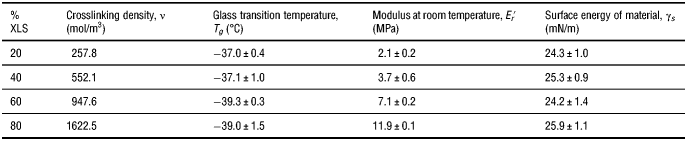
where R is the gas constant and T is the absolute temperature at which E r′ is measured.[Reference Ortega, Kasprzak, Yakacki, Diani, Greenberg and Gall22] The ν values along with the thermo-mechanical properties of all samples obtained from DMA are presented in Table I.
Representative DMA curves of the developed samples.

Summary of thermo-mechanical properties obtained from DMA analysis. Also presented are the crosslinking density and surface energy at room temperature.
Contact angle testing
The values for γ s obtained using the contact angle measurements, for all samples at 22 °C, are also presented in Table I. It can be seen that γ s does not change significantly with the amount of XLS. A previous study by some of the authors demonstrated that oligomers can be pulled out from the sample during adhesion testing and transferred to the probe surface, thereby reducing the surface energy of the probe.[Reference Kroner, Maboudian and Arzt23] This leads to a gradual change from glass surface energy to sample surface energy. To quantify this effect, contact angle measurements were performed on a pristine piece of glass cleaned with acetone, ethanol, and isopropanol, which gave average values of 47° for water and 0° for hexadecane. The same piece of glass was brought in contact with a 20% XLS sample 100 times and average contact angles were measured to be 75° for water and 11° for hexadecane. Using Eqs. (1) and (2), the surface energy of pristine glass and sample-contacted glass was calculated to be 53 and 33 mN/m, respectively. A significant decrease in the surface energy of glass towards the surface energy of the material (~25 mN/m) was observed. It can be assumed that the glass surface energy will approach the sample surface energy after a few hundred measurements. Therefore, the samples were indented 1000 times to stabilize the probe surface energy, before the actual adhesion measurements were obtained. All theoretical calculations were performed assuming the probe and the polymer samples were of equal surface energy.
Spherical probe adhesion measurements
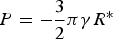
Hertz investigated the contact between elastic spherical bodies and proposed a theory that agrees quite well for a contact between rigid materials. However, it fails to describe the behavior of soft materials, as it does not take into account adhesion.[Reference Hertz1] Thus, Johnson, Kendall, and Roberts extended Hertz's theory taking adhesive interactions into consideration, resulting in the well-known JKR theory.[Reference Johnson, Kendall and Roberts3] The JKR theory derives an expression for the pull-off force, P, at which separation of the two spheres will occur, as
 $$P = - \displaystyle{3 \over 2}\pi \gamma R^{\ast}$$
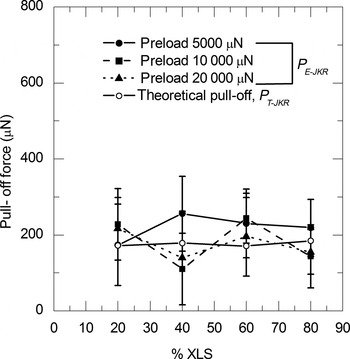
where R* is the reduced radius given by 1/R* = 1/R 1 + 1/R 2, with R 1 and R 2 being the radii of curvature of the bodies in contact and γ is the work of adhesion per unit area. From Eq. (4) it can be seen that the pull-off force only depends on γ and R*, and is independent of the elastic modulus. Figure 2 shows the experimental JKR pull-off force, P E-JKR values obtained from adhesion testing at 22 °C for three different preloads of 5000, 10,000, and 20,000 µN. P E-JKR followed a similar trend for all tested preloads. Following the oligomer transfer argument, theoretical pull-off forces were also obtained by using γ s straight in Eq. (4) instead of γ and are termed P T-JKR. P T-JKR matches quite well with P E-JKR for all samples tested, thereby justifying the oligomer transfer argument. The data from Fig. 2 indicate that the pull-off force is independent of the amount of XLS and accordingly of the elastic modulus for a large range of tested samples, which is in agreement with the JKR theory. The scatter shown in Fig. 2 might be related to the relatively high stiffness of the material, which causes low adhesion. As a consequence, slight variations in surface topography and inhomogeneities in the material properties result in a broad variation of the data.
Experimental and theoretical JKR pull-off forces at room temperature as a function of %XLS. Experimental pull-off forces are independent of the amount of XLS in the range from 20% to 80% XLS.

Flat probe adhesion measurements
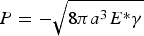
The indentation of a flat punch on an elastic half-space is proportional to the applied load, while the contact area stays constant, independent of the preload.[Reference Kendall2] Kendall[Reference Kendall2] showed that the value of P, the critical pull-off force can be obtained from fracture mechanics and thermodynamic arguments. Using this approach, P was obtained as
 $$P = - \sqrt {8\pi a^3 E^{\ast} \gamma }$$
where a is radius of the probe, 1/E* is the reduced elastic modulus given by (1 − ν12)/E 1 + (1 − ν22)/E 2, where E 1 and E 2 are the elastic moduli of the two materials in contact and ν 1 and ν 2 are their respective Poisson's ratios. Consequently, P depends on the probe size, the surface energy of the materials, and their elastic moduli.
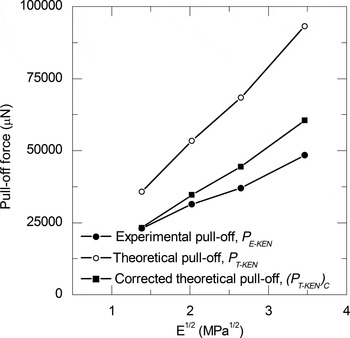
The experimental Kendall pull-off force, P E-KEN, obtained from the adhesion measurements is presented in Fig. 3. P E-KEN was observed to increase linearly as a function of the square root of the elastic modulus, as expected from Eq. (5). Theoretical pull-off forces, P T-KEN were calculated as before and were also seen to increase as a function of the square root of the elastic modulus. As surface energy and probe size are constant, this is an effect of the change in elastic modulus. However, the P E-KEN values are lower than P T-KEN values by a factor of 1.5–2.
Experimental and theoretical Kendall pull-off forces at room temperature as a function of square root of material modulus. Pull-off force increases as a function of elastic modulus. The error bars are very small and lie within the symbols (on the order of 200 µN).

The reason for this difference was that the probe used in this study did not have a perfectly flat surface. White light interferometry of the probe showed a variation of approximately 5 µm in surface roughness close to the edge. Therefore, the surface roughness of the rigid probe was dominant over the surface roughness of the soft samples during adhesive contact formation. This variation in surface roughness was predominantly seen to exist in the annulus of width 250 µm from the edge of the probe. However, the rest of the probe surface (diameter ~1.5 mm) was relatively flat, showing a variation in roughness to a fraction of 1 µm. Therefore, a perfectly flat adhesive Kendall contact occurs over a diameter of 1.5 mm instead of 2 mm of the probe size, thereby explaining the P T-KEN values being higher than the P E-KEN values. The corrected P T-KEN values corresponding to a flat probe diameter of 1.5 mm (P T-KEN)C are also shown in Fig. 3 and matches fairly well with the experimental results. Despite the absolute values differing from each other, the observed general trend follows the prediction of the Kendall model. These experiments highlight that adhesion against a flat probe can be controlled by tuning the crosslinking density and therefore the elastic modulus.
Conclusion
Acrylate networks with T g (~− 37 °C) and varying elastic modulus (2–12 MPa) were developed such that the effect of modulus on pull-off force measurements can be studied. For spherical testing, the experimental pull-off forces showed no modulus dependency as expected from the JKR theory. It is proposed that the transfer of free oligomers from the sample to the probe surface causes a decrease in probe surface energy during repeated measurements. The theoretical pull-off forces calculated considering this effect were in good agreement with the experimental pull-off forces for all samples tested. Flat probe testing revealed an increase in pull-off force as a function of elastic modulus, which is in agreement with Kendall's theory. The experimental values were lower than the theoretical values owing to probe geometry allowing for reduced contact and causing detachment at lower pull-off forces.
Acknowledgments
This project has been partly funded by the Volkswagen Stiftung and by the German Science Foundation (DFG SPP1420).