INTRODUCTION
Symbioses are common in the marine environment. Some taxa appear to be particularly prone to be involved in associations. It is the crustaceans that probably form more associations with other classes than any other marine animals (Ross, Reference Ross and Bliss1983), crustacean–cnidarian associations being particularly common (Patton, Reference Patton1967).
Many associations of shrimps and crabs with other animals have been described from the eastern Atlantic (e.g. Wirtz & Diesel, Reference Wirtz and Diesel1983; Wirtz et al., Reference Wirtz, Müller and Nahke1988; Wirtz, Reference Wirtz1997; Wirtz & d'Udekem d'Acoz, Reference Wirtz and d'Udekem d'Acoz2001, in press; Calado et al., Reference Calado, Dionisio and Dinis2007) and from the Caribbean (e.g. Herrnkind et al., Reference Herrnkind, Stanton and Conklin1976; Criales, Reference Criales1984; Patton et al., Reference Patton, Patton and Barnes1985; Spotte & Bubucis, Reference Spotte and Bubucis1996). The crustaceans encountered in these studies often belonged to undescribed species. To date, however, no such studies have been made along the coast of Brazil. Searching potential hosts for associated crustaceans along the coast of Espírito Santo, Brazil, was therefore likely to result in the discovery of new associations, the discovery of crustacean species new for Brazil and the discovery of undescribed species.
MATERIALS AND METHODS
All observations were made while SCUBA diving (43 dives, 40 during daytime, three during night-time; depth range 0–42 m) or snorkelling during daytime and at night, from March to June 2006, along the coastline of Espírito Santo. Potential host species were searched visually and symbionts were collected with the help of a small hand net. The geographical coordinates of the sampling sites are:
Santa Cruz, Aracruz: 20°00′S 40°09′W
Curva da Jurema, Vitória: 20°18′S 40°17′W
Ilha do Boi, Vitória: 20°18′S 40°16′W
Guarapari: 20°39′S 40°30′W
Ilhas Rasas, Guarapari: 20°40′S 40°22′W
Baiuana, Guarapari: 20°41′S 40°19′W
Pedra do Dentão, Guarapari: 20°41'S 40°23′W
Wreck of ‘Victory 8B’, Guarapari: 20°41′S 40°23′W
Ilha Escalvada, Guarapari: 20°42′S 40°24′W
Piúma: 20°50′S 40°37′W
Ilha dos Franceses: 20°55′S 40°45′W.
The decapod specimens are deposited in the Museu de Zoologia, Universidade de São Paulo under the numbers MZUSP 17003 to 17017 and 17028 to 17044.
RESULTS
SYMBIOSES WITH CNIDARIA
(a) Actiniaria
(1) Condylactis gigantea (Weinland, 1860)
Twenty Condylactis gigantea, in 9–19 m depth, from 5 to 35 cm diameter, were searched for crustacean symbionts. Only the smallest anemone (5 cm diameter, in 11 m depth) did not harbour crustacean symbionts. The other 19 anemones harboured eight different species of crustaceans.
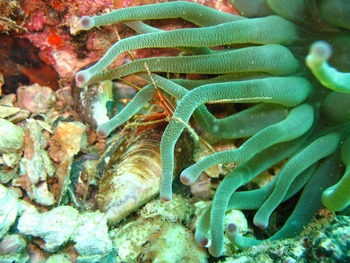
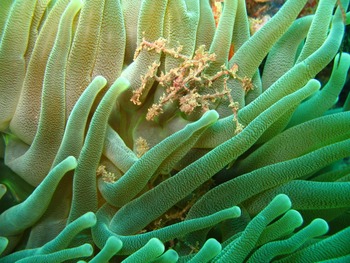
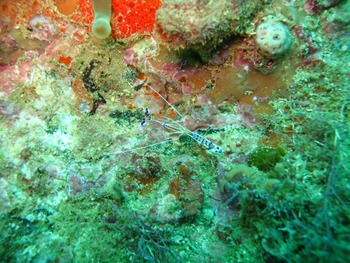
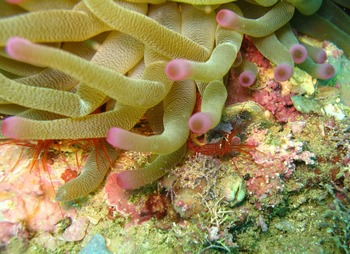
The most common associate was Stenorhynchus seticornis (Herbst, 1788), found at 17 anemones, in group-sizes of one to six. These spider crabs were usually at the outer margin of the sea anemone but with one or several legs between the anemone's tentacles and touching the tentacles of the anemone (Figure 1). The crab Mithraculus forceps (A. Milne-Edwards, 1875) was found at 12 anemones, usually hidden below the tentacles, close to the stem of the anemone. Other decapod species encountered with Condylactis gigantea were Periclimenes yucatanicus (Ives, 1891) (a single individual in five cases and two individuals in two cases), Lysmata ankeri Rhyne & Lin, 2006 (four times a single animal, once five animals; Figure 4), a male–female pair of Metoporhaphis calcarata (Say, 1818) (one case; Figure 2), Periclimenes pedersoni Chace, 1958 (one case; Figure 3), Cronius ruber (Lamarck, 1818) (one case) and an unidentified Mithrax sp. (two cases). All these decapod species were in frequent contact with the sea anemones' tentacles.
The spider crab Stenorhynchus seticornis associated with Condylactis gigantea.

Condylactis gigantea with Metoporhaphis calcarata.

Condylactis gigantea with Periclimenes pedersoni.

Condylactis gigantea with Lysmata ankeri.

There were up to four different crustacean species associated with the same individual sea anemone. When the female of the Metoporhaphis calcarata pair and the Periclimenes pedersoni—collected from the same anemone—were transported to the surface in a plastic bag, the Metoporhaphis grabbed the Periclimenes and started to feed on it.
(2) Unidentified aiptasiid, possibly Bellactis ilkalyseae Dube, 1983
In 15 m depth, at Ilha Escalvada, an aiptasiid anemone was hanging over the entrance of a small tunnel. The antennae of two alpheid shrimps were sticking out from this tunnel, frequently brushing against the anemone's tentacles (Figure 5). The alpheids probably belong to an undescribed species, which has been reported as Alpheus armatus Rathbun, 1901 by Coelho et al. (Reference Coelho, Ramos-Porto and Melo1990) from north-east Brazil (A. Anker, personal communication).
Aiptasiid with Alpheus aff. armatus.

(b) Antipatharia
(1) Tanacetipathes sp. 1
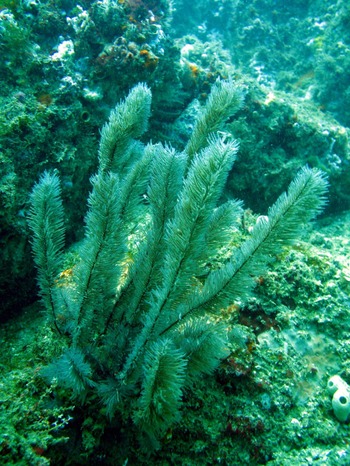
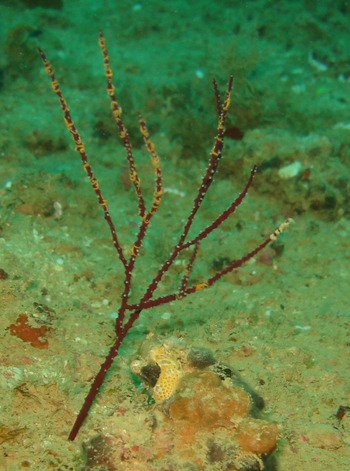
A single colony, about 80 cm high, of this bushy black coral was encountered at Ilha Escalvada in 19 m depth (Figure 6). Several specimens of Periclimenes sp. 1 were collected from it. This is likely to be an undescribed species of the Periclimenes iridescens group but the species cannot be determined, as most pereiopods of the specimens are missing. The absence of an apical process on the telson allies it to Periclimenes antipathophilus Spotte, Heard & Bubucis, 1994 but the single fifth pereiopod available does not have the characteristic rows of comb setae.
Tanacetipathes sp. 1 in 19 m depth at Ilha Escalvada.

(2) Tanacetipathes sp. 2
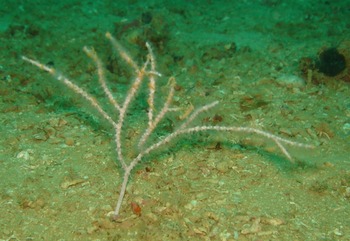
A smaller Tanacetipathes species, about 40 cm high, was common at Baiuana in 40–42 m depth (Figure 7). A branch of it was sent to an expert at Rio de Janeiro Natural History Museum but never identified. Several specimens of Periclimenes sp. 1 were collected from this bushy black coral.
Tanacetipathes sp. 2 in 40 m depth at Baiuana.

(3) Cirripathes (secchini Echeverría, 2002 ?)
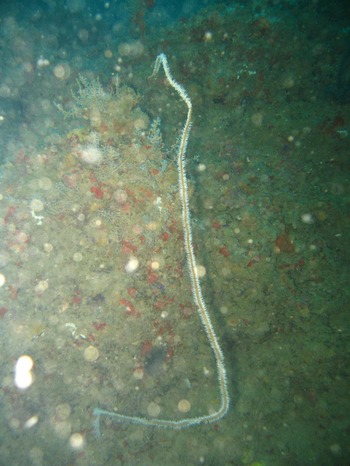
The only whip coral reported from Brazil is Cirripathes secchini Echeverria, 2002. About 20 whip corals in 40–42 m depth at Baiuana, were checked visually and by sliding the stem through the fingers of the investigator (Figure 8). A single whip coral had a Pseudopontonides principes (Criales, 1980) clinging to it.
Cirripathes (secchini ?) in 42 m depth at Baiuana, host of Pseudopontonides principes.

(c) Gorgoniaria
(1) Muricea flamma Marques & Castro, 1995
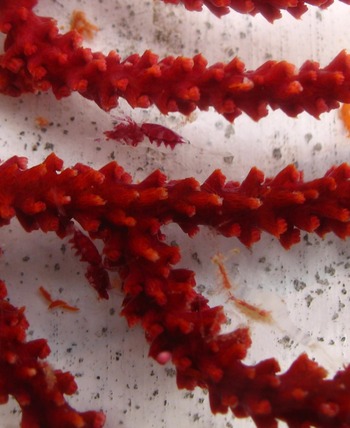
Many specimens of this common and large gorgonian were wiped with a hand-held aquarium net at Ilha Escalvada in 15–20 m depth. In each case, numerous individuals of two apparently common shrimp species were caught (Figure 9). One of them belongs to the genus Neopontonides and is closely related to the species beaufortensis (Borradaile, 1920) (and was called N. beaufortensis in De Grave, Reference De Grave2008); this is probably an undescribed species. The second, somewhat less-common shrimp on Muricea flamma was an (at the time) undescribed species of Periclimenes, recently described as Periclimenes guarapari De Grave, Reference De Grave2008, currently only known from the Guarapari area. See below for other hosts of these two species. A sample of shrimps collected on 9 April in 15 m depth contained (among numerous Neopontonides sp. and Periclimenes guarapari) a single specimen of Latreutes parvulus (Stimpson, 1866).
Muricea flamma with Neopontonides sp. and Periclimenes guarapari.

(2) Lophogorgia violacea (Pallas, 1766)
A small colony of this gorgonian (Figure 10) was wiped with a hand-held aquarium net on 6 May, at Baiuana, in 38 m depth, and a single shrimp was collected. The gorgonian was sent to the Natural History Museum of Rio de Janeiro. The shrimp turned out to be Pseudocoutierea conchae Criales, 1981. This is a new record for Brazil for this species and is the first time that the species has been discovered since its original description from Colombia.
The sampled colony of Lophogorgia violacea (photograph by Jean-Christophe Joyeux), host of Pseudocoutierea conchae.

(3) Unidentified small white gorgonian
A small colony of an unidentified white gorgonian (Figure 11) was wiped with a hand-held aquarium net on 6 May, at Baiuana, in 38 m depth, and a single shrimp was collected. This was again Neopontonides sp. (cf. the section on the gorgonian Muricea flammea).
The sampled colony of an unidentified white gorgonian (photograph by Jean-Christophe Joyeux), host of Neopontonides sp.

(4) Plexaurella grandiflora Verrill, 1912
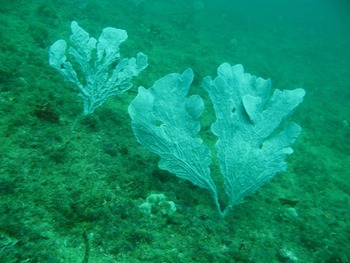
Colonies of this large, bushy gorgonian (Figure 12) were wiped with an aquarium net, in 10–15 m depth at Ilha Escalvada. Numerous specimens of Periclimenes guarapari and Neopontonides sp. were caught (cf. section on Muricea flamma).
Plexaurella pumila in the foreground, P. grandiflora behind it (Ilha Escalvada, about 10 m depth).

(5) Plexaurella pumila Verrill, 1912
Six colonies of this small, bushy gorgonian (Figure 12) were covered with plastic bags and collected in toto in 17 m depth at Ilha Escalvada. Two shrimps were encountered in these plastic bags but the sample was lost and the species could not be determined. An additional colony collected in 3 m depth at Ilha dos Franceses had no symbiotic decapods.
(6) Phyllogorgia dilatata (Esper, 1806)
Many colonies of this large, broad gorgonian (Figure 13) were wiped with a hand-held aquarium net in 10–18 m depth at Ilha Escalvada and at Piúma. Many specimens of Neopontonides sp. were caught in each case (cf. section on Muricea flamma).
Phyllogorgia dilatata, host of Neopontonides sp.

SYMBIOSES WITH GASTROPODA
Crepidula sp.
A gastropod belonging to the genus Crepidula was on an Arca specimen collected in 11 m depth at Ilhas Rasas. A small pinnotherid crab was found sheltering underneath it, Zaops ostreum (Say, 1817).
SYMBIOSES WITH ECHINODERMATA ECHINOIDEA
(1) Tripneustes ventricosus (Lamarck, 1816)
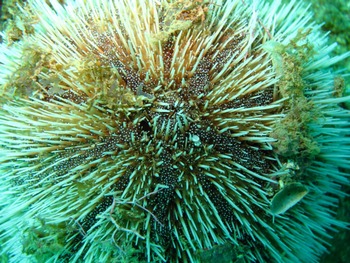
Four large Tripneustes ventricosus (diameter about 12 cm) from 10 to 15 m depth at Ilha Escalvada and Ilhas Rasas were visually checked for symbionts. On one of them, four Gnathophylloides mineri Schmitt, 1933 could be seen (Figure 14). This sea urchin was collected and soaked in diluted ethanol, whereupon a total of nine shrimps emerged, seven ovigerous females and two (the smallest animals) without eggs. Gnathophylloides mineri is known from south-eastern Florida as far south as Bahia (Ramos-Porto & Coelho, Reference Ramos-Porto, Coelho and Young1988); thus, to find it in Espírito Santo State slightly extends the known distribution of the species to the south.
Gnathophylloides mineri on Tripneustes ventricosus (new record for Espírito Santo).

(2) Echinometra lucunter (Linnaeus, 1758)
About 20 Echinometra locunter were cut out of their boreholes during low tide at Guarapari. The boreholes were visually inspected and the sea urchins were washed in fresh water. A striped gammarid (Crustacea, Amphipoda) was encountered in several cases but no decapods.
(3) Unidentified irregular sea urchin, probably Meoma ventricosa (Lamarck, 1816)
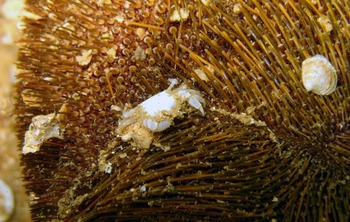
This large (about 15 cm long) irregular sea urchin is buried in the sand. A small elevation of the sand betrayed their location in the following cases. One animal from 38 m depth at Baiuana had no associated decapods. One of two animals from 15 m depth at Ilhas Rasas had four Dissodactylus crinitichelis Moreira, 1901 clinging to its lower side (Figure 15). One animal from 32 m depth at Pedra do Dentão had a Holothuriophilus tomentosus (Ortmann, 1894) clinging to its lower side (Figure 16).
Dissodactylus crinitichelis on unidentified irregular sea urchin.

Holothuriophilus tomentosus on unidentified irregular sea urchin.

POTENTIAL HOSTS WITHOUT DECAPOD SYMBIONTS
(1) Bunodosoma caissarum Corrêa in Belém, 1987
About 20 large specimens of this common intertidal sea anemone were searched for symbionts in shallow water (0–1 m depth); none were encountered.
(2) Stychodactyla duerdeni (Carlgren, 1900)
Three large specimens (15–20 cm disc diameter) of this sea anemone were seen when snorkelling in tide pools near Santa Cruz. Even though the species is known to harbour shrimps of the genus Periclimenes in the Caribbean (e.g. photograph in Human & Deloach, Reference Human and Deloach2002, using the incorrect name Actinoporus elegans for the anemone), no symbionts were seen with these three anemones. Carlos Eduardo Ferreira of Niteroi University (personal communication) has seen shrimps with this sea anemone at the Abrolhos Reefs in Bahia State, Brazil.
(3) Actinostella flosculifera (Le Sueur, 1817)
About ten large specimens of this sea anemone were searched for symbionts in large tide pools and down to 10 m depth; none were encountered.
(4) Palythoa caribaeorum (Duchassaing de Fonbressin & Michelotti, 1860)
The surface of a large area covered with this encrusting anemone (Cnidaria, Zoantharia) at Ilha dos Franceses, was wiped with a hand-held aquarium net; no crustacean symbionts were encountered.
(5) Carijoa riisei (Duchassaing & Michelotti, 1860)
The wreck of the ‘Victory 8B’, in front of Guarapari, is overgrown with many colonies of the telestacean octocoral Carijoa riisei. Numerous colonies in 25–30 m depth were checked; no symbiotic decapods were found.
(6) Crassostrea gasar (Adanson, 1757)
Ten individuals of the bivalve Crassostrea gasar (formerly called C. brasiliana) lying on muddy sand at Curva da Jurema, in 1–2 m depth, were collected and opened; no decapods were found inside them.
(7) Crassostrea rhizophorae (Guilding, 1828)
Ten Crassostrea rhizophorae, glued to rock and emerged at low tide at Ilha do Boi, were opened; no decapods were found inside them.
(8) Isognomon sp.
Twelve of these soft shelled bivalves were opened, in about 15 m depth at Ilha Escalvada; no decapods were found inside them.
(9) (Pseudo)chama sp.
A Chama or Pseudochama species is commonly attached to the rock, in shallow water in the Guarapari area. Six of these bivalves, from 5 to 10 m depth at Ilhas Rasas and Ilha Escalvada were opened; no decapods were found inside them.
(10) Pinna sp.
Five small Pinna sp., 10–12 cm long, from muddy sand in about 3–6 m depth at Curva da Jurema, were opened; no decapods were found inside these bivalves. Visual inspection (looking into the open valves from above) of a Pinna of about 15 cm length, in 8 m depth at Ilha Rasa, did not result in the discovery of symbionts.
(11) Pteria sp.
Five animals collected in about 3 m depth at Ilhas dos Franceses had no decapods inside them. Two large specimens of this bivalve (about 8 cm long) collected at the wreck of the ‘Victory’ in 27 m depth had no decapods inside them.
(12) Arca sp.
A single Arca, 8 cm long, was collected in 11 m depth at Ilhas Rasas; no symbionts were found inside this bivalve but see the section on Crepidula above.
(13) Spondylus (americanus Hermann, 1781?)
A large Spondylus with long spines was collected in 41 m depth at Baiuana; no decapods were found inside this bivalve.
(14) Spondylus sp.
A Spondylus without spines was collected in 14 m depth at Ilha Escalvada, 14 m; no decapods were found inside it.
(15) Isostichopus badionotus (Selenka, 1867)
Sixteen large individuals of this common sea cucumber were searched for symbionts at Ilha Escalvada, during daytime, in 10–15 m depth. One to eight individuals of a small undescribed parasitic gastropod of the genus Melanella (A. Warén, personal communication) were found on 12 of these sea cucumbers but no crustaceans.
(16) Unidentified feather stars
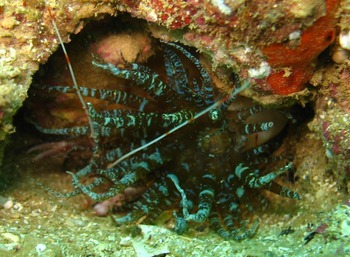
Small red-brown, yellow and white feather stars are common in the Guarapari area. During the day they hide in cracks, at night they come out and unfold their arms. More than 20 feather stars in 10–18 m depth were visually searched for symbionts at night at Ilha Escalvada. No symbionts were seen.
(17) Unidentified basket star
More than ten individuals of an unidentified basket star, unfolded at night, were visually surveyed at Ilha Escalvada in 10–18 m depth. No symbionts were seen.
(18) Oreaster reticulatus (Linnaeus, 1758)
Fifteen individuals of the large starfish Oreaster reticulatus were searched for symbionts in the Guarapari area: none were seen.
(19) Styela plicata (Lesueur, 1823)
Six large (about 8 cm high) specimens of the tunicate Styela plicata were collected from 2 m depth at Curva da Jurema and cut open; no symbionts were found.
(20) Microcosmus (exasperatus Heller, 1878 ?)
Four specimens of this tunicate were collected in 12 m depth at Ilhas Rasas and opened; no symbionts were found inside them.
(21) Phallusia nigra Savigny, 1816
A single, large tunicate of the species Phallusia nigra (about 10 cm high) was collected from 9 m depth at Ilha Escalvada and cut open; no symbionts were found.
DISCUSSION
(1) Zoogeography
The two most common species of symbiotic decapods encountered were Periclimenes guarapari and Neopontonides sp. The first one was undescribed at the time of the study and has since been described on the basis of specimens collected during this study (De Grave, Reference De Grave2008). The latter is probably also an undescribed species and will be dealt with in a separate publication.
The Periclimenes species from the two black corals of the genus Tanacetipathes is probably also undescribed but the specimens cannot be fully identified.
The finding of Pseudocoutierea conchae (associated with Lophogorgia violacea) provides the first record of this species from Brazil and the first record since the description of the species. The finding of Pseudopontonides principes from whip coral provides the first record of this species for Brazil.
Periclimenes pedersoni was recorded from Brazil as Periclimenes aff. pedersoni by Gasparini et al. (Reference Gasparini, Floeter, Ferreira and Sazima2005). The colour pattern of Brazilian animals was compared with those from the Caribbean and no significant difference was found.
Alpheus aff. armatus has been recorded from north-eastern Brazil (Coelho et al., Reference Coelho, Ramos-Porto and Melo1990); the record from Espírito Santo State provides a southward extension of the known range of the species.
Both Gnathophylloides mineri and Periclimenes yucatanicus have been recorded from Bahia State (Young & Serejo Reference Young, Serejo, Dutra, Allen, Werner and McKenna2006); the current record from Espírito Santo State provides a slight southward extension of their known range.
Holothuriophilus tomentosus has only been known from Santa Catarina State and Bahia State (de Melo & Boehs, Reference De Melo and Boehs2004; Almeida & Coelho, Reference Almeida and Coelho2008); this is the first record for the State of Espírito Santo.
Stychodactyla, Chama, Pinna, Spondylus and Echinometra are all known host genera for shrimps or crabs in other areas, such as the Caribbean or the eastern tropical Atlantic (Schoppe & Werding, Reference Schoppe and Werding1996, references in Introduction); it therefore came as a surprise not to find associated crustaceans with them during the present study. Compared with the Caribbean and the eastern tropical Atlantic, slightly fewer symbionts than expected were found in the present study. This could simply be due to the fact that Espírito Santo is further away from the central tropics and therefore already has a lower species density.
(2) Host specificity
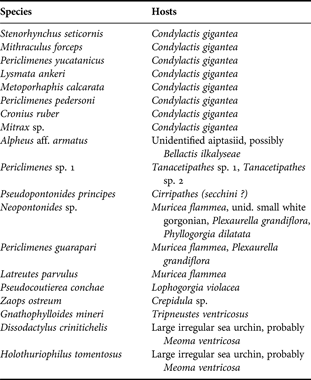
Table 1 shows which hosts were recorded for the symbiotic decapods of this study.
The symbiotic crustaceans and their host species.

The host with largest number of symbiotic decapod crustaceans (eight species) was the sea anemone Condylactis gigantea. All decapods found in association with this anemone were in contact with the tentacles of the anemone without eliciting a feeding reaction of the anemone (i.e. tentacles adhering to the crustacean). This could be due either to an innate characteristic of these crustacean species or could be individually acquired in an adaptation process to the anemone, the latter suggested by experiments (Levine & Blanchard, Reference Levine and Blanchard1980; Crawford, Reference Crawford1992; Giese et al., Reference Giese, Mebs and Werding1996; Melzer & Meyer, in preparation). The crustacean with the largest number of hosts was the shrimp Neopontonides sp., encountered on four different species of gorgonians.
Records of crustaceans with only a single host might represent true monospecific associations but could also be due to low and locally restricted sample size. Indeed, some of the symbionts encountered here with a single host species, e.g. Thor amboinensis, are known to live with other host species in other areas (Wirtz, Reference Wirtz1997 and references therein).
The pinnotherid crab Holothuriophilus tomentosus was known only in association with the bivalve Anomalocardia brasiliana (de Melo & Boehs, Reference De Melo and Boehs2004); to find it with a sea urchin comes as a surprise. All six known species of the genus Pseudocoutierea live in association with gorgonians and antipatharians (De Grave, Reference De Grave2007). The shrimp Latreutes parvulus is a seagrass dwelling species but has, on occasion, been recorded on gorgonians (Wirtz & d'Udekem d'Acoz, in press).
(3) The relation between host species and associated species
The symbiotic decapods probably derive some degree of protection from their host organisms. This is obvious when they manage to live between the tentacles of sea anemones or between the spines of sea urchins. Most gorgonians are unpalatable to predators such as fish (Epifanio et al., Reference Epifanio, Martins, Villaca and Gabriel1999 and references therein), and crustaceans living on them may simply profit from the fact that their hosts are avoided; it remains to be tested if the symbiotic crustaceans perhaps even take up unpalatable compounds from their hosts. Many symbiotic decapods are kleptoparasitic, feeding on particles gathered by the host, and occasionally even feed on host tissue (e.g. Telford, Reference Telford1982; Wirtz & Diesel, Reference Wirtz and Diesel1983; Fautin et al., Reference Fautin, Guo and Hwang1995). Some of them may simply be parasites.
The advantages for the host organisms, if any, are less clear. Smith (Reference Smith1977) observed defence of the anemone Bartholomea annulata against the fire worm Hermodice carunculata by its symbiotic snapping shrimp Alpheus armatus. Spotte (Reference Spotte1996) demonstrated elevated levels of ammonia between the tentacles of sea anemones harbouring symbiotic shrimps (presumably due to ammonia excretion by the shrimps); as experimental increase of ammonia concentration has been shown to benefit the zooxanthellae in the sea anemone's tissue, the presence of a symbiotic animal excreting ammonia apparently enhances zooxanthellae production and thus benefits sea anemones that harbour zooxanthellae (Holbrook et al., Reference Holbrook, Brooks, Schmitt and Stewart2008). See Wirtz (Reference Wirtz1997) and Goh et al. (Reference Goh, Ng and Chou1999) for a general discussion of possible costs and benefits of hosts and symbionts.
(4) The social structure of symbiotic decapods
Symbiotic crustaceans show a great variation in social structures, from solitary and pair-living to living in large groups (e.g. Dellinger et al., Reference Dellinger, Davenport and Wirtz1997; Wirtz, Reference Wirtz1997; Thiel et al., Reference Thiel, Zander and Baeza2003a; Baeza & Thiel, Reference Baeza, Thiel, DuVy and Thiel2007; Baeza, Reference Baeza2008, and references therein). The same species may differ in social structure, depending on its host (Dellinger et al., Reference Dellinger, Davenport and Wirtz1997). It appears to be the size and density of the host species that determines the social structure of the symbiont (Dellinger et al., Reference Dellinger, Davenport and Wirtz1997; Thiel & Baeza, Reference Thiel and Baeza2001; Wirtz & d'Udekem d'Acoz, Reference Wirtz and d'Udekem d'Acoz2001; Thiel et al., Reference Thiel, Zander, Valdivia, Baeza and Rueffler2003b). Very small hosts harbour single animals, as is the case of Pontonia species in Pseudochama and in Spondylus. Larger but defendable hosts are often occupied by a pair of associates (e.g. Knowlton, Reference Knowlton1980; Dellinger et al., Reference Dellinger, Davenport and Wirtz1997; Baeza, Reference Baeza2008), whereas the same species may live in groups of several adult and juvenile animals on still larger organisms (Dellinger et al., Reference Dellinger, Davenport and Wirtz1997; Wirtz & d'Udekem d'Acoz, Reference Wirtz and d'Udekem d'Acoz2001). When the hosts live in high densities, the symbionts can switch hosts easily (in search of mates, for instance; cf. Diesel, Reference Diesel1986) but this becomes more difficult when host distance increases (cf. Thiel et al., Reference Thiel, Zander and Baeza2003a,Reference Thiel, Zander, Valdivia, Baeza and Ruefflerb). Another factor determining symbiont group sizes and movement patterns is predation. When predation outside the protecting host is high, symbiont movement between hosts is reduced (Knowlton, Reference Knowlton1980; Baeza & Thiel, Reference Baeza, Thiel, DuVy and Thiel2007). In this study, predation between an inachid crab and a shrimp that were initially collected from the same sea anemone was observed. The effect of predation between different symbionts on the same host has not yet been explored.
ACKNOWLEDGEMENTS
Jean-Christophe Joyeux invited the first author to come to Vitória and the CNPq made it possible with a Bolsa Pesquisador (300066/2005-8). Scientists and staff at the Departamento de Ecologia of the UFES gave a warm welcome. The IBAMA granted collection permit Processo 02009.000349/2006-91. Many experts helped in the identification of specimens, in particular Arthur Anker (Alpheus), Clovis Castro (Gorgonaria), Luciana Granthom Costa (Tunicata), Rosabelle Nalesso (Bivalvia), and Erika Schlenz (Actiniaria). These experts did not see all the species mentioned in this report and all remaining errors are mine. Fernando Campagnoli and the staff of the Brazil Dive Centre made the SCUBA dives at Guarapari possible. Alexandre Oliveira de Almeida commented on an early draft of the paper. Many thanks to all of them.