Introduction
The oleaginous sunflower (Helianthus annuus L.) is mainly cultivated in eastern Europe and the former Soviet Union, as well as in Argentina. The area cultivated expands to the arid regions of the Mediterranean and northern Africa, where this species has agronomic importance because of its moderate tolerance to drought and salinity (Miller, Reference Miller1995; Connor and Hall, Reference Connor, Hall and Schneiter1997). In Argentina, the potential area for sunflower planting extends from Chaco in the north to La Pampa in the south. In this area, sunflower plants are often exposed to periods of drought, and increasingly so towards the west of the country (Vázquez and Paolini, Reference Vázquez and Paolini1991). Over the past years, expansion of soybean culture has affected the planting area of other cultivated plants, and sunflower cultivation has been displaced to marginal areas. To expand the sunflower area, it is necessary to obtain lines that are tolerant to environmental stress, such as drought, salinity and low temperatures (Dvörák and Ross, Reference Dvörák and Ross1986). Thus, the elucidation of morphological and biochemical responses to adverse conditions will help to improve drought tolerance, which is one of the main objectives of current sunflower breeding programmes (Fick and Miller, Reference Fick, Miller and Schneiter1997).
Several hormones, including abscisic acid and jasmonates (JAs) play a role in normal plant developmental processes and also in plant adaptation to abiotic stress. JAs belong to the family of oxygenated fatty acid derivatives, collectively called oxylipins, which are produced via the oxidative metabolism of polyunsaturated fatty acids. They originate from linolenic acid via 12-oxo-phytodienoic acid (OPDA) formation, a pathway consisting of several enzymatic steps. Jasmonic acid (JA), its methyl ester (JAME), certain l-amino acid conjugates, a glucose ester and hydroxylated forms are all found in plants (Sembdner and Parthier, Reference Sembdner and Parthier1993; Wasternack and Hause, Reference Wasternack and Hause2002). These compounds modulate diverse processes, including the development of reproductive structures, such as fruits and flowers, and anther and pollen formation (Sanders et al., Reference Sanders, Lee, Biesgen, Boone, Beals, Weiler and Goldberg2000; Stintzi and Browse, Reference Stintzi and Browse2000; Hause et al., Reference Hause, Stenzel, Miersch, Maucher, Kramell, Ziegler and Wasternack2000; Miersch et al., Reference Miersch, Weichert, Stenzel, Hause, Maucher, Feussner and Wasternack2004). Furthermore, JAs are also involved in germination and seedling development (Wasternack and Hause, Reference Wasternack and Hause2002). In addition, a role for JAs in the signal transduction pathways between stress perception and response [i.e. jasmonate-induced proteins (JIPs) biosynthesis] has been demonstrated (Wasternack and Parthier, Reference Wasternack and Parthier1997). Thus, the coordinated activation of metabolic pathways mediated by JAs provides resistance to environmental stresses (Sasaki-Sekimoto et al., Reference Sasaki-Sekimoto, Taki, Obayashi, Aono, Matsumoto, Sakurai, Suzuki, Hirai, Noji, Saito, Masuda, Takamiya, Shibata and Ohta2005). In this sense, Gao et al. (Reference Gao, Wang, Lu, Zhang, Shen, Liang and Zhang2004) demonstrated that JA is involved in the drought-induced accumulation of betaine, an osmoprotectant accumulating in plant leaves under environmental stress. Similarly, an enhancement in the endogenous JA content was observed by Xin et al. (Reference Xin, Zhou and Pilet1997) in water-stressed maize root cells. JA was detected for the first time in sunflower in the pericarp of immature seeds of a dwarf cultivar (Meyer et al., Reference Meyer, Miersch, Buttner, Dathe and Sembdner1984). Moreover, the amount of JA was dependent upon the developmental stage of the fruit, i.e. the pericarp of broad bean fruits contained c. 3.000 ng of JA (g FW)− 1 and immature pericarp of Glycine max 1.260 ng.
Seed germination and seedling growth of most cultivated species are critical life history stages often subjected to high mortality rates. Seedlings may be less stress tolerant than the adult plant, and may be exposed to more extreme environmental fluctuations at the soil surface. The ability of a seed successfully to become a young plant can be strongly reduced by many stress factors. Moreover, environmental perturbations during seed maturation influence the development of the progeny in many species (Amzallag et al., Reference Amzallag, Nachmias and Lerner1998). For example, drought stress during grain formation modifies the germination attributes of offspring in Sorghum (Benech Arnold et al., Reference Benech Arnold, Fenner and Edwards1991). In relation to the hormonal content of seeds, Andrade et al. (Reference Andrade, Vigliocco, Alemano, Miersch, Botella and Abdala2005) reported a differential accumulation of the different members of the family of JAs in tomato seeds during germination and imbibition, as well as in their response to salinity. Germination experiments with sunflower seeds exposed to drought showed that below − 2.1 MPa, germinability was strongly reduced (Somers et al., Reference Somers, Ullrich and Ramsay1983). Depending on the genotype, the threshold for occurrence of 50% germination varied between − 0.7 and − 2.2 MPa (Chimenti, Reference Chimenti1991). This observation is in agreement with those of Somers et al. (Reference Somers, Ullrich and Ramsay1983), who found an intraspecific variability for tolerance to low water potential. We have recently characterized two sunflower lines with contrasting drought sensitivity: the B59 line (sensitive) and the B71 line (tolerant). Laboratory experiments in which drought conditions were mimicked by mannitol solutions demonstrated that B71 had a lower germination percentage than the control; the B59 line responded in the same manner, but the germination percentage was more affected by drought. In addition, data collected in the field from plants grown in drought showed that B71 yielded more seeds (kg ha− 1) than B59 (unpublished data), compared to yields obtained under irrigation.
Considering the economic importance of sunflower in Argentina and other countries, together with the need to cultivate this oleaginous plant in areas with unfavourable environmental conditions, it is of interest to know how the drought conditions experienced by the mother plant affect the hormonal content in sunflower lines with differential sensitivity to drought. In the present study, we analysed the endogenous JAs content of dry sunflower seeds from B59 and B71 plants grown under irrigation and drought. In addition, the changes in JAs content after 72 h of imbibition were also evaluated.
Materials and methods
Plant material
Sunflower seeds (Helianthus annuus L., Asteraceae) of the B59 and B71 inbred lines were sown in an experimental field at EEA-INTA Manfredi, Argentina. Seeds were obtained from plants of both lines grown under irrigation and drought. Drought and irrigation treatments were started when plants had developed the fourth pair of leaves (V4 stage). For drought, plants were covered with polypropylene until harvest, while irrigated plants were watered when the soil moisture reached a level of 60% of field capacity. Seeds were germinated between wet filter paper towels in a chamber under 16 h light, at 28°C and 60% relative humidity, and 8 h dark, 20°C and 70% relative humidity. Germination was scored at 24, 48 and 72 h. JAs were measured in embryo, cotyledons and pericarp of dry seeds and of imbibed seeds after 72 h. At 72 h, only germinated seeds were selected for hormone determinations, discarding those seeds that had not germinated. Quantification of JAs was performed on four replicates.
Extraction, purification and estimation of jasmonates
Jasmonates were extracted and pre-purified according to Gidda et al. (Reference Gidda, Miersch, Levitin, Schmidt, Wasternack and Varin2003) and Andrade et al. (Reference Andrade, Vigliocco, Alemano, Miersch, Botella and Abdala2005). Dry and imbibed seeds (1 g DW) were homogenized with 10 ml methanol and 100 ng [2H6]jasmonic acid ([2H6]JA), 100 ng [2H5]12-oxo-phytodienoic acid ([2H5]OPDA), 100 ng 11-O-[2H3]acetyl-jasmonic acid (11-[2H3]OAc-JA) and 100 ng 12-O-[2H3]acetyl-jasmonic acid (12-[2H3]OAc-JA) as internal standards. The homogenate was filtered in vacuo on a column with a cellulose filter. Thereafter, the eluate was evaporated, followed by acetylation of endogenous hydroxylated-JAs with pyridine and acetic acid (2 : 1) at 20°C overnight. The extract was taken to dryness, dissolved in 10 ml of methanol and loaded on columns filled with 3 ml DEAE-Sephadex A25 (Amersham Pharmacia Biotech AB, Uppsala, Sweden) (Ac− -form, methanol). The column was washed with 3 ml methanol. After washing with 3 ml 0.1 M acetic acid in methanol (all eluates combined gave fraction A), eluates with 3 ml of 1 M acetic acid in methanol and 3 ml of 1.5 M acetic acid in methanol were collected, evaporated, separated by preparative high purity liquid chromatography (HPLC), and analysed by gas chromatography–mass spectrometry (GC–MS).
HPLC
Eurospher 100-C18 (5 μm, 250 × 4 mm; Knauer, Berlin, Germany); Solvent A, methanol (MeOH); Solvent B, 0.2% acetic acid in water; gradient, 40% A to 100% A in 25 min; flow, 1 ml min− 1; fractions at R t 10 min to 11 min 30 s were collected in one vial, 12 min to 13 min 30 s and 20 min 30 s to 22 min were collected in one vial.
Derivatization
Evaporated samples were dissolved in 200 μl CHCl3/N, N-diisopropylethylamine (1 : 1) and derivatized with 10 μl pentafluorobenzylbromide at 20°C overnight. The evaporated samples from the HPLC were dissolved in 7 ml n-hexane and passed through a Chromabond SiOH column (500 mg; Machery-Nagel, Germany). The pentafluorobenzyl esters were eluted with 7 ml n-hexane/diethylether (2 : 1), evaporated, dissolved in 100 μl acetonitile (MeCN) and analysed by GC–MS.
GC-MS
GCQ (Thermo Finnigan, San Jose, California, USA), 100 eV, negative chemical ionization, ionization gas NH3, source temperature 140°C, column Rtx-5w/Integra Guard (Restek, Germany) (5 m inert precolumn connected with column 15 m × 0.25 mm, 0.25 μm film thickness, crossbond 5% diphenyl–95% dimethyl polysiloxane), injection temperature 250°C, interface temperature 275°C; helium 40 cm s− 1; splitless injection. Column temperature program: 1 min 60°C, 25°C min− 1 to 180°C, 5°C min− 1 to 270°C, 10°C min− 1 to 300°C, 10 min 300°C. R t of pentafluorobenzyl esters: [2H6]JA, 10 min 30 s; JA, 10 min 36 s; 11-[2H3]OAc-JA, 14 min; 11-OAc-JA, 14 min 3 s; 12-[2H3]OAc-JA, 15 min 39 s; 12-OAc-JA, 15 min 42 s; [2H5]OPDA, 20 min 10 s; OPDA, 20 min 16 s. Fragments m/z 209, 215 (standard), m/z 267, 270 (standard), m/z 267, 270 (standard) and m/z 291, 296 (standard) were used for the quantification of JA, 11-hydroxyjasmonate (11-OH-JA), 12-hydroxyjasmonate (12-OH-JA) and OPDA, respectively.
Statistical analysis
An analysis of variance (ANOVA) test was used for the statistical analysis of JAs measurements. Data were subjected to a multiple range test a posteriori. The software used was Statgraphics Plus, version 3, (Manugistics, Rockville, Maryland, USA).
Results
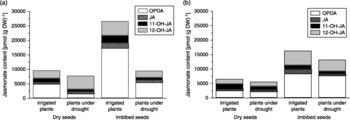
The JA precursor OPDA, JA and the JA derivatives (11-OH-JA and 12-OH-JA) were detected in dry and imbibed seeds. The total amount of JAs increased in imbibed seeds of both B59 and B71 relative to dry seeds. Imbibition triggered a substantial increase in OPDA content in seeds from plants grown under both soil moisture conditions. B59 imbibed seeds from irrigated plants showed the highest total JAs content, approximately 26,000 pmol g− 1 (Fig. 1).
Total content of jasmonates in dry and imbibed seeds of Helianthus annuus produced from irrigated plants or those exposed to drought conditions. (a) Seeds of the drought-sensitive B59 line; (b) seeds of the drought-tolerant B71 line. JA, jasmonic acid; OPDA, 12-oxo-phytodienoic acid; 11-OH-JA, 11-hydroxyjasmonate; 12-OH-JA, 12-hydroxyjasmonate.

Dry seeds produced by irrigated plants of the B59 line showed a high content of OPDA, while in seeds from plants under drought, the major compound was 12-OH-JA. OPDA was also the main jasmonate in imbibed seeds from irrigated plants. However, a threefold reduction in this compound was observed in imbibed seeds from plants under drought with respect to those from irrigated plants (Fig. 1a). In line B71, the total JA content, as well as the pattern of these compounds, was slightly modified by these soil moisture conditions (Fig. 1b).
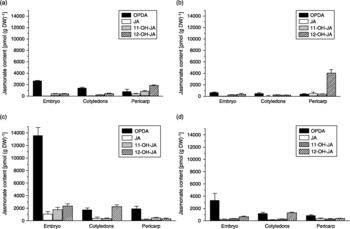
To assess JAs in the different parts that constitute the dry seed, we analysed these compounds in the embryo, cotyledons and pericarp. OPDA was the major compound in the embryo and cotyledons of dry seeds from irrigated plants of B59 (Fig. 2a). However, in the pericarp of dry seeds from plants grown under drought, the main compound was 12-OH-JA (Fig. 2b). In embryos of imbibed seeds of B59, OPDA was the only compound that showed a substantial increase (fivefold) (Fig. 2c, d), relative to dry seeds from irrigated plants (Fig. 2a, b). In contrast, imbibition caused a decrease of 12-OH-JA in the pericarp of seeds produced from both soil moisture conditions.
Content of jasmonates in the embryo, cotyledons and pericarp of seeds produced from drought-sensitive Helianthus annuus before imbibition, and after 72 h of imbibition (daily cycle: 16 h light, 28°C/8 h dark, 20°C), when visible germination had occurred. (a) Dry seeds from B59 plants grown under irrigation; (b) dry seeds from B59 plant grown under drought; (c) imbibed seeds from B59 plants grown under irrigation; (d) imbibed seeds from B59 plants grown under drought. JA, jasmonic acid; OPDA, 12-oxo-phytodienoic acid; 11-OH-JA, 11-hydroxyjasmonate; 12-OH-JA, 12-hydroxyjasmonate. n = 4, P < 0.005.

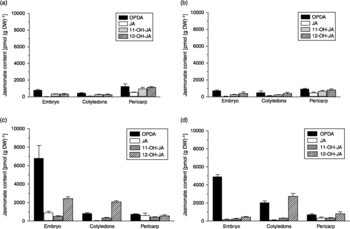
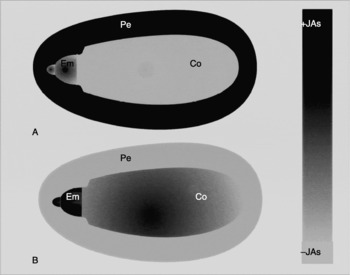
In B71 seeds, we did not observe variations between dry seeds from plants grown under irrigation and drought (Fig. 3a, b). In embryos of imbibed seeds from irrigated plants, a steep increase in OPDA (ninefold) and 12-OH-JA (sevenfold) content (Fig. 3c) was observed relative to dry seeds (Fig. 3a). Cotyledons also showed an approximately eightfold increase in 12-OH-JA (Fig. 3c). Imbibed seeds from plants grown under drought also displayed increased OPDA content in the embryo, while cotyledons showed a higher content of OPDA and 12-OH-JA (Fig. 3d). Taking into account the total JAs measured in the different parts of the seed, the highest content was found in the pericarp of dry seeds, followed by embryo and cotyledons. On the other hand, in imbibed seeds, the highest amount of JAs was found in the embryo followed by cotyledons and pericarp (Fig. 4).
Content of jasmonates in the embryo, cotyledons and pericarp of seeds produced from drought-tolerant Helianthus annuus before imbibition, and after 72 h of imbibition (daily cycle: 16 h light, 28°C/8 h dark, 20°C) when visible germination had occurred. (a) Dry seeds from B71 plants grown under irrigation; (b) dry seeds from B71 plant grown under drought; (c) imbibed seeds from B71 plants grown under irrigation; (d) imbibed seeds from B71 plants grown under drought. JA, jasmonic acid; OPDA, 12-oxo-phytodienoic acid; 11-OH-JA, 11-hydroxyjasmonate; 12-OH-JA, 12-hydroxyjasmonate. n = 4, P < 0.005.

Schematic representation of variation in content of jasmonates among parts of a dry seed (A) and an imbibed seed (B) of Helianthus annuus. Pe, pericarp; Em, embryo; Co, cotyledons. Darker regions represent a higher content of jasmonates (jasmonic acid, 12-oxo-phytodienoic acid, 11-hydroxyjasmonate, 12-hydroxyjasmonate).

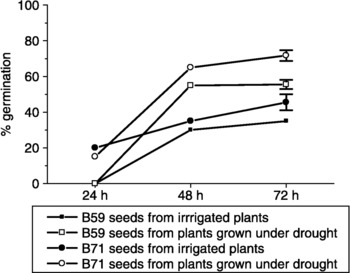
The germination percentages after 24, 48 and 72 h of imbibition were recorded for seeds of both lines. During the time course of germination, a higher percentage was recorded at 48 and 72 h for seeds from plants grown in drought than for those irrigated. At 72 h the increase of germination percentage was 1.6-fold for both lines (Fig. 5).
Germination percentages of B59 (drought-sensitive line) and B71 (drought-tolerant line) Helianthus annuus seeds at 24, 48 and 72 h of imbibition (daily cycle: 16 h light, 28°C/8 h dark, 20°C).

Discussion
Although jasmonates are involved in germination and seedling development, little is known about their regulatory mechanism and their structural modifications in these processes (Wasternack and Hause, Reference Wasternack and Hause2002). Studies in our laboratory showed that in tomato, exogenous JA, 11-OH-JA and 12-OH-JA applications caused a differential inhibition of seed germination. At 10− 4 M JA completely inhibited germination, while the JA hydroxylates resulted in less inhibition (unpublished results). Here we report that: (1) the same JAs members were present in dry and imbibed sunflower seeds; (2) that the total amount of these compounds increased significantly after imbibition; and (3) that drought conditions suffered by the mother plant during seed formation caused a differential ratio of accumulation of JAs and affected the germination rate of the seed progeny. Moreover, dry sunflower seeds displayed the same JAs family members (JA, OPDA and the hydroxylate derivatives) as tomato seeds (Andrade et al., Reference Andrade, Vigliocco, Alemano, Miersch, Botella and Abdala2005). None the less, the amount measured by these authors in tomato seeds was twofold lower than that of sunflower seeds. The difference in JAs content between seeds of both species could be due to the fact that the sunflower seed is one of the most important sources of edible oil, showing a higher content of unsaturated fatty acids, such as oleic, linoleic and linolenic acids, and a lower content of saturated acids, such as palmitic and stearic acid (Martínez-Force et al., Reference Martínez-Force, Alvarez-Ortega, Cantisán and Garcés1998). Linolenic acid is the first precursor in the JA biosynthesis pathway, and lipoxygenases are some of the enzymes strongly related to JA biosynthesis. High levels of lipoxygenase activity were found at the beginning of barley seed germination (Holtman et al., Reference Holtman, van Duijn, Sedee and Douma1996). Thus, the higher content of JAs in sunflower may be a consequence of an optimum lipoxygenase activity, generating more 13-hydroperoxide of linolenic acid, another intermediate in the JA pathway. Our results indicate that seeds of different species accumulate JAs to different levels; they also show that changes in the environment during seed maturation have a strong influence on the progeny, as previously suggested by Benech Arnold et al. (Reference Benech Arnold, Fenner and Edwards1991) and Amzallag et al. (Reference Amzallag, Nachmias and Lerner1998).
The total amounts of JAs in dry sunflower seeds show that accumulation of these compounds was lower in seeds derived from plants under drought than in those coming from irrigated plants in the lines both sensitive (B59) and tolerant to drought (B71). This indicates that the soil moisture conditions under which the mother plants were grown may modify the hormonal content of the seeds. The differences observed in the germination percentage between sunflower seeds from different soil moisture conditions may be a consequence of the modified content of JAs. Moreover, due to the known role of abscisic acid (ABA) as a strong germination inhibitor, we cannot discard an interaction between JAs and ABA in the control of this process.
Here, we also report a differential accumulation of JAs among the parts that constitute a dry and imbibed seed. Different ratios of OPDA, JA–isoleucine conjugate and JA among the parts of a plant organ were previously reported for tomato flowers by Hause et al. (Reference Hause, Stenzel, Miersch, Maucher, Kramell, Ziegler and Wasternack2000). In their work, OPDA content was much higher than JA in pistils, whereas JA content exceeded OPDA content in flower stalks. Remarkably high amounts of the JA conjugate were found in buds, ripe flowers, stalks and pistils. In our study, the substantial OPDA increase at 72 h of imbibition in seeds from plants grown under both soil moisture conditions indicated that OPDA content was dynamic and changing over the time of water uptake. As OPDA possesses signalling properties in various processes, such as volatile formation (Koch et al., Reference Koch, Krumm, Jung, Engelberth and Boland1999), tendril coiling (Stelmach et al., Reference Stelmach, Müller, Hennig, Laudert, Andert and Weiler1998; Blechert et al., Reference Blechert, Brodschelm, Holder, Kammerer, Kutchan, Muller, Xia and Zenk1999) and expression of specific genes (Kramell et al., Reference Kramell, Miersch, Atzorn, Parthier and Wasternack2000), it cannot be ruled out that OPDA may play a role in the germination events. The lower content of total JAs in dry seeds, in relation to imbibed seeds of both lines, indicates that water uptake triggers activation of JAs metabolism, since OPDA, the first cyclic precursor in JA biosynthesis, was the main compound accumulated in embryos at 72 h of imbibition in both lines and under both soil moisture conditions. Moreover, the OPDA decrease, observed only in dry and imbibed seeds of the B59 line grown under drought, may imply that this compound plays a role in the tolerance to drought in the germination stage. In the same sense, the lower germination of the (sensitive) B59 line than that of the (tolerant) B71 line might be associated with the stable OPDA endogenous content in seeds of the B71 line. Andrade et al. (Reference Andrade, Vigliocco, Alemano, Miersch, Botella and Abdala2005) reported that imbibition caused a decrease of 12-OH-JA in the whole tomato seed. However, when we analysed the parts of imbibed sunflower seeds, the decrease in 12-OH-JA content occurred only in the pericarp, while embryo and cotyledons showed an increase in the content of this compound. Hence, the different profiles of the JA family members among seeds of different species are consistent with the existence of an ‘oxylipin signature’ (Weber et al., Reference Weber, Vick and Farmer1997), and also suggest that regulation of JAs biosynthesis may differ between seeds and seedlings. Further investigations will be needed to clarify the role of the JA hydroxylates in the early events of germination. Therefore, we conclude that JAs patterns vary during sunflower germination, environmental conditions experienced by the mother plant modify the seed JAs content, and consequently may influence the germination rate of their progeny. Future experiments are necessary to elucidate the mechanisms by which the different JAs are involved in seed germination.
Acknowledgements
We thank Iliana A. Martínez for language revision of this paper. This work was supported by grants from SECYT-UNRC to G.A. and economical support from DAAD to G.A.