Introduction
Support for the idea of a living wage has become a common theme among trade unions, employers and politicians of all political persuasions in recent years. Since the introduction of the idea into the UK by The East London Communities Organisation (TELCO) and UNISON in November 2000, and popularisation by the Living Wage Campaign, the adoption of the concept has been widespread.
The necessity and desirability of regulating labour markets, and specifically wage levels for low paid workers, has been debated as long as free wage labour has been a mechanism for the use of labour in the production process. Within this context, the reigniting of campaigns for a living wage are but the most recent development of long running debates over the extent to which low skilled labour requires additional protection within the labour market. While the terminology and focus of such debates have altered over time from restricting child labour in the nineteenth century, utilising wages boards in ‘sweated’ industrial and agricultural trades in the early twentieth century to minimum wages in the late twentieth century, a living wage is but the most recent example of attempts to place a floor on the level of wages paid to low skilled labour.
Central to the justification of a living wage lies the assumption that labour markets are heterogeneous. In labour markets for what is deemed to be ‘low-skilled’ work specifically, excessive exploitation in employment contracts is commonplace (UNISON, 2013). Within an economic context this can be understood as a form of market failure arising from three specific reasons, namely in either the supply or demand for labour and in imperfect information within labour markets (Flinn, Reference Flinn2006). Within a context of social policy, this may arise from the social construction of ‘low-skilled’ work, the concentration of particular social groups, for example, female, ethnic minority or young workers in these employment areas, and finally the location of particular industries generating spatially determined employment patterns (Wills, Reference Wills2009).
If a living wage can be justified in terms of combatting one or other forms of market failure, what effect would such a living wage have? Could a living wage demonstrate an ability to compensate for labour market heterogeneity? Could a living wage reduce the social cost of firms’ use of market power, such as in the case of monopsony, perhaps by demonstrating an impact on equality?Footnote 1
In this article, we set out to test the effectiveness of a living wage within the public sector. In particular, we seek to quantify the extent to which low pay (defined as that below the living wage) can be identified in the workforce. We further seek to examine the impact on wage levels of a change in wage rates to comply with the living wage, if introduced across the public sector, and quantify the level of additional cost incurred in the public sector wage bill to account for this change. While the evidence supports the potential benefits derived from a living wage, we further seek to identify which groups are differentially impacted through the benefits of a living wage. By examining the spatial distribution of low paid public sector employment, we provide evidence for the geographical impact of a living wage. Similarly, we use age, gender and ethnicity to examine the differential impact of the living wage on populations identified as facing disadvantage within the labour market. In doing so, we can assess the wider impact of a living wage on household inequality. The following sections of this article address these questions using data from the UK Quarterly Labour Force Survey, and then, utilising data from the British Household Panel Survey, examine the impact of a living wage on income distribution within the UK.
The living wage campaign
The suggestion that workers require a wage level sufficient to permit them to maintain a standard of living beyond subsistence level has a long history (Glickman, Reference Glickman1997). Within the United States and European countries, such as Germany, the rise of a modern consumer movement generated the development of a recognition that wages had to be linked not simply to levels of effort or skill, but also consumption (MacLachlan and Trentmann, Reference MacLachlan, Trentmann, Bevir and Trentmann2004). However, current interest in the living wage within the United Kingdom originates in the spread of a movement from the United States in the 1990s. The transmission of the concept derived from support provided by the community organisation The East London Communities Organisation (TELCO) and the public sector trade union UNISON (Queen Mary College, 2009a).Footnote 2 Research on low pay amongst workers in the East End of London demonstrated the incidence of low pay among cleaning workers in the City of London and the role that contracting-out of services had played in encouraging levels of pay to fall to the minimum wage level of £3.70 per hour in 2001 (Wills, Reference Wills2001: 3). Those working in low paid sectors were likely to be trapped in these labour markets and facing exclusion from higher paid labour markets (Sloane et al., Reference Sloane, Latreille and O’Leary2013). Private sector cleaning companies (such as those with contracts in London's Canary Wharf) concentrated their recruitment activities on recent migrants, and as white workers and older immigrant groups, such as those from the Caribbean, moved out of cleaning it was the more recent immigrant groups that replaced them. These workers often found that their language skills restricted their access to better paid employment. The development of Compulsory Competitive Tendering (CCT) within public bodies, to ensure low cost provision of goods and services, was identified as one of the key drivers in these developments whereby reduced costs were achieved through cuts in staffing, pay levels and quality of provision (Wills, Reference Wills2001, Reference Wills2007).
A further group found to be working in the low pay sector, particularly in the case of those who remained within the public sector, were female workers from households with children. The rise in married women's participation rates in the labour market has been one of the key features of changes in employment in advanced economies. As Killingsworth and Heckman noted ‘[M]ost of the increase in the aggregate female participation rate in recent years is attributable to an increase in the participation rate of married women . . . for the United States, Canada, Great Britain and Germany, respectively.’ Further, they suggested this ‘substantial increase in participation among women, particularly married women, stands in sharp contrast with the secular decline in male participation rates’ (Killingsworth and Heckman, Reference Killingsworth, Heckman, Ashenfelter and Layard1986: 107). The social construction of gender roles leaving women as the dominant carer in child rearing was also being transferred into the domain of work available to these workers. Wills’ research demonstrated women with children were then highly dependent upon work which fitted with existing low cost childcare arrangements (Wills, Reference Wills2009). These groups were also often found to be at risk of their pay and conditions of service being reduced over time in the face of threats of contracting-out of service provision to private providers under CCT rules (Wills, Reference Wills2007: 4). Thus in-house provision remained, but only if higher pay, conditions and staffing levels fell to imitate those lower levels of pay, conditions and staffing exhibited in the private sector.
The development and spread of low pay within a highly segmented labour market is suggested to have been a direct consequence of the rise of a new and unequal geography of globalisation (Harvey; Reference Harvey2006; Stiglitz, Reference Stiglitz2002; Harman, Reference Harman2009). Globalisation has permitted rising profitability within business occurring at the expense of the share of income going into wages and salaries (Brenner, Reference Brenner2006; Daly and Broadbent, Reference Daly and Broadbent2009). While living standards were maintained, it was at the cost of rapidly rising levels of personal debt which itself triggered the current global economic crisis (Turner, Reference Turner2008). As a result, Wilkinson and Pickett (Reference Wilkinson and Pickett2009) suggest, contemporary advanced societies have seen rapidly rising levels of inequality experienced across a range of social indicators, including income, health and wellbeing, crime, violence and social dislocation. Further, the ability to resist these processes has been reduced by falling trade union membership and weakening of trade union influence in pay bargaining, with the result that the least skilled, least educated and most vulnerable workers are the most likely to face low wages and poor working conditions (Mason, Reference Mason2007).
This critical literature concludes that globalisation has ensured that high levels of low wage labour have emerged and that this labour has been found to have limited access to higher-waged, higher-skilled labour markets. Thus, the living wage discourse identifies both low bargaining power and a resultant inequality within earned income as central to explanations for the need for regulation of low skill labour markets. In this article, we therefore explore whether a living wage can have a progressive impact on income inequality for those sections of the labour force trapped in low waged, low skilled work, and in particular for those facing discrimination in terms of age, gender or race.
Within London, the living wage campaign has succeeded in raising pay for some 6,000 workers in both the private and public sectors. Their household income is estimated to have increased by over £30 million per annum (Queen Mary College, 2009b). As a result, calls for a living wage have become central to union wage bargaining and campaigns across the UK. Locally calculated living wages have begun to be developed to reflect the variation of living costs across the UK. Glasgow City Council for example was the largest of 130 employers across the city to support the introduction of a £7 per hour living wage (Glasgow City Council, 2009).
A wider role for the public sector, as a mechanism for encouraging the development of a living wage, has also been recognised by the Scottish Parliament in its debate on the introduction of a living wage in 2014 (The Herald, 2014). The public sector as a major employer, indeed the largest employment sector in many areas, potentially provides a significant driver for introducing a living wage within the private sector. In addition, as a significant purchaser of goods and services, many of which fall into the employment categories typical of the minimum wage sectors, the public sector may impose minimum conditions of employment upon all private sector contractors awarded public sector contracts. The regional dimension, and sub-national in the UK context, of the public sector can thus provide an important role in addressing spatial income inequalities. Indeed, Lee et al. (Reference Lee, Sissons and Jones2013: 27) suggest that cities with a ‘high proportion of employment in the public sector tend to have more equal labour markets’. It is the impact of a living wage on the public sector that is the focus of this article. However, we first turn to providing an economic understanding of a living wage.
Economic theory and the living wage
Neo-liberal economic theory is often utilised to demonstrate the desirability of low levels of regulation in markets. Therefore, in order to demonstrate why regulation may be needed to address market failure we first need to examine the justification for free markets in labour markets. Marginal analysis under the assumptions of perfect competition suggests that, in equilibrium, labour gains the wage rate equivalent to its marginal product value in relation to the production process (Begg et al., Reference Begg, Fischer and Dornbusch2000: 117‒23). Therefore, under perfect competition the wage paid for labour reflects the value added in the production process, and low skilled labour receives a low wage due to its limited contribution to the value added in the production process. Stable (Reference Stable2008) draws on this analysis for his rejection of a living wage as a policy goal, suggesting that a living wage would distort market signals and hence introduce inefficiencies, Pareto losses, within market economies. The major difficulty with this approach is the assumption of perfect competition. Models of imperfect competition, with firms represented as price-making rather than price-taking agents, provide a much richer, subtler and more realistic approach to understanding the behaviour of firms and real world markets. Marginal analysis under conditions of imperfect competition, where firms are capable of exercising market power while still retaining a profit-maximising utility function, results in outcomes that are not efficient for the economy as a whole (Akerlof, Reference Akerlof1970).
Economists who have moved away from models of perfect competition have also generated very different conclusions to conceptualising the role of labour in economies (Sawyer, Reference Sawyer1979). Blanchflower and Oswald's (Reference Blanchflower and Oswald1996) work on the relationship between local unemployment and wage rates suggests that a wages curve implies a negative correlation and causation between unemployment levels and wage rates. Whereas micro-economics suggests wages are paid as compensation for the disutility of giving up leisure, and compensation in higher unemployment areas would be higher in order to retain or attract labour into less desirable areas, Blanchflower and Oswald (Reference Blanchflower and Oswald1996: 361) suggest higher levels of local unemployment are associated with lower wage levels.
This analysis underpins the extensive literature on the minimum wage. Flinn (Reference Flinn2006), in his analysis of the minimum wage in the US, used a model incorporating imperfect competition to generate results that would suggest that in order to maximise welfare the minimum wage should rise dramatically to $8.66 per hour compared to the minimum wage level of $4.25 used in the model.
In summary, while the social policy literature has identified qualitatively the existence of firms’ market power in relation to wage setting, a well-established economics literature also highlights, from a theoretical perspective, that firms are able to gain and exercise market power in imperfectly competitive markets. Regulation of the labour market through minimum wages may then be understood as a mechanism to reduce firms’ utilisation or abuse of their market power.
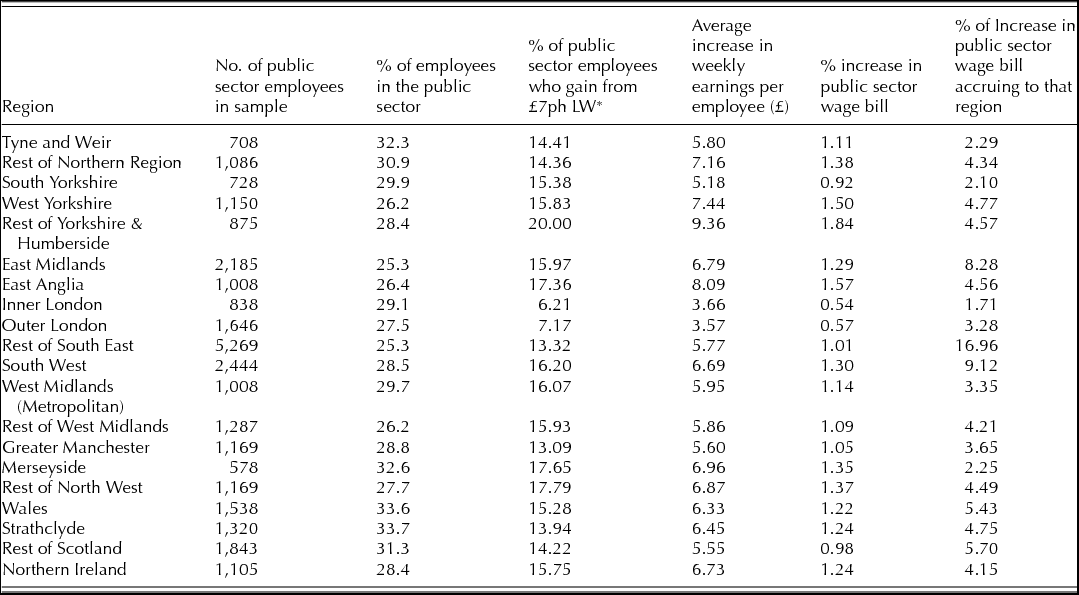
For the purposes of this article, we simplify the analysis by suggesting that where firms act as monopsonists within a labour market we can readily demonstrate a standard result that wages will be lower than under perfect competition (Frank, Reference Frank1994). As is demonstrated in Table 1, the public sector in large parts of the UK is responsible for almost one third of employment, and in setting wage levels can indeed be considered to be a monopsonist within a labour market.
Regional impact of public sector living wage

Source: UK Quarterly Labour Force Survey (2005–08). * LW refers to Living Wage.
If monopsony permits us to explain the market failure which gives rise to the proposal for a living wage, what impact would such a policy have? It is to this question we now turn. However, prior to doing so we highlight our methodology and our use of the UK Quarterly Labour Force Survey and the British Household Panel Survey data in addressing these issues.
Methodology and data
Our study seeks to examine the impact of the living wage in three ways. First, it considers its impact on the wage distribution and its spatial consequences for the UK labour market. Second, it examines the differential impact of introducing a living wage on different sub-groups within the labour market. And, finally, it examines the impact of a living wage on the income distribution at the level of the household. In order to look at the first two aspects of the living wage, we require data on individual wage rates. The UK Quarterly Labour Force Survey (QLFS) is the largest and most authoritative data set available for this form of research. The QLFS is a quarterly survey of a sample of those within the labour force, both employed and unemployed, with detailed data on wage rates and individual characteristics. Each respondent is surveyed over five quarters and is asked detailed information about their labour income in their initial entry into the sample. By combining different waves together (though each individual appears only once), we can create a population of sufficient size to allow for disaggregation by wage level, nation, region, gender, age and ethnicity.
Our study of the QLFS is obtained by adjusting nominal wage data to the real September 2007 level and aggregating together sixteen waves of quarterly data, starting with the January 2005 to March 2005 quarter and finishing with the October 2008 to December 2008 quarter. Once we have excluded those respondents who are not in employment, and those missing data that we require for our analysis, our sample consists of 102,121 employed respondents, of whom 73,167 are in the private sector (71.6 per cent of all employees) and 28,954 in the public sector (28.4 per cent).
The QLFS data permits us to disaggregate the population by hourly wage rate levels, and in this study we disaggregate the population into bands of hourly wage rate levels increasing at each level by 25 pence per hour. We further disaggregate the population into private and public sectors to examine the differences within and between the two sectors.
Once we have disaggregated the population into hourly wage rate bands, it is possible to notionally increase public sector hourly wage rates such that all public sector employees currently paid at a rate less than the living wage are instead paid at a level equal to a living wage in order to examine the costs of a living wage on the public sector. Where the living wage has already been implemented, its level has been determined by reference to a relative poverty measure (Hirsch and Moore, Reference Hirsch and Moore2012). The living wage calculation has been undertaken to identify the cost of living for a household in each geographical location to ensure their household income is above the threshold for the receipt of welfare benefits and thus avoid the high marginal rates of taxation associated with poverty traps. In practice, it was set at the level of £7.00 per hour or thereabouts in all the regional studies.Footnote 3 In this analysis, we examined the effects of a living wage set at a variety of levels, although we chose to focus our discussion on the effects of a living wage set at the rate identified by the Joseph Rowntree Foundation (JRT) in 2009 and adopted by Glasgow City Council (2009), namely £7.00 per hour. It is important, however, to acknowledge two qualifications regarding this approach. First, the analysis does not take account of any increase in wage bill asked, or required, of private sector employers who provide goods or services to the public sector. Second, the analysis does not take account of any wage rises that employees currently at or above the living wage may seek in order to maintain wage differentials over those employees benefitting from the introduction of the living wage. Thus our analysis is a comparative static assessment and does not consider dynamic effects.
We further extend our analysis of the QLFS by disaggregating the data to examine specific effects of a public sector living wage on young workers, female workers in general, female workers in single parent households and ethnic minority workers.
Our third and final analysis involves investigating the extent to which a living wage may act as an effective policy lever in addressing household income distribution. In order to examine this, we need to use a data set that permits household's total income to be accurately calculated. Although much smaller in size, with only 10,000 households, the British Household Panel Survey (BHPS) crucially permits us to link income from employment with income derived from welfare payments and income from wealth.Footnote 4 This then allows us to examine the impact of changes of wage rates on total household incomes and hence household inequality. The BHPS thus provides us with the ability to utilise detailed household composition data to examine the impact on inequality within the income distribution at the household level. Hence, we can examine changes in the level of household inequality, a key indicator of the reduction of market failure identified by Wills (Reference Wills2007) and the trade union UNISON (2013), both proponents of the living wage. In this section of the analysis, we use equivalised gross household income before housing costs (i.e. household income data adjusted by a McClements Scale score for household composition) to examine the extent to which the increase derived from a living wage goes to households lower down the income distribution.
Results
Low pay and the costs of a living wage
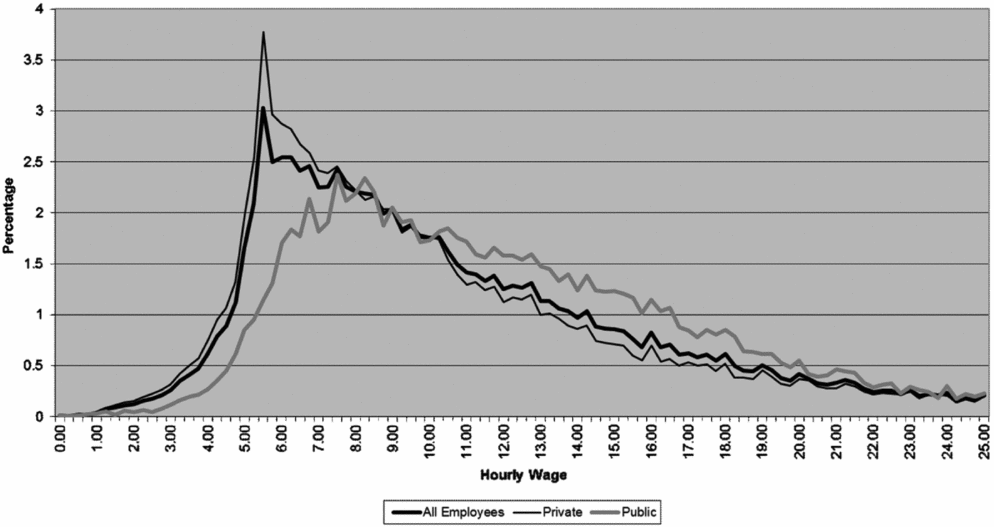
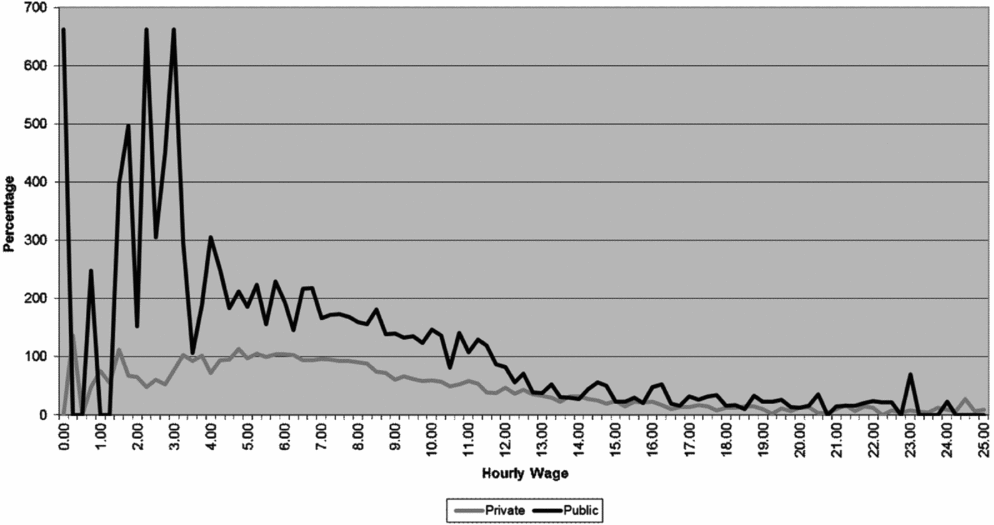
Figure 1 presents the distribution of hourly wage rates in the QLFS data for all employees, plus separately for private and public sector employees.Footnote 5 What is very marked about these results is that the modal wage both for all employees and private sector employees is at the statutory minimum wage for non-youth employees (as of October 2007 this stood at £5.52 per hour, falling within the £5.50 to £5.74 per hour band); this single hourly wage band accounts for 3.03 per cent of all employees and 3.77 per cent of private sector employees. For public sector employees, the distribution peaks at £7.50 to £7.74 per hour, with 2.38 per cent of public sector employees in that hourly wage band. These results suggest that for much of the private sector the statutory minimum wage constitutes a binding constraint on just how low hourly wage rates can be set. An immediate conclusion flowing from this is that a living wage could potentially constitute a binding constraint on low hourly wage rates in the public sector (Wills, Reference Wills2009).
Distribution of hourly wages (quarterly labour force survey data)

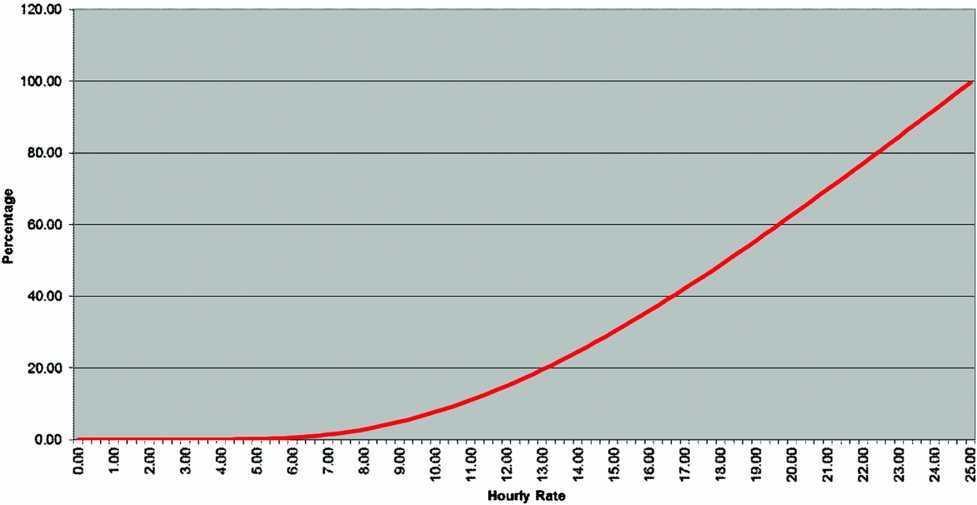
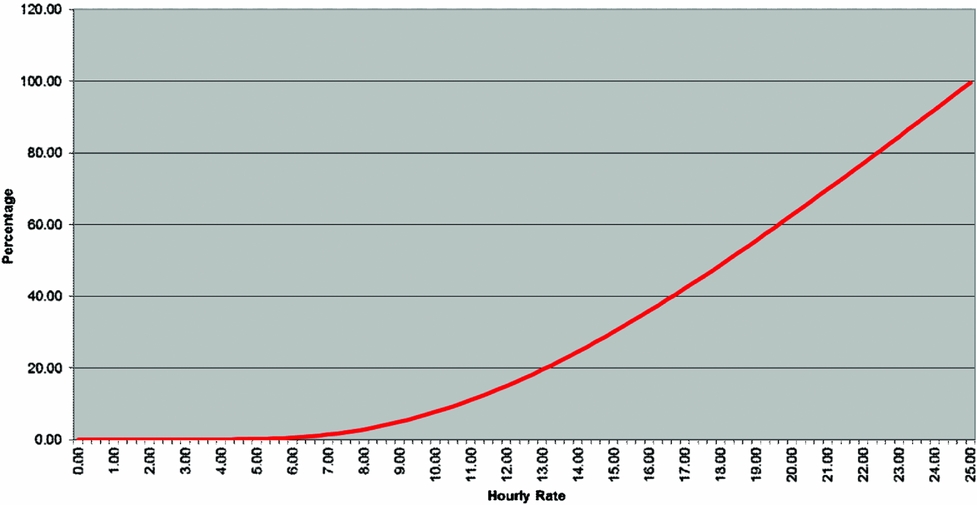
Figure 2 below shows the cost to the public sector of applying different levels of the living wage (expressed as a percentage of the current public sector wage bill identified in the QLFS). It is clear that the cost to the public finances increases as the proposed living wage increases; ceteris paribus, a higher living wage results in a higher number of employees benefitting from the living wage and a higher average benefit per employee (with the total benefit to employees ‒ and hence the total financial cost to the public sector ‒ being the product of these two numbers). In theory, this suggests the possibility that the financial cost of the living wage would rise at an ever-increasing rate as the level of the living wage rises. However, proponents of the living wage had more modest targets in mind (UNISON, 2013).Footnote 6 Our analysis indicates that if the living wage recommended by the Joseph Rowntree Foundation, and set by Glasgow City Council, of £7.00 per hour, were applied nationally it would increase the UK's public sector wage bill by just 1.21 per cent.Footnote 7 Even factoring in the additional national insurance and pension contributions this rises to just 1.51 per cent.Footnote 8
Cost of living wage (% of existing public sector wage bill) (QLFS data)
The evidence in Table 1 also indicates that the introduction of a living wage would have a strong spatial dimension, and, therefore, the costs of a living wage are not uniform. There is large regional variation in the proportion of workers employed in the public sector, with just over 25 per cent of employees in the East Midlands and the South East compared to levels of over 33 per cent in Wales and Strathclyde. In addition, there is a large variation in the proportion of those public sector employees who gain from a living wage, with around 7 per cent benefiting in Inner and Outer London, yet as much as 20 per cent in the Rest of Yorkshire and Humberside region and 17 per cent in the East Anglia, Merseyside and the Rest of the North West regions. As a result, the cost of a living wage also varies regionally, for the level chosen of £7.00 per hour, from between 0.5 per cent in the London regions to 1.84 per cent in the Rest of Yorkshire and Humberside region.Footnote 9 The final column of Table 1 shows that the benefits of the living wage are linked to population share. Thus, the largest share of the benefits flowing from the living wage (16.96 per cent) accrues to the Rest of the South East (with 5,269 respondents accounting for 18 per cent of our sample).
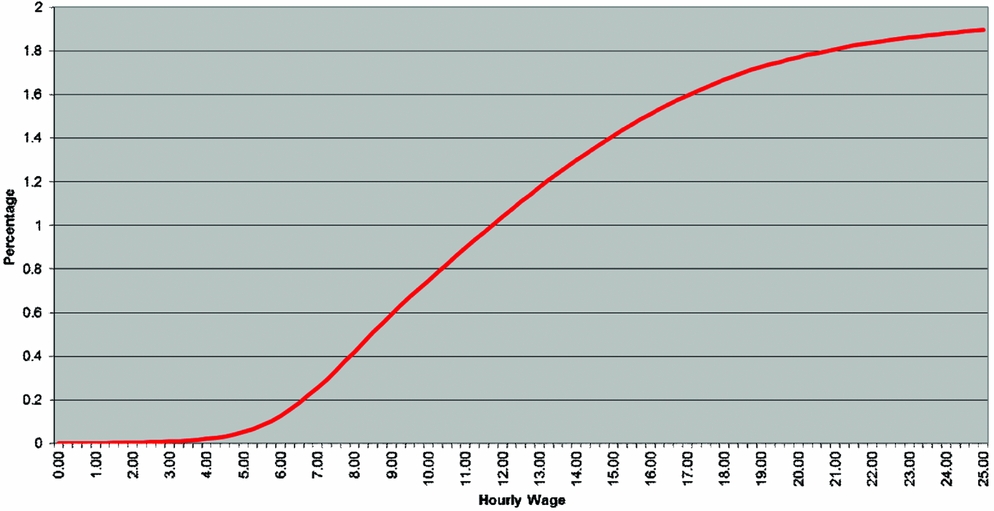
Although the living wage we have focused on resulted from research undertaken by the Centre for Research in Social Policy and the Joseph Rowntree Foundation, it is just one possible figure (Valadez and Hirsch, Reference Valadez and Hirsch2014). Figure 3 below presents the marginal cost of moving the living wage from one wage rate band to the next (in effect a 25 pence increase in the minimum wage); again, these costs are denominated as a percentage of the public sector wage bill.
Marginal cost of living wage (% of existing public sector wage bill) (QLFS data)

The evidence from Figure 3 shows that the additional cost of increasing the living wage in the public sector from £7 per hour to £7.25 per hour would be only 0.26 per cent of the current public sector wage bill, while the saving achieved by instituting a living wage of only £6.75 per hour would lessen the cost by only 0.22 per cent of the current public sector wage bill. The relatively low cost of a higher living wage combined with, as we demonstrate later in the article, the inequality reducing effects of a living wage means that the £7 per hour recommended by the Joseph Rowntree Foundation could perhaps be increased still further.
While the above highlights the extent of low pay and the relatively low cost of reducing low pay, it is also necessary to consider which specific groups would benefit from a living wage in the public sector. In order to do this, we have to undertake our analysis at a UK-wide level because regional disaggregations would result in small sub-sample problems.
Youth, gender and ethnicity
As Figure 1 highlights, the hourly wage distributions do not begin at £5.52 per hour (the £5.50 to £5.74 per hour wage band): 12.3 per cent of all employees, and 15.0 per cent and 5.6 per cent of private and public sector employees, respectively, earn below the non-youth statutory minimum wage. Two principal reasons for this exist. First, workers under the age of twenty-two have a lower statutory minimum wage (as of October 2007 it was £4.60 per hour for employees in the age range eighteen to twenty-one, and £3.40 for employees in the age range sixteen to seventeen). Second, not all employers will be compliant with the minimum wage legislation.Footnote 10 If young workers are particularly affected by low pay, we should be able to identify the increased prevalence of young workers in the QLFS wage data. Figure 4 below provides exactly this insight into the extent to which those employees on the lowest hourly wage rates tend to be younger employees. The data indicate, for each of the hourly wage bands, the ratio of the percentage of employees aged between sixteen and twenty-four years of age in that band compared to the percentage of all employees in that band. Thus, for example, 3.75 per cent of young private sector employees are in the £5.50 to £5.74 hourly wage band, compared to 3.77 per cent of all private sector employees, resulting in a percentage of 99.43; the figures for the public sector are 1.78 per cent, 1.14 per cent and 155.99 per cent, respectively.
Young employee hourly wage distribution as % of all employee hourly wage distribution (QLFS data)

The main result demonstrates a clear, positive relationship between age and hourly wage rates. Young employees are much more likely to be placed in low hourly wage bands than their older counterparts. This is consistent with the positive correlation found by Lee et al. (Reference Lee, Sissons and Jones2013: 69) between the preponderance of low-skilled employment in cities with higher wage inequalities. However, a more disturbing result can also be discerned. Whereas Figure 1 demonstrates that private sector hourly wages are much more skewed towards the minimum wage, this evidence demonstrates that younger workers in the public sector are more likely to be found at the lower wage bands than older workers. Thus, at £4.00 per hour younger workers are three times more likely to be found in this pay band than older workers. Whatever protection against low wages is offered by the public sector, this protection tends to be reserved for its older employees. For most wage bands prior to the £7.00 to £7.24 band, younger public sector workers tend to be placed within each band with a frequency two to three times that of their older public sector counterparts.
The UK's minimum wage legislation offers differing levels of protection depending on the employee's age, with a standard hourly rate for those aged twenty-two and above, a lower rate for those between eighteen and twenty-one, and an even lower rate for those who are sixteen or seventeen. The stated intention was to prevent the minimum wage pricing young (less experienced) people out of the labour market. These results suggest that contrary to what we might expect, it is the public sector that is incorporating age into its wage structure more markedly than its private sector counterpart. Therefore, incorporating into the living wage the age discrimination found in the minimum wage seems highly likely to generate widespread, unequal treatment of young workers by the public sector. The regulation of the labour market that a non-discriminatory living wage would introduce would impact quite markedly on the public sector's low wage structure.
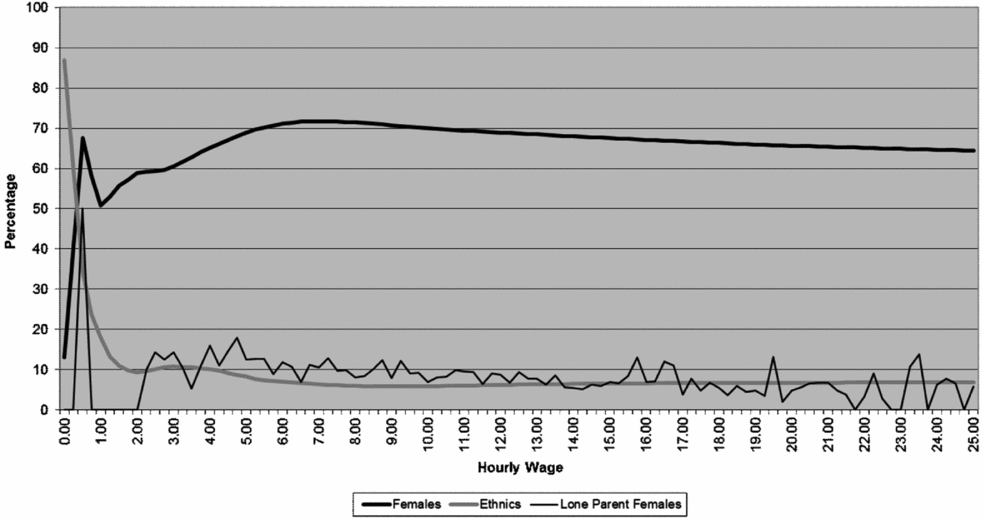
Low pay is not spread evenly throughout the demographic groups in British society, and the above analysis suggests that we need to examine whether the living wage would target its assistance at other disadvantaged demographic groups, for it is not just young workers who the living wage literature suggests are particularly disadvantaged by weak regulation in the labour market (Hirsch and Moore, Reference Hirsch and Moore2012). Women generally, and specifically women in single parent households, and ethnic minority workers, are all specifically identified as subject to problems within the labour market. To this end, we examined the extent to which the living wage would in fact target its assistance at these particular groups: women (66 per cent of our public sector sample) and ethnic minority workers (6.9 per cent of our public sector sample). Figure 5 suggests that the introduction of a living wage would target resources at women workers, though not at ethnic minority workers.Footnote 11
Percentage of living wage benefits going to females and ethnic minorities, percentage of females who are lone parents (QLFS data)

For the wage bands running from £4.25 to £4.49 through to £18.75 to £18.99, the proportion of the additional wage bill accruing to women workers exceeds their representation in the public sector workforce. The £7.00 per hour living wage is in fact the optimal level in terms of redressing the gender wage gap with the largest proportion, 71.69 per cent, of the increase in income (for the £7.00 to £7.24 wage band in Figure 5) going to women workers. Furthermore, the financial assistance accruing to females as a result of a public sector living wage is particularly focused on those females in single parent households, as indicated by the other data graphed in Figure 5. These data indicate, separately for each wage band, the percentage of public sector female employees who are in single parent households. The general picture to be taken from these data is that female single parents working in the public sector tend to be disproportionately located in lower wage bands, and hence would disproportionately benefit from the introduction of a public sector living wage. The evidence provided here is consistent with research indicating that gender is of particular significance in the development of household poverty. Beatty et.al. (Reference Beatty, Fothergill, Houston, Powell and Sissons2009) identified the role played by gender in explanations for the rise of incapacity benefit claimants, and Houston and Lindsay (Reference Houston and Lindsay2010) identify the additional problems women face in overcoming the spatial mismatch in the location of poverty and paid employment. Certainly, as Table 1 and Figure 5 demonstrate, a living wage has particular impact on the spatial impact of low pay and on gender inequalities.
Somewhat contrary to the living wage literature, our results do not support the view that a public sector living wage could represent a mechanism whereby the living standards of ethnic minority workers would be targeted (Wills, Reference Wills2007). From the wage band £6.25 to £6.49 onwards, the proportion of the additional wage bill accruing to ethnic minority workers is less than their representation in the public sector workforce. Three potential explanations for this lack of impact might be relevant. First, it may be that ethnic minority workers fill many higher skilled roles, for example, trained medical positions within the UK's National Health Service, and whether they are doctors or nurses they are unlikely to benefit from a living wage anywhere near the £7 per hour that is the focus of much of the debate about the living wage in the UK. Second, as we saw in Table 1, there is a spatial dimension to the benefits from a living wage and many of the metropolitan areas where ethnic minority workers are to be found, particularly in inner and outer London, are the least affected. Finally, it might also be noted that the living wage literature identifies a particular subset of ethnic minority workers who might not be typically found within the public sector, recent immigrant workers with poor English language skills.
If the QLFS data suggests that a public sector living wage could indeed impact on young and women workers’ wage rates, reducing age and gender discrimination, it remains to be seen what impact a living wage could have on inequality more generally. It is to this question that we now turn.
Inequality and the living wage
While the QLFS provides some household composition data, it has a number of weaknesses when attempting to utilise income data to compare household levels of inequality.Footnote 12 Most significantly, the QLFS provides data for labour force income and thus for those not in the labour force, those aged below sixteen years of age or non-working adults over sixty-nine years of age, the QLFS provides no data. Similarly, income data for the self-employed and non-labour income, in the form of dividend and interest payments, means our household income measure derived from the QLFS would be biased towards households with in-work adults.
In contrast, the British Household Panel Survey (BHPS) provides both data on household income and detailed household composition data. Although the BHPS has a smaller sample size, it permits us to go beyond the analysis available with the QLFS and to not only identify public sector workers, but also group those workers within their respective households and calculate their total household income. In doing so, we are then able to rank households within an income distribution into deciles in order to examine the extent to which the benefits from a living wage accrue to those households lower down the income distribution.
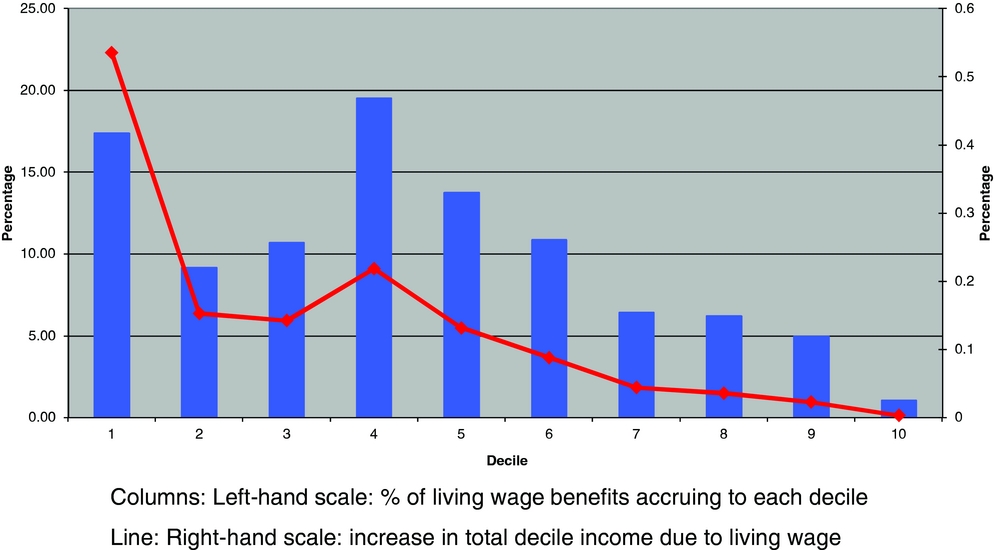
Figure 6 demonstrates that the benefits of a living wage accrue predominantly to households in the first and the fourth income deciles. Thus, households in which the working poor are located fall below median income, predominantly in the fourth decile, or alternatively they are unable to claim work-related benefits and appear in the first decile. Workless households in receipt of welfare benefits (typically the second and third income deciles) will see less of an impact of a living wage and those at the highest end of the income distribution (deciles six and above) will also see very little benefit from a living wage. Thus, the bar chart in Figure 6 shows that 17.38 per cent of all of the additional income goes to households in decile 1, while 19.50 per cent goes to households in decile 4. This concentrated effect is even more apparent when we express these additional incomes as a percentage of each decile's existing total income as presented in the line graph in Figure 6. Thus, using this approach we see that the living wage's effect is most pronounced on the first decile, whose total income rises by 0.53 per cent, and the fourth decile, whose total income rises by 0.22 per cent.Footnote 13 Not surprisingly, the living wage needs to be understood as an in-work anti-poverty measure and is particularly effective at addressing inequality within the lowest income decile.
Distribution of the benefits (equivilised income) of a £7 per hour public sector living wage

Conclusions
This article has examined the literature on a living wage derived from both an economic and a human geography perspective (Hirsch and Moore, Reference Hirsch and Moore2012). It has demonstrated that the arguments for regulating low wages within the labour market can be readily identified within the economic and geography literatures identifying imperfect market behaviour and segmented labour markets as suggested by Wills (Reference Wills2009). It further examined the evidence for the impact of a living wage in the public sector and found evidence for the positive effect a living wage could have on three specific groups of workers: the young, women and women workers heading single parent households. In addition, the living wage had a progressive impact on income inequality for those households in work. Surprisingly, it found little impact on ethnic minority workers, but this may be explicable in the limited access to the public sector for newly migrant low-skilled workers.
The cost of the living wage was also found to be low relative to the public sector pay bill. At 1.21 per cent of the total pay bill, anti-poverty measures such as the living wage may be an effective in-work remedy to household inequality (UNISON, 2013). It also demonstrates in Table 1 an important spatial difference in its impact. The living wage can thus be recognised as an important potential policy tool for the devolved governments in the UK and local authorities in developing a spatially specific anti-poverty measure (Johnstone and McWilliams, Reference Johnstone, McWilliams, Mooney and Scott2005). In the aftermath of the Scottish independence campaign and referendum, public policies to address inequality have acquired greater resonance with both policy-makers and the general public.
There are two areas where this study may be limited. First, we do not address the impact a rise in the wage rate would have on households’ receipt of welfare benefits. Were these to be withdrawn at high marginal rates the impact of the living wage would be markedly reduced. Hirsch, for example, suggests the marginal rates of taxation are as high as 76 per cent (Hirsch, Reference Hirsch2001: 18). However, as Figure 6 indicates, the main beneficiaries of a living wage are households in the bottom and fourth deciles, implying that there is some separation between households that would be beneficiaries of the living wage and households which are recipients of welfare benefits. Second, we have focused our examination of the living wage solely on the public sector. If public sector organisations were to impose a living wage clause on all of their private sub-contractors then both the benefit and the cost of the public sector living wage would be greater than indicated by these results.