An overarching goal of the field of prevention science is to intervene in the course of development to ameliorate or eliminate the emergence of maladaptation and psychopathology (Ialongo et al., 2006). The discipline of developmental psychopathology, with its major focus on the dialectic between the study of normality and pathology, is in a unique position to provide an important theoretical foundation for prevention science (Cicchetti & Hinshaw, 2002; Cicchetti & Toth, 1992; Ialongo et al., 2006; Institute of Medicine, 1994).
An organizational perspective on development has been an influential theoretical approach in the field of developmental psychopathology (Cicchetti, 1993; Cicchetti & Schneider-Rosen, 1986; Cicchetti & Sroufe, 1978; Sroufe & Rutter, 1984). Theorists who adhere to an organizational perspective direct prevention science to focus on the progressive organization of developmental competencies and incompetencies in the course of epigenesis with the goal of structuring preventive efforts (Cicchetti & Toth, 1992; Ialongo et al., 2006; Toth & Cicchetti, 1999). To effect change in the course of development and avert psychopathological outcomes, preventive interventions informed by an organizational perspective should focus on promoting competence and reducing ineffective resolution of the stage-salient developmental issues that emerge at different periods in ontogenesis. By adopting the approach emphasized by organizational theorists, the deflection of maladaptation onto more adaptive developmental pathways may be achieved, thereby enhancing the individual's capacity for a greater likelihood of subsequent successful adaptation (Cicchetti, 1993; Cicchetti & Tucker, 1994; Sroufe, 1989). Inherent in the organizational perspective is the importance of early intervention, before developmental liabilities may become consolidated (Cicchetti, Toth, & Bush, 1988; Toth & Cicchetti, 1999).
Although the quintessential goal of prevention science is to right the developmental course and prevent the emergence of psychopathology, the results of prevention trials also possess important implications for developmental theory. As developmental experiments, prevention trials provide a wealth of information about the processes of typical and atypical development (Cicchetti & Hinshaw, 2002; Cicchetti & Toth, in press; Hinshaw, 2002; Howe, Reiss, & Yuh, 2002; Ialongo et al., 2006; Kellam & Rebok, 1992). The translation of developmental theory into the design and implementation of preventive interventions (Cicchetti & Toth, 1992; Noam, 1992; Shirk, 1999; Toth & Cicchetti, 1999) and the results of preventive interventions must form a circular link back to the conceptual framework to advance both the theory and future randomized intervention trials (Cicchetti & Hinshaw, 2002; Ialongo et al., 2006).
If the developmental course is altered due to a preventive intervention, and the risk of the disorder or negative outcome is reduced, then the research results will contribute to our understanding of developmental processes (Cicchetti & Rogosch, 1999; Coie et al., 1993). Conversely, if the reduction of a targeted risk factor does not appear to have altered the pathogenic process, then that risk factor would not be viewed as a causal agent, but may be a marker of atypical development (Cicchetti & Hinshaw, 2002; Hinshaw, 2002; Kraemer et al., 1997).
Child maltreatment poses severe risks for long-term maladjustment and the development of psychopathology (Cicchetti & Toth, in press; Cicchetti & Valentino, 2006). Child maltreatment exemplifies a pathogenic relational environment that is far beyond the range of what is normatively encountered and engenders substantial risk for maladaptation across diverse domains of biological and psychological development (Cicchetti & Manly, 2001; Cicchetti & Valentino, 2006; DeBellis, 2001). Both the proximal environment of the immediate family and the more distal factors associated with the culture and the community, as well as the transactions that occur among these ecological contexts, conspire to undermine normal biological and psychological developmental processes in maltreated children (Cicchetti, 2002; Cicchetti & Lynch, 1993; DeBellis, 2001; Pollak, Cicchetti, Klorman, & Brumaghim, 1997). Efforts to prevent the deleterious consequences of maltreatment are thus of critical importance.
In this paper, we report on the evaluation of the efficacy of two theoretically informed, randomized preventive interventions for maltreating mothers and their 1-year-old infants. Guided by an organizational perspective on development, and by the translation of empirical research that documents that maltreated children manifest impairments in attachment organization, in this investigation we intervened early in the life course of maltreated infants to prevent the compromised developmental attainments that accompany maltreatment and that are precursors to later maladaptation and psychopathology.
The capacity for preferential attachment originates during early experiences and interactions with the caregiver (Gunnar & Vazquez, 2006; Schore, 2003; Sroufe, 1979, 1996). The preattachment parent–infant environment helps to shape children's physiological regulation and biobehavioral patterns of response (Gunnar & Vazquez, 2006; Hofer, 1987; Pipp & Harmon, 1987). Near the end of the first year of life, normally developing infants derive feelings of security from their caregivers and use them as a base from which to explore the environment (Cummings & Davies, 1996; Sroufe, 1979, 1996). Dyadic interactions, marked by relatedness and synchrony, resiliency to stress, and appropriate affective interchange, are associated with the development of a secure attachment relationship (Sroufe, 1979, 1996). In the absence of regular contingent responsivity, neither infant nor caregiver derives feelings of efficacy in the relationship and the development of a secure attachment is likely to be impeded (Ainsworth, Blehar, Waters, & Wall, 1978; Sroufe & Waters, 1977).
Because there are many enduring problematic characteristics of the home environments where maltreatment has occurred, such as emotional or physical rejection, aggression or hostile management, threatening affective or verbal assaults, or lack of appropriate responsivity (Azar, 2002; Cerezo, 1997; Crittenden & Ainsworth, 1989; Howes & Cicchetti, 1993; Rogosch, Cicchetti, Shields, & Toth, 1995), as expected, research investigations have discovered that the vast majority of the attachment relationships between maltreated youngsters and their caregivers are pathological in nature. The attachments of maltreated infants consistently have been shown to be insecure (Crittenden, 1988; Egeland & Sroufe, 1981; Schneider-Rosen, Braunwald, Carlson, & Cicchetti, 1985). Moreover, given the unpredictable, chaotic relationships that characterize the maltreating home environment and the strong likelihood that the parents in these families had insecure attachment relationships with their own parents (Crittenden & Ainsworth, 1989; Gonzalez, Cicchetti, & Rogosch, 2006; Lyons-Ruth & Jacobvitz, 1999; Main & Goldwyn, 1984; Main & Hesse, 1990), maltreated infants commonly develop disorganized-disoriented (Type D) attachments with their caregivers (Barnett, Ganiban, & Cicchetti, 1999; Carlson, Cicchetti, Barnett, & Braunwald, 1989; Lyons-Ruth, Repacholi, McLeod, & Silva, 1991). Furthermore, investigations have revealed that in the rare instance of secure attachment in maltreated infants, these secure attachments are likely to be unstable and to eventuate in insecurity (Cicchetti & Barnett, 1991; Schneider-Rosen et al., 1985).
Organizational theorists posit that the quality of the resolution of each stage-salient issue primes the way subsequent developmental tasks are likely to be negotiated (Cicchetti & Schneider-Rosen, 1986; Sroufe & Rutter, 1984). Because maltreated infants predominantly develop insecure attachments, there is a high probability that these babies will unsuccessfully resolve subsequent developmental issues, paving the way for these infants to proceed along maladaptive developmental pathways. The likelihood that maladaptation and psychopathology will occur is exacerbated by the preponderance of Type D attachments in the maltreated babies. The developmental sequelae of disorganized–disoriented attachments are often characterized by more maladaptive and pathological outcomes than is the case for other types of attachment insecurity (Carlson, 1998; Lyons-Ruth, Easterbrooks, & Cibelli, 1997; van IJzendoorn, Schuengel, & Bakermans-Kranenburg, 1999). Thus, the preventive interventions to promote the attainment or maintenance of secure attachment organization in maltreated infants are crucial for redirecting the course of development onto adaptive pathways.
Sharing the common goal of preventing subsequent inadequate parenting to avert maladjustment in maltreated infants, the two interventions differed in their strategies for attaining these goals. The first model, psychoeducational parenting intervention (PPI), focused on providing mothers with didactic training in child development, parenting skills, coping strategies for managing stresses in the immediate environment and assistance in developing social support networks. The second model, infant–parent psychotherapy (IPP), involved dyadic parent–child therapy sessions designed to improve the parent–child attachment relationship by altering the influence of negative maternal representational models on parent–child interaction. The pre- and postintervention functioning of mothers and infants in both models of intervention were compared with the functioning of mothers and maltreated infants who receive services typically available through the Department of Social Services (DSS), the community standard (CS) group. A fourth nonmaltreated comparison (NC) group, comprising demographically comparable mothers and their nonmaltreated infants, also were included to have a low income standard of comparison for the maltreatment groups.
Home visitation, a component of the two interventions provided herein, has transpired over the course of the past several decades as an effective model for preventing damage to vulnerable children (National Commission to Prevent Infant Mortality, 1989; Olds & Kitzman, 1993; Shirk, Talmi, & Olds, 2000; United States Congress, 1988). In fact, the United States Advisory Board on Child Abuse and Neglect (1990) identified home-visitation services as the best documented strategy for preventing child maltreament. Although impressive findings on the effectiveness of home visitation have emerged (Olds et al., 1997, 1998; Olds, Henderson, Chamberlin, & Tatelbaum, 1986), a recent study on the efficacy of home-visitation services for families where maltreatment had already occurred did not succeed in preventing the recidivism of physical abuse or neglect (MacMillan et al., 2005). Moreover, to date, evaluations of whether home-visitation services can alter the future life-course development in infants or children who have been maltreated have yet to be conducted.
Unlike the PPI model, which focuses on current behavior utilizing behavioral intervention skills, the core of the IPP intervention resides within the mother's interactional history and its effect on her representation of relationships, most significantly, that of her infant. A number of attachment-theory informed interventions have been developed for high-risk, multiproblem populations (Atkinson & Goldberg, 2004; Bakermans-Kranenburg, van IJzendoorn, & Juffer, 2003, 2005; Berlin, Ziv, Amay-Jackson, & Greenberg, 2005; Cicchetti, Toth, & Rogosch, 1999; Toth, Maughan, Manly, Spagnola, & Cicchetti, 2002; van IJzendoorn, Juffer, & Duyvesteyn, 1995). With respect to attachment, theoreticians continue to debate whether modifying parental attachment organization, including their representations of their child, will result in improved parenting or, conversely, whether improving parenting may, independent of attention to parental attachment representations, lead to more secure attachment relationships between parent and child.
In a meta-analysis of 12 studies of the effectiveness of preventive or therapeutic interventions in enhancing parental sensitivity or children's attachment security, van IJzendoorn et al. (1995) concluded that interventions were more effective in improving maternal sensitivity than in fostering children's attachment security. Importantly, van IJzendoorn et al. also found that the association between parental internal working models of attachment figures and infant attachment was stronger than the link between maternal sensitivity and attachment and that the former remained significant after sensitivity was included as a moderator variable. In another meta-analysis of the effectiveness of preventive interventions for enhancing parental sensitivity and infant attachment security, Bakermans-Kranenburg et al. (2003) concluded that the most effective interventions used a moderate number of sessions and a behavioral focus (e.g., van den Boom, 1994, 1995). However, within the meta-analysis, only three randomized studies, all conducted with multiproblem populations, were described as intensive and having numerous sessions. These interventions also were very comprehensive, and they included a combination of behavioral, representational, and supportive interventions, thereby making it difficult to disentangle various components of the intervention.
Therefore, the relative efficacy of specific types of behavioral versus relationship-based interventions remains open to further investigation. Accordingly, we compared competing models of intervention, with one being more parent-skills oriented (i.e., PPI) and the other being more focused on maternal representation and the mother–child relationship (i.e., IPP). The evaluation study was guided by the following hypotheses:
- Factors associated with higher vulnerability for insecure infant–mother attachment, including maltreatment in the mother's childhood, insecure representations of the mother's own mother, higher stress, lower social support, lower maternal sensitivity, and inappropriate parenting attitudes, will be observed in the mothers in the maltreatment group.
- At 12 months, the rate of insecure attachment will be higher in the maltreatment group than in the nonmaltreatment group.
- Disorganized attachment will predominate in the maltreatment group.
- Higher rates of change from insecure to secure attachment will be observed in the IPP and PPI groups. The rate of secure attachment will increase in the IPP and PPI groups following the provision of the interventions.
- The rate of secure attachment will be greater in the IPP group than in the PPI group following the provision of the interventions.
- In the absence of active intervention, the rate of stable attachment from 12 to 26 months will be higher in the CS and NC groups than in the IPP and PPI groups. Stable insecure attachment will predominate in the CS group.
Method
Participants
Infants in maltreating families and their mothers were recruited for a study of the effects of child maltreatment on infant development and for an evaluation study of the efficacy of two preventive interventions designed to optimize mother–infant relationships and improve parenting. The maltreatment sample consisted of 137 infants (60 boys, 77 girls) and their mothers. A nonmaltreated comparison group of 52 infants (28 boys, 24 girls) and their mothers also were recruited. During the initial assessment, infants were on average 13.31 months of age (SD = 0.81); mothers ranged in age from 18 to 41 years (M = 26.87, SD = 5.88). The majority of mothers (74.1%) were of minority race/ethnicity.
To recruit 12-month-old infants in maltreating families and their mothers, a Department of Human Services (DHS) recruitment liaison was retained. As an employee of DHS, the liaison was able to access DHS Child Protective Service (CPS) and preventive service records to identify all infants known to have been maltreated and/or who were living in maltreating families with their biological mothers. Infants who had been placed in foster care were not targeted for inclusion because of the limited ongoing contact with their mothers. The DHS liaison contacted eligible families and explained the project to mothers. Mothers who were interested in participating signed a release form for their names to be given to project staff. During the initial contact by project staff, the mothers provided informed consent and permission for their infant's participation. Mothers also signed a release allowing project staff to have access to DHS records regarding the family's CPS and preventive service involvement.
Maltreatment determinations
All DHS records pertaining to the family were accessed and independently coded by trained research coders. The Maltreatment Classification System (MCS; Barnett, Manly, & Cicchetti, 1993) was utilized to classify all forms of maltreatment that had occurred in the family and that the infant had experienced. Based on operational criteria, the MCS designates all subtypes of maltreatment (i.e., neglect, emotional maltreatment, physical abuse, sexual abuse). Coding of the DSS records was conducted by trained research assistants, doctoral students, and clinical psychologists. Adequate reliability has been obtained (weighted κs ranging from .86 to .98; Manly, Kim, Rogosch, & Cicchetti, 2001). Other investigators have demonstrated that the MCS is reliable and valid in classifying maltreatment (Bolger, Patterson, & Kupersmidt, 1998; Dubowitz et al., 2005; English et al., 2005; Manly, 2005; Smith & Thornberry, 1995).
In terms of the subtypes of maltreatment, neglect involves failure to provide for the child's basic physical needs for adequate food, clothing, shelter, and medical treatment. In addition to inadequate attention to physical needs, forms of this subtype include lack of supervision, moral–legal neglect, and education neglect. Emotional maltreatment involves extreme thwarting of children's basic emotional needs for psychological safety and security, acceptance, and self-esteem, and age-appropriate autonomy. Examples of emotional maltreatment of increasing severity include belittling and ridiculing the child, extreme negativity and hostility, exposure to severe marital violence, abandoning the child, and suicidal or homicidal threats. Physical abuse involves the nonaccidental infliction of physical injury on the child (e.g., bruises, welts, burns, choking, broken bones). Injuries range from minor and temporary to permanently disfiguring. Finally, sexual abuse involves attempted or actual sexual contact between the child and caregiver for purposes of the caregiver's sexual satisfaction or financial benefit. Events range from exposure to pornography or adult sexual activity, to sexual touching and fondling, to forced intercourse with the child.
In the recruited sample, 66.4% of the infants had directly experienced abuse and/or neglect during the first year of life. None of the infants with individual level maltreatment had been sexually abused, whereas 8.8% had been physically abused, 84.6% had been neglected, and 69.2% had been emotionally maltreated. Few cases of physical abuse were present in the sample because of the high likelihood of foster care placement when abuse occurs during infancy. The remaining 33.6% of the infants were living in families where abuse and neglect had been experienced by siblings.
Recruitment of nonmaltreating families
Because of the predominance of poverty in the sample of maltreating families, a demographically comparable sample of mothers and infants in low-income families was recruited through the rolls of families receiving Temporary Assistance to Needy Families (TANF). The DHS liaison identified families with infants from the TANF rolls and screened these families for child maltreatment. The DHS liaison then contacted eligible families, explained the study, and for interested mothers, obtained a signed release form for the family's name to be given to the research staff. Subsequently, project staff obtained informed consent and signed permission for all DHS records pertaining to the family to be reviewed. DHS and preventive records were thoroughly screened to rule out the existence of documented child maltreatment in these families. Mothers also were interviewed regarding maltreatment and any DHS involvement to further validate nonmaltreatment status.
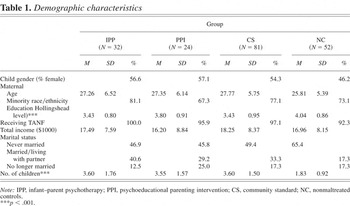
Following completion of baseline assessments, the mothers and infants recruited for the maltreatment sample were randomly assigned to one of three groups: IPP (n = 53), PPI (n = 49), or CS (n = 35). More cases were randomly assigned initially to the IPP and PPI groups as a result of some mothers declining to participate in the interventions. The maltreatment groups and the nonmaltreatment comparison group were comparable on a range of demographic variables (see Table 1). The groups did not differ on child gender, maternal age, maternal minority race/ethnicity, current receipt of TANF, total family income, or marital status. Overall, 53.4% of the infants were girls. Mothers on average were 26.98 years of age (SD = 5.98), 74.6% were of minority race/ethnicity, and 12.7% of mothers were currently married. The average family income was $17,151.00, including welfare benefits, and 96.3% of the families were currently receiving TANF. Overall, 41.8% of the mothers had a high school education or less. However, the average Hollingshead level of education differed between groups, F (3, 185) = 4.24, p = .001. Post hoc Tukey tests indicated that mothers in the NC group had higher level education than mothers in the IPP and CS groups. However, the three maltreatment groups did not differ from each other. Finally, the groups differed on the number of children to whom the mothers had given birth, F (3, 188) = 38.82, p < .001. Post hoc tests indicated that mothers in the NC group had fewer children than the mothers in each of the maltreatment groups, but the IPP, PPI, and CS groups did not differ from each other. Thus, the families in the sample are characterized by poverty, relatively large family size, and frequent unstable marriages.
Demographic characteristics

Procedures
During the baseline assessment period, home- and center-based research sessions were conducted with the mothers and infants. During interviews conducted in the home by trained research interviewers, mothers completed demographic and diagnostic interviews and a variety of self-report questionnaires. During a subsequent center-based laboratory session, mothers and infants participated in the strange situation procedure, in addition to other assessments. Finally, two trained observers, who were unaware of maltreatment status and study hypotheses, conducted a 3-hr home observation. Follow-up assessments utilizing the same home- and center-based sessions and procedures were conducted when the children were approximately 26 months old, after the interventions for the IPP and PPI groups had been completed.
Preventive interventions
IPP
This model of intervention is derived from the work of Fraiberg, Adelson, and Shapiro (1975), and it has been shown to be efficacious in fostering secure attachment in high risk, low income, immigrant families (Lieberman, 1991, 1992; Lieberman & Pawl, 1988). A guiding assumption of IPP is that difficulties in the parent–infant relationship do not result from deficits in parenting knowledge and skill alone. Rather, the problems that maltreating mothers have in relating sensitively and responsively to their infants stem from insecure internal representational models that evolved in response to the mother's own experiences in childhood. The infant evokes affects and memories associated with the mother's childhood relationship experiences, and in the process, a mother's unresolved and conflictual feelings can be projected onto the infant, resulting in distorted perceptions of the infant, a lack of attunement, and insensitive care.
In IPP, the patient is not the mother or the infant, but rather it is the relationship between the mother and her baby. Masters level therapists met weekly with mothers and their 12-month-old infants during sessions conducted in the home over the course of 1 year. The approach is supportive, nondirective, and nondidactic, and includes developmental guidance based on the mother's concerns. During the sessions, the therapist and the mother engage in joint observation of the infant. The therapist's empathic responsiveness to the mother and the baby allows for expansion of parental understanding and exploration of maternal misperceptions of the infant. Therapists strive to allow distorted emotional reactions and perceptions of the infant as they are enacted during mother–infant interaction to be associated with memories and affects from the mother's prior childhood experiences. Through respect, empathic concern, and unfailing positive regard, the therapeutic relationship provides the mother with a corrective emotional experience, through which the mother is able to differentiate current from past relationships, form positive internal representations of herself and of herself in relationship to others, particularly her infant. As a result of this process, mothers are able to expand their responsiveness, sensitivity, and attunement to the infant, fostering security in the mother–child relationship and promoting emerging autonomy in the child.
PPI
This model of preventive intervention is derived from the preventive intervention work of Olds and colleagues (Olds et al., 1997, 1998; Olds & Kitzman, 1990), involving visitation by nurses to the homes of low-income, teenage mothers of newborns over a 2-year period. The nurses provided a home-based education program on infant physical and psychological development and parenting, encouraged mothers to seek further education and employment, and enhanced informal social support. The home visitation program was effective in reducing the emergence of child maltreatment and fostered improved health and mental health outcomes for mothers and children (Olds et al., 1997, 1998). Although very promising, it is not known whether this approach is effective when maltreatment already had occurred during infancy. Accordingly, the PPI intervention was supplemented by a variety of cognitive and behavioral techniques to address parenting skill deficits and social–ecological factors, such as limited personal resources, poor social support, and stresses in the home, associated with maltreatment. Masters level therapists, experienced in working with multiproblem families, conducted home visits scheduled weekly over a 12-month period. The PPI model was psychoeducationally based, striving to address current concerns, provide parental education and parenting skill training, reduce maternal stress, foster social support, and increase life satisfaction. The approach is didactic in nature, providing mothers with specific information and knowledge regarding child development. Training in parenting techniques, problem solving, and relaxation were utilized. Within a core agenda of topics on parenting and social skills to be addressed with all mothers, flexibility and latitude on the amount of time spent on each area were stressed to tailor the intervention to each mother's primary needs.
Both the IPP and PPI interventions were manualized, with central components and core principles of each approach specified. Therapists participated in individual and group supervision on a weekly basis, and checks on the fidelity of the intervention implementation for each approach were conducted throughout the course of intervention. Extensive outreach was typically necessary to engage mothers in the interventions. The length of intervention averaged 46.4 weeks (SD = 7.36) for the IPP group and 49.4 weeks (SD = 4.81) for the PPI group. Although intervention sessions in the home were scheduled weekly, fewer sessions were conducted as a result of cancellations and missed appointments. On average, 21.56 (SD = 9.60) sessions were conducted in the IPP group and 25.38 sessions (SD = 9.65) in the PPI group.
CS
Mothers and infants randomized to the CS group did not receive enhanced services. Rather, families continued to receive services that were typically available to maltreating families in the community. Families may have continued to be monitored by CPS and may have participated in other preventive services programs.
Measures
Demographics interview
Developed by Cicchetti and Carlson (1989), this measure has been used extensively in research with high-risk, low-income populations. Information obtained includes: family composition, gender, race/ethnicity, birth dates, parent's education and occupation, income level, and receipt of public assistance.
Childhood Trauma Questionnaire (CTQ)
The CTQ (Bernstein, Fink, Handelsman, & Foote, 1994) was designed to obtain retrospective self-report information about past experiences of maltreatment. Because mothers in the maltreatment groups may have experienced maltreatment during their own childhoods, a measure to address intergenerational transmission of maltreatment was included. Factor analytically derived subscales correspond to different types of maltreatment, including physical/emotional abuse, physical neglect, emotional neglect, and sexual abuse.
Perceptions of Adult Attachment Scale (PAAS)
The PAAS (Lichtenstein & Cassidy, 1991) is a self-report questionnaire designed to assess an individuals' perceptions of the quality of their early childhood relationships with their mothers, as well as their current state of mind regarding attachment and their current relationships with their mothers. The measure has been shown to have good test–retest reliability and internal consistency (Lichtenstein & Cassidy, 1991), and the subscales have demonstrated relations with the Adult Attachment Interview (Lichtenstein-Phelps, Cassidy, Belsky, & Crnic, 1995). Subsequent confirmatory factor analyses have refined the original PAAS subscales (Gonzalez et al., 2006). Subscales characterizing childhood experiences include loved, rejected–neglecting, rejected–threatened, role reversal, and enmeshment. Present state of mind scales include lack of memory about childhood, derogation of attachment, angry, vulnerable, and balancing forgiving.
Maternal Behavior Q-Set (MBQ)
After a 3-hr home observation of mother–child interaction, two trained observers independently completed the MBQ (Pederson & Moran, 1995). The MBQ consists of 90 items that assess features of maternal sensitivity in relating to the infant. Observers sort the 90 items into a forced distribution of nine piles that vary in the extent to which the item is characteristic or uncharacteristic of maternal behavior. The distribution of items for each mother is correlated with an ideal criterion distribution of maternal sensitivity to derive an individual score. Sensitivity scores evidence stability (.71) over a 4-month period. Intraclass correlations between pairs of observers averaged .72 at the baseline and .71 at the follow-up assessments.
Adult–Adolescent Parenting Inventory (AAPI)
The AAPI (Bavolek, 1984) is a 32-item questionnaire measuring parenting and child-rearing attitudes, with particular attention given to maladaptive parental behavior associated with child abuse and neglect. The items are answered on a 5-point Likert scale indicating the respondent's degree of agreement or disagreement. Four subscales are derived, including inappropriate expectations, lack of empathy, belief in corporal punishment, and parent–child role reversal. Internal consistencies for the scales in this study ranged from .73 to .90. The AAPI demonstrates discriminant validity distinguishing between abusive and nonabusive parents (Bavolek, 1984).
Social Support Behaviors Scale (SBS)
The SBS (Vaux, Riedel, & Stewart, 1987) is a 45-item instrument measuring real and potential social supports available to individuals. Five modes are assessed, including emotional, socializing, practical assistance, financial assistance, and advice/guidance. Separate scales assess these forms of support for family and for friends. Internal consistencies for the scales have exceeded .85. Concurrent validity has been demonstrated through high correlations with social support network associations, support appraisals, and the Inventory of Socially Support Behavior.
Parenting Stress Inventory (PSI)
The PSI (Abidin, 1990) is a 101-item questionnaire assessing parenting stress in the child domain (adaptability, acceptability, demandingness, mood, distractibility/hyperactivity, reinforcing parent) and the parent domain (depression, attachment, restrictions of role, sense of competence, social isolation, relationship with spouse, parent health). Internal consistencies range from .70 to .83 for the child domain and from .90 to .93 for the parent domain. Internal consistency for the total stress score is .95. Abidin (1990) reports numerous indicators of construct, discriminant, and predictive validity.
Strange Situation
During the baseline assessments, the standard Strange Situation (Ainsworth et al., 1978) was conducted with mothers and infants to assess the infant's attachment organization. Two independent raters each coded all of the videotapes of the individual Strange Situation sessions, and raters were unaware of the maltreatment status and group assignment of individual mother–child dyads. When there was a disagreement in coding, discussion proceeded until consensus was obtained for the primary attachment classification. Ainsworth's criteria for the A, B, and C classifications were utilized, and D classifications were based on the Main and Solomon (1990) criteria.
During the follow-up postintervention assessments at age 26 months, the standard Strange Situation was again conducted. The coding system developed by Schneider-Rosen et al. (1985), which emphasizes the developmental reorganizations that occur within the attachment behavioral systems as well as among the attachment, exploration, affiliation, and fear/wariness behavioral systems, was utilized. Coding of the videotaped sessions was completed by two independent raters who were unaware of group status, family history, or baseline attachment classification. They coded all videotapes, with any disagreements resolved by conferencing. The four-category attachment classification system (A, B, C, D) was used.
The coders attained 100% agreement with the strange situation training tapes utilized by Sroufe. One coder (D.C.) was trained by Mary Main to code attachment disorganization/disorientation and he trained the second coder (F.R.) to reliability. Interrater agreement for the entire attachment classification coding exceeded 88%.
Results
Random assignment
Because of the preventive goals of reaching and intervening with the population of maltreating families with infants, families meeting research criteria were initially identified by the DHS liaison and invited to participate in the research study, with possible involvement in the two active interventions. Mothers had not sought out services on their own, and engagement in the preventive interventions was a crucial initial step for project therapists. The families recruited due to maltreatment were randomly assigned to the IPP, PPI, or CS groups following completion of the baseline assessments. Despite intensive efforts to engage mothers assigned to the IPP and the PPI groups in the interventions, some mothers declined to be involved in the intervention at the outset. For other families, mothers could not be engaged in the intervention. Overall, 21 (39.6%) of the mothers randomly assigned to the IPP intervention and 25 (51.0%) of the mothers assigned to the PPI intervention did not participate. These rates likely reflect the fact that the families were not seeking treatment. Nevertheless, despite our intentions and efforts, a sizable group of mothers could not be engaged. The rates of refusal are problematic for intent to treat analyses because the lack of participation could overwhelm treatment effects.
To identify potential selection factors that would differentiate those who engaged in the interventions and those who refused, group comparisons were conducted, contrasting the IPP group, the IPP decliners, the PPI group, the PPI decliners, and the CS group. No significant group differences among the groups were found for baseline demographic variables, including child gender, maternal age, number of children, marital status, socioeconomic status (SES), family income, and race/ethnicity. The groups also did not differ significantly on baseline measures of interest, including maternal representations of the childhood and current relationship with her own mother, history of maltreatment as a child, parenting attitudes, maternal sensitivity, perceived parenting stress, social support, or history of psychiatric disorders. Thus, evidence was not found for selection factors contributing to refusal of the interventions.
Because of the lack of differences between these maltreatment groups, the primary data analytic comparisons to be presented involve the IPP and PPI cases that engaged in these interventions, and a nontreatment group including those randomly assigned to the CS group and those declining the IPP and PPI interventions. These comparisons thus allow for the contrast of intervention effects for those families who actually completed the interventions in relation to maltreating families who did not receive an active intervention. Intent to treat analyses were also conducted. In these analyses, the original random assignment is retained, with the IPP participants and IPP decliners combined, as well as the PPI participants and PPI decliners combined.
Participant retention
All families, irrespective of their compliance with group assignment, were actively recruited for follow-up assessments after the completion of the interventions at age 26 months. Nevertheless, attrition did occur, and 41 families (21.7%) did not complete postintervention assessments. Although there was attrition in each group, the rate of attrition was higher among families randomly assigned to the CS group (42.9%), but did not differ among the other groups. Families who were retained versus lost to follow-up were compared on baseline measures to determine variables that might relate to differential attrition. The groups did not differ on major family demographic variables including family SES level, family income, maternal education, maternal age, single marital status, and minority race/ethnicity. The retained and nonassessed families also did not differ in terms of baseline measures of maternal representations of her own mother in childhood and at present, the experience of maltreatment in her own childhood, parenting attitudes, stress associated with parenting, and social support. One variable was identified that did differentiate the groups. Maternal sensitivity was found to be lower in the families not assessed at follow-up (M = 0.21, SD = 0.38) compared to the retained families (M = 0.35, SD = 0.34), t (182) = 2.16, p = .03. Aside from this variable, the sample assessed at follow-up appeared representative of the total sample.
Baseline functioning of mothers
We have already seen that the maltreatment groups, including the IPP participants, IPP decliners, PPI participants, PPI decliners, and CS groups did not differ on the variables of interest examined in this study. To evaluate our hypotheses that the mothers in maltreating families would differ on historical, representational, and contextual constructs, we conducted a series of multivariate analyses of variance (MANOVAs) with follow-up contrasts between the mothers from maltreating families and the nonmaltreating group.
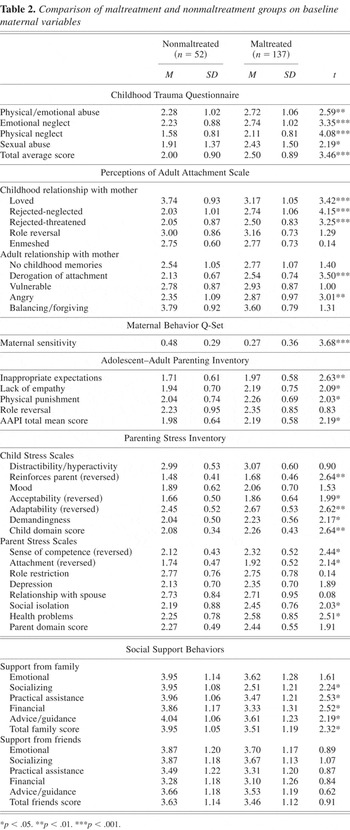
The scale scores from the CTQ were first examined to determine whether mothers in maltreating families reported higher levels of maltreatment in their own childhoods. A significant multivariate effect for maltreatment status was found, Wilks' λ = .09, F (4, 184) = 4.77, p = .001. Mothers' in the maltreatment group had significantly higher scores on the physical/emotional abuse, emotional abuse, physical neglect, and sexual abuse scales, as well as the total scale score, than did mothers in the nonmaltreatment group (see Table 2). Mothers representations of their childhood relationships with their own mothers and their current state of mind regarding attachment also differed significantly, Wilks' λ = .85, F (10, 155) = 2.82, p = .003. Univariate contrasts on the PAAS indicated that mothers in the maltreatment group reported that their own mothers were less loving, more rejecting–neglecting, and more rejecting–threatening than mothers in the nonmaltreatment group. Furthermore, mothers in the maltreatment group reported higher scores for derogation of attachment and for current anger in regard to their own mothers than did mothers in the nonmaltreatment group. The groups did not significantly differ on other PAAS subscales.
Comparison of maltreatment and nonmaltreatment groups on baseline maternal variables

Maternal sensitivity and parenting attitudes also distinguished the maltreatment and nonmaltreatment groups, as indicated by a significant multivariate effect for maltreatment status, Wilks' λ = .90, F (5, 178) = 4.14, p = .001. As shown in Table 2, mothers in the maltreatment group exhibited lower levels of maternal sensitivity than did mothers in the nonmaltreatment group. Additionally, the scales of the AAPI differed significantly between groups, with mothers in the maltreatment group reporting higher inappropriate expectations, lack of empathy, and acceptance of the appropriateness of physical punishment than did mothers in the nonmaltreatment group. Total AAPI scores also were higher in the maltreatment group.
Differences in stress associated with parenting also were found between mothers in the maltreatment and nonmaltreatment group. A MANOVA with PSI subscales as the dependent variables revealed a significant multivariate effect for maltreatment status, Wilks' λ = .87, F (13, 169) = 1.95, p = .03. Univariate contrasts indicated that mothers in the maltreatment group reported more stress in subscales of both the child and the parent domains. Mothers in the maltreatment group experienced their children as less reinforcing, accepting, and adaptable, and more demanding than did mothers in the nonmaltreatment group. In terms of the parent domain, mothers in the maltreatment group reported more stress associated with a low sense of parenting competence, difficulties in attachment to their children, social isolation, and health concerns.
In terms of social support, a marginal multivariate effect for maltreatment status was found for family support variables, Wilks' λ = .95, F (5, 181) = 2.09, p = .07, whereas the multivariate effect for support from friends was not significant, Wilks' λ = .99, F (5, 179) = .42, p = .83. The univariate contrasts for family support variables were examined, and mothers in the maltreatment group reported less support from family members in the areas of socializing, practical assistance, financial assistance, and advice/guidance.
Thus, mothers in the maltreatment group differed across multiple domains associated with greater vulnerability for maltreatment and problems in parenting and family functioning. Mothers in the maltreatment group reported more abuse and neglect in their own childhoods, representations of more rejecting, less loving relationships with their own mothers as children, more derogation of attachment generally, and more current anger in their relationships with their own mothers. Mothers in the maltreatment group also were observed to be less sensitive with their infants and to have a range of problematic parenting attitudes. Finally, greater parenting stress and less social support among these mothers also were found.
Baseline attachment classifications
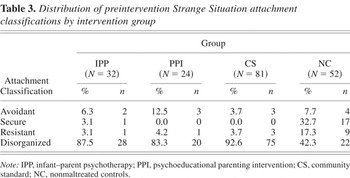
Across the four experimental groups, the distribution of the four-group attachment classifications differed significantly, χ2 (9, N = 189) = 63.98, p < .001 (see Table 3). Follow-up contrasts indicated that no significant differences existed among the IPP, PPI, and CS groups in their respective distributions of attachment classifications. However, each maltreatment group differed significantly from the NC group. In the NC group, the distribution of cases reflected the high-risk nature of the low-income sample. The rate of secure attachment was relatively low (32.7%). Additionally, among infants classified as insecure, few cases of Type A (7.7%) and Type C (17.3%) were observed, and 42.3% of the NC group was classified as Type D. In contrast, across the three maltreatment groups, secure attachment was virtually nonexistent; only one infant in the IPP group was classified as secure. The vast majority of cases in the maltreatment groups were classified as Type D (87.5, 83.83, and 92.6%, for the IPP, PPI, and CS groups, respectively). Very low rates of organized insecure classifications (A and C) were observed across the maltreatment groups.
Distribution of preintervention Strange Situation attachment classifications by intervention group

Given the scarcity of secure and organized insecure classifications in the three maltreatment groups, we further contrasted the groups on the rate of disorganized attachment. Consistent with the overall distributions, the presence of disorganized attachment differed significantly among the groups, χ2 (3, N = 189) = 48.57, p < .001. As in the four-group attachment classifications, the rate of disorganized attachment did not differ among the IPP, PPI, and CS groups, and each maltreatment group differed significantly from the NC group (all ps < .001).
In these analyses, the CS group was compromised of mothers and infants who did not take part in the IPP or PPI interventions. The CS nontreatment group included both cases randomized to the CS group, as well as cases who declined participation in the IPP and PPI interventions. The extent to which these subgroups were comparable was evaluated. In this analysis the following groups were contrasted: IPP, PPI, CS as randomized, CS who declined IPP, and CS who declined PPI. No differences in baseline attachment distributions were found among these five maltreatment groups, χ2 (12, N = 137) = 9.04, p = .70. No cases of secure attachment were observed in the CS subgroups. Furthermore, the rates of disorganized attachment in the three CS subgroups were 91.4, 100, and 88.0%, respectively, for the CS randomized, CS (IPP declined), and CS (PPI declined) subgroups, respectively. Thus, the mother/child dyads randomized to the CS group, and those declining participation did not differ in their distributions of attachment classification at baseline, and these subgroups did not differ from the IPP and PPI groups.
Postintervention attachment classification
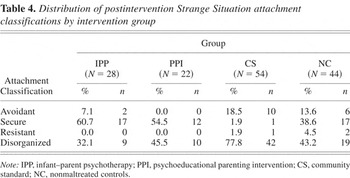
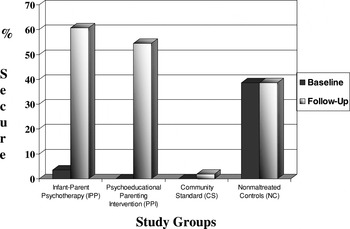
Following the completion of the IPP and PPI preventive interventions, all mother–child dyads were reassessed in the strange situation when children were approximately 26 months of age. Table 4 provides the distributions of attachment classifications for the four treatment groups, and again significant group differences were found, χ2 (9, N = 148) = 43.75, p < .001. However, the pattern of significant group differences had changed, indicating substantial intervention effects. Contrasts among the groups revealed that the IPP, PPI, and NC groups all differed significantly (ps < .001) from the CS group, and no significant group differences existed among the IPP, PPI, and NC groups. The rate of secure attachment increased from 3.1 to 60.7% in the IPP group, and from 0 to 54.5% in the PPI group, whereas in the CS group, in the absence of theoretically informed intervention, secure attachment at follow-up was virtually nonexistent (1.9%). The rate of secure attachment in the NC group was roughly unchanged (32.7 to 38.6%). Consistent with the four-group attachment classification differences, the rate of secure versus insecure attachment among the groups was significantly different at postintervention, χ2 (3, N = 148) = 39.35, p < .001, with the IPP, PPI, and NC groups having significantly higher rates of secure attachment than the CS group (all ps < .001), and not differing significantly from one another. The effect size, h, for the contrasts of the CS group with the IPP, PPI, and NC groups were 1.51, 1.41, and 1.17, respectively, indicating that the differences in rates of secure attachment all constituted large effect sizes. Figure 1 depicts the pattern of change for secure versus insecure attachment across the four study groups. Substantial increases in secure attachment were observed in the IPP and PPI groups, whereas change in the CS and NC groups was minimal.
Distribution of postintervention Strange Situation attachment classifications by intervention group


The percentage of secure attachment classifications at baseline and postintervention follow-up for the four study groups.
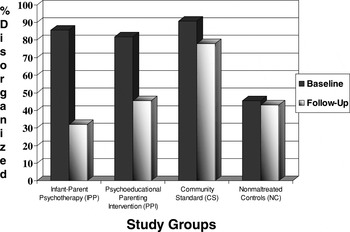
Disorganized attachment continued to be prominent in the CS group (77.8%), contrasting with lower rates in the IPP (32.1%), PPI (45.5%), and NC (43.2%) groups, χ2 (3, N = 148) = 20.40, p < .001. The intervention and NC groups had significantly lower rates of disorganized attachment than the CS group (all ps < .01), and these groups did not differ significantly from each other. The effect sizes for these significant differences were all medium to large (h = .70–.96). Compared to baseline assessments, the rate of disorganized attachment decreased markedly in the IPP and PPI groups, whereas little change was observed for the CS and NC groups, as shown in Figure 2.

The percentage of disorganized–disoriented attachment classifications at baseline and postintervention follow-up for the four study groups.
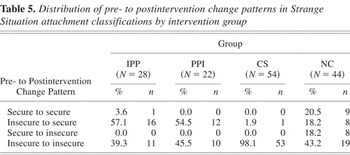
The pattern of stability and change in attachment classification from pre- to postintervention also was examined in more detail. Each case was classified into one of four groups, including stable secure, insecure to secure, secure to insecure, and stable insecure. When the four experimental groups were contrasted, significant group differences were observed, χ2 (9, N = 148) = 85.28, p < .001, as shown in Table 5. Follow-up contrasts indicated that all groups were significantly different from each other (all ps < .002), except for the IPP and PPI group contrast.
Distribution of pre- to postintervention change patterns in Strange Situation attachment classifications by intervention group

The majority of cases in the IPP and PPI groups (57.1 and 54.5%, respectively) changed from insecure to secure attachments. In contrast, the rate of changing from insecure to secure attachment was 1.9% in the CS group and 18.9% in the NC group. Overall, the rate of becoming secure differed significantly among the groups, χ2 (3, N = 148) = 42.19, p < .001, with all groups differing significantly (all ps < .005), except the IPP and PPI groups. The effect sizes for the contrasts of the CS group with the IPP and PPI groups were large (h = 1.51 and 1.46, respectively). Medium to large effect sizes were found for the greater likelihood of the IPP (h = .84) and PPI (h = .79) groups changing from to insecure to secure, relative to NC group.
The experimental groups also differed in the rate of stable insecure attachment, χ2 (3, N = 148) = 45.61, p < .001. In the absence of intervention, nearly all of the CS group was stable insecure (98.1%). The rates of stable insecure attachment were significantly lower in the IPP (39.3%), PPI (45.5%), and NC groups (43.2%), all ps < .001, and the rates of stable insecure attachment did not differ among these groups. The significant group contrasts all represented large effect sizes (h = 1.51, 1.34, and 1.43, respectively).
Because of the high rates of disorganized attachment in this sample, the rate of stable disorganized attachment also was examined, and significant group differences were found, χ2 (3, N = 148) = 27.60, p < .001. In the CS group, 74.1% of the children were classified as disorganized at both time periods. In contrast, the rates of stable disorganized attachment were significantly lower (all ps < .002) in the IPP (28.6%), PPI (36.4%), and NC (27.3%) groups, and these groups did not differ from each other. These significant differences involved medium to large effect sizes (h = .94, .78, and .87, respectively).
Intent to treat analyses
Because of the frequency of mothers declining to take part in the IPP and PPI interventions, a sizable number of mothers and infants randomized to the intervention groups did not, in fact, complete the interventions. In the intent to treat analyses, we examined group differences based on the original random assignment, thereby including the IPP decliners in the IPP group and the PPI decliners in the PPI group. Although the groups declining intervention did not differ on baseline attachment classifications from the mothers/infants randomized to the CS group, whether these subgroups differed on postintervention attachment distributions was initially determined. At follow-up, the IPP decliners, PPI decliners, and CS randomized groups did not differ on the four-group attachment classifications, χ2 (6, N = 54) = 6.25, p = .40. Disorganized attachment was the most frequent follow-up classification for all subgroups, including 85.0% for those declining IPP, 75% for those declining PPI, and 72.2% for those randomized to CS, and these rates did not differ among the subgroups, χ2 (2, N = 54) = 1.00, p = .61. In terms of the pattern of change from baseline to follow-up, all cases except one across the three subgroups were stable insecure. Furthermore, all subgroups evinced comparable rates of stable D attachment, 80.0, 75.0, and 66.7%, respectively, and these rates did not differ significantly, χ2 (2, N = 54) = 0.89, p = .64. Thus, the three subgroups of cases not receiving intervention were comparable and characterized by stable insecure and disorganized attachment across the two assessment periods.
Given the lack of change toward secure attachment in the cases declining IPP and PPI, inclusion of these participants in the intervention groups to which they were initially randomized is likely to reduce the large effect sizes observed for intervention effects in promoting secure attachment for those mothers and infants who actually participated in the interventions. When the groups were analyzed as randomized in the intent to treat analyses, intervention effects nevertheless continued to be found, despite the sizable number of nonparticipating cases. At follow-up, the rate of secure attachment continued to differ across groups, χ2 (3, N = 148) = 12.03, p = .007, with those cases randomized to the IPP (40.9%) and to the PPI (30.0%) groups and the NC group (38.8%) having significantly higher rates of secure attachment than the group randomized to CS (0%) (contrast ps < .01). The effect sizes for each of these contrasts with the CS group were large (h = 1.16–1.39). Similarly, the rate of changing from insecure to secure attachment at follow-up also differed, χ2 (3, N = 148) = 12.66, p = .005. The randomized IPP (38.6%) and PPI (30.0%) groups had significantly higher rates of becoming secure than the CS group (0%) (ps < .01), and these contrasts constituted large effect sizes (h = 1.34 and 1.16, respectively). Finally, the groups as randomized also differed on the rate of stable disorganized attachment, χ2 (3, N = 148) = 15.79, p = .001. Of interest, stable disorganized attachment was more frequent in the group randomized to CS (80.0%) than in the cases randomized to IPP (45.5%) and to PPI (50.0%; p = .01 and .025, h = .83 and .64, respectively). Thus, the intent to treat analyses indicate that, even with the cases declining intervention included in the IPP and PPI groups, treatment effects were nonetheless found, with the IPP and PPI groups having higher rates of secure attachment following the intervention, higher rates of changing from insecure to secure attachment, and lower rates of stable disorganized attachment than the CS group. However, these differences were driven by the cases that actually participated in the intervention.
Mediators of intervention efficacy
We evaluated whether constructs targeted by the IPP and PPI interventions functioned as mediators of intervention efficacy, explaining the processes through which the interventions had their effects on promoting attachment security. In this context, mediators of intervention efficacy involve variables that changed differentially in the IPP and/or PPI groups and that accounted for the variation in the attachment outcomes that occurred. Thus, the interventions influence change in the mediating variable that, in turn, influences the outcome. Processes that were expected to change as a result of IPP included improvements in maternal representations of her own mother and increases in maternal sensitivity. For the PPI intervention, change in parenting attitudes, decreases in child-rearing related stress, and increased social support were targeted areas for change. Thus, initially, whether there were changes in these domains from baseline to follow-up and whether there was differential change for the experimental groups was evaluated. Repeated measures analysis of variances with pre- and postintervention assessments of respective variables as the dependent variables were conducted. The primary interest was in determining if there were significant Group × Time interactions, which could then be related to the attachment outcomes. In these analyses, none of the variables considered, that is, measures of maternal representations, maternal sensitivity, parenting attitudes, child-rearing stress, social support, was involved in the targeted interaction effect. As a result, none of these constructs could serve as mediator of intervention efficacy, accounting for how improvements in attachment security were attained.
Discussion
Consistent with our hypothesis, mothers in the maltreatment groups compared to those in the nonmaltreatment group were found to differ substantially on important constructs expected to confer vulnerability on the mother's capacity to form a secure attachment relationship with her infant. Specifically, mothers in the maltreatment groups reported having experienced more abuse and neglect in their own childhoods; moreover, mothers in the maltreatment groups had more negative representations of aspects of their childhood and contemporary relationships with their own mothers.
It is not surprising that, given their early relationship difficulties and current anger and resentment to their own mothers, maltreating mothers also reported less availability of social support from family members. Accordingly, the ability of these mothers to rely on family members in times of need appears compromised. Maltreatment group mothers also reported significantly higher current stress with respect to feeling more demands and struggles in relation to their infant, as well as feeling less competent as a parent. Social isolation and health concerns also were more prominent stressors for these mothers. The mothers in the maltreatment group also conveyed deficits in their understanding of appropriate parenting attitudes and behavior relative to nonmaltreating mothers. Moreover, based on extensive home observations of mother–infant interaction, research assistants who were unaware of group status and experimental hypotheses rated mothers in the maltreatment group as substantially lower in maternal sensitivity to their infants than nonmaltreating mothers. Thus, childhood histories of abuse and neglect, negative relationship representations, limited family social support, stressors in multiple domains, and insensitive maternal patterns of relating to her infant likely conspire to impair the development of secure attachment relationship formation with their infant.
The baseline attachment classifications indicated that the babies in maltreating families exhibited an extremely high rate of insecure attachment. Specifically, only one infant in the maltreatment groups (<1%) was classified as securely attached. Although the rate of secure attachment was significantly higher in the group of infants in nonmaltreating families (32.7%), this was well below the percentage of secure attachment observed in nondisadvantaged samples of babies (Thompson, 1998). The low rate of attachment security found in the group of nonmaltreated comparison infants underscores the extremely high-risk backgrounds in which these babies reside. Clearly, the stresses associated with poverty and other risk factors that commonly accompany membership in the low socioeconomic strata increase the probability that strains will be placed on the mother–infant attachment relationship.
In terms of the specific insecure attachment organizations observed, not only were the infants in maltreating families classified as insecure, but also 89.8% were classified as disorganized. In contrast, 42.3% of the infants in nonmaltreating families were classified as disorganized. Thus, in the baseline assessments of the largest group of infants in maltreating families assessed in the Strange Situation to date (N = 137), disorganized attachment organization was almost ubiquitons. The high rate of disorganized attachment found in the infants in maltreating families is consistent with the percentage of Type D attachment in maltreated infants reported in the extant literature (Bakermans-Kranenburg et al., 2003; Barnett et al.,1999; Carlson et al., 1989; Lyons-Ruth et al., 1991). No differences in the rate of insecure or disorganized attachment were observed among the three groups of babies from maltreating families. In addition, the rate of disorganized attachment in the group of infants from nonmaltreating families was higher than usually found in infants from the low SES (Barnett et al., 1999; Carlson et al., 1989), attesting to the high-risk status of the comparison group. Furthermore, the high rate of disorganized attachment in infants from maltreating families places them at extremely high risk for embarking on negative developmental trajectories; especially given the deleterious sequelae of disorganized attachment (Carlson, 1998; Green & Goldwyn, 2002; van IJzendoorn et al., 1999).
At the conclusion of the intervention, when the infants were approximately 26 months of age, dramatic changes in attachment classification were observed. At intervention follow-up, the rate of secure attachment had increased remarkably in the two intervention groups to 60.7 and 54.5% for the IPP and PPI groups, respectively. In contrast, the rate of secure attachment in the CS group remained virtually nonexistent (1.9%). Moreover, the rate of secure attachment in the NC group (38.6%) continued to surpass the CS group. Thus, marked gains in establishing secure attachment organization were achieved in both of the intervention groups.
The results of this randomized preventive intervention trial demonstrate that an attachment-theory informed intervention, IPP, and an intervention that focuses on improving parenting skills, increasing maternal knowledge of child development, and enhancing the coping and social support of skills of maltreating mothers, PPI, both were successful in altering the predominantly insecure attachment organizations of infants in maltreating families. These findings are contrary to our hypothesis that the IPP intervention would be more successful in improving attachment security than would the PPI intervention. Perhaps differences in the future outcomes of these interventions will be discovered during the preschool period as development and attachment organization become increasingly representational in nature.
In support of this assertion, Toth and colleagues (2002) conducted a preventive intervention trial with maltreating mothers and their preschool age maltreated children. Maltreated children were randomly assigned to an attachment theory-informed intervention, PPP, PPI, or the CS. An NC group of infants also participated. Both the PPP and PPI interventions were modified to address the advances in symbolic and representational development that occur during the preschool period.
At baseline (M age = 48.18 months) and again at postintervention 1 year later (M age = 61.47 months), 11 narrative story stems (Bretherton, Oppenheim, Buchsbaum, Emde, & The MacArthur Narrative Group, 1990; Bretherton, Ridgeway, & Cassidy, 1990) were individually administered to child participants by experimenters unaware of group status and experimental hypotheses. The narratives were videotaped and subsequently coded. The narratives depicted moral dilemmas and emotionally charged events in the context of parent–child and family relationships. Narrative story stems included vignettes designed to elicit children's perceptions of the parent–child relationship, of self, and of maternal behavior in response to child transgressions, intrafamilial conflicts, and child accidents.
Children in the PPP intervention evidenced a greater decline in maladaptive maternal representations over time than did children in the PPI and CS interventions. Moreover, children who took part in the PPP intervention displayed a greater decrease in negative self-representations than did children in the CS, PPI, and NC groups. Additionally, the mother–child relationship expectations of PPP children became more positive over the course of the intervention compared with children in the PPI and NC groups. These results suggest that an attachment-theory informed model of intervention (PPP) is more effective at improving representations of self and of caregivers than is a didactic model of intervention (PPI) directed at parenting skills and contradict predictions that would emanate from the meta-analysis of interventions targeting maternal sensitivity and child attachment (Bakermans-Kranenberg et al., 2003, 2005). Because the intervention focused on changing representational models, as assessed by a narrative story-stem measure, outcomes that might be expected to improve more dramatically in the PPI model (e.g., parenting skills, knowledge of child development) could not be addressed. Alternatively, the PPP intervention may have been more effective than the PPI intervention as a result of being implemented during the preschool period when representational capacities are expanding. In contrast, the IPP and PPI interventions may have both resulted in improvements in attachment security because they were initiated during infancy and toddlerhood.
In the current study, change from insecure to secure attachment was significantly more likely in the IPP and PPI groups than in the CS and the NC groups. In contrast to the reorganization in attachment that had occurred in the intervention groups, stability of insecure attachment was almost universal in the CS group (98.1%). Similarly, stability of attachment also was more common in the NC group with 70.4% of the insecure nonmaltreated children remaining insecure at postintervention follow-up and 52.9% of those who were secure remaining secure. Overall, stability of secure/insecure attachment was 63.6% in the NC group. As such, continuity of attachment organization was more characteristic of the groups not participating in the active preventive interventions.
Given the extremely high rate of disorganized attachment in the maltreated infants at age 13 months, it also is remarkable that the two preventive interventions were efficacious in reducing this atypical attachment pattern. Stable disorganized attachment was observed among 74.1% of the CS children, whereas stable disorganized attachment occurred at much lower rates in the two intervention groups, 28.6 and 36.4% for the IPP and PPI groups, respectively, comparable to the rate observed in the NC group (27.3%). Thus, infants who have been maltreated are highly likely to maintain disorganized/disoriented attachments in the absence of intensive efforts to improve the mother–child relationship and parenting.
Taken together, the results of the intervention provide strong support for the benefits of the preventive interventions in altering the developmental trajectories of maltreated infants. Through targeting a central developmental task of the infancy period (Sroufe, 1979), the interventions were successful in transforming the attachment organization of a substantial percentage of maltreated infants. Not only were marked reductions achieved in the rate of insecure attachment, but also disorganized attachments were shown to be modifiable and secure attachments were attained. These results are noteworthy for demonstrating the malleability and plasticity of the attachment system through focusing on changing aspects of the early mother–child relationship. The establishment of secure attachment relationships in the maltreated youngsters through the preventive interventions holds promise for achieving more competent resolutions of subsequent developmental tasks. In the context of a secure attachment relationship, the secure maltreated children are more likely to develop positive self-representations. Secure representational models of the self and self in relation to others then will further promote competent striving to adapt to subsequent developmental challenges as these children begin forming relationships with other adults and peers (Sroufe & Fleeson, 1986, 1988). By intervening to promote more competent developmental trajectories through instilling a secure attachment organization, it is anticipated that maladjustment and the development of psychopathology will be more likely to be averted as these children develop.
Given the success of this randomized prevention trial, it becomes important to consider why these therapeutic models were effective in altering attachment security when previous investigations did not yield such findings. A number of components of these interventions may have contributed to their success. All therapists received extensive training before implementing the interventions and these clinicians were familiar not only with the intervention modality, but also with the theory from which the interventions was derived. All therapists also had considerable prior experience working with low-income maltreating families. Both models also were manualized, weekly individual and group supervision was provided, and therapist adherence to their respective model was monitored for each case throughout the provision of the intervention. Case loads also were maintained at levels considerably lower than typical of outpatient mental health settings, and therapists were therefore able to devote considerable time to engaging mothers and to conceptualizing treatment plans. The positive outcome of this investigation supports the importance of investing in more costly interventions, including allowing therapists sufficient time for training and supervision. The extensive outreach expended toward engaging mothers in treatment also is a noteworthy component of these interventions that may have contributed to their success. When mothers cancelled or failed to be available for scheduled visits, sessions were rescheduled during the same week. Thus, unlike clinics where cases are closed when sessions are repeatedly failed, our therapists continued to reach out to engage mothers in the treatment process.
Clearly, consistent with the principles of the organizational perspective, and with Gottlieb's (1992) notion of probabilistic epigenesis, the early insecure, generally disorganized attachments displayed by maltreated infants, do not doom these youngsters to have poor-quality relationship expectations and negative self-representations throughout the life span (Cicchetti & Tucker, 1994). The success of the interventions, informed by basic research knowledge on the etiology and developmental sequelae of child maltreatment, suggests that attachment organization is modifiable, even if a high percentage of Type D attachments is initially characteristic of the sample. Following the organizational perspective, it is expected that these maltreated youngsters, now that they are traversing a more positive developmental trajectory, will be more likely to continue on an adaptive pathway and successfully resolve future salient developmental tasks. The preventive interventions have demonstrated that behavioral plasticity is possible, at least in the early years of life.
The extremely high stability of attachment insecurity in the CS group is especially alarming. These results portend that the maltreating infants in the CS group are at exceedingly high risk for maladaptive outcomes on subsequent stage-salient issues of development. The typical intervention services provided to maltreated infants are not sufficient to remediate their early developmental difficulties. Without the receipt of theoretically derived, intensive interventions, maltreated infants are likely to embark on a negative developmental trajectory. Clearly, case management, which focuses upon monitoring the physical safety of maltreated children, is inadequate to foster positive socioemotional development. Moreover, these results underscore the criticality of providing evidence-based services to maltreating families.
In our clinical prevention trial, cases randomly assigned to IPP and PPI did not always comply with the assignment, declining to be involved in the interventions. As a result, those who completed the interventions are partially self-selected. Intent to treat analyses examined group composition based on the initial random assignment irrespective of whether mothers actually participated. Consequently, in our statistical analyses, those who completed and those who declined or discontinued their assignment to one of the active preventive interventions were combined to examine group differences for those we intended to treat. The incorporation of intent to treat analyses did not alter the findings reported above; infants in both active preventive interventions were significantly more likely to change from insecure to secure attachment. Moreover, the reductions in disorganized attachment in the active intervention groups likewise remained even when intent to treat analyses were conducted.
Despite the positive results obtained with the IPP and PPI interventions, there are limitations to the study. Changes were not found for the constructs hypothesized to serve as potential mediators of intervention efficacy. This state of affairs is common in randomized clinical trial research, although intervention efficacy is demonstrated, the mechanisms of change are difficult to identify. In contrast to the findings of van IJzendoorn et al. (1995), the current study was successful in improving young children's attachment organization, but enhancement of observed maternal sensitivity was not demonstrated. We plan to probe further for changes in the intervention groups that may explain how the efficacy of the intervention was achieved. Videotaped interactions between mothers and infants in stressful and unstressful situations will be examined for a more detailed analysis of changes in maternal behavior and relationship qualities that may account for the improvements in attachment security that were observed.
Another study limitation involves the degree to which mothers did not engage in the interventions, despite active outreach efforts, indicating that additional strategies are necessary to facilitate active participation. It is important to emphasize that all mothers were solicited for involvement in the interventions without seeking assistance on their own, and internal motivation for change and improved family function may not have been present. In essence, we conducted a population study in which all eligible families were approached rather than only those referred for, mandated to, or voluntarily seeking assistance. In view of this, the positive outcomes of these interventions are even more remarkable.
In closing, the translation of knowledge from the field of developmental psychopathology into the conduct of this clinical trial underscores the importance of broadening such efforts. We believe that the results of this randomized prevention trial are both gratifying and sobering. The fact that plasticity is possible during infancy and that even the most disorganized form of attachment is modifiable in extremely dysfunctional mother–child dyads offers significant hope for thousands of young children and for their families. By fostering secure attachment, costlier interventions such as foster care placement, special education services, residential treatment, and incarceration can be averted. Unfortunately, our results also shed light on the harsh reality of the ineffectiveness of services currently being provided in many communities throughout the nation. It is critical that professionals, government officials, social policy advocates, and mental health insurers recognize the necessity of investing in the delivery of theoretically informed, evidence-based interventions. Although this may appear to be a costly endeavor in the short term, the long-term benefits with respect to enhancing positive child development, preventing the dissolution of families, and decreasing the burden of mental illness in society cannot be overstated.