1 Introduction
Passivization has played a key role in formulating theories of syntax and sentence processing. From early on in the generative grammar tradition, experimental work on passives has been used to evaluate theoretical proposals. Passive processing was used in testing the first psycholinguistic theory: the Derivational Theory of Complexity (DTC). The DTC emerged from transformational grammar and proposed that the overall complexity of a sentence increases with each application of a transformation; that is, the more transformational steps the higher the complexity. In directly testing the DTC, the time to read sentences that varied in the number of transformations (e.g. passives, negation, wh-questions) was measured. While there was some support for the DTC, it was abandoned as not all cases bore out the predicted differences. Nonetheless, much future work still considered that some transformations are difficult, including the movement required by passives. This can be observed across language processing fields. (i) Bever (Reference Bever and Hayes1970) famously used passives to argue for heuristic strategies in parsing. The errors observed in comprehension were attributed to a heuristic of assigning the first NP to agent in English; (ii) Borer & Wexler’s (Reference Borer, Kenneth, Roeper and Williams1987) maturation account builds on the delay in the acquisition of A-movement, as required by passives; (iii) Grodzinsky (Reference Grodzinsky1990) proposed that the failure to understand passives observed in people with agrammatic aphasia is better understood as part of an overarching problem with the representation of movement-derived sentences.
In a more recent influential paper on the processing of passives, Ferreira (Reference Ferreira2003) showed that unimpaired adult speakers appear to (somewhat) consistently fail to correctly assign thematic roles in passives, i.e. fail to understand who did what to whom in a passive sentence. This result, she argued, supports the idea that algorithmic processing is often replaced by processing heuristics (Good Enough Processing; Christianson et al. Reference Christianson, Hollingworth, Halliwell and Ferreira2001, Ferreira Reference Ferreira2003, Ferreira & Patson Reference Ferreira and Patson2007, Ferreira & Christianson Reference Ferreira and Christianson2016, Karimi & Ferreira Reference Karimi and Ferreira2016). Building on Bever (Reference Bever and Hayes1970) and Townsend & Bever (Reference Townsend and Bever2001), she argued that the first NP is attributed agenthood, resulting in an incorrect interpretation of the English passive. As the participants were not at floor levels on passives, she further assumed that computationally more taxing algorithmic processes often correct the heuristic, just not consistently. This strengthened one common belief about passives: they are harder to parse than actives. If this were not the case, the algorithmic processes would always succeed in correcting the heuristic, and performance on the passive should be equivalent to the active.
Consideration of additional previous ‘online’ processing studies, however, delivers a fragmented picture on this matter. While the already discussed offline data from adult processing (notably the study in Ferreira Reference Ferreira2003, just mentioned) and most (early) research in both language acquisition (see e.g. Bever Reference Bever and Hayes1970, Horgan Reference Horgan1978, Maratsos et al. Reference Maratsos, Danny, Becker and Chalkley1985, Borer & Wexler Reference Borer, Kenneth, Roeper and Williams1987 a.o.) and language impairment (Grodzinsky Reference Grodzinsky2000, Grillo Reference Grillo2008 a.o.) point to passives being more difficult than actives, online studies paint a different picture. Passives have repeatedly been reported to be read faster than actives (Carrithers Reference Carrithers1989, Rohde Reference Rohde2003, Traxler et al. Reference Traxler, Corina, Morford, Hafer and Hoversten2014), even if not significantly so in all cases. These results appear to suggest the unexpected conclusion that actives are harder to parse than passives, in sharp contrast to the offline results reported above.
To address this apparent paradox and to further understand the nature of (any) complexity of passivization, Paolazzi et al. (Reference Paolazzi, Grillo, Alexiadou and Santi2015, Reference Paolazzi, Grillo, Alexiadou and Santi2016) identified a number of factors that could help to explain why passivization demonstrates divergent online and offline complexity effects. These include (1) aspectual class of the verbal predicates involved (stative versus eventive), which interacts with passivization for the availability of verbal/adjectival passive reading cross-linguistically and is known to affect passives processing in acquisition, and (2) morphological ‘richness’ of passives when compared with their active counterparts.
This paper will consider these two factors from a cross-linguistic perspective. To date, psycholinguistic studies of passivization have focused primarily on English. However, cross-linguistic variation in passivization can provide further insight into these issues. Specifically, we consider German, as it differs from English with respect to these two factors in informative ways.
In Section 2, we discuss these two factors, considering both prior English studies by Paolazzi et al. (Reference Paolazzi, Grillo, Alexiadou and Santi2015, Reference Paolazzi, Grillo, Alexiadou and Santi2016) and how German can further inform these data. Sections 3 and 4 present two German experiments to test these two factors, adapted from the original English experiments in Paolazzi et al. (Reference Paolazzi, Grillo, Alexiadou and Santi2015) and Paolazzi et al. (Reference Paolazzi, Grillo, Alexiadou and Santi2016). The experiments simultaneously test online processing (using self-paced reading) and offline comprehension (through comprehension questions following each sentence) of passives. The results show a partial overlap with what was previously observed for English: passives are read just as fast (or faster) than actives at multiple regions also in German. However, contrary to what was observed for English by Paolazzi et al. (Reference Paolazzi, Grillo, Alexiadou and Santi2016), we found that passives of stative predicates are understood just as well as their active counterparts. A final discussion, in Section 5, provides an account of this difference and explores potential avenues for future targeted cross-linguistic research.
2 Two key factors in the processing of passives
2.1 Aspect and the disambiguation of adjectival/verbal passives in English
English lacks a morphological distinction between adjectival and verbal passives, since both are introduced by a form of be, as illustrated in (1), which can be parsed either as an auxiliary (with verbal passives) or as a copula (with adjectival passives).

Under common assumption, an adjectival passive is less complex than a verbal passive since it does not involve additional movement (in passivization) and therefore behaves just like an active construction in this respect.Footnote [2] This simpler syntactic representation may lead to a preference of an adjectival parse. In particular, two main factors determine availability and strength of the ambiguity in English: first, the presence (and referential type) of a by-phrase; second, predicate semantics. Both are discussed in the following two sections.
2.2 Passivization and the by-phrase
Until recently, it was claimed for English that the presence of a by-phrase was enough to disambiguate towards the verbal reading, as by-phrases were assumed not to be available with adjectival passives. However, authors like McIntyre (Reference McIntyre, Alexiadou and Schäfer2013) and Bruening (Reference Bruening2014) have shown for English that by-phrases are also found with adjectival passives, and the literature on German adjectival passives (e.g. Rapp Reference Rapp1997, Kratzer Reference Kratzer and Conathan2000, Anagnostopoulou Reference Anagnostopoulou, Alexiadou, Rathert and von Stechow2003, Maienborn Reference Maienborn2007) has long acknowledged this fact (see also Alexiadou, Anagnostopoulou & Schäfer Reference Alexiadou, Anagnostopoulou and Schäfer2015 for recent discussion of various languages). Thus, a sentence like (2) is still ambiguous between an adjectival reading (a sharp judgment on the poor quality of the lines in the drawing) and a verbal reading (a statement about a specific event of drawing involving an actual child).

As Gehrke (Reference Gehrke2015) discussed at length, however, adjectival passives (at least of eventive predicates) are only compatible with by-phrases whose complement is weakly or non-referential (e.g. bare nouns and weak (in)definites, as in (2)) or generic (as in (1)), but not with strongly referential ones (such as regular definites, specific indefinites, possessives, proper names); we will henceforth call the latter ‘referential by-phrases’. This holds for English and German alike, as illustrated in (3) (see also discussion in Alexiadou, Gehrke & Schäfer Reference Alexiadou, Gehrke and Schäfer2014).

A further difference between stative and eventive inputs to passivization in English can be observed when we turn to short passives, i.e. passives without by-phrases, which in prinicple can be verbal or adjectival. In particular, English short passives of eventive predicates freely support implicit external arguments, whereas those of stative predicates do not, given that the former allow control into a purpose clause (4a), whereas the latter do not (4b).

A similar contrast can be observed in the following examples.

Short passives of stative predicates in English only allow implicit generic by-phrases, as evidenced by the ability to support an ultimate cause/source of a particular state (his charisma), rather than a purpose clause.

Hence, in the presence of a referential by-phrase, an English passive is unambiguously verbal, since such a by-phrase is not available for an adjectival passive in English.
Given these observations, let us consider the passive sentences in (7) (items 23 and 24 from Experiment 2 of Traxler et al. Reference Traxler, Corina, Morford, Hafer and Hoversten2014), which Traxler et al. used to test whether passives are harder to process than actives.

One problem we see with (7) is that, at least early on in parsing (i.e. prior to encountering the referential by-phrase), it is not possible to infer that a verbal as opposed to adjectival passive needs to be built. Both sentences in (7a) and (7b) can receive a predicative, non-passive interpretation (i.e. an adjectival passive interpretation), as shown by the felicitous continuation with about in (8).

This is a problem for online reading time (RT) studies, which seek to find complexity effects at the verb, as a verbal passive structure is not necessarily projected by this region. Traxler et al. (Reference Traxler, Corina, Morford, Hafer and Hoversten2014) also looked at RTs at the by-phrase. However, complexity effects are often found in spill-over regions in self-paced reading, so there is a possibility that such effects have been missed here, especially since the by-phrases were typically short (at most two or three words, although the items in (7) are already improving on this point). As for offline studies, one might argue that this is not (necessarily) a problem, as by the end of the sentences in (7), the ambiguity is gone. However, the potential for two parses could generate some interference in memory, providing an explanation of the offline results in Ferreira (Reference Ferreira2003) on grounds independent of passivization itself.
An additional point, to which we turn now, is that the ambiguity between a verbal and an adjectival passive parse is particularly prominent with stative inputs, passives of which, we will argue below, are preferably parsed as adjectival. With stative inputs, then, it becomes impossible to separate complexity effects due to voice alternations from those due to reanalysis of an adjectival as a verbal passive upon encountering a referential by-phrase. Let us then turn to the nature of the particular aspectual class of verbs triggering verbal and adjectival passive interpretations.
Passivization and verb type
We conjecture that the problem of a passive construction being potentially ambiguous between a verbal and an adjectival passive is more prominent with certain verbal inputs. In particular, we take an adjectival passive to ascribe a temporal stative property to its subject, and therefore the best input is a verbal predicate containing a stative subevent, as already noted by Rapp (Reference Rapp1997). More precisely, the state has to be interpretable as a temporal state, so that good inputs are some states and changes of state (i.e. accomplishments and achievements, in the sense of Vendler Reference Vendler1957), whereas activities/processes, such as kick, as well as more lasting states like know, are less good inputs (see also Alexiadou et al. Reference Alexiadou, Anagnostopoulou and Schäfer2015, Gehrke Reference Gehrke2015 and literature cited therein). Hence, the English passive in (9) will always be parsed as a verbal passive, given that an adjectival interpretation (out of context and without additional coercion) is unavailable.

In some languages, also the verbal passive comes with aspectual input requirements, in the sense that at least for English (and also for Italian, but not for German, as we will discuss in more detail in 2.4), the best input to a verbal passive is an eventive predicate (i.e. activities, accomplishments, achievements). Passivized stative predicates, then, like the one in (10), will first and foremost be parsed as an adjectival passive, unless context (e.g. a referential by-phrase) requires a verbal passive interpretation; we will come back to this below.

Hence, the ambiguity between a verbal and an adjectival passive is eliminated, or at least rendered much less prominent, with some predicates: passives of activities are interpreted as verbal and passives of states are preferably interpreted as adjectival.
More generally, then, stative predicates very naturally occur in adjectival passives, while at the same time resisting verbal passivization in at least some languages, including English. As we will discuss in more detail in Section 2.4, this is even more clearly visible in Italian, where unambiguous verbal passivization with the auxiliary venire ‘come’ is restricted to predicates that involve a change of state. Thus, when applied to stative predicates such as love and worry, a verbal passive in these languages is strongly marked, and we assume that in this case such predicates undergo coercion into a consequent state subevent to receive an inchoative, i.e. eventive interpretation (for a more general discussion of this issue, see Gehrke & Grillo Reference Gehrke, Grillo, Blaho, Schoorlemmer and Vicente2007, Reference Gehrke and Grillo2009); this comes with a cost clearly observable in reduced acceptability. In the same Section 2.4, we will see that German, which unambiguously introduces adjectival and verbal passives through a formal distinction between the verbal auxiliary and the adjectival copula, differs from both English and Italian in allowing (some) states to appear in verbal passives and importantly in not forcing them into an inchoative reading.
The relevance of predicate semantics, as well as the adjectival/verbal ambiguity, in passivization is well known in the acquisition literature. Traditionally, a distinction is made between children’s ability to comprehend and produce ‘actional’ passives, claimed to be available, and ‘non-actional’ passives, claimed to be problematic (see, e.g., Maratsos et al. Reference Maratsos, Danny, Becker and Chalkley1985, Borer & Wexler Reference Borer, Kenneth, Roeper and Williams1987, Fox & Grodzinsky Reference Fox and Grodzinsky1998). In this account, children succeed in interpreting (short) actional passives because actional predicates easily derive an adjectival interpretation, which, unlike the verbal interpretation, is accessible to them (cf. the girl was well-combed). Passives of non-actional predicates, on the other hand, would not allow an adjectival-passive interpretation (cf. *the girl was well-feared) and can only be interpreted as verbal passives, which in this model cannot be derived by children.
More recently, Gehrke & Grillo (Reference Gehrke and Grillo2009) proposed that the relevant distinction might be better couched in the difference between eventive and stative predicates and in particular combined with the idea that verbal passivization requires an event structure with at least two subevents, which is absent in states. Stative predicates, then, they claimed, are harder to passivize because they involve inchoative coercion into a transition into state, which adds this additional subevent.
Aspectual coercion (e.g. Moens & Steedman Reference Moens and Steedman1988, de Swart Reference de Swart1998), i.e. the reinterpretation of a given event of a particular event class as belonging to a different one (e.g. of a state as an inchoative state – an achievement, by adding an initial bound to the state, or of an achievement as an accomplishment, by adding a preparatory process), has been previously shown to increase processing complexity (Piñango, Zurif & Jackendoff Reference Piñango, Zurif and Jackendoff1999, McElree et al. Reference McElree, Traxler, Pickering, Seely and Jackendoff2001, Traxler, Pickering & McElree Reference Traxler, Pickering and McElree2002, Piñango et al. Reference Piñango, Winnick, Ullah and Zurif2006, Bott Reference Bott2010, Paczynski, Jackendoff & Kuperberg Reference Paczynski, Jackendoff and Kuperberg2014). More crucially for the present discussion, Brennan & Pylkkänen (Reference Brennan and Pylkkänen2010) showed that inchoative coercion increases processing complexity, leading to longer RTs in sentences like (11b) than (11a).

Data from aphasia and acquisition indirectly support the coercion account, showing a similar distinction to be at play, in the sense that both populations have been shown to have more problems in comprehending passives of stative than of eventive inputs. For discussion of results from aphasia, see Grodzinsky (Reference Grodzinsky1995) and Grillo (Reference Grillo2008), and for additional empirical support of the event-structure based account of acquisition of passivization in Gehrke & Grillo (Reference Gehrke and Grillo2009), see Crawford (Reference Crawford2012), Estrela (Reference Estrela2014), Snyder & Hyams (Reference Snyder, Hyams, Domenico, Hamman and Matteini2015) and especially Volpato, Verin & Cardinaletti (Reference Volpato, Verin and Cardinaletti2015).Footnote [3]
Thus, while the distinction between stative and eventive inputs to passivization has thus far featured prominently in the acquisition literature, it seems to not have found its way into the adult processing literature. Since, as further argued here, event structure, and in particular the difference between states and events, is a factor affecting the adjectival/verbal passive disambiguation, Paolazzi et al. (Reference Paolazzi, Grillo, Alexiadou and Santi2015, Reference Paolazzi, Grillo, Alexiadou and Santi2016) argued that previous offline and online results are potentially confounded. The problem with previous studies then is that sentences containing particular stative verbs, but also particular types of eventive verbs that readily derive adjectival passives, might be misconstrued as adjectival passives up until the head of a referential by-phrase is encountered, leading to reanalysis, which is usually costly. These costs should be observable in lower accuracy scores and/or longer RTs online. Very importantly, however, online costs should only be observed at or after the by-phrase, since at earlier regions (e.g. the verb, typically the region of interest in these earlier studies) the ambiguity still persists as an adjectival parse is not problematic. We will see in Section 2.3 that these predictions were supported by Paolazzi et al. (Reference Paolazzi, Grillo, Alexiadou and Santi2015, Reference Paolazzi, Grillo, Alexiadou and Santi2016).
Richness of morphological cues
In comparison to actives, English passive sentences typically contain additional morphological cues such as the passive auxiliary and the preposition by, introducing the external argument. Paolazzi et al. (Reference Paolazzi, Grillo, Alexiadou and Santi2015, Reference Paolazzi, Grillo, Alexiadou and Santi2016) suggested that previous literature overlooked the role that morphological information can play in modulating reading times. Specifically, the additional morphological cues in the passive may speed up processing at specific points for reasons that are independent of the more general question of the complexity of the passive voice itself. For instance, previous work on passivization has typically compared actives without auxiliaries (in simple tenses) with passives in which an auxiliary immediately precedes the verb, as in (12).

In comparison with the active, the passive version of the sentence contains these two additional elements (auxiliary, by), and this might facilitate incremental parsing by reducing uncertainty about the type of the following constituent. In a traditional bottom-up approach to sentence processing, processing of a word initiates when that word is encountered. This would suggest that any difference in RTs at the verb observed when studying contrasts such as the one in (12) should be attributed to the inherent complexity of processing the verb attack in the active and passive voices. Recent perspectives, however, have seen a revival of early analysis by synthesis accounts (Bever & Poeppel Reference Bever and Poeppel2010), which emphasize the importance of top-down, predictive processes in sentence processing. Several studies in experimental psycholinguistics have shown that processing complexity at particular regions in a sentence is modulated by expectations about coming words and constituent type for those regions. The contribution of these expectations to sentence processing has been formalized using the information theoretic notions of entropy and surprisal (Hale Reference Hale2001).
Konieczny (Reference Konieczny2000) discussed the tension between principles of locality, which predict that complexity increases when increasing the distance between two dependent elements in a sentence (Gibson Reference Gibson1998), and antilocality effects issuing from anticipatory/predictive processes. Konieczny (Reference Konieczny2000) first observed that the addition of adjectival phrases to an object modifying relative clause led to faster RTs at the main verb in German. Since German is a language with (unmarked) subject–object–verb (SOV) order (in main clauses), addition of adjectives to a modified object means increasing the distance between the head of the object and the verb, yet RTs at the verb were found to be faster. Jaeger et al. (Reference Jaeger, Fedorenko, Hofmeister and Gibson2008) found similar effects in English when more PPs were added to a center-embedded relative clause modifying the subject head of a main clause. One reasonable explanation for these effects is that the more the presentation of the verb (a required element in a subject–verb dependency) is delayed by presentation of modifiers, the higher the expectation of the parser for the next word to be the verb, i.e. the lower the level of surprisal of the parser in encountering the verb. More generally, structural analyses entertained for earlier regions of the sentence generate structural expectations about parts of the sentence that are yet to come (Lau et al. Reference Lau, Stroud, Plesch and Phillips2006, Staub & Clifton Jr Reference Staub and Clifton2006, Staub, Clifton & Frazier Reference Staub, Clifton and Frazier2006, Levy et al. Reference Levy, Fedorenko, Breen and Gibson2012, Traxler Reference Traxler2014). The amount of surprisal of a word/phrase in a syntactic environment relates to its predictability in that environment.Footnote [4]
In the case at hand, presence of the auxiliary might speed up RTs at the verb simply because it leads to an increased expectation that the following word will be a verb. In other words, since the likelihood for verbs to follow auxiliaries is very high, the computational load associated with processing verbs after auxiliaries is lower than when they are presented in isolation or following a noun.
Similarly, only in passives is the second DP the girl preceded by the preposition by, which again might well reduce its surprisal, as one immediately expects a noun phrase to follow the preposition, and this might lead to faster RTs within this region.
These kinds of expectation-based effects can thus be naturally captured within a surprisal account (Konieczny Reference Konieczny2000, Hale Reference Hale2001, Levy Reference Levy2008 e.g.). More importantly, for the present discussion, this kind of effect should be controlled for whenever possible. While it is impossible to match the active and passive versions with respect to by, a proper comparison should control for the presence of the auxiliary, to avoid misinterpretation of RT effects due to reduced surprisal of a verb when preceded by an auxiliary with a genuine effect of voice alternation. As we will see, German naturally provides such a possibility across different types of predicates.
2.3 Previous results in English
Paolazzi et al. (Reference Paolazzi, Grillo, Alexiadou and Santi2015, Reference Paolazzi, Grillo, Alexiadou and Santi2016) addressed these issues by simultaneously collecting comprehension accuracy and RT (self-paced) data while manipulating the predicate’s event structure. In a first experiment (Paolazzi et al. Reference Paolazzi, Grillo, Alexiadou and Santi2015), only eventive predicates were used with a manipulation of voice (see (13a), (13b)); this move was intended to reduce to a minimum the chances that an adjectival passive parse would be projected. An additional condition with a progressive version of the active was used to control for effects of predictability at the verb following an auxiliary (13c). The stimuli were prenormed for plausibility of thematic role assignment to be equivalent across conditions.

All predicates used denoted complex events, specifically agentive/causative, eventive/resultative. Besides compatibility with progressive aspect, other standard diagnostics were employed to ensure a uniform set of eventive predicates. These included compatibility with adverbs of intent (deliberately), compatibility with in x time modification, compatibility with a …and this event happened at 4pm scenario, and compatibility with VP-ellipsis (e.g. The guitarist rejected the singer and the doctor did so, too).
Importantly, there was no effect of voice on accuracy: passives were understood just as well as actives; in fact, accuracy scores were almost identical across conditions (passive 85.71%; progressive 83.67%; simple active 83.3%). In addition, RTs at the verb did not differ in the auxiliary conditions (passive and progressive) but were significantly longer for simple actives without auxiliaries. This supports the idea that previously observed effects at this region (i.e. faster RTs for passives than actives) were due to the lack of auxiliary in the active condition. The results further showed faster RTs at multiple regions within the second DP (the attractive and talented singer) in passives; this effect reached significance at two regions (at the determiner and the conjunction). The authors ascribed this to the fact that the second DP is more predictable in passives than in actives because it follows the preposition by.
The results of this first experiment support the idea that previously observed faster RTs in passives can be accounted for within a surprisal account (Hale Reference Hale2001). The richer morphology of English passives (auxiliary, by) when compared with the active can generate stronger predictions for upcoming syntactic constituents, significantly reducing the time needed to process them. That this account is on the right track is strongly supported by the observation that RTs at the verb are also faster for the progressive form than the simple active form (and do not differ between the progressive and the passive). Clearly, the presence of an auxiliary acts as a strong predictor for the following predicate, making it easier to process.
Lack of differences in accuracy when only eventive predicates are used provides preliminary support for the idea that previous results might have been confounded by the use of a mixed bag of predicates, with passives of stative predicates negatively affecting comprehension because they allow for adjectival interpretation at initial stages of parsing. In a second experiment, Paolazzi et al. (Reference Paolazzi, Grillo, Alexiadou and Santi2016) addressed this issue by replacing eventive verbs with stative verbs, in particular subject experiencer verbs such as love, admire.Footnote [5] Only two conditions were tested in this second experiment (simple active and passive), because stative predicates do not generally allow the progressive form for independent reasons. Besides the change in verb type, the only other modification with respect to the first study involved replacing the locative PPs (incompatible with statives) with implicit causality clauses. Once more, plausibility of thematic role assignment was controlled for in an online questionnaire. As in the previous study, comprehension questions followed each sentence to allow comparison of online and offline effects.

As in the first experiment, faster RTs were found in passives at the verb and within the initial regions of the second DP. The effect, however, was reversed (at least numerically) at the head of the second DP (head of by-phrase). Crucially, with stative predicates, voice did affect accuracy, as participants understood actives better than passives (passive 78.3%; active 86.1%, p
 $=$
.003). This was despite the fact that the presence of the auxiliary and the by facilitated initial stages of parsing.
Summarizing, passivization leads to faster RTs online, independently of predicate type, and this is consistent with a surprisal-based or expectation-based account. However, offline, passivization does seem to interact with the predicate type. More specifically, passivization of a stative predicate creates more difficulty than passivization of an eventive predicate. Paolazzi et al. argued that the results are compatible with an account under which participants initially assign an adjectival parse to the stative passive. As the participants continue to read, and specifically when the head of the referential by-phrase is encountered, it becomes clear that this analysis is untenable.Footnote [6] Reanalysis and/or coercion is required, which explains numerically longer RTs at the head of the by-phrase for passives and the offline comprehension difficulties. Taken together, these results support the claim that previous complexity effects with passives might in fact be due to the use of stative predicates alongside eventive ones.
A picture thus emerges in which passives indeed appear not to be more complex than actives by default, but only when formed on stative predicates and in virtue of these leading to a temporary ambiguity between an adjectival and a verbal reading of the passive. The faster RTs, on the other hand, should not be taken as evidence that passives are easier to parse than actives, but rather that levels of surprisal might be lower at specific points during the processing of passives thanks to their richer morphology.
The broader significance of these results lies in shifting the attention to the complex interplay of event structure, the adjectival/verbal disambiguation, coercion and morphological richness. Given the complexity of the matter, this seems like a more promising route than treating each outcome of passivization as a monolithic phenomenon. Ideally, the contribution of each ingredient to processing complexity should be tested in isolation. It is immediately clear, however, that only a targeted and controlled examination of passive processing across languages might allow us to progress in this direction. Investigation of English alone can only take us so far, as many of these ingredients co-vary in a single language and are impossible to disentangle.
Here, the goal is to initiate this targeted cross-linguistic examination by considering the case of German, which will allow us to dig deeper into the contribution of the temporary adjectival/verbal ambiguity and morphology to the overall complexity of passives of stative predicates.
2.4 Interpreting unambiguous verbal passives in German
As discussed above, testing of voice alternations in English always involves having to deal with the ambiguity between adjectival and verbal readings of the passive. Judging from the results in Paolazzi et al. (Reference Paolazzi, Grillo, Alexiadou and Santi2015, Reference Paolazzi, Grillo, Alexiadou and Santi2016), this ambiguity acts as a powerful confound. To a certain extent, this makes it harder to establish whether previous studies found passives to be more difficult to interpret than actives due to this ambiguity that arose from using a mixed bag of predicates or due to passivization itself. In this paper, we directly address this issue by testing German, a language that notably displays unambiguous verbal and adjectival passives. In particular, German verbal passives select the auxiliary werden ‘become’ (15a), while adjectival passives select the copula sein ‘be’ (15b).

This feature allows separation of potential effects of the verbal/adjectival ambiguity from effects solely due to the manipulation of voice. In particular, contrary to English, if an effect of complexity were to be detected, it would only be imputable to passivization. If the interpretation difficulties observed in English are due to the temporary ambiguity that arises from the stative predicates and not to passivization itself, we do not expect to observe any effects of voice on accuracy in German.
Another important characteristic of German verbal passives with werden is that, contrary to Italian venire passives, they do not force an eventive reading when embedding a stative verb (see Koo Reference Myung-Chul1997: p. 98f). As we have briefly mentioned in Section 2.2, stative verbs, which are always good inputs to Italian essere-passives (16a), have to be coerced into an inchoative reading in Italian venire passives (16b). Furthermore, coercion is not always an option, as some predicates resist inchoative readings (16c) and generate ungrammatical sentences under venire.

(16a) is ambiguous between a verbal reading (inchoative) and an adjectival reading (the preferred reading), attributing a certain disfavor/popularity among his fellow-citizens to Gianni. (16b) can only receive an inchoative interpretation, i.e. it can only be interpreted as a state coming into existence: ‘Gianni gets feared/appreciated at a given point’, e.g. for something he did. The verbs in (16c), finally, resist the inchoative interpretation forced by venire, which explains their unacceptability in this environment.
German werden, on the other hand, does not force an inchoative interpretation of states, as shown in (17).

Example (17), despite being a verbal passive, is only interpreted as attributing the property of being feared or appreciated to Hans. Importantly, the corresponding adjectival passive (with the copula sein ‘be’) in this case would be ungrammatical in German, but becomes more acceptable with additional modification by bei/von allen ‘at/by all’ or weltweit ‘worldwide’ (recall our discussion in §2.1; see also Zifonun Reference Zifonun and Hoffmann1992, Zifonun, Hoffmann & Strecker Reference Zifonun, Hoffmann and Strecker1997 for earlier discussions of this point). This difference between German and Italian is likely to be attributed to the fact that Italian venire is a marked form, the Italian default auxiliary for passivization being essere ‘be’, which can introduce both adjectival (in its copular interpretation) and verbal passives. In German, on the other hand, werden is a fully grammaticalized default auxiliary used for verbal passives (see Eroms Reference Eroms and Hoffmann1992). The exact characterization of this asymmetry is beyond the scope of this paper. The crucial issue for us here is that even if werden-passives are unambiguously verbal, they do not require an inchoative interpretation of states (see Rapp Reference Rapp1997: p. 124).
These characteristics make German an ideal testing ground for voice alternations, and, contingently, for the account proposed in Paolazzi et al. (Reference Paolazzi, Grillo, Alexiadou and Santi2015, Reference Paolazzi, Grillo, Alexiadou and Santi2016).
2.5 Parsing unambiguous verbal passives in German
As we have seen, there is a partial overlap between English and German passives, leading to the expectation that similar parsing effects should be observed in the two languages. If the surprisal account of faster RTs in English passives is on the right track, we expect to find a similar effect of morphological richness on RTs in German. Surprisal should be reduced in regions following the preposition von ‘by’, and therefore also RTs in the passive should be reduced when compared with the active.
The same surprisal account, however, would make different predictions in the two languages in other regions. Faster RTs at the verb in English passives, for example, were shown to depend on the presence of the auxiliary. If passives are contrasted with progressives, in which the active verb is also preceded by an auxiliary, the effect is cancelled.
We argue that German might display shorter RTs in passives at the verb independently of the presence of an auxiliary. German actives and passives both have an auxiliary when verb-final sentences are compared across active and passive voices. However, the German passive, like the English passive, is still morphologically richer than the German active, since it has the additional von ‘by’.
Importantly, in German canonical SOV orders, the by-phrase immediately precedes the main verb, as illustrated in (18).

Hence, German provides a purer measure of the morphological effect independent of interactions with other factors potentially affecting complexity, such as integrating the argument with the verb and expectations for argument/adjuncts following predicates with particular event structure in the passive voice. Finally, since the verb is more likely to immediately follow a by-phrase than a direct object, surprisal at the verb might be smaller in passives than actives.
German word order is highly flexible compared with English, and a lot of variation can be found in the ordering of arguments and adjuncts. However, deviations from a basic ‘canonical’ order are generally considered to be information-structurally marked and less acceptable out of the blue. Importantly, the canonical word order varies with voice.
Crucially for us, the object DP in an active sentence can naturally be followed by additional event modifiers. In fact, this is the most natural word order out of the blue (i.e. as an answer to the question ‘What happened?’), as the contrast in (19a), (19b) shows. With passives, however, the presence of additional modifiers intervening between the by-phrase and the verb would have to be licensed by a particular information structure (cf. (19c), (19d)).

Therefore, the difference in canonical word order in actives and passives suggests that prediction of a verb should be stronger after a by-phrase than after an accusative marked DP, leading to shorter RTs at the verb in passives than actives also in German.
In the following sections, we present the results of two self-paced reading experiments crossing event structure and voice in German, designed to test the processing of passivization in the absence of adjectival/verbal ambiguity and coercion. Indirectly, the experiments also test whether previously observed complexity effects in the processing of passives in English stem from the verbal/adjectival ambiguity and its interaction with event structure. If the original approach of Paolazzi et al., and our present reasoning, are on the right track, we can expect two types of results.
On the one hand, since both English and German passives display richer morphology than their active counterparts, we should be able to replicate the English online results, i.e. we should find faster RTs for passives in German, at least in the region of the by-phrase. Since the by-phrase precedes any information about event structure, this should be true of both eventive and stative predicates.
On the other hand, if the interaction of event structure and voice observed in accuracy in English is indeed caused by the verbal–adjectival ambiguity and/or the need to coerce states into an inchoative interpretation in English verbal passives, the lack of ambiguity of German verbal passives should cancel the effect of event structure observed in English, i.e. we should expect no difference in accuracy across both eventive and stative actives/passives.
3 Experiment 1
Participants
Forty native German speakers from the University of Stuttgart participated in the experiment. All participants gave their informed consent and received either course credits or monetary compensation for their participation.
Materials
The original stimuli from Paolazzi et al. (Reference Paolazzi, Grillo, Alexiadou and Santi2015), which contrasted active and passive sentences with eventive inputs, were carefully translated into German unambiguously verbal passives with the auxiliary werden ‘become’ and additionally adapted to German syntax. To ensure that the verb appeared in the same position in both the active and the passive versions, and that an auxiliary was present in both conditions, we compared past tense passives with active perfects (20).

All items had the same structure as in (20), with a subject DP followed by the auxiliary (either become or have), the by preposition (in the passive condition only), the second DP (with a definite determiner followed by two conjoined adjectives and the N), a locative preposition, the participle and finally a temporal subordinate clause (see Appendix A for a full list of stimuli). A long second DP was used to replicate the results in Paolazzi et al. (Reference Paolazzi, Grillo, Alexiadou and Santi2015), which found faster RTs at multiple regions within the second DP. Number of words was matched across conditions; one extra word was inevitably present in the passive (by) when compared with the simple active condition.Footnote [7]
Contrary to the experiment in Paolazzi et al. (Reference Paolazzi, Grillo, Alexiadou and Santi2015), the present experiment only contrasted two conditions. The progressive condition was excluded from the experiment for the following reason. German lacks a progressive, so we had to rely on a different periphrastic verb form: the perfect (which, unlike the English perfect, most often functions like a simple past). Therefore, the active version already contained an auxiliary (the perfect auxiliary), which ensured proper comparability with passives along this dimension.
Thirty items per condition were constructed, manipulating Voice [active versus passive] with an additional 60 fillers. To ensure that participants paid due attention to the task, a comprehension question followed each stimulus sentence. Half of the questions required ‘Yes’ responses and the other half required ‘No’ responses (e.g. Hat der Gitarrist die Sängerin zurückgewiesen? ‘Did the guitarist reject the singer?’). The questions exclusively targeted thematic relations between different arguments of the verb.Footnote [8] All nouns and verbs in the questions had been used in the actual sentences.
Procedure
The experiment was conducted in a word-by-word self-paced reading fashion with a moving window display paradigm (Just, Carpenter & Woolley Reference Just, Carpenter and Woolley1982). A Latin-square design was used, to ensure that each subject would see only one instance of each sentence (i.e. either the active or the passive version). The experiment was run on a PC using the Linger software developed by Doug Rohde (http://tedlab.mit.edu/∼dr/Linger/).
Instructions on the modality of the experiment were given by the researcher and presented on the computer screen. The participants were instructed on the functioning of the moving window display. A line of dashes, separated by blank spaces, would appear on the screen, covering words of a sentence, each dash covering one character of a word. At the first press of the space bar, a word would appear on the screen, replacing the first set of dashes. At a second press of the space bar, a new word would appear and the previous word would be replaced by dashes again. The time required to press the space bar for each word was recorded by the software. Upon the final key press, a comprehension question appeared to which participants responded by key presses (‘F’ for YES, ‘J’ for NO). Each sentence was followed by a comprehension question. Each participant was first familiarized with the experimental method via a series of practice trials, which were excluded from data analysis. All experiments were performed in a soundproof booth at the Linguistics Lab at the University of Stuttgart using a PC desktop computer. A Razer©(Black Widow©2014) gaming keyboard (1000 Hz polling rate) was used for accurate timing. The experiment took approximately 20 minutes to complete. Participants were instructed to take breaks only after answering the comprehension question. A mandatory break was planned in the middle of the experiment.
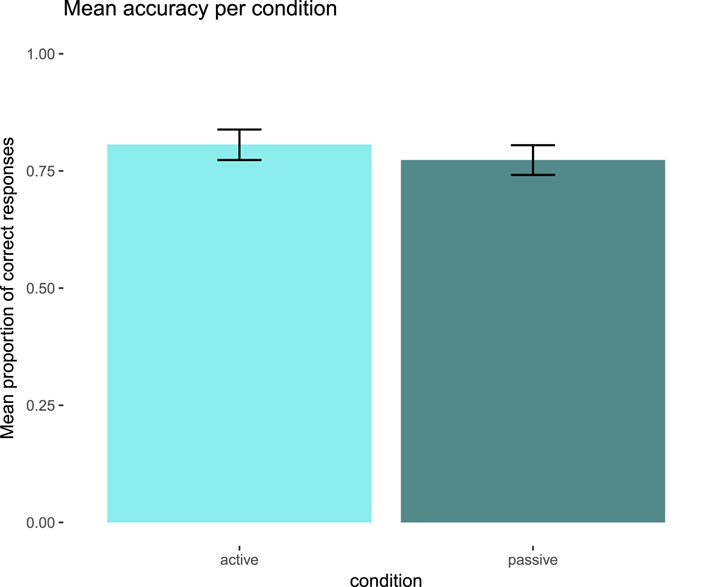
Mean proportion of correct responses per condition with confidence intervals.

Data analysis
Comprehension data analysis and results
All participants scored above 70% accurate on comprehension questions. Comprehension question accuracy was analyzed with a mixed effects model in R with a binomial distribution. Voice was the Fixed Effect and Item and Participant were Random Effects. Both random intercepts and slopes were included. The analysis did not show any significant difference in accuracy across condition. The percentage of correct responses for actives was 80.6%, and it was 77.3% for passives. This effect was not significant (p-value
 $=$
.12).
Response times
Statistics were performed by using mixed effect regression models as implemented in the R-package lme4 (Bates et al. Reference Bates, Mächler, Bolker and Walker2014). Response times were analyzed in a linear mixed effects model with Voice as Fixed Effect and Item and Participant as Random Effects. Both random intercepts and slopes were included. P-values were determined through treating the t-value as a z-statistic (Barr et al. Reference Barr, Levy, Scheepers and Tily2013). The effect of Voice was not significant (p-value
 $=$
.11).
Reading time analysis
Reading times longer than 2500 ms and shorter than 100 ms were eliminated from the analysis. Residual RTs (RRTs) were calculated on the remaining log transformed RTs for each subject from the difference between a word logRT and its predicted logRT based on a model that included number of characters (considering both experimental and filler items) as a Fixed Effect and Participant Random Effects (intercept only). This is a standard procedure for self-paced reading data and works to eliminate the confounding effects of individual reading speed and character length per word (Ferreira & Clifton Reference Ferreira and Clifton1986). Residual reading times that deviated from the mean by more than 2.5 standard deviations (per participant and region) were automatically eliminated from the analysis at this point using Kevin Tang’s Linger Toolkit (Tang Reference Tang2014; Linger Toolkit. http://tang-kevin.github.io/Tools.html). Residual reading times were analyzed with a linear mixed effects model in R with Voice as a Fixed Effect and Item and Participant as Random Effects. Both random intercepts and slopes were included.Footnote [9] There were three regions of interest: (1) the second DP (embedded within the by-phrase in the passive condition), (2) the participle and (3) the postverbal region.
Reading time results and intermediate discussion
As in the English study reported in Paolazzi et al. (Reference Paolazzi, Grillo, Alexiadou and Santi2015), we found that passives were read numerically faster than actives at multiple regions (see Figure 2). Reading times were significantly faster for passives two regions downstream from the beginning of the by-phrase (i.e. at the first prenominal adjective attractive, 27 ms faster on average in passives, p-value
 $=$
.027), and approached significance at the conjunction, 14 ms faster for passives, (p-value
 $=$
.08). Taken together, these results support the idea that the higher number of morphological cues in passives (i.e. presence of von ‘by’) reduces surprisal associated with the following DP and locally reduces syntactic processing complexity.
Mean residual RTs per region.

Contrary to what was observed in English, where faster RTs at the verb in passives are better understood in a surprisal framework as a consequence of the presence of an auxiliary immediately preceding the verb (hence the lack of difference between passives and progressives), there was no effect of Voice at the verb in the unambiguously verbal passive in German (p-value
 $=$
.37). We have suggested above that the likelihood of a verb following the second DP is higher with by-phrases than with accusative objects, which would lead to the prediction of faster RTs at the verb in passives than actives.Footnote
[10]
It is possible that the presence of both a locative PP and a temporal modifier between the second DP and the verb might reduce the chance to observe this effect, as they increase expectation of a verb also in the active condition. This cross-linguistic difference was also predicted as both actives and passives were introduced by auxiliaries in our experiment (remember that the presence of the auxiliary was already shown to be the main factor in determining RTs at the verb in Paolazzi et al.’s results). Voice did not affect RTs at any other region.
Overall, therefore, the results add to the picture sketched in Paolazzi et al. (Reference Paolazzi, Grillo, Alexiadou and Santi2015): passives of eventive predicates are not harder to parse than corresponding actives, and faster RTs are observed in the presence of richer morphological cues and are best explained as a consequence of surprisal. Let us then turn to Experiment 2, in which we investigated verbal passivization of stative predicates.
4 Experiment 2
As discussed in Section 1, passives of states in English can, at least locally, be parsed as adjectival passives. Paolazzi et al. (Reference Paolazzi, Grillo, Alexiadou and Santi2016) claimed that the complexity effect observed with passives of stative predicates is due to this ambiguity: complexity arises from a conflict between an initial preference for the adjectival interpretation and the difficulty of integrating a referential by-phrase within this parse.
Experiment 2 tests this account by looking at the processing of verbal passives of stative predicates in German. As already noted, since all passives with the auxiliary werden ‘become’ can only receive a verbal interpretation, regardless of whether the input is eventive or stative, this language offers a perfect testing ground for the previous account. In particular, our prediction is that given the lack of adjectival/verbal ambiguity, verbal passives of states should also not be harder than actives in German, just like the results we had for verbal passives of events reported in Experiment 1. One can notice another difference from English: German is verb-final; the by-phrase precedes the verb, so that any measure of complexity would therefore be expected to show up at the verb or as spill-over in the regions following it.
We therefore expect to replicate an RT advantage for passives over actives at the region of the second DP/by-phrase observed in Experiment 1 (also observed for English). Because of the lack of adjectival/verbal ambiguity and of the availability of a stative interpretation for the German verbal passives, we should not observe any inversion of the effect at the verb or at the following regions. Contrary to English, we should also not expect an advantage for actives over passives in our offline measure (comprehension accuracy).
Participants
Thirty-four German native speakers, all students from the University of Stuttgart, gave their informed consent to participate in the study and received either course credits or monetary compensation for their participation.
Materials and design
We constructed 24 minimal pairs of active/passive sentences following the format in (21).Footnote [11] Translation of the stimuli from the experiment on statives in Paolazzi et al. (Reference Paolazzi, Grillo, Alexiadou and Santi2016) proved more difficult, so new stimuli were constructed that obeyed the same format as the original ones. To ensure comparability with the original study and uniformity across the predicates used, we used standard tests of stativity. For consistency and comparability with the English experiment, we used almost exclusively subject experiencer predicates. There is broad consensus in the literature that these predicates are clearly stative (see, e.g., Landau Reference Landau2010, Fábregas & Marín Reference Fábregas and Marín2015 and literature cited therein). Additionally, we used standard stativity tests for German (see Maienborn Reference Maienborn2003, Reference Maienborn2005), such as anaphoric reference with geschehen ‘happen’, incompatibility with adverbs of intent, incompatibility with locative modifiers, incompatibility with in-adverbials/compatibility with for-adverbials, etc. Furthermore, since German is verb-final, we added a subordinate (causal or concessive) clause to create an additional region after the verb to test for spill-over effects. All stimulus sentences were normed for plausibility of thematic role assignment in an online questionnaire. The structure of each stimulus sentence was kept constant, with a subject DP followed by the auxiliary (become versus have), the by preposition (in passives only), the second DP, which contained two adjectives preceding the head noun, followed by the participle and finally a causal or concessive clause (21). A full list of the stimuli is available in Appendix B. The experimental procedure was kept identical to the one of Experiment 1.

Let us then turn to the data analysis and the results.
Data analysis and results
Data analysis was conducted exactly as in the previous experiment.
Accuracy
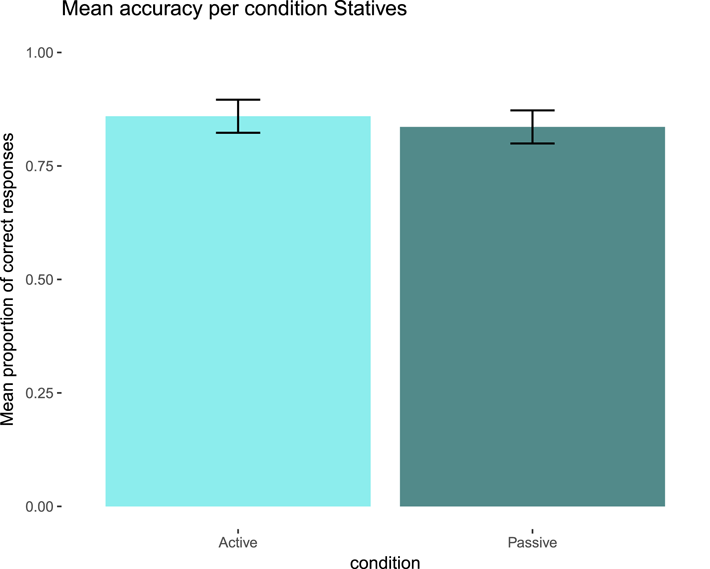
Due to low accuracy results on fillers (lower than 70% overall), two participants were excluded from the final analysis. Hence, data from 32 participants were analyzed. As shown in Figure 3, unambiguous verbal passives of stative verbs are understood just as well as their active counterparts (actives 85.9% correct, passives 83.5% correct, p-value
 $=$
0.48). This indirectly supports the idea that the main factor explaining lower performance with stative passives in English relates to the adjectival/verbal ambiguity, which is absent in German.
Mean proportion of correct responses per condition with confidence intervals.

Response times
Response times did not differ across condition (
 $t=-1.50$
, p-value
 $=$
.132).
Reading times
As in Experiment 1, we found an effect of Voice at multiple regions, with faster RTs for passives than actives, as can very clearly be seen in Figure 4.
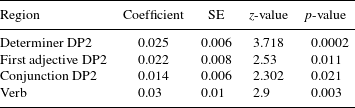
The effect was significant at two regions within the second DP (i.e. the by-phrase), namely at the determiner (p-value
 $=$
.0002), first adjective (p-value
 $=$
.011), conjunction (p-value
 $=$
.021) and crucially at the verb (p-value
 $=$
.003). No other effect was significant.
Taken together with the offline results, the RT effects show that, contrary to English passives with stative inputs, which are potentially ambiguous between a verbal and an adjectival parse, German unambiguously verbal passives are not harder to process than actives.
Mean residual RT per region for Experiment 2.

Effect of voice contrast on residual RT at different regions.

Comparison
An additional analysis was conducted to establish whether there was any difference in RTs and accuracy across Experiments 1 and 2.
Reading times
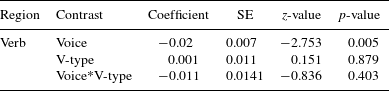
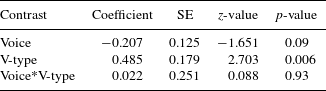
The results of the interaction analysis of the RTs at the verb are summarized in Table 2.
Analysis of the RT results at the verb showed no interaction between Voice and V(erb)-type (p-value
 $=$
0.403) and no main effect of V-type (p-value
 $=$
0.879). Only an overall effect of Voice was observed (p-value
 $=$
.005), with verbs read faster in passives than actives across both statives and eventives.
Analysis of interaction of V-type and Voice on residual RT at the verb.

Analysis of the pre-verbal region was irrelevant, as the relevant difference between the two experiments was V-type. Analysis of postverbal regions did not reveal any significant interaction or main effects.
Accuracy
As shown in Table 3, a clear lack of interaction of V-type and Voice also emerges from the analysis of the accuracy results. We do, however, observe a marginal effect of Voice on accuracy when the two data sets are combined (p-value
 $=$
.09).
Summarizing, there was no interaction between V-type and Voice on either RT or accuracy. The combined analysis also revealed a significant effect of Voice on RT at the verb, across verb type. A significant effect was previously only observed in the stative experiment, with RTs only numerically faster in passives than actives in the eventive condition. This was likely due to an issue of power. Finally, we observe an overall better accuracy, across both actives and passives, with stative than eventive predicates.Footnote [12]
Analysis of accuracy across Experiments 1 and 2.

5 Discussion and conclusions
Not many experiments have investigated the processing of passive sentences in unimpaired adults, and the few existing studies were conducted mostly in English and typically measured either offline comprehension or RTs, but not both. A fragmented picture emerges from these studies, showing that passives lead to worse performance in comprehension (Ferreira Reference Ferreira2003), but faster RTs in reading (Carrithers Reference Carrithers1989, Rohde Reference Rohde2003, Traxler et al. Reference Traxler, Corina, Morford, Hafer and Hoversten2014). As discussed in the introduction, following Paolazzi et al. (Reference Paolazzi, Grillo, Alexiadou and Santi2015, Reference Paolazzi, Grillo, Alexiadou and Santi2016), it is hard to evaluate the role of Voice alternation itself in determining previous results as, in English, these are potentially confounded by three factors: (1) variable degree of morphological richness across voice, which likely influences RTs; (2) ubiquitous presence of adjectival/verbal passive ambiguity in English; (3) the use of a mixed bag of verbs, which is problematic in the light of (2) since event structure interacts with this ambiguity in English.
Paolazzi et al. (Reference Paolazzi, Grillo, Alexiadou and Santi2015, Reference Paolazzi, Grillo, Alexiadou and Santi2016) argued that a clearer picture emerges when these factors are controlled for. The previously observed passive advantage in RTs can be largely explained away as an effect of surprisal, due to richer morphological information in passives than actives. In English, the processing of passivization interacts with predicate semantics in predictable ways: passives of eventive verbs are not harder to understand than corresponding actives. Complexity effects emerge when stative verbs are passivized, as these are initially more likely to receive an adjectival interpretation, which successively requires reanalysis and coercion into an inchoative state.
These arguments make a strong case for in-depth, targeted cross-linguistic investigation on the interplay of each of these complex factors in determining complexity of passivization. Cross-linguistic research, we have claimed, should target languages that modulate each of these factors independently from one another. In other words, it is not enough to simply test the processing of passives across languages, we should target specific languages (e.g. German, Italian) on the basis of how each of these factors can be isolated from the others. Here, we targeted German, which, contrary to English, disambiguates verbal passives early on in the sentence (through the auxiliary werden ‘become’ followed by the preposition von ‘by’). This allowed us to control for the adjectival/verbal passive ambiguity. Interestingly, English and German verbal passives also differ along another dimension: German verbal passives of stative verbs can still denote states.
We simultaneously tested the online parsing and offline comprehension of passives in two self-paced reading studies, with comprehension questions following each sentence. The first experiment looked at effects of Voice (active–passive) on RT and comprehension of sentences containing eventive predicates (as in Paolazzi et al. Reference Paolazzi, Grillo, Alexiadou and Santi2015). The same contrast was tested in the second experiment, but using only stative verbs (subject experiencer predicates, as in Paolazzi et al. Reference Paolazzi, Grillo, Alexiadou and Santi2016).
The results add to the previous literature in multiple ways. First of all, we observe a genuine asymmetry between online and offline results. While we did find a marginal effect of voice in comprehension questions, voice does not appear to significantly affect comprehension. More importantly, and contrary to the predictions of Good Enough Processing and the Agent First Strategy, this result was not associated with longer RTs. As seen in the introduction, Shallow Processing states that correct interpretation of passives will only be achieved when Agent First heuristics are replaced by slower/more effortful algorithmic processes. This leads to predict longer RTs in passives. Reading times, however, were faster for passives than actives at multiple regions. This effect, observed across the two experiments, was significant within the second DP and the verb. One should notice that, as standard, RTs of incorrect trials were removed. That is, faster RTs co-occurred with correct comprehension, which excludes a potential speed–accuracy trade-off analysis. Results from the visual world paradigm (Kamide, Scheepers & Altmann Reference Kamide, Scheepers and Altmann2003, Knoeferle & Crocker Reference Knoeferle and Crocker2006, Meyer, Mack & Thompson Reference Meyer, Mack and Thompson2012) paint a somewhat similar picture: (unimpaired) adult speakers are able to rapidly and reliably revise an initial active bias upon hearing semantic or morphosyntactic cues signaling passive voice.Footnote [13]
Following Paolazzi et al. (Reference Paolazzi, Grillo, Alexiadou and Santi2015, Reference Paolazzi, Grillo, Alexiadou and Santi2016), we argue that the present results support a surprisal-based (e.g. Hale Reference Hale2001) or expectation-based account (e.g. Levy Reference Levy2008). Faster RTs within the second DP parallel what was observed for English; both can be taken to reflect lower surprisal for a DP following the by/von preposition.
Faster RTs at the verb were also observed in English, but in that case they could be ascribed to the presence or absence of an auxiliary (with an advantage observed for passives and progressive actives, but not simple past actives). It should be recalled, however, that (to control for word order) an auxiliary was present in both actives and passives in the present experiment. A different explanation for this effect is needed.
We have suggested that, once certain properties of default word order and morphological richness are considered, a surprisal account naturally predicts faster RTs at the verb in German passives. We have previously seen that morphological richness can lead to increased expectation for particular constituent types: presence of the auxiliary led to shorter reading times in passives and progressives in English. In the present experiments, both actives and passives contained an auxiliary; in German, however, the verb is also preceded by the second DP (by-phrase/object DP). We argued that prediction of a verb is stronger after a by-phrase than after a simple accusative-marked DP. The additional piece of morphology in passives (by) makes processing of the verb easier because by-phrases are less likely than direct object to be followed by spatial or temporal event modifiers out of the blue (as in the present experiment). We have shown that these orders are non-canonical in passives, in that they require a special intonation/information structure, neither of which is required of actives.
A second crucial result is that, as predicted, there was no interaction between verb type and voice on RT and accuracy. Contrary to what was observed in English by Paolazzi et al. (Reference Paolazzi, Grillo, Alexiadou and Santi2016), passives of statives did not elicit more errors in comprehension than passives of eventive predicates. This difference, we claim, follows from a basic grammatical difference between English, which does not morphologically distinguish between adjectival and verbal passives, and German, which unambiguously introduces verbal passives through the werden ‘become’ auxiliary.
By embedding stative verbs in unambiguously verbal passives in German, we indirectly support the claim that the interaction of the adjectival/verbal ambiguity with event structure is responsible for previously observed complexity effects with English passives. In English, this ambiguity is maintained up until the referential by-phrase, which forces structural reanalysis and possibly coercion of the stative predicate into a consequent state. As no ambiguity is present in German (and furthermore no coercion into an inchoative reading is needed), no complexity effects are expected.
Taken together, our results endorse the call for targeted cross-linguistic research in psycholinguistics more generally, and in particular in the complex domain of voice alternation. The results further support and complete the account proposed by Paolazzi et al. (Reference Paolazzi, Grillo, Alexiadou and Santi2015, Reference Paolazzi, Grillo, Alexiadou and Santi2016) for the English results: passives are not necessarily harder than actives. In fact, when the adjectival/verbal ambiguity is removed from the picture, as is done in a language in which the passive in question is unambiguously a verbal one, like German, passives are just as easy to parse as actives.
Finally, from an acquisition perspective, these results might be expected as well. As mentioned, the centrality of event structure and the adjectival/verbal ambiguity in passivization was already recognized in the acquisition literature. Borer & Wexler (Reference Borer, Kenneth, Roeper and Williams1987) suggested that children’s asymmetric ability to deal with passives of ‘actional’ and ‘nonactional’ passives stems from their inability to derive verbal passives through A-movement of the internal argument. Being unable to derive passives via A-movement, children resort to an adjectival parse when possible. In this perspective, passives of actional verbs are easier because they can more easily receive an adjectival interpretation (as in, e.g., the girl is well-combed).
Gehrke & Grillo (Reference Gehrke and Grillo2009) suggested that the relevant distinction is not based on actionality, but on event structure. (Many) states, in fact, freely participate in adjectival passivization across languages but resist verbal passivization in many languages. Gehrke and Grillo’s account, therefore, is radically different from that proposed in Borer and Wexler (and very much in line with the account discussed here): verbal passives of states are hard because they initially license an adjectival interpretation, which then turns out to be incompatible with referential by-phrases. In some languages, furthermore, states need to be coerced into events to successfully participate in verbal passivization, which further adds to their complexity. Predicates describing complex events, on the other hand, readily passivize across languages. This predicts a potential domain of variation in acquisition: passives should be harder to acquire/understand in languages like English, where they are potentially ambiguous until the head of the by-phrase. In languages like German, on the other hand, verbal passives are disambiguated early, which might make them less problematic for children to acquire. In a large-scale investigation on the acquisition of passivization across languages, Armon-Lotem et al. (Reference Armon-Lotem, Haman, Jensen de López, Smoczynska, Yatsushiro, Szczerbinski, van Hout, Dabašinskienė, Gavarró, Hobbs, Kamandulytė-Merfeldienė, Katsos, Kunnari, Nitsiou, Sundahl, Xavier Parramon, Sauerland, Torn-Leesik and van der Lely2016) tested children’s ability to comprehend passives in 11 typologically different languages. In line with our results, the study found that passives are easier to acquire in languages such as German where they are uniquely marked, unlike what the literature on passive acquisition reports for English. The study, unfortunately, only tested passives of ‘actional’ verbs. More work is thus needed to properly test the interaction of grammatical differences and event structure in the acquisition of passives.
To complete this picture, in future work, we plan to test the processing of unambiguously verbal passives in Italian. As discussed above, Italian passives display a mixed set of properties. Like English, Italian has ambiguous be-passives to introduce either adjectival or verbal passives and, similarly to German, it can disambiguate for the verbal reading via the auxiliary venire. Importantly, contrary to German werden-passives, Italian venire passives force an inchoative interpretation of stative verbs. This partial overlap with German would allow one to assess whether the main factor distinguishing English from German is the lack of ambiguity or the lack of coercion.
Summarizing, we presented two self-paced reading studies, with comprehension questions following each sentence, testing the processing of unambiguously verbal passives in German. The first experiment contrasted the processing of actives and passives built on eventive predicates, while the second used stative verbs. The main findings of the paper are as follows.
- (22)
German passives are read faster than actives, similarly to what was previously observed in English (Carrithers Reference Carrithers1989; Traxler et al. Reference Traxler, Corina, Morford, Hafer and Hoversten2014; Paolazzi et al. Reference Paolazzi, Grillo, Alexiadou and Santi2015, Reference Paolazzi, Grillo, Alexiadou and Santi2016), which supports an expectation-based (e.g. Levy Reference Levy2008) or surprisal-based account (e.g. Hale Reference Hale2001).
- (23)
German passives are just as easy to understand as their active counterparts, which argues against Shallow Processing and Agent First Strategy.
- (24)
Comprehension accuracy with unambiguous verbal passives in German is independent of the event structure associated with the underlying predicate, contrary to what was observed for English, which suggests an account for the latter based on the adjectival/verbal ambiguity and coercion, as proposed in Paolazzi et al. (Reference Paolazzi, Grillo, Alexiadou and Santi2016).Footnote [14]
APPENDIX A
Items in Experiment 1
(1)
(a) Der Gitarrist wurde von der attraktiven und talentierten Sängerin in der Konzerthalle zurückgewiesen, während es zu regnen begann.
(b) Der Gitarrist hat die attraktive und talentierte Sängerin in der Konzerthalle zurückgewiesen, während es zu regnen begann.
(2)
(a) Der Caterer wurde von dem kreativen und kompetenten Küchenchef in der Küche bezahlt, während das Telefon zu klingeln begann.
(b) Der Caterer hat den kreativen und kompetenten Küchenchef in der Küche bezahlt, während das Telefon zu klingeln begann.
(3)
(a) Der Auszubildende wurde von dem unbedarften und ungeschickten Elektriker in dem Physiklabor verletzt, während Wolken aufkamen.
(b) Der Auszubildende hat den unbedarften und ungeschickten Elektriker in dem Physiklabor verletzt, während Wolken aufkamen.
(4)
(a) Der Detektiv wurde von der lauten und feindseligen Zeugin vor der Lobby bedrängt, während sich die Tür zu öffnen begann.
(b) Der Detektiv hat die laute und feindselige Zeugin vor der Lobby bedrängt, während sich die Tür zu öffnen begann.
(5)
(a) Der Produzent wurde von dem untalentierten und überheblichen Künstler in dieser Woche verklagt, während die Sonne schien.
(b) Der Produzent hat den untalentierten und überheblichen Künstler in dieser Woche verklagt, während die Sonne schien.
(6)
(a) Der Küchenchef wurde von dem aggressiven und aufsässigen Kellner in der Restaurantküche erstochen, während die Kunden zu gehen begannen.
(b) Der Küchenchef hat den aggressiven und aufsässigen Kellner in der Restaurantküche erstochen, während die Kunden zu gehen begannen.
(7)
(a) Der General wurde von dem täuschenden und feigen Soldat in dem Wald zurückgelassen, während die Feinde den Angriff wieder aufnahmen.
(b) Der General hat den täuschenden und feigen Soldat in dem Wald zurückgelassen, während die Feinde den Angriff wieder aufnahmen.
(8)
(a) Der Politiker wurde von der eifersüchtigen und gekränkten Kellnerin auf der Männertoilette verletzt, während die Pressevertreter draußen beschäftigt waren.
(b) Der Politiker hat die eifersüchtige und gekränkte Kellnerin auf der Männertoilette verletzt, während die Pressevertreter draußen beschäftigt waren.
(9)
(a) Der Anwalt wurde von dem nervösen und unehrlichen Richter in der überfüllten Cocktailbar gegenüber des Amtsgerichts bestochen, während die Angeklagten auf den Beginn der Verhandlung warteten.
(b) Der Anwalt hat den nervösen und unehrlichen Richter in der überfüllten Cocktailbar gegenüber des Amtsgerichts bestochen, während die Angeklagten auf den Beginn der Verhandlung warteten.
(10)
(a) Die Studentin wurde von dem frauenfeindlichen und rassistischen Professor in diesem Spracheninstitut bedrängt, während die Party im Obergeschoss anfing.
(b) Die Studentin hat den frauenfeindlichen und rassistischen Professor in diesem Spracheninstitut bedrängt, während die Party im Obergeschoss anfing.
(11)
(a) Der Verkäufer wurde von der erfahrenen und kompetenten Mitarbeiterin in der Konzernzentrale eingestellt, während die Konferenz ihre Arbeit wieder aufnahm.
(b) Der Verkäufer hat die erfahrene und kompetente Mitarbeiterin in der Konzernzentrale eingestellt, während die Konferenz ihre Arbeit wieder aufnahm.
(12)
(a) Der Direktor wurde von der charmanten und charismatischen Schauspielerin im Café zurückgewiesen, während der Mond hell schien.
(b) Der Direktor hat die charmante und charismatische Schauspielerin im Café zurückgewiesen, während der Mond hell schien.
(13)
(a) Der Pilot wurde von dem glatzköpfigen und übergewichtigen Flugbegleiter in der Flughafenlounge erstochen, während das Flugzeug lärmend abhob.
(b) Der Pilot hat den glatzköpfigen und übergewichtigen Flugbegleiter in der Flughafenlounge erstochen, während das Flugzeug lärmend abhob.
(14)
(a) Der Bildhauer wurde von dem bizarren und temperamentvollen Fotografen in der Kunstgalerie ausgeraubt, während die Menge sich zu versammeln begann.
(b) Der Bildhauer hat den bizarren und temperamentvollen Fotografen in der Kunstgalerie ausgeraubt, während die Menge sich zu versammeln begann.
(15)
(a) Der Demonstrant wurde von dem aggressiven und stämmigen Polizisten in der Straße angegriffen, während die Leute laut zu rufen begannen.
(b) Der Demonstrant hat den aggressiven und stämmigen Polizisten in der Straße angegriffen, während die Leute laut zu rufen begannen.
(16)
(a) Die Nonne wurde von dem respektierten und weisen Lehrer im blumigen Garten gerettet, während die Glocken zu läuten begannen.
(b) Die Nonne hat den respektierten und weisen Lehrer im blumigen Garten gerettet, während die Glocken zu läuten begannen.
(17)
(a) Die Krankenschwester wurde von dem gutaussehenden und angesehenen Arzt in der Personalküche verführt, während die Operation begann.
(b) Die Krankenschwester hat den gutaussehenden und angesehenen Arzt in der Personalküche verführt, während die Operation begann.
(18)
(a) Der Forscher wurde von der leichtsinnigen und mutigen Reporterin im Labor gerettet, während der Tank lautstark explodierte.
(b) Der Forscher hat die leichtsinnige und mutige Reporterin im Labor gerettet, während der Tank lautstark explodierte.
(19)
(a) Die Kellnerin wurde von dem faszinierenden und koketten Model im chinesischen Restaurant verführt, während die Vorstellung weiter ging.
(b) Die Kellnerin hat das faszinierende und kokette Model im chinesischen Restaurant verführt, während die Vorstellung weiter ging.
(20)
(a) Der Babysitter wurde von dem vertrauenswürdigen und reifen Apotheker in der Apotheke bezahlt, während das Baby weinte.
(b) Der Babysitter hat den vertrauenswürdigen und reifen Apotheker in der Apotheke bezahlt, während das Baby weinte.
(21)
(a) Der Fabrikant wurde von dem verärgerten und gekränkten Auftraggeber in der Kanzlei verklagt, während das Faxgerät piepte.
(b) Der Fabrikant hat den verärgerten und gekränkten Auftraggeber in der Kanzlei verklagt, während das Faxgerät piepte.
(22)
(a) Der Mechaniker wurde von dem ruppigen und ärgerlichen Fahrzeugelektriker in der Werkstatt gefeuert, als ein neuer Kunde ankam.
(b) Der Mechaniker hat den ruppigen und ärgerlichen Fahrzeugelektriker in der Werkstatt gefeuert, als ein neuer Kunde ankam.
(23)
(a) Der Verdächtige wurde von der listigen und einfühlsamen Kriminalbeamtin im dunklen Verhörzimmer beleidigt, während sich der Wachtmeister Notizen machte.
(b) Der Verdächtige hat die listige und einfühlsame Kriminalbeamtin im dunklen Verhörzimmer beleidigt, während sich der Wachtmeister Notizen machte.
(24)
(a) Die Verkäuferin wurde von dem nervösen und hysterischen Kunden in dem Einkaufszentrum gestoßen, als viele Menschen das Einkaufszentrum verließen.
(b) Die Verkäuferin hat den nervösen und hysterischen Kunden in dem Einkaufszentrum gestoßen, als viele Menschen das Einkaufszentrum verließen.
(25)
(a) Das Kind wurde von dem jungen und dünnen Babysitter im farbenfrohen Kinderzimmer geschlagen, während die Milch zu kochen begann.
(b) Das Kind hat den jungen und dünnen Babysitter im farbenfrohen Kinderzimmer geschlagen, während die Milch zu kochen begann.
(26)
(a) Der Soldat wurde von dem gefährlichen und bewaffneten Rebellen in der Kampfzone entführt, während die Hubschrauber zu landen begannen.
(b) Der Soldat hat den gefährlichen und bewaffneten Rebellen in der Kampfzone entführt, während die Hubschrauber zu landen begannen.
(27)
(a) Der Student wurde von dem betagten und verehrten Professor aus der Bibliothek gerettet, während die Feuerwehrleute eintrafen.
(b) Der Student hat den betagten und verehrten Professor aus der Bibliothek gerettet, während die Feuerwehrleute eintrafen.
(28)
(a) Die Tänzerin wurde von dem gewaltsamen und ausfälligen Choreografen in der Umkleide geschlagen, während die Musik zu spielen begann.
(b) Die Tänzerin hat den gewaltsamen und ausfälligen Choreografen in der Umkleide geschlagen, während die Musik zu spielen begann.
(29)
(a) Der Ermittler wurde von dem glatzköpfigen und unangenehmen Barkeeper in der Kneipe bestochen, während sich ein Publikum versammelte.
(b) Der Ermittler hat den glatzköpfigen und unangenehmen Barkeeper in der Kneipe bestochen, während sich ein Publikum versammelte.
(30)
(a) Der Kletterer wurde von dem unklugen und inkompetenten Reiseführer in dem Unterschlupf zurückgelassen, während die Sonne aufzugehen begann.
(b) Der Kletterer hat den unklugen und inkompetenten Reiseführer in dem Unterschlupf zurückgelassen, während die Sonne aufzugehen begann.
APPENDIX B
Items in Experiment 2
(1)
(a) Der gewählte Kandidat wurde von dem alten und erfahrenen Parteivorsitzenden abgelehnt, was die Partei in eine erneute Krise stürzte.
(b) Der gewählte Kandidat hat den alten und erfahrenen Parteivorsitzenden abgelehnt, was die Partei in eine erneute Krise stürzte.
(2)
(a) Der eigenwillige Schriftsteller wurde von seinem seltsamen und wortkargen Kollegen respektiert, obwohl er ihn nicht mochte.
(b) Der eigenwillige Schriftsteller hat seinen seltsamen und wortkargen Kollegen respektiert, obwohl er ihn nicht mochte.
(3)
(a) Der umtriebige Bürgermeister wurde von seinen kritischen und aufgebrachten Mitbürgern geachtet, da in einer Demokratie alle zusammenarbeiten müssen.
(b) Der umtriebige Bürgermeister hat seine kritischen und aufgebrachten Mitbürger geachtet, da in einer Demokratie alle zusammenarbeiten müssen.
(4)
(a) Der erfahrene Abteilungsleiter wurde von seinen jungen und alten Kollegen geschätzt, was das Arbeiten für alle angenehmer machte.
(b) Der erfahrene Abteilungsleiter hat seine jungen und alten Kollegen geschätzt, was das Arbeiten für alle angenehmer machte.
(5)
(a) Der kleine Junge wurde von dem gleichaltrigen und netten Nachbarsjungen bewundert, ohne dass dieser das jedoch bemerkte.
(b) Der kleine Junge hat den gleichaltrigen und netten Nachbarsjungen bewundert, ohne dass dieser das jedoch bemerkte.
(6)
(a) Der kluge Student wurde von dem erfahrenen und langgedienten Dozenten beneidet, da dieser so selbstsicher und kompetent vor der Gruppe auftrat.
(b) Der kluge Student hat den erfahrenen und langgedienten Dozenten beneidet, da dieser so selbstsicher und kompetent vor der Gruppe auftrat.
(7)
(a) Der erfahrene Coach wurde von seinen verwöhnten und verweichlichten Spielern gehasst, solange er den Verein trainierte.
(b) Der erfahrene Coach hat seine verwöhnten und verweichlichten Spieler gehasst, solange er den Verein trainierte.
(8)
(a) Der strenge Lehrer wurde von seinen motivierten und fleißigen Schülern geliebt, da alle im Unterricht große Lernfortschritte erzielen konnten.
(b) Der strenge Lehrer hat seine motivierten und fleißigen Schüler geliebt, da alle im Unterricht große Lernfortschritte erzielen konnten.
(9)
(a) Der engagierte Mitarbeiter wurde von seinen alten und neuen Kollegen wertgeschätzt, was auch dem Chef nicht verborgen blieb.
(b) Der engagierte Mitarbeiter hat seine alten und neuen Kollegen wertgeschätzt, was auch dem Chef nicht verborgen blieb.
(10)
(a) Die fürsorgliche Oma wurde von ihrer netten und besorgten Familie gebraucht, weil in solch schlimmen Situationen nur Zusammenhalt und Liebe helfen.
(b) Die fürsorgliche Oma hat ihre nette und besorgte Familie gebraucht, weil in solch schlimmen Situationen nur Zusammenhalt und Liebe helfen.
(11)
(a) Der langjährige Oppositionsführer wurde von dem pflichtbewussten und fleißigen Regierungschef geachtet, da sie in den wichtigen Fragen trotz unterschiedlicher Parteizugehörigkeit gut zusammenarbeiten konnten.
(b) Der langjährige Oppositionsführer hat den pflichtbewussten und fleißigen Regierungschef geachtet, da sie in den wichtigen Fragen trotz unterschiedlicher Parteizugehörigkeit gut zusammenarbeiten konnten.
(12)
(a) Die attraktive Frau wurde von ihrem jungen und hübschen Liebhaber verschmäht, was niemand verstehen konnte.
(b) Die attraktive Frau hat ihren jungen und hübschen Liebhaber verschmäht, was niemand verstehen konnte.
(13)
(a) Dem erfahrenen Manager wurde von den alteingessenen und einflussreichen Aktionären vertraut, was sich letztlich als schwerer Fehler erweisen sollte.
(b) Der erfahrene Manager hat den alteingessenen und einflussreichen Aktionären vertraut, was sich letztlich als schwerer Fehler erweisen sollte.
(14)
(a) Dem hinterlistigen Gitarristen wurde von seinem aufbrausenden und unberechenbaren Bandkollegen vertraut, weil sie sich schon lange kannten.
(b) Der hinterlistige Gitarrist hat seinem aufbrausenden und unberechenbaren Bandkollegen vertraut, weil sie sich schon lange kannten.
(15)
(a) Den neuankommenden Flüchtlingen wurde von den ängstlichen und ablehnenden Anwohnern misstraut, was die Situation für alle sehr schwierig machte.
(b) Die neuankommenden Flüchtlinge haben den ängstlichen und ablehnenden Anwohnern misstraut, was die Situation für alle sehr schwierig machte.
(16)
(a) Der erwachsene Sohn wurde von seiner einfühlsamen und fürsorglichen Mutter bemitleidet, was in dieser schlimmen Situation wenigstens etwas Trost spendete.
(b) Der erwachsene Sohn hat seine einfühlsame und fürsorgliche Mutter bemitleidet, was in dieser schlimmen Situation wenigstens etwas Trost spendete.
(17)
(a) Der aufbrausende Chef wurde von dem ehrgeizigen und eigenwilligen Mitarbeiter gefürchtet, was sich deutlich negativ auf das Betriebsklima auswirkte.
(b) Der aufbrausende Chef hat den ehrgeizigen und eigenwilligen Mitarbeiter gefürchtet, was sich deutlich negativ auf das Betriebsklima auswirkte.
(18)
(a) Der junge Oberarzt wurde von seinen älteren und erfahreneren Kollegen vergöttert, was jedoch niemals offen geäußert wurde.
(b) Der junge Oberarzt hat seine älteren und erfahreneren Kollegen vergöttert, was jedoch niemals offen geäußert wurde.
(19)
(a) Der große Künstler wurde von dem alten und weisen Lehrer verehrt, was dieser sich jedoch niemals vorstellen konnte.
(b) Der große Künstler hat den alten und weisen Lehrer verehrt, was dieser sich jedoch niemals vorstellen konnte.
(20)
(a) Der aufbrausende Küchenchef wurde von dem vorlauten und aufsässigen Kellner verachtet, was ein ums andere Mal zu Streit führte.
(b) Der aufbrausende Küchenchef hat den vorlauten und aufsässigen Kellner verachtet, was ein ums andere Mal zu Streit führte.
(21)
(a) Der sympathische Junge wurde von seinen alten und neuen Mitschülern gemocht, was kein Wunder war.
(b) Der sympathische Junge hat seine alten und neuen Mitschüler gemocht, was kein Wunder war.
(22)
(a) Die attraktive Frau wurde von vielen alten und jungen Männern begehrt, was nicht wenige Probleme mit sich brachte.
(b) Die attraktive Frau hat viele alte und junge Männer begehrt, was nicht wenige Probleme mit sich brachte.
(23)
(a) Der junge Tennisstar wurde von seinem sportlichen und fairen Gegner bedauert, was die Niederlage für diesen jedoch nur noch schlimmer machte.
(b) Der junge Tennisstar hat seinen sportlichen und fairen Gegner bedauert, was die Niederlage für diesen jedoch nur noch schlimmer machte.
(24)
(a) Der beteiligten Feuerwehrleute wurde von ihren traurigen und leidenden Angehörigen gedacht, was viele wieder an die schrecklichen Ereignisse erinnerte.
(b) Die beteiligten Feuerwehrleute haben ihrer traurigen und leidenden Angehörigen gedacht, was viele wieder an die schrecklichen Ereignisse erinnerte.