Introduction
Brassica napus Linnaeus and B. rapa Linnaeus canola (oilseed rape) (Brassicaceae) crops are susceptible to a number of specialist and generalist insect pests during the growing season. Flea beetles, principally Phyllotreta cruciferae (Goeze) and Phyllotreta striolata (Fabricius) (Coleoptera: Chrysomelidae), are specialist feeders of brassicaceous plants and the most economically important chronic insect pest of canola in Canada (Canola Council of Canada 2014). More insecticide is applied annually to control these insects than any other insect pest in the crop (Lamb and Turnock Reference Lamb and Turnock1982; Madder and Stemeroff Reference Madder and Stemeroff1988). Phyllotreta cruciferae is the main pest of oilseed crops in India, and, along with P. undulata Kutsch., is the main flea beetle pest of crucifers in eastern Europe (Crop Protection Compendium 2015). Phyllotreta striolata is a pest of oilseed and vegetable cruciferous crops around the world (Crop Protection Compendium 2012). Canola is most susceptible to damage from flea beetle feeding at the seedling stage, with heavy infestations resulting in severe damage to the cotyledons, first few leaves, petioles, and stems (Lamb Reference Lamb1984), which may require reseeding under heavy attack (Canola Council of Canada 2014). As well as seedling mortality, heavy foliar feeding from emergence to the fourth leaf stage can result in delayed and reduced seedling growth, delayed and uneven maturity, lower seed yields, and decreased seed grade (Westdal and Romanow Reference Westdal and Romanow1972). Crop losses and associated control costs in North America can exceed US$ 300 million annually (Knodel and Olson Reference Knodel and Olson2002). More than 90% of canola seed in North America is treated prophylactically with systemic insecticidal seed treatments for flea beetle control annually (Soroka et al. Reference Soroka, Grenkow and Irvine2008), and under severe infestation the crop is also sprayed with foliar insecticides. Pesticide control options against flea beetles may be decreasing, since currently registered neonicotinoid seed treatments have variable efficacy in controlling Phyllotreta Chevrolat species (Tansey et al. Reference Tansey, Dosdall, Keddie and Sarfraz2008), and genetic resistance to pyrethroids has been found recently in Phyllotreta species in Europe (Heimbach and Müller Reference Heimbach and Müller2012; Anonymous 2015).
Diamondback moth (Plutella xylostella (Linnaeus) (Lepidoptera: Plutellidae)), another specialist crucifer insect pest, is one of the most destructive pests of brassicaceous crops worldwide (Furlong et al. Reference Furlong, Wright and Dosdall2013). Diamondback moth larvae feed on exposed tissues of plants within the mustard family, canola being a primary target in Canada. Host location, oviposition stimulation, and feeding initiation by diamondback moth are governed principally by host glucosinolate composition, level, and breakdown products (Sarfraz et al. Reference Sarfraz, Dosdall, Keddie and Myers2011). The annual economic cost of diamondback moth worldwide is US$ 4–5 billion, depending on assessment parameters used (Zalucki et al. Reference Zalucki, Shabbir, Silva, Adamson, Shu-Sheng and Furlong2012). Due to high selection pressure, diamondback moths have developed resistance to many insecticides (reviewed in Talekar and Shelton Reference Talekar and Shelton1993). Therefore, development and adoption of diamondback moth-resistant canola cultivars would contribute to a reduction in costly and environmentally unsustainable pesticide applications.
Trichomes, or leaf hairs, have evolved as an effective physical defence mechanism against herbivore oviposition and feeding (Woodman and Fernandes Reference Woodman and Fernandes1991). Both trichome density and length negatively affect feeding and oviposition of many insects. The impact of trichomes on feeding by specialist insect pests has been studied in several Brassica Linnaeus plant species, including B. rapa, B. napus, and B. villosa Bivona-Bernardi (Agren and Schemske Reference Agren and Schemske1993; Palaniswamy and Bodnaryk Reference Palaniswamy and Bodnaryk1994). Mature leaves of B. villosa with an extremely high density of trichomes (~4000 cm−1) are immune to flea beetle damage compared to Brassica species with low leaf trichome densities (Palaniswamy and Bodnaryk Reference Palaniswamy and Bodnaryk1994). Soroka et al. (Reference Soroka, Holowachuk, Gruber and Grenkow2011) demonstrated antixenosis seedling resistance to flea beetles feeding on a trichome-enhanced transgenic B. napus line that expressed the Arabidopsis thaliana (Linnaeus) Heynhold AtGL3 trichome regulatory transgene, relative to feeding on the semi-glabrous B. napus cultivar Westar. Feeding on plants with increased trichome density can result in behavioural changes in flea beetles; they simply walk away from leaf discs with a high density of trichomes (Palaniswamy and Bodnaryk Reference Palaniswamy and Bodnaryk1994), or do not initiate feeding probes on trichome-enhanced B. napus leaves (Soroka et al. Reference Soroka, Holowachuk, Gruber and Grenkow2011). Also, the presence of trichomes reduces diamondback moth oviposition on Arabidopsis thaliana (Linnaeus) Heynhold (Brassicaceae) (Handley et al. Reference Handley, Ekbom and Agren2005).
Enhancing factors that impart plant resistance to pests may be detrimental to other plant functions. Introduction of the AtGL3 gene into B. napus resulted in up to a 1000-fold increase in trichome density on the abaxial surfaces of first leaves, and created hairs on stems below the cotyledons and on cotyledon petioles where no hairs had occurred on the parental line (Gruber et al. Reference Gruber, Wang, Ethier, Holowachuk, Bonham-Smith and Soroka2006). However, initial growth of this hairy-leafed transgenic line, named AtGL3+, was somewhat slower and other agronomic characteristics tested in the greenhouse were less favourable than those of the Westar parental plants (Alahakoon et al. Reference Alahakoon, Taheri, Nayidu, Epp, Yu and Parkin2016). When the genome of AtGL3+ B. napus was manipulated by a knock down of the expression of a second trichome regulatory gene, BnTTG1, greenhouse growth and the density of trichomes on the adaxial surface and leaf edges of all leaves examined was greater on this newly developed K-5-8 line, even though fewer trichomes were observed on the abaxial leaf veins and petioles of its first three leaves compared with the AtGL3+ line (Alahakoon et al. Reference Alahakoon, Taheri, Nayidu, Epp, Yu and Parkin2016). However, the impact of the higher trichome density on field agronomic characteristics of the AtGL3+ and K-5-8 lines and their interactions with insects was not known.
In this investigation we compared the agronomic attributes of these two transgenic B. napus lines with elevated trichome coverage when grown to harvest in the field. We compared the feeding damage that incurred on the glabrous cotyledons and hairy leaves of both lines and their parent Westar cultivar in naturally infested flea beetle field bioassays and in laboratory bioassays using a laboratory colony of diamondback moths.
Materials and methods
Plant material
Three plant entries were used in field and growth chamber experiments: we tested the open-pollinated, semi-glabrous, B. napus cultivar Westar; the homozygous, hairy-leafed B. napus line AtGL3+ that was developed from a Westar parental background (Gruber et al. Reference Gruber, Wang, Ethier, Holowachuk, Bonham-Smith and Soroka2006); and the homozygous, ultra-hairy-leafed B. napus line K-5-8, with BnTTG1 expression knocked down in the AtGL3+ B. napus line (Alahakoon et al. Reference Alahakoon, Taheri, Nayidu, Epp, Yu and Parkin2016) in growth chamber experiments in this study. In the field, we compared plants of these three entries with plants grown from Westar seeds treated with the neonicotinoid-based pesticide Helix XTra® (Syngenta Crop Protection Canada, Guelph, Ontario, Canada), consisting of 20.7% thiamethoxam insecticide, and the fungicides difenoconazole 1.24%, metalaxyl-M 0.39%, and fludioxonyl 0.135%.
Field trial design and plant growth characterisation
We tested the four B. napus entries at the Saskatoon Research Centre (AAFC) Farm (52.554°N, 106.577°W; orthic dark brown chernozemic soil) between May and August 2011 in a confined field trial approved by the Canadian Food Inspection Agency (CFIA), Ottawa, Ontario, Canada, for transgenic plants with novel traits. The trial consisted of a randomised four-replicate complete block design, with each replicate composed of four 6.1-m rows per plant entry, 200 seeds per row, 0.30 m between rows, and random sampling conducted on plants in the two middle rows. We measured per cent seedling emergence on five occasions, at 12, 14, 18, 22, and 35 days after seeding, by counting all of the plants that had emerged within the two middle rows of a plant line in each replicate and dividing by the number seeded. We measured plant height, number of leaves per plant, and leaf area on five four-week-old plants per replicate. We immediately placed harvested leaves on ice and transferred them to the laboratory, where leaf area was measured using a digital image analysis system (Pseudo-colour Ag-Vision®, Decagon Device Inc., Pullman, Washington, United States of America). To comply with reproductive containment requirements, at bolting before floral bud emergence we placed a pollen-proof net cage 1×1×1 m in size over a subset of plants within each entry and replicate. We then sealed cage edges with soil and destroyed uncaged plants. We removed cages upon pod maturity, and counted the number of racemes (reproductive branches) with pods on three plants per line per replicate. We counted the number of pods on three randomly selected racemes per plant, and counted and weighed seeds from 10 pods of each of these plants to calculate seed yield per plant and 100-seed weight. We conducted an emergence test on field-harvested seeds that were sown onto CoCo mix media (Alahakoon Reference Alahakoon2013) for 10 days under greenhouse conditions (22/18 °C, 16/8 hour light/dark photoperiod, light intensity 230 μmol/m2/s).
Flea beetle feeding bioassay in the field
We rated flea beetle feeding levels in the field on four occasions: 14 days after seeding, when plants were in the cotyledon stage; 18 and 22 days after seeding, when plants were in the cotyledon and first-second leaf stage; and 28 days after seeding, when cotyledons, first and second, and third and fourth leaves were assessed. We determined seedling damage on 10 randomly selected plants per replicate sampled from the middle two rows of each replicate using a visual rating scale ranging from 0, no feeding and 1 (10% leaf area eaten) up to 10 (100% eaten) (Palaniswamy and Lamb Reference Palaniswamy and Lamb1992). A rating of 0.1 was given to patches of feeding of less than 10% of the leaf area. Damage ratings were multiplied by 10 and averaged to calculate the per cent area damaged per seedling.
Diamondback moth oviposition bioassays in the growth cabinet
A laboratory colony of P. xylostella, with periodic additions of wild-caught adults for conservation of genetic diversity, was maintained on potted B. napus cultivar AC Excel plants in screened cages (38×25×25 cm) in a white-walled walk-in growth chamber (22–26 °C, 12/12-hour light/dark photoperiod, 50 μmol/m2/s). We tested oviposition preferences separately in two experiments between AtGL3+ and Westar plants and between K-5-8 and Westar plants. We germinated seeds of the hairy lines and Westar in coarse vermiculite:shredded peat moss (4:1, v/v) in 2.5×10 cm plastic vials under insect/insecticide-free conditions inside a growth chamber (22/18 °C,16/8 hour photoperiod, 400 μmol/m2/s). We randomly placed vials containing 20 uniform seedlings, 10 from one of the trichome-enriched plant lines and 10 from the Westar plant lines, on a Styrofoam® base in a tray and transferred them to mesh cages (30×57×57 cm), then introduced adult moths into each cage. We gave female moths access to male moths for 48 hours before the experiment to facilitate mating. We watered seedlings daily by hand with a small spray bottle, and provided moths with a water:honey (10:1, v/v) solution. We conducted each experiment for seven days and replicated them three times. In the AtGL3+/Westar comparison, seedlings were five days old at initiation of the trials, 10 male and 40 female diamondback moths were released into each cage, and the location and number of eggs on cotyledons and on first and second leaves were noted every 24 hours for seven days. In the K-5-8/Westar comparison, seedlings were 11 days old at trial initiation, 10 female and 10 male diamondback moth adults were introduced into each cage, and the number of eggs laid on six different tissues – stem, cotyledons, and first to fourth leaves – were counted on three occasions. We determined egg numbers using both a dissecting microscope and a hand-held magnifying glass.
Diamondback moth feeding bioassays
To examine the effects of increased number of trichomes on feeding by diamondback moth larvae, we carried out no-choice feeding bioassays between Westar and ATGL3+ or K-5-8 lines, and choice feeding bioassays between Westar and K-5-8 lines. In the no-choice assay comparing Westar and AtGL3+ plants, we grew seedlings in a greenhouse in 2.5×10 cm vials at 26 °C, 16/8-hour light/dark photoperiod at 60% relative humidity and watered them daily to the second leaf stage, about 10 days after emergence. We then placed each vial into a covered plastic container (15×7 cm) with a screened circular vent 2 cm in diameter on the lid, and set the containers in a growth chamber at 22–26 °C and a 12/12-hour light/dark photoperiod. We selected second to early third instar diamondback moth larvae for consistency of size and individually weighed them on a Mettler Toledo model A6204 scale. We placed one larva on one cotyledon and one larva on the first leaf of each plant. Observations of larval movement and location, and seedling damage were recorded 12, 24, and 48 hours later. We visually assessed feeding damage based on percentages of the leaf consumed (Ulmer et al. Reference Ulmer, Gillott and Erlandson2001). We measured larval weights after 48 hours and recorded the number of pupae that developed. We tested 10 Westar and 10 AtGL3+ plants per experiment, which was replicated three times.
In the second no-choice bioassay, we placed two Westar plants and two plants of K-5-8, grown individually in 15 cm diameter pots for 17 days after emergence to the sixth to seventh leaf stage, into each of two mesh cages (30×20×20 cm) per line. We introduced eight second-instar to third-instar diamondback larvae reared on potted AC Excel plants into each of the four cages by placing them at points where leaves from each of the two plants touched each other. Two weeks after the introduction of the larvae, when plants were in the eighth leaf stage, we removed the larvae and measured the total remaining leaf area on each of the first to eighth leaves using the digital image analysis system described previously. We covered the feeding holes in the damaged leaves with sand, then measured the area of these “intact” leaves, and subtracted the area of each damaged leaf from the area of the “intact” leaves to estimate actual leaf area eaten. In choice bioassays, we introduced second to early third-instar diamondback larvae into each of eight mesh cages (30×20×20 cm), each cage holding one 17-day-old Westar and one K-5-8 plant, at points where leaves of the two plants touched. We then undertook procedures and measurements as in the no-choice bioassays.
Statistical analysis
We analysed data for plant growth parameters, feeding damage by flea beetles in the field, number of diamondback moth eggs, feeding damage by diamondback moths, diamondback moth larval weight gain, larval location, and number of pupae with two-way analysis of variance (ANOVA) using a MIXED model in SAS 9.2 (SAS Institute 2008). We tested assumptions of ANOVA by normality and Levene’s tests. We compared means using Tukey’s test in SAS 9.2 (SAS Institute 2008), and treatments were declared significant at P⩽0.05 and trends declared at P⩽0.1.
Results
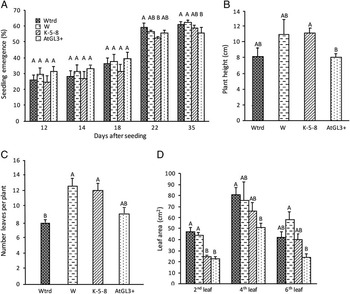
All four lines began to emerge about 10 days after seeding. We found no differences in emergence rates among the four lines at 12, 14, and 18 days after seeding (Fig. 1A). Although pesticide-treated Westar plants had a significantly higher rate of emergence (P⩽0.05) than K-5-8 plants at 22 days after seeding, by 35 days after seeding the rate of emergence/survival of K-5-8 seedlings was similar to that of both non-hairy leaved entries, while emergence of the AtGL3+ line was significantly lower than Westar and treated Westar seedlings (P⩽0.05) (Fig. 1A). Differences in emergence among lines were small; at about 55–60% emergence, rates of emergence were similar to other B. napus cultivars in the field (Canola Council of Canada 2015). While cotyledons of all four lines were glabrous, newly unfurled cotyledons of the two hairy-leaved transgenic lines were vertically oriented and initially curled upwards compared with those of treated and untreated Westar, but flattened during later growth. Four weeks after seeding, K-5-8 plants were significantly taller than AtGL3+ plants, with heights of the two Westar lines in between (P⩽0.05) (Fig. 1B). Untreated Westar and K-5-8 plants had greater numbers of leaves than did Westar plants grown from insecticide-treated seed four weeks after seeding (P⩽0.05) (Fig. 1C). Leaf area was consistently greater in the Westar entries than in AtGL3+ plants, but not in K-5-8 plants. At four weeks after seeding, leaves of both hairy lines were smaller in area than those of the two Westar entries, but only the later developing leaves of AtGL3+ remained consistently smaller than those of one or the other of the Westar entries, with leaves of K-5-8 falling in between (Fig. 1D).
Attributes (means±SEM) of field-grown plants of Brassica napus cultivar Westar (W), B. napus cultivar Westar treated with Helix XTra® seed treatment (Wtrd), AtGL3+ B. napus (AtGL3+), and K-5-8 (BnTTG1 knock down in AtGL3+ B. napus). (A) Seedling emergence on five occasions after seeding, (B) plant height, (C) number of leaves per plant, and (D) area of three leaf stages. Different letters over columns within a rating date or tissue type indicate significant differences in feeding levels, P⩽0.05.

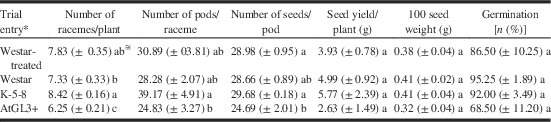
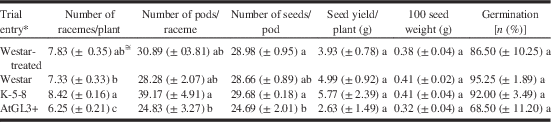
K-5-8 plants surpassed those of the other lines in most yield parameters measured. Twelve weeks after seeding, K-5-8 plants had more pod-bearing racemes than untreated Westar or AtGL3+ plants (Table 1). Likewise, K-5-8 plants had more pods per raceme than AtGL3+ plants, with treated Westar and Westar plants having number of pods in between those of the two transgenic lines (Table 1). The number of seeds per pod followed a similar pattern, with K-5-8 plants being similar to those of the two Westar entries, all of which had more seeds per pod than AtGL3+ plants (Table 1). Seed yield per plant, 100 seed weight, and subsequent seed emergence rates followed trends similar to number of seeds per pod, with values for K-5-8 plants similar to those of the two Westar entries and greater than the AtGL3+ plants, but high within-replicate variability rendered differences among entries non-significant (P⩾0.05) (Table 1). There were no differences in days to maturity among the four lines (data not presented).
Plant yield parameters (±SEM) from four Brassica napus canola entries grown under cages in the field, Saskatoon, Saskatchewan, Canada, 2011.
Notes:
* Entries were grown from B. napus cultivar Westar seed treated or not treated with Helix XTra® seed treatment, and two trichome-enriched lines, K-5-8 (BnTTG1 knock-down in AtGL3+ B. napus), and AtGL3+ B. napus.
≅ Means within columns followed by the same letters do not differ significantly at P⩽0.05, Tukey’s honest significant difference test.
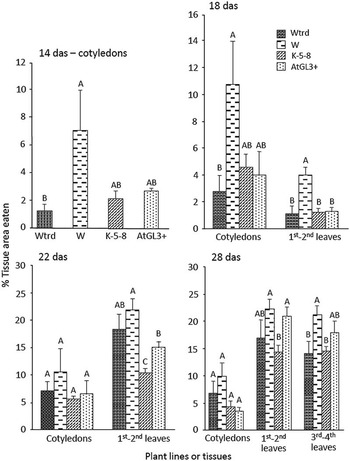
In the first flea beetle damage assessment, we found that cotyledons of both hairy entries had flea beetle feeding damage levels comparable to damage on cotyledons grown from Westar seed treated with insecticide, considerably lower than levels found on untreated Westar cotyledons (Fig. 2). This pattern of damage to cotyledons held for the three additional evaluations, significantly so for cotyledons 18 days after seeding. At that time, the first leaves of the untreated Westar entry had much more damage than those of all three other entries (Fig. 2). At 22 days after seeding, flea beetle damage to the first and second leaves of K-5-8 was the lowest of all entries, half as much as was seen on untreated Westar, which approached the economic threshold of 25% tissue area eaten. At 28 days after seeding, both first/second and third/fourth leaves of K-5-8 had less flea beetle feeding damage than untreated Westar leaves, with levels similar to those seen on Westar plants grown from pesticide-treated seed. On the other hand, by 28 days after seeding, flea beetle feeding levels on AtGL3+ leaves were similar to those seen on leaves of untreated Westar plants (Fig. 2).
Flea beetle feeding injury (% tissue area eaten±SEM) to cotyledons and leaves of Brassica napus cultivar Westar (W), B. napus cultivar Westar treated with Helix XTra® seed treatment (Wtrd), AtGL3+ B. napus (AtGL3+), and K-5-8 (BnTTG1 knock-down in AtGL3+ B. napus) in the field at Saskatoon, Saskatchewan, on four different dates, 14, 18, 22, and 28 days after seeding (das) based on visual assessments. Different letters over columns within a tissue type indicate significant differences in feeding levels, P⩽0.05.

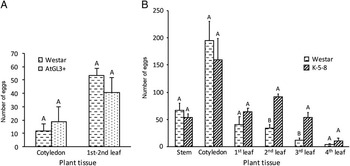
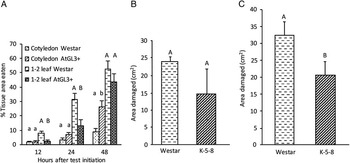
In diamondback moth oviposition assays, we found no statistical differences between the number of eggs laid on either cotyledons or first-second leaves of Westar or AtGL3+ seedlings (Fig. 3A), or between stems, cotyledons, or first leaves of Westar and K-5-8 seedlings (Fig. 3B) after seven day of feeding. Second and third leaves of K-5-8 plants, however, had significantly more eggs laid on them than comparable leaves of Westar (P⩽0.05), with the number of eggs on fourth leaves similar between the two lines.
Number of eggs (±SEM) laid in diamondback moth oviposition choice tests after seven days of exposure to female diamondback moths initially caged with (A) five-day-old seedlings of Brassica napus cultivar Westar and AtGL3+ (AtGL3+ B. napus), and (B) 11-day-old seedlings of B. napus cultivar Westar and K-5-8 (BnTTG1 knock down in AtGL3+ B. napus). Different letters over columns within a tissue type indicate significant differences in oviposition, P⩽0.05.

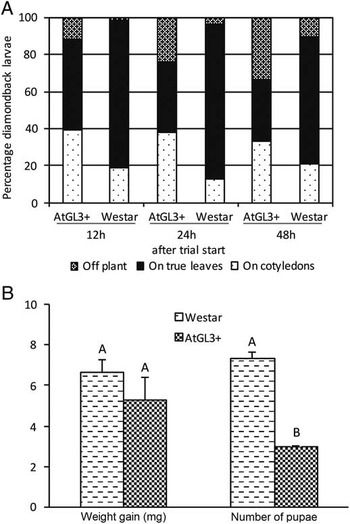
Diamondback moth larvae tended to migrate to leaves of Westar after initial placement on cotyledons, and tended to stay on leaves of Westar when initially placed there (Fig. 4A). In contrast, larvae placed on AtGL3+ cotyledons maintained their position. After initial placement on leaves of AtGL3+ plants, larvae migrated away, leaving the plants more often than when on Westar (Fig. 4A). Differences in diamondback moth larval position between the two lines were significant for cotyledons at 12 hours (P⩽0.02), and followed the same trend at 24 hours (P⩽0.07) and 48 hours (P⩽0.10). Likewise, differences in position were significant for leaves at 12 hours (P⩽0.009) and 24 hours (P⩽0.02) after feeding initiation, but not at 48 hours (P⩽0.20) (Fig. 4A). Moreover, differences between the two lines in number of larvae off plant increased with time at 12 hours (P⩽0.10), 24 hours (P⩽0.07), and 48 hours (P⩽0.02), respectively.
Behavioural and growth parameters of diamondback moth larvae 48 hours after initiation of a no-choice bioassay of Brassica napus cultivar Westar and AtGL3+ seedlings at the second leaf stage. (A) Position of larvae, and (B) larval weights and number of pupae. Different letters over columns within a growth parameter indicate significant differences in oviposition, P⩽0.05.

All diamondback moth larvae gained weight in the no-choice bioassays over the initial average weight of 3.90 mg. Although the average larval weight gain on AtGL3+ plants did not differ statistically compared with that of larvae feeding on Westar plants (Fig. 4B), many larvae on AtGL3+ plants were discoloured, slower moving, and not as responsive to disturbance as larvae feeding on Westar seedlings. The number of diamondback moth pupae that developed from AtGL3+ plants was less than half the number from Westar plants (Fig. 4B).
In the no-choice diamondback moth feeding bioassays of AtGL3+ and Westar plants, we found no differences in larval feeding on glabrous cotyledons of either line at 12 or 24 hours after feeding initiation, but less feeding injury occurred on cotyledons of Westar than on those of AtGL3+ after 48 hours (P⩽0.001, Fig. 5A). In contrast, larvae preferred to feed more on Westar leaves than on hairy AtGL3+ leaves, significantly so at 12 and 24 hours (P⩽0.005 and <0.0001, respectively) (Fig. 5A). In a no choice test, the amount of leaf tissue damaged by diamondback moth larvae was greater for Westar leaves than for K-5-8 leaves after two weeks of feeding, but not significantly so (Fig. 5B). However, in a choice test, Westar plants had more diamondback moth larval feeding damage than K-5-8 plants two weeks after feeding began (P⩽0.05) (Fig. 5C).
Feeding bioassays of diamond back moth larvae on Brassica napus cultivar Westar and two lines of B. napus with elevated trichome levels. (A) Visual estimates of % tissue area eaten (±SEM) by two larvae on cotyledons and first leaves of B. napus Westar and AtGL3+ seedlings at 12, 24, and 48 hours after initiation of the no-choice test. (B) No-choice and C) choice-tests illustrating leaf area of Westar and K-5-8 plants damaged (±SEM) by eight larvae two weeks after placement on 17-day-old plants. Different letters over columns within a tissue type indicate significant differences in feeding levels, P⩽0.05.

Discussion
This study presents the first field comparison of flea beetle injury to seedlings of hairy-leaf and ultra-hairy leaf transgenic lines relative to parental Westar. The presence of plant trichomes can trigger both antixenosis and antibiosis modalities of host plant resistance. The phenomenon of Brassica trichomes acting as physical feeding deterrents against insects has been reported previously (e.g., Agren and Schemske Reference Agren and Schemske1993; Palaniswamy and Bodnaryk Reference Palaniswamy and Bodnaryk1994; Soroka et al. Reference Soroka, Holowachuk, Gruber and Grenkow2011). As well as being physical barriers, non-glandular trichomes are nutritionally poor structures due to high cellulose and lignin contents, and, when consumed, negatively impact insect development (reviewed in Levin Reference Levin1973). Increased trichome density and length can negatively affect the ability of Phyllotreta flea beetles to gain access to food. In previous laboratory no-choice feeding trials, some flea beetles attempted to avoid trichomes of AtGL3+ plants by feeding in aberrant positions, maintaining leaf contact via mouthparts and metatarsi only (Soroka et al. Reference Soroka, Holowachuk, Gruber and Grenkow2011). In the current investigation, flea beetles initially fed much less on leaves of both of the hairy lines than on untreated Westar seedlings, but in later ratings of more developed plants, antixenosis was maintained only by K-5-8 plants. This extension of resistance to the third and fourth leaf places the level of protection by trichomes beyond the usual effective length of insecticidal seed treatments and, indeed, past the growth stages of canola seedlings that are susceptible to flea beetle feeding (Canola Council of Canada. 2014).
An unexpected outcome of manipulating B. napus with the two trichome regulatory genes was the endowment of flea beetle resistance to glabrous cotyledons of both hairy-leafed lines. The flea beetle feeding pressure was low in the current field trial, and further field testing under higher flea beetle populations is necessary to fully validate the presence of cotyledon resistance. However, our results are consistent with those seen in several other field trials of the AtGL3+ line under higher flea beetle feeding pressure at two locations (Soroka et al. Reference Soroka, Holowachuk, Gruber and Grenkow2011). Both of the transgenic hairy lines have vertically oriented young cotyledons that curl upwards upon emergence, although they become horizontally oriented as they fully expand and the plants grow. This unusual cotyledon morphology could contribute to the reduced preference by flea beetles, which show specific behaviour patterns when selecting host species (Henderson et al. Reference Henderson, Hallett and Soroka2004; Hallett et al. Reference Hallett, Ray, Soroka and Gruber2005). Alternatively, genetic modification may have caused changes in chemical composition in the glabrous cotyledons that resulted in avoidance by the beetles. Comparisons of the biochemical composition and gene expressions in cotyledons of the three entries could help to determine antixenosis factors that contribute to flea beetle resistance in the hairy lines.
Our bioassays found no consistent differences in oviposition preference of female moths between Westar and AtGL3+ cotyledons and true leaves, but did show a preference for oviposition on second and third leaves of K-5-8 plants over similar-aged semi-glabrous Westar leaves. Both negative (Handley et al. Reference Handley, Ekbom and Agren2005; Sletvold et al. Reference Sletvold, Huttmen, Handley, Kärkkäinen and Agren2010) and positive (Talekar et al. Reference Talekar, Liu, Chen and Yiin1994) relationships have been reported between number of trichomes in crucifer hosts and oviposition preference of diamondback moth. It may be that canola trichome density does not elicit a strong selective response from ovipositing diamondback moth females. Moreover, increased oviposition on tissues with greater trichome density does not necessarily translate into increased herbivory. If the egg deposit remains on the surface of the trichome mat, increased environmental exposure could result in increased egg desiccation and elevated predation and parasitism because of greater visibility of eggs. As well, emerging larvae could starve if unable to reach the epidermis to feed (Levin Reference Levin1973).
This is the first study to demonstrate resistance to diamondback moth larval feeding in trichome-enriched B. napus, both in newly emerged seedlings (AtGL3+) and in pre-bolting plants (K-5-8). AtGL3+ plants exhibit increased trichome density over Westar plants only up to the fourth leaf, while higher trichome density is maintained up to the 12th emerging K-5-8 leaf (Alahakoon Reference Alahakoon2013). We bioassayed young seedlings of AtGL3+ plants for this reason; we tested later stages of K-5-8 plants to determine if trichome resistance to diamondback moth larvae is also maintained in more advanced plants. AtGL3+ seedlings were shown to elicit a non-preference response from the larvae, which moved off these plants when placed on leaves in a no-choice bioassay. Further, the sluggish movement of larvae feeding on AtGL3+ seedlings, the tendency for lower weight gains, and the fewer pupae on these plants suggest that antibiosis factors are present in these seedlings that affect larval biology. Such avoidance of trichome-enhanced tissues and poorer fitness when feeding raises the prospect of seasonal population decline of the multi-voltine diamondback moth. Decreased feeding on young seedlings is of importance if diamondback moths ever regularly over-winter on the Canadian Prairies and threaten canola crops when seedlings emerge (Dosdall Reference Dosdall1994). In the Westar/K-5-8 assessment, the resistance held in older plants that were typical of those commonly encountered when moths migrate from the south later in spring. Unfortunately, for logistical reasons we did not retrieve pupae from the K-5-8 bioassays and cannot speculate on whether antixenosis or antibiosis factors affected larval feeding on this line. Although the consequences of feeding on K-5-8 leaves to diamondback larval health and population development remains to be determined, it is clear that less diamondback moth larval feeding damage occurs on both canola lines with increased foliar trichome expression. Generally, feeding by flea beetles is more injurious to small seedlings of B. napus than is feeding by diamondback moth larvae because flea beetles feed on apical meristems more frequently and on foliage in a more dispersed pattern than do diamondback moth larvae (Gavloski and Lamb Reference Gavloski and Lamb2000a). As well, seedlings can compensate for feeding by both pests to some degree (Gavloski and Lamb Reference Gavloski and Lamb2000b). However, having early season resistance to both pests could improve the fitness of lines that possess this resistance trait over that of lines with resistance to one or the other of the herbivores or those with no resistance at all.
Although seedlings of AtGL3+ were evaluated for flea beetle resistance in previous field studies (Soroka et al. Reference Soroka, Holowachuk, Gruber and Grenkow2011), this is the first field comparison of growth characteristics from seedling emergence to harvest and beyond of AtGL3+ and K-5-8 plants relative to their Westar parent. While both AtGL3+ and K-5-8 plants showed decreased flea beetle feeding over Westar, only K-5-8 plants were equal to Westar plants in agronomic traits. K-5-8 plants exhibit greater trichome density, trichome length, and tissue coverage than AtGL3+ plants (Gruber et al. Reference Gruber, Wang, Ethier, Holowachuk, Bonham-Smith and Soroka2006; Alahakoon et al. Reference Alahakoon, Taheri, Nayidu, Epp, Yu and Parkin2016). A higher density of trichomes can alter the boundary layer of a leaf, increasing gas exchange between the leaf and its surroundings (reviewed in Johnson Reference Johnson1975). The resulting increase in CO2 availability can lead to a higher photosynthetic rate and increased plant growth, consistent with enhanced K-5-8 vegetative growth seen in both the laboratory and field, and increased leaf photosynthetic gene expression levels and gene diversity (Alahakoon et al. Reference Alahakoon, Taheri, Nayidu, Epp, Yu and Parkin2016). An increase in tree growth and photosynthetic rate accompanying trichome density increase has also been reported in Populus alba Linnaeus (Salicaceae) with over-expression of the MYB186 trichome gene (Plett et al. Reference Plett, Wilkins, Campbell, Ralph and Regan2010). Increase in length and density of trichomes also did not limit the reproductive traits or other physiological processes of ultra-hairy K-5-8, in contrast to AtGL3+ plants. Leaves of K-5-8 had a much wider range of biochemical gene expression changes, including those regulating cell wall components, antioxidants, and glucosinolates and their breakdown products, compared with leaves of AtGL3+ (Alahakoon et al. Reference Alahakoon, Taheri, Nayidu, Epp, Yu and Parkin2016). In a similar manner increased trichome density showed little to no cost to B. rapa growth except delayed flowering (Agren and Schemske Reference Agren and Schemske1993), which increased the number of harvestable pods (Agren and Schemske Reference Agren and Schemske1994). Plant growth and reproductive fitness depends on growing conditions, gene expression level, and expression of resistance traits at particular plant development stages (Fakheran et al. Reference Fakheran, Paul-Victor, Heichinger, Schmid, Grossniklaus and Turnbull2010; Paul-Victor et al. Reference Paul-Victor, Züst, Rees, Kliebenstein and Turnbull2010; Sletvold et al. Reference Sletvold, Huttmen, Handley, Kärkkäinen and Agren2010; Alahakoon et al. Reference Alahakoon, Taheri, Nayidu, Epp, Yu and Parkin2016). Cotyledon expression levels of most biochemical genes were much less extreme and cotyledon size was larger for K-5-8 than the AtGL3+ line (M.G., unpublished data). Moreover, K-5-8 plants had reduced BnTTG1 gene expression relative to AtGl3+. At higher expression levels the BnTTG1 gene, in combination with AtGL3+ overexpression, is associated with strongly depressed fertility, depressed vegetative and reproductive growth and line instability (Alahakoon et al. Reference Alahakoon, Taheri, Nayidu, Epp, Yu and Parkin2016). In the future, K-5-8 would benefit from a field study undertaken over multiple years in multiple locations, and with different seeding rates and pest pressures, to determine whether it is as robust as it appears at this time.
Westar, with similar yields as K-5-8 in the current study, was a high yielding and early maturing B. napus cultivar developed at AAFC Saskatoon Research Centre and released for commercial cultivation in 1982; it quickly dominated the canola industry (Klassen et al. Reference Klassen, Downey and Capcara1987). However, because of the tremendous advances in canola varietal development since that time, the ultra-hairy trait will need to be introduced into newer, more advanced breeding lines in order to be agronomically competitive. Fortunately, the procedure for doing so has been established (Alahakoon et al. Reference Alahakoon, Taheri, Nayidu, Epp, Yu and Parkin2016), and plant lines and genes for trichome enhancement are available.
This study demonstrates that two newly developed B. napus lines with elevated foliar trichome density are resistant to the crucifer specialist insects Phyllotreta flea beetles and diamondback moth. The agronomic features of one of these lines, K-5-8, under damage equal those of the insecticide-treated glabrous parent in the field. Decreased feeding by flea beetles and diamondback moth larvae on the glabrous cotyledons of the two trichome-enriched lines, particularly those of K-5-8, suggest that these cotyledons should be further evaluated to determine why they inhibit feeding by these pests.
Acknowledgements
The financial support of the Agriculture Development Fund of Saskatchewan and SaskCanola is gratefully acknowledged. The authors thank Min Yu, Jennifer Holowachuk, Wesley Wizniuk, Delwin Epp, and Ruwandi Andrahennadi for their technical assistance.