Implications
Different factors affect the ability of ducks to hepatic steatosis, the main effect being species. However, comparisons between Pekin and Muscovy ducks exhibiting different growth rates have never taken into account the effects of age and developmental stage. The aim of this study was to investigate whether age can interfere with the species effect. Moreover, the possibility of shortening the rearing period before the overfeeding step could reduce the production costs for overfed ducks and also the environmental impact (raw material requirements for feeding, manure production).
Introduction
Overfeeding in domestic palmipedes, such as ducks, induces considerable nutritional hepatic steatosis that is mainly used to produce fatty liver (‘foie gras’). This development of steatosis results from an accumulation of lipids in the liver (mainly triacylglycerol, Hermier et al., Reference Hermier, Salichon, Guy, Peresson, Mourot and Lagarrigue1999), leading to a liver weight, which can account for 10% of the BW in <2 weeks of overfeeding. However, among ducks, the ability to hepatic steatosis differs according to species (Hermier et al., Reference Hermier, Guy, Guillaumin, Davail, André and Hoo-Paris2003; Chartrin et al., Reference Chartrin, Bernadet, Guy, Mourot, Hocquette, Rideau, Duclos and Baéza2006a). For example, the Muscovy duck (Cairina moschata) is able to produce a heavy fatty liver (around 500 g), whereas the Pekin duck (Anas platyrhynchos) produces a small fatty liver (∼300 g) when they are overfed according to their ingestion ability, in spite of the lower ingestion ability of the Muscovy duck compared with the Pekin duck (Baéza et al., Reference Baéza, Rideau, Chartrin, Davail, Hoo-Paris, Mourot, Guy, Bernadet, Juin, Méteau and Hermier2005). On the other hand, Pekin ducks always exhibit higher lipid content in muscles and adipose tissues than Muscovy ducks regardless of the feeding level, whether they are fed ad libitum or overfed (Chartrin et al., Reference Chartrin, Bernadet, Guy, Mourot, Duclos and Baéza2006b).
Various studies (Chartrin et al., Reference Chartrin, Bernadet, Guy, Mourot, Hocquette, Rideau, Duclos and Baéza2006a; Saez et al., Reference Saez, Baéza, Davail, Durand, Bauchart and Gruffat2009a; Hérault et al., Reference Hérault, Saez, Robert, Al Mohammad, Davail, Chartrin, Baéza and Diot2010) have demonstrated that the Muscovy duck has a greater ability to synthesise and store lipids in the liver than the Pekin duck, which could partly explain its greater ability to produce a fatty liver. Depending on feeding level (ad libitum or overfed), the level of hepatic secretion of lipids in very-low-density lipoprotein (VLDL) form has been demonstrated to be higher in Muscovy ducks than in Pekin ducks, or similar for the two species, respectively (Saez et al., Reference Saez, Baéza, Davail, Durand, Bauchart and Gruffat2008 and Reference Saez, Baéza, Davail, Durand, Bauchart and Gruffat2009a). However, the fact that the Pekin duck exports VLDL with higher triglyceride (TG) content than that of the Muscovy duck might limit the development of hepatic steatosis (Saez et al., Reference Saez, Savary-Auzeloux, Baéza, Bernadet, Davail, Durand, Bauchart and Gruffat2012). Higher muscle uptake of circulating lipids, greater ability to store intramuscular lipids and more active muscle lipogenesis could explain the higher intramuscular fatness of the Pekin duck (Chartrin et al., Reference Chartrin, Bernadet, Guy, Mourot, Hocquette, Rideau, Duclos and Baéza2006c; Saez et al., Reference Saez, Davail, Gentes, Hocquette, Jourdan, Degrace and Baéza2009b and Reference Saez, Baéza, Bernadet and Davail2010).
All studies to date have compared Pekin and Muscovy ducks at the same age, very often at 14 weeks of age, which is the usual age at the end of the overfeeding period. However, Pekin ducks have earlier body development than Muscovy ducks (Baéza et al., Reference Baéza, Rideau, Chartrin, Davail, Hoo-Paris, Mourot, Guy, Bernadet, Juin, Méteau and Hermier2005). For meat production, Pekin ducks are usually slaughtered at 6 to 7 weeks of age, whereas male Muscovy ducks are slaughtered at 12 weeks of age (Baéza, Reference Baéza2000). For each species, the slaughter ages are compromises between meat yield, carcass fatness and feed cost. Therefore, this difference in body maturity between species could result in differences in tissue development, particularly peripheral adipose tissue, which might also occur earlier in Pekin ducks, and thus explain why fat deposition is greater in peripheral tissues of this species at 14 weeks of age than in Muscovy ducks. In order to test this hypothesis, we undertook a study to compare the ability to liver steatosis in Pekin and Muscovy ducks beginning the overfeeding period at 10, 12, 14 and 16 weeks of age, in order to allow ducks of both species to have practically achieved the development of breast muscles at slaughter and to be engaged in the phase of fat deposit.
Material and methods
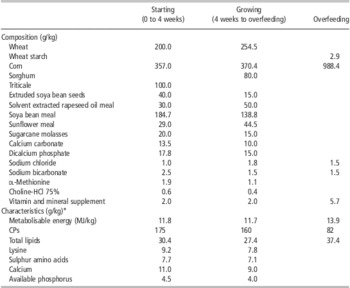
All experimental procedures were conducted in accordance with the French National Guidelines for the Care and Use of Animals for Research Purposes (Certificate of Authorisation to Experiment on Living Animals No. 37–005, Ministry of Agriculture and Fisheries). Male ducks from two different species, Pekin and Muscovy (Grimaud Company, Roussay, France), were reared at the experimental unit for breeding waterfowl (UE89, Benquet, France). Each species was distributed into four groups of 40 ducks, starting at 2-week intervals in order to have four different ages at the beginning of the overfeeding period (10, 12, 14 and 16 weeks). From 1-day old to 8, 10, 12 and 14 weeks of age, ducks were fed ad libitum. Ducks were then feed restricted (180 g of feed distributed per duck and per day at the beginning, increasing to 345 g at the end of the period) corresponding to 80% of ad libitum feeding. At 10, 12, 14 or 16 weeks of age, ducks were overfed for 2 weeks with corn and corn meal. The main characteristics of diets (starting, growing and overfeeding) are shown in Table 1. The growth of birds was monitored by weighing them at 4, 6, 8, 10, 12, 14, 16 and 18 weeks of age. The feed consumption per group was determined during the same periods by weighing feed distributed at the beginning of the period and feed non-consumed at the end of the period.
Composition and characteristics of feed for rearing and overfeeding periods

The preparation for overfeeding contained corn (25%), corn meal (35%) and water (40%).
*Calculated values according to INRA nutrient tables for poultry (INRA, 1989).
At the end of the overfeeding period, a blood sample was collected on EDTA from each duck 12 h after the last meal in order to quantify plasma TG concentration. Plasma was separated by centrifugation at 3000 × g for 10 min at 4°C and stored at −20°C. All ducks were then slaughtered at the experimental unit (UE89, Benquet, France). After 24 h storage at 4°C, carcasses were cut up in order to determine the weights of the liver, breast muscle with and without skin, thigh +shank and abdominal fat. Samples of liver and breast muscle were stored at −20°C before determining lipid and moisture content. The technological quality of fatty livers weighing more than 300 g (minimum weight of commercial ‘foie gras’ according to EU regulation, n = 105 for Muscovy ducks and n = 35 for Pekin ducks) was estimated by measuring cooking loss. The main blood vessels were carefully removed. A piece of liver (about 100 g) was removed from the main lobe and weighed precisely. Samples were salted (12 g/kg) and placed in individual tin cans. The cans were placed in water at 70°C and cooked for 1 h at 85°C under a pressure of 0.8 bar. After 30-min chilling, the cans were removed from the autoclave and stored at 4°C for 1 week. They were then opened, and each cooked liver was carefully dissected of all visible fat and weighed. The amount of fat loss during cooking was expressed as a percentage of the initial liver weight. Plasma TG content was quantified by a colorimetric enzymatic method according to Fossati and Prencipe (Reference Fossati and Prencipe1982) using a kit provided by Bio-Mérieux (Marcy-l'Etoile, France). The lipid and moisture content of the liver and breast muscle was determined according to Folch et al. (Reference Folch, Lees and Sloane-Stanley1957) and Association of Official Analytical Chemists (AOAC, 1990), respectively, in 12 samples per group (representing the average weight of the group). The data were submitted for ANOVA using the GLM procedure of SAS (1989). The model included the main effects of species, age at the beginning of the overfeeding period and their interaction. Among the different groups, significant differences between means were shown according to the Newman–Keul test, and the level of significance was set at P < 0.05.
Results
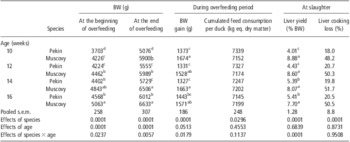
Overfeeding performance (Table 2)
By comparison with Pekin ducks, Muscovy ducks had higher BWs at the beginning (4649 v. 4224 g) and the end (6257 v. 5593 g) of the overfeeding period, greater BW gains (1604 v. 1365 g), except at 16 weeks of age, higher liver weight (518 v. 269 g), higher liver yield (8.2% v. 4.8%) and much greater liver cooking loss (50.3% v. 20.1%) but lower cumulated feed consumption during the overfeeding period (7183 v. 7270 g). The BW at the beginning of the overfeeding period increased with age, but the difference was significant between 10, 12 and 16 weeks for Muscovy ducks and between 10, 12 and 14 weeks for Pekin ducks. The BW at the end of the overfeeding period increased with age, but the difference was significant between 12 and 14 weeks for Muscovy ducks and between 10, 12 and 16 weeks for Pekin ducks. For a given species, there was no effect of age on BW gain during the overfeeding period. The liver weights of Muscovy ducks were not affected by age, whereas they increased between 10 and 14 weeks in Pekin ducks (+53%). The liver yield of Muscovy ducks was not affected by age, whereas it was higher at 14 and 16 weeks than at 10 and 12 weeks in Pekin ducks. The liver cooking loss and the cumulated feed consumption during the overfeeding period were not affected by age. The liver cooking loss was correlated with liver weight (R = 0.76, P < 0.05).
Effects of species and age of Pekin and Muscovy ducks at the beginning of the overfeeding period on the performance (mean; n = 32 per treatment)

a,b,c,dWithin a column, means without a common letter differ (P < 0.05).
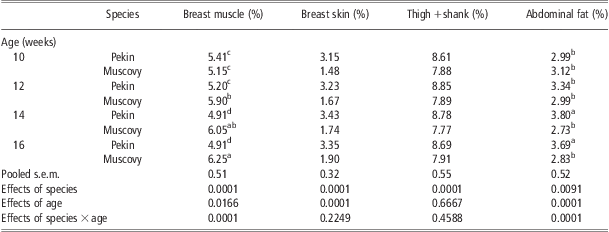
Carcass composition (Table 3)
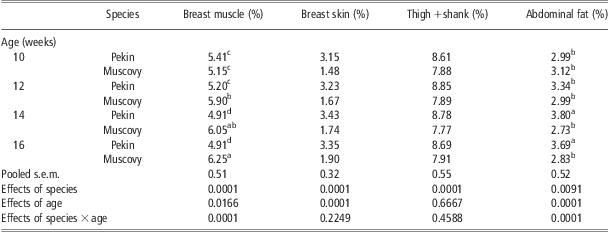
By comparison with Pekin ducks, Muscovy ducks had higher breast muscle weight (366 v. 285 g), higher breast muscle yield (5.9% v. 5.1%) except at 10 weeks, lower weight (108 v. 184 g) and percentage (1.7% v. 3.3%) of breast skin, lower abdominal fat weight (182 v. 193 g) except at 12 weeks, lower percentage of abdominal fat (2.9% v. 3.4%) except at 10 and 12 weeks and lower percentage of thigh + shank (7.9% v. 8.7%). Species had no effect on the weight of thigh + shank except at 10 weeks. Breast muscle weight increased between 10 and 16 weeks only in Muscovy ducks (+37%). The percentage of breast muscle increased with age until 14 weeks in Muscovy ducks, and decreased between 12 and 14 weeks in Pekin ducks. The weight and percentage of breast skin increased with age in both species. The weight of thigh + shank increased between 12 and 14 weeks in Muscovy ducks, whereas it increased between 10 and 16 weeks in Pekin ducks (+20%). The percentage of thigh + shank was not affected by age. The weight of abdominal fat was not affected by age in Muscovy ducks, whereas it increased between 10 and 14 weeks in Pekin ducks (+43%). The percentage of abdominal fat was not affected by age in Muscovy ducks, whereas it increased between 12 and 14 weeks in Pekin ducks.
Effects of species and age of Pekin and Muscovy ducks at the beginning of the overfeeding period on the carcass composition at slaughter (mean; n = 32 per treatment)
Percentages are expressed in relation to BW.
a,b,c,dWithin a column, means without a common letter differ (P < 0.05).
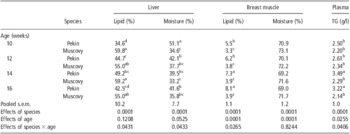
Lipid and moisture content of liver and breast muscle (Table 4)
Muscovy ducks had higher lipid content (1.3-fold) and lower moisture content (35.3% v. 43.6%) in the liver than Pekin ducks. By contrast, Pekin ducks had higher lipid content (1.8-fold) and lower moisture content (70.4% v. 72.0%) in breast muscle than Muscovy ducks. Age had no effect on lipid and moisture content in the livers of Muscovy ducks, whereas the lipid content increased and the moisture content decreased between 10 and 12 weeks in the livers of Pekin ducks. The lipid content in breast muscle was not affected by age in Muscovy ducks, whereas it increased between 12 and 14 weeks in the breast muscle of Pekin ducks. The moisture content of breast muscle decreased with age. The liver lipid content was correlated with liver weight (R = 0.63, P < 0.05) and liver moisture content (R = 0.81, P < 0.05). The lipid content in breast muscle was correlated with the weight of breast skin (R = 0.80, P < 0.05) and the moisture content in breast muscle (R = 0.90, P < 0.05).
Effects of species and age of Pekin and Muscovy ducks at the beginning of the overfeeding period on the lipid and moisture content of breast muscle and liver and plasma TG content 12 h after the last meal (mean; n = 12 per treatment).

TG = triglyceride.
a,b,c,dWithin a column, means without a common letter differ (P < 0.05).
Plasma TG concentration (Table 4)
Pekin ducks had higher plasma TG content (2.94 v. 2.22 g/l) than Muscovy ducks. The TG plasma content was not affected by age in Muscovy ducks, whereas it increased between 12 and 14 weeks in Pekin ducks. The correlations between TG plasma content and liver weight, lipid content of the liver and breast muscle and weights of abdominal fat and breast skin were low and not significant (0.06, 0.17, 0.35, 0.28 and 0.40, respectively).
Discussion
Species effect
Our study showed that Muscovy ducks have higher BW and muscle weight than Pekin ducks, confirming the previous reports by Guy et al. (Reference Guy, Hermier, Davail, Bely, André and Hoo-Paris1999), Hermier et al. (Reference Hermier, Guy and Guillaumin2000) and Chartrin et al. (Reference Chartrin, Bernadet, Guy, Mourot, Duclos and Baéza2006b). Regardless of the age at the beginning of the overfeeding period, Pekin ducks had a lower ability to produce fatty livers in spite of higher feed consumption than Muscovy ducks. However, Pekin ducks were able to store neo-synthesised lipids in peripheral adipose (abdominal and subcutaneous fat) and muscle tissues, which seem to be the preferential sites for this species. By contrast, Muscovy ducks were able to produce heavier fatty livers containing a higher proportion of lipids. Moreover, the ability of Pekin ducks to export hepatic neo-synthesised lipids seemed to be greater than that of Muscovy ducks. At the end of the overfeeding period, Pekin ducks had higher plasma TG content than Muscovy ducks. Davail et al. (Reference Davail, Rideau, Guy, André, Hermier and Hoo-Paris2003) and Hermier et al. (Reference Hermier, Guy, Guillaumin, Davail, André and Hoo-Paris2003) showed that Pekin ducks had higher VLDL plasma content than Muscovy ducks. The neo-synthesised TG content was preferentially accumulated in the liver of Muscovy ducks, whereas it was mostly stored in the peripheral tissues of Pekin ducks. These results confirmed the previous findings of Baéza et al. (Reference Baéza, Rideau, Chartrin, Davail, Hoo-Paris, Mourot, Guy, Bernadet, Juin, Méteau and Hermier2005) and Chartrin et al. (Reference Chartrin, Bernadet, Guy, Mourot, Duclos and Baéza2006b). Finally, Muscovy ducks that exhibited higher liver weights than Pekin ducks also had greater liver cooking loss, both parameters being highly correlated.
Age effect
Over the period studied (10 to 16 weeks), the BWs of ducks increased with age (+21.5% and +15.2% at the beginning and the end of the overfeeding period, respectively). However, this age effect depended on species. The increase in BW at the beginning of the overfeeding period was 23.4% and 12.4% for Pekin and Muscovy ducks, respectively. Breast muscle weight increased with age, particularly in Muscovy ducks whose muscle development occurs later than that of Pekin ducks (Baéza, Reference Baéza2000). The lipid content of breast muscle increased with age from 4.4% at 10 weeks to 6.0% at 16 weeks, whereas the moisture content decreased. However, this age effect depended on species. The lipid content in breast muscle of Muscovy ducks remained unchanged, whereas it increased in that of Pekin ducks. The plasma TG content increased with age only in Pekin ducks, suggesting an increase in the liver's ability to synthesise and/or to export lipids in this species and explaining the increase in lipid deposition in adipose and muscle tissues with age. However, this parameter could not be used to predict fatty liver production. Moreover, the ability of peripheral adipose and muscle tissues in circulating lipid uptake, lipid storage and/or lipid synthesis may be enhanced with age in Pekin ducks. The ability of Muscovy ducks to produce fatty livers remained similar regardless of the age, whereas this ability increased with age in Pekin ducks (+60% between 10 and 16 weeks), also resulting in an increase in the liver lipid content and a decrease in moisture content.
Conclusions
Pekin ducks have lower fatty liver production than Muscovy ducks when overfed, along with higher TG plasma content and higher lipid content in peripheral muscle and adipose tissues. The usual age for beginning overfeeding is 12 weeks. The lipid and moisture contents of liver and breast muscle were modified by moving them forward to 10 weeks or by delaying them to 14 or 16 weeks. The high level of differences observed between Pekin and Muscovy ducks remained unchanged, and thus liver weights of Pekin ducks will remain low regardless of the age for beginning overfeeding. The differences in lipid deposition (liver or peripheral tissues) depend on species and not body maturity. It will be interesting to investigate the greater ability of Pekin ducks to achieve peripheral and liver fatness with age, whereas it remained unchanged in Muscovy ducks. The economic and environmental value of reducing the age of ducks at the beginning of the overfeeding period should also be evaluated.
Acknowledgements
The authors thank the technical staff of UE89 Palmipèdes à Foie Gras (Benquet, France) who reared, slaughtered and cut the ducks, and T. Bordeau who participated in sample preparation and laboratory analyses.