Introduction
The adult stage of digeneans from the family Brachycladiidae occurs mainly in hepatic and pancreatic ducts, but also in the intestine, lungs and head sinuses of marine mammals worldwide (Fernández et al., Reference Fernández, Aznar, Latorre and Raga1998a, Reference Fernández, Littlewood, Latorre, Raga and Rollinsonb; Gibson, Reference Gibson, Jones, Gibson and Gibson2005). The bulk of their diversity is found in cetaceans (35 of c. 42 described species), with additional species infecting pinnipeds and the sea otter (Aznar et al., Reference Aznar, Balbuena, Fernández, Raga, Evans and Raga2001; Dailey, Reference Dailey2007). Very little is known about the biology of brachycladiids. No intermediate or paratenic host has been identified for any species (Fernández, Reference Fernández1996; Barnett et al., Reference Barnett, Smales and Cribb2008), and data on patterns of specificity are fragmentary. Available evidence indicates that there are contrasting patterns in the occurrence of brachycladiid species within host communities, with some species being widespread among many sympatric marine mammals and others being restricted to single host species. For instance, Orthosplanchnus arcticus has been reported in six pinniped species and two cetacean species from arctic and subarctic waters (Adams, Reference Adams1988; Raga & Balbuena, Reference Raga, Balbuena, Donovan, Lockyer and Martin1993), whereas Lecithodesmus goliath occurs in at least five species of baleen whales in the northern North Pacific (Deliamure, 1961; Yurakhno, Reference Yurakhno1967). In contrast, a parasitological survey of over 300 cetacean individuals from 13 species stranded on the coast of England and Wales (Gibson et al., Reference Gibson, Harris, Bray, Jepson, Kuiken, Baker and Simpson1998) revealed that Campula oblonga occurred almost exclusively in harbour porpoises, Phocoena phocoena. Likewise, Synthesium pontoporiae is restricted to the franciscana dolphin, Pontoporia blainvillei, in the South American Atlantic (Andrade et al., Reference Andrade, Pinedo and Barreto2001; Melo et al., Reference Melo, Ramos and Di Beneditto2006; Berón-Vera et al., Reference Berón-Vera, Crespo and Raga2008; Marigo et al., Reference Marigo, Vicente, Valente, Measures and Santos2008, and references therein).
The reasons for these sharp differences in host specificity are unknown. However, they could be investigated using a simple yet powerful conceptual framework, i.e. the encounter/compatibility paradigm (Euzet & Combes, Reference Euzet, Combes, Bocquet, Genermont and Lamotte1980; Combes, Reference Combes2001; Kuris et al., Reference Kuris, Goddard, Torchin, Murphy, Gurney and Lafferty2007). This paradigm states that specificity is determined by two sequential filters. The encounter filter would prevent infections of potential hosts that cannot contact the parasite, whereas the compatibility filter would: (1) exclude those contacted hosts in which the parasite is unable to find the appropriate resources and/or escape or deter the host's defences; or (2) impact other fitness components of the parasite if the contacted host is not unsuitable but suboptimal. In the case of brachycladiids, marine mammals become infected by consuming infected prey (probably fish and/or squid, see Fernández et al., Reference Fernández, Littlewood, Latorre, Raga and Rollinson1998b) and, therefore, dietary patterns are expected to determine the likelihood and frequency of host–parasite contacts. In any event, brachycladiids are expected to end up in a variety of potential hosts that overlap their diets (e.g. cetaceans, pinnipeds, marine birds) but differences in their suitability as habitats will prevent establishment in some hosts or affect parasite growth and/or reproduction in others (Raga et al., Reference Raga, Fernández, Balbuena, Aznar, Perrin, Würsig and Thewissen2009). In summary, differences of specificity between brachycladiid species could be understood by investigating the possibility of contacts within a marine mammal community, and the degree of compatibility with the contacted hosts.
In this paper, we adopt the encounter/compatibility filter paradigm to investigate, for the first time, the patterns of specificity of species of the Brachycladiidae. We focus on the species infecting the hepato-pancreactic ducts of a community of cetaceans in the western Mediterranean. First, we determine infection levels of each brachycladiid species in each cetacean species and discuss differences of infection in the light of existing data on diet overlap among hosts. Second, we compare fitness components (size, fecundity) of the individual parasites found in different host species. The overall results will provide a starting point to analyse patterns of specificity in other brachycladiid species and, by extension, in helminths from wild hosts for which parasitological research is based on opportunistic sampling.
Materials and methods
Sample collection
A total of 103 striped dolphins, Stenella coeruleoalba, 18 Risso's dolphins, Grampus griseus, 14 bottlenose dolphins, Tursiops truncatus, 8 common dolphins, Delphinus delphis, and 5 long-finned pilot whales, Globicephala melas, was analysed for hepato-pancreatic digeneans. Dolphins were found stranded along the Mediterranean coast of Spain (Comunidad Valenciana, between 40°25′N, 0°26′E and 37°58′N, 0°41′W) during 1982–2008. During necropsy, the liver and pancreas were removed and stored at − 20°C. After thawing, the hepato-pancreatic ducts were opened and rinsed with water under a sieve of 0.02 mm mesh. Worms were collected, counted, cleaned in 0.9% saline and fixed and preserved in absolute (for molecular analysis) or 70% (for morphometric analysis) ethanol. Published parasitological surveys on part of the samples of long-finned pilot whales and Risso's dolphins used in this study can be found in Raga & Balbuena (Reference Raga, Balbuena, Donovan, Lockyer and Martin1993) and Fernández et al. (Reference Fernández, Agustí, Aznar and Raga2003), respectively.
Molecular analysis
To confirm that specimens of Brachycladium atlanticum from striped dolphins and the common dolphin were conspecific, the internal transcribed spacer 2 (ITS2) region of the rDNA gene was compared (see Nolan & Cribb, Reference Nolan and Cribb2005). Two specimens of B. atlanticum from a common dolphin and four from a striped dolphin were cut in half and one piece was used to extract rDNA following a standard phenol–chloroform methodology (Holzer et al., Reference Holzer, Sommerville and Wootten2004). The ITS2 region was amplified using primers ITS2.2 (5′-CCTGGTTAGTTTCTTTTCCTCCGC-3′; Anderson & Barker, Reference Anderson and Barker1993) and GA1 (5′-AGAACATCGACATCTTGAAC-3′; Anderson & Barker, Reference Anderson and Barker1998) in 10 μl polymerase chain reactions (PCR). The thermocycling profile used was 35 cycles of 94°C for 50 s, 56°C for 50 s and 72°C for 1 min and 20 s, a single extension of 72°C for 4 min and a final hold at 10°C. Sequences were aligned using the BioEdit sequence alignment editor (Hall, Reference Hall1999). Sequences are available in GenBank under accession numbers: GQ226035 (B. atlanticum from striped dolphin) and FJ211250 (B. atlanticum from common dolphin).
Comparison of infection levels
Ecological terms follow Bush et al. (Reference Bush, Lafferty, Lotz and Shostak1997). The 95% confidence intervals (CI) for prevalence were set with Sterne's exact method (Reiczigel, Reference Reiczigel2003) and the 95% CIs for mean intensity and mean abundance with 20,000 bootstrap replications (Rózsa et al., Reference Rózsa, Reiczigel and Majoros2000). Prevalence of each parasite was compared between pairs of host species based on difference of prevalence (DP) statistic expressed as a percentage. Exact 95% confidence limits for DP were set by inverting a two-sided unconditional test for difference of proportions (see Agresti & Min, Reference Agresti and Min2001 for details). Pairwise differences of mean abundance between host species were tested with a bootstrap 2-sample Welch's t-test (Rózsa et al., Reference Rózsa, Reiczigel and Majoros2000).
Compatibility analysis of B. atlanticum
We selected 106 gravid specimens of B. atlanticum from 29 striped dolphins, and 17 from the only infected common dolphin. All specimens had been collected from fresh carcasses and were processed in a standardized manner. Worms were cleaned in 0.9% saline and fixed in 70% ethanol, dehydrated through a graded ethanol series, stained with aluminium carmine (Georgiev et al., 1986) and mounted on Canada balsam. For each specimen, we measured the area of body, vitellarium, uterus, testes (combined), oral sucker, ventral sucker and egg. An average egg area was obtained by randomly selecting 10 eggs in utero. The areas of these seven elements were the only ones that could readily be measured in most specimens (e.g. the ovary was often covered by a dense mass of eggs). Areas provide more objective and precise measurements than distances when organs are irregular in shape. Drawings of specimens were taken using a light microscope connected to a drawing tube. The areas were calculated from scanned drawings using Image Tool 3.00 (University of Texas Health Science Center at San Antonio, available at http://ddsdx.uthscsa.edu/dig/download.html). Counts of eggs in utero were considered as a surrogate of fecundity. However, direct counting of eggs was impossible and, therefore, a coarse estimation was made by calculating the ratio between the area of the uterus filled with eggs and mean egg area.
We estimated, in striped dolphins, the amount of intraspecific variability of size and fecundity of B. atlanticum that was attributable to host individual effects. We selected striped dolphin individuals harbouring at least two worms (n = 21), and performed one-way ANOVAs using ‘host individual’ as a random factor, and body area (as a surrogate of size), egg area, or fecundity of B. atlanticum as dependent variables. The variability accounted for by host individual was assessed with the coefficient of determination (r 2). In addition, we used Spearman correlation tests (one-tailed) to investigate whether average body area, egg area and/or fecundity of B. atlanticum per host was reduced at increasing population sizes, either of B. atlanticum alone or of B. atlanticum+Oschmarinella rochebruni (the other co-occurring species).
For the comparison between the two host species, we examined whether average log-transformed values of body area, egg area and fecundity of B. atlanticum specimens from the common dolphin were within the distribution range of the mean values obtained in the 21 striped dolphins. Also, a principal component analysis (PCA) based on the variance–covariance matrix of the seven morphometric variables was conducted to visualize differences in static multivariate allometry of B. atlanticum between the two host species (see Bray & Des Clers, Reference Bray and Des Clers1992; Pérez Ponce de León, Reference Pérez Ponce de León1995; Perdiguero-Alonso et al., Reference Perdiguero-Alonso, Montero, Raga and Balbuena2006). Both analyses indicated that specimens of B. atlanticum from the common dolphin exhibited both a smaller size and lower fecundity (see Results). Thus, we further examined whether the putative host species effect upon body size and fecundity were independent. A regression equation was obtained using mean values of body area and fecundity per host in striped dolphins. We used this equation to predict mean fecundity in worms from the common dolphin based on their mean body area. An independent host species effect on fecundity could be assumed if the observed fecundity was outside the 95% confidence interval of the predicted value.
Results
Molecular analysis
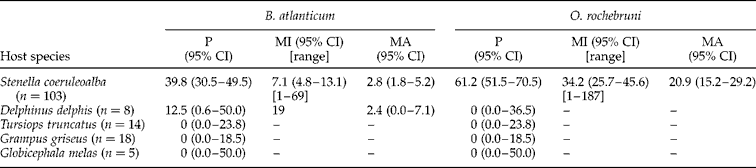
Two morphospecies of the Brachycladiidae, namely, B. atlanticum and O. rochebruni, were found in the whole sample of hosts, but only B. atlanticum was found in more than one host species (table 1). A sequence of 362 bp of the ITS2 was obtained from single specimens of B. atlanticum from striped dolphin and common dolphin, and their sequences were identical.
Infection parameters for Brachycladium atlanticum and Oschmarinella rochebruni in five cetacean species from the western Mediterranean.
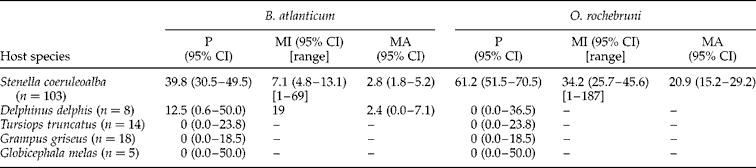
n, number of hosts analysed; P, prevalence (%); MI, mean intensity; MA, mean abundance. Range of intensity is in square brackets and 95% confidence interval for parameters in parentheses.
Infection patterns
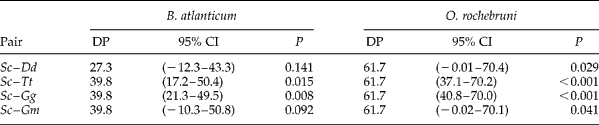
Infection parameters for B. atlanticum and O. rochebruni are shown in table 1. Striped dolphins were infected with both species, and a single common dolphin was infected with 19 individuals of B. atlanticum. The other cetacean species were all uninfected. In an inferential context, statistical evidence suggests that striped dolphins were significantly more infected with B. atlanticum than the other species except the common dolphin, although the difference with long-finned pilot whales was just marginally significant due to the small sample in the latter (table 2). Also, the mean abundance of B. atlanticum did not differ significantly between striped dolphins and common dolphins (t-test, t = − 0.176, 109 df, P = 0.822). In the case of O. rochebruni, there was evidence that striped dolphins were significantly more infected than any other species, although the differences with common dolphins and long-finned pilot whales were just marginally significant (table 2).
Percentage differences in prevalence (DP) with its associated 95% confidence interval (CI), and probability value (P), in pairwise comparisons between values of prevalence of the digeneans Brachycladium atlanticum and Oschmarinella rochebruni in striped dolphins, Stenella coeruleoalba, and each of four delphinid species from the western Mediterranean.
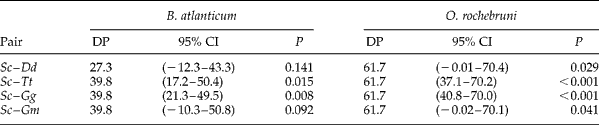
Sc, Stenella coeruleoalba; Dd, Delphinus delphis; Tt, Tursiops truncatus; Gg, Grampus griseus; Gm, Globicephala melas.
Compatibility analysis
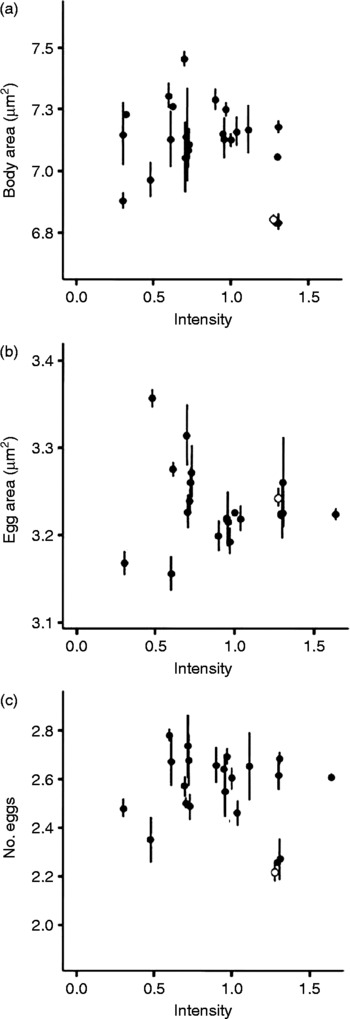
In striped dolphins, there were highly significant differences among individual hosts in all seven morphometric variables, and number of eggs, of B. atlanticum (one-way ANOVAs, P < 0.008 in all cases). In morphometric variables, the variance accounted for by ‘host individual’ ranged from r 2 = 0.426 (testes area) to r 2 = 0.705 (ventral sucker area), with values for body area and number of eggs being r 2 = 0.596 and r 2 = 0.461, respectively. We did not observe significant decreases of average values of body area (Spearman correlation, r s = − 0.16, one-tailed P = 0.199), egg area (r s = − 0.24, n = 106, one-tailed P = 0.105) or number of eggs per host (r s = 0.04, one-tailed P = 0.420), at increasing intensities of B. atlanticum (fig. 1); the same occurred using the combined intensity of B. atlanticum+O. rochebruni (body area: r s = − 0.24, one-tailed P = 0.103; egg area: r s = − 0.17, one-tailed P = 0.194; egg number: r s = − 0.08, one-tailed P = 0.348). Therefore, we assumed that there were no density-dependent effects on these variables.
Scatterplot showing the relationship between intensity and (a) body area, (b) egg area and (c) number of eggs of the digenean Brachycladium atlanticum from striped dolphin, Stenella coeruleoalba (black dots) and common dolphin, Delphinus delphis (white dot) from the western Mediterranean. Each point is an average value per host, and bars represent standard deviation. x and y axes are presented in a log-scale.

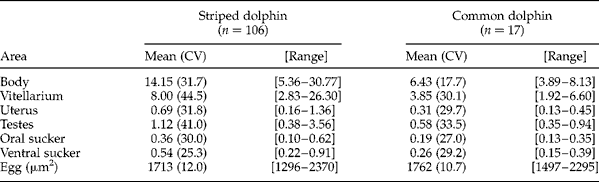
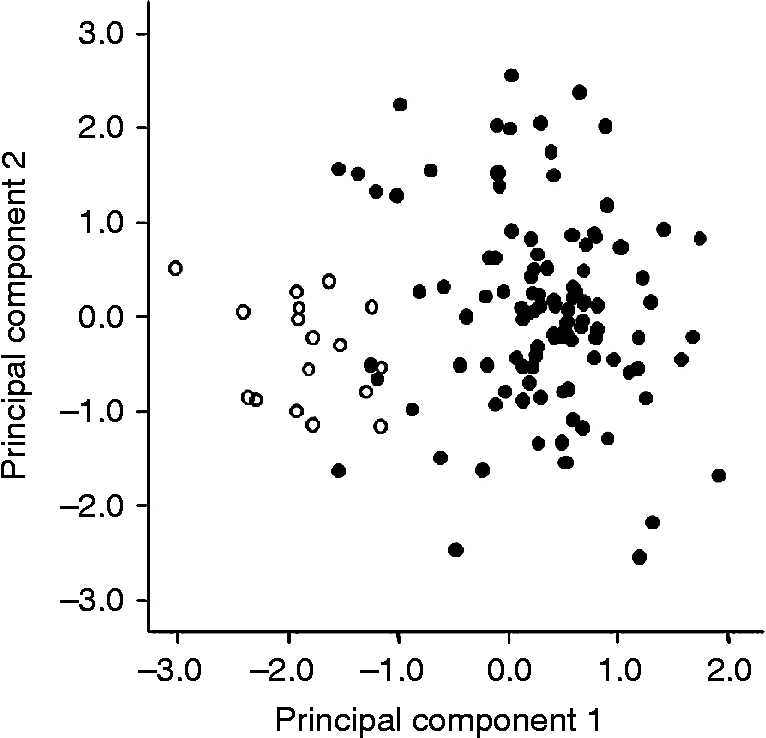
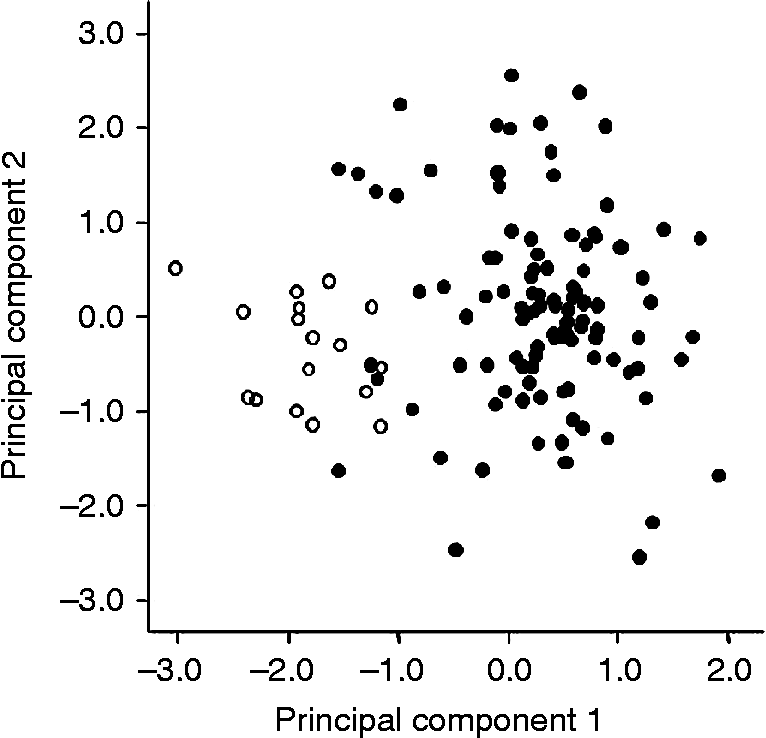
Morphometric values of specimens of B. atlanticum collected from the common dolphin were, on average, roughly half of those observed in specimens from striped dolphins, except in the case of egg area (table 3). Results from the PCA confirmed the existence of size differences associated with host species. The two first components accounted for 75.8% of the total morphometric variation, and all variables except egg area loaded positively on the first component (fig. 2). There was a clear segregation of individuals of B. atlanticum from the common dolphin only along the first (size) axis (fig. 2). Note, however, that specimens of B. atlanticum from common dolphins were collected from a single host. Thus, we also compared the average value of body size, egg size and egg number in the common dolphin with those obtained from individual striped dolphins. Average body area and egg number, but not egg area, were in the lower tail of the distribution of mean values obtained from the sample of striped dolphins (fig. 1).
Areas (in mm2 unless otherwise stated) of seven elements of the digenean Brachycladium atlanticum measured in 106 specimens collected from 29 striped dolphins, Stenella coeruleoalba, and 17 specimens collected from one common dolphin, Delphinus delphis.
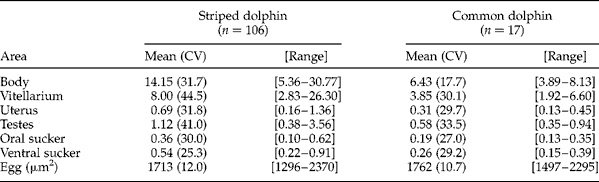
CV, Coefficient of variation.
Scatterplot of the first two principal components of the variance–covariance matrix of seven morphometric variables obtained from the digenean Brachycladium atlanticum from striped dolphin, Stenella coeruleoalba (black dots) and common dolphin, Delphinus delphis (white dots) from the western Mediterranean. Principal components 1 and 2 accounted for 62.3% and 13.5% of variance, respectively. The first eigenvector has the following loadings: body, 0.157; vitellarium, 0.165; uterus, 0.165; testes, 0.121; oral sucker, 0.121; ventral sucker, 0.125; egg, − 0.009.
In striped dolphins, mean body area of B. atlanticum per individual host was a significant predictor of mean number of eggs (regression equation: no. eggs = 17.24+26.55 × body area; r 2 = 0.562, P < 0.0001). The mean body area observed in individuals of B. atlanticum from the common dolphin was 643 μm2, and the predicted number of eggs according to the above equation was 188 (95% CI: 79–279). The actual mean number of eggs (178) was close to the predicted value, and lay within the confidence interval.
Discussion
Infection data suggest that two species of the Brachycladiidae infect delphinid cetaceans in the western Mediterranean. The striped dolphin appears to be the main definitive host for O. rochebruni. Although sample sizes for other cetacean species were small, prevalence was significantly higher in striped dolphins, with potential population differences with other species being as high as 70% (see upper 95% CIs in table 2). Oschmarinella rochebruni has also been reported in striped dolphins from the central Mediterranean (Vegni-Talluri, Reference Vegni-Talluri1982; Manfredi et al., Reference Manfredi, Dini, Ganduglia, Podesta and Repetto1992; Di Cave et al., Reference Di Cave, Carlini, Cerioni, Mariniello, Orecchia and Paggi1993). Surveys in other localities, however, indicate that O. rochebruni does not show a strict specificity to striped dolphins worldwide, as it infects other members of the subfamily Delphininae (Gibson et al., Reference Gibson, Harris, Bray, Jepson, Kuiken, Baker and Simpson1998; see also LeDuc, Reference LeDuc, Perrin, Würsig and Thewissen2009). In the North Pacific, O. rochebruni was found in common dolphins, spinner dolphins, Stenella longirostris, and spotted dolphins, Stenella attenuata, but not in as many as 31 striped dolphins (Dailey & Perrin, Reference Dailey and Perrin1973; Dailey & Otto, Reference Dailey and Otto1982). Likewise, in the eastern North Atlantic, Gibson et al. (Reference Gibson, Harris, Bray, Jepson, Kuiken, Baker and Simpson1998) reported O. rochebruni in common dolphins, but not in striped dolphins. There is also an additional record of O. rochebruni in spotted dolphins from South Africa (Gibson & Harris, Reference Gibson and Harris1979).
Striped dolphins also had the highest prevalence of B. atlanticum in the study area, but there was lower statistical power to detect population differences with other host species. Prevalence was significantly higher than in Risso's dolphins (n = 18) and bottlenose dolphins (n = 14), but evidence was not conclusive in the comparison with long-finned pilot whales (n = 5). Although sample size was also low in the case of common dolphins (n = 8), we detected a positive infection of B. atlanticum, and neither the prevalence nor the mean abundance differed from those from striped dolphins. A conservative interpretation would therefore be that B. atlanticum infects both striped dolphins and common dolphins, and more rarely, if at all, other delphinids. To date, B. atlanticum had only been reported in striped dolphins from the Canary Islands (Abril et al., Reference Abril, Balbuena and Raga1991) and, therefore, its finding in a common dolphin constitutes a new host record.
The restriction of O. rochebruni and B. atlanticum to 1–2 host species must result from a different probability of contact (encounter filter) and/or establishment (compatibility filter) among cetacean species. Obviously, the contribution of each filter cannot be quantified in our system, but some insight can be gained from two lines of evidence. First, it is likely that both O. rochebruni and B. atlanticum infect Mediterranean striped dolphins via mesopelagic cephalopods and/or mesopelagic fish, which are their two major prey groups in the study area (Blanco et al., Reference Blanco, Aznar and Raga1995, Reference Blanco, Ruiz, Aznar, Raduán, Fernández and Raga2009). In contrast, the individuals of bottlenose dolphin that we analysed for liver flukes had consumed mainly demersal neritic fish (Blanco et al., Reference Blanco, Salomón and Raga2001), whereas Risso's dolphins and long-finned pilot whales had fed on mesopelagic cephalopods almost exclusively (Blanco et al., Reference Blanco, Raduán and Raga2006; Blanco, pers. comm.). These dietary differences might suggest that O. rochebruni and B. atlanticum use mesopelagic fish to complete their life cycle (see Fernández et al., Reference Fernández, Littlewood, Latorre, Raga and Rollinson1998b), thus rarely contacting, if at all, these three cetacean species. The hypothesis that contacts did not occur is also supported by the observation that immature, transient individuals of O. rochebruni or B. atlanticum were not detected throughout the gut of any individual of bottlenose dolphins, Risso's dolphins or long-finned pilot whales (Raga & Balbuena, Reference Raga, Balbuena, Donovan, Lockyer and Martin1993; Fernández et al., Reference Fernández, Agustí, Aznar and Raga2003; Fernández, pers. comm.). However, we cannot rule out the possibility that the passage of food could be so fast (see, e.g., Kastelein et al., Reference Kastelein, Nieuwstraten, Vertegen, Read, Wiepkema and Nachtigall1997) that there was a low likelihood of detecting unsuccessful infections.
We currently lack data on the diet of common dolphins because the stomach of most individuals analysed in the present study was empty (Blanco, pers. comm.). However, in other geographical areas, common dolphins are known to exploit both neritic and oceanic resources, including a substantial amount of mesopelagic fish in their diet (Pusineri et al., Reference Pusineri, Magnin, Meynier, Spitz, Hassani and Ridoux2007 and references therein). The association between diet and the probability of infection by O. rochebruni and B. atlanticum will be more firmly established when more cetacean samples, particularly of common dolphins, are available.
In striped dolphins, we observed a highly significant effect of the individual host on the morphology and fecundity of B. atlanticum: about half of the variability of the body area and fecundity was accounted for by this factor. Strong host-individual effects on morphometry have also been reported for the brachycladiid Synthesium tursionis from Mediterranean bottlenose dolphins (Fernández et al., Reference Fernández, Balbuena, Pertusa and Raga1995). Without experimental data it is difficult to determine the factors that induce this type of variability. However, for a range of intensity of 1–69 worms we found no evidence for potential effects of inter- or intraspecific competition on morphometric variables and/or the fecundity of B. atlanticum. Crowding effects on body size and/or fecundity have been reported for several digenean species under experimental conditions (e.g. Nollen, Reference Nollen1983; Yao et al., Reference Yao, Huffman and Fried1991; Stillson & Platt, Reference Stillson and Platt2007, and references therein) but usually at intensities not commonly observed under natural conditions (Bush & Lotz, Reference Bush and Lotz2000).
Individuals of B. atlanticum collected from a single common dolphin represented a dwarf version of those commonly observed in striped dolphins, and apparently were less fecund. The lowered fecundity could result from the physical constraint relating to the accommodation of eggs in a smaller uterus. First, egg size did not differ between specimens of B. atlanticum from both species. Indeed, previous studies on brachycladiids have also shown that egg size is a highly conserved character regardless of the worm's body size and host individual (Fernández et al., Reference Fernández, Balbuena, Pertusa and Raga1995). Second, the observed fecundity is what should be expected according to body size. On the other hand, the low intensity of B. atlanticum observed in the common dolphin (just 19 worms) would suggest that dwarfism has not resulted from crowding effects.
The question remains, however, whether these traits are related to a ‘host individual’ or a ‘host species’ effect. In our study, both effects are inevitably confounded, but there is clear evidence that the mean values of body size and fecundity observed in the common dolphin are extreme compared with the distribution of the mean values obtained in a sample of striped dolphins. In other words, common dolphins appears to be less suitable as hosts for B. atlanticum than striped dolphins. Other studies report surprisingly similar effects of apparently unsuitable host species on worm morphology and fecundity. Adams et al. (Reference Adams, Hoberg, McAlpine and Clayden1998) found a single mature specimen of the brachycladiid Campula oblonga in the liver of a thresher shark, Alopias vulpinus. This parasite is otherwise specific to porpoises (Phocoenidae) and, therefore, its occurrence in sharks was exceptional (Adams et al., Reference Adams, Hoberg, McAlpine and Clayden1998). Interestingly, the specimen collected from the shark was dwarf and exhibited a reduced fecundity but an egg size comparable to that in its typical hosts. Likewise, single specimens of Diclidophora merlagi, a typical monogenean from whiting, Merlangius merlangus, were found in two cod, Gadus morhua, from two localities in the North Atlantic (Perdiguero-Alonso et al., Reference Perdiguero-Alonso, Montero, Raga and Balbuena2006). Both monogenean specimens exhibited a stunted growth, but one of them had developed an egg of normal size (Perdiguero-Alonso et al., Reference Perdiguero-Alonso, Montero, Raga and Balbuena2006).
In conclusion, this is the first study in which an assessment of host–parasite specificity has been attempted in a community of cetaceans. Available data suggest that, in the western Mediterranean, both O. rochebruni and B. atlanticum exhibit narrow specificity for striped dolphins. We conclude that these parasites contact other cetaceans less frequently, if at all, and/or exhibit a reduced fitness in them. Admittedly, our study suffers from several drawbacks associated to opportunistic sampling. However, we believe that it represents a starting point to properly address the study of specificity, not only in the Brachycladiidae, but also in any helminth group for which host sampling must, by necessity, be opportunistic.
Acknowledgements
We heartily thank the staff of the Marine Zoology Unit of the Cavanilles Institute of the University of Valencia for assistance with stranded animals. Special thanks are also due to Mercedes Fernández and Juan Antonio Balbuena for sharing information about infection parameters, Carmen Blanco for providing dietary data and Isabel Blasco for her assistance with the molecular work. We are also grateful to two anonymous referees for their constructive comments. This study was supported by project CGL2007-63221 from the Ministry of Science and Innovation of Spain, and by the Conselleria de Medi Ambient, Aigua, Urbanisme i Habitatge of the Generalitat Valenciana. P.M. benefits from a graduate fellowship from the Spanish Ministry of Education.