Introduction
Increased military spending in the past two decades and rising political tensions in Asia have produced dire predictions about the prospect for peace in the area.Footnote 2
Considering a wide range of territorial disputes, proliferation of weapons of mass destruction, historical animosities, different regime types, economic gaps, the anxiety caused by the rise of China as a self-assured actor in the region, and America's recent re-alignment towards Asia, one might indeed be left with a relatively gloomy vision of Asia's security trajectory.Footnote 3 More recently, political tensions have been accumulating among regional actors over incidents such as the Chinese fishing boat crisis in Japanese territorial waters (September 2012), the Chinese–Philippine naval border dispute (April 2012), South Korea's presidential visit to the disputed islet between South Korea and Japan (August 2012), the nationalization of three of the contested islets by the Japanese government (September 2012), and China's announcement of its new air-defense identification zone (September 2013).
This study rests on the way people feel about their own security: the relationship between this feeling and the countermeasure they opt for, as well as the reasons behind advocacy for military expenditures. The objective aspect of Asia's security environment therefore remains outside the scope of the current analysis. Although the above-mentioned incidents have taken place after the survey was conducted in November 2008, regional tensions in East Asia are hardly a new phenomenon. One can easily recall for example the negative impact Japanese Prime Minister Koizumi's visits to Yasukuni shrine during his tenure (2001–06) had on the diplomatic relations of Japan with South Korea and China. Stirred up by nationalistic politicians and conservative media, strong anti-Japanese sentiment surfaced soon after in both nations. Likewise, Japanese mass perception of China deteriorated dramatically from 2003 onwards, and the positive perception of South Korea dropped between 2004 and 2006.Footnote 4 Therefore, to argue that data collected in 2008 is of little relevance for a contemporary analysis of Asian affairs would be short sighted.
In addition to students' perceptions of military spending, an examination of mass perception of threats among Asian students may provide us with insights concerning not only the students themselves, but also the policy options available for decision-makers. As Chen Jie (Reference Chen2001: 254) has argued, ‘mass perception of threat can significantly influence a country's foreign behavior in at least two important ways’. The first way for threat perception to affect the international system is when it is used by decision-makers in order to allocate extensive resources for defense. The second way is when it provides solid political support for a hardline, coercive policy against a perceived enemy. So, a study of the security views held by students from leading universities in Asia sheds light on some of the complexities regarding threat perceptions, military spending, and the future security trajectory of the Asian region.
Theoretical background and earlier findings
Rational choice theory
Political theorists and social scientists in general have widely embraced the contention that all action is in essence ‘rational’ and that individuals calculate the possible costs and benefits when making a decision (Elster, Reference Elster1986; Coleman, Reference Coleman1973; Coleman, Reference Coleman1990). Accordingly, rational-choice theory (RCT) posits, in formulating opinions regarding resource allocation, that individuals would rationally take into consideration factors such as existing external situations and economic self-interest. For example, Gamson and Modigliani (Reference Gamson and Modigliani1966) and Reilly (Reference Reilly1979) have pointed out that Americans who deemed Russia as a threat tended to support greater defense spending to counter it. Similarly, Phillips (Reference Phillips1973) found that individuals whose jobs are related to military spending – such as military employees – or live in areas in which the local economy heavily relies on military production, were inclined to support higher defense spending. However, RCT reasoning has also been contested by various paradigms, such as the cognitive school. According to the cognitivist approach to decision-making, the neurobiological, psychological, and cultural grounds behind the choices individuals make remain unaccounted for under RCT. This criticism points to a need to further explore human motivation and goals in order to understand why actors want certain things and how they shape preferences, particularly in the case of military spending.
Military spending
Various ‘non-rational’ explanatory factors have been considered in the literature. Psychological dispositions of individuals, such as aggressiveness, high concern for status in the personal sphere and gender, were found to have some correlation with the role of military power in foreign policy, the use of armed force and military spending, respectively (Christiansen, Reference Christiansen1959; Scott, Reference Scott1960; Hamilton, Reference Hamilton1968). Higher level of education among American population was found to correlate negatively with the inclination to support military spending (Ladd, Reference Ladd1978), and frequent consumption of TV news was found to correlate with increased support for military spending (Hofstetter and Moore, Reference Hofstetter and Moore1979). Another set of variables capture the impact of the contemporary social–historical milieu on attitudes about defense spending (Kriesberg and Klein, Reference Kriesberg and Klein1980: 88). After studying possible explanations underlining the trend toward increased support for arms spending among the American public between 1972 and 1978, Kriesberg and Klein concluded that factors explaining this phenomenon shifted with time: specifically, ‘the decline of the impact of the Vietnam war, a rise in particular elements of conservative ideology, and an increase in anti-Soviet and anticommunist sentiment’ account for the fluctuating support for military spending they identified in the period under study (1980: 79). Whereas the literature on American public perceptions abounds, few studies deal with Asian mass perceptions of security issues and particularly, with students perceptions. Studies conducted on this topic seem to reflect the heightened security environment in North-East Asia. In their research of Chinese, Japanese, and Korean students perceptions (N = 181), Gries, Zhang, Masui, and Lee found that all three countries displayed a strong tendency to protect national sovereignty. Chinese students were especially prone to encourage their government to ‘aggressively defend their national territory’ in relation to the disputed islands with both Japan and Korea (2008: 258).Footnote 5 Likewise, Gries et al. (2009: 256–8) reported high levels of threat perceptions experienced by Chinese (Japan as the main source of threat), Japanese (China as the main source), and South Korean students (both China and Japan as the cause of alarm).
In the context of China, numerous researchers have contended that since the mid-1990s, as a means to strengthen its legitimacy in time of rapid economic development and social disruptions and in order to replace its outdated communist ideology, the Chinese Communist Party (CCP) has fostered party-centered nationalism (Friedman, Reference Friedman1997; Zhao, Reference Zhao1998; Chang, Reference Chang2000). Indeed, indoctrination through history classes, school textbooks, ‘red song’ campaigns, and party-controlled media emphasizes Chinese past humiliation inflicted by foreign powers and the struggle for the foundation of the PRC, as pursued by the Communist Party. The educational lesson is clear; China, led by the CCP, will yield no more to external actors. Accordingly, nationalist sentiment and support-rates for military spending are expected to soar. More recently, Zhao's findings (Reference Zhao2003), regarding the students demonstrations which had followed the American bombing of the Chinese embassy in Belgrade in 1999, suggest an aggressive, independent response pursued by the students.Footnote 6 Presumably, the harsh reaction of the students was why China's official response to the bombing of its embassy in Belgrade had to be ‘toned down’.Footnote 7 In other words, more than simply guided by the authorities, students' nationalist-sentiment stands on its own feet. To summarize, earlier research findings emphasize the sensitivity to territorial disputes, high levels of perceived threats, and rising nationalist trend among Asian students. Specifically, nationalism in China is portrayed as an obstacle that strains Chinese decision-makers in their handling of foreign matters and incites occasional violent upheavals.
Two hypotheses are generated below.
1. Government spending in a specific policy area would be related to the perception of threat in that area. Particularly, a demand to spend more on defense and military issues in a certain country would be correlated with a heightened perception of traditional security threats such as war and conflict.
2. Since they display low levels of perceived military security threats, the relative tendency of Chinese students to support increased military and defense spending is a result of aggressive design, in which anti-foreign, unilateral, and national sentiments play a role (null hypothesis).
Methodology
In order to evaluate the hypotheses mentioned above, data from the Asian Student Survey of 2008 will be sampled. First, a statistical measure was applied to questions 15 (a)-(j). In these questions, student were asked to indicate to which areas they would like to see their government allocate more or less resources. Examining the data by country allows to determine if and in which sectors there exists a relationship between level of threat and the countermeasures in terms of government spending, and to pinpoint in which countries the desire to increase military budgets is most prominent. If hypothesis 1 is correct, there should be some sort of a statistical relationship between levels of threat and government spending; specifically, students who perceived high levels of traditional security threats would be prone to support higher spending on the military and defense.
Having evaluated the support for military and defense expenditures by country, the data sampled from Chinese students appeared deviant. Thereafter, Chinese students' perceptions and intentions were examined: questions number 4 (influence on your country: Japan, North Korea, Russia, South Korea, USA, Philippines, India, Vietnam, respectively); number 7 (stability in Asia – US military power, balance among great powers, economic development); number 8 (deciding policies: territorial issues), and number 10c (I see myself as part of my country), will be comparatively reviewed.Footnote 8 If hypothesis 2 is correct, then (a) Chinese students' view of foreign countries would be generally negative and there would be a statistical relationship between military spending and foreign influence over China; (b) Chinese students would downplay the importance of American military presence and economic development in the region (the latter being naturally associated with peace-time, whereby growing interdependency between actors mitigate tensions), and emphasize balance among great powers as constructive to Asian stability; (c) Chinese students would be disposed to resolve issues of territorial disputes unilaterally, through their national government rather than regional or international organizations; (d) a statistical relationship between national identity among Chinese students, and the demand to increase military and defense spending, as well as negative perceptions of other countries (such as the US, Japan, or India) and of American military presence in Asia would be established; and (e) the relatively strong desire among Chinese students to increase government spending on military and defense would not be a byproduct of an overall tendency to support higher government spending in all areas.
Results
Hypothesis 1 – Government spending and threat perception
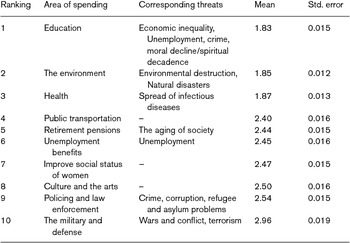
First, a statistical correlation between desired government spending and perceived threats was explored. Table 2 captures the data regarding government spending from all seven countries participating in the survey. Although not easy to assign each area of spending with a corresponding threat/compatible security sector, some connections are possible.Footnote 9
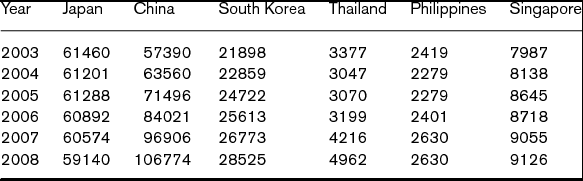
Military expenditures of countries sampled in this paper, 2003–2008
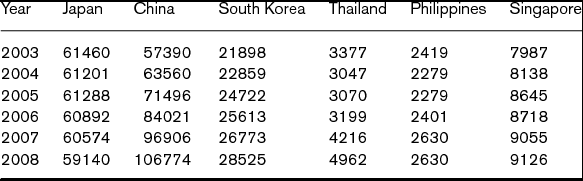
Notes: This table was complied from SIPRI Military Expenditure dataset. See SIPRI Military Expenditure Database 2012, http://milexdata.sipri.org. These data are for military expenditure by country in constant price US$ (millions), presented according to calendar year, and in current (2012) US$m.
Source: Asian Student Survey 2008.
Government spending and corresponding threats

Source: Asian Student Survey 2008.
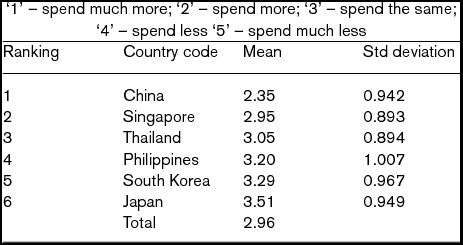
One point becomes clear from the table: government spending in the realm of military and defense is ranked below all other areas.
It is important to emphasize that students were not asked to rank governmental spending according to their relative importance, but rather to indicate, independently, which areas they would like to see their government allocating more or less resources. Notwithstanding, the mean score of government spending on the military and defense (2.96) implies that the general tendency among Asian students is to maintain, rather than augment, current defense budgets. Yet, the standard error of government spending on the military and defense was also the highest among all areas of government spending (0.19), pertaining to the relatively deviant nature of the data. Subsequently, the link between threat perception and desired military and defense spending by country should now be examined. The results draw attention to one country – China.
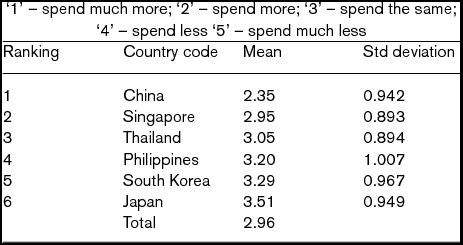
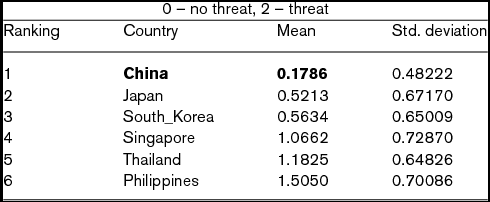
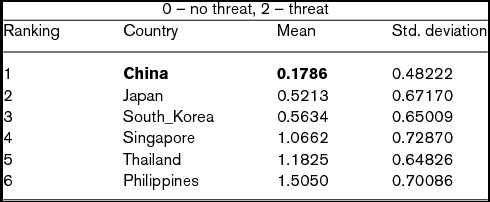
As can be inferred from Table 3, Chinese students are more prone to advocate increased government spending on military and defense than any other country sampled in the survey.Footnote 10 What may the reasons be for that? One might expect that the demand for building up defense spending will originate from the threat perception, in which wars, conflict and terrorism – ‘traditional security threats’ – play a significant role. An example involving the environment sector may demonstrate this point. When applying an independent-samples T test to the question of government spending on environmental issues, a significant difference (0.00) between the mean scores of Chinese students who pointed to an environmental threat (‘environmental destruction’) and students who did not was revealed. In other words, and as RCT proposes, Chinese students who perceive environmental destruction as a threat to their country are inclined to support increased governmental spending to counter the threat.Footnote 11 However, this was not the case for the military sector, where neither Chinese students nor any of the other countries who participated in the survey displayed such a trend.Footnote 12 In order to confirm this point, a new variable – ‘traditional security threats’ – was created. The new variable is a combination of two threats – wars/conflicts and terrorism. As Table 4 illustrates, Chinese students are once again the least concerned with traditional security threats. The desire to increase the military budget among Chinese students is therefore not the result of military threats.
The disapproval rating of government spending on the military and defense
Source: Asian Student Survey 2008.
Traditional security threats (wars, conflicts + terrorism)
*Source: Asian Student Survey 2008.
How can we account for the discrepancy between low levels of threat perception and the desire to increase defense budget among Chinese students? One way would be to hypothesize that demand for augmenting a budget may originate in a sense of lacking, either in the face of a threat or in the face of meeting a certain target. Since the threat levels they exhibit are obviously low, Chinese students may feel that the current level of military spending is inadequate to achieve some goal, or a set of goals. What are the objectives and intentions that Chinese students have? Un-surprisingly, similar questions about Chinese policy-makers have been the center of scrutiny among both China's neighbors and the West. In fact, these questions are perhaps the primary source of contemporary miscalculations in Asia. In the next section, I will first set the context for assessing Chinese students' intentions by considering China's grand strategy, and then clarify their objectives and motivations by using the data available in the Asian Student Survey.
China's grand strategy
Formulated by influential think-tanks in the mid-1990s, the term ‘Peaceful Rise’ was first introduced by Chinese politicians to describe the country's foreign policy approach in the early 2000s. The term depicts China as a responsible leader, emphasizing the use of soft power, and pledging to avoid unnecessary international conflicts. Chinese leaders and scholars have reiterated the Peaceful Rise terminology on many occasions. Zheng Bijian, a policy advisor for the Communist Party, wrote for the journal Foreign Policy:
China will not follow the path of Germany leading up to World War I or those of Germany and Japan leading up to World War II, when these countries violently plundered resources and pursued hegemony. Neither will China follow the path of the great powers vying for global domination during the Cold War. Instead, China will transcend ideological differences to strive for peace, development, and cooperation with all countries of the world.Footnote 13
Later on in 2004, Chinese leaders followed president Hu Jintao and acknowledged the negative implications of the word ‘rise’, and modified the term to ‘Peaceful Development’. On December 2005, a White Paper published by the State Council Information Office, elaborated on the new concept:
Peaceful development is the inevitable way for China's modernization; promoting world peace and development with China's own growth . . . seeking mutual benefit and common development with other countries; and building a harmonious world of sustained peace and common prosperity.Footnote 14
Despite Zheng's prediction regarding the peaceful rise of China, and the moderated terminology Chinese leaders have applied in international discourse, the link between growing economic power and expansionist aspirations is well supported by empirical evidence.Footnote 15 Since the Chinese economy has grown at an annual average of 10% over the last three decades, making it currently the second largest economy in the world, and since this economic growth co-occurred with extensive military spending in the past two decades, it is not surprising that regional actors are wary of China's intentions.Footnote 16 Next, Chinese students' dispositions will be examined.
Hypothesis 2 (null) – The tendency of Chinese students to support relatively higher military and defense budgets is a result of an aggressive design in which anti-foreign, unilateral, and nationalist sentiments play a role
Chinese students believe that their country should evolve as a great power. Since military might is an important characteristic of great-power politics, they support the modernization of the PLA. Here is where things get slightly more complicated. What is the desired course of China's return to a great power status? Would Chinese students rather to see a peaceful and amicable China or, rather, an aggressive, self-assured one? How can we determine the inspirations and goals of Chinese students? Next, I identify five propositions and test them using the Asian Student Survey.
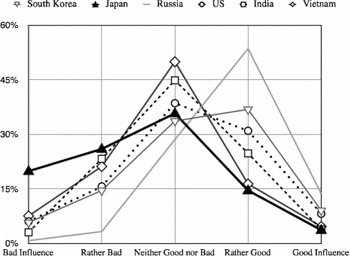
The first proposition (a) assumes that the desire to increase military spending originates from anti-foreign sentiment. Particularly, when considering expansion, Chinese students are likely to be aware of the dominant military actor in the region, the US. If the proposition is correct then (a1) Chinese students' view of the US would be negative, and (a2) a positive statistical relationship between Chinese military spending and American influence over China would exist. Yet 39% of the Chinese students claim that the US has ‘good’ or ‘rather good’ influence over their country, as opposed to 22% who think that the US has ‘rather bad’ or ‘bad’ influence (for 38% of the students, the US has neither good nor bad influence). Likewise, no statistical relationship between American influence over China and Chinese military spending was found. In any case, at least among the sampled population, there is no evidence indicating anti-American sentiment.Footnote 17Figure 1 displays Chinese students' perceptions of other foreign countries; Comparing US influence over China with other countries substantiate this trend.
Influence on China by different countries
Source: Asian Student Survey 2008.

As can be inferred, anti-foreign sentiment is particularly strong vis-à-vis Japan, Vietnam, and India. When looking for a correlation between the desire to increase military spending and the influence of these countries over China however, only the view of Japan was very weakly correlated at a level of 0.083.
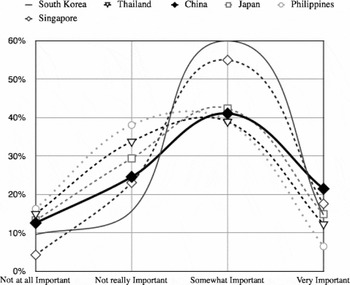
The second proposition (b) assumes that because they opt for regional dominancy, Chinese students would downplay the importance of American military presence and economic development in the region, and emphasize balance among great powers as a stabilizing factor in the region. Perhaps surprisingly, almost two thirds (63%) of the Chinese students stated that they view the presence of US military in Asia as ‘somewhat’ or ‘very’ important factor for stability in Asia. This is particularly interesting because Chinese students' view of American military power is more positive than that of the Japanese, Thai, and Filipino (see Figure 2).
Stability in Asia – US military power
Source: Asian Student Survey 2008.

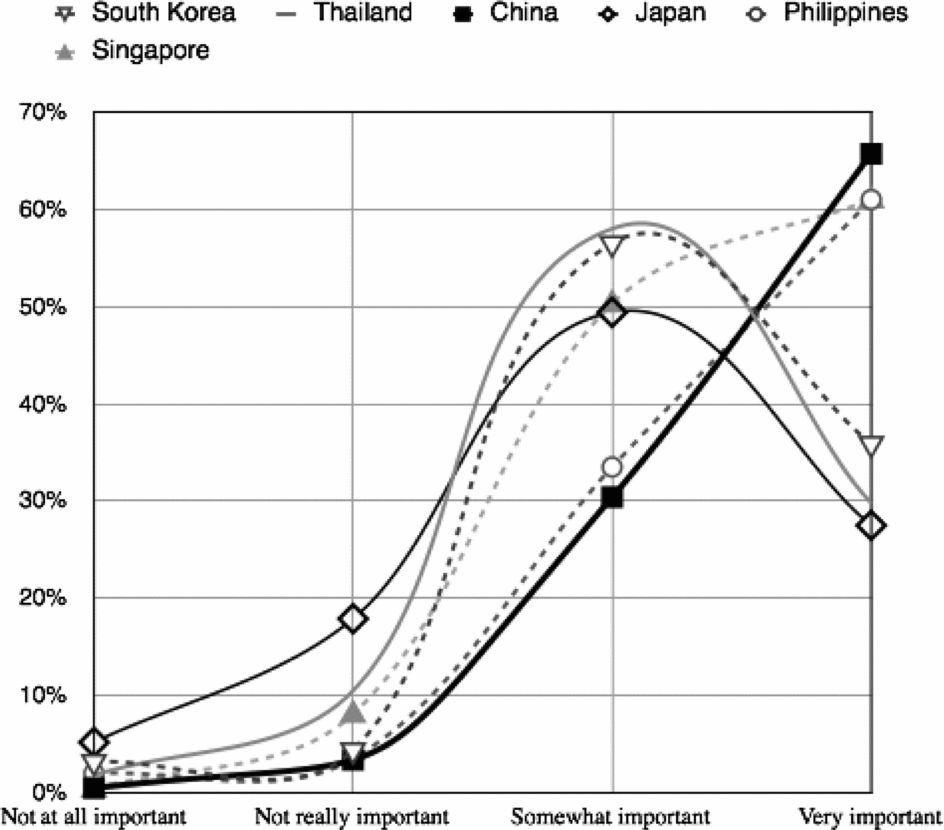
Notwithstanding, when asked about balance among the great powers, a decisive 96% of the Chinese students viewed it as a ‘very’ or ‘somewhat’ important factor in the stability of Asia. All other countries lagged behind: Japanese (77%), Vietnamese (88%), Thai (88%), Singaporeans (91%), South Korean (92%), and Filipino (94%). Excluding the Philippines, all of the other countries except China registered positive but more modest views of balance among great powers in the region; among Chinese students, almost two thirds (65.7%) indicated balance among great powers to be ‘very important’ (see Figure 3).
Stability in Asia – balance among great powers
Source: Asian Student Survey 2008.
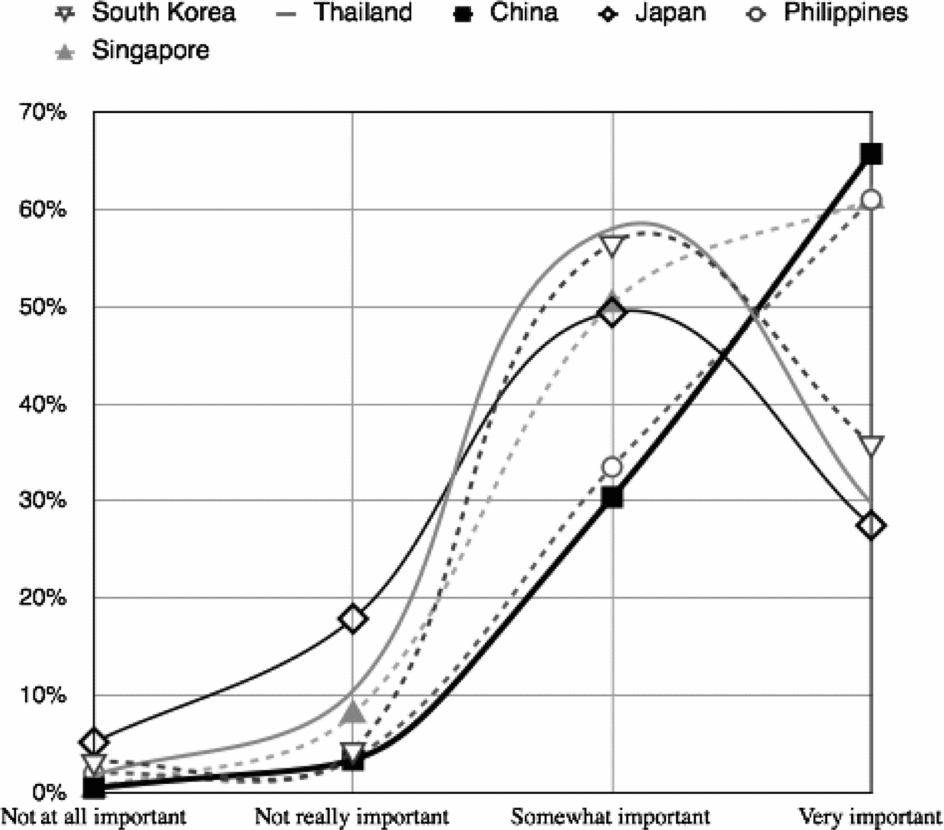
Similarly, the tendency among Chinese students to regard economic development as a ‘very important’ factor for Asian stability was high, second only to the Philippines (76.5% of Chinese students, 91.5% of Filipino). Overall, 97% of Chinese students view economic development as an important (either somewhat or very) factor for stability in Asia. These data indicate that Chinese students tend to view balance among great powers, rather than American military power, as a crucial factor in maintaing the stability of the region. Yet it also suggests that Chinese students believe that economic development is even more crucial to maintain stability in the region.
The third proposition (c) assumes that Chinese students would be disposed to resolve issues of territorial disputes unilaterally, rather than multilaterally. Asked to indicate which policies should be decided by national governments, regional organizations, or international organizations, only 33.2% of the Chinese students thought that territorial disputes should be decided by national governments, while 50.4% considered it as a policy to be decided by international organizations (the other 16.1% of the students opted for regional organizations). Perhaps surprisingly, the number of Chinese students who entrusted territorial issues to international organizations was higher than all other countries excluding Singapore (South Korea 46.4%, Vietnam 31.3%, Thailand 38.3%, Philippines 44.8%, and Japan 45.6%). These figures are also interesting because in other ‘sensitive’ policy-areas, Chinese students indicated stronger unilateral tendencies: the protection of human-rights (49.8%, ranked 2nd after the Philippines), management of exchange rates (52.3%, ranked 2nd after Vietnam), and trade policy (47.6%, ranked 2nd after Vietnam).
The fourth proposition (d) assumes that the demand to increase military spending is associated with a strong nationalist sentiment. It presumes that a statistical relationship between national identity among Chinese students, and (d1) the demand to increase military and defense spending, as well as (d2) negative perceptions of foreign countries, and of (d3) American military presence in Asia would be established. Subsequently, when checking for a correlation between Chinese students' national identity and the desire to increase military spending, a trivial correlation of magnitude 0.082 was found. Small correlation between Chinese national identity and perception of Japan's (0.11) negative influence over China was found, and non-substantial correlation with US (0.071) negative influence was found. No correlations were found for India or Vietnam. Finally, when looking for a correlation between Chinese students' national identity and American military power as a stabilizing factor in Asia, no such relationship could have been identified. These data allow for insubstantial relationships between Chinese students' national sentiment and arming the PLA, between national sentiment and American influence, and deny a connection between Chinese students' national sentiment and driving American military power out of the region of the other. The only meaningful correlation – although small – was found between and national sentiment and Japan's influence.
The fifth proposition (e) assumes that the relatively strong desire to increase government spending on military and defense – when compared with non Chinese students – would not be a mere byproduct of an overall tendency among Chinese students to support higher government spending.
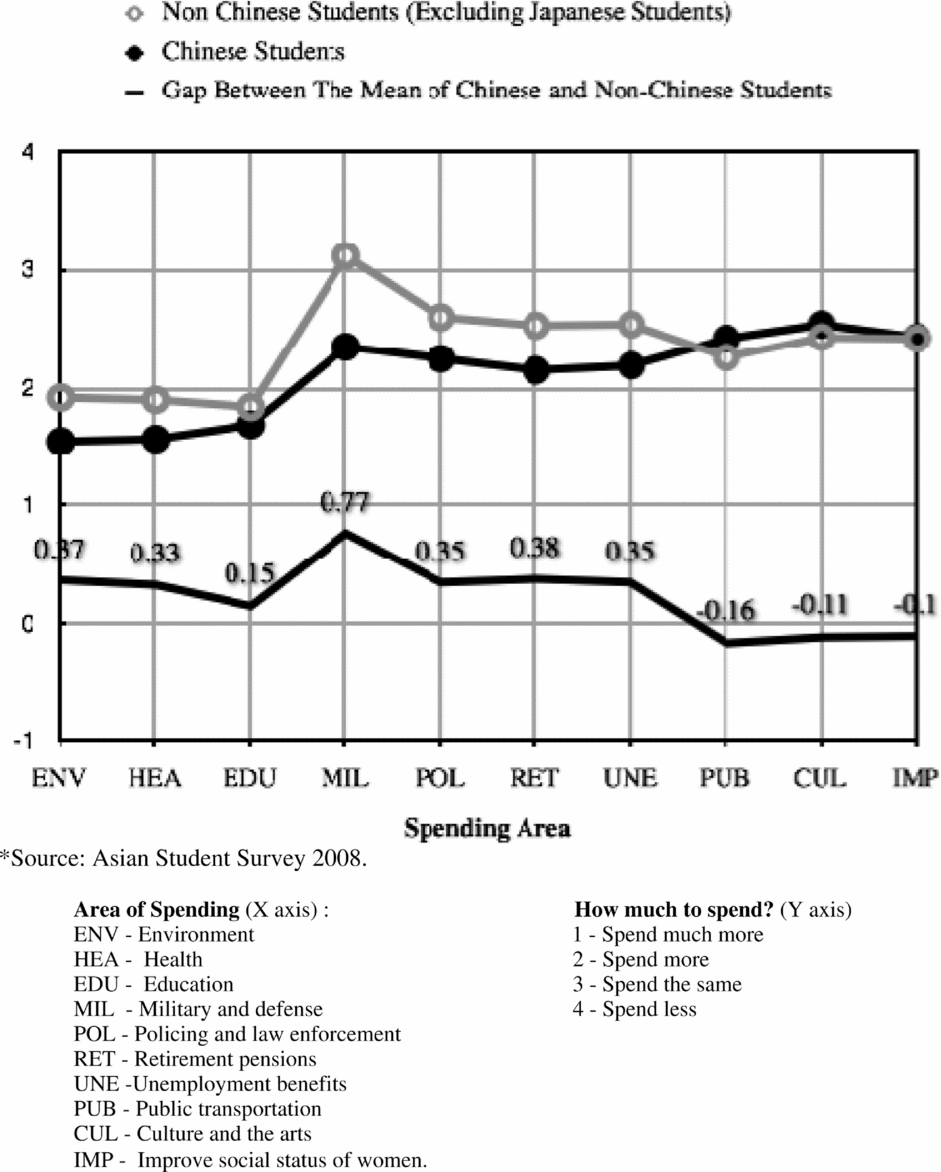
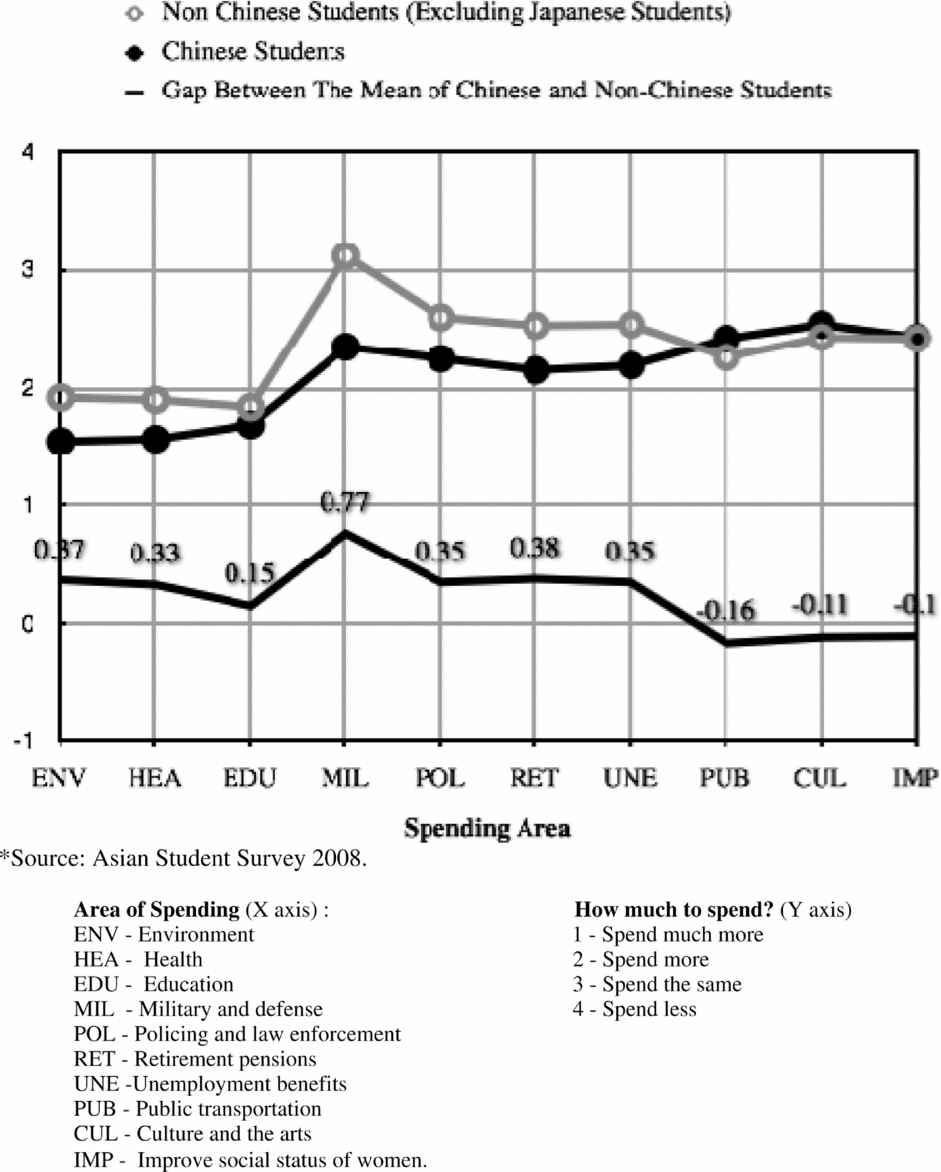
Yet the data refute this proposition. As illustrated in Figure 4, when compared to non-Chinese students,Footnote 18 Chinese students support higher budgets in seven areas of spending and lower budgets in three: public transportation, the culture and arts, and improving the status of women. Marked in black, the line pertaining to the gap between the mean scores of Chinese and non-Chinese students is particularly high in the budget-areas of military and defense (0.77), retirement benefits (0.38), environment (0.37), unemployment benefits (0.35), policing and law enforcement (0.35), and health (0.33). Although the desire to increase military spending in China was ranked very low when juxtaposed with other governmental budget-areas (with only public transportation and culture and the arts below it), the spending gap between the mean scores of Chinese and non-Chinese students in the military and defense was about twice as large as the gap in the next area (retirement benefits). A further exploration of the aberrant nature of the data pertaining to Chinese students by gender, study major (sciences or arts), university, and exposure to domestically made media (TV/movie/animation) did not suggest other associations that can account for this trend.
Government spending by area – the mean of Chinese and non-Chinese students
After testing the null hypothesis, this paper finds that:
1. Unlike proposition (a) stipulated, Chinese students do not display strong anti-foreign sentiment, specifically in the case of the US, the global hegemon and the main military actor in the region. Although they do show adverse sentiment towards Japan – 45.9% viewed it as having either bad or rather bad influence over their country – this relatively negative view does not translate into stronger support of military spending. Moreover, 35.8% of Chinese students view Japan as having neither good nor bad influence, and 18.3% consider it to have a good or rather good influence. In other words, the perception of Japan among Chinese students is not absolute, and it allows for positive sentiment as well.
2. Unlike proposition (b) assumed, Chinese students do not reveal military expansionist intentions, as roughly two thirds of them believe that American military power is a stabilizing factor in the region and as an overwhelming majority ‘prioritize’ economic development over any other factor.Footnote 19 Yet Chinese students also view balance among great powers as an important factor for Asian stability. In-fact, their view of this factor was more positive than any other country sampled in the survey. How can one reconcile these results? Here I suggest that instead of simply wishing to drive American military presence away from the region, the majority of Chinese students opt for economic development and balance among great powers as stabilizing factors in the region. In other words, Chinese students seek to share the role of great power alongside the US – largely accepting the latter's military presence in the region.
3. Unlike proposition (c) postulated, Chinese students do not demonstrate support for a unilateral approach to issues of territorial disputes, as approximately two thirds of them believe these issues should not be decided by national governments. These findings contradict Gries et al. (Reference Gries, Zhang, Masui and Wook Lee2009) findings concerning the same issue.
4. Unlike proposition (d) assumed, nationalist sentiment among students is not correlated with the desire to increase military spending, or with American influence/military presence in the region. The only correlation that was found was with the view of Japan's influence over China, but even that link was very weak. Reflecting on the issue of the self-identity of Chinese students, it becomes clear from the Asian student survey that national sentiment, or a sense of belonging to one's country, is the strongest attribute of Chinese students' sense of selfhood. Asked to specify their self-identity, e.g. whether they view themselves as world citizens, as part of Asia, their own country, as part of their local communities, or as autonomous individuals, not only Chinese but Asian students in general most profoundly expressed a sense of affiliation with their respective countries.Footnote 20 To the extent we can make inferences about the Chinese students' national sentiment as a whole, it seems that while national sentiment is the most important attribute, this is by no means a unique phenomenon. In all of the other Asian countries sampled in the survey, national sentiment was the most compelling characteristic of self-identity. In fact, compared to all other countries sampled in the survey, Chinese nationalist sentiment stands below the Asian average.Footnote 21
5. Somewhat corresponding with proposition (e), although the gap between the mean of Chinese and non-Chinese students for the military and defense was the highest among all other areas, the initial abnormal nature of the data sampled from Chinese students appears less unusual taking into account their Chinese students' inclination – compared with non-Chinese – to seek higher budgets in seven out of ten budgetary areas.
Conclusively, these findings undermine the null hypothesis. At least among Chinese students who participated in the survey, there is no sufficient evidence that associates nationalist-driven expansionism or anti-foreign sentiment with support for military spending. Additionally, there is no evidence of a unilateral approach to issues of international sovereignty, and belligerent motivations. Reflecting back to this study's main question and offering alternative explanations, it seems as if the overall inclination among Chinese students to seek higher government spending in most areas, can somewhat mitigate the puzzle underlining this paper; still, this is only partial solution. The next section outlines the major challenges to the above-mentioned analysis.
Discussion
The main challenges to this paper's findings regarding Chinese students' non-violent design are three-fold. First, there is the risk of shifting Chinese goals towards an aggressive-expansionist stance, as captured by the proverb ‘appetite comes with eating’. According to this logic, desire, or facility, increases as an activity proceeds and, hence, China's economic and military buildup may lead to a surge in the assertiveness of its students. This, however, is by no means a predetermined course: cases of economic growth that did not lead to military expansionist endeavors are well documented.Footnote 22
Second, there is the unresolved issue of Taiwan. What role does the settlement of the matter play in the propositions suggested above? Do Chinese students seek to coerce Taiwan into the ‘One China’ policy or do they comply with the current status-quo? The majority opinion in the scholarly and political circles clearly links China's return to great power status with the incorporation of Taiwan, either on peaceful terms or by means of force. Moreover, the issue of Taiwan has been used by China's ruling circles in order to reinforce the party's legitimacy. It is reasonable to assume that when Chinese students grant the issue of territorial disputes to international and regional organization, they do not consider the issue of Taiwan in this context, since that issue is a matter of national sovereignty. However, as Friedman argued persuasively, economic interests play a restraining role in China's policy toward Taiwan, thus preventing the hardliners inside the military and the Communist party from taking the lead.Footnote 23 It seems that economic development is the first priority not only for Chinese decision-makers but also for Chinese students. Although questions concerning Taiwan are lacking from the survey, available data do seem to substantiate a tendency among Chinese students to prioritize economic development as a stabilizing factor in Asia.
Third, like all policy makers in the world, Chinese policy-makers are striving to balance domestic and external interests. However, in a non-democratic society such as China, the problem of balancing these often conflicting interests is intensified by what seems to be the CCP's prime objective, that is to maintain its rule over the population. To recall Krasner's observation regarding the Qing dynasty and its strategy in Central Asia at the beginning of the nineteenth century, ‘[the Qing rulers] feared that external losses would be taken as signs of weakness that could enhance the strength of internal enemies’ (Krasner, Reference Krasner2009: 223). Likewise, contemporary political tensions between China and its neighbors, as mediated by state control media and the ruling elites, could potentially shift Chinese students' view towards a more aggressive stance. Similarly, the economic slump in China may induce the ruling elites to use foreign threats as a tool to maintain their legitimacy, generating a more aggressive international stance.
In an attempt to solve the puzzle of this paper, let us reiterate its reasoning thus far and propose an alternative explanation as to the still-somewhat deviant nature of Chinese students' data. Since very low levels of perceived military threats were detected, the RCT logic of threat–countermeasure has been undermined. Thereafter, the motivations and strategic goals of Chinese students have been scrutinized. As discussed, contrary to expectations, the demand for augmenting the defense budget was not associated with aggressive design.
Alternatively, Chinese students support military spending because they believe that the PLA was, and still is, far from being a modernized military force. Why does China need a state-of-the-art military force when it does not face military threats? Because China is a great power and because modern military is crucial to maintain balance among great powers (which is in turn, a crucial factor for stabilizing Asia according to the students). But this does not mean Chinese students are eager to use this military force in order to realize regional dominancy; instead, they believe China's armed forces should be on a par with other military forces and that the defense budget should match China's economic growth. In support of this proposition, one should consider that whereas the raw figures do pertain to a dramatic increase in its military budget since 1980s, the PLA was notably underdeveloped at that time. Likewise, if one considers China's defense budget in terms of its percentage of GDP, which has varied from 1.22% to 1.42% over the past decade,Footnote 24 then it becomes clear that this growth corresponded with China's economic growth. Consequently, the data pertaining to China's military expenditures do not appear to be extreme (for comparison purposes, the US defense budget share of its GDP averaged 4.7% in 2010–11).Footnote 25 The support for modernizing China's military force among Chinese students can therefore be seen in the context of a successful articulation of this need by China's leaders. How do Chinese leaders communicate the country's military buildup to domestic audiences?
Two examples demonstrate this political message as circulated in domestic media outlets. In 2007, the Ministry of Finance submitted its budget outline to the National People's Conference, justifying the requirement to increase military spending with the need to prepare the PLA for modern warfare, help it to deal with situations of emergency, keep territorial integrity and national sovereignty, and improve the socio-economic conditions of its personnel.Footnote 26 In a similar manner, the spokesman of the National People Conference asserted at the concluding press-conference of the Chinese People's Political Consultative Conference held on 4 March 2008, that while the military budget increased by 17.6% from FY 2007, it paralleled China's economic growth. In addition, the spokesperson stressed that the share of the military budget actually decreased when compared to the overall government budget and elaborated on the reasons behind the increase: to improve the salaries of the military personnel; to respond to a decline in purchasing power; to enhance the educational and administrative capacities of the PLA; and to modernize its obsolete weapons systems, including preparation of the army for the digital age.Footnote 27 It is interesting to note that the issue of protecting the national sovereignty had been removed from officials' clarifications of budget increases. The ‘modernization’ narrative, however, is apparent in both public officials' messages. Although consistent with the data available in the Asian Student Survey, this proposition requires further analysis. Had questions pertaining to students' trust in their leadership and the army, as well as their possible awareness to this specific type of political message been presented to the students, this hypothesis could have been better evaluated. However, data sampled from a different survey – the Asia Barometer – indicate a relatively strong trust of Chinese population in the army, suggesting a positive view of the PLA. In turn, this view might have facilitated a perception among the students, whereby the necessity to modernize the PLA is recognized.Footnote 28 One must also consider that since all university first-year students in China are required to participate in PLA-mandatory regimen as part of their college education curriculum, it is possible to assume that they have a fair knowledge of the organization and its needs.Footnote 29
Further research about Chinese students may benefit from a longitude research design, in which questions of military spending can be measured in different time frames. This will enable the researcher to analyze trends and account for changes in these trends. Moreover, a better understanding of the PLA's public image and the implications of the military training that students have to go through may help verify the alternative hypothesis.
Conclusions
This study explored two hypotheses. Whereas in some particular cases there were statistically significant differences between threats and countermeasures, the assumed link between security threats and government spending was generally lacking. Specifically, a clear-cut relationship between military threats and defense spending was not found. Consequently, the rational choice theory alone cannot explain public perceptions of military spending. As critics of the RCT would posit, motivations and goals may indeed play a role in individual calculations. Trying to reconcile the data sampled from the survey, possible explanations as to why Chinese students are more prone to increase military expenditure, despite holding little fear of military threats have been tested; but anti-foreign, unilateral, and nationalist sentiments were all dismissed as having little or no correlation with the desire to increase military spending. The conclusion of this study is that rather than aggressive design involving hegemonic aspirations, Chinese students opt for economic development and great power balance. Although various challenges lie ahead, there was no evidence suggesting that they seek military supremacy in Asia or that their nationalist sentiment assumes a belligerent stance. Thus, the image of nationalistic, uncontrolled students that strain Chinese decision-makers in their handling of foreign policy issues does not appear to be in line with the data sampled from the Asian student survey. On the contrary, Chinese students aim for responsible conduct in the international arena, and for cooperation with international organizations on sensitive issues such as territorial disputes. Students' national sentiment in China is by no means a prerequisite for increased military spending, negative views of American power or curbing American military presence in Asia. In the end, Chinese students' preferences and world views do not seem to provide a political support-base for a hardline, coercive policy against a perceived enemy.
About the author
Eitan Oren is a PhD candidate at the University of Tokyo, studying under the guidance of Professors Tanaka Akihiko and Sonoda Shigeto. His research interests are NorthEast Asian security, Japanese politics and society, and Japanese threat and risk perceptions. Recently one of his research papers got published in Sonoda Shigeto's book Risk in East Asia, Keiso-shobo (2013). The chapter is titled ‘funsõ risuku to ajia – gunji shishūtsu ninshiki no hikaku seijigaku’ (Conflict risk and Asia – Comparative look on military expenditure perceptions), and deals with Asian perceptions of military expenditures. Oren is now working on publishing two more papers – ‘North Korea's Threat Perception in Japan : A Comparison with South Korea’, and ‘Japan's Strategic Culture’. He participated in the IASA–IOS Join Workshop of Young Sociologists in Taiwan (March 2011), and the ITASIA conference in Tokyo (November 2012), where he delivered presentations dealing with various issues of NorthEast Asian security.