INTRODUCTION
The noncognitive construct of grit was first introduced by Duckworth and colleagues (Reference Duckworth, Peterson, Matthews and Kelly2007). Defined as “the perseverance and passion for long term goals” (Duckworth et al., Reference Duckworth, Peterson, Matthews and Kelly2007, p. 1087), grit was presented along with two components: perseverance of effort and consistency of interest. However, this second-order factor presentation was later criticized (see Credé et al., Reference Credé, Tynan and Harms2017). The grit-related works of research proliferated in psychology and education but much less in second language acquisition (SLA) context, and this has made L2 learners’ grit an underresearched area for almost a decade. An issue contributing to this lack of research, as recalled by Khajavi et al. (Reference Khajavi, MacIntyre and Hariri2021), might be the lack of language-domain-specific measures of the construct. Also, the inconsistencies of the current research findings on grit in SLA are mainly rooted in the use of domain-general measures of the construct (Teimouri et al., Reference Teimouri, Plonsky and Tabandeh2020) and the use of exploratory factor analysis as the sole method of validating the factor structure of the scales (Alamer, Reference Alamer2021)
The first language-domain-specific measure of grit, the L2 grit scale, has been recently developed by Teimouri et al. (Reference Teimouri, Plonsky and Tabandeh2020) and brought hope to explore the construct further in SLA. They have provided initial proof for the reliability and validity of the construct in SLA. Also, very recently, Sudina et al. (Reference Sudina, Brown, Datzman, Oki, Song, Cavanaugh, Thiruchelvam and Plonsky2020) have built on Teimouri et al.’s work of research to further examine the psychometrics of the L2 grit scale through exploratory and confirmatory factor analyses as well as comparing L2 learners’ grit in EFL and ESL contexts. It is evident that the existing research about grit in L2 learning domain is still in its infancy and there are certain controversies about L2 learners’ grit definition, measurement, antecedents, and outcomes. It should be noted that the issues, specifically measurement issues, raised about grit are mainly domain-general and these issues cannot be necessarily generalized to the existing research findings of L2 grit. However, being aware of the challenges of the domain-specific construct, we took advantage of a suitable method to lessen the possibility of the emergence of those challenges in the SLA domain.
The present research addresses these challenges and, given the long-term nature of the construct of grit, draws attention to the need for validating this construct in the language-specific-domain through new methodological techniques and approaching it from a dynamic perspective. In what follows, we present a brief review of both domain-general and language-domain-specific literature of grit and then focus on the concerns raised regarding this construct in its domain-general and language-domain-specific sense.
DOMAIN-GENERAL GRIT
Grit was claimed to have a determining role in students’ success (Duckworth et al., Reference Duckworth, Peterson, Matthews and Kelly2007; Duckworth & Quinn, Reference Duckworth and Quinn2009). However, no association has been found between an individual’s grit and his or her race, gender, race, or academic status (Credé et al., Reference Credé, Tynan and Harms2017). No association has also been found between grit and individuals’ general intelligence and physical health (Eskreis-Winkler et al., Reference Eskreis-Winkler, Duckworth, Shulman and Beal2014). Regarding the difference between grit and resilience, Perkins-Gough (Reference Perkins-Gough2013) pointed out that grit renders individuals loyal over a long-term period beyond resilience under pressure. Similarly, Duckworth and Gross (Reference Duckworth and Gross2014) attributed grit to loyalty over a long period despite facing challenges and difficulties.
Positive links between grit and other constructs in different domains such as well-being (Datu et al., Reference Datu, Valdez and King2015), emotional engagement (Datu et al., Reference Datu, Valdez, King, King and Bernardo2016), happiness (Von Culin et al., Reference Von Culin, Tsukayama and Duckworth2014), and commitment in marriage (Eskreis-Winkler et al., Reference Eskreis-Winkler, Duckworth, Shulman and Beal2014) have been reported. Also, Lucas et al. (Reference Lucas, Gratch, Cheng and Marsella2015), exploring the behavior of grittier individuals compared to less gritty ones, revealed that grittier individuals were less willing to give up in the face of failure though they had a tendency “to incur a cost for their persistence” (p. 20).
In the field of educational psychology, gritty students have been found to have higher achievement scores and higher rates of education compared to less gritty students (Eskreis-Winkler et al., Reference Eskreis-Winkler, Duckworth, Shulman and Beal2014; Strayhorn, Reference Strayhorn2014), though the association between students’ grit and their achievement has not been revealed in some other studies (e.g., Chang, Reference Chang2014; Ivcevic & Brackett, Reference Ivcevic and Brackett2014). A meta-analysis on grit conducted by Credé et al. (Reference Credé, Tynan and Harms2017) indicated a weak but positive association between the two variables. Advocating the importance of grit is also related to the works of research on the development of expertise with an increasing attention to continuous deliberative practice (Krampe & Ericcson, Reference Krampe and Ericsson1996). Besides, there are several theoretically sound moderators of the association between academic performance and grit that show the relation is at best context-dependent. In other words, how grit relates to academic outcome is moderated by the nature of the domain of performance (Credé et al., Reference Credé, Tynan and Harms2017).
THE USE OF DOMAIN-GENERAL GRIT IN SLA DOMAIN
In the SLA domain, grit has been mainly underinvestigated. The earliest study on the construct was carried out by Lake (Reference Lake, Apple, Da Silva and Fellner2013), who applied a domain-general scale by Duckworth et al. (Reference Duckworth, Peterson, Matthews and Kelly2007), reporting a stronger interest in grittier learners to spend time and make efforts in learning L2 than less gritty learners. Also, Changlek and Palanukulwong (Reference Changlek and Palanukulwong2015), investigating motivational features in gritty students, found a positive association between students’ motivation and their grit.
Moreover, applying a modified version of the general grit scale, Kramer et al. (Reference Kramer, McLean and Shepherd Martin2017) found a moderate link between L2 learners’ achievement in vocabulary and their grit. Robins (Reference Robins2019), investigating the influence of grit on L2 learners’ retention and academic success in American online English language classes, found that their overall grit was not a significant predictor of their retention. However, they found a slight correlation between with their participants’ grit and their grade point average (GPA). Likewise, a low but positive association between Chinese secondary school students’ grit and their English language scores was found by Wei et al. (Reference Wei, Gao and Wang2019). Nevertheless, Yamashita (Reference Yamashita2018) reported no association between Japanese learners’ grit and GPA. Very recently, Khajavy et al. (Reference Khajavi, MacIntyre and Hariri2021), examining the link between grit and language mindsets, found a weak association between the two variables but they reported no significant correlation between grit and L2 achievement. Also, Nazari and Alizadeh Oghyanous (Reference Nazari and Alizadeh Oghyanous2021), using a mixed-methods design, assessed the links among 325 Iranian EFL teachers’ grit, stress, turnover intentions, and well-being in light of their teaching experience. They found significant associations between novice and experienced teachers’ grit and their turnover intentions, well-being, and occupational stress. Chen and others (Reference Chen, Lake and Padilla2021) assessed the contribution of grit to L2 learners’ motivation among 441 female university students. Their findings indicted significant associations between general domain grit, L2 domain-specific grit, L2 motivational constructs such as self-efficacy in L2 listening and reading, as well as negative L2 motivational factors including anxiety in L2 listening and reading. Based on this finding, they suggested that the nomological network of L2 learning motivation can be expanded through the introduction of new concepts from positive psychology like grit.
CONCERNS ABOUT GENERAL-DOMAIN GRIT
In general, despite the establishment and growth of grit literature as in the general domain, concerns regarding its measurement and application have been raised (e.g., Credé, Reference Credé2018; Credé et al., Reference Credé, Tynan and Harms2017; Rimfeld et al., Reference Rimfeld, Kovas, Dale and Plomin2016). Grit has been introduced as a controversial personality trait in education. Those mostly seeing it as controversial (e.g., Osgood, Reference Osgood2012) argue that, by definition, grit puts extreme burden on learners and pushes them to go beyond themselves; however, others put more emphasis on the positive role grit plays during the course of academic achievement (e.g., Banse & Palacios, Reference Banse and Palacios2018). Regardless of its stance, grit has been mostly addressed in the literature in relation to academic success and it has attracted a bulk of research. Strong claims were made about grit by Duckworth to introduce it as even a stronger predictor of success than cognitive ability (Credé et al., Reference Credé, Tynan and Harms2016).
A recurrent problem in the body of research on grit, especially those addressing grit and academic success, is that they have mostly reported the overall score of the construct at the cost of neglecting the two first-order components of grit at the core of its definition (Credé et al., Reference Credé, Tynan and Harms2016). However, components of the construct (perseverance of efforts [PE] in pursuit of long-term goals and consistency of interest [CI] also known as passion) can often be better predictors of learning outcomes than the overall construct of grit (Paunonen & Ashton, Reference Paunonen and Ashton2001). Thus, these components need closer attention which brings us to the main problem at the heart of the definition. Several scholars, including Christopoulou et al. (Reference Christopoulou, Lakioti, Pezirkianidis, Karakasidou and Stalikas2018), admitted that within the last decade, the majority of grit-related studies (general domain) received certain criticism mainly for neglecting situational and context-specific nature of grit.
In summary, regarding the main concerns of domain-general grit, Credé et al. (Reference Credé, Tynan and Harms2017) questioned the construct validity of grit as a higher-order construct by regarding PE as a more powerful antecedent of performance than consistency of interest. Also, they criticized the significance of grit for its moderate link with performance and retention. Moreover, Schmidt and colleagues (Reference Schmidt, Nagy, Fleckenstein, Möller and Retelsdorf2018) questioned the divergent validity of grit due to its strong association with conscientiousness and self-control. Finally, Credé (Reference Credé2018) contended that the operationalization of the grit has led to a misinterpretation of girt as high PE and high CI. This means that low levels of each of these two subdomains (e.g., PE and CI) might not be regarded as grit. Moreover, as criticized by Morell et al. (Reference Morell, Yang, Gladstone, Turci Faust, Ponnock, Lim and Wigfield2021), the short version of the grit scale that has been widely used in the grit-related literature fails to adequately tap into the long-term goals that individuals pursue at the core of the construct.
Besides the issues concerning the general-domain-grit, the need for the exploration of the construct from a dynamic perspective emerges from the dynamic nature inherent in its definition. Schmidt et al. (Reference Schmidt, Fleckenstein, Retelsdorf, Eskreis-Winkler and Moller2017) described grit as “an individual’s tendency to persistently pursue long-term goals despite challenges or obstacles.” Such terms as persistent, long-term, and pursue as well as the key terms perseverance and consistency in the two components of grit (i.e., PE and CI) all point to the long-term nature and, thus, the time-dependent aspect of the construct and the potential fluctuations already assumed. Attention to this temporal aspect of the construct implies that scholars need to focus more on the dynamic, longitudinal, temporal, and contextual nature of grit in their lines of research. The same is expected to reflect in the operational definition of grit too, which seems to be lacking in the literature of the construct.
That would indicate the need for research on grit with a dynamic perspective, which can be followed by entering the realm of complexity and dynamic systems theory (CDST) to tackle more nuances of changes in the construct. According to Darrah and Bartlett (Reference Darrah and Bartlett1995) and Thelen et al. (Reference Thelen, Kelso and Fogel1987), if grit and other similar personality constructs are explored from a CDST approach, more aspects of the task, person, and environment are measured in combination to obtain a more accurate measurement of the construct.
So far, the existing works of research on general-domain-grit has mainly focused on students’ outcomes. They have scarcely attended to the temporally indicated fluctuations in learners’ grit as it develops through an education course and changes due to multiple contextual factors. Besides, many of these investigations are in single-shot or have cross-sectional designs. That would raise issues, one of which is the neglect of personality as a dynamic system that cannot be adequately explained by traditional quantitative methods on three aspects: feedback loops among components through time, bidirectional relationships across time intervals, and combination of patterns (Beck & Jackson, Reference Beck and Jackson2020).
CONCERNS ABOUT GRIT IN SLA AND THE EMERGENCE OF LANGUAGE-DOMAIN-SPECIFIC GRIT
Both Khajavi et al. (Reference Khajavi, MacIntyre and Hariri2021) and Sudina et al. (Reference Sudina, Brown, Datzman, Oki, Song, Cavanaugh, Thiruchelvam and Plonsky2020) attributed the inconsistent results on the association between learners’ grit and their achievement in SLA to the lack of a language-domain-specific grit for a more precise measurement of the construct in SLA. Likewise, Teimouri et al. (Reference Teimouri, Plonsky and Tabandeh2020) contended that a main limitation of the previous research on personality in SLA stems from the use of global personality assessment scales applied in social psychology (e.g., the Big Five model). More specifically, they argued that the application of such domain-general (i.e., nonlanguage specific) tools may not be more precise for measuring behavioral variances among L2 learners because contexts explain variation among individuals “to a certain extent” (Pervin & John, Reference Pervin and John2001, p. 290).
Teimouri et al. (Reference Teimouri, Plonsky and Tabandeh2020) also maintained that a language-domain-specific scale of personality would provide a more suitable measurement of L2 learners’ personality constructs as well as behavioral traits in L2 context compared to scales developed outside L2 settings, which are domain-general. To support this argument, they referred to the development and application of language-domain-specific scales to measure individual differences in the L2 context such as L2 motivation and second/foreign language anxiety scales. They also noted that because language achievements measures of L2 learners are language-domain-specific, to come up with a local-local measures consistency in the L2 context, SLA researchers should also use L2 domain-specific measures of personality in SLA research on personality constructs like grit. This, they reported, would increase the strength of the results of this research and provide a solution for the global-local inconsistencies of the past research findings on personality in SLA. Thus, they asserted that as the research on language anxiety started with a “confounded approach” and shifted to “specialized approach” (MacIntyre, Reference MacIntyre, Gkonou, Daubney and Dewaele2017), the grit research in SLA needed to shift from a confounded approach, associated with the use of domain-general measures of the construct, to a specialized one linked with the application of language-domain-specific measures.
With these limitations in mind, Teimouri et al. (Reference Teimouri, Plonsky and Tabandeh2020) developed the first L2 grit scale to measure the language-domain-specific grit in SLA. They developed the scale in a pilot study. Initially, they generated an item pool measuring learners’ grit in L2 settings (10 items for CI and 10 for PE). Afterward, they developed a scale with 20 items submitted to 35 undergraduates studying English as foreign language at university. After such statistical analyses as item analysis, principal component analysis (PCA), and reliability analysis, they retained 12 items, 6 to measure PE and 6 to measure CI. Three items were later on removed and the scale was finally left with nine items. Similar to Duckworth’s domain-general scale, in this domain-specific scale, all items were rated on a 5-point Likert scale.
Also, Sudina et al. (Reference Sudina, Brown, Datzman, Oki, Song, Cavanaugh, Thiruchelvam and Plonsky2020) investigated the factor structure of the L2 grit scale designed by Teimouri et al. (Reference Teimouri, Plonsky and Tabandeh2020) through exploratory factor analysis (EFA), confirmatory factor analysis (CFA), and multiple regression analysis (which fails to take into account measurement errors). Sudina et al. (Reference Sudina, Brown, Datzman, Oki, Song, Cavanaugh, Thiruchelvam and Plonsky2020) showed that, firstly, the L2 grit scale enjoyed an adequate internal-consistency reliability (x = .77). Their application of PCA indicated a two-component structure (POV = 50.87%) and substantiated the construct validity of the scale. Also, the concurrent validity of the scale (rc = .84) was established using a one-tailed Pearson’s test for positive correlation between domain-general Grit–S and L2 grit scale scores. Finally, the L2 grit scale showed a higher predictive validity, accounting for about 21% of the variance of L2-teacher retention-related scores in comparison to the Grit–S.
Very recently, Alamer (Reference Alamer2021) tested the validity of grit among language learners and their association to their vocabulary knowledge. To do this, he adapted the Grit Scale (Duckworth et al., Reference Duckworth, Peterson, Matthews and Kelly2007) and Academic Grit Scale (AGS; Clark & Malecki, Reference Clark and Malecki2019) as the basis of his L2-Grit Scale. To make the items of the scale relevant to the L2 domain, he made some modifications in the items of the original grit and AGS scales. His L2-Grit Scale comprises the two subscales of PE and CI. Each subscale consists of six items based on a 5-point Likert scale. While testing the standard CFA of his model including the association between PE and CI, he did not achieve satisfactory results. In addition, he found a negative and weak link between PE and CI (r = – 0.09). As he argued, this finding was not consistent with his primary hypothesis about the positive contribution of PE and CI to the global factor of grit (Duckworth et al., Reference Duckworth, Peterson, Matthews and Kelly2007). Considering the steps regarding the construct validity of grit in a previous study (Muenks et al., Reference Muenks, Wigfield, Yang and O’Neal2017), he developed another competing model, the bifactor CFA model, involving the general factor of grit and PE and CI “that capture the residual dependencies among the observed variables are constructed” (p. 10). Muenks et al. (Reference Muenks, Wigfield, Yang and O’Neal2017) explained that the higher-order factor model is not the appropriate representation of grit to test whether grit’s two subscales make up a single, cohesive construct because the higher-order factor model is mathematically equivalent to a two correlated-factor model. Alamer (Reference Alamer2021) found that the bifactor CFA model had a good fit to the data. He also contended that this model type can more appropriately assess the grit appearance as an underlying factor because it does not depict a higher-order factor model of L2 grit. He also found an indirect association between language learners’ initial grit and their later vocabulary knowledge.
Closely linked with the theoretical definition of grit, the operational definition of the construct in SLA is expected to reflect the longitudinal nature of the construct as measured. Despite the findings of the previously mentioned studies with a focus on L2 grit, given the long-term nature of grit inherent to the nature of the construct, the question is whether the existing language-domain-specific instrument can manage to measure the longitudinal and temporal aspect of grit as well. Concerning the need for a local-local consistency of measures in SLA (Teimouri et al., Reference Teimouri, Plonsky and Tabandeh2020), given the longitudinal nature of grit, examining the time-invariance of L2 grit could contribute to the longitudinal exploration of this construct .
Also, in line with the dynamic turn in SLA and given longitudinal nature of L2 grit, as an individual difference (ID) variable, the longitudinal exploration of L2 grit can contribute to the exploration of this construct from a CDST perspective and the application of CDST compatible methods. In his book The Psychology of the Language Learner Revisited, Dörnyei and Ryan (Reference Dörnyei and Ryan2015) maintained that serious issues have been raised about the classic assumptions of IDs. One of these classic assumptions is that “IDs are relatively stable.” He stressed that “when we look more closely, individual learner characteristics are not stable but show salient temporal variation” (p. 6). Consistent with the “dynamic turn” in SLA (see e.g., de Bot et al., Reference de Bot, Lowie and Verspoor2007; Larsen-Freeman & Cameron, Reference Larsen-Freeman and Cameron2008), Dörnyei and Ryan (Reference Dörnyei and Ryan2015) further noted:
IDs are better seen as ongoing, evolving constructs rather than stable learner traits…. Reframing individual differences as complex dynamic systems has the potential to mitigate many of the failings associated with the classic ID conceptualization…. Arguably the most significant contribution of a complex dynamic systems approach is in its role as an overriding guiding principle that positions change rather than stability as the norm, moving us away from static conceptualizations of learners toward embracing notions of change and growth.
(p. 6)Quite parallel with the shift from a stable-oriented view to a dynamic one toward IDs in SLA, research on grit in educational psychology has also received some criticism over the past several years, including its construct validity. As Credé (Reference Credé2018) argued, the operationalization of the construct has resulted in a misinterpretation that girt should be defined in terms of high perseverance of effort and high consistency of interest, such that any low levels of each of these two subconstructs (e.g., high PE, low CI; low PE, high CI; or low PE, low CI) should not be regarded as grit. This point implies that the “either-or approach” to the concept of grit cannot be a reasonable conceptualization of the construct. Also, Alamer (Reference Alamer2021), assessing L2 grit in a longitudinal perspective, concluded that initial grit did not predict later achievement of the vocabulary, but only sustained endorsement of grit predicted the increase in vocabulary, which implies the temporal change of L2 grit. Such points further highlight the need to go beyond conventional methods of analyzing an ID, especially L2 grit, with a longitudinal nature, which by definition is developmental and dynamic and cannot be captured wholly in single-shot designs. In other words, this dynamic line of research on L2 grit concerns how single-shot research designs can embrace the developmental nature of the construct and its growth over time. Conventional analytic approaches using cross-sectional data are hardly indicative of how grit unfolds through the process of L2 learning.
Thus, following the specialized approach to grit in SLA, the dynamic approach of L2 grit should address the longitudinal nature of this construct.
Furthermore, adopting a dynamic perspective toward L2 grit requires the application of CDST compatible research designs in SLA as well. To approach this issue, we need to see what best fits the exploration of personality constructs in SLA domain. SLA domain is described by Gass and Plonsky (Reference Gass and Plonsky2020) as ever-dynamic and benefiting from a growing range of methodologies elaborated in copious publications that herald a methodological turn in the field. According to MacIntyre et al. (Reference MacIntyre, Mercer and Gregersen2020), psychology and language learning are combined with the multidimensional process of communication, which increases the complexity of language learning to a great extent. The constant changes through time and the potential effect of minute contextual differences further challenge researchers in language learning domain. Their research projects are expected to embrace this complexity and dynamism.
However, conventional research methods fail to capture this complexity and dynamism and need to be advanced to analytical approaches such as latent growth modeling (LGM) (Hiver & Al-Hoorie, Reference Hiver and Al-Hoorie2019), which manages to trace the trajectory of growth in a latent factor of interest. When researchers aim to explore more than one manifest variable, they can either use composite LGM or a curve-of-factors model (CFM) (McArdle, Reference McArdle, Nesselroade and Cattell1988), also regarded as a second-order or multivariate LGM, to consider the issues involved in the application of composite variables at each time point in a univariate LGM. The CFM extends the univariate LGM by including multiple indicator variables of the latent factor of interest at each measurement occasion. As a result, CFM makes it possible to incorporate each indicator’s factor loading on the construct of interest, unique error variance, and intercept in a model (Whittaker et al., Reference Wittaker, Beretvas and Falbo2014).
Within the boundary of nomothetic approaches to CDST, Hiver and Al-Hoorie (Reference Hiver and Al-Hoorie2019) recommend curve growth modeling designs for quantitative measures of developmental, psychological, or affective constructs. In curve growth modeling designs, the focus on latent variables shows the assumption of observed temporal trajectory in data analysis as a manifestation of the underlying dynamic process of construct. It is regarded as a CDST compatible method because in CDST there is less interest in repeated measures of the observed trajectory; instead, the interest is more in estimating the unobservable (latent) trajectory (Hiver and Al-Hoorie, Reference Hiver and Al-Hoorie2019). According to Bollen and Curran (Reference Bollen and Curran2006), the use of growth modeling allows researchers to describe the time trajectories of construct and the inclusion of explanatory variables in the behavior model of that construct. There are further justifications for the priority of curve growth factor modeling to trace such constructs as L2 grit, which will be addressed in the proceeding section.
We should now more precisely refer to the privileges of CFM and its prerequisite longitudinal confirmatory factor analysis (LCFA) to explore L2 grit. The limitations of the formerly used validation methods need to be mentioned along with the privileges of the suggested LCFA-CFM approach.
AN OVERVIEW OF A LONGITUDINAL CONFIRMATORY FACTOR ANALYSIS-CURVE OF FACTORS MODEL
Tracing and documenting changes in a human behavior or construct can be done in a number of traditional analytical methods including regression analysis, mean comparisons, and repeated-measures analysis of variance. However, the advent of structural equation model (SEM) analytical framework in recent years has enabled multilevel modeling and sensitivity to inter- and intraindividual changes (Wickrama et al., Reference Wickrama, Lee, O’Neal C and Lorenz2016). One such approach is LCFA extended to a second-order growth curve model known as a CFM as elaborated in the following text.
CFA is generally used to affirm a preexisting opinion about the structure of a global factor that reflects a behavior, trait, or construct of interest. It shows how different indicators (items) that assess a number of sub-constructs load on (or contribute to) the global factor (latent variable). It is argued that a simple CFA can be extended to a longitudinal CFA (LCFA), using repeated measures of the construct over time. LCFA helps to test the invariance of the construct over time. In other words, it helps to see whether the subdomain indicators of the construct as a latent variable contribute to the factors of the same construct of interest in the same way over time (Hiver & Al-Hoorie, Reference Hiver and Al-Hoorie2019; Wickrama et al., Reference Wickrama, Lee, O’Neal C and Lorenz2016).
The test of factor invariance through time is absent in a simple CFA which has been so far used to validate tests of grit in the literature (Whittaker et al., Reference Wittaker, Beretvas and Falbo2014). When the latent factor invariance is tested and proven, a second-order growth curve (i.e., a curve of factors model) is specified. All growth curve models (conventional, parallel-process, and curve of factors) share the benefit of describing and analyzing change in individual constructs or behaviors through time periods. They not only show changes in the target behavior or construct within time but also measure the rate of change (called the slope) and the effect of initial status (called level or intercept). The further benefit of CFM is that it takes into account second-order latent variables. Similar to other growth curve models, the slope and intercept are defined by the repeated measures. However, in CFM, the factor scores of the latent variable in the model (CFA latent factors) are later used as the indicators of a second-order growth curve. Put it simply, in the LCFA-CFM analytical approach, the main latent factor in LCFA then becomes the indicator of the CFM (e.g., slope and intercept).
The justifications for recommending the LCFA-CFM analytical approach to capture the development of L2 grit can be summarized as:
-
- The repeated measure of the construct and analyzing the changes through time that is consistent with the longitudinal nature of the construct of interest (i.e., L2 grit) (Hiver & Al-Hoorie, Reference Hiver and Al-Hoorie2019; Lorenz et al., Reference Lorenz, Wickrama, Conger, Conger, Lorenz and Wickrama2004; Wickrama et al., Reference Wickrama, Lee, O’Neal C and Lorenz2016);
-
- Ensuring that the subconstruct indicators (i.e., perseverance of efforts and consistency of interest) contribute to the repeated latent factor (grit) with a common structure over time (the role of LCFA) (Meredith & Horn, Reference Meredith, Horn, Sayer and Collins2001; Wickrama et al., Reference Wickrama, Lee, O’Neal C and Lorenz2016);
-
- Accounting for interindividual variation of the latent factor (grit) (Whittaker et al., Reference Wittaker, Beretvas and Falbo2014; Wickrama et al., Reference Wickrama, Lee, O’Neal C and Lorenz2016);
-
- Consideration of measurement errors and time-specific variance (Little, Reference Little2013; Wickrama et al., Reference Wickrama, Lee, O’Neal C and Lorenz2016); and
-
- Fitness to the CDST approach and line of research (Hiver & Al-Hoorie, Reference Hiver and Al-Hoorie2019; Meredith & Horn, Reference Meredith, Horn, Sayer and Collins2001; Thompson and Green, Reference Thompson, Green, Hancock and Mueller2006).
LCFA occurs in the following main steps (as suggested by Wickrama et al., Reference Wickrama, Lee, O’Neal C and Lorenz2016). These include:
-
1. Estimating a configural (unconstrained) LCFA including indicators;
-
2. Ensuring measurement invariance of the factor loadings, mean parameters, and the error variance of the indicators between and among the measurement occasions (points of time); and
-
3. Estimating the CFM with the help of the latent factors of the LCFA that has been identified for the measurement model.
Among these four steps, the first three are addressed in the LCFA and the last step in the CFM. The former deals with the first-order latent variables while the latter deals with the second-order latent variables. For the test of antecedents and outcomes of the latent factor (which admittedly is not the concern of the present research), Wickrama et al. (Reference Wickrama, Lee, O’Neal C and Lorenz2016) suggest ways to incorporate time-invariant and time-varying covariates in the model.
Considering the dawning realization of the dynamic approach, measurement, analytical approaches and psychometrics need to pass from domain-general to domain-specific and then to the dynamic sphere. Assessment of psychological and affective constructs in SLA is still a newcomer to the third sphere. Thus, measurement of such inherently longitudinal human constructs such as L2 grit needs to be enlightened by appropriately validated measurement instruments that are capable of capturing its temporal changes. The present research aimed to suggest the LCFA-CFM approach to examine change of L2 grit over time.
This research not only aimed to draw attention to the shortcomings of traditional statistical approaches and research designs to measure the developing and temporal aspects of L2 grit, but also tried to test a longitudinal construct validation of the existing scale. This research is pioneering in testing the validity of L2 grit from a longitudinal perspective and modeling the second-order latent factors involved in the measurement of the construct. It explores the rate of change in their grit and the association of their initial status of L2 grit with their rate of growth in this construct over time. It further provides information on how the learners whose grit was lower at the beginning of the measurement differed in their growth rate of grit from those whose grit was higher at the outset. With these justifications in mind, we aimed to answer the following research questions in the present study
-
1. Concerning LCFA of L2 grit, does the construct based on a bifactor CFA model hold factor invariance over time?
-
2. Regarding the CFM of L2 grit, to what extent is the initial level of the construct associated with its growth level during an L2 course?
METHODOLOGY
The present quantitative research adopted the L2 grit scale which has been newly developed by the field specialists, yet whose validity needed to be addressed from a longitudinal approach. The latent construct to be measured (in self-reports) was L2 grit which was further comprised of two subconstructs, perseverance of efforts and consistency of interest, together making up nine items in the overall scale. The scale was used to collect the required data from a sample of 437 EFL learners in four measurement occasions so that the validity of the scale across these four phases and the growth of the construct across individuals could be measured. The statistical model used to validate the scale lies in the SEM framework, yet not within conventional SEM techniques that deal with cross-sectional data, but rather with the longitudinal SEM that is a newcomer to the SLA domain (Hiver & Al-Hoorie, Reference Hiver and Al-Hoorie2016). The participants, instrumentation, and procedures, respectively, are introduced here.
PARTICIPANTS AND SETTING
The target population for which the L2 grit scale was designed is EFL/ESL language learners. From this population, a sample of 437 Iranian EFL learners of both sexes was selected purposively from the private language institutes of three big cities in Iran, one located in the north, one in the center, and the other in the north east of the country. A total number of 278 participants were female and 159 were male. Their level of language proficiency ranged between lower-intermediate to upper-intermediate, measured using the Oxford Placement Test. Their age range was 17 to 34 years. They were adult English language learners whose L1 was Persian. They learned English as a foreign language. The data were collected in the spring and summer 2020 in the Iranian context. The courses in all the institutes considered for data collection in this study included 16 sessions and 1 final session. Each session took 1.5 hours. Each week of the course consisted of 2 weekday sessions (Saturday–Wednesday/Monday–Thursday). It is worth noting that that the weekdays, according to Iranian calendar, indicate Saturdays to Thursdays and the weekend is limited to Fridays.
INSTRUMENTATION
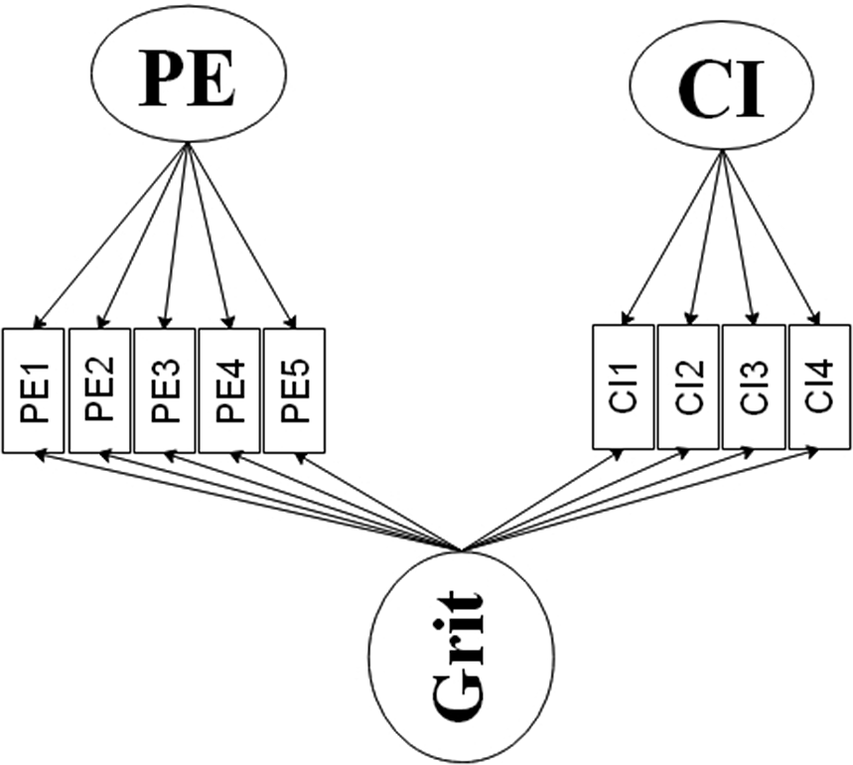
Like the domain-general grit scale (Duckworth et al., Reference Duckworth, Peterson, Matthews and Kelly2007), the L2 grit scale developed by Teimouri et al. (Reference Teimouri, Plonsky and Tabandeh2020) consists of two associated subconstructs: CI and PE in learning a second language. The former assesses changes of students’ interest during learning a second language and the latter measures how persistent learners are in the achievement of their L2 goals. Having conducted reliability analyses and PCA, Teimouri et al. (Reference Teimouri, Plonsky and Tabandeh2020) maintained 12 items, 6 items measuring CI (e.g., My interests in learning English changes from year to year) and 6 items measuring PE (e.g., I will not give up learning English until I master it). Their further analysis showed that the item-total correlations for three items fell below the minimum criteria of .40 and were, thus, discarded. The nine remaining items were then regarded as the L2 grit scale. Also, they asserted that their participants’ reports indicated reliably higher scores for the language-domain-specific grit than the domain-general grit (t[190] = 84.34, p < .001, Cohen’s d = .81). Like Duckworth et al.’s scale of domain-general grit, all the items of the L2 grit scale are organized using a 5-point Likert-type scale that ranges from 1 “not at all like me” to 5 “very much like me.” However, given the raised concerns regarding the standard CFA of the L2 grit models in the previous studies and also the one tested in Alamer (Reference Alamer2021), and the proposal of a subsequently alternative solution of a bifactor-CFA model by Alamer (Reference Alamer2021), in this study we followed the procedures of our LCFA-CFM approach in the study using a bifactorial-CFA model of Teimouri et al.’s (Reference Teimouri, Plonsky and Tabandeh2020) model of L2 grit (see Figure 1). To check the reliability of the scale used in our study, we applied Cronbach’s α to check its internal consistency and McDonald’s ω (McDonald, Reference McDonald1985, Reference McDonald1999) to test its composite reliability (Şimşek & Noyan, Reference Şimşek and Noyan2013). The reason for the use of McDonald’s ω was that “there is a tendency for coefficient α to underestimate the true reliability when the data are multidimensional” (Osburn, Reference Osburn2000, p. 343). Table 1 indicates the information about the reliability coefficients of the scale. The reliability estimates of the L2 grit scale and its subscales, as seen in Table 1, are high.
L2 grit model on a bifactor CFA.

Reliability estimates of L2 grit scale and its subdomains

Note: CI = consistency of interest; PE = perseverance of effort.
DATA COLLECTION
The data collection method was questionnaire-based. The L2 grit scale was submitted to the research sample in four measurement occasions with 2-week intervals beginning at the outset of each EFL course (to take into account the initial status factor). This longitudinal data collection helped to measure changes in the target variable through time. It also allowed for estimating the rate of the changes at each measurement occasion and accounted for interindividual differences. Questionnaire completion was done step by step in class in the presence of a member of the research team. The participants were ensured of the confidentiality of the information they provided and they could leave the project whenever they were not at ease with their participation in the project.
DATA ANALYSIS
The data were analyzed using Mplus 7.4 and robust maximum likelihood estimator (MLR) (see Appendix). The first step was to examine the longitudinal associations among the latent variables using an unconstrained LCFA model (i.e., a configural model). We set the factor loading (λ) of one indicator to 1 for each point of time (PE1˜5), and its intercept to zero for model identification purposes (known as the “marker variable” scale setting for the CFA parameters). To test the model fit, we used goodness of fit indices including comparative fit index (CFI), Tucker–Lewis index (TLI), root mean square error of approximation (RMSEA), and standardized root mean square residual (SRMR). The acceptance criteria were CFI and TLI ≥ .90 and ≥ .95, and RMSEA and SRMR ≤ .08 and ≤ .05, pointing to adequate and excellent fit indices, respectively (Hu & Bentler, Reference Hu and Bentler1999; Marsh et al., Reference Marsh, Hau and Wen2004).
Then, the standardized factor loadings for each component of grit indicator that formed the latent variable (L2 grit) were estimated. Conventionally, according to factor analysis literature, factor loadings ≥ .60 are taken as acceptable (Matsunaga, Reference Matsunaga2010). Moreover, the correlations among the latent factors (i.e., L2 grit over points of time) were calculated. The statistical significance of auto-correlated errors among specific subdomains was also checked. Next, the measurement invariance was tested using multiple indices. First, we fit a configural factorial invariance model. Using this unconstrained model, we checked whether each latent variable could be formed in a similar manner. Then, a weak invariance model was estimated.
Subsequently, a strong invariance model was estimated. If the fit indices showed that the strong invariance model was not similar to the weak invariance model, we could not assume that the LCFA captured the longitudinal changes of true means because possibly a change in the mean of the latent factor through time was due to the variability in the means of observed variables over time. To test for each type of measurement invariance, we examined overall model fit indices, including Δχ2 and ΔCFI. If the assumption of measurement invariance was met for the LCFA model, the second-order growth curve modeling (CFM) was estimated.
RESULTS
The main steps of conducting LCFA-CFM, as suggested by Wickrama et al. (Reference Wickrama, Lee, O’Neal C and Lorenz2016) involve “ensuring measurement invariance of the factor loadings, mean parameters and the error variance of the indicators between and among the points of times” and “estimating the CFM with the help of the latent factors of the LCFA that has been identified for the measurement model.” Accordingly, the results are presented here along these main steps.
Step 1: Estimating a configural (unconstrained) LCFA including indicators
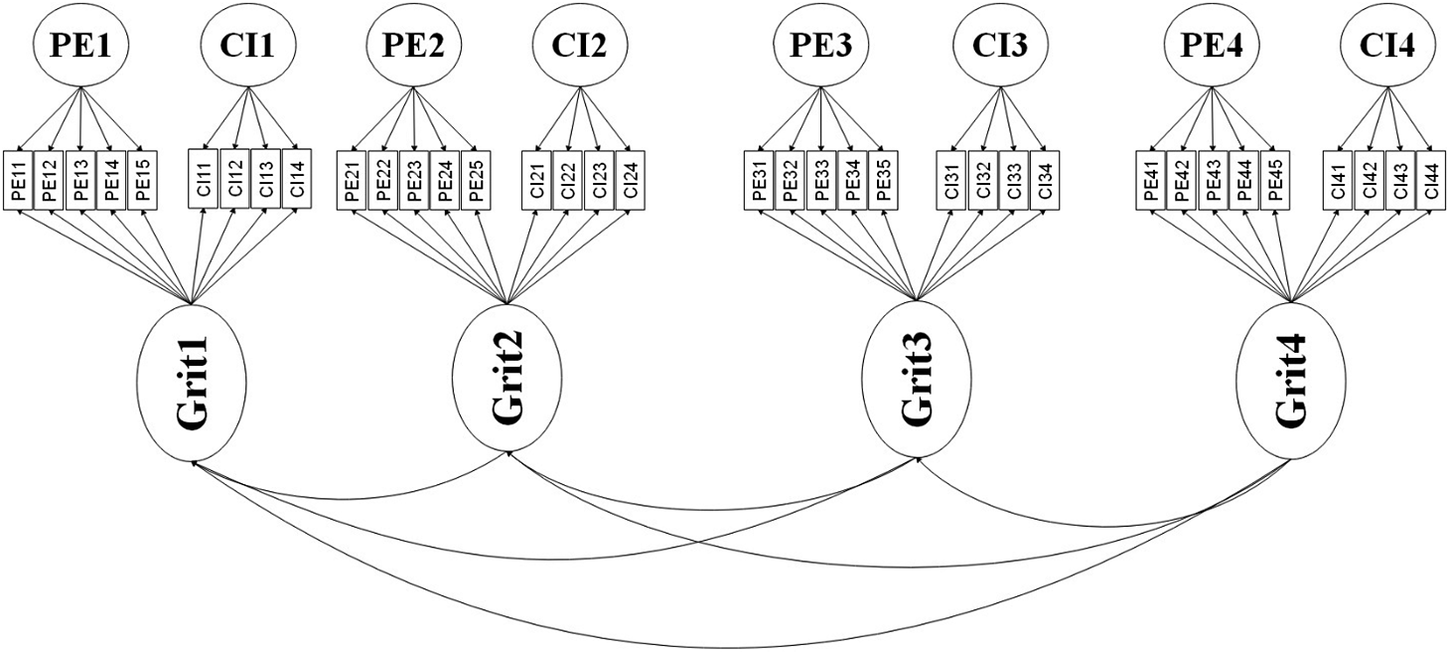
The next step in investigating the longitudinal correlation patterns among indicators is to examine the longitudinal associations of the main latent factor using an unconstrained LCFA model (a configural model mapped in Figure 2).
A configural latent confirmatory factor analysis.
Note: PE = perseverance of effort; CI = consistency of interest.

For model identification purposes, we set the factor loading (λ) of one indicator to 1 for each point of time (PE1˜4), and its intercept was set to zero (which is known as the “marker variable” scale setting for CFA parameters).
The results of the initial LCFA model show that the model fits the data structure well (χ2(df) = 86.181(50), p < .05; CFI/TLI = .991/.987; RMSEA = .057; SRMR = .033). Effect sizes were also calculated and reported for correlations r = .25, r = .40, r = .60, representing small, medium, and large effect sizes, respectively (Cohen, Reference Cohen1992; Plonsky & Oswald, Reference Plonsky and Oswald2014).
As seen in Table 2, the standardized factor loadings for each item of two subdomains were also calculated. All the factor loadings were higher than .65 (p < .001). Conventionally, referring back to the factor analysis literature, factor loadings ≥ .60 are taken as acceptable (Matsunaga, Reference Matsunaga2010). Therefore, these factor loadings appear acceptable and it shows that these items are indicators of L2 grit (the main latent factor). Besides, the correlations among the latent factors (i.e., L2 grit over time) are in the moderate range (ranged from .46 to .63, p < .001). This would represent modest correlations among the latent global factors (or acceptable discriminant validity of L2 grit over time).
Standardized parameter estimates of a configural LCFA model

Step 2: Ensuring measurement invariance of the factor loadings, mean parameters, and the error variance of indicators between and among points of times
Measurement invariance, under robust maximum likelihood (ML) estimation, is usually tested using a nested chi-square difference test, Δχ2, between the configural model and the model(s) enforcing equality constraints (Ferrer et al., Reference Ferrer, Balluerka and Widaman2008; Harring, Reference Harring2009). Yet, in a Monte Carlo simulation study, Meade et al. (Reference Meade, Johnson and Braddy2008) realized that χ2 is highly sensitive to sample size. Therefore, for model comparison, using an alternative fit index was suggested, such as the comparative fit index (CFI), which is less sensitive to sample size and more sensitive to a lack of invariance than χ2. According to Rensvold and Cheung (Reference Rensvold, Cheung, Schriesheim and Neider2001), the assumption of measurement invariance is met when the change in the CFI (ΔCFI) between the configural model and the constrained model is below .01. But Little (Reference Little2013) suggested that the judgment should not be influenced by any single statistic. Rather, multiple indicators of the change in model fit need to be taken into account simultaneously. Therefore, we considered several model fit indices to assess measurement invariance. Firstly, as recommended by Wickrama et al. (Reference Wickrama, Lee, O’Neal C and Lorenz2016), a configural factorial invariance model should be fit (i.e., a model with no constraints imposed on any model parameters). This unconstrained model can be used to check whether each latent construct could be formed in a similar manner (comparable factor loading patterns are expected over time).
Secondly, a weak invariance model needed to be estimated, which freely estimates the mean parameters but constrains factor loadings for the same indicators at different time periods. If fit indices comparing the weak invariance model to the unconstrained model show that constraining the factor loadings to be equal does not significantly distort the model fit, we may conclude that there is evidence for equivalent relationships among indicators and the latent factor through time (in other words, the assumption of weak invariance is granted) (Wickrama et al., Reference Wickrama, Lee, O’Neal C and Lorenz2016).
Thirdly, a strong invariance model needed to be estimated, which is a model that constrains indicator means and factor loadings to be equal across different points of time. If the fit indices show that the strong invariance model is not similar to the weak invariance model, we cannot assume that the LCFA embraces the longitudinal changes of true means (i.e., the latent factor means) because maybe the change in the mean of latent factor over time is caused by variability in the means of observed indicators over time (Wickrama et al., Reference Wickrama, Lee, O’Neal C and Lorenz2016). However, if the strong invariance model constraining both the indicator means and factor loadings fits as well as the weak invariance model based on indicators of difference in model fit, the indicator variables are perceived to have a stable association with the latent factor. That is to say that a one unit increase in the latent factor is accompanied by a similar degree of change in an indicator variable at each point of time. Thus, the strength of the relationship between the indicator and the latent factor is constant from time to time. Besides, strong measurement invariance shows that changes in the latent factor mean through time can be induced by true change in the main latent factor (Brown, Reference Brown2006). To test each type of measurement invariance, we examined the overall model fit indices including Δχ2 and ΔCFI. Table 3 indicates the results of the nested model comparisons.
Results from models testing measurement invariance in L2 grit longitudinal CFA model

The analyses showed that the configural model (M2) had a good overall fit. Next, we created M3 by constraining the factor loadings to be equal. The assumption of weak invariance was then tested by comparing M3 with M2. The results showed that the constraints incorporated in M3 do not significantly reduce the model fit compared to M2 (the configural model) (Δχ2(df) = 24.75(8), p = .06; ΔCFI = .001). Thus, the assumption of weak invariance is met.
In comparing M3 (the weak invariance model) to M4 (the strong invariance model), which brings in constraints to make the manifest variable means equal across time, the Δχ2 statistic revealed a statistically significant reduction in model fit (Δχ2(7) = 33.04(8), p < .001; ΔCFI = .007). This shows that M3 is the best fitting model, but the ΔCFI was less than .01. As Cheung and Rensvold (Reference Cheung and Rensvold2002) suggested that the set of constrained parameters is basically the same over time when the ΔCFI is at or below .01, we can go onto conclude that the assumption of strong measurement invariance is met.
Finally, we also tested a strict invariance model. As expected, based on the previous models, the fit statistics showed that the assumption of strict invariance was not met (Δχ2(df) = 54.18 (8), p < .001; ΔCFI = .015).
According to Wickrama et al. (Reference Wickrama, Lee, O’Neal C and Lorenz2016), strong invariance, as we found support for in M5, is the minimum level of measurement invariance required to proceed to second-order modeling. Thus, second-order modeling has certain prerequisites: (a) stable relationships between factor loadings and latent factor through time and (b) the possibility of attributing “true mean” changes in the constructs through time to true construct differences and not to changes in the indicator mean.
Step 3: Estimating the CFM with the help of the latent factors of the LCFA that has been identified for the measurement model
After the assumption of measurement invariance was met for the LCFA model, a second-order growth curve model, a curve-of-factors model (CFM), was estimated (see Figure 3). The variance of the slope factor for the second-order growth curve model can likely be estimated when diagonal covariances among indicators (in this case, adjacent covariances between Gritt and Gritt+1) are higher than off-diagonal covariances. In our LCFA model with strong invariance, we found that the covariances between adjacent latent constructs were higher (ranged from .063 to .171, p < .001) than the off-diagonal covariances (ranging between .041 and .132, p < .001). These model covariances suggest that a second-order slope variance can possibly be estimated in a CFM without leading to a solution that has a negative variance.
Results of a second-order growth curve model (CFM) using the marker variable scale setting approach.
Note: Unstandardized coefficients are shown. Strong invariance was specified using the marker variable approach. For simplicity, the residual variances among the same indicators as well as the covariances among subdomain indicators over time were estimated but are not shown in the figure.

Based on the model fit indices, the specified CFM had a good fit with the data structure (χ2(df) = 179.218(71), p < .001; CFI/TLI = .988/.972; RMSEA = .053, SRMR = .06). Statistically significant mean levels were estimated for the intercept and slope of the second-order model, which indicates an initial level of L2 grit that is greater than zero and an increasing trend in L2 grit over time (Intercept: 24.142, p < .001, slope: .043, p < .001, respectively). Interindividual differences in the second-order growth factors were also statistically significant with estimated variances suggesting the existence of interindividual variation within both the second-order intercept (initial level) and the rate of change over time (slope) (Intercept: .166, p < .001, slope: .004, p < .001). The statistically significant slope variance shows that some individuals have a higher rate of change in L2 grit compared to others with a lower rate of change in L2 grit through time, and still others maintain the same level of L2 grit through the passage of time.
As for the interpretation of the covariance between intercept and slope, the covariance (the unstandardized coefficient) between the intercept and slope was estimated at –.491, p < .001. The negative covariance between the intercept and slope in the current example suggests that individuals with lower initial levels of L2grit had a steeper increase in L2 grit over time compared to individuals experiencing higher initial levels of L2 grit. That is, factor scores of persons lower in the initial L2 grit increased more rapidly across time than factor scores for individuals with higher values of the global construct of L2 grit initially. In other words, those students who started off at higher level of L2 grit also exhibit less change in L2 grit over time and those participants who started at lower level of L2 grit exhibited more change in their grit over the term.
DISCUSSION
The present findings can be discussed in the light of a few relevant works of research. We adopted a LCFA-CFM approach to, first, check the factor structure of L2 grit over time. The scale has been recently developed by Teimouri et al. (Reference Teimouri, Plonsky and Tabandeh2020) and validated by the same researchers as well as Sudina et al. (Reference Sudina, Brown, Datzman, Oki, Song, Cavanaugh, Thiruchelvam and Plonsky2020) through traditional statistical approaches such as PCA using direct oblimin rotation and confirmatory factor analysis. They also ran a set of standard multiple regression analyses to examine the associations between L2 grit and other personality constructs. It is evident that the approaches these scholars have adopted in exploring the factor structure of L2 grit lie within the conventional SEM framework that makes use of cross-sectional data and, thus, fails to measure the longitudinal nature of the construct. Given the need for a local-local consistency of measures in SLA (Teimouri et al., Reference Teimouri, Plonsky and Tabandeh2020), testing the factor structure the L2 grit from a longitudinal perspective can also strengthen this consistency. That is, given the longitudinal nature of grit, examining the LCFA of L2 grit in longitudinal studies, in line with the emergence of dynamic methods in SLA (see Hiver & Al-Hoorie, Reference Hiver and Al-Hoorie2019) could provide us with deeper insights into the language-domain-specific grit. What was missing in the prior validation was the lack of attention to the temporal and developmental nature of L2 grit and the need to measure it longitudinally, given the longitudinal nature of the construct. The patterns of growth, rate of growth, and the association of learners’ initial level of L2 grit with its growth were neither considered nor measured in the previous research on L2 grit. However, to provide deeper insights into changing patterns of the L2 grit construct, we showed that the new generation of statistical analyses in SEM analytical framework, such as CFM, and its embedded LCFA, as a quantitative method for complexity in SLA (Hiver & Al-Hoorie, Reference Hiver and Al-Hoorie2019), is capable of capturing the trajectory of changes in a latent variable of interest like L2 grit as it grows across different time periods.
However, in our LCFA of the L2 grit construct in this study, we were inspired by the criticisms concerning the domain-general grit as well as language-domain-specific grit. A number of researchers (e.g., Credé, Reference Credé2018; Credé et al., Reference Credé, Tynan and Harms2016; Morell et al., Reference Morell, Yang, Gladstone, Turci Faust, Ponnock, Lim and Wigfield2021) have questioned the construct validity of the domain-general measurement instruments of grit. They criticized the grit model introduced by Duckworth et al. (Reference Duckworth, Peterson, Matthews and Kelly2007) for its lack of focus on the long-term nature of the construct especially the pursuit of long-term goals. Also, Alamer (Reference Alamer2021) raised concerns regarding the standard CFA of the L2 grit models including a higher-order factor of CI and PE. Thus, motivated by this lacking respect for the longitudinal, dynamic, and complex nature of grit in the existing models and related works of research in the general-domain of grit as well as the need for a bifactor model of L2 grit we proposed to conceive and measure L2 grit as a longitudinal construct to indicate that some developments, which have not been applied in the general domain of grit, can be first implemented at the language-domain-specific level.
Based on the findings of this study, we can now ensure that the subdomain indicators of the L2 grit construct, PE and CI, contribute to repeated latent factors that reflect the global factor of L2 grit, indicating the same meaning over time. More specifically, we can ensure that the factor structure of L2 grit based on a bifactor CFA is invariant over time. In other words, the global factor of L2 grit, including the indicators of both PE and CI, has not varied across the four time points considered in this study. Therefore, we can ensure that the results of measuring the real change of L2 grit not biased. We should note that without the consideration of LCFA of the L2 grit construct, as addressed in this study, any observed change of the construct in a course of language learning could be misinterpreted. This finding implies that the suitability of the L2 grit can be attributed, from this time forth, to its language-domain-specificity and time-invariance measurement capacity.
The CFM findings showed that the initial level of L2 learners’ grit was negatively associated with the rate of their grit growth during the course. The grit of learners whose initial level of the construct was lower at the outset grew significantly faster than those whose initial level of grit was higher. This would point to the fact that an initial state of a personality construct like L2 grit does not warrant the rate of its change through time. That would again indicate why an approach like CFM is required to trace the L2 grit longitudinally in different points of time and not only once. This finding supports why Hiver and Al-Hoorie (Reference Hiver and Al-Hoorie2019) emphasize the need for innovative research methods especially advanced statistical techniques such as CFM to embrace the dynamicity of human constructs and behaviors.
As indicated by these findings, the initial high level of L2 grit may not necessarily imply a steeper increase in the construct during learning an L2. Regarding the domain-general grit, Credé (Reference Credé2018) argued that the domain-general grit should not be misinterpreted as a dichotomous construct of either gritty or not gritty. The negative association between the intercept and slope of L2 grit in this study, implying different growth levels of the construct for individuals compared with their initial level of the construct, indicate that L2 grit should be viewed as a continuous variable ranging from low to high.
These findings also indicate that certain variables can affect less gritty learners (at the beginning of an L2 course) more than their grittier counterparts. For instance, the mediation of the motivating role of teachers can be hypothesized to help learners with a lower L2 grit at the beginning of the course experiences a faster growth of the construct during the course due to increasing interest and intensifying efforts. Yoon et al. (Reference Yoon, Kim and Kang2020) highlighted the role of teacher support for autonomy and learners’ engagement as mediating factors between learners’ grit and achievement. Based on their findings, we can postulate that regardless of the level of learners’ L2 grit in the initial session of an L2 course, teachers’ support and learners’ high level of engagement, as a result of appropriately challenging tasks assigned in the course, can heighten learners’ L2 grit in the other sessions of the course.
Also, Yoon et al. (Reference Yoon, Kim and Kang2020) contended that learner-centered learning and teaching plays a pivotal role in boosting learners’ grit due to their inherent self-directed learning. Because all the courses regarded for data collection in this study followed a communicative language teaching method, which is a learner-centered teaching method (Larsen-Freeman, Reference Larsen-Freeman2000), the self-directed learning inherent in this method might have helped less gritty learners at the beginning of the course to increase their persistence of effort and interest in the course and raise their L2 grit with a steeper degree than those who were grittier than them in the first session of the course. An additional qualitative phase to such research can help to identify these possible mediating factors.
As another explanation for the negative association between the intercept and the slope of L2 grit in the CFM of this study, we can refer to a relevant trait, mindset, which in the literature has been often linked with learners’ grit and has been shown to be causally related to it (Frydenberg, Reference Frydenberg and Frydenberg2017). As described by Khajavi et al. (Reference Khajavi, MacIntyre and Hariri2021), L2 learners’ perception of their L2 learning ability is linked to their effort. The relationship between these two can be explained by the two constructs of language mindset and grit, respectively, with the latter referring to individuals’ perceptions of their language learning ability (Lou & Noels, Reference Lou and Noels2017; Mercer & Ryan, Reference Mercer and Ryan2009; Ryan & Mercer, Reference Ryan, Mercer, Mercer, Ryan and Williams2012). With this in mind, we can hypothesize that the observed different rates of growth in L2 learners’ grit for the less gritty and grittier EFL learners at the outset can be a function of their mindset.
Moreover, the steeper increase of L2 grit of less gritty learners during the course might be explained in terms of the association between grit and situational-specific emotional states (Datu & Fong, Reference Datu and Fong2018). Given the recent research on the dynamics of emotions in SLA ( see Boudreau et al., Reference Boudreau, MacIntyre and Dewaele2018; Gkonou et al., Reference Gkonou, Daubney and Dewaele2017), the link between positive emotions and grit (Datu et al., Reference Datu, Yuen and Chen2018), and the contribution of L2 teachers to learners’ moments of enjoyment (Dewaele et al., Reference Dewaele, Witney, Saito and Dewaele2018), we can conjecture that the learners’ emergence of positive emotions under the influence of teachers in different situations of an L2 course might pave the way for the change in L2 grit of less gritty learners during the course.
It should be mentioned that in the dynamic context of an L2 class many relevant variables can work in concert to motivate less gritty language learners (at the beginning of the course) to perceive themselves capable of learning the language and feel their language learning efforts rewarded. Further research can help to reveal more about the factors affecting and affected by L2 learners’ grit in the dynamic context of an L2 class. For instance, more advanced forms of curve growth modeling can also be used to incorporate more latent variables within the model including motivation and mindset. Longitudinal SEM analyses help to trace L2 grit (and other similar personality constructs) in the reality of classroom learning and reveal more of the intertwined network of learner-related and contextual factors.
CONCLUSION
Given the ever-dynamic nature of SLA domain and the concomitant methodological turn in related research (Gass & Plonsky, Reference Gass and Plonsky2020), L2 learners’ personality constructs require to be explored longitudinally to capture a more realistic and developmental picture of these constructs as they evolve in the live classroom setting. To do so, the measurement of these constructs is expected to reflect this dynamic turn. Traditional statistical analyses no longer suffice to embrace the minute patterns of development in language learners’ personality constructs including grit. One-shot research designs only provide a snapshot of these constructs as cross-sectional data fail to reflect the patterns of temporal changes of these constructs (Larsen-Freeman, Reference Larsen-Freeman2016). The existing measurement instruments tapping onto L2 learners’ personality constructs such as grit need to be validated beyond the mere simple confirmatory factor analysis and need to follow a procedure that examines the invariance of the latent construct across points of time. That fits more with the longitudinal process of language learning.
The present research focused on the measurement of L2 learners’ grit and drew attention to the shortcomings of the validation of the existing scale and the need to reconsider its construct validity. The LCFA-CFM approach proposed in this research managed to assure the longitudinal validity of the scale and set an example for how to measure L2 grit through time. This approach can be applied to measure other L2 learners’ personality constructs that dynamically grow during the learning experience such as enjoyment, mindset, and boredom. The model can be also extended to a factor-of-curves model as well to measure the effects of more than one latent variable on L2 grit throughout the longitudinal analysis procedure. The model proposed in the present research may also be extended to a mixture growth curve model to account for intraindividual differences as well. Furthermore, the model can be extended to explore the antecedents and outcomes of L2 learners’ grit, as the body of related literature is still in its nascent stages and requires a measurement approach appropriate for the inherent dynamic and context-sensitive nature of the construct. Considering the context-sensitive nature of grit, probably further components can be added to the modeling of the construct to embrace its context-specific aspects. A new line of research is summoned up to benefit from advanced statistical techniques that can manage the heterogeneity issue; measurement errors; inter- and intraindividual differences; patterns of growth in indicators and patterns of growth in the latent variables; the effect of initial status; and also, the rate of growth in the latent variable. These statistical procedures can pave the way for research into the dynamic language learning process and the nuances of language learners’ behaviors and traits.
Competing Interest
The author(s) declare none.
APPENDIX
THE MPLUS SYNTAX FOR THE LCFA-CFM APPROACH IN THIS STUDY
MODEL:
Grit1 by PE11
PE12
PE13
PE14
PE15
CI11
CI12
CI13
CI14 (1–9);
Grit2 by PE21
PE22
PE23
PE24
PE25
CI21
CI22
CI23
CI24 (1–9);
Grit3 by PE31
PE32
PE33
PE34
PE35
CI31
CI32
CI33
CI34 (1–9);
Grit4 by PE41
PE42
PE43
PE44
PE45
CI41
CI42
CI43
CI44 (1–9);
[PE11–PE41@0];
[PE12–PE 42] (10);
[PE13–PE43](11);
[PE14–PE44](12);
[PE15–PE45](13);
[CI11–CI41] (14);
[CI12–CI42] (15);
[CI13–CI43] (16);
[CI14–CI44] (17);
PE11–DEP41 (18);
PE12–PE 42(19);
PE13–PE 43 (20);
PE14–PE 44 (21);
PE15–PE 45(23);
CI11–CI41 (24);
CI12–CI42 (25);
CI13–CI43 (26);
CI14–CI44(27);
[Grit1–Grit5];
PE11 WITH PE21 PE31PE41;
PE21 WITH PE31PE41;
PE31 WITH PE41;
PE12 WITH PE22 PE32PE42;
PE22 WITH PE32PE42;
PE32 WITH PE42;
PE13 WITH PE23 PE33PE43;
PE23 WITH PE33PE43;
PE33 WITH PE43;
PE14 WITH PE24 PE34PE44;
PE24 WITH PE34PE44;
PE34 WITH PE44;
PE15 WITH PE25 PE35PE45;
PE25 WITH PE35PE45;
PE35 WITH PE45;
CI11 WITH CI21CI31CI41;
CI21 WITH CI31CI41;
CI31 WITH CI41;
CI12 WITH CI22CI32CI42;
CI22 WITH CI32CI42;
CI32 WITH CI42;
CI13 WITH CI23CI33CI43;
CI23 WITH CI33CI43;
CI33 WITH CI43;
CI14 WITH CI24CI34CI44;
CI24 WITH CI34CI44;
OUTPUT: STANDARDIZED MOD (3.84);