

Medieval plainsong is known as a primarily diatonic repertory. The notational matrix that became standard between the ninth and eleventh centuries permitted chromatic alteration at only one point in the scale, b/b♭. Beginning in the early twentieth century, however, the presence of a ‘non-diatonic’ chant tradition was brought to light by Gustav Jacobsthal, Dominique Delalande, and others.Footnote 1 By examining references to chants in treatises and their transmission in practical sources, these studies showed persuasively that certain melodies had employed pitches such as low B♭, E♭ and F♯ before they were committed to pitch-specific notation. To fit into the notation system, these melodies had to be emended or relocated to a different pitch level.
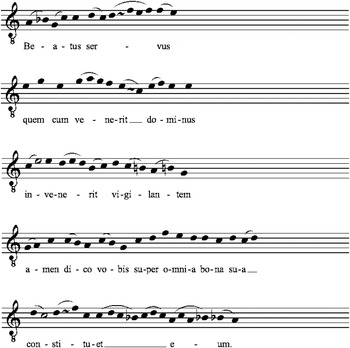
The objective of these early studies was to restore the melodies to a putative original state. With the hindsight of modern scholarship, we can raise certain objections to this goal. Given the oral origins of the repertory, it is unlikely that single, original versions of these chants ever existed. Even when this premise is set aside, however, it often possible to posit a plausible hypothesis about where emendation has taken place and which version reflects the ‘unemended’ reading. An oft-cited case is the communion Beatus servus, whose problems are witnessed both in practical sources and in contemporaneous writings.Footnote 2 This piece is classified as a fourth-mode chant in most tonaries. In the earliest pitch-specific manuscript, Mo 159, it is written a fourth higher, ending on a (Example 1). The melody employs b♭, the semitone above the final, and b♮, the whole tone above the final. If the whole melody were transposed down a fourth, to end on the regular final E, the b♮s at ‘invenerit vigilantem’ would be F♯s. In this case, we can determine where the melody employs irregular semitones by mentally transposing it to the regular final. Beatus servus illustrates the fruitfulness of this methodology: while it may not recover a mythical ‘original’ melody, it has potential to bring us as close as we can come to understanding the intentions behind the written sources.
Beatus servus, communion (Mo 159)

In this essay I consider some aspects of the ‘non-diatonic’ tradition that have not been fully addressed in previous studies and explore their relationship to early medieval theory and pedagogy. The solo verses of the offertory chants exhibit a particularly extensive and prolonged use of irregular semitones. Based on comparative transcriptions, elsewhere I have proposed that entire sections of these pieces were displaced in relation to the background scale, sometimes permanently.Footnote 3 These cases raise questions about the pre-theoretical chant tradition that are not altogether answered through established methodologies. The first part of this essay illustrates some unresolved problems that emerge in comparative transcriptions of these melodies. Next I examine the conception of irregular semitones in the Enchiriadis treatises, along with its implications for understanding the extensive displacements and interpreting variant readings. The final section explores some aspects of the Enchiriadis reception that point to changes in tone system and pitch conception, shedding light on the contexts surrounding the suppression of irregular semitones.
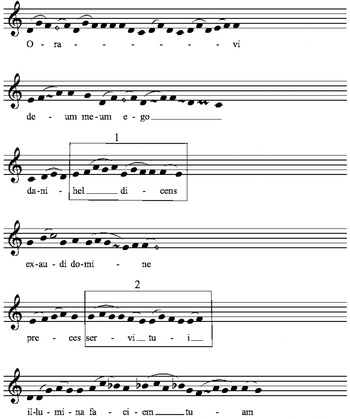
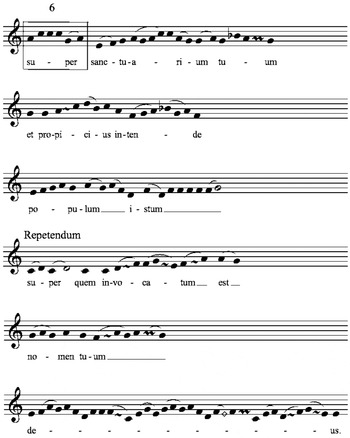
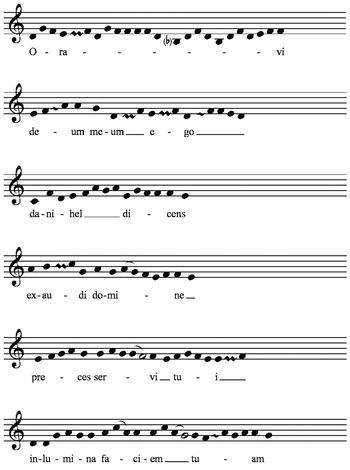
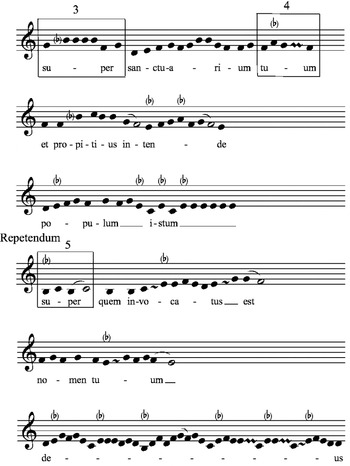
Oravi deum, the offertory for the sixteenth Sunday after Pentecost, appears in most manuscripts as a deuterus melody throughout.Footnote 4 Examples 2a and 2b show two different versions of the melody. The melodic figures in boxes 1 and 2 occur frequently in third- and fourth-mode chants. In the majority reading, represented by Mo 159 in Example 2a, the melody comes to the expected close on E. In two key Aquitanian manuscripts, however, the second half of the melody, beginning at ‘super sanctuarium’, is notated a whole tone lower, as shown in Example 2b (compare boxes 3 and 6). To replicate the interval structure of Mo 159 at this lower pitch level, preserving the deuterus quality, an E♭ is consistently needed. In addition, an a♭ would be required on ‘tuum’ (box 4). This modally irregular version is found in Pa 1121, the earliest source to transmit offertory verses in heighted notation, and in Pa 776.Footnote 5 As Roman Hankeln and Rupert Fischer have shown, Pa 776 has a tendency to notate problem spots in their ‘unemended’ range.Footnote 6 In the absence of other evidence, it would nevertheless be tempting to see this downward displacement as a scribal error. In this case, however, the modally anomalous reading of Example 2b is confirmed elsewhere. John of Afflighem, writing around 1100, mentions Oravi deum in his extensive discussions of chants that have been corrupted by singing errors. He recommends that the piece be emended at the passage beginning on ‘super’, precisely where the variants occur (compare boxes 3 and 6).Footnote 7 Some sources for John's treatise transmit a music example showing that ‘super sanctuarium’ should begin with the pitches a and c, as it does in the majority reading of Mo 159 (Example 2a, box 6). John's remark on the need for correction at ‘super’ implies that he knew the modally irregular practice witnessed in Pa 1121 (Example 2b, box 3). The same anomaly, moreover, is independently preserved in three later manuscripts, from Hamburg, Reims, and Lille. In these sources, versions very similar to that of Pa 1121 are simply notated a fifth higher, ending on a and preserving the deuterus character with a b♭.Footnote 8 It is unlikely that the modal enormity of Example 2b, with its downward shift, entered the tradition at random in sources so chronologically and geographically diverse. The more probable alternative is that the majority reading of Example 2a, ending on E, reflects a correction of a practice that was once common but had come to be viewed as an error.
Offertory Oravi deum, majority version (Mo 159)


Offertory Oravi deum, alternative version (Pa 1121)


Further problems with this chant emerge in the two solo verses. In uncleffed Aquitanian sources such as Pa 1121 (Example 2b), scribes rarely give a clear indication of the relative pitch level between the respond and each verse. In Pa 1121, the intended pitch level of Oravi deum's verses is unclear. In addressing similar cases, Hankeln has argued persuasively for a distinction between the ‘written level’ and the ‘performance level’. The intended performance level of a verse, he proposes, can often be determined by the cue for the repetendum, the closing portion of the respond that follows each verse. This method of resolving the problem rests on the assumption that the melodic material comprising the repetendum should be sung at the same pitch level each time it occurs.Footnote 9
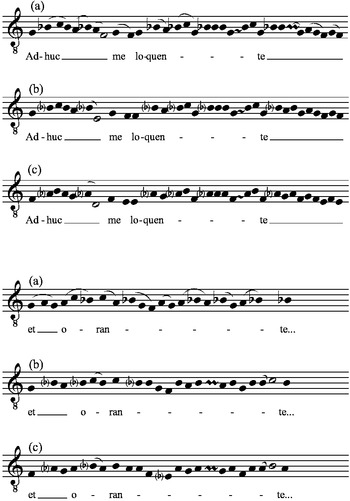
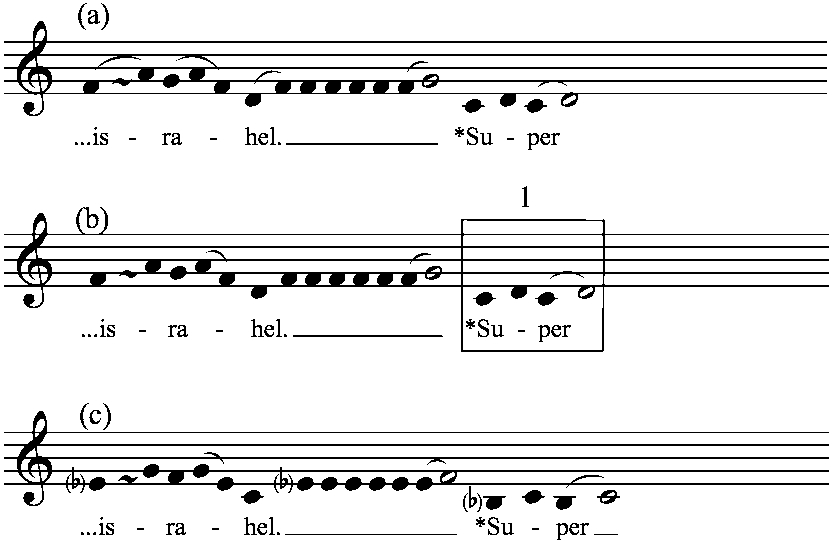
Example 3 illustrates the notational ambiguity of Pa 1121 in the first verse of Oravi deum. The example shows the opening of the verse, the ending of the verse, and the repetendum. For the purposes of reference, the majority reading (in pitch level) is given on the top line, here transcribed from Mo 159. The middle line shows a transcription from Pa 1121 at its written level, where the verse appears to begin in relation to the end of the respond. Although this version matches the majority reading of Mo 159, problems arise at the end of the verse, with the cue to the repetendum ‘super quem’. This cue (Box 1), beginning on C, is written a whole tone higher than the corresponding passage of the respond itself, where it begins on B-flat (See Example 2b, Box 5). In the bottom line of Ex. 3, Pa 1121 is transcribed with the repetendum serving as a guide to the correct pitch level of the verse. The assumption that the repetendum of ‘super quem’ begins on low B♭ (as it does in the respond) produces a hypothetical performance level in which the verse lies a whole tone below the majority reading on the top line.
Three versions of Oravi Deum, beginning and end of verse 1: (a) Mo 159; (b) Pa 1121 (written level); (c) Pa 1121 (hypothetical performance level)

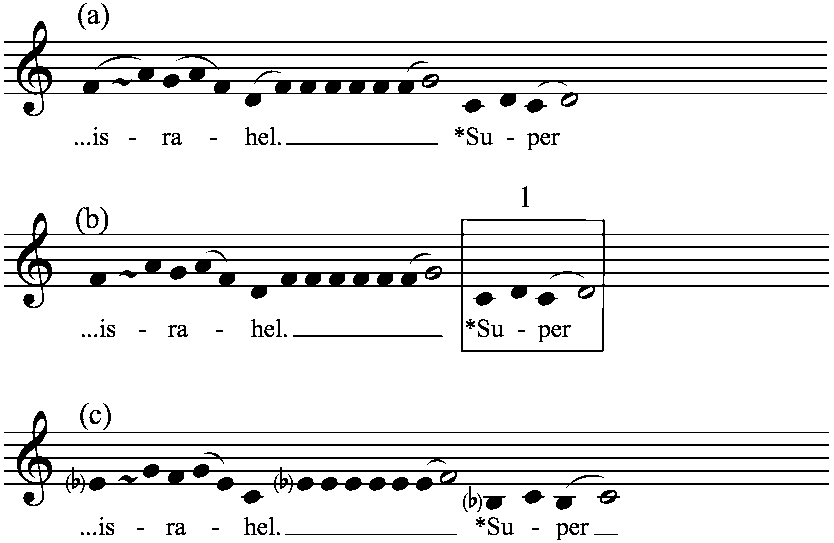
These three readings of the verse and repetendum produce strikingly distinct aural impressions. If the written level, transcribed on the middle line, is the intended pitch level of the verse in Pa 1121, then the melodic irregularities that mark the end of the respond are ‘corrected’ at the beginning of the verse. The verse then proceeds unproblematically until the repetendum. The difficulties that emerge with the repetendum become readily apparent when one sings through the respond, verse excerpt, and repetendum. If the verse and repetendum were sung at the written level shown on the middle line, the melodic material of the repetendum would sound at two different pitch levels, a whole tone higher the second time. In an alternative approach, one could sing the verse at the written level and the repetendum at its original pitch level, a tone lower, assuming that the written level of the repetendum cue is a scribal error. The result would be a disconcerting downward shift at the beginning of the repetendum. A third solution, following Hankeln's methodology, is to use the repetendum cue as a guide to the intended pitch level. In the resulting performance, shown on the bottom line, the verse would be sung a whole tone below its written level. To duplicate the interval structure of the majority version, the pitches E♭ and a♭ would consistently be required. In this interpretation, the displacement of the melody in the second half of the respond continues throughout the verse and repetendum. Once dislocated, the melody never gets back ‘on track’.
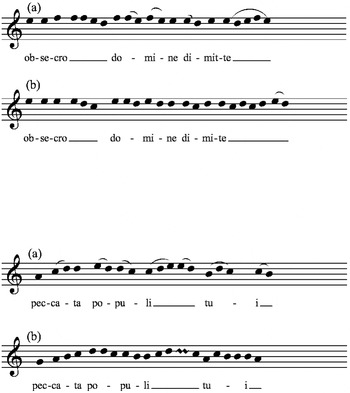
A passage from a verse of Sanctificavit, the offertory for the seventeenth Sunday after Pentecost (Example 4), illustrates another difficulty in establishing a preferred reading of these melodies. The version of Pa 776 (bottom line) is written a whole tone lower than that of Ben 34 (top line). In determining which reading of this passage is the ‘unemended’ one, it is helpful to consider their frequency in the manuscript tradition. In this case, both versions are well represented in the manuscripts. The version of Pa 776 is found in most Aquitanian manuscripts, including Pa 1121. Outside of Aquitaine, however, the pitch level of Ben 34 is much more common.Footnote 10
Offertory Sanctificavit, verse 1, excerpt: (a) Ben 34; (b) Pa 776

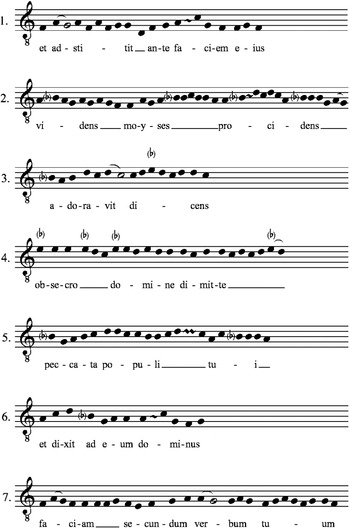
In this passage the two versions differ intervallically. Described in modern terms, the reading of Ben 34 (top line) articulates the minor third d–f, a trait associated with the first and second modes; the version of Pa 776 is focused on the major third c–e, a characteristic of the fifth and sixth modes. These differences in intervallic structure suggest that the pre-theoretical tradition had one of two possible pitches that are unavailable in the standard tone system. If the minor third of Ben 34 represents the intended tonal structure of the passage, then an e♭ would be required to replicate this structure a whole tone lower, at the level of Pa 776. The other possibility is that the major third of Pa 776 is intended; if so, an f♯ would be required to replicate this structure at the level of Ben 34.
Either alternative is certainly possible. In judging which is more plausible, we should consider the usual melodic vocabulary of the chant tradition. The version of Ben 34, with the minor third, is more typical. The top note of the minor third is customarily a repercussive pitch in chant melodies, with the melodic activity focused within the minor third below it. The melodic figures at the beginning of the passage normally occur with the semitone below the repeated pitch. The major-third version, with c and e, is less representative. If the major-third version is the correct alternative, then the passage diverges somewhat from the norms of plainchant. If the minor third c–e♭ is the intended interval, then the ‘non-diatonic’ practice does not represent a departure from the usual melodic language of the chant repertory. Instead, the whole diatonic system is displaced in relation to the background scale, a procedure more akin to modulation.
I propose that we can reach a better understanding of these extended displacements through considering them in the light of the Enchiriadis treatises. The ninth-century Musica enchiriadis and Scolica enchiriadis (hereafter ME and SE) are among the most widely transmitted texts on music in the eleventh century. SE is the only known text to permit ‘chromatic alteration’ other than b♭ before the twelfth or thirteenth century.Footnote 11 The importance of SE as a witness to ‘chromaticism’ in chant melodies was first brought to light in Jacobsthal's seminal study.Footnote 12 More recently, it has been addressed by Charles Atkinson, who illustrates how SE provides a model for notating passages that fall outside of the gamut.Footnote 13 Taking the observations of Atkinson and Jacobsthal as a point of departure, I shall consider the special relevance of SE for the type of prolonged displacement just illustrated. The Enchiriadis conception of irregular semitones can tell us more about how these melodies were viewed and help in establishing hypothetical preferred readings.
THE ‘ENCHIRIADIS SCALE’ AND THE VITIA
As is well known, the Enchiriadis tone system consists of a series of T–S–T tetrachords in a disjunct arrangement that replicates at the fifth rather than the octave. The resulting tone system, shown in Figure 1, shares its central octave, D–d, with the standard medieval tone system; this octave supplies the majority of pitches needed in chant melodies.Footnote 14 On the two ends of the scale, however, the disjunct arrangement results in several pitches that are lacking in the standard medieval scale: Γ, regarded as an added note, low B♭, lacking in most medieval systems, high f♯, and, among the residual notes, c♯. This so-called ‘Enchiriadis scale’ has been dismissed as irrelevant to plainchant. In much early scholarship, it was either justified as a means of facilitating organum at the fifth, even though the tradition gives greater emphasis to organum at the fourth; or it was viewed as a purely theoretical or pedagogical construct.Footnote 15
Enchiriadis tone system

Despite the apparent oddities of its tone system, SE is fundamentally pedagogical, taking the form of a dialogue between master and student. The student learns the tone system by singing four- and five-note scale segments derived from it, emphasising the correct placement of the semitone. The practical use of the Enchiriadis treatises in pedagogy is suggested by their wide dissemination and the negative reaction they provoke in later writers such as Guido and Hermannus, who decry the system's lack of octave equivalence.Footnote 16 Calvin Bower has emphasised the centrality of two aspects of the Enchiriadis tradition in early pedagogy.Footnote 17 Its basic unit, a T–S–T tetrachord, reappears in many subsequent treatises. A closely related and widely echoed theme is the modal qualities. From the opening pages of both treatises, it is clear that modal quality is integral to pitch conception and pedagogy. Classified according to its intervallic environment, every note of the system is either protus, deuterus, tritus, or tetrardus, with the semitone between the deuterus and tritus tones. These terms are widespread in early treatises and tonaries, with parallels in the Byzantine tradition. The initial singing demonstrations in SE are intended to help the student to distinguish these four qualities, first within the tetrachord of finals (DEFG), then in an ascending and descending series of ‘similarly constituted’ tetrachords, and finally in pentachords bound by the identical qualities a fifth apart.Footnote 18 The dasian notation reflects this emphasis on the intervallic aspect of pitch, referring both to the positions of notes and to their modal qualities.Footnote 19 As shown in Figure 1, similar symbols are used indicate each protus, deuterus, and tetrardus note. The relative position of the tetrachords in which they occur is indicated by the orientation of the symbol. The default form of the tetrachord is formed from the four finals of chant, DEFG; the signs are rotated backward for the graves, upside down for the superiores, and backward and upside down for the excellentes. A fundamental principle of the dasian notation and the Enchiriadis pitch conception, then, is that notes are defined in relation to other notes. As Bower has suggested, modal qualities were almost certainly not the invention of a single Enchiriadis author or group of authors; it is more likely that they originated in the oral pedagogy of the late eighth or early ninth century.Footnote 20 Whatever else may be said about the Enchiriadis tone system, the pedagogical advantages of the disjunct arrangement as a vehicle for teaching modal quality are clear. The qualities are replicated at evenly spaced points against the background scale; in the resulting system, there are functionally only four notes. As I will show, this emphasis on the functional aspect of pitch plays an important role in SE's conception of irregular semitones.
Nancy Phillips has suggested that the disjunct tetrachords represent the actual tone system used in plainsong. She points to a group of antiphons whose ‘unemended’ readings employ the augmented octaves of the Enchiriadis system, incorporating both F♮ in the central octave and f♯ in the high octave.Footnote 21 Indeed, it is clear that every note of the four tetrachords – excluding the residual high c♯ – was used in the repertory. The Γ and low B♭ of the graves tetrachord occur frequently in second-mode graduals, and the occasional use of the high f♯ of the excellentes tetrachord is witnessed in both theoretical and pratical sources, which recommend various approaches to circumventing the ‘non-existent’ high f♯.Footnote 22 At first glance, what stretches credulity about the system as representing a normative pitch collection for plainchant is not the pitches it has but those it lacks: low B♮, high f♮, and, perhaps most conspicuously, b♭ in the central octave.
The Enchiriadis tradition, however, makes provisions for notes that fall outside its tone system, thereby affording much more flexibility than the standard medieval pitch system. SE characterises these altered notes as the result of misplaced semitones and refers to them by three terms: ‘vitia’, usually translated as ‘defects’ or ‘vices’; and ‘absoniae’, or ‘dissonantia’, seemingly interchangeable terms typically translated as ‘dissonances’.Footnote 23 In a slightly earlier passage of SE, these words are associated with three related kinds of mistakes. The first two errors involve beginning a passage either too high or too low and measuring an incorrect distance between tones, which results in an irregular semitone placement. The third dissonance, ambiguous in meaning, may refer to a failure to match pitch in responsorial singing.Footnote 24
To help the student distinguish between the correct and incorrect semitone placement, the master introduces irregular semitones into a series of pentachords, producing the equivalents of E♭ and F♯. Although these misplaced semitones are errors, he says, they are sometimes deliberately used in the performance of chant, comparable to solecisms in poetry: ‘Certainly they are errors, but just as barbarisms and solecisms are figuratively intermixed into verse, so semitones are sometimes intentionally inserted into chants.’Footnote 25 The analogy to barbarisms and solecisms reflects the penchant for describing and understanding music through grammatical analogies. As defined in the Ars minor and Ars maior of Donatus, which served as the basis for medieval grammars, solecisms involved the use of an improper grammatical form or word order, and barbarisms referred to vices of diction such as accent or elision.Footnote 26 The irregular semitones, then, are likened to rules of grammar that were mandatory in prose but could be broken in poetry if they contributed to a higher poetic goal.
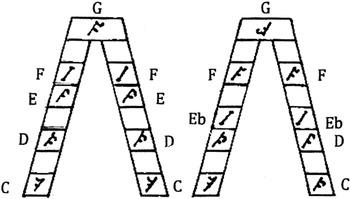
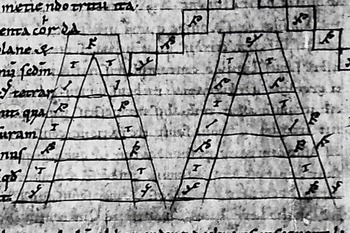
A further clue to the Enchiriadis conception of these irregular semitones lies in their notation. The misplaced semitones in the pentachords are illustrated in ladder diagrams. In most sources, each step on the ladder represents a semitone. The interval of a tone between two notes is represented by an empty space. The pentachord in Figure 2, for example, begins with a tetrardus pitch, the equivalent of C. (Modern letter equivalents have been added for clarification.) The diagram on the left presents the pentachord in its correct form, with the semitone between E and F. Spaces indicating the tone occur between the signs for C and D and between those for F and G; the line between the E and F represents the semitone. In the second diagram, the semitone is shifted down a step, spanning the interval between D and a note equivalent to E♭. In the dasian notation, this shift is represented as a change in modal quality. At the third position, the E, which would ordinarily be deuterus in quality, has now been transformed into tritus, with the semitone below it. To represent this shift, the author replaces the deuterus sign for E, which comes third in the normal pentachord, with the sign for tritus. The tritus sign is placed two ladder steps below its usual position, indicating its vertical displacement.
Illustration of a vitium in Scolica Enchiriadis

Because of their functional emphasis, the dasia show the results of this shifted semitone in a way that letter notation cannot. With its basis in position rather than function, letter notation would represent the notes on the second diagram with the same signs as the first diagram. In the dasian notation, however, the notes on the first and second diagrams are represented by different signs, reflecting the shift in position of the semitone. The fourth note, F, is designated not with the usual tritus sign, but with the tetrardus symbol, because the note below it is now a whole tone rather than a semitone; the G at the top of the pentachord is given the protus sign that usually represents a, because there are now two whole tones below it. The bottom two notes, the equivalents of D and C, are represented by different signs on the descent.Footnote 27 As the dasia show, the change in placement of the semitone at the third position effects a change in the modal quality of all subsequent notes. The representation of tones and semitones as steps on a ladder, moreover, graphically shows that the introduction of an irregular semitone results in a downward shift of the whole diatonic system. Stated in terms associated with Ptolemiac theory, the dynamic, functional aspect of pitch is flexible in relation to the thetic, position-based aspect.
This functional conception of pitch is patent throughout the demonstration of vitia. From the perspective of modern notation, only two irregular notes are introduced, E♭ and F♯. In SE, however, there are six different ‘absoniae’, because these pitches are introduced in different contexts and result in different rearrangements of the modal qualities. Some, for example, occur in pentachords that begin on a tetrardus pitch (C), others in pentachords starting on the protus (D). Some misplaced semitones are introduced on the ascending side of the ladder, others on the descending side. Through the irregular semitones, the author writes, ‘one mode is changed (transfertur) into another, or is restored’.Footnote 28 In two of the diagrams, the semitone is introduced at an irregular point on the ascending side, but placed back in the correct spot on the descending side. The master characterises this process as ‘violating both sides with incomplete intervals’, suggesting that a restoration of the original mode is brought about only through a second error.Footnote 29 It is after these demonstrations that the master remarks that irregular semitones are sometimes deliberately introduced into chants. Although he gives no criteria for distinguishing between permissible and impermissible vitia, the analogy to solecisms and barbarisms suggests that the acceptable contexts for introducing irregular semitones are determined by convention or taste.
In this demonstration of vitia for pedagogical purposes, the shifted semitone occurs only in the range of the finales tetrachord. The tradition's emphasis on the principle of modal affinity, its reduction of all possible pitches to four basic functions, nevertheless suggests that the same alteration may have been permissible in each tetrachord. The author of SE remarks that the first dissonance, lowering the second note of the tetrachord to produce E♭, often occurs in the ‘pentachord of the tetrardus’, that is, the pentachord beginning with a tetrardus pitch.Footnote 30 Although he demonstrates it starting on the tetrardus note of the graves tetrachord (C), the implication is that the same shift may occur at the equivalent position in each tetrachord. With this procedure, the b♮ equivalent in the superiores tetrachord would become b♭, and the f♯ of the excellentes tetrachord would become f♮. The second kind of dissonance, raising the third note of the finales tetrachord to produce F♯, would result in low B♮ in the graves, c♯ in the superiores and g♯ in the excellentes. The latter two notes are rarely, if ever, encountered in chant melodies. The process of altering the two inner notes of each tetrachord, however, does produce the seemingly essential pitches of chant melodies that are lacking in the basic Enchiriadis tone system: low B♮, b♭, and high f♮.
Implications for practice
The Enchiriadis understanding of ‘non-diatonic’ practice as a modulation that results from a misplaced semitone resonates strongly with the evidence of practical sources and can inform our readings of problematic chants. The elementary concepts introduced in the Enchiriadis treatises, including the four modal qualities, are closely tied to the melodic vocabulary of plainchant. In ninth-century treatises, both are invoked in definitions of mode. In ME and SE the modes are distinguished by the ‘character’ (virtus) and ‘varied nature’ (vis varietatis) of the four sounds.Footnote 31 Both treatises describe the modes according to the character (virtus) of the final, a definition echoed and refined in many later treatises.Footnote 32 Another common way of illustrating mode in early treatises and tonaries is simply by reference to melodies that belong to them. The essential characteristics for each mode were encapsulated in widely circulated melody types, created for this purpose.Footnote 33 The author of ME characterises them as “customary melodies for investigating the character (vis) of each mode” and describes how their opening and closing pitches and overall ranges relate to the tetrachords of the tone system.Footnote 34 The melody types show that pitches with specific modal qualities are associated with particular roles in the melody. The tritus tones F and c, for example, are typically repercussive notes, a trait reflected in some of the melody types for modes 3, 5, and 8, where c is a prominent repeated note.Footnote 35 Clearly the modal qualities of notes, mode itself, and the melodic gestures of the chant repertory are closely associated in the pedagogy of the ninth up through the eleventh century.
In the examples of ‘non-diatonic’ practice we have examined, the change in the position of the modal qualities is correlated with a change of role for particular notes in the melodies. In the majority version of Oravi deum (Example 2a) the tritus pitches F and c serve their typical repercussive roles on ‘super’, ‘sanctuarium’, and ‘istum’. In Pa 1121 (Example 2b), the whole system is shifted downwards. Beginning at ‘super sanctuarium’, (Box 3) the semitones are below b♭ (rather than c) and E♭ (rather than F), which now serve the repercussive role. This version of the melody resonates with the Enchiriadis conception of irregular semitones in several ways. First, there is no true chromaticism, with successive semitones; rather, the usual arrangement of tones and semitones is simply relocated, precisely the procedure graphically shown in the vitium diagrams. Once the downward shift has occurred, moreover, the latter half of the piece proceeds as a typical plainchant melody. The irregularity lies not in the configuration of the melody itself, but solely in its relationship to the background scale established in the first half of the chant. Finally, the apparently permanent shift in this example brings to mind the master's remark on the restorative effect of ‘violating both sides with incomplete intervals’. Once a violation of the usual tone and semitone arrangement has occurred, the original mode is restored (restituitur) only through a second shift of semitone. Because a second absonia does not occur in this version of Oravi deum, the chant never gets back ‘on track’. As we have seen, the displacement that marks the second half of the respond may have continued in the performance of the verses (Example 3). At the opening of the first verse, in fact, there is a second downward displacement, one that is preserved in the majority reading of the melody (top line of Example 3). The focal pitch moves temporarily from c to b♭ for ‘adhuc me loquente et orante’. In the second transcription of Pa 1121 (the ‘hypothetical performance level’ on the bottom line of Example 3), this whole structure is shifted downwards. As improbable as a♭s in chant melodies may seem to us, this solution does resolve the problematic transition to the repetendum.
Sanctificavit, verse 1, excerpt (Pa 776)

These principles can help in establishing preferred readings of other problem spots. In the more normative version of Sanctificavit (Example 4, top line), the tritus note high f is repeated several times, reflecting its typical repercussive role in chant melodies. In the bottom line, the whole system is shifted down, so that the repercussive pitch is high e. The most probable explanation is that the tritus tone e♭, with the semitone below, is intended. The probable ‘unemended’ version of the whole passage, transcribed from Pa 776, is presented in Example 5. The displacement begins in line 2, on ‘videns’: b♭ (rather than c) becomes the repercussive, tritus note, with the semitone below. In line 4, the tritus role, which would ordinarily be served by high f, is now given to high e♭. With this reading of the evidence, both passages appear as typical chant melodies: much melodic activity is focused within the minor third, whose top note serves as a repeated, focal pitch. At ‘faciam’ (line 7), the verse resumes a normal position on the background scale and the transpositional variants between sources end.
It is worth noting that this particular modulation is not consistent with the specifics of the vitia described in SE because it cannot be effected through altering one of the inner notes of a tetrachord. The same holds for the verse of Oravi deum. These melodies, however, resonate with what I view as the broader message conveyed in the vitium diagrams, namely that downward and upward shifts of the whole diatonic system were possible. These prolonged displacements seem closely tied both to the functional pitch conception that underlies the dasian notation and to the flexibility of function reluctantly permitted in SE. I would argue, in fact, that this way of thinking about pitch makes such modulations possible.
THE ENCHIRIADIS RECEPTION AND CHANGING PITCH CONCEPTIONS
With the advent of pitch-readable notation in the eleventh century, melodies that employed these displacements had to be emended, at least in writing, to fit into the notational system. Although the practice of irregular semitones undoubtedly continued, eleventh-century theorists make no provision for it. The vitia of SE, however, are exceptional even in the ninth-century theoretical context. The diatonic octave-based system, with an added b♭, is articulated in two ninth-century treatises. The main treatise of Alia musica is best known for its fusion of the practical church modes with the Greek octave species transmitted through Boethius. The author defines the modes through octave species that fix the semitones at specific points. Echoing the comments of the SE master, the author remarks that if the semitones that define the octave species are moved, the result is a change in the ‘entire quality of the mode [tropi]’.Footnote 36 Apart from a passing reference to the synemmenon tetrachord, the Alia musica tradition mentions no exceptions to the normal series of tones and semitones.Footnote 37 Towards the end of the ninth century, Hucbald presents an arrangement of the tetrachords modelled on the Greek system, with two conjunct tetrachords on either end, producing full octave equivalence.Footnote 38
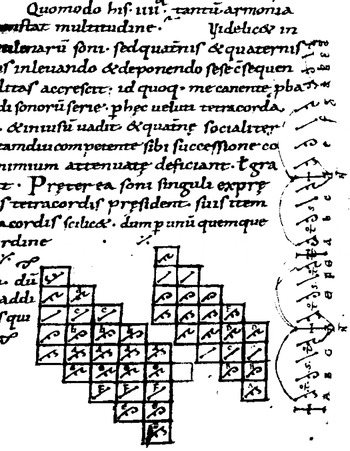
Influences of these other theoretical systems are manifest in the reception of the Enchiriadis treatises. The sources show a fascinating interaction between different tone systems and pitch conceptions, opening a window onto the circumstances surrounding the suppression – at least in theory – of irregular semitones. I have argued that these modulatory shifts are conceptually rooted in the flexible relationship between position and function that is so aptly expressed in the concept of vitia. The Enchiriadis manuscripts, however, show hints of a decline in that flexibility. In some cases, newer pitch systems are mapped onto the dasia; at other times, the dasia are reinterpreted to refer solely to position and not to function. To illustrate, I begin with an example in which the Enchiriadis tone system is neatly fused with a more modern pitch system. Figure 3 shows two diagrams from the opening of SE in Ei 79, copied in Einsiedeln in the late tenth or early eleventh century. The scribe elucidates some of the pentachords and tetrachords shown in the series of boxes with Odonian letter notation. The diagram in the right margin shows a series of tetrachords. Because the rotations indicating the position of the notes have not yet been introduced at this point in the treatise, the four tetrachords are represented by identical rotations of the signs. It is clear from the text, however, that the diagram refers to four successive tetrachords.Footnote 39 In most manuscripts, this diagram is simply written in dasian notation. In this source, however, the scribe's letter notation maps a different pitch system onto the dasia. Instead of writing the notes of the Enchiriadis scale, the scribe has written the pitches of what was becoming the standard medieval system. In contrast to the Enchiriadis system, which begins on Γ, this scale begins on A. In lieu of the disjunct arrangement, moreover, the scribe has indicated two conjunct tetrachords on each end, with a disjunction in the middle. This arrangement of tetrachords reflects the medieval adaptation of the Greek Greater Perfect System introduced by Hucbald, whose treatise survives in a roughly contemporaneous manuscript from the region.Footnote 40 Soon after the copying of these sources, Hucbald's writings were to influence two theorists at nearby Reichenau, Bern and Hermannus Contractus. Although this scribe's reinterpretation of the tetrachords is far from the intent of the Enchiriadis tradition, he shows a certain theoretical aplomb in reconciling the discrepancies. Understanding that dasia are all about modal quality, he correctly maps them on to the new tone system. The deuterus and tritus signs indicating the semitone are placed between b and c and between E and F. In the conjunct tetrachords, the scribe indicates the dual role of the pitch D as both the tetrardus note of lower tetrachord and the protus of the following tetrachord. This pivotal function of D is, in fact, an important aspect of Hermannus's theory. In contrast to Hermannus, however, this scribe has not rejected dasian notation. Instead, he has merely updated it, superimposing on it a tone system closer to the one in contemporaneous use.Footnote 41
Diagram from the opening of Scolica Enchiriadis in Einsiedeln, Stiftsbibliothek MS 79. Reproduced with permission

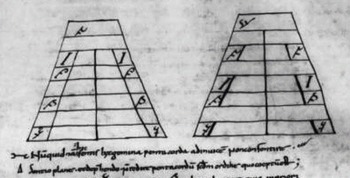
In other Enchiriadis sources, we can see a tendency to de-emphasise the functional meaning of the dasia. The diagrams that illustrate the vitia, for example, are especially error-ridden. In Gerbert's early edition, they are an incomprehensible muddle, in part because the sources themselves are so variant.Footnote 42 A few mistakes remain even in Schmid's edition.Footnote 43 Scribes sometimes use the dasia as if they referred to the position of notes rather than their function. The first vitium diagram (Figure 2 above), for example, begins on C, and the equivalent of E♭ is introduced on the ascending side. On the descending side, as we have seen, all pitches are represented by different symbols, reflecting the change in their modal qualities. The diagram is transmitted correctly in the majority of sources, including the oldest, the ninth-century fragment from Werden.Footnote 44 Another early source, however, transmits the version shown in Figure 4. In this source, Valenciennes, Bibliothèque Municipale MS 337, the misplaced semitone that occurs on the ascent is indicated correctly, as are the three signs that immediately follow it. On the descending side, however, last two signs do not reflect the modulation that has occurred. Instead, D is represented by the regular protus sign and C by the normal tetrardus sign, just as they are on the ascending side. The scribe has used the dasia as if they represented fixed pitches rather than modal qualities. Similar errors are transmitted in six other sources, representing all three major textual families of the treatises.Footnote 45
Vitium diagram in Valenciennes, Bibliothèque Municipale MS 337. Reproduced with permission

Figure 5 shows the diagram in a twelfth-century manuscript from St. Emmeram in Regensburg, which uses both sets of signs.Footnote 46 The last three dasia placed inside the boxes are written correctly, reflecting the shifted semitone. Outside of the boxes, however, the reinterpreted, position-based versions of the signs have been added: the regular deuterus sign for E, the protus sign for D, and the tetrardus sign for C. One vitium diagram, showing an f♯, is especially subject to errors. In a pentachord starting on C, the equivalent of F♯ is inserted on the ascent, represented by a second deuterus sign at the fourth position. The result is a change in the modal quality of all subsequent pitches. Twelve manuscripts, however, transmit a version of this pentachord in which all the signs on the descending side are position-based, reflecting specific pitches rather than modal qualities.Footnote 47 In the transmission of the vitium diagrams, we can see an interaction between the functional aspect of pitch, where the dasia have their origins, and the positional aspect privileged in the notations more familiar to eleventh-century scribes and singers: letters and neumes.
Vitium diagram in Munich, Bayerische Staatsbibliothek clm 14272. Reproduced with permission

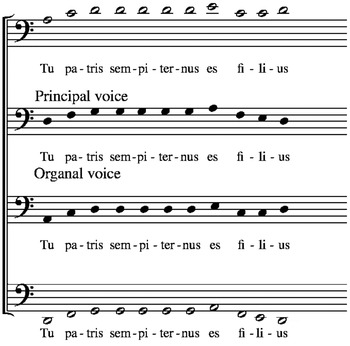
The dasian signs are occasionally used as if they referred only to position, without reference to function or even to specific pitches. This type of reinterpretation occurs in several different contexts, but perhaps most conspicuously in the composite organum diagrams. Dasia, with their augmented octaves, are not normally used to show composite organum, which requires full octave equivalence. The two inner voices in Example 6, in black noteheads, are an excerpt from the Te deum set in organum at the fourth.Footnote 48
Organum at the fourth and octave from ME

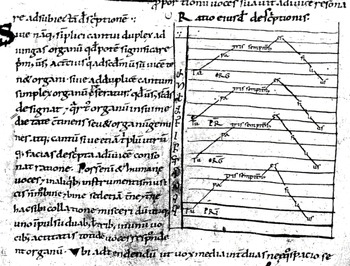
The subsequent passage of ME describes this same example performed with each voice duplicated at the octave; this practice is shown in the open noteheads of Example 6. This octave duplication of the principal voice cannot be represented in dasian notation, in part because the lowest pitch in the notation system is Γ. More important, a hypothetical extension of the disjunct tetrachords into this range would result in a low E♭, producing an augmented octave on the second syllable of ‘filius’. Acknowledging this tension between the dasian system and the need for octave duplication in organum, the author of ME remarks that octave equivalence is brought about ‘mutatione mirabili’, by a wondrous transformation.Footnote 49 In most sources, the organal voices are laid out on a grid, without dasia and without indication of specific pitches. Each horizontal line represents a scale step, designated in most manuscripts with the abstract letters A–G.Footnote 50 In five manuscripts, however, each of these lines is assigned a dasia.Footnote 51 Figure 6 shows this example as it appears in Kraków, Biblioteka Jagiellońska MS BJ 1965, an eleventh-century source from northern Italy.
Organum at the fourth and octave in Kraków, Jagiellońska MS BJ 1965. Reproduced with permission

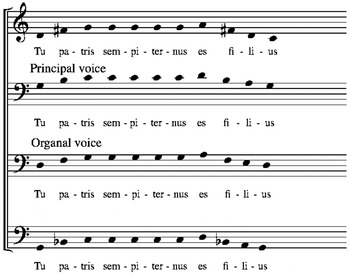
The transcription in Example 7 demonstrates the problems that would result if these dasia were interpreted according to their usual meaning.Footnote 52 The principal voice, shown in line 2, would be transposed to begin on G, resulting in a change to the intervallic structure of the melody; the semitone b–c is now between the two syllables of ‘patris’. In the duplication at the fourth and octave, the augmented octaves associated with the dasian system emerge almost immediately.Footnote 53 In this example, then, the dasia are dissociated from the functional meaning that is unambiguously articulated in the treatises. The intervallic change to the principal voice, moreover, suggests that these dasia do not even designate specific pitches. Instead, they appear to serve as mere placeholders, designating the relative positions of the voices and distinguishing the scale steps between them. The scribe has converted the dasia into a position-based notation stripped of its intended functional implications.
Transcription according to dasia in Kraków 1965

Similar uses of dasian notation are scattered in manuscripts throughout the period.Footnote 54 One example, shown in Figure 7, is from a twelfth-century source of Guido's Regulae from Christ Church Canterbury.Footnote 55 The diagram occurs in the context of a monochord division that produces the pitches of the Guidonian gamut. This scribe, however, writes the series of dasian signs above the letter notation in the order that they appear in the Enchiriadis system, even though they do not map correctly onto the Guidonian gamut in the upper and lower parts of the scale. At the bottom of the series, for example, the scribe designates A with the deuterus sign and B with the tritus sign, even though the interval between A and B is a whole tone. This scribe uses the dasia as if they referred to any stepwise series of pitches, regardless of modal quality.
Diagram from Guido's Regulae, Cambridge, Trinity College MS 944. Reproduced with the permission of the Master and Fellows of Trinity College, Cambridge

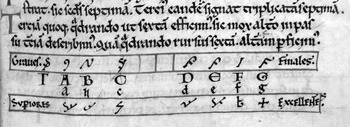
In Guido's Regulae, this monochord division follows closely upon a passage condemning the dasian notation precisely because of its periodicity at the fifth.Footnote 56 Given this context, it seems unlikely that the scribe misunderstood the dasian tone system. More plausibly, the mapping of the dasia onto the Guidonian gamut reflects a reinterpretation of the signs to indicate position rather than intervallic environment. This scribe's effort to reconcile conflicting theoretical systems is further evident in his superimposition of tetrachords onto the gamut. Although Guido's treatises eschew tetrachords, the scribe has laid out the gamut in four-note segments, with two disjunct tetrachords at the bottom (ΓABC–DEFG), labelled ‘graves’ and ‘finales’. The third ‘tetrachord’, labelled ‘superiores’, is, in fact, the trichord abc, implying that two conjunct tetrachords are intended at the upper end: abcd and defg. The resulting tetrachord system corresponds to the first four tetrachords in John of Afflighem's formulation, which modern historians have dismissed as a misunderstanding of contemporaneous theory.Footnote 57 This scribe, however, may have seen it as a worthy attempt to fuse the incompatible tone systems that circulated in treatises throughout the period. John's treatise was certainly known at Canterbury; the earliest surviving source of it was copied there.Footnote 58 Instead of using John's names for the third and fourth tetrachords (acutae and superacutae), however, the scribe adopts the names given to them in the Enchiriadis tradition: superiores and excellentes.Footnote 59
To summarise, various reinterpretations of the dasia are evident both in the copying of the Enchiriadis treatises and in copies of other treatises. In early work on the Enchiriadis treatises, some of these cases were invoked to support a hypothesis that the Enchiriadis tone system was identical with the Boethian double octave.Footnote 60 In a recent refinement of this theory, Barbara Hebborn proposes that the original purpose of the dasia was to designate the double octave, and that tone system of the Enchiriadis texts reflects later changes in the use of dasia.Footnote 61 There is scant evidence for this hypothesis. The signs make their first known appearance in the Enchiriadis texts, where they are unambiguously associated with modal qualities and intervallic environments, resulting in the tone system of Figure 1. In each of the four examples examined, moreover, the dasia are reinterpreted in different ways. In the erroneous versions of the vitium diagrams, they are used as indicators of specific pitches rather than modal qualities. When dasia are incorporated into composite organum diagrams and Guido's Regulae, by contrast, they seem to indicate any stepwise series of pitches. The variety inherent in these reinterpretations suggests that they are late, ad hoc phenomena, adaptations made to fit the practical needs of scribes and cantors at the time the manuscripts were copied.
Instead of dismissing these alternative uses of dasia as mere errors, however, it is fruitful to reflect on what they might tell us about changing tone systems and pitch conceptions. Some changes can be framed in terms of the thetic–dynamic dichotomy. Beginning in the eleventh century, very different uses of the dasia sometimes coexist within the same MS. The putatively earliest Enchiriadis source to transmit a version of composite organum with dasia is Barcelona, Archivio de la Corona de Aragon, Cod. Ripoll 42, copied between 1018 and 1046.Footnote 62 Pa 7212, copied around 1100, presents a very similar rereading of the dasia, but in an expanded context.Footnote 63 Chapter 11 of ME introduces the three primary consonances and their various combinations. In a diagram modelled on Boethius, the steps in a double octave are represented by the letters A–G, given in descending order.Footnote 64 In Pa 7212, the pitches of this double octave are also assigned dasia, which appear to mark each scale step without regard to function.Footnote 65 The simultaneous use of dasia to convey such different meanings indicates that they were no longer a primary vehicle for teaching intervallic environment and modal quality. Indeed, Figures 6 and 7 suggest the intervallic significance of the dasia was no longer universally understood or accepted by scribes and cantors. Neumes were now in practical use, and letter notation and Greek note names were the standard ways of representing pitch in theoretical sources. These notations privilege position over function. The notational and theoretical emphases on the thetic aspect of pitch may have led scribes and cantors to interpret dasian notation in a similar way. Although the functional, intervallic facet of pitch continued to be equally vital, it was now taught through solmisation. One Enchiriadis source, the late tenth-century Vienna, Österreichische Nationalbibliothek Cod. 55, was updated in the thirteenth century to reflect this change. In the final passage of SE, the master reinforces the teaching of the four modal qualities by having the student sing didactic melodies built around the four finals, with the words ‘archos’, ‘deuterus’, etc. As if to indicate that this way of teaching modal quality had been superseded by solmisation, the thirteenth-century scribe has replaced this music example with a diagram showing the Greek note names and solmisation syllables, which are also explained in a gloss.Footnote 66
The reinterpretations of dasian notation suggest a decline in the flexible pitch conception reflected in the vitium diagrams. By the eleventh century, semitones had long been fixed at specific points in theoretical writings, and these positions were aurally reinforced through solmisation. In Guido's Micrologus, we find ambivalence even towards the one position on the scale where flexibility was permissible, b♮/b♭. Although b♭ was necessary to avoid the tritone, it also changed the modal quality of the surrounding notes. Guido writes: ‘We use b-flat mostly in that chant in which F or f recurs rather extensively, either low or high. Here b-flat seems to create a certain confusion and transformation, so that G sounds as protus and a as deuterus, whereas b[-flat] itself sounds as tritus.’Footnote 67 Modal transformation conceptually echoes the views about the effects of the shifted semitone expressed a century and a half earlier in the Enchiriadis tradition and in Alia musica. In Guido's writing, however, the remark is directed towards a generally accepted pitch, one that was very common in the chant repertory. As a solution, he recommends partial whole-tone transposition: ‘But if you wish not to have b-flat at all, alter the passages in which it occurs, so that instead of F G a and b-flat you have G a b and c. … For it best avoids a sad confusion if one apportions such ascents and descents clear-sightedly between D E F and a b c.’Footnote 68 With this statement, Guido was certainly not advocating a complete suppression of b♭. In the Regulae, however, he comes close to calling for its suppression, and in the Epistola, he appears to prohibit it outright. With his remarks on b-flat Guido demonstrates a preference for a tradition in which each step on the scale is associated with a single modal quality, a position he articulates most fully in the Epistola.Footnote 69 This ideal is put into practice in some chant manuscripts, particularly where b♭ is used in close proximity to G. In the first verse of Oravi deum (Example 3, top line), the opening passage is sometimes notated a whole-tone higher, through ‘orante’. In this reading, found among geographically diverse manuscripts, the melodic activity is focused between the pitches a and c, creating exactly the modal consistency Guido recommends.Footnote 70 By this time, the flexible relationship between position and function reflected in the vitia of Scolica enchiriadis had waned.
Despite the efforts to conceal the irregular semitones under the veils of modal theory and pitched notation, the practice itself never vanished. John of Afflighem's remarks on specific chants attest to two uneasily coexisting realities: although irregular semitones were still sung at the end of the eleventh century, they had come to be viewed as mere errors. These melodies, John says, were ‘distorted by the ignorance of men … who followed the promptings of their own minds’.Footnote 71 Theodore Karp and John Snyder have shown that once theorists turn their attention to the expansion of the gamut, they mention precisely the same chant passages that were subject to variant transmission in the eleventh and twelfth centuries.Footnote 72 The irregular semitones are also preserved, albeit unintentionally, in the scribes' attempts to circumvent them in writing. Whenever they lack a standard solution to guide them, scribes adapt these melodies to the diatonic notational matrix in a multiplicity of ad hoc ways. Through their variant readings, we learn that some melodies were never conclusively subsumed into the standard tone system. With a closer look at the pitch conception of the Enchiriadis treatises and its transformation over time, we have a wider lens through which to view this tension between theory and practice.