Introduction
Fasciolosis is of well-known veterinary importance and an increasing human health problem, with reported cases in all five continents (Esteban et al., Reference Esteban, Bargues and Mas-Coma1998; Mas-Coma et al., Reference Mas-Coma, Funatsu and Bargues2001; Marcilla et al., Reference Marcilla, Bargues and Mas-Coma2002). The causative agent of endemic fasciolosis in the cattle, sheep and goat populations of northern and south-western Tunisia is Fasciola hepatica and Galba truncatula has been identified as its only intermediate host (Ayadi et al., Reference Ayadi, Makni and Ben Saïd1997; Hammami & Ayadi, Reference Hammami and Ayadi1999). One of the major preventive steps against this disease is the control of the vector snail population. Use of molluscicides to eradicate the snail vector is considered the method of choice to eliminate fasciolosis. The potential use of plants for the biological control of snails transmitting parasitic infections has recently received considerable attention. Plants of the Solanaceae family appear among the most promising for use in the control of schistosomiasis and fasciolosis (Melendez & Capriles, Reference Melendez and Capriles2002; El-Ansary et al., Reference El-Ansary, Mohamed, Mahmoud and El-Bardicy2003; Wanyonyi et al., Reference Wanyonyi, Chhabra, Mkoji, Njue and Tarus2003; Ahmed & Rifaat, Reference Ahmed and Rifaat2004; Silva et al., Reference Silva, Batista, Camara and Agra2005, Reference Silva, Camara, Agra, de, de Carvalho, Frana, Brandoline, da Silva Paschoal and Braz-Filho2006). The present study is based on evaluation of the molluscicidal and antiparasitic activities of Solanum nigrum villosum compared with those of cupric chloride.
Materials and methods
Preparation of crude aqueous extracts of S. n. villosum and CuCl2 solutions
Solanum n. villosum, a common annual herbaceous weed (family Solanaceae) locally known as ‘Enab-El-Deeb’, was described in many fields of south-western Tunisia by Pottier-Alapetite (Reference Pottier-Alapetite1981). In the present study it was collected from Tozeur's traditional oases in September and October 2005. Solanum n. villosum leaves and fruits were collected in autumn, which was considered as the optimum time according to Amer et al. (Reference Amer, Ahmed and Ramzy1998). The extraction procedure used in the present study was kept as simple as possible, bearing in mind that little expertise or equipment would be available to the rural communities who might use S. n. villosum as a molluscicide.
Leaves, ripe red and unripe green fruits were oven dried at 40°C for 2 days, ground to a fine powder and stored dry. Crude aqueous extracts were prepared from these powders by mixing each weighed powder with 1 litre of dechlorinated water and then filtering through a pre-weighed Whatman No. 1 filter paper. After drying and re-weighing each filter paper, the exact concentration of plant constituents in each assessed solution was calculated. CuCl2 solution was prepared by adding dechlorinated water to 1 g of CuCl2 up to 1 litre.
The material from each part of the plant and the CuCl2 solution were used to produce a series of concentrations so that the molluscicidal potency of each sample could be evaluated.
Snails and control organisms
Uninfected adult G. truncatula (3–5 mm in length) were collected locally from a drainage canal located in Tozeur's traditional oases (south-western Tunisia) in February 2006, transferred to laboratory aquaria and acclimatized for a minimum period of 4 days. They were placed in holding tanks containing aerated, dechlorinated water and washed sand, before being exposed to aqueous extracts. The activity of each molluscicidal product used at LC90 was assessed over 48 h in the laboratory on organisms sharing the same habitat with G. truncatula in the oases (irrigation or drainage canals and seguia—a water canal derivation). These organisms were identified as Paramecium caudatum (Protozoa); Melanoides tuberculata (Mollusca), Gyrinus natator and Dineutus emarginatus (Arthropoda) and Rana sp. (Amphibia). Lymnaea vulgaris L. Pfeiffer (Mollusca), described by Pallary (Reference Pallary1923) in Tunisia, was found only in the irrigation canals and seguia.
Molluscicidal tests
Evaluation of the molluscicidal activity of crude aqueous extracts of S. n. villosum and CuCl2 against snails was as recommended by the World Health Organization (1965). Solutions of different concentrations were prepared for each product. Uninfected snails were exposed, in groups of ten (five replicates) for 48 h, to 500 ml of each concentration of one of the four molluscicidal products: leaf, ripe fruit and unripe fruit extracts or CuCl2. Similarly, five ten-snail groups immersed in dechlorinated water were used as controls. After exposure, snails were rinsed thoroughly in dechlorinated water and left for 48 h in dechlorinated water before mortality was evaluated. Mortality was recorded after 24 and 48 h and dead animals were removed immediately so that other animals would not be contaminated. Snail mortality was established by the retraction of the body within the shell; no response to a needle probe was taken as evidence of death.
Semi-field application of extracts
Primary field screenings were carried out under controlled conditions according to the WHO (1965). The experimental LC90 solution for each molluscicidal product was poured on three isolated zones of 0.1 m2 each from the drainage canal containing only G. truncatula. Three other zones without treatment containing canal water were used as controls. Any mortalities of G. truncatula were observed over a period of 7 days.
Antiparasitic tests
Each molluscicidal product (crude aqueous extracts of the leaves and fruits) was then tested at LC90 on a group of 20 naturally infected snails (3.5–5 mm in length). The activity of each molluscicidal product was interrupted after 48 h by placing snails in dechlorinated water. A group of 20 naturally infected snails, not exposed to molluscicides and placed only in dechlorinated water, was used as a control. After dissection, snail bodies were removed in 200 μl of dechlorinated water. The cercariae and rediae were assumed to be dead when they stopped all movement. Deteriorated larval stages were identified by their surface alteration and vesiculation (Rug & Ruppel, Reference Rug and Ruppel2000). The numbers of deteriorated and undeteriorated larval stages (rediae, cercariae and intraredial germinal masses) were counted in each snail; then the deterioration rate was calculated.
Cercaricidal tests
The effects of each S. n. villosum aqueous extract, used at the lethal concentration (LC90) on production of cercariae in exposed snails, were assessed. Forty G. truncatula (5–7 mm length) (four groups, each of ten snails) naturally infected with F. hepatica were used. One of the four groups was selected as the control and these snails were placed in dechlorinated water. The activity of each molluscicidal product was interrupted after 48 h by replacing snails in dechlorinated water. A daily monitoring of snails was carried out between 09.00 and 10.00 hours, counting cercariae shed and replacing water. The average number of cercariae shed was calculated for each molluscicidal product.
Statistics
Concentrations that would kill 50% (LC50) or 90% (LC90) of the exposed snails, and the confidence intervals (95% CI), were determined by R language analysis (Ihaka & Gentleman, Reference Ihaka and Gentleman1996). Student's t-test was used to compare cercariae, rediae and intraredial germinal mass deterioration rates after molluscicidal treatments and the average of cercariae shed by molluscs after each treatment.
Results
Molluscicidal activity
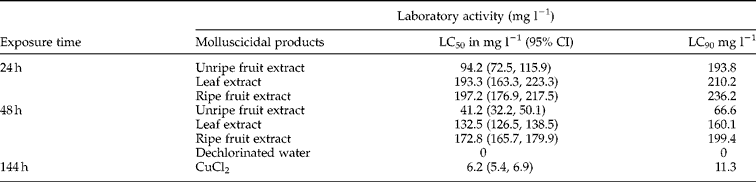
Cupric chloride solution and aqueous extracts of S. n. villosum leaves, ripe and unripe fruits from Tozeur's traditional oases were toxic to Tozeur's G. truncatula during the laboratory assessment. Of all plant extracts tested, unripe fruits showed the highest molluscicidal activity, giving an LC50 value of 41.2 mg l− 1 after 48 h exposure (table 1).
Molluscicidal activity of Solanum nigrum villosum extracts and cupric chloride against uninfected Galba truncatula.
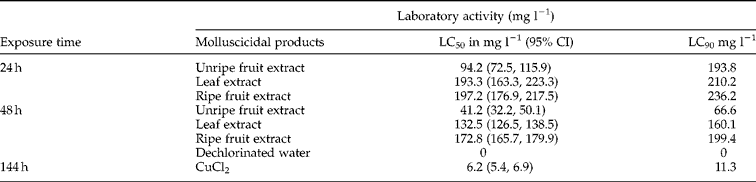
LC50, 50% lethal concentration; LC90, 90% lethal concentration; CI, confidence interval.
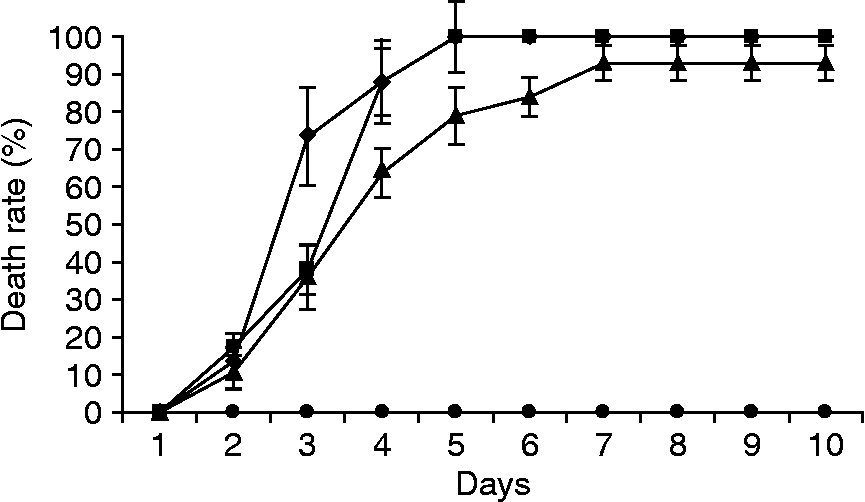
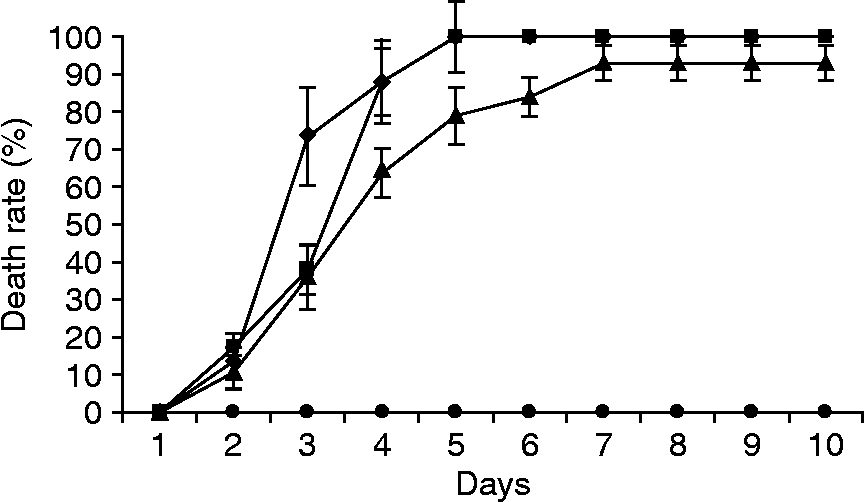
Cupric chloride at 11.3 mg l− 1 induced the death of 90% of molluscs after 6 days of treatment (table 1). Cupric chloride at 1 mg l− 1 concentration induced the death of 97% of mollusca after 25 days of treatment. Haemolysis and hypersecretion of mucus were the common toxic responses of snails to the extracts of S. n. villosum. Control organisms in laboratory assessments were not affected by S. n. villosum molluscicidal products after 48 h exposure, except Lymnaea vulgaris which showed 100% mortality. Even in semi-field conditions, each S. n. villosum extract was toxic to G. truncatula and the unripe fruit showed the highest toxicity (fig. 1).
Molluscicidal activity of unripe fruit, leaf and ripe fruit extracts of Solanum nigrum villosum on uninfected Galba truncatula under semi-field conditions. Death rates obtained using (♦) unripe fruit, (■) leaf, and (▲) ripe fruit extracts of S. n. villosum; and (●) dechlorinated water.
Antiparasitic activity
Deterioration rates of cercariae, rediae and intraredial germinal masses in G. truncatula with different extracts of S. n. villosum after 48 h of treatment are shown in table 2. The three S. n. villosum molluscicidal products were toxic to the larval stages of F. hepatica. The unripe fruit extract was significantly more toxic than the leaf and ripe fruit extracts to cercariae (P < 0.001).
Deterioration rates (%) of cercariae, rediae and intraredial germinal masses in infected Galba truncatula after 48 h exposure to molluscicidal products and in infected, untreated snails placed in dechlorinated water.

P: P value calculated comparing: a to b (a/b); b to c (b/c) and a to c (a/c).
Cercarial shedding
Naturally infected G. truncatula exposed to unripe fruit extract at an LC90 of 66.6 mg l− 1 shed significantly fewer F. hepatica cercariae than those exposed to leaf and ripe fruit extracts (164.4, 768.7 and 1194.5, respectively; P < 0.001 for each; table 3).
Mean of Fasciola hepatica cercariae shed by Galba truncatula after exposure to Solanum nigrum villosum extracts.

SD, standard deviation.
P: P value calculated, comparing: a to b (a/b); b to c (b/c) and a to c (a/c).
Discussion
Several species of Solanum have been found to have significant and potentially useful molluscicidal and anthelmintic activities (Wei et al., Reference Wei, Xu, Liu, Dai, Dussart and Trigwell2002; Udalova et al., Reference Udalova, Zinov'eva, Vasil'eva and Paseshnichenko2004; Ahmed & Rifaat, Reference Ahmed and Rifaat2004, Reference Ahmed and Rifaat2005; Silva et al., Reference Silva, Batista, Camara and Agra2005, Reference Silva, Camara, Agra, de, de Carvalho, Frana, Brandoline, da Silva Paschoal and Braz-Filho2006). These activities were generally attributed to the presence of glycoalkaloids detected in different concentrations (Alzerreca & Hart, Reference Alzerreca and Hart1982; Friedman et al., Reference Friedman, Rayburn and Bantle1991; Bekkouche et al., Reference Bekkouche, Markouk, Larhsini, Jana and Lazrek2000; Weissenberg, Reference Weissenberg2001). Only a few reports have been interested in the study of molluscicidal activity of S. nigrum against the intermediate hosts of fasciolosis compared with those of schistosomiasis and, to our knowledge, the present study is the first report on the activity of S. n. villosum against the snail G. truncatula.
We have assessed the effect of S. n. villosum extracts on uninfected G. truncatula and a higher and rapid toxicity was shown with the unripe fruit extract. We noted with interest that the 48 h LC50 value of the unripe fruit was approximately three times the toxicity of the leaf and four times that of the ripe fruit extracts. This finding may be because young immature fruits contained more glycoalkaloids than leaves and ripe fruits, decreasing with their maturity (Saber et al., Reference Saber, Balbaa and Zaky1963). These glycoalkaloids were identified in all varieties of S. nigrum as solasonin and solamargin (Bekkouche et al., Reference Bekkouche, Markouk, Larhsini, Jana and Lazrek2000; Weissenberg, Reference Weissenberg2001). Even with other snails, such as Bulinus truncatus and Biomphalaria alexandrina, intermediate hosts of schistosomiasis, similar molluscicidal activity of Solanum species was reported (Amer et al., Reference Amer, Ahmed and Ramzy1998; Silva et al., Reference Silva, Batista, Camara and Agra2005).
That the unripe fruit extract remains the most toxic against G. truncatula maintained under semi-field conditions and that these extracts had no toxicity towards non-target aquatic organisms, lead us to conclude that their use might be efficacious and generalized in the draining system of south-western Tunisian oases.
Concerning the study of the antiparasitic activity of S. n. villosum, we noted that the highest toxicity of the unripe fruits to redia, intraredial germinal masses and cercariae may be attributed to the high level of glycoalkaloids contained in unripe fruits. Cercaricidal activity of S. nigrum leaf extracts has also been reported against other trematodes: F. gigantica, Schistosoma haematobium and Schistosoma mansoni (Ahmed & Ramzy, Reference Ahmed and Ramzy1997).
In the present study, the decreased number of cercariae shed by treated snails may be explained by the deterioration of some cercariae and the resistance of other ones to the treatment. In future studies, it would be interesting to assess the effect of the unripe fruit extract on worms developed from shed treated cercariae, such as studies on schistosomiasis. These studies have reported that shed treated cercariae developed in the definitive host attenuated adult worms with lower fecundity (El- Ansary et al., Reference El-Ansary, Mohamed, Mahmoud and El-Bardicy2003).
Acknowledgements
This study was funded by the Ministry of Higher Education, Scientific Research and Technology.