In September 1952 Elizabeth Bishop wrote to her editor, Katherine White,
I'm starting off towards the end of October via freighter to South America. – When I went in to get my passport re-newal yesterday I found that because it says I'm a “writer” on it that to get it renewed means I have to have a letter to the passport dept. from some publication saying I am a writer. Of course I couldn't think of any except the New Yorker.Footnote 1
The New Yorker supplied the necessary paperwork confirming that Bishop was indeed a “writer,” and she embarked for Brazil, where she was to live for the next fifteen years. All but one of the “Brazil” poems Bishop wrote in that period, later collected in Questions of Travel (1965), appeared first in the New Yorker magazine.Footnote 2 Although recent criticism has sought to contextualize Bishop's poetry and to engage with the political dimensions of her travel writing in particular, relatively little attention has been paid to the publishing environment in which the Brazil poems first appeared, or to the mediating part that the New Yorker played in relation to Bishop's own role as cultural go-between.Footnote 3 This article begins by asking how Bishop's poems packaged Brazil for readers of the 1950s New Yorker, and how the workings of those poems intersected with the strategies of other texts in close proximity to them, in particular of advertisements and cartoons. The pages of this magazine, I shall argue, represent a crucial interpretative context for the Brazil poems, and especially of those most recognizable tonal and stylistic habits of Bishop's – detachment, self-irony, and provisionality. If the New Yorker rubber-stamped Bishop's passport renewal, the income she earned from publishing in the magazine allowed her to make a home in Brazil, while at the same time, I shall suggest, keeping her at one remove from her adopted country. I go on to pursue these matters of home and belonging in relation to the houses in and about which Bishop wrote poems that then took up lodgings in the New Yorker. In attending to these material aspects of the outside world in which the Brazil poems were accommodated – the buildings in which they were written and the magazine in which they were published – my larger purpose is to offer a new perspective on the questions of belonging that lie at the heart of Bishop's unsettled poetics, and so on the politics of her writing at mid-century.
I. New Yorker Double-Talk
Poetry has always had a regular spot, but never a prominent place, in the New Yorker. Founding editor Harold Ross began including “serious verse” in the magazine in 1928 and was later dissuaded from removing it only on condition that the poems that did feature would be transparent and accessible. In the late 1930s the antipathy between the New Yorker and “advanced, intellectual verse” persisted and was mutual: in 1939, the year Elizabeth Bishop's first New Yorker poem (“Cirque d'hiver”) was published, poetry editor William Maxwell turned down Auden's “September 1, 1939,” and had a solicitation of his own declined by Wallace Stevens.Footnote 4 When William Shawn took over the editorship in 1951 the policy regarding “serious poetry” was more open-minded, but the requirement of verifiable reference remained – verse as well as prose was subject to the magazine's fact-checking policy – so that formal experiment, or poetry that could be deemed “obscure,” was effectively ruled out.Footnote 5 Elizabeth Bishop signed a first-read agreement with the New Yorker in 1947, and went on to publish there almost all the poems, as well as the two stories she wrote in the fifteen years she spent living in Brazil.Footnote 6 What was it that suited Bishop's poetry to this magazine, and vice versa, and what does that mutual accommodation tell us more generally about Bishop's writing at mid-century?
There is a certain kind of doublespeak that is characteristic of the New Yorker. throughout the magazine's history, advertisements for luxury goods have seemed at odds with its more serious air of social responsibility, the frivolous browsings of the window-shopper out of step with the magazine's “reporters at large” in the wider world. Given the wall of separation between the advertising and editorial departments of the New Yorker, perhaps its mixed messages should not in themselves surprise us. But what is particular to this magazine throughout its history is its knowingness: the New Yorker has always been ready to make comic capital out of its own double-talk.Footnote 7 It is the resulting habit of self-irony, and with it, I shall argue, a tendency to have things both ways, that the New Yorker recognized and cultivated in Bishop's verse.
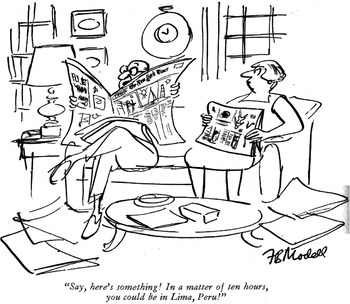
Frank Modell, cartoon, New Yorker, 14 May 1960, 124. © Frank Modell, The New Yorker Collection/www.cartoonbank.com.

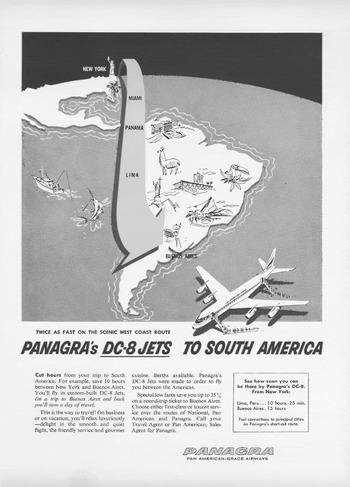
Panagra Airways advertisement, New Yorker, 14 May 1960, 147. The boxed text reads, “See how soon you can be there by Panagra's DC-8 from New York: Lima, Peru … 10 hours, 25 min.”

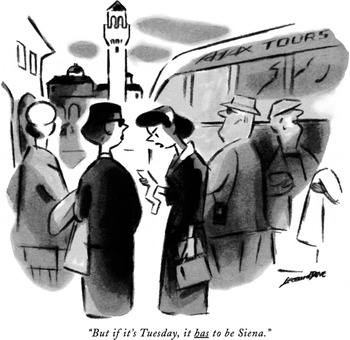
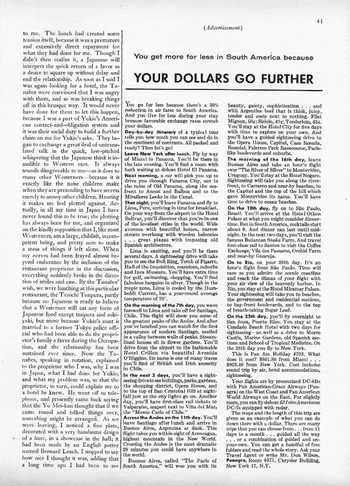
A 1960 New Yorker cartoon shows a newspaper reader remarking, “Say, here's something! In a matter of ten hours, you could be in Lima, Peru!” (Figure 1). The gag is that “you” might well refer to his homely wife, but there's a hidden joke here too: twenty pages on in the same issue is an ad for Panagra Airways which reads, “see how soon you can be there by Panagra's DC-8 from New York: Lima, Peru … 10 hours, 25 min.” (Figure 2): the man in the cartoon might as well be reading the magazine in which he appears. In the 1950s the New Yorker's jokes at its own expense centred especially on foreign travel: in this period the magazine was packed with advertisements for airlines, traveller's cheques, cameras, binoculars – desirable commodities for a professional class newly at liberty to travel abroad – yet at the same time the American tourist featured heavily in New Yorker cartoons. The most familiar of these shows a young woman stepping off a tour bus clutching her itinerary and protesting, “but if it's Tuesday, it has to be Siena” (Figure 3). Of course the very issue that featured this drawing also carried an airline ad proposing just the kind of rigid itinerary sent up in the cartoon (Figure 4).Footnote 8 My argument is that much as the coexistence of advertisements and cartoons in the New Yorker promotes consumer desire and then asks its readers to suspend that desire – asks them to consider the figure they would cut as that kind of consumer – so Elizabeth Bishop's poems offer with one hand and take away with the other.
Leonard Dove, cartoon, New Yorker, 22 June 1957, 19. © Leonard Dove, The New Yorker Collection/www.cartoonbank.com.

Panagra Airways advertisement with day-by-day itinerary, New Yorker, 22 June 1957, 41.

These equivocations take a number forms in Bishop's verse, most obviously in its persistent self-corrections (“up in the air – up, rather, in the leaves – ”), and, as in “Arrival at Santos,” in quibbles that can take up whole lines (“or, like this, only attempt, since it does not matter”).Footnote 9 Like the “unassertive” colours of the seaport in that poem, these lines say and unsay themselves simultaneously. There are also the varying tones of “Arrival at Santos,” beginning with the voice of the tour guide before shifting into lofty critique – “Oh, tourist, / is this how this country is going to answer you // and your immodest demands for a different world” – only to produce a further jolt when the knowing speaker sits down and becomes a wide-eyed tourist herself. In these ways “Arrival at Santos” declines to settle on a particular perspective, critical or otherwise, preferring instead to replicate the mood of “suspension” it observes in its seaport setting. “Questions of Travel” (1956) illustrates most clearly the work done by these habits of self-revision and provisionality in the poetry's first publishing environment. An advertisement for ad space in Holiday magazine which appeared in the same issue of the New Yorker as that poem is representative of the context.Footnote 10 It reads, “Most everyone enjoys America's new leisure one way or another … but people in the Holiday Mood do something about it!” What they do, it transpires, is buy things: “reach people in a Holiday mood today, and you'll sell,” the copy goes on, “it catches the spirit of the times, stirs imaginations, whets appetites for pleasure-giving products and services.”Footnote 11 The target reader of this ad in the New Yorker is not quite in the holiday mood himself. Given that this is an ad for ad space, its intended reader might well be an advertising executive observing consumer activity at one remove, and with half an eye on his own opportunity to make a sale. And these semi-detached reading practices were something that the New Yorker fostered more generally too: the magazine's mid-century readers shared a taste for luxury goods including foreign travel, but at the same time, because they recognized themselves in New Yorker cartoons, they were prompted to adopt a critical distance on the acts of consumption depicted there (“But if it's Tuesday, it has to be Siena”).Footnote 12
If an advertisement for a luxury commodity allows its reader, in the context of the New Yorker, a knowing vantage point on her own aspirations, what might a poem such as Bishop's “Questions of Travel” do for that same reader? How did the interpretative framework of the magazine shape readers’ first encounters with this scene of an unspecified elsewhere?
In the first line “here” means both “here in the exotic location from which I am writing” and “here on this page.” In its overlaying of those “heres” the poem asks how one has become the other, how the raw material of place, its abundance spilling into excess, has been made to fit its allotted space. Whereas “Arrival at Santos” packages itself from the start into quatrains, here the free verse keeps nothing in check, though the repeated “too” suggests a norm in relation to which the measure of things has been taken. What is primarily on show in “Questions of Travel” is Bishop's caution about packaging the foreign, and her doubts about the propriety of managing this “impractical” landscape prompt her to question the whole business of “here” and “there.” “Should we have stayed at home and thought of here?” the poem goes on to ask, as though addressing itself to an armchair traveller who is doing exactly that, flicking through the airline ads, glancing at an air-route map or an itinerary that schematizes space and manages time in its own ways.
“Questions of Travel” goes on to allow itself just those snapshots it hesitates to indulge in a series of acutely detailed scenes held at several removes by the conditional on which they are predicated (“it would have been a pity / not to have seen …”). These distancing aspects of Bishop's poetry, its suspended conditionals, its questioning of its own procedures, have not gone unnoticed by critics. Betsy Erkkila has written about Bishop's “willingness to reverse, question, destabilize, and ironize the gaze of the colonizer, including her own, and thus to pose resistant points of view,” while Kim Fortuny thinks of Bishop's indecisions as a kind of Keatsian negative capability.Footnote 13 But in the context of the New Yorker in 1957, in hesitating to package itself quite like an advertisement for foreign travel, in sharing its doubts over the propriety of selling the exotic, “Questions of Travel” seems to me to supply something more comforting for its reader, that is, a reflection of herself as beyond the grip of consumer desire, sophisticated enough to share the poem's ironies, and, as a special bonus for that insider position, the free gift of those postcard descriptions (“a bamboo church of Jesuit baroque,” “the crudest wooden footwear”) which the poem declines ostensibly to entertain. Rather than, as recent criticism would have it, “undermin[ing] the stability of binary oppositions” or setting in motion a “dialectical approach to cultural encounter,” Bishop's doublespeak, like the New Yorker's, is peculiarly accommodating. It allows the liberal imagination to enjoy the satisfaction of having things both ways.Footnote 14
II. Your Dollars Go Further
It was the strength of the postwar dollar that made foreign travel newly affordable for middle-class Americans, and which prompted advertisements in the New Yorker for visits to South America “because your dollars go further” (Figure 4). The favourable exchange rate, coupled with a first-read agreement guaranteeing Bishop 25 percent above the magazine's already generous per-line rates, meant that writing for the New Yorker was a particularly remunerative occupation: the cheque she received for her nine-page story “In the Village,” for example, paid for a two-seater MG.Footnote 15 Things were quite different for her partner. Lota de Macedo Soares's income from the development of inherited land was vulnerable to swings in the volatile Brazilian economy. Whereas foreign travel became prohibitively expensive for Soares, Bishop could travel freely, and in fact she profited from the relative stability of the dollar. In 1954 she wrote,
the cruzeiro here took a sudden and awful plunge, a real inflation, and Lota of course just doesn't know what to do. For example, prices in Paris for her would now be exactly twice as much as they were for a friend of ours who came back just before Christmas. Things remain the same for me, and here, of course, I've been getting richer and richer.Footnote 16
Bishop makes light of these fluctuations in an unfinished poem, “Letter to Two Friends.” Addressing Marianne Moore and Robert Lowell, she writes, “Marianne, loan me a noun! / Cal, please cable a verb,” and the fragmentary draft ends, “but my dollar goes higher & higher – / exchange anxiety / with a visa about to expire.”Footnote 17 In this play of foreign exchange rates against epistolary exchange, Bishop's debts to friends mount up, while the rising dollar produces wealth. The result, though, is not a balance of payments, but a kind of vertigo, increasing financial security bringing with it artistic insecurity because this kind of income feels unearned. Yet Bishop was not just a passive spectator on her growing good fortune: a financier friend suggested that she borrow dollars from US banks, invest them in Brazil where interest rates were rising to counter the effects of inflation, pay back the original loan and make a profit. She invited Lowell to take advantage of the same opportunity:
Perhaps you'd like to try a small amount, say $5,000, just to see? I think I'd feel worried if you wanted to invest a lot here the first thing. What I'm doing will bring about 100% in 2½ years, however – something quite conservative for here, and quite safe. This is a dreadful paragraph – how did I skid from poetry to percents?Footnote 18
Bishop's “skid from poetry to percents” has more logic to it than she perhaps realized. It was in part the income from poetry published in the New Yorker that provided the dollars that kept her comparatively rich in inflation-bound Brazil, and the relative poverty of her adopted country that gave her some of the raw materials for that verse, its authenticity adding to its value.
These exchanges are especially pertinent to a reading of “Manuelzinho.” Manuelzinho was Soares's tenant gardener, and Bishop wrote two poems about him and his family, “Manuelzinho” and “Squatter's Children.” She was self-conscious at times about selling these poems to the New Yorker, writing to Howard Moss, “the poor Squatter's children go by the house every day … I feel as if I should split my check with them but shall probably cheat and just give them a bag of candy.”Footnote 19 In other letters Bishop seems less conscious of the complex connections between employment, poetry and money:
I often wonder how you do manage on your money. I can, here, but only because our exchange keeps pace pretty much with the Brazilian inflation, and food is very cheap, comparatively, and I wear nothing but blue jeans! But it is getting tougher on Lota all the time. The price of bread doubles today – for example – and we have a “staff” of four or five – who get very little pay but eat about a loaf each day … The New Yorker took a long, long poem [“Manuelzinho”] – to my great surprise, it was such an impracticable shape for them.Footnote 20
The scare quotes around “staff” register unease, as though Bishop cannot decide what to call these quasi-feudal relationships, the gardener elsewhere cast as “squatter,” less wage-earner than indentured servant. Curious too is Bishop's seeming not to recognize the connection between feeding the “staff” and employing one of the staff in the poem she goes on to mention. The food is cheap for her (even though it has doubled in price), and that is because it is paid for in dollars earned, in part, from depictions of the very people who consume a loaf of it each day. In this unacknowledged way the “staff” earn their keep.Footnote 21 Notable also is the remark that “Manuelzinho” (Bishop's poem) “was such an impracticable shape” for the New Yorker. On first arriving in Brazil, Bishop says in several letters that the scenery is “unbelievably impractical,” meaning that its strange shapes are awkward to translate.Footnote 22 So if “Manuelzinho” is similarly “impracticable,” perhaps Bishop is not just saying that the poem is long and thin, but that it's the most untranslatable object, the most Brazilian thing she has made, and it is in that sense that she is surprised that it belongs in the New Yorker.
The New Yorker dealt with the “impracticable shape” of “Manuelzinho” by printing the poem over three columns, but Bishop still thought the gardener looked out of place. She wrote to Robert Lowell, “I am pleased you said you liked my ‘Manuelzinho.’ Somehow when he appeared just now, in The New Yorker, he seems more frivolous than I'd thought, but maybe that's just the slick, rich surroundings.”Footnote 23 The surroundings were indeed rich: advertisements for Hilton Hotels, a Jaguar convertible, Chanel No 5 and a Tiffany necklace, those indices of a booming economy contrast in an obvious way with the gardener's humble life. In another respect, though, Manuelzinho was very much at home, and that, as I shall argue, is because of the comedy surrounding his position as a domestic servant.
This is a dramatic monologue spoken at some distance from its author, and located, ostensibly at least, at some distance from its readers. Positioning is half the problem in the poem's opening strophe. Manuelzinho's status is hedged about with qualifications (“half squatter, half tenant,” “a sort of inheritance”): those attempts at precision signal uncertainty, as when “tenant” searches for an internal rhyme but does not quite find one in “no rent” and, grasping for an external match, runs into an irritable list of alternatives (“but you don't; or you won't; or you can't”). Manuelzinho's situation is tricky to pinpoint, but that does not make his tenure insecure. He seems to have grown up here (“in your thirties now”), but more than that, “the world's worst gardener since Cain” hints at a lineage reaching back to the Old Testament. If there is a kind of inheritance at stake in that line, it is hard to forget that the mark of Cain is blackness – that the story of Cain and Abel has been used as a justification for slavery and segregation – and in that connection the sugar bags that come later in Bishop's poem perhaps mark the last remnants of a plantation economy.
These signs of a lingering feudalism may seem distant from the consumer-capitalist context of the magazine in which the poem first appeared, yet what makes “Manuelzinho” especially consumable by readers of the New Yorker is the familiar comedy surrounding domestic servants who are just a little too much part of the family. Mary Corey has examined representations of domestic staff in the mid-century New Yorker, which she summarizes thus: “when a domestic steps into a New Yorker household and becomes an intimate stranger there, entitlement, identification, compassion, paternalism, and love are curiously intermingled.”Footnote 25 These are exactly the ingredients of the mixed tone in “Manuelzinho,” so that although the scenery is exotic, and although the economic relationship between a Brazilian aristocrat and her tenant farmer differs from that between a suburban housewife and her hired help, the mixture of identification and irritation in Bishop's poem would have sounded quite familiar among comic pieces in which the servants get the upper hand, or in which the maid doesn't know her place. It is in this context that we should read the territorial claims in “Manuelzinho”:
Although Manuelzinho and the speaker are at odds – the servant outside, the mistress inside – they are never quite separated. The carefully placed line break in “with your head and back inside / a sodden burlap bag” puts Manuelzinho back inside for a moment, as if he didn't quite know where he belonged. What is it that the speaker “can't endure” – the impertinence of his trespass, or his pathos? Is she irritated by him, or is she moved? Either way, “endure” mutates into “indoors,” seeming to seal the division between her sphere and his; yet still faintly across that divide there are comings and goings, along the aural path that connects his burdened “back” and sodden “bag” to her refuge in a “book”.
Although it is tempting to read the carnivalesque inversions and boundary crossings in this poem as challenges to social hierarchy, to read, as Erkkila does, “the dialectics of class dominance and resistance in ‘Manuelzinho’ ” would be to set aside the local environment of the poem, a magazine for whose readership it is safely predictable that domestic servants should sometimes seem smarter than their employers.Footnote 26 In 1954 Peter De Vries published a short comic piece in the New Yorker about a gardener he had hired for a season, and who refused to leave. Little by little “Ed Cutlett,” complete with cockney accent, intrudes into the domestic sphere, hopelessly incompetent, but hard to shake off. Eventually he gets into the author's bedroom and subjects him to a tedious reading of a bad book.Footnote 27 Bishop's poem is more subtle than the De Vries story, but it has in common with that piece the peculiar bafflement of the middle classes when dealing with the servants, so that it reads not as trenchant critique, but as an instance of that “gentle bewilderment toward the social system” that Dwight MacDonald had diagnosed in the New Yorker's editors as far back as 1937.Footnote 28
The most important thing to come between mistress and servant in “Manuelzinho” is books. The household account books do not divide outside from inside, labour from leisure. Instead, they contain a shared currency:
“Or, briskly, you come to settle” places its line break nicely, so that you wonder for a moment whether Manuelzinho has come to reclaim his territory. As for settling the books, mistress and servant, landowner and tenant, are in it together. Manuelzinho and the speaker “whisper conspiratorially,” and this is the moment to remember the third party silently outside the poem – the poet, Elizabeth Bishop, certainly an outsider to the dreams dreamed in that kitchen. What keeps Bishop out and her friend and the tenant farmer in are their different currencies. The conspirators belong to an inflationary world where columns of figures “stagger,” meaning both totter and amaze, and yet, honeycombed with zeros, amount to nothing. This speaks of creative accounting, and of a larger economy in crisis, the runaway inflation of the world in which the poem is set.Footnote 29 Elizabeth Bishop did not live in that world, even though she lived in that house, but the poem she made of it, the doubled-up account whereby she delivered its “impracticable” shape, was perfectly accommodated in the New Yorker, and allowed her to exchange inflation-bound Brazil for US dollars.
III. Open House
Bishop's home in the New Yorker placed her at one remove from the domestic economy of her home in Brazil, the currency of her verse and the dollars she earned from it insulating her from the poverty and “impracticality” that served among her raw materials. Along with those exotic and primitive details of the Brazilian landscape and people, there was also a strikingly modern aspect of Bishop's immediate environment that found its way into her poems and so, via the pages of the New Yorker, into the hands of the American leisure class. Because she lived for fifteen years with developer and architect Lota de Macedo Soares, Bishop was a front-row spectator on the unprecedented architectural advances Brazil witnessed in the mid-twentieth century. The Ministry of Education and Health building (1937), designed by Lúcio Costa with the assistance of a young Oscar Niemeyer and overseen by Le Corbusier, was one of the first manifestations of these advances, which would culminate in the grand project of Brasília (1956–60). Bishop was especially well placed to observe these developments and to think through her own designs in relation to them. Because of her relationship with Soares, she was intimately involved with the work of the younger generation of modernist architects, not least because Samambaia, the house that became her and Soares's home, was literally built around them, its structure adapted to accommodate the poet. Samambaia was one of the “three loved houses” whose loss is recorded in Bishop's late villanelle “One Art.”Footnote 30 The emotional resonance of home for a virtual orphan who grew up and lived for most of her life as a house guest or in temporary lodgings has been much explored, and has tended to direct criticism to interior psychology. Rather than gloss “house” as “home,” I want now to think about Bishop's houses as buildings, as functional and aesthetic objects within and about which she made some of the works of art that went on to take up lodgings in the New Yorker.
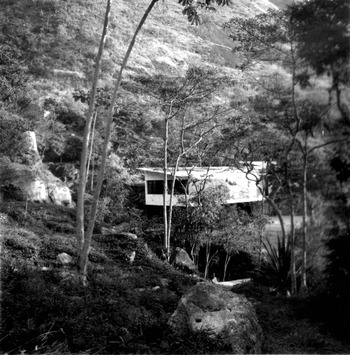
View of Samambaia. © Special Collections, Vassar College Libraries.

Samambaia, Lota de Macedo Soares's house at Petrópolis, was designed by Sérgio Bernardes, one of a group of young architects trained by Niemeyer and working in a line of descent from Costa and Le Corbusier.Footnote 31 The house Bernardes designed, closely supervised by Soares, was typical in several respects of the new Brazilian architecture (Figure 5). It featured the concrete and glass, the functionalist straight lines and lack of adornment that are the keynotes of the International style, but in the particulars of its source materials and construction processes it was also very much a Brazilian product. Bishop's early letters from Brazil about the progress of the building bring out the improvisatory techniques necessary to a modernist project in a semi-industrial context:
Sometime I should like to see a modern house being built in the U. S., because the way they do things here is so “empirical,” as Lota says. To begin with, they were completely baffled by the house – the aluminium roof, steel girders, etc., and it wasn't until she told them that it was going to look like a Carnival building that they'd go ahead – they liked that idea.Footnote 32
As Justin Read has suggested, International-style buildings belong in one sense everywhere, but because their prefabricated components emerge from industrial settings, they do not seem at first to belong in Brazil.Footnote 33 Samambaia took its name from the indigenous plant life (“it means ‘Fern,’ ” Bishop told Marianne MooreFootnote 34), but its design did not make sense to the builders until it had been translated into the local idiom. It was the very paucity of local construction materials, the fact that steel, for example, had to be imported, that gave Latin American modernist architecture part of its character, and so, paradoxically, it is precisely these buildings’ not being made of local materials, their seeming at odds with their environment, that makes them characteristically Brazilian. Climate also made a difference. Open volumes are at the heart of the International style, and in Brazil that openness extends to the natural world, dissolving the physical boundaries between inside and outside. When Elizabeth Bishop remarked, in a much-quoted letter from Samambaia, “a cloud is coming in my bedroom window right this minute,” she was speaking quite literally, and her letter illustrates the materiality – the contemporary architecture – of her house, as well as the imagined “lofty vagueness” of the nation that became her home.Footnote 35
When it became clear that Bishop was to be a long-term resident, Soares adapted the plans of the house to include a studio in which the poet could work. Bishop described it to Anny Baumann:
I have a “studio” – I can't quite believe it yet at all but I just go and sit in it and look around – it isn't quite finished yet. There is one large room with a fireplace. Lota found a rock somewhere that is gray-blue with mica in it, extremely pretty, and had them make it out of that – whitewashed walls and a herringbone brick floor. Then there is a small bathroom and kitchenette with a pump and a primus stove for tea, etc. It [the studio] is way up in the air behind the house, overlooking the waterfall. I have all my books together for the first time in ten years.Footnote 36
Legible in this description are the polarities of functionalism and aestheticism which a modernist building has to combine if it is to house a poet. The studio is plainly practical (Bishop needed somewhere to work) but its function, the production of poetry, is arguably superfluous.Footnote 37 The workroom was weighty with the rock of its environment and connected to the main business of the household, but it was also set apart, a self-sufficient space where Bishop had “all [her] books together for the first time.” It is in this respect, because of the studio's imaginative autonomy, as well as because of its physical position and the transparency of its structure, that Bishop's studio felt as though it were “way up in the air,” forming a weightless sphere of its own.
“Song for a Rainy Season” replicates that combination of connection and disconnection that characterized the studio and its occupant:
As plants take over a building, first clinging to and then obscuring its structure, so dependent clauses take over this first stanza: “the house we live in” never finds its main verb, and the sentence gets lost in the thicket of subordinate clauses itemizing flora and fauna. Structuring end-rhymes are softened by fainter echoes: “hidden” meets full rhymes in “ridden” and “unbidden,” but the stark outline made by rhyming on the same part of speech is muted by the half-rhymes, “live in” and “lichen,” that come between, so permitting conversational rhythms to wind themselves around the unobtrusive scaffold of the poetic line. Three words at the end of the stanza merit closer inspection – “cling, / familiar, unbidden” – each carries the seed of a negative sense, fork-tongued words in this case doing the work of Bishop's habitual doublespeak. “Cling” could suggest too desperate an attachment; “familiar” slips readily into overfamiliar, breeding presumption, if not contempt; “unbidden” is the most two-faced of these, connoting either unwanted intrusion or gifts graciously bestowed.Footnote 39 These equivocations gathered at the end of the stanza prompt us to wonder about the matters of attachment and belonging that go to the heart of this uneasy lyric.
Bishop's song recapitulates in its second half, the New Yorker printing in two columns emphasizing its symmetry. “Hidden, oh hidden” comes back in “House, open house”:
Samambaia was literally an open house, its walkways and piloti exposing its interior space to the elements. By the time Bishop wrote her poem it had become an “open house” in a figurative sense too, the public role of its owner no doubt attracting the attention that led to the building's growing international reputation.Footnote 40 Samambaia had featured in such European architecture journals as L'architecture d'aujourd'hui in 1952, and in Henrique Mindlin's 1956 Modern Architecture in Brazil, a book that Bishop helped to translate.Footnote 41 By 1960 the house had begun to attract touring architects on their way to Brasília, yet in “Song for a Rainy Season” there is some doubt over the welcome afforded to visitors who are merely passing through and to the particular “bookworm” whose signature, the map, is etched on its walls.Footnote 42
The scale of human history, to which modernist architecture and romantic love affairs belong, diminishes in this poem against the larger timescales – “a dim age,” “a later era” – that it also imagines. Bishop's stipulations regarding the publication of “Song for a Rainy Season” in the New Yorker emphasized these larger perspectives, and she resisted her editor's attempts to localize the poem's range of reference. In reply to a query from Katherine White, Bishop confirmed that her phrase “a later era” should stand (White had ventured the smaller-scale “later season” as an alternative), and to White's suggestion that she “place this rainy season in the title, or in a subtitle, which we believe should carry the word ‘Brazil,’ ” Bishop replied, “I don't want to become a local-color poet. If you wanted to change the title to ‘Song for A Rainy Season’ perhaps that would help disassociate it from Brazil.”Footnote 43 Although in subsequent printings the poem's title reverts to “Song for the Rainy Season,” for the purposes of the New Yorker Bishop chose to defend the autonomy of her song, refusing to index it with the kind of label that would refer it to a particular place or time.
Saul Steinberg, untitled, 1960. Ink on paper, originally published in the New Yorker, 8 October 1960. © The Saul Steinberg Foundation/Artists Rights Society (ARS), New York/DACS, London.

Even so, no poem can shut itself away from the environment in which it is read. I want to turn now to the poem's public meanings, meanings that Bishop may not have intended, but which cling, unbidden, to her song in the setting of the New Yorker of 1960. “Song for a Rainy Season” was first printed opposite a Saul Steinberg drawing (Figure 6).Footnote 44 When you look at one of these texts, the other inevitably enters the field of view, and reading between them brings out a dialogue about the rectilinear and the curvaceous, the functional and the aesthetic. The Steinberg design that faces Bishop's poem is a series of narratives about getting from A to B, the degree of elaboration in the line between them varying with each frame. In one place a seemingly natural form that looks like lichen waylays the trajectory from A to B; in another the line threatens to lose itself in a maze of its own devising, so preoccupied in its figures of eight that a tree sprouts unnoticed from its fertile ground; it is about the flourishing of the doodle, about improvisations in which hand and pen are allowed free play while the rational mind is occupied elsewhere, and in that sense it celebrates the nonfunctional aspects of drawing. Unlike most New Yorker cartoons, Steinberg's piece does not refer to the social or political world; nor does it hand itself over in the delivery of a gag: this is not a joke you can “get.” In this refusal of functionality, this preservation of autonomy, as well as in the chancy way Steinberg's lichens match Bishop's, the contingent juxtaposition of these two texts reveals a deeper kinship between them.
Steinberg's drawing shares with Bishop's “Song” a foundation in modernist architecture. The draughtsman had trained as an architect in Milan, and he continued to observe and invent buildings when he came to New York in 1942; he had a special affection for wildly decorative art deco structures such as the Chrysler Building, and that relish of ornament comes out in the exuberant curlicues, the baroque extravagances of his New Yorker drawings. In 1947 the New Yorker commissioned Steinberg to produce a spot drawing of Le Corbusier to illustrate Geoffrey T. Hellman's profile of the architect. When he sent the drawing to William Shawn, Steinberg added a note written on graph paper:
My drawing represents [Le Corbusier] as he is in New York – lonesome, – and as he usually is – bitter-looking – and as I saw him more often – in Italian restaurants. I placed him on this millimetric paper because it looks like his architecture, neat, orderly, transparent, logical.Footnote 45
The functionalist aspects of Corbusian modernism are for Steinberg the line that gets, without ornament or play, from A to B.Footnote 46 The drawing juxtaposed with Bishop's “Song for a Rainy Season” resists that utilitarian mode, much as Bishop's poem declines to exhaust itself in delivering “local color.” The juxtaposition of these two texts first catches the eye because of their twining lines, but their deeper connection also brings out the reciprocal relationship between this magazine and the works of art it published. It is not so much that the New Yorker determined the meanings of Bishop's poetry; rather, that magazine and poem, or magazine and drawing, or design and poem, are mutually legible. In the case of “Song for a Rainy Season,” despite the New Yorker's insistence on reference, and in that respect on the utility of the verse it chose to publish, Bishop, like Steinberg, made space there for an art object that was neither wholly referential nor merely decorative. And to the extent that “Song for a Rainy Season” is not a local-colour poem, it replicates the paradox of Brazilian modernist architecture: like the International-style house in and about which it was written, this poem represents the locale of its making precisely in not being made of local materials. In that sense, the publishing environment of the New Yorker reveals “Song for a Rainy Season” as the most Brazilian-modernist thing Bishop made.
IV. Regeneration
During her time in Brazil, Elizabeth Bishop's status changed from that of house guest and patronized artist to member of an extended Brazilian family, and eventually, sustained by her earnings from the New Yorker, to that of property owner and cultural patron. On visiting the small coastal town of Paraty in 1960 she wrote to her aunt, “you could buy a huge house, perfect 18th-century … for about $2,000 … I'd like to buy the whole town, just to preserve it.”Footnote 47 To put the figure Bishop mentions in context, it is worth noting that in 1952 the New Yorker had paid her $1,200 for her story “Gwendolyn.” In 1965 she did buy an eighteenth-century house, a restoration project, in Ouro Preto, the former mining town which had by then been designated a national monument.Footnote 48 The final part of this essay considers place and heritage in “Under the Window: Ouro Prêto,” one of the last of Bishop's Brazil poems to be published in the New Yorker, and takes the confluence of inside and outside in that poem as a figure for the contextual reading practice I am proposing.
The urge to modernize and the impulse to conserve had coincided in Brazil since the 1930s. The same group of progressive intellectuals that designed the Ministry of Education and Health building under the auspices of the modernizing Vargas regime in 1933 declared the former state capital, Ouro Preto, a national monument in the same year.Footnote 49 It was in Ouro Preto, the cradle of Brazilian nativism, and in relation to her own architectural and literary preservation projects, that Bishop wrote “Under the Window: Ouro Prêto.” A poem about conservation and about origins, “Under the Window” was composed by a poet wondering about her own place in relation to her “native land,” poised ready to leave Brazil (she took up a teaching post at the University of Washington in Seattle in January 1966) and at the same time tiring of the comforts of her literary home, the New Yorker. Footnote 50
Bishop wrote to Lowell in 1965, “I am curious to see my native land again. I must say I hate it in The New Yorker. I did a couple of poems lately – one will be in that magazine next year [“Under the Window: Ouro Prêto”].”Footnote 51 It's not clear what Bishop means by “I hate it in The New Yorker.” Assuming that “it” means “my native land,” it may be that the magazine has exposed what is hateful in the US in the investigative journalism for which it was renowned in the early 1960s (Bishop wrote this letter a month after the serialization of Truman Capote's “In Cold Blood.”) Or is it that she hates the land of the New Yorker, the nation whose leisure class has this magazine as a cultural home? This is also the period in which the New Yorker has become “a castrated and even reactionary publication” for at least one commentator.Footnote 52 Either way, Bishop is ready to make a move. The thinking about origins and authenticity that comes with that restlessness finds its place in Ouro Preto and its means of expression in the New Yorker.
In choosing to set her poem “here where there used to be / a fountain,” Bishop taps into a rich set of sources: since Horace's ode on the fons Bandusiae, the fountain or spring has been a place to ponder the source of poetic inspiration, and to think about native origins.Footnote 53 Through the early modern period and as it features in romantic verse, the fountain has accrued associations with loquacity – especially with women's chatter – and with literary and social continuity over time, associations that “Under the Window: Ouro Prêto” takes up.Footnote 54 The communal water supply in Ouro Preto encourages the conversation that flows through Bishop's poem, and because of the narrowness of the street, a constant stream of chatter comes to the poet-speaker in her upper room, hence the confluence in the poem of inside and outside:
“Here” in “here where all the world still stops” hesitates between the room from which the speaker listens, and in whose private sphere the world stands still, and “here” beside the fountain, the public forum where everyone stops briefly in passing. This doubling around “still stops” captures the paradox of stillness and mobility held in the fountain trope, the illusion of stasis caught by the water's quasi-sculptural form. Whereas the fountain's sculpted mouths have been removed to the museum, the spring, now a rusty pipe, preserves life in the conversation of the women gathered there, which Bishop binds into a living inheritance, “a strong and ropy stream” bespeaking continuous talk over centuries.
The poem continues to conflate inside and outside, and to forge continuities between ancient and modern:
Whether the “throbbing rosebuds” belong to the bodies of the lovers hidden in the house, or to the engine of the truck on show in the street, the bumper sticker “here i am for whom you have been waiting” literalizes the context-dependence of all utterances. This movable sign might be the words of a lover, the brash boast of a truck driver, even the words of Christ, given the washing of feet and the suggestion of communion in “put them back together again.” And it is in this poem's closing lines that Bishop reverts to her own shifty habit of self-revision. In this instance it signals a new departure:
It is no mere accident of zoology that the petrol blue butterfly Bishop glimpses at the end of her poem is called Morpho. Insofar as they function as scenes of metamorphosis and as mirrors, still pools with the potential for transformation, fountains have long been associated with Narcissus.Footnote 56 But in this moment of self-revision (“no, more blue than that”) Bishop produces a creature that escapes the self-replicating circuit in which the New Yorker has begun to confine her verse. As if poetic indecisions were a habit of thought that had begun to stagnate into a stylistic tic, the change proposed in this line seems more decisive: “no, more blue than that” has a regenerative energy. And, crucially, the metamorphosis from mirror to butterfly comes about because of what has come in from outside, the oil that “has seeped into / the margins of the ditch” not so much a pollutant as an energizing surface on the mirror-like pool of “standing water.”
In 1958 Elizabeth Bishop accompanied Aldous Huxley and his wife on a sightseeing trip to the Brazilian interior. On their tour of the new capital, Brasília, Bishop found the half-built cityscape hard to read:
We passed the “superblocks” of apartments being built by the institutos; skeletons of steel and cement, it was hard to tell much about them except that they are very high and very close together, and again, with infinite space in all directions, it is hard to understand why they should be placed together at all, and with courtyards and area-ways not much larger than those in Rio – explicable because there actually is very little building space left, and real-estate values are higher than in New York.Footnote 57
“Infinite space in all directions” was puzzling: why crowd the buildings together when there was so much room? Bishop found her feet in this blank territory, as do all travellers, in relation to known coordinates. She compared Brasília to Rio, which was then her home, and to New York, the place which, I have argued, played a mediating role in her own economy. “Infinite space in all directions” has a disorientating effect for critical practice too: it is hard to read any text, as it hard to construe any configuration of objects, when it is placed in the middle of nowhere. So where exactly does Elizabeth Bishop's unsettled poetry – written in a Brazilian modernist studio, and consumed in a large-circulation American magazine – belong? A poetic as uninsistent as Bishop's is peculiarly susceptible to its critical environment, and if we make it too much our own the risk is that it becomes a sort of mirror, reflecting back our particular ideological preferences, with provisional poetics, for example, lending itself too readily to construal as subversive politics. It is a delicate business to get at the doings of verse that declines so persistently to declare itself, but if we seek the historical workings of Bishop's poetry refracted through the material contexts of its production and consumption, and allow the verse to be, as it were, polluted by the places where it was made and the situations in which it has been read, we come closer to recovering its politics. In my reading there is a strongly conservative tendency to the self-ironies and mixed messages of Bishop's Brazil poems, even while those poems register Bishop's discomfort with her very position as mediator. This reading remains, like any other, partial and contingent, because Bishop's poetry, the New Yorker magazine, and the modernizing culture of mid-century Brazil are too varied and various to be brought fully into alignment; but for that, if we value poetry for the density and the complexity of its historical engagements, we will value Bishop's all the more.